

Pollinator Post 10/29/24 (2)

Anita shows me the young Coast Live Oak in Mendocino Park that is merely a shrub. The tips of the branches have been badly defoliated by the caterpillars of the California Oak Moth.
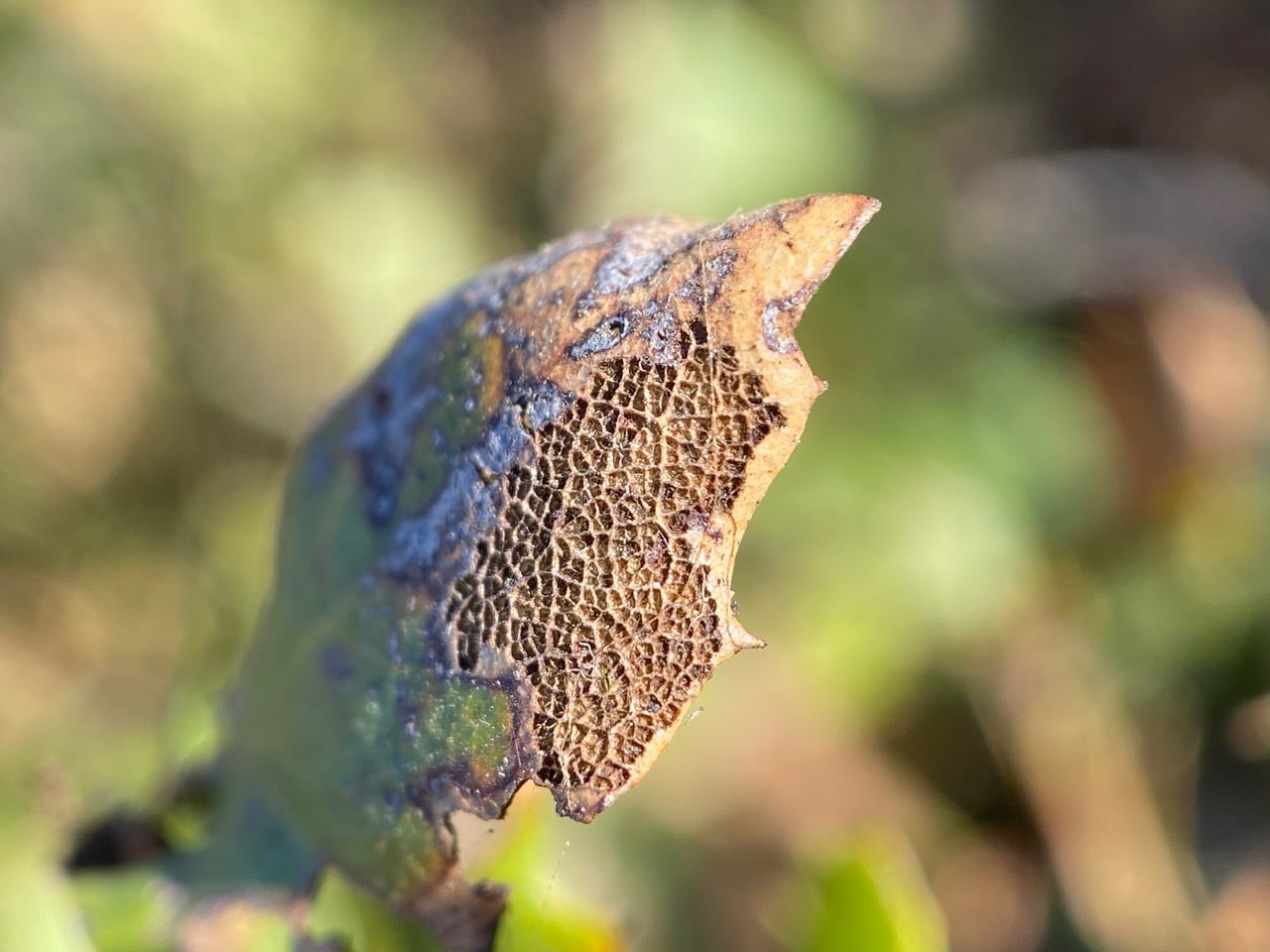
Many of the leaves are turning brown. There are clear signs of skeletonization where the young California Oak Moth caterpillars have chewed away the tissues between the veins.

Hoping to find California Oak Moth eggs on the underside of a leaf, I turn over a damaged leaf, and am instead greeted by an aggregation of odd looking insects. Are these scale insects exuding wax? iNaturalist has identified the insects as the Crown Whiteflies, Aleuroplatus coronata (family Aleyrodidae). What we have here are apparently mostly pupae.
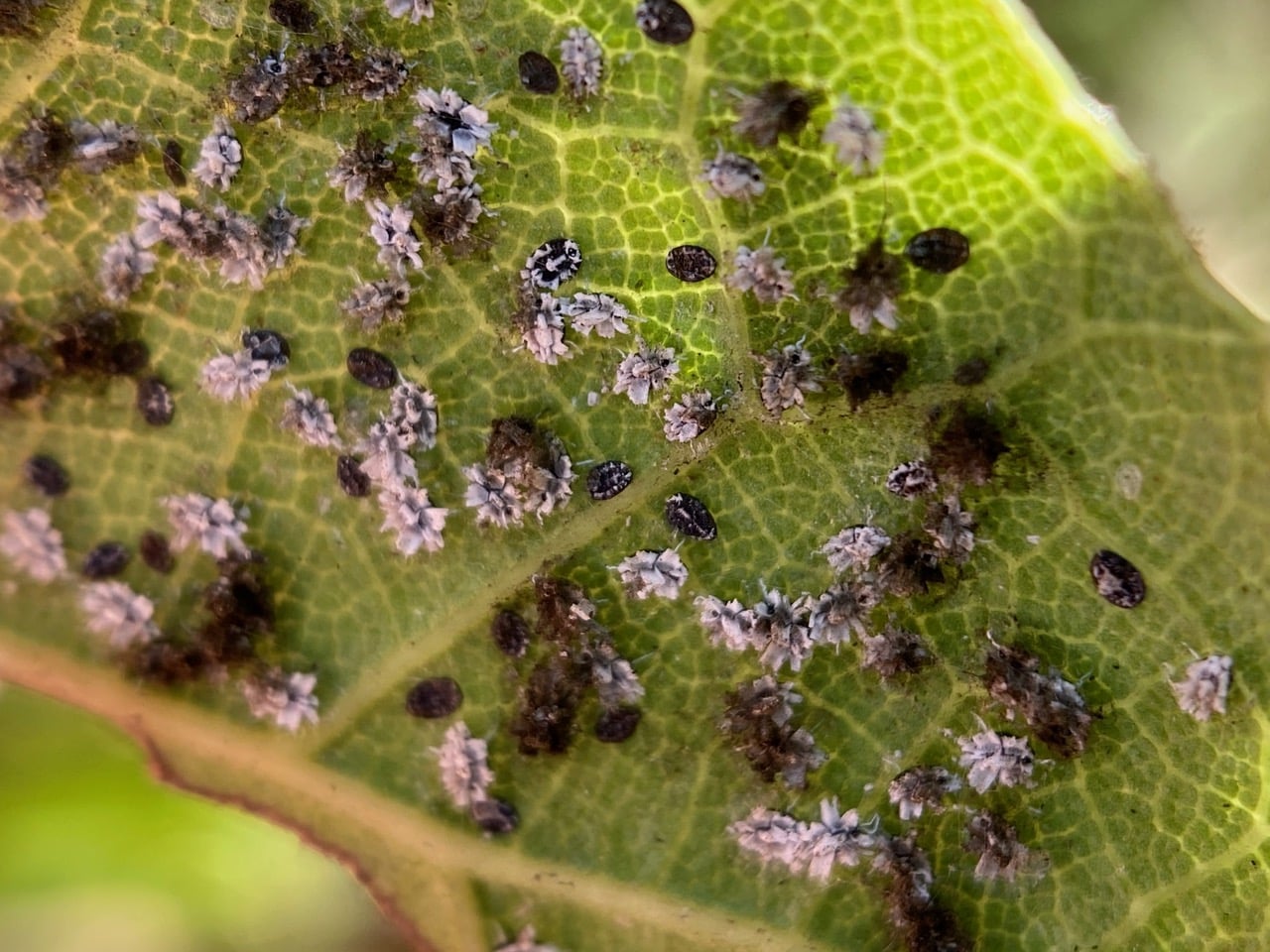
I turn over another damaged leaf and find more of the same insects, some of them black.
Despite their name, Whiteflies are not true flies. Rather, they are in the order Hemiptera along with aphids, mealybugs, and scales. They comprise the family Aleyrodidae. These are small insects, most with wingspan of less than 3 mm and a body length of 1-2 mm. Like all members of Hemiptera, Whiteflies have piercing-sucking mouthparts that they use to extract sap from plants. Whiteflies typically feed on the underside of plant leaves, tapping into the phloem of plants, introducing toxic saliva, and excreting copious quantities of honeydew. Since the whiteflies congregate in large numbers, infested plants can be quickly overwhelmed. Damage consists of yellowing and wilting of the foliage, reduction in crop yield. Honeydew and the resulting sooty mold may interfere with photosynthesis in the affected plant. Whiteflies are capable of transmitting viral pathogens to host plants.
Adult whiteflies cover all parts of the body except the eyes with waxy particles. They produce filaments or sheets of a waxy material from abdominal wax plates, composed of many pores and use their tibia to periodically break off the extruding filaments to form waxy particles. The purpose of the waxy coating is not known. It has been suggested that it may 1) prevent water loss, 2) waterproof against water droplets, 3) protect from sticking to honeydew, and 4) deter predators.
The Crown Whitefly, Aleuroplatus coronatus is native to the southern U.S. and Mexico, and now a common pest on native oaks in the western states. Restricted to oak and chinquapin trees, it is rarely a threat to the health of the trees, but large populations can reduce the aesthetic appearance by covering the lower surface of the leaves. Typical whitefly life cycle begins with eggs laid on the underside of leaf hatching to the mobile first instar nymph. As this moves to the second instar the legs are lost and the insect becomes sessile, feeding in one place through the next nymph stages and the pupa. The species is most easily identified by the pupa, which has a black oval body surrounded by wide lateral sheets of white wax
protruding from the front and rear, and a vertical dorsal “crown” of white wax arising from the top of the body. The adults are similar to most other whiteflies, with white powdery wings and resembling a tiny moth. The nymphs are similar to the pupa except the waxy sheets are much shorter.
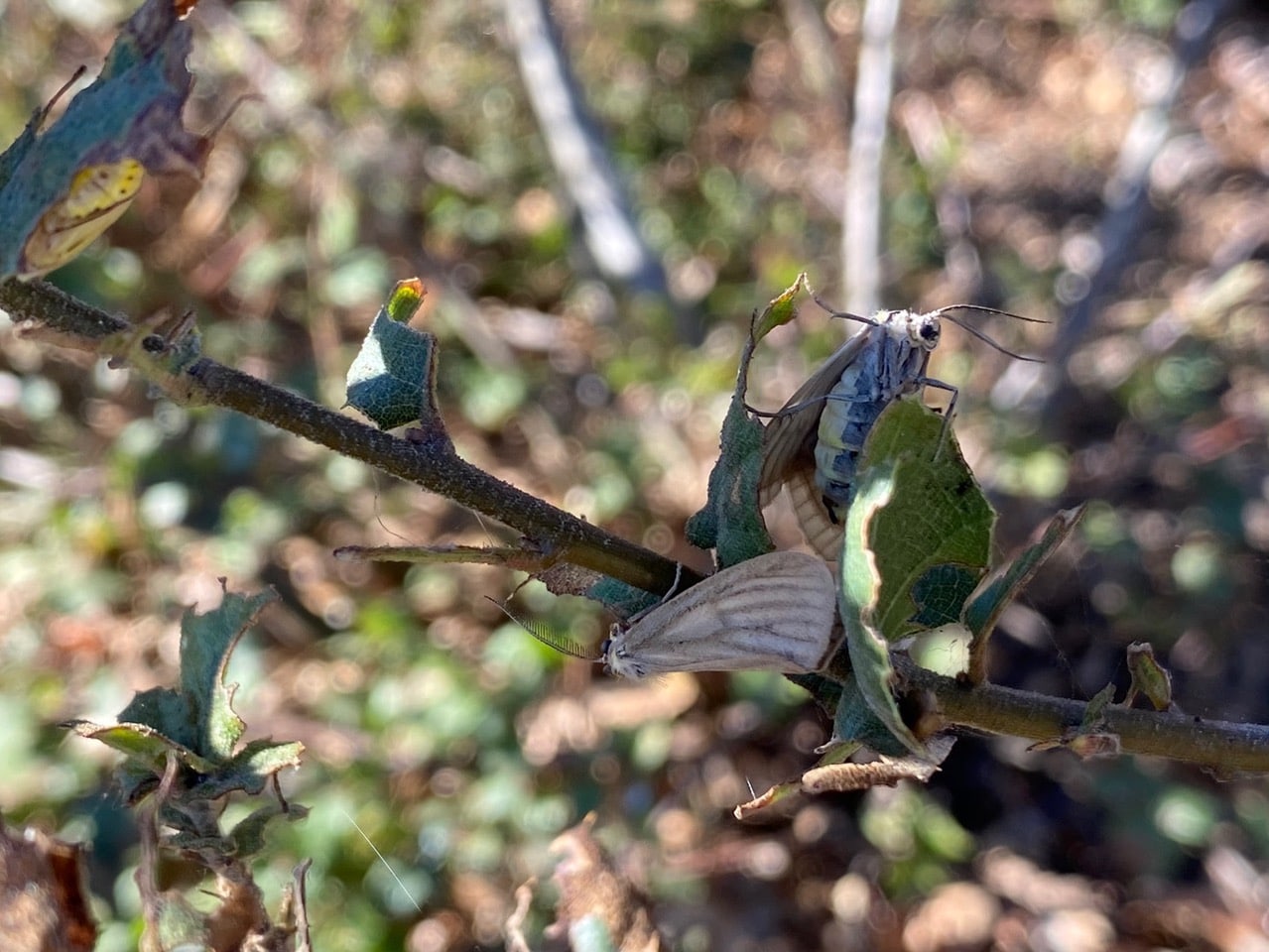
Sharp-eyed Anita spots a pair of California Oak Moths mating in the dappled shade of the shrubby oak. The pair separates as I approach with my camera. The one on the lower left is clearly the male, with feathery antennae. The other is a gravid female with a large abdomen.
The California Oak Moth, Phryganidia californica is a moth in the family Notodontidae. They are tan to gray moths with prominent wing veins. The wingspan is about 30 mm. Adults are on wing from March to November. There are two generations per year in northern California. Sometimes there is a third generation in southern California.
The larvae feed on the leaves of oak, especially Coast Live Oak, Quercus agrifolia. Young larvae feed between veins on the lower leaf surface. Although the upper leaf surface is left intact, it eventually dries out and turns brown. Larvae in later instars chew completely through the leaf blade, often leaving only major leaf veins. In severe infestations, individual trees may be almost entirely defoliated, typically by late summer or early fall. Despite the visually devastating effects of its caterpillars, the moth is rarely, if ever, responsible for the outright death of trees.
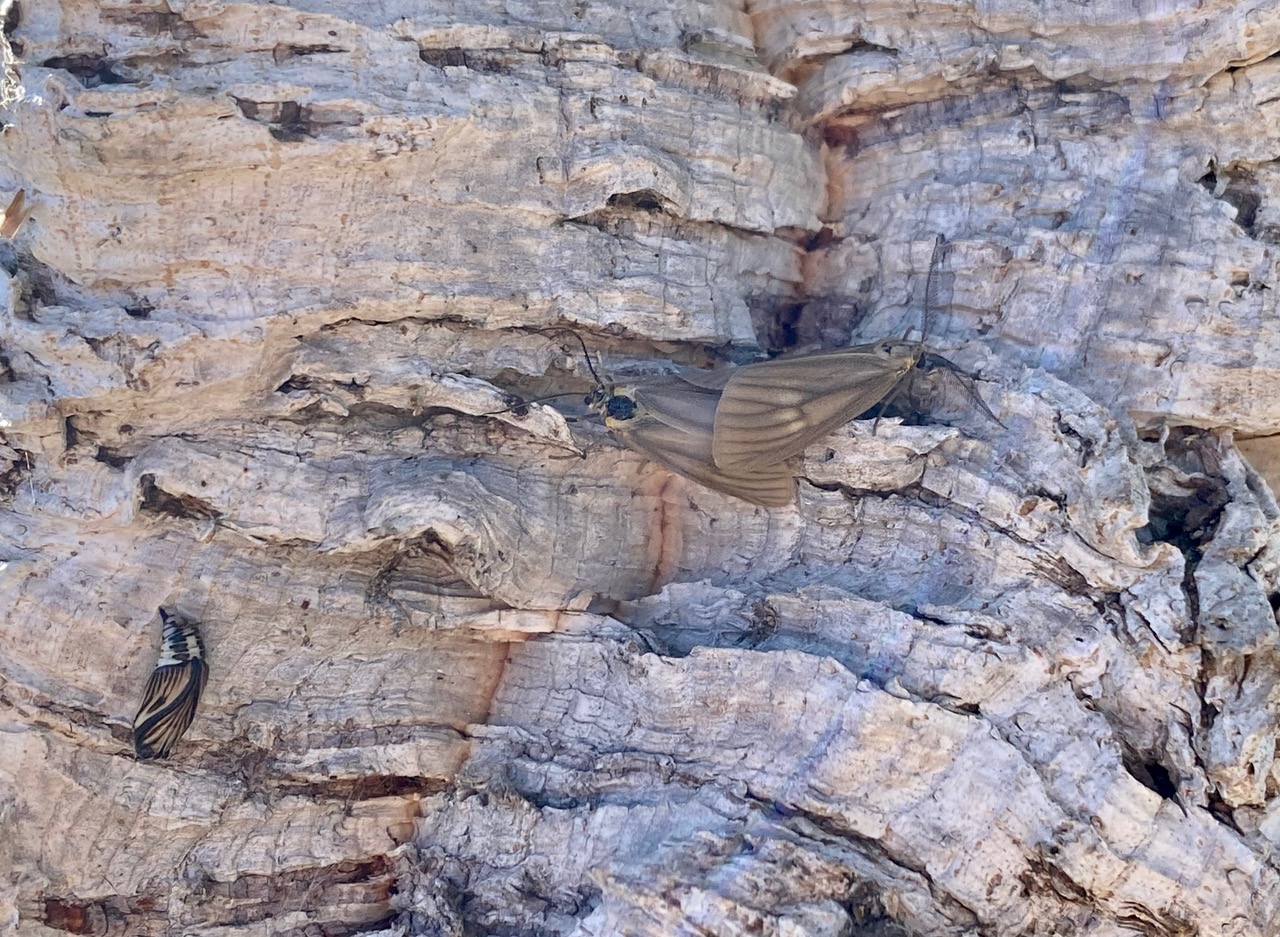
Anita finds another mating pair of California Oak Moths on a Cork Oak, Quercus suber on the side walk. The one on the right with the feathery antennae is the male. Close by on the lower left, there is a pupa attached to the bark.

I take a close-up of the female after the pair separated.

Here’s the male. The pectinate (comb-like) antennae of the male moths enable them to locate a female by the pheromones (scent messages) she releases to attract potential mates.

Near the base of another Cork Oak, Anita points out a California Oak Moth caterpillar that is crawling quickly up the rough terrain of the bark. Note the bulbous brown head capsule of the caterpillar, sometimes called California Oakworm. About an inch long, it is a mature larva, probably in search of a place to pupate. This is the only live caterpillar we find today. The infestation is obviously winding down.
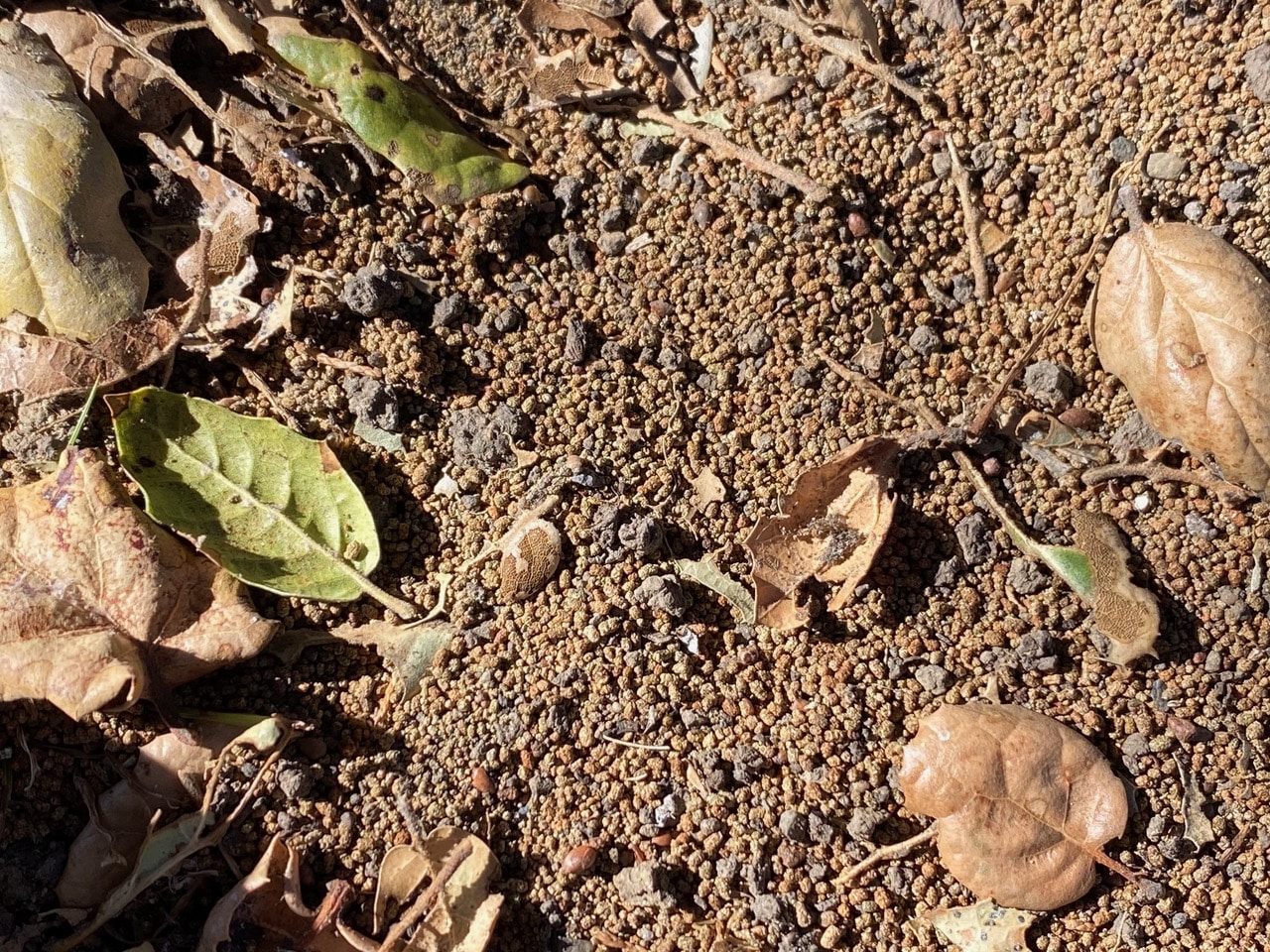
We next visit the large Coast Live Oak in the front yard of Anita’s neighbor and fellow Mendocino Park volunteer, Margot. The tree is severely infested with the California Oak Moth, almost defoliated. I look down on the ground under the tree, and feel a irrepressible smile coming over my face. The carpet of grainy caterpillar frass (insect poop) brings back fond memories.
I have been a docent at the Martin Griffen Preserve in Marin County for more than 20 years. The preserve on the edge of Bolinas Lagoon experiences an outbreak of these moths on the oak trees every five years or so. I learned to enjoy the infestations – together with the children I led on the hike, we would stand in silence under the trees and listen to the frass dropping on our hats like tiny rain drops. Despite the infestations, the moths were never a threat to the health and survival of the oaks. The moth caterpillars are mother nature’s pruning service. Their frass fertilize the ground around the trees, returning the nutrients back into the soil. I have collected some of the eggs and reared the moths to adulthood. I have cheered on the little caterpillars who immediately turned around to consume their own egg shells as soon as they hatched. The moths provide a boost to the local wildlife such as birds, lizards, and predatory insects that welcome the moths as a food source. What’s not to love about Phryganidia californica?
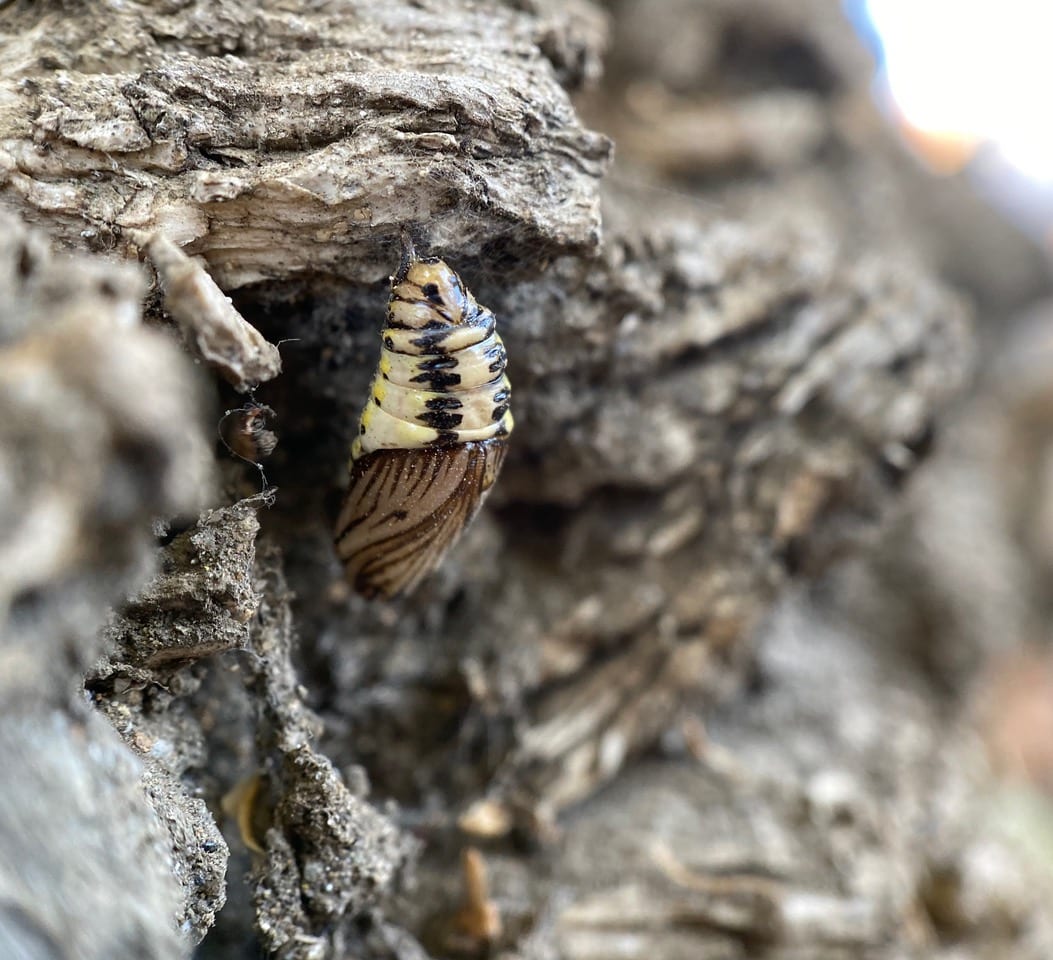
There are numerous California Oak Moth pupae on the trunk of Margot’s oak tree. The pupa may be mistaken for a butterfly chrysalis, as there is no silken cocoon encasing it, and it is boldly marked in black and white/yellow.

Here’s another pupa of the California Oak Moth. Note the pair of thick, diverging segmented lines on the bottom half of the pupa. These encase the developing antennae!

Look, here’s a vacated pupa case! See those two diverging “tubes” from which the antennae were pulled out?
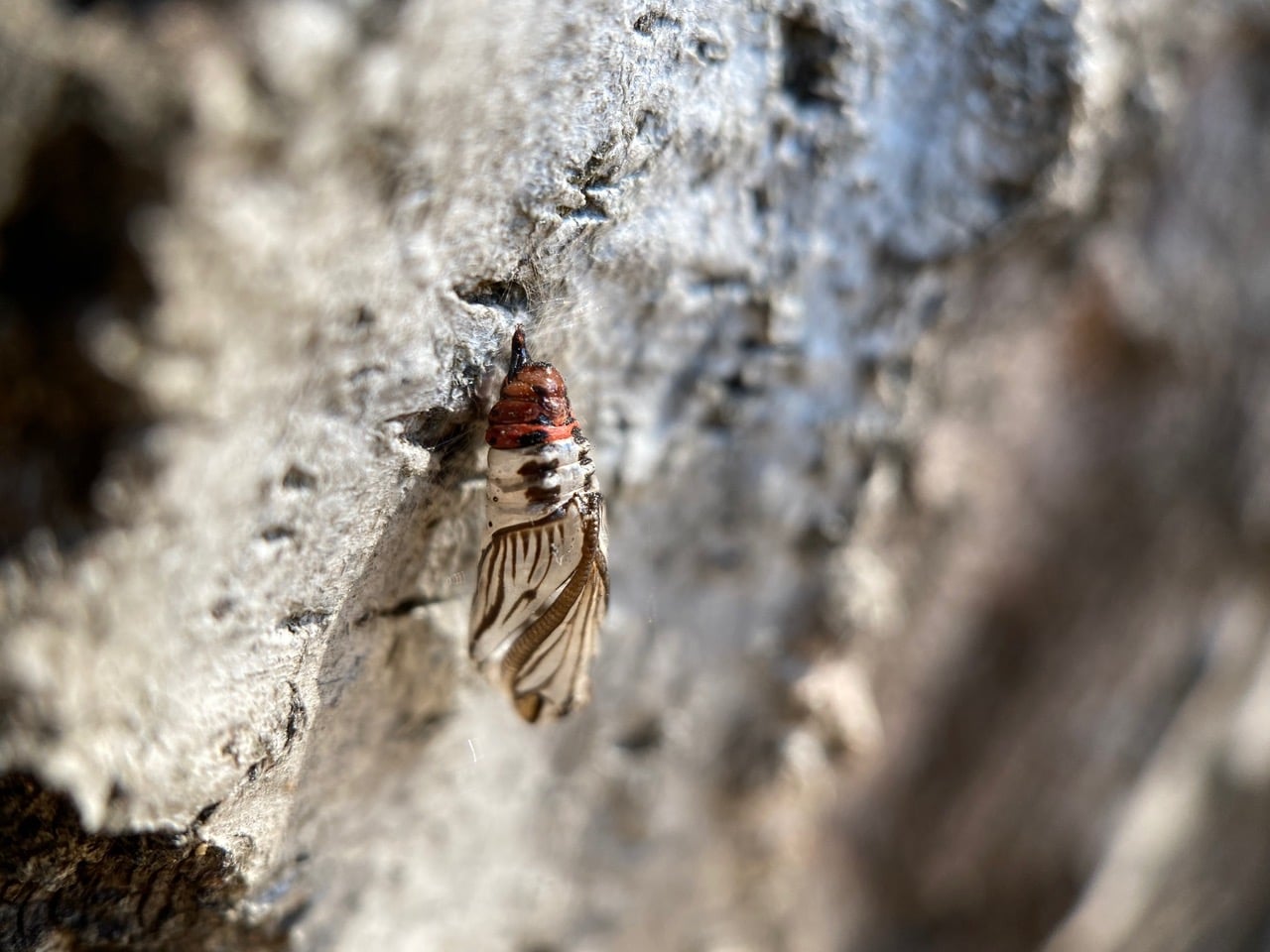
Yet another empty pupa case. The adult moth has emerged from the bottom.

Anita alerts me to a big struggle happening on the trunk of the tree. In a craggy crevice, a wingless moth seems to be fighting for its life behind some old spider web. Has the moth been caught by a spider? Even with the macro lens, I fail to see a spider. It takes both of us about a minute to figure out that there is no predation going on. Mired in the spider web, a new adult oak moth is struggling to eclose from its pupa case.
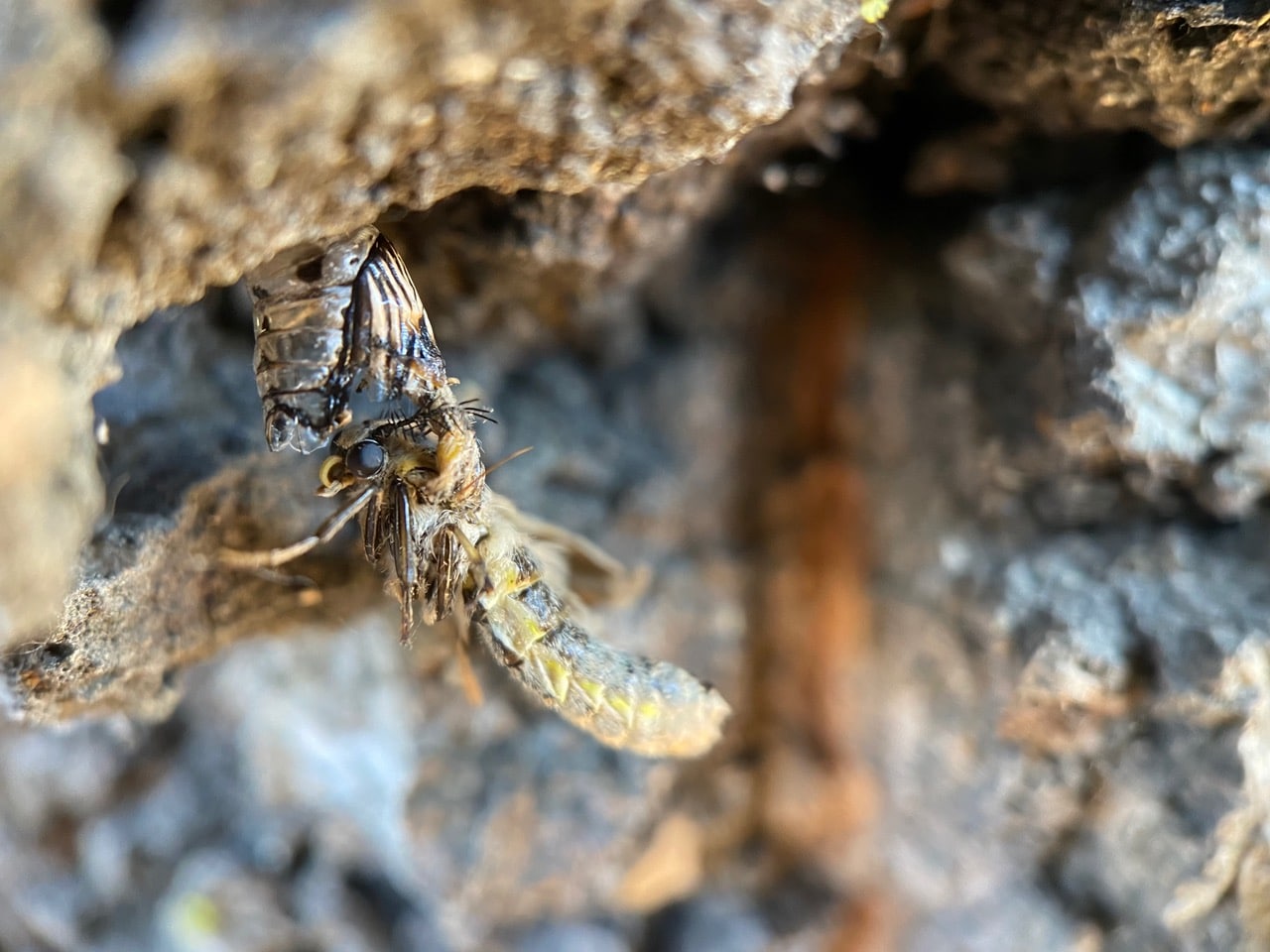
With a small twig, I quickly remove the spider web from the struggling young moth. It wriggles for a while, then remains still, apparently exhausted. It is still attached to it pupa case when we leave. Transition at every stage of a moth’s life is rife with danger.