

Pollinator Post 10/29/24 (1)

It has come to my attention that there is an outbreak of California Oak Moth in the El Cerrito – Richmond area. I asked Anita, an avid volunteer at the Mendocino Park in Richmond whether the infestation has affected her area. In response, Anita has kindly scouted out some hot spots where I may photograph the moths and their life cycle.
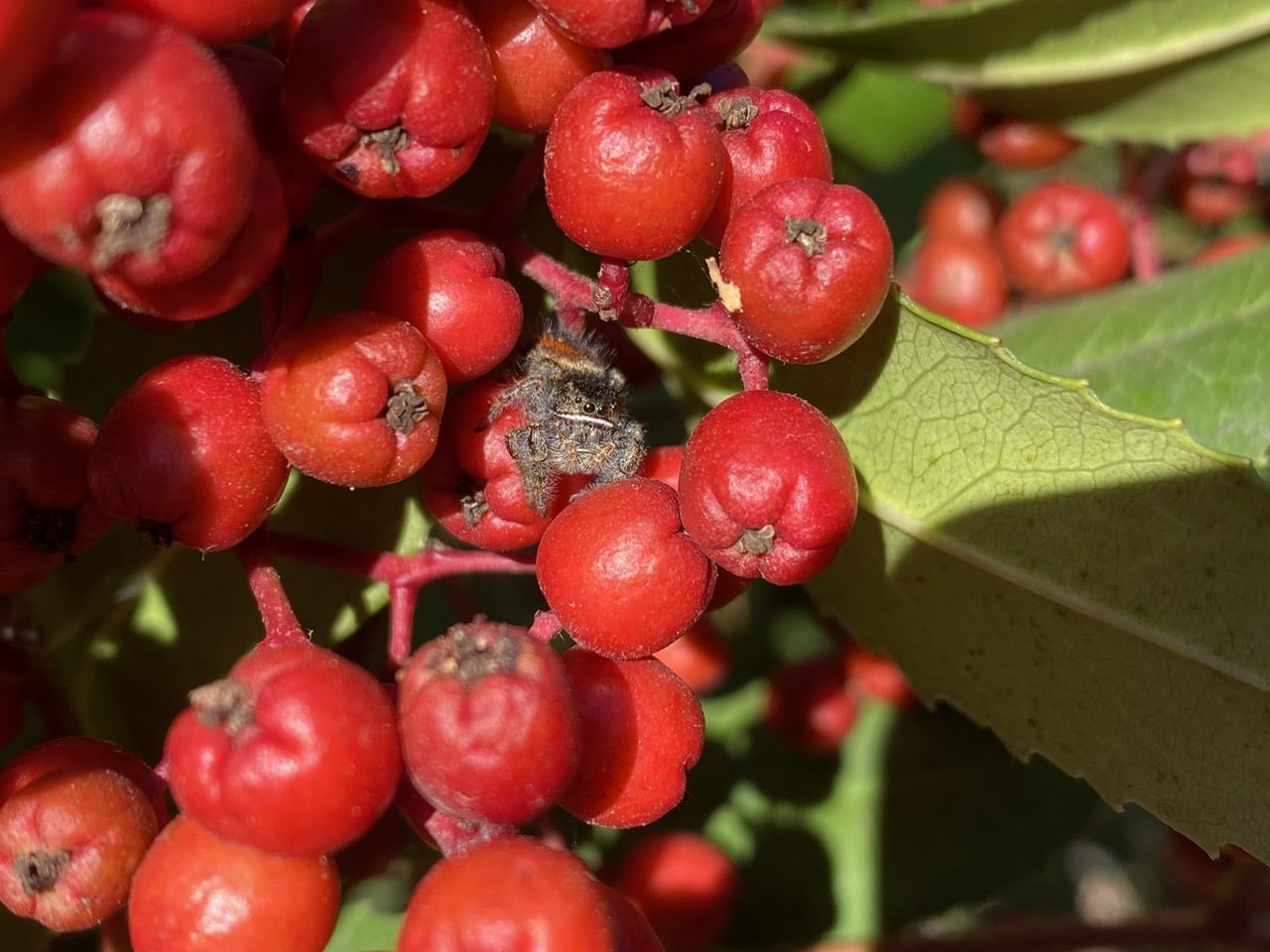
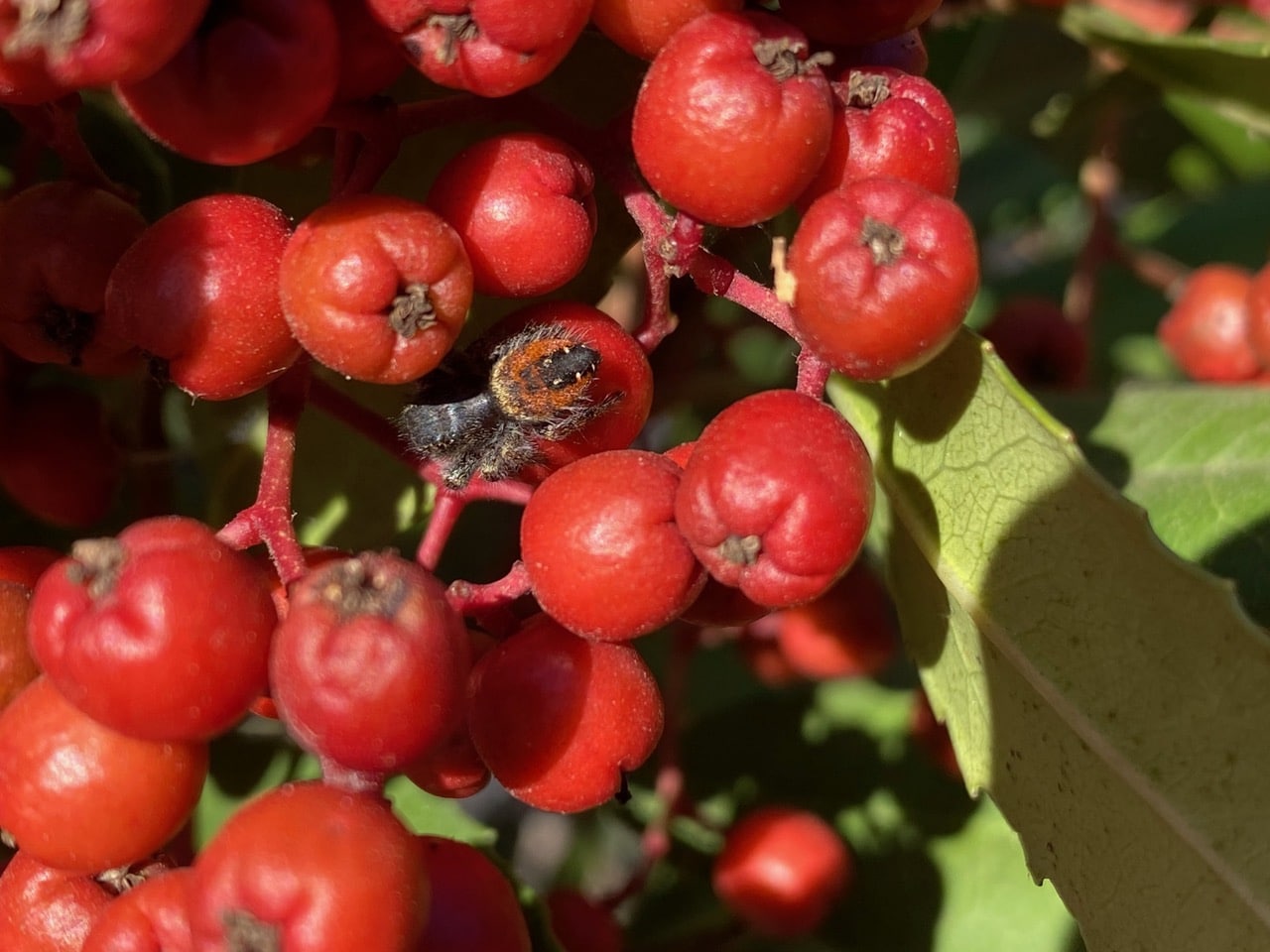
Arriving early at Mendocino Park where Anita and I have planned to meet, I stop by to admire a neighbor’s Toyon, Heteromeles arbutifolia that is loaded with bright red berries. A sudden movement among the berries alerts me to the presence to a well-camouflaged Johnson’s Jumping Spider, Phidippus johnsoni (family Salticidae). Do you see it?



 On the retaining wall in front of Mendocino Park, I spot these small maze-like silken galleries built atop the rough mortar partially covered in dried moss. Webspinners! Of all the insects I am likely to see today, these are probably the most unique and interesting. But alas, the Webspinnners are difficult to see unless one resorts to invasive measures that destroy their homes, and I’m not about to do that.

Compared to many jumping spiders, the principal anterio-median eyes of the Johnson’s Jumping Spider are relatively small.
Salticids are free-roaming hunting spiders. They do not weave a web to catch prey. They stalk, then pounce on their prey. Just before jumping, the spider fastens a safety line to the substrate. It can leap 10-20 times their body length to capture prey. Their movement is achieved by rapid changes in hydraulic pressure of the blood. Muscular contractions force fluids into the hind legs, which cause them to extend extremely quickly.
Jumping spiders are visual hunters. Their excellent vision has among the highest acuities in invertebrates. Since all their 8 eyes are fixed in place and cannot pivot independently from the body like human eyes can, jumping spiders must turn to face whatever they want to see well. This includes moving their cephalothorax up and down, an endearing behavior.
A view of the spider’s abdomen tells me that it is a female. Males of the species have an all-red abdomen.
In front of Mendocino Park, I stop to marvel at the large Cork Oak on the side walk.
Quercus suber, commonly called the Cork Oak, is a medium-sized evergreen oak tree. It is the primary source of cork for wine bottle stoppers and other uses. The tree is native to southwest Europe and northwest Africa. The thick, longitudinally cracked cork layers of the gray-brown bark are characteristic of the Cork Oak. The tree is grown for the production of cork in several Mediterranean countries, especially Portugal. The cork consists of dead, air-filled, thin-walled cells and contains cellulose and suberin. Cork is heat and sound insulating; the suberine gives it water-repellent properties. During cork harvest, the tree remains standing while large sections of its outer bark – the cork itself – are cut and peeled from the tree. Cork Oak is unique in its ability to regenerate its outer bark. After a tree reaches 25 years of age, it can be stripped of its cork once every 9 to 12 years without causing damage to the tree. A single Cork Oak, which lives up to 200 years, can be harvested over 16 times.
The Cork Oak is considered a pyrophyte – its thick, insulating bark helps to protect it from forest fires. The quick regeneration of this oak makes it successful in the fire-adapted ecosystems of the Mediterranean biome.
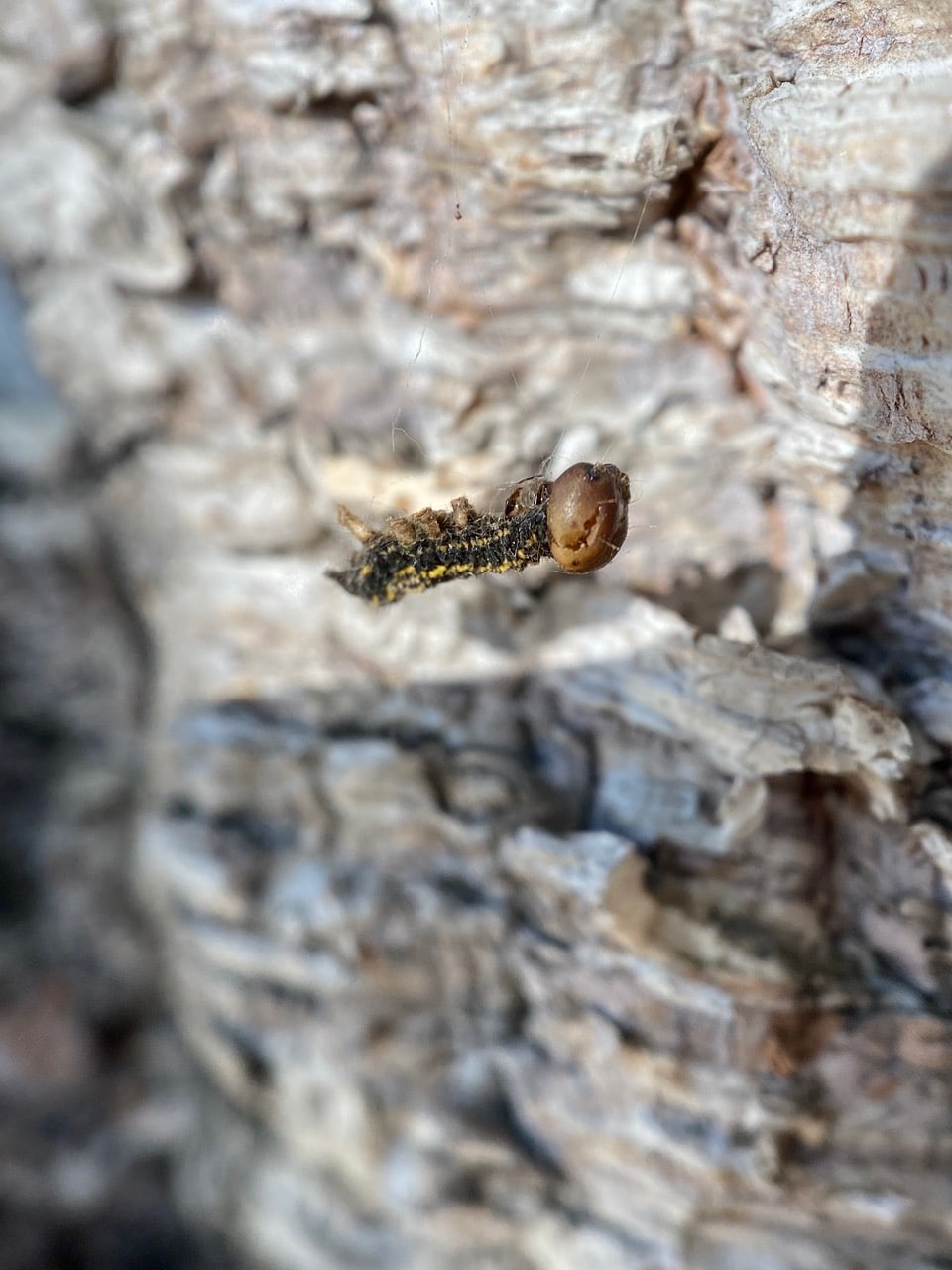
Dangling on strands of silk a shriveled California Oak Moth caterpillar with a cracked head capsule is blowing in the wind. A victim of predation?
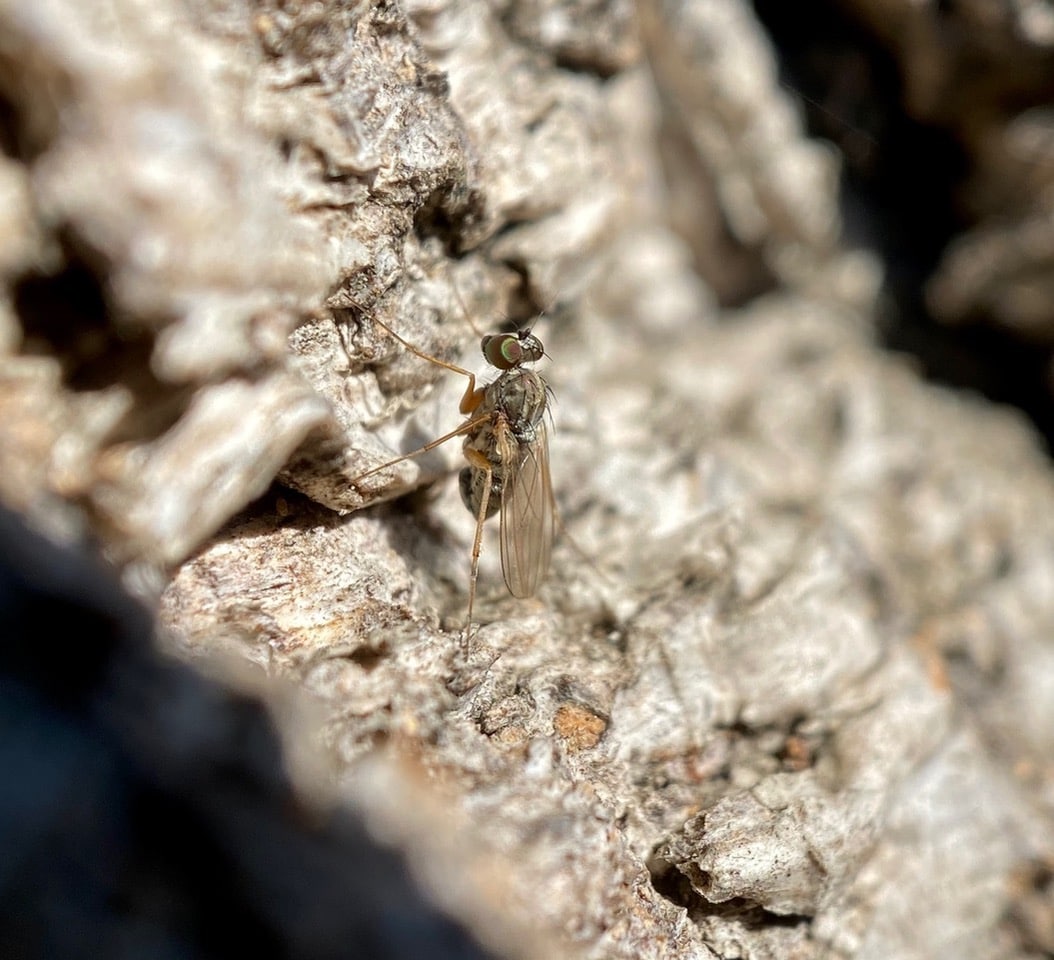
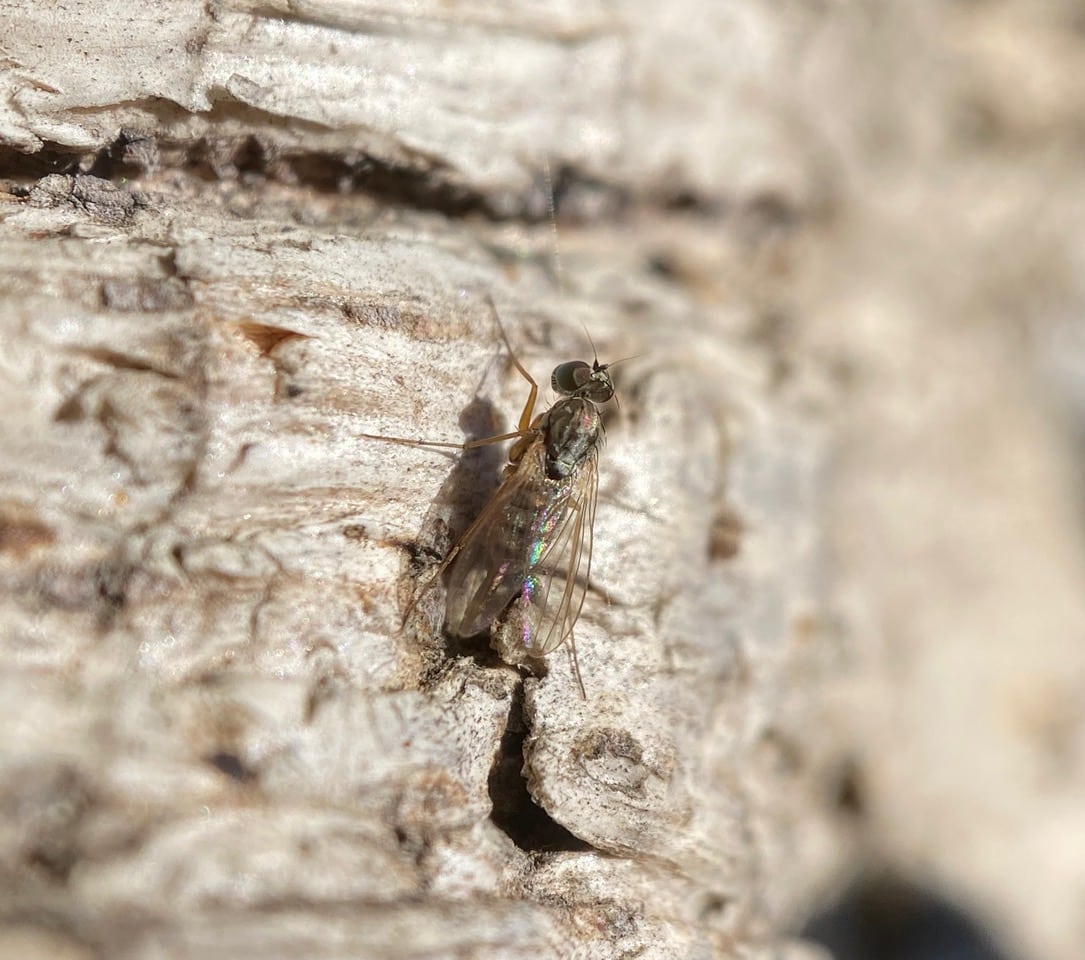
Hey, that’s something I recognize – a Woodpecker Fly, Medetera sp. (family Dolichopodidae)! It’s the size of a small mosquito.
Dolichopodidae, the Long-legged Flies are a large, cosmopolitan family of true flies. They are generally small flies (1-9 mm) with large, prominent eyes, and a metallic cast to their appearance. They have characteristically long and slender legs. Their posture is often stilt-like standing high on their legs, with their body almost erect. Most adults are predatory on other small animals. In most species the mouthparts are short and have a wide aperture as an adaptation for sucking small prey.
The Woodpecker Fly, Medetera is a large genus in the family Dolichopodidae. The adults are commonly found resting on vertical surfaces such as tree trunks, on which they have a characteristic vertical upright stance reminiscent of the woodpecker bird. Medetera adults are predators of soft-bodied arthropods, while the larvae are predators of bark beetle larvae.
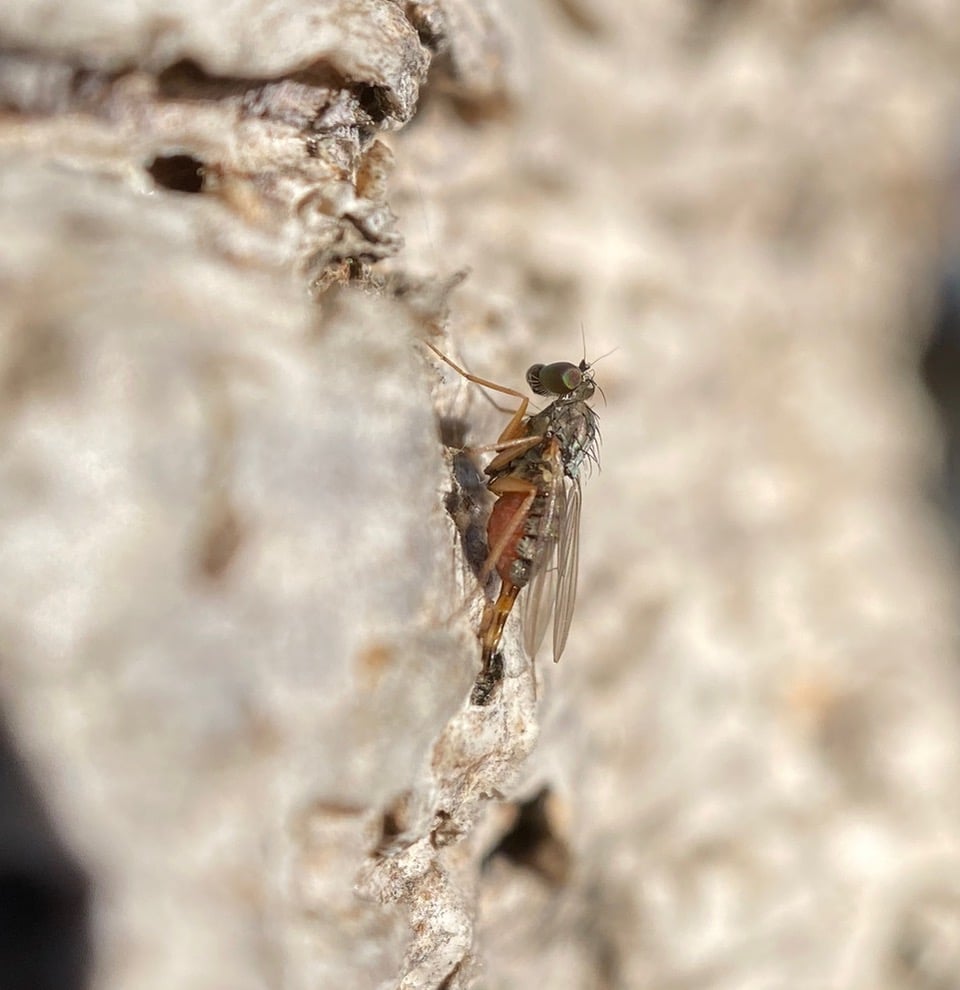
Wait, that’s a gravid female Woodpecker Fly laying eggs in the soft bark of the Cork Oak.
The female flees from my prying eyes…
…but finally settles further up the tree trunk to groom herself with her hind legs. Note the slender, long legs of the Woodpecker Fly.
Then she extends her ovipositor to lay eggs again – Wow! It makes sense that the Woodpecker Fly female oviposits in the bark, as the larvae that hatch out are predators of bark beetle larvae. Never did I dream that I would be privy to this behavior.
On the retaining wall in front of Mendocino Park, I spot these small maze-like silken galleries built atop the rough mortar partially covered in dried moss. Webspinners! Of all the insects I am likely to see today, these are probably the most unique and interesting. But alas, the Webspinnners are difficult to see unless one resorts to invasive measures that destroy their homes, and I’m not about to do that. Close-up of the fine webbings produced by the Webspinners (order Embioptera). Their silk can appear bluish in certain light.
The order Embioptera, commonly known as Webspinners, are a small group of mostly tropical and subtropical insects. Webspinners are gregarious, living subsocially in galleries of fine silk which they spin from glands on their forelegs. Members of these colonies are often related females and their offspring; adult males do not feed and die soon after mating. Males of some species have wings and are able to disperse, whereas the females remain near home where they were hatched. They may emerge to search for a new food source to which the galleries can be extended, but in general, the insects rarely venture from their galleries. The Webspinners are generalist herbivores. They feed on plant litter, bark, moss, algae and lichen. Webspinners continually extend their galleries to reach new food sources, and expand their existing galleries as they grow in size.
The name Embioptera means “lively wings” in Greek, probably referring to the insect’s remarkable speed of movement both forward and backward. The long, cylindrical, narrow and highly flexible body is well adapted for the silk tunnels in which they live. In the males, the wings have a crosswise crease, allowing them to fold forwards over the body. This, along with the flexibility allows easy movement through the narrow silk galleries, either forwards or backwards without resulting in damage.
The galleries produced by Embiopterans are tunnels and chambers woven from the silk they produce. These can be found on rocks, tree bark, or in leaf litter. The galleries maintain humidity, and offer protection from predators and the elements while the insects forage, live and breed. Embiopterans produce a silk thread similar to that of the silkworm. The silk is produced in spherical secretory glands in the swollen tarsi (lower leg segments) of the forelimbs, and can be produced by both adults and larvae. Some species have up to 300 silk glands (150 in each forelimb). The large numbers allow individuals to spin large amounts of silk very quickly, creating extensive galleries. Webspinner silk is among the thinnest of all animal silks, about 90-100 nanometers in diameter.