

Pollinator Post 10/23/26 (1)

The first rain of the season we had yesterday has heralded in a clear, cool morning at Bay Farm Island. I find myself checking out the late blooming native Telegraphweed, Heterotheca grandiflora along the shoreline.

A male Fine Striped Sweat Bee, Agapostemon subtilior (family Halictidae) lands momentarily on a fresh flowerhead of Telegraphweed.
In Greek, the genus name Agapostemon means “stamen loving”, referring to the bee’s need to forage for pollen. The family Halictidae consists of small, non-aggressive bees with short tongues. They are called sweat bees because they are often attracted to human perspiration from which they obtain salts and water.
The Striped Sweat Bee, Agapostemon subtilior is most commonly found in the west coast of the United States. The species is easily recognized by its metallic green coloration. The females have an entire body that is brilliant blue-green, while the males have an abdomen that is brownish-black with yellow bands. The males (9-10 mm) are smaller than the females (11mm). Due to their short tongues, the Striped Sweat Bees have a limited ability to access nectar from deep flowers. They are generalist foragers, visiting a wide range of flowers.
Female Agapostemon subtilior are active May through October, while males are on wing from July through October. Two generations are produced per year. In the fall fertilized females overwinter in their nests while males typically die. In the spring the fertilized females emerge. They construct their underground nests in bare, loamy soil, lay their eggs in brood chambers and provision them with pollen before dying. In this first generation, the eggs hatch into mostly females as they develop from fertilized eggs. To fix the skewed sex ratio these females lay unfertilized haploid eggs that develop into males. During the summer months the male and female Striped Sweat Bees mate, thus repeating the cycle.
An individual of A. subtilior may change color based on atmospheric humidity, varying from bluish to pale green as local conditions become drier or moister. Maybe our bee is such a dark, saturated green today because the humidity is high after the rain?

Lower down on the same plant, another male Fine Striped Sweat Bee is resting motionless on a flowerhead. It is rather unusual behavior for a male of this species – they are usually hyperactive, constantly on the lookout for females and rivals. Since male bees do not participate in nest building, they do not have a home to return to at the end of the day. At night they usually sleep out in the open, often on flowers and vegetation. Is this bee still asleep? At 11:30 am?

Most of the Telegraphweeds have gone to seed now, with straw-colored pompoms of seed heads covering the plants.
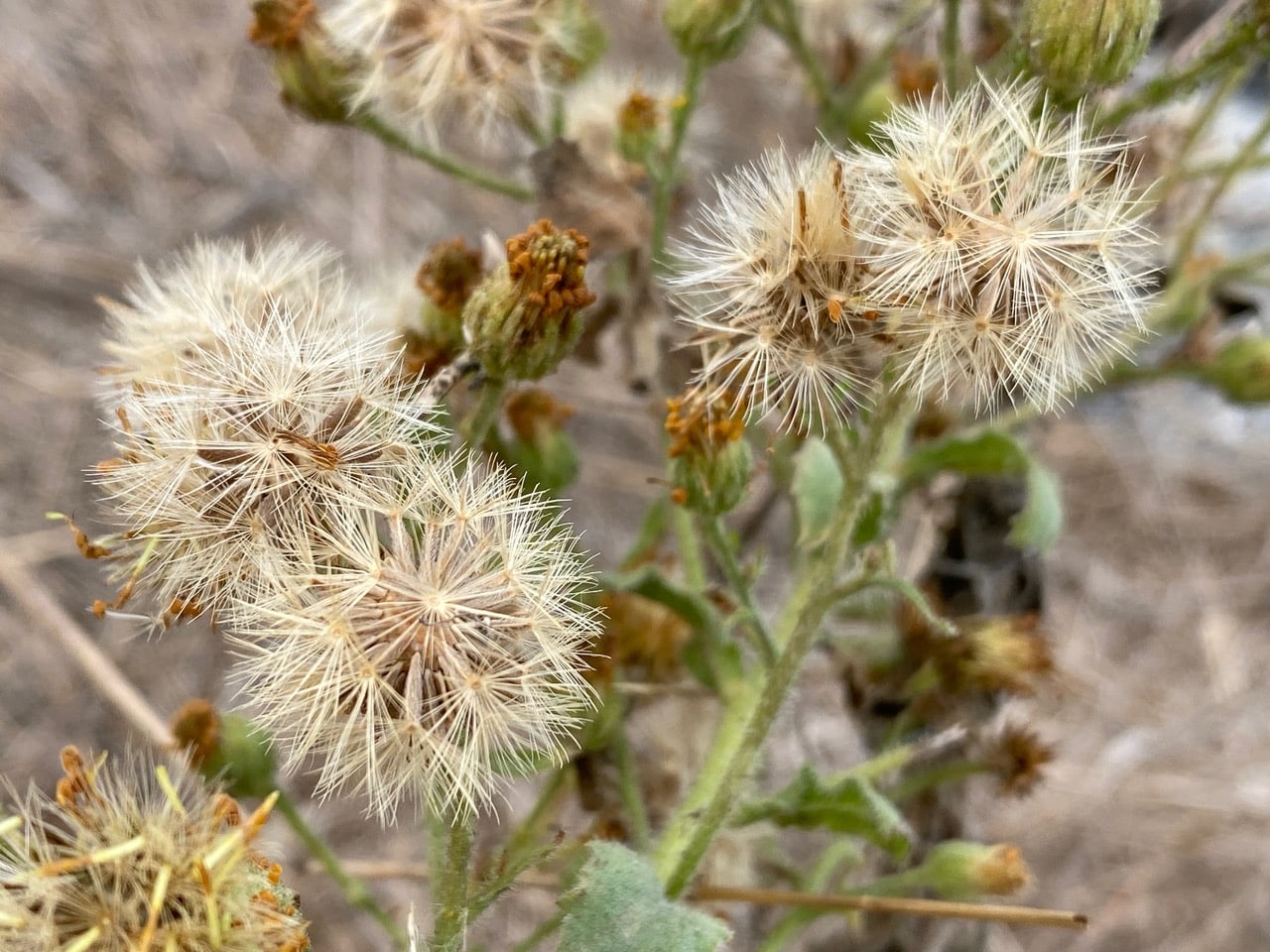
While much coarser than the puffballs of Dandelion, the seed heads of the Telegraphweed have the same basic structure for facilitating wind dispersal of their seeds.
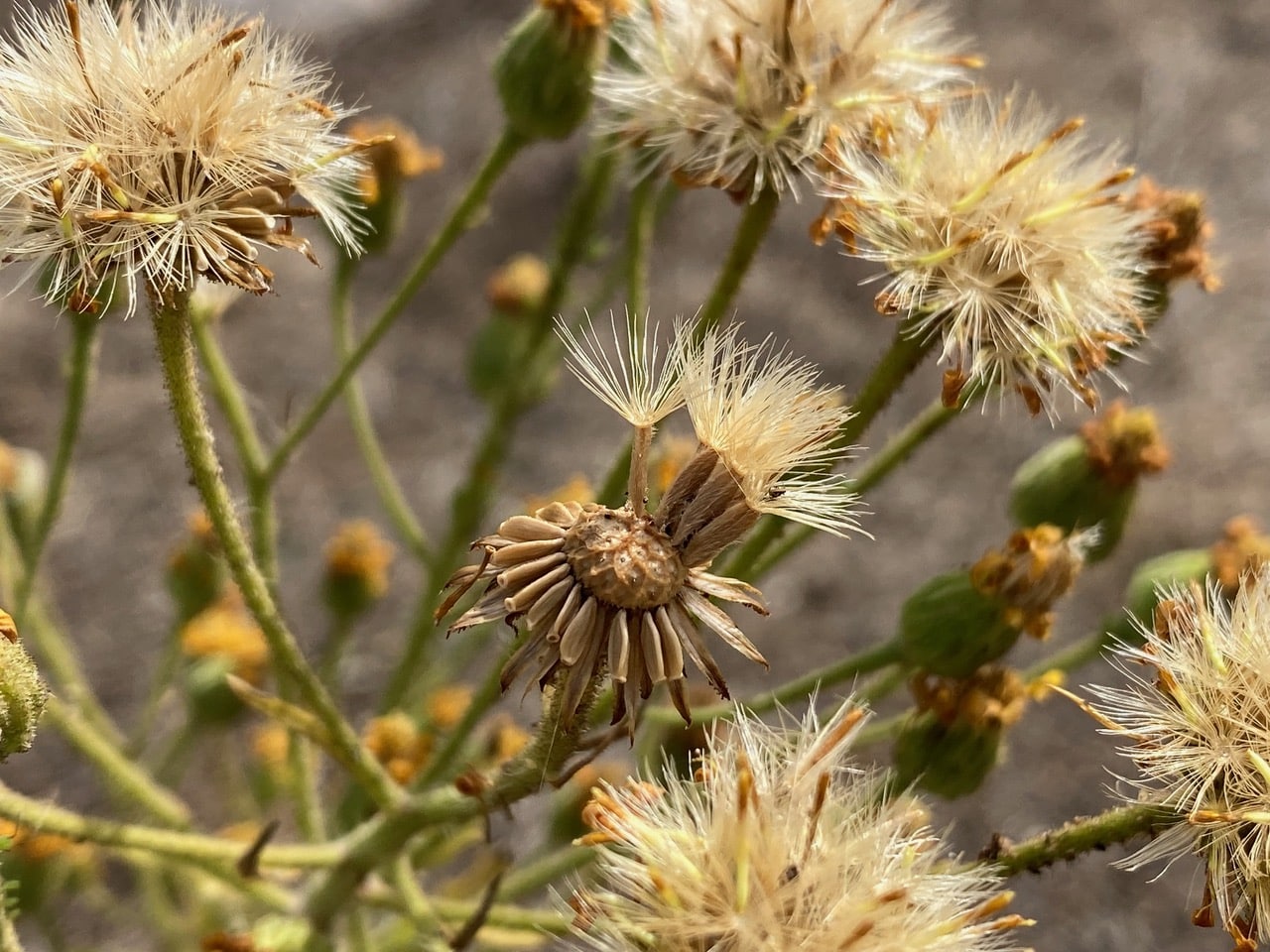
As the winged seeds are released to the wind, the last seeds to be shed are the ones at the base produced by the ray flowers. Note that these do not have the parachute “wings”.
This hardy native produces two types of seeds as a survival strategy for uncertain environments. The parachute-bearing seeds from the disk florets are transported by the wind and are likely to be carried away from the parent plant to colonize new area. These seeds germinate quickly. The seeds produced by the ray florets on the rim have no parachute and fall close to the parent plant, in an environment where the parent plant has succeeded. Ray seeds are more sensitive to environmental conditions and germinate slowly. Ray seeds ensure the continuation and expansion of the original population. Thus, Telegraphweed distributes its seedlings over both space and time, a strategy that accounts for its successful colonization of disturbed areas.
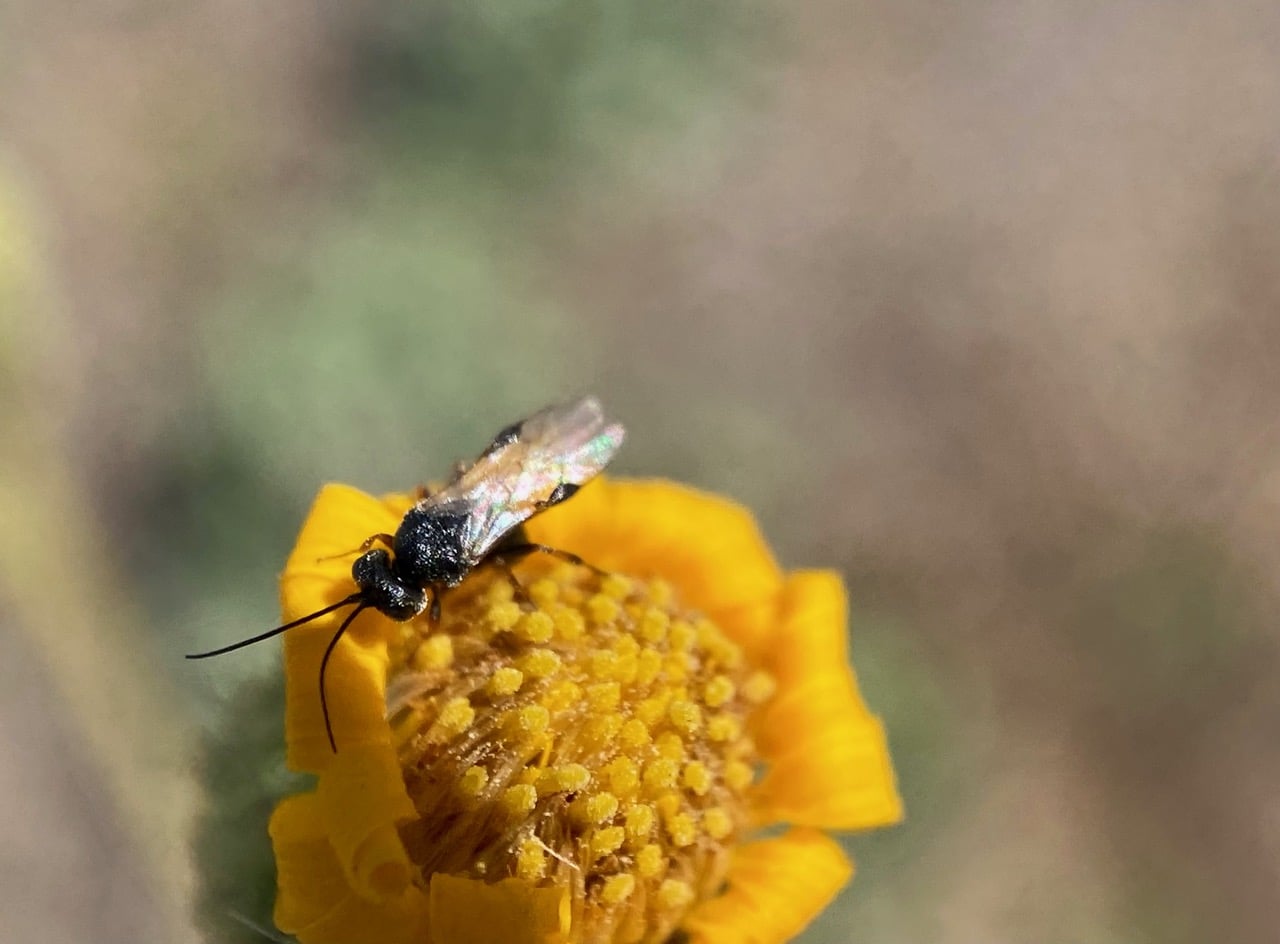
A small black wasp with long antennae is hunting on a fading flowerhead of Telegraphweed. It’s interesting how the long, narrow ray petals roll up neatly like a yoga mat when the flowerhead fades. iNaturalist has helped identify the wasp as a parasitoid wasp in the genus Chelonus (family Braconidae).

The Braconidae are a family of parasitoid wasps. After the closely related Ichneumonidae, braconids make up the second-largest family in the order Hymenoptera, with about 17,000 recognized species. Females often have long ovipositors to lay eggs on or in their hosts. The larvae of most braconids are internal primary parasitoids of other insects, especially the larval stages of Coleoptera, Diptera, and Lepidoptera. Generally, the braconid life cycle begins when the female wasp deposits her eggs in the host insect, and the braconid larvae develop in the host body, eating it from the inside out. When the wasp larvae are ready to pupate, they may do so in or on the host insect. The new generation of adult braconid wasps emerges from their cocoons and begins the life cycle again.
Braconid wasps use a remarkable weapon to disable the defenses of their host insects – a virus. These parasitic wasps coevolved with polydnaviruses (read poly-DNA-virus), which they carry and inject into the host insects along with their eggs. The virus attacks the host’s immune system and renders it unable to encapsulate the wasp egg; it also halts the host’s development, so it can’t pupate and transform into an adult. Amazingly, the “bracovirus” also changes the host’s metabolism so that it can survive longer without food or water – thus ensuring a nurturing environment for all the young wasps to come.
Chelonus is a wasp genus in the family Braconidae. Their larvae feed chiefly on larvae of moths in superfamilies Tortricoidea and Pyraloidea. Chelonus species are valued as natural biological control agents for suppressing agricultural pests.

The wasp uses her long antennae to probe every nook and cranny of the flowerhead, apparently searching for a potential host in which to lay her egg. Chelonus wasps are dark, robust, and heavily sculpted. Unlike parasitic wasps that drill deep into wood or plant tissue to reach hidden hosts, Chelonus females typically have short ovipositors because they are egg-larval parasitoids that deposit their eggs directly into the exposed or easily reachable eggs of host moths. Females inject an egg inside a moth egg. The wasp larva hatches inside the developing caterpillar host and matures alongside it before eventually consuming the host from the inside.
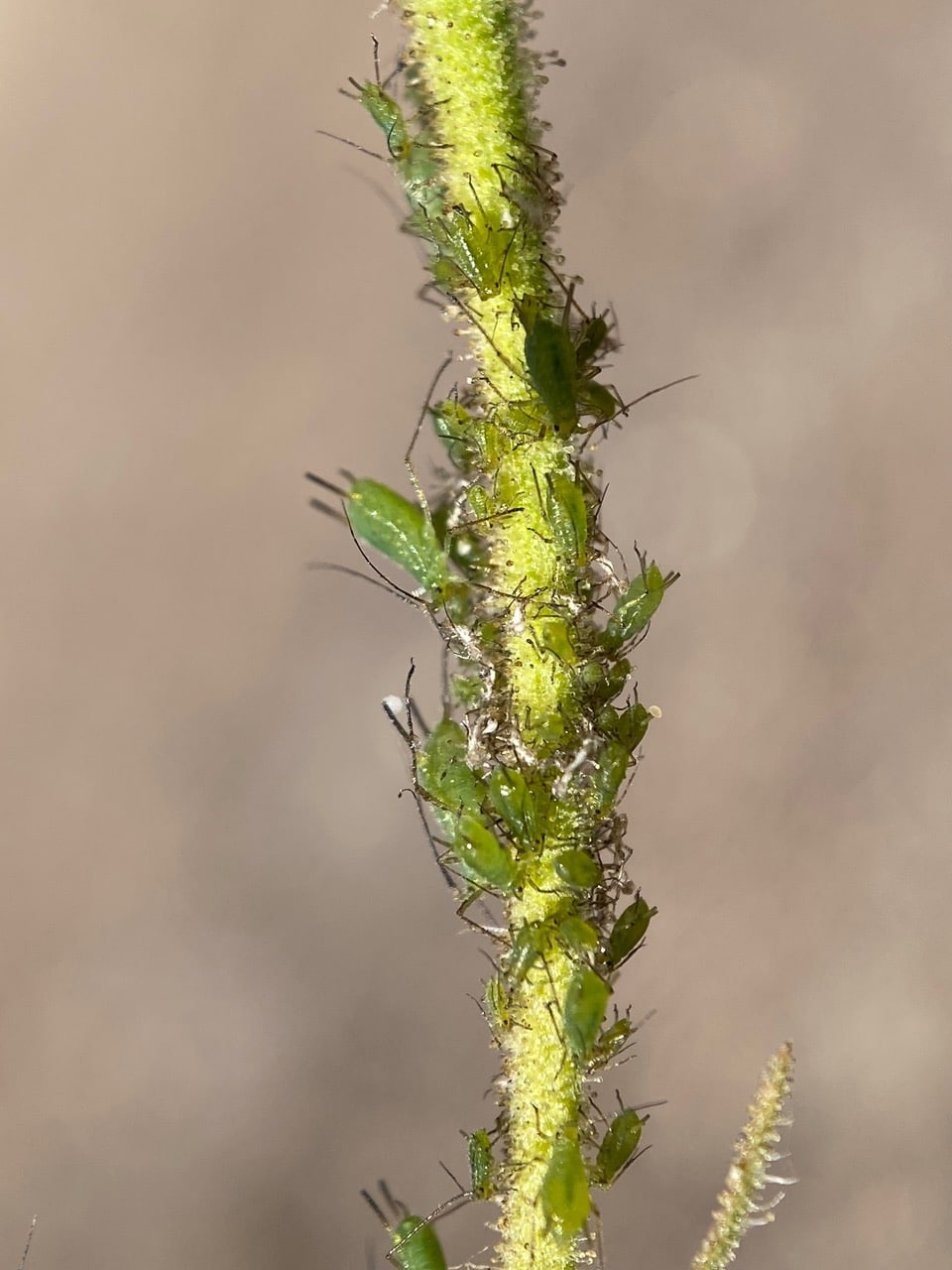
There’s a thriving colony of large, green, long-legged aphids on this Telegraphweed, Heterotheca grandiflora. The aphids belong to the genus Macrosiphum.
Aphids (family Aphididae) are small sap-sucking insects in the order Hemiptera (true bugs). A typical life cycle involves flightless females giving live birth to female nymphs, – who may also be already pregnant, an adaptation called telescoping generations – without the involvement of males. Maturing rapidly, females breed profusely so that the population multiplies quickly. Winged (alate) females may develop later in the season, allowing the insects to colonize new plants. In temperate regions, a phase of sexual reproduction occurs in the autumn, with the insects often overwintering as eggs.
Aphids usually feed passively on phloem of plants. Once the phloem vessel is punctured, the sap, which is under pressure, is forced into the aphid’s food canal. Aphids produce large amounts of a sugary liquid waste called “honeydew”. A fungus called sooty mold can grow on honeydew deposits that accumulate on leaves and branches, turning them black.
Macrosiphum is a common genus of large, long-legged aphids, measuring up to 3.5 mm long. The genus name derives from their long, slender “tailpipes” (cornicles) on the rear of their bodies. During the summer populations are made of parthenogenetic females. In the fall, males and females are produced; they mate and females lay eggs that overwinter. These aphids are highly polyphagous, feeding on over 200 plant species, including vegetables like tomatoes, potatoes, and ornamentals. They extract sap from soft new foliage and terminal stems, causing leaves to curl, yellow, and stunt. They secrete a sticky, sugary waste product called honeydew that may coat the plant, promoting the growth of sooty mold. The aphids are also prominent vectors capable of transmitting plant viruses between crops.

Away from the crowd, a mature aphid is giving live birth on an involucre of a fading Telegraphweed flowerhead. Note that the baby is born breech, rear end first.
Aphids have many generations a year. Most aphids in California’s mild climate reproduce asexually throughout most or all of the year with adult females giving birth to live offspring – often as many as 12 per day – all clones of the mother. The young aphids or nymphs molt, shedding their skin about four times before becoming adults. When the weather is warm, many species can develop from newborn to reproductive adult in 7-8 days. Because each adult aphid can produce up to 80 offspring in a matter of a week, aphid populations can increase in staggering speed.

After a few minutes of straining and pushing, mama aphid lowers herself to give her newborn a soft landing.

A few winged aphids can be seen on this spent Telegraphweed flowerhead. The colony is getting ready to disperse to new plants.

A bloated, glossy black aphid is resting on the involucre of a spent Telegraphweed flowerhead.
The bloated, black aphid has been parasitized by a wasp in the family Aphelinidae. The mother wasp uses her ovipositor to inject a single egg and symbiotic polydnaviruses into an aphid. The wasp larva hatches and slowly consumes the aphid’s non-vital organs while it is still alive. Right before the larva pupates, it kills the host aphid. The chemical interaction between the wasp and the aphid’s cuticle causes the aphid to swell into a balloon-like, shiny black “mummy”. The wasp pupates safely inside the black shell. Once mature, it chews a perfectly round exit hole in the rear of the mummy to escape and hunt for new aphids.
Not all aphid wasps turn their hosts black – wasps from the subfamily Aphidiinae (family Braconidae) tend to leave behind tan, gold, or brown mummies. Together, these two families of parasitoid wasps are highly effective natural pest control agents for gardens and agriculture.

A tiny Chelonus wasp is searching for a host on a fading flowerhead of Telegraphweed.

Another Chelonus wasp is foraging on a Telegraphweed flowerhead. Do you see the tiny white egg that is shaped like a grain of rice? It is probably a hover fly egg.

A female Oblique Streaktail, Allograpta obliqua (family Syrphidae) is foraging on a Telegraphweed flowerhead.
Although small in size (6-7 mm long), the Oblique Streaktail is easily recognizable for the unique pattern on its black-and-yellow abdomen. It is a common North American species of hover fly. Adults visit flowers for nectar and pollen, and are pollinators. Females lay eggs on plant surfaces near aphids. Larvae feed on the aphids.

A small caterpillar is wrapped around the involucre of a spent Telegraphweed flowerhead. iNaturalist has helped identify it as a larva of the Darker-spotted Straw Moth, Heliothis phloxiphaga (family Noctuidae).
Heliothis phloxiphaga is found in the United States and southern Canada. It feeds on a variety of plants, and the caterpillars are considered pests to certain trees, including Ulmus, Malus, and Prunus. Adults fly during the summer.
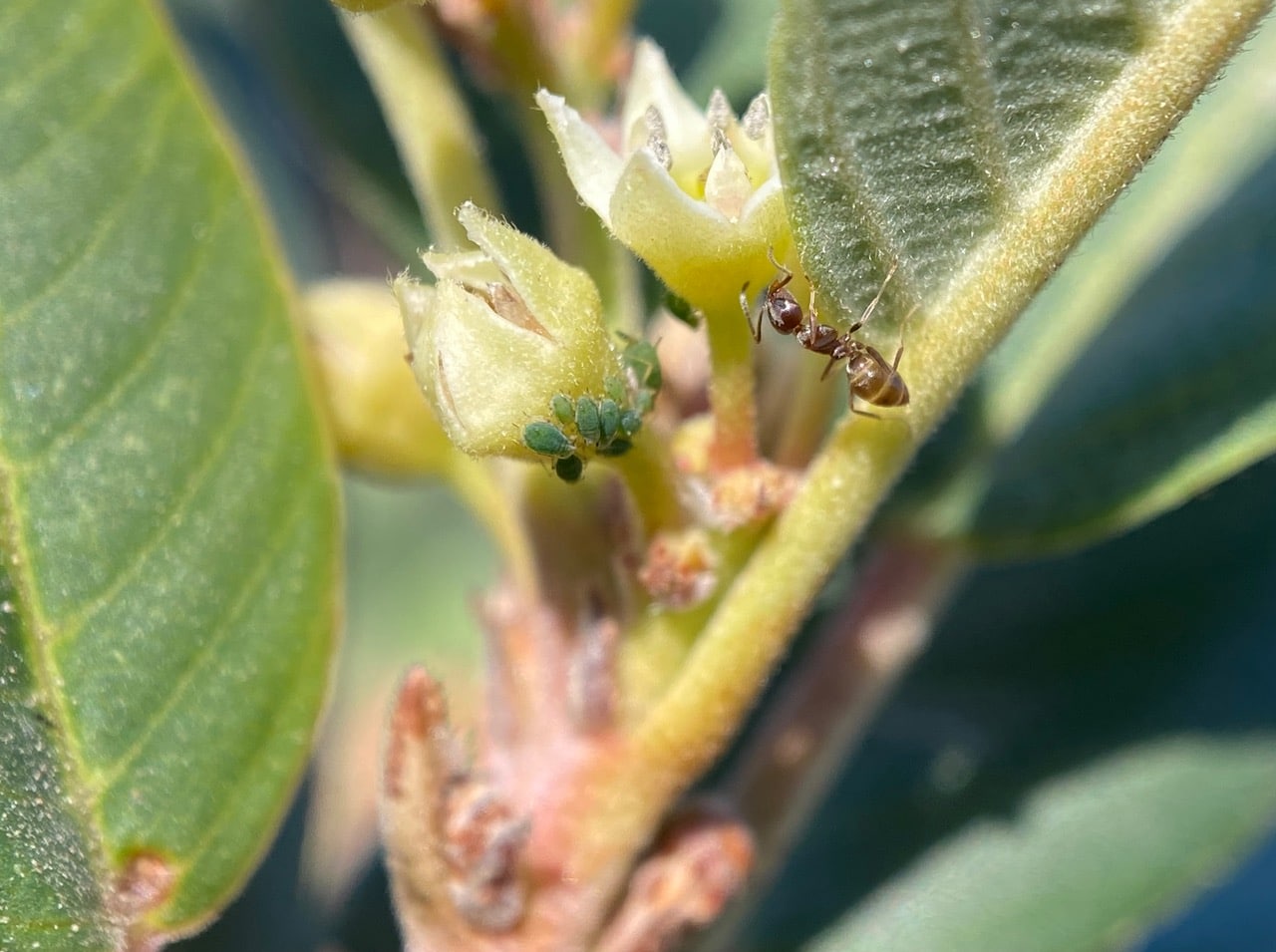
Argentine Ants, Linepithema humile (family Formicidae) mill around a cluster of fresh flowers of California Coffeeberry, Frangula californica. The ants are not only foraging for nectar and pollen from the flowers, but also tending a small colony of tiny, green aphids.
Ants and aphids share a well-known mutualistic relationship. The aphids produce honeydew, a sugary food for the ants; in exchange, the ants care for and protect the aphids from predators and parasites. Some ants will “milk” the aphids to make them excrete the sugary substance. The ants stroke the aphids with their antennae, stimulating them to release the honeydew. Aphid-herding ants make sure the aphids are well-fed and safe. When the host plant is depleted of nutrients, the ants carry their aphids to a new food source. If predatory insects or parasites attempt to harm the aphids, the ants will defend them aggressively. Some species of ants continue to care for aphids during winter. The ants carry the aphids to their nest for the winter months, and transport them to a host plant to feed the following spring.

Three excited Argentine Ants crowd into a freshly opened flower of Coffeeberry, apparently seeking nectar at the base of the flower.
The Argentine Ant, Linepithema humile (family Formicidae) is native to Northern Argentina, but it has been inadvertently introduced by humans to many countries, and is now an established invasive species in many Mediterranean climate areas worldwide. The success of the species can be attributed to their lack of aggression between the colonies. There is no apparent antagonism between separate colonies of its own kind, resulting in “super-colonies” that extend across hundreds or thousands of kilometers in different parts of the their range. Genetic, behavioral, and chemical analyses show that introduced Argentine Ants on separate continents actually represent a single global supercolony.
The Argentine Ants are ranked among the world’s worst invasive animal species. In its introduced range, the Argentine ant often displaces most or all native ants and can threaten native invertebrates and even small vertebrates that are not accustomed to defending against the aggressive ants. This can, in turn, imperil other species in the ecosystem, such as native plants that depend on native ants for seed dispersal, or lizards that depend on native ants for food.

A small jumping spider with a golden sheen is moving on a leaf of California Coffeeberry, Frangula californica. It is a Buttonhook Leafbeetle Jumping Beetle, Sassacus vitis (family Salticidae).
Jumping spiders (family Salticidae) are free-roaming hunting spiders. They do not weave a web to catch prey. They stalk, then pounce on their prey. Just before jumping, the spider fastens a safety line to the substrate. It can leap 10-20 times their body length to capture prey. Their movement is achieved by rapid changes in hydraulic pressure of the blood. Muscular contractions force fluids into the hind legs, which cause them to extend extremely quickly. Jumping spiders are visual hunters. Their excellent vision has among the highest acuities in invertebrates. Since all their 8 eyes are fixed in place and cannot pivot independently from the body like human eyes can, jumping spiders must turn to face whatever they want to see well. This includes moving their cephalothorax up and down, an endearing behavior.
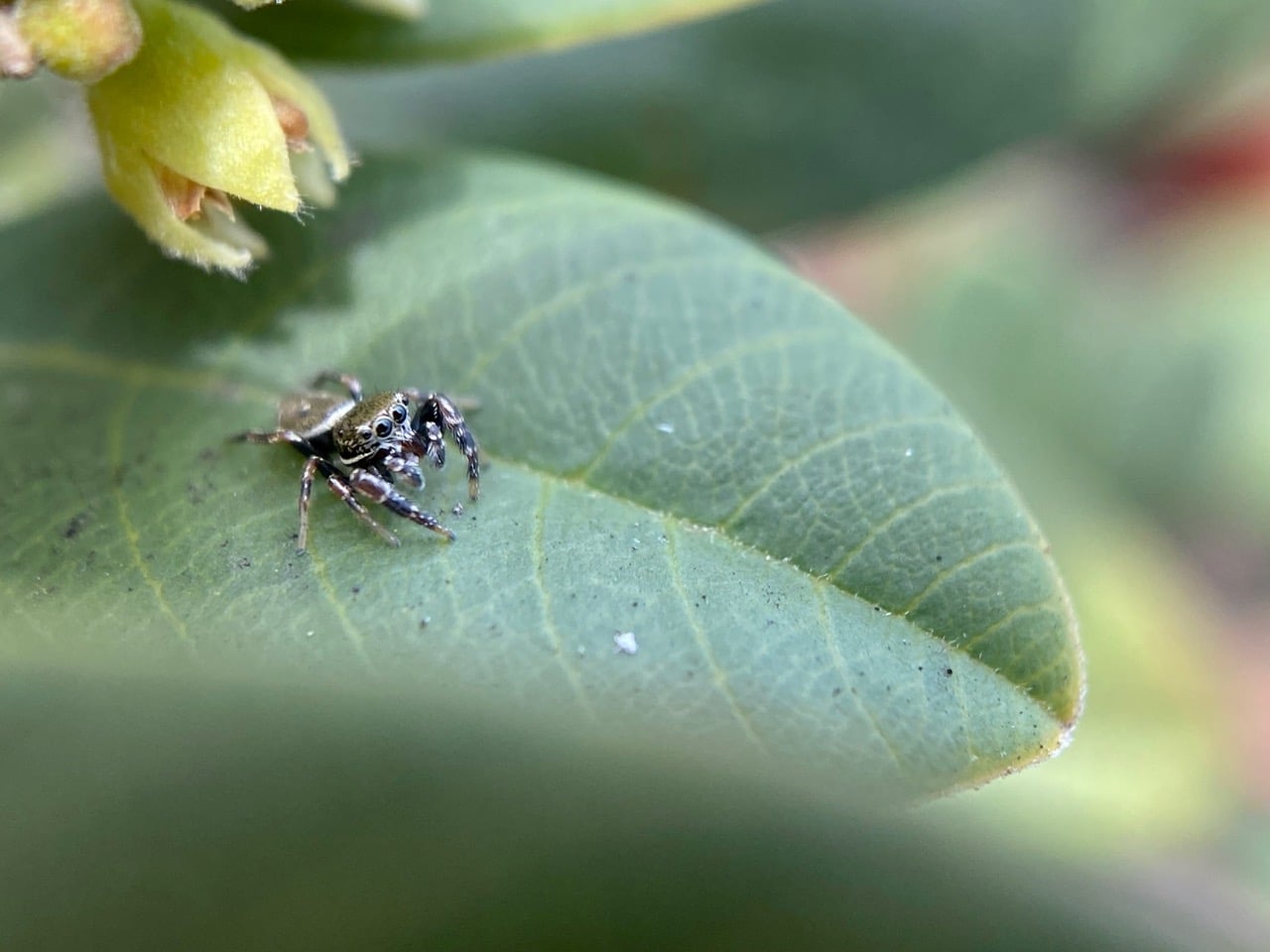
Sassacus vitis is native to North America, with a range spanning from Canada to Panama. It is a small jumping spider with iridescent gold abdomen and white ring around the anterior surface of abdomen. Body is covered with golden scales. Males are 3.5 mm long, females 4.5 mm. The name vitis is Latin for “grapevine”. The spider is commonly found on shrubs and vines and in fields. Best known as a common resident of vineyards.
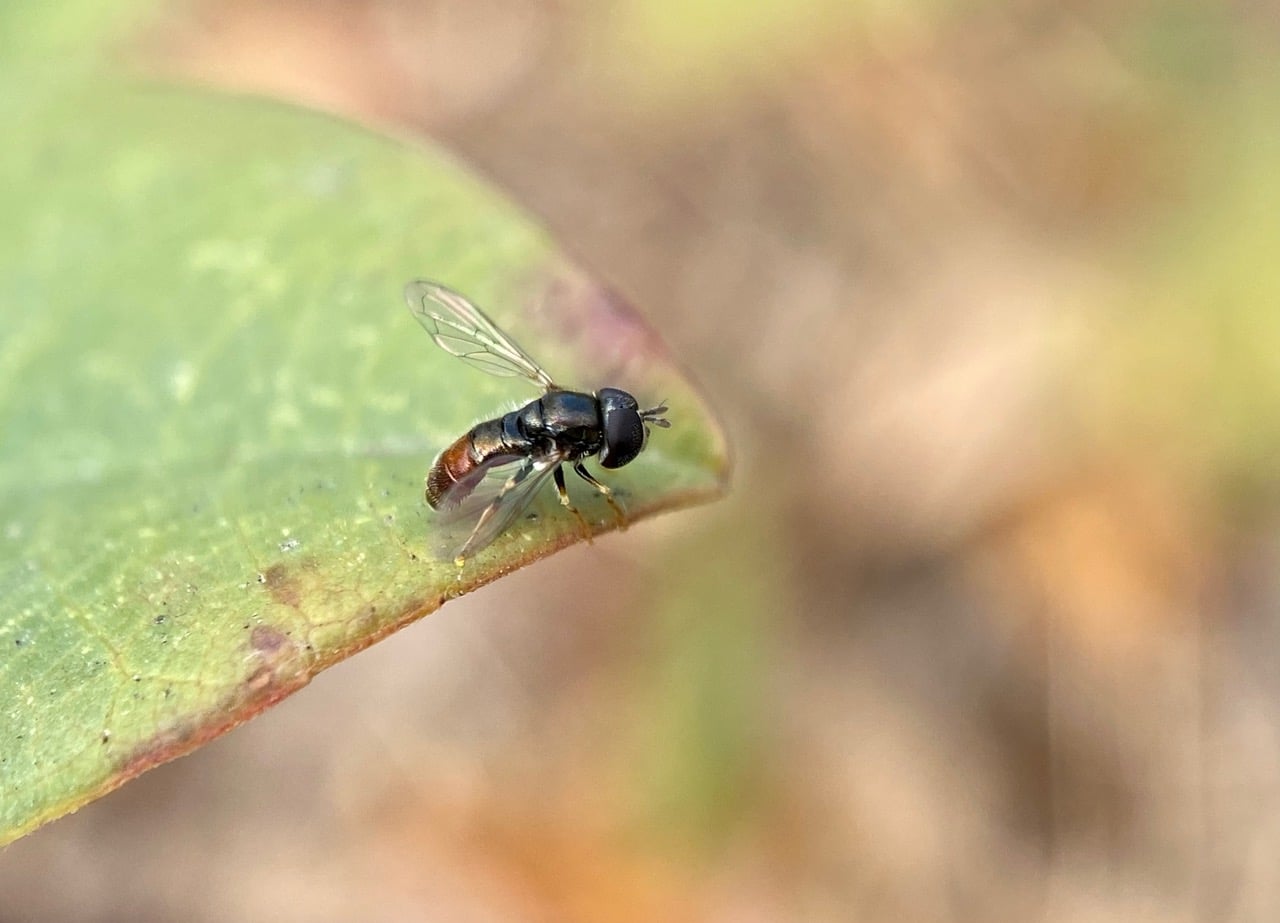
A Common Grass Skimmer, Paragus haemorrhous (family Syrphidae) has landed on a Coffeeberry leaf.
The Common Grass Skimmer, Paragus haemorrhous (family Syrphidae) is the smallest hover fly I know, measuring only about 4 mm in length. The species has a world-wide distribution, found in unimproved grasslands, dune grass, open areas and pathsides in forest, and meadows. Adults visit flowers for nectar and pollen. Larvae feed on aphids on low herbaceous plants.
Photos of Common Grass Skimmer (Paragus haemorrhous) · iNaturalist

A black wasp with smoky bluish wings is running around on the sandy ground along the trail. iNaturalist has helped identify it as a Square-headed Wasp in the genus Larropsis (family Crabronidae).
Crabronidae is a huge, diverse family of solitary hunting and digger wasps in the superfamily Apoidea, occurring worldwide. They are known as Square-headed or Sand Wasps. Their head is often broad or squarish when viewed from the front, and they are frequently black with yellow, white, or red markings. They are usually short-necked with a collar-like front segment (pronoun) and low-set antennae. They do not fold their wings flat over the back when resting.
Adults feed exclusively on nectar and pollen from flowers. Females hung specific prey – such as flies, aphids, beetles, cicadas, or spiders – depending on the species, paralyzing them with a sting. The wasps build nests by burrowing in sandy soil, excavating rotten wood, or utilizing hollow plant stems to provision paralyzed prey for their larvae.

Larropsis is a genus of solitary, square-headed wasps belonging to the family Crabronidae. They are commonly found in open, sandy, or dry habitats, and frequently seen visiting flowers for nectar. Females construct individual nests underground in the soil. Females hunt and paralyze prey using venom, then drag the immobilized creatures into their nests to serve as a live food source for their developing larvae. Their prey typically includes adult Orthoptera (grasshoppers/crickets), Hemiptera, or Lepidoptera caterpillars.