

Pollinator Post 10/22/24
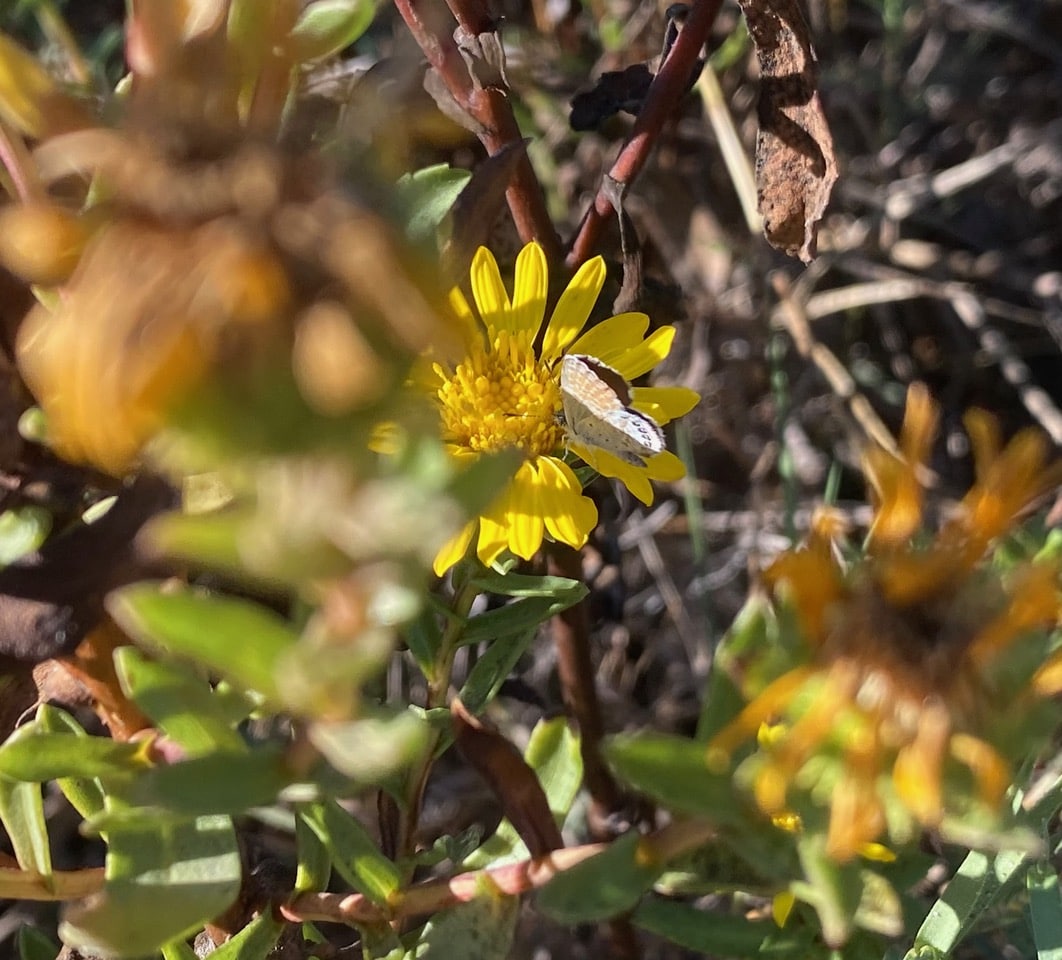
Although it is not our preference, Fred and I have come to Bay Farm for a rather late walk at 3:15 pm. The cool breezes from the bay makes the afternoon heat tolerable. I wonder what insects I might find.
A very small butterfly flies into a tangle of Grindelia plants to take nectar from a fresh flowerhead. Its size and the markings and coloration of the underside of its wings are suggestive of a Western Pygmy Blue.







The butterfly next lands on a Fleshy Russian Thistle, Salsola soda (family Chenopodiaceae). This time I get to see the upper surface of its wings. Indeed, it is a Western Pygmy Blue, Brephidium exilis (family Lycaenidae). The butterfly is visiting one of its larval food plants in the Goosefoot family.
With a wingspan of 12-20 mm, about the size of a thumbnail, the Western Pygmy Blue, Brephidium exilis (family Lycaenidae) is one of the smallest butterflies in the world and the smallest in North America. The butterfly is found in alkaline areas such as deserts and salt marshes. The caterpillars feed on plants in the Goosefoot family Chenopodiaceae, commonly found in salty habitats. Although the species has no set breeding season, mating activity is at its peak during late summer and early fall.
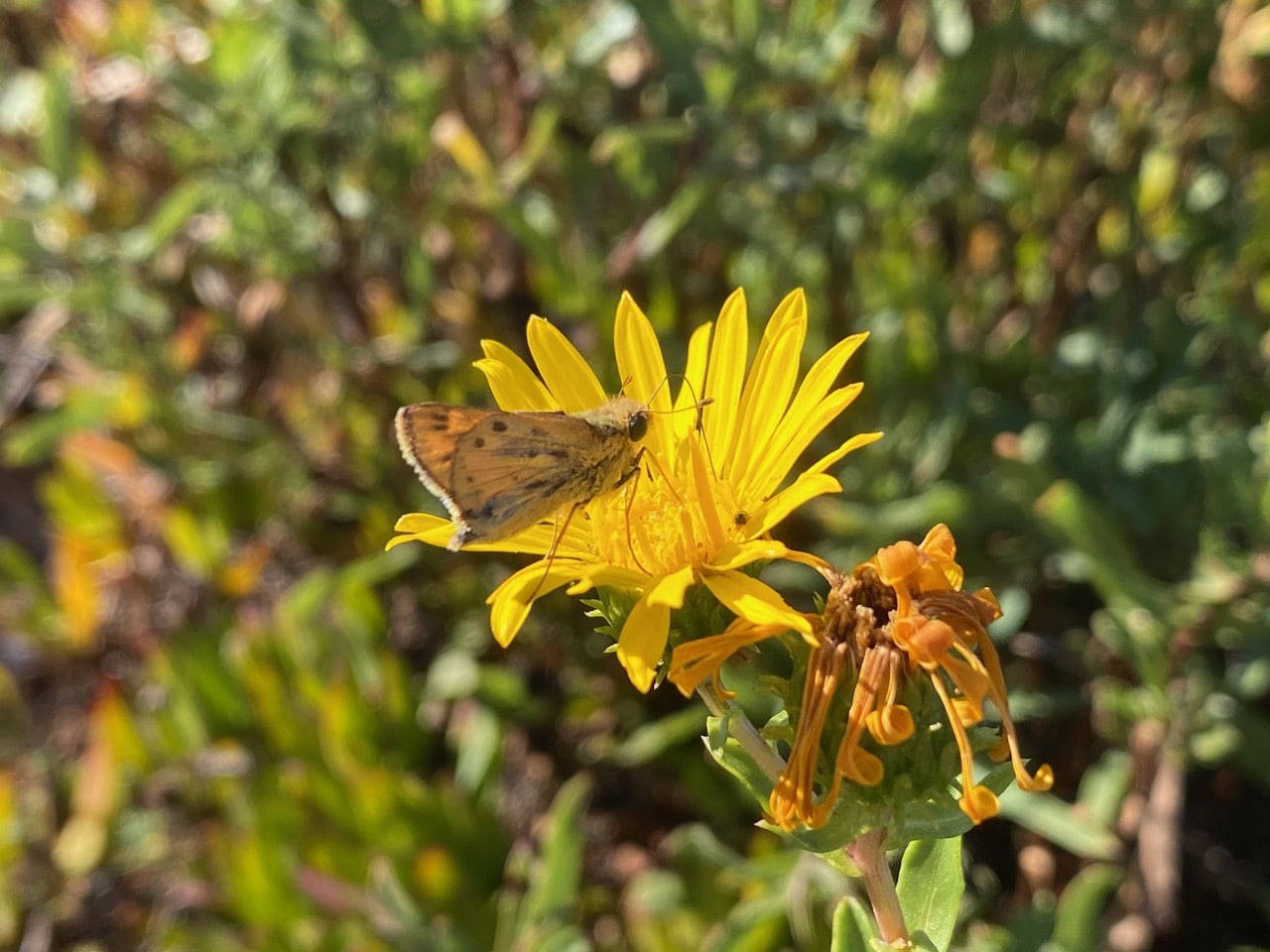
A Skipper butterfly (family Hesperiidae) is taking nectar from a Grindelia flowerhead.
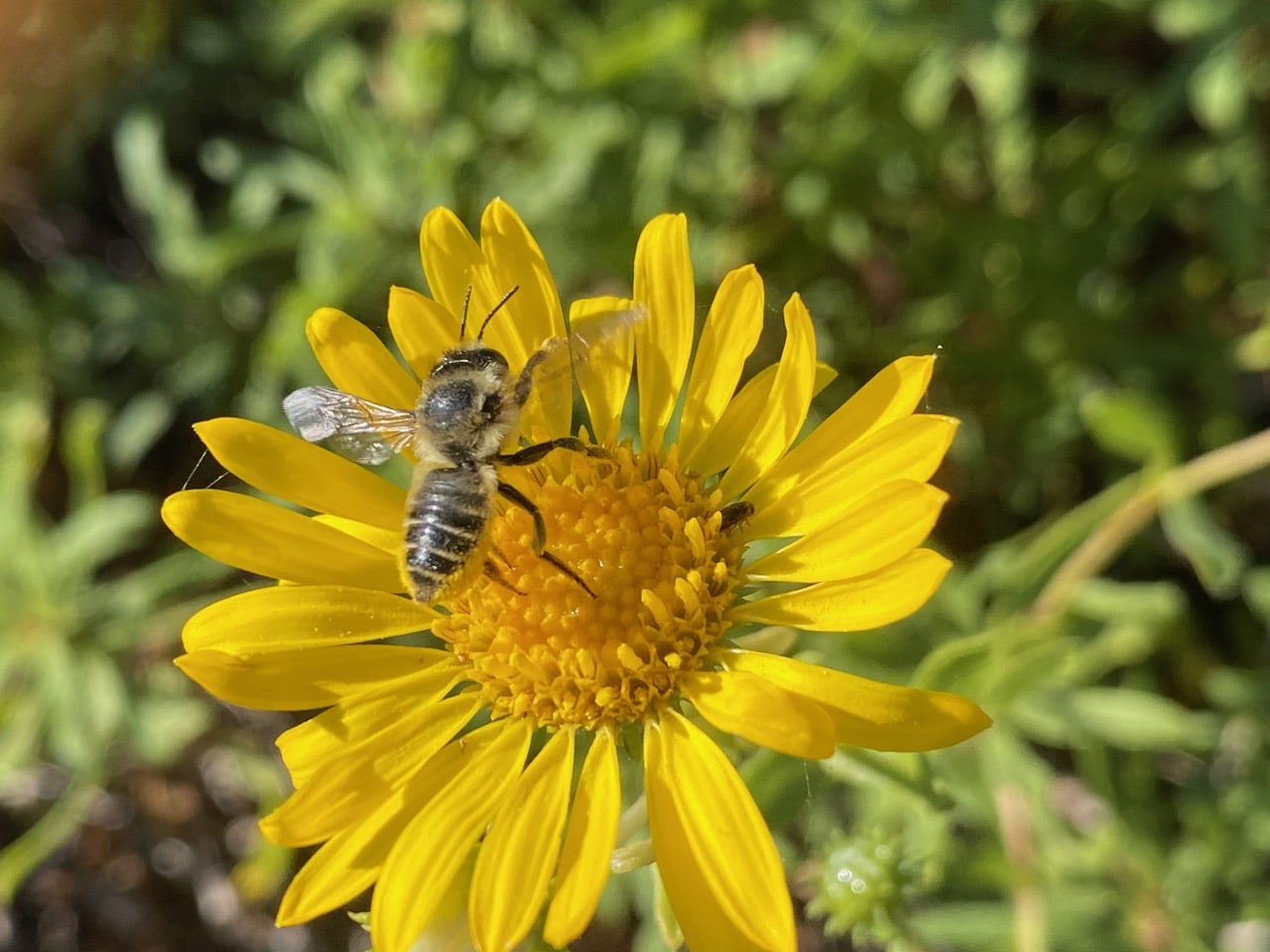
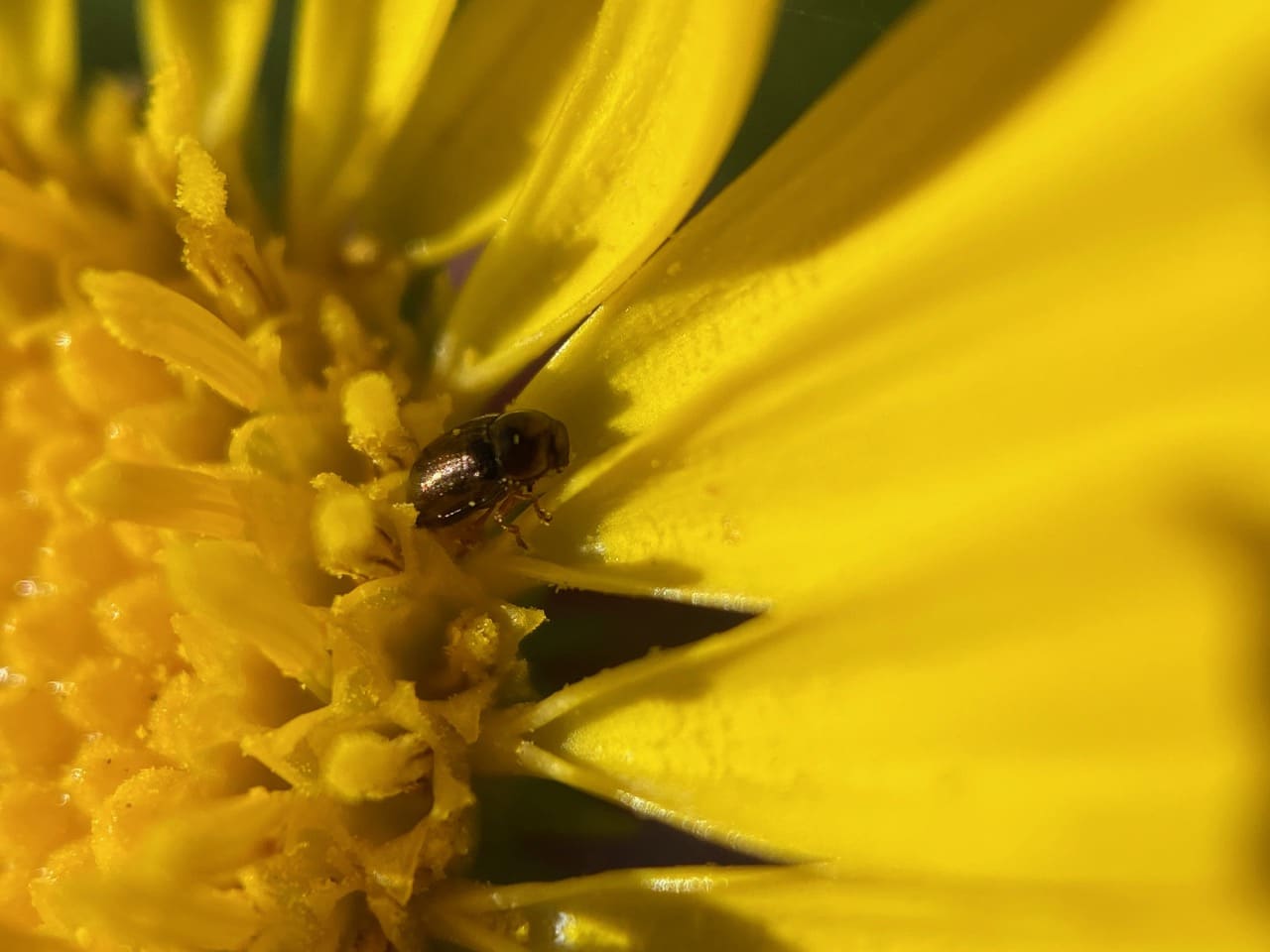
I was going to take a look at a tiny shiny beetle on a Grindelia when a female Western Leafcutter Bee, Megachile perihirta (family Megachilidae) suddenly lands on the same flowerhead. The bee’s abdominal scopa is already packed with pollen.
After a flurry of pollen gathering moves, the female Leafcutter is off to the next flowerhead.
Leaf-cutter Bees, Megachile sp. (family Megachilidae) are stout-bodied, usually with pale hair on the thorax and stripes of white hairs on the abdomen. Females usually have a triangular abdomen with a pointed tip, and males’ faces are covered with dense, pale hair. Flight season is from May into September, with peak activity from June to August.
Solitary females construct nests in tubular cavities, including hollow stems, tree holes, and abandoned beetle burrows in wood. Many use holes drilled into wood, straws, or other manufactured tunnels. Females cut pieces from leaves or flower petals for use in the construction of brood cells. Most Megachile females are generalists when foraging for pollen. Pollen is transported in dense scopae on the underside of the abdomen.
Photos of Western Leafcutter Bee (Megachile perihirta) · iNaturalist
Getting back to the little beetle, I recognize it as a Bronze Leaf Beetle, Diachus auratus (family Chrysomelidae) – the tiny beetle that spends its younger days masquerading as caterpillar poop!
Members of the family Chrysomelidae are commonly known as Leaf Beetles. Adults and larvae feed on all sorts of plant tissues, and all species are fully phytophagous. Many are serious pests of cultivated plants, including food crops. Others are beneficial due to their use in biocontrol of invasive weeds.
The Bronze Leaf Beetle, Diachus auratus is a species of case-bearing leaf beetle in the family Chrysomelidae, subfamily Cryptocephalina. It is found in Australia, the Caribbean, the Americas, Oceania, and Southern Asia. Adults, 1-2 mm, are found on many unrelated plants, especially plants in bloom. Case-bearing leaf beetles are found in two subfamilies within Chrysomelidae. As she lays her eggs, the female case-bearing leaf beetle covers each one with a layer of excrement. After the larvae hatch, they retain this covering (case) as camouflage and add to it throughout their larval life. When disturbed, the larvae pull in their head and legs; because their color and shape resemble caterpillar droppings they are ignored by predators. Eventually the larva seals the case to pupate inside, before emerging as an adult. Some species are myrmecophiles, living near or even inside ant nests.
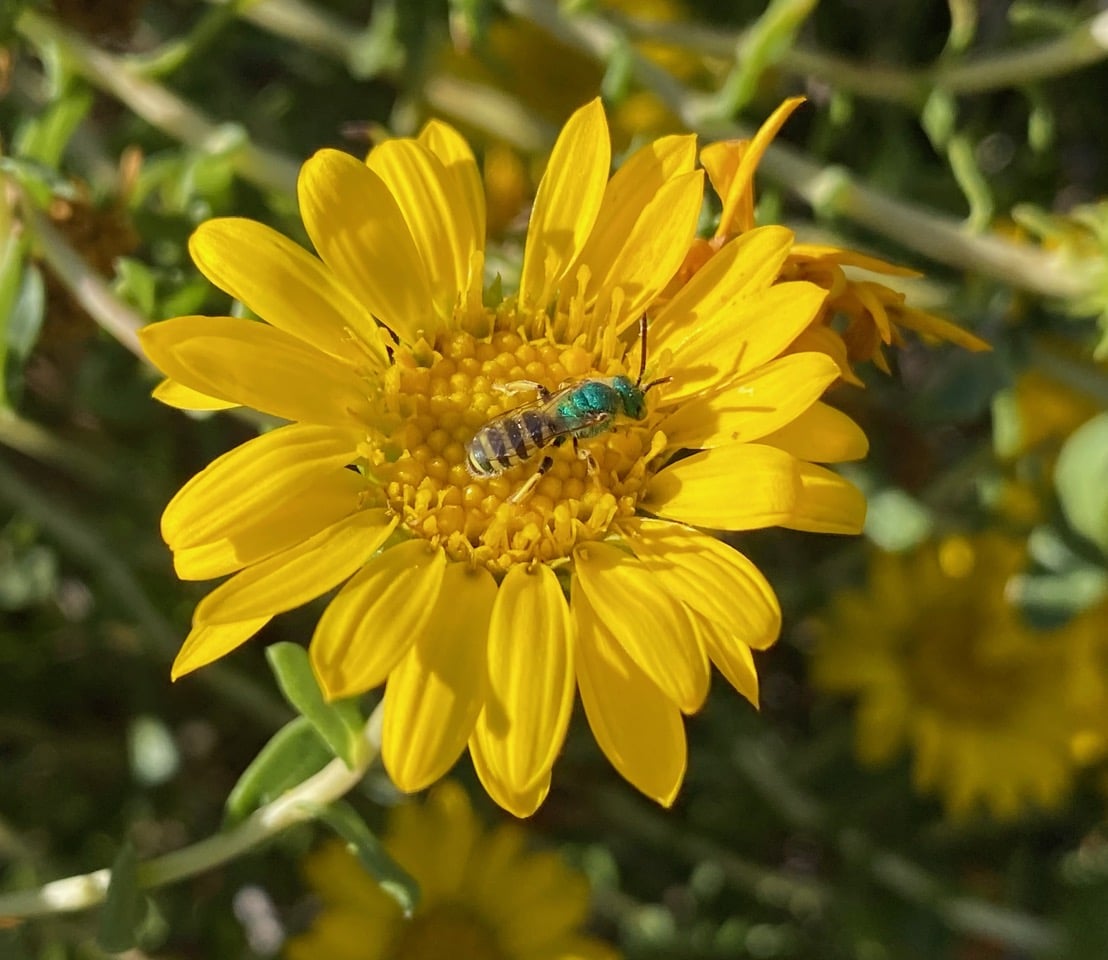
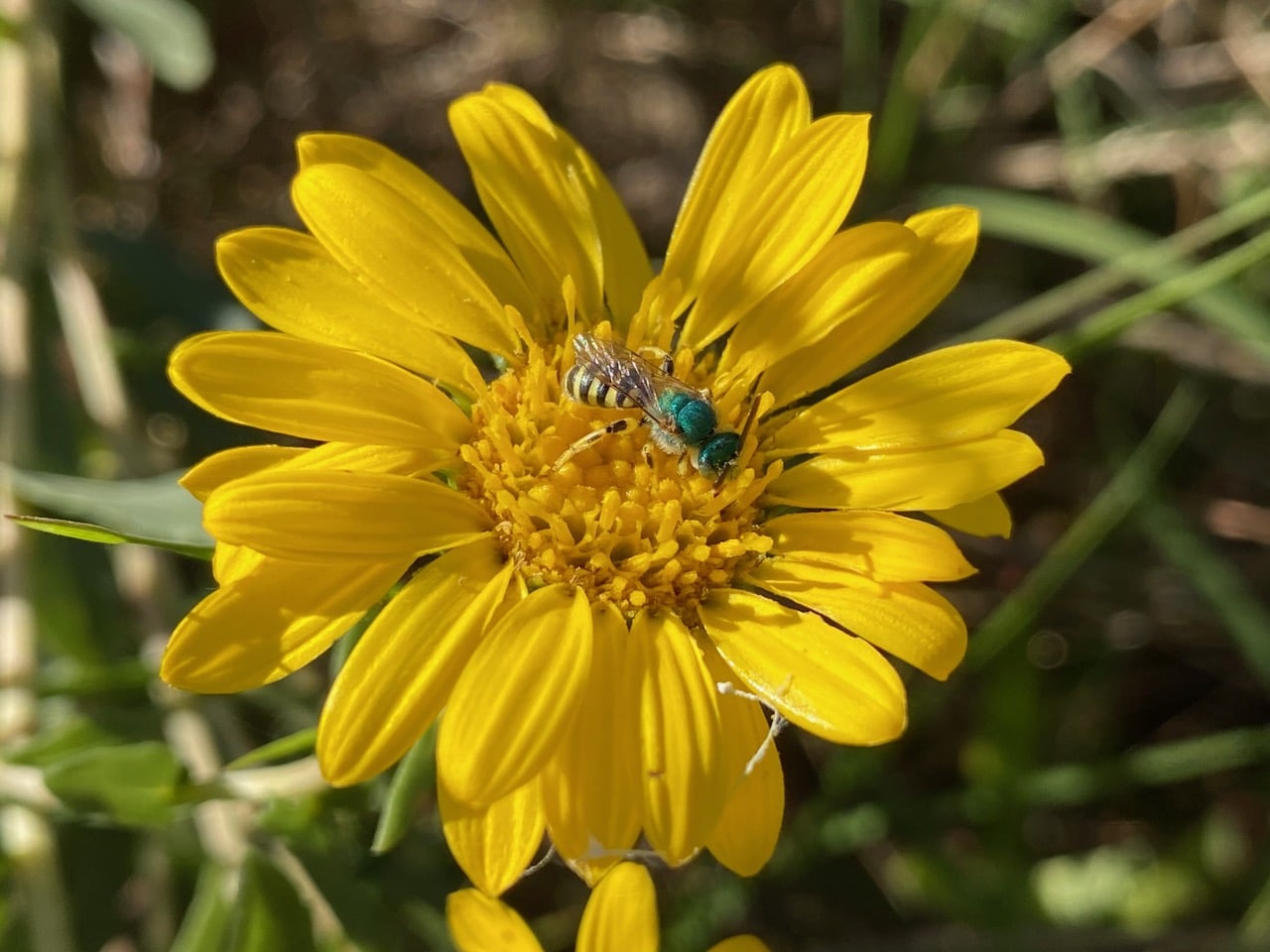
There are many male Striped Sweat Bees, Agapostemon sp. (family Halictidae) visiting the Grindelia that are still in bloom.
The genus Agapostemon is widespread and abundant throughout North America. These ground-nesting bees are most diverse and abundant in temperate regions and southwestern U.S. deserts. Agapostemon are commonly called “sweat bees” because they are closely related to, and resemble bees in the Halictus and Lasioglossum genera. Unlike those bees however, Agapostemon are not attracted to human sweat.
Agapostemon are brightly colored metallic green or blue bees measuring 7 to 14.5 mm long. Most species have a metallic green head and thorax, and black-and-yellow striped abdomen; some females are entirely bright green or blue. Females carry pollen on scopal hairs located on their hind legs. Agapostemon are generalists. Like other members of the family Halictidae, they are short-tongued and thus have difficulty extracting nectar from deep flowers. Males are often seen flying slowly around flowers looking for females. The bees favor flowers with high densities. They are active summer through fall.
Yesterday I received a notification from iNaturalist about a taxonomic split in the genus Agapostemon. Apparently the species that we have previously been calling the Texas Striped Sweat Bee, Agapostemon texanus is actually two species, the other being A. subtilior. According to the distribution map, the bees inhabiting our area is most likely the latter. Bummer – a new name to remember!
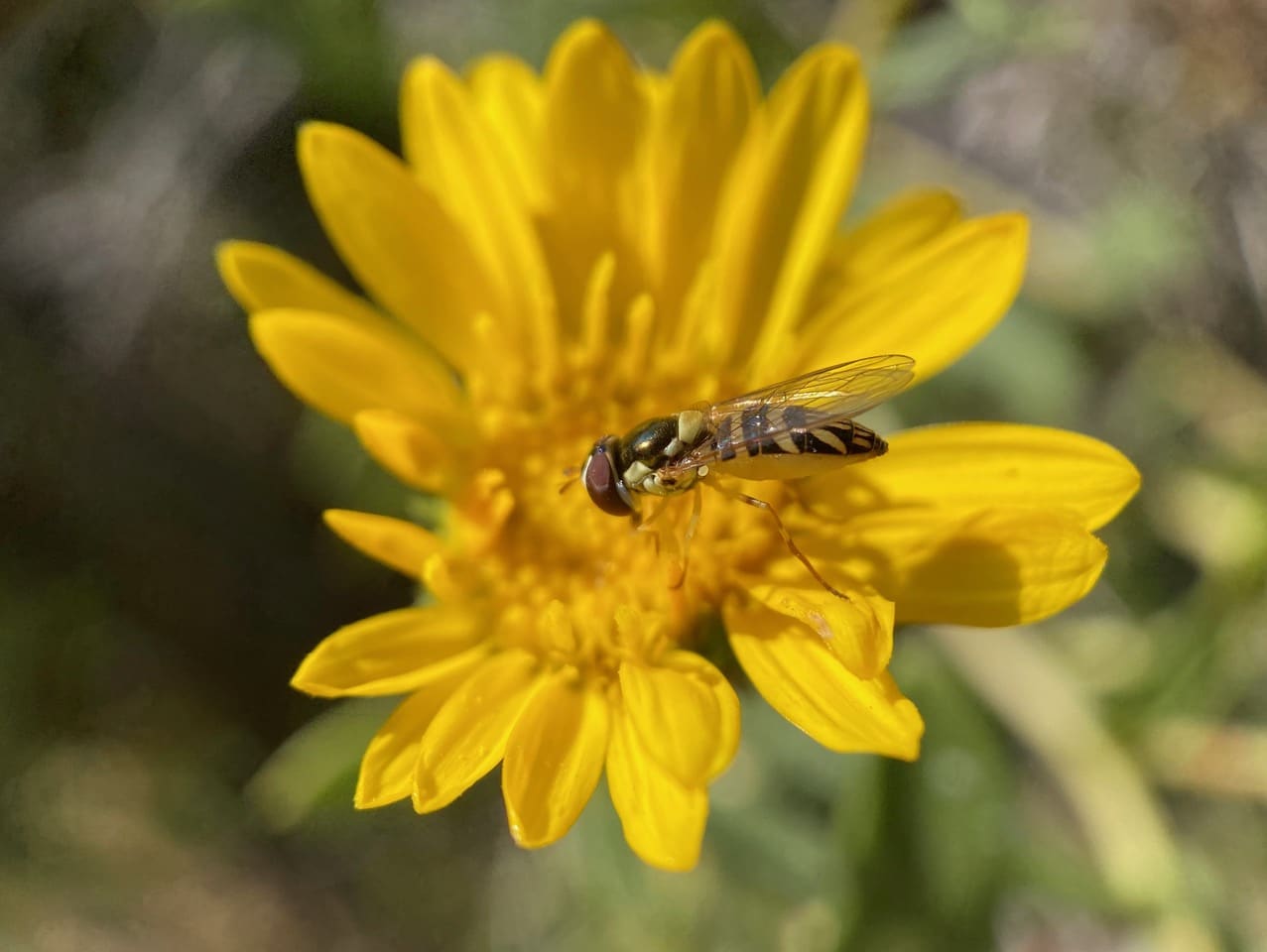
A gravid female Oblique Streaktail, Allograpta obliqua (family Syrphidae) lands on a Grindelia flowerhead. Her distended abdomen shows that she is probably ready to lay her eggs.
Here’s a clear view of the distinctive abdominal markings of the Oblique Streaktail.
The Oblique Streaktail, Allograpta obliqua (family Syrphidae) is a common North American species of hoverfly. Adults are 6-7 mm long. Females have a tapered abdomen that ends in a pointed tip. Eggs are laid on surfaces of leaves or stems near aphids. The larvae are important predators of aphids. Adults visit flowers for nectar and pollen, and are pollinators.
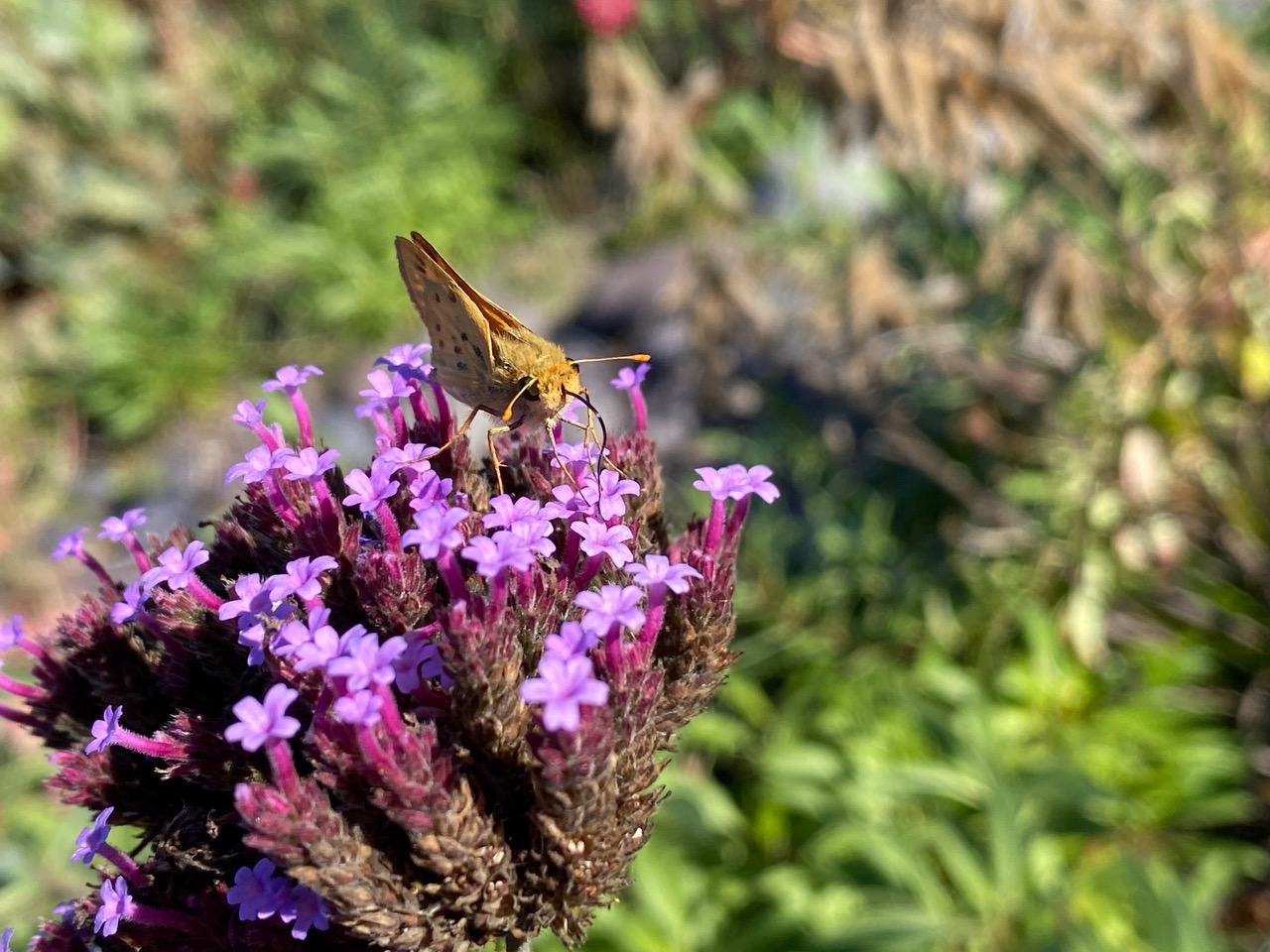
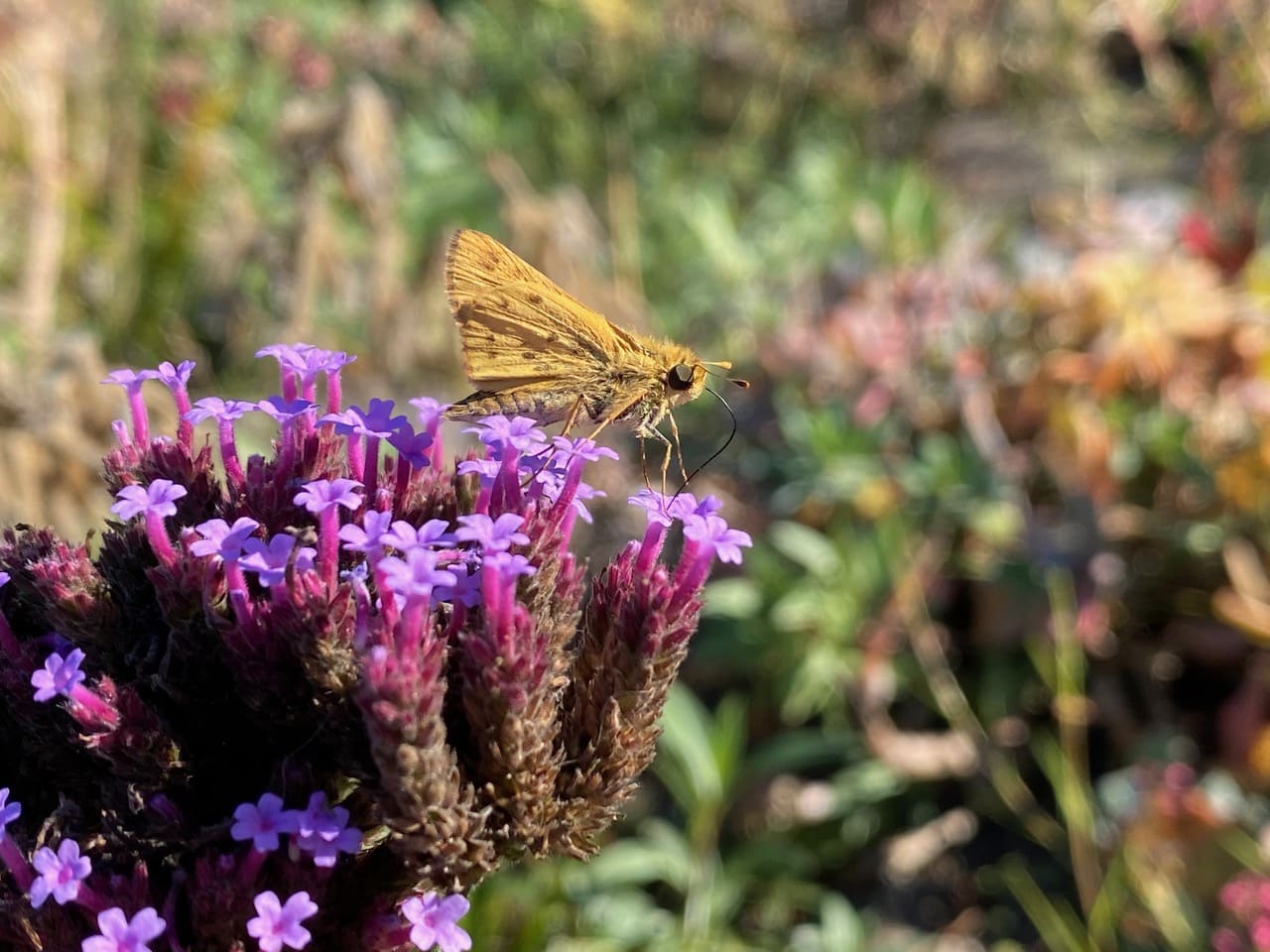
A neighbor’s prodigious garden spills onto the side of Shoreline Trail, delighting some insects. A Fiery Skipper has landed on an inflorescence of the Purpletop Vervain, Verbena bonariensis. The little butterfly unrolls its long flexible proboscis to probe for nectar in the base of the tiny tubular flowers.
Skippers are a family, the Hesperiidae, of the order Lepidoptera (butterflies and moths). They are named for their quick, darting flight habits. Most have the antenna clubs hooked backwards like a crochet hook. They also have generally stockier bodies and larger compound eyes than the other butterflies. Their wings are usually small in proportion to their bodies. When at rest, skippers keep their wings usually angled upwards or spread out, and only rarely fold them up completely. Californian species are mostly brown or tan, with black, orange, or yellow markings.
Skipper caterpillars are usually green or brown, sometimes yellowish, never brightly colored. They have a distinctive “collar”, a narrow ring around the body right behind the head. Caterpillars are camouflaged and often hide during the day. Many species make nests of leaves and silk for additional protection. Most North American species feed on grasses, but some common species eat shrubs and trees, especially in the bean family. Most species are limited to a single group of food plants. Adult skippers are only active during the day, but Skipper caterpillars feed mainly when it is dark or partly light.
The Fiery Skipper, Hylephila phyleus is a species of butterfly in the family Hesperiidae. The species has a wide range in North and South America. At about 1 inch in length, males are orange or yellow while the females are dark brown. In both sexes, small brown spots are seen on both the hindwings and forewings. Like other skippers, the Fiery Skippers often hold their wings in a “triangle” shape – the forewings held upright, and the hindwing folded flat. This position is thought to better absorb the sun’s rays. The butterfly’s flight is described as rapid and darting. Fiery Skipper larvae are greenish pink-grey with a black head and constricted neck. These caterpillars are often considered pests as they feed on many species of turfgrass.
A Honey Bee, Apis mellifera (family Apidae) is taking nectar on an inflorescence of the ornamental Perez’s Sea Lavender, Limonium perezii. What makes up most of the attractive lavender color are actually the trumpet-shaped calyces. The actual flowers are white.
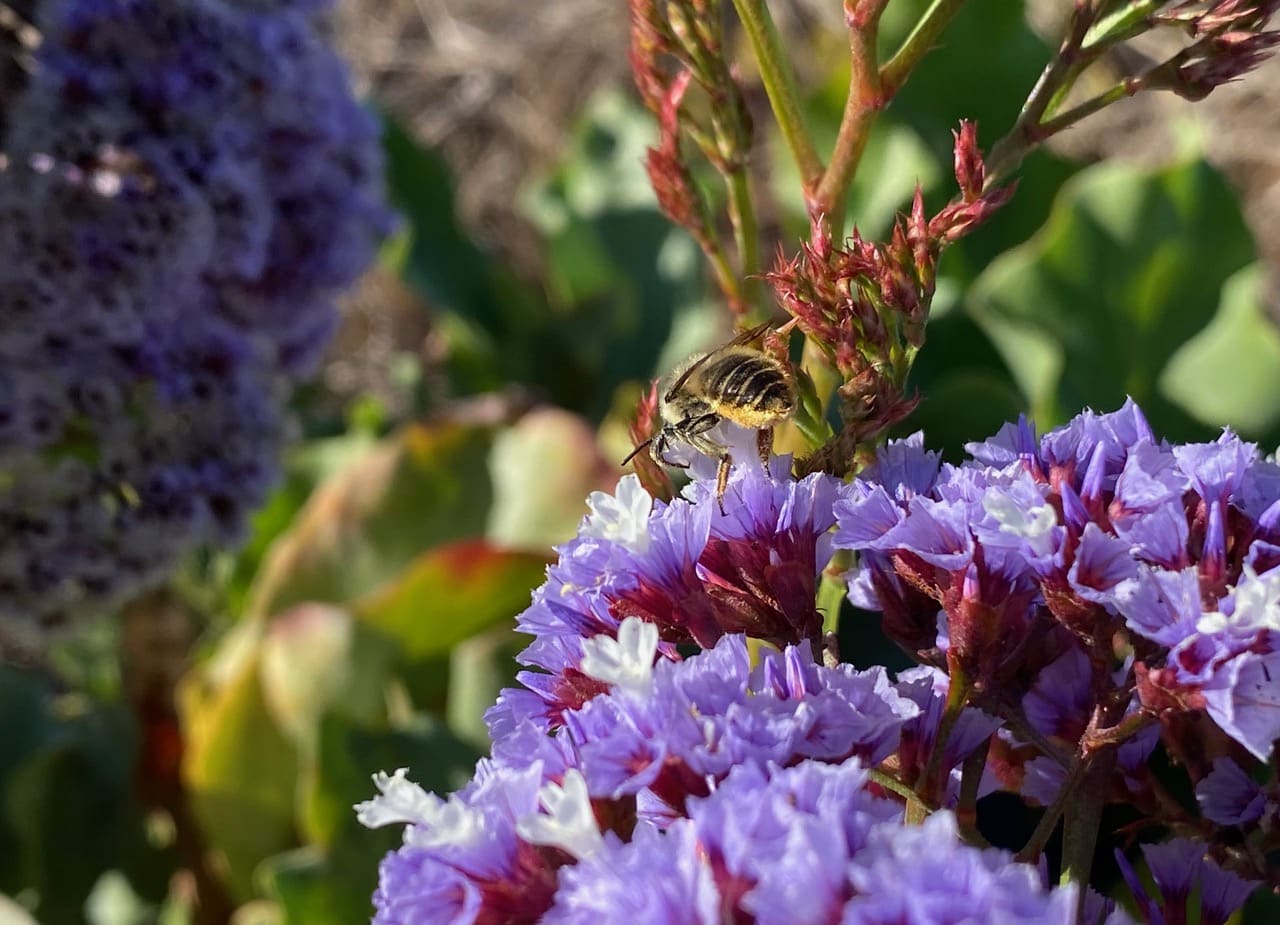
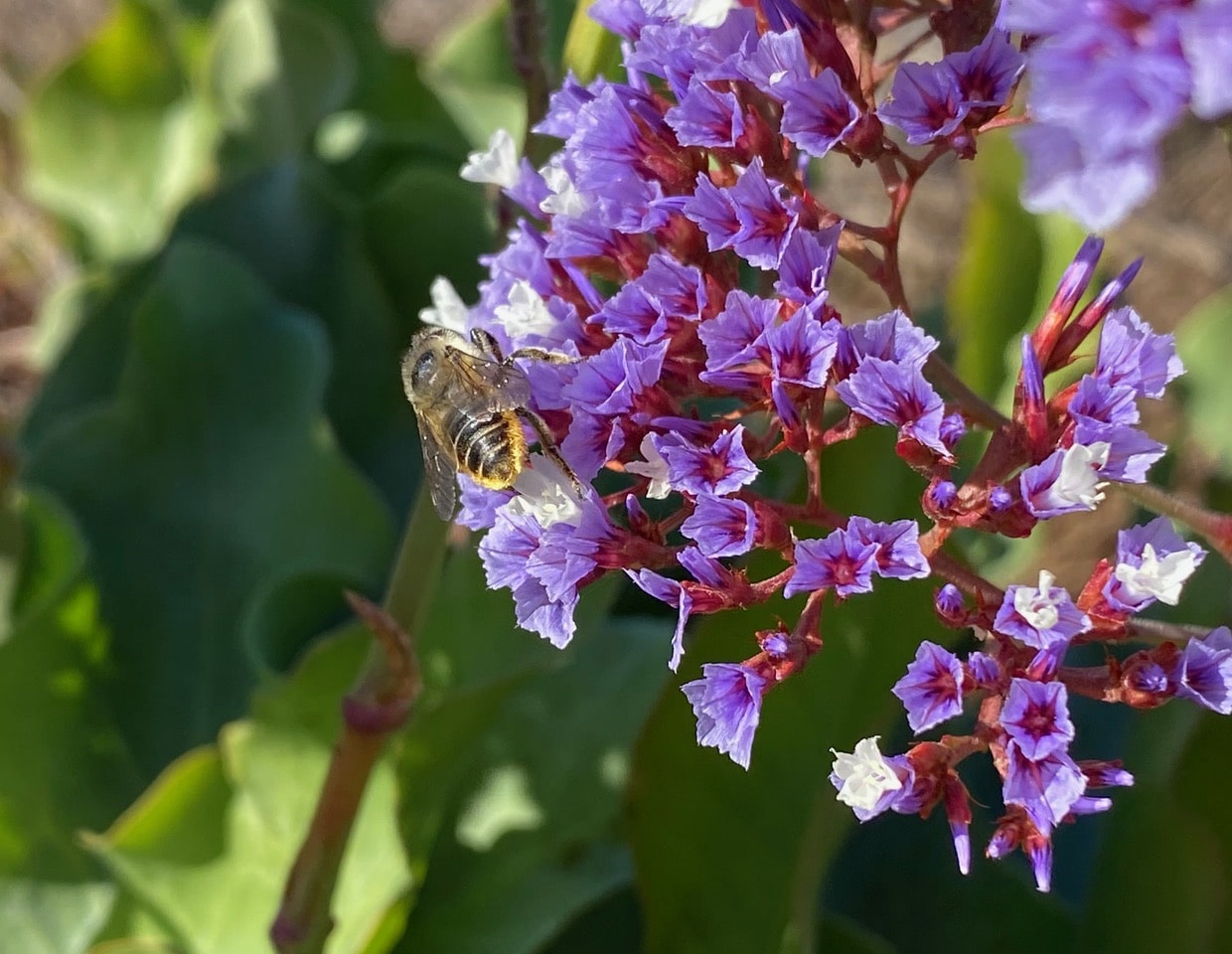
Ooh, there’s another bee on the Perez’s Sea Lavender, about the same size as the honey Bee, but stockier. It is a female Western Leafcutter Bee, Megachile perihirta (family Megachilidae). A male’s abdomen would be more rounded, and he would not have the orange hairs that make up the scopa on the underside of the females.
Hunched forward, the Leafcutter Bee reaches into a flower to sip nectar. She appears to have some light colored pollen on her abdominal scopa (special pollen collecting hairs).
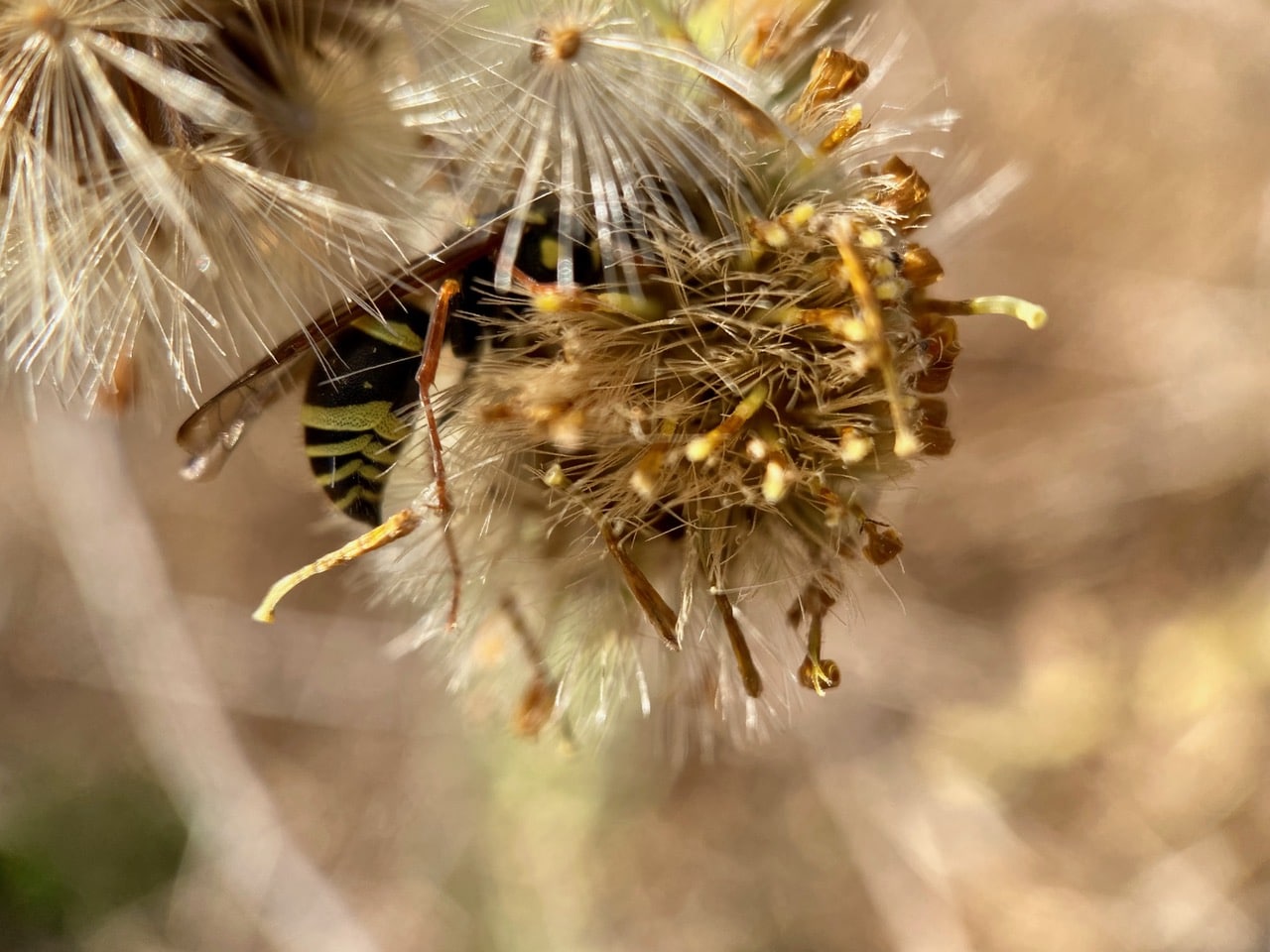
A small wasp is rummaging in a seed head of Telegraphweed, Heterotheca grandiflora. It is a Mason Wasp, Ancistrocerus bustamente (family Vespidae, subfamily Eumeninae). It is probably a female hunting for prey to provision her nest.
Potter wasps (or mason wasps), the Eumeninae, are a cosmopolitan wasp group presently treated as a subfamily of Vespidae. Most eumenine species are black or brown, and commonly marked with strikingly contrasting patterns of yellow, white, orange, or red. Their wings are folded longitudinally at rest. Eumenine wasps are diverse in nest building. The Mason Wasps are species that generally nest in pre-existing cavities in wood, rock, or other substrate. Potter Wasps are the species that build free-standing nests out of mud, often with a spherical mud envelope. The most widely used building material is mud made of a mixture of soil and regurgitated water.
All known Eumenine species are predators, most of them solitary mass provisioners. When a cell is completed, the adult wasp typically collects beetle larvae, spiders, or caterpillars and, paralyzing them, places them in the cell to serve as food for a single wasp larva. As a normal rule, the adult wasp lays a single egg in the empty cell before provisioning it. The complete life cycle may last from a few weeks to more than a year from the egg until the adult emerges. Adult mason wasps feed on floral nectar.