

Pollinator Post 10/20/24
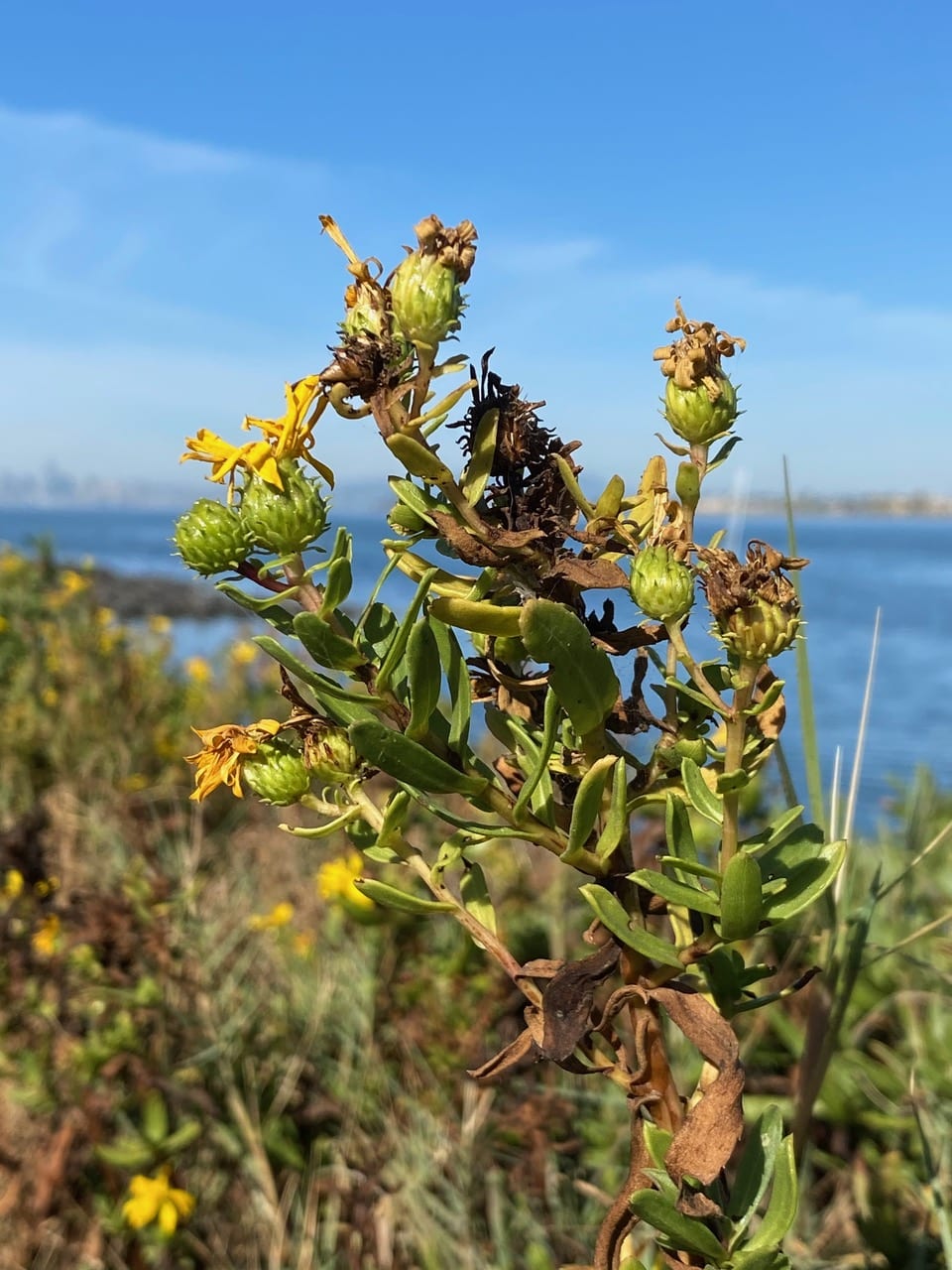
The Oregon Gumweed, Grindelia stricta along the shoreline of Bay Farm Island is winding down its season. I see fewer fresh flowers everyday.
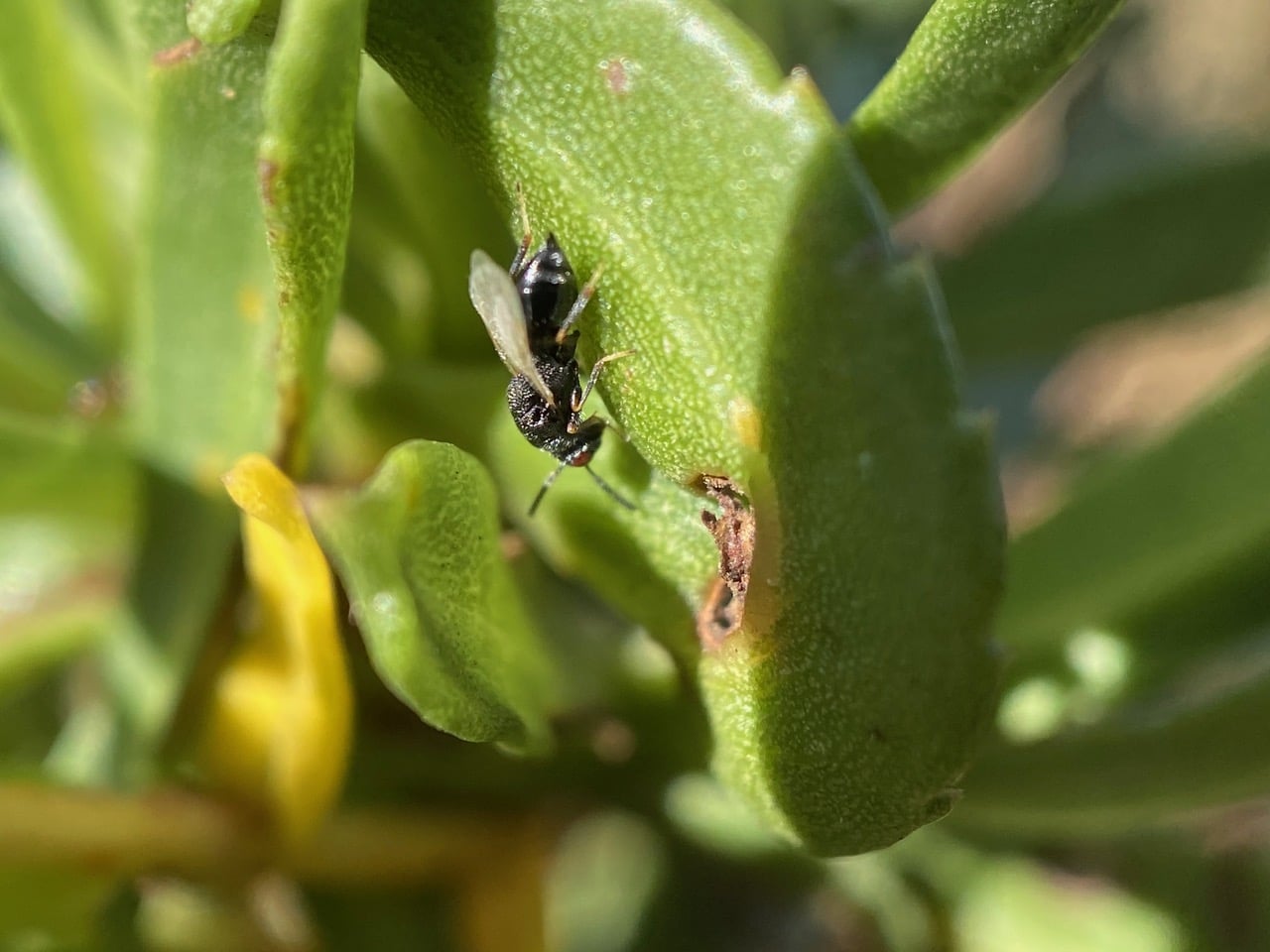
While there are fewer large insects to find among the Grindelia, I can now focus on the smallest of them that have been bypassed so far in favor of the more visible ones. Some tiny insects are flying over the Grindelia. The only way I can see them is to visually track their movements and see where they land. Ah, this one is a parasitic chalcid wasp, Eurytoma sp. (family Eurytomidae, superfamily Chalcidoidea).
Most Chalcid species are parasitoids of other insects, attacking the eggs or larval stage of their host, though many other life cycles are known. These hosts are to be found in at least 12 different insect orders including Lepidoptera (butterflies and moths), Diptera (true flies), Coleoptera (beetles), Hemiptera (true bugs), and other Hymenoptera, as well as two orders of Arachnida. When the host is itself a parasitoid, the wasps are referred to as hyperparasitoids. Generally beneficial to humans as a group, chalcidoids help keep various crop pests under control, and many species have been used as biocontrol agents.
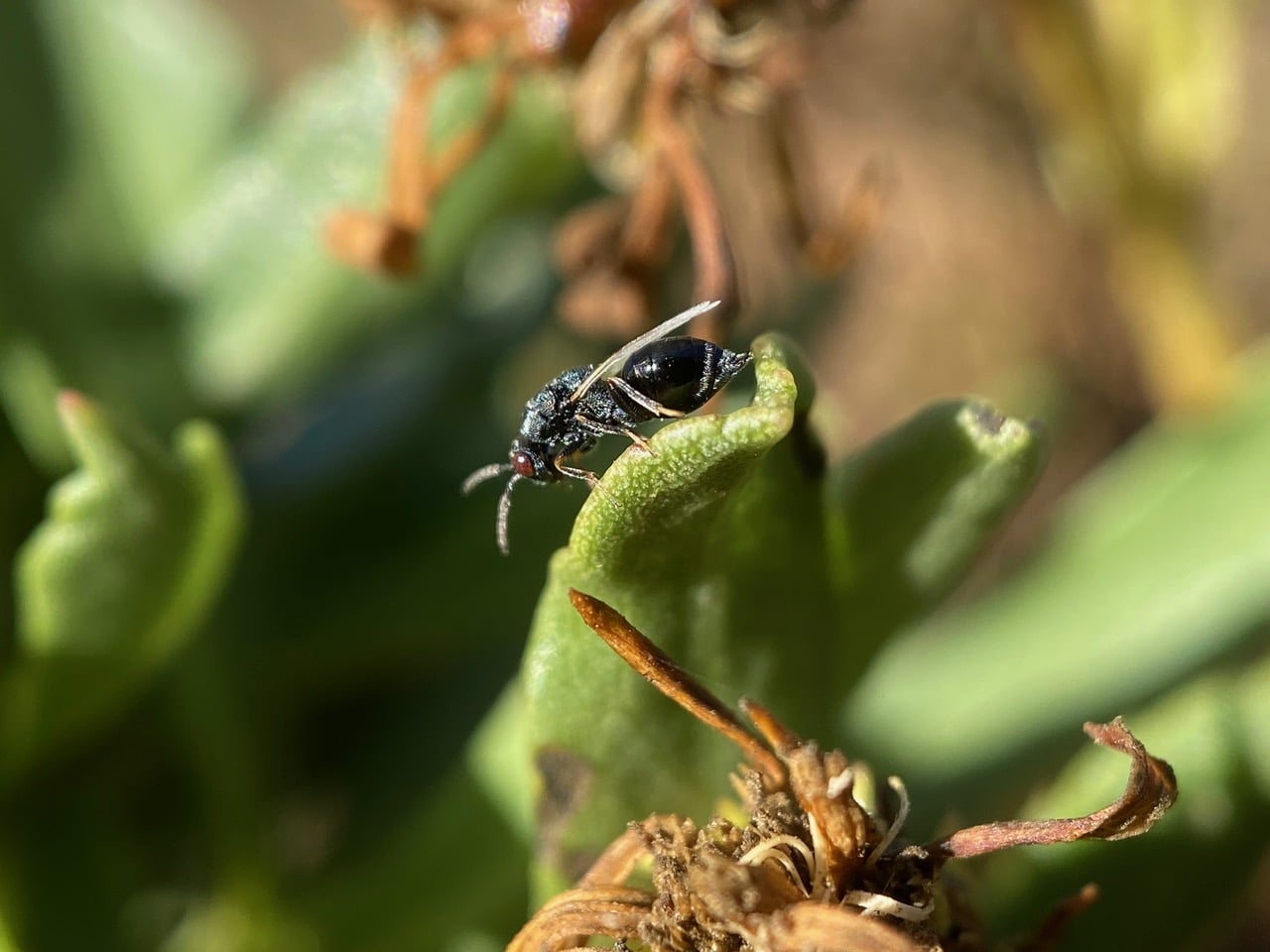
The Eurytomidae are a family within the superfamily Chaldoidea. Unlike most chalcidoids, the larvae of many are phytophagous (feeding in stems, seeds, or galls), while others are more typical parasitoids, with hosts that are usually found within plant tissues. They are found throughout the world in virtually all habitats, and a few are considered pests. The wasps tend to be dull and not metallic, and heavily punctured, with very thick collar-like pronota.
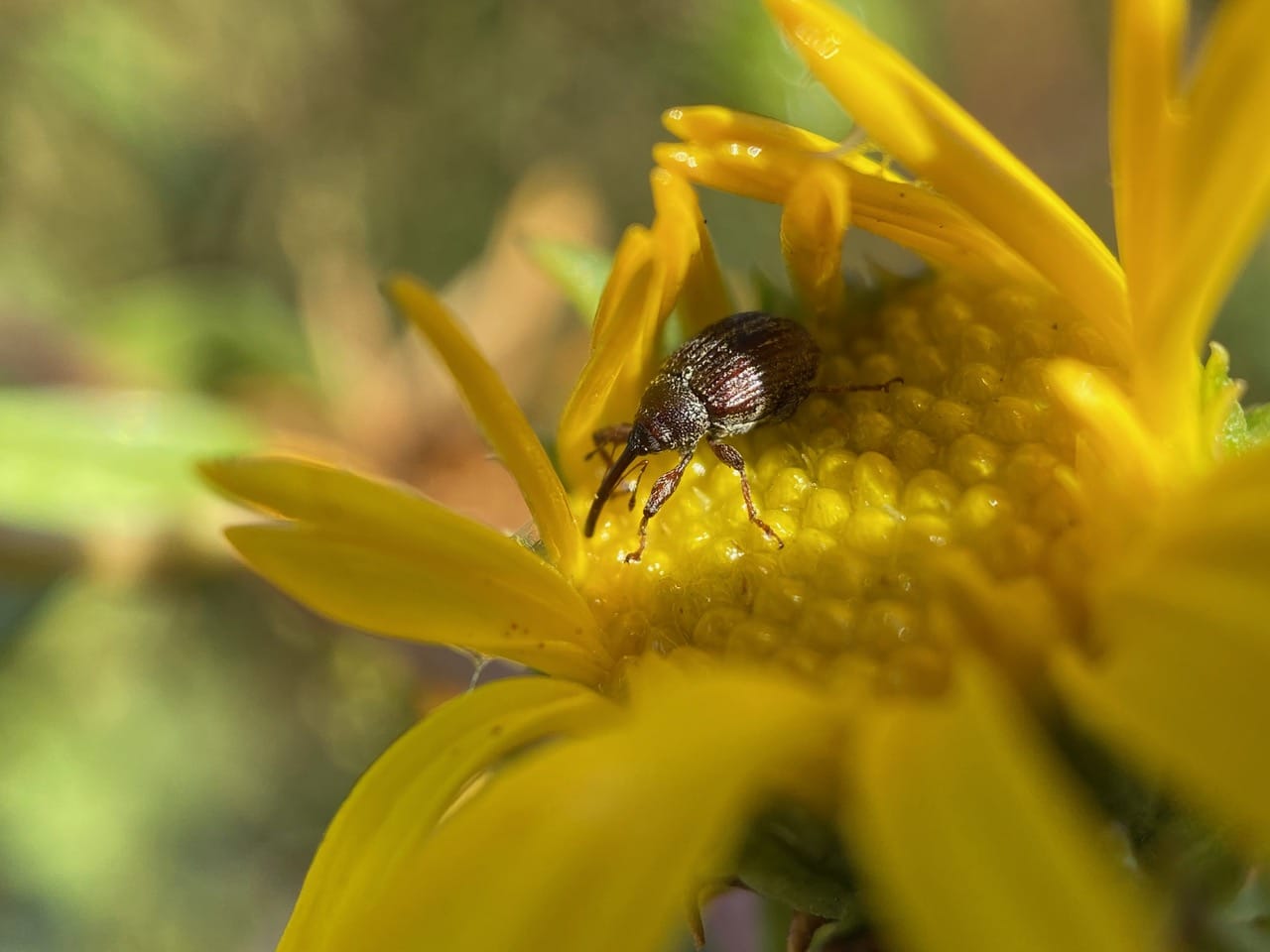
A small Weevil (family Curculionidae) is hidden in partial shadows on a Grindelia flowerhead.
Weevils, family Curculionidae, are also called snout beetles. Curculionidae is one of the largest beetle families (about 40,000 species). Most weevils have long, distinctly elbowed antennae that may fold into special grooves on the snout. The snout is used not only for penetration and feeding but also for boring holes in which to lay eggs. The mouthparts are quite small and located at the end of the rostrum (snout), designed for chewing. Many weevils have no wings, while others are excellent fliers. Most are less than 6 mm in length. The majority of weevils feed exclusively on plants. The fleshy, legless larvae of most species feed only on a certain part of a plant – i.e., the flower head, seeds, fleshy fruits, stems, or roots. Many larvae feed either on a single plant species or on closely related ones. Adult weevils tend to be less specialized in their feeding habits. The family includes some very destructive agricultural pests.
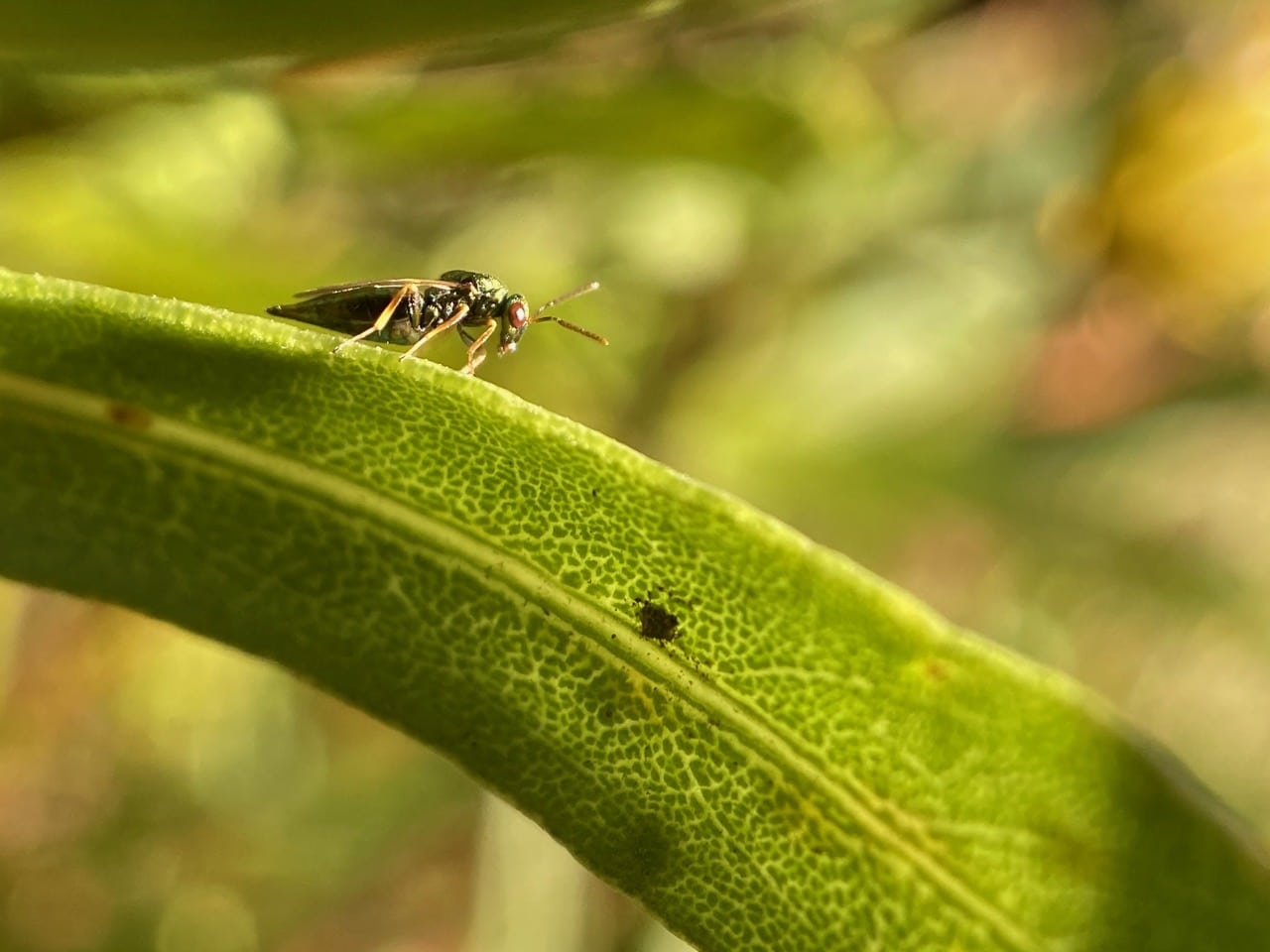
Ooh, another chalcid wasp on the Grindelia! The iridescent green wasp has red eyes, and a large abdomen that tapers evenly to a pointed tip. Looks like a typical chalcid wasp Omyrus sp. (family Ormyridae).
The Ormyridae are a small family of parasitic wasps in the superfamily Chalcidoidea. They are either parasitoids or hyperparasitoids on gall-forming insects, primarily cynipid wasps and tephritid flies. The 120 or so species (mostly in the genus Ormyrus) occur worldwide, except for South America. Some species have distinctive scalloped sculpturing of their thorax. Adults of many species are iridescent.

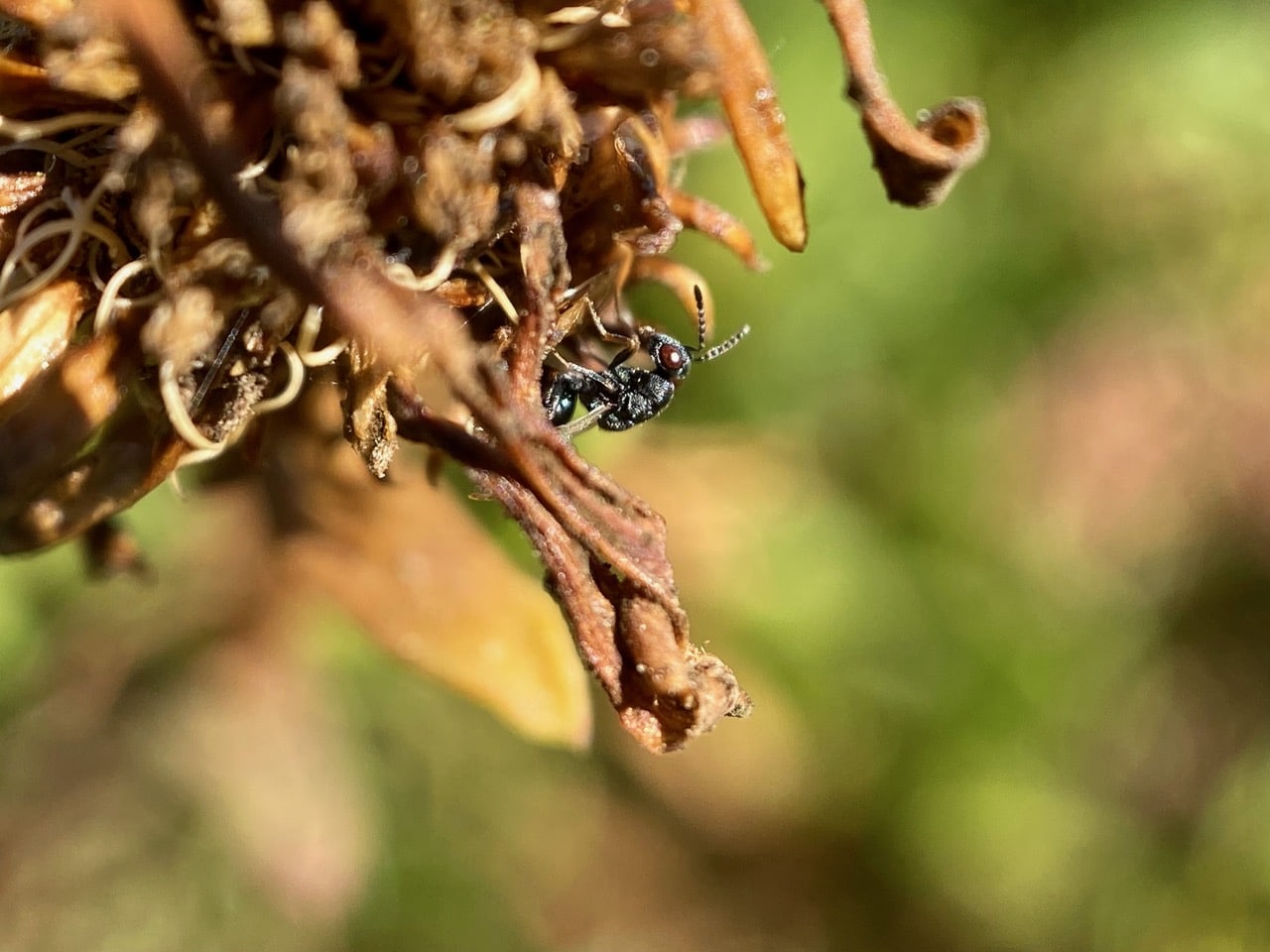
Hey, yet another chalcid wasp, Eurytoma sp. (family Eurytomidae)!
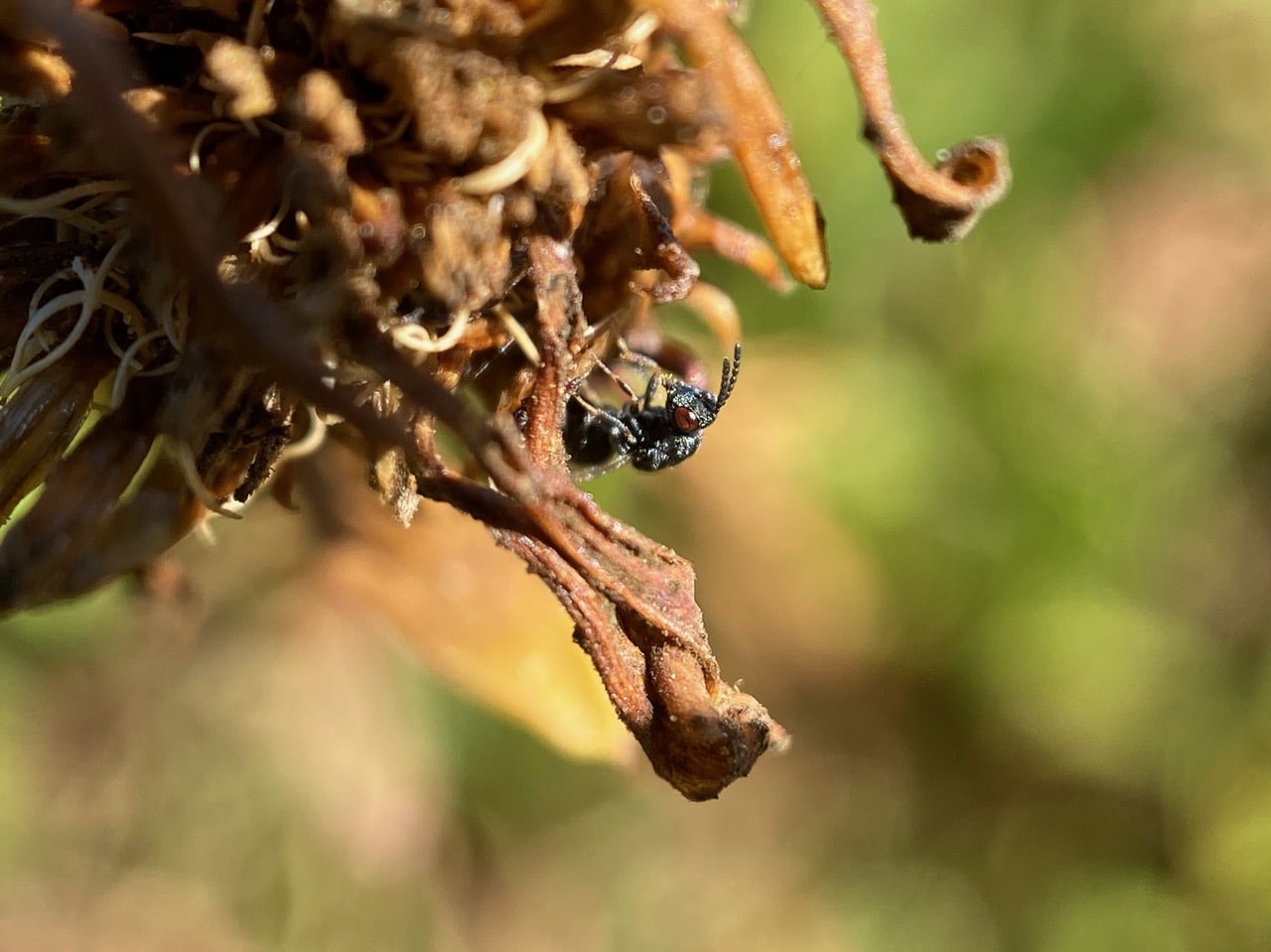
The tiny wasp proceeds to groom itself, giving me a view of its heavily punctured thorax.
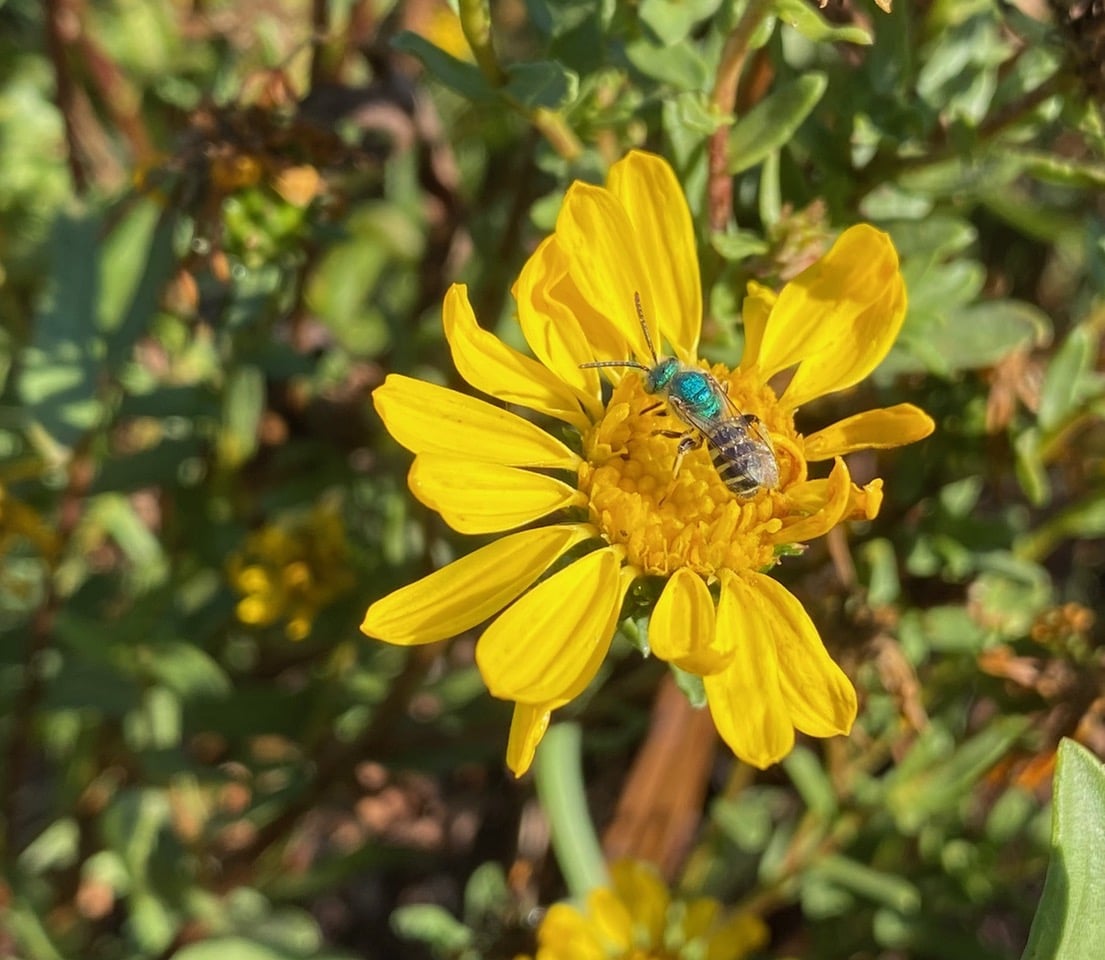
While the numbers of most bees have sharply declined, the Texas Striped Sweat Bee, Agapostemon texanus (family Halictidae) is still going strong. This individual is a male, as evidenced by his black-and-yellow striped abdomen. Females are entirely green.
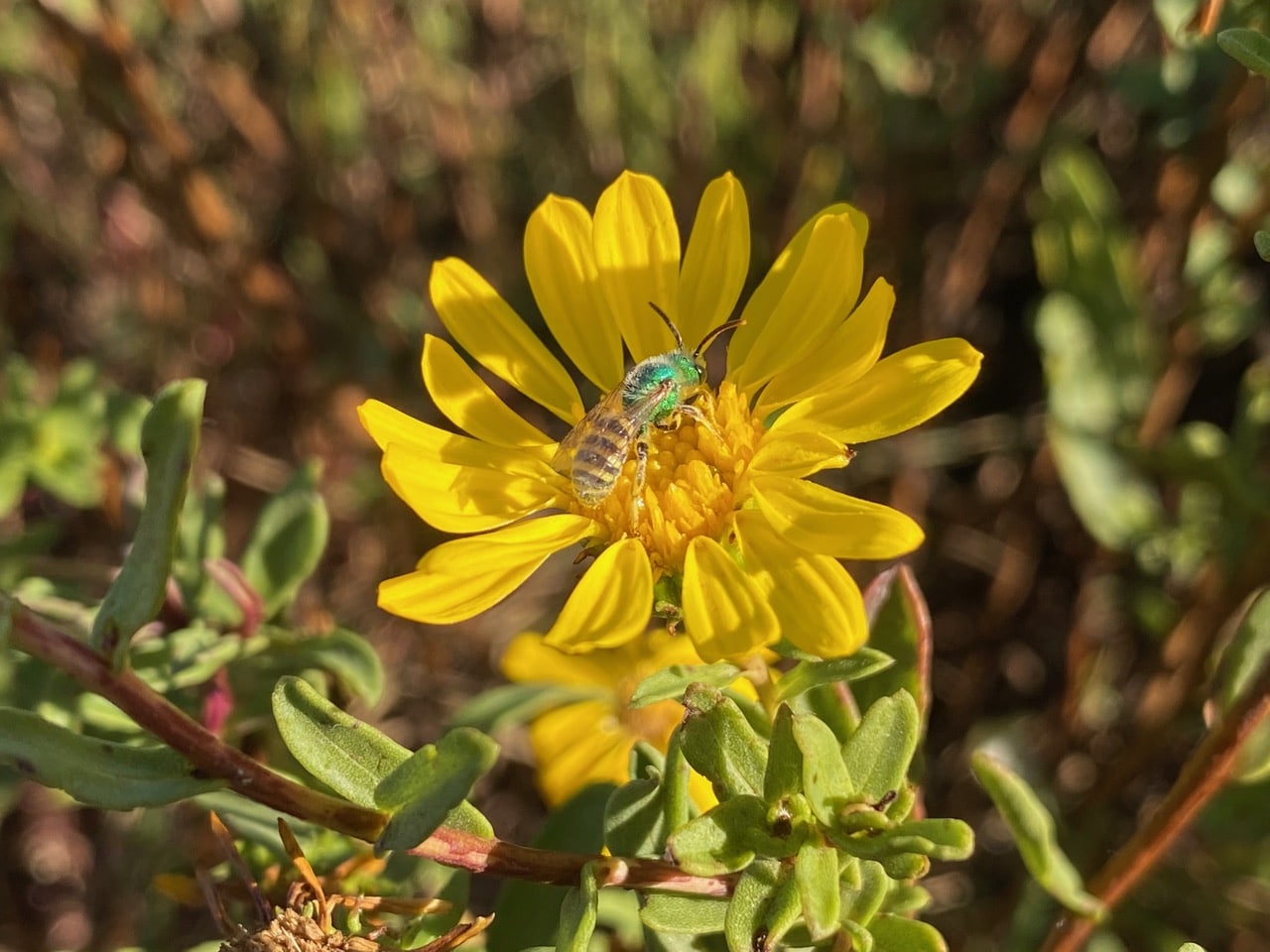
In Greek, the genus name Agapostemon means “stamen loving”, referring to the bee’s need to forage for pollen. The family Halictidae consists of small, non-aggressive bees with short tongues. They are called sweat bees because they are often attracted to human perspiration from which they obtain salts and water.
The Texas Striped Sweat Bee, Agapostemon texanus is most commonly found in the west coast of the United States. The species is easily recognized by its metallic green coloration. The females have an entire body that is brilliant blue-green, while the males have an abdomen that is brownish-black with yellow bands. The males (9-10 mm) are smaller than the females (11mm). Due to their short tongues, the Texas Striped Sweat Bees have a limited ability to access nectar from deep flowers. They are generalist foragers, visiting a wide range of flowers.
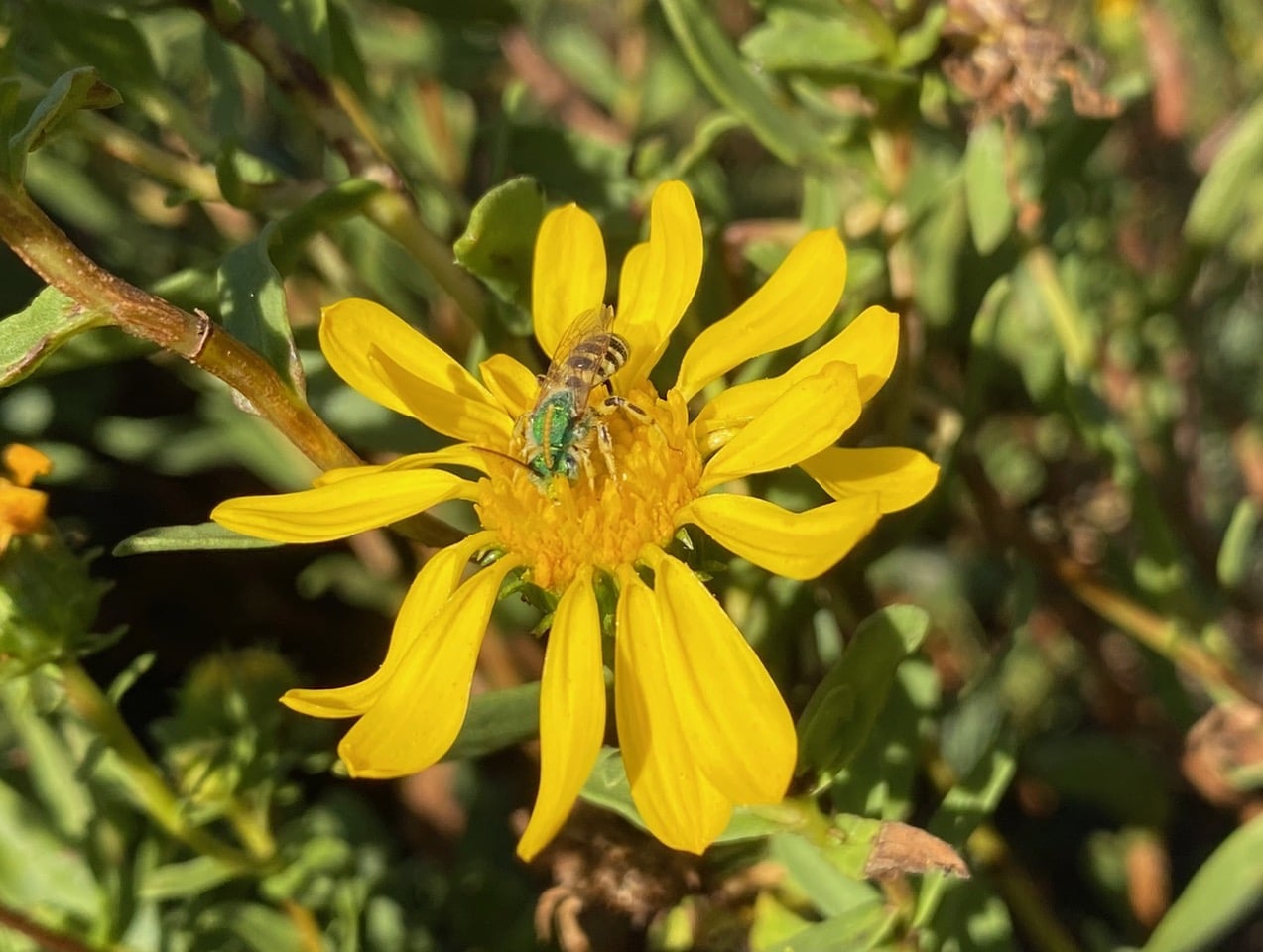
Female Agapostemon texanus are active May through October, while males are on wing from July through October. Two generations are produced per year. In the fall fertilized females overwinter in their nests while males typically die. In the spring the fertilized females emerge. They construct their underground nests in bare, loamy soil, lay their eggs in brood chambers and provision them with pollen before dying. In this first generation, the eggs hatch into mostly females as they develop from fertilized eggs. To fix the skewed sex ratio these females lay unfertilized haploid eggs that develop into males. During the summer months the male and female Texas Striped Sweat Bees mate, thus repeating the cycle.
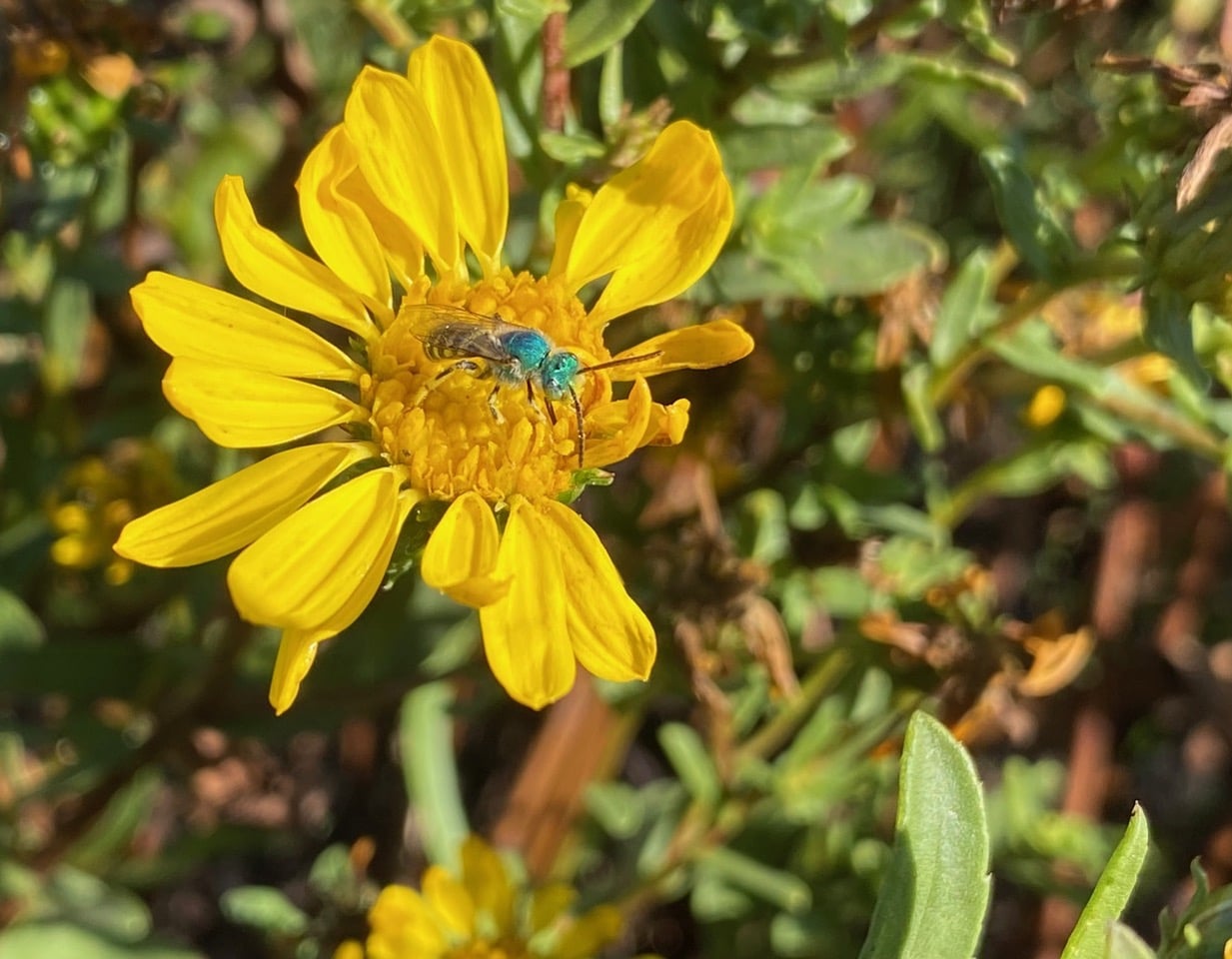
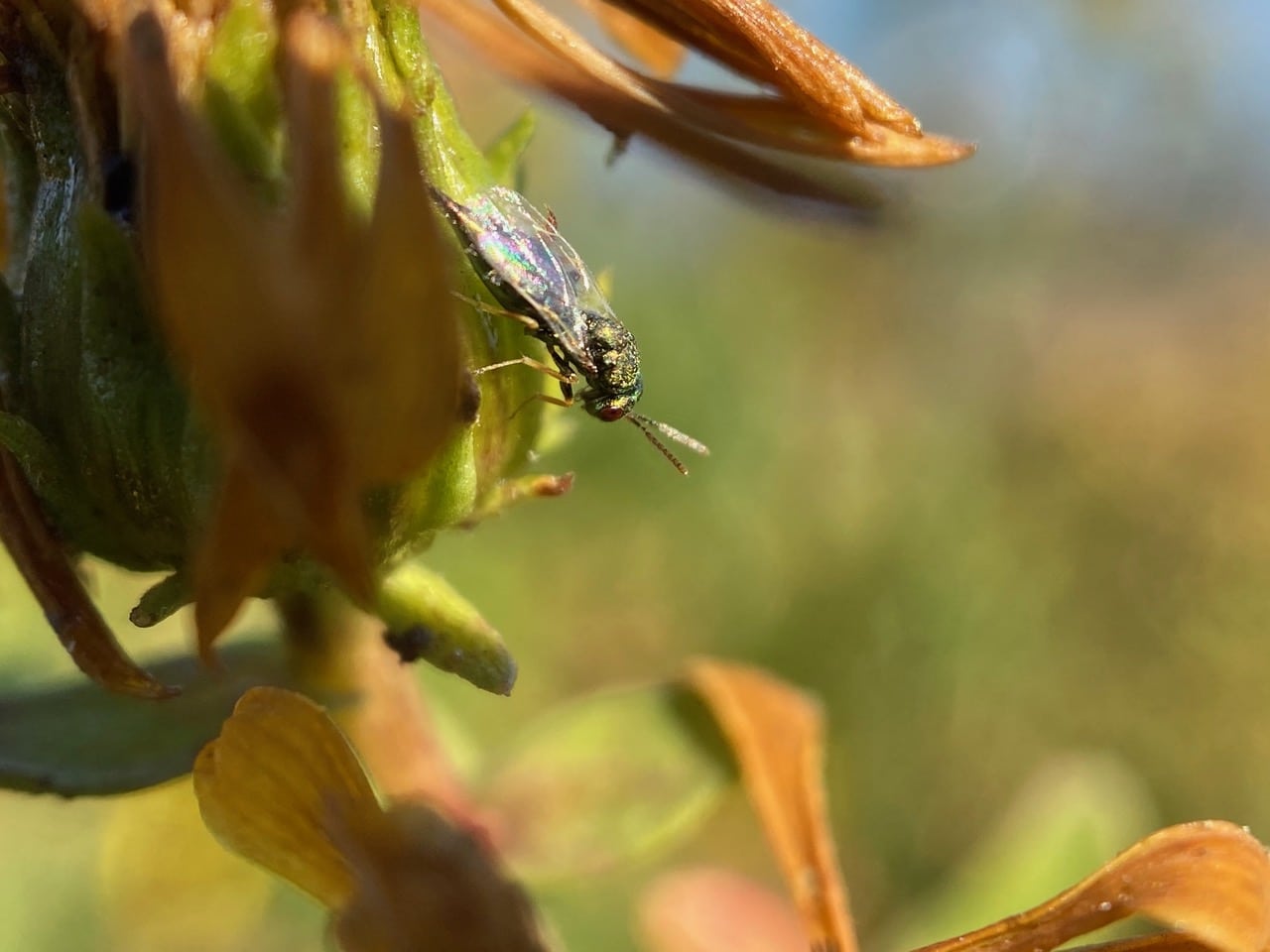
Yet another chalcid wasp, Omyrus sp. (family Ormyridae)! This one is on a fading Grindelia flowerhead. I have on two occasions recorded a female Fruit Fly (family Tephritidae) laying eggs in the immature Grindelia flowerheads. Maybe the parasitoid wasp is here to lay eggs on the Fruit Fly larvae? These wasps are known to parasitize gall-forming Tephritid flies.
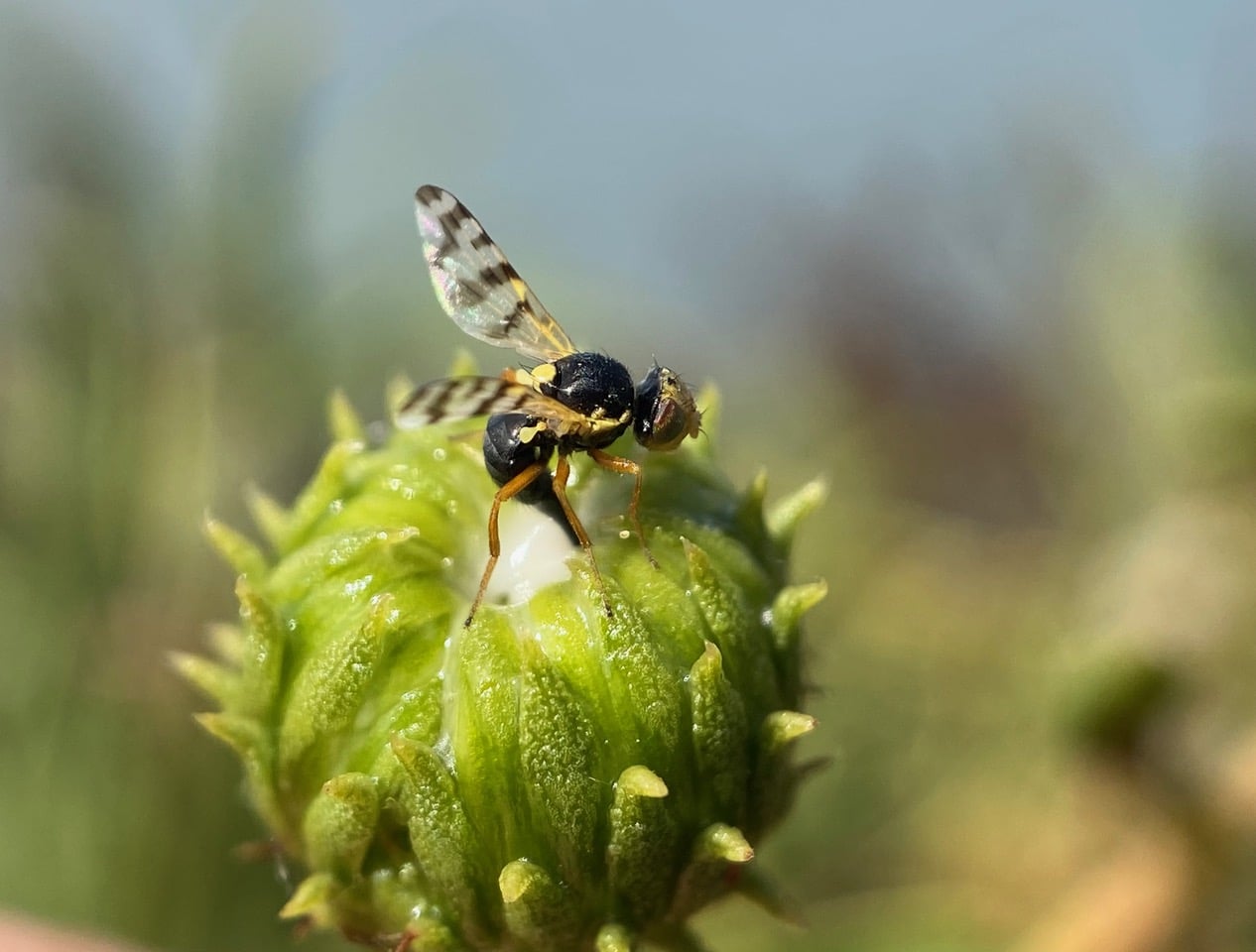
This photo was taken on 9/15/24. The female Fruit Fly depositing eggs in the immature Grindelia flowerhead has now been identified by an expert on iNaturalist as the species Goedenia formosa (family Tephritidae).
When I asked about the wasp’s adaptations for dealing with the gooey sap of Grindelia, Spencer informed me that a similar species that uses Grindelia as a host plant, Goedenia steyskali has a better studied life history. Apparently, the larvae actually eat the sap as they emerge from the base of the flower! They even overwinter with the aid of the sap by combining it with feces to build a little cell that the third instar lives in while waiting to pupate. So cool!
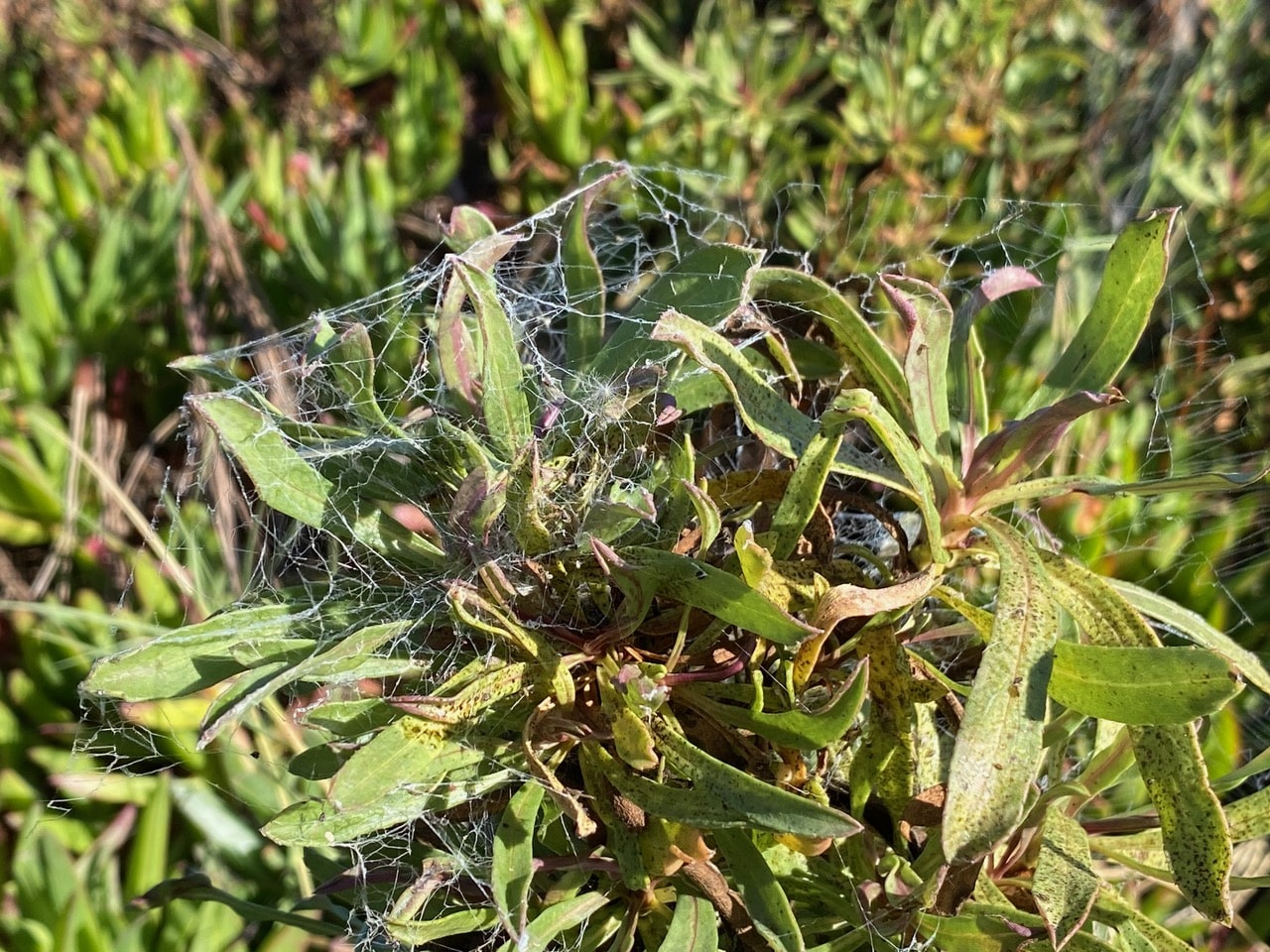
Real Halloween decorations on a Grindelia. The extensive web that wraps around the whole plant most likely belongs to a Grey House Spider, Badumna longinqua (family Desidae).
Badumna longinqua (family Desidae) is native to eastern Australia, but it has increased its global range to north and south America, South Africa, and Japan. In the United States, B. longinqua is usually found in woodlands, along immediate coastal areas, within agricultural ecosystems, and recently in vineyards. It is usually the spider found in tangles of leaves held together by messy webs on the outermost upper fringes of small shrubs in the suburbs. Although also abundant around homes and buildings, the spiders are not often seen as it feeds at night and will stay hidden in its retreat during the daytime.
The female B. longinqua spider can potentially spend her entire life in one same web, while the mature males tend to roam in search of mates. As a starting point for its web, the spider first finds a satisfactory hiding place, such as a crack or small opening to funnel out its web from, which it then interlines with silk. From this tubular entrance, it builds a multitude of ladder-like webs in a radiating fashion. Badumna spiders use cribellate silk which is produced from numerous tiny silk glands underneath a specialized spinning organ called a cribellum. The cribellum surface is covered by hundreds of thousands of tiny, elongate spigots which each produces an extremely thin single fibril of cribellate silk merely tens of nanometers thick. All spigots act together to produce a single cribellate thread made up of thousands of silk fibrils. The fibers are so small in diameter that they are strongly subject to Van der Waals forces. In addition, the fibers have a surface that absorbs waxes from the epicuticle of insect prey on contact. This creates a powerful adhesion without any liquid glue. Cribellate spiders possess a row of toothed bristles, the calamistrum on the hind legs that they use to comb out the silk, producing a woolly texture.
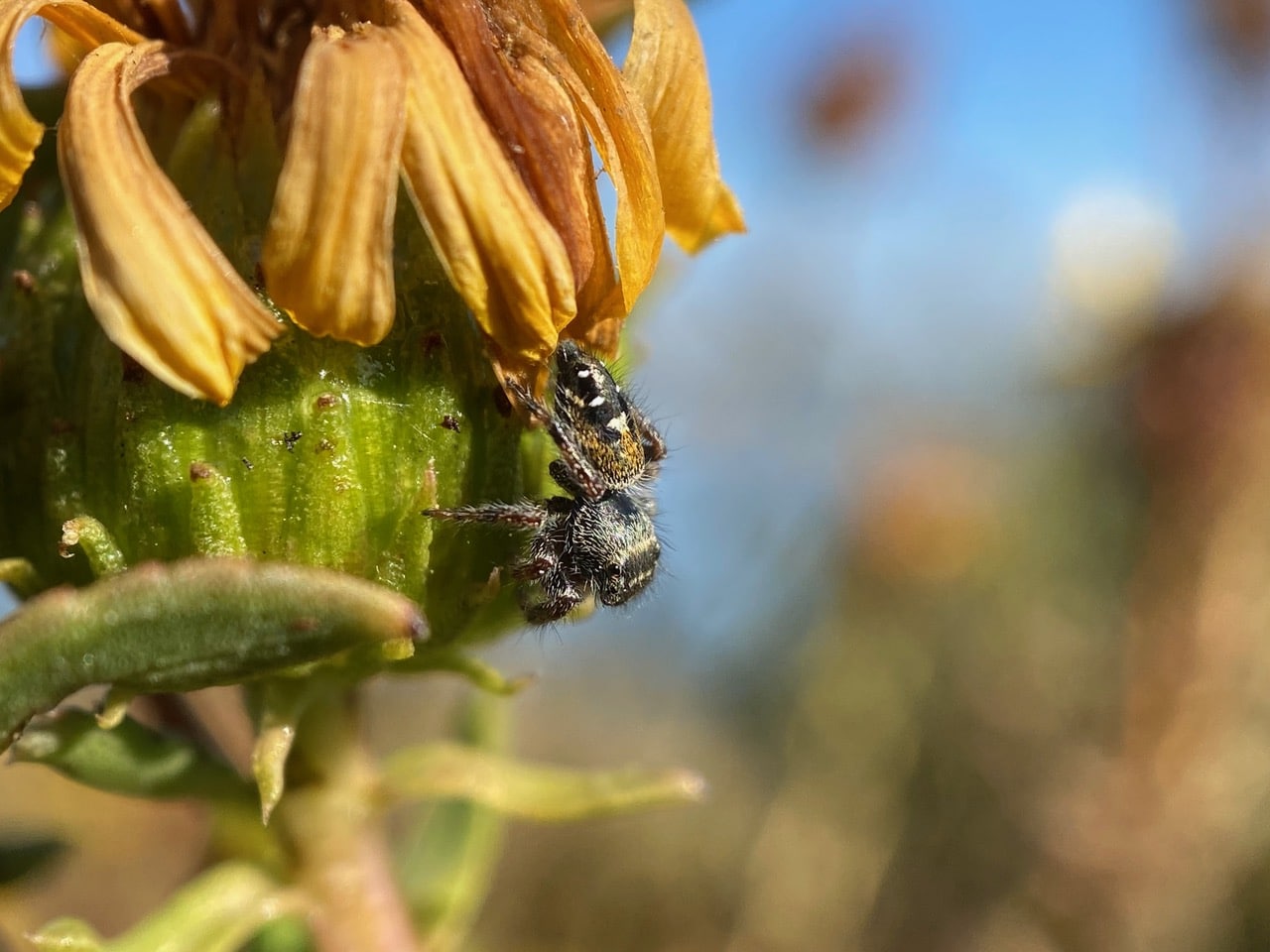
As a tiny wasp lands on the involucre of a faded Grindelia flowerhead, I close in for a photo only to find a small jumping spider instead. The spider has apparently made a leap for the wasp but missed. Judging from the faint reddish-orange hairs on its abdomen, the spider is apparently a young female Johnson’s Jumping Spider, Phidippus johnsoni (family Salticidae).
Salticids are free-roaming hunting spiders. They do not weave a web to catch prey. They stalk, then pounce on their prey. Just before jumping, the spider fastens a safety line to the substrate. It can leap 10-20 times their body length to capture prey. Their movement is achieved by rapid changes in hydraulic pressure of the hemolymph (insect version of blood). Muscular contractions force fluids into the hind legs, which cause them to extend extremely quickly.
Johnson’s Jumping Spider, Phidippus johnsoni is one of the largest and most commonly encountered jumping spiders of western North America. Adults are about a centimeter in length. While both sexes have a bright red abdomen, the female has an additional black central stripe with white markings. The spiders construct conspicuous tubular silken nests under rocks and wood on the ground. They stay inside the nests at night and during bad weather. Molting, egg laying and sometimes courtship and mating occur inside these nests. They feed on a wide variety of insects, and also prey heavily on spiders. Cannibalism does occur sometimes, when females feed on males.
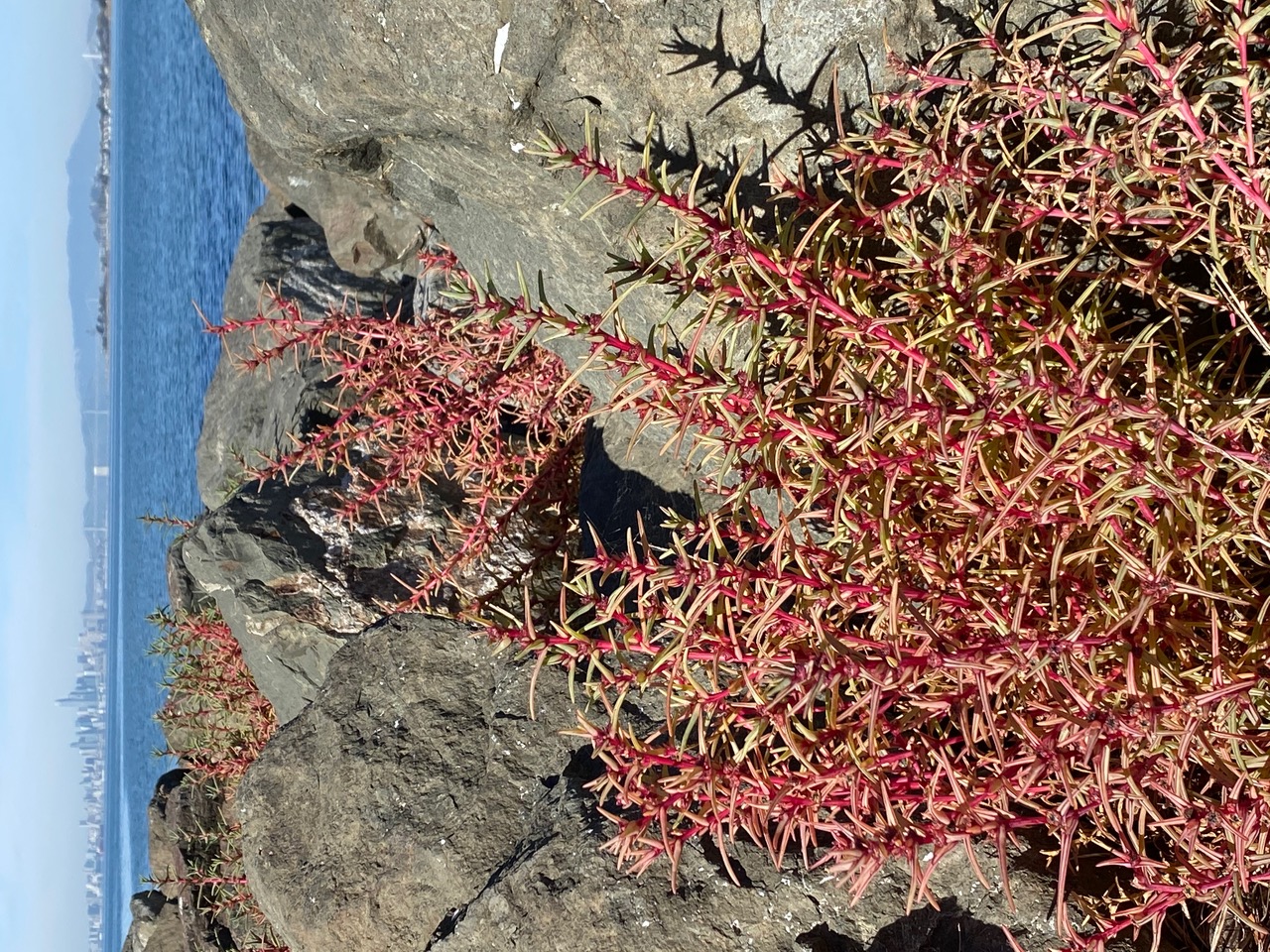
The Fleshy Russian Thistle, Salsola soda (family Chenopodiaceae) along the shore are turning red.
Salsola soda (Fleshy Russian Thistle, Oppositeleaf Russian Thistle, or Glasswort) is native to southern Europe and inhabits vernal pools, swamps, mudflats and salt marshes. It is widespread in the San Francisco Bay region, in estuaries, especially in disturbed areas. It is also found in undisturbed salt marsh areas in the southern San Francisco Bay. The plant has floating fruits that serve to distribute their seeds on tidal currents.
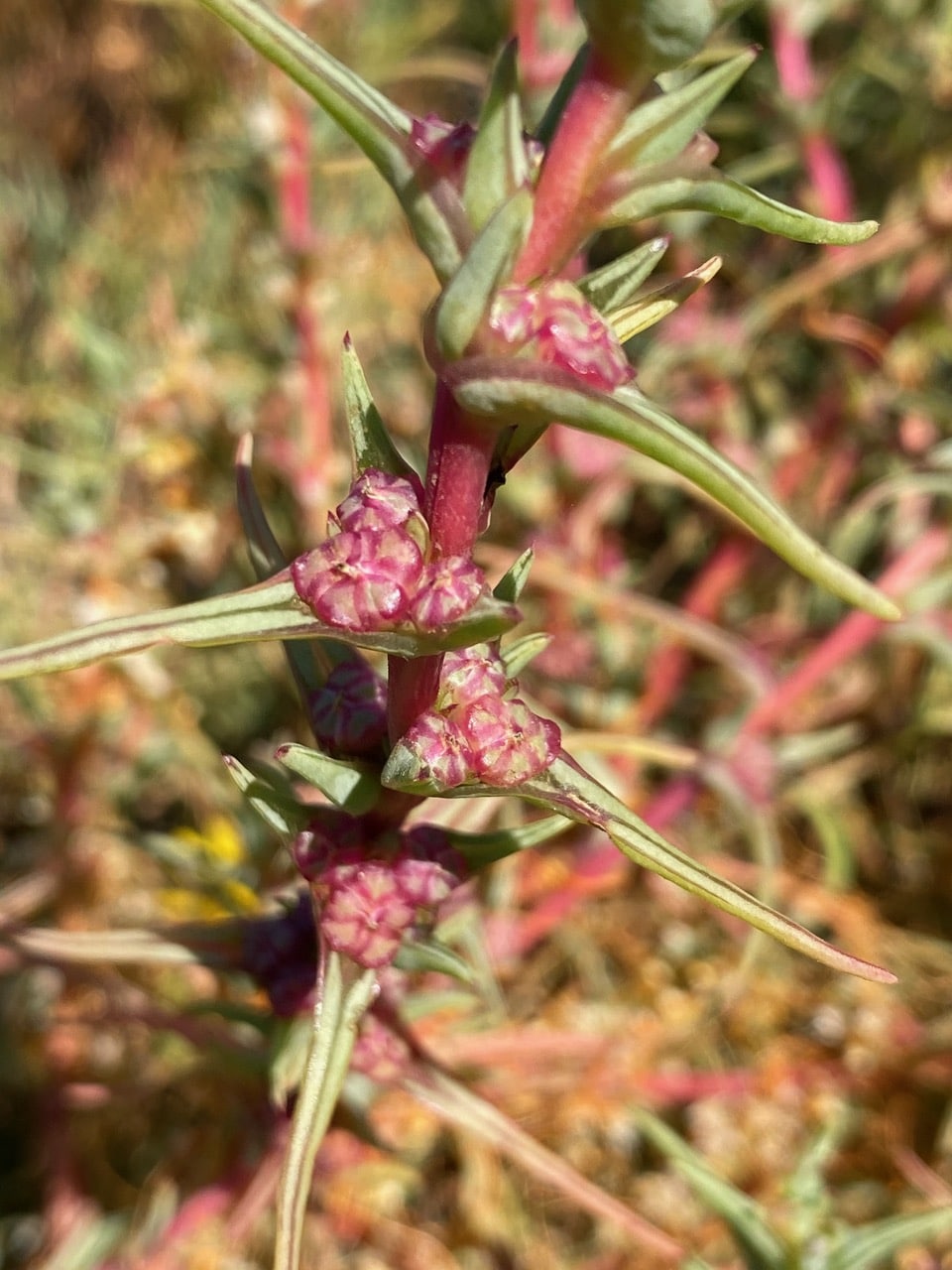
The color is enhanced by small clusters of reddish jelly-like structures at the leaf axils.
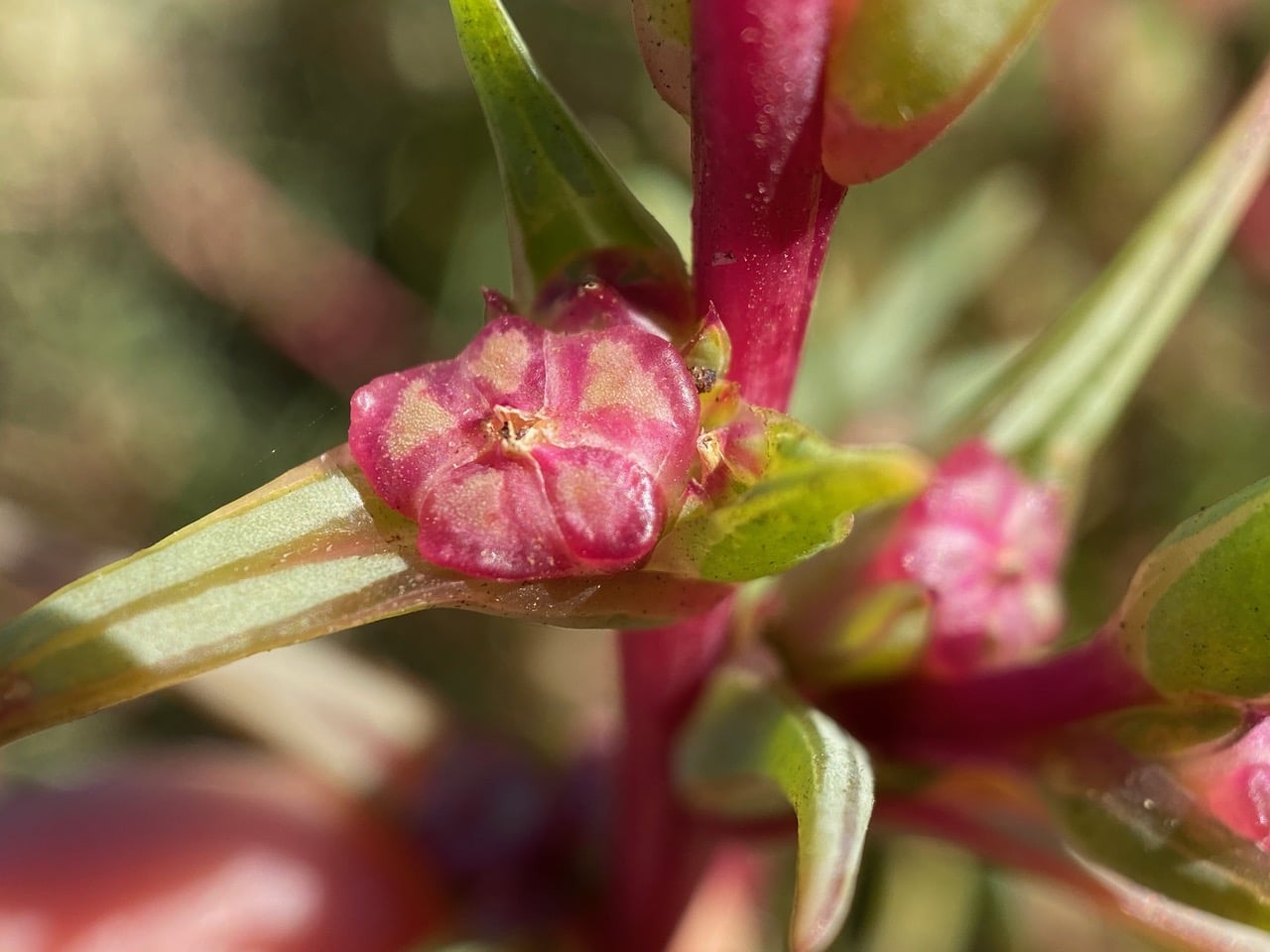
Are these flower buds? or fruits? Have I already missed the flowering?
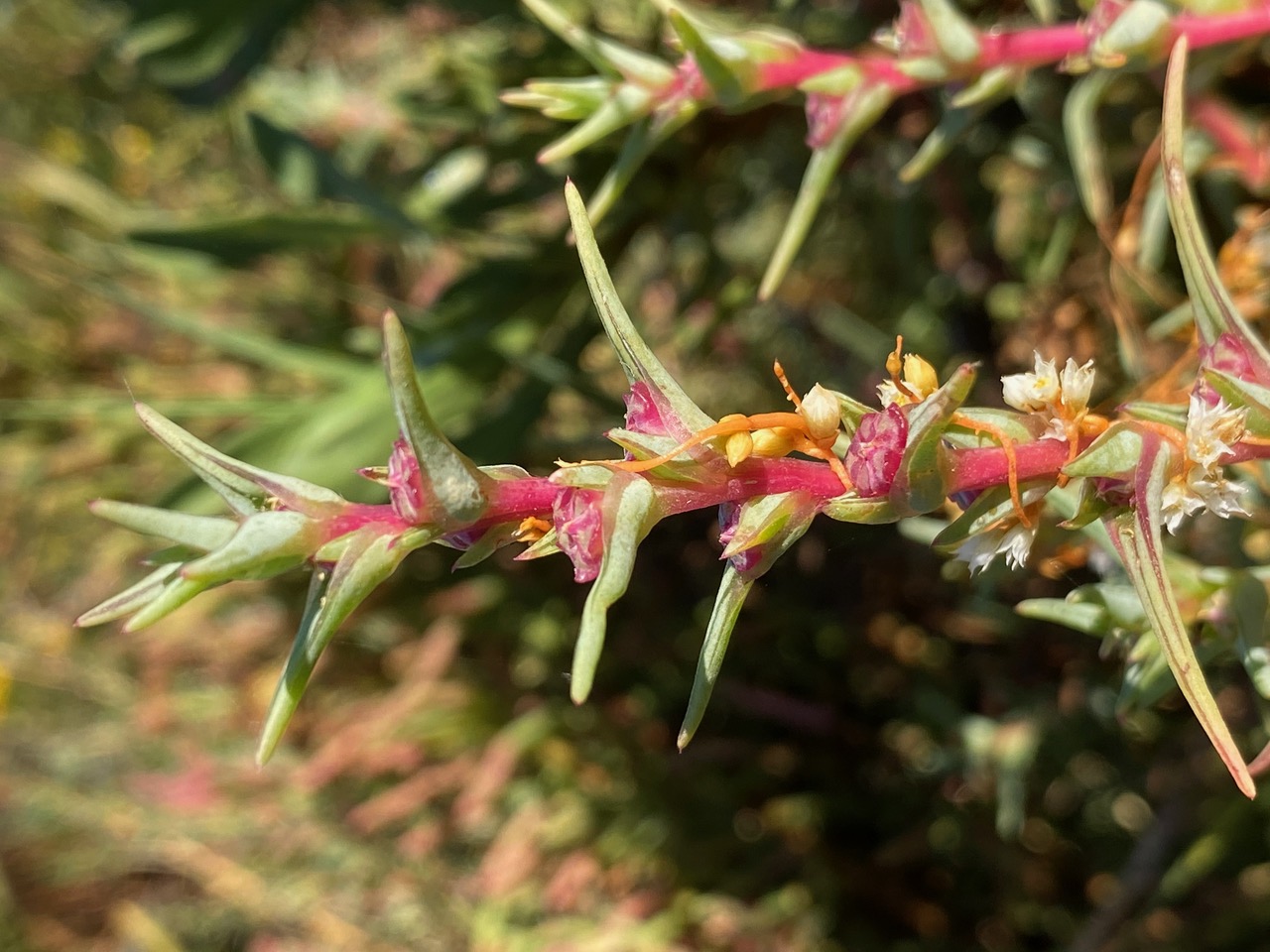
With orange thread-like stems twined around its host, the parasitic Dodder has a stranglehold on this Fleshy Russian Thistle.
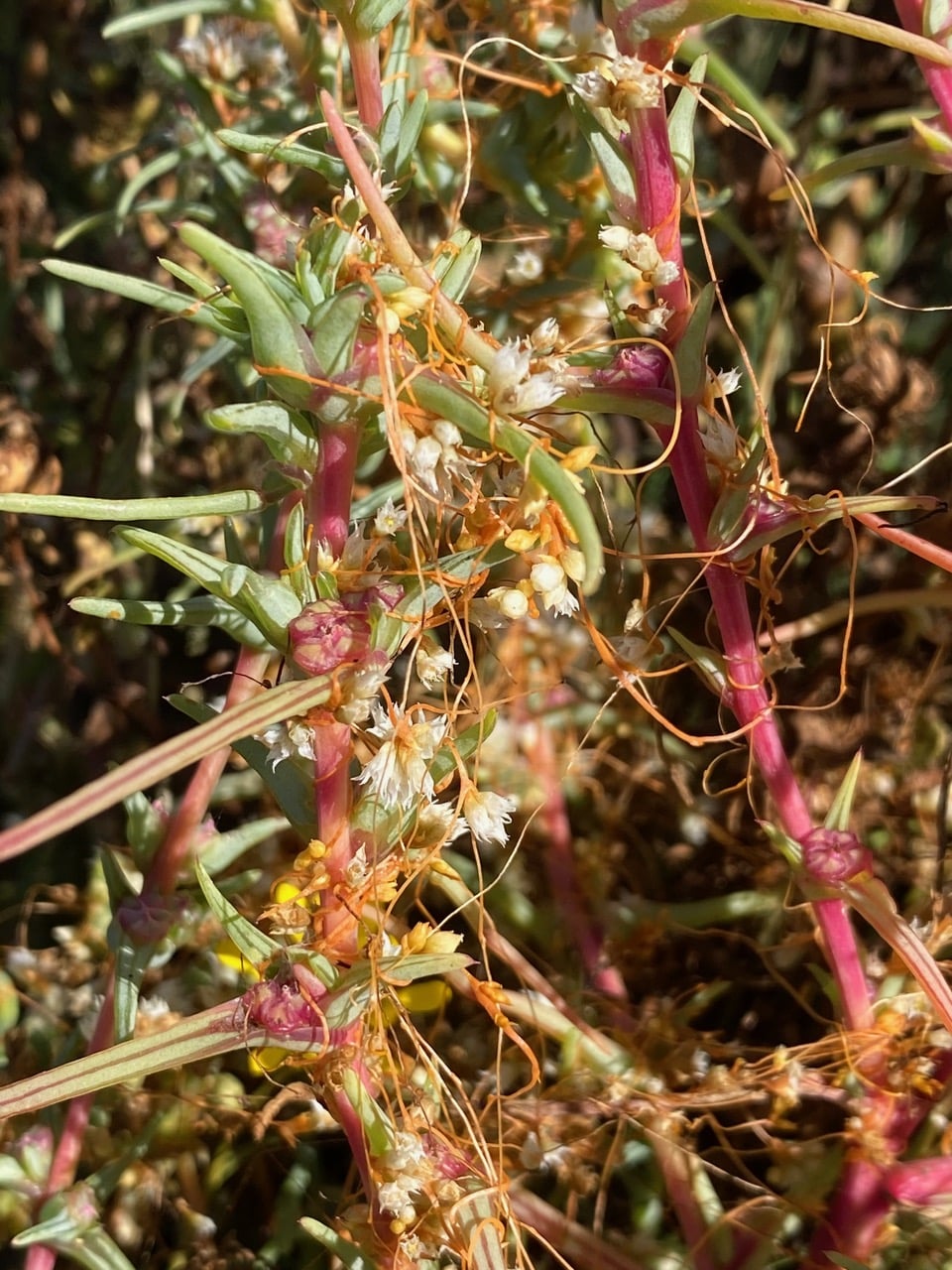
The tangled masses of string-like stems of the parasitic Dodder bear little resemblance to most plants. Dodder is an annual parasitic vine in a single genus, Cuscuta in the family Cuscutaceae. Dodders are obligate parasites, meaning they can’t make a living without their plant hosts. The thin, thread-like, yellow or orange stems grow rapidly entwining and covering their host plants.
Dodder seeds germinate in the soil and can live on their own for 5-10 days. Dodder seedlings are capable of detecting plant volatiles released by prospective host plants. If they have not found a suitable host in time the seedlings will die. Seedlings that find a suitable host twine around the plant and insert haustoria (modified adventitious roots) into the tender stem. The haustoria penetrate and tap the host plant’s vascular system for water, minerals and nutrients. Dodder is weakly photosynthetic, but most produce very little food on their own. As the vine successfully taps the host plant, its connection to the soil is severed. Small, white, bell-shaped flowers form in late summer and early fall and can produce copious amounts of seeds.
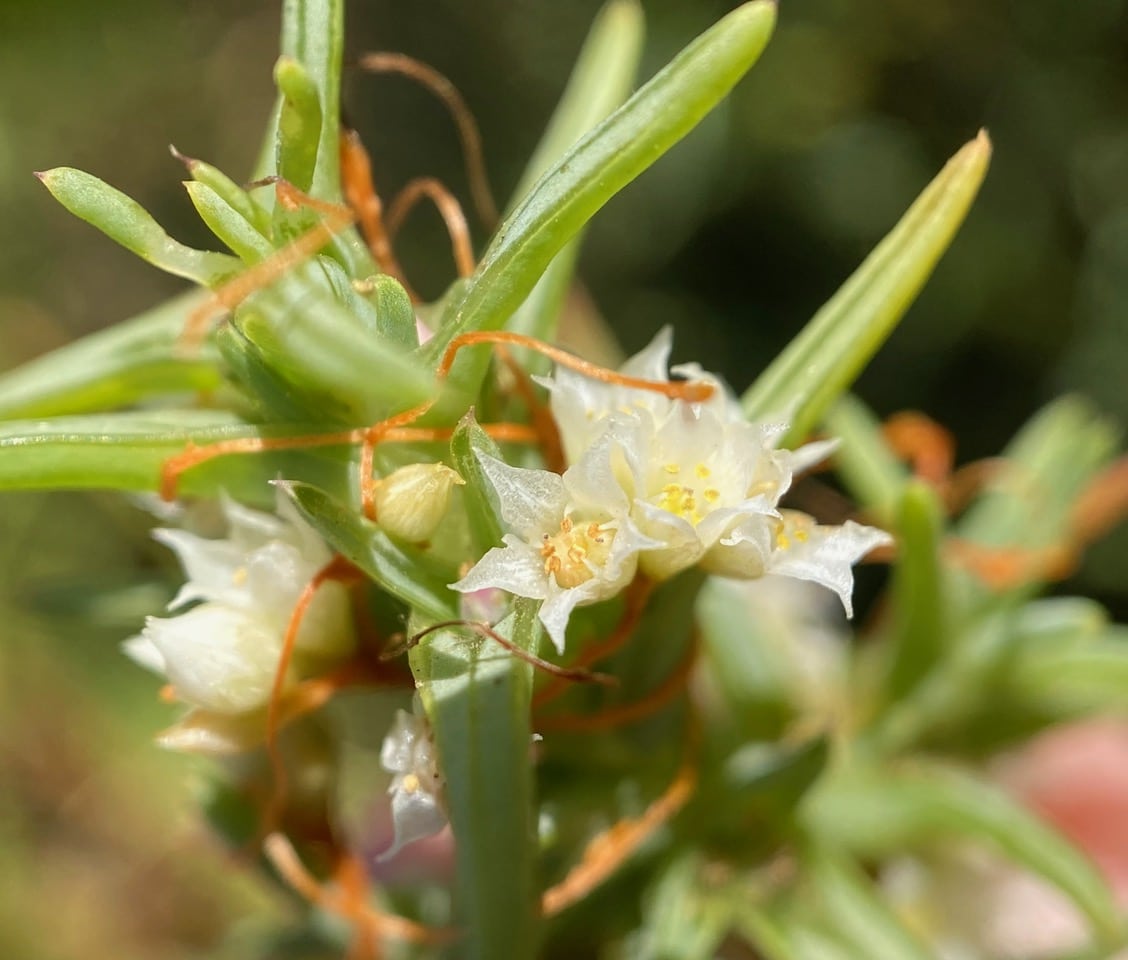
Close-up of Dodder flowers.
The small inconspicuous Dodder flowers are primarily pollinated by wasps, particularly small, native wasp species that are attracted to the host plant’s flowers. Dodder uses its host plant’s flowering signals to synchronize its own flowering. The host plant’s leaves sense environmental cues and produce a flowering signal that travels through the plant’s vascular system. Dodder “eavesdrops” on it to produce its own flowers. Dodder flowers generally don’t produce much nectar, and lack their own strong floral scent. It relies on the proximity to its host plant’s flowers to attract pollinators.
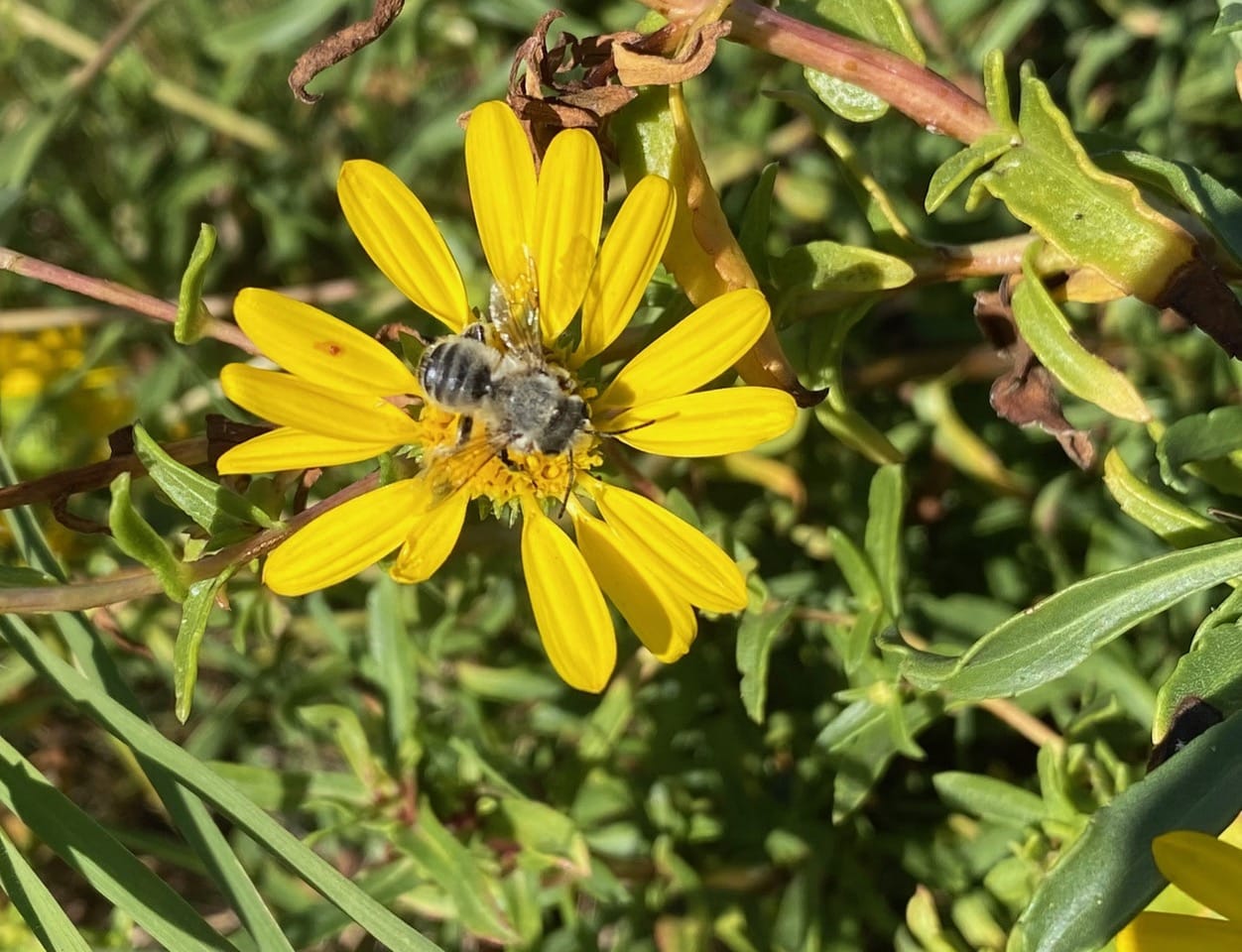
A male Western Leafcutter Bee, Megachile perihirta (family Megachilidae) visits a Grindelia flowerhead. These bees are still going strong – I see both males and females on the Grindelia today.
Leaf-cutter Bees, Megachile sp. (family Megachilidae) are stout-bodied, usually with pale hair on the thorax and stripes of white hairs on the abdomen. Females usually have a triangular abdomen with a pointed tip, and males’ faces are covered with dense, pale hair. Flight season is from May into September, with peak activity from June to August.
Solitary females construct nests in tubular cavities, including hollow stems, tree holes, and abandoned beetle burrows in wood. Many use holes drilled into wood, straws, or other manufactured tunnels. Females cut pieces from leaves or flower petals for use in the construction of brood cells. Most Megachile females are generalists when foraging for pollen. Pollen is transported in dense scopae on the underside of the abdomen.
Photos of Western Leafcutter Bee (Megachile perihirta) · iNaturalist