

Pollinator Post 10/2/25 (2)

A tiny glint of gold on a ray petal of an Oregon Gumweed, Grindelia stricta alerts me to the presence of a Buttonhook Leafbeetle Jumping Spider, Sassacus vitis (family Salticidae).
Jumping spiders (family Salticidae) are free-roaming hunting spiders. They do not weave a web to catch prey. They stalk, then pounce on their prey. Just before jumping, the spider fastens a safety line to the substrate. It can leap 10-20 times their body length to capture prey. Their movement is achieved by rapid changes in hydraulic pressure of the blood. Muscular contractions force fluids into the hind legs, which cause them to extend extremely quickly. Jumping spiders are visual hunters. Their excellent vision has among the highest acuities in invertebrates. Since all their 8 eyes are fixed in place and cannot pivot independently from the body like human eyes can, jumping spiders must turn to face whatever they want to see well. This includes moving their cephalothorax up and down, an endearing behavior.

It is often difficult to tell whether a particular spider is an adult or an immature, judging by size alone. In the jumping spiders in the genus Sassacus, the adults are only about 3-5 mm. The genus name Sassacus was the last chief of the Pequot Indians, a Native American tribe of the Connecticut Valley that was vanquished in a war with English settlers in 1637. The iridescent color and very compact appearance of these spiders leads scientists to suspect that they are mimics of certain leaf beetles in the family Chrysomelidae. Many Chrysomelids don’t taste good, as they feed on poisonous plants and sequester those plant toxins for their own defense. They advertise their distastefulness to predators with bold black and white, yellow, orange, or red color patterns, or with brilliant metallic colors. One of the defining characteristics of the genus is the very short legs. The fourth pair of legs is still the thickest, with one or two pairs of spines, used in tackling prey. Like most jumping spiders, Sassacus engages in visual courtship displays. The twitching abdomen also produces an auditory stimulus as the male waves his front legs to garner the female’s attention.
Sassacus vitis is native to North America, with a range spanning from Canada to Panama. It is a small jumping spider with iridescent gold abdomen and white ring around the anterior surface of abdomen. Body is covered with golden scales. Males are 3.5 mm long, females 4.5 mm. The name vitis is Latin for “grapevine”. The spider is commonly found on shrubs and vines and in fields. Best known as a common resident of vineyards.

Ooh, that looks like the pupa of a Leaf Beetle (family Chrysomelidae). The mature larva has attached its rear end to a Grindelia leaf. It molted for the last time, with its shed skin or exoskeleton bunching up at the rear.
Leaf Beetles in the family Chrysomelidae make up one of the largest and most commonly encountered beetles. They are all phytophagous – both adults and larvae feed on all sorts of plant tissues.

A pair of small, brown beetles are mating at the base of an immature Grindelia flowerhead.

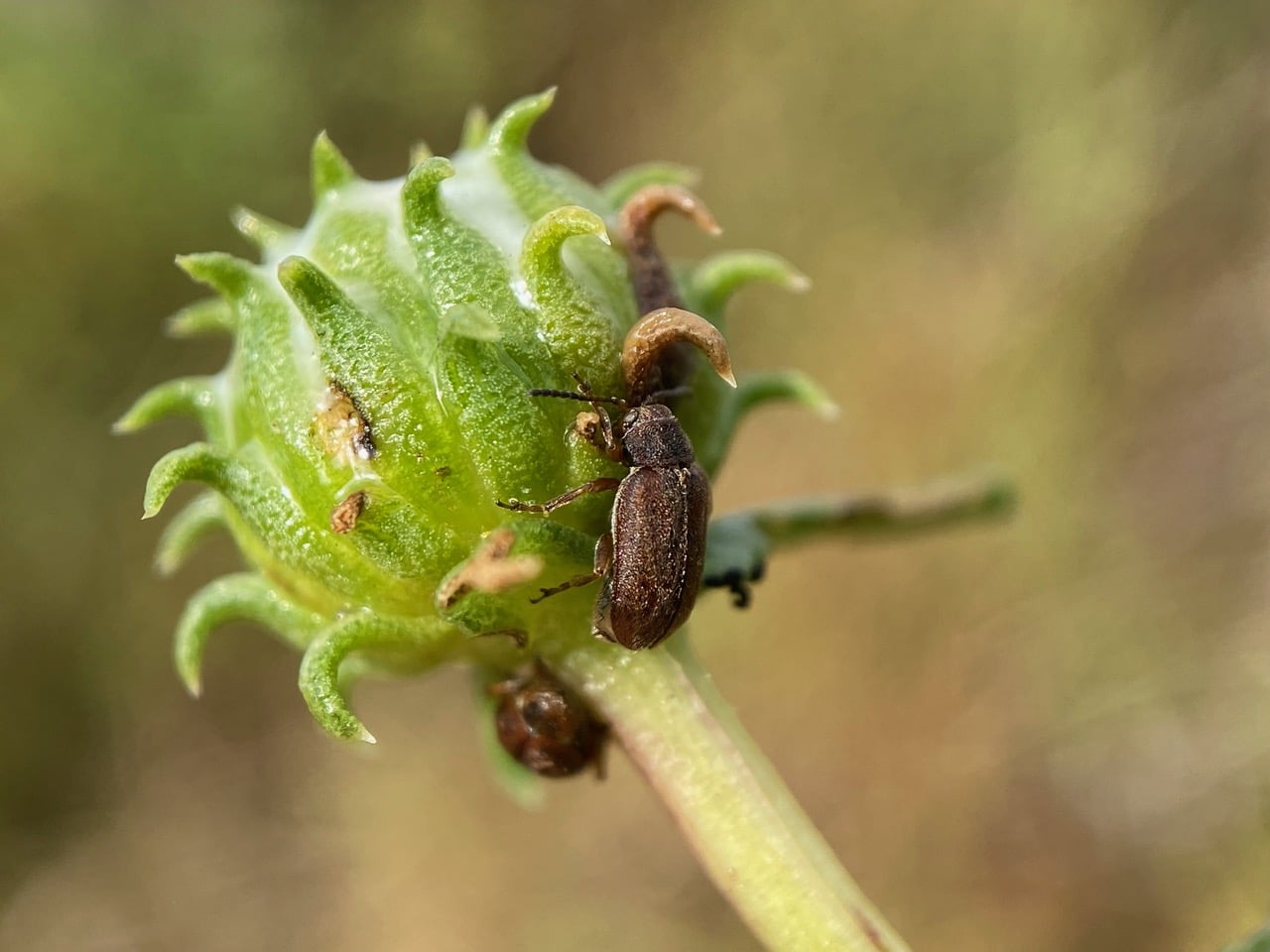




The experts on iNaturalist have helped to identify the beetles as members of the Leaf Beetle family, Chrysomelidae.
Alarmed by my approaching camera, the beetles disengage and go their own separate way.
Unfortunately, the beetles cannot be identified beyond the family level just by photos alone. In fact, I have previously misidentified this common beetle on the Grindelia as a Jewel Beetle (family Buprestidae). Fortunately two sharp-eyed experts on iNaturalist caught the mistake and kindly notified me. What a great community of naturalists sharing their information!
Beetles (order Coleoptera) are widely considered the most diverse insect order on the planet. Their immense variety has made them a subject of fascination among scientists, and the observation that “God has an inordinate fondness for beetles” is famously attributed to the biologist J.B.S. Haldane. With roughly 400,000 species, beetles make up about 40% of all known insect species. They represent about 25% of all known animal species, making them the largest group in the entire animal kingdom. Their diversity is expressed in a wide range of ecological roles, from predators and pollinators to decomposers and agricultural pests. Beetles can be found in nearly every habitat on Earth, except for the sea and polar regions.
The Grindelia in this patch along the shoreline look sick with yellow and spotted foliage; many branches have died back. I wonder what is ailing them.
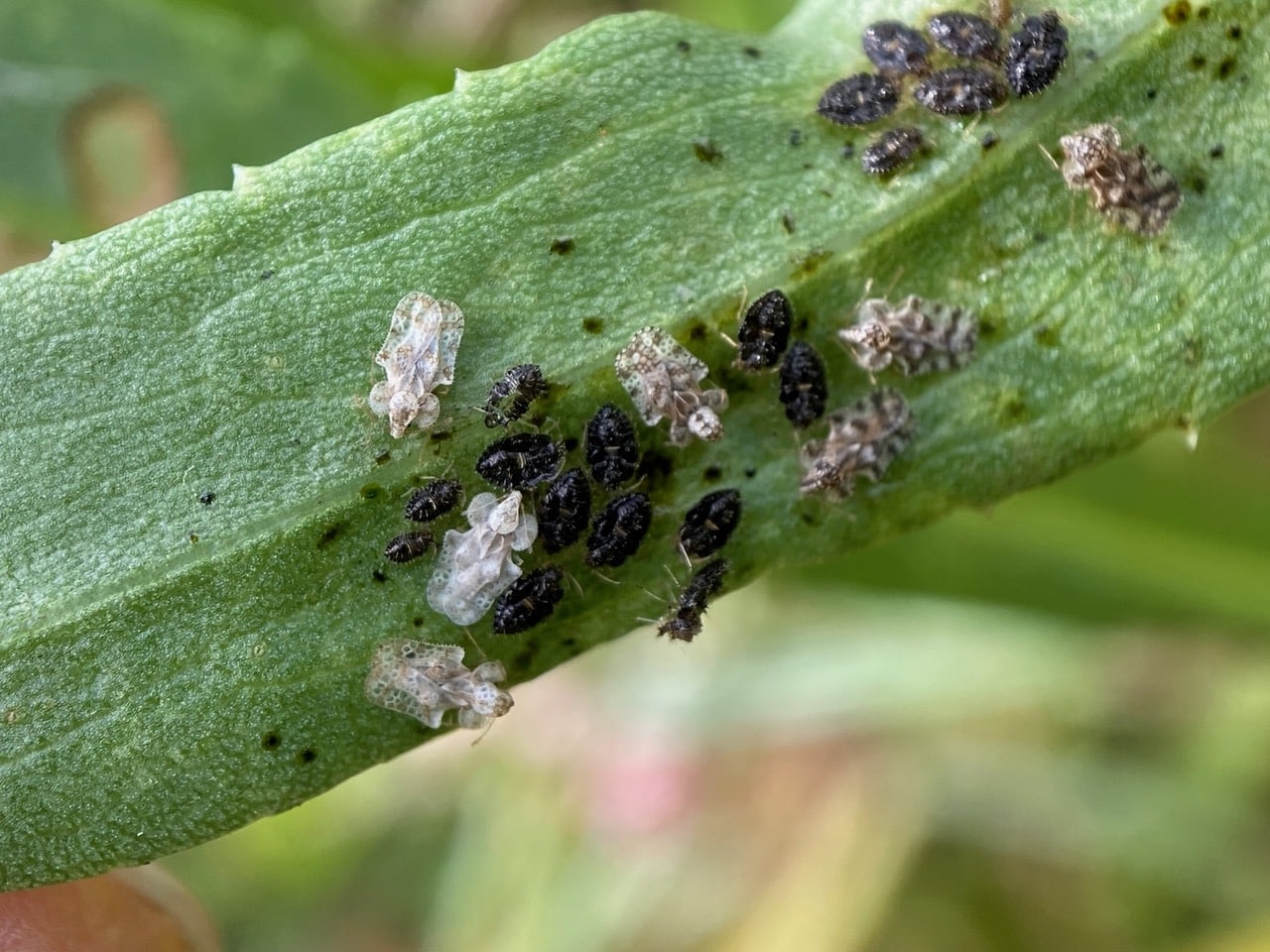
Turning over a Grindelia leaf, I find this aggregation of adult and nymphal Lace Bugs, Corythuca sp. (family Tingidae). The adults have beautiful, lacy wings, while the nymphs are black and bristly.
The Tingidae are a family of very small (2-10 mm) insects in the order Hemiptera that are commonly referred to as lace bugs. They are called lace bugs because the pronotum and fore wings of the adult have a delicate and intricate network of divided areas that resemble lace. Their body is flattened dorsoventrally, and the head is often concealed under the hood-like pronotum. Lace Bugs feed by sucking sap from plants, extracting the protein they need and excreting liquid waste as honeydew. The most common symptom of feeding is the stippled and mottled yellowish foliage. In heavy infestations, black sooty mold may develop on the honeydew, impairing photosynthesis by the plant. This may result in some dieback of twigs and branches and a reduction in flowering the following year. Tingids are usually host-specific and can be very destructive to plants. Each individual usually completes its entire lifecycle on the same plant, if not the same part of the plant.
The genus Corythucha is primarily distributed in the northern hemisphere, including Europe, North America and eastern Asia.
On the same plant, I find this female Spittlebug, Complex Clastoptera lineatocollis (family Clastopteridae). Wow, no wonder the plant is unhappy – it has two different Hemiptera sucking the life out of it. The bite marks on the leaves hint of damage by possibly beetles. Why is this patch of Grindelia particularly vulnerable to insect infestation? Do weakened plants attract more pests?
The Spittlebug, Complex Clastoptera lineatocollis (family Clastopteridae) is found in western United States. The bugs feed mostly on Asteraceae, although other hosts have been reported. Females are brownish (3.3-3.8 mm), while the smaller males (3.0-3.2 mm) are mostly black.
The adult Spittle Bug is sometimes called a Froghopper. The Froghopper is a “true bug” in the order Hemiptera. Froghoppers are champion jumpers among insects, out-performing even the fleas. The bug can leap the human equivalent of a skyscraper without a running start. It is the highest jumping insect proportional to body size. The muscles in its hind legs act like a “catapult” to release energy explosively.
Athletic prowess aside, the Froghopper is better known for its young, the “spittle bug”. The nymphs produce foamy white masses on plants within which they feed on plant sap. Froghoppers have piercing-sucking mouthparts, and feed on plant sap as both nymphs and adults. A recent report claims, “Froghoppers are the super-suckers of the animal world. The tiny insects produce negative pressures equivalent to people sucking a 100-meter-long straw.” The sucking power is strong enough to suck the water out of a cup at the base of the Statue of Liberty while perched on its crown. To complement that, the Froghopper is also exceptional at urination, excreting the human equivalent of 2,500 gallons of urine a day.
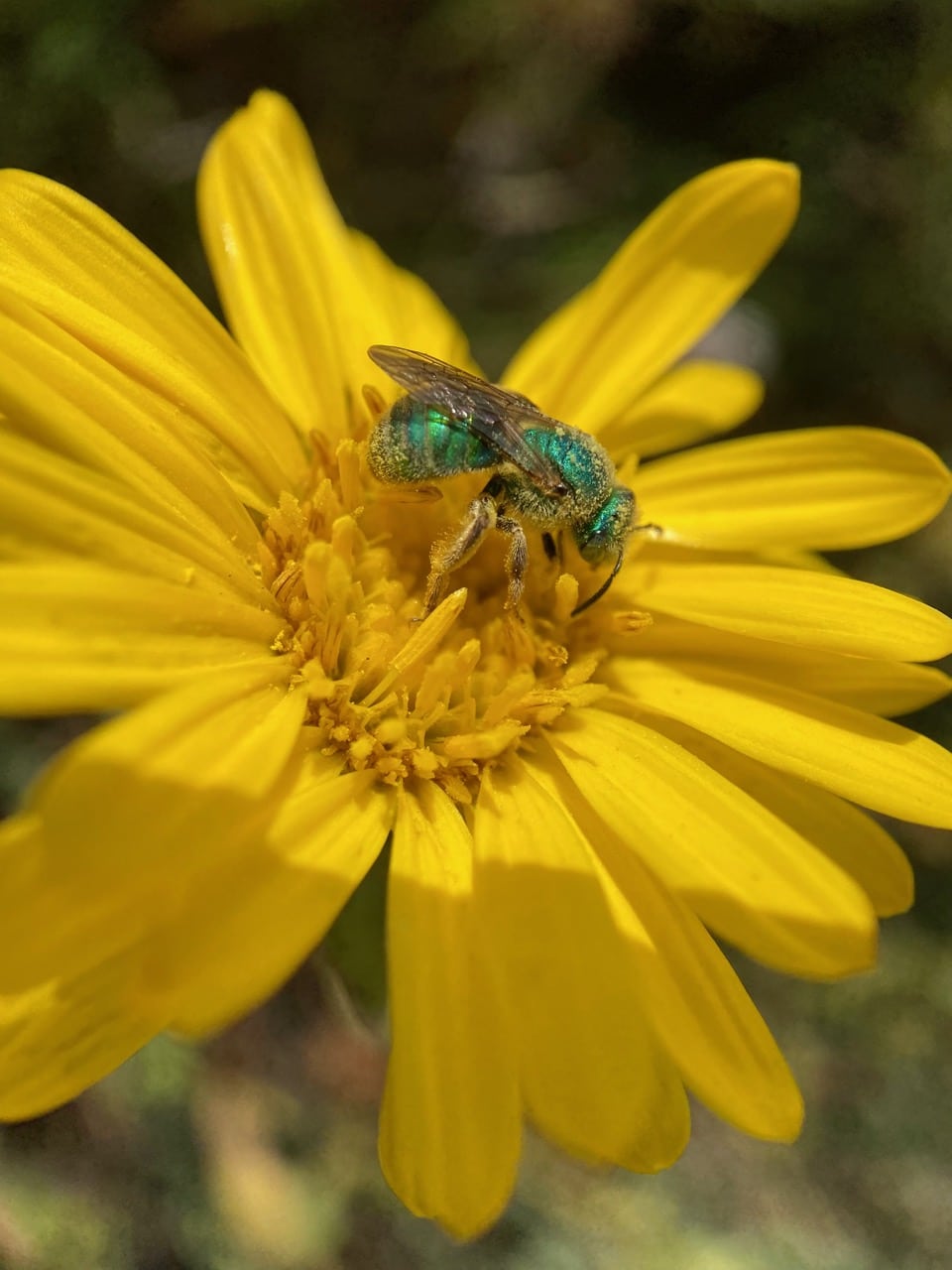
A female Fine Striped Sweat Bee, Agapostemon subtilior (family Halictidae) is foraging on a Grindelia flowerhead.
The genus Agapostemon is widespread and abundant throughout North America. They are most diverse and abundant in temperate regions and southwestern U.S. deserts. Agapostemon are commonly called “sweat bees” because they are closely related to, and resemble bees in the Halictus and Lasioglossum genera. Unlike those bees however, Agapostemon are not attracted to human sweat.
Agapostemon are brightly colored metallic green or blue bees measuring 7 to 14.5 mm long. Most species have a metallic green head and thorax, and black-and-yellow striped abdomen; some females are entirely bright green or blue. Females carry pollen on scopal hairs located on their hind legs. Agapostemon are ground-nesters and generalist foragers. Like other members of the family Halictidae, they are short-tongued and thus have difficulty extracting nectar from deep flowers. Males are often seen flying slowly around flowers looking for females. The bees favor flowers with high densities.
Agapostemon females dig deep vertical burrows in flat or sloping soil, or sometimes in banks. Most species are solitary, but some species nest communally. Up to two dozen females may share a single nest entrance, but each individual builds and provisions its own cluster of brood cells. Where a communal nest gallery shares a single entrance, one bee usually guards the hole, with only her head visible from above ground. Unlike other social bees, in communal bees there is no reproductive division of labor. In cool temperate regions, there is one generation per year, with females active in the early summer and males and pre-diapausing females active in the late summer. Only mated females survive the winter. This is probably because unmated females cannot enter diapause (insect version of hibernation).
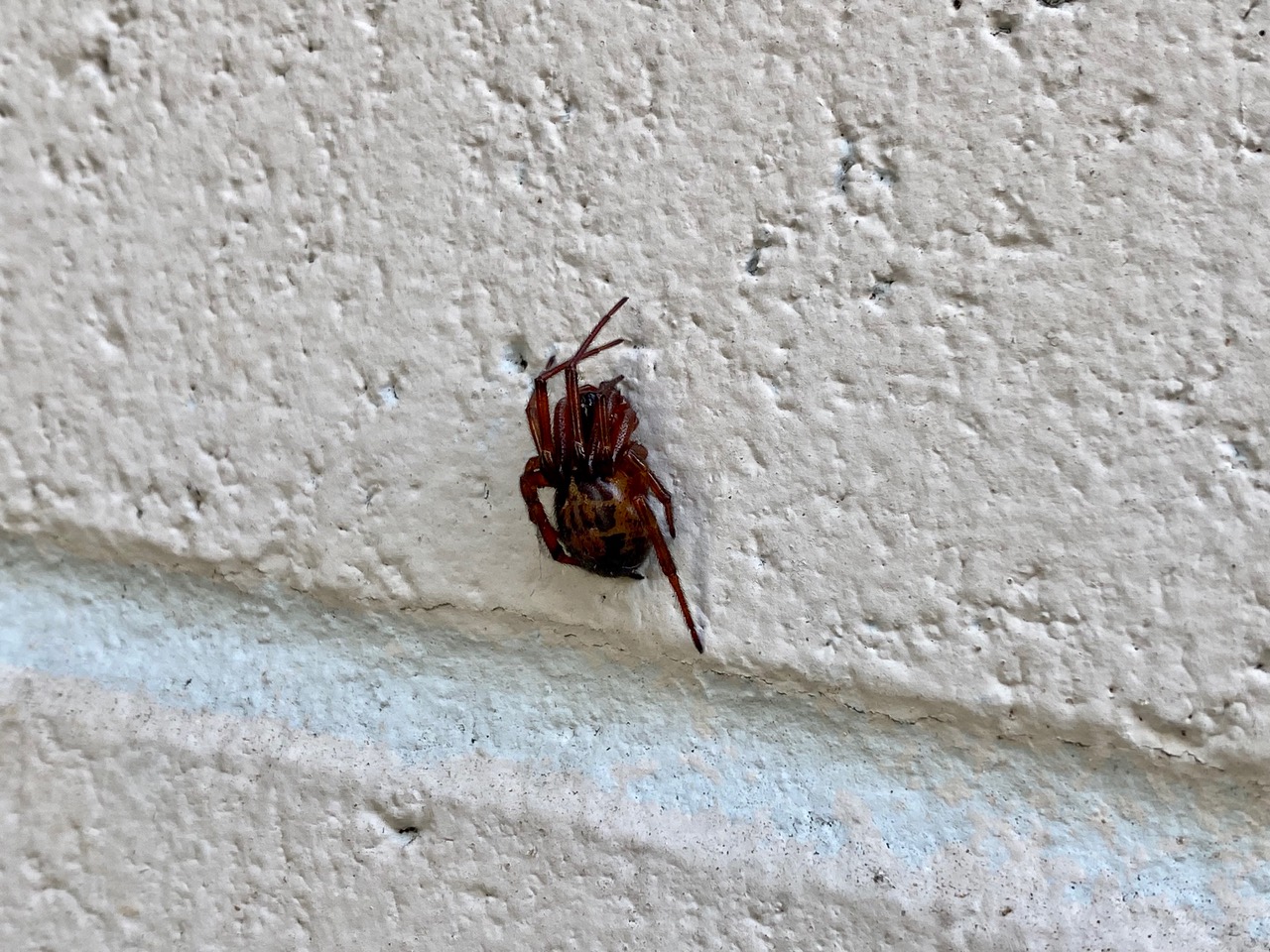
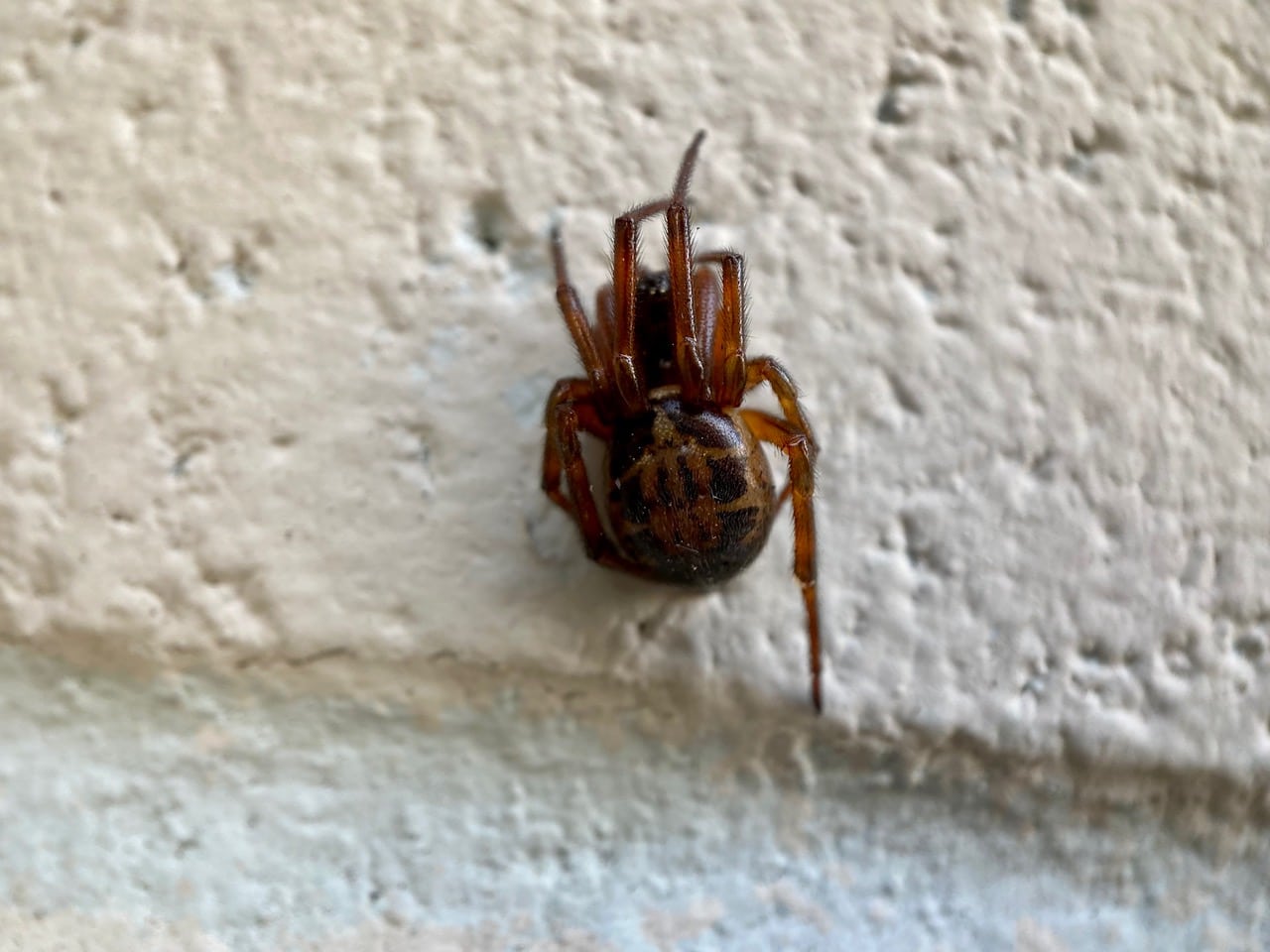
On the wall of the women’s restroom at the park, I find this rather large, dark brown spider. iNaturalist has helped identify it as the Noble False Widow, Steatoda nobilis (family Theridiidae). A new one for me!
The Noble False Widow, Steatoda nobilis superficially resembles the black widow spider (genus Latrodectus), hence the common name of ‘false widow’. The spider is native to Madeira and the Canary Islands from where it has spread to Europe and other parts of the world including the United States. It can be found all year round, both indoors and outdoors in a variety of habitats including cacti, roadside cuttings, and demolished buildings. In California they have been observed in urban habitats but have also spread to natural habitats. They are hefty spiders with females measuring 9.5 – 14 mm in size.
As with other members of the family Theridiidae, Steatoda nobilis constructs a cobweb which is an irregular 3-dimensional tangle of sticky silken fibers, with a tubular retreat hidden in a deep crack or hole. Steatoda nobilis uses an “attack wrap” strategy to immobilize prey. Captured prey is wrapped using the spider’s fourth legs, allowing the spider to bite the victim. The potent, fast-acting venom allows them to capture vertebrate as well as invertebrate prey much larger than themselves. To humans, the symptoms of a bite are typically similar to a bee or wasp sting.
A small black fly has landed on a blade of grass. I recognize it as a female Sugarcane Soldier Fly, Inopus rubriceps (family Stratiomyidae), similar to the one I found earlier.
The Sugarcane Soldier Fly, Inopus rubriceps (family Stratiomyidae) is native to eastern Australia where it infests such crops as corn, pastures, and sugarcane. The fly was accidentally introduced into California over 50 years ago. It is now infesting lawns in San Francisco and other Bay Area counties. Damage to turf and other members of the grass family results from withdrawal of sap from roots of host plants by the larvae and possibly, injection of a toxin into the plant.
In California adults occur in large numbers from late September to early November each year. Eggs are deposited in crevices in the soil. The adults are sexually dimorphic. Females have tiny red heads with eyes set far apart. The smaller males have large eyes that occupy the whole surface of the head.
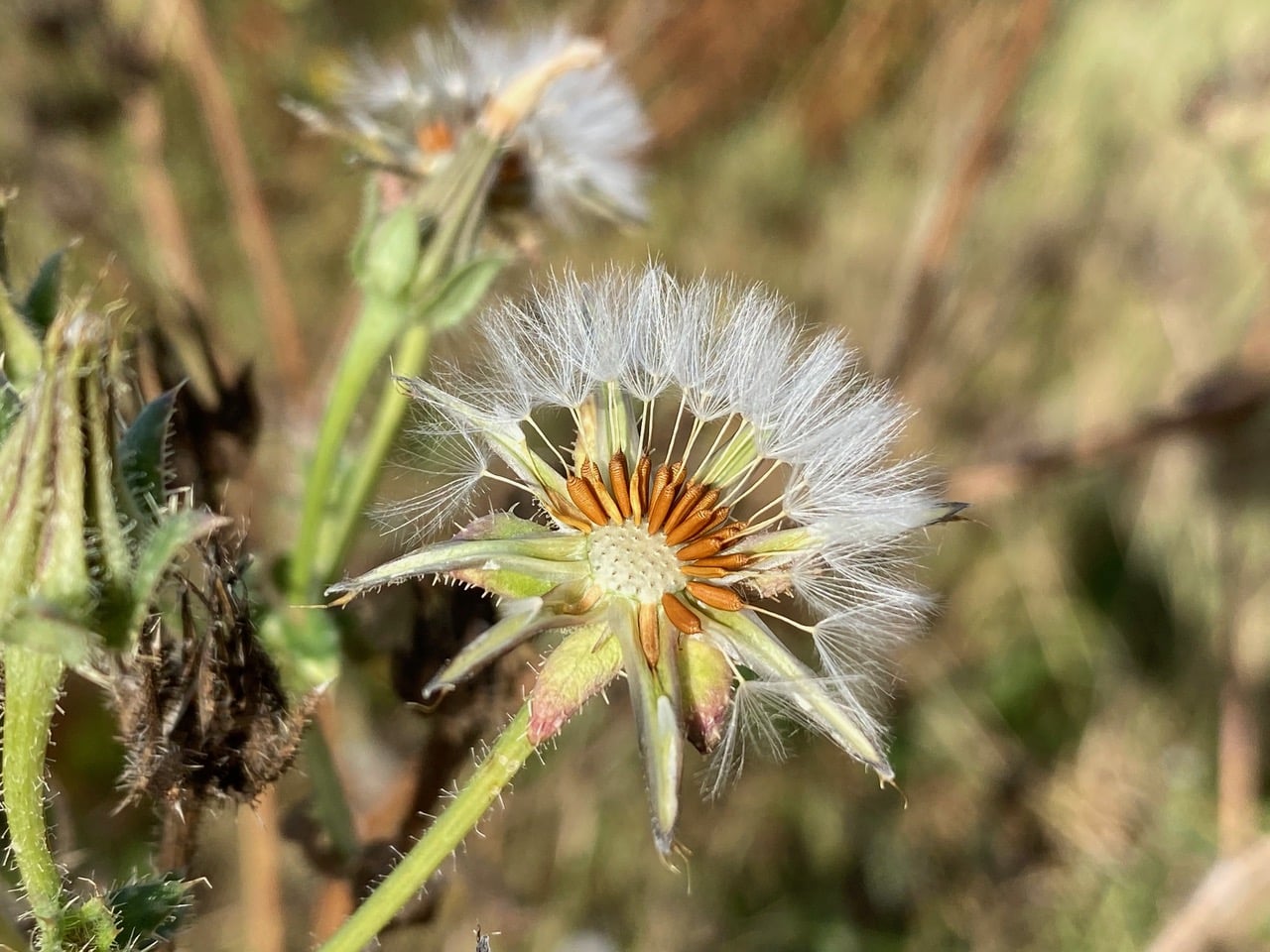
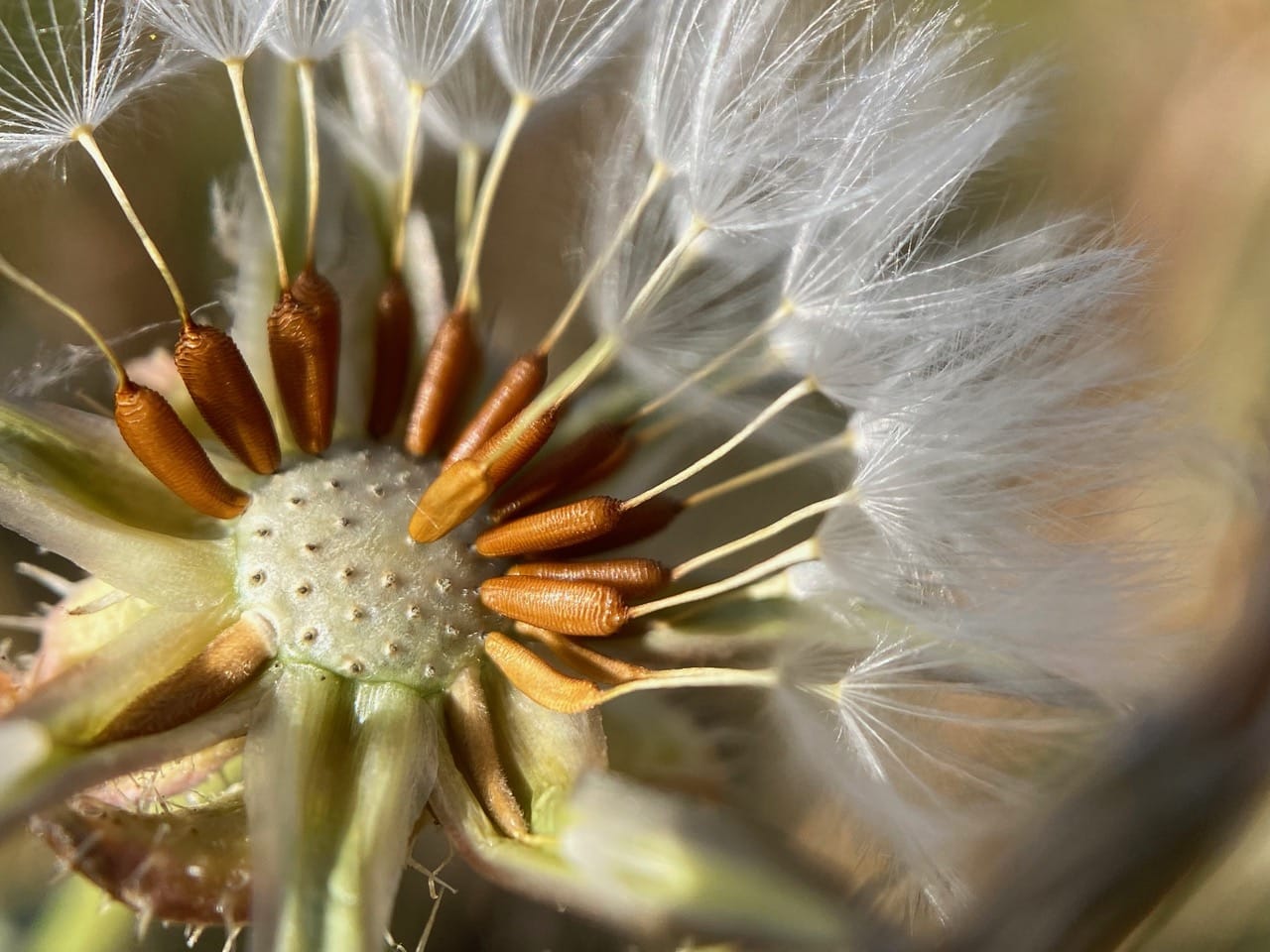
The Bristly Oxtongue, Helminthotheca echioides is in the process of dispersing its plumed seeds. More than half of the seeds on this seed head have been blown away by the wind.
The seed head of the Bristly Oxtongue is similar in structure to that of the Dandelion. After all, both are in the Asteraceae family. The plumes of a dandelion puffball are the pappus, which is the parachute-like structure attached to each individual seed.
The pappus is the modified calyx, or modified sepal – it serves to catch the wind to disperse the achene (single-seeded fruit) over long distances.
You will enjoy this video on the magic of plumed flight: The Extraordinary Flight of Dandelion Seeds – YouTube
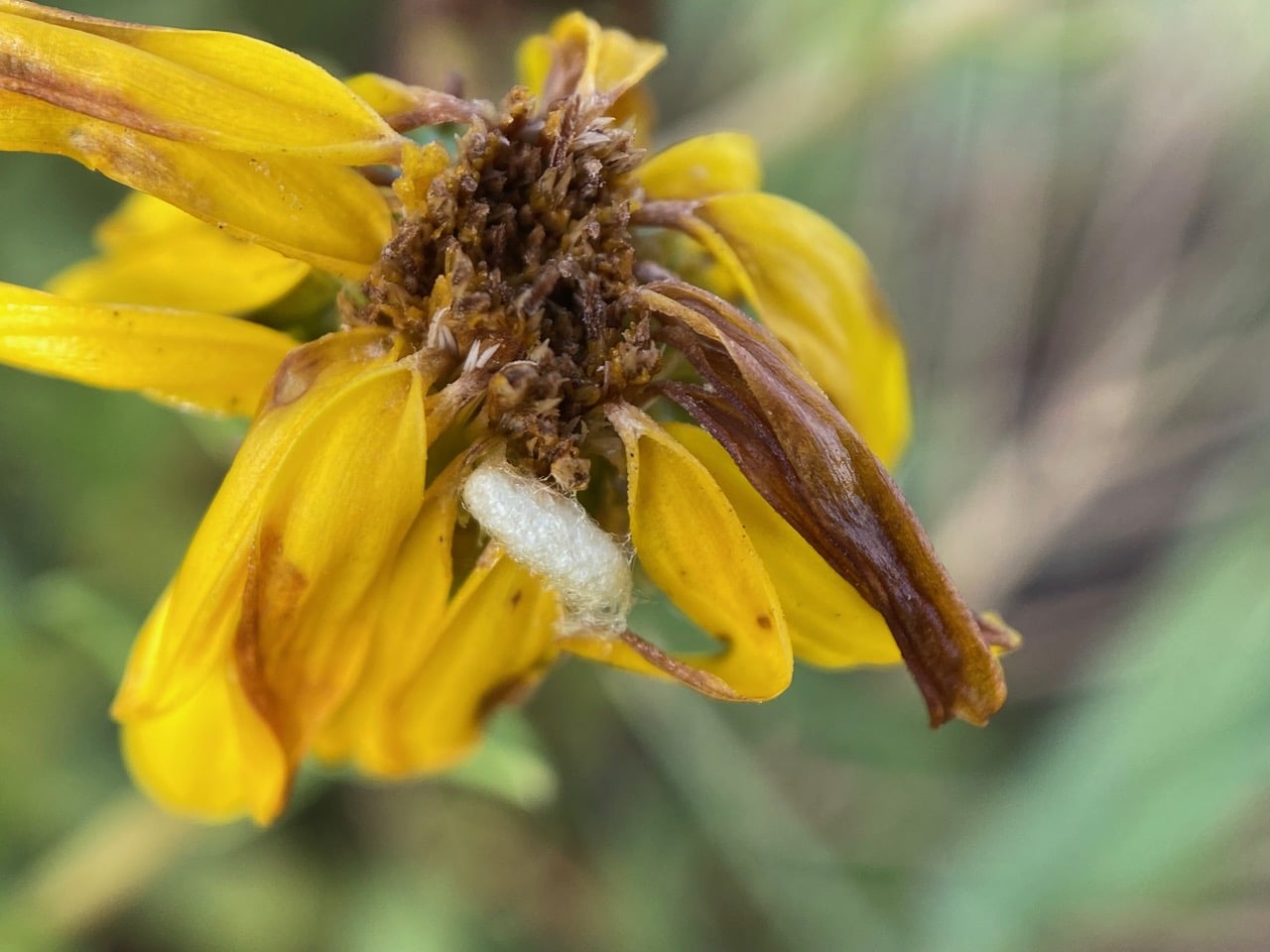
A silken cocoon is attached to a fading Grindelia flowerhead. What’s inside? I often find small Pug Moth caterpillars (genus Eupithecia) on the Grindelia flowerheads, feeding on the flower parts. But these caterpillars typically descend from their host plant and pupate in the leaf litter or soil at the base of the plant. In fact the size and shape of the cocoon reminds me of those spun by Braconid Wasps that parasitize caterpillars.
The female Braconid Wasp uses her ovipositor to lay a single or dozens of eggs in or on the host caterpillar, depending on the species. The wasp larva hatches and feeds on the caterpillar’s body fluids and non-essential organs. When the larva is mature, it chews its way out of the caterpillar’s skin. The larva immediately begins spinning its cocoon, often attached to plant parts or the dead caterpillar itself. Adult wasp emerges from the cocoon and flies off to find new caterpillars to attack.
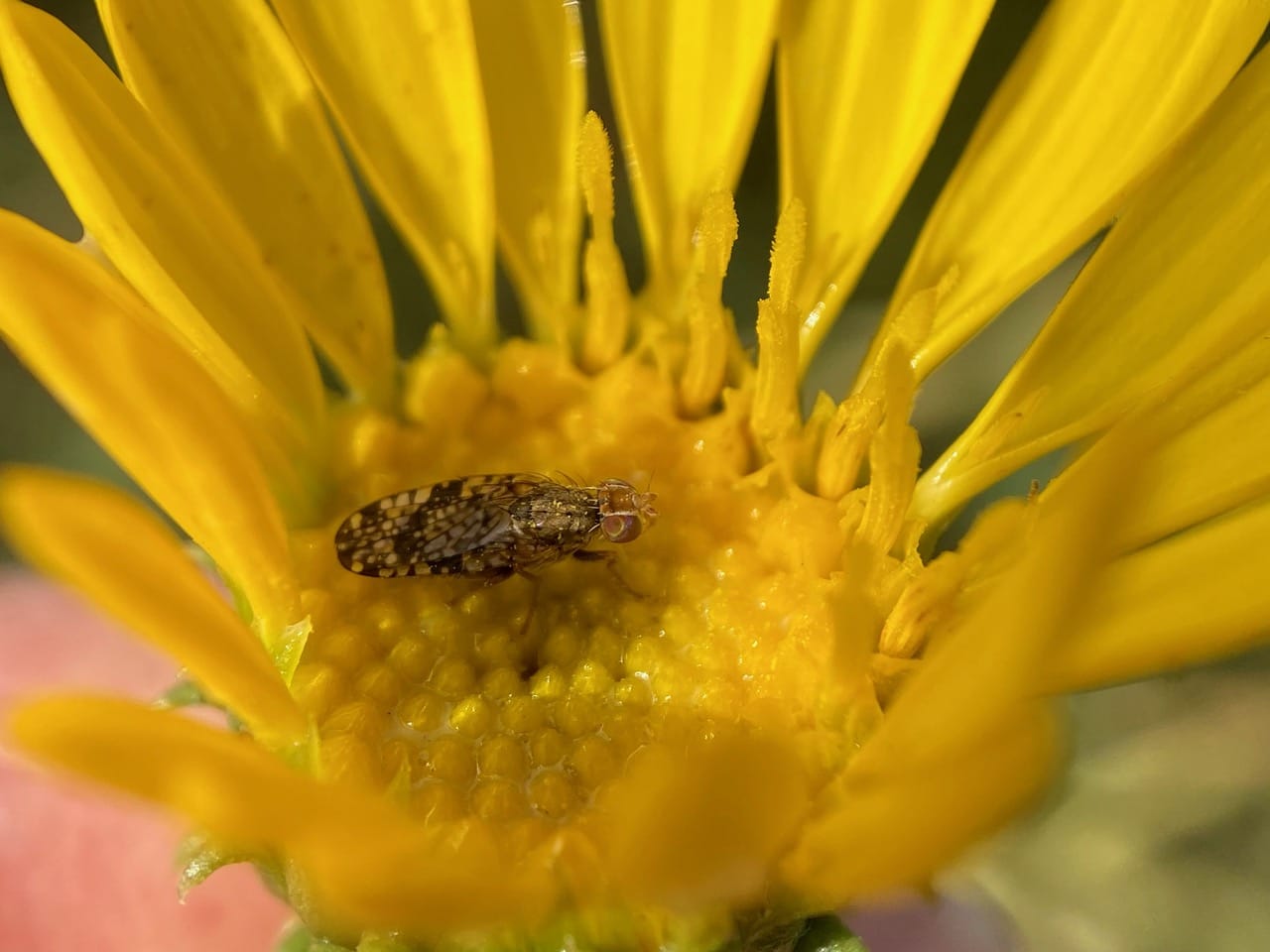
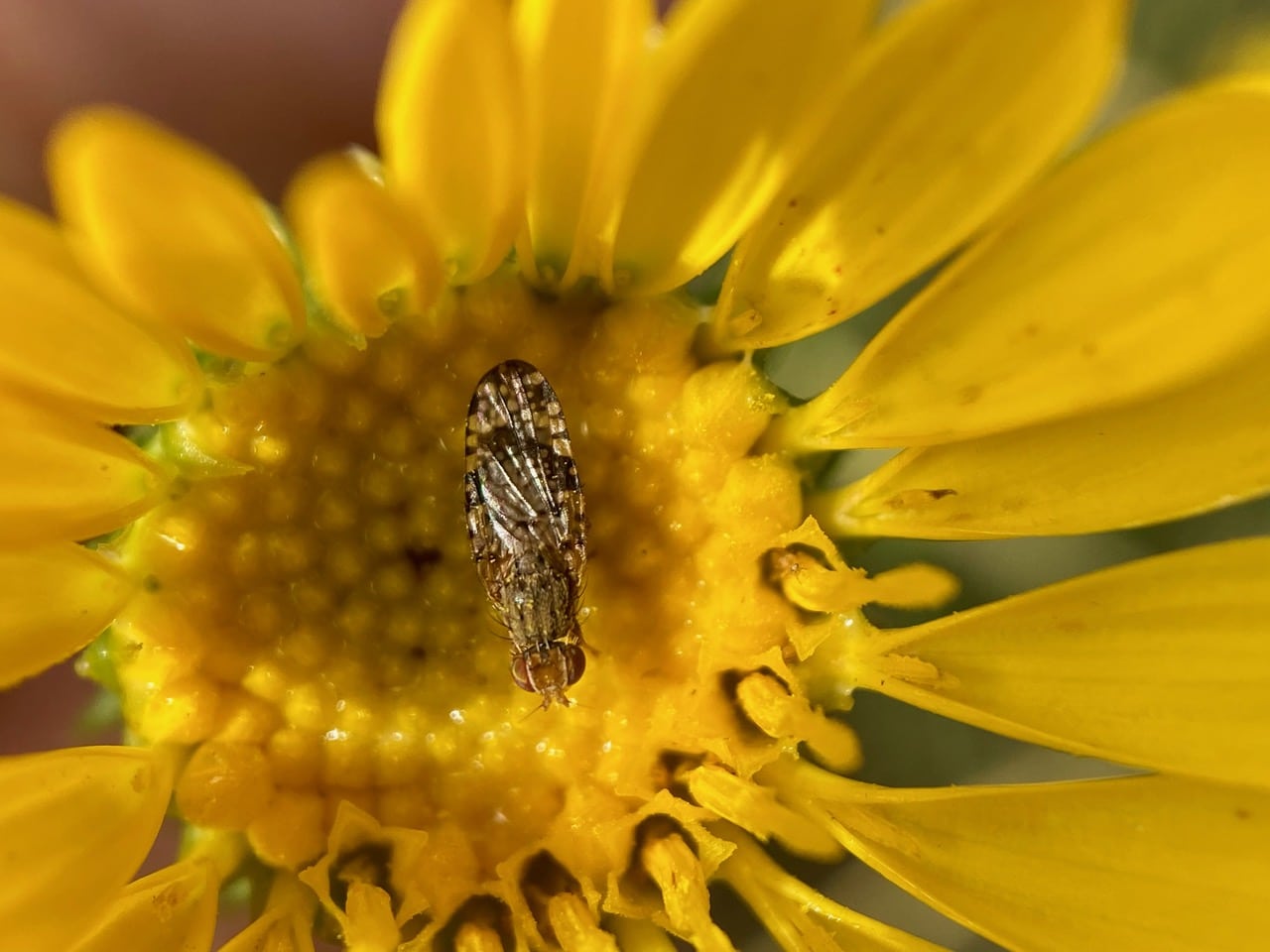
A small fly with picture wings is perched on a freshly opened Grindelia flowerhead. It is a Fruit Fly, Campiglossa sp. (family Tephritidae). I can’t tell its gender because its abdomen is covered by the wings. But if it is a female, she might be here to lay her eggs among the florets.
Tephritids are small to medium-sized flies that are often colorful, and usually with picture wings. The larvae of almost all Tephritidae are phytophagous. Females deposit eggs in living, healthy plant tissues using their telescopic ovipositors. Here the larvae find their food upon emerging. The larvae develop in leaves, stems, flowers, seeds, fruits, and roots of the host plant, depending on the species. Adults are often found on the host plant and feeding on pollen, nectar, rotting plant debris, or honeydew. Tephritid flies are of major economic importance as they can cause damage to fruit and other plant crops. On the other hand, some Tephritids are used as agents of biological control of noxious weeds.
The genus Campiglossa has a worldwide distribution. Adult females oviposit in flowerheads of Asteraceae. The short, stout larvae live in the ovaries, feeding on the developing seeds. Many species are reported to be monophagous, some oligophagous. In entomology, a monophagous insect is one that feeds on only a single species of plant; oligophagous insects feed on a few closely related species.