

Pollinator Post 10/18/24

The day is forecast to be windy with high fire risk, but the morning seems calm and pleasantly sunny. I figure I should go for a walk at Bay Farm while the going is good.
I return to the same stretch of the Shoreline Trail on Bay Farm Island where I have photographed this Telegraphweed, Heterotheca grandiflora on 10/12.
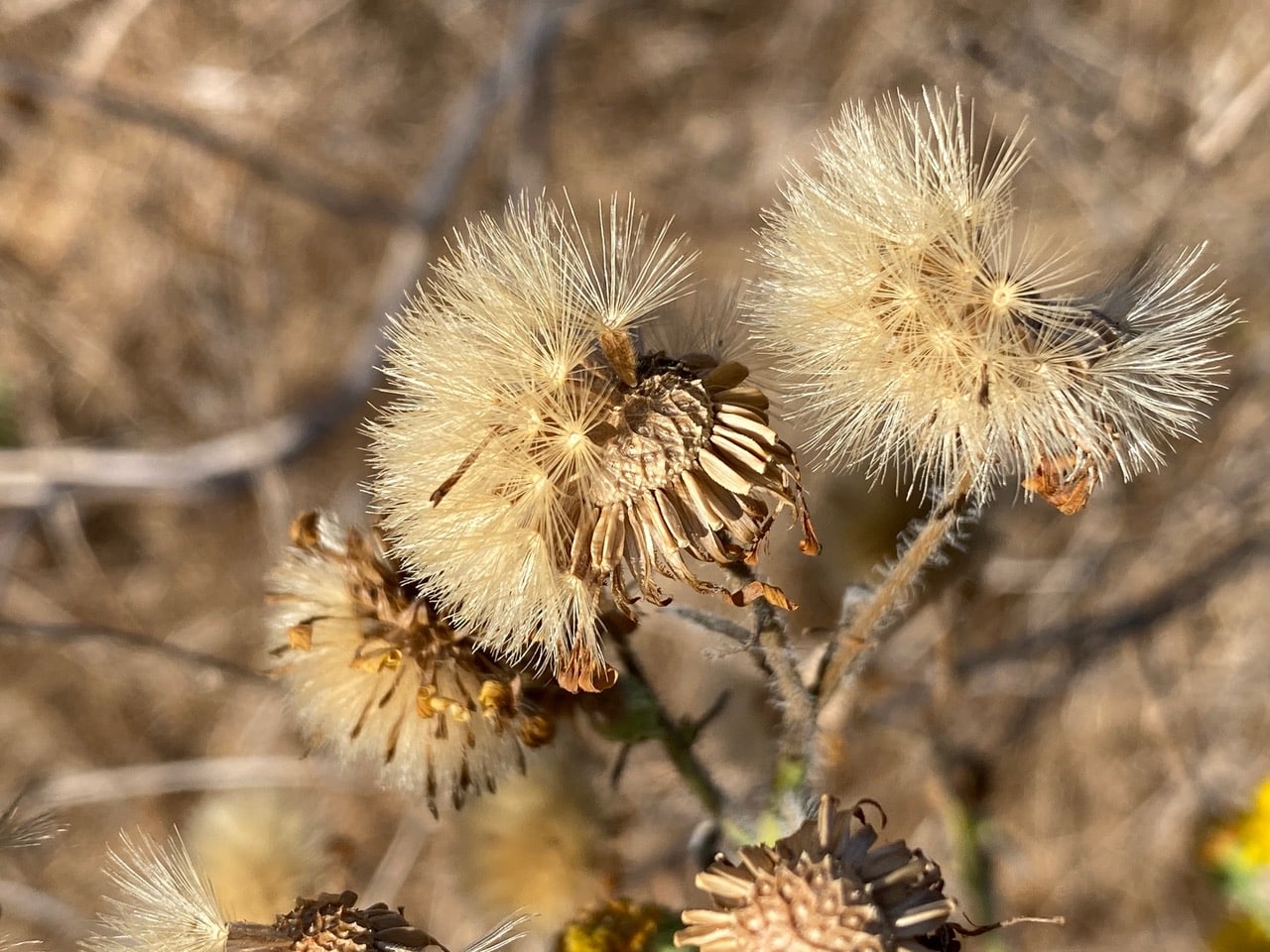
I am hoping for a photo of the two types of seeds on the Telegraphweed, and am delighted to find the perfect seed head that shows both nicely.
This hardy native produces two types of seeds as a survival strategy for uncertain environments. The parachute-bearing seeds from the disk florets are transported by the wind and are likely to be carried away from the parent plant to colonize new area. These seeds germinate quickly. The seeds produced by the ray florets on the rim have no parachute and fall close to the parent plant, in an environment where the parent plant has succeeded. Ray seeds are more sensitive to environmental conditions and germinate slowly. Ray seeds ensure the continuation and expansion of the original population. Thus, Telegraphweed distributes its seedlings over both space and time, a strategy that accounts for its successful colonization of disturbed areas.
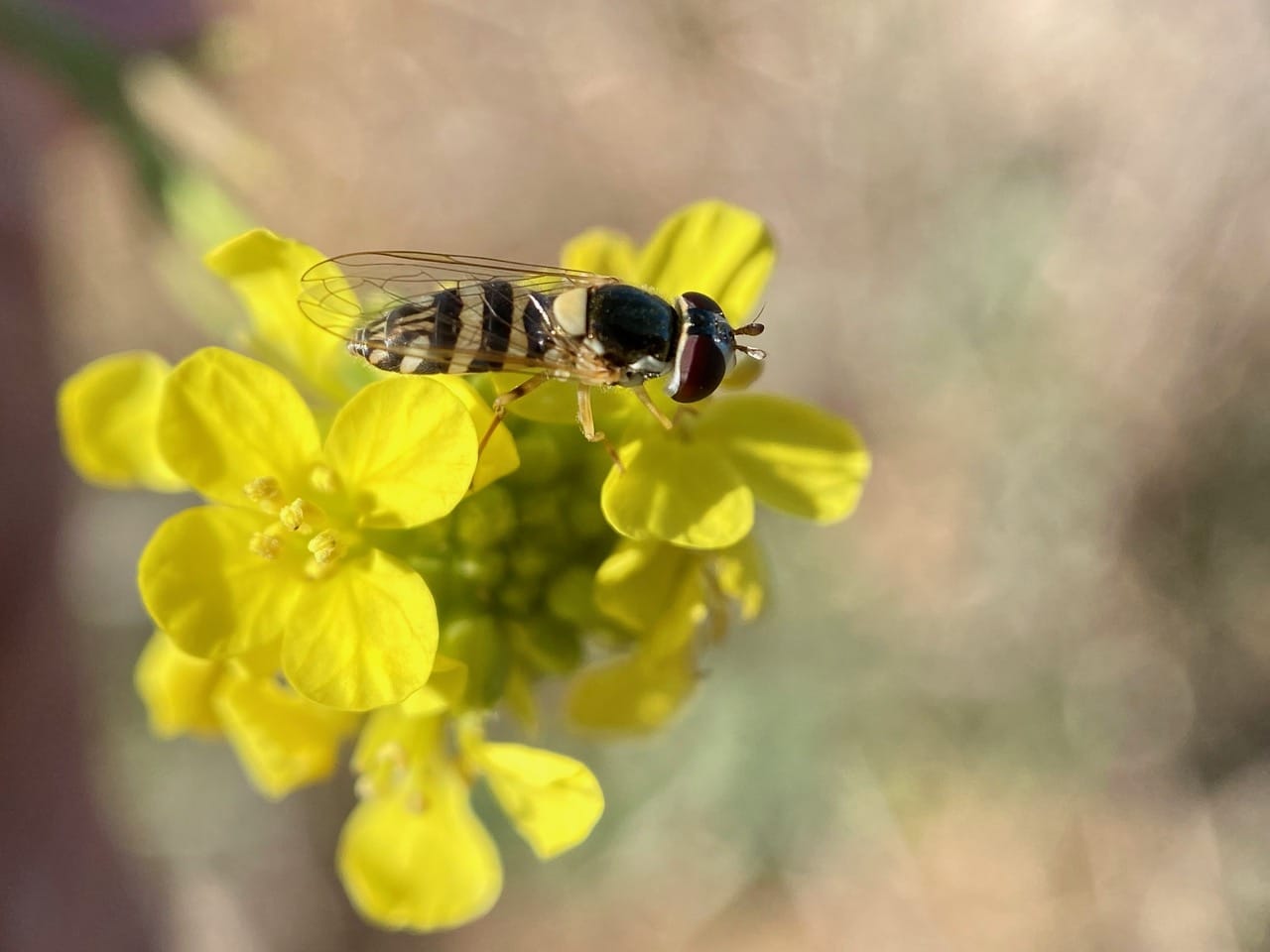
Unfortunately, this stretch of the trail is rather dry and barren, with only a few weeds offering flowers this time of year. The insects are not complaining. A female Oblique Streaktail, Allograpta obliqua (family Syrphidae) is foraging on an inflorescence of Wild Mustard, Brassica campestris.
The Oblique Streaktail, Allograpta obliqua (family Syrphidae) is a common North American species of hoverfly. Adults are 6-7 mm long. Females have a tapered abdomen that ends in a pointed tip. Eggs are laid on surfaces of leaves or stems near aphids. The larvae are important predators of aphids. Adults visit flowers for nectar and pollen, and are pollinators.
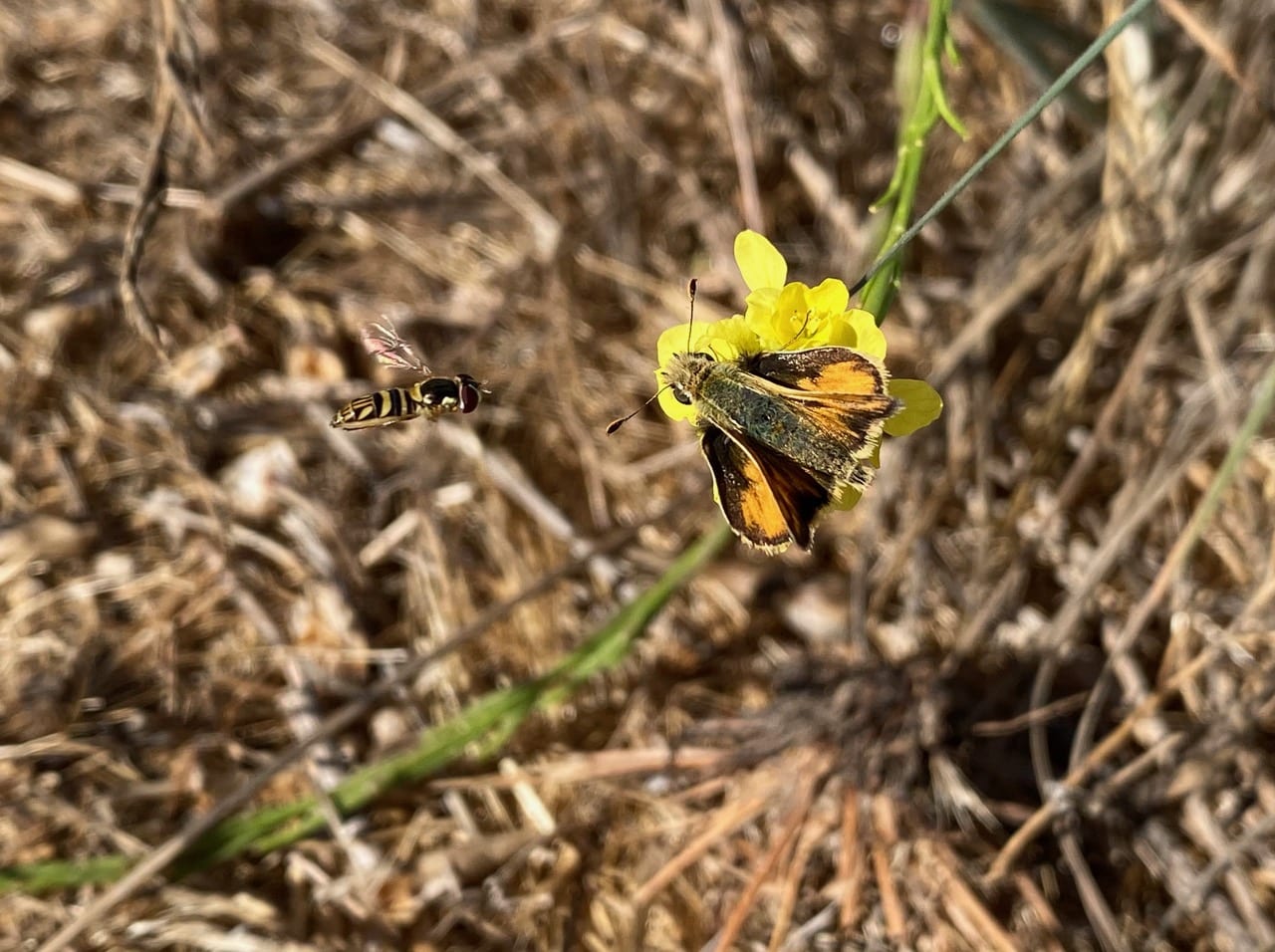
A Skipper butterfly (family Hesperiidae) suddenly lands on the cluster of Wild Mustard flowers, rudely displacing the little hover fly.
Skippers are a family, the Hesperiidae, of the order Lepidoptera (butterflies and moths). They are named for their quick, darting flight habits. Most have the antenna clubs hooked backwards like a crochet hook. They also have generally stockier bodies and larger compound eyes than the other butterflies. Their wings are usually small in proportion to their bodies. When at rest, skippers keep their wings usually angled upwards or spread out, and only rarely fold them up completely. Californian species are mostly brown or tan, with black, orange, or yellow markings.
Skipper caterpillars are usually green or brown, sometimes yellowish, never brightly colored. They have a distinctive “collar”, a narrow ring around the body right behind the head. Caterpillars are camouflaged and often hide during the day. Many species make nests of leaves and silk for additional protection. Most North American species feed on grasses, but some common species eat shrubs and trees, especially in the bean family. Most species are limited to a single group of food plants. Adult skippers are only active during the day, but Skipper caterpillars feed mainly when it is dark or partly light.
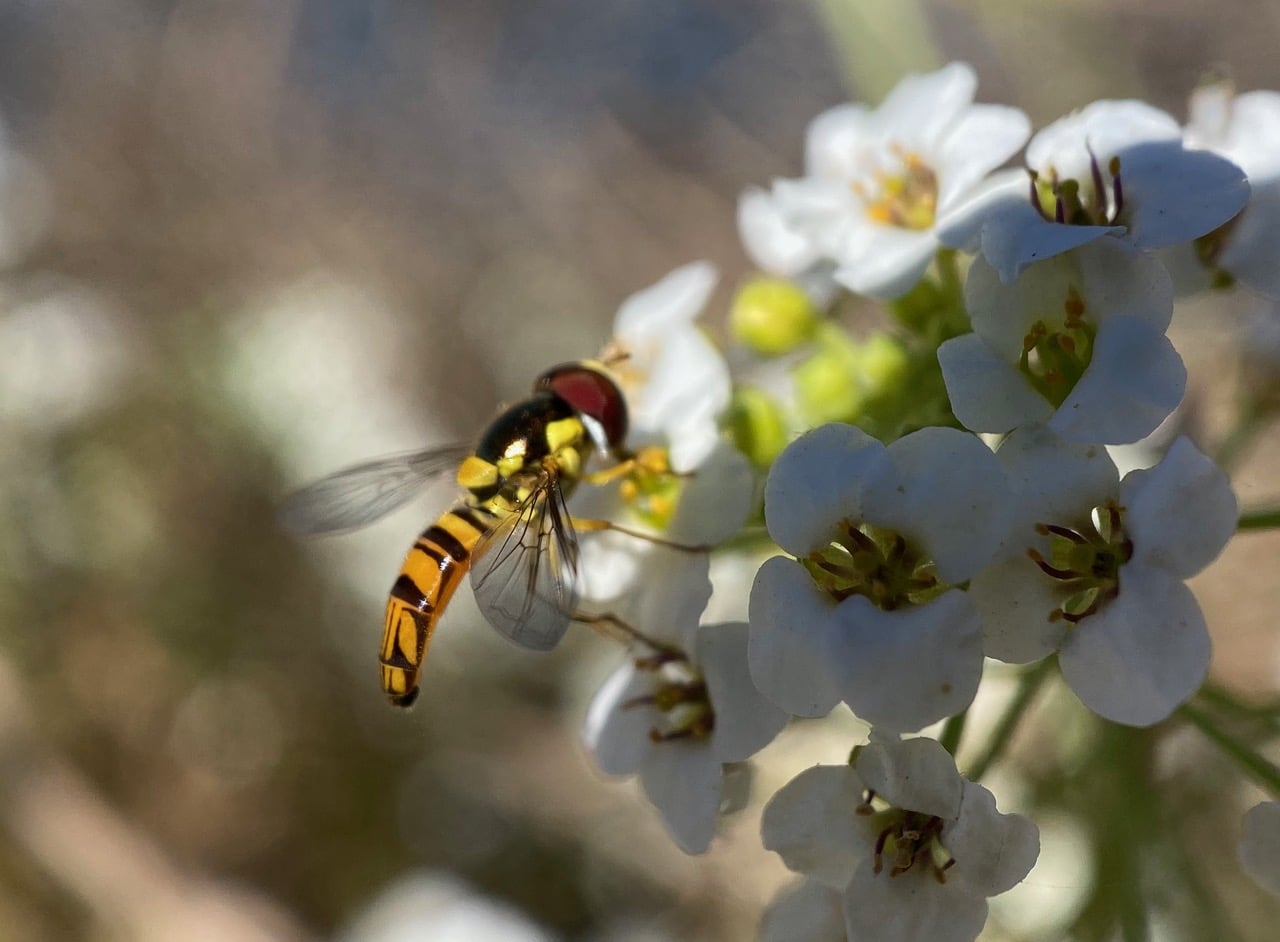
Just a few steps away, a male Oblique Streaktail, Allograpta obliqua (family Syrphidae) is foraging on an inflorescence of of Sweet Alyssum, Lobularia maritima. He has a slimmer abdomen than the females, and he has holoptic eyes that meet along a central line on top of the head.
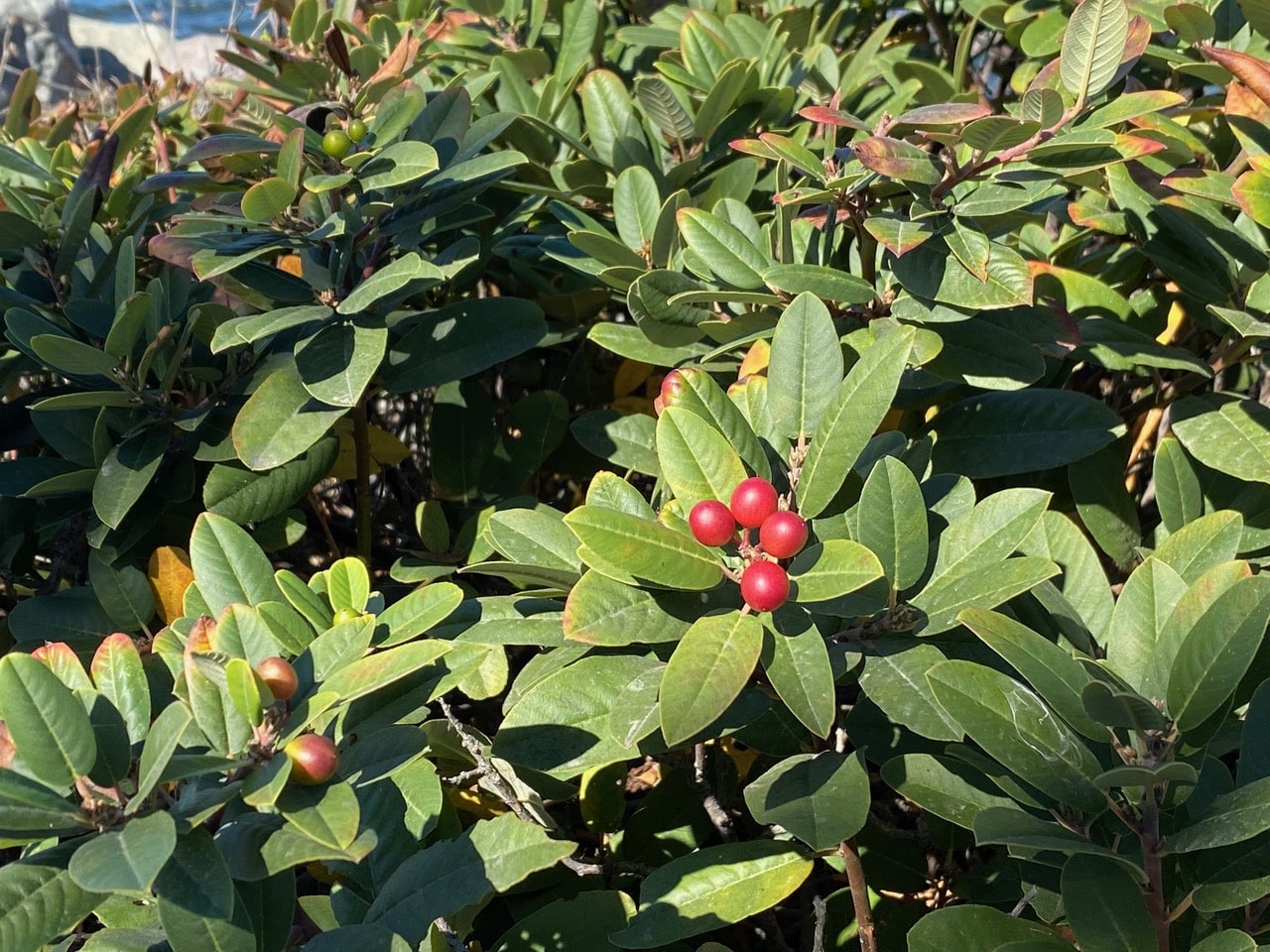
Three large shrubs of Coffeeberry, Frangula californica grow next to the rock wall just above the lapping waves. They have produced a bumper crop of fruits this year.
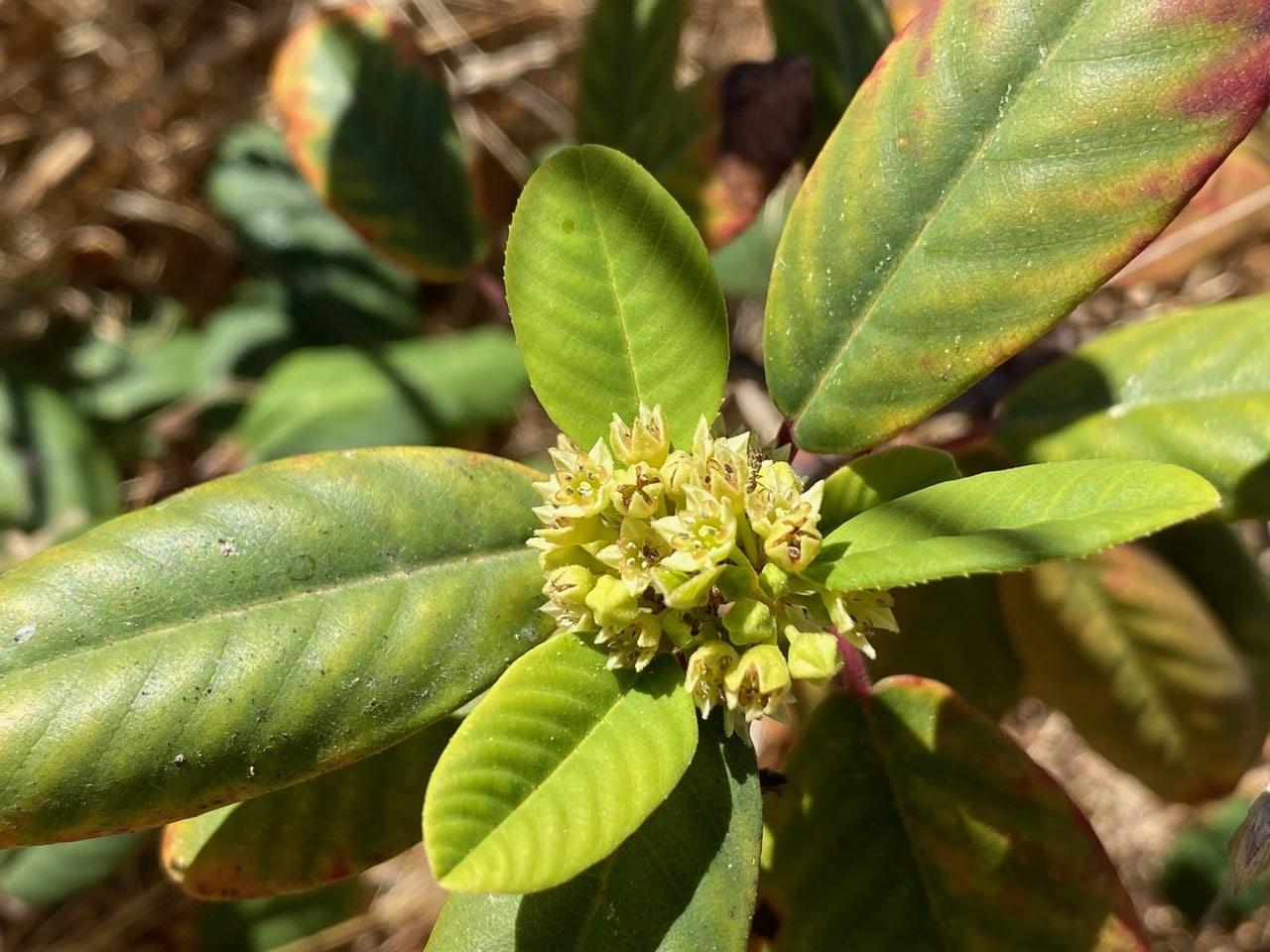
Much to my surprise, there are still a few clusters of flowers on the Coffeeberry.

Argentine Ants, Linepithema humile (family Formicidae) delight in the offerings of the small Coffeeberry flowers.
The Argentine Ant, Linepithema humile (family Formicidae) is native to Northern Argentina, but it has been inadvertently introduced by humans to many countries, and is now an established invasive species in many Mediterranean climate areas worldwide. The success of the species can be attributed to their lack of aggression between the colonies. There is no apparent antagonism between separate colonies of its own kind, resulting in “super-colonies” that extend across hundreds or thousands of kilometers in different parts of the their range. Genetic, behavioral, and chemical analyses show that introduced Argentine Ants on separate continents actually represent a single global supercolony.
The Argentine Ants are ranked among the world’s worst invasive animal species. In its introduced range, the Argentine ant often displaces most or all native ants and can threaten native invertebrates and even small vertebrates that are not accustomed to defending against the aggressive ants. This can, in turn, imperil other species in the ecosystem, such as native plants that depend on native ants for seed dispersal, or lizards that depend on native ants for food.
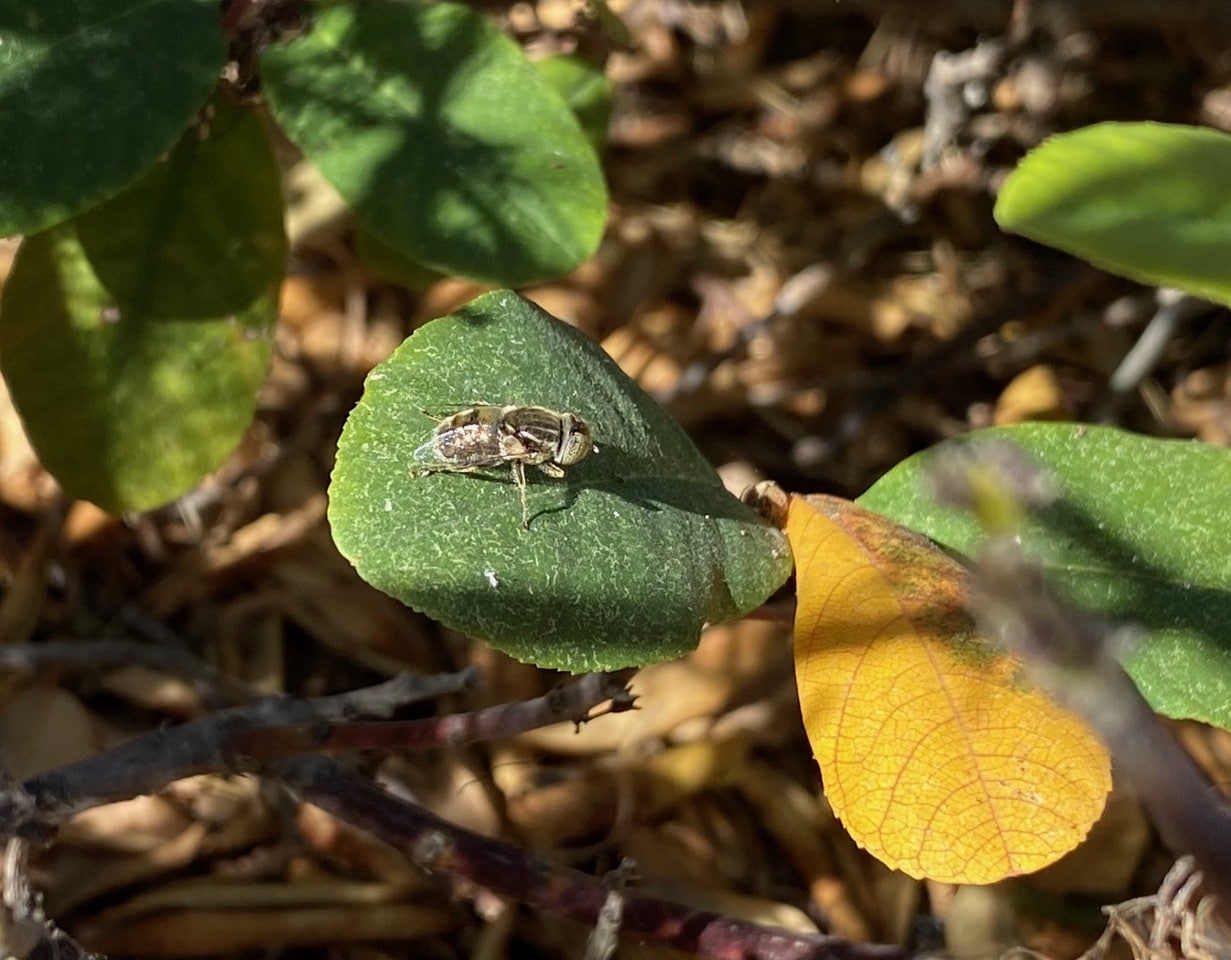
A shiny fly lands on a Coffeeberry leaf. Hey, it’s a Common Lagoon Fly, Eristalis aeneus (family Syrphidae), an unusual hover fly that has eyes patterned with black spots.
The species is native to Europe, and widespread throughout Europe and the United States. It draws its common name from its habitat of lagoons, ponds, slow-moving rivers, streams and irrigation ditches. The larvae are commonly found along shorelines in rock pools containing large amounts of decaying seaweed. They develop in brackish as well as a variety of freshwater habitats. The adults fly very fast and low over ground vegetation, and feed on yellow composites and white umbellifers. The flight period is April to October, and the fly overwinters as an adult.
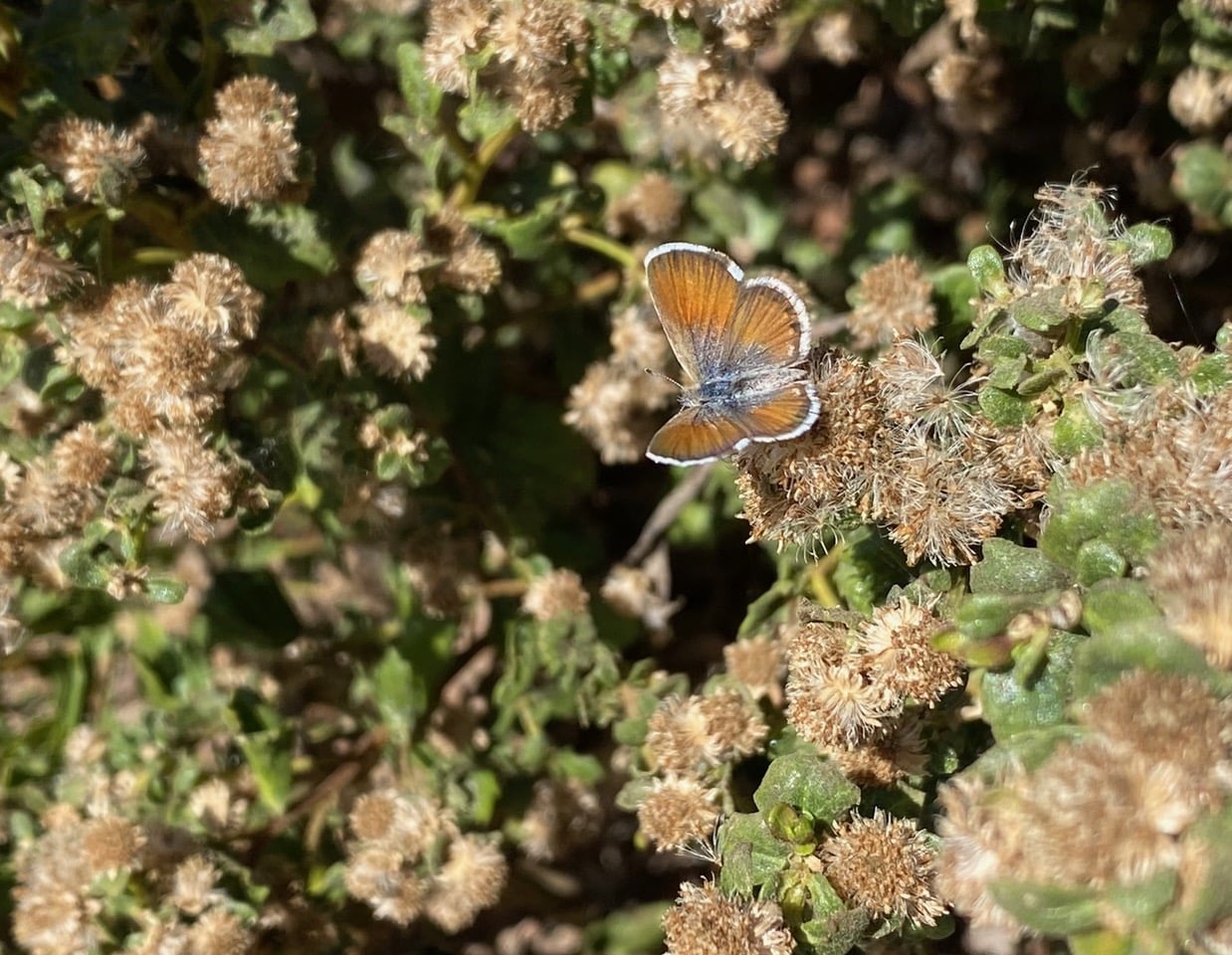 A small butterfly flits around the base of a large male Coyote Brush, Baccharis pilularis for a while before landing on the dried flowerheads. It is a Western Pygmy Blue, Brephidium exilis (family Lycaenidae).
 With a wingspan of 12-20 mm, about the size of a thumbnail, the Western Pygmy Blue, Brephidium exilis (family Lycaenidae) is one of the smallest butterflies in the world and the smallest in North America. The butterfly is found in alkaline areas such as deserts and salt marshes. The caterpillars feed on plants in the Goosefoot family Chenopodiaceae, commonly found in salty habitats. Although the species has no set breeding season, mating activity is at its peak during late summer and early fall.

A tiny iridescent wasp is running around on the foliage of the Coyote Brush. The wasp has a long ovipositor – obviously a female. iNaturalist has identified it as a chalcid wasp, Torymus sp. (family Torymidae).
Torymidae is a family of wasps in the superfamily Chalcidoidea. Most species in this family are small with attractive metallic coloration, and females generally have long ovipositors. Many are parasitoids on gall-forming insects, and some are phytophagous (plant-eating) species, sometimes using the galls formed by other insects. Over 960 species in about 70 genera are found worldwide. They are best recognized in that they are one of the few groups of chalcidoidea in which the cerci are visible. Most members of the genus Torymus are ectoparasitoids of gall forming insects, usually gall wasps and gall midges.
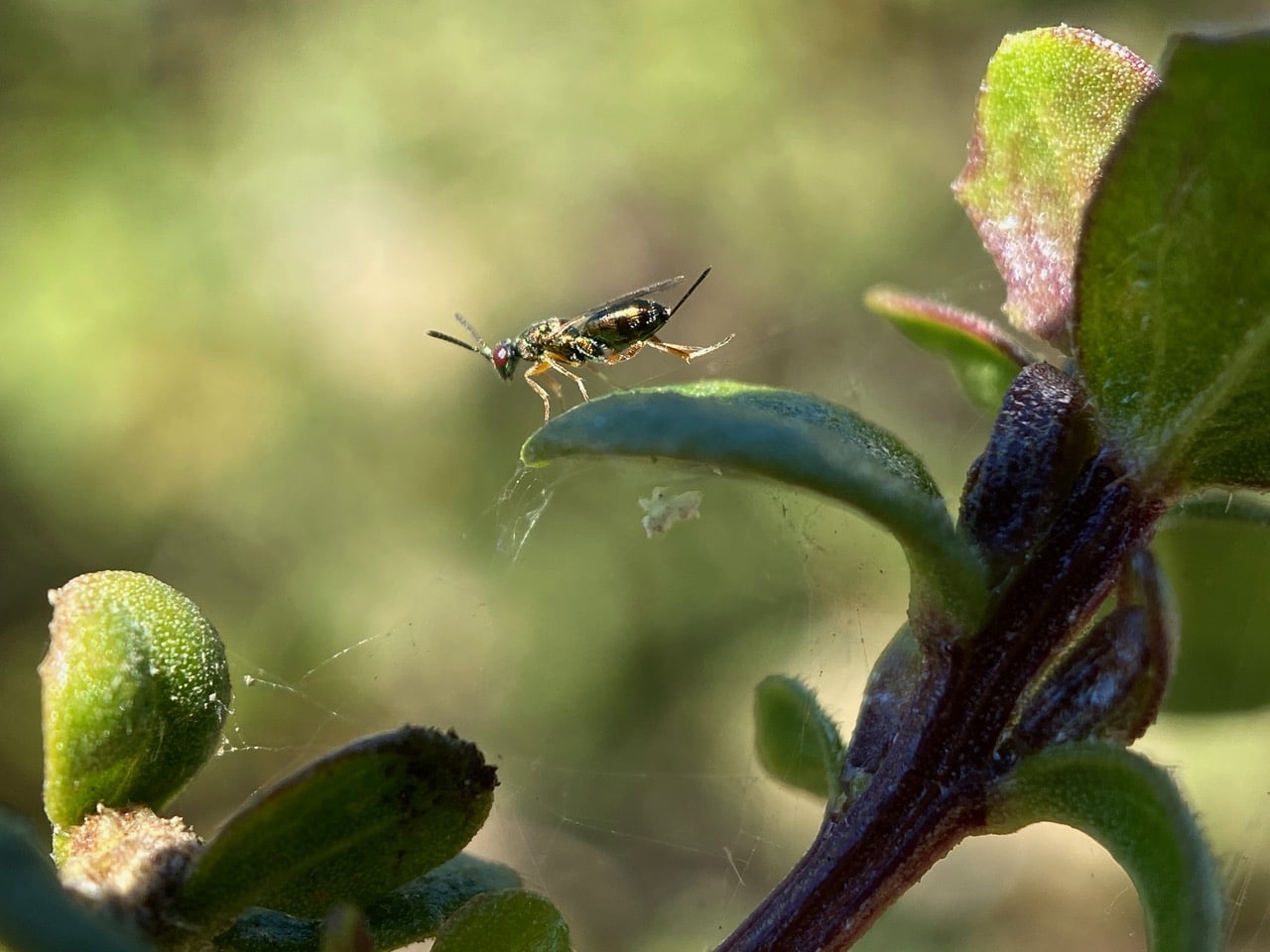
The wasp stands on a leaf to groom herself.
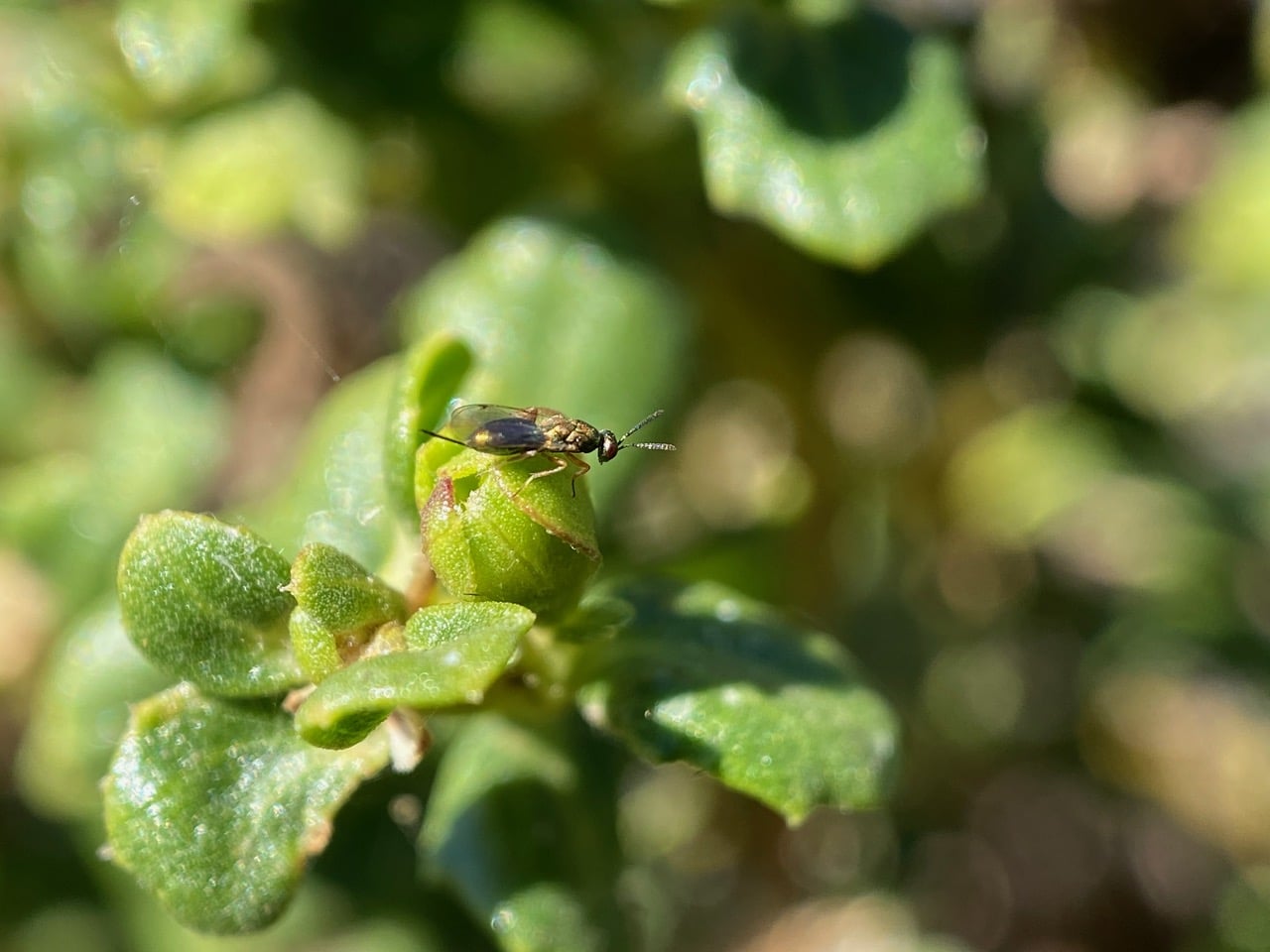
She then climbs to the terminal leaves and remains in this hunkered position for a long time. Is she laying eggs? The long “ovipositor” we see is only the sheath that protects the actual ovipositor. During egg laying, the ovipositor is unsheathed and pushed vertically downward into the substrate to inject an egg.

A Gray Hairstreak, Strymon melinus (family Lycaenidae) has landed to take nectar from a small cluster of male Coyote Brush flowerheads. It is continuously rubbing its hind wings together, up and down.
Why the name “hairstreak”? These small butterflies have a slim, hair-like tail on the lower corner of each hindwing. Gray Hairstreak also has colorful false eyespots near the base of each tail. The eyespots and antenna-like tails are believed to fool predators into mistaking its tail for its head. Hairstreaks even add a behavioral component – a nectaring hairstreak often rubs its wings up and down, simulating the movement of twitchy antennae. This may fool birds, lizards, and spiders into attacking the wrong end, sparing the life of the butterfly.
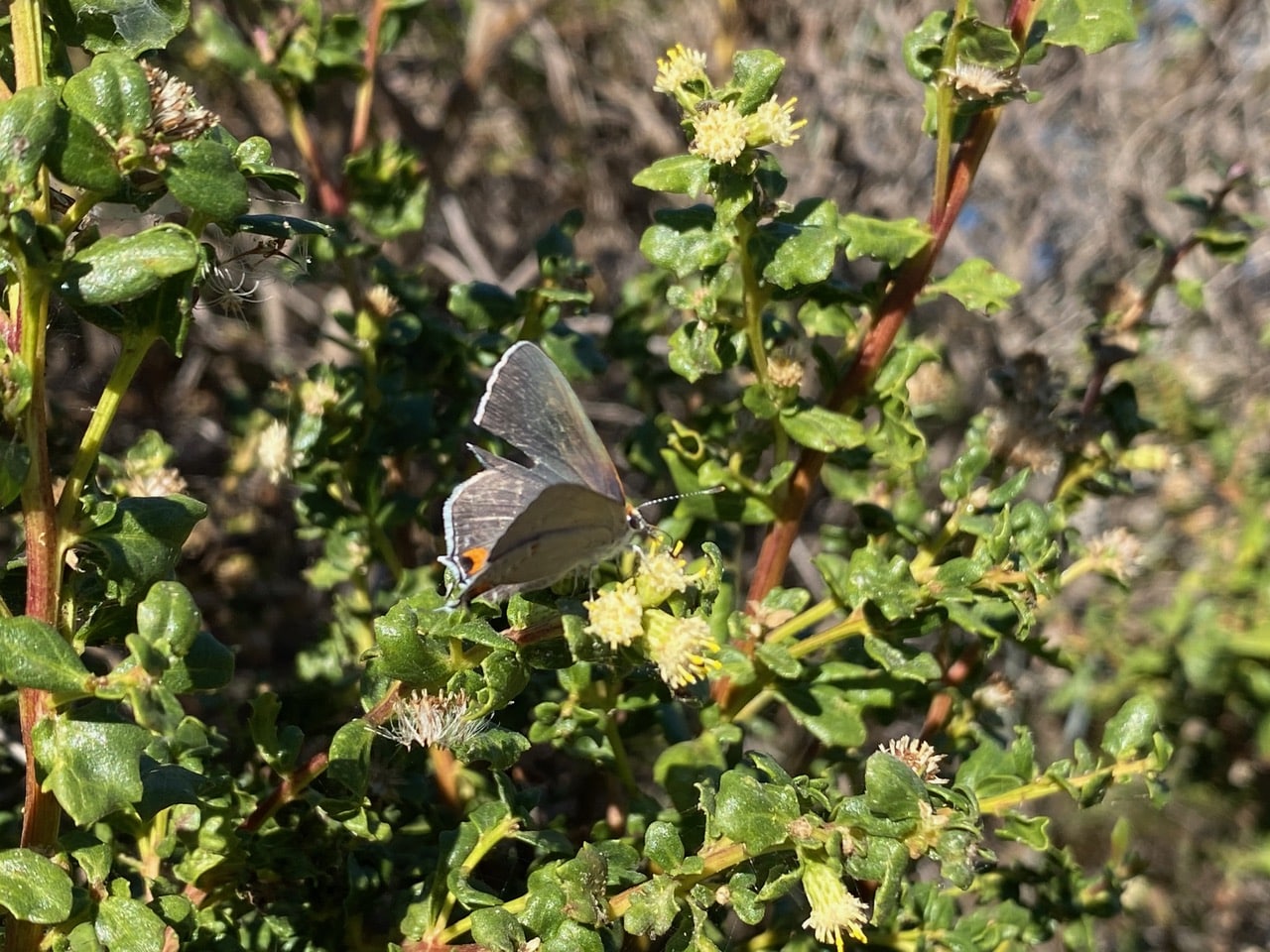
The butterfly has seen better days – it has a torn left forewing and missing a lot of scales on all its wings.
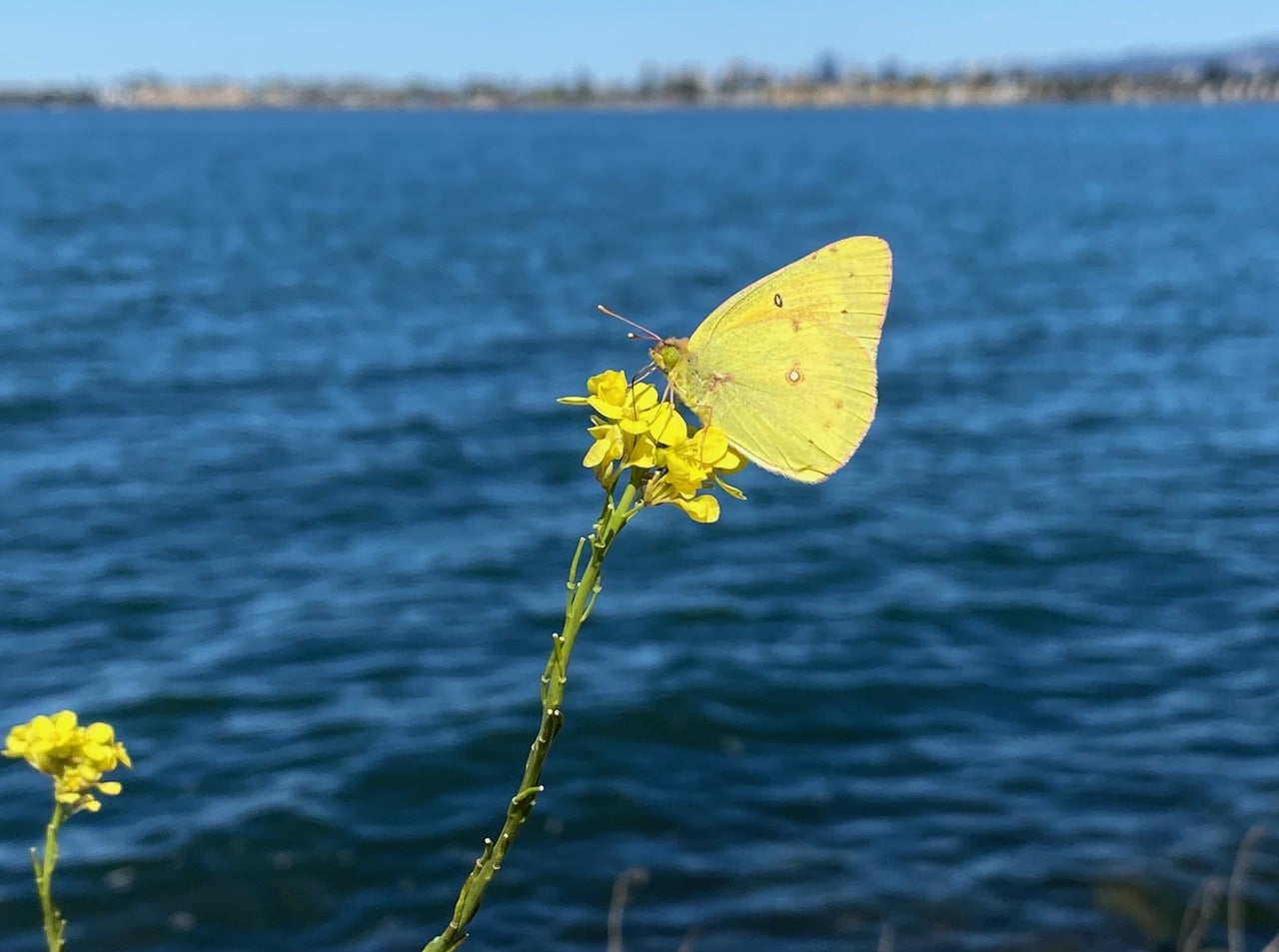
I encounter a fourth butterfly species along this short, weedy stretch of the trail – an Orange Sulphur, Colias eurytheme (family Pieridae). It is taking nectar from a cluster of Wild Mustard flowers.
The Orange Sulphur, Colias eurytheme is a widespread and common North American butterfly, belonging to the Pieridae family, the “Whites and Sulphurs”. It is medium-sized with a wingspan of about 2 in. Though color may vary among individuals, the wings are typically yellowish and orange, although some females are white and may appear greenish. The top wing surface has dark brown to black edging. Adults fuel up on nectar from a variety of flowering plants. The caterpillars (green with a white side streak) tend to concentrate on pea family plants (family Fabaceae), such as alfalfa, vetch and clover. Males patrol for females, looking for the characteristic female ultraviolet light absorbance on the hind wings. In contrast, the males’ hindwings reflect ultraviolet light instead.