

Pollinator Post 10/15/24 (2)
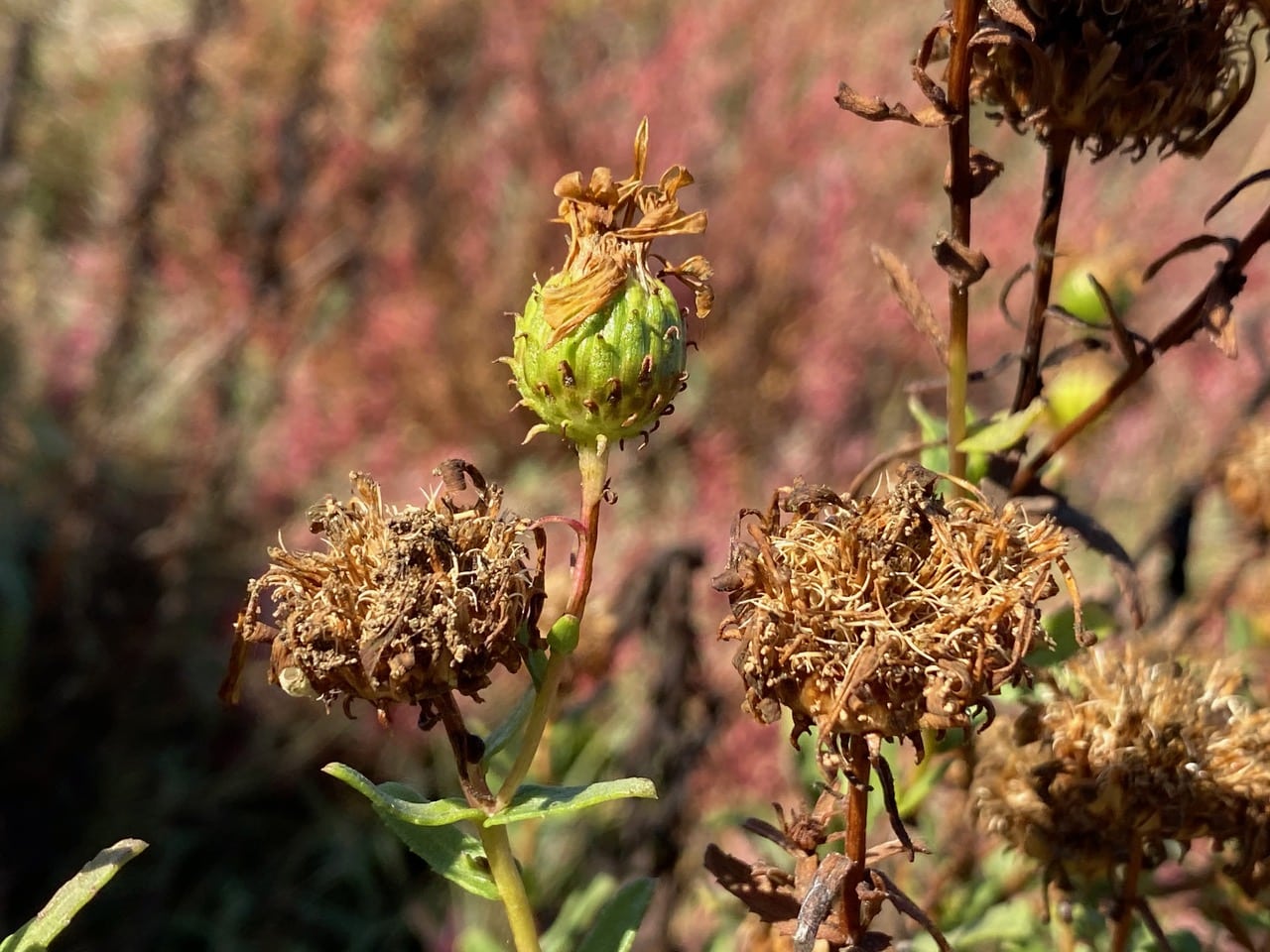
Most of the Oregon Gumweed, Grindelia stricta along the shoreline have gone to seed.
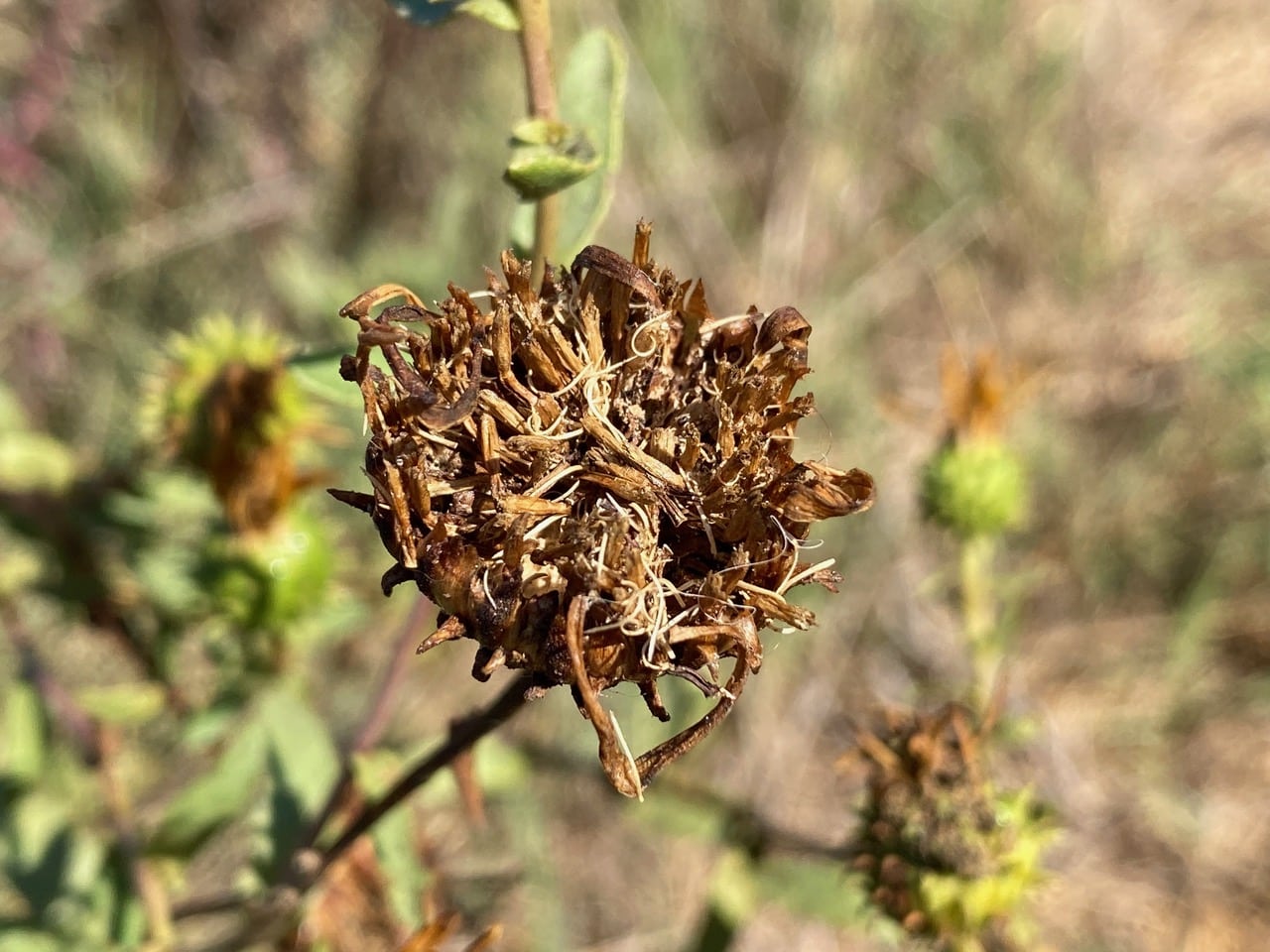
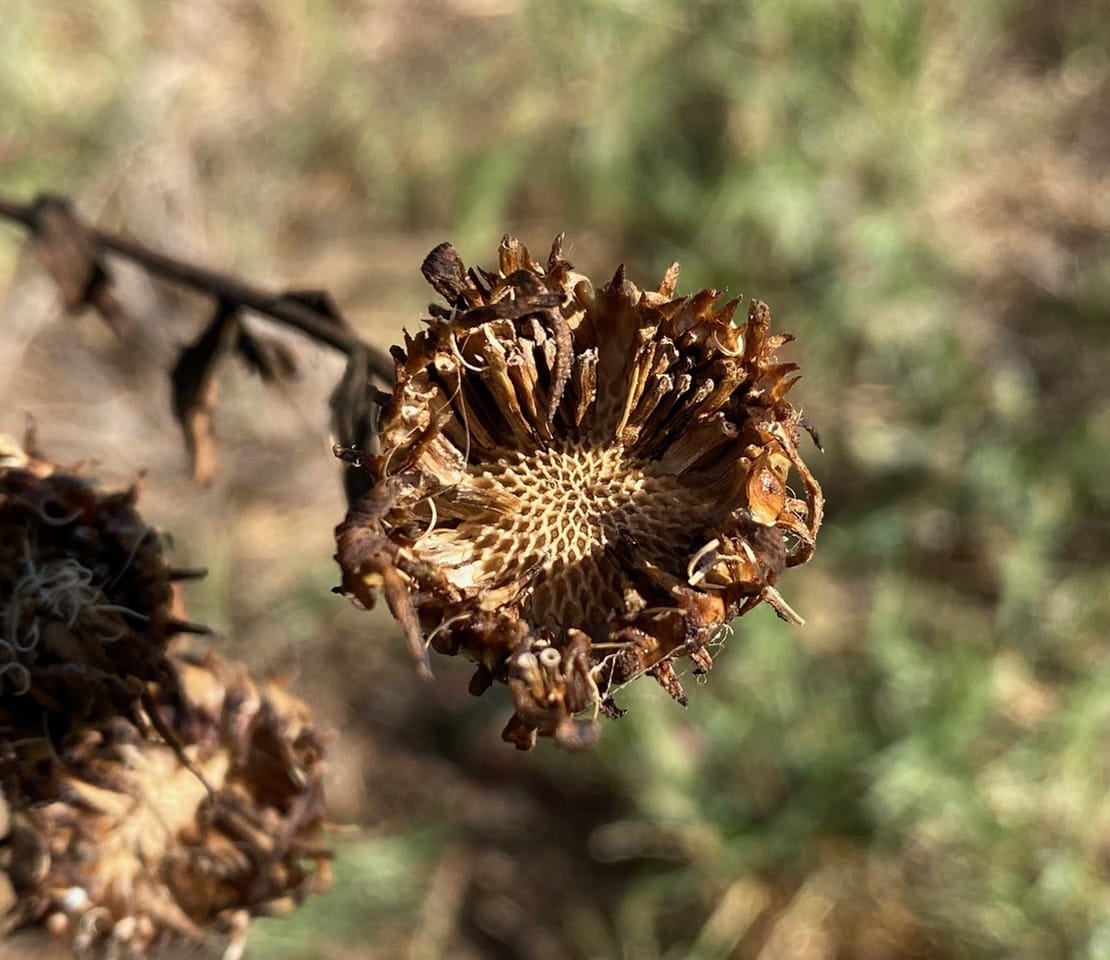


Unlike many members of the sunflower family Asteracea, the seed heads of Grindelia are not the adorable fluffy puffballs. Grindelia seed heads are a messy, disarrayed collection of wilted flower parts mixed in with the seeds.
Here’s a Grindelia seed head that has shed most of its seeds. The seeds are arranged in vertical columns, attached to the base in a beautiful radiating symmetry in accordance to the Fibonacci sequence.
I scrape off what remains on the seed head with my finger and place the contents in my palm. With a quick blow from my breath, I remove the lighter chaff to reveal the Grindelia seeds. These “seeds” are actually achenes – dry one-seeded fruits that do not open to release the seeds. With a silent prayer, I sprinkle the seeds into the ground. May these go on to produce more Grindelia, a keystone species that supports so much life along this shoreline.
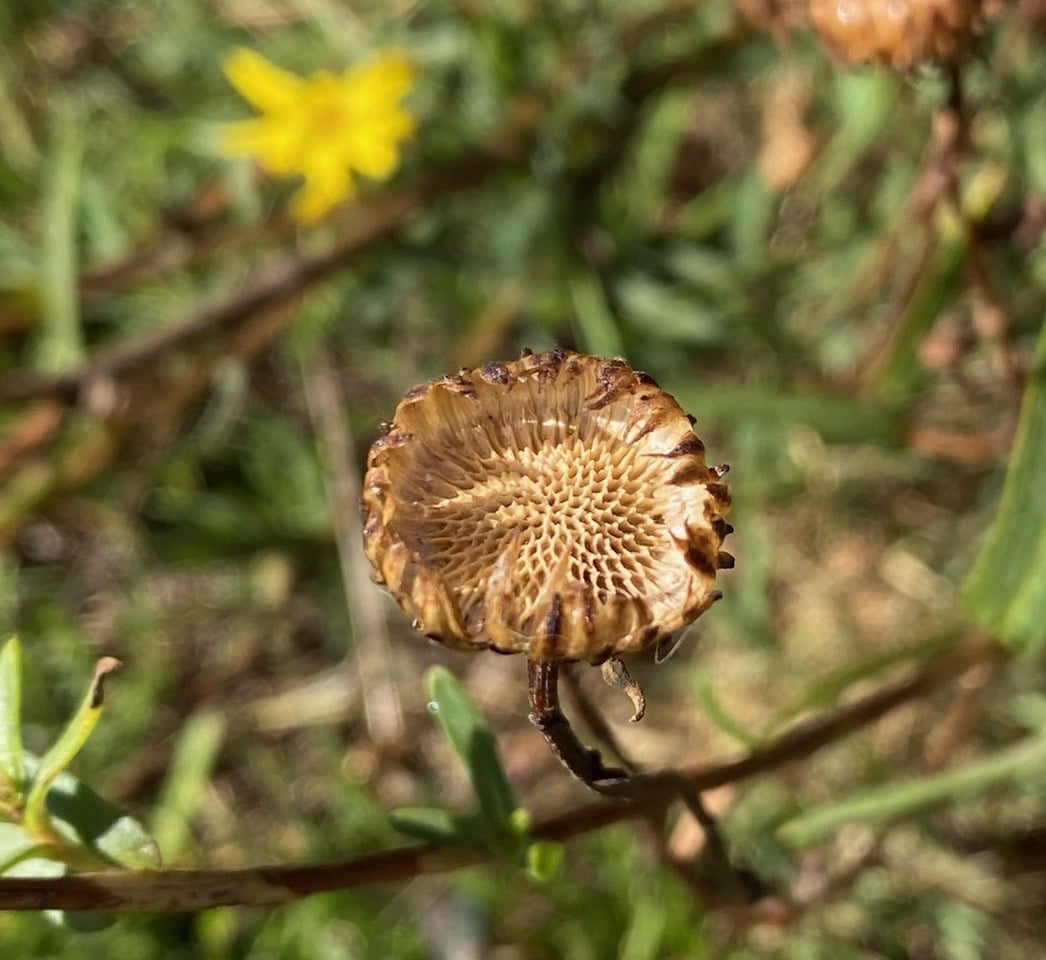
Here’s a Grindelia seed head that is emptied of its seeds (without my help).
A Buttonhook Leafbeetle Jumping Spider, Sassacus vitis (family Salticidae) is lurking in the shadows on a withered Grindelia flowerhead.
The spider is native to North America, with a range spanning from Canada to Panama. It is a small jumping spider with iridescent gold abdomen and white ring around the anterior surface of abdomen. Body is covered with golden scales. Males are 3.5 mm long, females 4.5 mm. The name vitis is Latin for “grapevine”. The spider is commonly found on shrubs and vines and in fields. Best known as a common resident of vineyards.
Salticids are free-roaming hunting spiders. They do not weave a web to catch prey. They stalk, then pounce on their prey. Just before jumping, the spider fastens a safety line to the substrate. It can leap 10-20 times their body length to capture prey. Their movement is achieved by rapid changes in hydraulic pressure of the blood. Muscular contractions force fluids into the hind legs, which cause them to extend extremely quickly. Jumping spiders are visual hunters. Their excellent vision has among the highest acuities in invertebrates. Since all their 8 eyes are fixed in place and cannot pivot independently from the body like human eyes can, jumping spiders must turn to face whatever they want to see well. This includes moving their cephalothorax up and down, an endearing behavior.
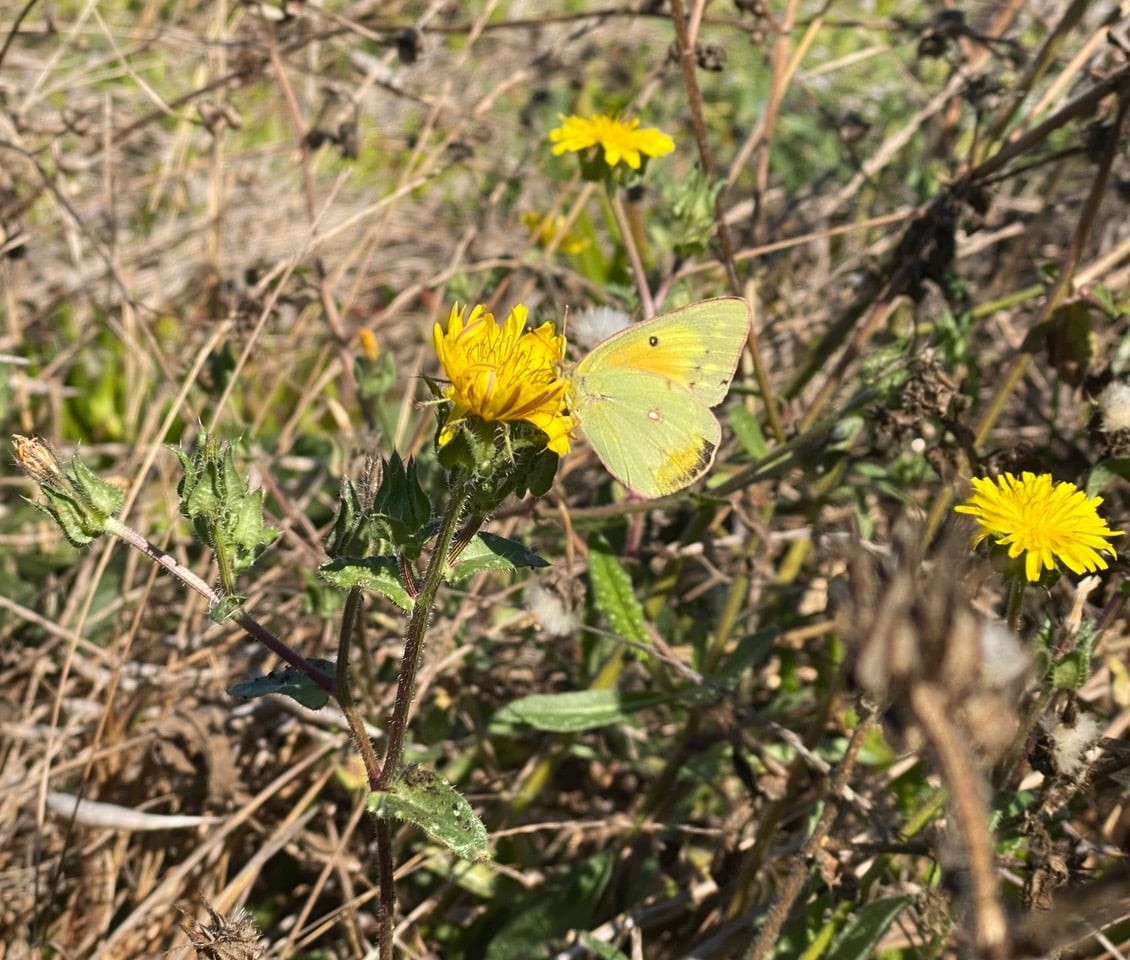
An Orange Sulphur butterfly is taking nectar from a Bristly Oxtongue flowerhead.
The Orange Sulphur, Colias eurytheme is a widespread and common North American butterfly, belonging to the Pieridae family, the “Whites and Sulphurs”. It is medium-sized with a wingspan of about 2 in. Though color may vary among individuals, the wings are typically yellowish and orange, although some females are white and may appear greenish. The top wing surface has dark brown to black edging. Adults fuel up on nectar from a variety of flowering plants. The caterpillars (green with a white side streak) tend to concentrate on pea family plants (family Fabaceae), such as alfalfa, vetch and clover. Males patrol for females, looking for the characteristic female ultraviolet light absorbance on the hind wings. In contrast, the males’ hindwings reflect ultraviolet light instead.
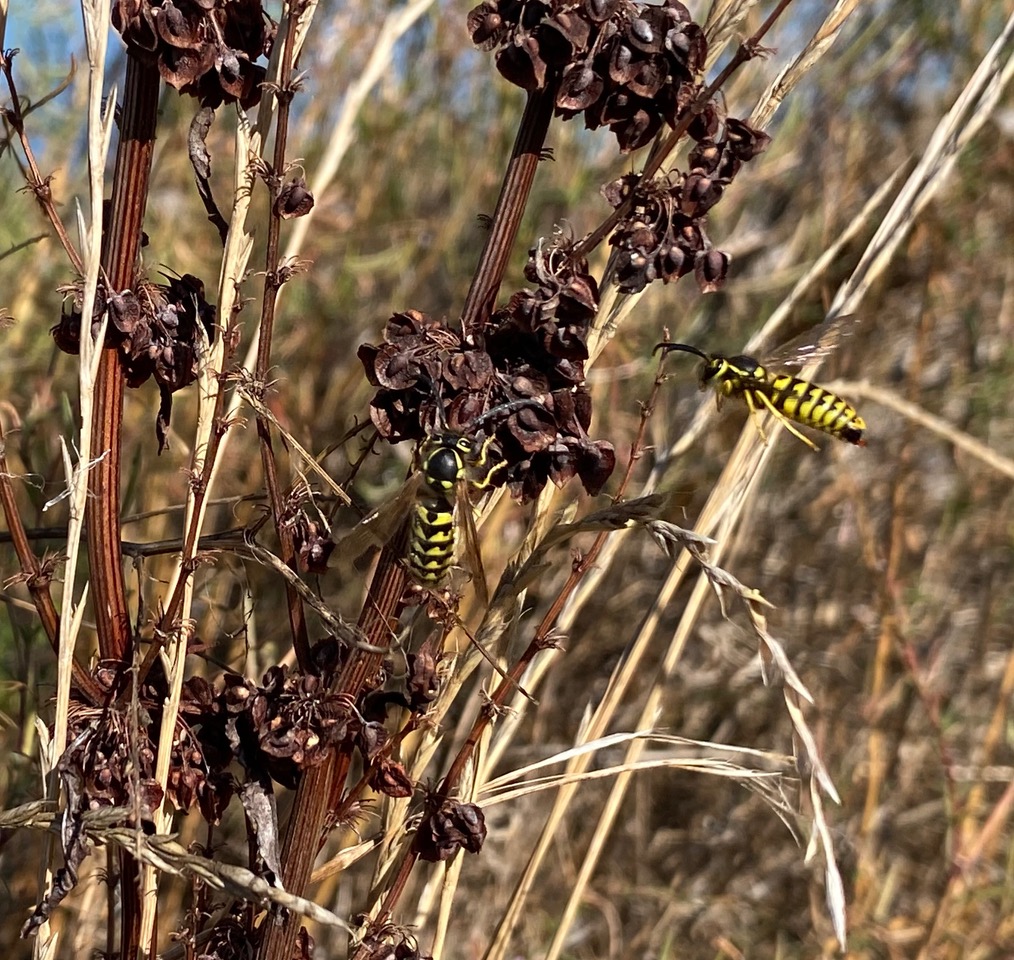
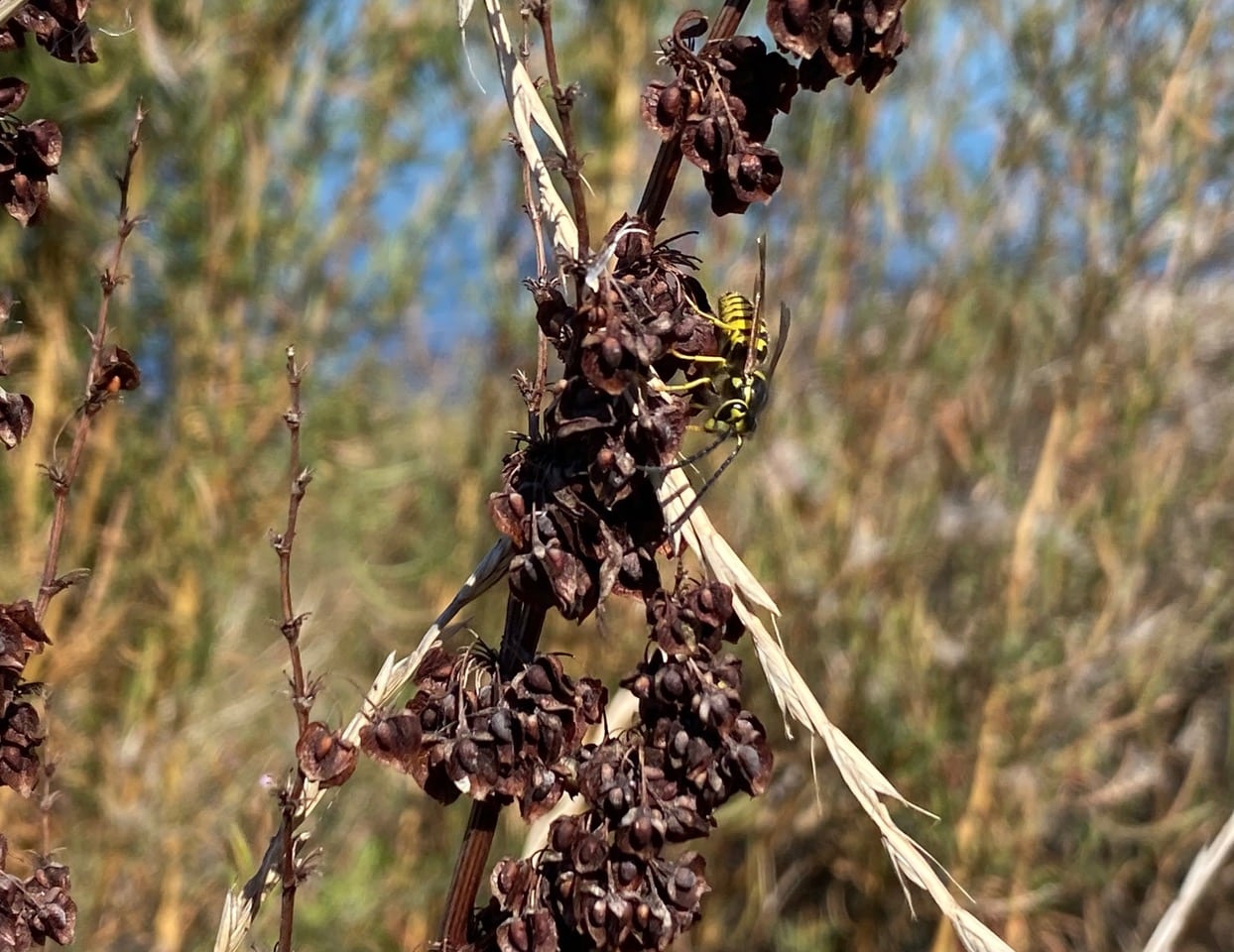
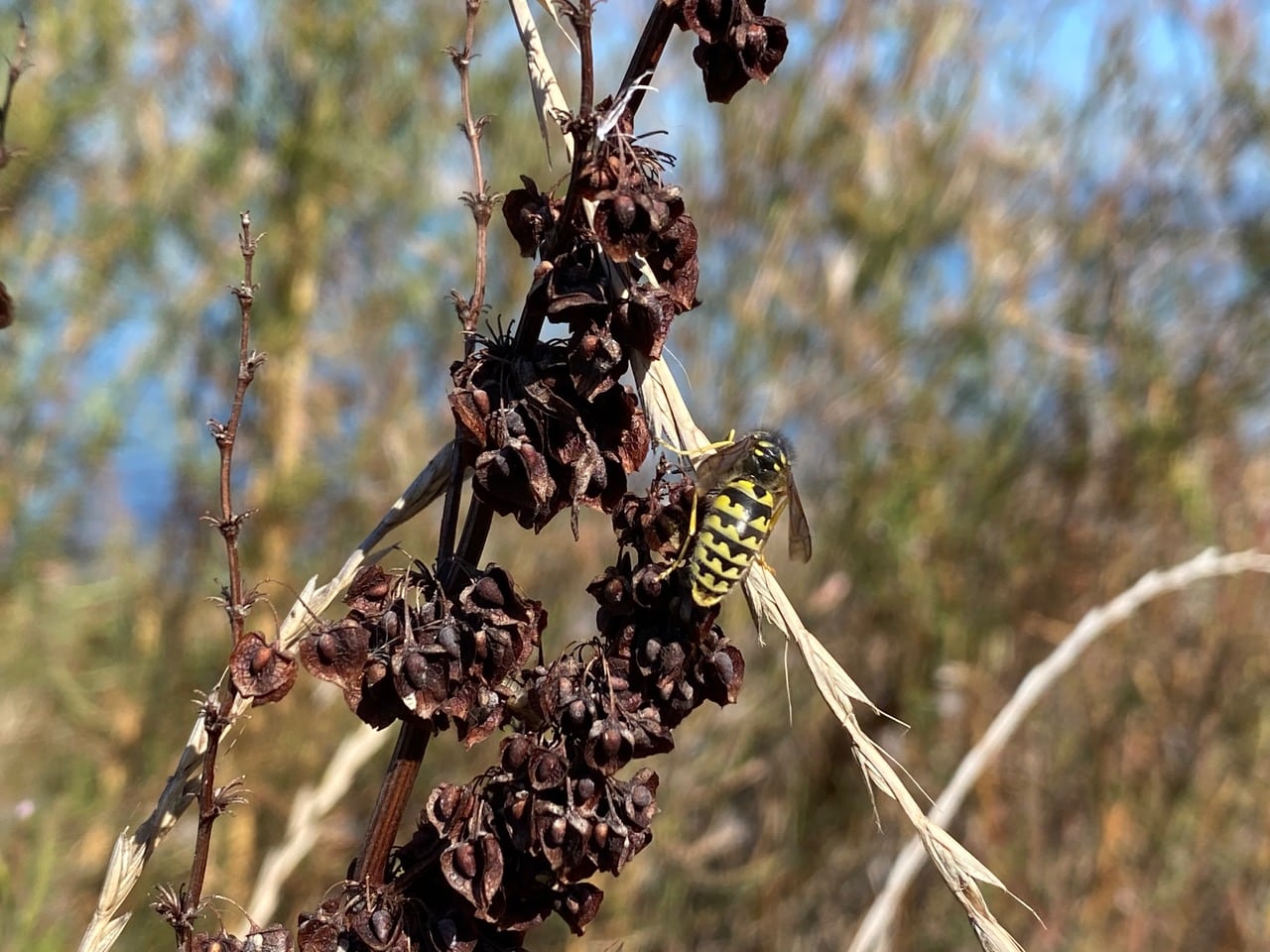
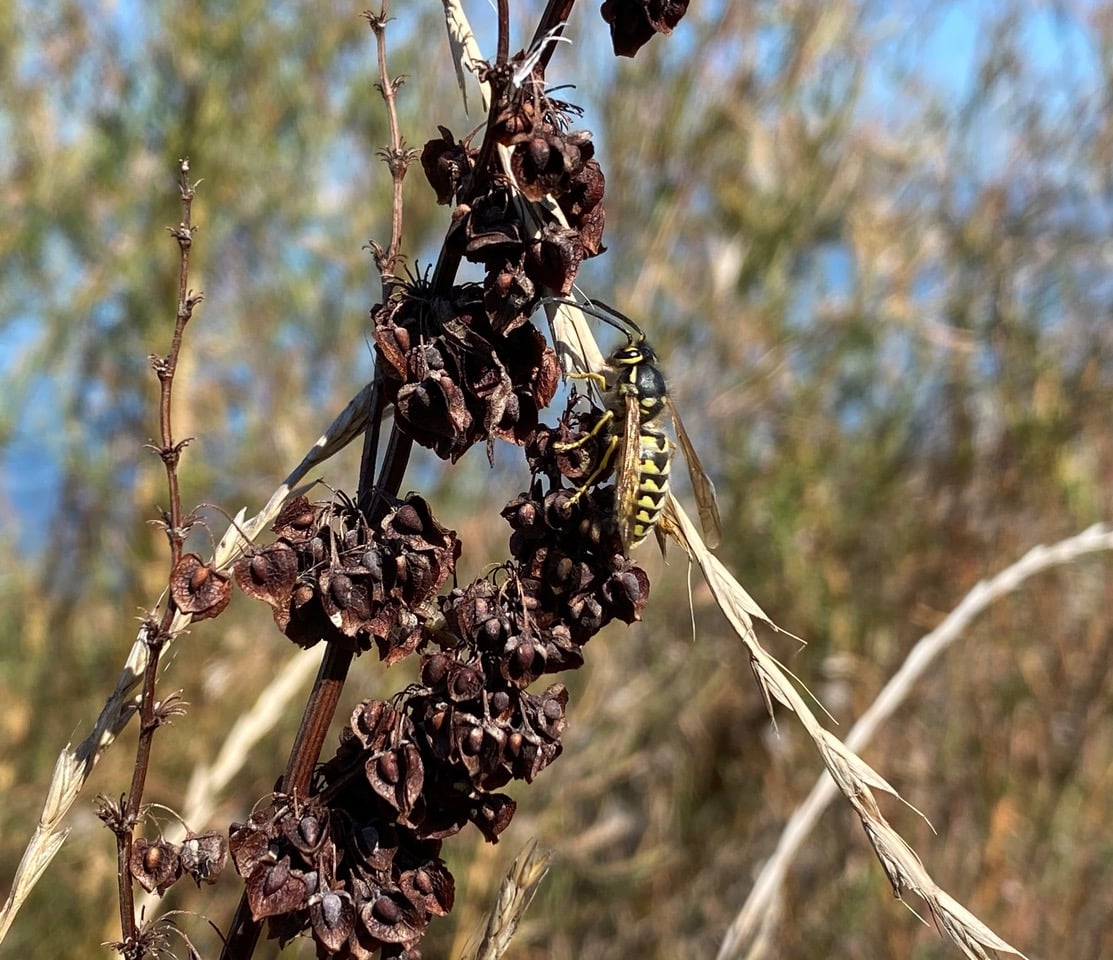
I suddenly find myself in the midst of an insect swarm. They are buzzing everywhere around me, and occasionally landing on the tall dried vegetation in frenzied clusters. When I take a good look I realize that they are Yellowjackets. Has their nest been disturbed, and they are out to defend their colony?
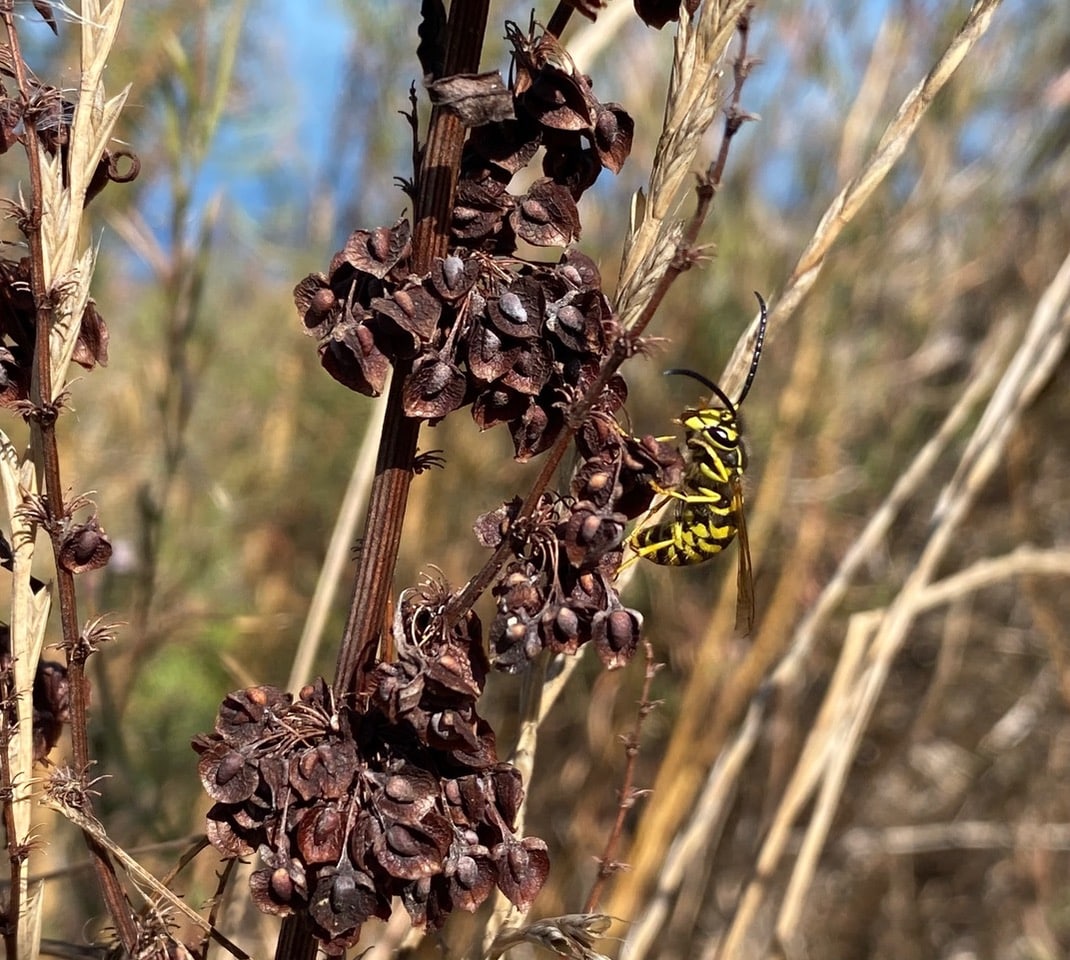
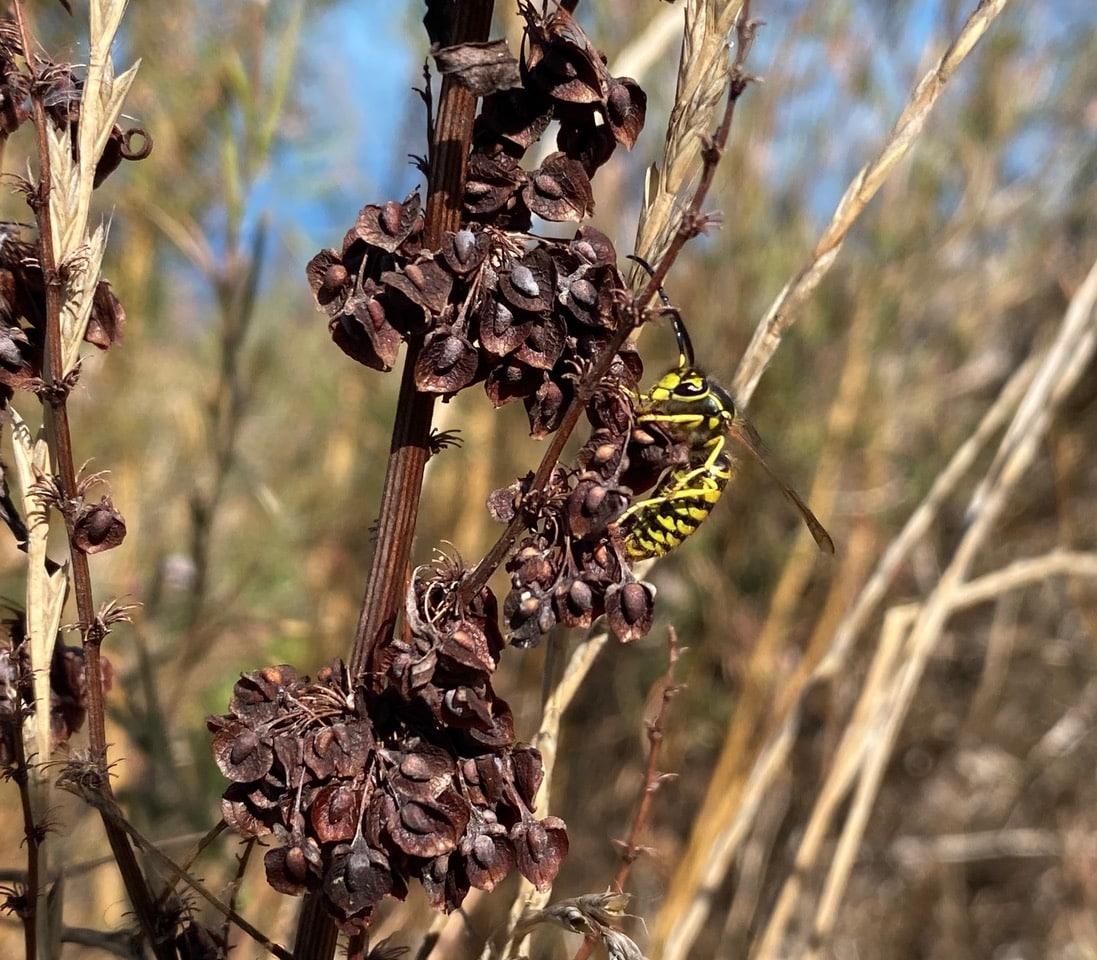
I quickly take a few pictures of the wasps and beat a fast retreat. When I review the photos at home, I realize that these might be Yellowjacket drones (males). They have extra long antennae…
… and elongated abdomen. So maybe the frenzied affair is a mating swarm? That’s the only time we are likely to encounter drones.
My friend Emil, a Hymenopteran enthusiast/expert, has confirmed my suspicions. These are indeed male Yellowjackets. There are two major clues to identifying the drones – they have longer antennae, and they have seven abdominal segments (females have six). There is disappointingly little information out there on the triggers for the mating swarms of Yellowjackets. We know that in ants and termites, the environmental triggers are usually some rain that synchronizes the swarming of reproductives from neighboring colonies. We haven’t had a drop of rain for months.
The following information is gleaned from the website of the Illinois College of Aces, Department of Crop Sciences:
“Yellowjackets, like other social insects, have a caste system with division of labor. Each colony has a queen whose purpose is to reproduce. Male yellowjackets fertilize the queen, and sterile female workers forage for food, take care of the queen and the young, and defend the nest.
Single queens begin building nests in the spring. Depending on the species, she will locate a sheltered space underground, often an abandoned rodent burrow, or in a structure and construct a golf ball sized nest of paper that is made by mixing wood fibers with her saliva. She lays eggs and cares for the grub-like larvae in the nest. The first generation of sterile female workers emerge in June and assume the care of the nest. This allows the queen to concentrate on reproduction. Yellowjacket adults feed on nectar, fruit juices, sap and other liquids and provide insects and carrion to the larvae. The population of worker yellowjackets increases during the summer and peaks in early to mid-August.
From late summer into early fall the queen produces queen and male yellowjackets. Each nest can produce thousands of new queens. Queens and males swarm from the nest and mate. The males, workers, and old queens die as winter approaches. Newly mated queens seek overwintering sites in protected places such as logs, under bark or leaf litter, and occasionally in human-made structures. They remain dormant through the winter and begin the cycle once again in the spring.”
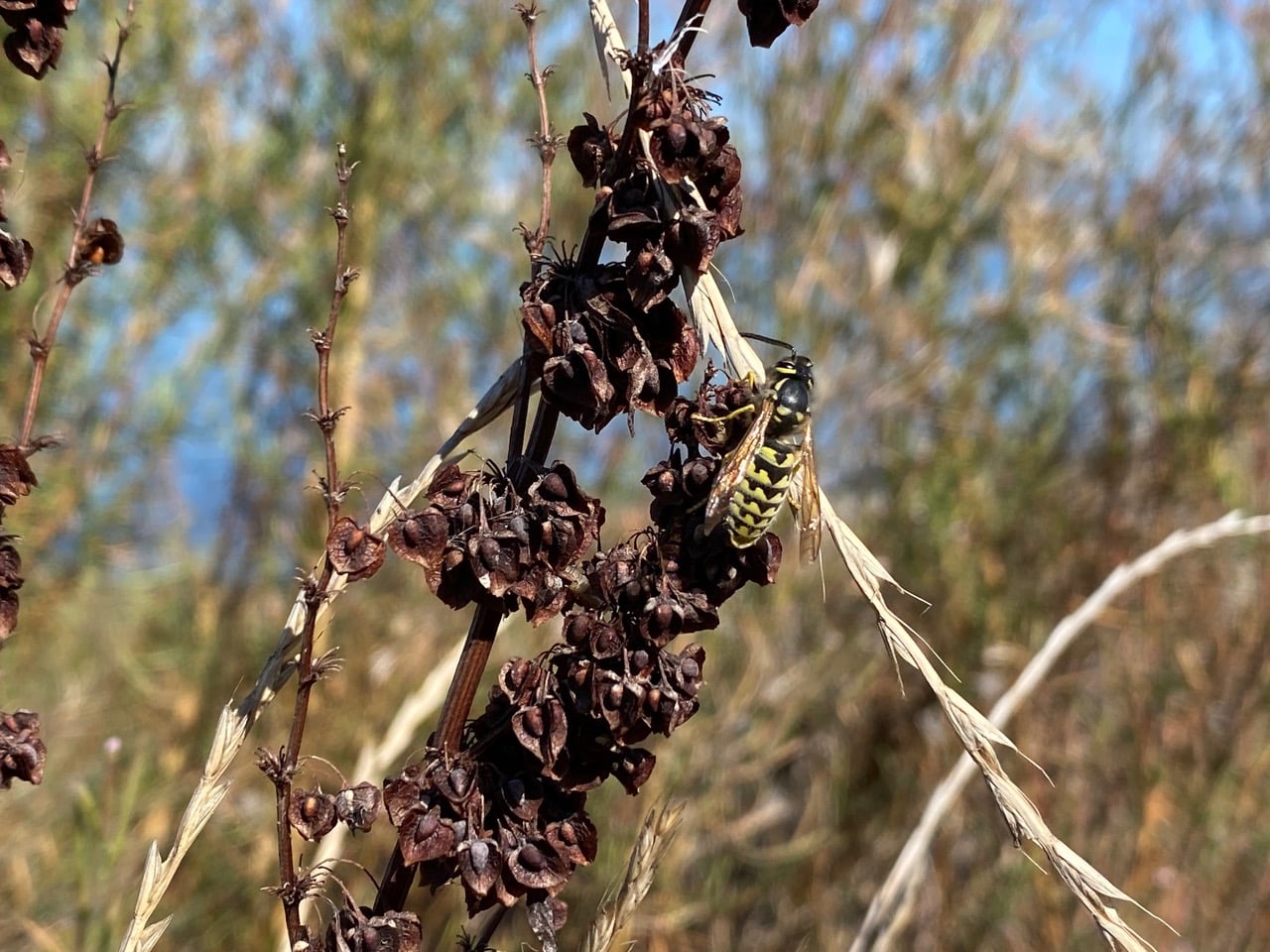
The 7 abdominal segments are on full display on this Yellowjackt drone.
Yellowjackets are beneficial insects in the sense that they pollinate plants and feed other insects and carrion to their larvae. Often they prey on insects that we consider as pests. Unfortunately, their ability to sting makes them a safety hazard. The stings of social wasps, such as yellowjackets, have evolved as a defense mechanism. Yellowjackets are easily provoked and, will attack in force if their nest is disturbed. Unless a person is allergic to yellowjacket venom, stings are rarely life threatening.
I need not be fearful about being in this mating swarm after all. Most of the swarming wasps are drones (males). Males don’t even have a stinger. Females, including the queen do have stingers – these are modified ovipositor, or egg-laying apparatus.
The drone proceeds to groom itself on the dried Curly Dock.
From Emil: “Yellowjacket queens do die in the fall, which is followed right away by the colony sending out the next wave of queens and males to mate with them, so that’s right on schedule… I can’t say I’ve ever encountered a swarm of males like that! It requires perfect timing since the males live only very briefly.”
I am certainly lucky to have witnessed this event. Perfect timing indeed!
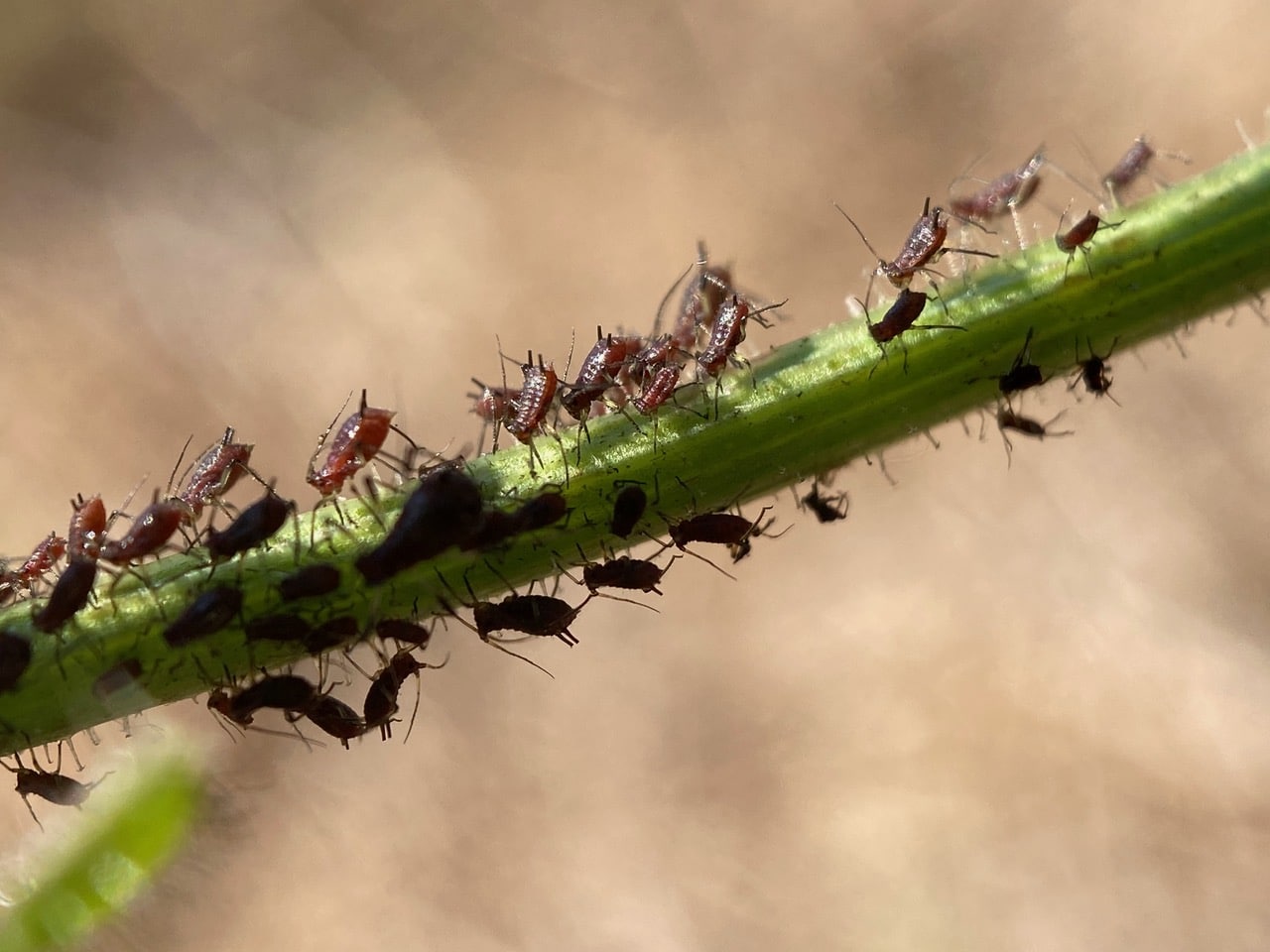
I always check out plants with aphids – something interesting is bound to happen on them. I park myself in front of an aphid-infested Bristly Oxtongue, Helminthotheca echioides and wait for the show to start.
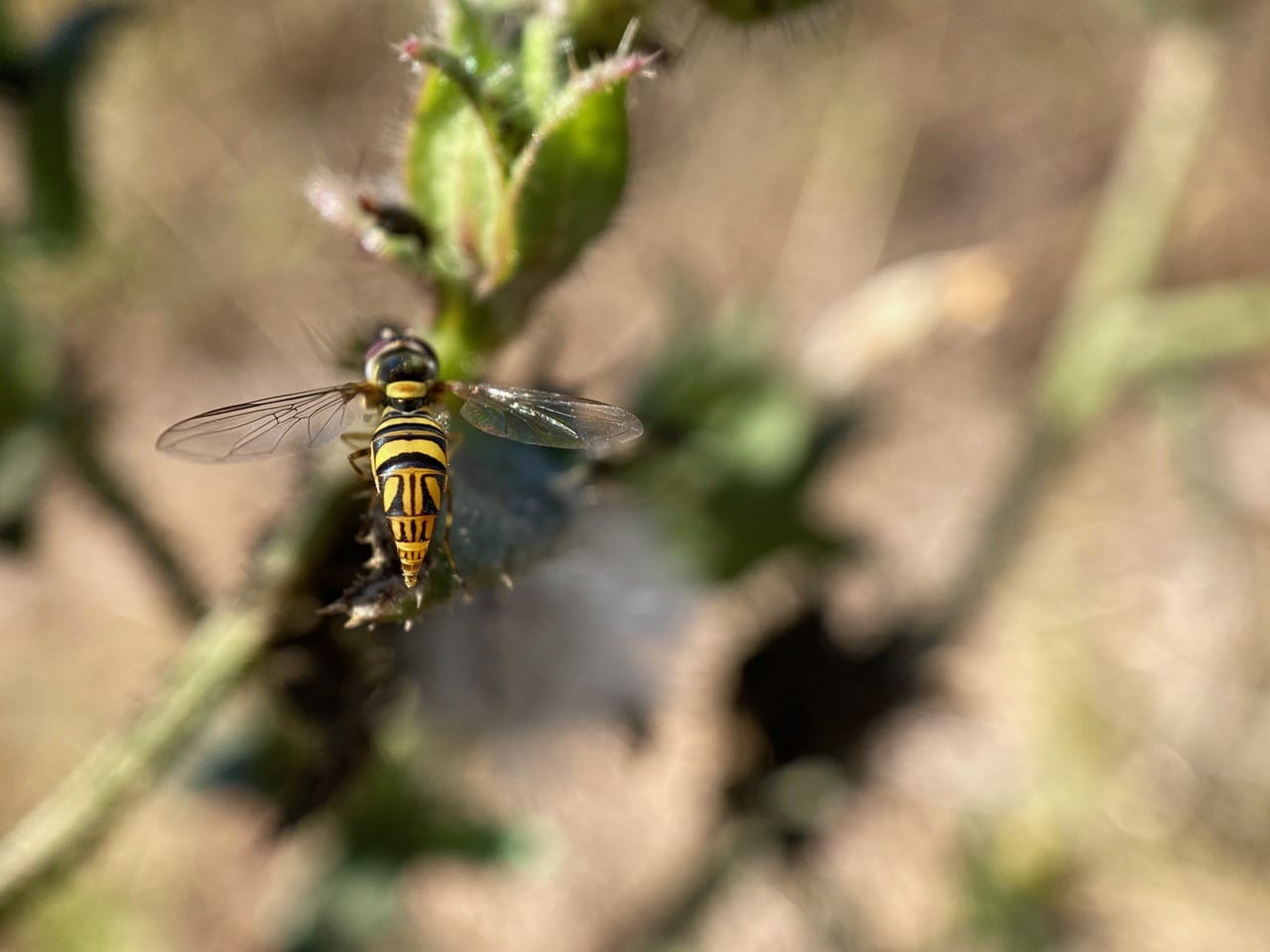
A female Oblique Streaktail, Allograpta obliqua (family Syrphidae) lands on a leaf and curls her abdomen forward to lay eggs. The larvae of many hover flies are voracious predators of aphids and other soft-bodied insects. Gravid females seek out aphid colonies to lay their eggs close by to ensure that their young would have plenty to eat.
Syrphid larvae have no eyes and no legs. They swing their tapered head from side to side in search of prey. When they make contact with a prey, they grab hold of it with their mouthpart, then suck out the victim’s body contents. Depending on species, a Syrphid larva can feed on 100 to 400 aphids before it pupates.
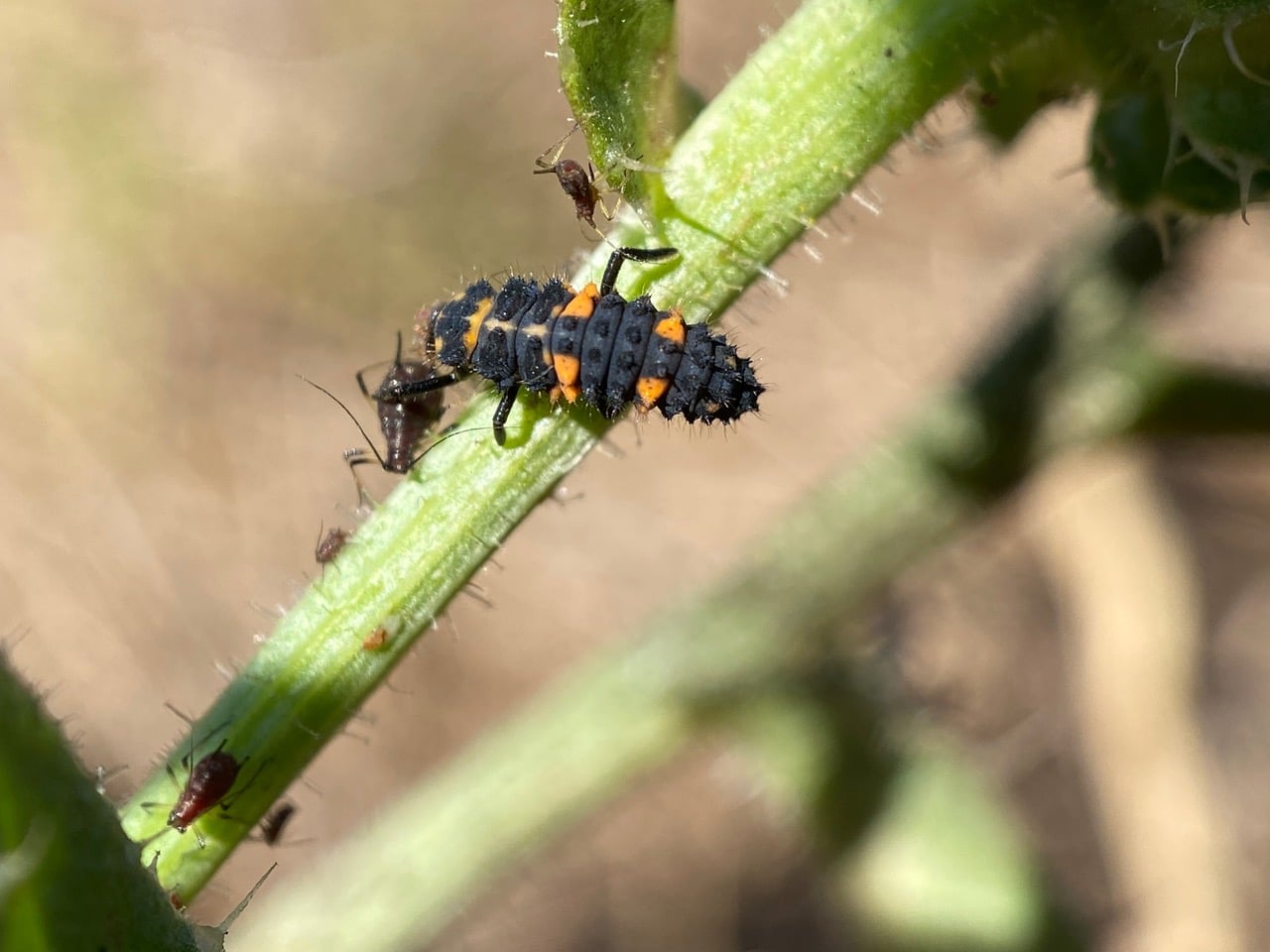
Gotcha! A Lady Beetle larva (family Coccinellidae) has caught a large aphid in its front leg. Lady Beetle larvae are voracious predators of aphids.
Lady beetles go through complete metamorphosis, which comprises four stages: eggs, larva, pupa and adult. The larva goes through four molts during their development. Often described as miniature alligators with six legs, the larvae are voracious predators of aphids. Each larva can eat about 400 aphids in the three weeks before it pupates. Besides aphids, they also feed on soft scales, whitefly pupae, thrips, and spider mites.
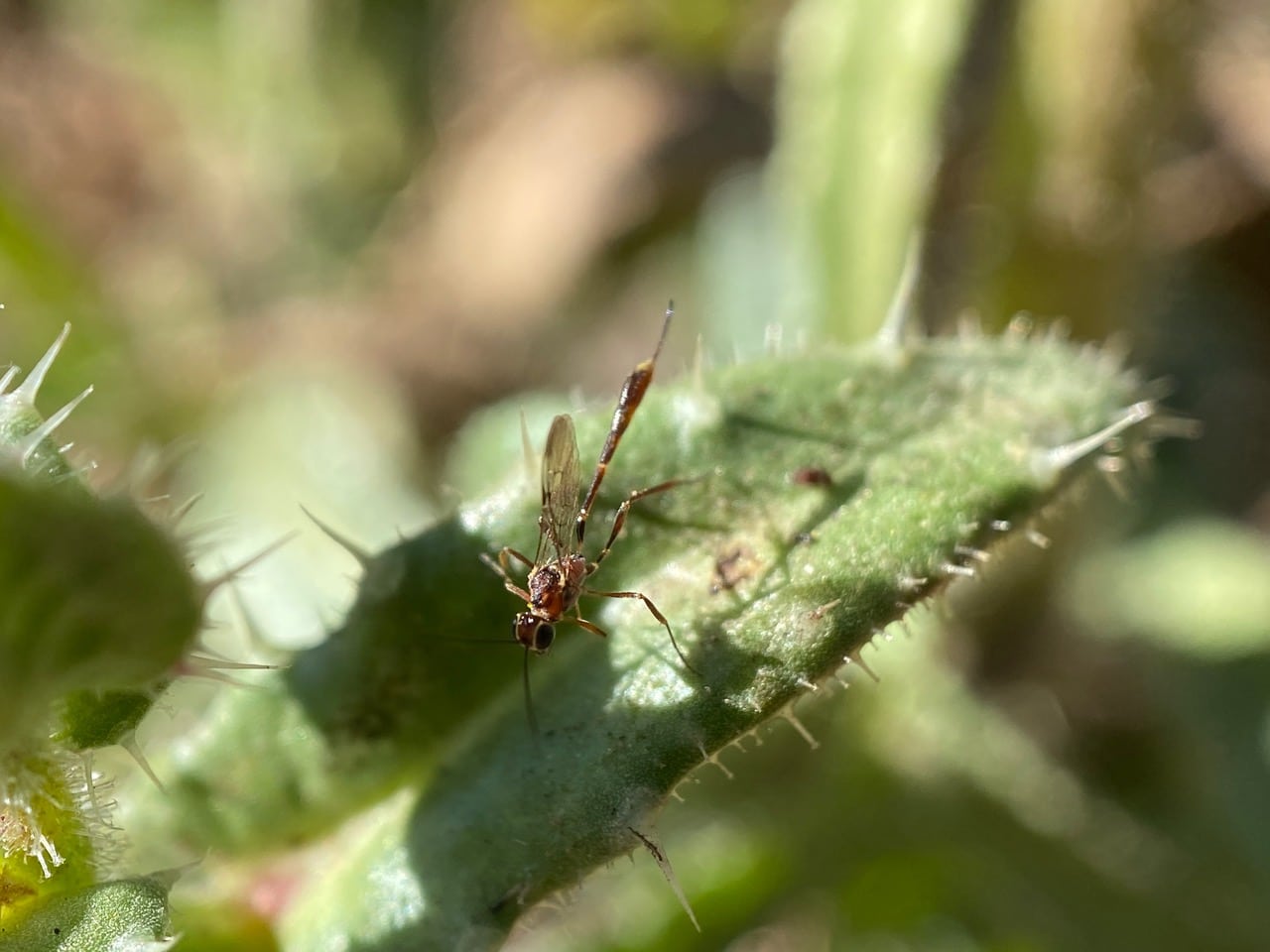
A female parasitoid wasp, Anomalon sp. (family Ichneumonidae) is grooming itself on a Bristly Oxtongue leaf. Is she here to lay eggs in the beetle larvae?
The Ichneumonidae, also known as the Ichneumon Wasps, or Ichneumonids, are a family of parasitoid wasps. They are one of the most diverse groups within the Hymenoptera (the order that includes the ants, wasps and bees) with about 25,000 species and counting. Ichneumon Wasps attack the immature stages of insects and spiders, eventually killing their hosts. They play an important role in the ecosystem as regulators of insect populations.
The Ichneumon Wasps have longer antennae than typical wasps, with 16 segments or more as opposed to 13 or fewer. Ichneumonid females have an unmodified ovipositor for laying eggs. They generally inject eggs either directly into their host’s body or onto its surface, and the process may require penetration of wood. After hatching, the Ichneumonid larva consumes its still living host. The most common hosts are larvae or pupae of Lepidoptera (butterflies and moths), Coleoptera (beetles) and Hymenoptera. Adult Ichneumonids feed on plant sap and nectar. Females spend much of their active time searching for hosts while the males are constantly on the look out for females. Many Ichneumonids are associated with specific prey, and Ichneumonids are considered effective biological controls of some pest species.
Anomalon is a large genus of parasitoid wasps in the family Ichneumonidae. The wasps are found worldwide, but most diverse in tropical regions. In the Americas they are mostly found in very wet rain forests. Recorded hosts include tenebrionid (darkling beetle) or elaterid (click beetle) larvae, and noctuid and tortricid moth larvae.