

Pollinator Post 10/14/26 (1)

Another beautiful day to walk among the Oregon Gumweed, Grindelia stricta along the shoreline of Bay Farm Island.






The edges of the shoreline is exposed in medium tide, with barely a ripple on the water on this calm day.
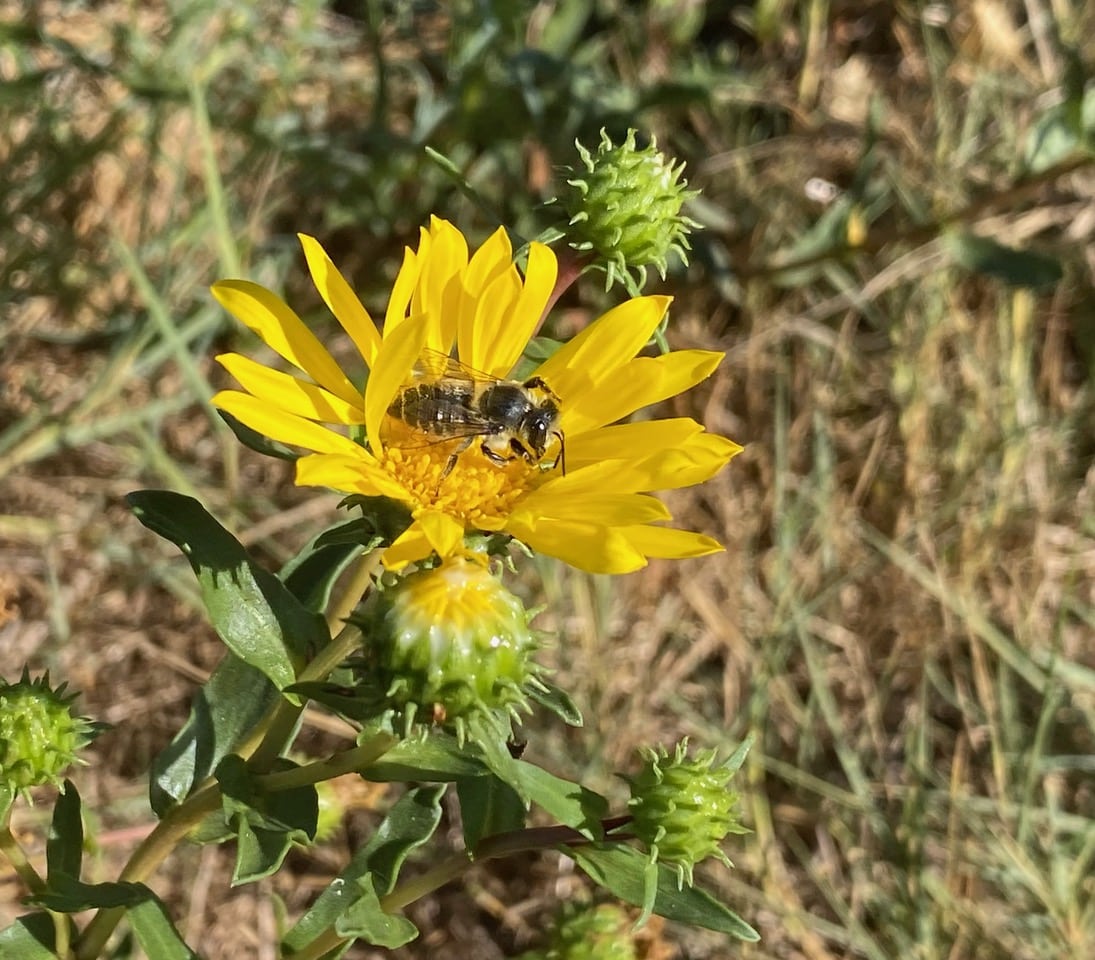
A female Western Leafcutter Bee, Megachile perihirta (family Megachilidae) is foraging on one of the last few fresh flowerheads of Grindelia.
Leafcutter Bees, Megachile sp. (family Megachilidae) are stout-bodied, usually with pale hair on the thorax and stripes of white hairs on the abdomen. Females usually have a triangular abdomen with a pointed tip, and males’ faces are covered with dense, pale hair. Flight season is from May into September, with peak activity from June to August. Solitary females construct nests in tubular cavities, including hollow stems, tree holes, and abandoned beetle burrows in wood. Many use holes drilled into wood, straws, or other manufactured tunnels. Females cut pieces from leaves or flower petals for use in the construction of brood cells. Most Megachile females are generalist foragers, but prefer flowers in the family Asteraceae. They carry pollen on the scopa located on the underside of the abdomen.
North America is home to many leafcutter bees, but the Western Leafcutter, Megachile perihirta is one of the largest. The species ranges on the west coast from British Columbia south to northern Mexico. From a distance, the female can be mistaken for a honey bee. She is about the same size as a worker honey bee and enjoys many of the same flowers, but her head is disproportionately large because it houses the bulky muscles that operate her large mandibles. While most leafcutter bees nest above ground in tubes and tunnels, the Western Leafcutter nests underground. Often a small group of females live in a community and burrow into soil, gravel, or sand.
A tiny jumping spider with a briilliant golden sheen is hunting on a Grindelia flowerhead. It is easily recognizable as the Buttonhook Leafbeetle Jumping Spider, Sassacus vitis (family Salticidae).
Jumping spiders (family Salticidae) are free-roaming hunting spiders. They do not weave a web to catch prey. They stalk, then pounce on their prey. Just before jumping, the spider fastens a safety line to the substrate. It can leap 10-20 times their body length to capture prey. Their movement is achieved by rapid changes in hydraulic pressure of the blood. Muscular contractions force fluids into the hind legs, which cause them to extend extremely quickly. Jumping spiders are visual hunters. Their excellent vision has among the highest acuities in invertebrates. Since all their 8 eyes are fixed in place and cannot pivot independently from the body like human eyes can, jumping spiders must turn to face whatever they want to see well. This includes moving their cephalothorax up and down, an endearing behavior.
Sassacus vitis is native to North America, with a range spanning from Canada to Panama. It is a small jumping spider with iridescent gold abdomen and white ring around the anterior surface of abdomen. Body is covered with golden scales. Males are 3.5 mm long, females 4.5 mm. The name vitis is Latin for “grapevine”. The spider is commonly found on shrubs and vines and in fields. Best known as a common resident of vineyards.
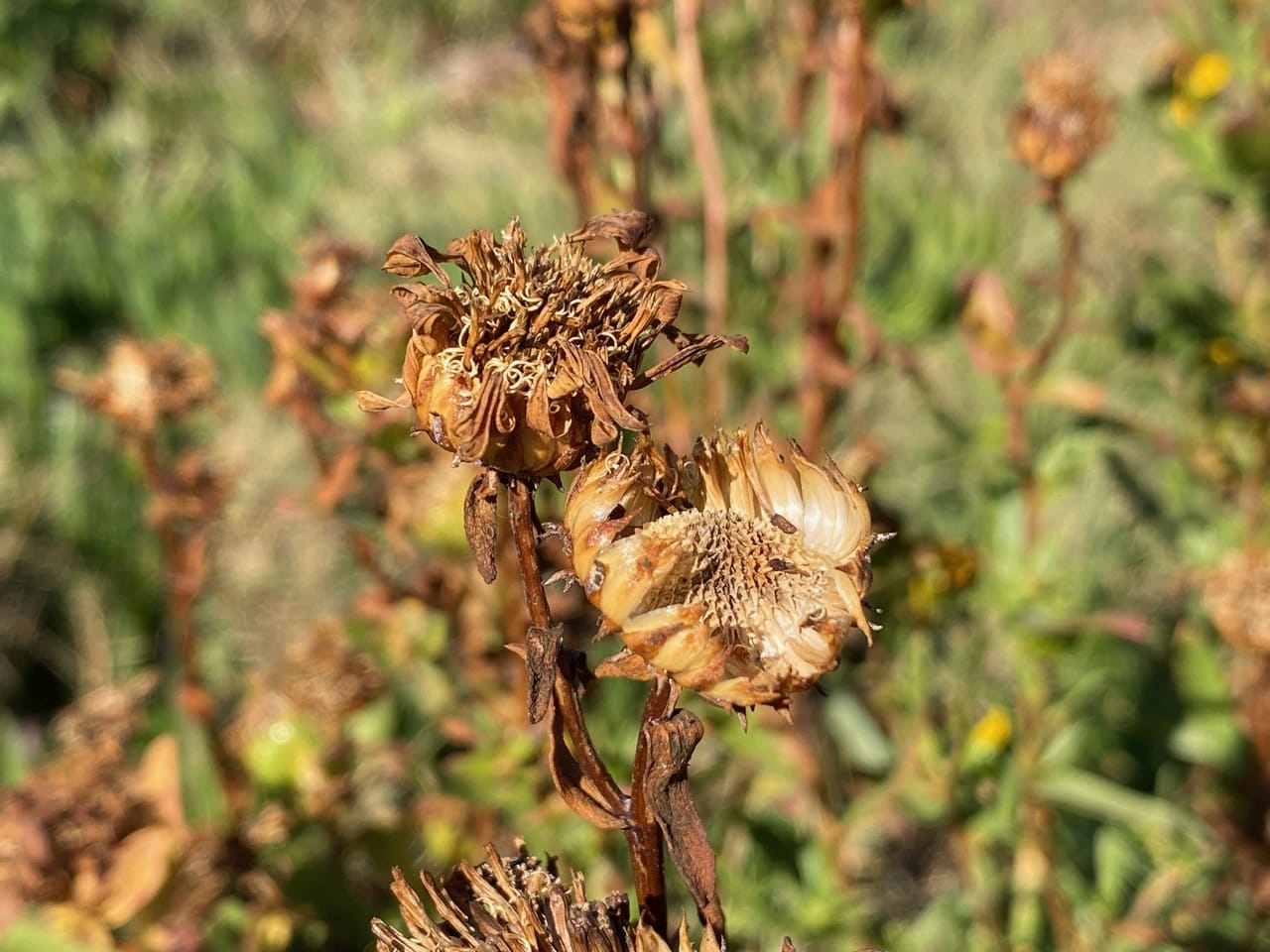
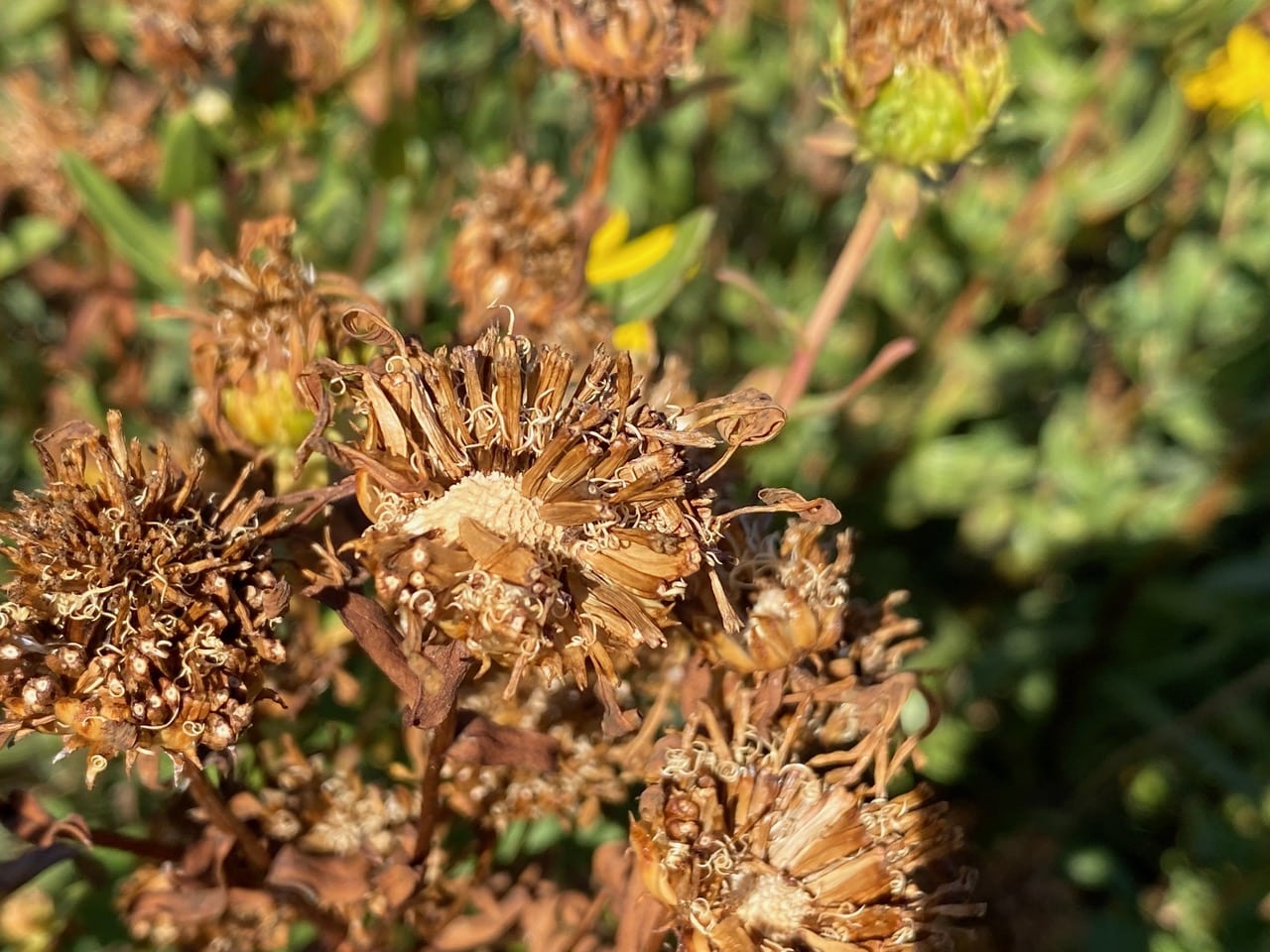
Many of the Grindelia seed heads are already emptying out their seeds.
Grindelia (Gumweed) seeds can be harvested by hand once the flower heads have dried out, typically from late summer through fall. Look for flower heads that have finished blooming, turned brown or off-white, and feel dry and brittle to the touch. Rubbing the dried inflorescences between the fingers releases the flattened, single-seeded achenes.
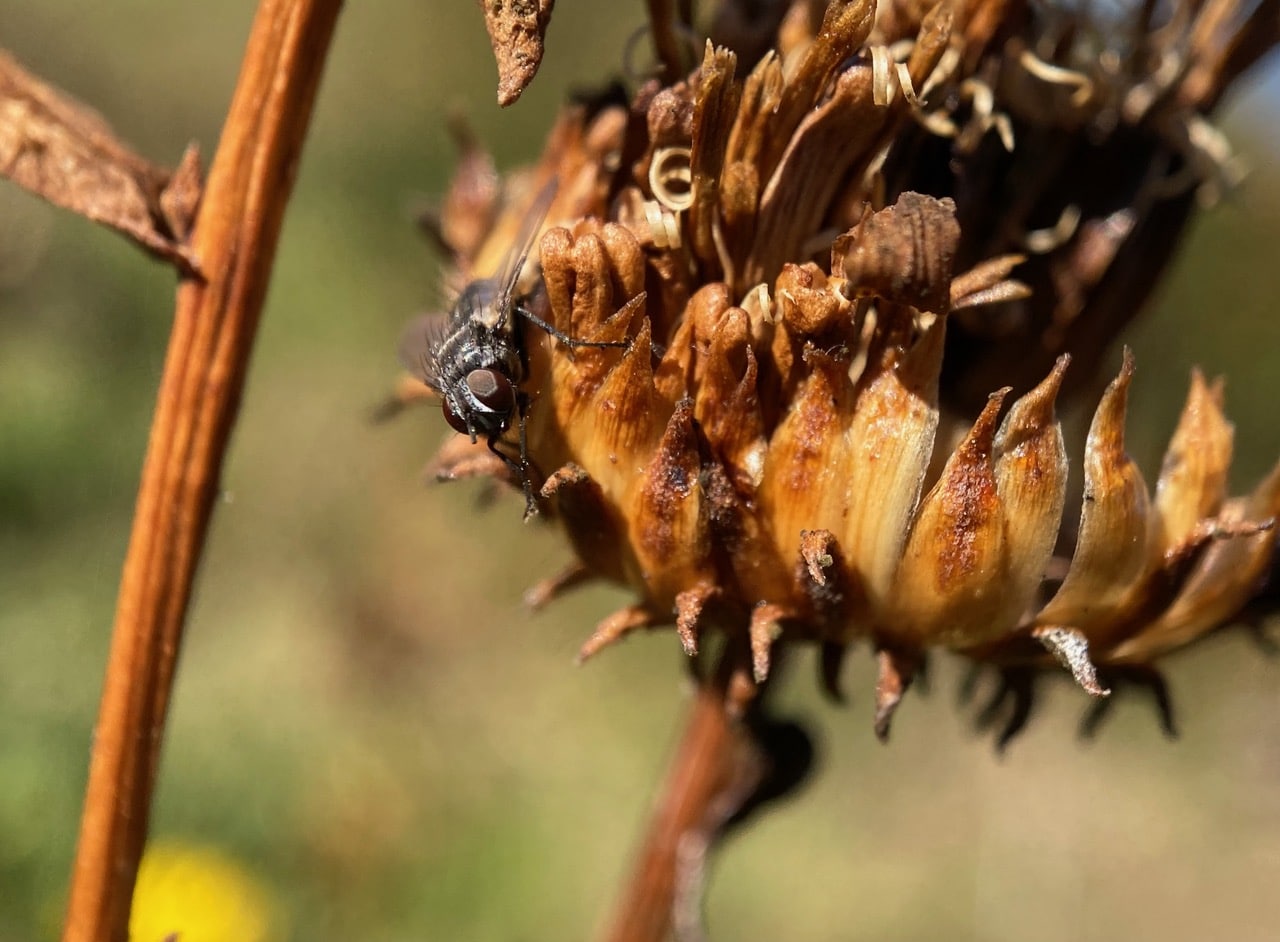
A small, dark fly has landed on a dried Grindelia seed head.
iNaturalist has helped identify it as a Bristle Fly (family Tachinidae).
The family Tachinidae is by far the largest and most important group of parasitoid flies. All species are parasitic in the larval stage. Most adults have distinct abdominal bristles, hence the common name. Adults feed on liquids such as nectar and honeydew. They can be found resting on foliage, feeding at flowers or searching for hosts.
Most Tachinids attack caterpillars, adult and larval beetles, true bugs, grasshoppers, and other insects. Females lay eggs in or on the host. Tachinid larvae live as internal parasites, consuming their hosts’ less essential tissues first and not finishing off the vital organs until they are ready to pupate. The larvae leave the host and pupate on the ground. Tachinids are very important in natural control of many pests, and many have been used in biological control programs.
A small fly with picture wings is perched on a dried Grindelia seed head. iNaturalist has helped identify it as a Sunflower Seed Maggot, Neotephritis finalis (family Tephritidae).
Commonly called Fruit Flies, Tephritids are small to medium-sized flies that are often colorful, and usually with picture wings. The larvae of almost all Tephritidae are phytophagous. Females deposit eggs in living, healthy plant tissues using their telescopic ovipositors. Here the larvae find their food upon emerging. The larvae develop in leaves, stems, flowers, seeds, fruits, and roots of the host plant, depending on the species. Adults are often found on the host plant and feeding on pollen, nectar, rotting plant debris, or honeydew. Tephritid flies are of major economic importance as they can cause damage to fruit and other plant crops. On the other hand, some Tephritids are used as agents of biological control of noxious weeds.
The Sunflower Seed Maggot is a sunflower specialist, found on over 20 species of Asteraceae. Larvae feed on immature seeds and pupate in flowerheads.
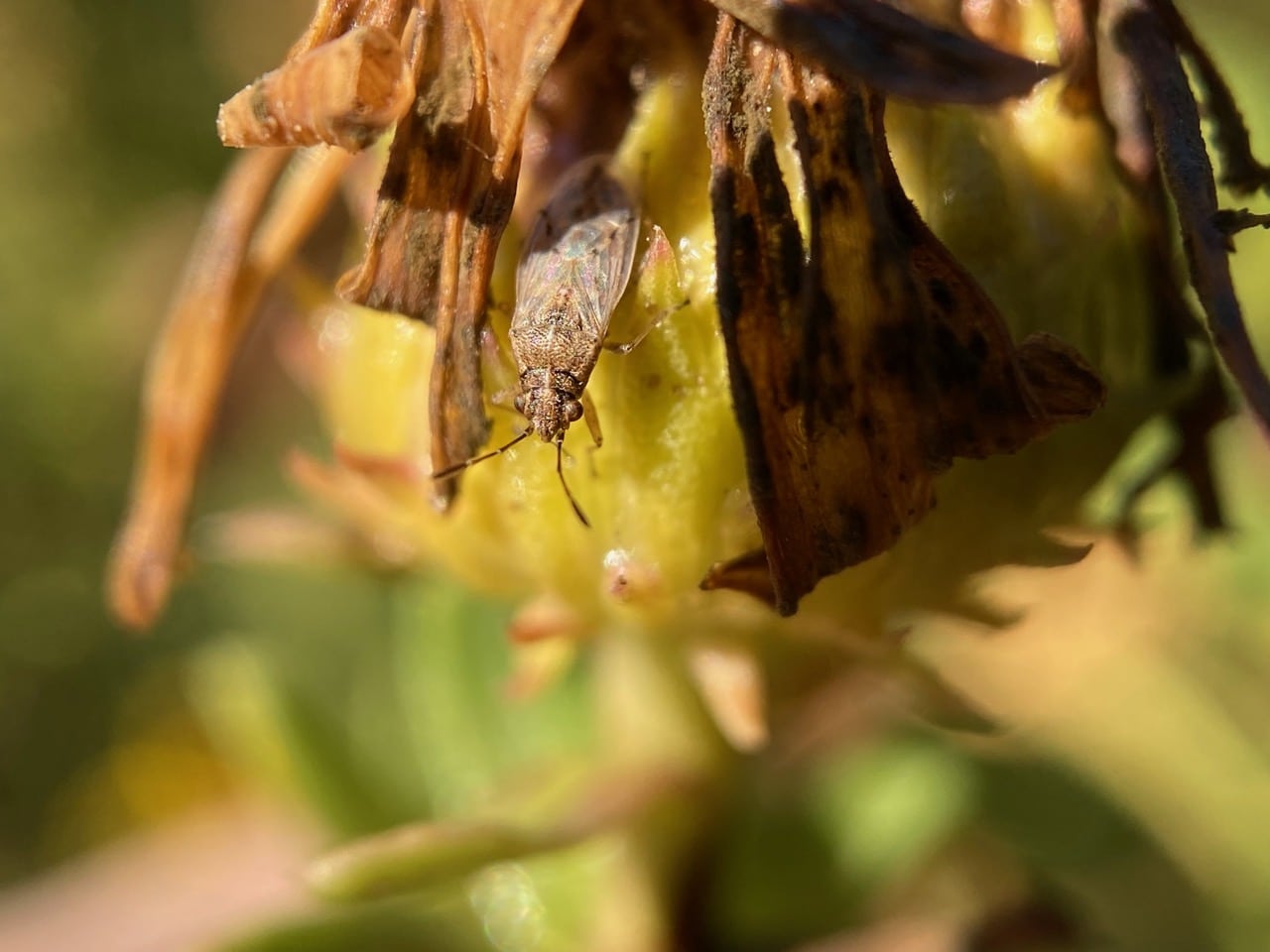
A Scentless Plant bugs, Arhyssus sp. (family Rhopalidae) is resting on the involucre of a spent Grindelia flowerhead.
Arhyssus is a genus of small, true bugs belonging to the family Rhopalidae. There are over a dozen species native to North America. They are small, typically measuring 5-12 mm in length. They possess distinct, raised simple eyes (ocelli) at the front of the head. Unlike other true bugs, they lack well-developed scent glands (hence the common name).
Arhyssus primarily feed on weeds, seeds, and xeric (dry-habitat) grass plants. Adults spend the spring and summer feeding outdoors. In early autumn, they migrate into wall crevices, woodpiles, or homes to hibernate.
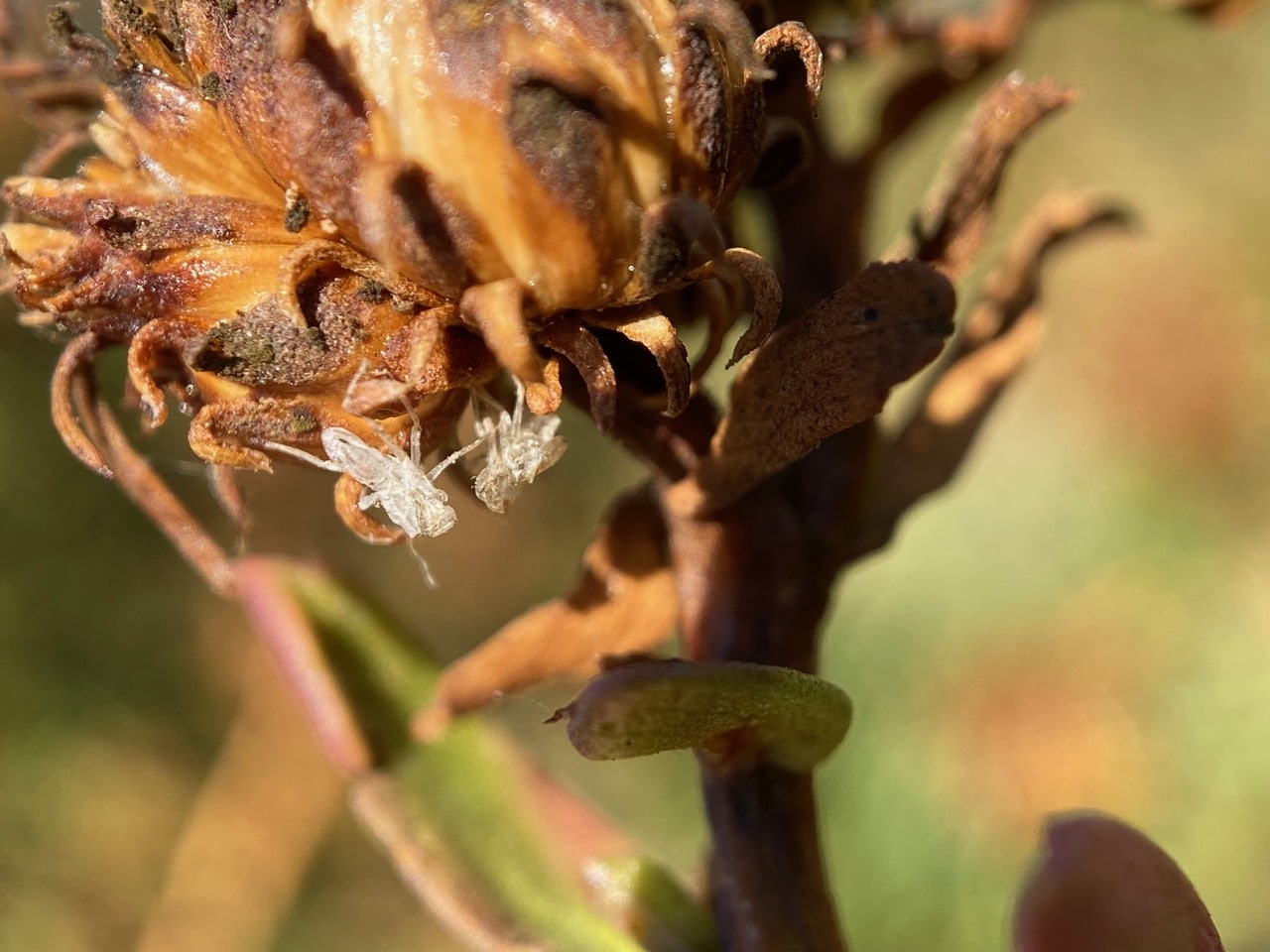
Ghostly white exuviae cling to the base of a dried Grindelia seed head. They are the shed exoskeletons left by insects after they molt. Insects that undergo incomplete metamorphosis go through a series of molts during their development without the pupa stage. The immature stage that hatches from the egg, a nymph looks like a smaller version of the adult, shares the same habitat and food sources, and develops external wing buds as it grows. As the nymph grows, its exoskeleton becomes too tight and must be shed through multiple stages called instars. The adult is the final, mature stage featuring fully developed wings and reproductive organs.
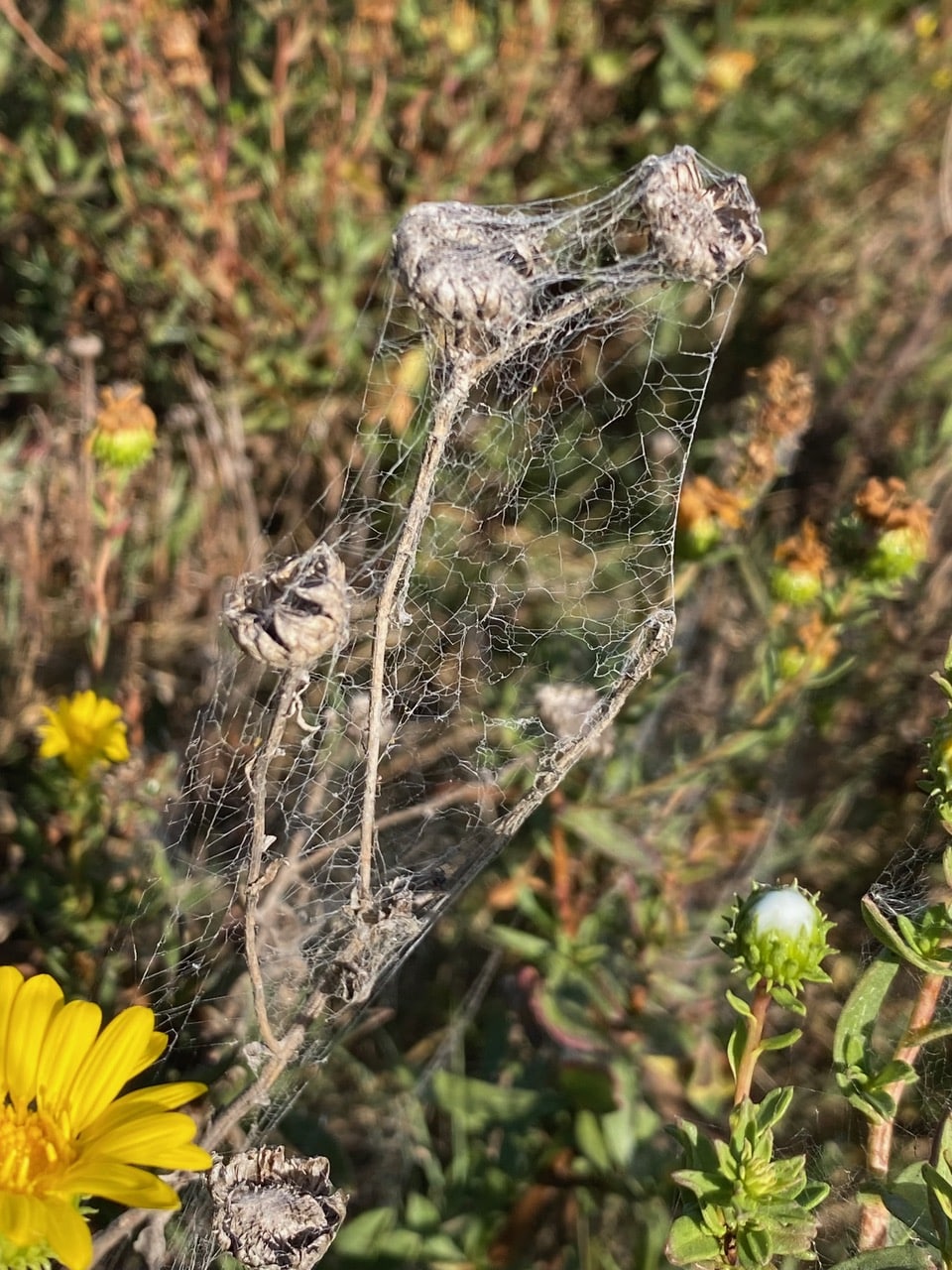
Dried Grindelia stems serve as convenient scaffolding on which spiders could hang their aerial traps, especially visible this time of year. These are the real Halloween decorations! This untidy web made of cribellate silk is probably constructed by a Badumna spider.
Badumna spiders build messy, lacy, sheet-like webs that radiate outward from a dense, silk-lined retreat inside crevices, bark, or window frames. Because the spiders occupy these webs for long periods, they continually repair and add silk nightly, making the architecture look increasingly disorderly over time. Badumna spiders produce cribellate silk which is a dry, wool-like capture silk rather than a sticky, glue-coated thread. The silk comes from a specialized, plate-like spinning organ located in front of the spinnerets called the cribellum, which features thousands of tiny spigots. The spider uses a comb-like row of bristles on its fourth pair of legs called the calamistrum to card (comb) the ultra-fine silk fibers into a puffy, crimped matrix. Instead of using liquid glue, the nanoscale silk fibrils mechanically snag and entangle the tiny hairs and claws of visiting insects.
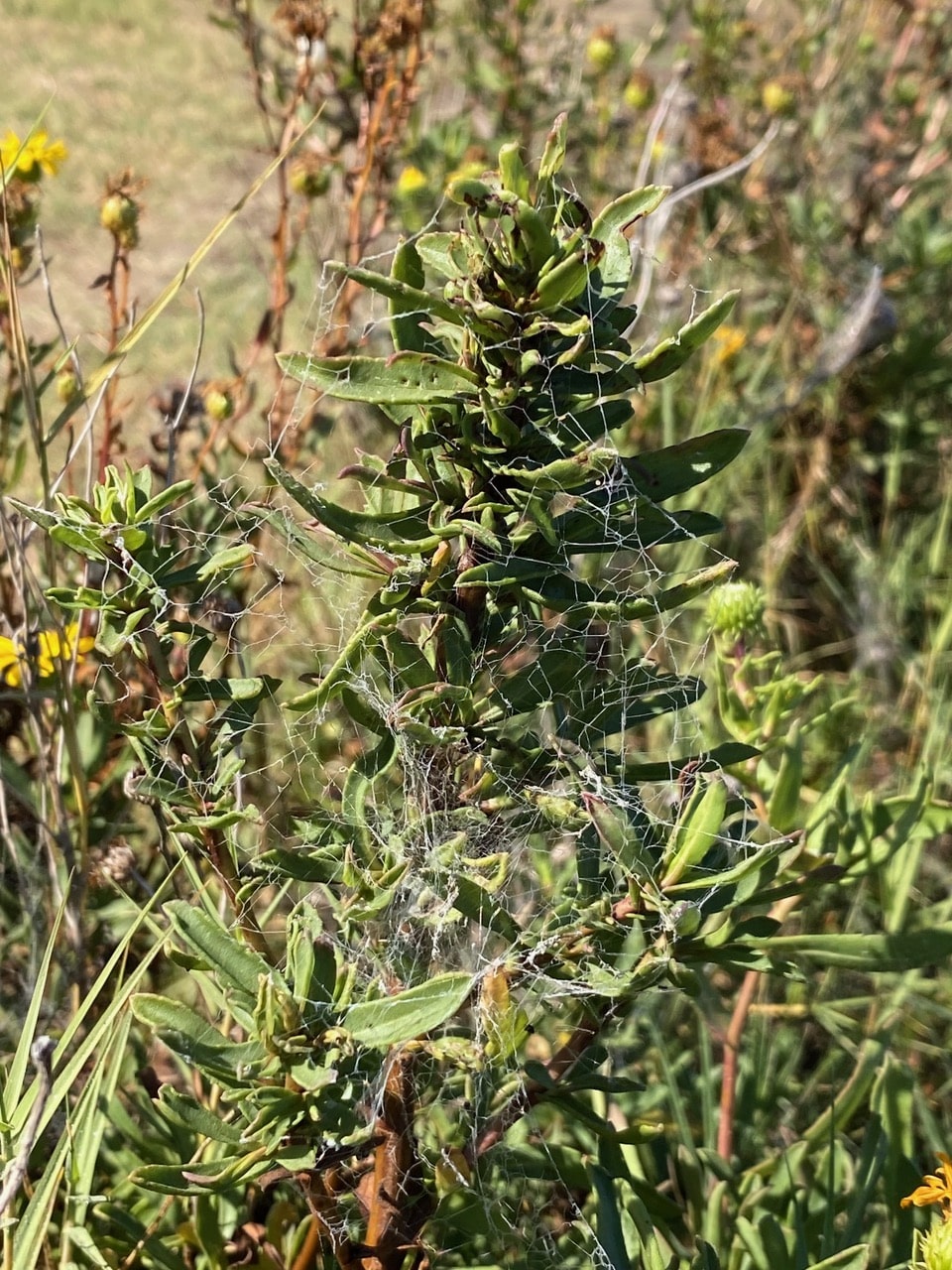
Living, green plants are used by the spiders too!
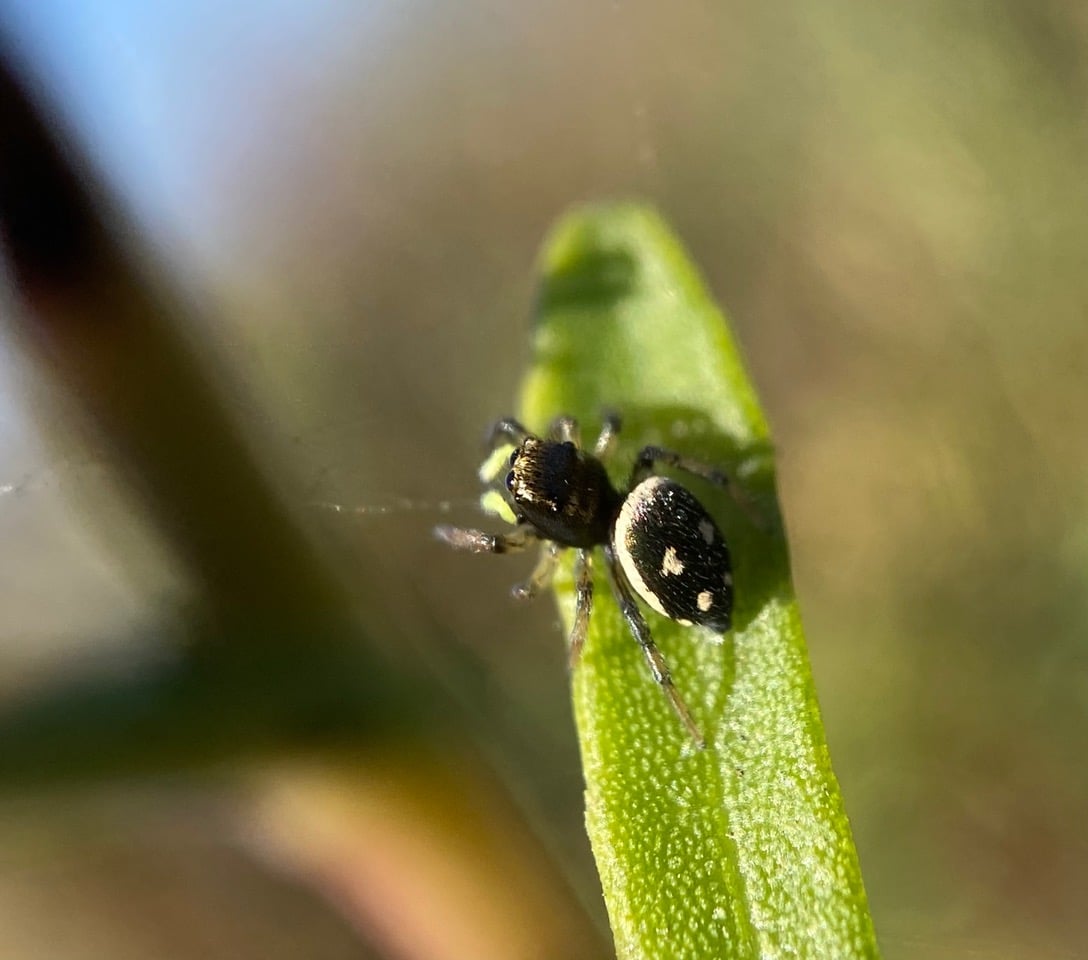
A black Jumping Spider with four large white spots on its abdomen is wandering on a Grindelia leaf. It is a Sun Jumping Spider, Heliophanus apiatus (family Salticidae).
Jumping spiders (family Salticidae) are free-roaming hunting spiders. They do not weave a web to catch prey. They stalk, then pounce on their prey. Just before jumping, the spider fastens a safety line to the substrate. It can leap 10-20 times their body length to capture prey. Their movement is achieved by rapid changes in hydraulic pressure of the blood. Muscular contractions force fluids into the hind legs, which cause them to extend extremely quickly. Jumping spiders are visual hunters. Their excellent vision has among the highest acuities in invertebrates. Since all their 8 eyes are fixed in place and cannot pivot independently from the body like human eyes can, jumping spiders must turn to face whatever they want to see well. This includes moving their cephalothorax up and down, an endearing behavior.
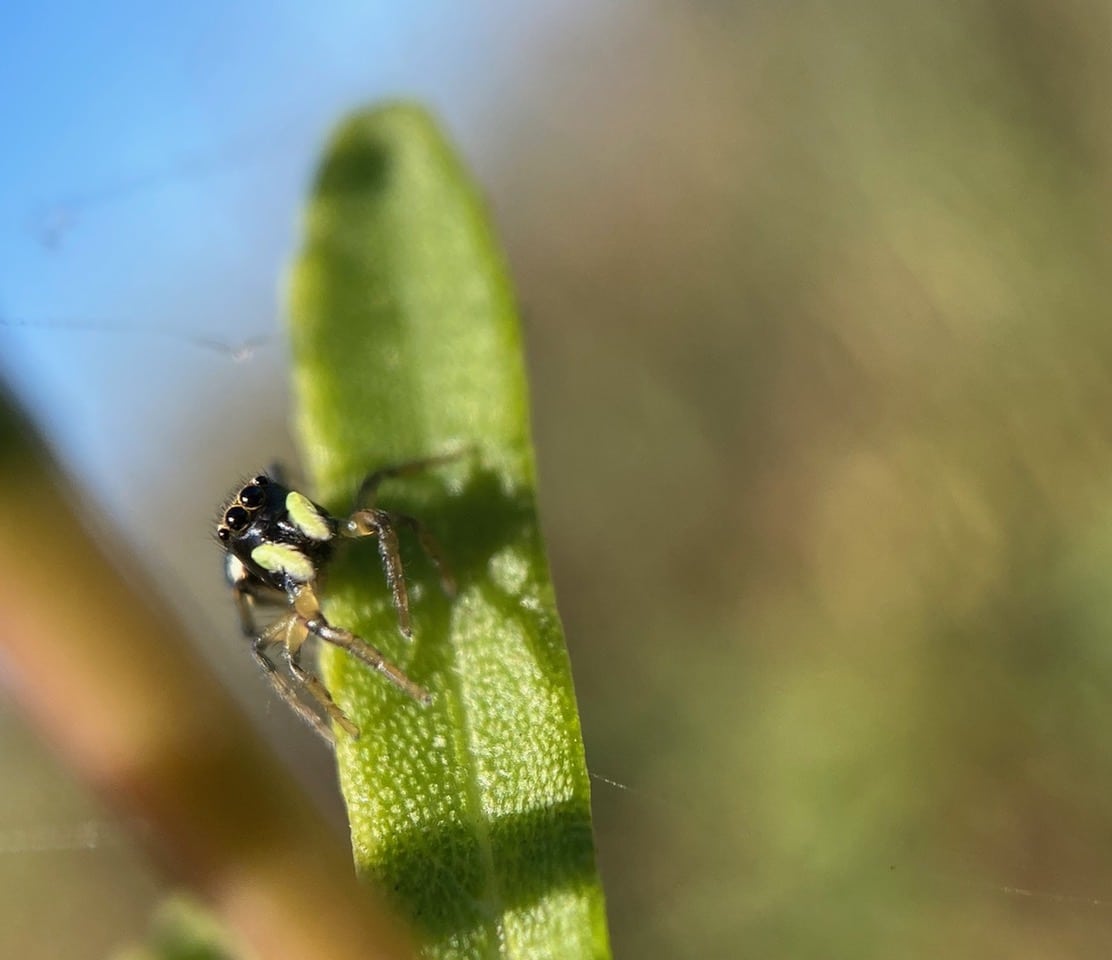
Sensing the approach of my camera, the spider spins around to face me, waving its greenish-yellow pedipalps excitedly. Ooh, it’s a female!
Mature female Heliophanus apiatus have bright yellow or greenish-yellow pedipalps, whereas mature males have legs and palps that are almost black with white stripes.
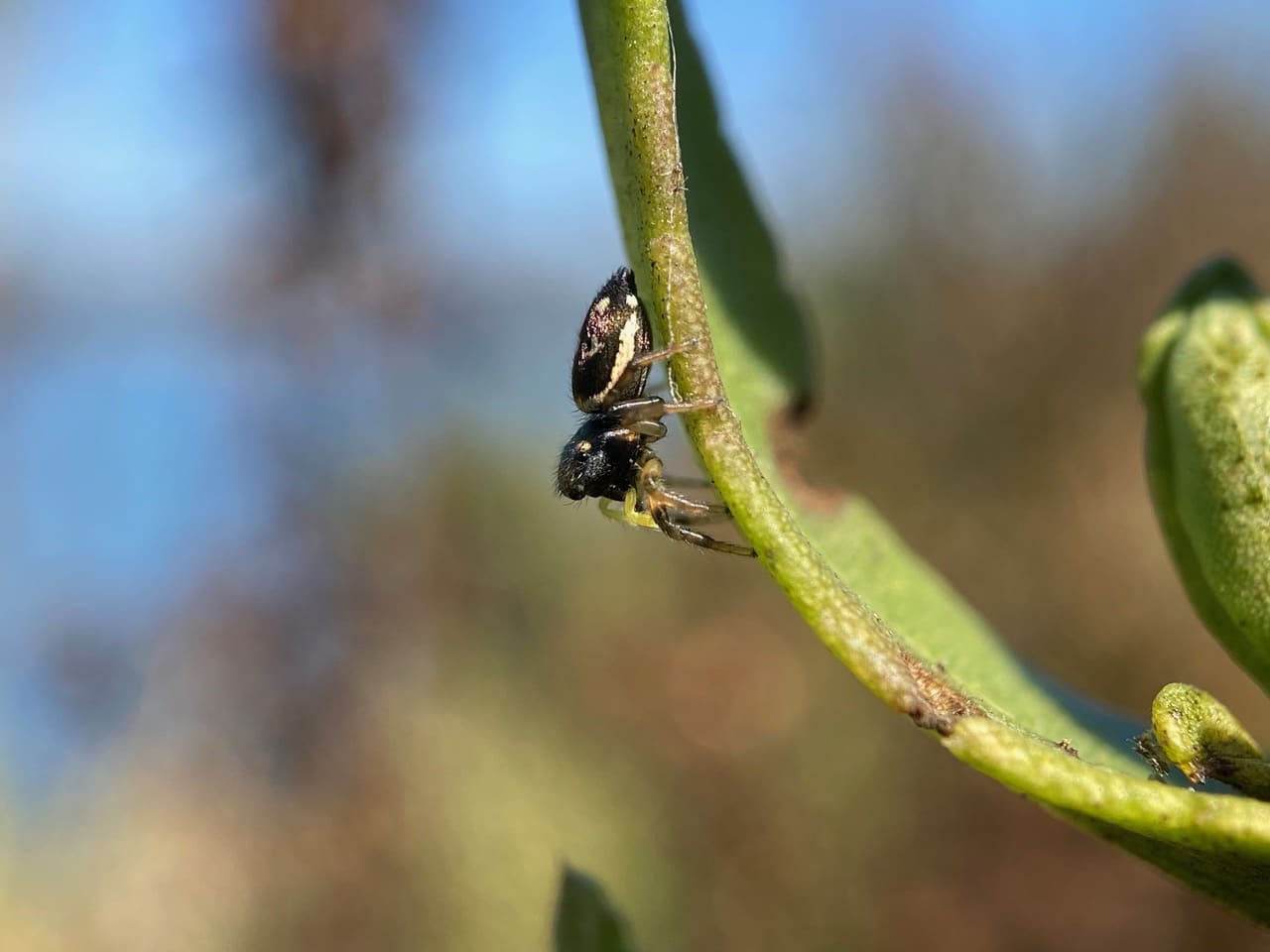
What an odd profile, with the face dropping off vertically!
The genus Heliophanus is one of the largest genera of jumping spiders with over 150 species, widespread in the Palearctic and Africa, with one center of diversity in the Mediterranean region. Heliophanus apiatus was first reported in the San Francisco Bay Area in 2015. H. apiatus is a small salticid, male measuring 3.5-4.0 mm, and females 4.0-4.5 mm in body length. Mature males and females are similar in appearance, but only the females have yellow pedipalps. These spiders are found on low vegetation and on hard structures on or near the ground. They are capable of taking prey their own size.
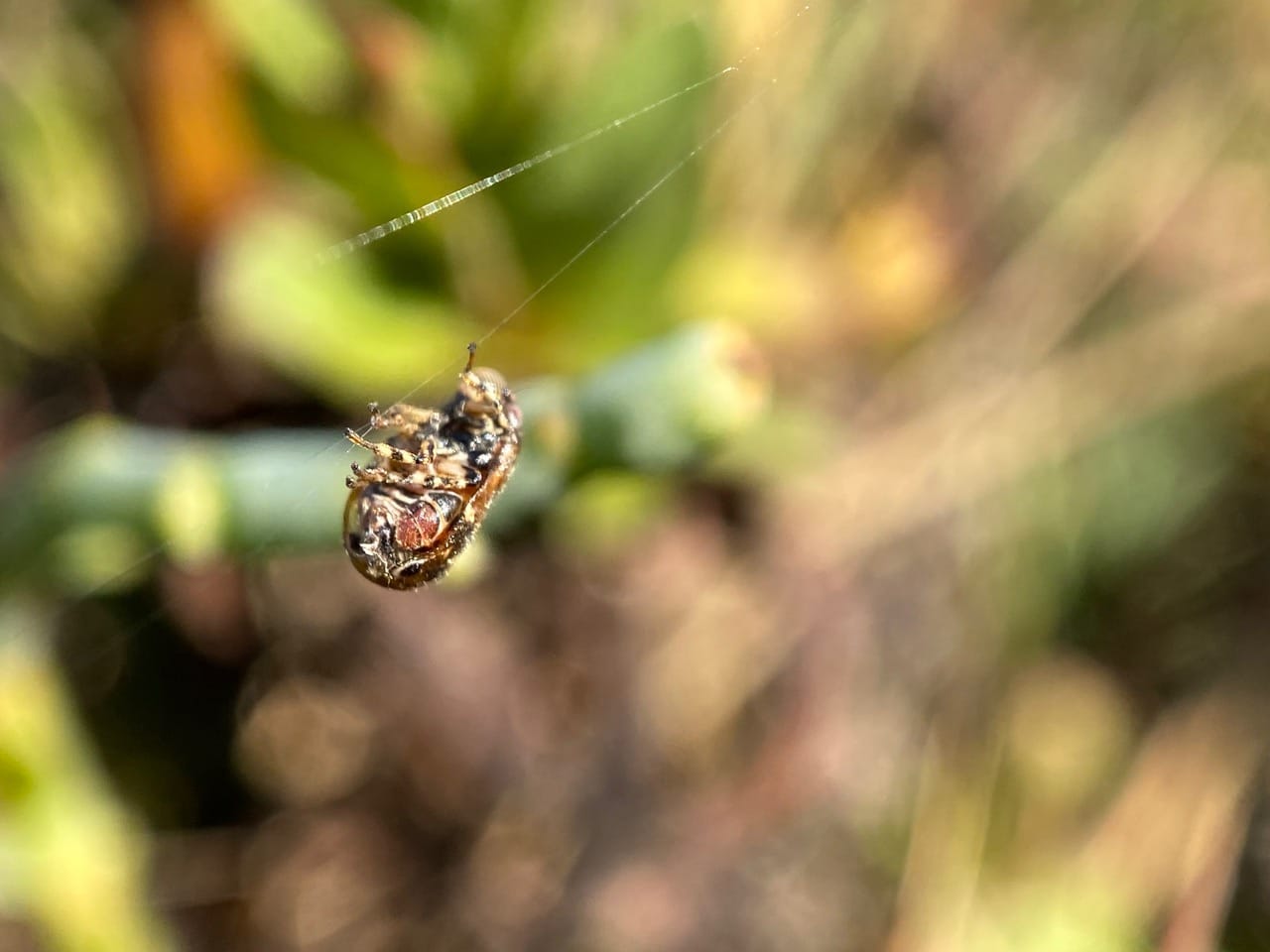
Trapped by a spider web, a small insect maneuvers itself clumsily along a silk line, shaking the whole web.
It finally reaches the tip of a dried grass, and manages to disentangle from the spider web before the web owner gets to it.
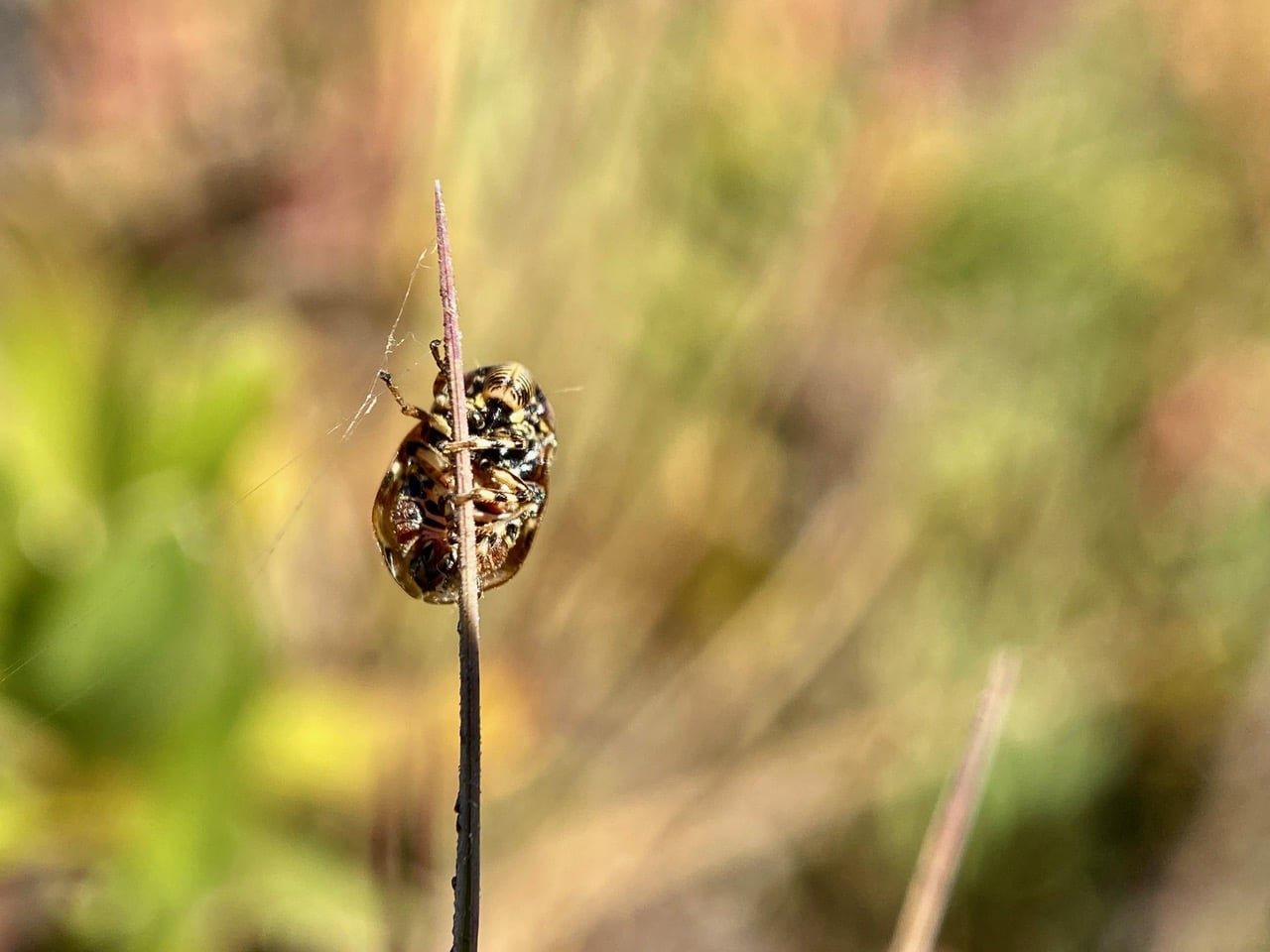
Ah, the lucky escapee is a female Spittlebug, Clastoptera lineatocollis (family Clastopteridae).
The Spittlebug, Complex Clastoptera lineatocollis (family Clastopteridae) is found in western United States. The bugs feed mostly on Asteraceae, although other hosts have been reported. Females are brownish (3.3-3.8 mm), while the smaller males (3.0-3.2 mm) are mostly black.
Why the common name of “spittlebug”? The nymphs (immatures) of these bugs create foam masses on plants in which they live and feed. Like the adults, the nymphs use their piercing, sucking mouthparts to feed on plant juices. The nymph produces a cover of foamed-up plant sap reminiscent of saliva, hence the common name of spittlebug. Whereas most insects that feed on sap feed on the nutrient-rich fluid from the phloem, Spittlebugs tap into the much more dilute sap flowing upward via the xylem. The large amount of excess water that must be excreted and the evolution of special breathing tubes allow the young spittlebug nymphs to grow in the relatively protective environment of the spittle. Symbiotic bacteria in the insects’ digestive system provides them with the essential amino acids that their diet lacks. The foam serves a number of purposes. It hides the nymph from the view of predators and parasites, and it insulates against heat and cold, and protects the delicate nymphs from desiccation. Moreover, the foam
Unlike their young, adult spittlebugs (also known as Froghoppers) are efficient flyers and hoppers, feeding on diverse plant species. Using their piercing-sucking mouthparts, they pierce plant stems to feed on xylem. To get enough nutrients, they consume massive quantities of sap, drinking up to 280 times their body weight daily, resulting in high waste excretion. Froghoppers can cause damage by distorting plant leaves and causing shoot tips to die back. Froghoppers are champion jumpers among insects, out-performing even the fleas. The bug can leap the human equivalent of a skyscraper without a running start. It is the highest jumping insect proportional to body size. The muscles in its hind legs act like a “catapult” to release energy explosively.