

Pollinator Post 10/13/24 (1)
Another beautiful fall day at Shoreline Park, Bay Farm Island.
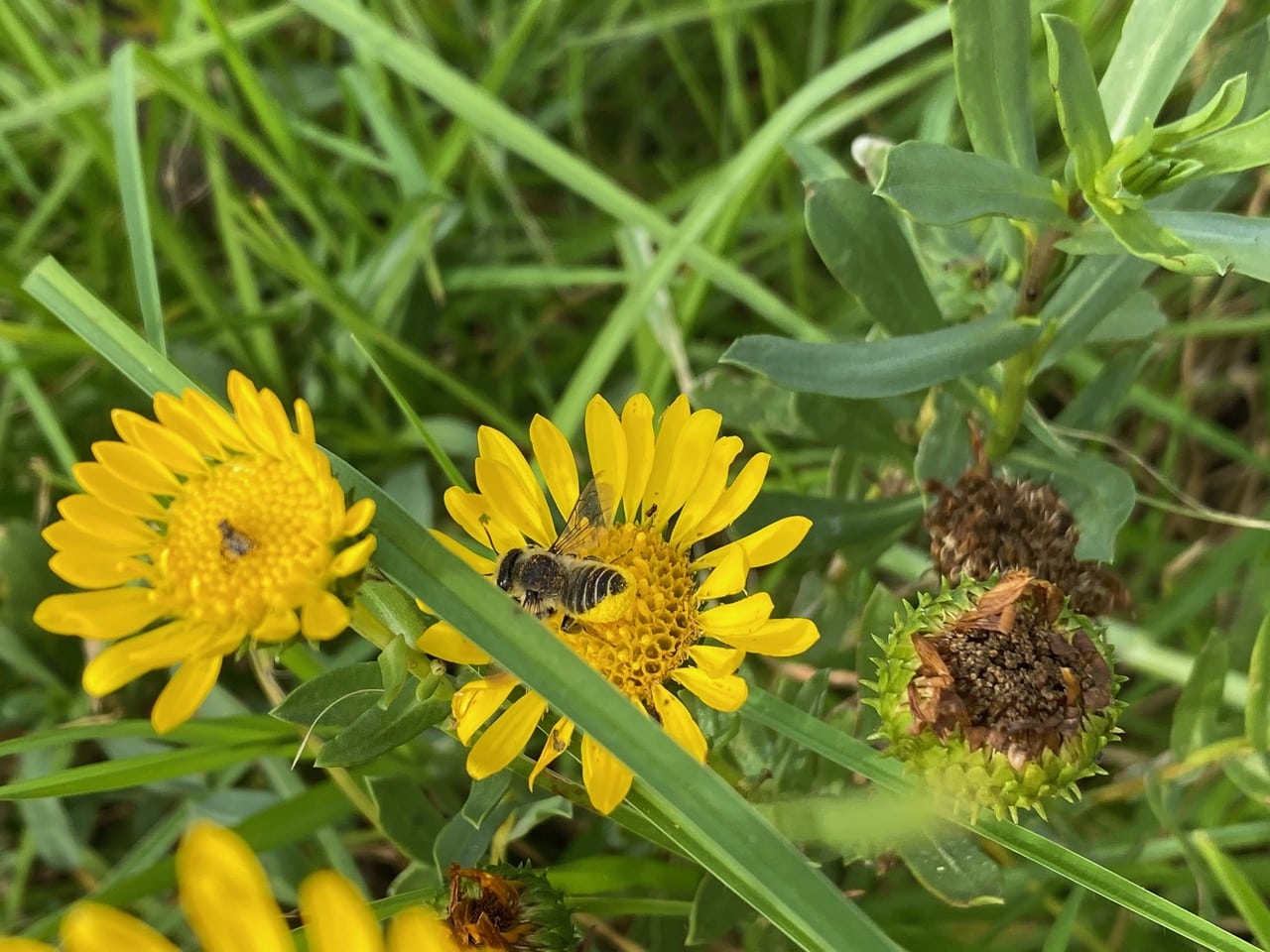
I barely got the the trail when I spot a female Western Leafcutter Bee, Megachile perihirta (family Megachilidae) out foraging on the Oregon Gumweed, Grindelia stricta flowerheads. The scopa on the underside of her abdomen is already yellow with pollen.



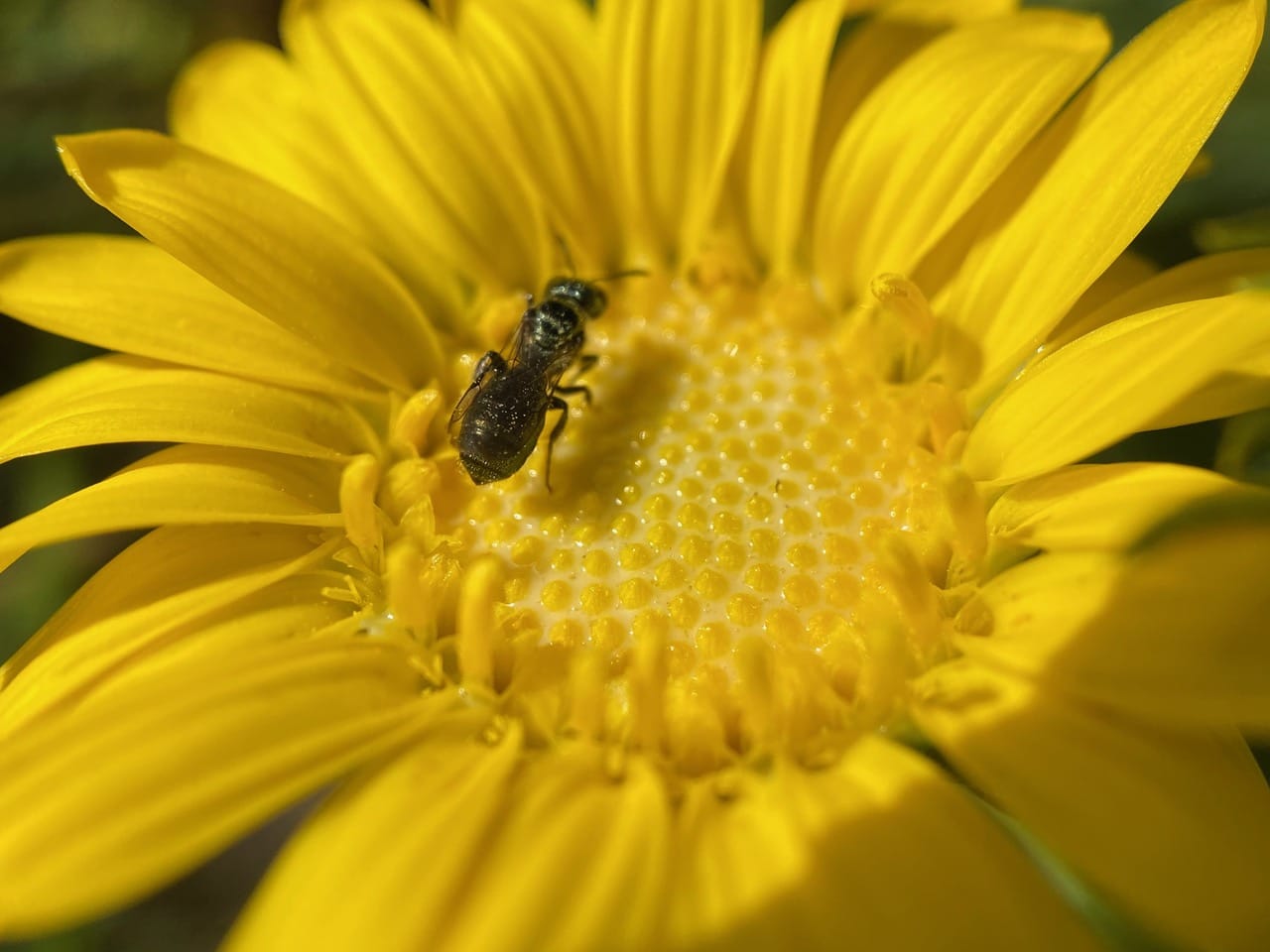
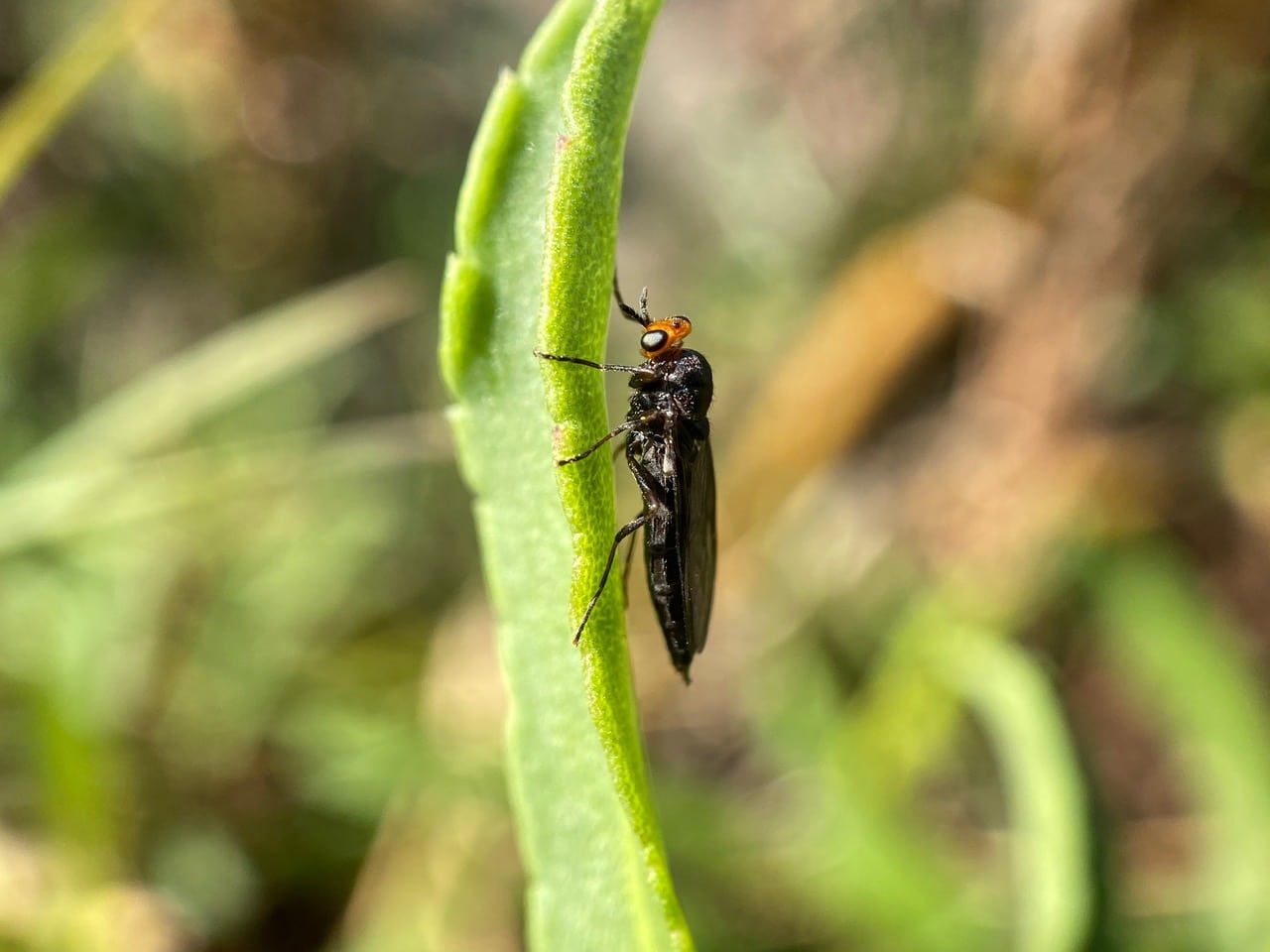 A small black insect lands on a Grindelia leaf. It is a female Sugarcane Soldier Fly (family Stratiomyidae).


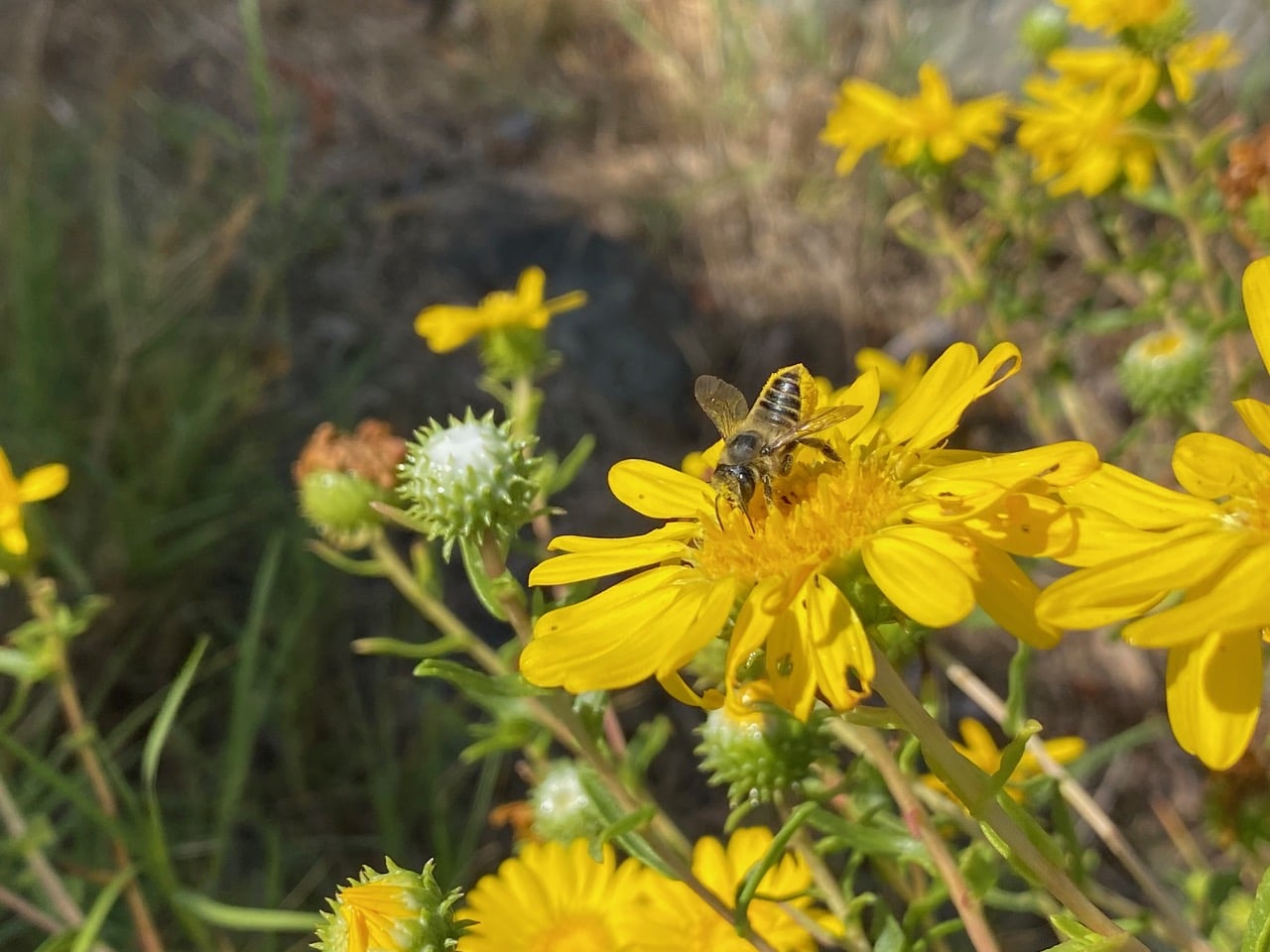

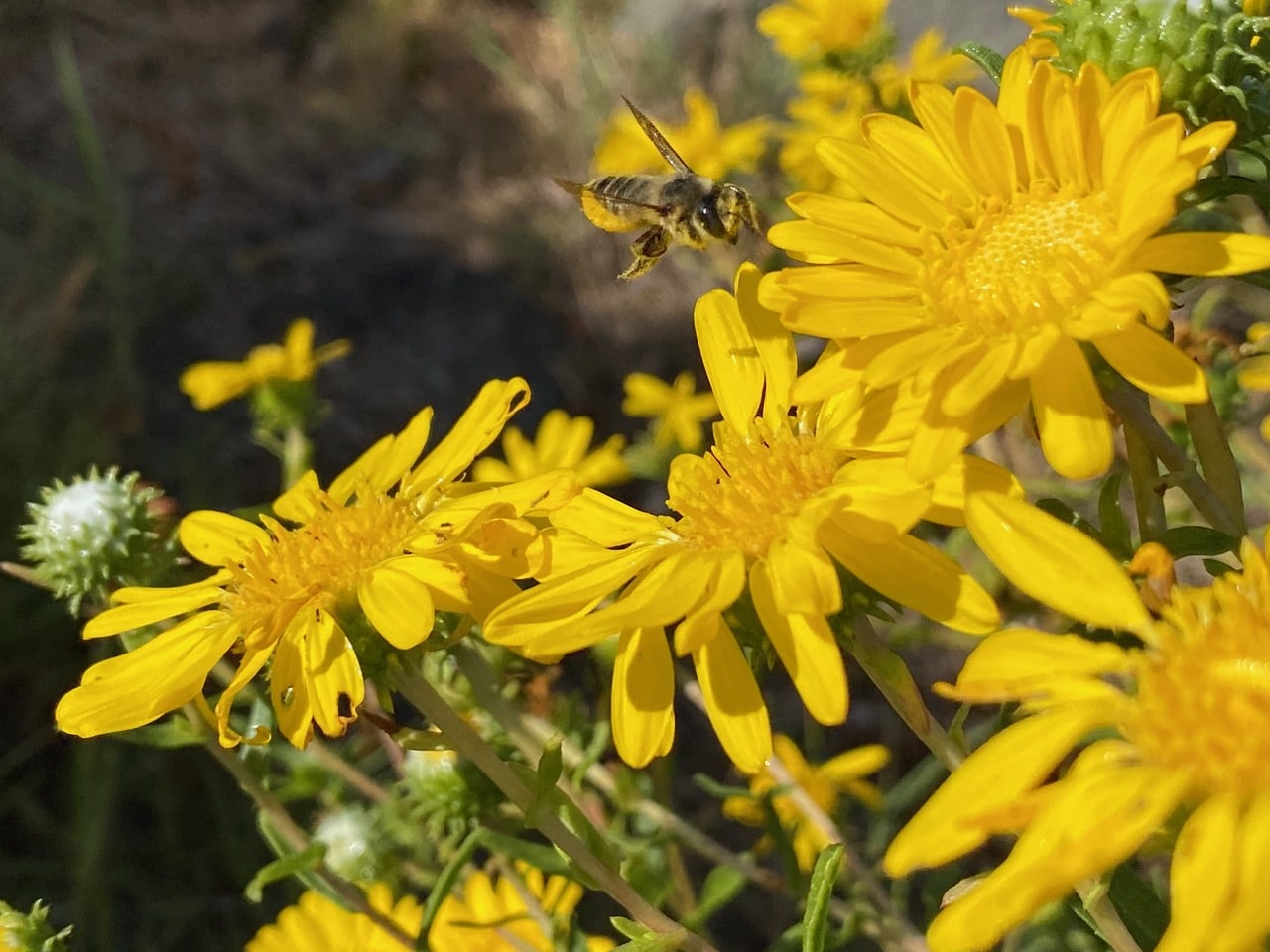


Leaf-cutter Bees, Megachile sp. (family Megachilidae) are stout-bodied, usually with pale hair on the thorax and stripes of white hairs on the abdomen. Females usually have a triangular abdomen with a pointed tip, and males’ faces are covered with dense, pale hair. Flight season is from May into September, with peak activity from June to August.
Solitary females construct nests in tubular cavities, including hollow stems, tree holes, and abandoned beetle burrows in wood. Many use holes drilled into wood, straws, or other manufactured tunnels. Females cut pieces from leaves or flower petals for use in the construction of brood cells. Most Megachile females are generalists when foraging for pollen. Pollen is transported in dense scopae on the underside of the abdomen.
Photos of Western Leafcutter Bee (Megachile perihirta) · iNaturalist
The pollen-covered belly of the feisty female is hardly visible against the bright yellow background of the flowerhead. Note that she is also taking nectar. Back at her nest, she will mix the pollen with the nectar to form a loaf of “bee bread” to provision each brood cell lined with cut pieces of leaf or petal. Busy mama indeed!
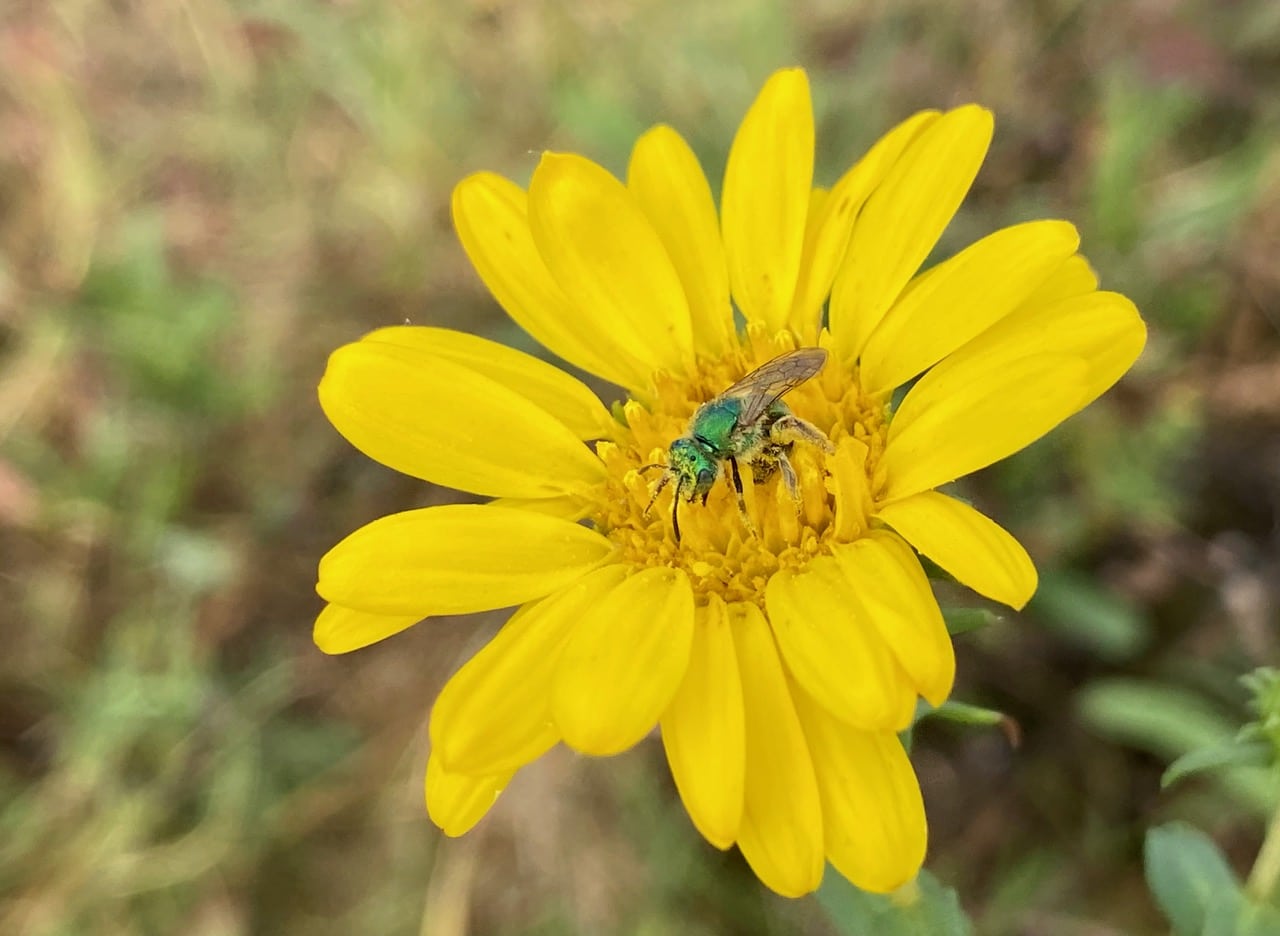
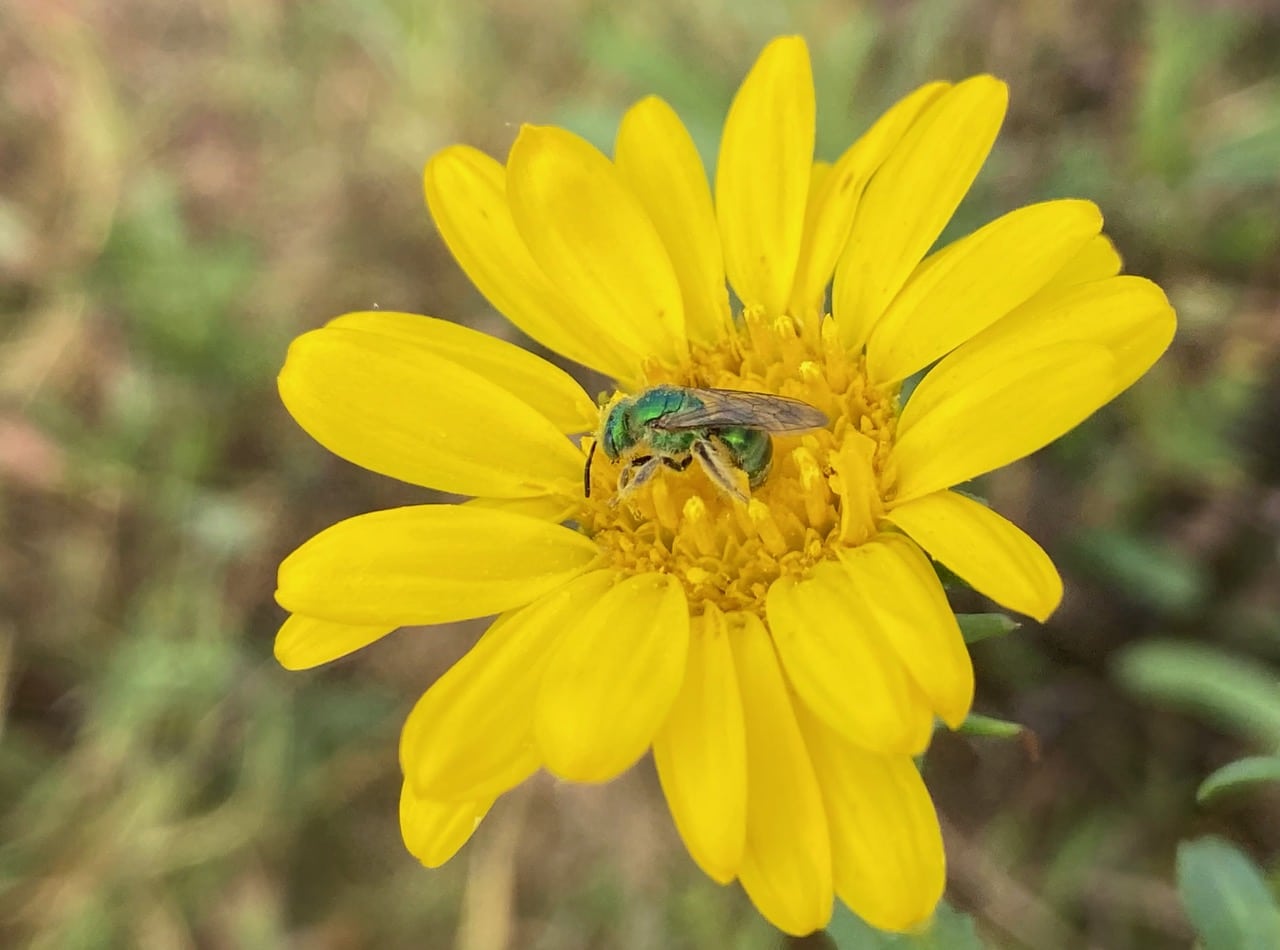
Another bee that is still active along the shoreline is the Texas Striped Sweat Bee, Agapostemon texanus (family Halictidae). Here, a female is collecting pollen on a Grindelia flowerhead.
The genus Agapostemon is widespread and abundant throughout North America. These ground-nesting bees are most diverse and abundant in temperate regions and southwestern U.S. deserts. Agapostemon are commonly called “sweat bees” because they are closely related to, and resemble bees in the Halictus and Lasioglossum genera. Unlike those bees however, Agapostemon are not attracted to human sweat.
Agapostemon are brightly colored metallic green or blue bees measuring 7 to 14.5 mm long. Most species have a metallic green head and thorax, and black-and-yellow striped abdomen; some females are entirely bright green or blue. Females carry pollen on scopal hairs located on their hind legs. Agapostemon are generalists. Like other members of the family Halictidae, they are short-tongued and thus have difficulty extracting nectar from deep flowers. Males are often seen flying slowly around flowers looking for females. The bees favor flowers with high densities. They are active summer through fall.
Agapostemon females dig deep vertical burrows in flat or sloping soil, or sometimes in banks. Most species are solitary, but some species nest communally. Up to two dozen females may share a single nest entrance, but each individual builds and provisions its own cluster of brood cells. Where a communal nest gallery shares a single entrance, one bee usually guards the hole, with only her head visible from above ground. Unlike other social bees, in communal bees there is no reproductive division of labor. In cool temperate regions, there is one generation per year, with females active in the early summer and males and pre-diapausing females active in the late summer. Only mated females survive the winter. This is probably because unmated females cannot enter diapause (insect version of hibernation).
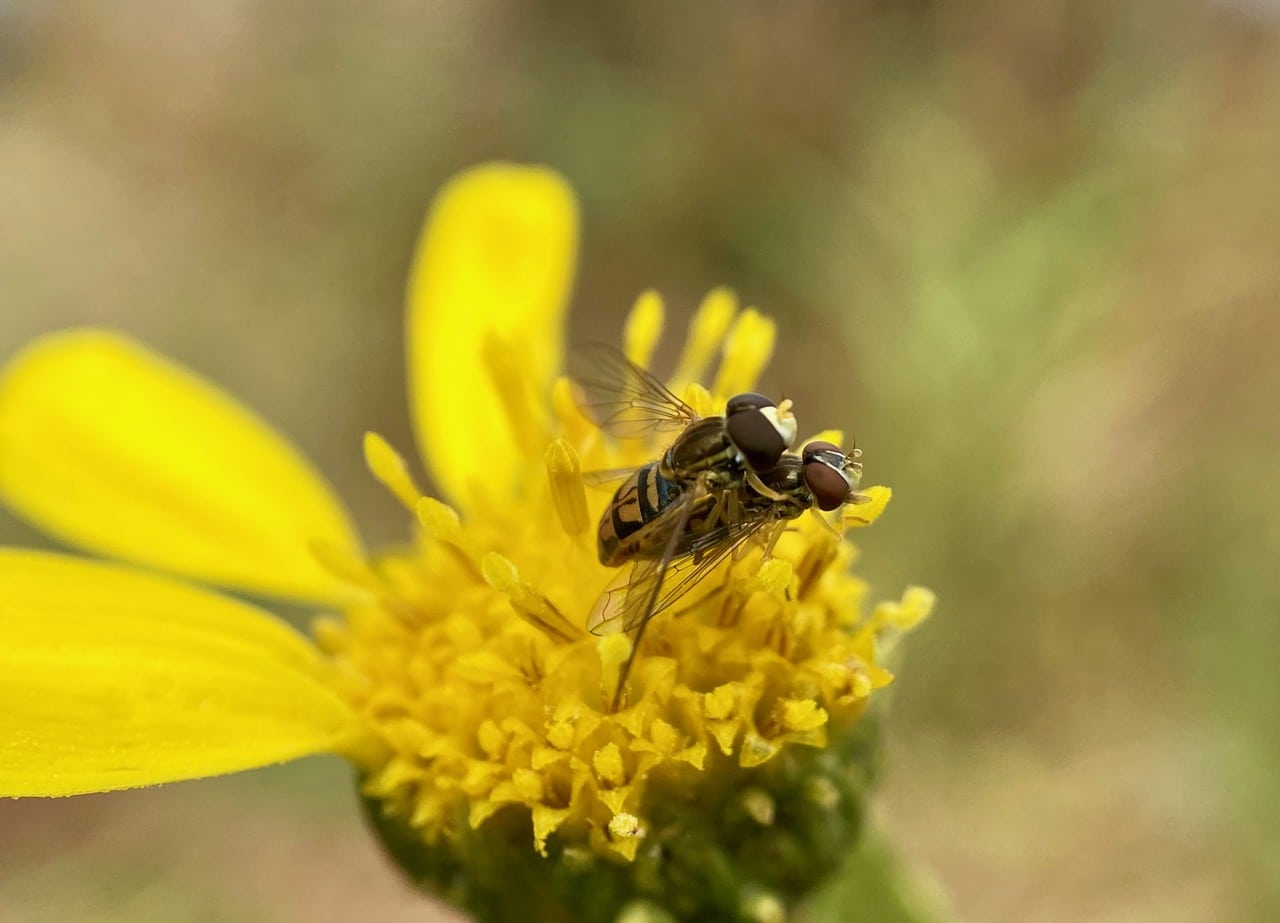
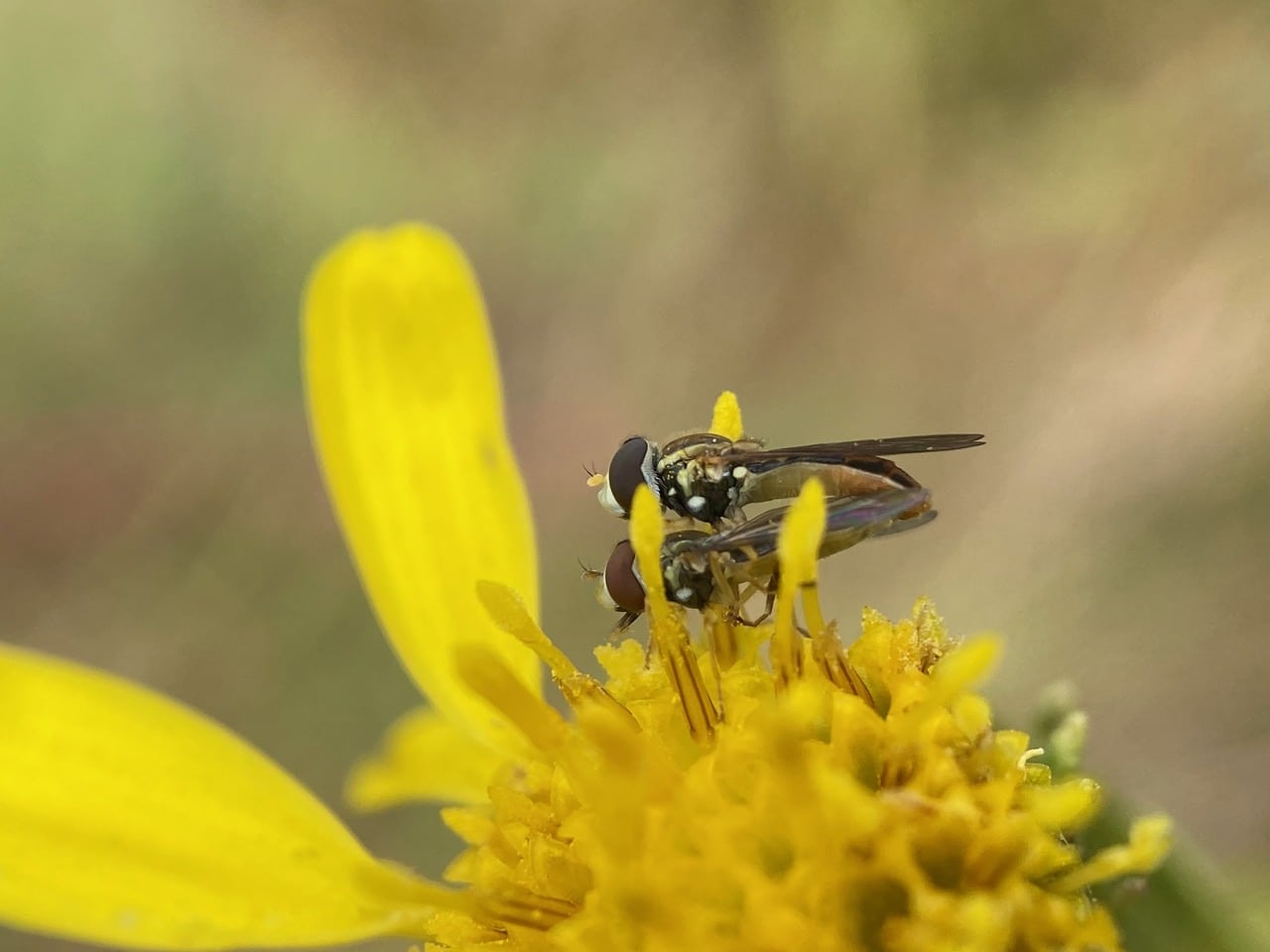
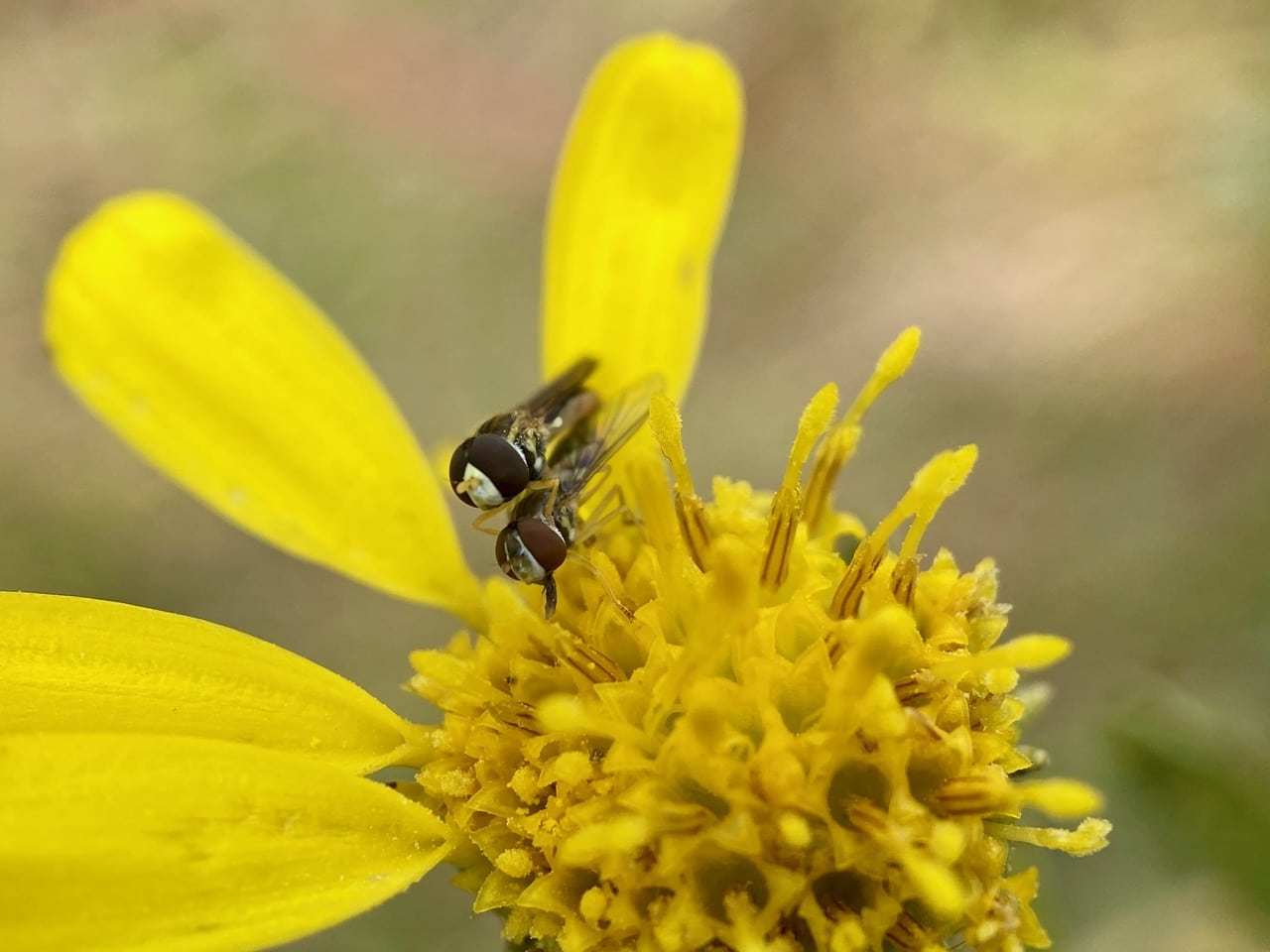
A pair of Margined Calligraphers, Toxomerus marginatus (family Syrphidae) is mating on a Grindelia flowerhead that has lost some of its ray petals. This is an unparalleled opportunity to compare the eyes of the male and female hoverflies. The male on top has holoptic eyes that meet along a central line on top of the head, while there is a gap between the female’s dichoptic eyes.
Toxomerus marginatus, also known as the Margined Calligrapher is a common species of hoverfly found in North America. These are small hoverflies, measuring 5-6 mm in length. The abdomen is black and yellow, and is narrowly margined with yellow. Adults are found in diverse habitats such as forests, fields, meadows, marshes, deserts, and alpine areas. They are highly adaptable and can occur is very disturbed habitats. Larvae prey on aphids, thrips, mites, and small caterpillars. Adults visit flowers for nectar and pollen.
The nonchalant female continues to feed during the whole process.
A small black insect lands on a Grindelia leaf. It is a female Sugarcane Soldier Fly (family Stratiomyidae). The Sugarcane Soldier Fly, Inopus rubriceps (family Stratiomyidae) is native to eastern Australia where it infests such crops as corn, pastures, and sugarcane. The fly was accidentally introduced into California over 50 years ago. It is now infesting lawns in San Francisco and other Bay Area counties. Damage to turf and other members of the grass family results from withdrawal of sap from roots of host plants by the larvae and possibly, injection of a toxin into the plant.
In California adults occur in large numbers from late September to early November each year. Eggs are deposited in crevices in the soil. The adults are sexually dimorphic. Females have tiny red heads with eyes set far apart. The smaller males have large eyes that occupy the whole surface of the head.
Close by, tragedy is unfolding on an immature Grindelia flowerhead low to the ground. Two male Sugarcane Soldier Flies are stuck on the gummy exudate of the young flowerhead. The one on top is motionless, probably dead. The one on the bottom is struggling mightily to free itself. I offer it a piece of grass to no avail. One of its legs is hopelessly mired in the sticky goo.
Then I find the same tragedy played out on several immature flowerheads of the plant. The Sugarcane Soldier Flies are abundant on the lawn area of the park on the other side of the trail. Were they accidentally blown onto the Grindelia flowerheads by the wind, or were they attracted to the flowerheads for some reason?
The entire Grindelia plant is glandular and highly resinous. This property is most conspicuous in the developing flowerheads. The overlapping phyllaries have numerous glands that produce copious amounts of white, gummy substance that coats the unopened flowerhead. I have never come across a concise explanation for the gooey stuff. It probably serves a defensive function, protecting the developing flowerhead from small insects. Its effectiveness is well demonstrated here.
A Small Carpenter Bee, Ceratina sp. (family Apidae) is foraging on a freshly opened Grindelia flowerhead. The surface of the flowerhead still looks wet and sticky, but the bee seems to be able to navigate without problem.
The Small Carpenter Bee genus Ceratina is closely related to the more familiar, and much larger Carpenter Bees (genus Xylocopa). Ceratina are typically dark, shiny, even metallic bees, with fairly sparse body hairs and a weak scopa on the hind leg. The shield-shaped abdomen comes to a point at the tip. Some species have yellow markings, often on the face.
Females excavate nests with their mandibles in the pith of broken or burned plant twigs and stems. While many species are solitary, a number are subsocial. Both male and female carpenter bees overwinter as adults within their old nest tunnels, emerging in the spring to mate. In the spring, this resting place (hibernaculum) is modified into a brood nest by further excavation. The female collects pollen and nectar, places this mixture (called bee bread) inside the cavity, lays an egg on the provision, and then caps off the cell with chewed plant material. Several cells are constructed end to end in each plant stem.

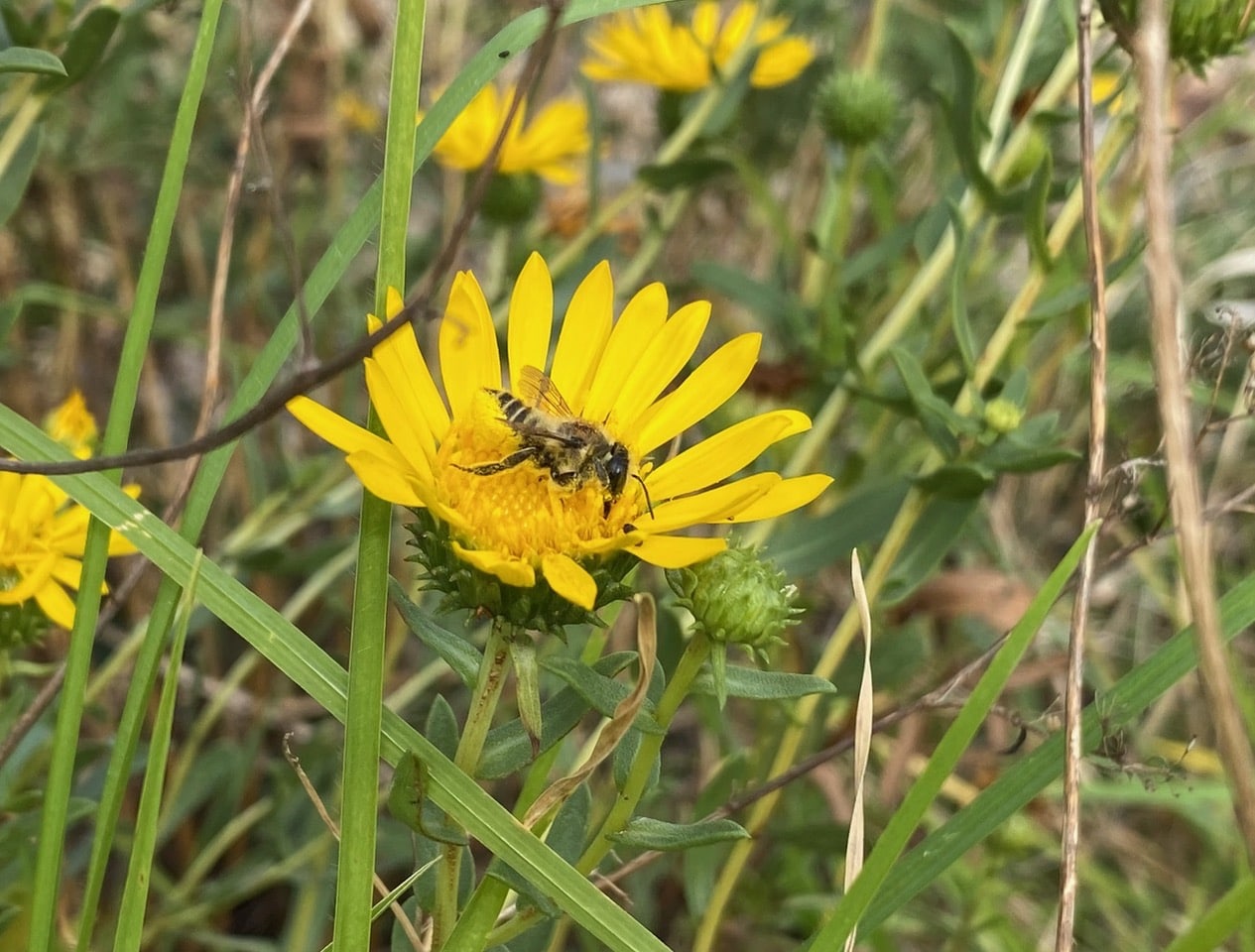
Hey, another female Western Leafcutter Bee, Megachile perihirta (family Megachilidae) foraging on the Grindelia flowerheads. These bees are sure active today.
Her abdomen tipped up, the female is actively collecting pollen into the scopa on the underside of the abdomen.
The bee lands on another flowerhead. Her tongue extended, she is loading up on nectar as well while she gathers pollen.
It is a joy to watch the leafcutter females work the Grindelia flowerheads.