

Pollinator Post 10/13/23 (2)
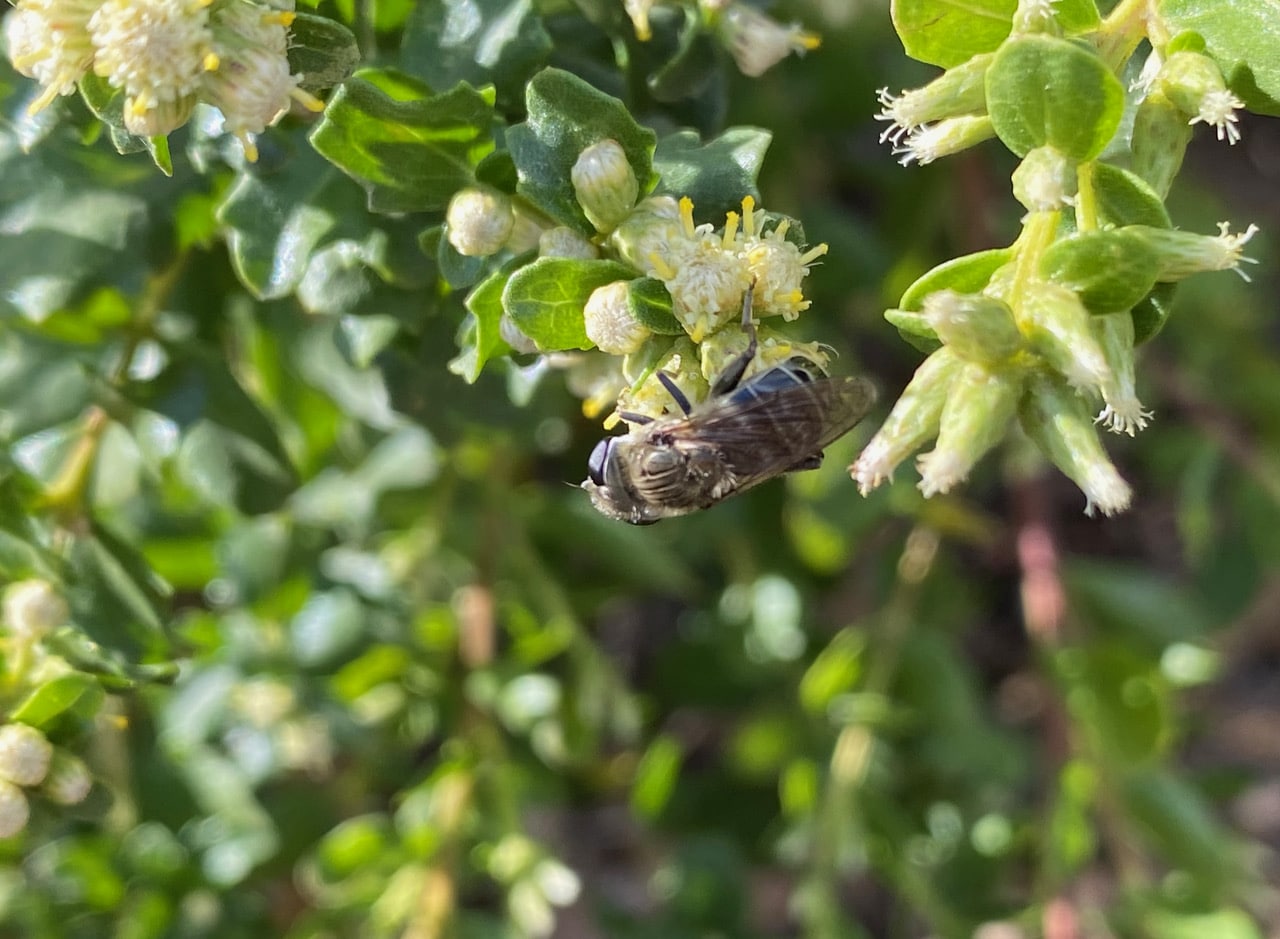
A Common Sickleleg, Asemosyrphus polygrammus (family Syrphidae) visits a Coyote Brush in bloom.
Little information is available about this species of hover fly, except that the larvae are rat-tail maggots.
Rat-tail maggots are the larval stage of many species of hover fly (family Syrphidae) in the tribes Eristalini. The maggots are most commonly found in dank and decaying environments such as compost, pond margins, and tree rot holes. The larvae feed on the decomposing material which is poor in oxygen but rich in organic matter. The “tails” are the siphons or breathing tubes that extend from their rear end to enable the larvae to breathe while submerged in the wet substrate. When mature, the larvae climb out to pupate on dry land. The larvae are important decomposers/recyclers and the adult flies are important pollinators. What’s not to love about Syrphids?
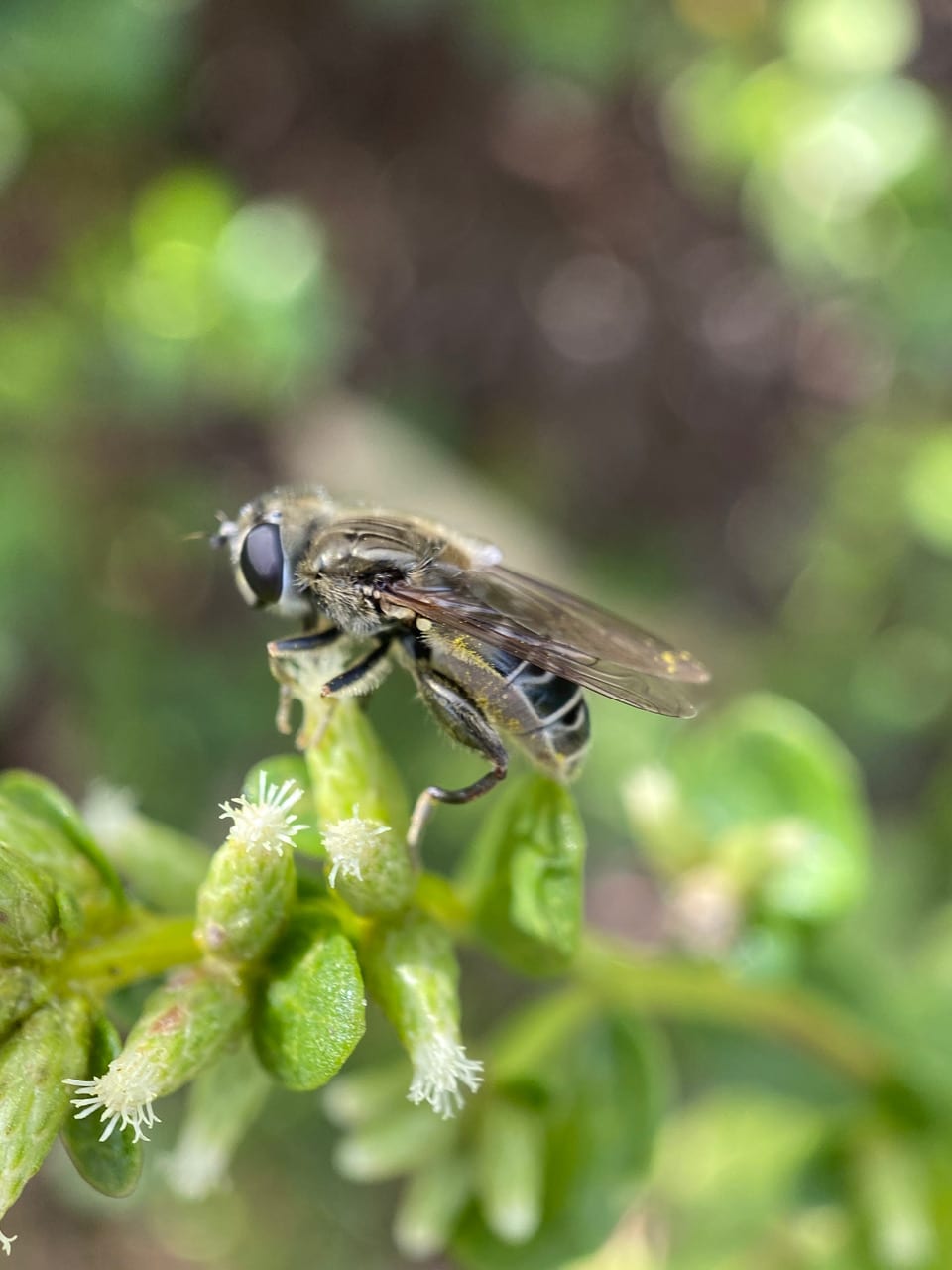
Close-up of the Common Sickleleg. Ah, now I know where the name “sickle-leg” came from – the fly’s tibia is strangely curved!
Photos of Common Sickleleg (Asemosyrphus polygrammus) · iNaturalist





A Common Buckeye butterfly flutters in front of me, then settles down on the leaf litter, almost disappearing from view.
Named for its conspicuous target-shaped eyespots, the mainly brown Common Buckeye is readily identifiable. The butterfly favors open, sunny areas with low vegetation and some bare ground. Males perch during the day on low plants or bare ground to watch for females, flying periodically to patrol or to chase other flying insects. Females lay eggs singly on leaf buds or on upper side of host plant leaves. Caterpillars feed on a variety of plants including the non-native narrowleaf plantain (Plantago lanceolata). The perennial herb contains the iridoid glycosides that the caterpillars sequester in their body, rendering themselves unpalatable to predators.
From a distance, I thought they were some fallen leaves caught on the Coyote Brush. I continue to watch small insects on the shrub for a while, until I realize that the “fallen leaves” were actually a Mantis. On closer inspection, it turns out to be a mating pair! The male is barely half the size of the female who is a full 3 inches long – one of the biggest insects I have seen in the garden.
Mantids are in their own insect order Mantodea, family Mantidae. They are superbly adapted as predators. The serrations/spines on the second and third sections of their long raptorial front legs interlock when they grab their prey, making escape impossible. Mantids have a very mobile head that is triangular in shape. Two very large compound eyes, spaced far apart, give them binocular vision. Mantids prey on insects, spiders and other invertebrates, but some larger species have been observed catching hummingbirds, small snakes, bats and baby mice. Female mantids lay eggs in a hardened foam egg case called an ootheca which they cement to a twig or branch. Mantids are often sold as egg cases for pest control in gardens.
Our pair of matids has been identified as the European Mantis, Mantis religiosa, family Mantidae. The species has a characteristic dark “bulls eye” marking on the inside of the forelegs (coxa). The body color can be green or brown. At rest, this species will sit, with their front arms folded, appearing as though they are praying, hence the name religiosa. These insects were introduced to North America from Europe to help control pest populations and have since established across the continent. The European Mantis is a voracious carnivore and ambush predator. They are able to grab flying prey, making grasshoppers a popular food. A unique feature of this species is its midline metathoracic ear, an ear on the underside of the body, that allows it to hear high and low frequencies as well as ultrasound. This ear helps aid in their predation, as they can lay in wait for prey items to move toward them before striking quickly with their spiked legs.
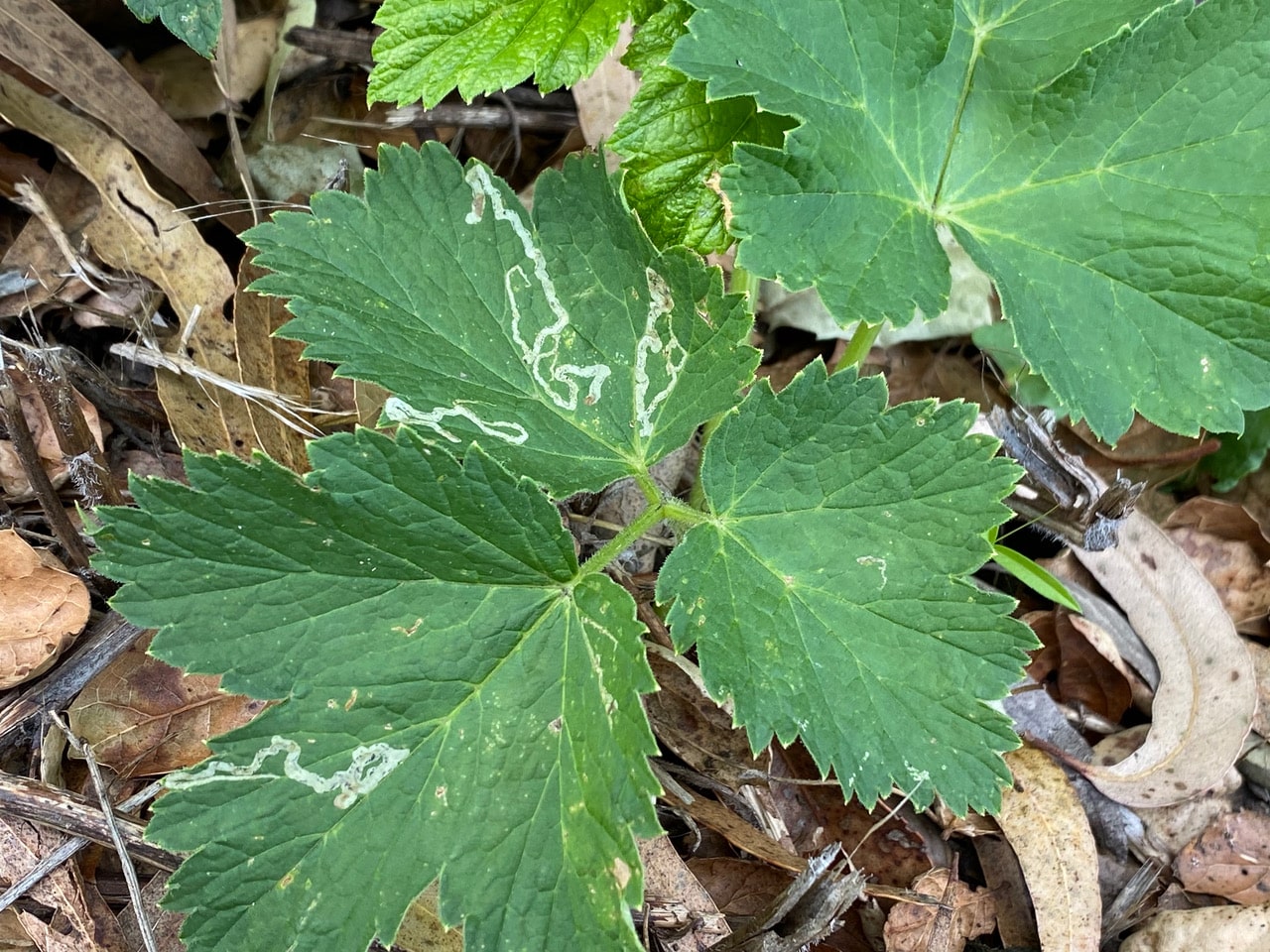
Who made those squiggle lines on the leaf of Cow Parsnip, Heracleum maximum? The culprits are most likely the Cow Parsnip Leaf Miner, Phytomyza sp. (family Agromyzidae).
A leaf miner is any one of numerous species of insects in which the larval stage lives in, and eats, the leaf tissue of plants. The vast majority of leaf-mining insects are moths (Lepidoptera), sawflies (Symphyta), and flies (Diptera). Some beetles also exhibit this behavior. Leaf miners are protected from many predators and plant defenses by feeding within the tissues of the leaves, selectively eating only the layers that have the least amount of cellulose, and lowest levels of defensive chemicals.
The Agromyzidae are a family commonly referred to as the Leaf-miner Flies, for the feeding habits of their larvae, most of which are leaf miners on various plants. They are small flies, most species in the range of 2-3 mm. Agromyzidae larvae are phytophagous, feeding as leaf miners, less frequently as stem miners or stem borers. A few live on developing seeds, or produce galls. There is a high degree of host specificity. A number of species attack plants of agricultural or ornamental value, so are considered pests. The shape of the mine is often characteristic of the species and therefore useful for identification. Adults occur in a variety of habitats, depending on the larval host plants.
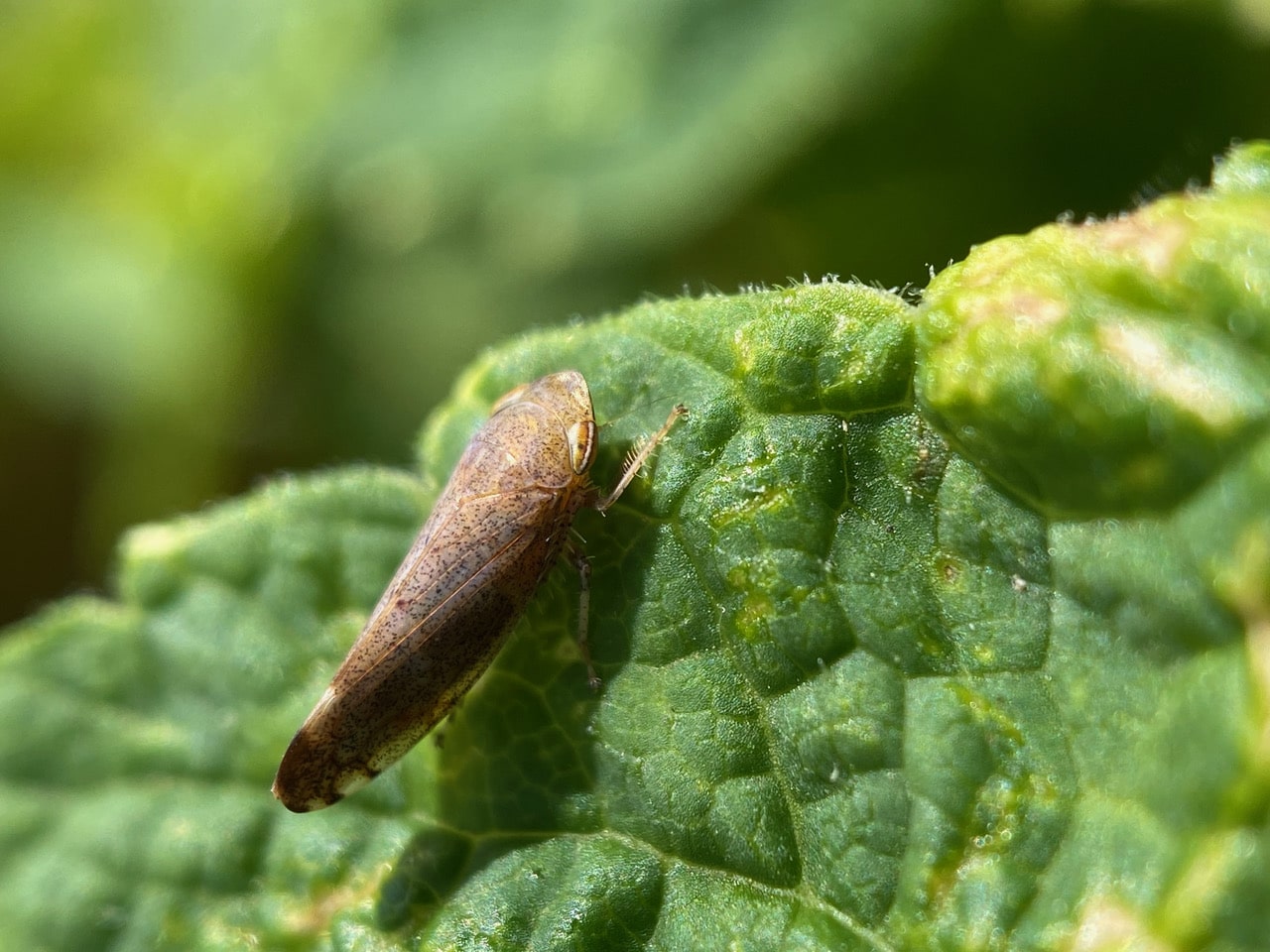
Looking every bit like plant debris, a Privet Leafhopper, Fieberiella florii (family Cicadellidae) is resting stock still on a leaf of Cow Parsnip, Heracleum maximum.
Leafhopper is the common name given to true bugs in the family Cicadellidae. The bugs are plant feeders that suck plant sap from grass, shrubs, or trees. Their hind legs are modified for jumping, and are covered with hairs that facilitate the spreading of a secretion over their bodies that act as a water repellent and carrier of pheromones. They undergo partial metamorphosis, and have various host associations, varying from very generalized to very specific.
The Privet Leafhopper, Fieberiella florii (family Cicadellidae) is native to Europe and has been established in the United States and Canada. The species feeds on a wide variety of broad-leafed, woody trees, shrubs and vines. Favorite host plants seem to be privet, fruit trees in the Rose family (cherries, plums, peaches, apricots and apples, etc.) and other woody plants in the rose family. It is an important pest known to spread plant diseases in fruit trees.
The edge of a Cow Parsnip leaf has been folded over sharply.
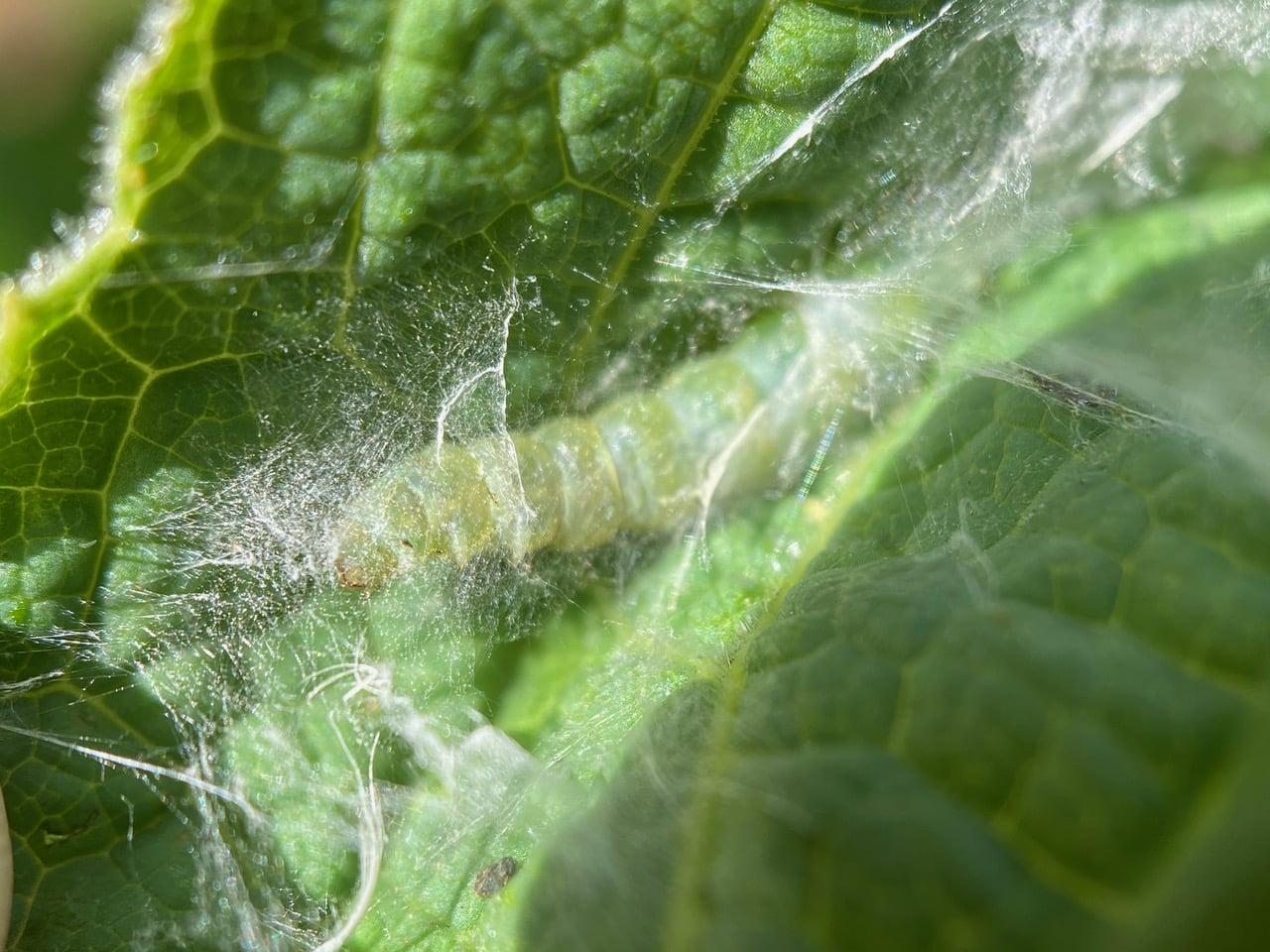
The edges are loosely sealed with white silk. Caterpillar or spider?
Curious, I gently pull apart the fold. The silk gives way easily, revealing a green caterpillar inside. I regret my action as soon as I see the insect. The construction of the retreat must’ve been a major undertaking for the little caterpillar. I hope it can repair or rebuild its shelter. The caterpillar is probably a member of the family Tortricidae, commonly known as tortrix moths or leafroller moths. Leaf shelter-builders, either leaf-tiers or leaf-rollers, use silk to help create protective shelters. The caterpillars attach silk to both sides of a leaf. When the elastic silk draws tight, the surfaces are pulled together. The shelter hides the caterpillars from predators and creates a safe haven for feeding in peace.
Caterpillars of both moths and butterflies have the ability to produce silk, much like a spider. Caterpillars produce silk through a “spinneret”. This tube-like structure is located on the lower side of the caterpillar’s mouth. Silk is generated as a liquid in the salivary glands and excreted through the spinneret; as it makes contact with air, it turns into a solid silk strand. Silk is one of the strongest natural fibers – it’s said that pound or pound, silk is stronger than steel.
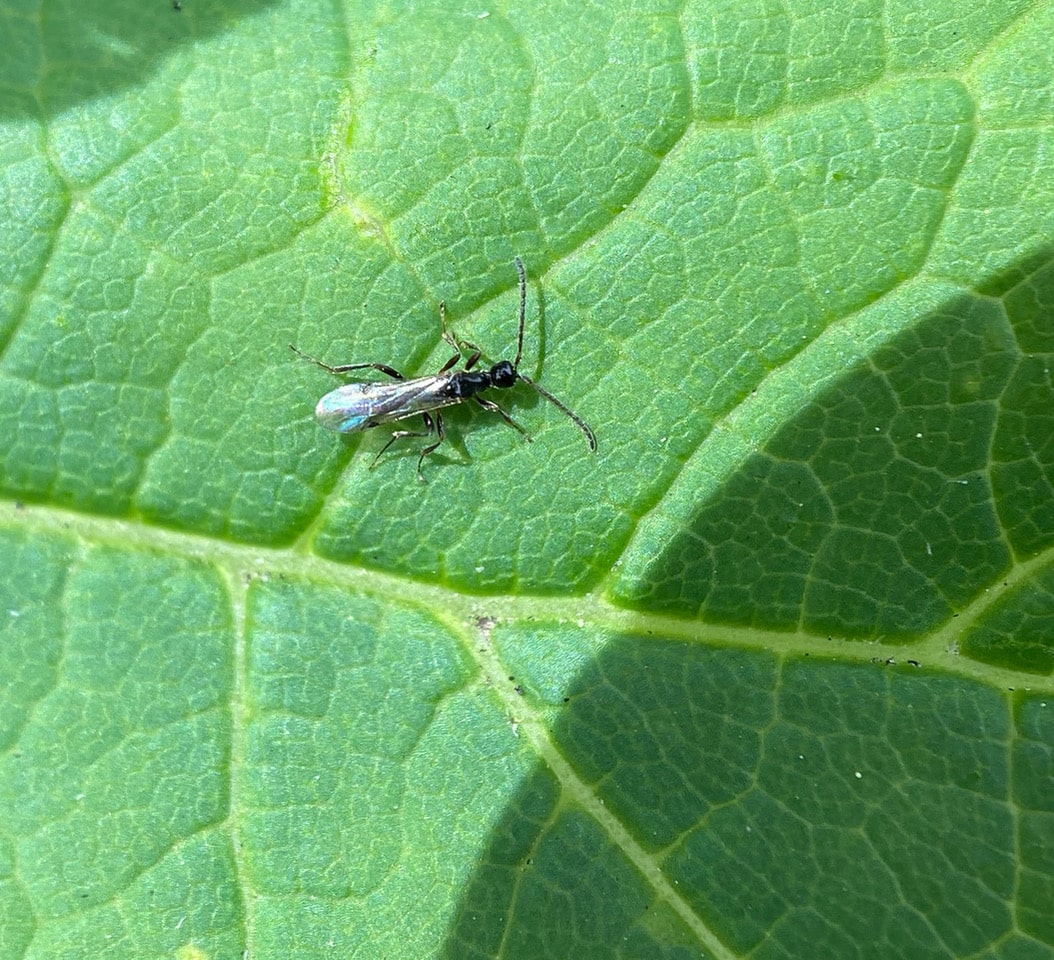
A tiny wasp, probably a parasitoid belonging to the superfamily Ichneumonoidea is exploring the surface of a Cow Parsnip leaf.
The superfamily Ichneumonoidea comprises the two largest families within Hymenoptera: Ichneumonidae and Braconidae, both with a cosmopolitan distribution. Members of the two families are distinguished by wing venation. Ichneumonoids are solitary wasps, and the vast majority are parasitoids; the larvae feed on or in another insect, eventually killing it. In general, ichneumonoids are host specific, and only attack one or few closely related host species. Many species use polydnaviruses to suppress the immune systems of their host insects.
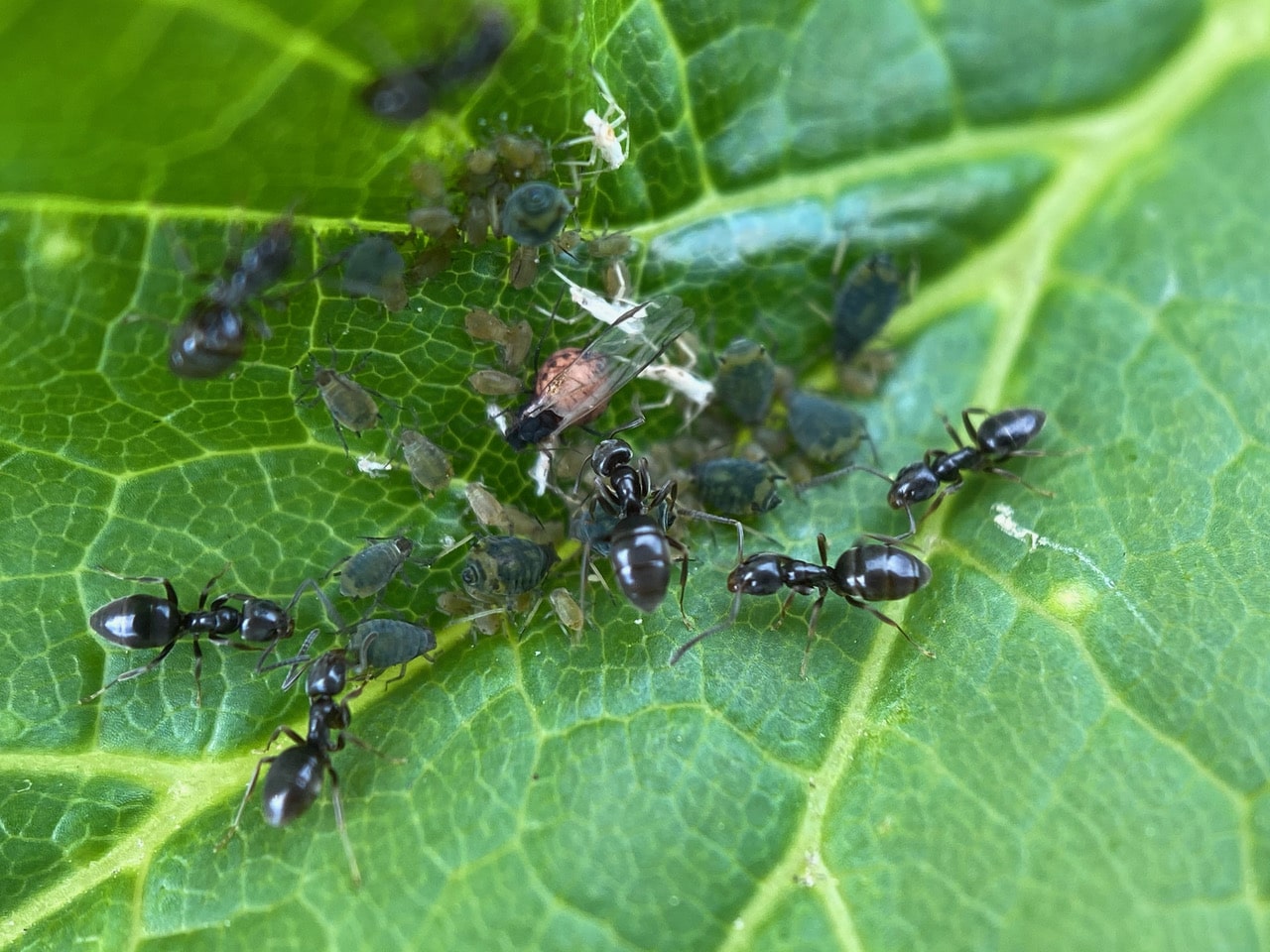
Some shiny black ants are tending a group of tiny aphids on a Cow Parsnip leaf. The ants appear to be Odorous House Ants. I am not familiar with this species of aphids. What I find surprising is the presence of an alate (winged reproductive) that looks completely different from the other aphids – it is larger and has a pinkish abdomen. The white stuff is aphid exuviae, exoskeletons shed at each molt.
Ants and aphids share a well-known mutualistic relationship. The aphids produce honeydew, a sugary food for the ants; in exchange, the ants care for and protect the aphids from predators and parasites. Some ants will “milk” the aphids to make them excrete the sugary substance. The ants stroke the aphids with their antennae, stimulating them to release the honeydew. Aphid-herding ants make sure the aphids are well-fed and safe. When the host plant is depleted of nutrients, the ants carry their aphids to a new food source. If predatory insects or parasites attempt to harm the aphids, the ants will defend them aggressively. Some species of ants continue to care for aphids during winter. The ants carry the aphids to their nest for the winter months, and transport them to a host plant to feed the following spring.
The Odorous House Ant, Tapinoma sessile (subfamily Dolichoderinae) is native to North America, ranging from southern Canada to northern Mexico. The species is found in a vast diversity of habitats, including within houses. The ants mainly feed on floral nectar and other sugary food. They also forage for honeydew produced by aphids and scale insects that they guard and tend.
Odorous House Ants are small ants, the workers measuring 2-3 mm. As in all members of the subfamily Dolichoderinae (odorous ants), this species does not possess a sting, instead relying on the chemical defense compounds produced from the anal gland. Such compounds are responsible for the smell given off by the ants when crushed or disturbed.
T. sessile colonies are polydomous (consist of multiple nests) and polygynous (contain multiple reproductive queens). The species practices seasonal polydomy – the colony overwinters in a single nest, and forms multiple nests during spring and summer when resources are more abundant and spread out.
The Odorous House Ants are rather docile, with little propensity for attack, preferring to use chemical secretions instead of biting. For this reason they are vulnerable to the invasion of the aggressive Argentine Ants, Linepithema humile.
As I pass B2’s Coffeeberry, I see that the caterpillar has retreated a little to avoid direct sun. Its fake eye-spot peers back at me from behind the leaf. Take care, B2. See you tomorrow!