

Pollinator Post 10/13/23 (1)

It’s a clear crisp fall morning at Skyline Gardens.
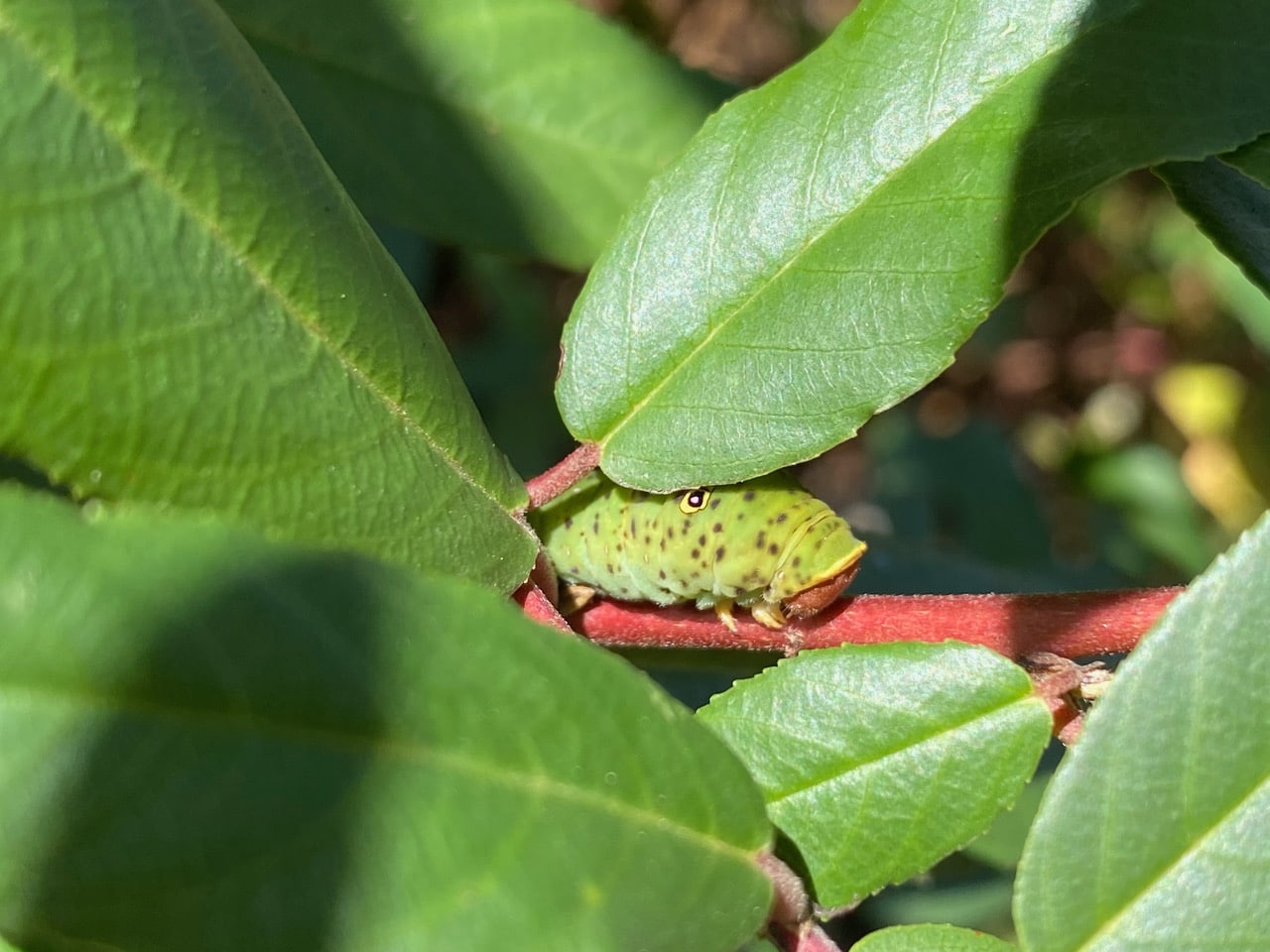



Our Pale Swallowtail caterpillar B2 is still on the same Coffeeberry stem, about 5 inches from the branch tip. At least it has emerged from the shadows and seems to be taking in the morning sun.
The dark spots don’t seem to have gotten any worse. I sure hope B2 can fight off the infection, whatever it is.
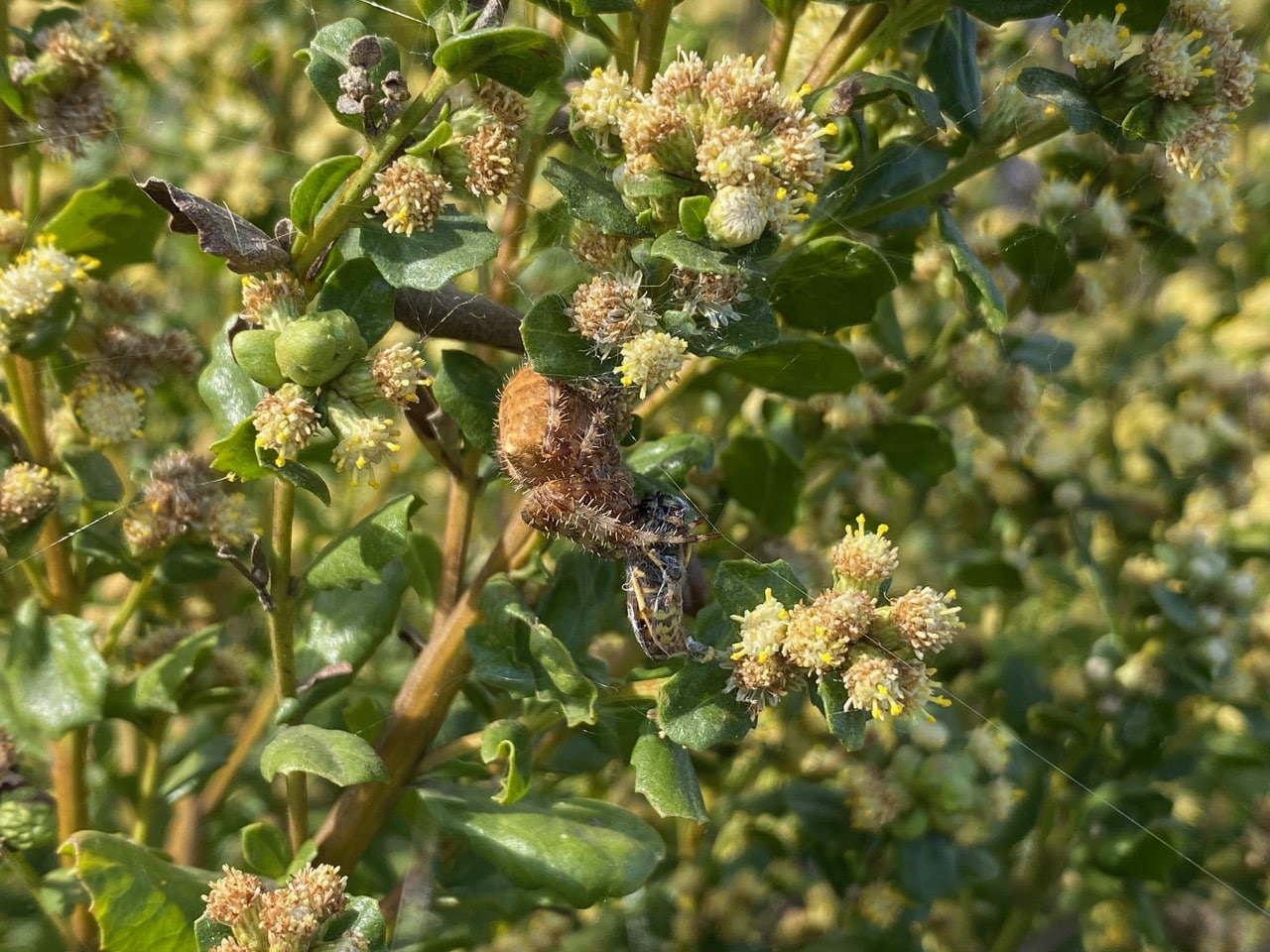
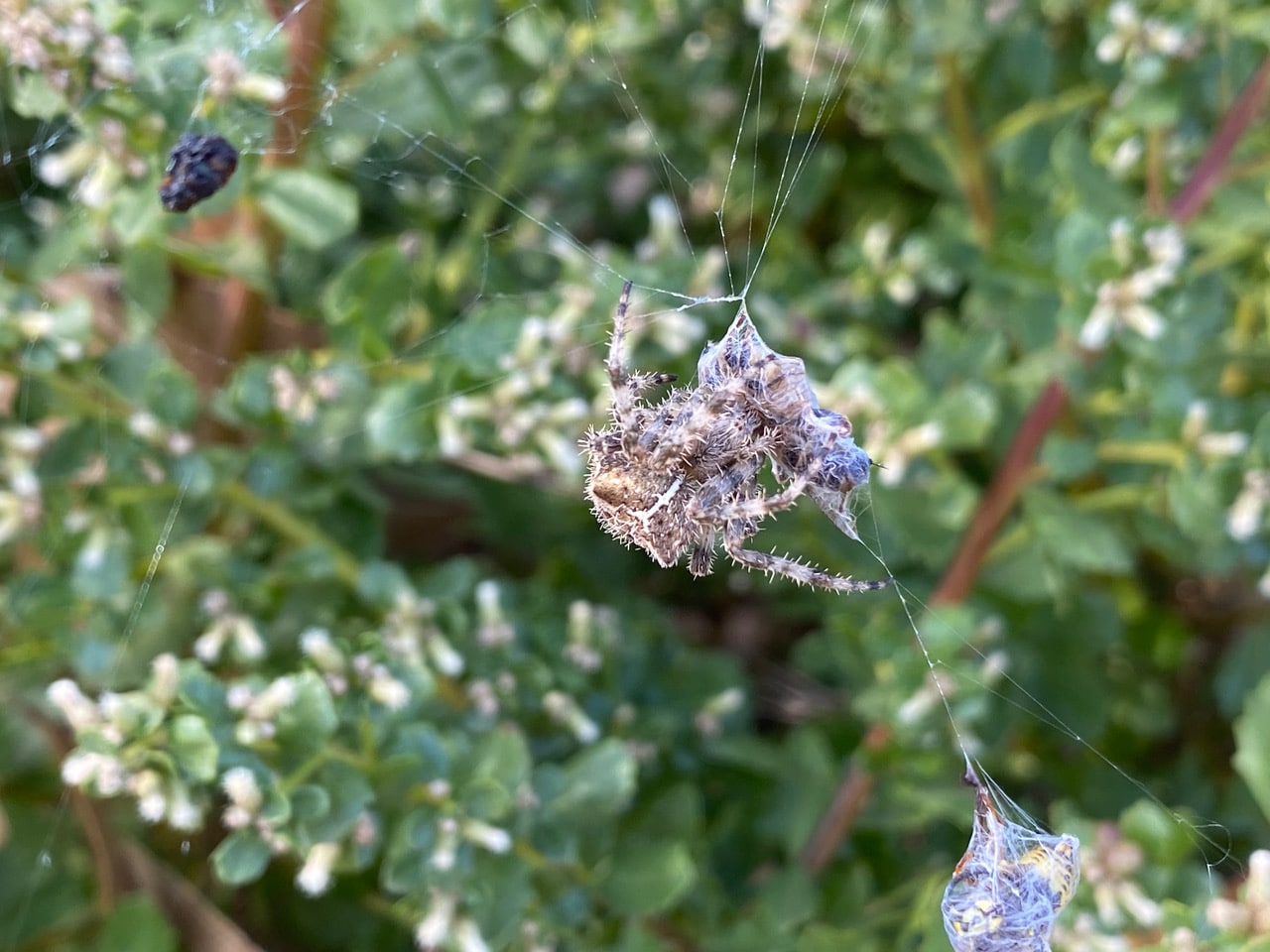
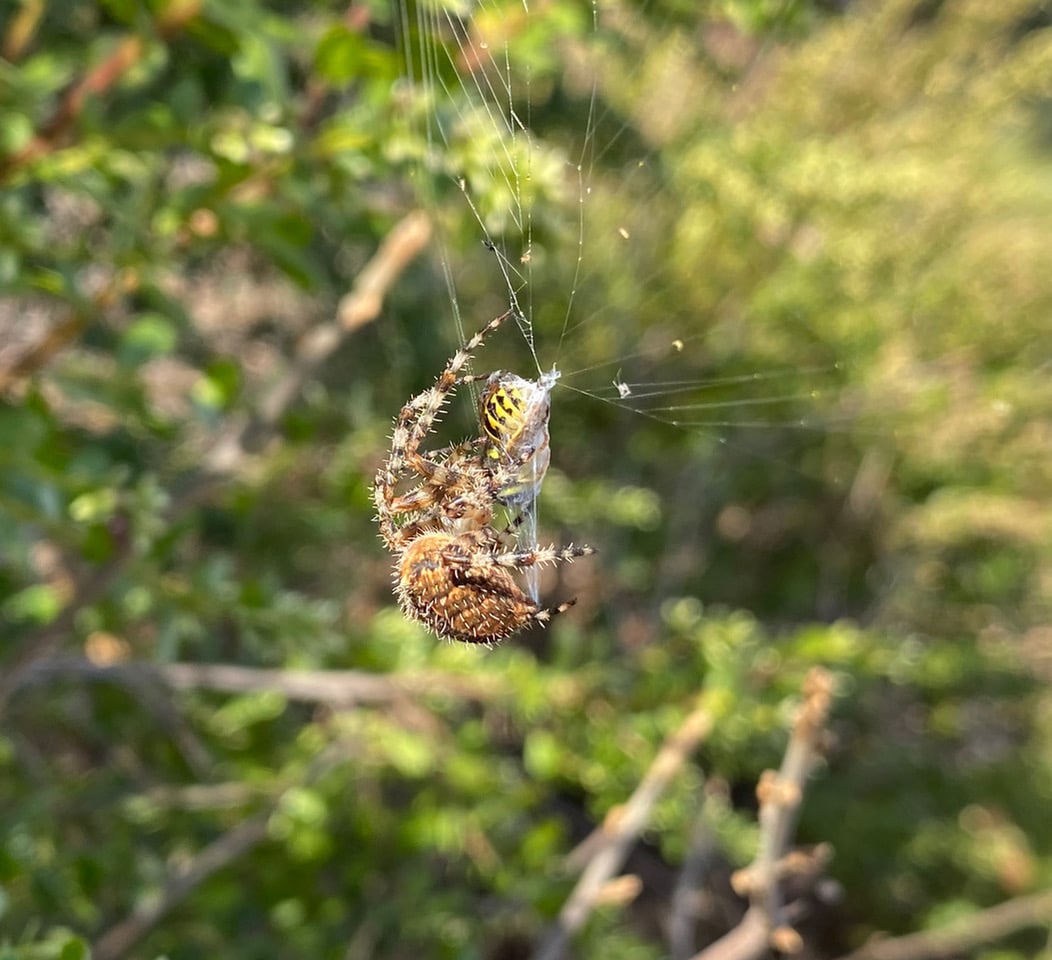
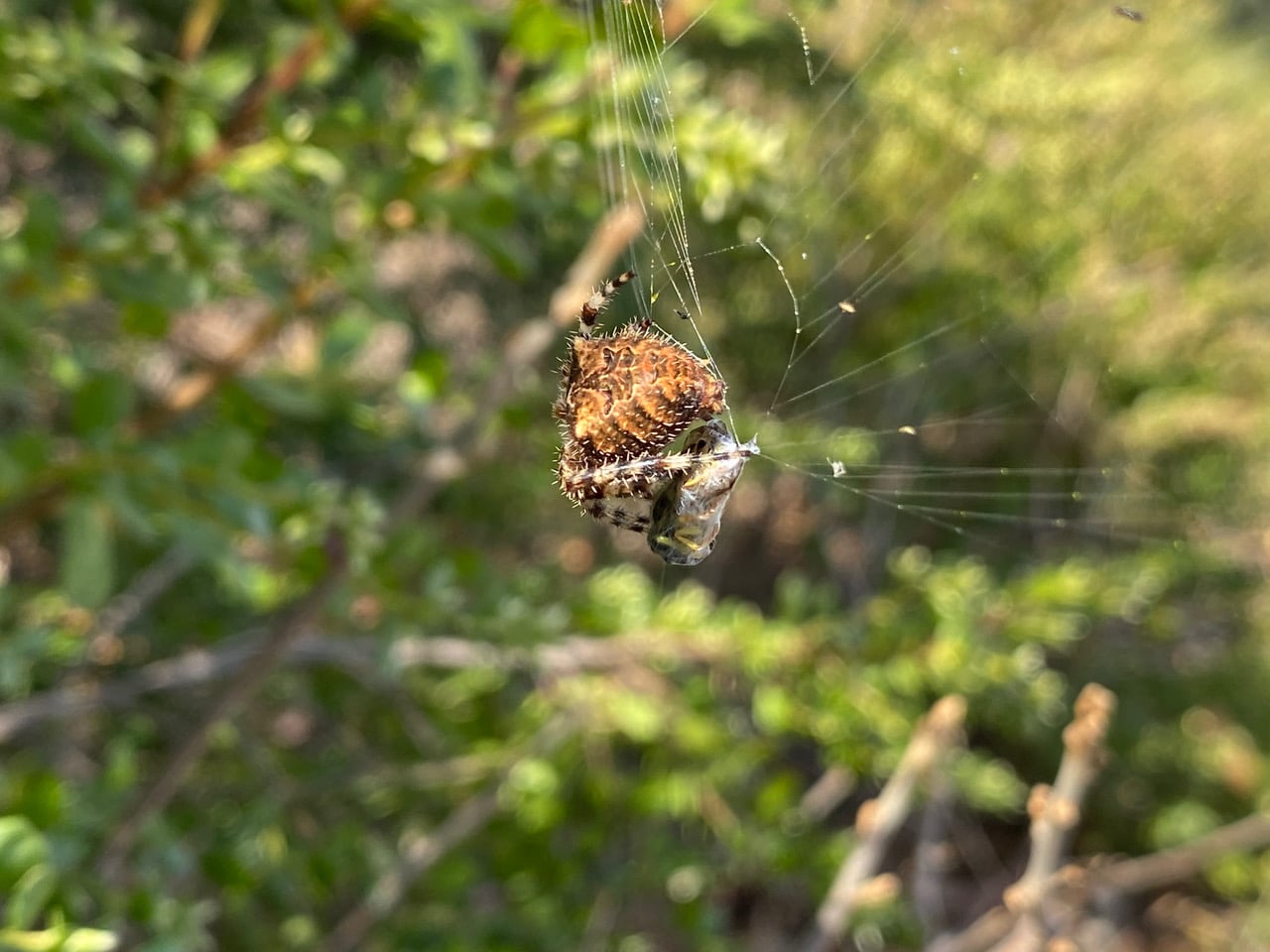
The Orb-weaver Spider, Araneus sp. (family Araneidae) on the Coyote Brush is feeding on a Yellowjacket it has wrapped up. Its orb web is in tatters, but it doesn’t matter. The spider is eating today!
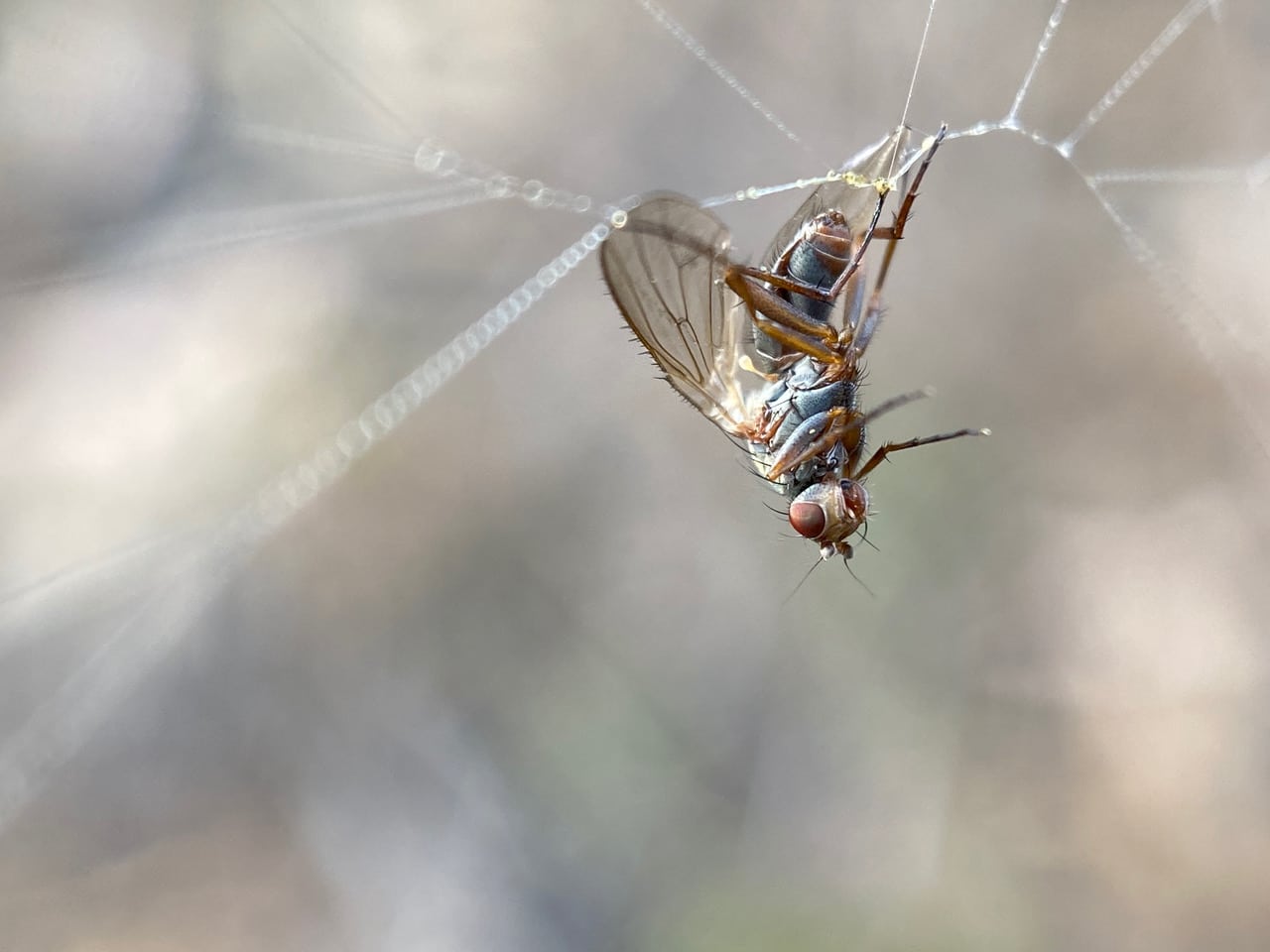
A small fly has been snared on the broken web, but the spider is ignoring it. The Yellowjacket is a much more substantial meal.
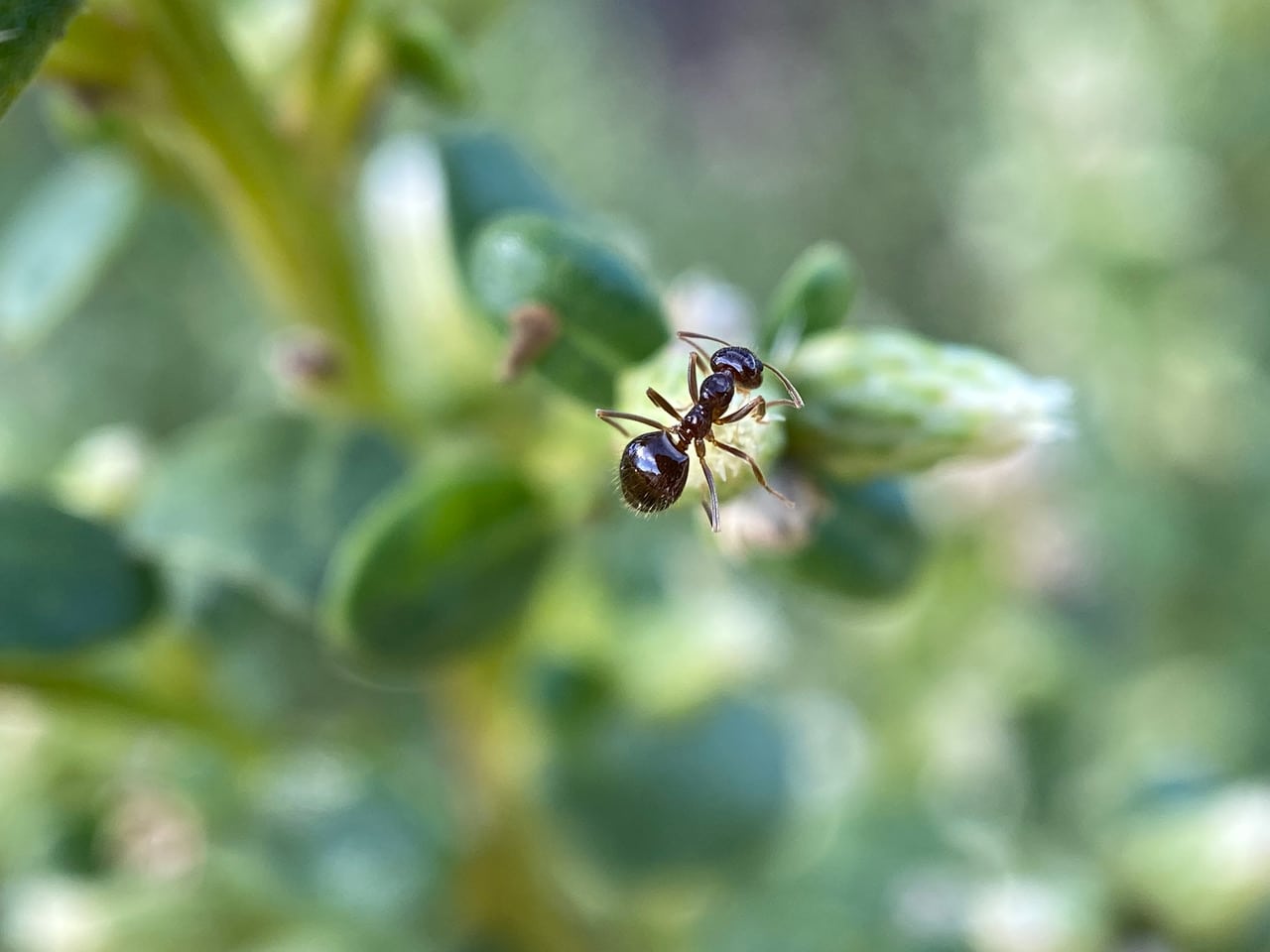
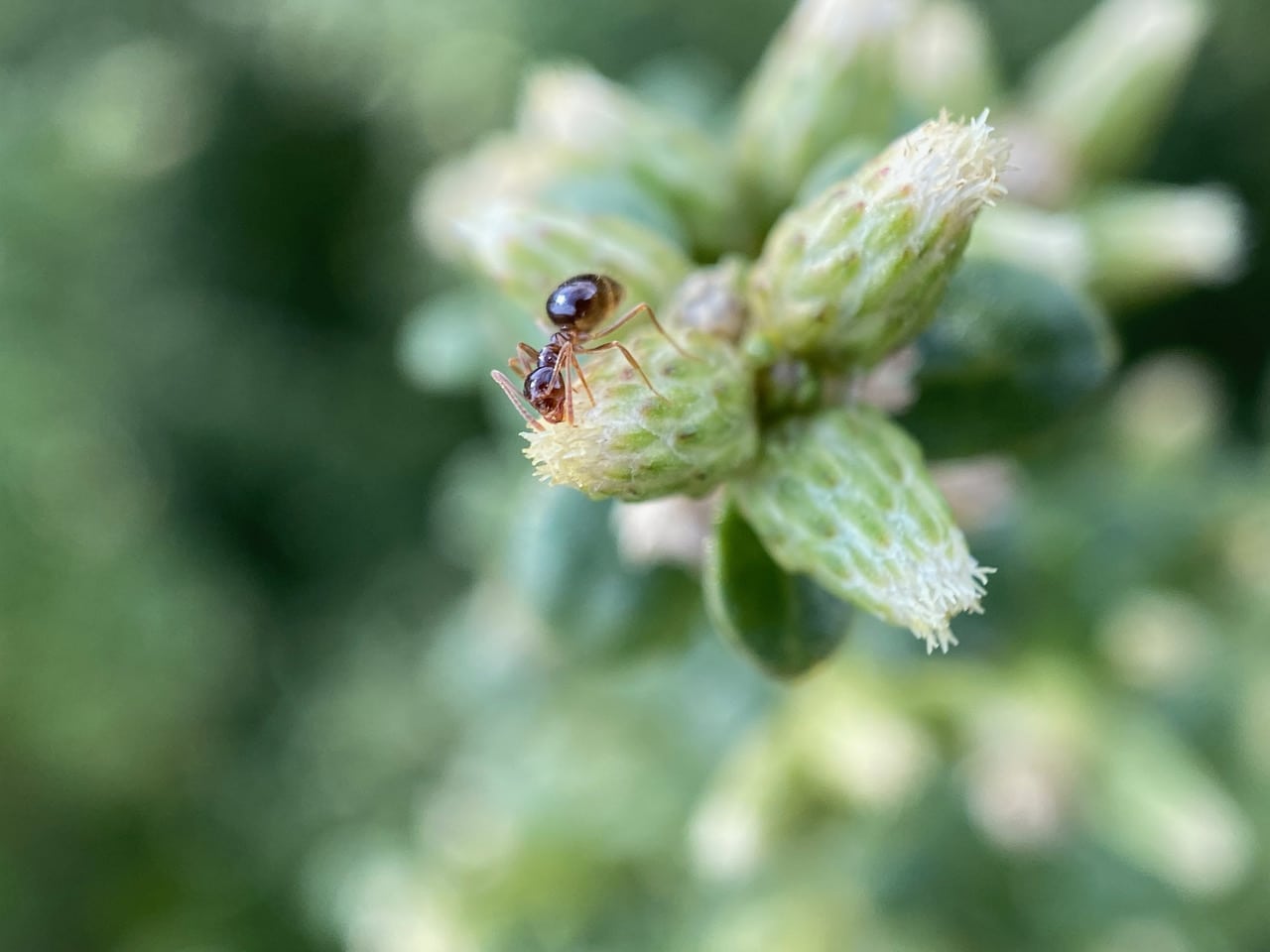
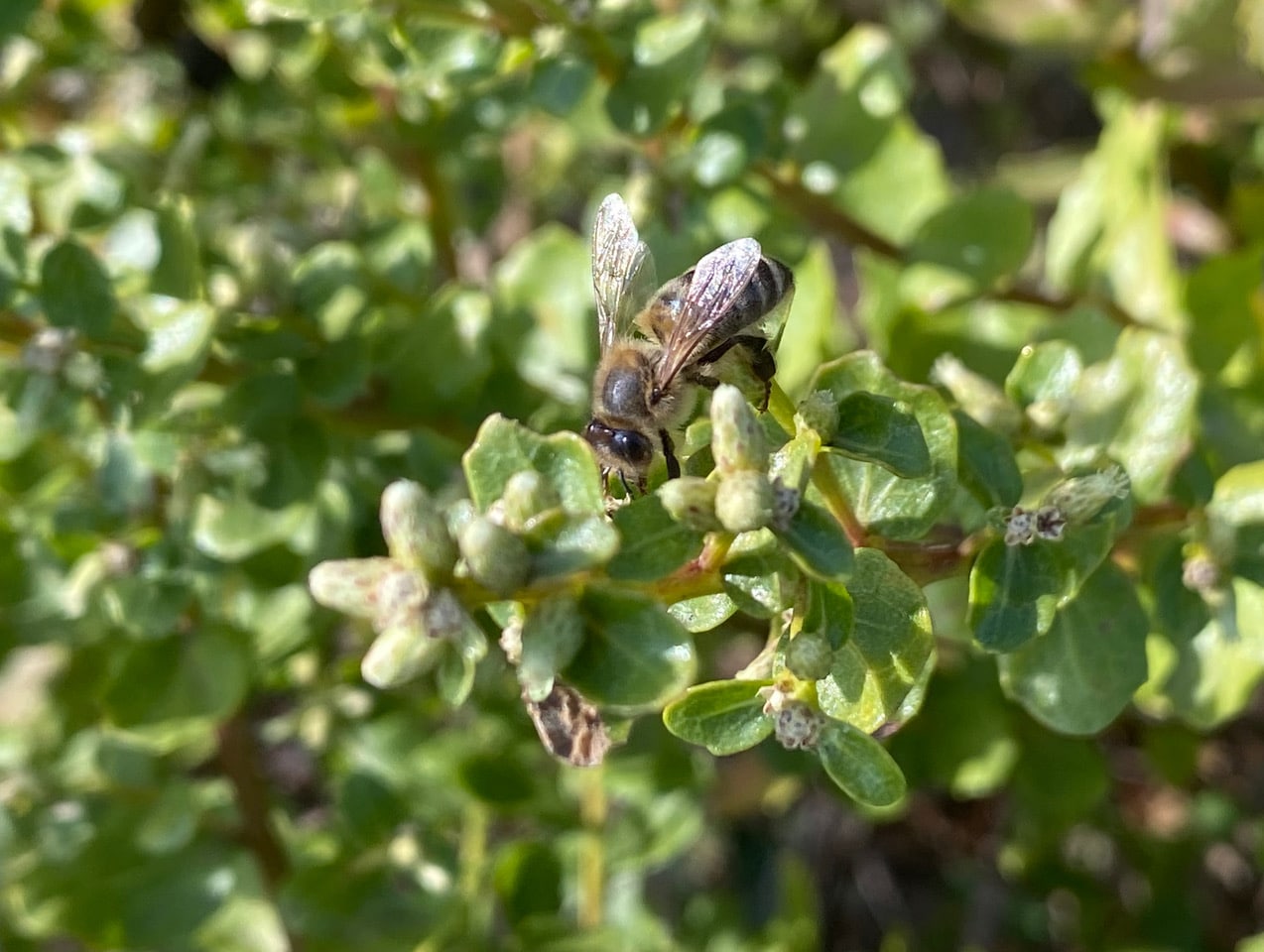
Many American Winter Ants, Prenolepis imparis (family Formicidae) are foraging on the flowers of a female Coyote Brush.
The American Ant, Prenolepis imparis is a widespread North American ant. A dominant woodland species, it is most active during cool weather, when most other ant species are less likely to forage. This species is one of a few native ants capable of tolerating competition with the invasive Argentine Ant, Linepithema humile. They are also aggressive toward other ants and produce abdominal secretions that are lethal to Argentine Ants. Prenolepis imparis is a generalist omnivore. Foragers are known for tending to aphids or scale insects from which they consume excreted honeydew, aggregating on rotting fruit, and exploiting protein-rich sources such as dead worms. The colony enters estivation (a hibernation-like state) and becomes inactive above ground for the warmer months, during which time eggs are laid and brood are reared. Reproductives overwinter and emerge on the first warm day of spring for their nuptial flight.
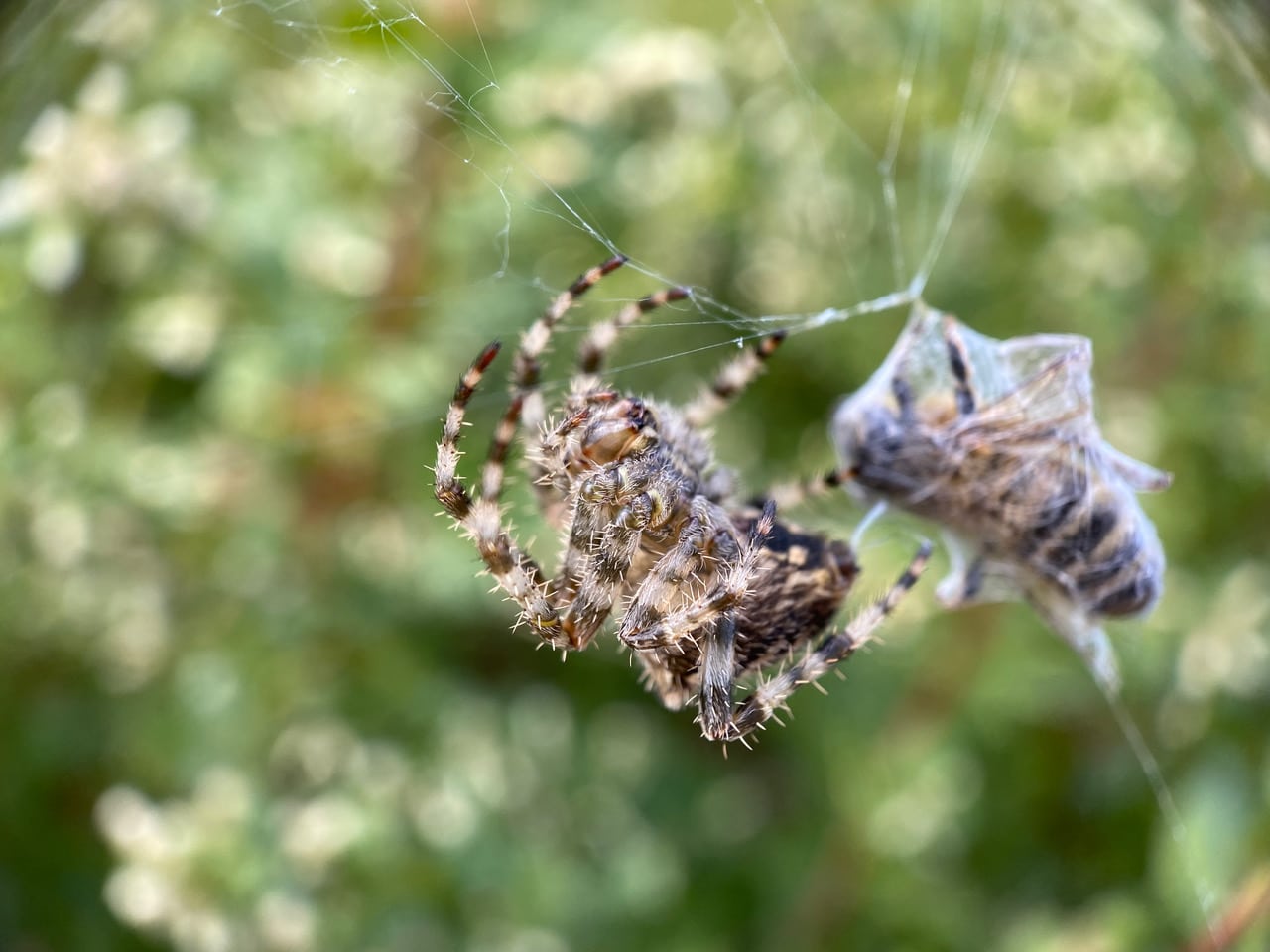
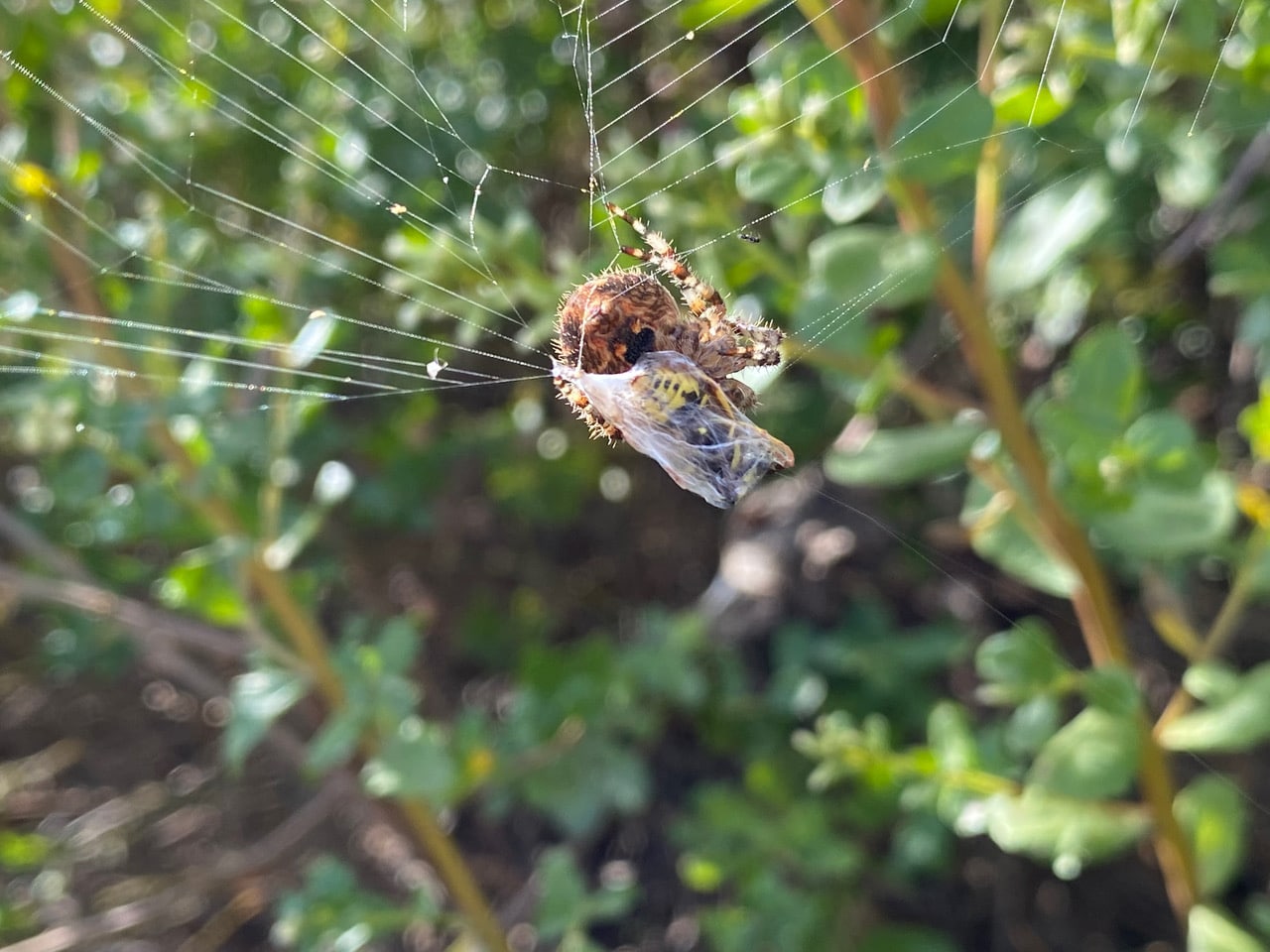
As the morning warms up, more insects are visiting the blooming Coyote Brush. It is a great day for the Orb-weaver spiders that have set up traps on the shrubs. This grayish Gem-shaped Orb-weaver, Araneus gemma (family Araneidae) has just finished wrapping a trapped Honey Bee in silk.
Araneus gemma, commonly known as Gem-shaped Spider of Cat-faced Spider is a common outdoor orb-weaver spider found in the western North America. The species occurs in varying colors, but is easily identified by the two horn-shaped growths on its relatively large abdomen. Females have a larger abdomen and head. Males have much smaller abdomens and longer bodies. Orb-weaver spiders are well known for sexual cannibalism. Females often kill and consume the males just before, during, or just after mating. The females die within days of laying a single egg sac with hundreds of eggs. Egg sacs can survive over winter, and the emerging spiderlings eat their siblings. The babies ride strands of silk in warm air currents to locations miles away.
The legs of orb-weaver spiders are specialized for spinning orb webs. The webs are built by larger females, which hang head down in the center of the web or remain hidden in nearby foliage, with one claw hooked to a signal line connected to the main orb, waiting for a disturbance to signal the arrival of prey. Prey is then quickly wrapped in silk and bitten, and the prey may hang on the web to be stored for later consumption. The initial bite serves to paralyzed the prey and to prevent injury to the spider from struggling prey. The injected enzymes serve to begin liquefaction of the prey’s internal structures.
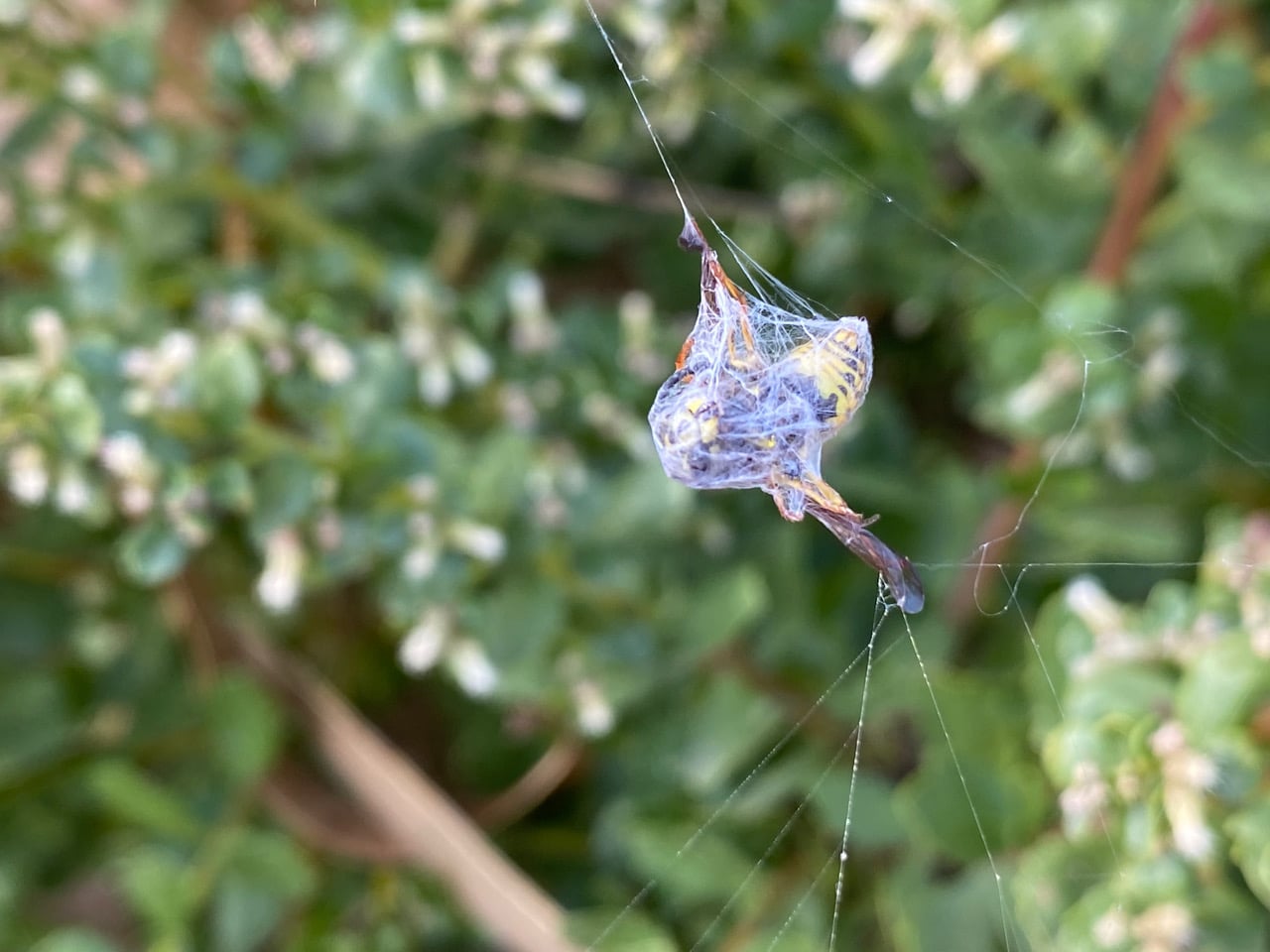
Just a couple of inches below, a wrapped Yellowjacket has been left on the web for later consumption.
The spider suddenly turns from the wrapped Honey Bee…
… to returns to an unfinished meal left in the hub of her web. A black gooey mass, the partially digested prey is no longer recognizable. We are looking at the underside of the spider across the web. Do you see the spinneret at the tip of her abdomen? This is where the silk is extruded.
A spinneret is a silk-spinning organ of a spider. Spiders have special glands that secrete silk proteins (made up of chains of amino acids). The spider pushes the liquid solution through long ducts, leading to microscopic spigots on the spider’s spinnerets. Spiders typically have two or three spinneret pairs, located at the rear of the abdomen. Most spinnerets are not simple structures with a single orifice producing a single thread, but complex structures of many microscopic spigots, each producing one filament. The spigots allow the spider to combine multiple filaments in different ways to produce many kinds of silk for various purposes.
Various species of spiders use silk extruded from spinnerets to build webs, to transfer sperm, to entrap insects, to make egg-cases, to manipulate static electricity in the air, and to fly (ballooning), etc.

Close-up of the Honey Bee wrapped in spider silk.
Better watch out, Honey, or you might be the next victim!
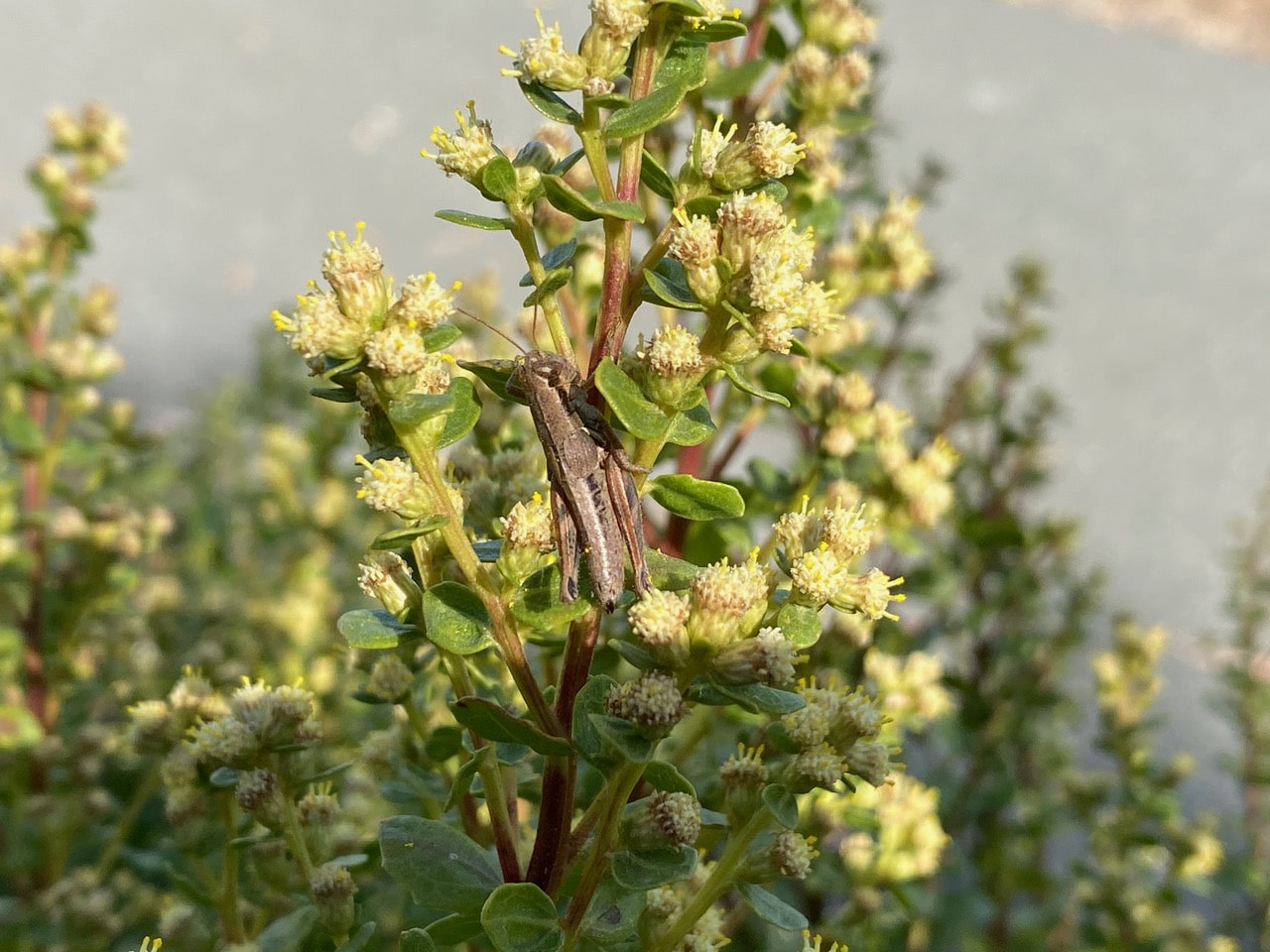
In a quick leap, a Scudder’s Short-winged Grasshopper lands among the flowerheads of a male Coyote Brush.
The Scudder’s Short-winged Grasshopper, Melanoplus scudderi is a species of spur-throated grasshopper in the family Acrididae, native to North America. Mostly found late in season, into late fall. Wings are short, shorter than pronotum or slightly longer.
Melanoplus species eat grasses of all kinds, as well as leafy and grassy agricultural crops and garden plants. They feed on the leaves, and sometimes fruit, flowers, and buds, as well as tree bark.
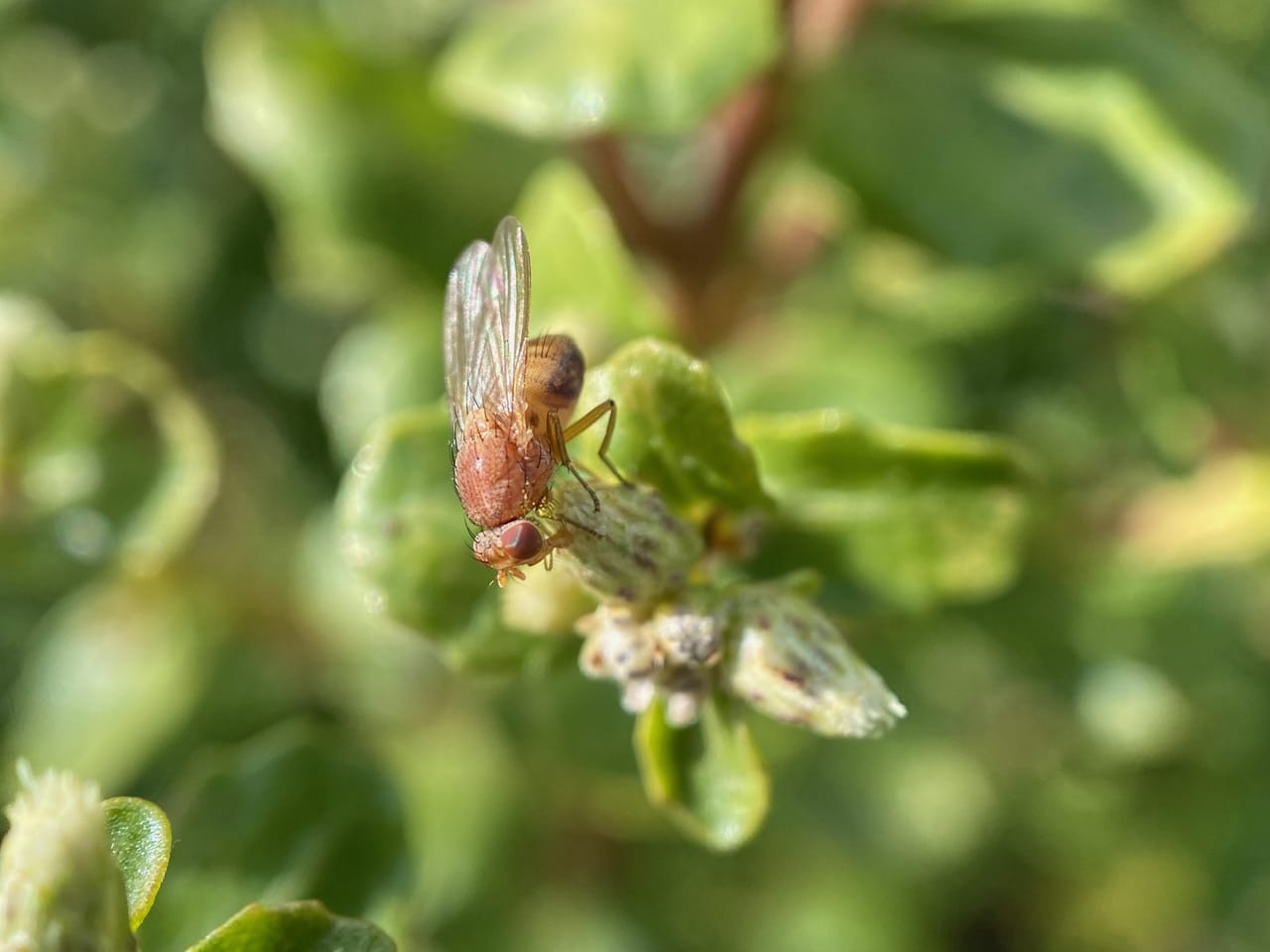
A Lauxaniid Fly is taking nectar from a flowerhead of a female Coyote Brush. One of the most common flies in the garden, it is often overlooked because of its size and lackluster appearance.
Lauxaniidae are small flies (2-7 mm in length). They are often rather plump and dull, the body color varying from yellow-brown to black, or with a combination of these colors. They are characterized by strong, backward pointing bristles on the front (top of the head right above the eyes). The larvae are mostly saprophages, feeding in leaf litter, soil, bird nests, etc. Larvae of some mine fallen leaves, others live in rotten wood. They serve an important role in the ecosystem as decomposers/recyclers of organic matter.
I can’t believe my luck as I watch a female Gem-shaped Orb Weaver Spider, Araneus gemma (family Araneidae) rushing out from her hiding place to retrieve a Yellowjacket that has just flown into the lower edge of her web. The spider proceeds to wrap the wasp with many layers of silk that is extruded from her spinneret, spinning the prey around like a rotisserie attached to only two points on the web.
The action is fast and furious. At this point I switch my camera into video mode to record the drama:
Once the wasp is securely wrapped, the spider skillfully severs it from the web. Toting the parcel with her hind legs (this behavior is new to me), she makes her way up the web. The predator arrives at the Coyote Brush to which her web is attached and sets her wrapped prey down. Eventually the spider makes a U-turn back to her catch and proceeds to feed on it. Wow! It’s all in a day’s work!