

Pollinator Post 10/12/23

Our Pale Swallowtail caterpillar B2 has disappeared from its previous perch on its Coffeeberry host plant. It looks like it has eaten part of the leaf at the tip. It’s good to know that B2 is still eating despite being sick.
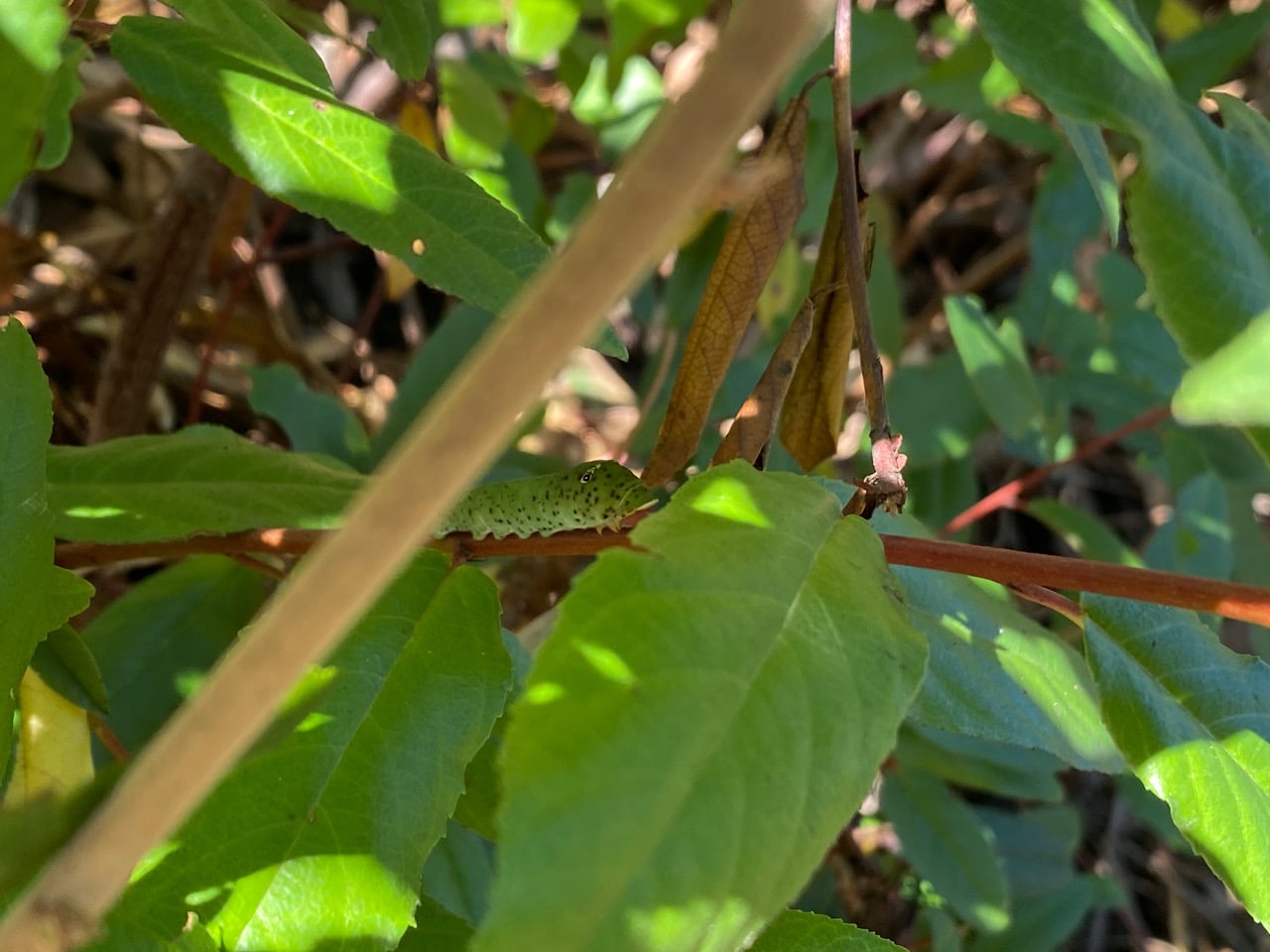
It takes a bit of searching to find B2. Hidden in the shadows, it is resting on the same stem, about 15 in. further from the branch tip.
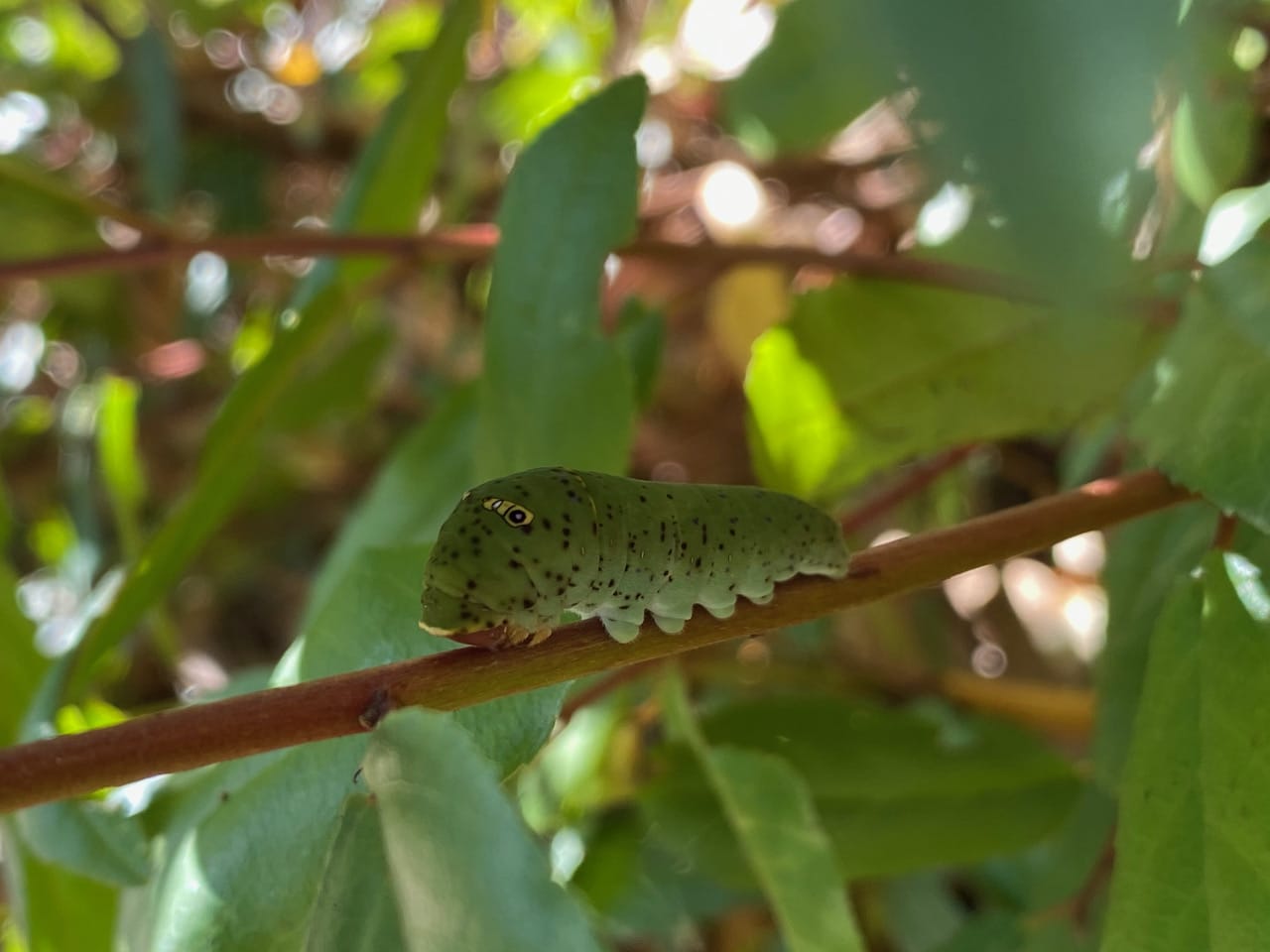
Oh dear, more dark spots have appeared on B2. I hope it is not feeling too bad. The weather is perfect today – not too hot and not too cold, with plenty of sunshine and gentle breezes. Hopefully that would dispel the damp conditions that’s likely the cause of B2’s problem. Hang in there, B2, we’re all rooting for you!
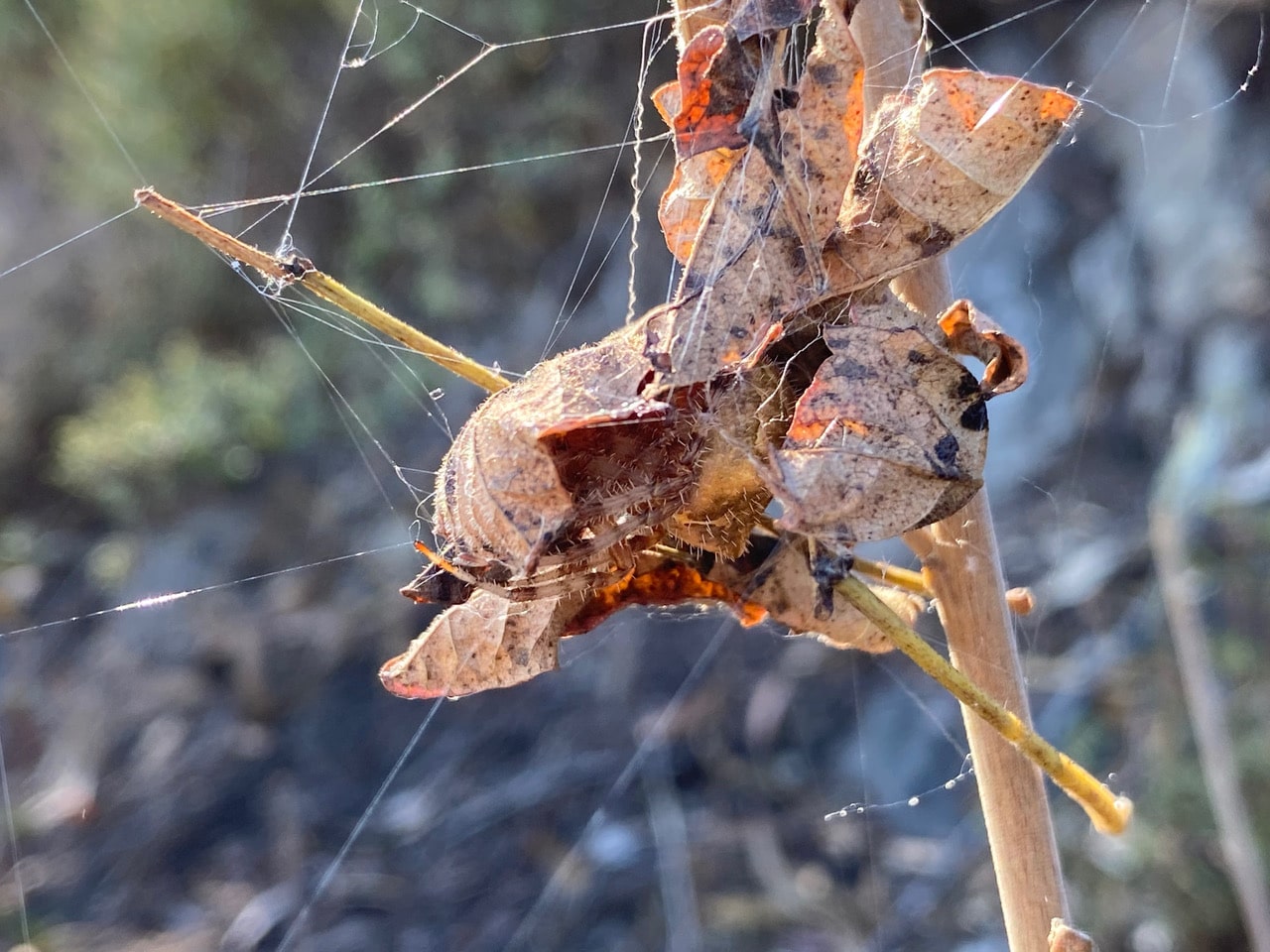
A large new orb web has been built by the female Gem-shaped Spider, Araneus gemma (family Araneidae) on the Poison Oak. The spider has skillfully shaped the dried leaves into a more secure retreat for herself. Note that one of her front legs is holding the signal line connected to the hub of her web. Quite the huntress she is!
Araneus gemma, commonly known as Gem-shaped Spider of Cat-faced Spider is a common outdoor orb-weaver spider found in the western North America. The species occurs in varying colors, but is easily identified by the two horn-shaped growths on its relatively large abdomen. Females have a larger abdomen and head. Males have much smaller abdomens and longer bodies. Orb-weaver spiders are well known for sexual cannibalism. Females often kill and consume the males just before, during, or just after mating. The females die within days of laying a single egg sac with hundreds of eggs. Egg sacs can survive over winter, and the emerging spiderlings eat their siblings. The babies ride strands of silk in warm air currents to locations miles away.
The legs of orb-weaver spiders are specialized for spinning orb webs. The webs are built by larger females, which hang head down in the center of the web or remain hidden in nearby foliage, with one claw hooked to a signal line connected to the main orb, waiting for a disturbance to signal the arrival of prey. Prey is then quickly wrapped in silk and bitten, and the prey may hang on the web to be stored for later consumption. The initial bite serves to paralyzed the prey and to prevent injury to the spider from struggling prey. The injected enzymes serve to begin liquefaction of the prey’s internal structures.
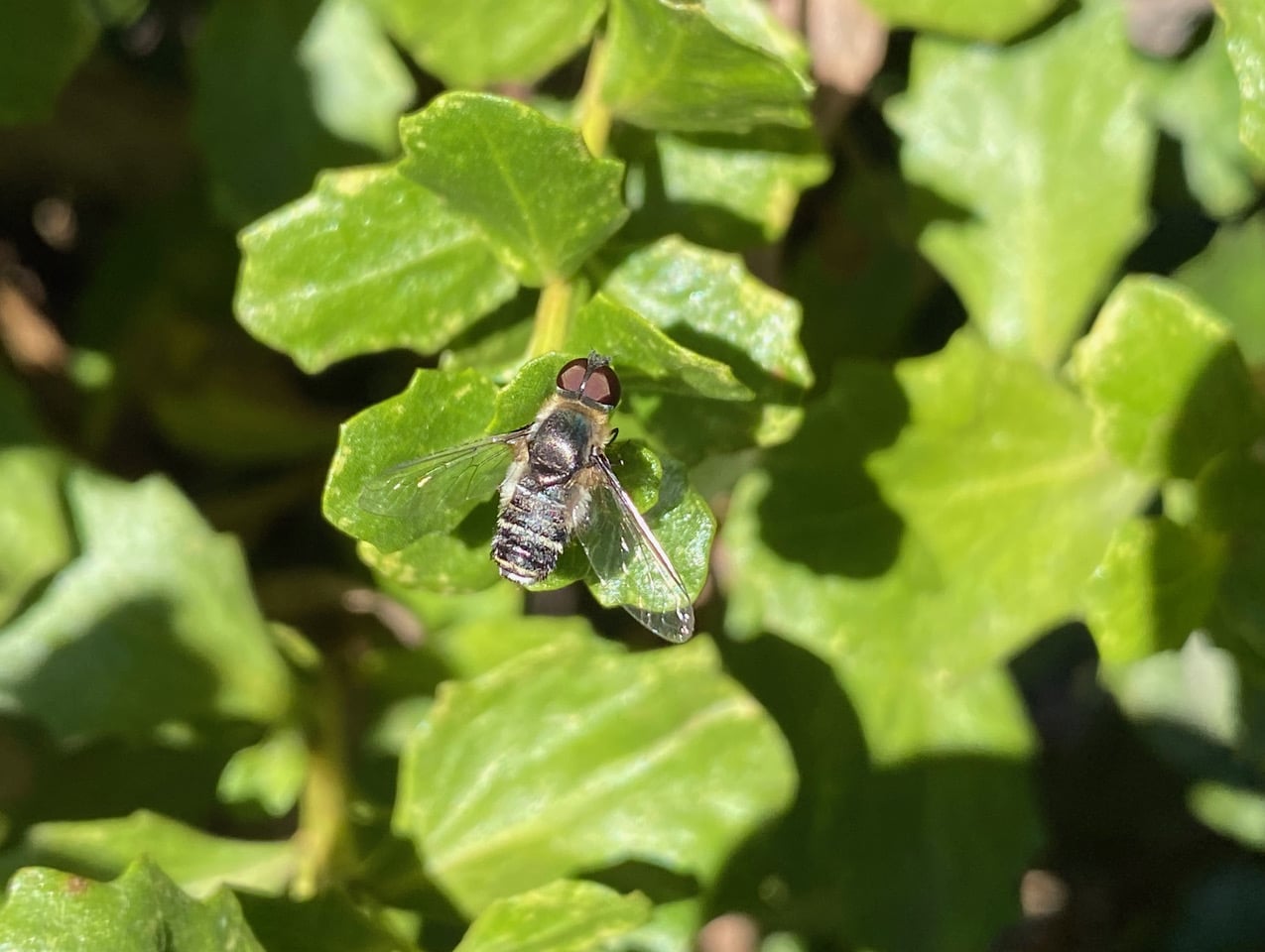 A Bee Fly, Villa lateralis (family Bombyliidae) has landed on a leaf of Coyote Brush.
 The Bee Flies belong to the family Bombyliidae. Adults generally visit flowers for nectar and pollen, some being important pollinators. Larvae generally are parasitoids of other insects. When at rest, many species of bee flies hold their wings at a characteristic “swept back” angle. The adult females usually deposit eggs in the vicinity of possible hosts, quite often in the burrows of beetles or ground-nesting bees/wasps. Bombyliidae parasitism is not host-specific, but rather opportunistic, using a variety of hosts. Adult females of the genus Villa lay eggs in mid-air and flick them towards the nest entrances of their hosts. They typically have an eversible pouch near the tip of their abdomen known as a sand chamber, which is filled with sand grains gathered before egg laying. These sand grains are used to coat each egg just before their aerial release, presumably to improve the female’s aim by adding weight.
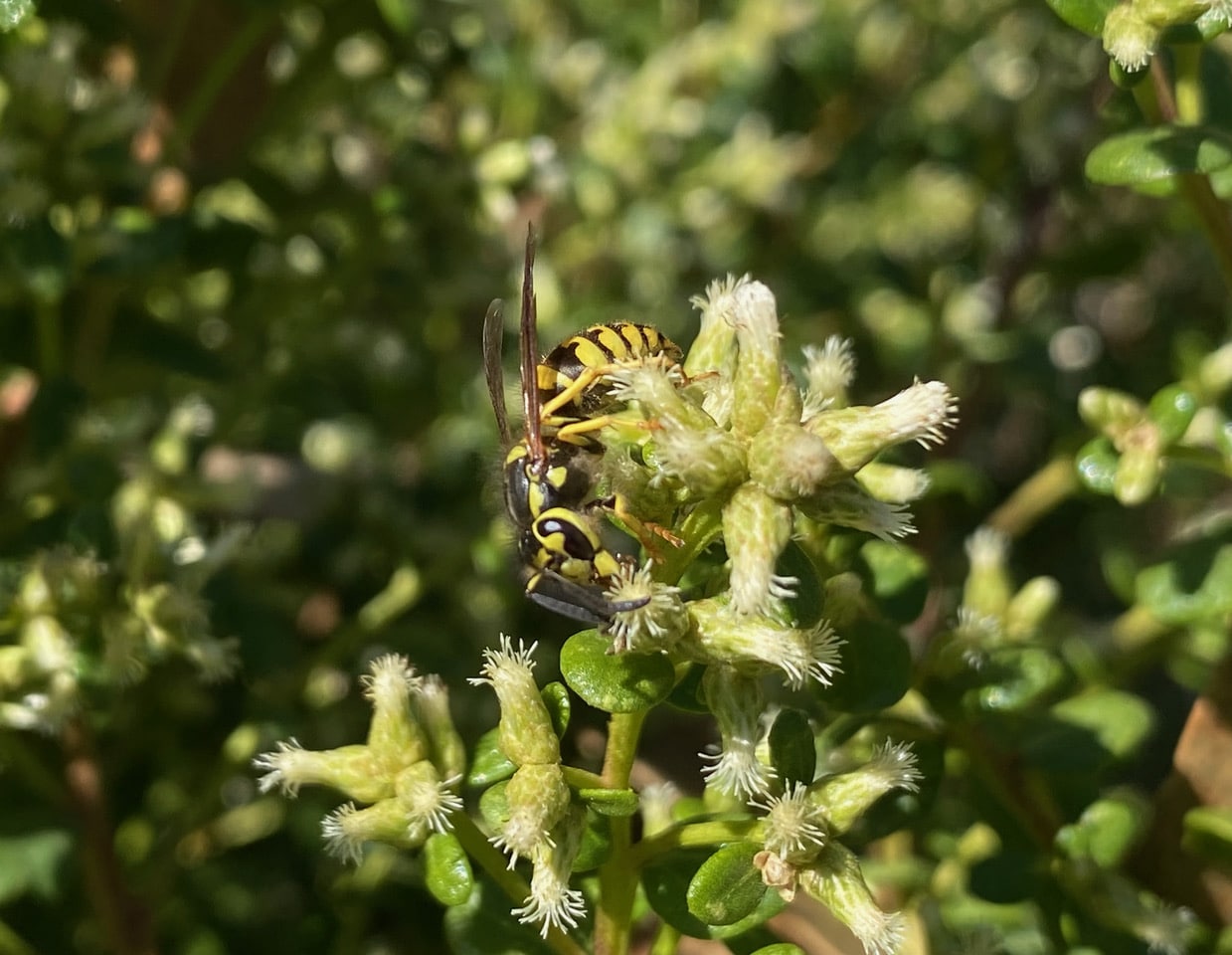
A large Yellowjacket is foraging among the flowers of a female Coyote Brush, Baccharis pilularis. Like the other colonial Hymenoptera, the Honey Bees, these wasps persist through the seasons well, thanks to their social organization.

Yellowjacket is the common name for predatory social wasps of the genera Vespula and Dolicovespula (family Vespidae). Yellowjackets are social hunters living in colonies containing workers, queens, and males (drones). Colonies are annual with only inseminated queens overwintering. Queens emerge during the warm days of late spring or early summer, select a nest site, and build a small paper nest in which they lay eggs. They raise the first brood of workers single-handedly. Henceforth the workers take over caring for the larvae and queen, nest expansion, foraging for food, and colony defense. The queen remains in the nest, laying eggs. Later in the summer, males and queens are produced. They leave the parent colony to mate, after which the males quickly die, while fertilized queens seek protected places to overwinter. Parent colony workers dwindle, usually leaving the nest to die, as does the founding queen. In the spring, the cycle is repeated.
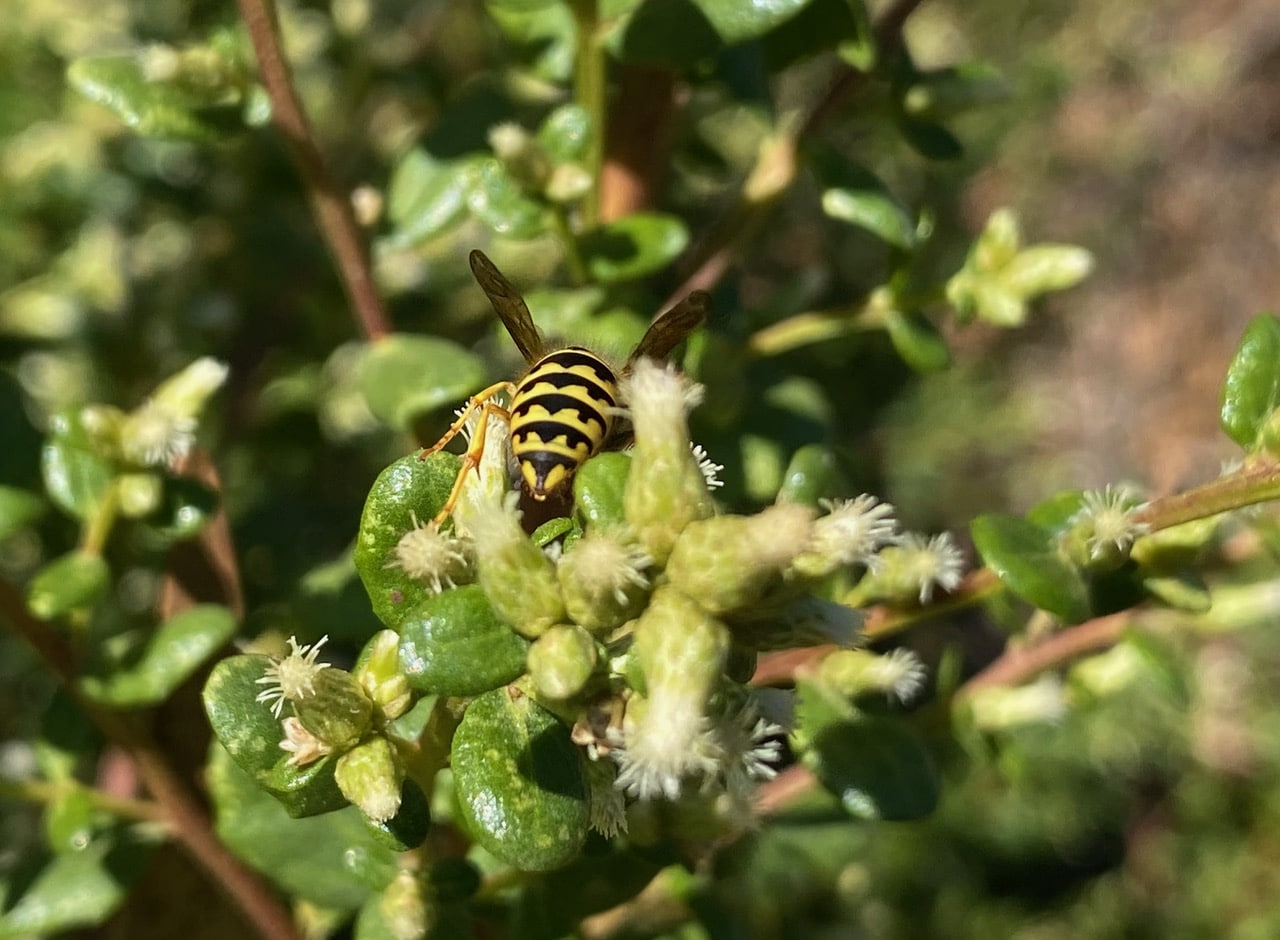
Yellowjackets have lance-like stingers with small barbs, and typically sting repeatedly. Their mouthparts are well-developed with strong mandibles for capturing and chewing insects, with probosces for sucking nectar, fruit, and other juices. The Western Yellowjackets typically build nests underground, often using abandoned rodent burrows. The nests are made from wood fiber that the wasps chew into a paper-like pulp. The nests are completely enclosed except for a small entrance at the bottom. The nests contain multiple, horizontal tiers of combs within. Larvae hang within the combs.
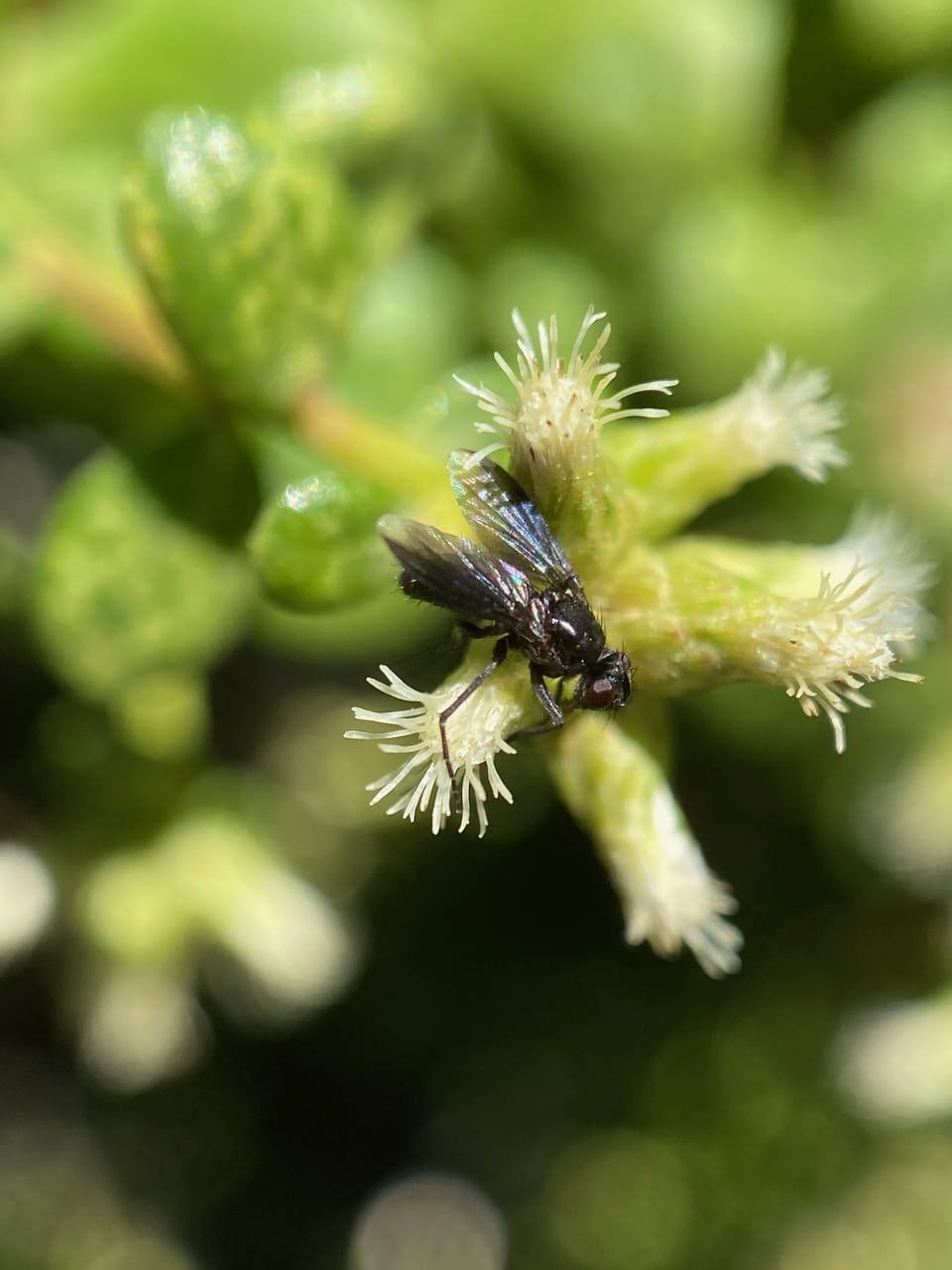
A small, glossy black fly is foraging among the female Baccharis flowerheads.
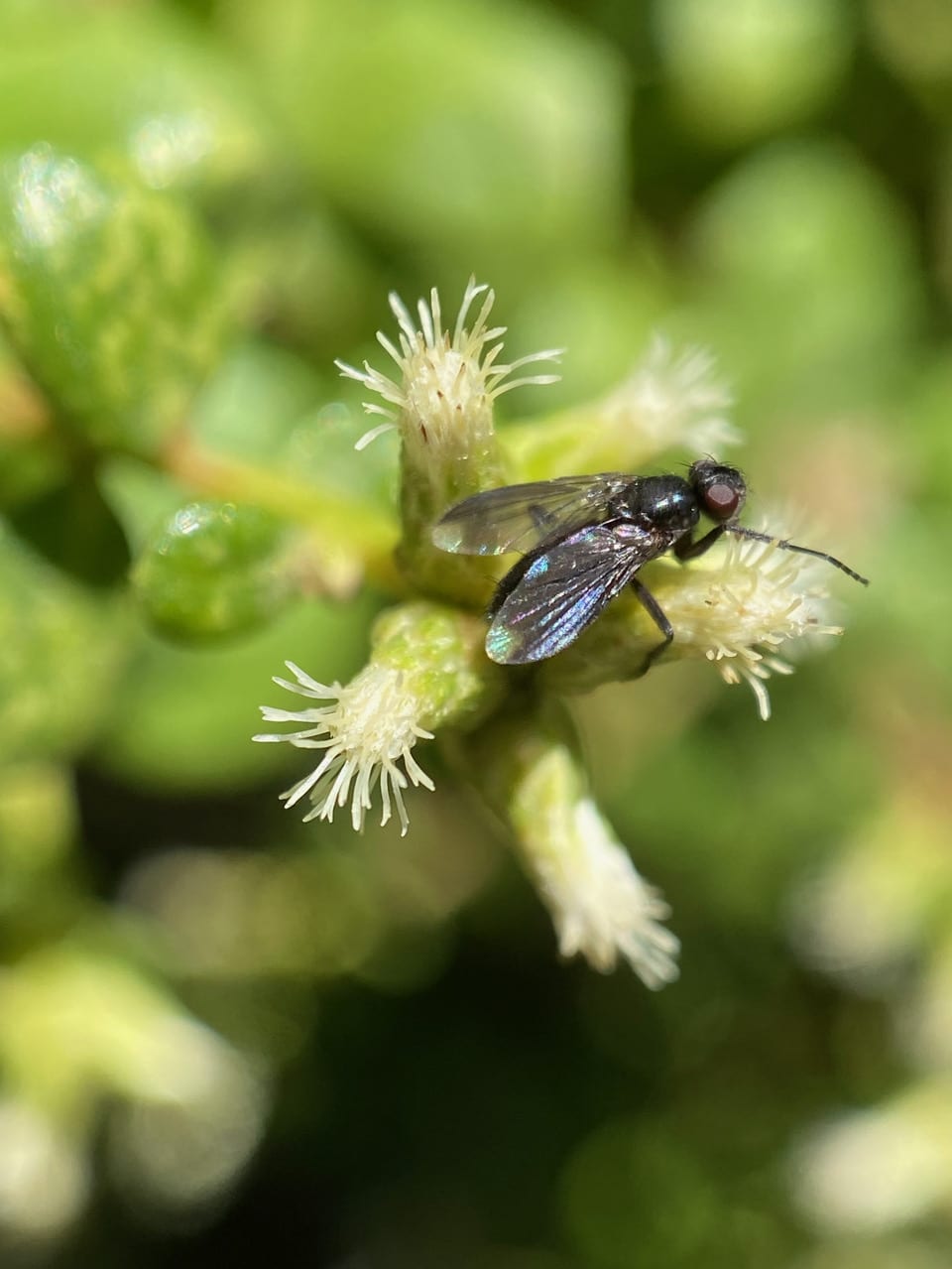
This view of the fly shows faint white spots at the tips of the wings. That’s a useful clue to the fly’s sex and identity! It is a female Smoky-winged Woodlouse Fly, Melanophora roralis (family Rhinophoridae).
Melanophora roralis is a species of woodlouse fly in the family Rhinophoridae. The fly is 3-5.5 mm long, black in color with hairy antennae and a shiny thorax. The species was introduced to North America from Europe. The flies inhabit old forests and damp areas near the shore. Females have a distinctive white spot at the tips of their wings. It is a parasite of the Woodlouse, Porcellio scaber.
Rhinophoridae are small, slender, black, bristly flies that are somewhat related to the Tachinidae. The larvae are mostly parasitoids of woodlice (pill bugs), beetles, spiders and other arthropods, and occasionally snails.

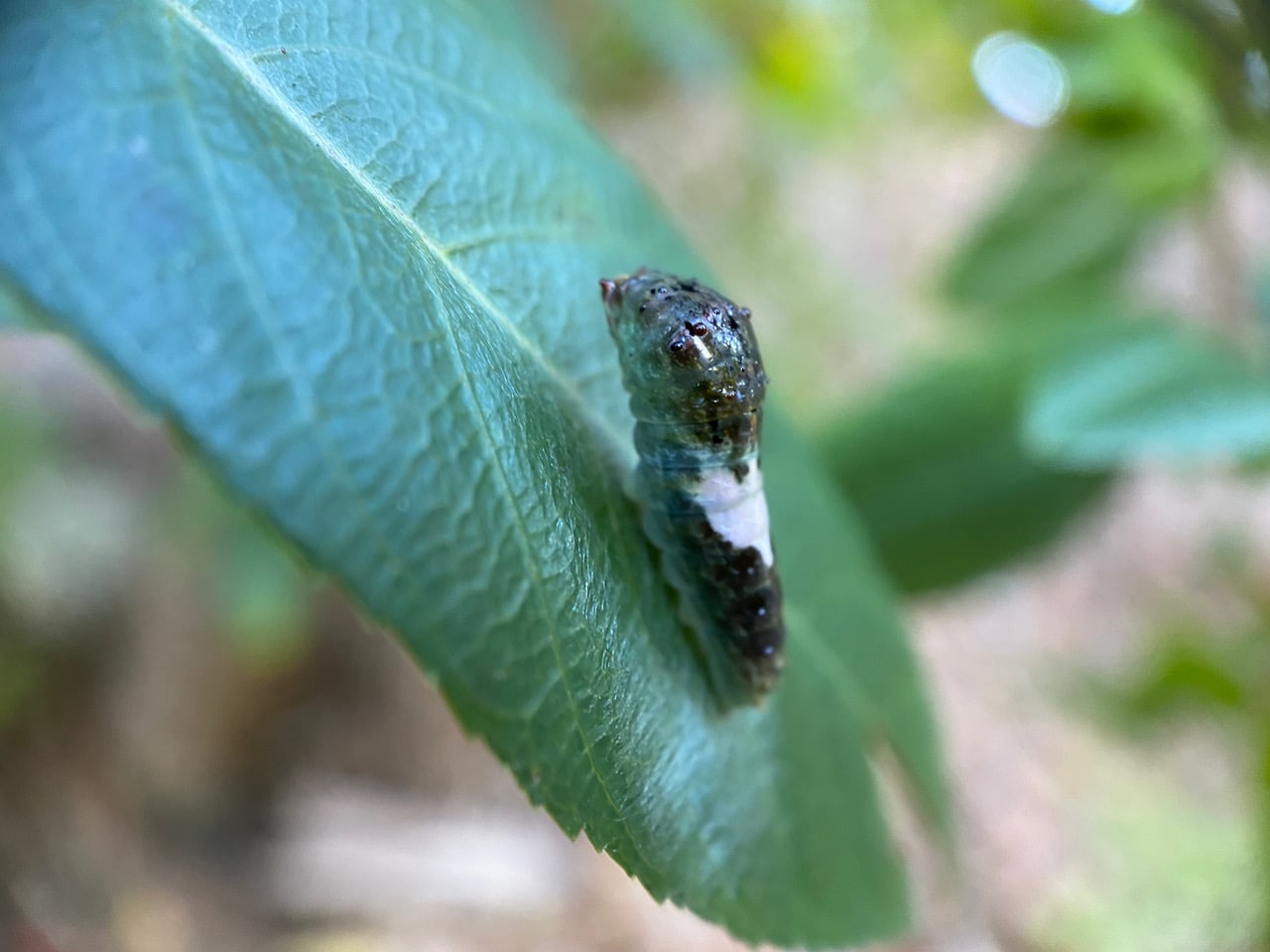
I stop by Inspiration Point to check on the little Pale Swallowtail caterpillar that I discovered a few days ago. Its Coffeeberry host plant is only a short walk from the gate. From the Nimitz Trail, the caterpillar still looks like bird poop, mostly brown and white. But on closer inspection, I see that it has acquired a blue cast over its skin, the color seeming to be spreading upward from its underside. The caterpillar is growing up nicely!