

Pollinator Post 10/11/26

Another beautiful clear day at Bay Farm. To avoid the wet conditions I experienced yesterday from the high tides, I walk a different section of the trail today on higher ground. Not much is blooming in this sparsely vegetated stretch except for the weedy native, the Telegraphweed, Heterotheca grandiflora. Even these are past their prime, with many already going to seed.
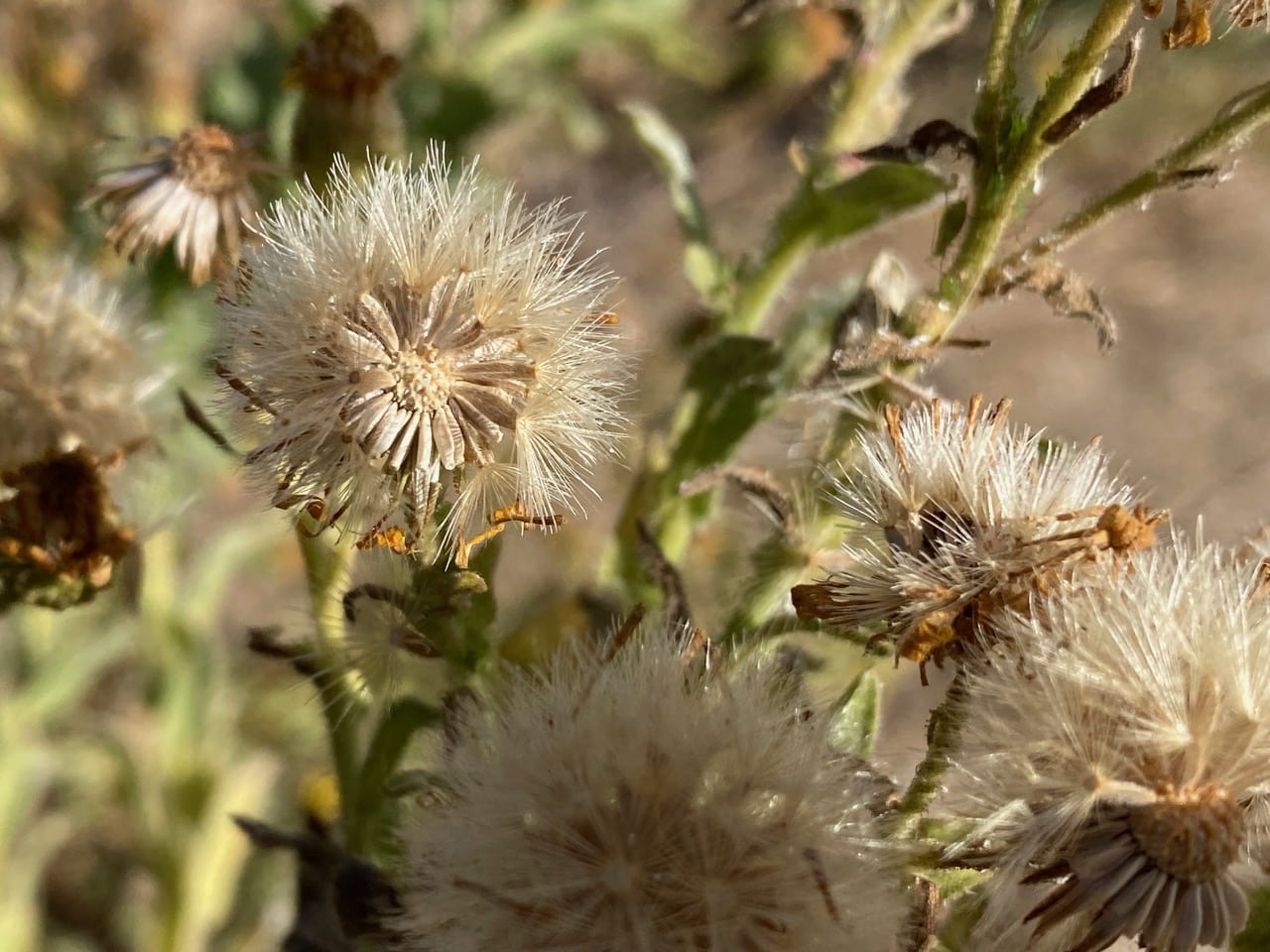
Similar to Dandelion puff balls, fluffy pom-poms of Telegraphweed seed heads are beginning to shed their plumed seeds to the wind.

The bright yellow flowerheads of Telegraphweed are the only color that brightens up the stark landscape here.

Several of the Telegraphweeds host aphid colonies on their upper stems. These are bright green aphids with long legs and long cornicles. iNaturalist has helped identify them as a member of the genus Macrosiphum (family Aphididae).
Aphids (family Aphididae) are small sap-sucking insects in the order Hemiptera (true bugs). A typical life cycle involves flightless females giving live birth to female nymphs, – who may also be already pregnant, an adaptation called telescoping generations – without the involvement of males. Maturing rapidly, females breed profusely so that the population multiplies quickly. Winged (alate) females may develop later in the season, allowing the insects to colonize new plants. In temperate regions, a phase of sexual reproduction occurs in the autumn, with the insects often overwintering as eggs.
Aphids usually feed passively on phloem of plants. Once the phloem vessel is punctured, the sap, which is under pressure, is forced into the aphid’s food canal. Aphids produce large amounts of a sugary liquid waste called “honeydew”. A fungus called sooty mold can grow on honeydew deposits that accumulate on leaves and branches, turning them black.
Macrosiphum is a common genus of large, long-legged aphids, measuring up to 3.5 mm long. The genus name derives from their long, slender “tailpipes” (cornicles) on the rear of their bodies. During the summer populations are made of parthenogenetic females. In the fall, males and females are produced; they mate and females lay eggs that overwinter. These aphids are highly polyphagous, feeding on over 200 plant species, including vegetables like tomatoes, potatoes, and ornamentals. They extract sap from soft new foliage and terminal stems, causing leaves to curl, yellow, and stunt. They secrete a sticky, sugary waste product called honeydew that may coat the plant, promoting the growth of sooty mold. The aphids are also prominent vectors capable of transmitting plant viruses between crops.
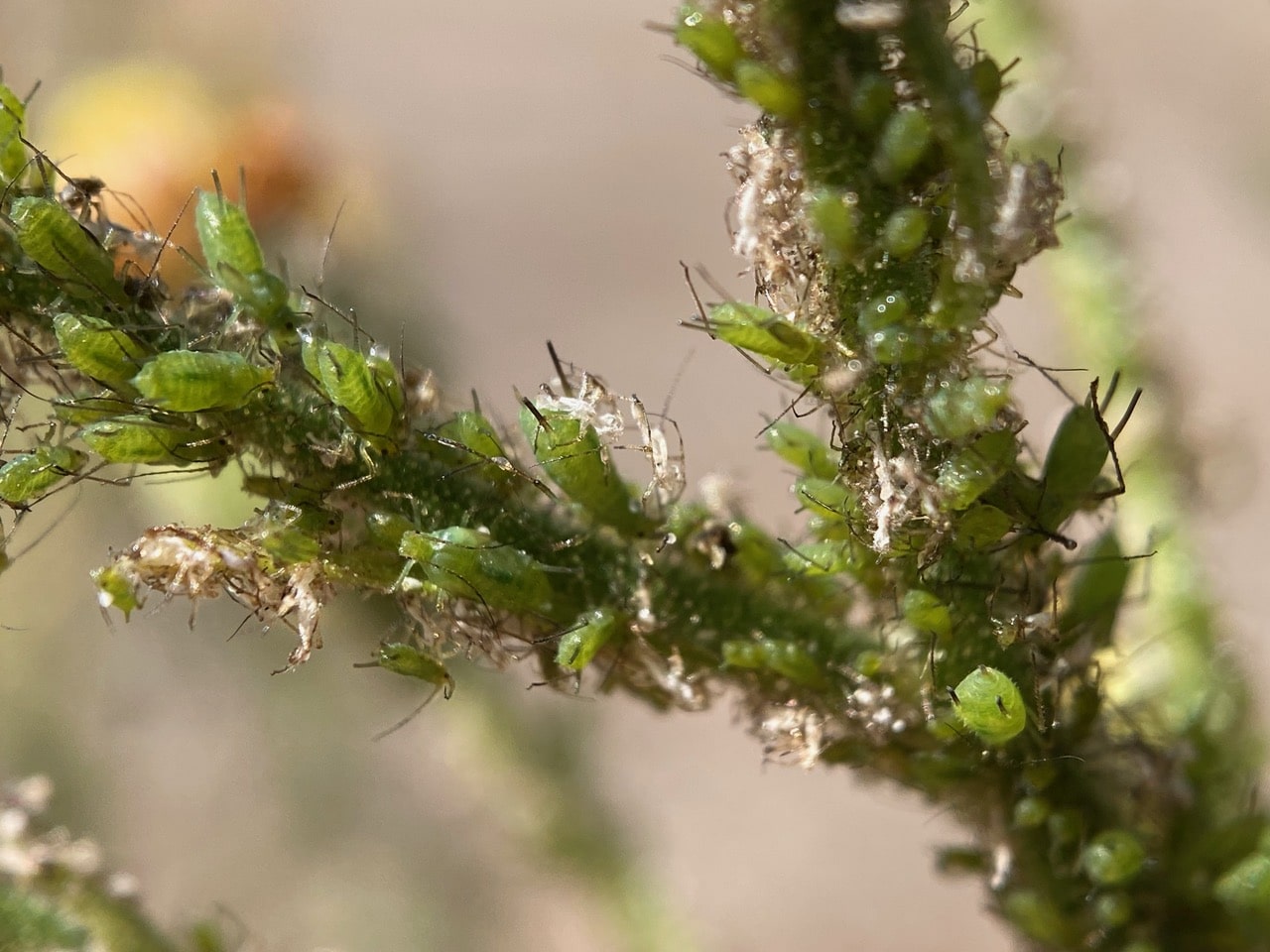
Whoa, this is a mature colony with aphids of various ages and sizes crowded together. The whitish debris is the exuviae or the shed exoskeletons left behind when the aphids molt as they grow.
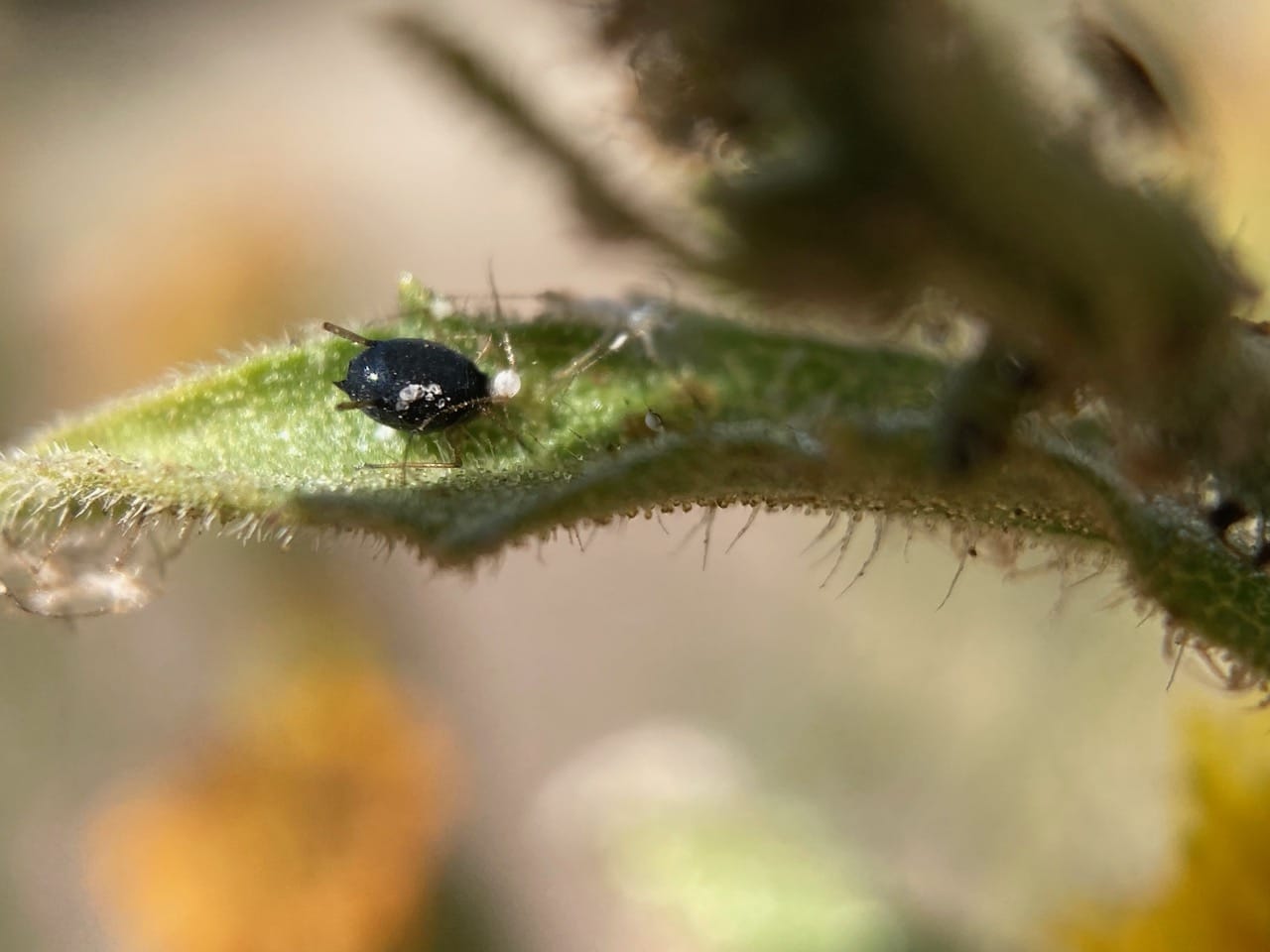
A bloated, black aphid is resting on a leaf of Telegraphweed.
The bloated, black aphid has been parasitized by a wasp in the family Aphelinidae. The mother wasp uses her ovipositor to inject a single egg and symbiotic polydnaviruses into an aphid. The wasp larva hatches and slowly consumes the aphid’s non-vital organs while it is still alive. Right before the larva pupates, it kills the host aphid. The chemical interaction between the wasp and the aphid’s cuticle causes the aphid to swell into a balloon-like, shiny black “mummy”. The wasp pupates safely inside the black shell. Once mature, it chews a perfectly round exit hole in the rear of the mummy to escape and hunt for new aphids.
Not all aphid wasps turn their hosts black – wasps from the subfamily Aphidiinae (family Braconidae) tend to leave behind tan, gold, or brown mummies. Together, these two families of parasitoid wasps are highly effective natural pest control agents for gardens and agriculture.
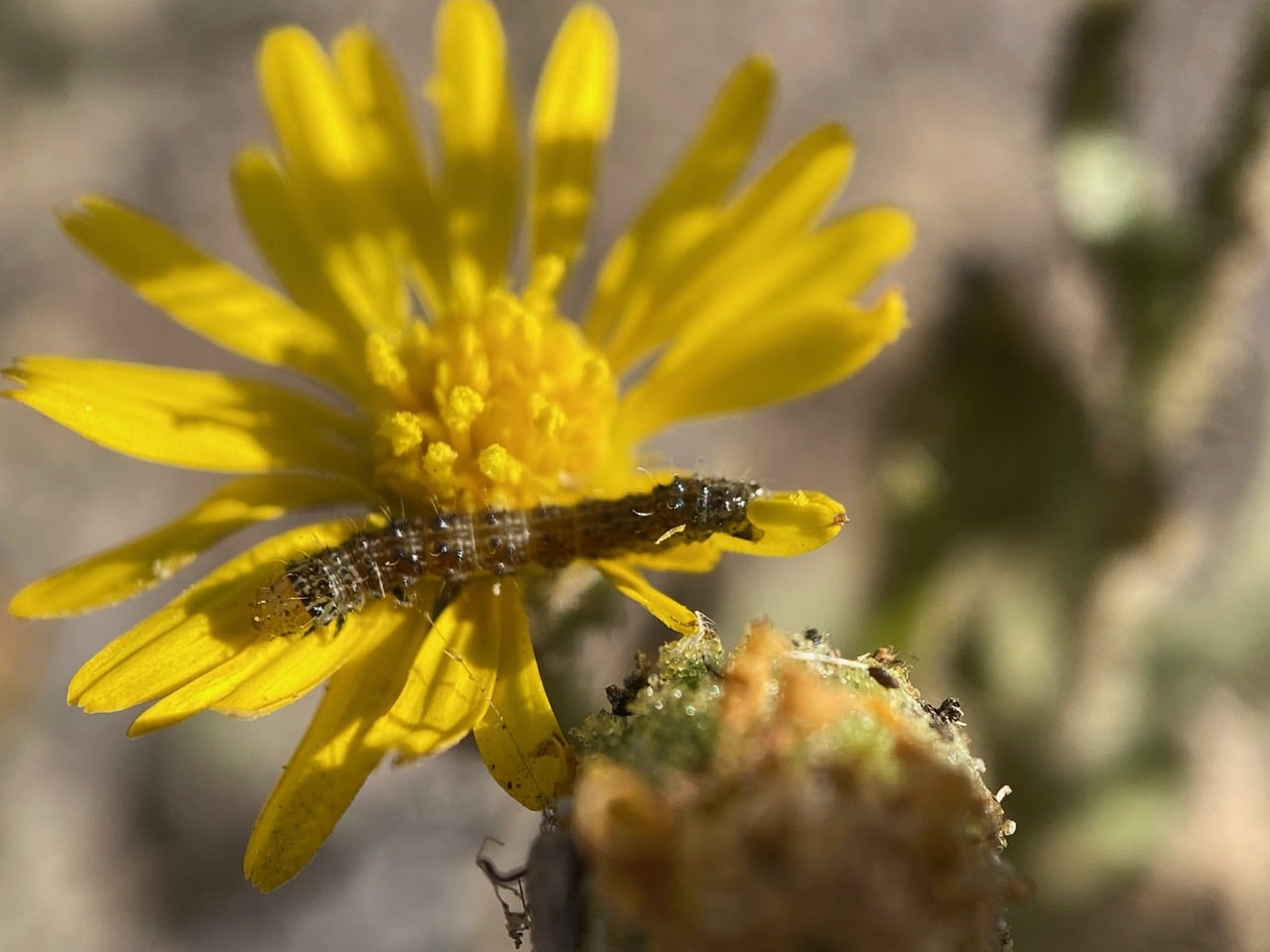
A caterpillar is resting on the ray petals of a Telegraphweed flowerhead. iNaturalist has helped identify it as the larva of a Darker-spotted Straw Moth, Heliothis phloxiphaga (family Noctuidae).
Heliothis phloxiphaga is found in the United States and southern Canada. It feeds on a variety of plants, and the caterpillars are considered pests to certain trees, including Ulmus, Malus, and Prunus. Adults fly during the summer.
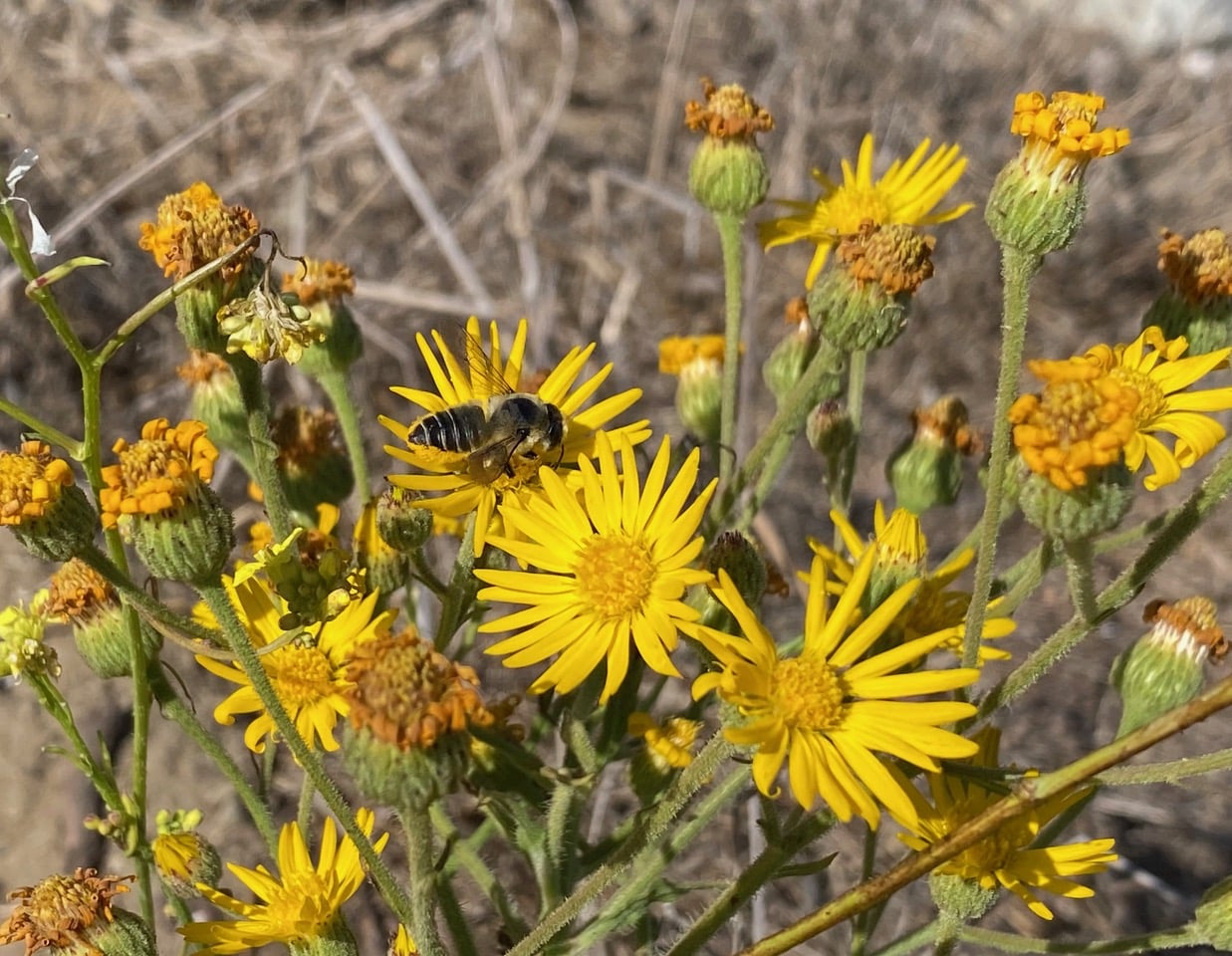
I have hardly ever seen any pollinators visit the flowers of Telegraphweed. So it’s a pleasant surprise to observe a female Western Leafcutter Bee, Megachile perihirta (family Megachilidae) go from one flowerhead to another to gather pollen onto the underside of her abdomen. Preferences aside, the Telegraphweed is the only significant floral resource available right now.
Leafcutter Bees, Megachile sp. (family Megachilidae) are stout-bodied, usually with pale hair on the thorax and stripes of white hairs on the abdomen. Females usually have a triangular abdomen with a pointed tip, and males’ faces are covered with dense, pale hair. Flight season is from May into September, with peak activity from June to August. Solitary females construct nests in tubular cavities, including hollow stems, tree holes, and abandoned beetle burrows in wood. Many use holes drilled into wood, straws, or other manufactured tunnels. Females cut pieces from leaves or flower petals for use in the construction of brood cells. Most Megachile females are generalist foragers, but prefer flowers in the family Asteraceae. They carry pollen on the scopa located on the underside of the abdomen.
North America is home to many leafcutter bees, but the Western Leafcutter, Megachile perihirta is one of the largest. The species ranges on the west coast from British Columbia south to northern Mexico. From a distance, the female can be mistaken for a honey bee. She is about the same size as a worker honey bee and enjoys many of the same flowers, but her head is disproportionately large because it houses the bulky muscles that operate her large mandibles. While most leafcutter bees nest above ground in tubes and tunnels, the Western Leafcutter nests underground. Often a small group of females live in a community and burrow into soil, gravel, or sand.
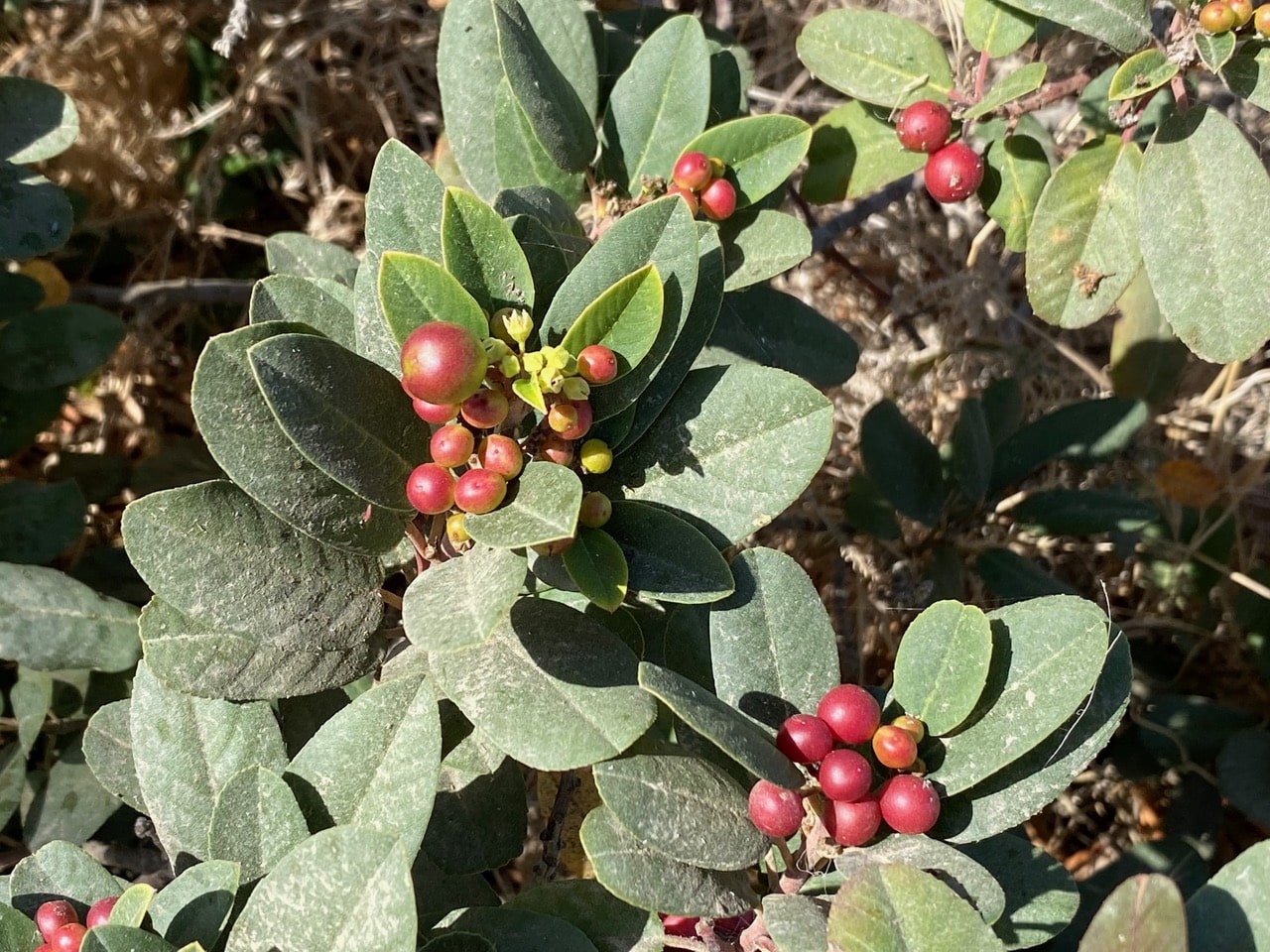
I next look at the three large shrubs of Coffeeberry. Reddish berries are ripening on the branch tips while some flowers are still being produced.
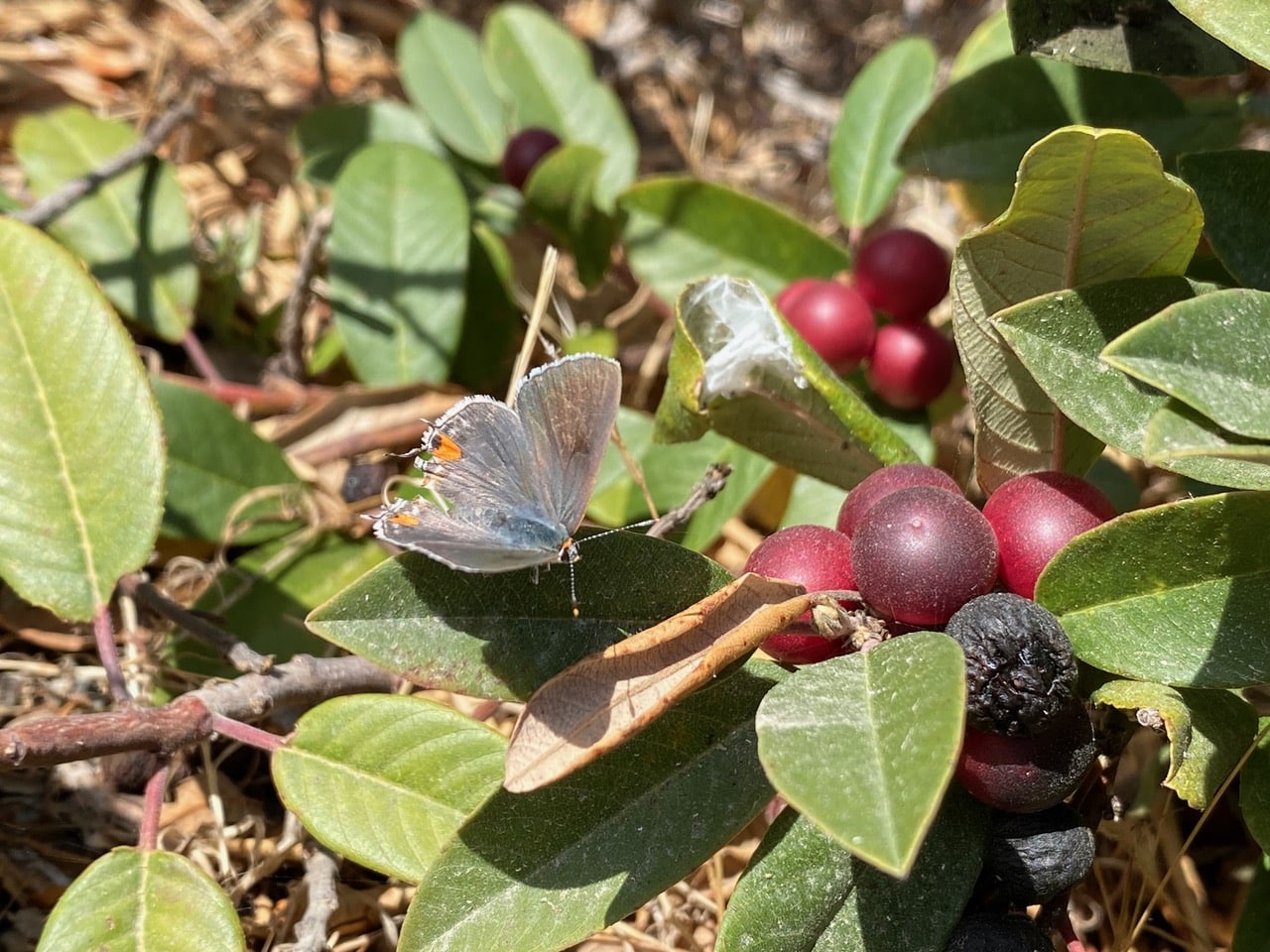
A worn-out Gray Hairstreak butterfly with damages to its hind wings lands on the foliage of Coffeeberry. It does not seem to be seeking nectar, merely a place to rest. Did it just suffer an attack from the rear?
Why the name “hairstreak”? These small butterflies have a slim, hair-like tail on the lower corner of each hindwing. Gray Hairstreak also has colorful false eyespots near the base of each tail. The eyespots and antenna-like tails are believed to fool predators into mistaking its tail for its head. Hairstreaks even add a behavioral component – a nectaring hairstreak often rubs its wings up and down, simulating the movement of twitchy antennae. This may fool birds, lizards, and spiders into attacking the wrong end, sparing the life of the butterfly.
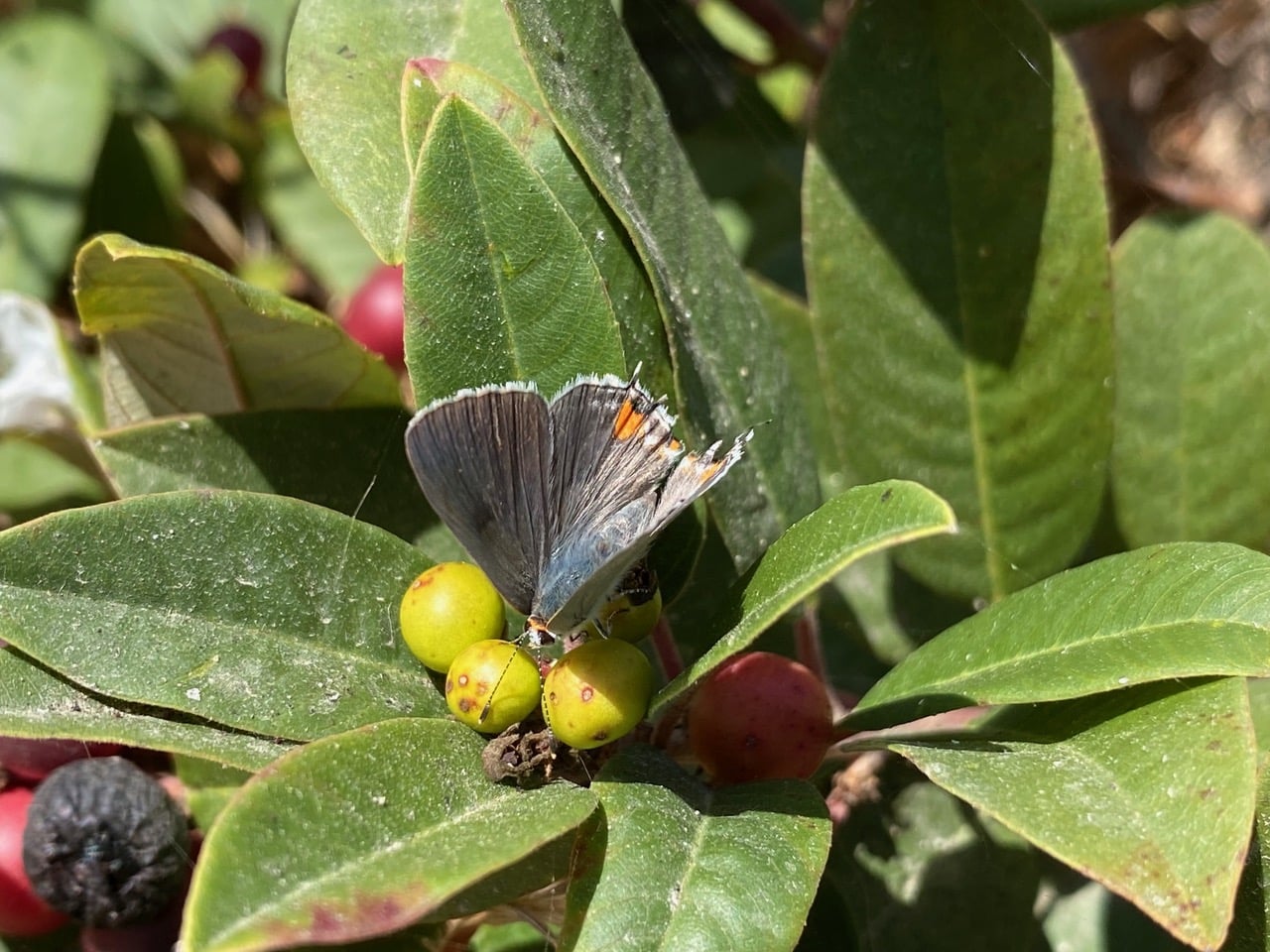
Female Gray Hairstreaks lay eggs singly on the flowers, flower buds, young fruits and nearby leaves of a host plant. Host plants include a wide variety of plants, notably from the pea (Fabaceae) and mallow (Malvaceae) families. The caterpillars are greenish at the start, but older individuals range in color from gray to pink. As in many species of Lycaenidae, Gray Hairstreak larvae are myrmecophiles (ant-lovers) – often tended by ants. Ants harvest a sweet liquid from the caterpillar’s dorsal nectary organ (“honey gland”) and in exchange may protect them from predators. Larvae of many Lycaenidae species also communicate with ants via ant-like sounds (clicks and hums) or by sending vibrations through the substrate.

Loss of false antennae on the hind wings not withstanding, the Gray Hairstreak closes its wings and proceeds to rub them together. This innate behavior has probably saved the butterfly’s life from a frontal attack by a predator.

A tiny gray fly is perched on the edge of a Coffeeberry leaf.
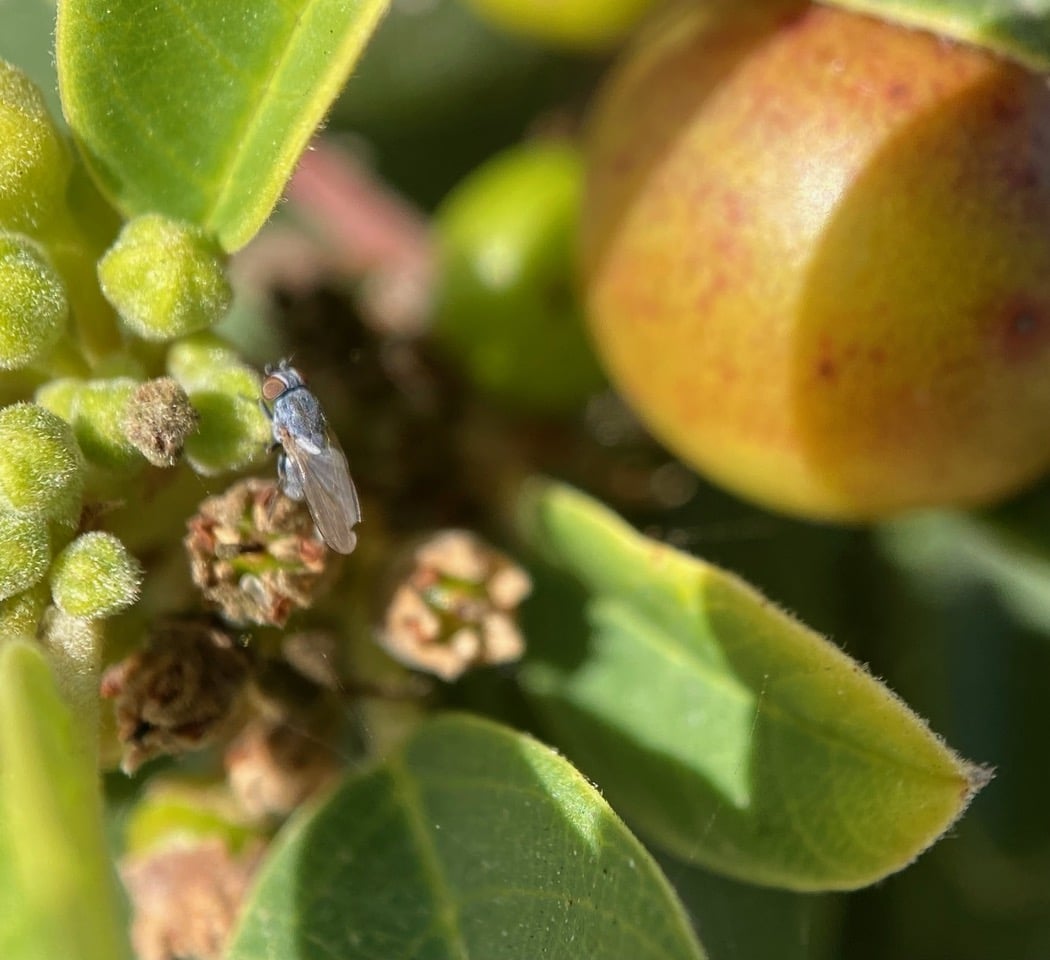
The fly proceeds to check every nook and cranny around a cluster of flower buds.
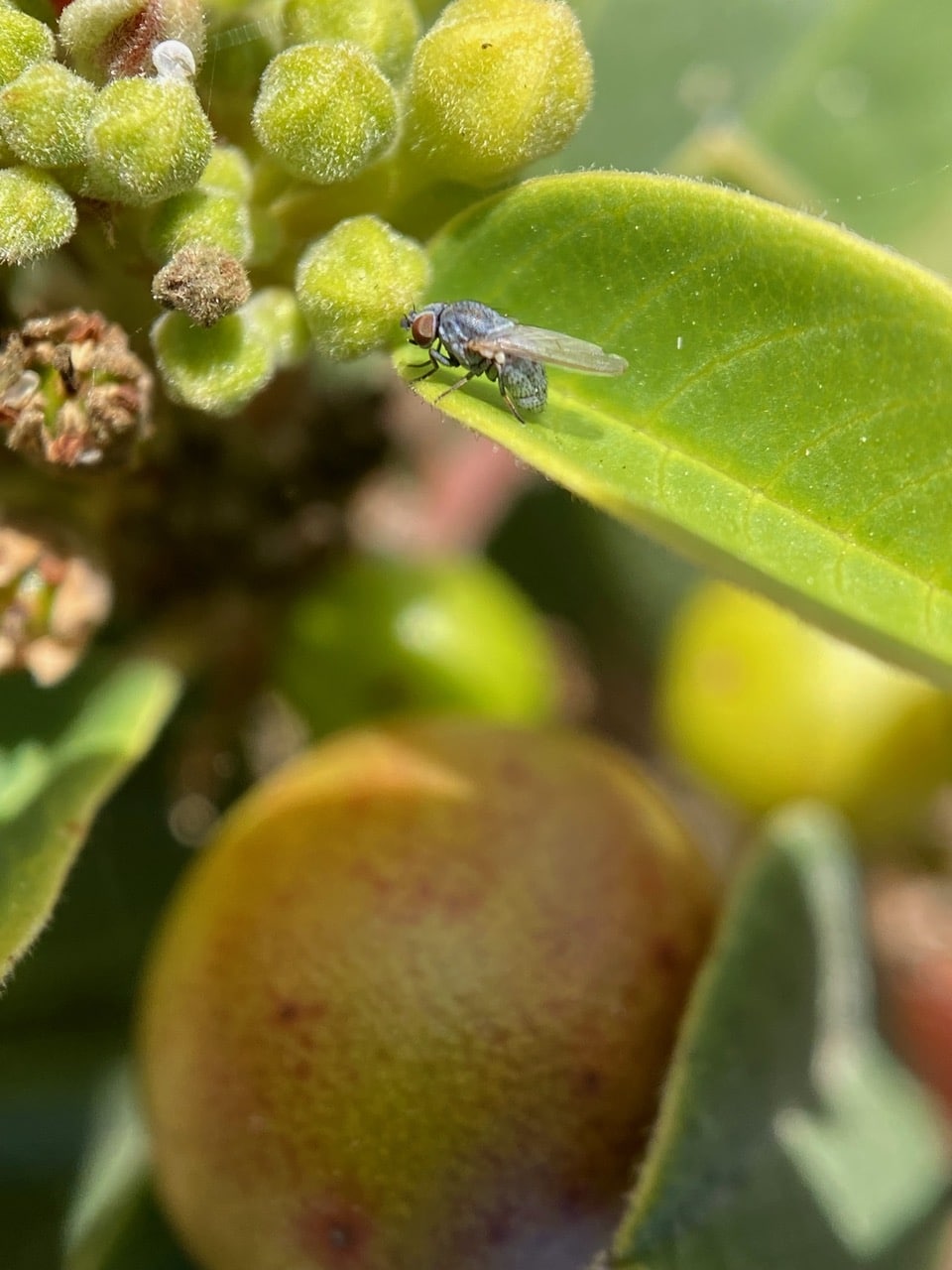
iNaturalist has helped identify the insect as an Aphid Fly, Leucopis sp. (family Chamaemyiidae).
The Chamaemyiidae are a small family of acalyptrate flies with less than 200 species described worldwide. Members of the genus Leucopis (aphid flies) are very small, measuring approximately 2-4 mm in length. These grayish flies often have black abdominal spots. The larvae are active and predatory and are often used for biological control of aphids, scale insect, mealybugs, and similar pests. The predatory maggots, about 3 mm long and yellowish, are often found within colonies of their prey, moving slowly with a wrinkled appearance and distinct, two-stalked breathing tubes (spiracles) at their rear.
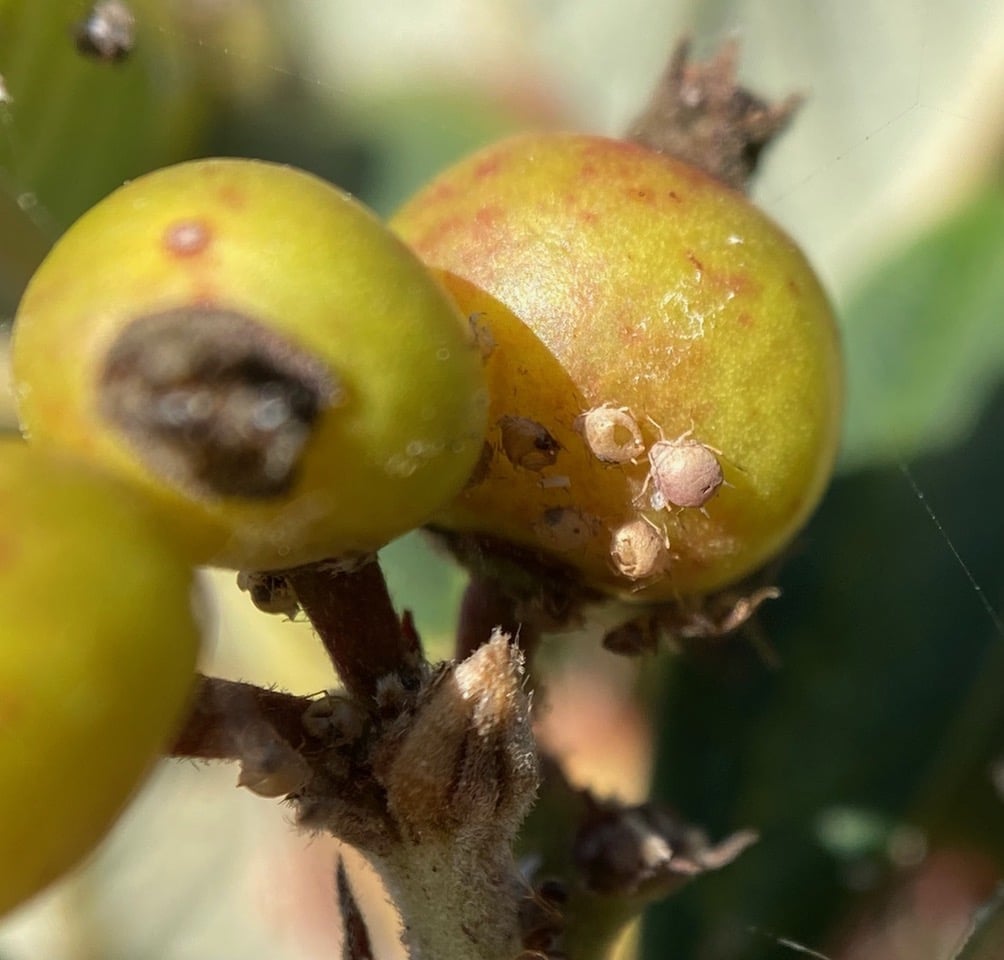
I zoom in on what looks like crusty materials near the base of a Coffeeberry fruit. These turn out to be the bodies of Aphid Mummies, many with a gaping hole in the abdomen.
From previous observations, I know that the Coffeeberry plant is occasionally infested by tiny, dark green aphids. The aphids have apparently been decimated by a parasitoid wasp. Aphid Mummy Wasps, Aphidius sp. (family Braconidae) are small wasps, typically less than 1/8 in. long. The female wasp lays a single egg in an aphid. When the egg hatches, the wasp larva feeds inside the aphid. As the larva matures the aphid is killed and becomes bloated and mummified, usually turning tan or golden in color. The adult wasp chews its way out of the mummy leaving a circular hole.

Argentine Ants, Linepithema humile (family Formicidae) are busy shuttling around the fresh flowers, occasionally going down to the base of the flowers for nectar. I wonder if the ants are also tending aphids on the plant? I have seen tiny green aphids on these shrubs before, but simply can’t find any today. Given the presence of the aphid mummies and the Aphid Fly, I am almost sure that there are some live aphids on the plant.
Ants and aphids share a well-known mutualistic relationship. The aphids produce honeydew, a sugary food for the ants; in exchange, the ants care for and protect the aphids from predators and parasites. Some ants will “milk” the aphids to make them excrete the sugary substance. The ants stroke the aphids with their antennae, stimulating them to release the honeydew. Aphid-herding ants make sure the aphids are well-fed and safe. When the host plant is depleted of nutrients, the ants carry their aphids to a new food source. If predatory insects or parasites attempt to harm the aphids, the ants will defend them aggressively. Some species of ants continue to care for aphids during winter. The ants carry the aphids to their nest for the winter months, and transport them to a host plant to feed the following spring.
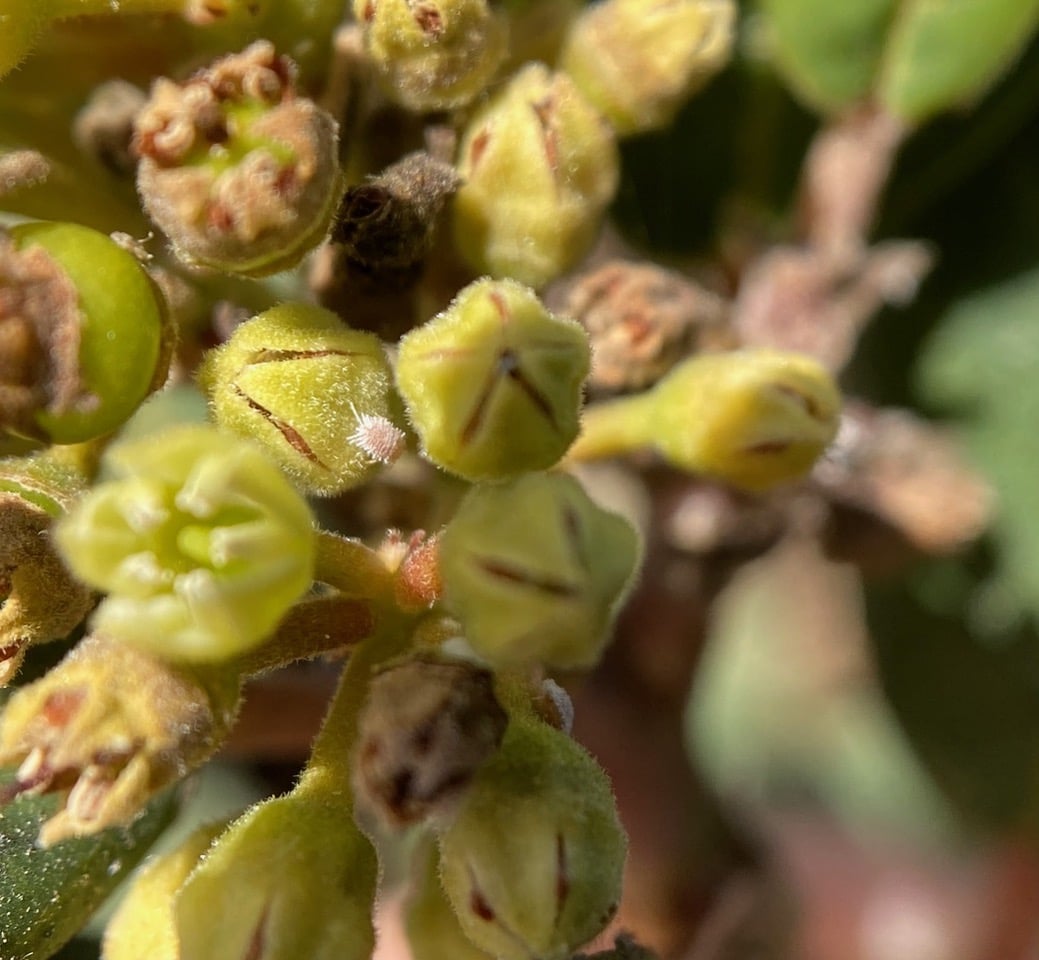
Do you see that tiny, straw-colored creature disappearing behind the unopened flower? It is a Mealybug.
Mealybugs are insects in the family Pseudococcidae, unarmed scale insects found in moist, warm habitats. Many species are considered pests as they feed on plant juices of garden as well as crop plants, sometimes acting as vectors for several plant diseases..
Mealybugs are sexually dimorphic. Females appear as nymphs, with reduced morphology, and lack wings. Males are smaller, gnat-like and have wings. Females feed on plant sap. They attach themselves to the plant and secrete a powdery wax layer used for protection while they suck plant juices. Males are short-lived, as they do not feed at all as adults and only live to fertilize the females. Mealybugs have a highly sophisticated metabolism that involves two bacterial endosymbionts, one inside the other. The bacteria make essential amino acids that the mealybugs do not get from their diet. Mealybugs only tend to be serious pests in the presence of ants. Some ants live in symbiotic relationships with them, protecting them from predators and feeding off the honeydew which they excrete.

A tiny Jumping Spider with a golden sheen is exploring its surroundings on a Coffeeberry leaf. It is a Buttonhook Leafbeetle Jumping Spider, Sassacus vitis (family Salticidae).
Jumping spiders (family Salticidae) are free-roaming hunting spiders. They do not weave a web to catch prey. They stalk, then pounce on their prey. Just before jumping, the spider fastens a safety line to the substrate. It can leap 10-20 times their body length to capture prey. Their movement is achieved by rapid changes in hydraulic pressure of the blood. Muscular contractions force fluids into the hind legs, which cause them to extend extremely quickly. Jumping spiders are visual hunters. Their excellent vision has among the highest acuities in invertebrates. Since all their 8 eyes are fixed in place and cannot pivot independently from the body like human eyes can, jumping spiders must turn to face whatever they want to see well. This includes moving their cephalothorax up and down, an endearing behavior.
Sassacus vitis is native to North America, with a range spanning from Canada to Panama. It is a small jumping spider with iridescent gold abdomen and white ring around the anterior surface of abdomen. Body is covered with golden scales. Males are 3.5 mm long, females 4.5 mm. The name vitis is Latin for “grapevine”. The spider is commonly found on shrubs and vines and in fields. Best known as a common resident of vineyards.
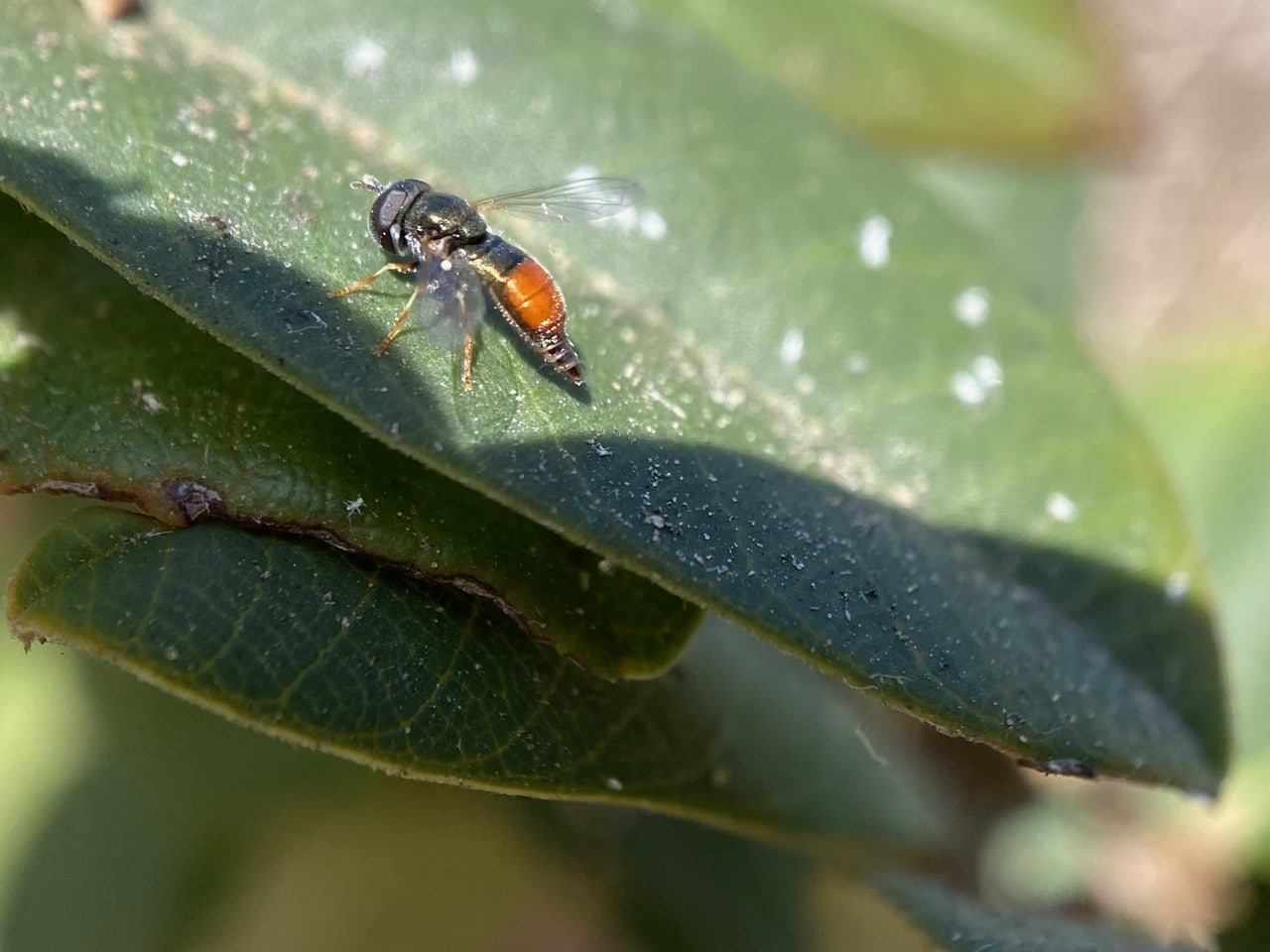
A female Common Grass Skimmer, Paragus haemorrhous (family Syrphidae) has landed on a Coffeeberry leaf, her ovipositor extended beyond her red abdomen. Is she here to lay her eggs?
The Common Grass Skimmer, Paragus haemorrhous (family Syrphidae) is the smallest hover fly I know, measuring only about 4 mm in length. The species has a world-wide distribution, found in unimproved grasslands, dune grass, open areas and pathsides in forest, and meadows. Adults visit flowers for nectar and pollen. Larvae feed on aphids on low herbaceous plants.
Photos of Common Grass Skimmer (Paragus haemorrhous) · iNaturalist
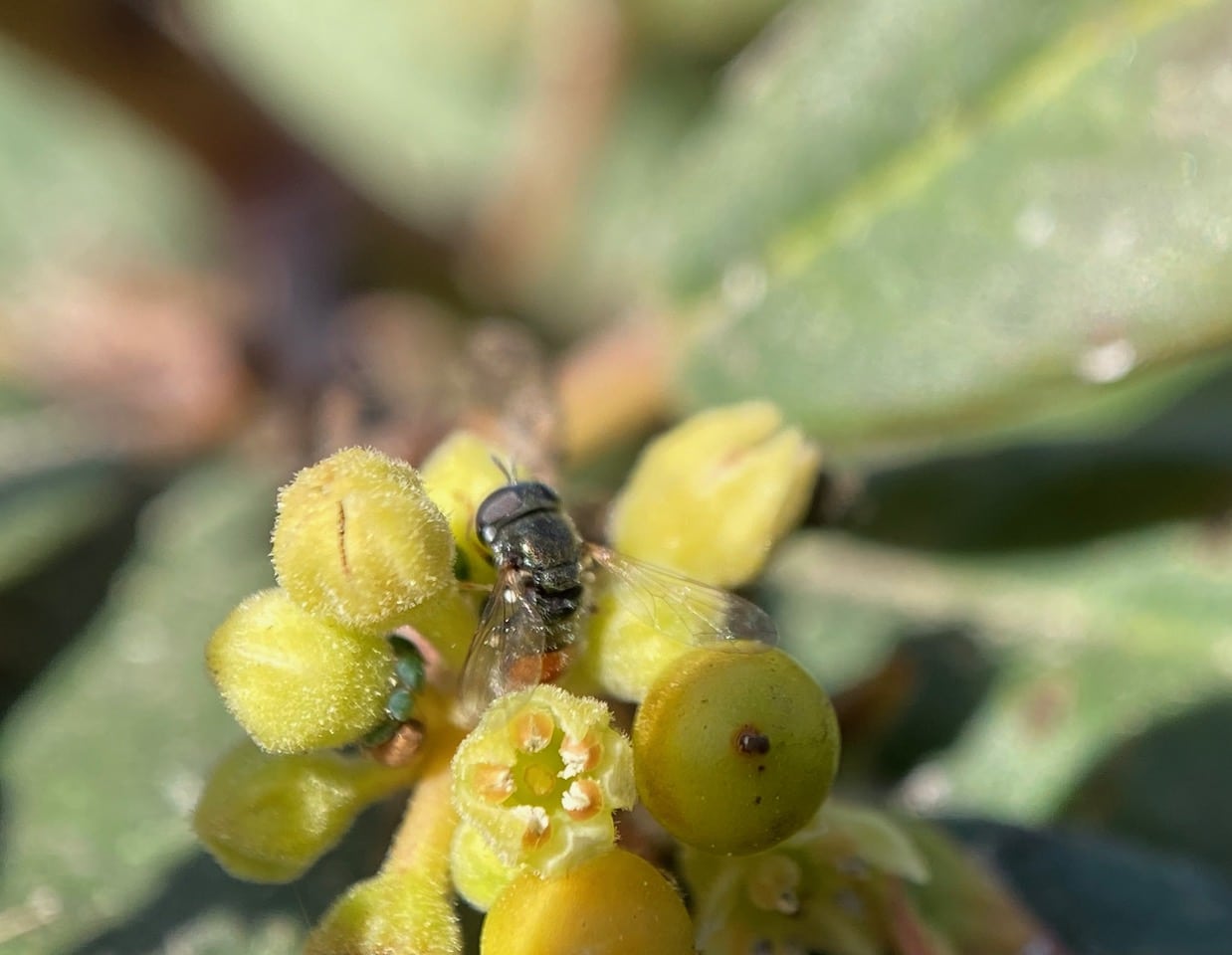
The Grass Skimmer makes a beeline to a cluster of Coffeeberry flower buds and after careful inspection, lowers her rear into it. Yes, I think she is laying eggs!

She emerges after a few seconds and proceeds to oviposit atop one of the flower buds. Note the dark green mass underneath the flower bud – they are tiny aphids! They are the color of the aphids I have seen on the Coffeeberry before. Mama hover fly has led me to the aphids I was searching for!
Female hover flies with aphidophagous larvae seek out aphid colonies in which to lay their eggs. This ensures that when the young hatch out they will have plenty to eat. The eggs are laid singly so that the larvae will not have to compete with each other for food.

That Coffeeberry leaf is senescing in a very colorful way. Note that while most of the leaf has lost chlorophyll and turned yellow, the areas around the dark blemishes have retained their green coloration. Is this a special case of the “green island phenomenon” involving cytokinins? While most of the leaves I have seen that exhibited this phenomenon were deciduous leaves with leaf-miners living in them, I think the mechanism is similar here on this Coffeeberry leaf.
The green island phenomenon refers to localized patches of green, photosynthetically active tissue that persist on aging or yellowing leaves (such as in autumn), while the rest of the leaf senesces, yellows, and drops. The phenomenon is mediated by cytokinins. Cytokinins are a class of plant hormones that delay programmed cell death and degradation in plant tissues. They preserve chlorophyll and proteins in the local area, keeping in the patch functional and green. Certain insects such as leaf-miners, create these islands so their larvae have a fresh, nutrient-rich food source deep into autumn. Research shows that symbiotic bacteria living inside the insects – such as Wolbachia – produce cytokinin-mimicking genes that manipulate the host plant’s metabolism. Certain fungi and viruses also secrete cytokinins or trigger local cytokinin accumulation, forming green islands around the infection sites.
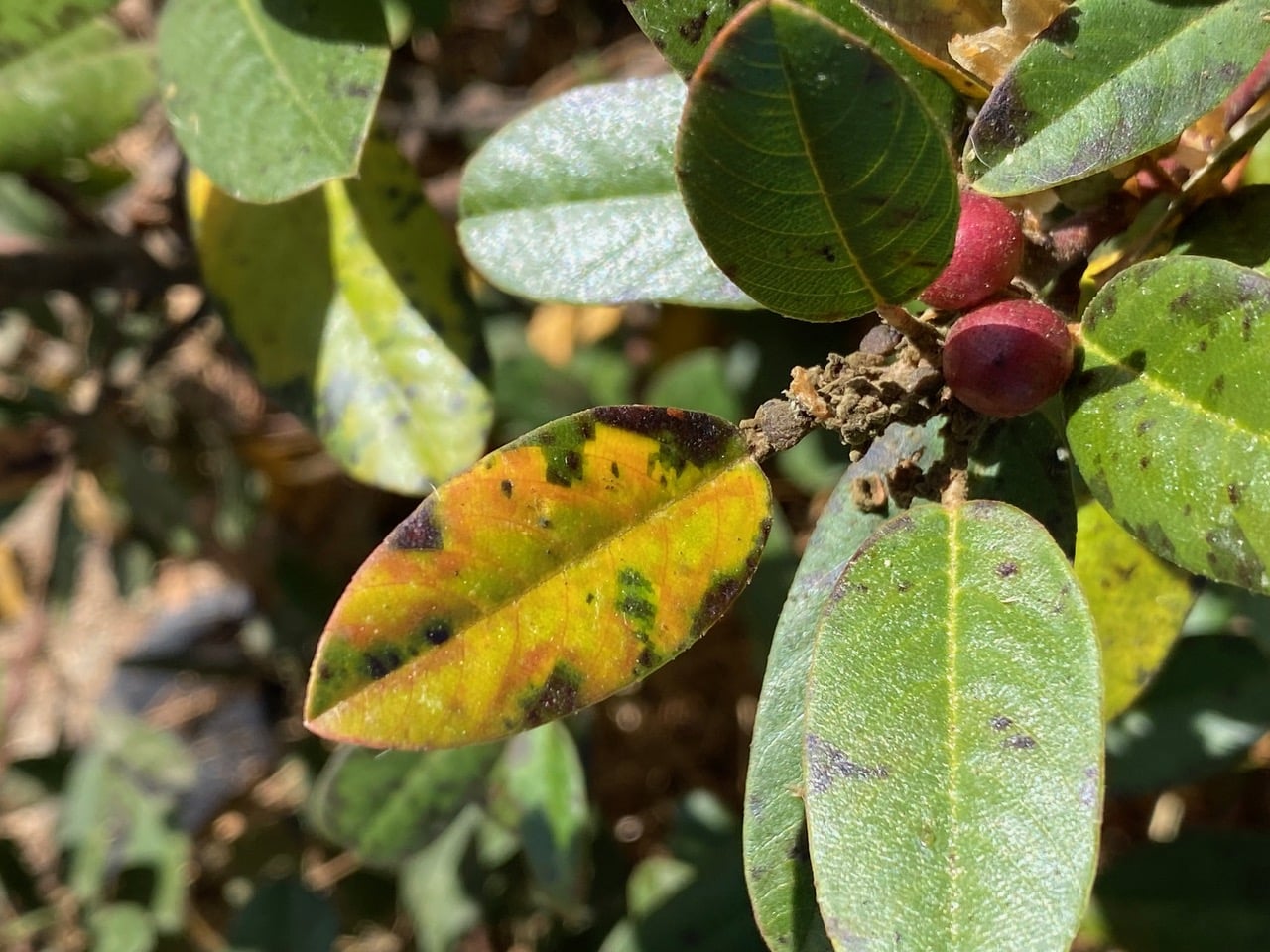
Here’s yet another leaf exhibiting the same phenomenon. While I am not sure what caused the dark spots on the Coffeeberry leaves (Bugs feeding with piercing-sucking mouthparts? Or infection with fungus or virus?), the presence of cytokinins can explain the green island phenomenon on the yellow leaf that the plant is ready to shed. Nature is beautiful and wondrous in all her expressions!