

Pollinator Post 10/10/26

Wow, it’s high tide in late morning at Bay Farm. I have rarely seen the water level so high along the shore here. Gentle waves are washing seaweeds onto the narrow beach. Is this the ‘Kelvin Wave’ I have been reading about? Scientists warn that a deep ocean wave driven by El Nino conditions could raise Bay Area sea levels by as much as 9 inches by early next week. That’s on top of sea levels already more than 6 inches above predicted levels because of warm water along the West Coast.

In many places, the tide has already encroached on the senescing Oregon Gumweed, Grindelia stricta growing along the shoreline.

Traces of white debris are left on the drying Grindelia where Spittlebugs made their foamy homes in happier days. I can’t even find any adult Spittlebugs today. Where have they all gone?
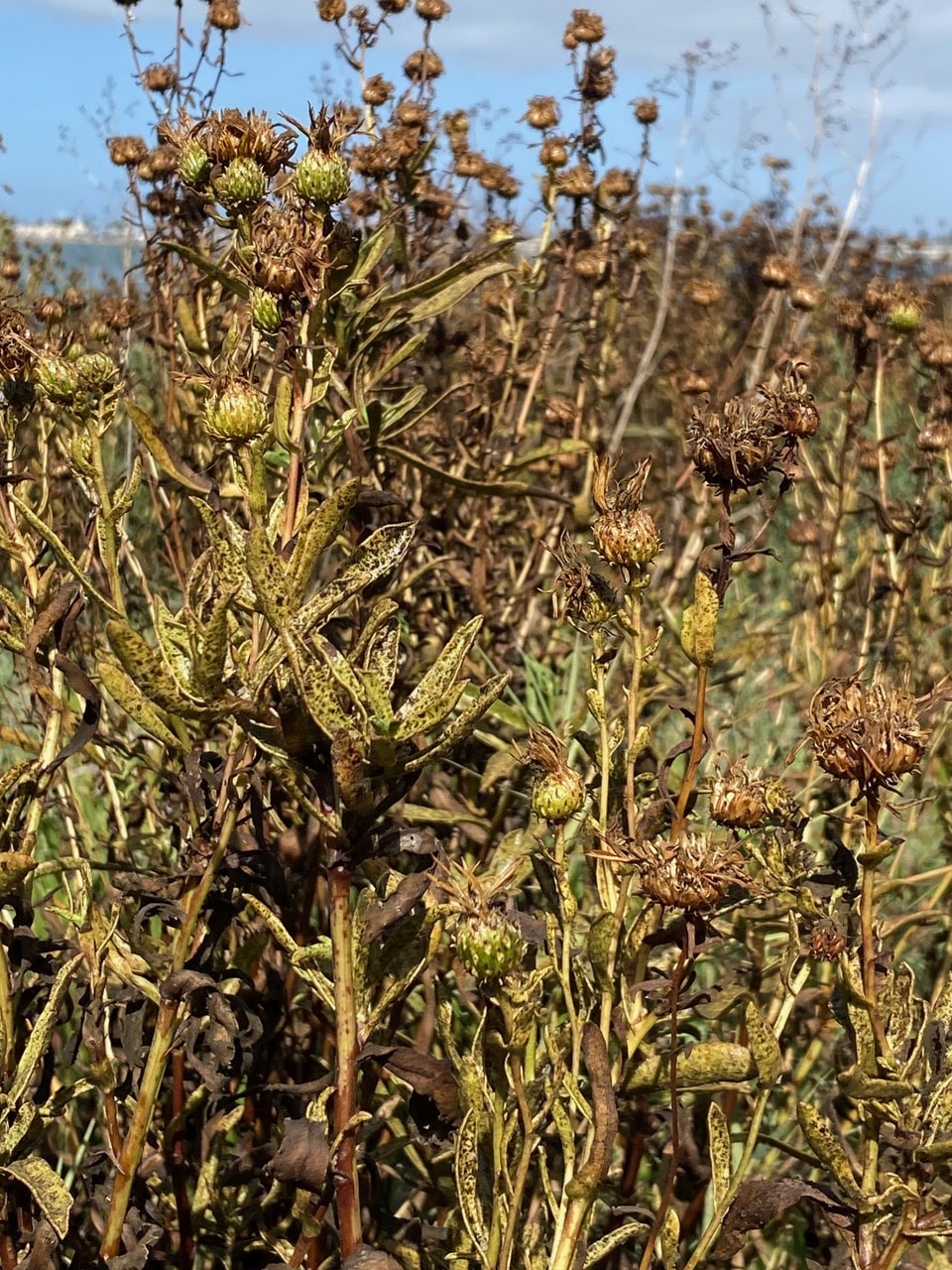
This patch of Grindelia looks especially sick. The plants have been attacked by two different sucking insects – the Spittlebugs and the Lace Bugs. The latter have left the yellow leaves mottled with sooty mold. Many of the flowerheads never had a chance to bloom before they wilted.

Despite the devastation, I can hardly find the culprits. Where have all the Lace Bugs gone? It takes me a while to find a single adult Lace Bug, Corythucha sp. (family Tingidae) on a sickly, yellowish Grindelia leaf.
The Tingidae are a family of very small (2-10 mm) insects in the order Hemiptera that are commonly referred to as lace bugs. The genus Corythucha is primarily distributed in the northern hemisphere, including Europe, North America and eastern Asia. They are called lace bugs because the pronotum and fore wings of the adult have a delicate and intricate network of divided areas that resemble lace. Their body is flattened dorsoventrally, and the head is often concealed under the hood-like pronotum. Unlike most bugs that suck xylem or phloem from plants, Lace Bugs puncture and feed on the leaf mesophyll cells. They insert their needle-like mouthparts into the mesophyll layer located between the upper and lower leaf epidermis. They inject saliva that contains digestive enzymes to break down the cell contents, then suck out the liquified chlorophyll and cell fluids. The most common symptom of feeding is the stippled and mottled yellowish foliage. In heavy infestations, black sooty mold may develop on the puncture wounds, impairing photosynthesis by the plant. This may result in some dieback of twigs and branches and a reduction in flowering the following year. Tingids are usually host-specific and can be very destructive to plants. Each individual usually completes its entire lifecycle on the same plant, if not the same part of the plant.
Lace Bugs survive the winter differently depending on whether they feed on evergreen or deciduous plants. On evergreen plants, they overwinter as eggs inserted directly into the undersides of leaves. The females protect these eggs by covering them with dark, hardened excrement that acts like a varnish. On deciduous plants, they overwinter as adults that leave the leaves and hide in sheltered, dry locations near the host plant.

A small, silvery beetle with a truncated abdomen not fully covered by the elytra is moving around on Grindelia foliage. iNaturalist has helped identify it as a Pruinose
Bean Weevil, Stator pruininus (family Chrysomelidae). Despite its common name, it is not a true weevil, but a species of seed beetle belonging to the Leaf Beetle family Chrysomelidae.

The Pruinose Bean Weevil has a very broad geographic range. It is native to the Americas but has spread globally due to human movement and trade. They are small beetles, typically measuring 2 mm in length. Like other seed beetles, Stator pruininus is highly specialized. Its larvae develop entirely inside the seeds of specific host plants, primarily feeding on legumes and woody shrubs.
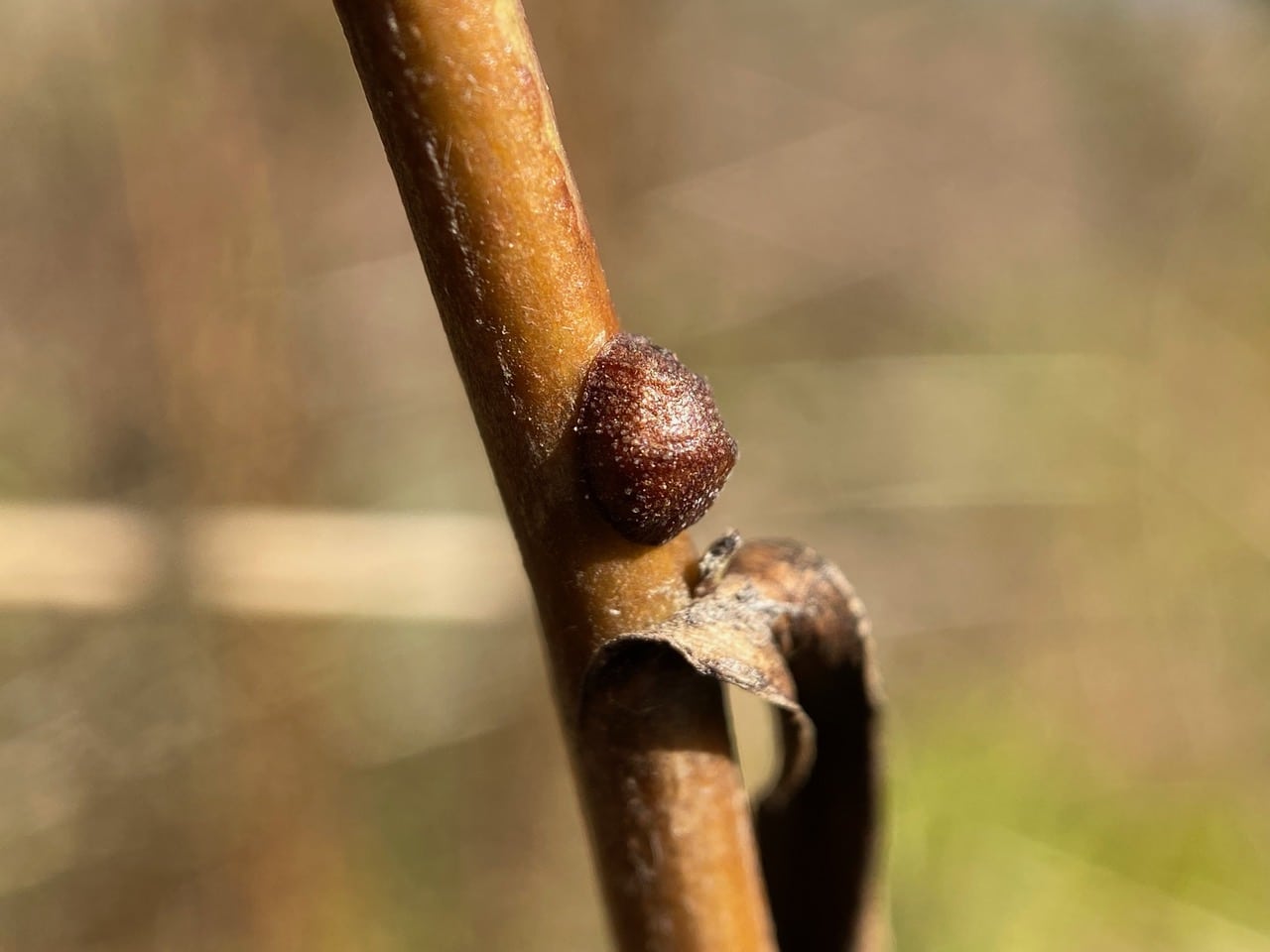
A Hemispherical scale, Saissetia coffeae (family Coccidae) is attached to a stem of a senescing Grindelia.
The Hemispherical Scale is a species of soft scale insect in the family Coccidae (order Hemiptera). Other common names include Helmet Scale and Coffee Brown Scale. The adult scale varies in diameter from about 2 mm to 4.5 mm, largely depending on the host plant. It is smooth, shiny and brown and closely adpressed to a stem or leaf, resembling a miniature military helmet. Young scales often have a slightly ridged surface, sometimes in the form of an “H”. Like other scale insects, the hemispherical scale had no limbs, piercing the plant tissues with its mouthparts and feeding on sap.
All hemispherical Scale insects are female, and breeding occurs by parthenogenesis. Up to a thousand eggs are laid, and they remain concealed under the scale husk, the parent dying soon after they are laid. The eggs hatch into first instars known as “crawlers”, the only mobile phase in this species, which leave the mother’s scale to disperse. Reaching a suitable spot, they sink their mouthparts into the plant, shed their skin and develop into second instar nymphs. There is a further instar stage before the adult stage is reached. There may be several generations each year.
The Hemispherical Scale attacks many different plants including crops, greenhouse plants and ornamental shrubs, being found on the stems, leaves and fruits. It produces copious amounts of honeydew which encourages the growth of sooty mold, and also causes leaf fall and the stunning of shoots on the host plant. It maybe attended by ants which feed on the honeydew and protect the scales from their natural enemies. It is attacked by parasitoids.

Although the ground here is not visibly wet, it is damp and soggy. Most of the coastline around Bay Farm Island is landfill. I wonder if the high water table could cause water to seep up during high tides. This is the spot along the trail where I have found a healthy population of ground-nesting Summer Longhorn Bees, Melissodes sp. (family Apidae). Will the infiltration of salt water harm their nests and larvae?

The tide is coming in so fast that the poor Grindelia is already inundated by water sloshing with seaweeds. Will the plant survive the onslaught?
Oregon Gumweed, Grindelia stricta is a coastal salt-marsh specialist. It natively grows in tidal flats, marshes, and along the natural levees of tidal channels. It is adapted to withstand periodic salt-water exposure and high-tide cycles. Ecological surveys show that the lower, seaward boundary where Grindelia can successfully grow sits very close to the King Tide line. They cannot survive below this zone because permanent or daily long-term submersion deprives their roots of necessary oxygen.
On a healthy Grindelia, I find a single female Spittlebug, Clastoptera lineatocollis (family Clastopteridae) resting on a green leaf. After wreaking havoc on the plants, these bugs have become hard to find now – the party is over.
The Spittlebug, Complex Clastoptera lineatocollis (family Clastopteridae) is found in western United States. The bugs feed mostly on Asteraceae, although other hosts have been reported. Females are brownish (3.3-3.8 mm), while the smaller males (3.0-3.2 mm) are mostly black.
Why the common name of “spittlebug”? The nymphs (immatures) of these bugs create foam masses on plants in which they live and feed. Like the adults, the nymphs use their piercing, sucking mouthparts to feed on plant juices. The nymph produces a cover of foamed-up plant sap reminiscent of saliva, hence the common name of spittlebug. Whereas most insects that feed on sap feed on the nutrient-rich fluid from the phloem, Spittlebugs tap into the much more dilute sap flowing upward via the xylem. The large amount of excess water that must be excreted and the evolution of special breathing tubes allow the young spittlebug nymphs to grow in the relatively protective environment of the spittle. Symbiotic bacteria in the insects’ digestive system provides them with the essential amino acids that their diet lacks. The foam serves a number of purposes. It hides the nymph from the view of predators and parasites, and it insulates against heat and cold, and protects the delicate nymphs from desiccation. Moreover, the foam
Unlike their young, adult spittlebugs (also known as Froghoppers) are efficient flyers and hoppers, feeding on diverse plant species. Using their piercing-sucking mouthparts, they pierce plant stems to feed on xylem. To get enough nutrients, they consume massive quantities of sap, drinking up to 280 times their body weight daily, resulting in high waste excretion. Froghoppers can cause damage by distorting plant leaves and causing shoot tips to die back. Froghoppers are champion jumpers among insects, out-performing even the fleas. The bug can leap the human equivalent of a skyscraper without a running start. It is the highest jumping insect proportional to body size. The muscles in its hind legs act like a “catapult” to release energy explosively.

A dusky hover fly lands on a flowerhead of Bristly Oxtongue, Helminthotheca echioides to feed on pollen. Its dark metallic sheen makes it easily recognizable as a Sedgesitter, Platycheirus sp. (family Syrphidae).
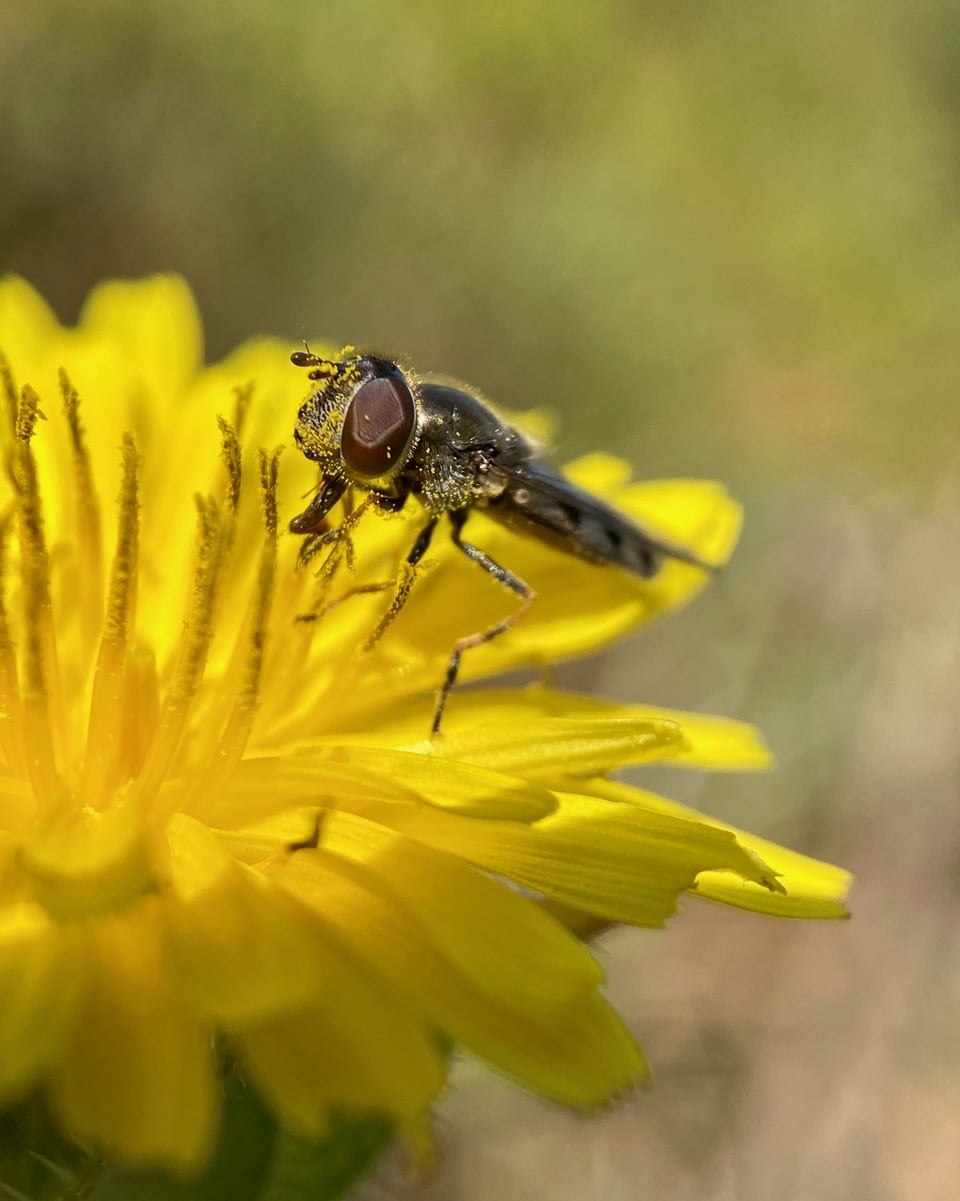
What is unexpected is iNaturalist’s suggestion of the species Greater Punctate Sedgesitter, Platycheirus stegnus. Yay, a new species for me! iNaturalist’s AI has picked up on the minute details on the fly that have escaped my notice – small dark pits dotting the cuticle on its face, seen here even when partially covered with pollen.
All hover fly species in the genus Platycheirus are commonly known as Sedgesitters because adults are frequently found in moist wetlands, marshes, and humid meadows where they often rest on or near low-growing, wind-pollinated plants like sedges. The word “Punctate” in the common name refers to the presence of punctations – small, distinct pits, dots, or puncture-like impressions dotting its body or cuticle. The word “Greater” refers to the species’ larger size compared to closely related forms in the same group. Adults of many Platycheirus species feed on pollen of wind-pollinated plants, such as Salix, Plantago, Poaceae, Cyperaceae, but they also visit other flowers. Many stay active during cold and rainy weather. Larvae feed on aphids.

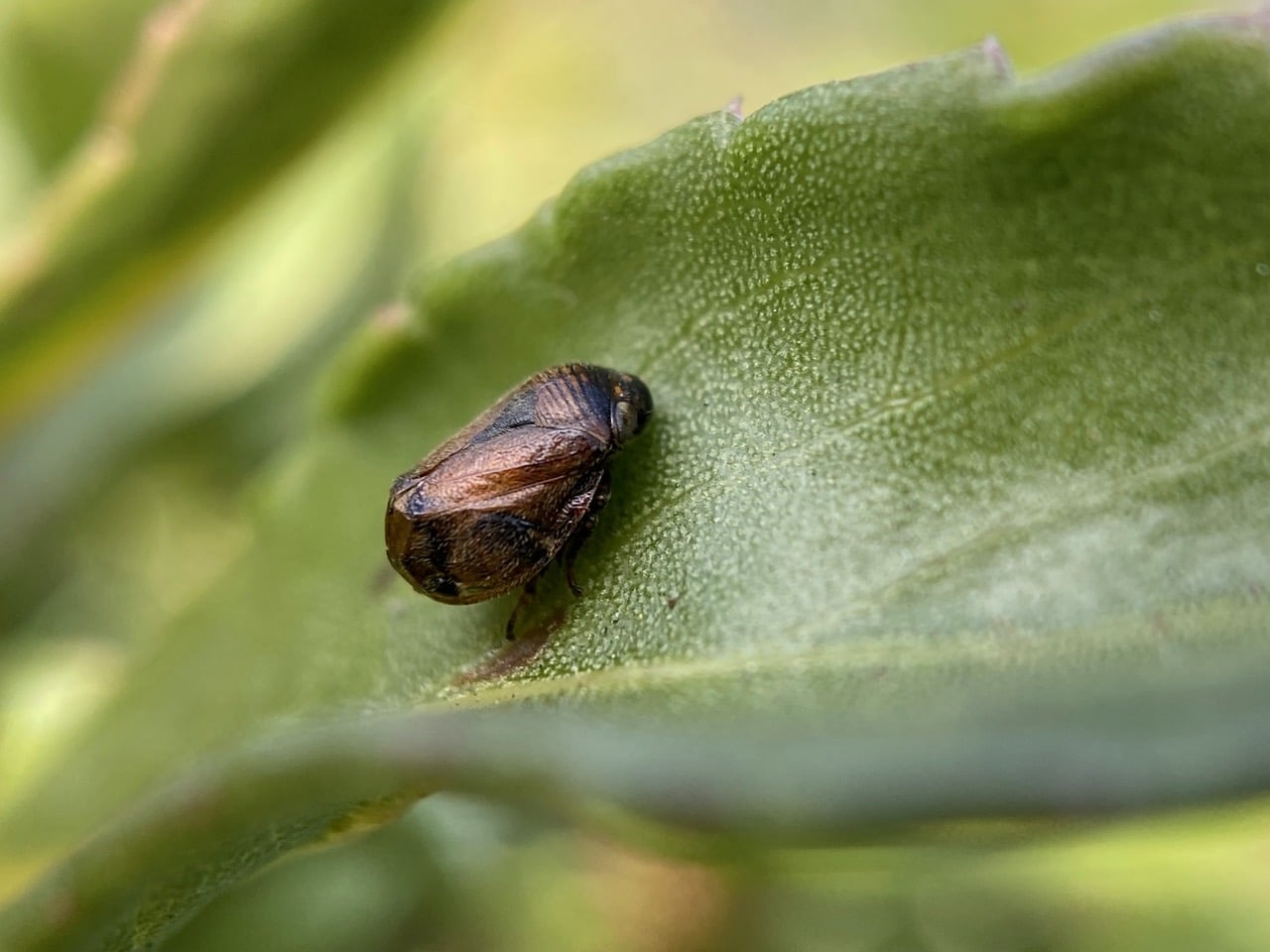
A Bronze Leaf Beetle, Diachus auratus (family Chrysomelidae) is wandering along a Grindelia leaf.
The Bronze Leaf Beetle, Diachus auratus (family Chrysomelidae) is a small, shiny, “bullet-shaped” beetle that feeds on the leaves, flowers, and fruits of plants, particularly berry crops such as strawberries, raspberies, and blackberries. It is a species of case-bearing leaf beetle in the subfamily Cryptocephalina, known for larvae that create cases out of feces and debris. The species is widespread in North America, as well as parts of Central and South America, Australia, and Asia. Adults, 1-2 mm, are found on many unrelated plants, especially plants in bloom. The larvae live underground and feed on the roots of plants, specifically grass and clover. As she lays her eggs, the female covers each one with a layer of excrement. After the larvae hatch, they retain this covering (case) as camouflage and add to it throughout their larval life. When disturbed, the larvae pull in their head and legs; because their color and shape resemble caterpillar droppings they are ignored by predators. Eventually the larva seals the case to pupate inside, before emerging as an adult. Some species are myrmecophiles, living near or even inside ant nests.

A colorful fifth (last) instar of the Southern Green Stink Bug, Nezara viridula (family Pentatomidae) is resting on a Grindelia leaf. Note the short wing pads.
Pentatomidae is a family of insects belonging to the order Hemiptera or “true bugs”. As hemipterans, the pentatomids have piercing-sucking mouthparts, and most are phytophagous, including several species that are severe pests on agricultural crops. Stink Bugs feed on plant fluids by inserting their needlelike mouthparts into stems, leaves or seed pods. While feeding, they inject materials into the plant to aid in digestion and sap removal. Penetration by the mouthparts can cause physical damage, much like stabbing the plant with a fine needle.
All Pentatomids have 5-segmented antennae (hence their family name, Penta – five and tomos – section.) They generally have a large triangular scutellum in the center of the back. The adult is generally shield-shaped when viewed from above. The common name of Stink Bug refers to their ability to release a pungent defensive spray when threatened, disturbed, or crushed.
The Southern Green Stink Bug, Nezara viridula (family Pentatomidae) is a plant-feeding stink bug. Believed to have originated in Ethiopia, it can now be found across the world. Because of its preference for certain species of legumes, such as beans and soybeans, it is an economically important pest on such crops.
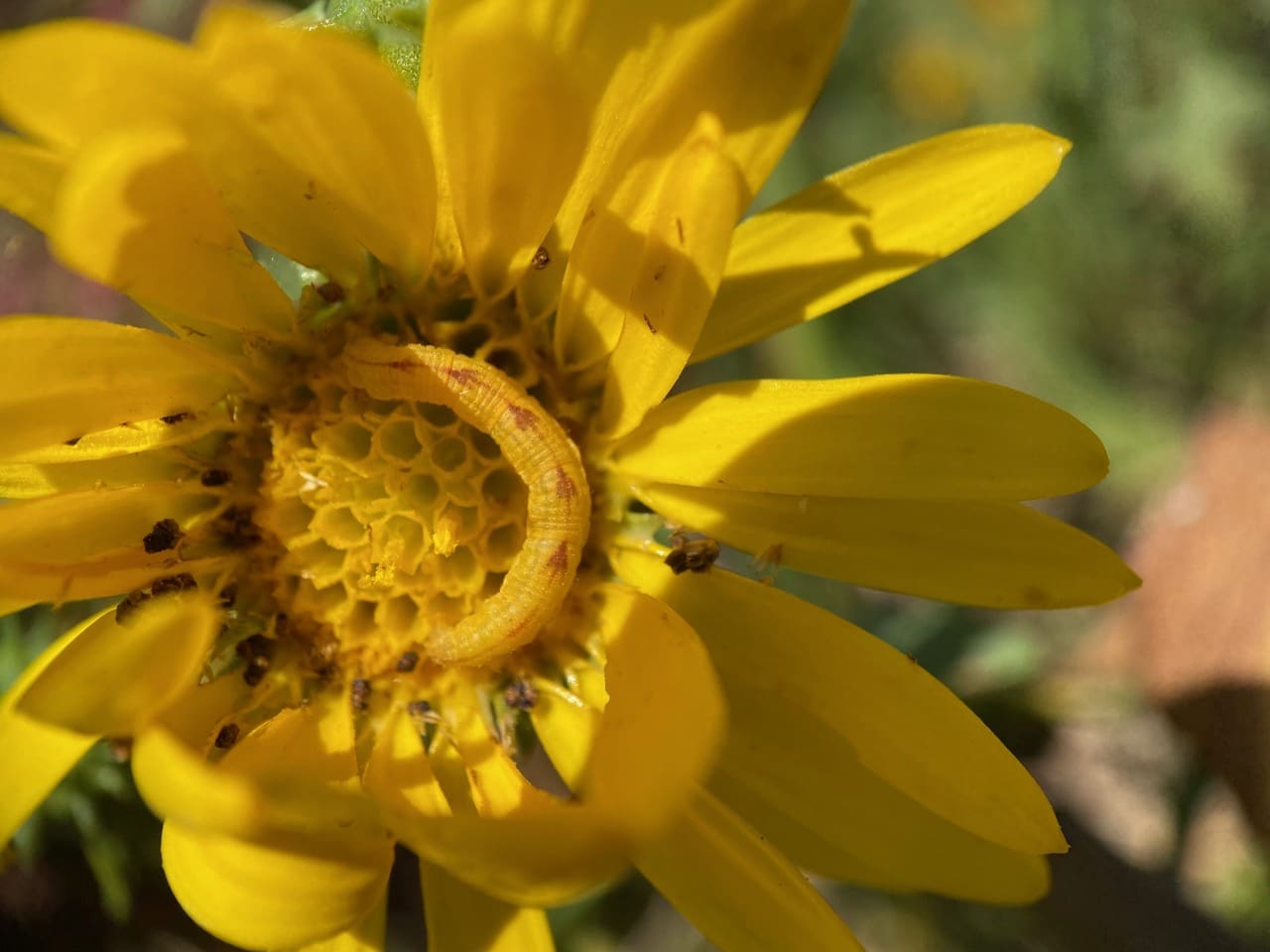
A large inchworm caterpillar of the Pug Moth, Eupithecia sp. (family Geometridae) is feeding on a Grindelia flowerhead. The red arrows on its back point to the front end of the caterpillar which is buried in a floret. Note that most of the florets have already been emptied of their reproductive parts. The dark frass scattered around the rim of the flowerhead attest to the caterpillar’s prodigious appetite.
Inchworms are also called loopers and measuring worms. The majority of the inchworms are the larvae of moths in the family Geometridae. The name comes from the Greek “geo” for earth and “metro” from measure, because the caterpillars seem to be measuring the surface on which they are walking. The “looping” locomotion is mandated by the absence of prolegs in the middle section of the caterpillar’s body.
Eupithecia is the largest genus of moths of the family Geometridae. Occurring worldwide except for Australasia, species in the genus are commonly known as pugs. The caterpillars move in a looping manner and are commonly called inchworms. Adults are typically small, 12 – 35 mm, with muted colors. Most species rest with forewings held flat at right angles to the body, while the hindwing are largely covered by the forewings. They are generally nocturnal. Larvae mostly feed from the flowers and seeds of their food plants rather than the foliage. Many species have a very specific food plant. Many are commonly found on Asteraceae flowers.
Many species of Pug Moth caterpillars are specialized flower feeders and will actually absorb the pigments from the flowers and pollen they eat. Because of this dietary habit, their bodies take on the exact hues of their host plants to camouflage themselves from predators.
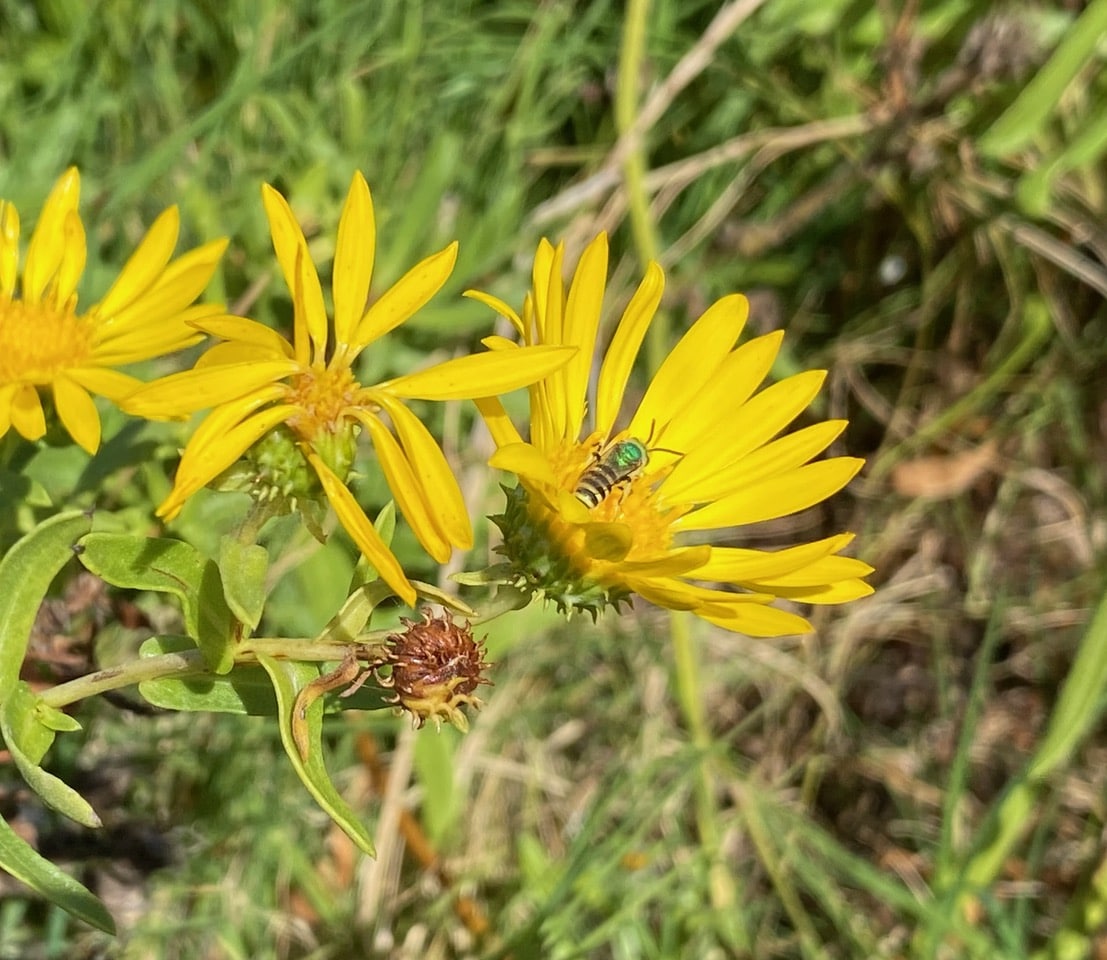
There are very few insects in flight today, except for a few Fine Striped Sweat Bees, Agapostemon subtilior (family Halictidae), most of them males.
The Fine Striped Sweat Bee, Agapostemon subtilior is a small, widespread species found across North America. They are active from late spring to fall, with all-green females measuring roughly 11 mm, and males (slightly smaller) displaying a black-and-yellow striped abdomen. Like other Agapostemon bees, they are solitary ground-nesters, and are polylectic, foraging from a wide variety of flowers.
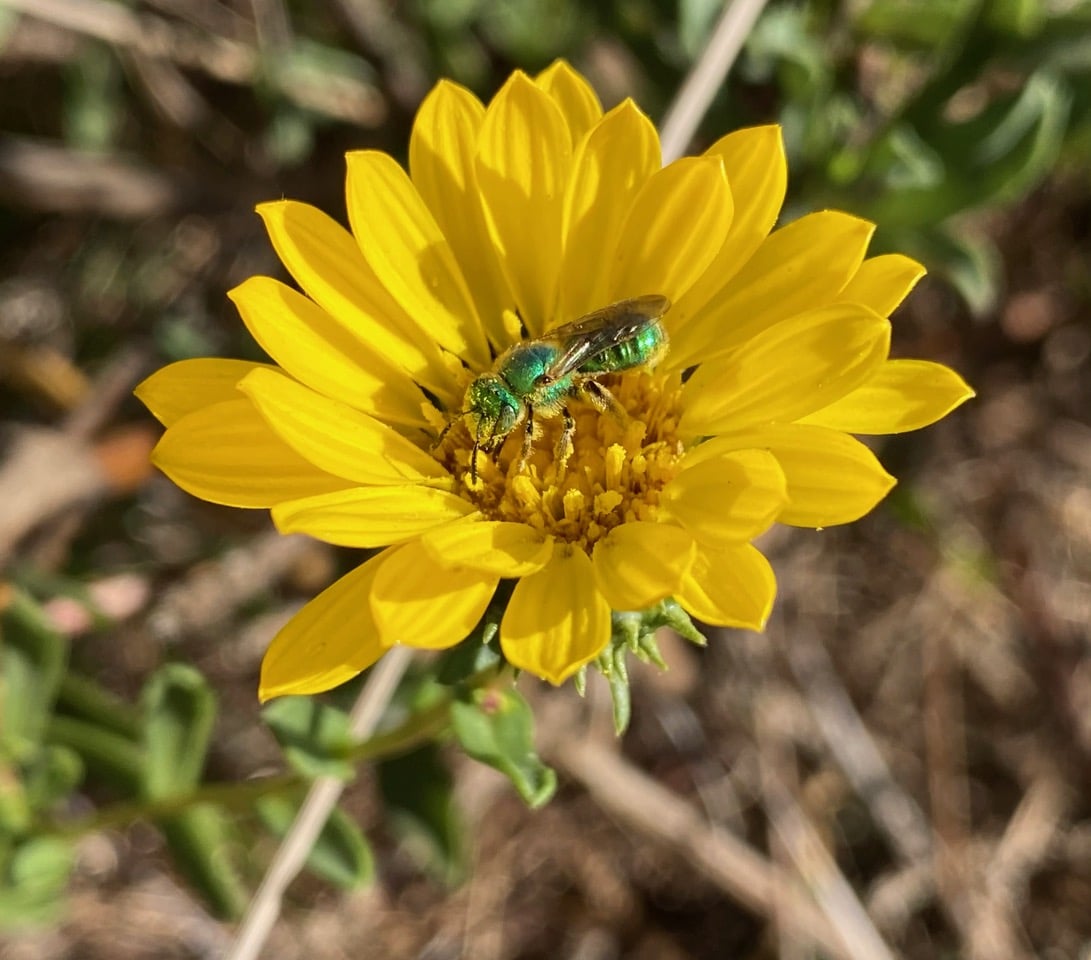
Ooh, here’s a female! I haven’t seen a female Fine Striped Sweat Bee, Agapostemon subtilior for a while and have wondered if their nesting season is over. This female does not seem to be collecting pollen, even though her face and lower body is covered with the sticky pollen while she probes for nectar on the Grindelia flowerhead.
Agapostemon females carry pollen on scopal hairs located on their hind legs. Agapostemon are ground-nesters and generalist foragers. Like other members of the family Halictidae, they are short-tongued and thus have difficulty extracting nectar from deep flowers. Males are often seen flying slowly around flowers looking for females. The bees favor flowers with high densities. Mated females overwinter in the soil and emerge in early spring to establish nests in the ground, often in aggregations (close to one another). They prefer to nest in loamy soil in flat, sloped, or bank areas, creating tunnels with individual brood cells. Although solitary, some species are communal, sharing a single entrance while maintaining separate tunnels. Females create balls of pollen and nectar in each cell, laying a single egg on each, which the larva consumes upon hatching. Males usually die after mating in late summer, while mated females hibernate through the winter.

Uh oh, the stretch of the trail where the Summer Longhorn Bees, Melissodes sp. (family Apidae) are known to nest is already under two inches of water! This is only an hour and a half after the last picture I took here earlier.

This is where the high tide has breached the berm, flooding the trail. The straw-colored deposit is old, decomposed seaweed, while the green is fresh seaweed. My shoes are already soaked through – it’s time to head home!