

Pollinator Post 10/10/24 (2)

A Common Checkered-Skipper, Burnsius communis (family Hesperiidae) lands on the leaf litter by the trail.
Because of its small size, bluish color, and spread-wing posture, the butterfly is often mistaken for one of the “Blues” in the family Lycaenidae. Skippers have the antennae clubs hooked backward like a crochet hook, while the typical butterflies have club-like tips to their antennae. Skippers also have generally stockier bodies and larger compound eyes.
Checkered Skippers belong to the subfamily Pyrginae, commonly known as spread-wing skippers, in the family Hesperiidae. Spread-wing skippers bask with their wings held wide open. The wings are held closed when they are at rest. Caterpillars make folded-leaf nests in which they live and feed on several plants in the mallow family, Malvaceae.
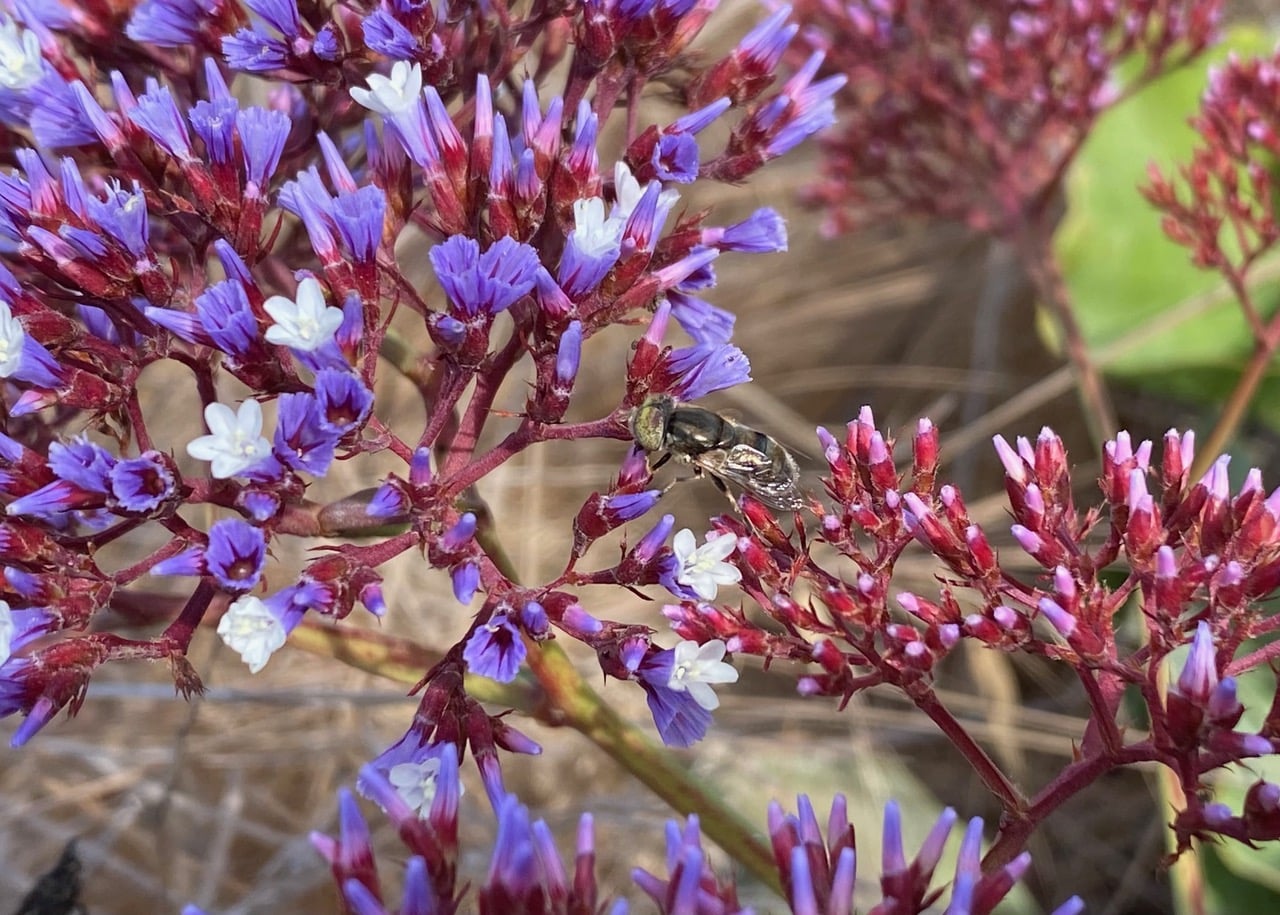
A shiny, dark fly lands on an inflorescence of Perez’s Sea Lavender, Limonium perezii. It is a Common Lagoon Fly, Eristalis aeneus (family Syrphidae), recognizable from its unusual eyes patterned with black spots.
The species is native to Europe, and widespread throughout Europe and the United States. It draws its common name from its habitat of lagoons, ponds, slow-moving rivers, streams and irrigation ditches. The larvae are commonly found along shorelines in rock pools containing large amounts of decaying seaweed. They develop in brackish as well as a variety of freshwater habitats. The adults fly very fast and low over ground vegetation, and feed on yellow composites and white umbellifers. The flight period is April to October, and the fly overwinters as an adult.
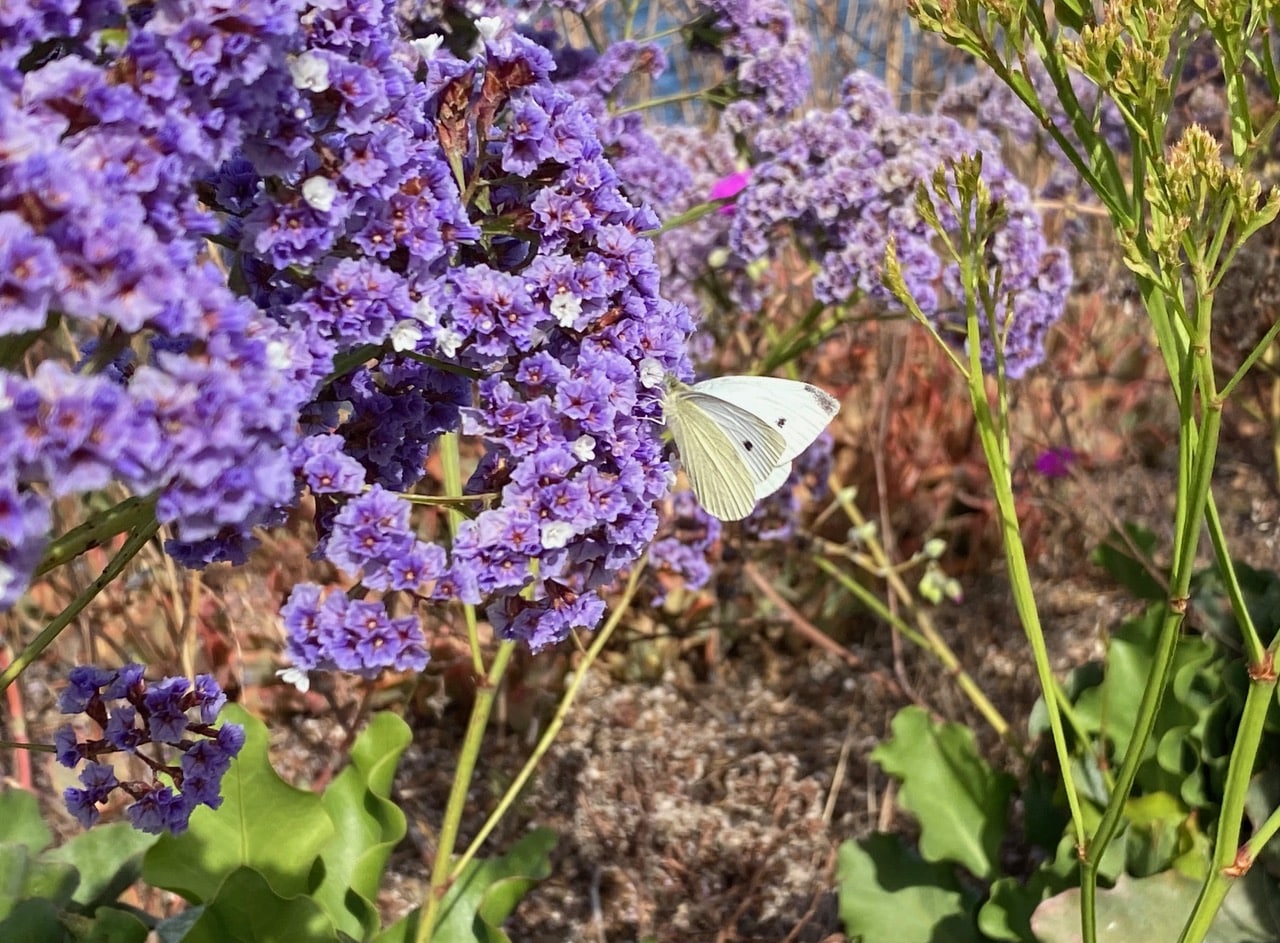
A male Cabbage White butterfly is taking nectar from an inflorescence of Perez’s Sea Lavender.
The Small White or Cabbage White, Pieris rapae (family Pieridae) was introduced to the US along with European cabbage imports in the 1860’5. The caterpillars feed on plants in the mustard or Brassicaceae family, and occasionally some in the caper family. The butterflies have a darkened, yellowish underside of the hind wings, which enables them to heat up quickly in the sun. The butterfly’s white wings reflect ultraviolet light, which we can’t see but the butterflies can. To our eyes the butterflies seem plain and drab, but to each other, females are a gentle lavender and males shine with a deep royal purple. Brighter males are more attractive to females and the color’s strength reflects the amount of protein the males consumed as caterpillars. During mating, male butterflies transfer nutrients to the females in the form of infertile sperm, a nuptial gift which will enhance the female’s life expectancy and fertility. A male with a higher quality diet can afford to be brighter and to produce bigger and more nutritious nuptial gifts.
Although we can’t see the UV reflectance of the butterflies, we can still tell the gender of the Cabbage White visually in the field. Both sexes have dark wingtips on the forewings. Females have two black spots in the center of the forewings; males have one. The underside is yellow-white. There is a black spot on the upper side of the hindwing that is not easily visible, as it is usually covered by the forewings.
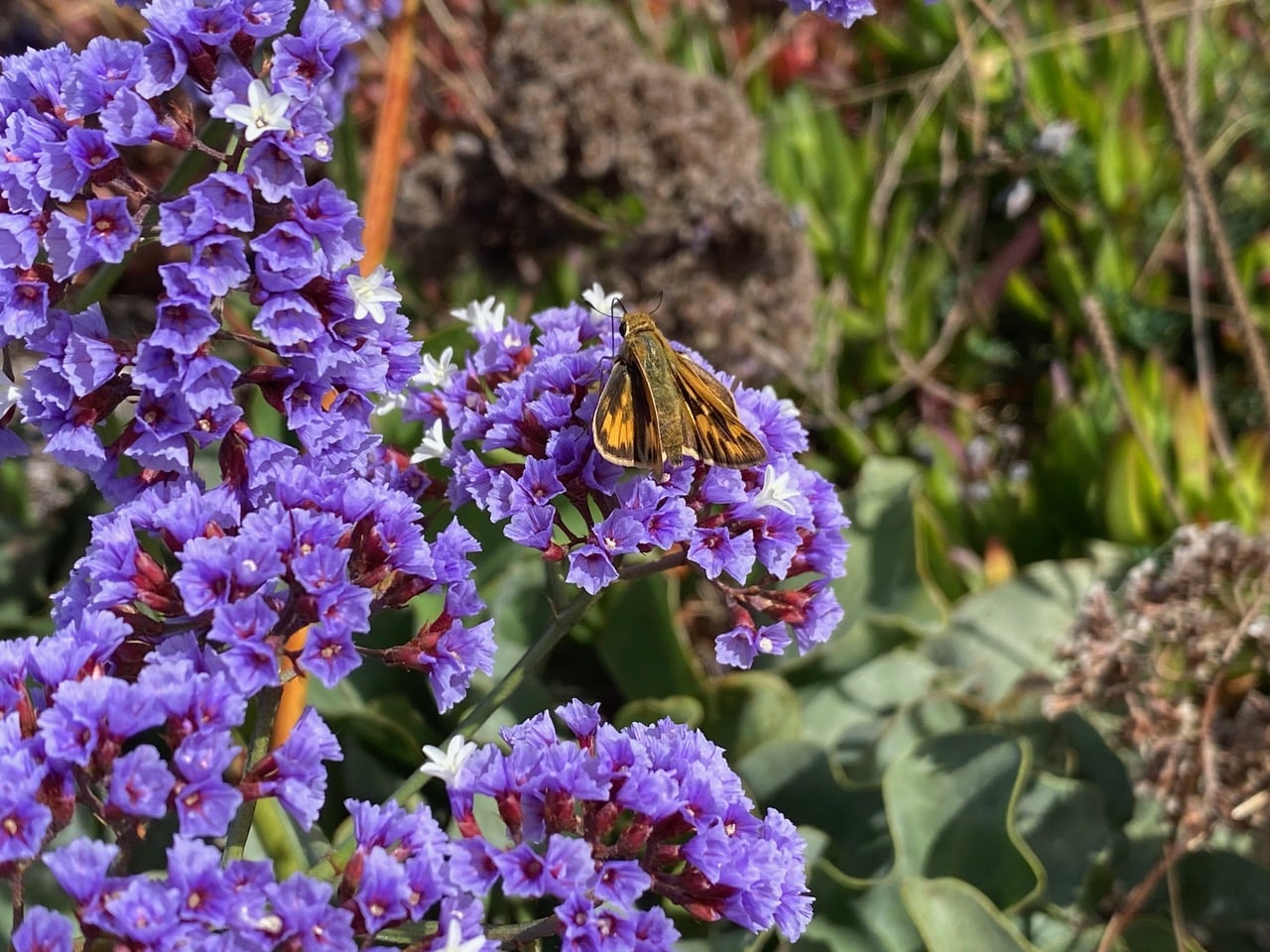
A Fiery Skipper, Hylephila phyleus (family Hesperiidae) is taking nectar on in inflorescence of Perez’s Sea Lavender, Limonium perezii.
The Fiery Skipper, Hylephila phyleus is a species of butterfly in the family Hesperiidae. The species has a wide range in North and South America. At about 1 inch in length, males are orange or yellow while the females are dark brown. In both sexes, small brown spots are seen on both the hindwings and forewings. Like other skippers, the Fiery Skippers often hold their wings in a “triangle” shape – the forewings held upright, and the hindwing folded flat. This position is thought to better absorb the sun’s rays. The butterfly’s flight is described as rapid and darting. Fiery Skipper larvae are greenish pink-grey with a black head and constricted neck. These caterpillars are often considered pests as they feed on many species of turfgrass.
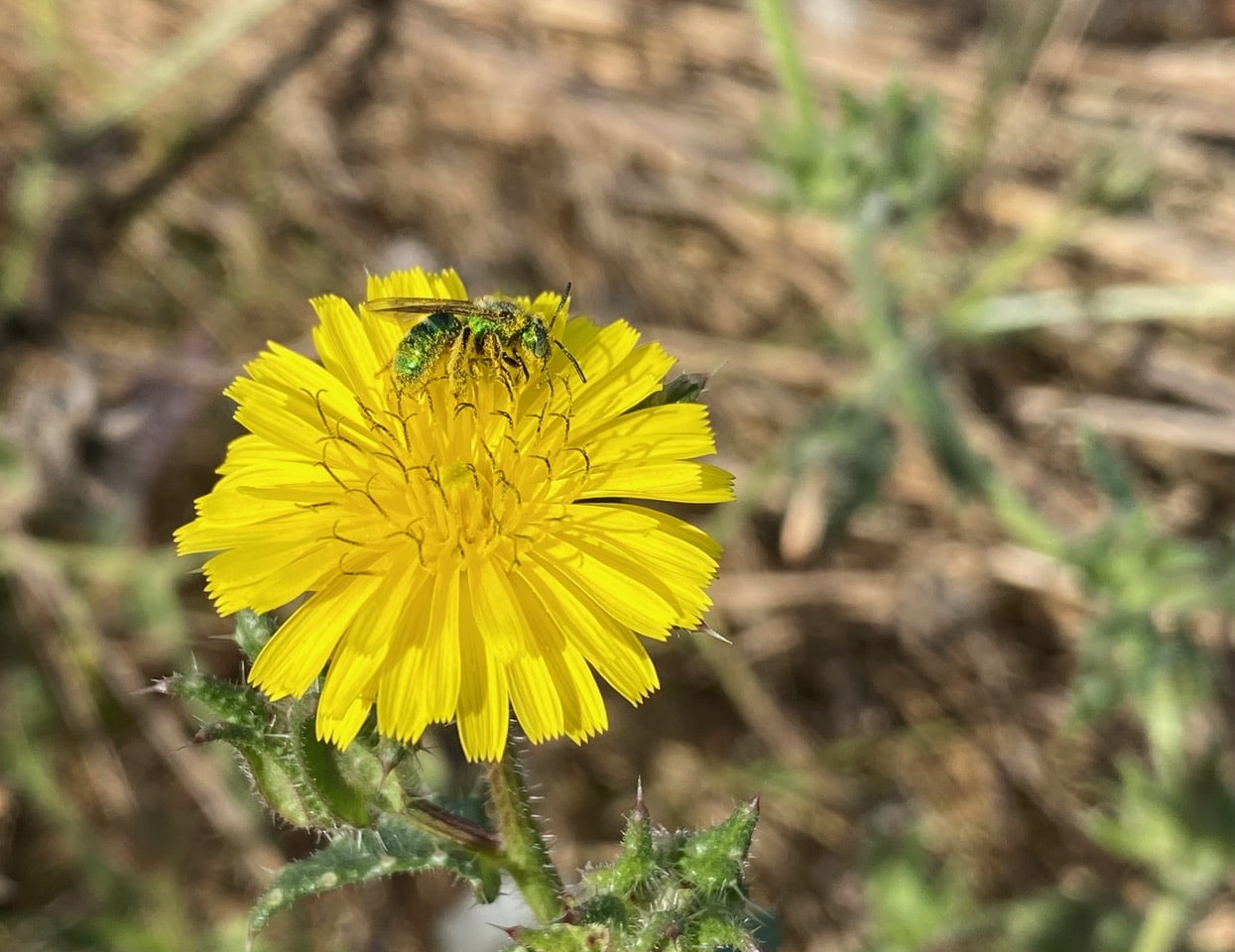
A female Texas Striped Sweat Bee, Agapostemon texanus (family Halictidae) is foraging on a flowerhead of Bristly Oxtongue, Helminthotheca echioides.
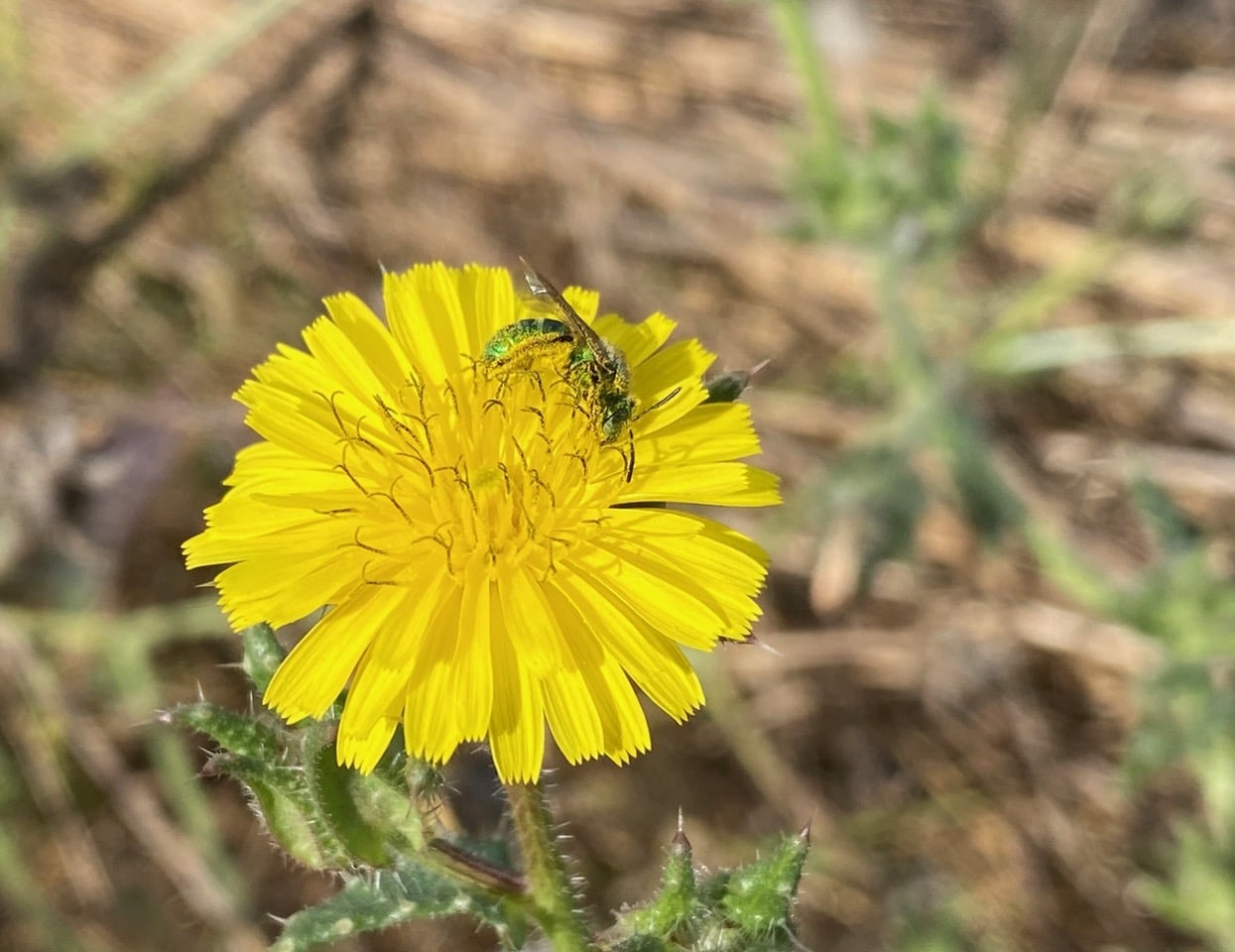
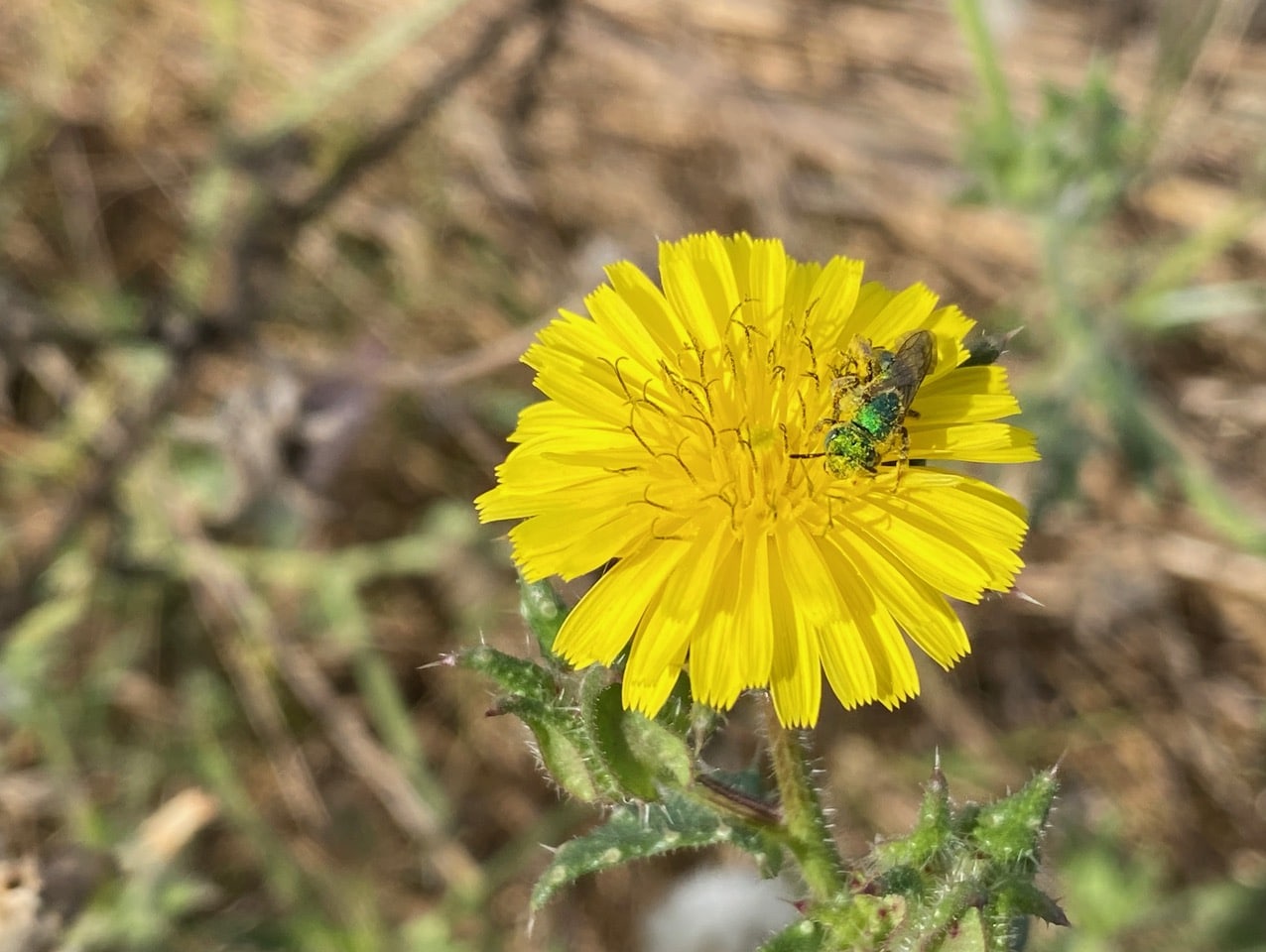
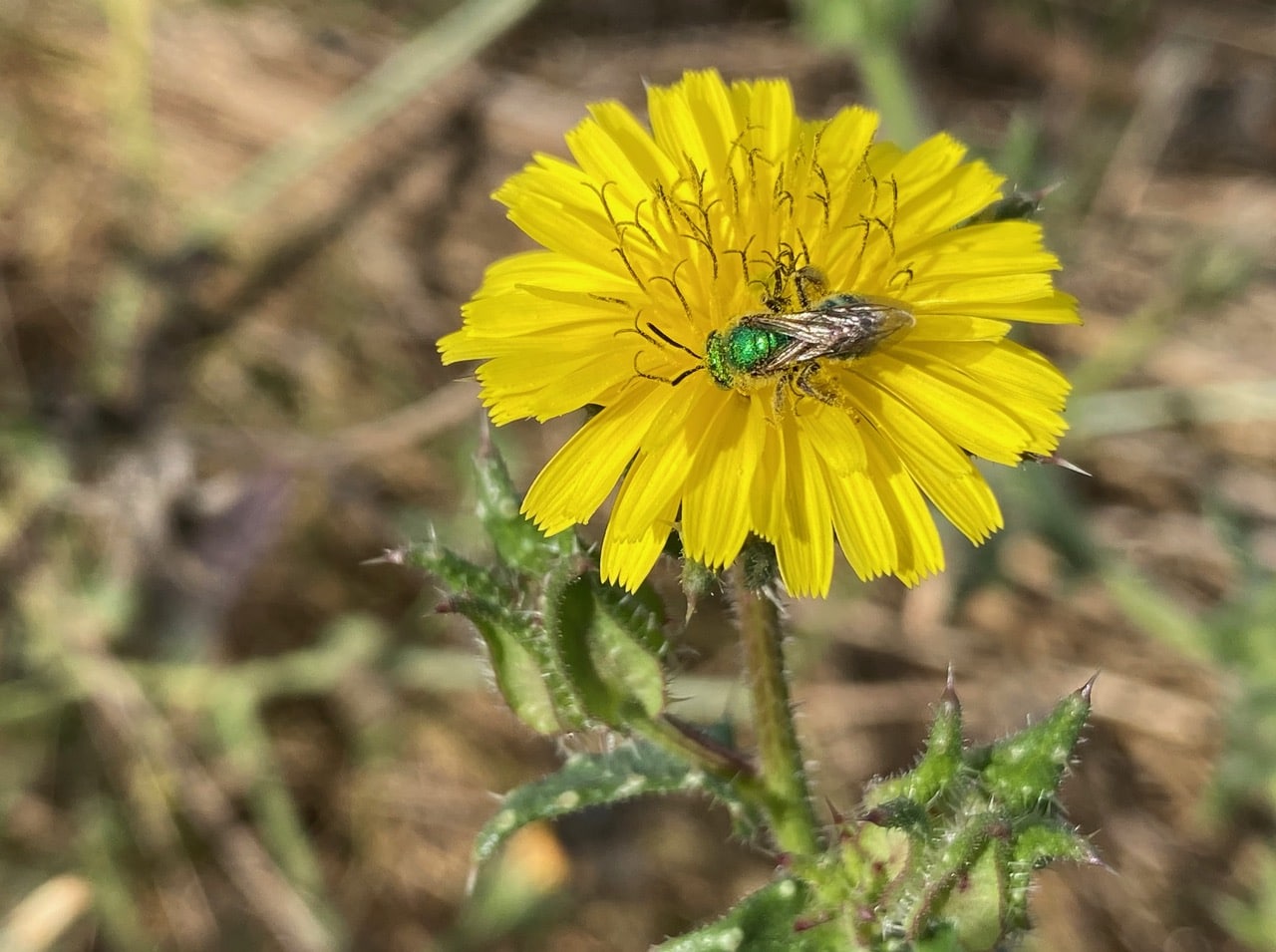
The genus Agapostemon is widespread and abundant throughout North America. These ground-nesting bees are most diverse and abundant in temperate regions and southwestern U.S. deserts. Agapostemon are commonly called “sweat bees” because they are closely related to, and resemble bees in the Halictus and Lasioglossum genera. Unlike those bees however, Agapostemon are not attracted to human sweat.
Agapostemon are brightly colored metallic green or blue bees measuring 7 to 14.5 mm long. Most species have a metallic green head and thorax, and black-and-yellow striped abdomen; some females are entirely bright green or blue. Females carry pollen on scopal hairs located on their hind legs. Agapostemon are generalists. Like other members of the family Halictidae, they are short-tongued and thus have difficulty extracting nectar from deep flowers. Males are often seen flying slowly around flowers looking for females. The bees favor flowers with high densities. They are active summer through fall.
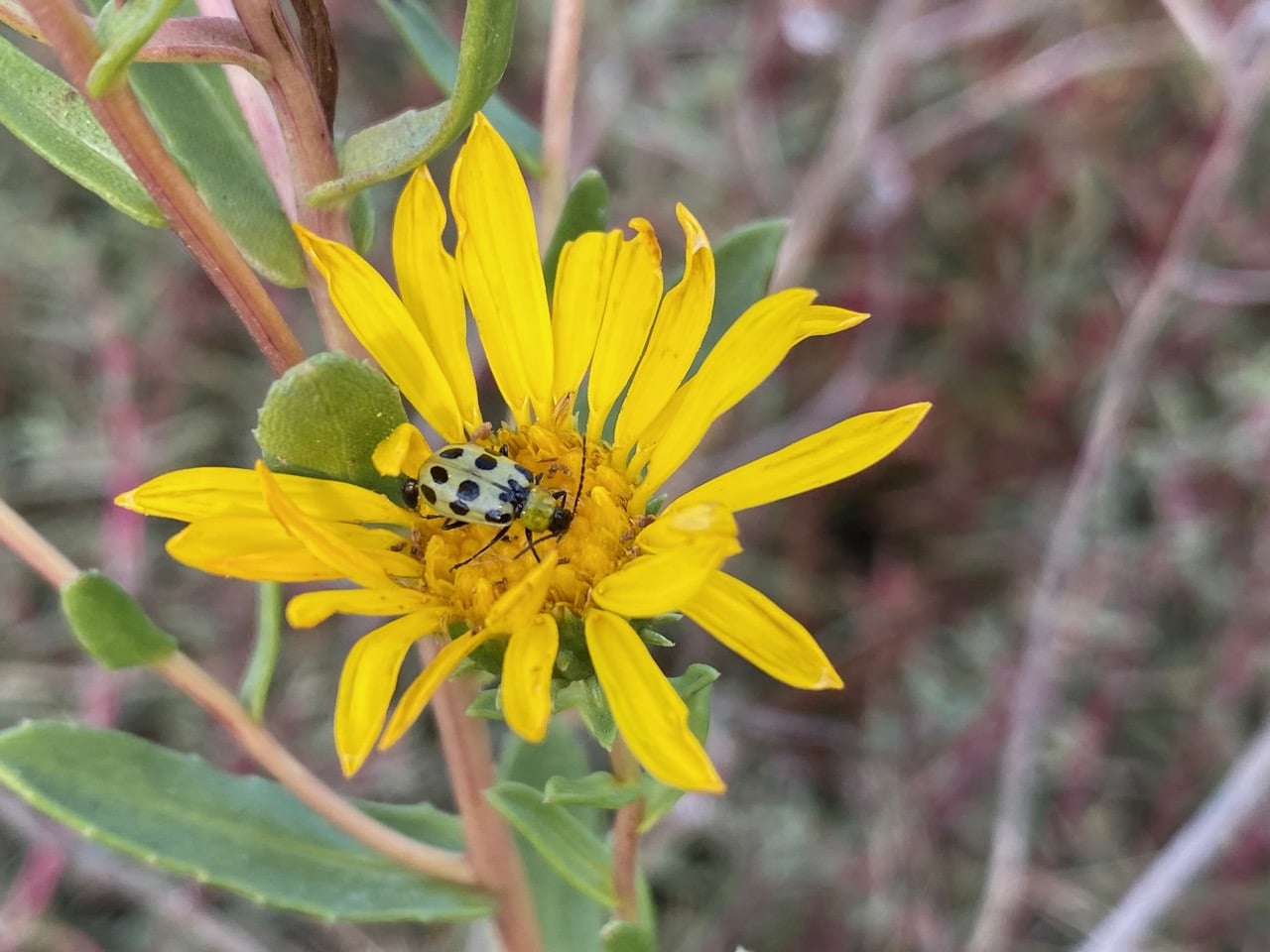
A Spotted Cucumber Beetle, Diabrotica undecimpunctata (family Chrysomelidae) is feeding on a Grindelia flowerhead.
Members of the family Chrysomelidae are commonly known as Leaf Beetles. Adults and larvae feed on all sorts of plant tissues, and all species are fully herbivorous. Many are serious pests of cultivated plants, including food crops. Others are beneficial due to their use in biocontrol of invasive weeds. Chrysomelids are popular among insect collectors, as many are conspicuously colored, typically in glossy yellow to red or metallic blue-green hues, and some have spectacularly bizarre shapes. Photos of Leaf Beetles (Family Chrysomelidae) · iNaturalist
Native to North America, the Spotted Cucumber Beetle can be a major agricultural pest, causing damage to crops in the larval as well as adult stages of their life cycle. Larvae, sometimes known as rootworms feed on the roots of emerging plants. In the adult stage the beetles cause damage by eating the flowers, leaves, stems and fruits of the plant.
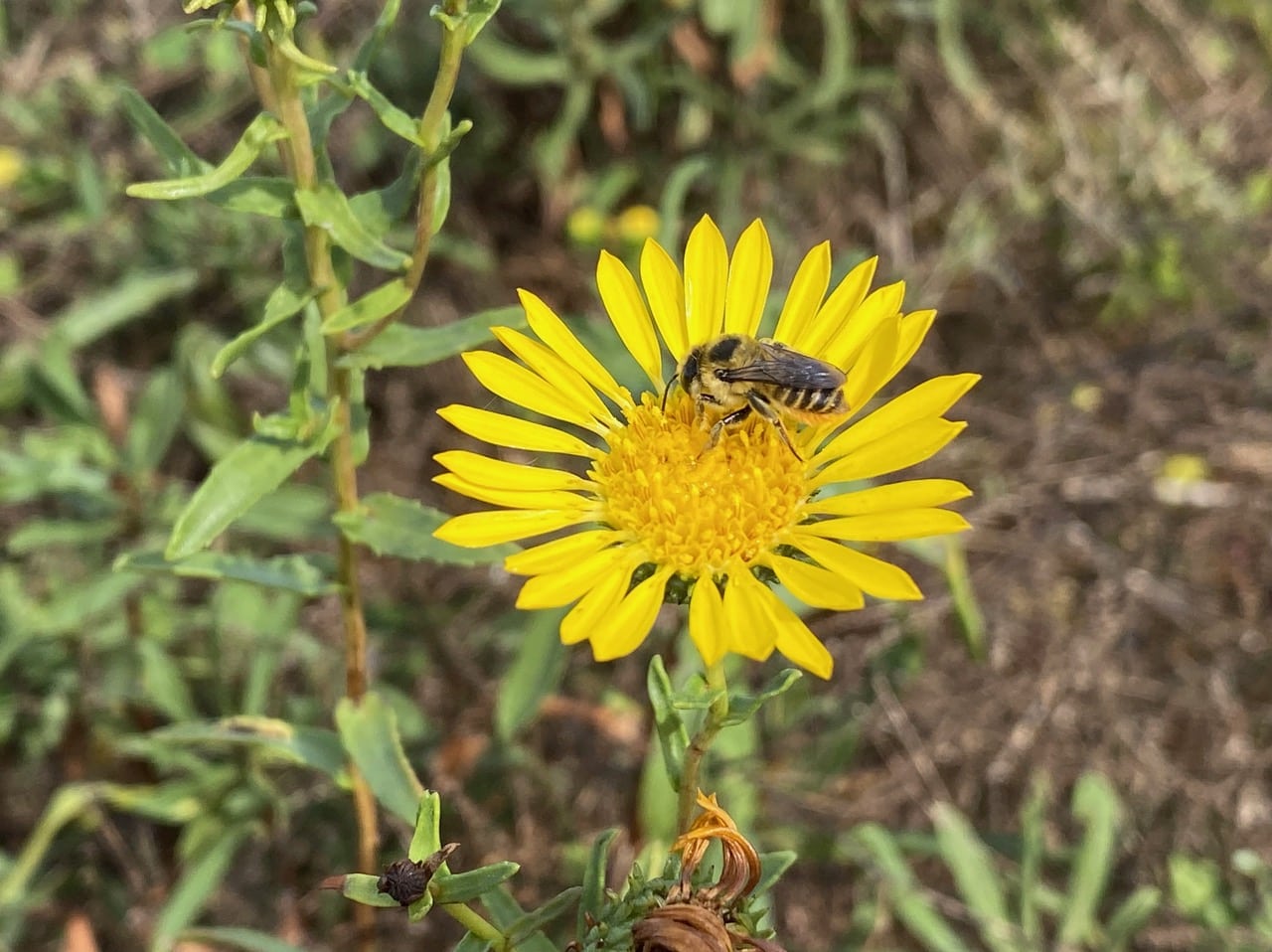 A female Western Leafcutter Bee, Megachile perihirta (family Megachilidae) lands on a Grindelia flowerhead. She is not in her typical animated, abdomen tipped-up mode today. She seems interested in only taking nectar, not collecting pollen.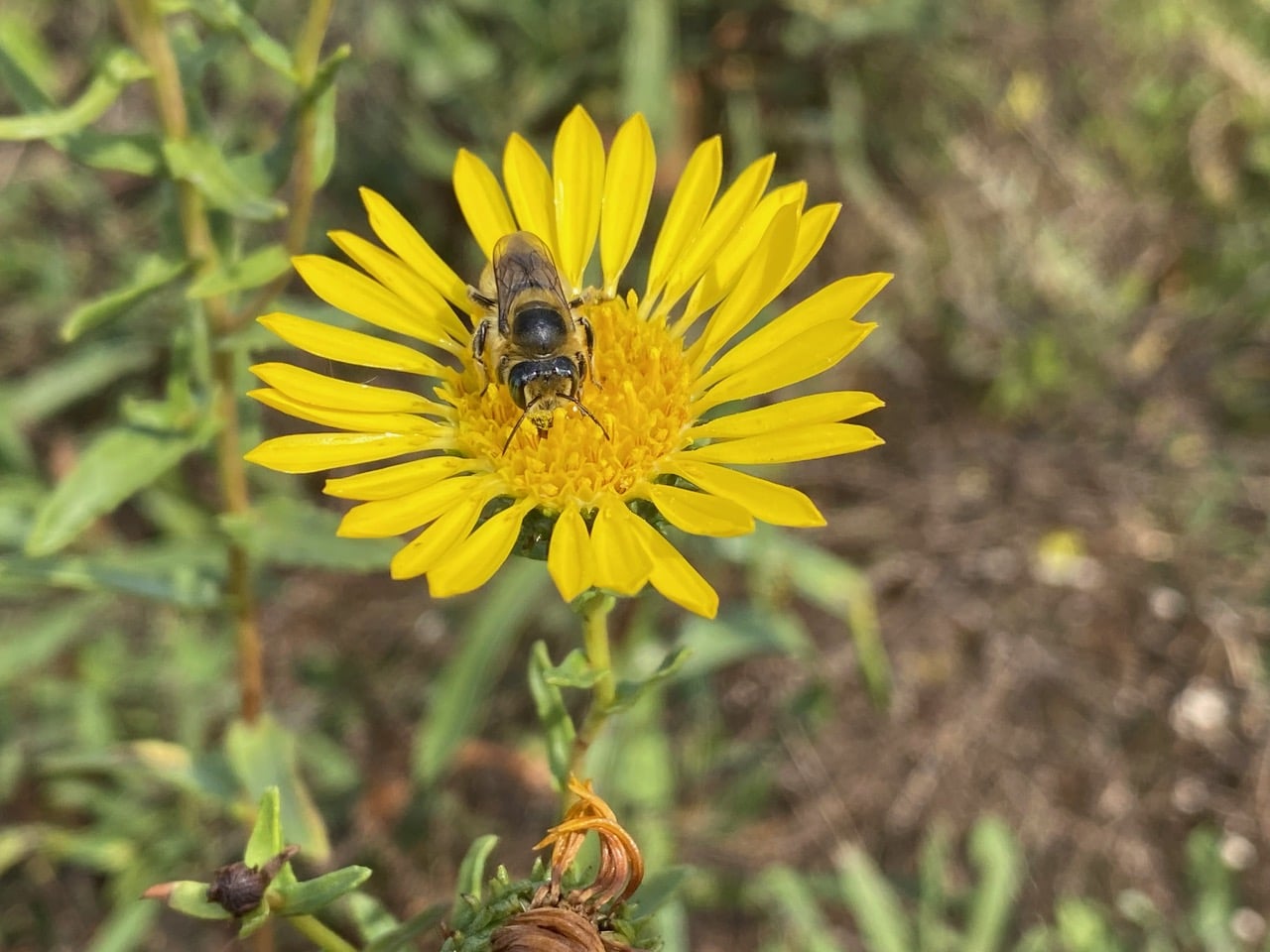
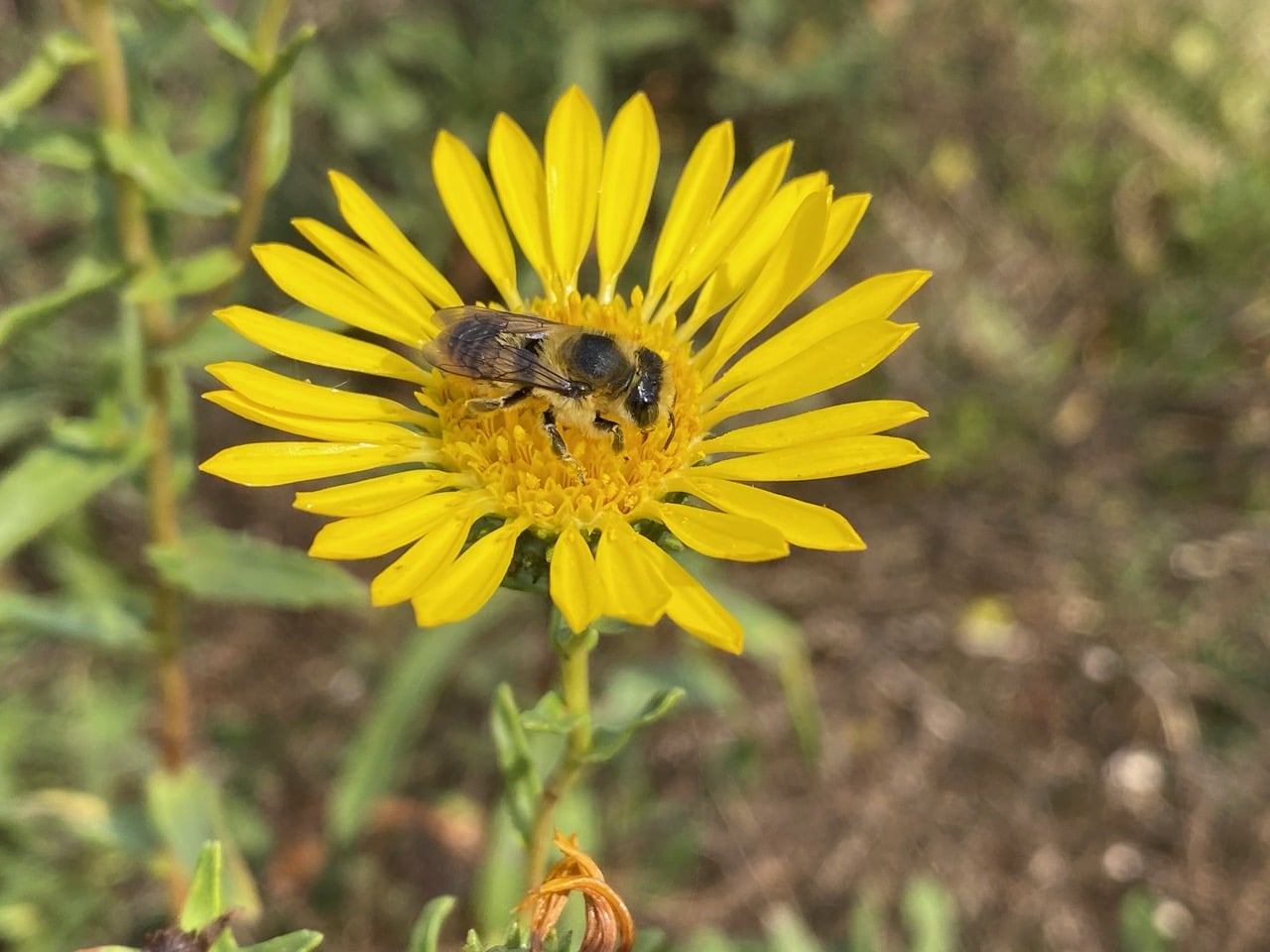
Leaf-cutter Bees, Megachile sp. (family Megachilidae) are stout-bodied, usually with pale hair on the thorax and stripes of white hairs on the abdomen. Females usually have a triangular abdomen with a pointed tip, and males’ faces are covered with dense, pale hair. Flight season is from May into September, with peak activity from June to August.
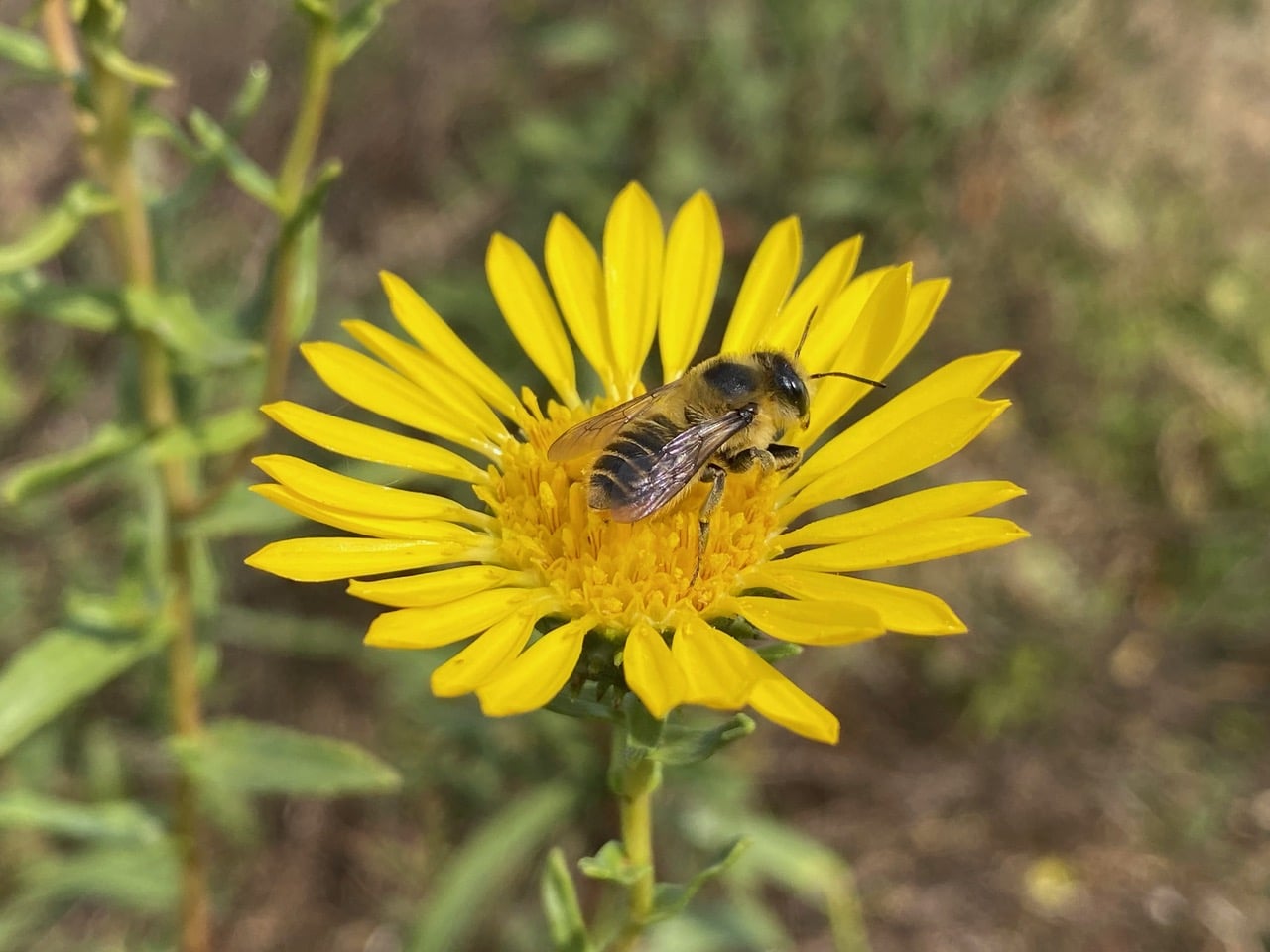
Leafcutter females construct nests in tubular cavities, including hollow stems, tree holes, and abandoned beetle burrows in wood. Many use holes drilled into wood, straws, or other manufactured tunnels. Females cut pieces from leaves or flower petals for use in the construction of brood cells. Most Megachile females are generalists when foraging for pollen. Pollen is transported in dense scopae on the underside of the abdomen.