

Pollinator Post 10/10/24 (1)
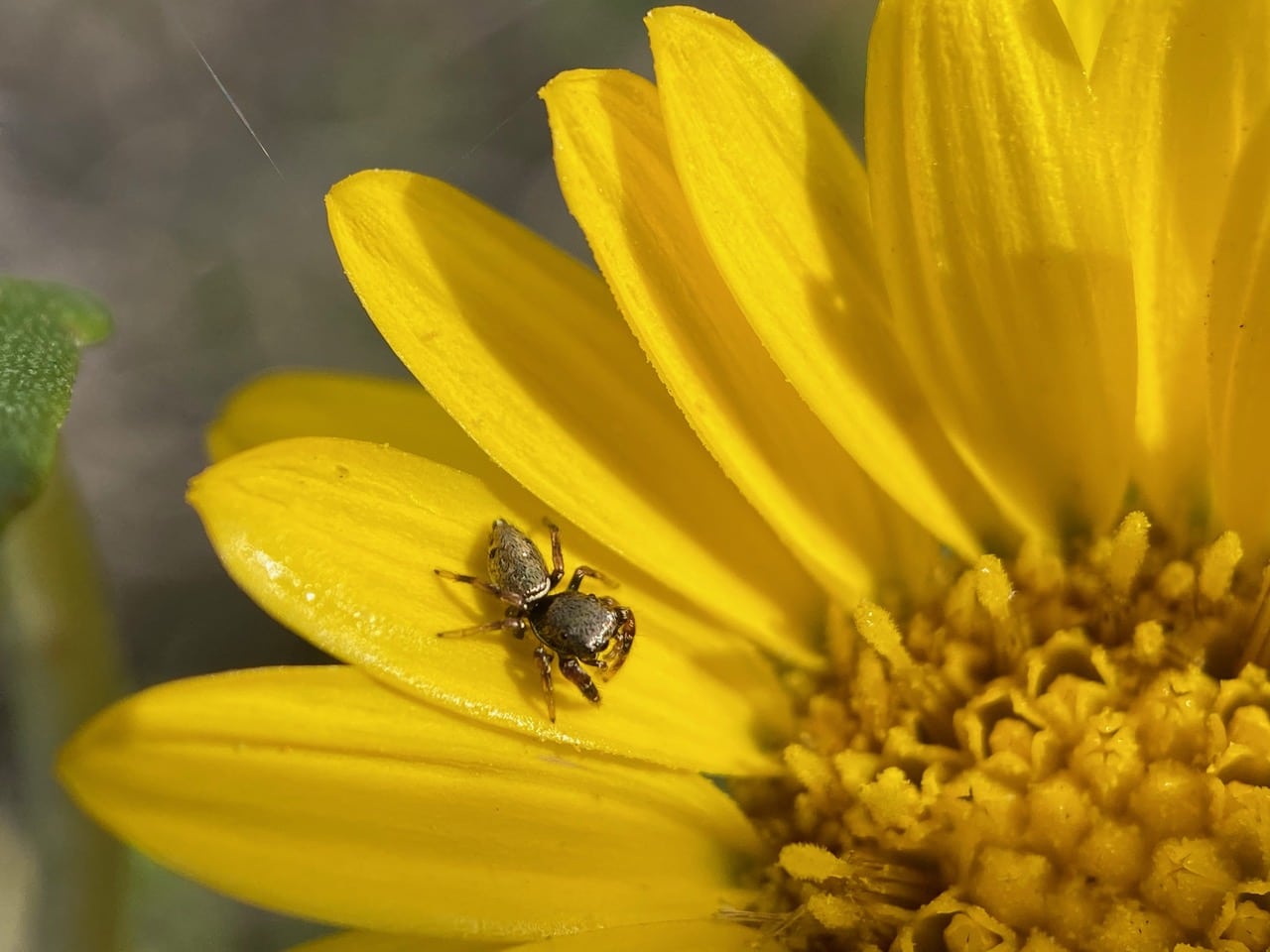
Another beautiful morning at Shoreline Park, Bay Farm Island.
Barely a glint on the Grindelia flowerhead, the tiny shiny jumping spider is by now instantly recognizable as the Buttonhook Leafbeetle Jumping Spider or the Grapevine Jumping Spider, Sassacus vitis (family Salticidae).
Salticids are free-roaming hunting spiders. They do not weave a web to catch prey. They stalk, then pounce on their prey. Just before jumping, the spider fastens a safety line to the substrate. It can leap 10-20 times their body length to capture prey. Their movement is achieved by rapid changes in hydraulic pressure of the blood. Muscular contractions force fluids into the hind legs, which cause them to extend extremely quickly.
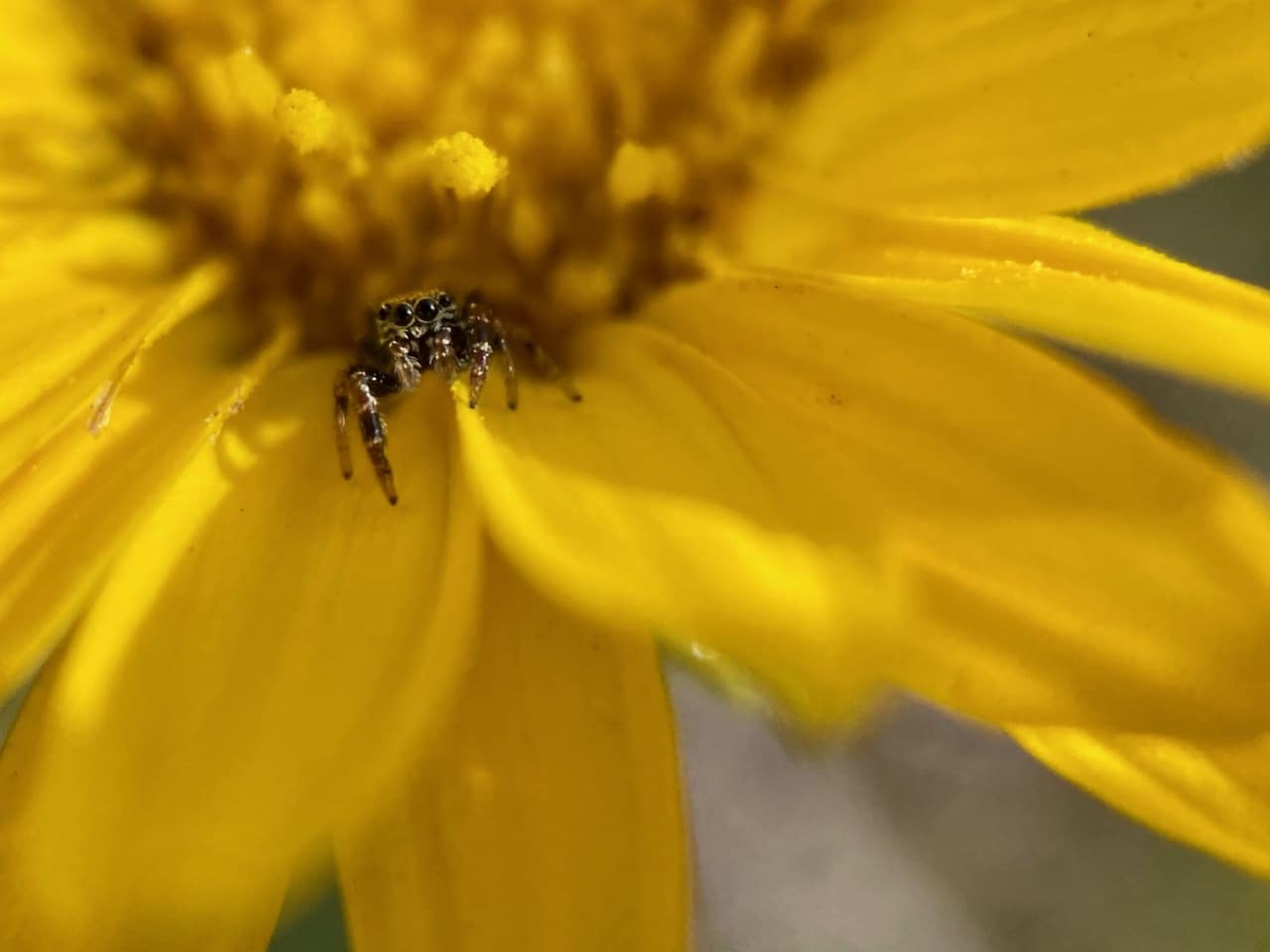
Jumping spiders are visual hunters. Their excellent vision has among the highest acuities in invertebrates. Since all their 8 eyes are fixed in place and cannot pivot independently from the body like human eyes can, jumping spiders must turn to face whatever they want to see well. This includes moving their cephalothorax up and down, an endearing behavior.
The Buttonhook Leafbeetle Jumping Spider, Sassascus vitis is native to North America, with a range spanning from Canada to Panama. It is a small jumping spider with iridescent gold abdomen and white ring around the anterior surface of abdomen. Body is covered with golden scales. Males are 3.5 mm long, females 4.5 mm. The name vitis is Latin for “grapevine”. The spider is commonly found on shrubs and vines and in fields. Best known as a common resident of vineyards.
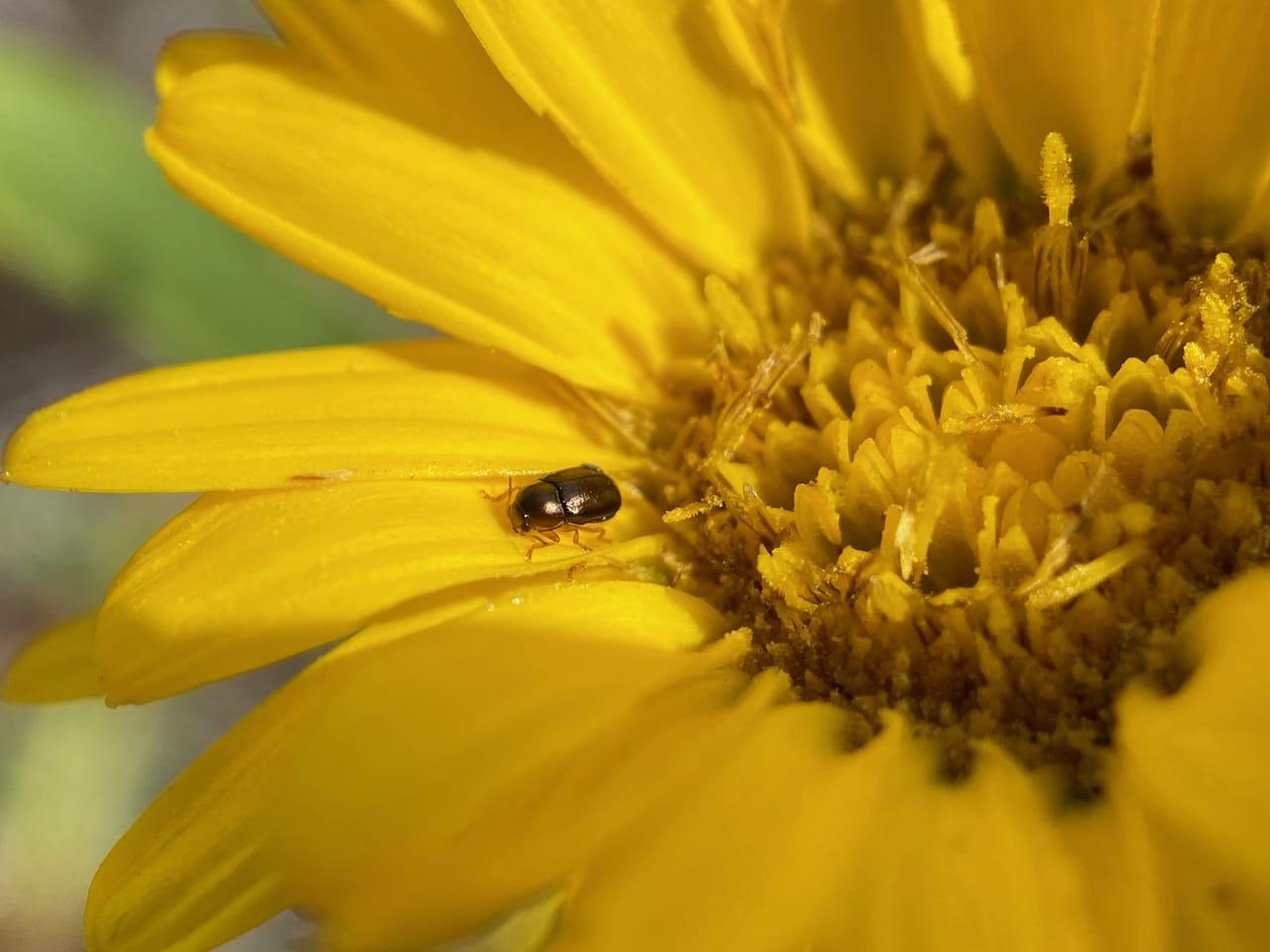
On an adjacent Grindelia flowerhead, an even smaller creature is glinting in the sunlight. Closing in, I discover that it is a beetle. iNaturalist has identified it as the Bronze Leaf Beetle, Diachus auratus (family Chrysomelidae). The florets in the flowerhead are in disarray, missing reproductive parts. Has the beetle been feeding on pollen?
Members of the family Chrysomelidae are commonly known as Leaf Beetles. Adults and larvae feed on all sorts of plant tissues, and all species are fully phytophagous. Many are serious pests of cultivated plants, including food crops. Others are beneficial due to their use in biocontrol of invasive weeds. Chrysomelids are popular among insect collectors, as many are conspicuously colored, typically in glossy yellow to red or metallic blue-green hues, and some have spectacularly bizarre shapes.
The Bronze Leaf Beetle, Diachus auratus is a species of case-bearing leaf beetle in the family Chrysomelidae, subfamily Cryptocephalina. It is found in Australia, the Caribbean, the Americas, Oceania, and Southern Asia. Adults, 1-2 mm, are found on many unrelated plants, especially plants in bloom. Case-bearing leaf beetles are found in two subfamilies within Chrysomelidae. As she lays her eggs, the female case-bearing leaf beetle covers each one with a layer of excrement. After the larvae hatch, they retain this covering (case) as camouflage and add to it throughout their larval life. When disturbed, the larvae pull in their head and legs; because their color and shape resemble caterpillar droppings they are ignored by predators. Eventually the larva seals the case to pupate inside, before emerging as an adult. Some species are myrmecophiles, living near or even inside ant nests.
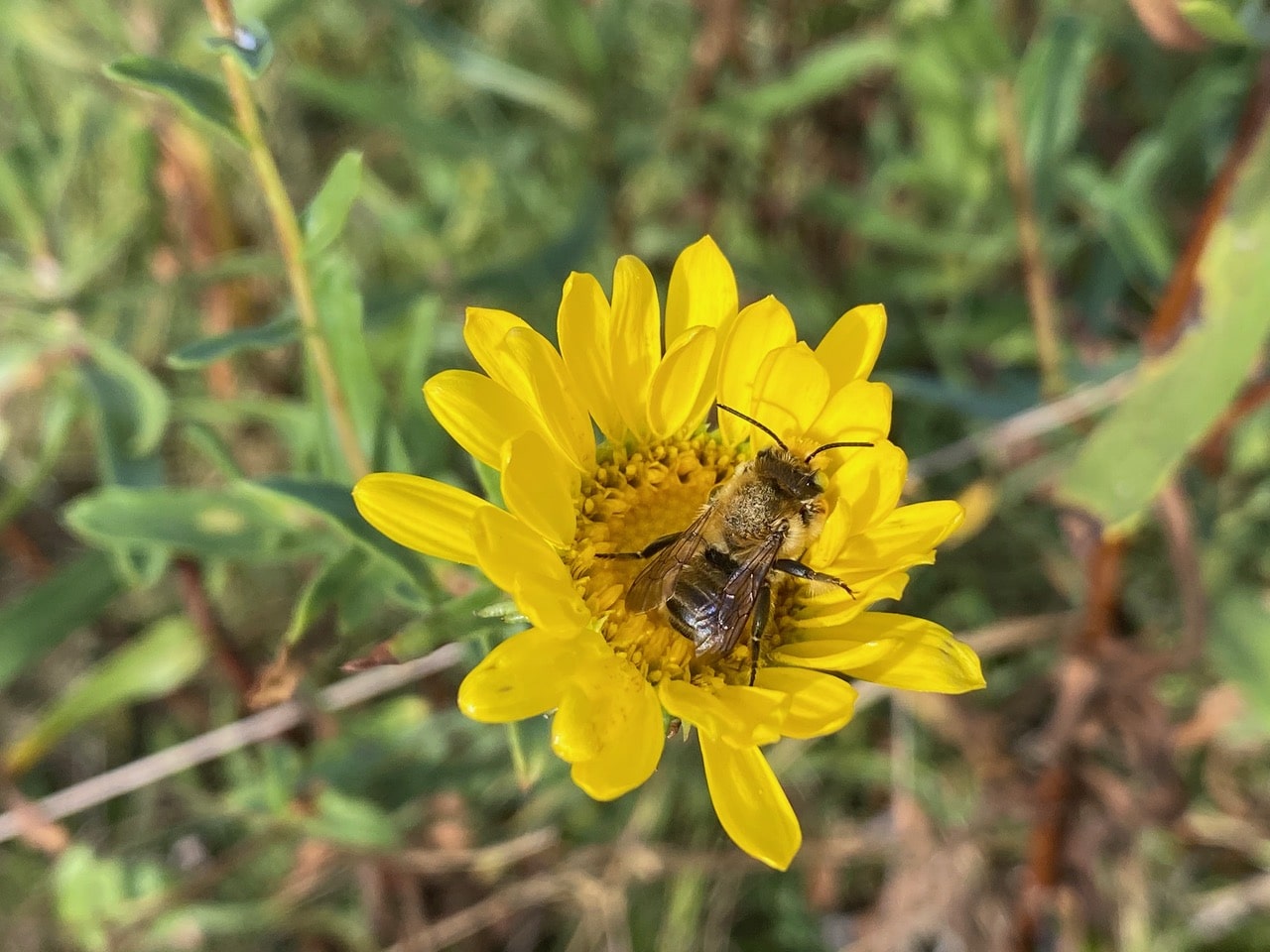
A male Western Leafcutter Bee, Megachile perihirta (family Megachilidae) is resting motionless on one of the few remaining Grindelia flowerheads. Did he decide to sleep here overnight for first dips on the females when they come out to forage in the morning? Generally, female solitary bees sleep in their nests that they construct and provision, while males tend to sleep in the open at night, usually on vegetation.

I stop by a Bristly Oxtongue, Helminthotheca echioides that is heavily infested with aphids. The stems are studded with aphids of all ages and sizes. The big dark aphid at the top is giving birth to a baby!
Aphids are small sap-sucking insects in the order Hemiptera. A typical life cycle involves flightless females giving live birth to female nymphs, – who may also be already pregnant, an adaptation called telescoping generations – without the involvement of males. Maturing rapidly, females breed profusely so that the population multiplies quickly. Winged females may develop later in the season, allowing the insects to colonize new plants. In temperate regions, a phase of sexual reproduction occurs in the autumn, with the insects often overwintering as eggs.
The life cycle of some species involves an alternation between two species of host plants. Some species feed on only one type of plant, while others are generalists, colonizing many plant groups. Some ants have a mutualistic relationship with aphids, tending them for their honeydew and protecting them from predators.
Aphids usually feed passively on phloem of plants. Once the phloem vessel is punctured, the sap, which is under pressure, is forced into the aphid’s food canal. Aphids produce large amounts of a sugary liquid waste called “honeydew”. A fungus called sooty mold can grow on honeydew deposits that accumulate on leaves and branches, turning them black.

Look, a winged aphid! As the colony gets overcrowded, or as resources dwindle, aphid colonies produce alates or winged reproductives. These will disperse to establish colonies on new plants.
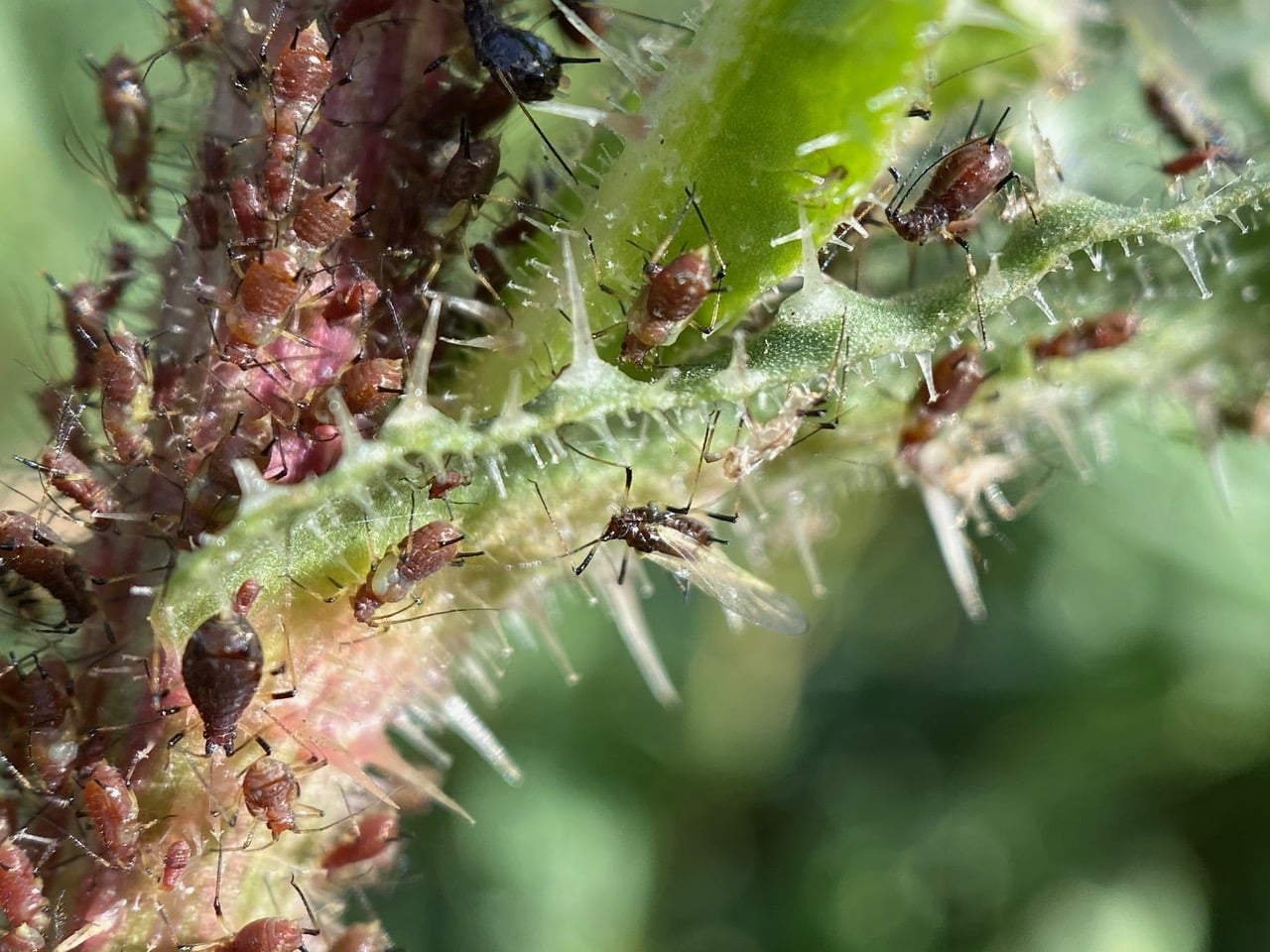
There are many more alates in the making. See those aphids with the fleshy, greenish wing buds? These will eventually turn into adults with functional wings. The colony is getting ready for mass dispersal.
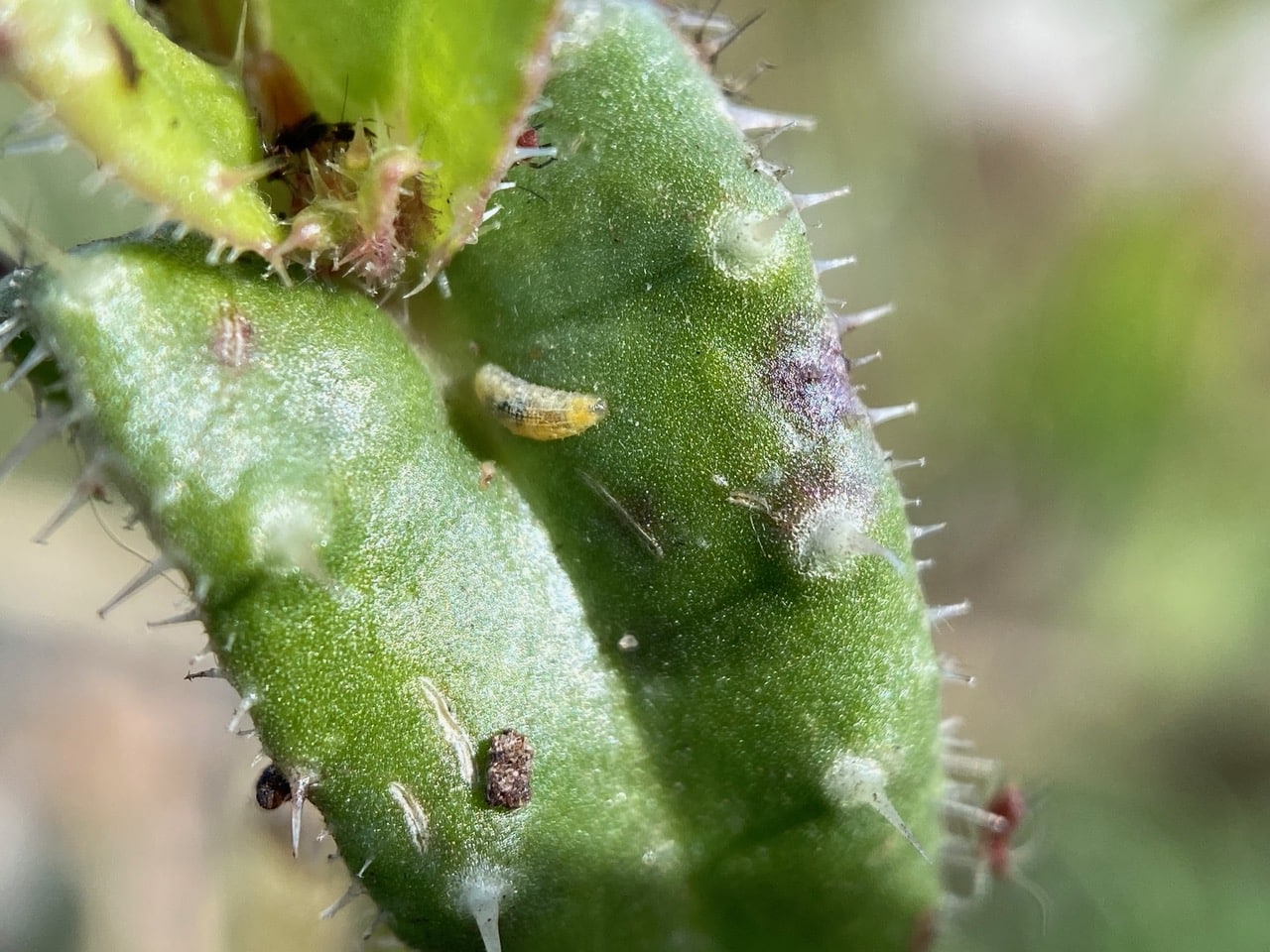
Barely a speck, a tiny Syrphid larva is resting on a leaf of Bristly Oxtongue. The larvae of many hover flies (family Syrphidae) are voracious predators of aphids. Females seek out aphid colonies to lay their eggs to ensure that their young would have plenty of food.
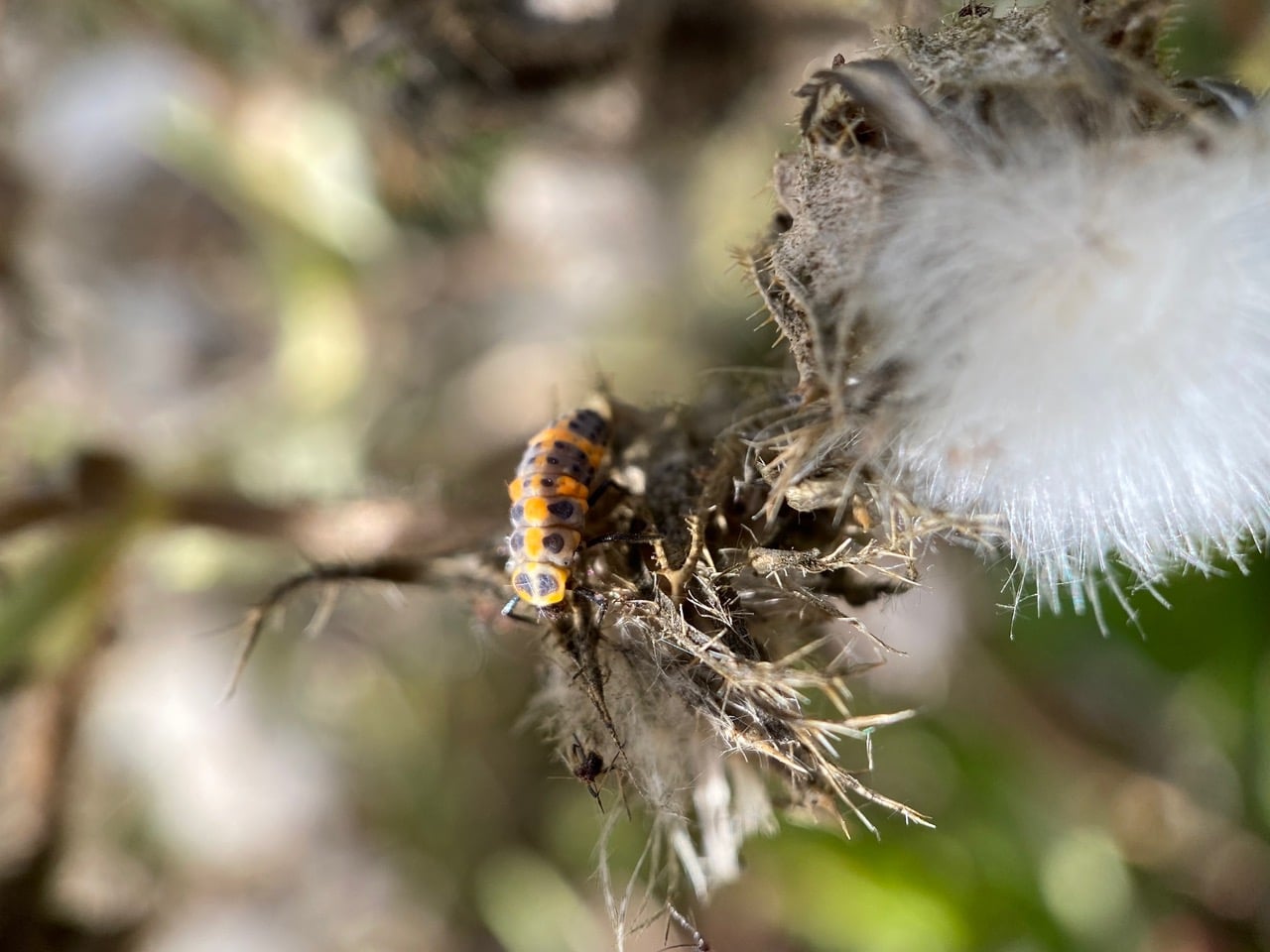
Ooh, here’s another aphid predator – a Lady Beetle larva (family Coccinellidae).

Hanging from a bract of a spent Bristly Oxtongue flowerhead, a Lady Beetle larva is feeding on an aphid.
Lady beetles go through complete metamorphosis, which comprises four stages: eggs, larva, pupa and adult. The larva goes through four molts during their development. Often described as miniature alligators with six legs, the larvae are voracious predators of aphids. Each larva can eat about 400 aphids in the three weeks before it pupates. Besides aphids, they also feed on soft scales, whitefly pupae, thrips, and spider mites.
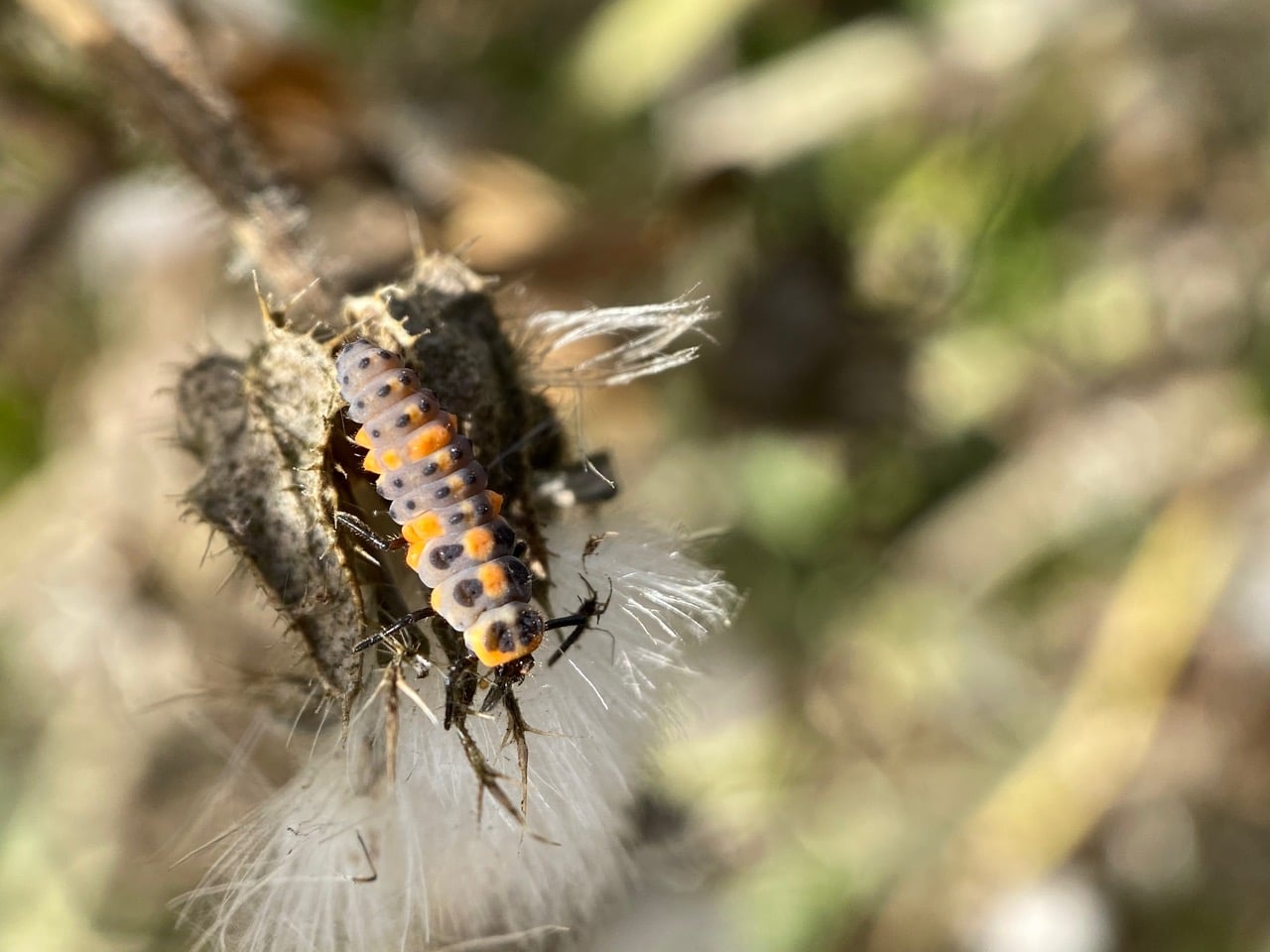
I think this is probably the larva of a different species of Lady Beetle. There are obviously more than one species on this plant.
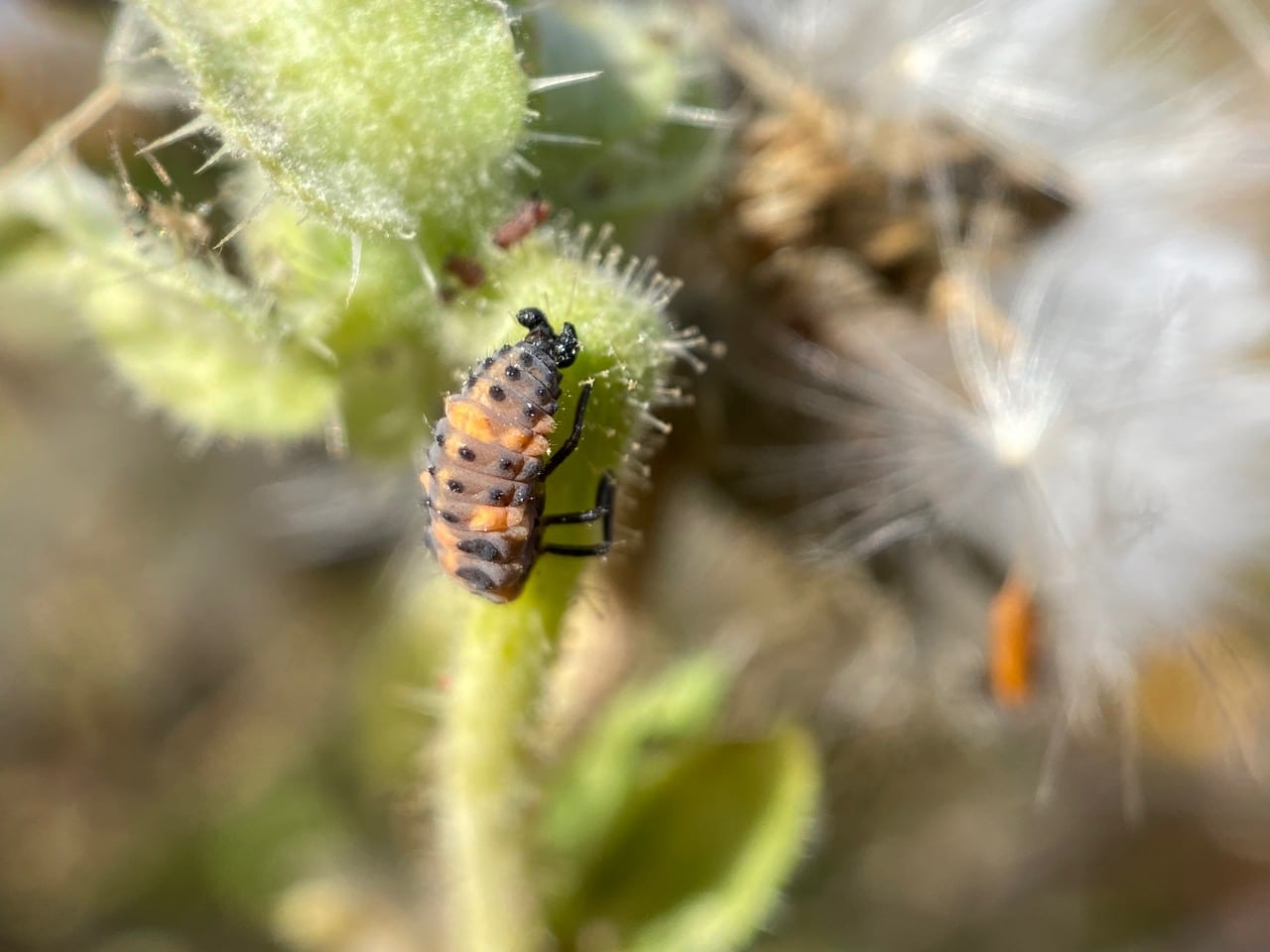
Here’s a larva that is getting ready to pupate! Hunched over head-down, it has attached its rear end to the leaf. Soon it will shed its larval skin and turn into a pupa.
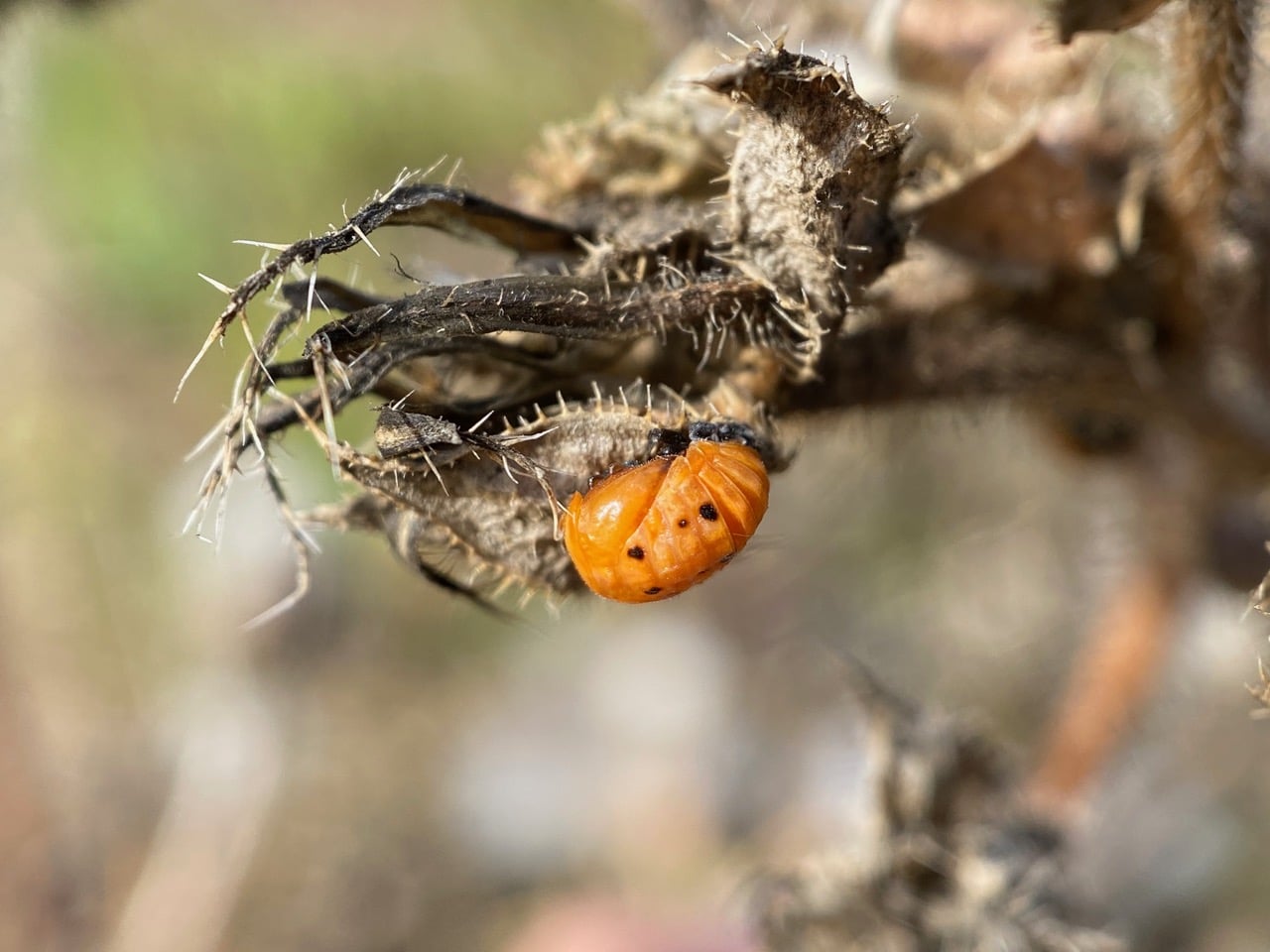
A Lady Beetle pupa is attached to a bract of a dried up flowerhead.
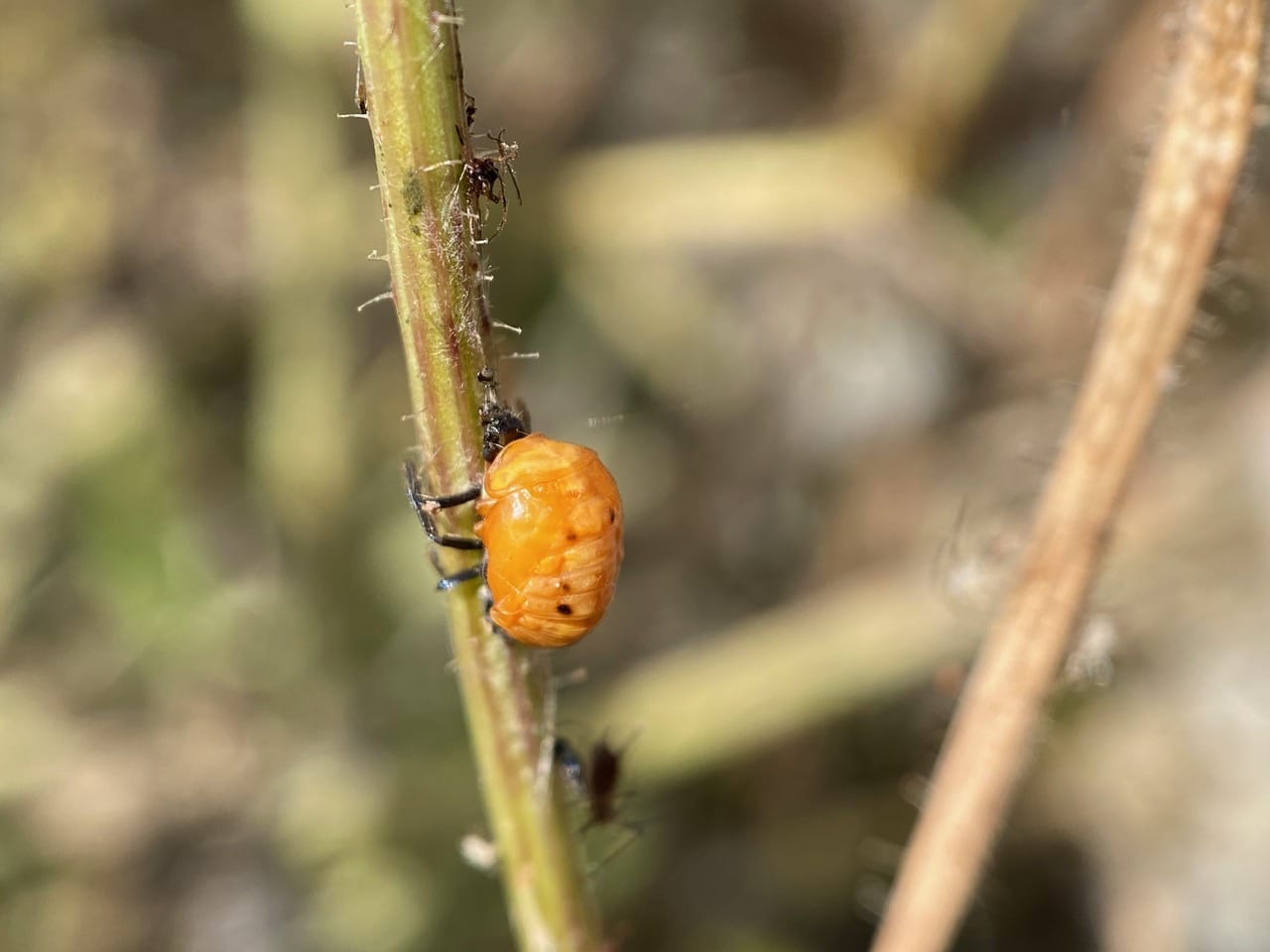
Why does this pupa seem to have legs and a black head?

Side view of the same pupa. Under the pupa, we can see the exuvia (shed exoskeleton) of the former larva that has been shed during its last molt.
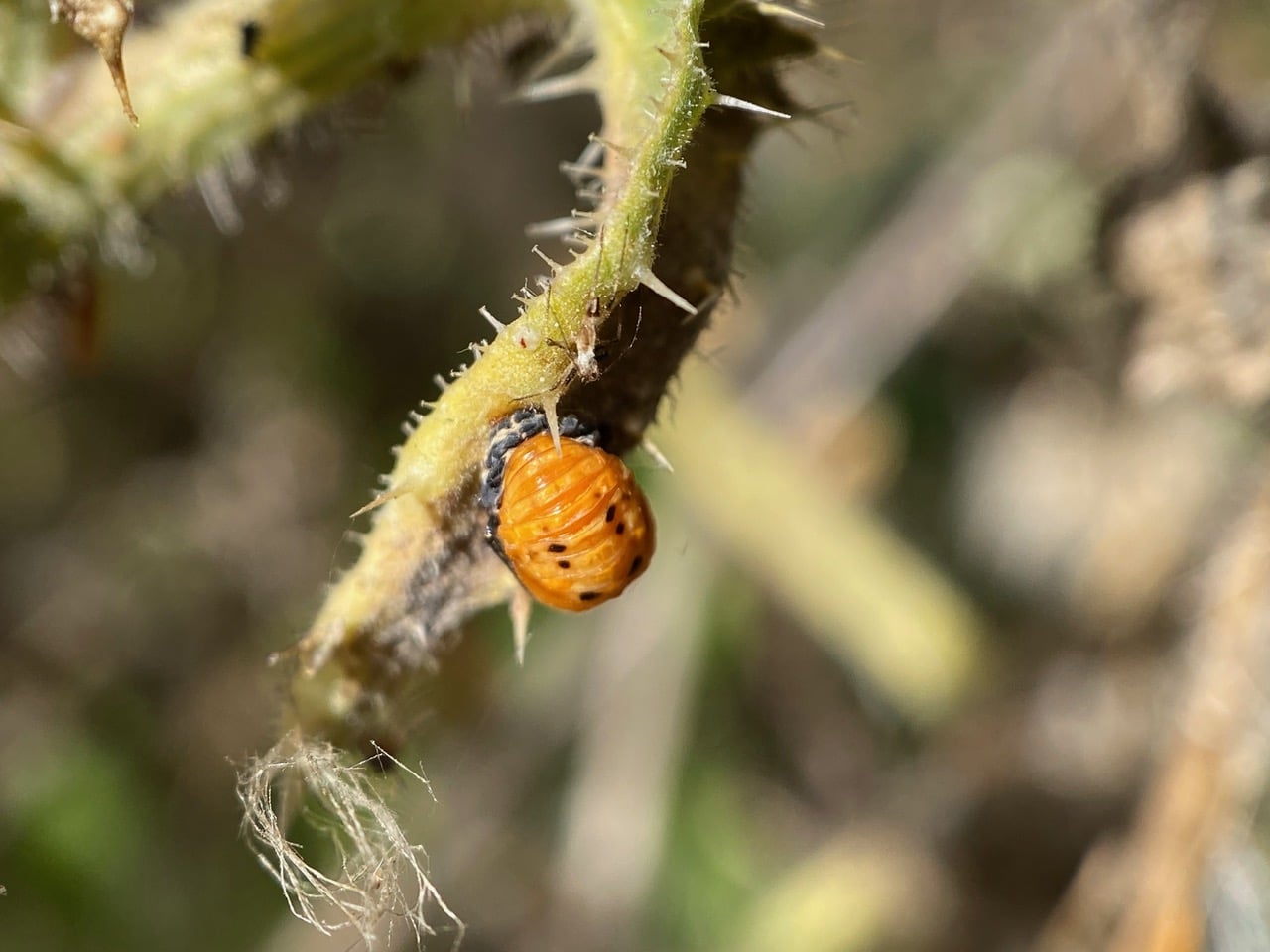
Rear end of a Lady Beetle pupa, attached to a leaf. See those grooves between the body segments? They make up a “gin trap” that serves a defensive function. Gin traps are essentially mouth-like elaborations of the clefts (grooves), flanked by heavily sclerotized margins fashioned as jaws. In the resting pupa, these jaws are held agape. But when the pupa is disturbed and thereby prompted to flex or rotate its abdomen, the jaws open and close in what is in effect a biting action. Experiments have shown that the pinching action of the gin traps are effective in deterring ants, major predators of the pupae.
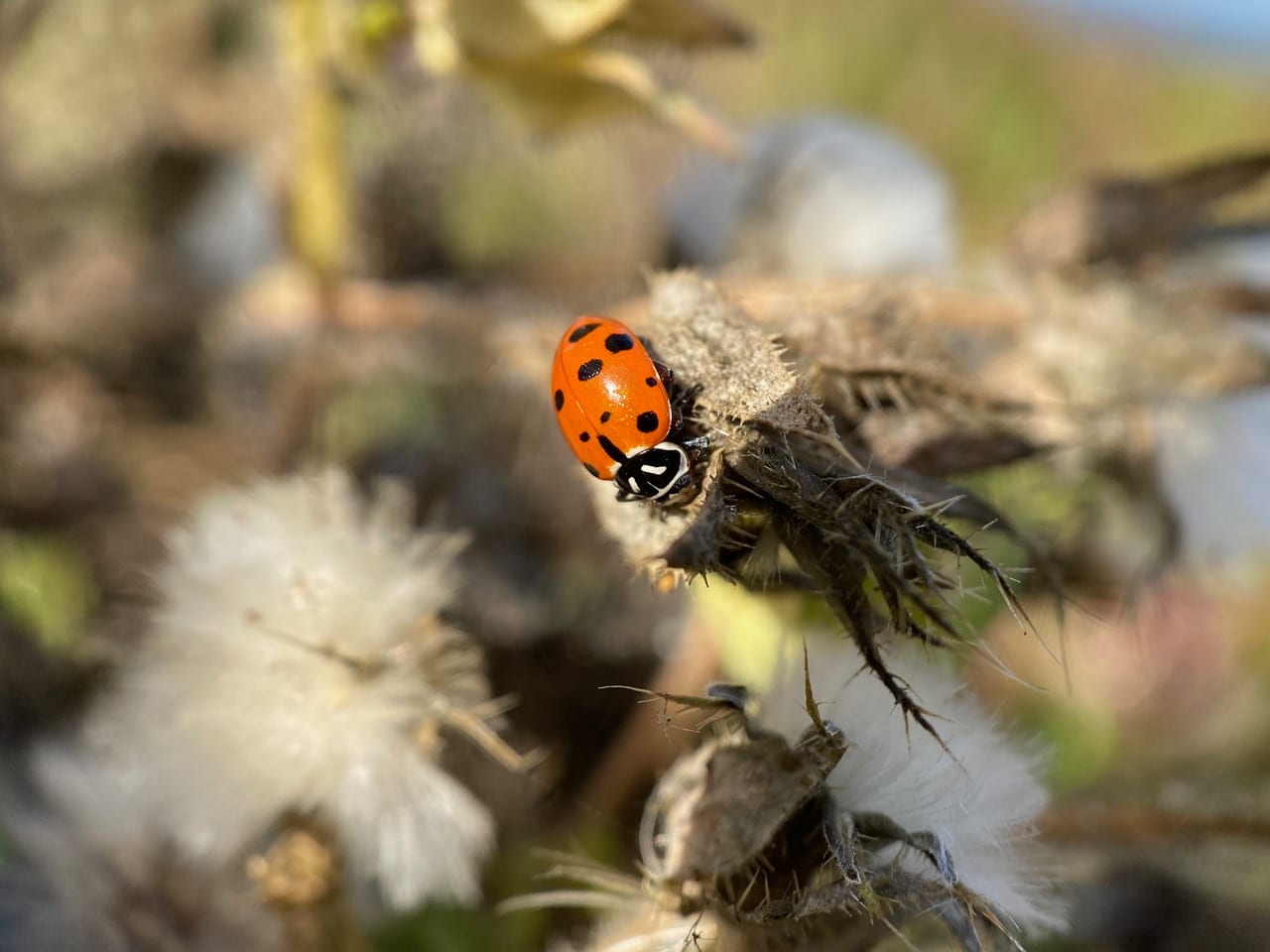
A Convergent Lady Beetle, Hippodamia convergens (family Coccinellidae) is basking in the morning sun on a dried flowerhead of Bristly Oxtongue. This native species is easily recognizable by the converging white lines on its pronotum. Number and size of the black spots on the elytra are variable; some individuals may be spotless.
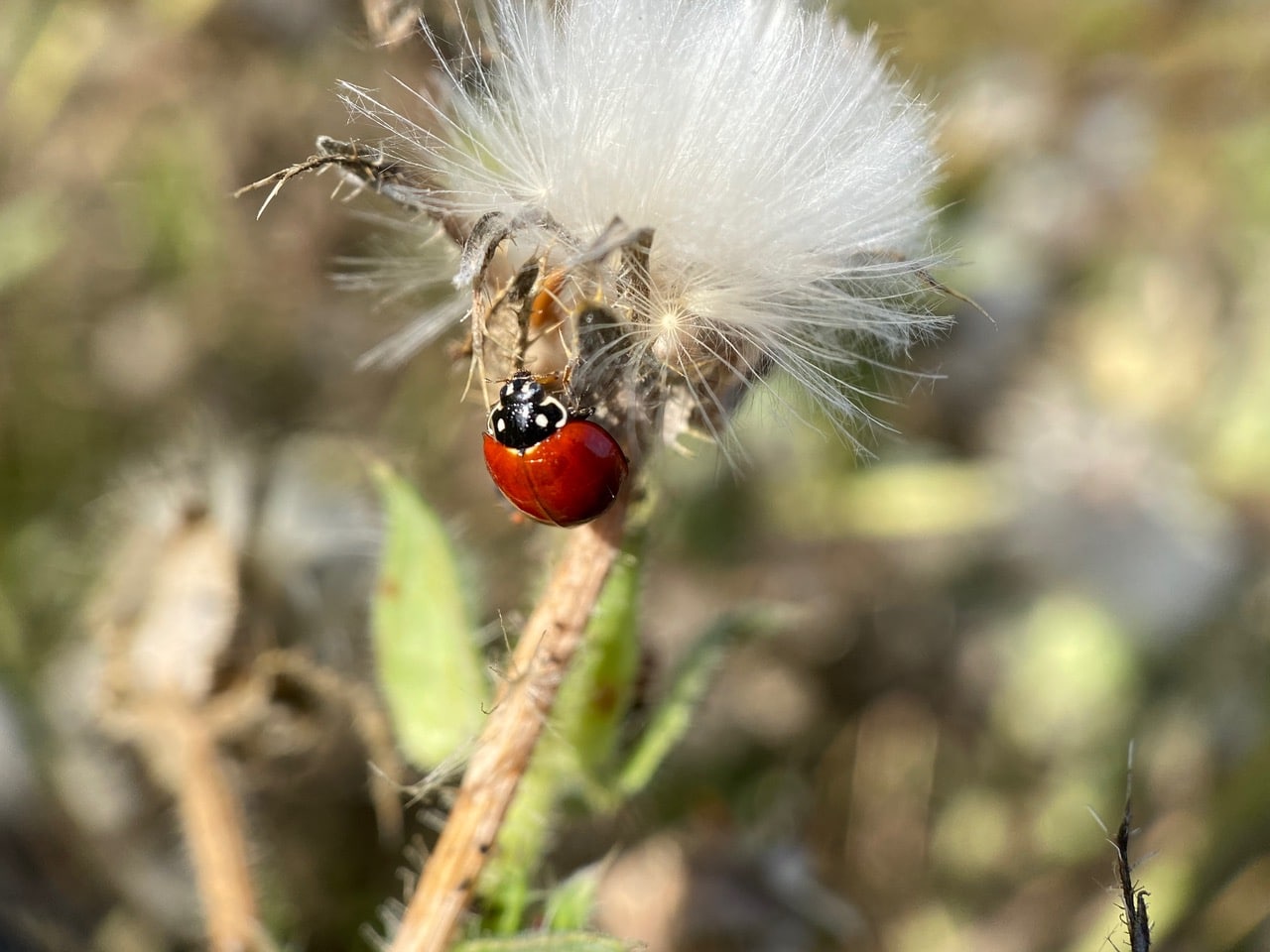
Hey, here’s a Spotless Lady Beetle, Cycloneda sanguinea (family Coccinellidae) under the fluffy plumes of a Bristly Oxtongue seed head. .

The Spotless Lady Beetle, Cycloneda sanguinea (family Coccinellidae) is a widespread species of lady beetle in the Americas. It is is large lady beetle with red, unspotted elytra (wing covers) ranging from 4-6.5 mm long. The black and white marks on the head and pronotum are very distinctive, and they are also gender-specific. These lady beetles are very often found feeding on aphids on milkweeds, but also occur on a number of other plants. Both adults and larvae are voracious predators of aphids and other soft-bodied insects.

As I look around the plant, I find a third species of Lady Beetle – the Pacific Five-spotted Lady Beetle, Hippodomia quinquesignata ssp. ambigua (family Coccinellidae). Wow, the aphids have attracted three different species of the predatory beetles! Whole life cycles of prey and predators are playing out on a single plant.
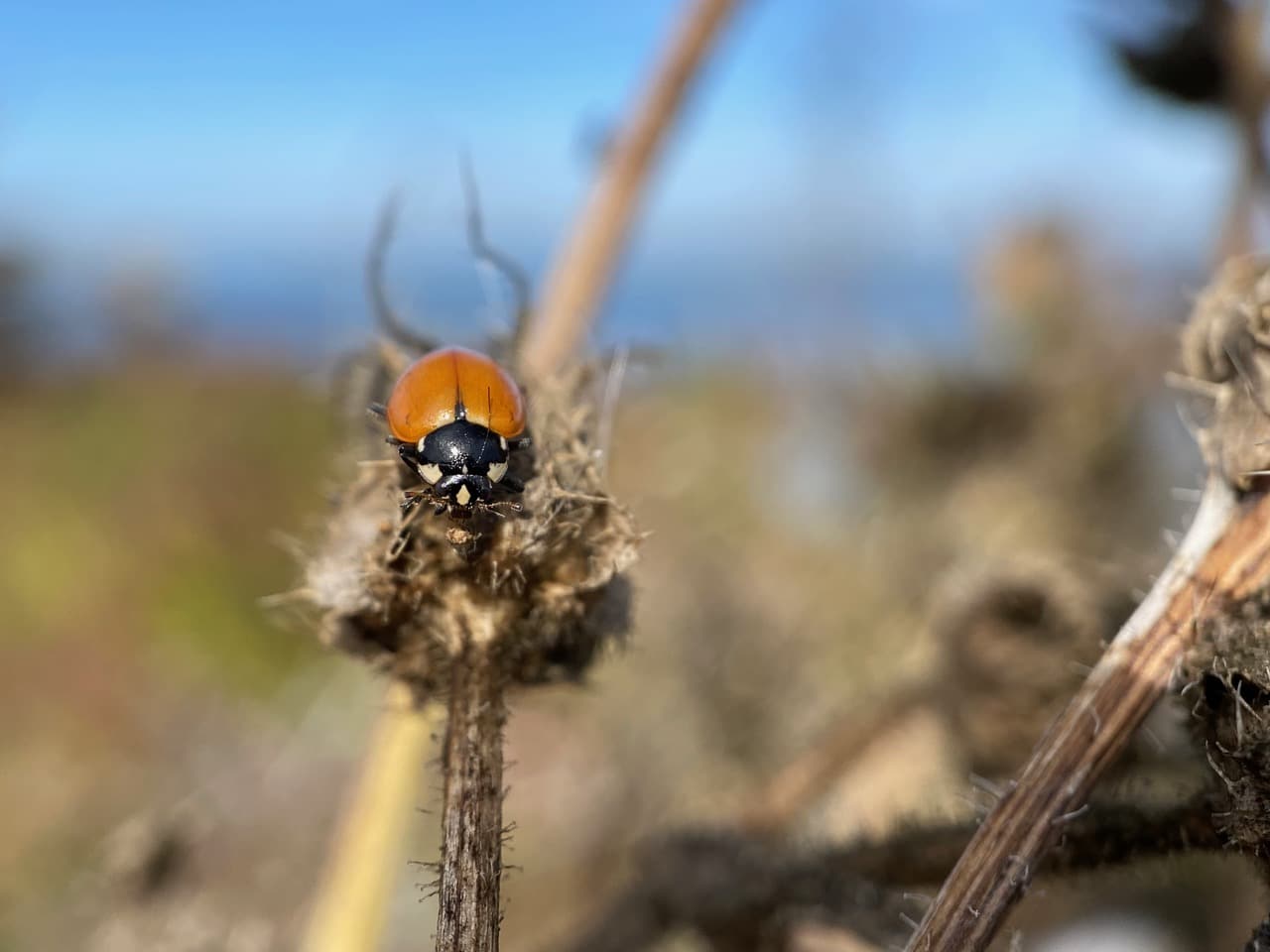
The Pacific Five-spotted Lady Beetle, Hippodomia quinquesignata ssp. ambigua (family Coccinellidae) is found in western North America. The name “five-spotted” is rather confusing. Elytral color pattern of this species is extremely variable, with some being completely spotless. What’s more, the pronotum may be with or without convergent pale spots.
 While still in bloom, the Telegraphweed, Heterotheca grandiflora growing in the drier section of the shoreline are already producing little pom-poms of fluffy seed heads. I am seeing more insect activity on these plants than ever before, perhaps because the Grindelia is fast losing its blooms.
  A Common Grass Skimmer, Paragus haemorrhous (family Syrphidae) is foraging on a Telegraphweed flowerhead.
The Common Grass Skimmer, Paragus haemorrhous (family Syrphidae) is easily the smallest hover fly I know, measuring only about 4 mm in length. The species has a world-wide distribution, found in unimproved grassland, dune grass, open areas and pathsides in forest, and meadows. Adults visit flowers for nectar and pollen. Larvae feed on aphids on low herbaceous plants.
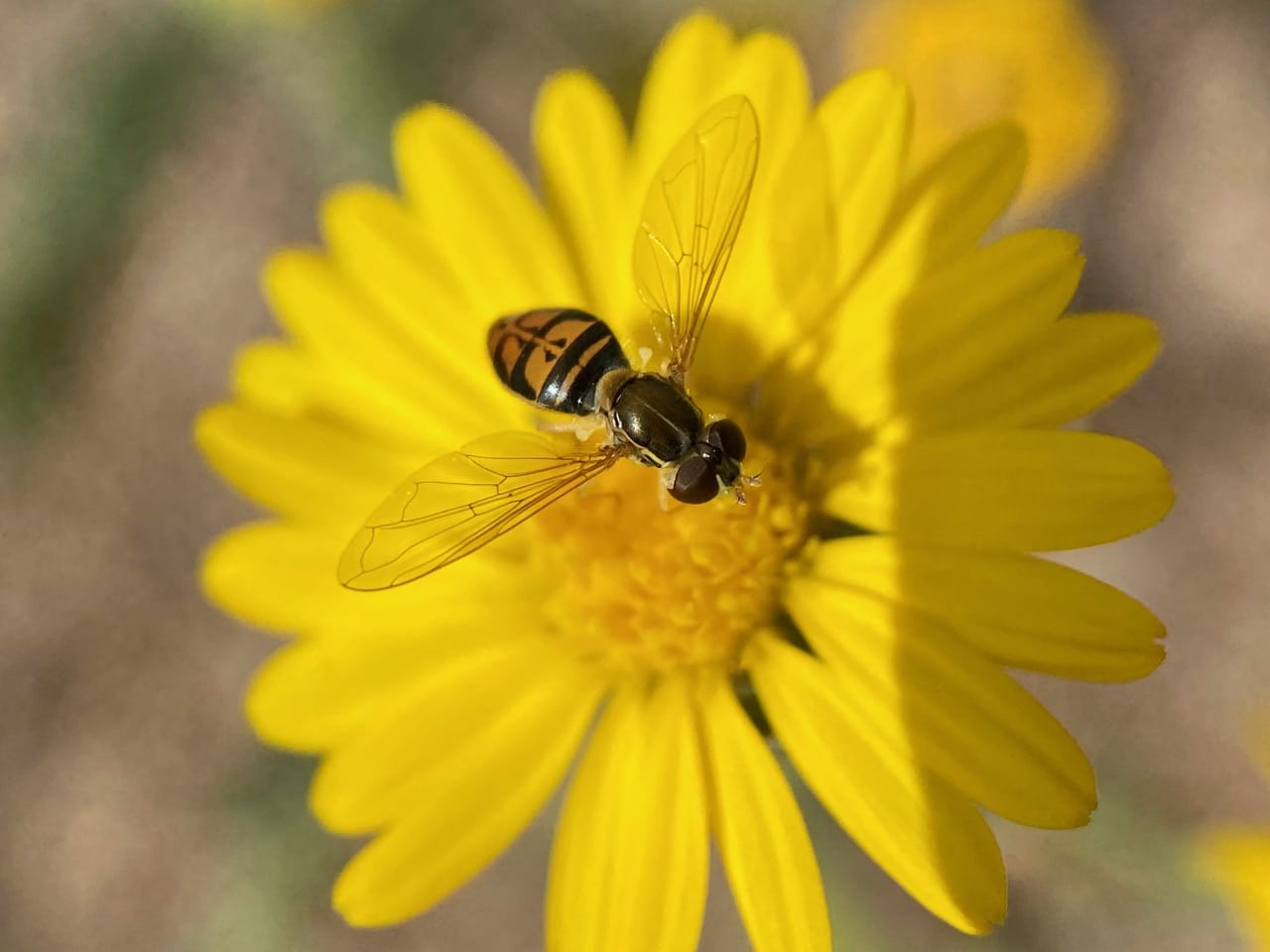
A Margined Calligrapher, Toxomerus marginatus (family Syrphidae) visits a Telegraphweed flowerhead.
Toxomerus marginatus, also known as the Margined Calligrapher is a common species of hoverfly found in North America. These are small hoverflies, measuring 5-6 mm in length. The abdomen is black and yellow, and is narrowly margined with yellow. Adults are found in diverse habitats such as forests, fields, meadows, marshes, deserts, and alpine areas. They are highly adaptable and can occur is very disturbed habitats. Larvae prey on aphids, thrips, mites, and small caterpillars. Adults visit flowers for nectar and pollen.
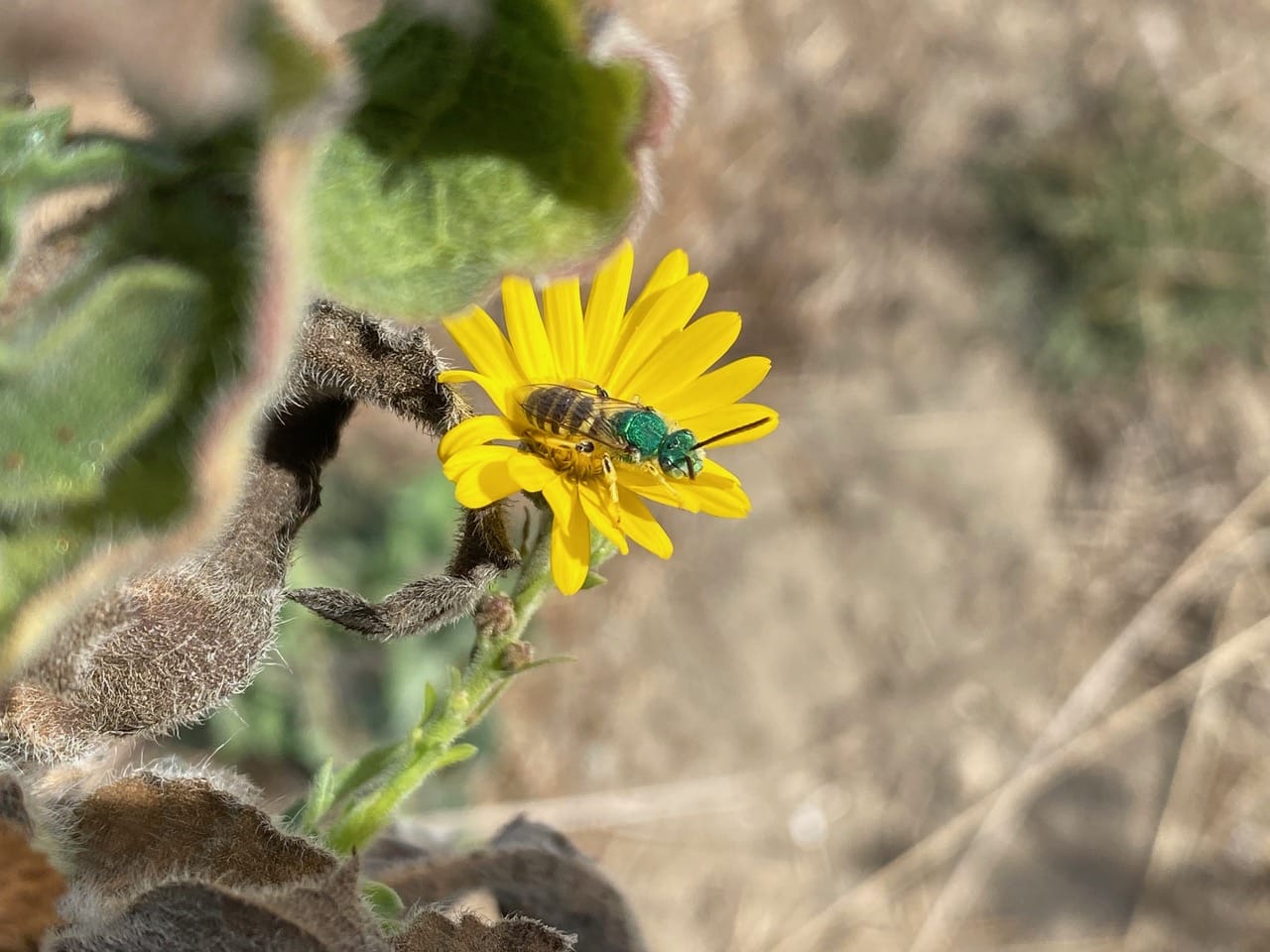
A male Texas Striped Sweat Bee, Agapostemon texanus (family Syrphidae) is using a Telegraphweed flowerhead as a perch from which to spot the females.
The genus Agapostemon is widespread and abundant throughout North America. These ground-nesting bees are most diverse and abundant in temperate regions and southwestern U.S. deserts. Agapostemon are commonly called “sweat bees” because they are closely related to, and resemble bees in the Halictus and Lasioglossum genera. Unlike those bees however, Agapostemon are not attracted to human sweat.
Agapostemon are brightly colored metallic green or blue bees measuring 7 to 14.5 mm long. Most species have a metallic green head and thorax, and black-and-yellow striped abdomen; some females are entirely bright green or blue. Females carry pollen on scopal hairs located on their hind legs. Agapostemon are generalists. Like other members of the family Halictidae, they are short-tongued and thus have difficulty extracting nectar from deep flowers. Males are often seen flying slowly around flowers looking for females. The bees favor flowers with high densities. They are active summer through fall.
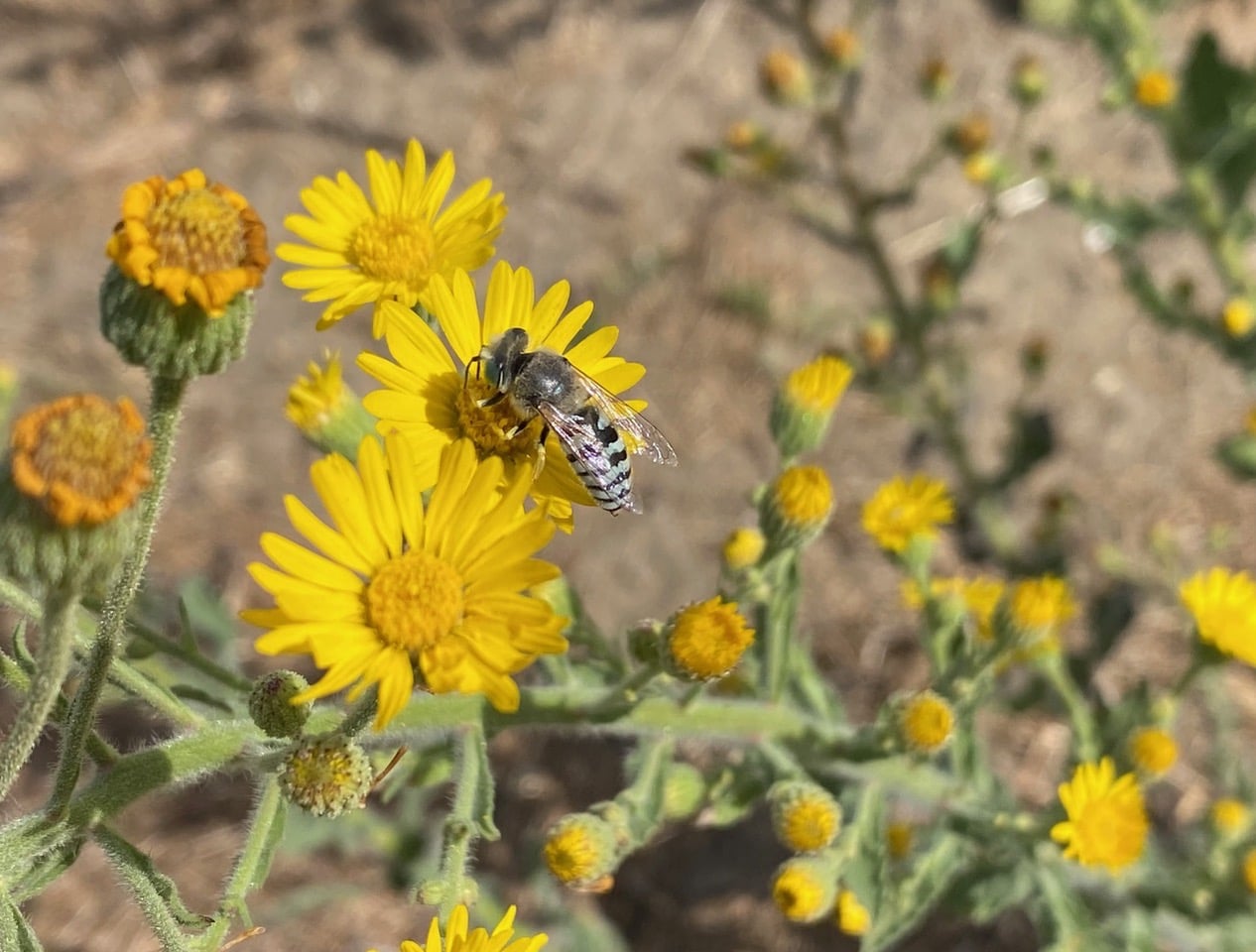
An American Sand Wasp, Bembix americana (family Crabronidae) is taking nectar from a Telegraphweed flowerhead.
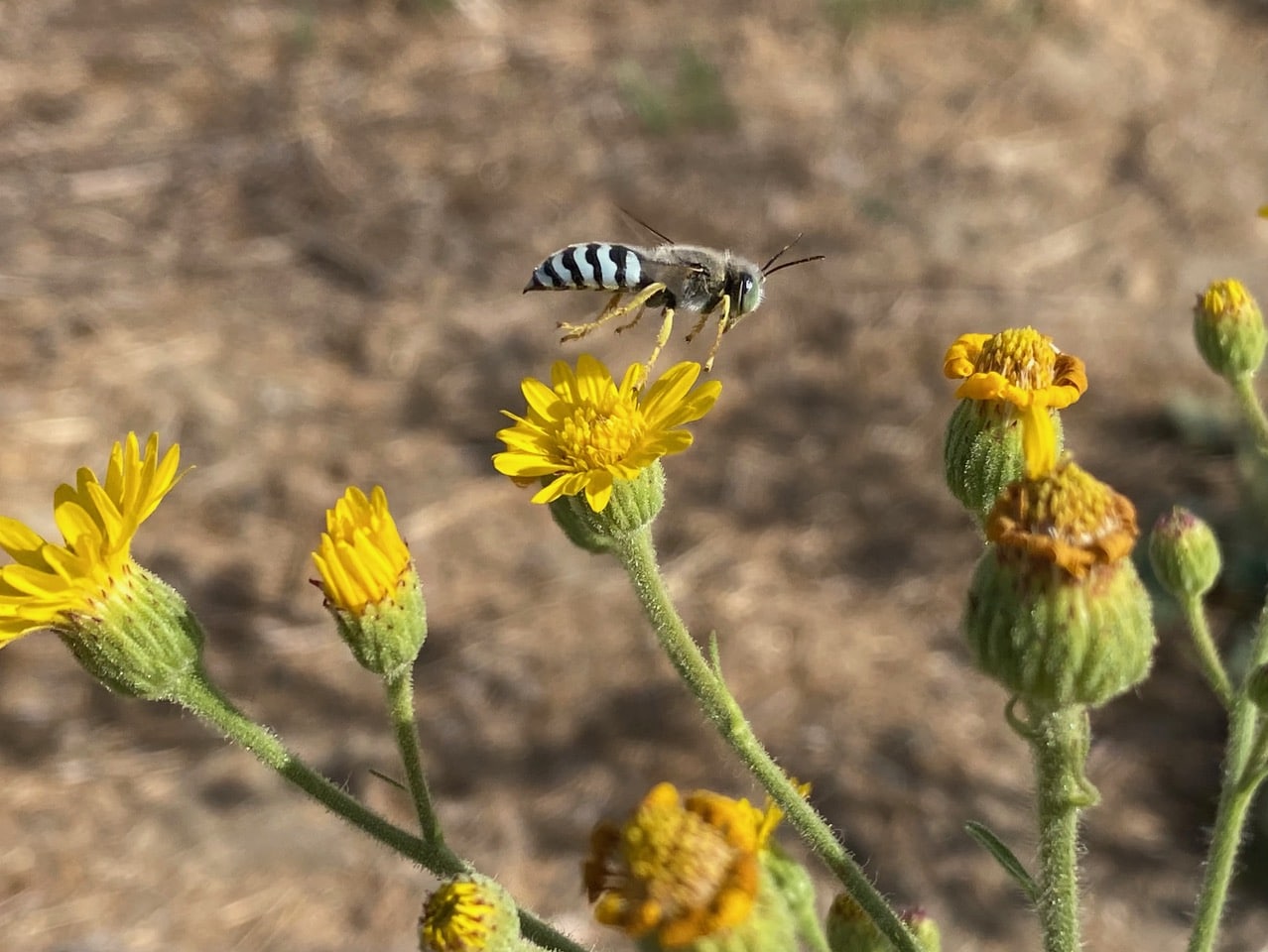
On to the next flowerhead!
Sand wasps in the genus Bembix are familiar and common throughout North America, digging their burrows in dunes, on beaches, and other habitats with loose, deep sand. The female rapidly kicks out large quantities of sand using a “tarsal rake” of spines on each front leg. The burrow is excavated before the wasp goes hunting. Bembix are generalist, opportunistic hunters. True flies in the order Diptera are the usual prey. A victim is paralyzed or killed by the wasp’s sting, and is then flown back to the nest. Most species will lay an egg on the first victim, while some species lay an egg in the empty cell before starting to hunt. Once the egg hatches, mama wasp brings flies to her larva as needed. This “progressive provisioning” is rare in the insect world. When the larva reaches maturity, mama wasp closes the cell. Inside, the larva spins an oblong cocoon, weaving sand grains into the structure and resulting in a hardened capsule. Overwintering takes place as a prepupa inside this cocoon, but there are usually two generations a year.
Male sand wasps often engage in an elaborate flight ritual called “sun dances”. Males emerge before females, and fly erratically at dizzying speed one or two inches above the ground attempting to detect virgin females about to emerge from their underground nests. Both sexes are often seen taking nectar at flowers, especially from Asteraceae family. Bembix wasps are often victims of other insects such as cuckoo wasps (Chrysididae), velvet ants (Mutillidae), satellite flies (Sarcophagidae), bee flies (Bombyliidae), and thick-headed flies (Conopidae).