

Pollinator Post 10/1/23

What a cutie! Our Pale Swallowtail caterpillar B2 has turned around on its home leaf on the Coffeeberry shrub to face the front, giving me a better look at its false eye-spots. The fake eyes are actually on the caterpillar’s thorax, not on its head. Its head is usually retracted under the bulging thorax.
Do caterpillars have eyes? Most caterpillars have six very simple eyes on each side of the head (making 12 in all), although some species have five or seven on each side. These light sensitive structures are called ocelli or stemmata. They probably only sense light and dark, and do not distinguish shapes or colors.
Caterpillars
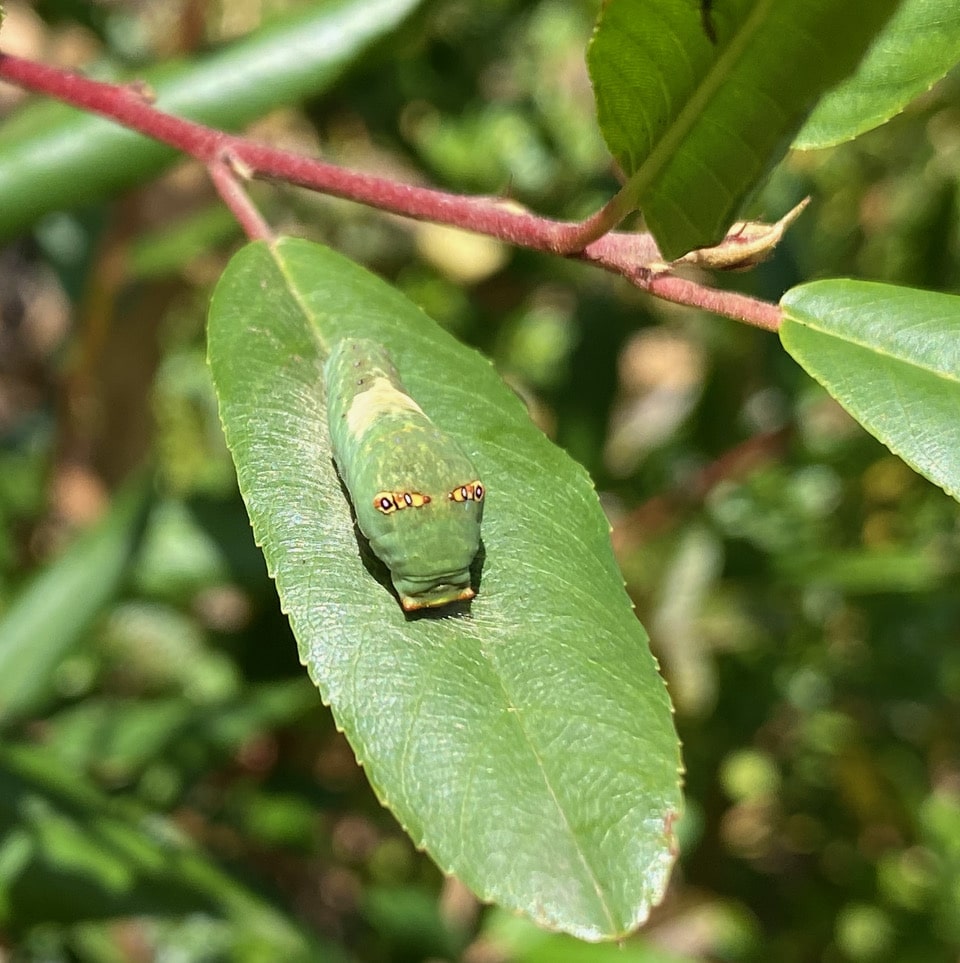



Swallowtail caterpillars (family Papilionidae) sport some of the biggest and most convincing fake eyes of any butterfly species in the world. These are adaptations that have evolved to give the caterpillar the appearance of being more threatening than it really is. Any bird, mouse or lizard looking for a quick meal will think twice before attacking the creature – it looks enough like a snake to scare off a predator.
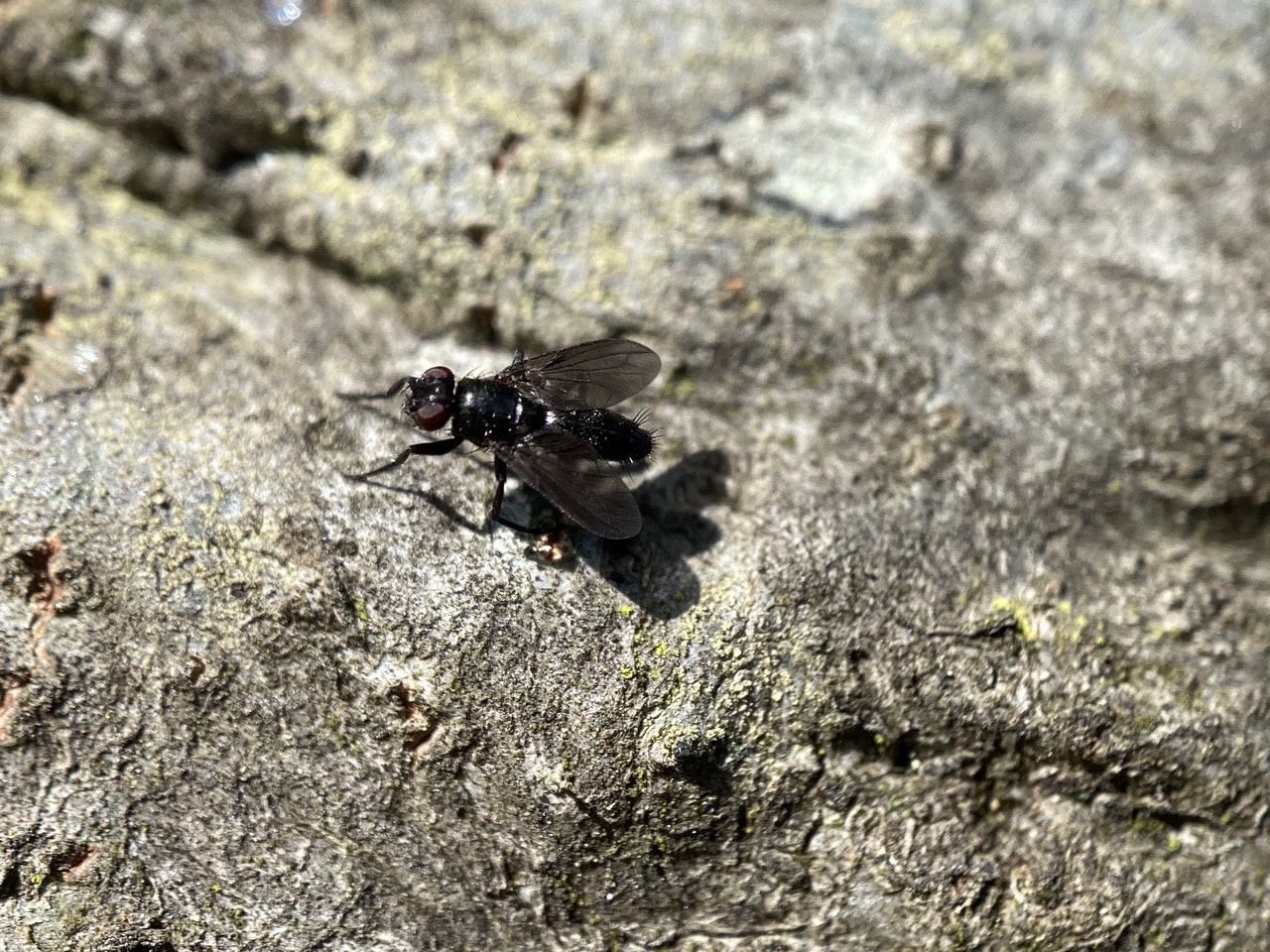
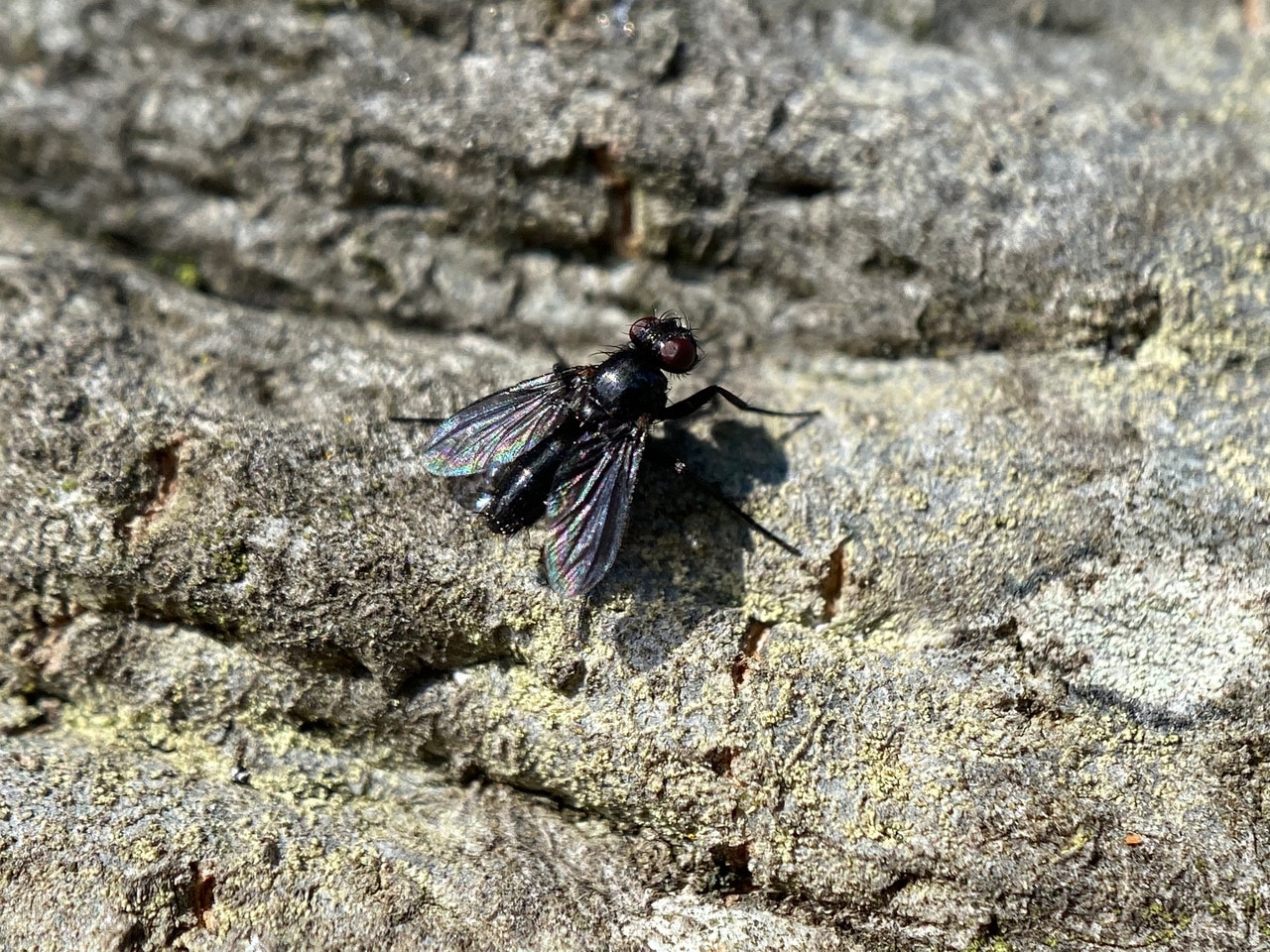
Pausing to rest on the bench under the oak tree beyond the Radio Tower, I notice insect movements at the base of an adjacent tree. About 20 glossy black insects are flitting restlessly around on the bark, landing quickly after each brief flight, appearing as if they are hopping instead of flying. They are the Smoky-winged Woodlouse Fly, Melanophora roralis (family Rhinophoridae). There must be a recent emergence of the flies. Rather surprising that they should emerge in such synchrony – as larvae they were internal parasitoids of woodlice (also known as sowbugs or roly-polies). Each fly has emerged from it own woodlouse host. I look for females that have a characteristic white mark on their wing tips, but can’t find any. These are all males? Are they here waiting for females?
This particular spot is under the shade of eucalyptus and oak trees, nurtured by prolific fog drip. The place is a good habitat for woodlice. I recall photographing them foraging on the inflorescences of California Goldenrod here last year.
Melanophora roralis is a species of woodlouse fly in the family Rhinophoridae. The fly is 3-5.5 mm long, black in color with hairy antennae and a shiny thorax. The species was introduced to North America from Europe. The flies inhabit old forests and damp areas near the shore. Females have a distinctive white spot at the tips of their wings. It is a parasite of the Woodlouse, Porcellio scaber.
Rhinophoridae are small, slender, black, bristly flies that are somewhat related to the Tachinidae. The larvae are mostly parasitoids of woodlice (pill bugs), beetles, spiders and other arthropods, and occasionally snails.

An Orbweaver Spider (family Araneidae) is resting head-down in the hub of its large orb web strung between a Poison Oak and Coyote Brush. There’s hardy anything trapped on the web, just a couple of tiny midges, hardly worthwhile for the spider to gather. This has been my observation lately – a marked scarcity of insect prey on the spider webs. The paucity of insects is having a rippling effect up the food chain.
An American Winter Ant is foraging on the female flowers of a Coyote Brush.
The American Ant, Prenolepis imparis is a widespread North American ant. A dominant woodland species, it is most active during cool weather, when most other ant species are less likely to forage. This species is one of a few native ants capable of tolerating competition with the invasive Argentine Ant, Linepithema humile. They are also aggressive toward other ants and produce abdominal secretions that are lethal to Argentine Ants. Prenolepis imparis is a generalist omnivore. Foragers are known for tending to aphids or scale insects from which they consume excreted honeydew, aggregating on rotting fruit, and exploiting protein-rich sources such as dead worms. The colony enters estivation (a hibernation-like state) and becomes inactive above ground for the warmer months, during which time eggs are laid and brood are reared. Reproductives overwinter and emerge on the first warm day of spring for their nuptial flight.
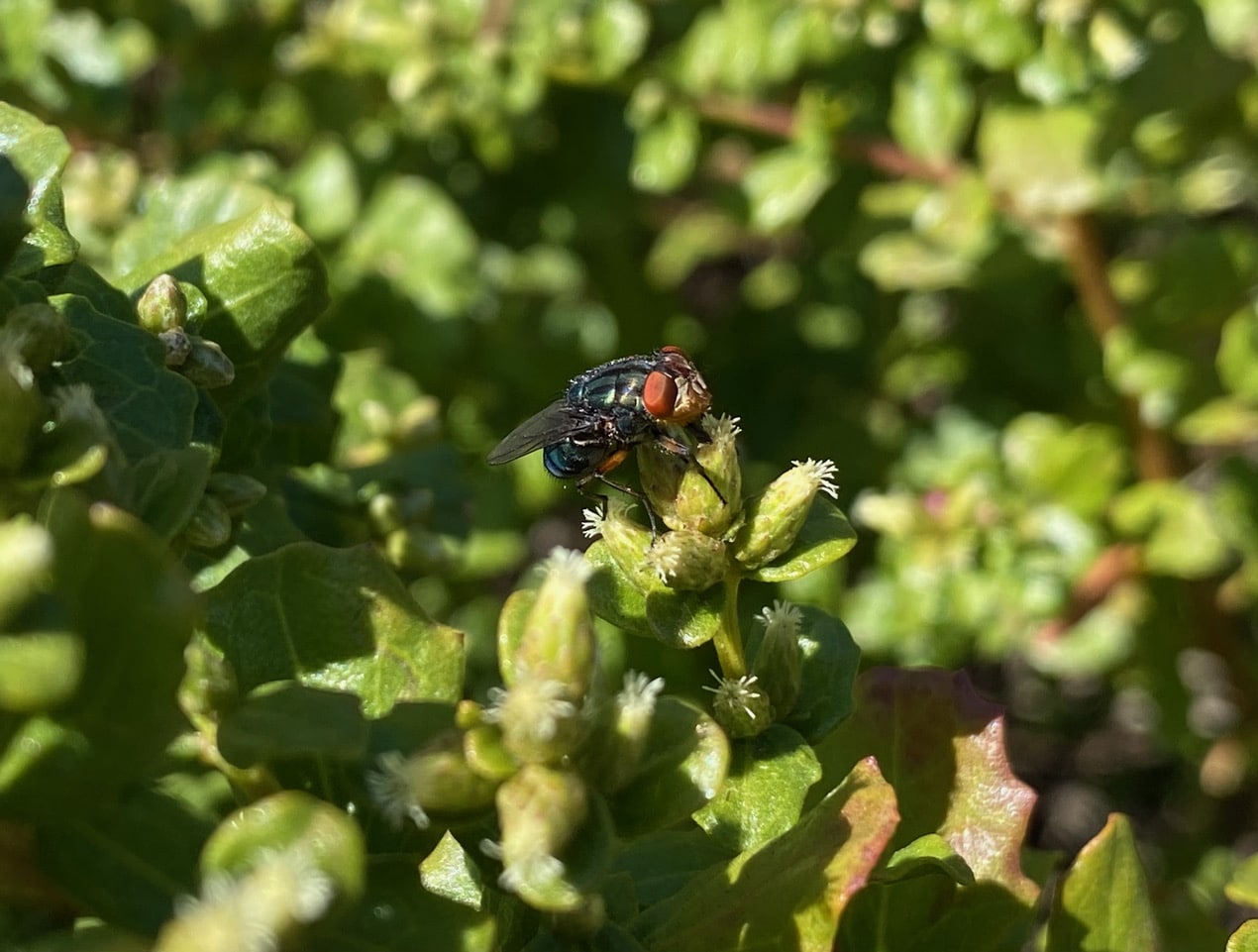
A Secondary Screwworm Fly, Cochliomyia macellaria (family Calliphoridae) is foraging on the female flowers of Coyote Brush.
The Secondary Screwworm, Cochliomyia macellaria (family Calliphoridae, commonly known as blow flies) ranges throughout the United States and the American tropics. The body is metallic greenish-blue and characterized by three black longitudinal stripes on the dorsal thorax. Females are attracted to carrion where they lay their eggs. These screwworms are referred to as “secondary” because they typically infest wounds after invasion by primary myiasis-causing flies. While the flies carry various types of Salmonella and viruses, C. macellaria can also serve as important decomposers in the ecosystem. In a lifetime, a female may lay up to 1000 or more eggs. Females may also lay their eggs with other females, leading to an accumulation of thousands of eggs. The larval stage of C. macellaria is referred to by the common name of secondary screwworms; this is due to the presence of small spines on each body segment that resemble parts of a screw. The larvae feed on the decaying flesh of the animal that they have been laid on until they reach maturity. Eventually the larvae fall off the food source to pupate in the top layer of the soil. Adult females will continue to feed on tissues of animals; however, now they preferentially feed off of live tissues and tissue plasma. Adult males will no longer consume tissue, but instead will eat nearby vegetation and take nourishment from floral nectar.
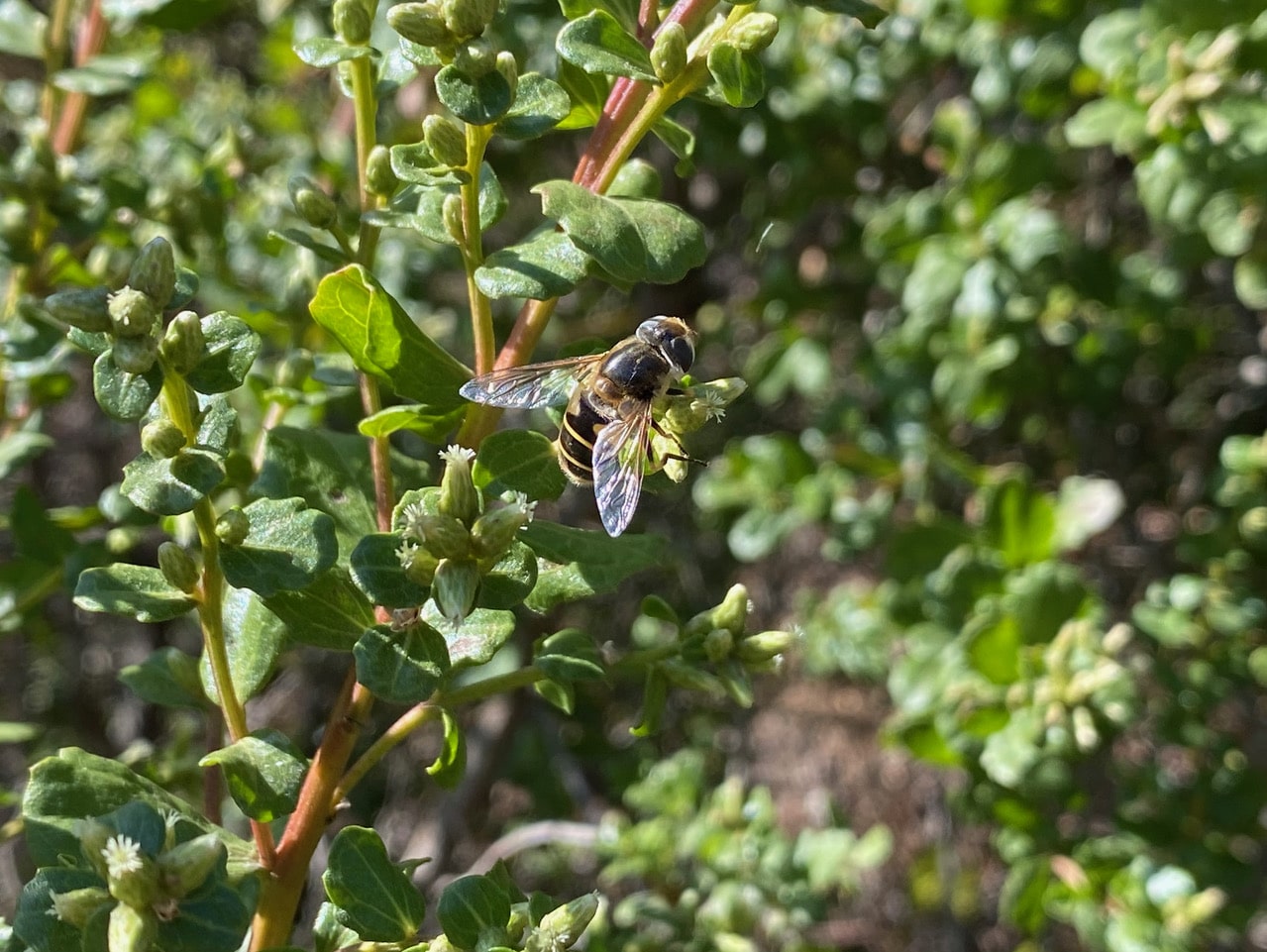
The Black-footed Drone Fly, Eristalis hirta (family Syrphidae) is a common Western North American species of hoverfly. The adults visit flowers for nectar and pollen. Larvae are aquatic filter-feeders of the rat-tailed type.
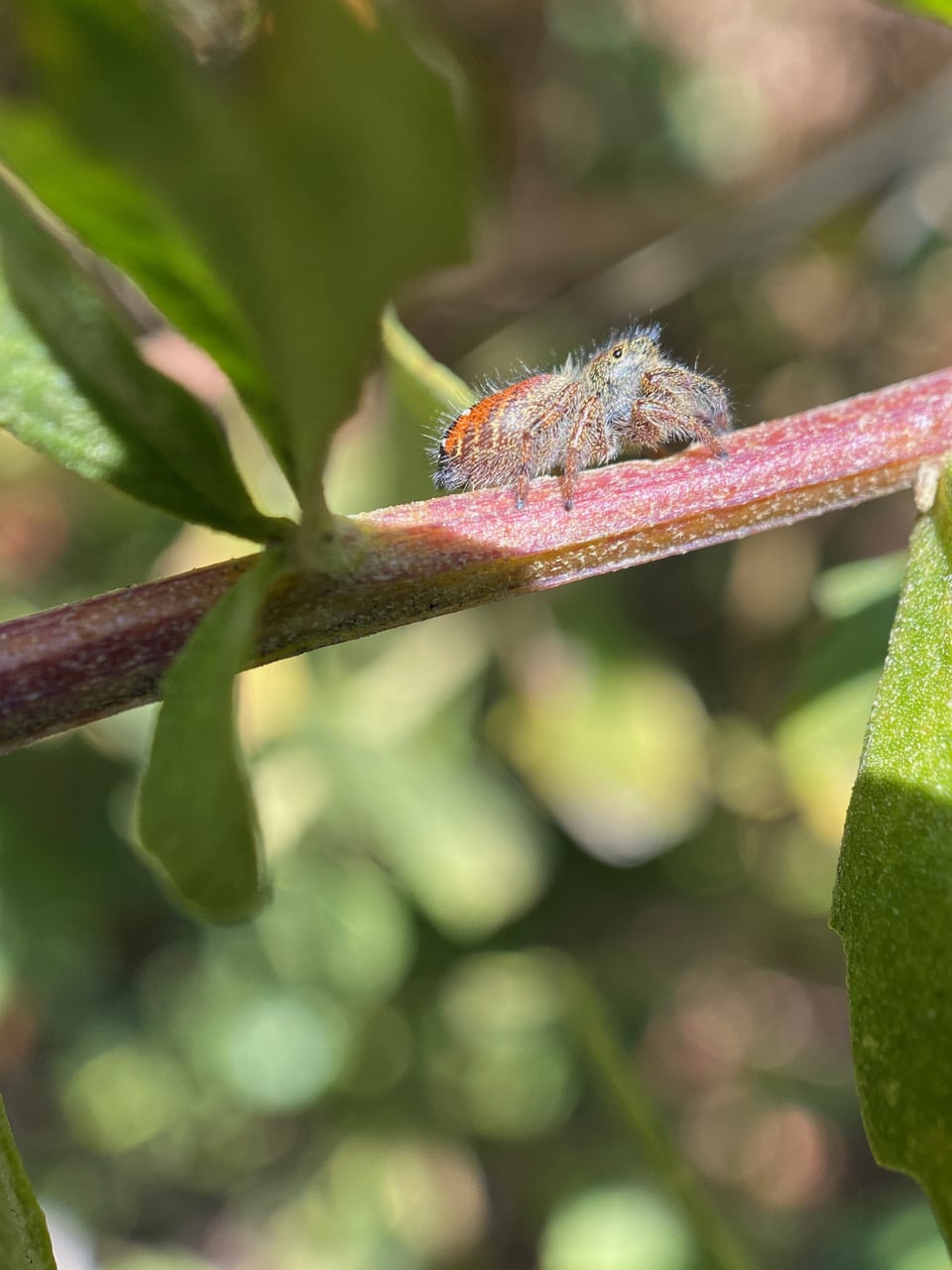
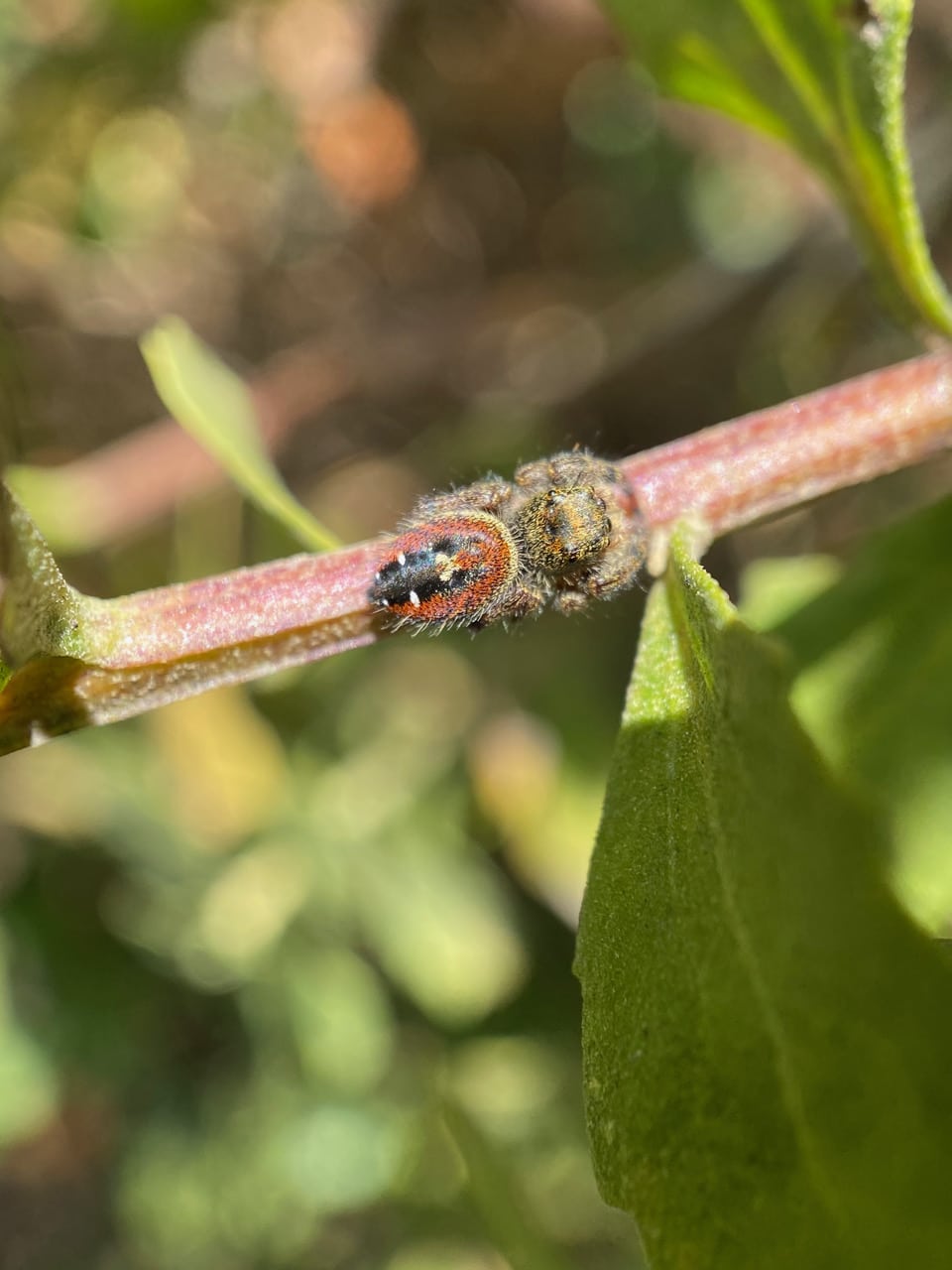
A female Red-backed Jumping Spider, Phidippus johnsoni (family Salticidae) is hunting on a Coyote Brush.
It is easy to tell the sexes apart in P. johnsoni. The males have all-red abdomens.
Salticids are free-roaming hunting spiders. They do not weave a web to catch prey. They stalk, then pounce on their prey. Just before jumping, the spider fastens a safety line to the substrate. It can leap 10-20 times their body length to capture prey. Their movement is achieved by rapid changes in hydraulic pressure of the blood. Muscular contractions force fluids into the hind legs, which cause them to extend extremely quickly.
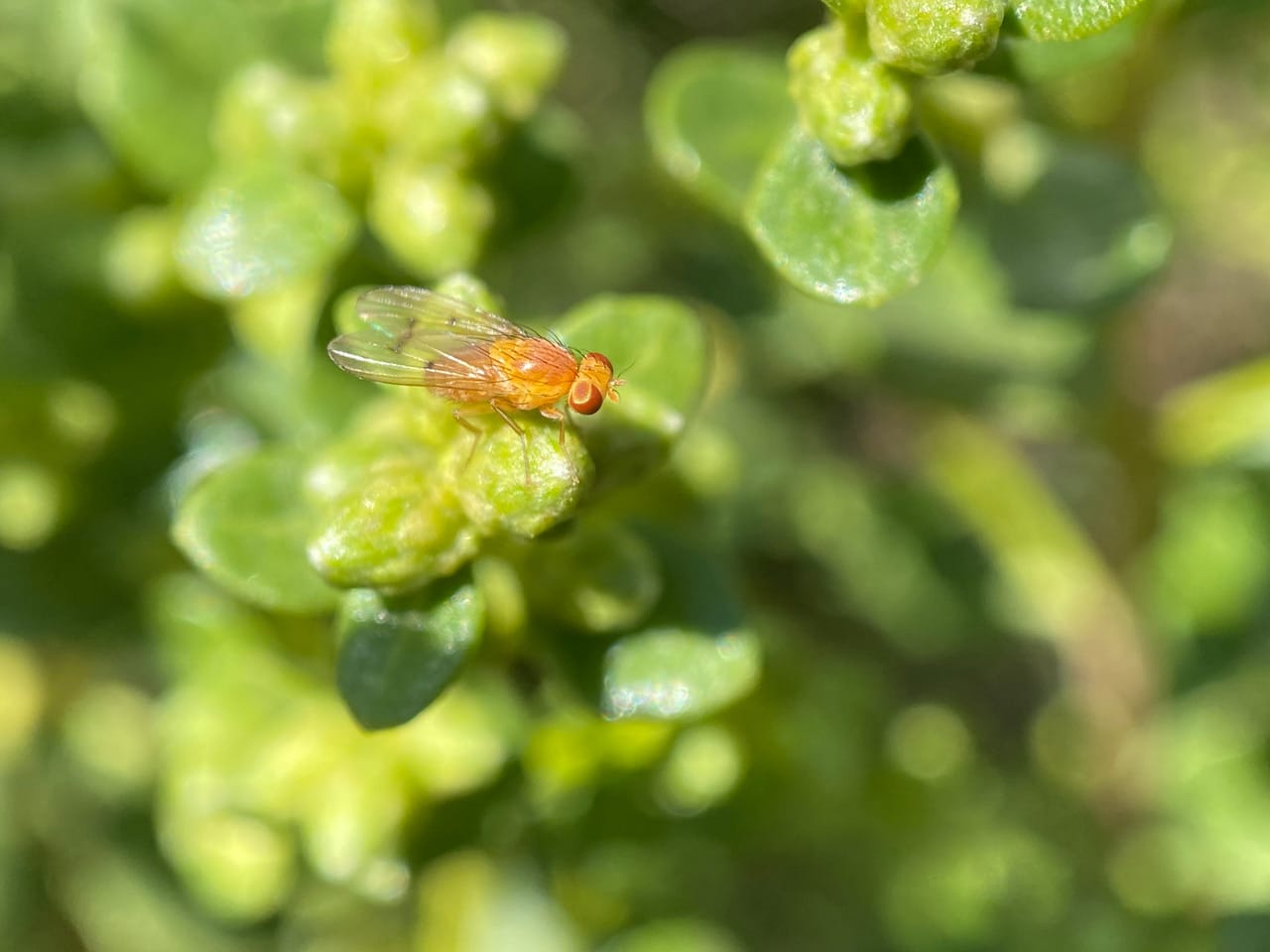
A Lauxaniid Fly (family Lauxaniidae) is perched on the immature flowerheads of Coyote Brush.
Lauxaniidae are small flies (2-7 mm in length). They are often rather plump and dull, the body color varying from yellow-brown to black, or with a combination of these colors. They are characterized by strong, backward pointing bristles on the front (top of the head right above the eyes). The larvae are mostly saprophages, feeding in leaf litter, soil, bird nests, etc. Larvae of some mine fallen leaves, others live in rotten wood.
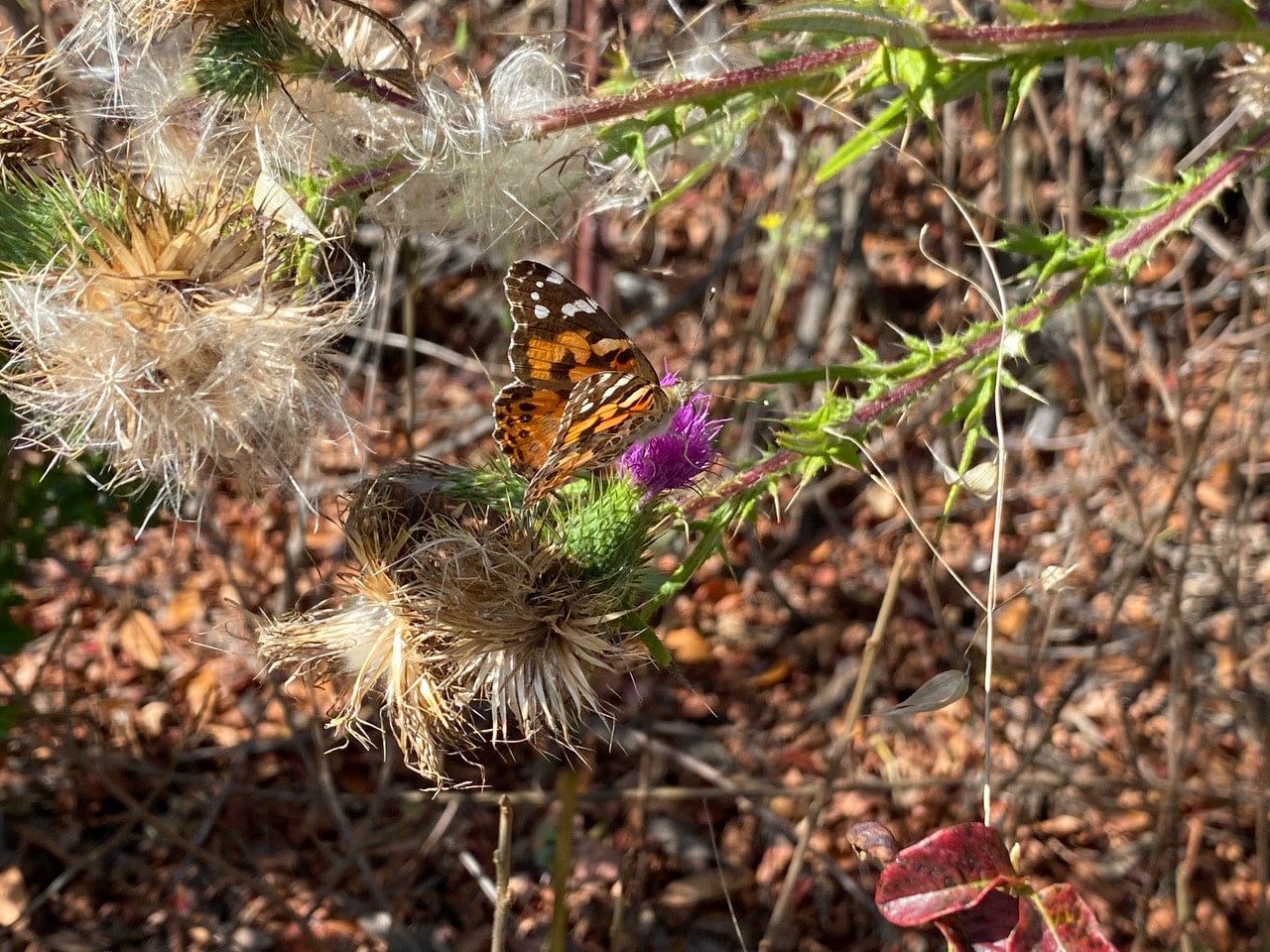
A Painted Lady butterfly, Vanessa cardui (family Nymphalidae) is taking nectar from one of the very last flowerheads of Bull Thistle, Cirsium vulgare.
The Painted Lady, Vanessa cardui (family Nymphalidae) is the most widespread of all butterflies. They are found on every continent except Antarctica and Australia. The butterfly also goes by the name thistle butterfly; its scientific name Vanessa cardui means “butterfly of thistle”. Although more than 100 host plants have been recorded for the species, the caterpillars’ favorites include thistles (Asteraceae), hollyhock and mallow (Malvaceae), and various legumes (Fabaceae).
Female Painted Lady butterflies lay eggs singly on the upper side of host plant leaves, sometimes on the thistle flowerheads. When small the caterpillars live for most of the time within a tent of leaves loosely spun together with silk. Only when larger are the larvae more likely to be found feeding outside a leaf tent on the food plant.
Painted Lady butterflies are known for their distinct migratory behavior. They are an irruptive migrant, meaning that they migrate independently of any seasonal or geographical pattern. The populations that migrate from North Africa to Europe may include millions of butterflies. The distance covered rivals that of the better known Monarch butterflies. The butterflies can cover up to 100 miles per day during their migration; the round trip may take up to 6 successive generations.
In California, the butterflies are usually seen flying from north to north-west. These migrations appear to be partially initiated by heavy winter rains in the desert where rainfall controls the growth of larval food plants. In the spring of 2019, the butterflies migrated by the millions across the state.
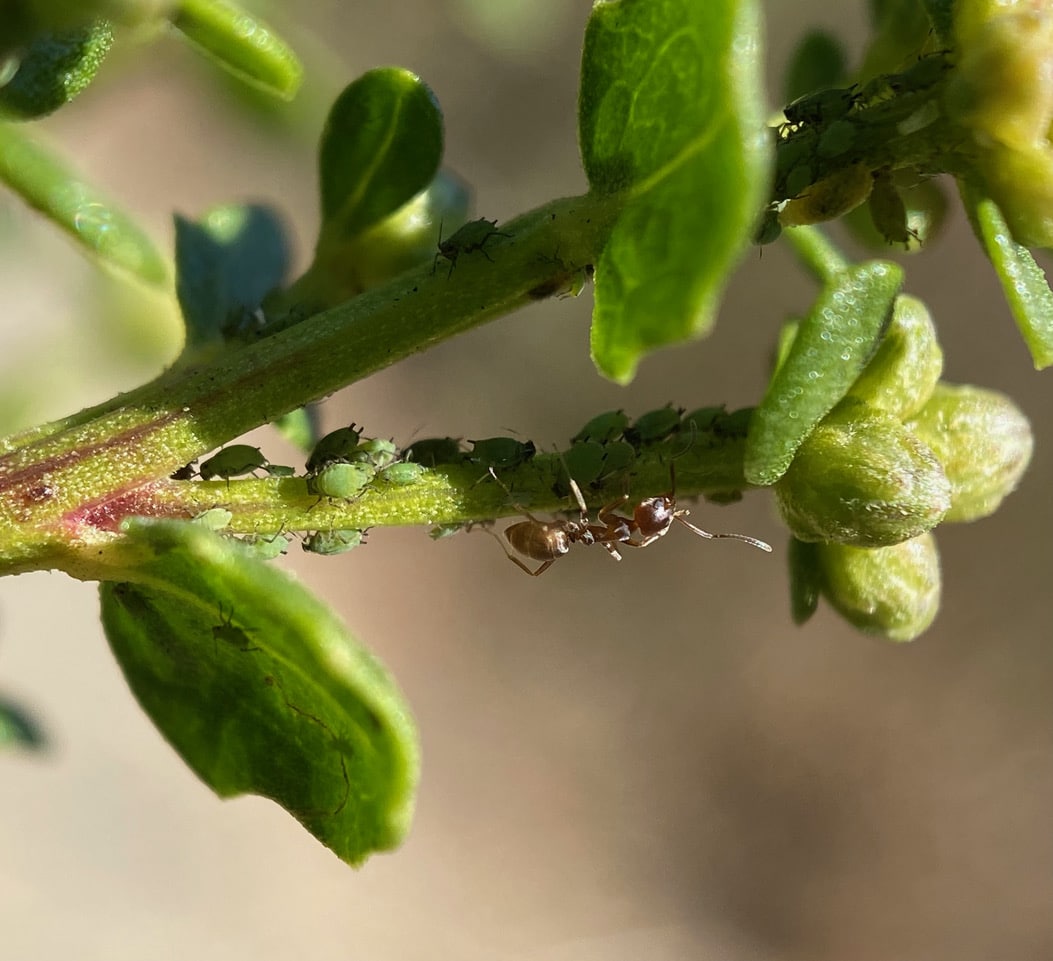
A small colony of green aphids have established themselves on a couple of terminal branches of a large Coyote Brush, Baccharis pilularis. The aphids are being tended by some Argentine Ants, Linepithema humile (family Formicidae).
Ants and aphids share a well-known mutualistic relationship. The aphids produce honeydew, a sugary food for the ants; in exchange, the ants care for and protect the aphids from predators and parasites. Some ants will “milk” the aphids to make them excrete the sugary substance. The ants stroke the aphids with their antennae, stimulating them to release the honeydew. Aphid-herding ants make sure the aphids are well-fed and safe. When the host plant is depleted of nutrients, the ants carry their aphids to a new food source. If predatory insects or parasites attempt to harm the aphids, the ants will defend them aggressively. Some species of ants continue to care for aphids during winter. The ants carry the aphids to their nest for the winter months, and transport them to a host plant to feed the following spring.
The Argentine Ant, Linepithema humile (family Formicidae) is native to Northern Argentina, but it has been inadvertently introduced by humans to many countries, and is now an established invasive species in many Mediterranean climate areas worldwide. The success of the species can be attributed to their lack of aggression between the colonies. There is no apparent antagonism between separate colonies of its own kind, resulting in “super-colonies” that extend across hundreds or thousands of kilometers in different parts of the their range. Genetic, behavioral, and chemical analyses show that introduced Argentine Ants on separate continents actually represent a single global supercolony.
The Argentine Ants are ranked among the world’s worst invasive animal species. In its introduced range, the Argentine ant often displaces most or all native ants and can threaten native invertebrates and even small vertebrates that are not accustomed to defending against the aggressive ants. This can, in turn, imperil other species in the ecosystem, such as native plants that depend on native ants for seed dispersal, or lizards that depend on native ants for food.
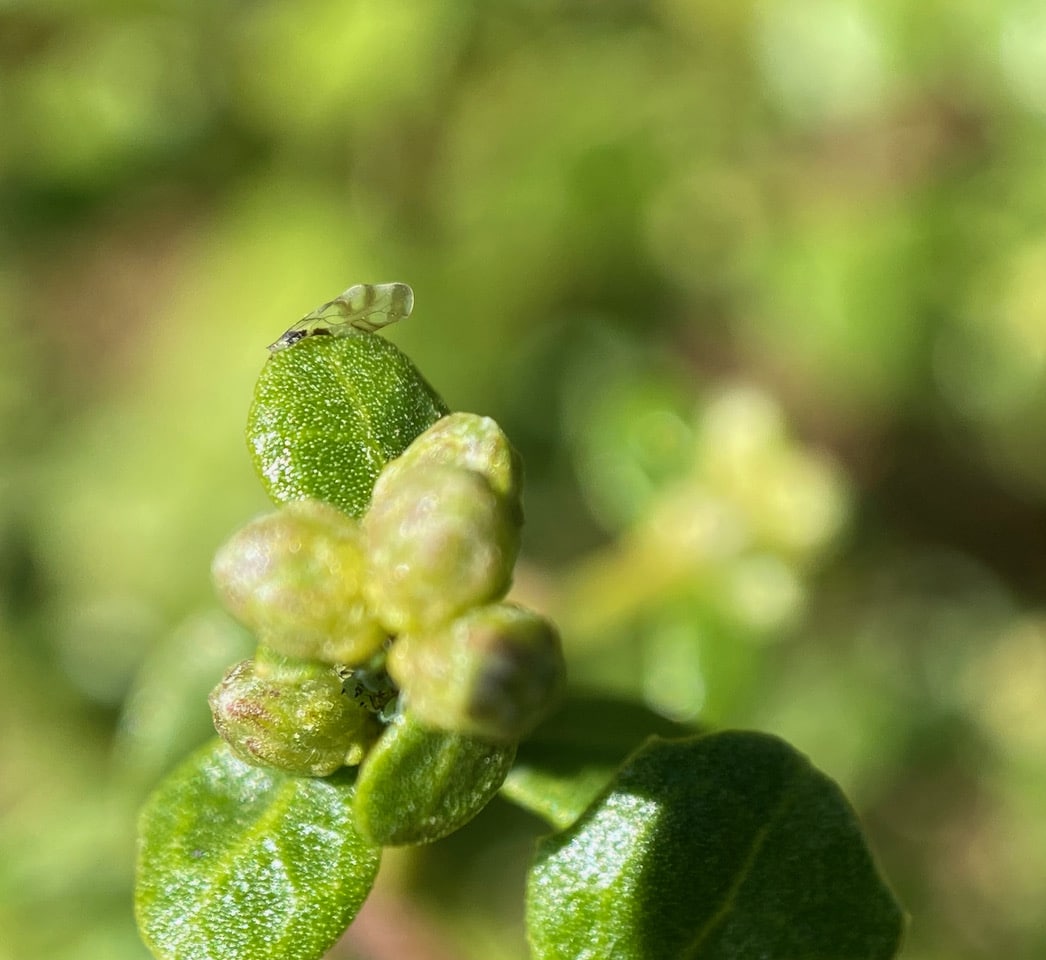
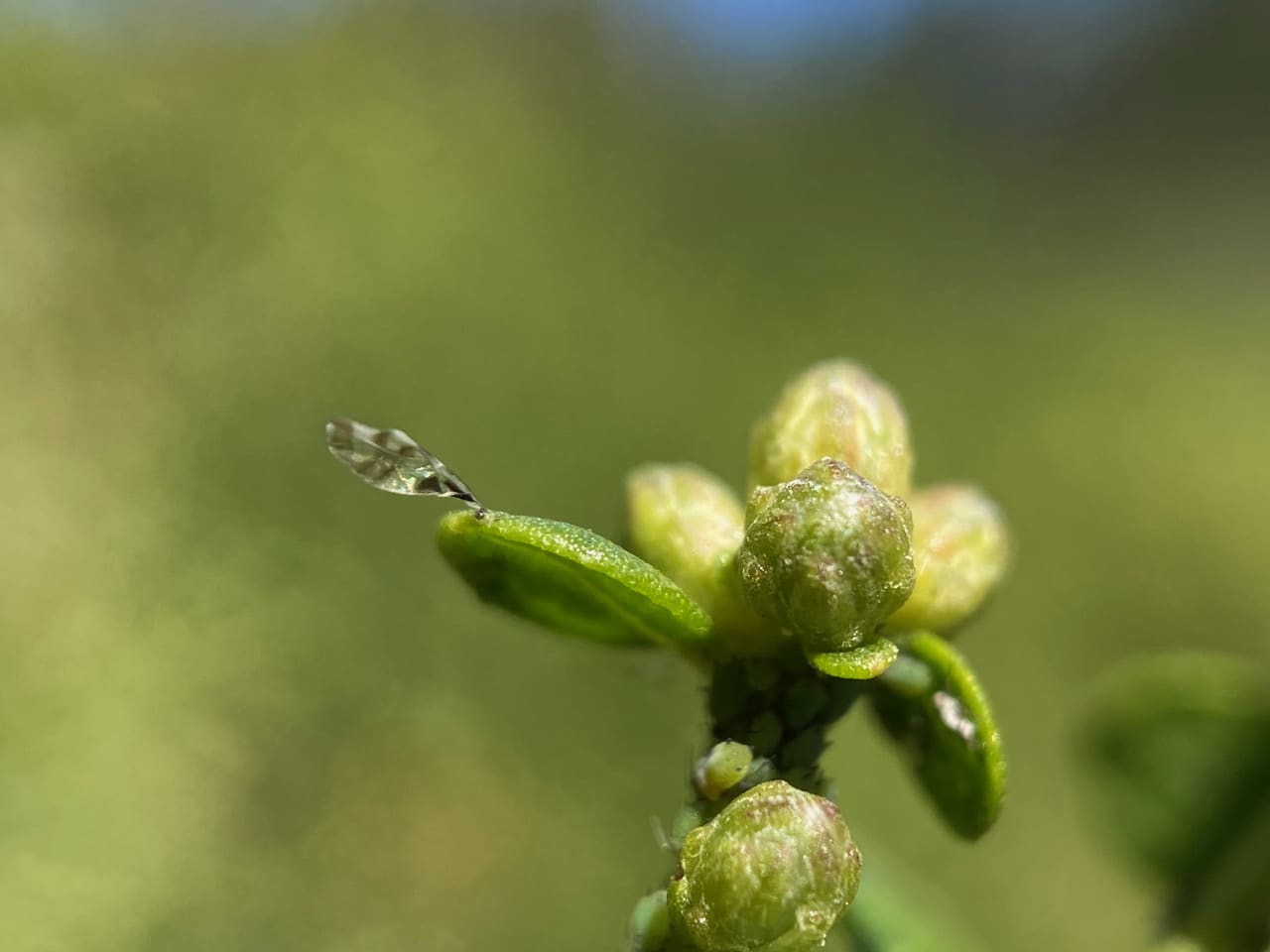
Who’s that tiny insect on the edge of the Baccharis leaf? It seems to have oversized, patterned wings. A Barklouse (order Psocodea)?
I watch in amazement as the insect is blown this way and that by the breeze, apparently anchored only with its front legs to the leaf.
The minute insect seems to be using its oversized wings as sails to catch the wind. What an interesting way to lift off! Is this a kind of passive dispersal?