

Pollinator Post 1/8/25
It is ironic that while catastrophic fires are raging in Southern California, the Bay Area is enjoying some of the best air quality we have had in a while. Fred and I decide to take our walk at a different park in Alameda today, at Crab Cove.
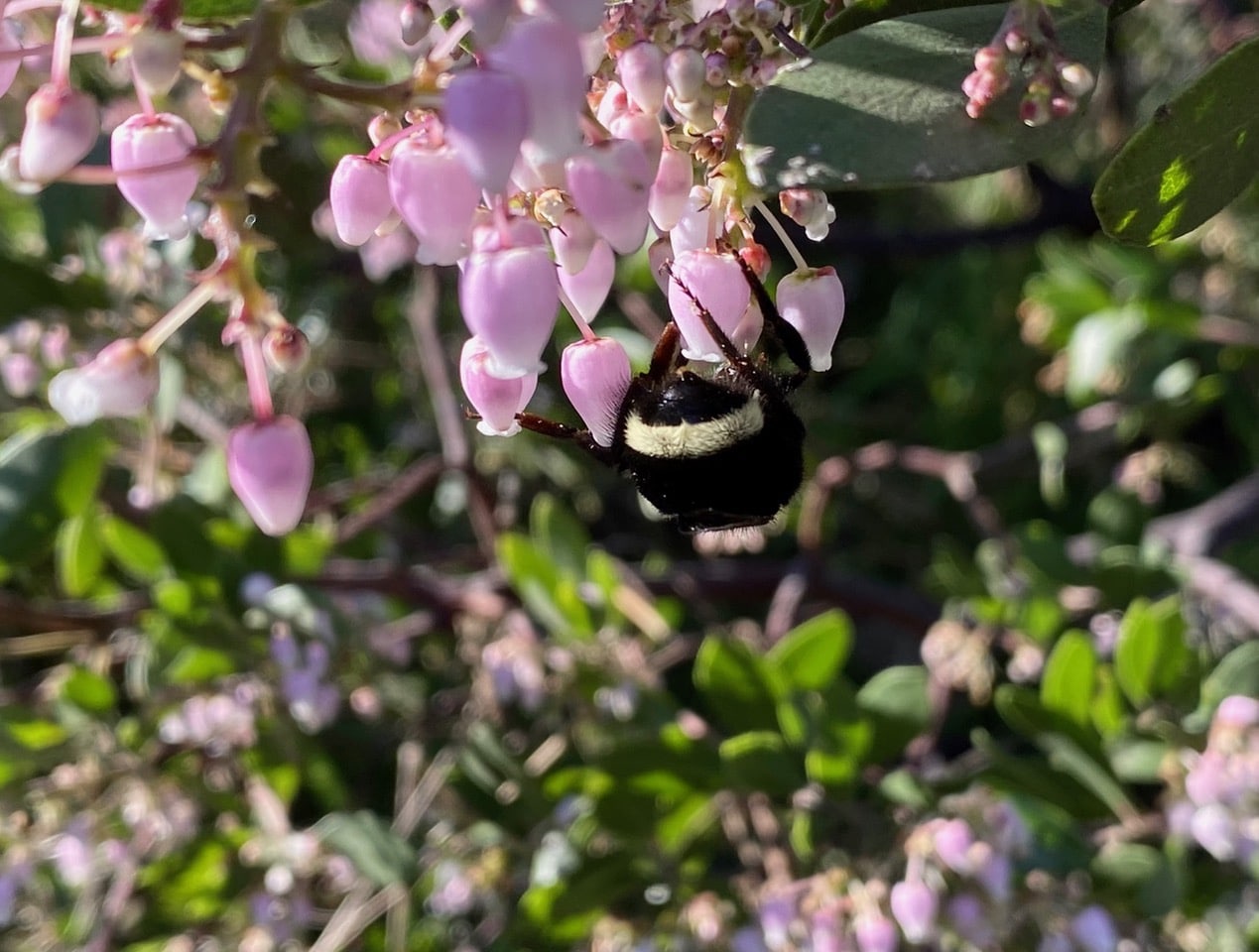
Arriving early before the visitor center is open, I check around the building for insects on the native plantings. Everything is quiet – probably too early and cold. I take a short walk to the native plant garden near the Bathhouse. Here two large manzanita are in full bloom, and a few bees are buzzing around the flowers. We are looking at the rear end of a queen Yellow-faced Bumble Bee, subgenus Pyrobombus (genus Bombus, family Apidae), with a conspicuous yellow band near the tip of her abdomen.
Bumble bees are social and live in colonial hives. Many of the large individuals seen early in the season are queens. They are the only members of their colony to survive the winter, hibernating until the days begin to warm and their host plants are in bloom. These queens have mated before they went into hibernation. Now their first order of business is to each find a nesting site (usually an abandoned rodent burrow), lay eggs, brood and nurture the first batch of workers. Hence forth, the queens stay behind in the hive to concentrate on laying eggs while the workers take on hive duties and foraging. Bumble bees are among the most cold tolerant bees, and are usually the first bees we see out foraging. This is why it’s important for us to plant early blooming natives to support the queen bumble bees.
Note that I no longer use the scientific name of Bombus vosnesenskii for the Yellow-faced Bumble Bee. My bee-expert friend Emil told me that as it is not possible to distinguish the species from similar species in the field, it is more appropriate to identify the bees as the subgenus Pyrobombus. The subgenus does include Bombus vosnesenskii, among many others. Pyrobombus bees are widespread in the Northern Hemisphere and covers nearly 50% of North American bumble bee fauna.
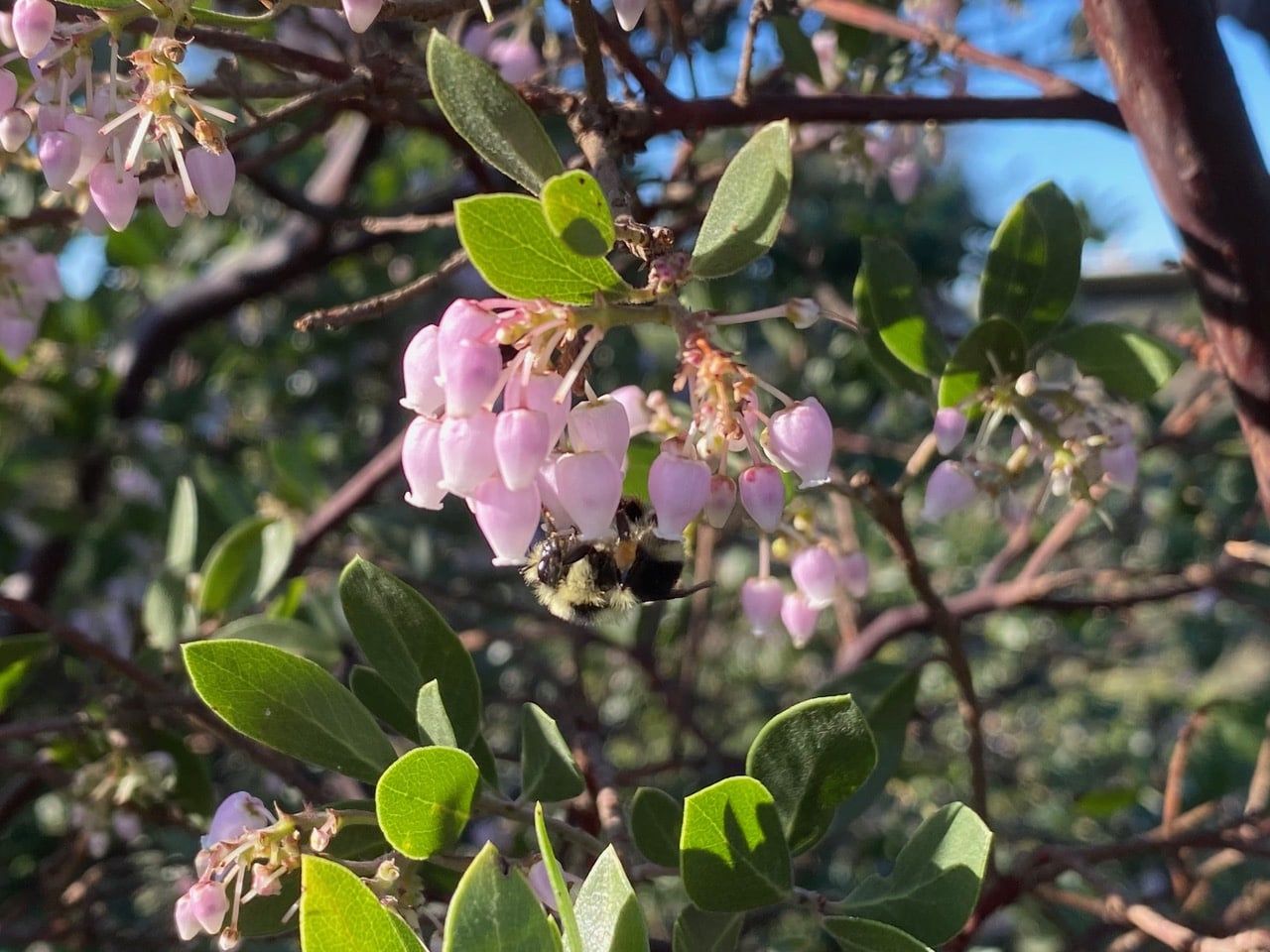
I am thrilled to see a couple of much smaller Black-tailed Bumble Bees, Bombus melanopygus (family Apidae) foraging on the manzanita as well. Given their small size, they are obviously worker bees. This is a happy sign that somewhere in the vicinity a queen has successfully established a nest, and raised the first brood of workers – Yay! Note the bit of pale yellow pollen in the worker bee’s pollen basket on hind leg.
To collect pollen, bumble bees perform sonication or “buzz pollination”. Hanging upside-down on the manzanita flower, they disengage their wings from the flight muscles; then the muscles are vibrated at a specific high frequency to cause the pollen to shake loose and to fall down onto the bee’s belly. The bee gathers the pollen into the pollen baskets on her hind legs before returning to her hive.
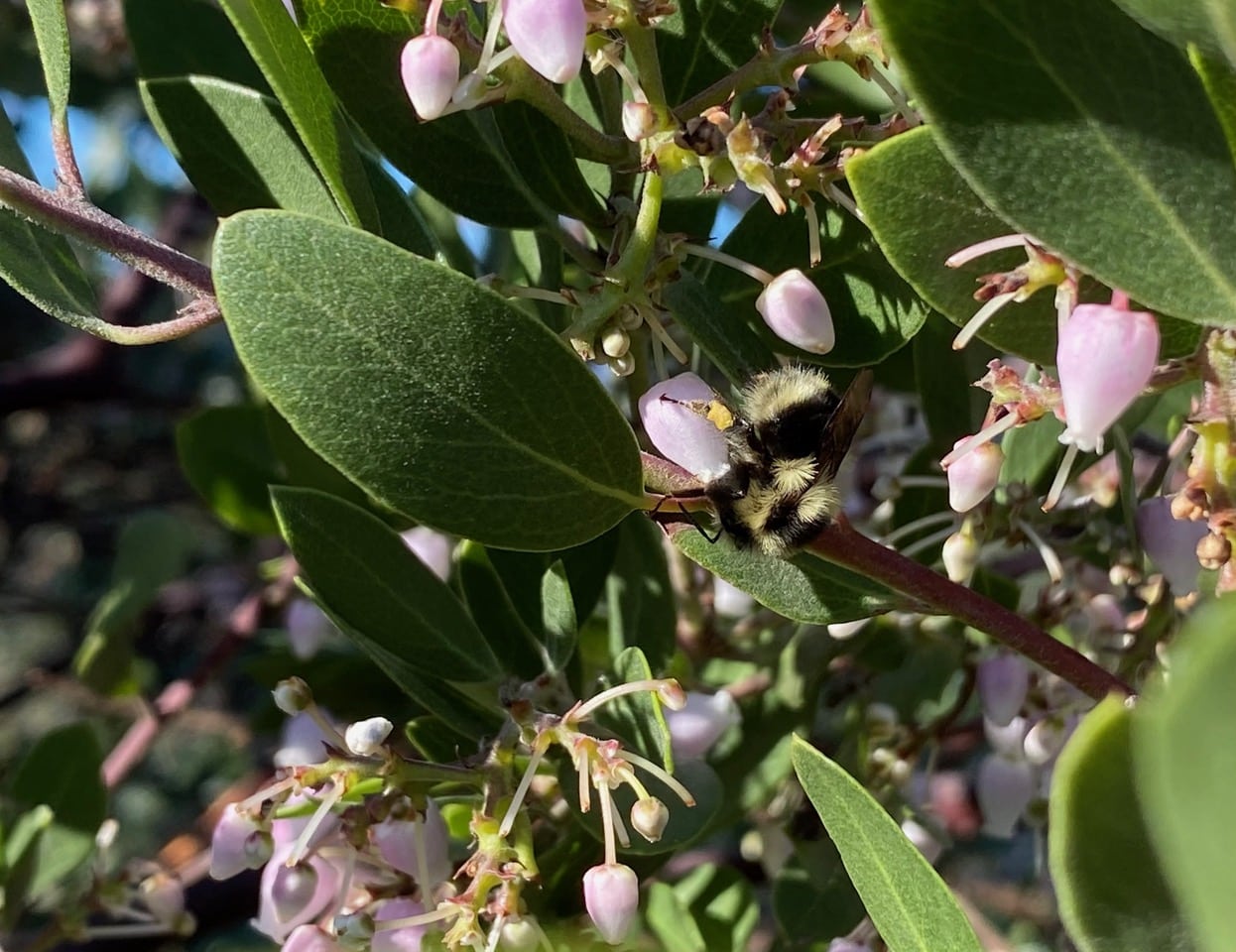
The Black-tailed Bumble Bee, Bombus melanopygus (family Apidae) is native to western North America, widely distributed from Alaska to Baja California. The bees are usually the first to appear on the early blooming plants in our area. This bumble bee can utilize a number of habitat types, including agricultural and urban areas. It feeds on a wide variety of plants, including manzanitas, Ceanothus, golden bushes, wild buckwheats, lupines, penstemons, rhododendrons, willows, sages, and clovers. It nests underground or aboveground in structures. I have once seen a colony nesting in an abandoned bird’s nest among the vines on my neighbor’s trellis.
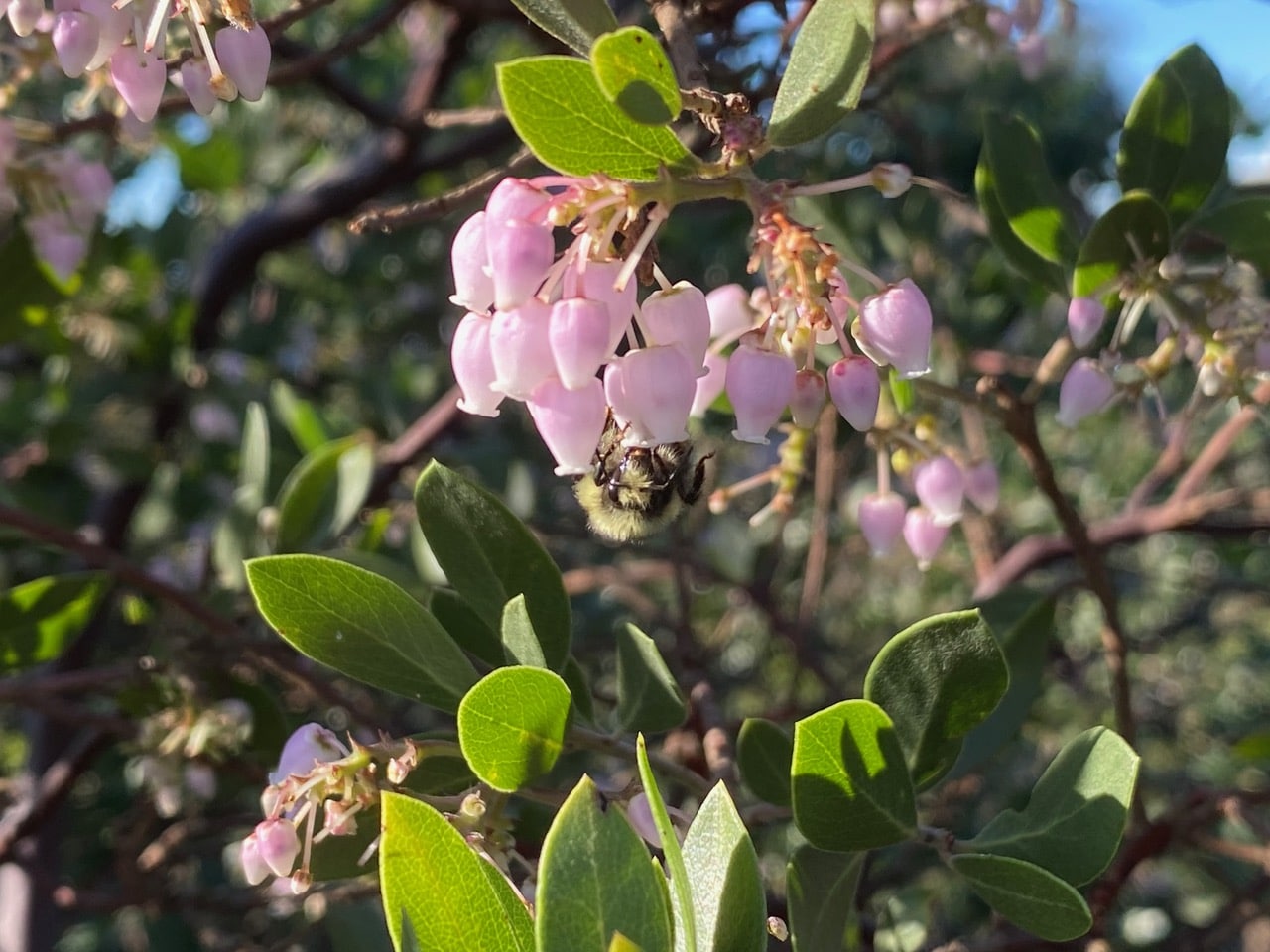
Sticking her tongue in the manzanita flower, the bee is also taking nectar. In fact, to pack the pollen mass into her corbiculae (pollen baskets), she mixes the pollen she has collected with some nectar to moisten it into a paste first.

Beautiful interpretive signs explain the creation of the native garden at Crab Cove.
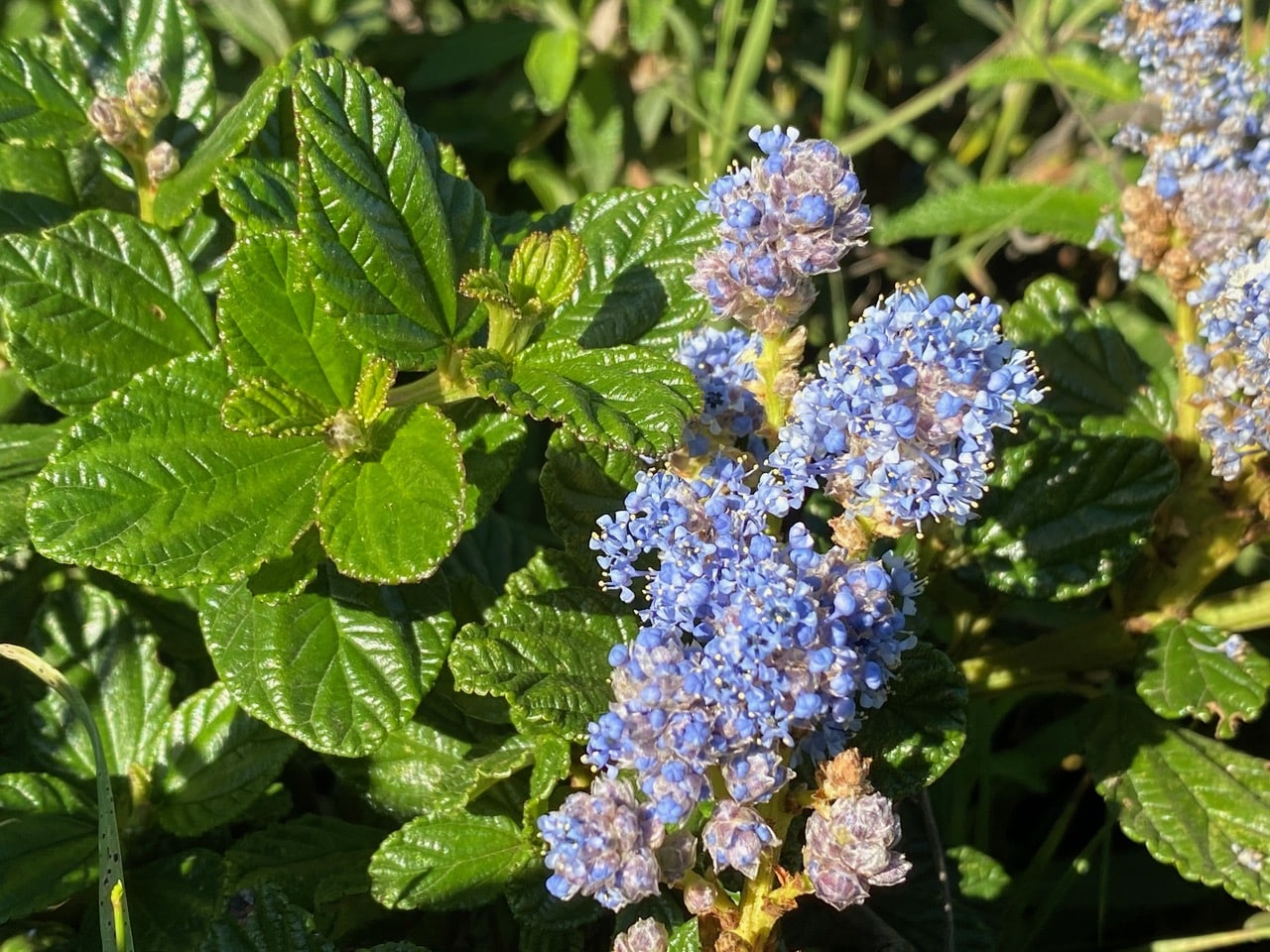
There are numerous shrubs of Ceanothus in the native garden, but only one plant has started to bloom.
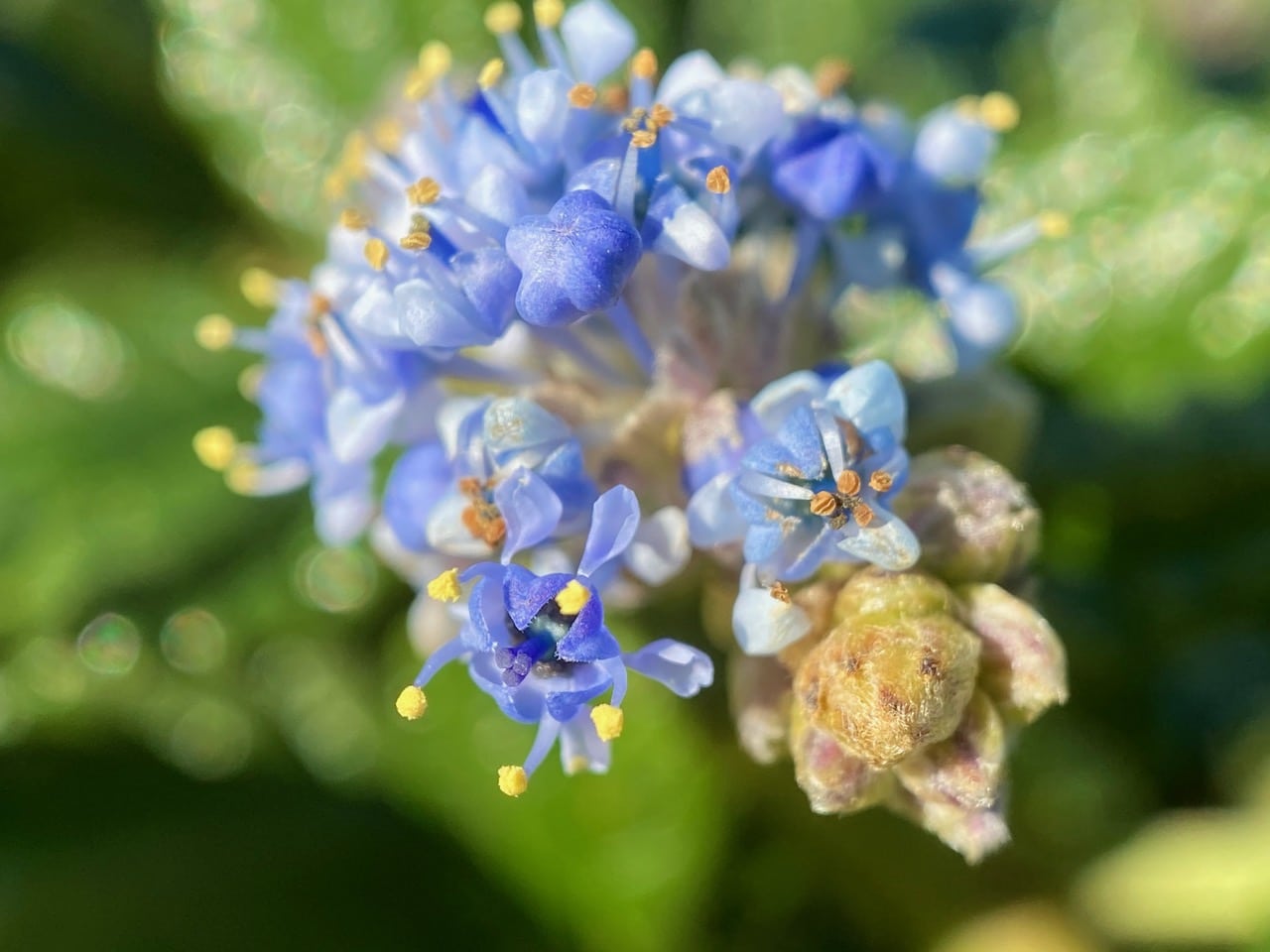
It is hard to figure out the floral structure of Ceanothus as the small flowers are tightly clustered on the inflorescence.
The individual flowers consists of 5 hooded sepals, 5 scoop-like petals, 5 stamens attached to a nectar-bearing disc, and a superior 3-lobed ovary. Both the sepals and petals are similarly colored. The anthers are fully exerted, making it easy for bees to collect pollen by simply walking over the inflorescence.
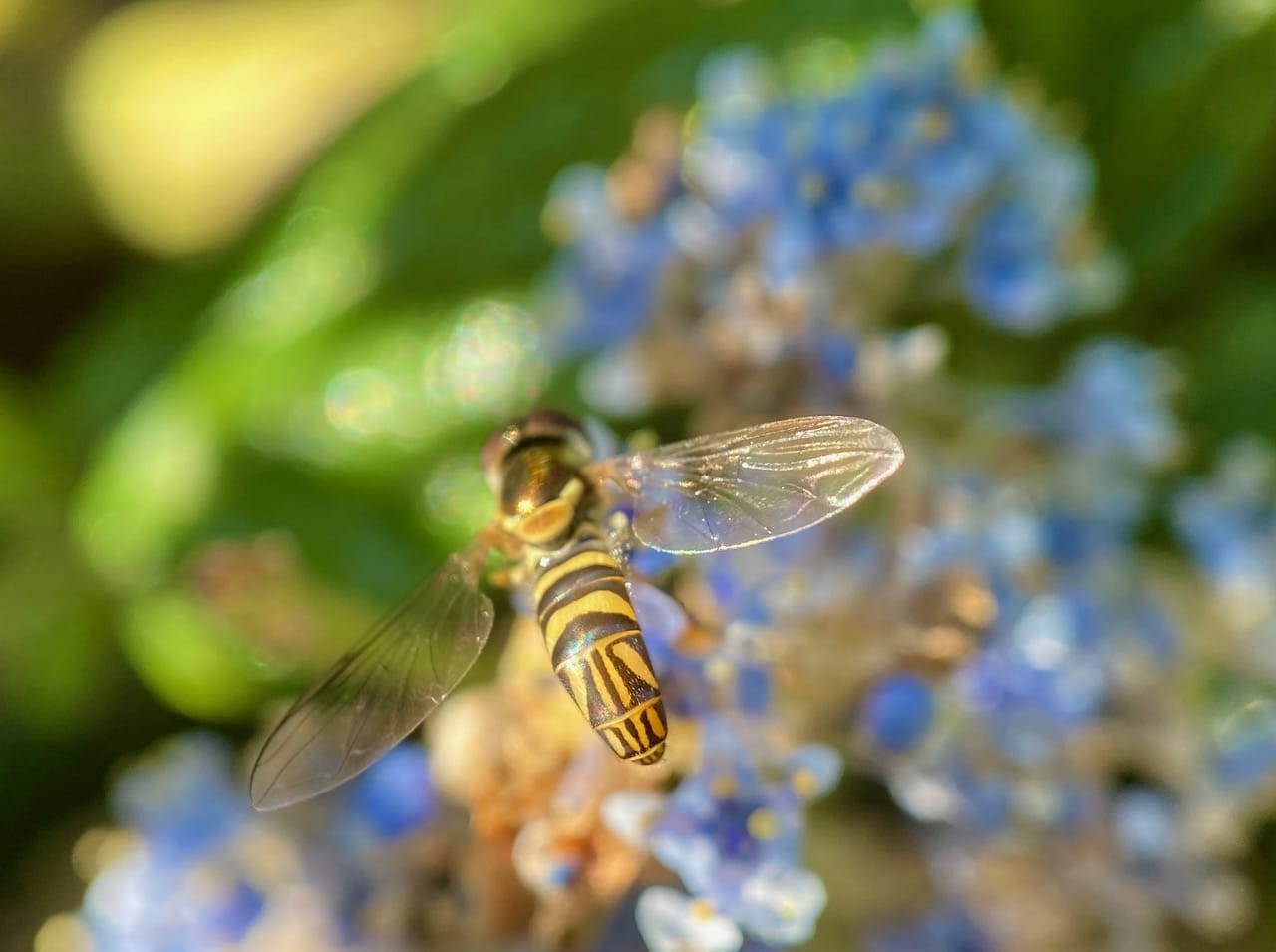
A hover fly comes in for landing on the Ceanothus flowers. The distinctive pattern on its abdomen tells me immediately that it is an Oblique Streaktail, Allograpta obliqua (family Syrphidae).
The Oblique Streaktail, Allograpta obliqua (family Syrphidae) is a common North American species of hoverfly. Adults are 6-7 mm long. Females have a tapered abdomen that ends in a pointed tip. Eggs are laid on surfaces of leaves or stems near aphids. The larvae are important predators of aphids. Adults visit flowers for nectar and pollen, and are pollinators.
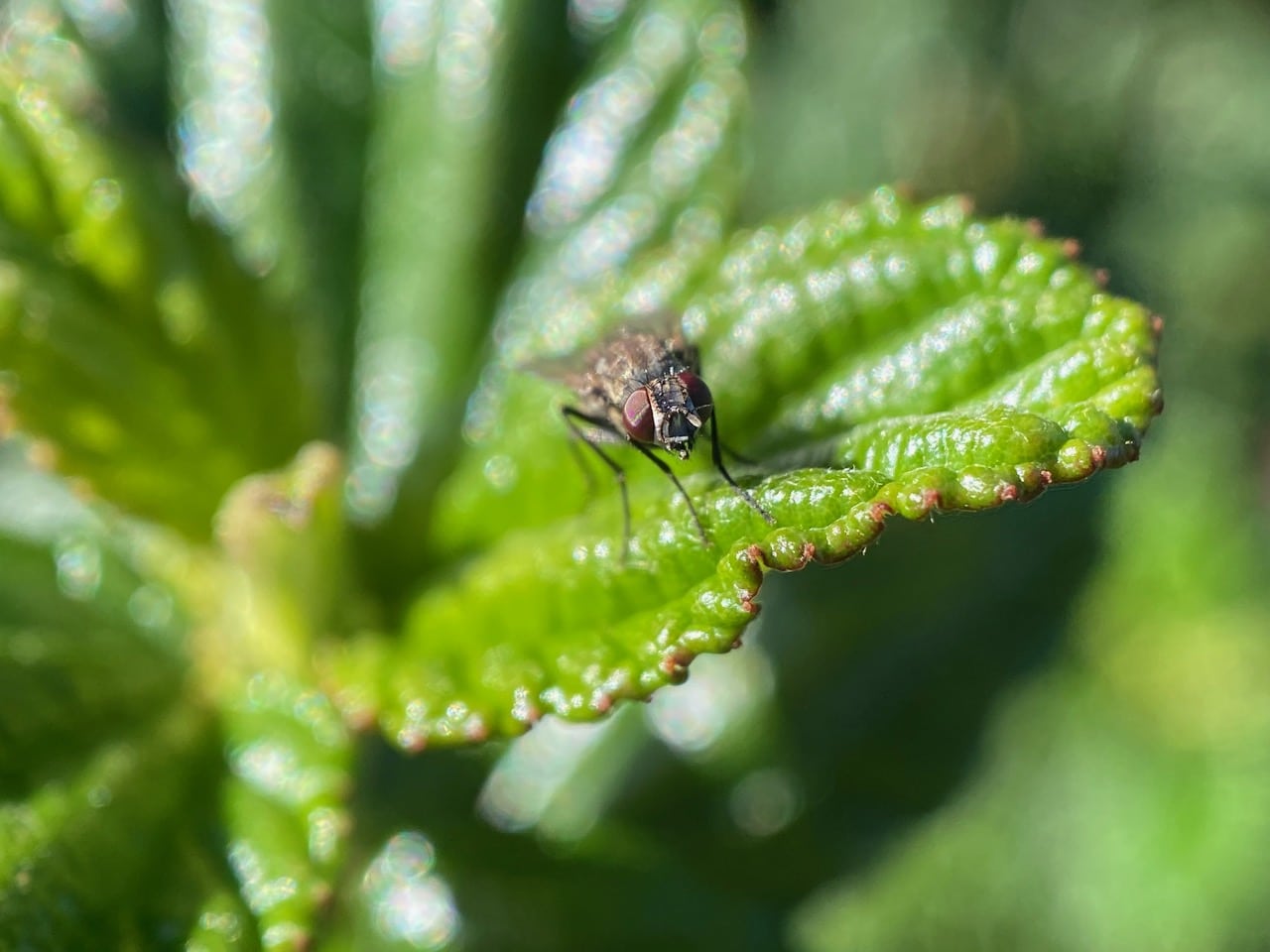
An unidentified fly on a Ceanothus leaf stares back at me through the macro lens.
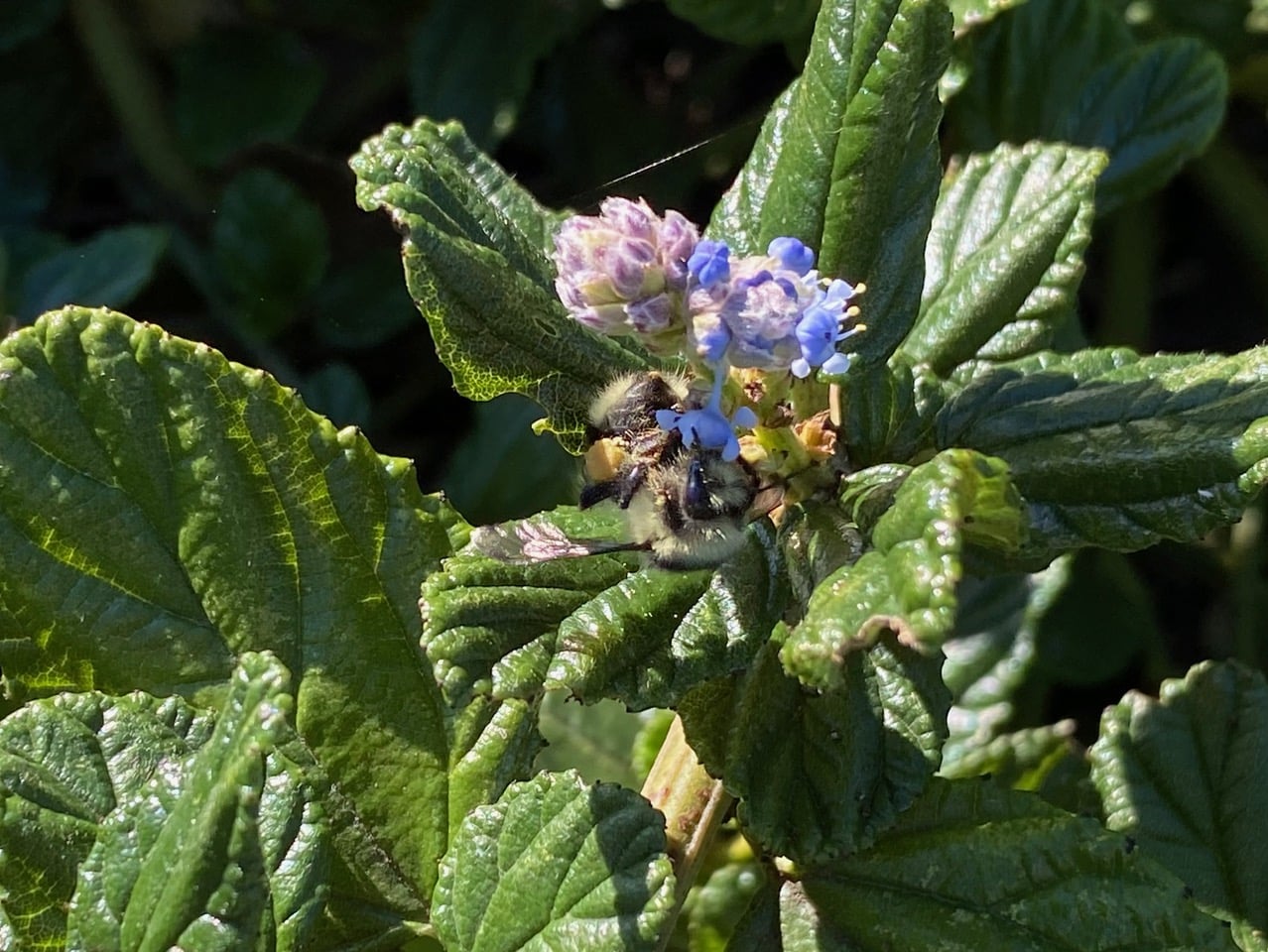
A Black-tailed Bumble Bee, Bombus melanopygus (family Apidae) forages on a young inflorescence of Ceanothus. She already has a sizable load of pollen in her pollen baskets.

I walk barefoot back to the visitor center along the beach. Near the visitor center, I find to my consternation that the short stretch of sandy bank along the upper beach has been badly eroded, probably by the recent storms coupled with extreme high tides, and the area has been razed by park maintenance. This is the spot where I have spent many happy hours last summer observing the various solitary bees and wasps that nest here. I wonder if I would see them this year?
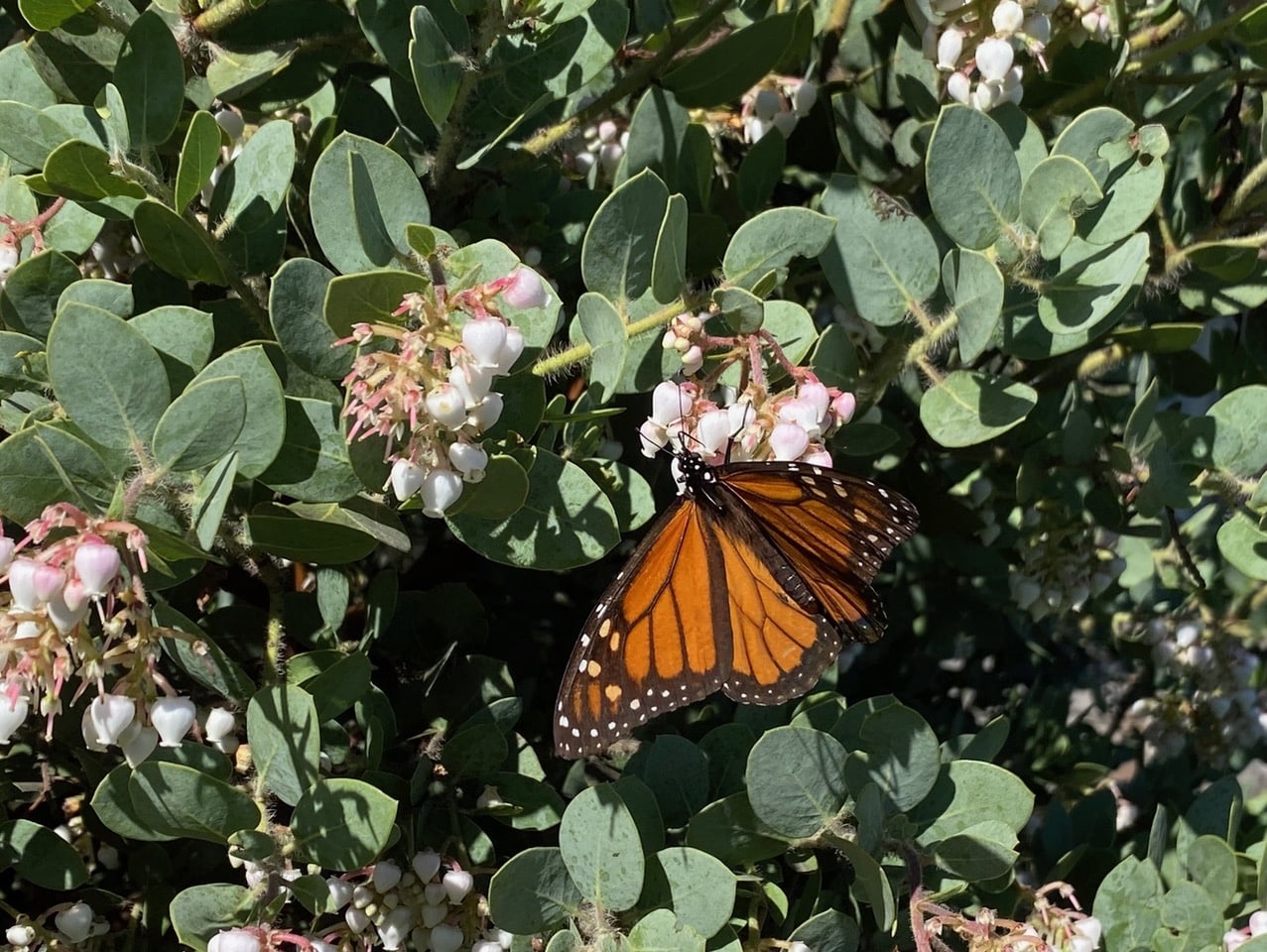
From a distance, I spot a Monarch butterfly on a blooming manzanita now in full sun. It is an exercise in agility for a large butterfly to obtain nectar from those small nodding flowers, having to work upside-down. I wonder if this individual is a resident or a migratory Monarch?
Monarch butterflies, Danaus plexippus (family Nymphalidae) are an iconic and well-loved insect for their cheery beauty and their extraordinary annual migration. The western population of Monarchs overwinter in large, conspicuous aggregations in the tall trees along the coast of California. Less commonly known is the fact that there are currently non-migratory or resident populations of these western Monarchs present in coastal California. Over the last few years, resident populations are found in rising numbers in areas with mild winters and year-round milkweed growth, such as southern California and the Bay Area. It is believed that the resident populations use non-native milkweed species planted by misguided home gardeners wishing to help the butterflies. Unlike the native milkweeds, these milkweeds do not die back in winter. Not only do the non-native milkweeds encourage the butterflies to stay around and breed year-round, they also harbor a virulent pathogen of the butterfly. It is not completely clear whether the migratory and the resident populations are genetically distinct, or whether there is significant exchange between them that might jeopardize the migratory instincts of the species in the long run. This is a conundrum that the Xerces Society is having to deal with.
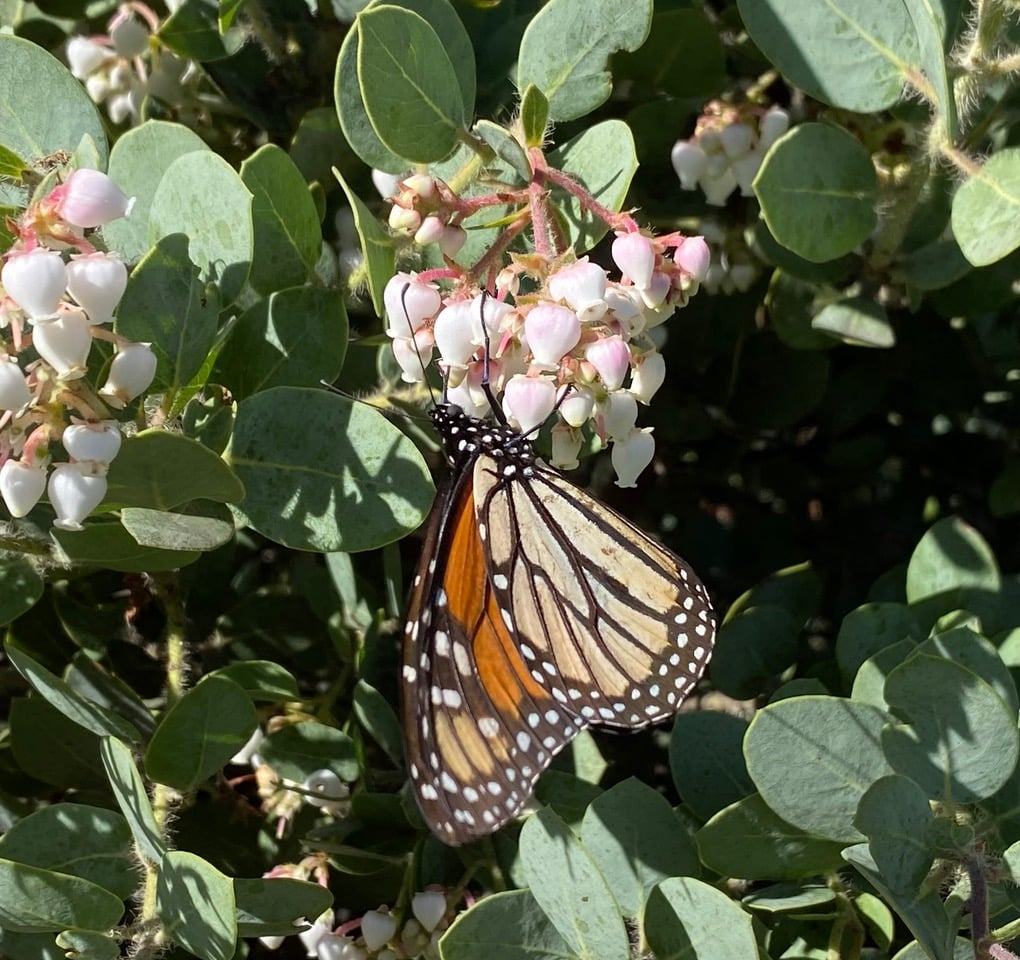
After a bit of struggle, the Monarch butterfly is finally able to insert its long proboscis into a manzanita flower.
Do butterflies pollinate flowers? Although butterflies do not intentionally collect pollen as bees do, they can help pollinate flowers. While probing for nectar, they often unwittingly pick up pollen on their proboscis, legs, or bodies and transfer it from flower to flower, aiding in the pollination process.
Manzanita flowers possess some of the characteristics of butterfly-pollinated flowers:
– occur in clusters, providing landing platforms
– brightly colored (red, pink, yellow, orange)
– open during the day
– produce ample nectar which is deeply hidden