

Pollinator Post 1/7/26 (2)

It is unusual to see a Yellowjacket wasp that is not busy doing something. Why is this Yellowjacket resting stock-still among the Manzanita foliage? It’s also unusual to see a Yellowjacket so early in the season. She seems to be exceptionally robust. A queen?
You can tell a queen yellowjacket from a worker mainly by size, and by timing. Queens are larger and bulkier, often closer to an inch, while workers are smaller about half an inch. Queens also appear less worn and might have fuller abdomens in early season. Queens are most often seen in spring establishing nests, while workers are abundant in summer/fall. Queen Yellowjackets emerge in spring to start a new colony alone; workers take over tasks later. Finding a large, solitary yellowjacket in spring strongly suggests a queen.
Yellowjacket is the common name for predatory social wasps of the genera Vespula and Dolicovespula (family Vespidae). Yellowjackets are social hunters living in colonies containing workers, queens, and males (drones). Colonies are annual with only inseminated queens overwintering. Queens emerge during the warm days of late spring or early summer, select a nest site, and build a small paper nest in which they lay eggs. They raise the first brood of workers single-handedly. Thereafter the workers take over caring for the larvae and queen, nest expansion, foraging for food, and colony defense. The queen remains in the nest, laying eggs. Later in the summer, males and queens are produced. They leave the parent colony to mate, after which the males quickly die, while fertilized queens seek protected places to overwinter. Parent colony workers dwindle, usually leaving the nest to die, as does the founding queen. In the spring, the cycle is repeated.
Yellowjackets have lance-like stingers with small barbs, and typically sting repeatedly. Their mouthparts are well-developed with strong mandibles for capturing and chewing insects, with probosces for sucking nectar, fruit, and other juices. Yellowjacket adults feed on foods rich in sugars and carbohydrates such as plant nectar and fruit. They also search for foods high in protein such as insects and fish. These are chewed and conditioned in preparation for larval consumption. The larvae secrete a sugary substance that is eaten by the adults.
The Western Yellowjackets typically build nests underground, often using abandoned rodent burrows. The nests are made from wood fiber that the wasps chew into a paper-like pulp. The nests are completely enclosed except for a small entrance at the bottom. The nests contain multiple, horizontal tiers of combs within. Larvae hang within the combs.
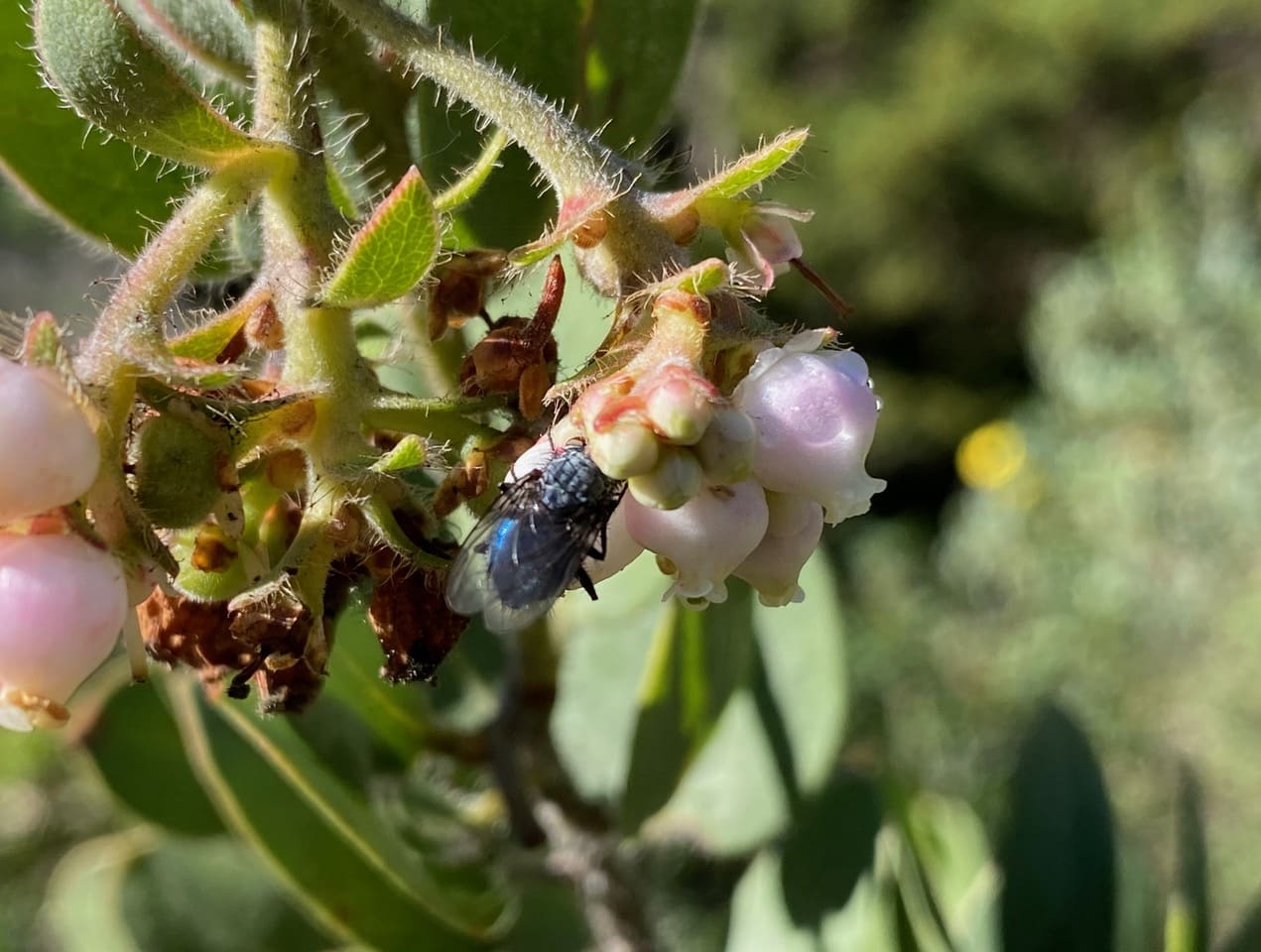
A Bluebottle Fly, Calliphora sp. (family Calliphoridae) is foraging among the Manzanita flowers. The fly is too large to enter the urn-shaped flowers, but is apparently content to scavenge for spilled nectar or pollen on the outside.
The Calliphoridae are variously known as blow flies, carrion flies, greenbottles, and bluebottles. Adults are usually brilliant with metallic sheen, often with blue, green, or black thoraces and abdomens. There are three cross-grooves on the thorax; calypters are well developed. Females visit carrion both for proteins and egg laying. The larvae that hatch feed on dead or necrotic tissue, passing through three instars before pupation. After the third instar, the larva leaves the corpse and burrows into the ground to pupate. Adult blow flies are occasional pollinators, being attracted to flowers with strong odors resembling rotting meat. The flies use nectar as a source of carbohydrates to fuel flight.

An unidentified fly visits the flowers of Manzanita.
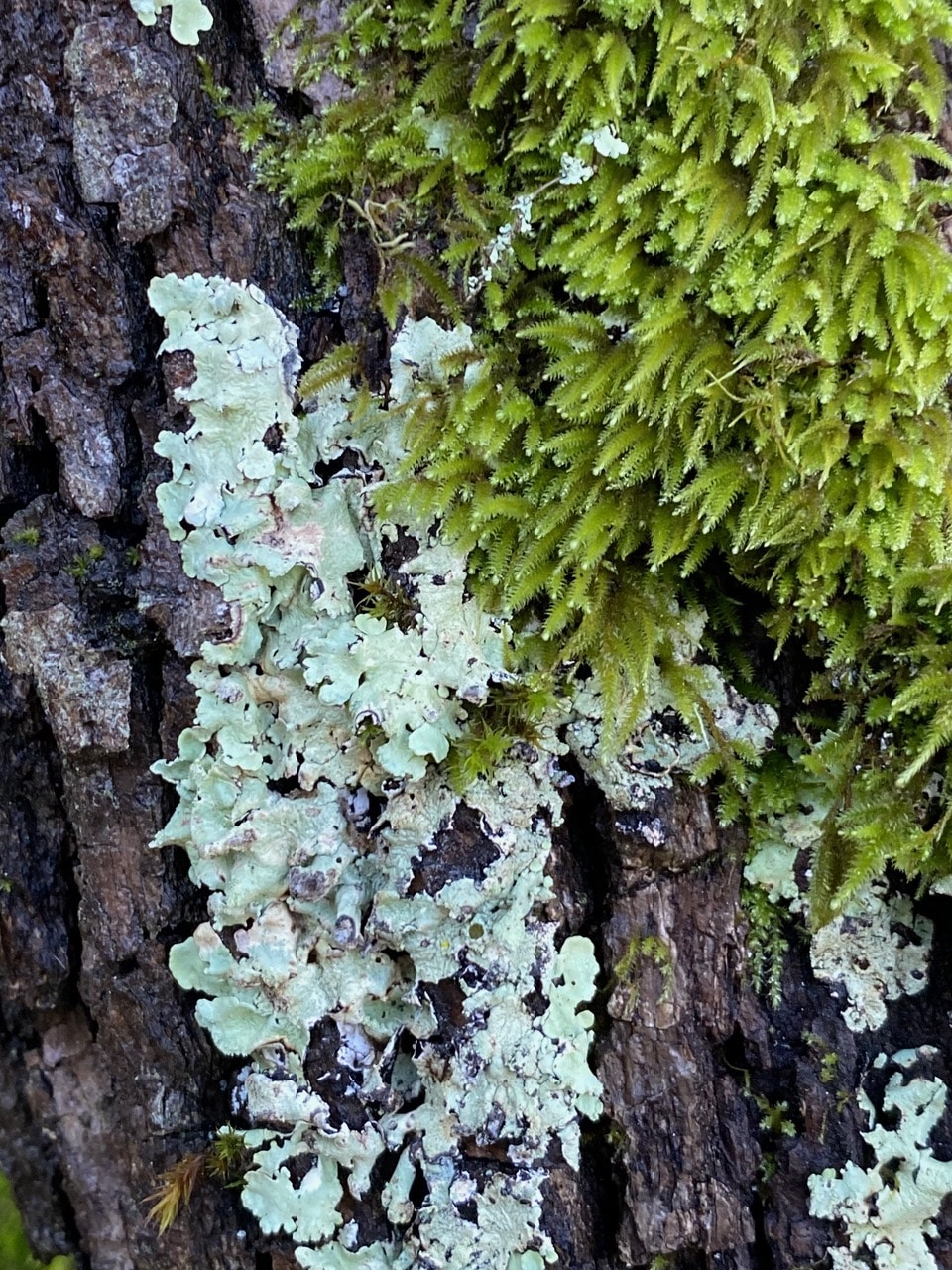
The abundant rains we had over the past week has plumped up the mosses and lichens on the trunk of this tree. They look vibrant and happy.
The grayish green growths are lichens. Lichen isn’t a plant but a fungus-algae partnership, while the grass-green moss is a simple, non-vascular plant. The key difference is their fundamental biology: lichen is a composite organism thriving in harsh, dry spots by absorbing moisture and nutrients from the air, whereas moss is a true plant with tiny leaves needing moisture for reproduction. Lichens and mosses are often found together because they thrive in similar damp, shaded microclimates, and their physical proximity creates a beneficial environment where moss helps retain moisture, benefiting water-sensitive lichens. Both organisms are early colonizers, breaking down rock surfaces (lichen) and stabilizing soil (moss), contributing to soil formation, and providing microhabitats for other small life forms, making them key components of ecosystems. Both have evolved to survive in low-light conditions. While they don’t have a direct symbiotic relationship with each other, they often grow side-by-side on rocks, trees, and soil, sharing similar needs for moisture, light and stable surfaces.

A yellowish green moss Homalothecium sp. is spreading on the rock, almost smothering it in a green embrace. One of my moss teachers had a nickname for Homalothecium – the “blonde hugger”.
Homalothecium Mosses are found in western North America. It usually grows on stone and soil, seldom on tree trunks and decaying wood. It typically grows in tangled mats or in crowded clumps with the branches upright, pale green when young, eventually turning somewhat yellowish. Stems are prostrate, sometimes reaching 10 cm in length, crowded with pinnate branching.

In stark contrast, there’s this moss that is growing on another rock. It forms discreet mounds with very fine texture. The moss is the Grey-cushioned Grimmia, Grimmia pulvinata. It is a common moss found on rocks, forming round, almost furry, grey cushions about 1-2 cm tall. A distinct character is the leaf tip, which is abruptly contracted into a long hair point, which may be as long as the leaf blade.

A close-up of the Grey-cushioned Grimmia shows the long, whitish leaf tips that give the mounds a frosted appearance when seen at certain angles.