

Pollinator Post 1/7/26 (1)
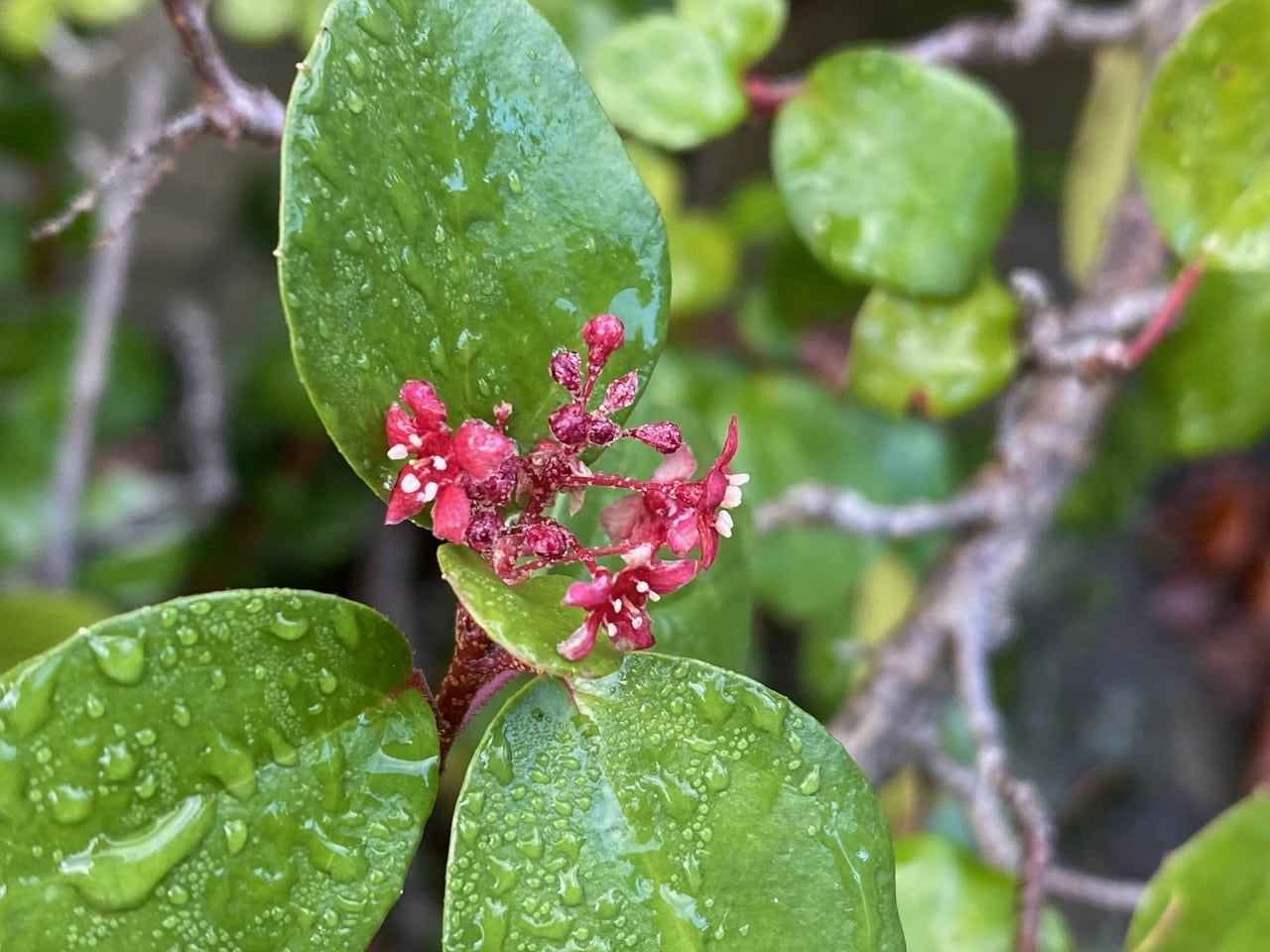
When I arrive this morning, the East Bay Regional Parks Botanic Garden appears to have been drenched by a rain shower. I am on the lookout for any plant in bloom.
The Santa Catalina Island Currant, Ribes viburnifolium near the front gate is already in full bloom. But everything is dripping with water. I don’t see any insect here, not even an ant.

Ditto for the Buckbrush, Ceanothus cuneatus.
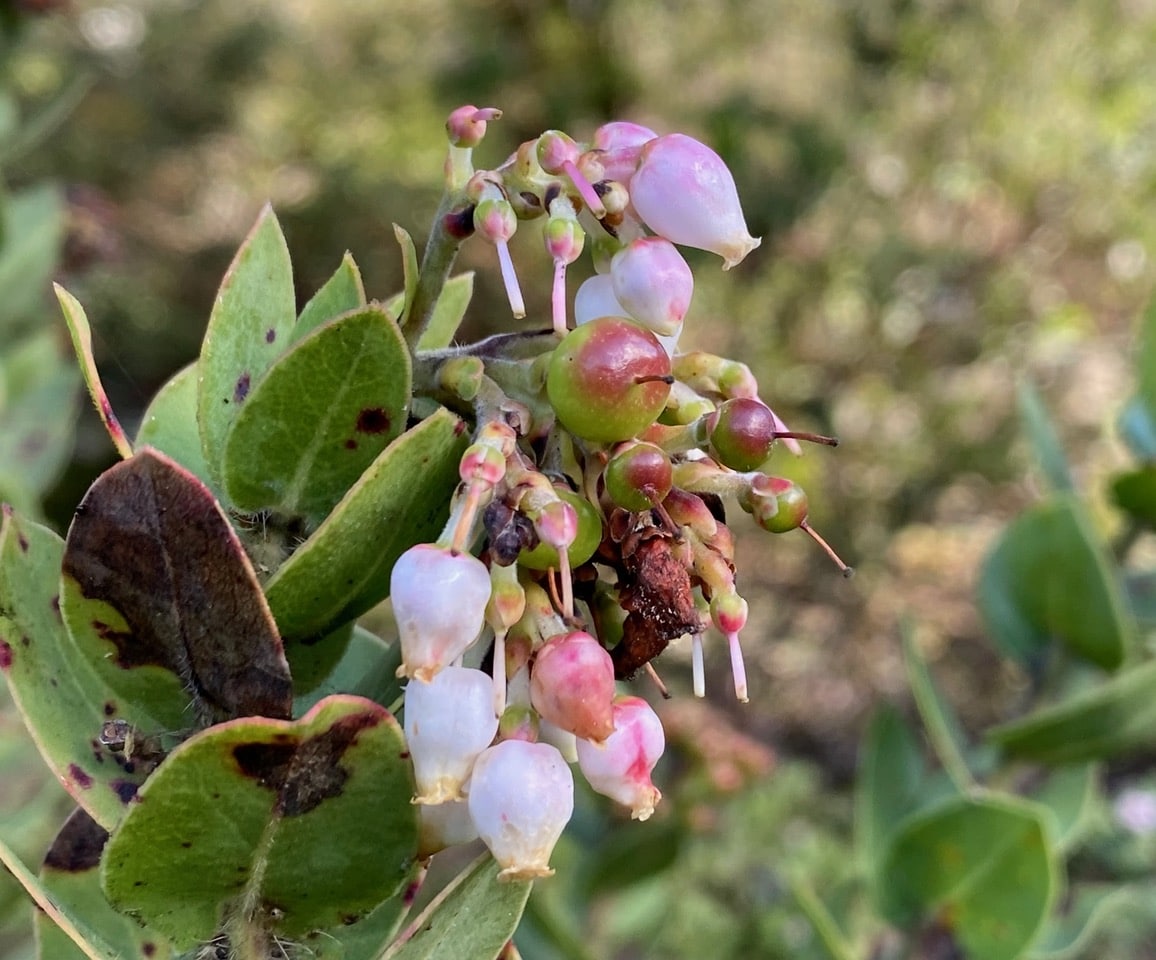
The earliest blooming Manzanita species in the garden are already bearing fruits. Luscious “little apples” appear where the flowers have dropped off in this cluster, their persistent styles still attached.
Manzanita is a common name for many species of the genus Arctostrphylos. The word manzanita is the Spanish diminutive of manzana meaning “little apples”. Manzanita fruit is technically a drupe, which means it has a large seed in the center surrounded by fleshy tissue and thin skin. Many animals eat manzanita fruits, including bears, deer, birds, and rodents. Coyotes and foxes help disperse the seeds in their droppings.

I approach a Monterey Cypress, Hesperocyparis macrocarpa that has a distinct yellowish cast to its foliage. Fresh globular female cones hang from its woody stems.

Closer inspection shows that the yellow color comes from the numerous little male cones on the tips of the needles. These don’t look like they are quite ready to release pollen yet. Pollen release in conifers often occurs in winter or spring, with timing varying by species and climate, leading to long allergy seasons for sensitive individuals.
Cone-bearing trees or conifers, such as the cypress, produce both male cones (pollen-producing) and female cones (seed-producing) on the same tree. Pollen grains from the male cones are lightweight and disperse through the air by wind, reaching the female cones. When the female cones are ready for pollination, the scales slightly open, allowing pollen to access the ovules. Once pollen lands on the receptive surface of the female cone, a pollen tube grows down to reach the egg cell, enabling fertilization. After pollination, the scales of the female cone close tightly to protect the developing seeds. Monterey Cypress seeds are primarily dispersed when their woody cones, which are serotinous, open due to the heat of wildfires, releasing seeds that fall onto the exposed, nutrient-rich soil. Some cones may also open on hot summer days, allowing for wind and rain dispersal.

A tiny fly, barely 2 mm, rests motionless on an unidentified leaf, seeming to enjoy the morning sun. iNaturalist has helped identify it as a Leaf-miner Fly (family Agromyzidae, subfamily Phytomyzinae).
The Agromyzidae are a family commonly referred to as the Leaf-miner Flies, for the feeding habits of their larvae, most of which are leaf miners on various plants. They are small flies, most species in the range of 2-3 mm. Agromyzidae larvae are phytophagous, feeding as leaf miners, less frequently as stem miners or stem borers. A few live on developing seeds, or produce galls. There is a high degree of host specificity. A number of species attack plants of agricultural or ornamental value, so are considered pests. The shape of the mine is often characteristic of the species and therefore useful for identification. Adults occur in a variety of habitats, depending on the larval host plants.
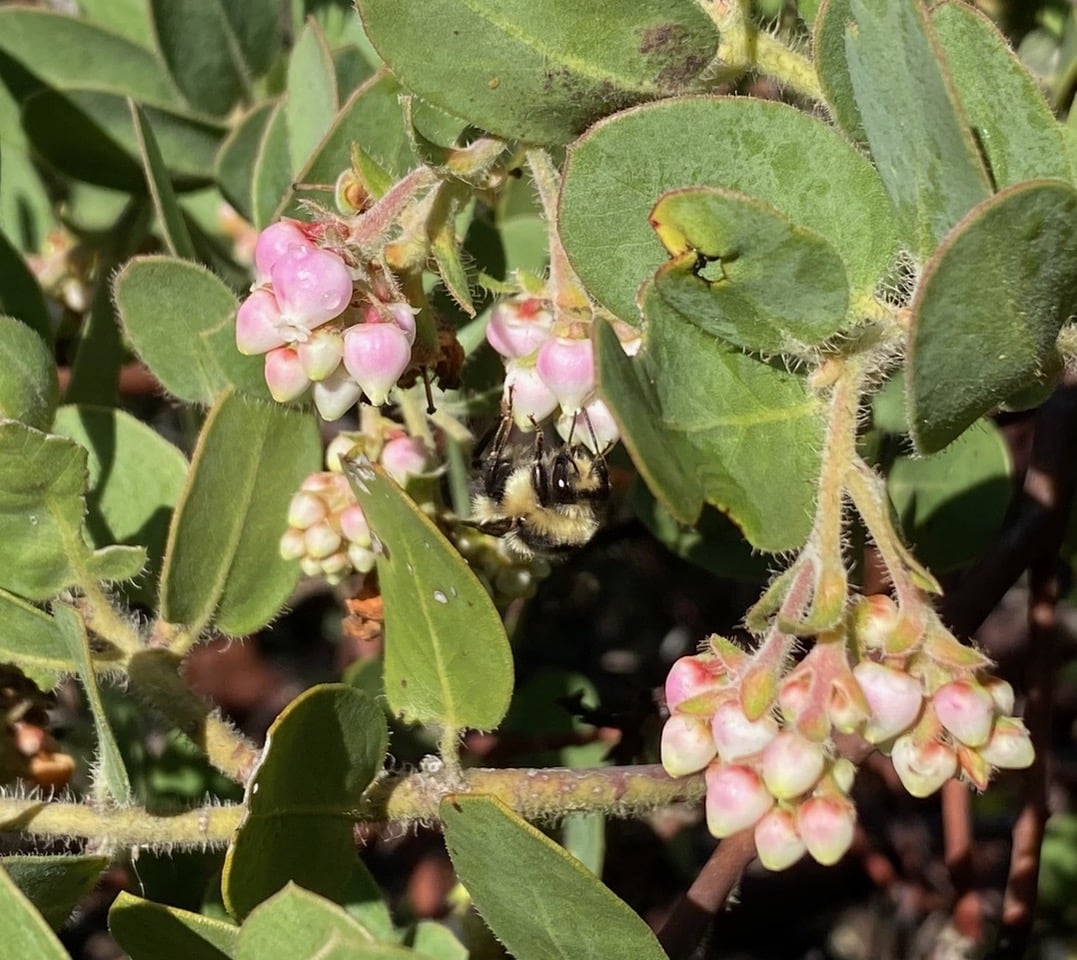
A large Black-tailed Bumble Bee, Bombus melanopygus (family Apidae) hangs upside down on a cluster of Manzanita flowers, Arctostaphylos sp., taking nectar.
Bumble bees are social and live in colonial hives. Many of the large individuals seen early in the season are queens. They are the only members of their colony to survive the winter, hibernating until the days begin to warm and their host plants are in bloom. These queens have mated before they went into hibernation. Now their first order of business is to each find a nesting site (usually an abandoned rodent burrow), lay eggs, brood and nurture the first batch of workers. There after, the queens stay behind in the hive to concentrate on laying eggs while the workers take on hive duties and foraging. Bumble bees are among the most cold tolerant bees, and are usually the first bees we see out foraging. This is why it’s important for us to plant early blooming natives to support the queen bumble bees.

The tip of the bee’s abdomen is black, hence the common name of Black-tailed Bumble Bee. The species is usually the earliest bumble bee to appear in the year, favoring our earliest blooming flowers such as Manzanitas and Ceanothus.
Bombus melanopygus is a species of bumble bee native to western North America, widely distributed from the Pacific to the Rocky Mountains, and from Alaska to Baja California. The species is found in various habitats, including agricultural and urban areas. The bees feed on many types of plants, including manzanitas, Ceanothus, golden bushes, wild buckwheats, lupines, penstemons, rhododendrons, willows, sages, and clovers. They nest underground or aboveground in structures.
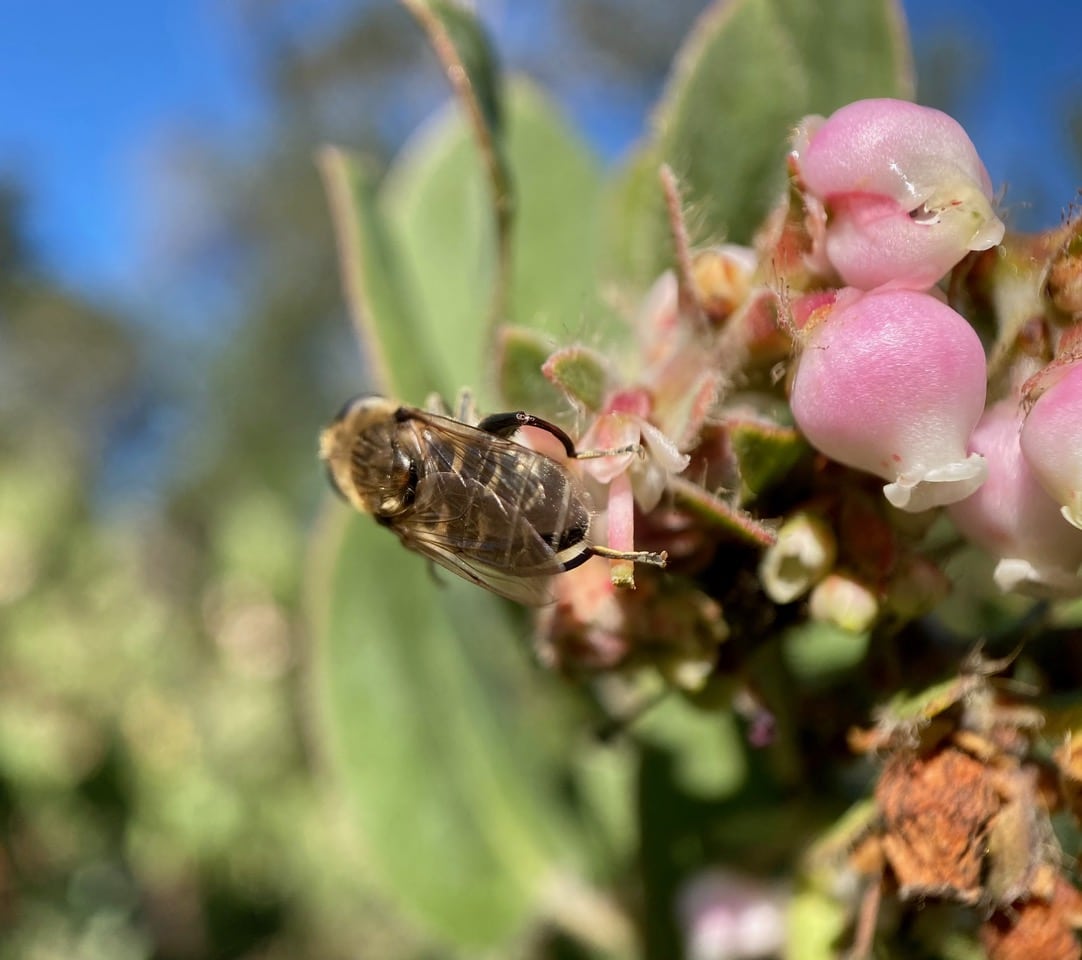
A Common Sickleleg, Asemosyrphus polygrammus (family Syrphidae) is foraging on a cluster of Manzanita flowers. Note the bowed hind tibia of the hover fly that gives it its common name.
The Common Sickleleg, Asemosyrphus polygrammus (family Syrphidae) is found in western North America. Appropriately, Polygrammus means “marked with many lines”, probably referring to the patterns on the thorax. The common name ‘sickle-leg’ probably refers to the bow-shaped tibia of the hind legs. Adults visit flowers for nectar and pollen. Larvae are rat-tail maggots. The maggots are most commonly found in dank and decaying environments such as compost, pond margins, and tree rot holes. The larvae feed on the decomposing material which is poor in oxygen but rich in organic matter. The “tails” are the siphons or breathing tubes that extend from their rear end to enable the larvae to breathe while submerged in the wet substrate. When mature, the larvae climb out to pupate on dry land. The larvae are important decomposers/recyclers and the adult flies are important pollinators.

When I reviewed this photo at home, I was surprised to find that this Common Sickleleg has its proboscis inserted into the side of a Manzanita flower, and not through the natural opening of the flower. It is nectar “robbing”! Since the fly does not have the necessary mouthparts for cutting a hole, it is probably a secondary nectar robber, merely taking advantage of a hole cut by a previous robber.
Nectar robbing in bees is a foraging behavior where a bee bypasses the flowers natural entry to steal nectar, often by biting a hole at the base of tubular flowers because their tongues are too short, cheating the plant of pollination. This can be primary robbing (creating a new hole) or secondary robbing (using holes made by others). It’s common in carpenter bees and short-tongued bumble bees. When they nectar rob, the insects bypass the reproductive structures of the flower, and therefore do not facilitate pollination.
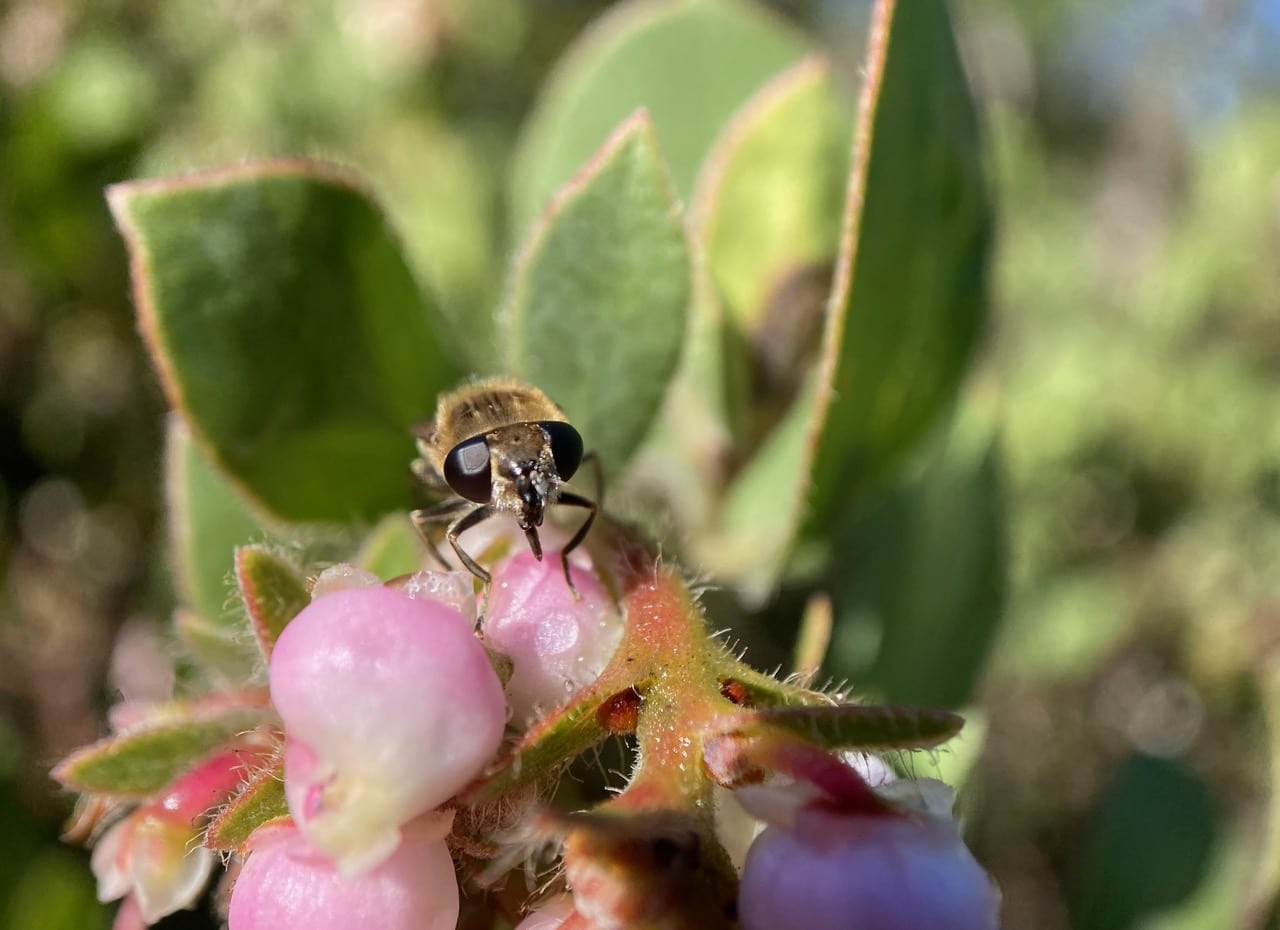
Every photo of the Common Sicklelegs I have ever taken shows dichoptic eyes – compound eyes that are set apart, not touching on top of the head. Surely they can’t be all female? The common rule states that the sexes of Syrphid flies are easily distinguished by the placement of their eyes – males have holoptic eyes that meet on top of the head, while females have dichoptic eyes. Puzzled, I scanned through hundreds of photos of the species on iNaturalist. They all showed dichoptic eyes. Finally I found my definitive answer – a series of photos on BugGuide of a mating pair of Common Sicklelegs shows that both the male and female had dichoptic eyes. The Common Sickleleg is an exception to the rule!

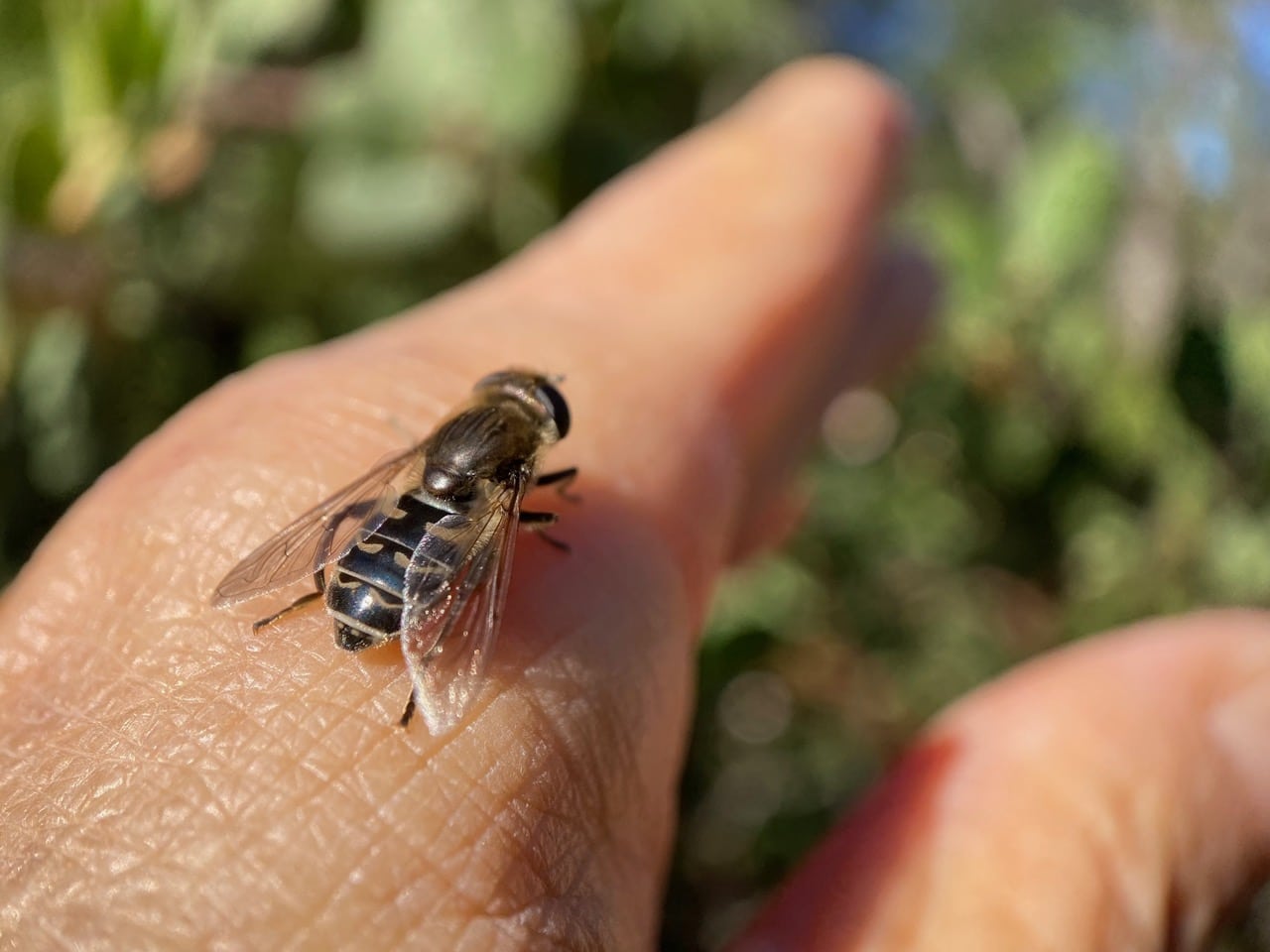
There are so many of the Common Sicklelegs today! This one actually lands on my left hand while I am photographing the flies on the Manzanita. They are some of the most mellow and cooperative hover flies I know.
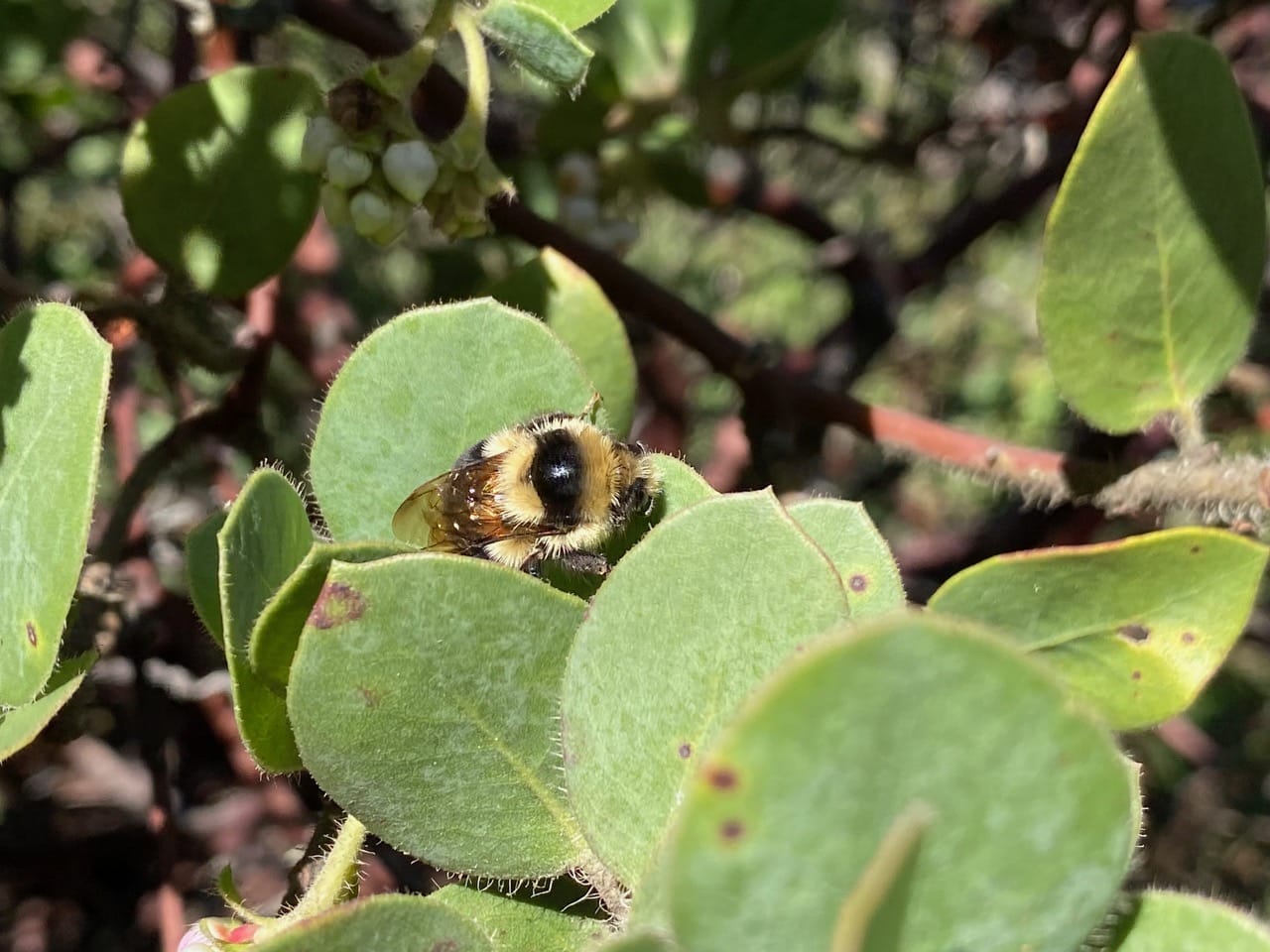
I suddenly notice a large Black-tailed Bumble Bee, Bombus melanopygus (family Apidae) hunkered motionless on a Manzanita leaf, her back to the sun. The queen bee must be taking a break from her busy foraging. I often see this behavior in early spring when fresh bumble bee queens emerge from their hibernation.
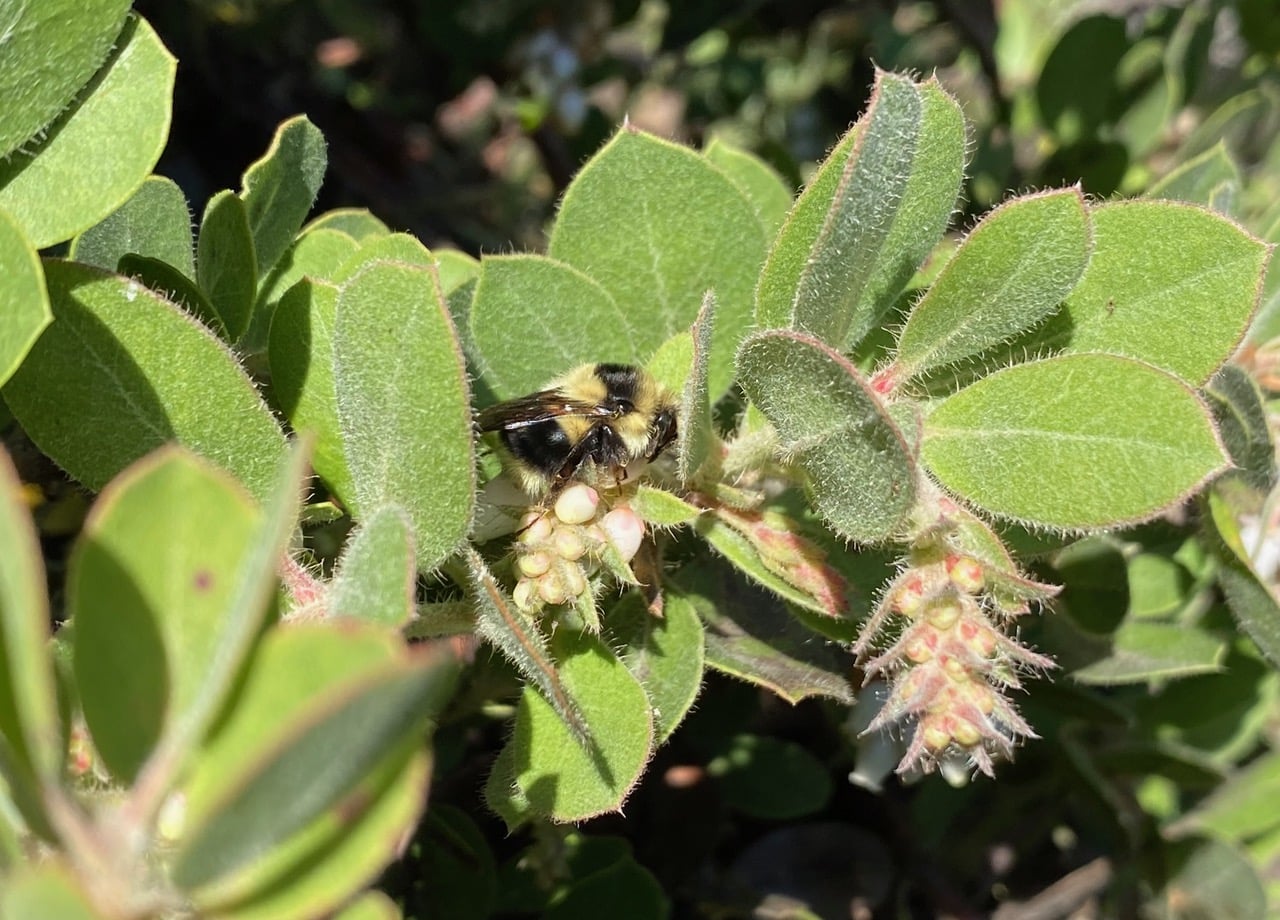
Here’s another queen Black-tailed Bumble Bee taking her royal nap on a cluster of Manzanita flower buds, tucked away among the foliage.

A large Yellow-faced Bumble Bee, subgenus Pyrobombus (genus Bombus, family Apidae) is probing a Manzanita flower for nectar with its tongue. Almost all the queen bumble bees I see today are not collecting pollen. They have probably not established a nest yet and have no young to feed. They are nourishing themselves to prepare for the hard work ahead, establishing a new colony all by themselves.

A huge Bumble Bee lands clumsily on the tip of a Manzanita branch. The queen proceeds to groom herself meticulously.

A side view of the bumble bee shows some surprising features. Instead of a wide yellow band near the tip of the abdomen typical in the Yellow-faced Bumble Bees, this individual seems to have several faint bands of yellow hairs on her abdomen. iNaturalist has helped identify it as a Fog-belt Bumble Bee, Bombus caliginosus (family Apidae).
The Fog-belt Bumble Bee, also known the Obscure Bumble Bee, Bombus caliginosus (family Apidae) is native to the West Coast of the United States, where its distribution extends from Washington to Southern California. The common name likely refers to the species’ preference for relatively humid, foggy coastal areas. The bee is very similar to the Yellow-faced Bumble Bee, Bombus vosnesenskii, and the two can only be told apart by the structure of the male ganitalia. The Fog-belt Bumble Bee tends to have longer hairs, however, and yellow hairs are found on the underside of the abdomen, where the Yellow-faced has only black hairs on the underside. This bumble bee has been noted on numerous families of plants. Queens emerge from hibernation in late January, the first workers appear in early March, and the males follow by the end of April. The colony dissolves in late October when all the inhabitants of the hive die except the new queens.
Relatively few confirmed recent records of the species reflect in part the severe difficulties in identifying this species due to its great similarity to the more widely distributed Yellow-faced Bumble Bees. I have a feeling these bees are more common in our area than we are aware of.
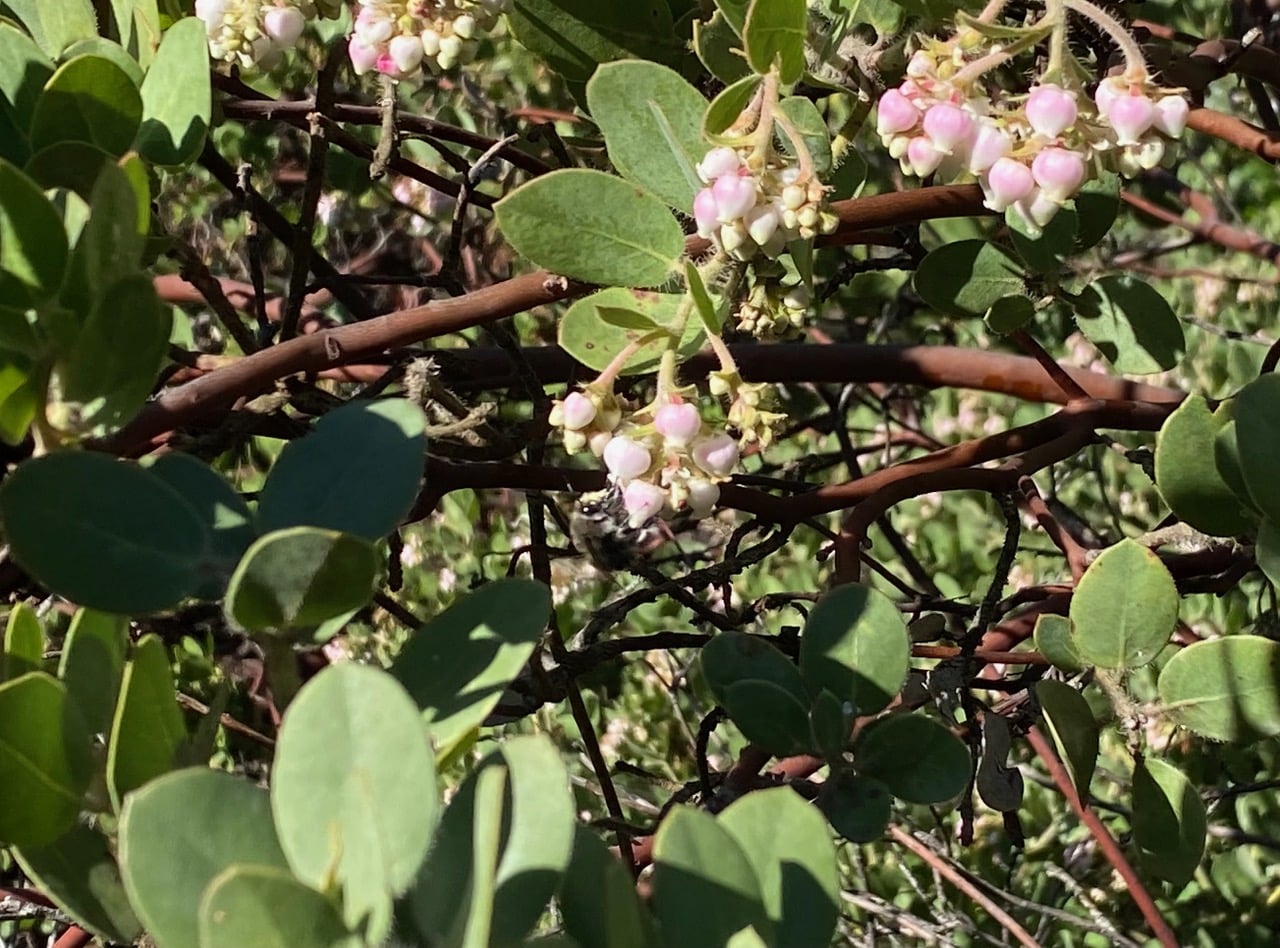
A bee buzzes noisily past me and lands on the lowest cluster of Manzanita flowers in the distance. It is a fuzzy gray bee, and has some yellow on its face. From its behavior and appearance, I know immediately that I have just seen a male Pacific Digger Bee, Anthophora pacifica. About the size of an average worker bumble bee, robust in build, and fuzzy gray all over, they are fast and noisy fliers. Best described as frenetic, they are a nightmare to photograph. They are as numerous on the manzanitas today as the bumble bees.
As their name implies, the Digger Bees nest in the ground, sometimes in huge aggregations. These fast and noisy flyers buzz around flowers, appearing to “hop” from flower to flower while foraging. The chubby, furry Digger Bees resemble the bumble bees in many ways, but are a lot noisier. They are a fearless, rowdy lot – fun to watch but a challenge to photograph. Male digger bees of many species have white or yellow integuments on their faces. Females have shaggy hairs on their back legs, used to carry pollen. Female Anthophora are capable of buzz pollination – i.e. they vibrate their wing muscles to shake pollen from the anthers of some flowers. Digger bees are generalist pollinators that visit an impressively wide range of plants. They are exceptionally effective pollinators and play an important role in maintaining wildflower diversity, in part because their long tongues allow them to pollinate deep-throated and tubular blossoms inaccessible to other bees.
Almost all of the Digger Bees I see today are males. Perhaps the females have yet to emerge? In most solitary bees, males usually emerge a few days before their sisters.
Female bees are able to determine the sex of their offspring by a system called haplodiploidy. Haplodiploidy is a sex-determination system whereby males develop from unfertilized eggs and are haploid, and females develop from fertilized eggs and are diploid. Female solitary bees tend to lay female eggs in the back of her burrow, and male eggs closer to the nest entrance. Since males develop faster, they can exit the burrow without disturbing their sisters. Male Digger Bees often hang around nest entrances, awaiting the emergence of a female for a chance to mate with her. When she appears, the males jump on her en masse, sometimes creating chaotic “mating balls”. It’s a boisterous affair!