

Pollinator Post 1/7/25
Air pollution has cleared up nicely in the afternoon and the sun is shining. Joyfully I head up to the Regional Parks Botanic Gardens.
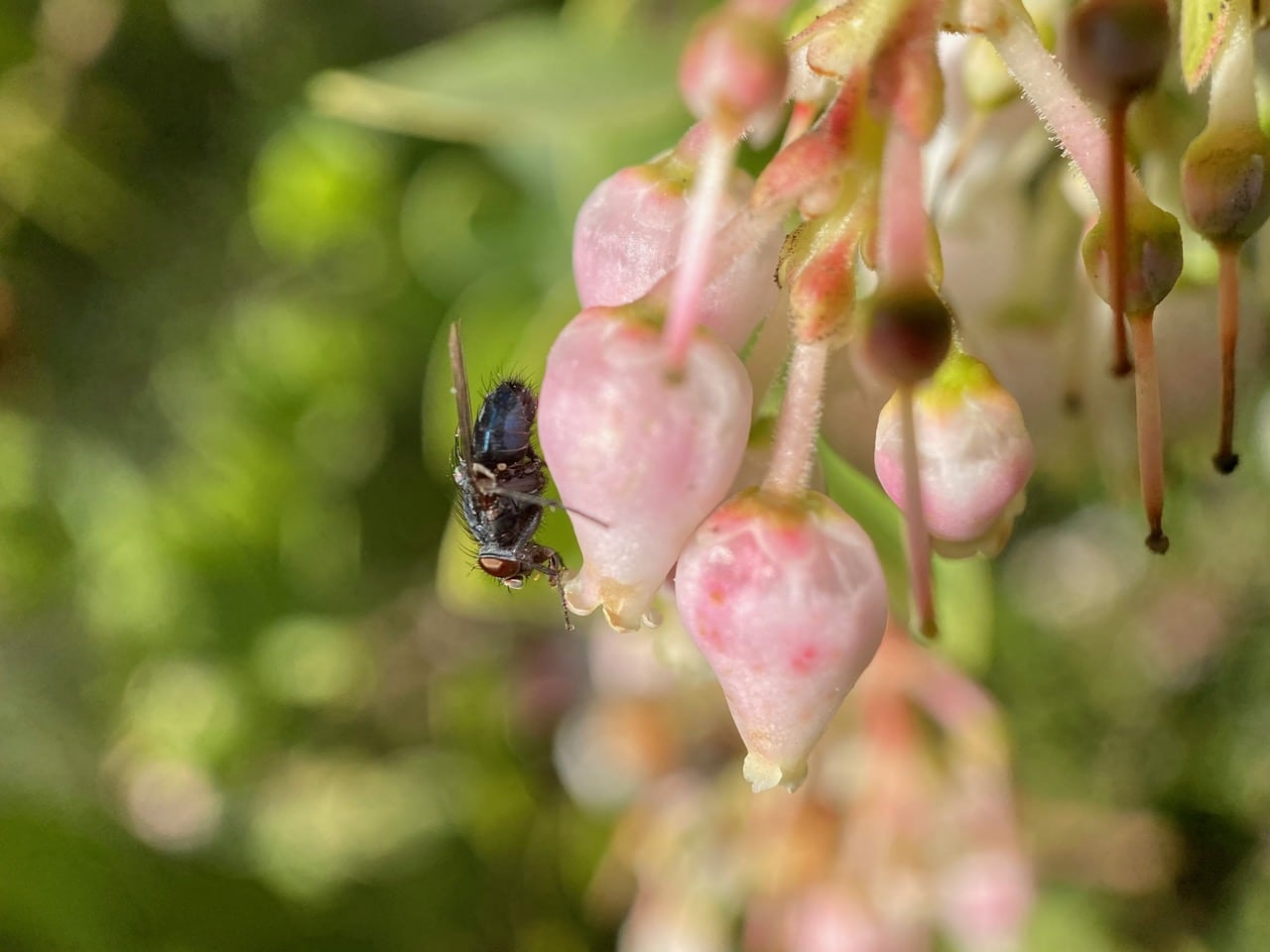
Its tongue extended, a Bluebottle Fly, Callifphora sp. (family Calliphoridae) is feeding on the outside of a manzanita flower. The fly is too large to enter the urn-shaped flower, but is apparently content to scavenge for spilled nectar or pollen.
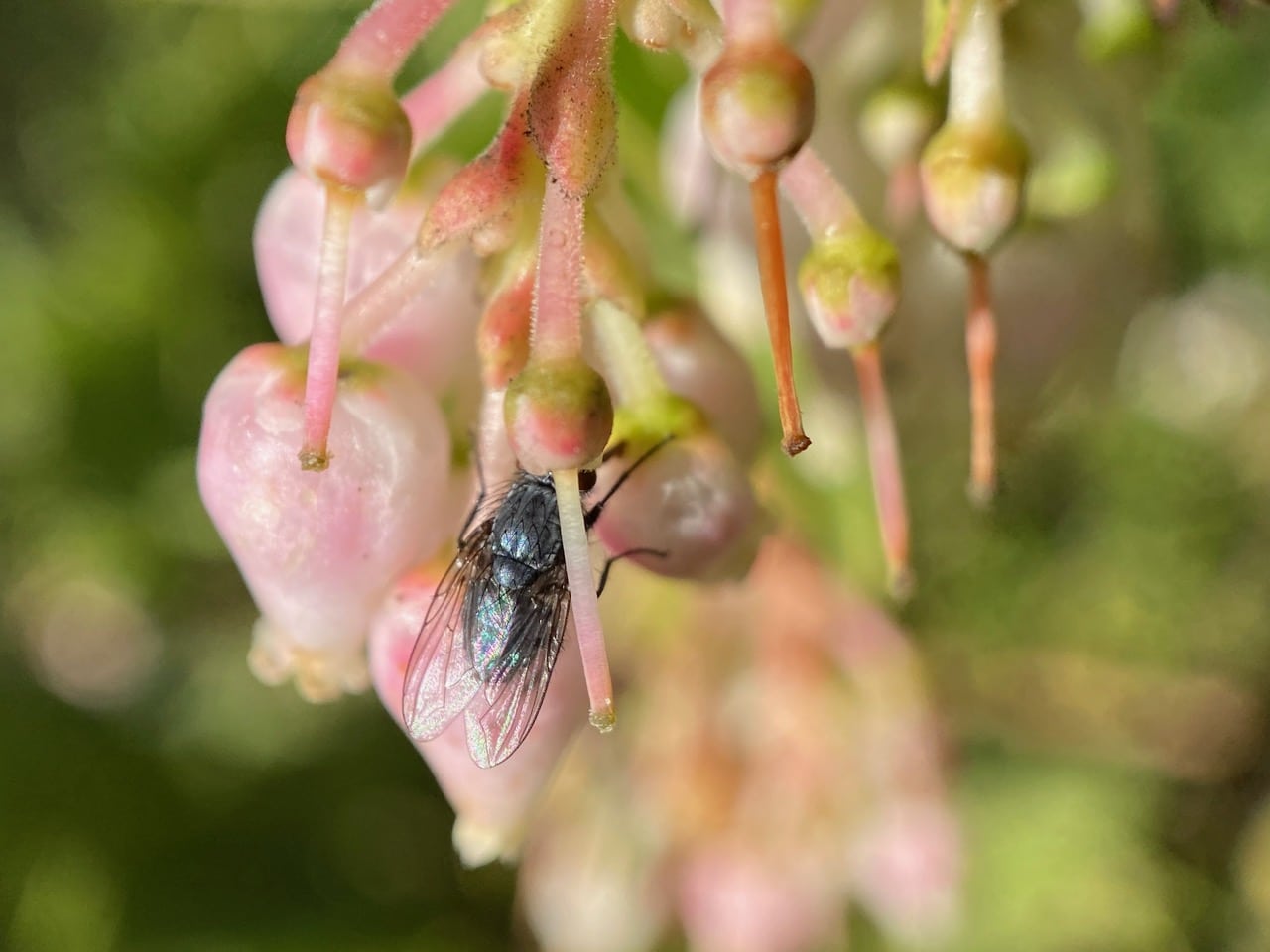
The Calliphoridae are variously known as blow flies, carrion flies, greenbottles, and bluebottles. Adults are usually brilliant with metallic sheen, often with blue, green, or black thoraces and abdomens. There are three cross-grooves on the thorax; calypters are well developed. Females visit carrion both for proteins and egg laying. The larvae that hatch feed on dead or necrotic tissue, passing through three instars before pupation. After the third instar, the larva leaves the corpse and burrows into the ground to pupate. Adult blow flies are occasional pollinators, being attracted to flowers with strong odors resembling rotting meat. The flies use nectar as a source of carbohydrates to fuel flight.
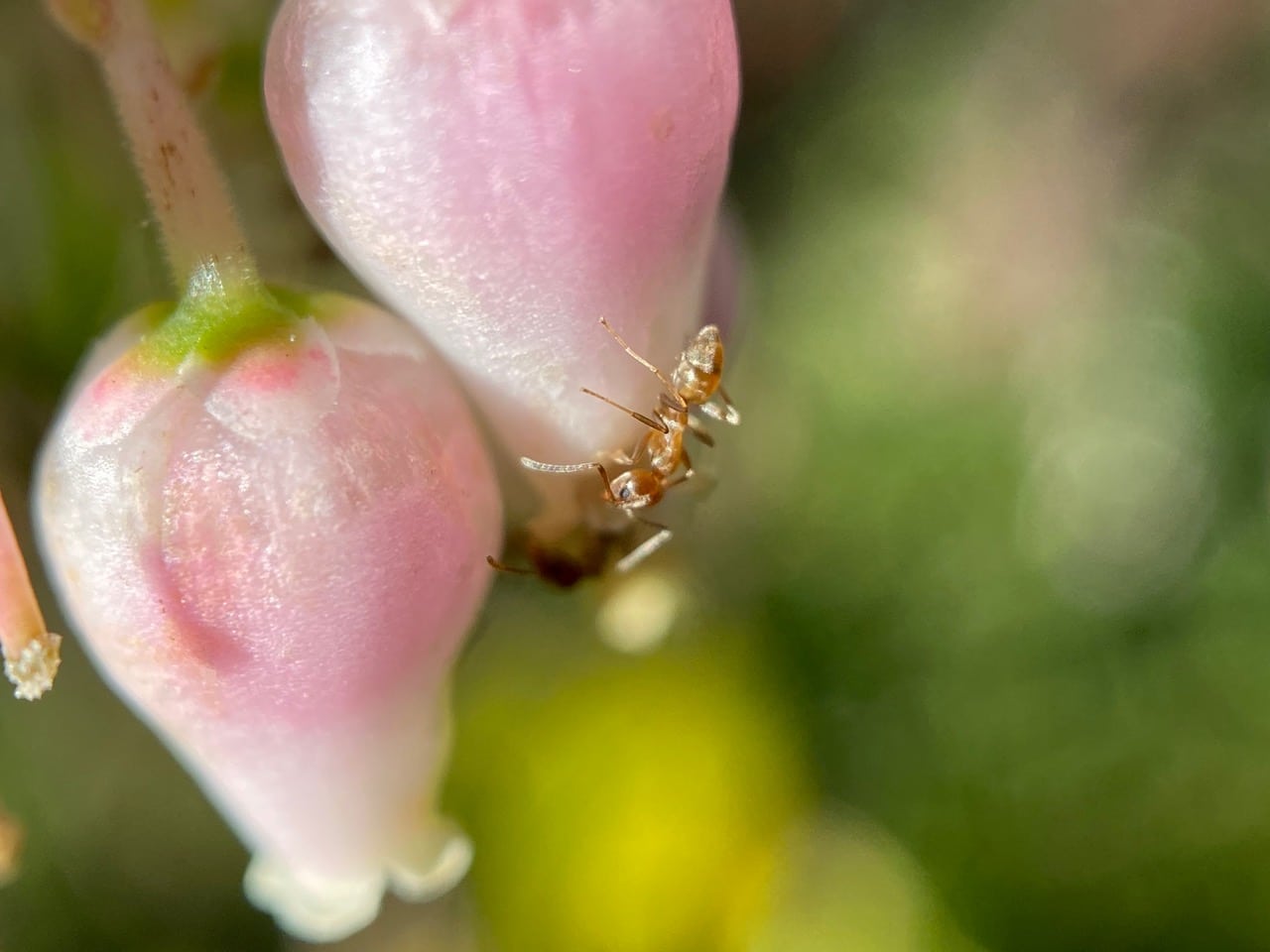
Numerous Argentine Ants are foraging on the manzanita flowers, going in and out of the corolla with ease.
The Argentine Ant, Linepithema humile (family Formicidae) is native to Northern Argentina, but it has been inadvertently introduced by humans to many countries, and is now an established invasive species in many Mediterranean climate areas worldwide. The success of the species can be attributed to their lack of aggression between the colonies. There is no apparent antagonism between separate colonies of its own kind, resulting in “super-colonies” that extend across hundreds or thousands of kilometers in different parts of the their range. Genetic, behavioral, and chemical analyses show that introduced Argentine Ants on separate continents actually represent a single global supercolony.
The Argentine Ants are ranked among the world’s worst invasive animal species. In its introduced range, the Argentine ant often displaces most or all native ants and can threaten native invertebrates and even small vertebrates that are not accustomed to defending against the aggressive ants. This can, in turn, imperil other species in the ecosystem, such as native plants that depend on native ants for seed dispersal, or lizards that depend on native ants for food.
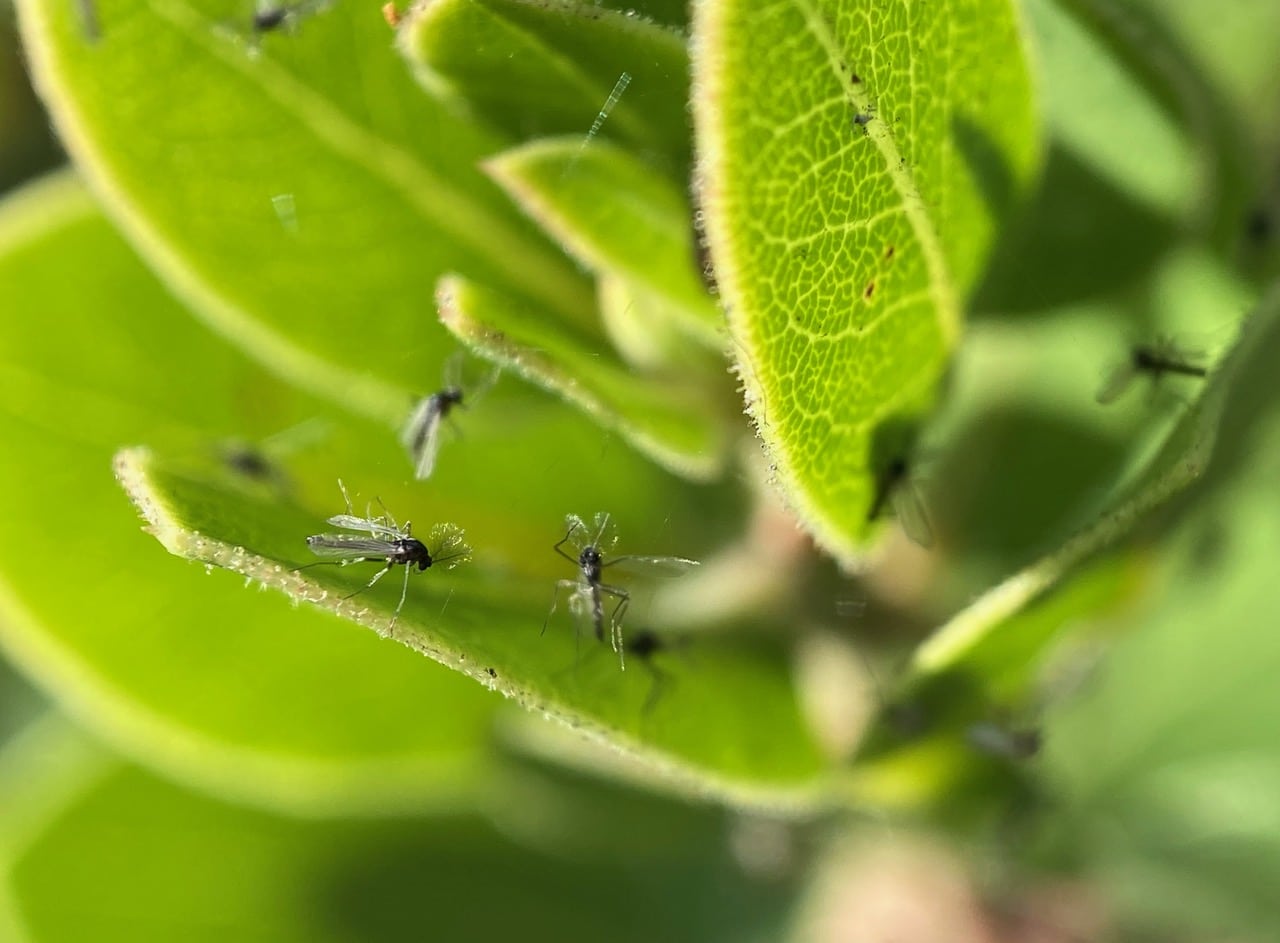
Approaching a large stand of manzanita, I see a swarm of midges dancing over the shrubs against the afternoon sun. I take a video of the spectacle Midges swarm over a manzanita shrub. – YouTube and wait patiently for one to land to see what it is. Alas, the insects are not cooperative. Some movements among the terminal leaves of a manzanita catches my attention – several midges have been snared by a spider web. Some are still alive and struggling. This gives me the perfect opportunity to take a closer look. Ah, they are Non-biting Midges in the family Chironomidae. Interestingly they are mostly males with prominent plumose antennae.
The Chironomidae is a large and diverse family of flies, with over 20,000 species known world-wide. Adult midges are small, most measuring 1-10 mm long, with narrow bodies and long legs. They resemble mosquitos, but do not bite. Males have long, feathery (plumose) antennae. Adults are short-lived. They feed on fly droppings, nectar, pollen, honeydew, and various sugar-rich materials. Larvae are mostly aquatic or semi-aquatic; most occur in freshwater habitats, a few occur in decaying matter, under bark, in moist ground, or tree holes. Larvae are mostly scavengers/detritivores. Collectively, they play a vital role in freshwater ecosystems as primary consumers. They harvest an enormous amount of energy from detritus and are important food items for fish, amphibians, birds, and predatory insects such as dragonflies and dance flies. Adult Chironomids can be pests when they emerge in large numbers, forming mating swarms over water or road surfaces.

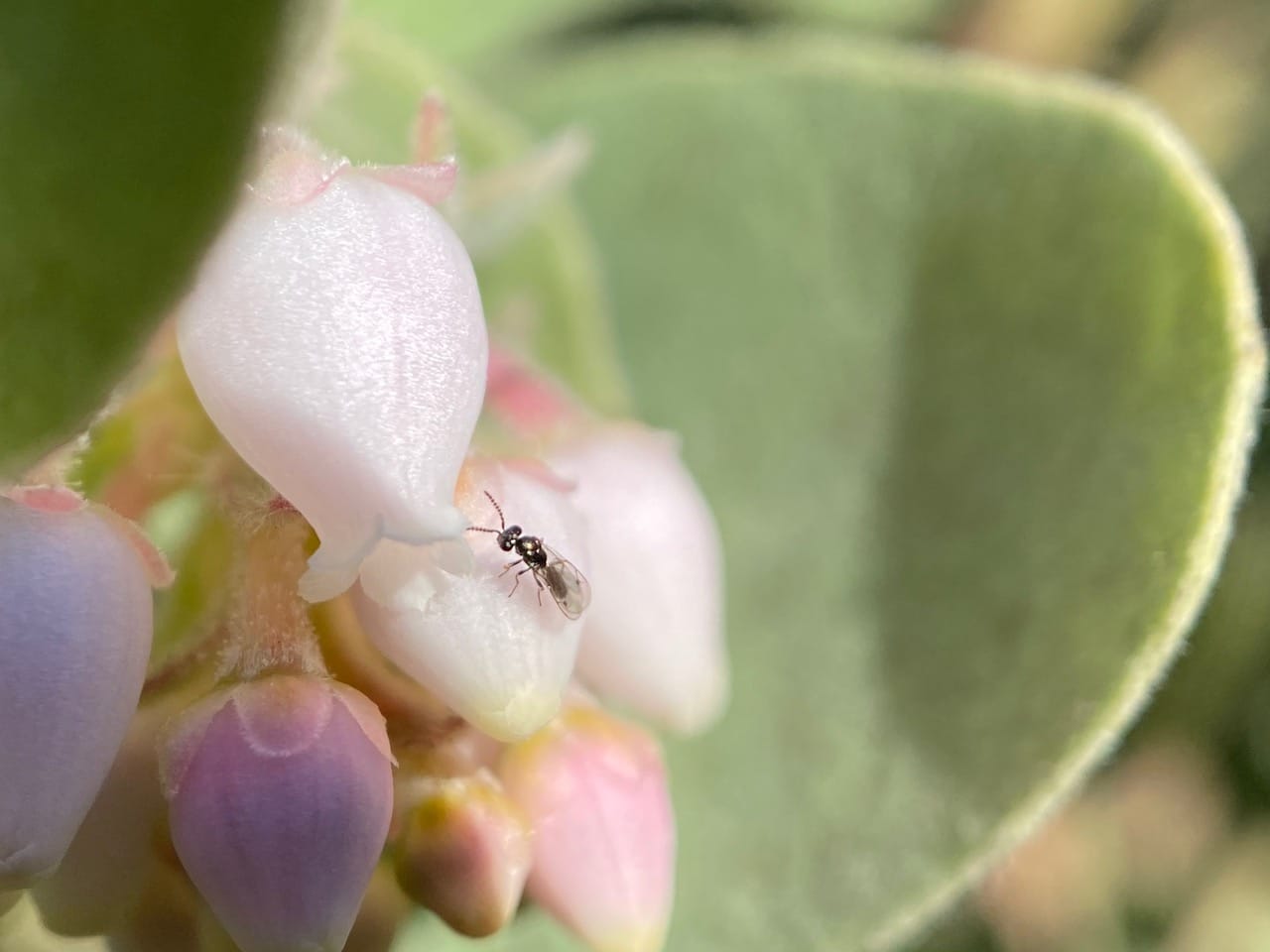
A Chalcidoid wasp in the family Pirenidae (superfamily Chalcidoidea) is moving on a cluster of manzanita flowers.
Most Chalcid species are parasitoids of other insects, attacking the eggs or larval stage of their host, though many other life cycles are known. These hosts are to be found in at least 12 different insect orders including Lepidoptera (butterflies and moths), Diptera (true flies), Coleoptera (beetles), Hemiptera (true bugs), and other Hymenoptera, as well as two orders of Arachnida. When the host is itself a parasitoid, the wasps are referred to as hyperparasitoids. Generally beneficial to humans as a group, chalcidoids help keep various crop pests under control, and many species have been used as biocontrol agents.
Members of the family Pirenidae are parasitoids or hyperparasitoids of insect eggs and larvae.
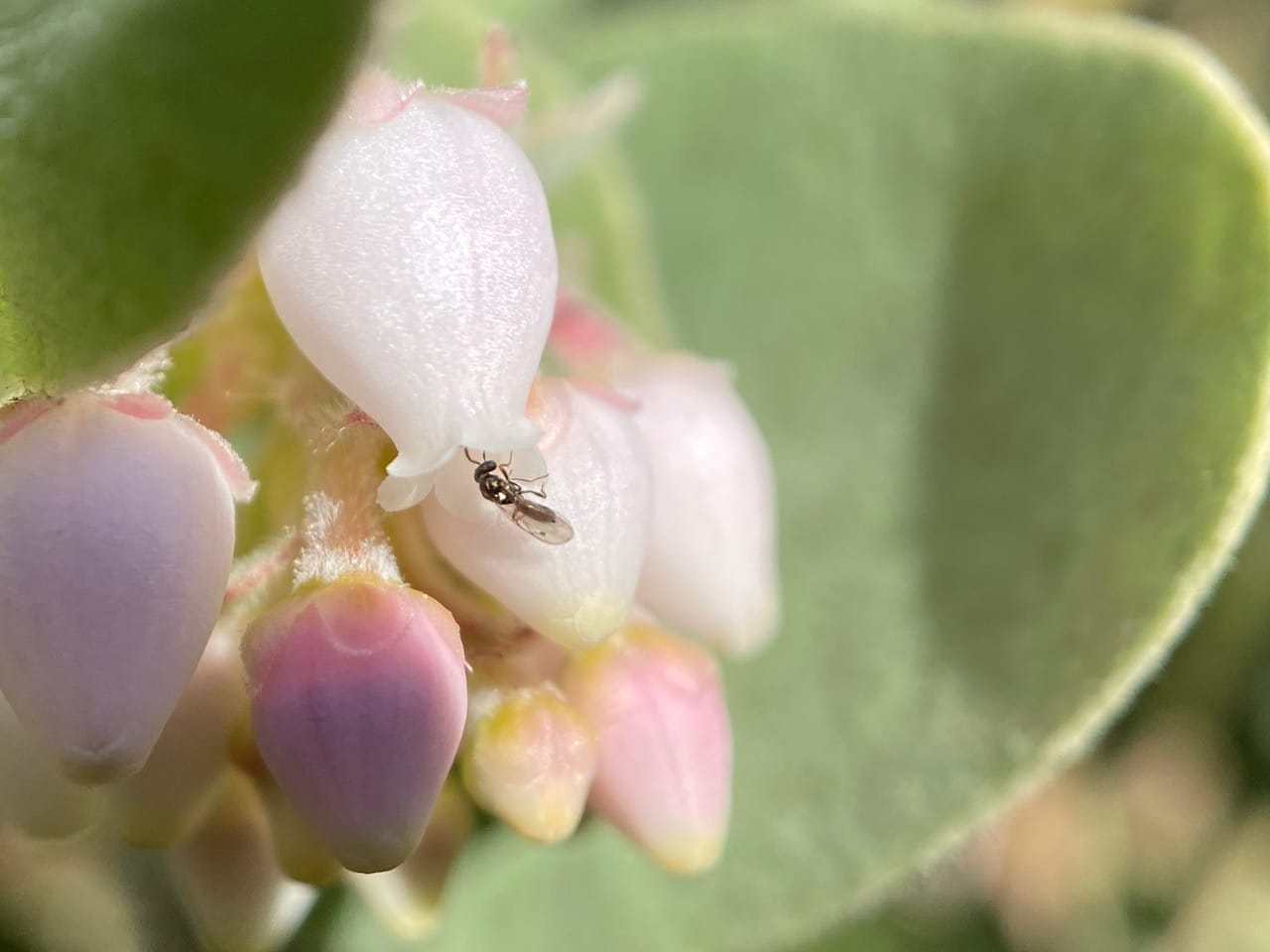
The tiny wasp climbs onto the lips of a manzanita flower and disappears into the urn-shaped corolla. Does this parasitoid have a special relationship with manzanitas? Is it searching for the eggs or larvae of a host insect in which to lay its eggs? The host must be small enough to enter the manzanita flowers. Right now the manzanitas are about the only plant in bloom in the garden, and the only other insects I have seen that are small enough to enter the flowers are the thrips and ants. The ants lay eggs communally in their own nests, so that leaves the thrips as the most likely hosts. Thrips are often found in manzanita flowers, and are known to serve as pollinators for the plant. It is fun to observe the workings of the miniature ecosystem of the manzanita flower!
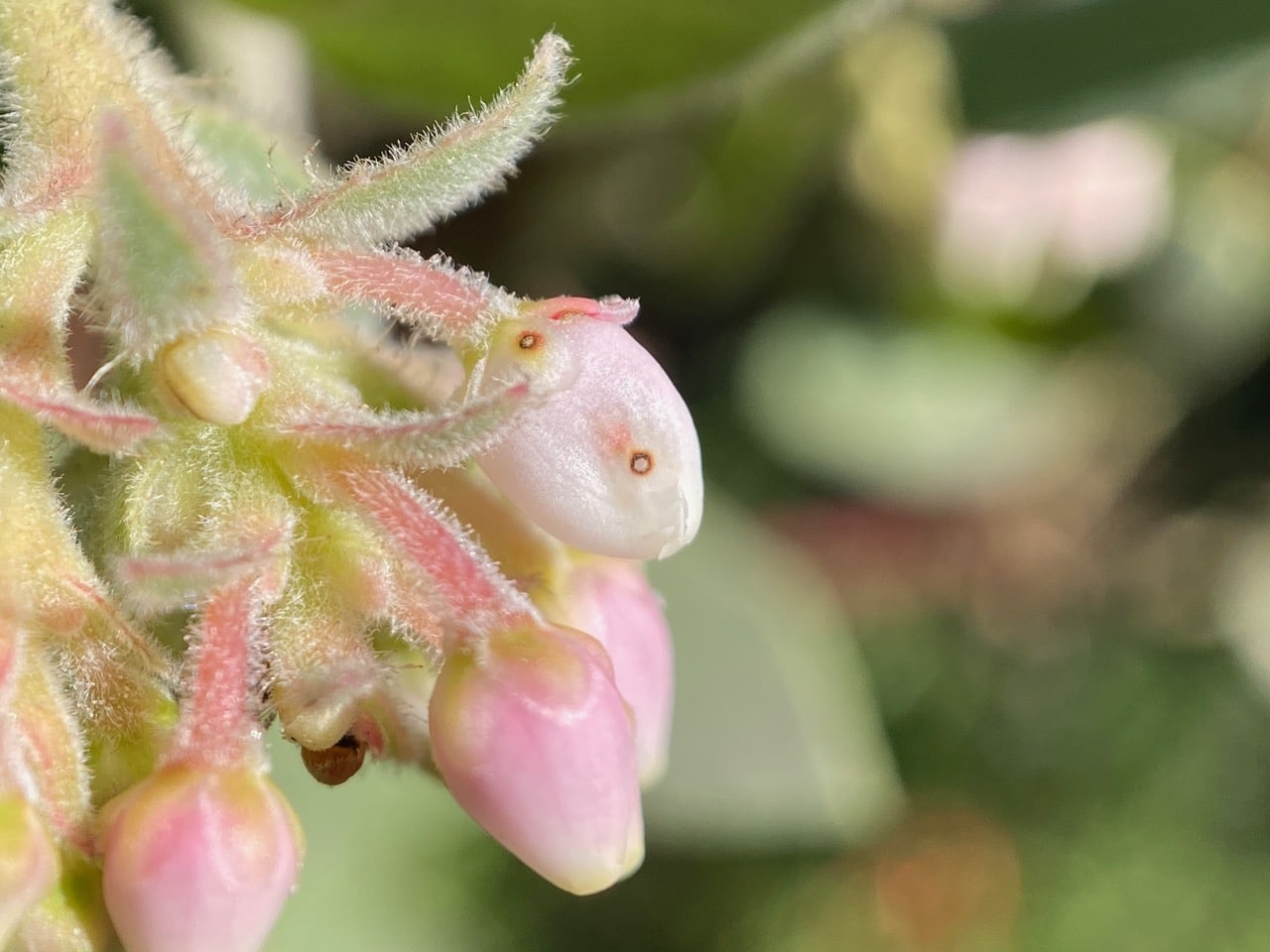
Ooh, who made those holes? Are these signs of “nectar robbing? Many small and/or deep-throated flowers tend to get their nectar “robbed” by large or short-tongued insects that can’t enter the corolla to reach the nectar the proper way. These insects simply cut a hole to extract the nectar directly. Since they bypass the reproductive structures of the flower, they do not serve as pollinators. Once the primary robber has left, other insects (secondary robbers) may come along to partake of the feast.
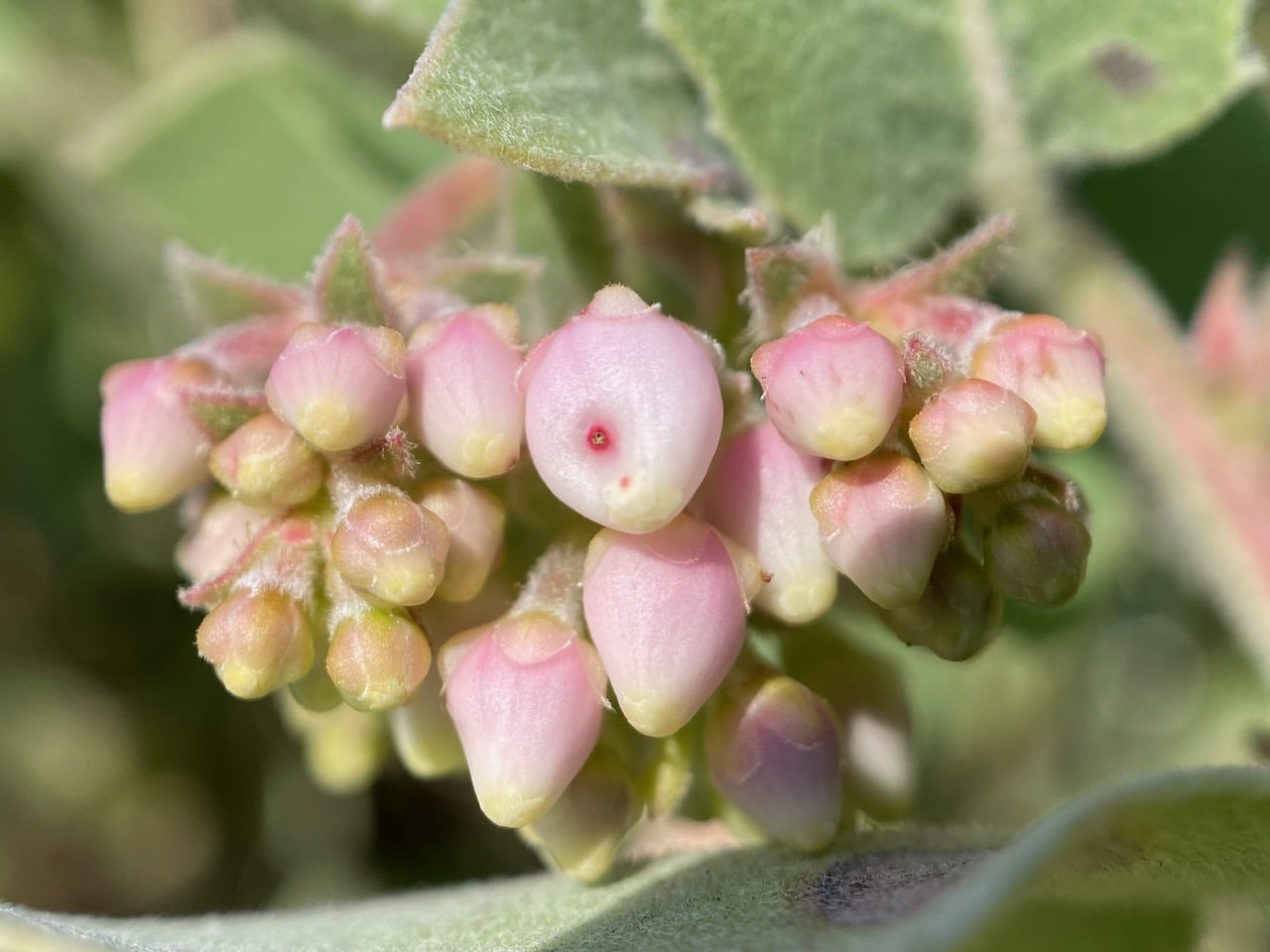
I wonder who made the hole ? Bumble bees are notorious for nectar robbing, but they have long enough tongues to reach the nectar of the manzanita flowers. These flowers have yet to open – maybe the bee is too impatient to wait for the flowers to open?
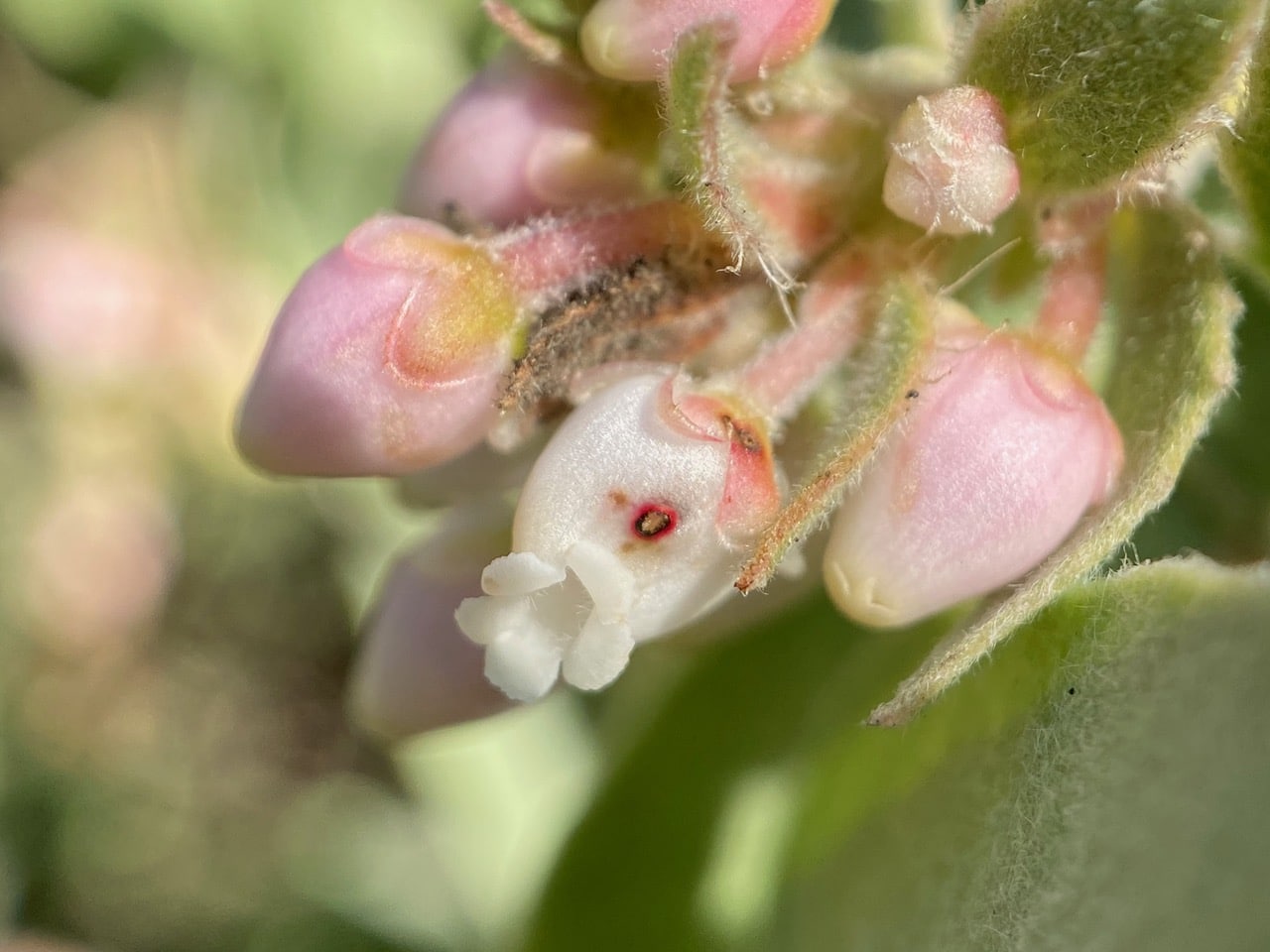
It is interesting that red pigments are concentrated around the puncture wound of the flower.
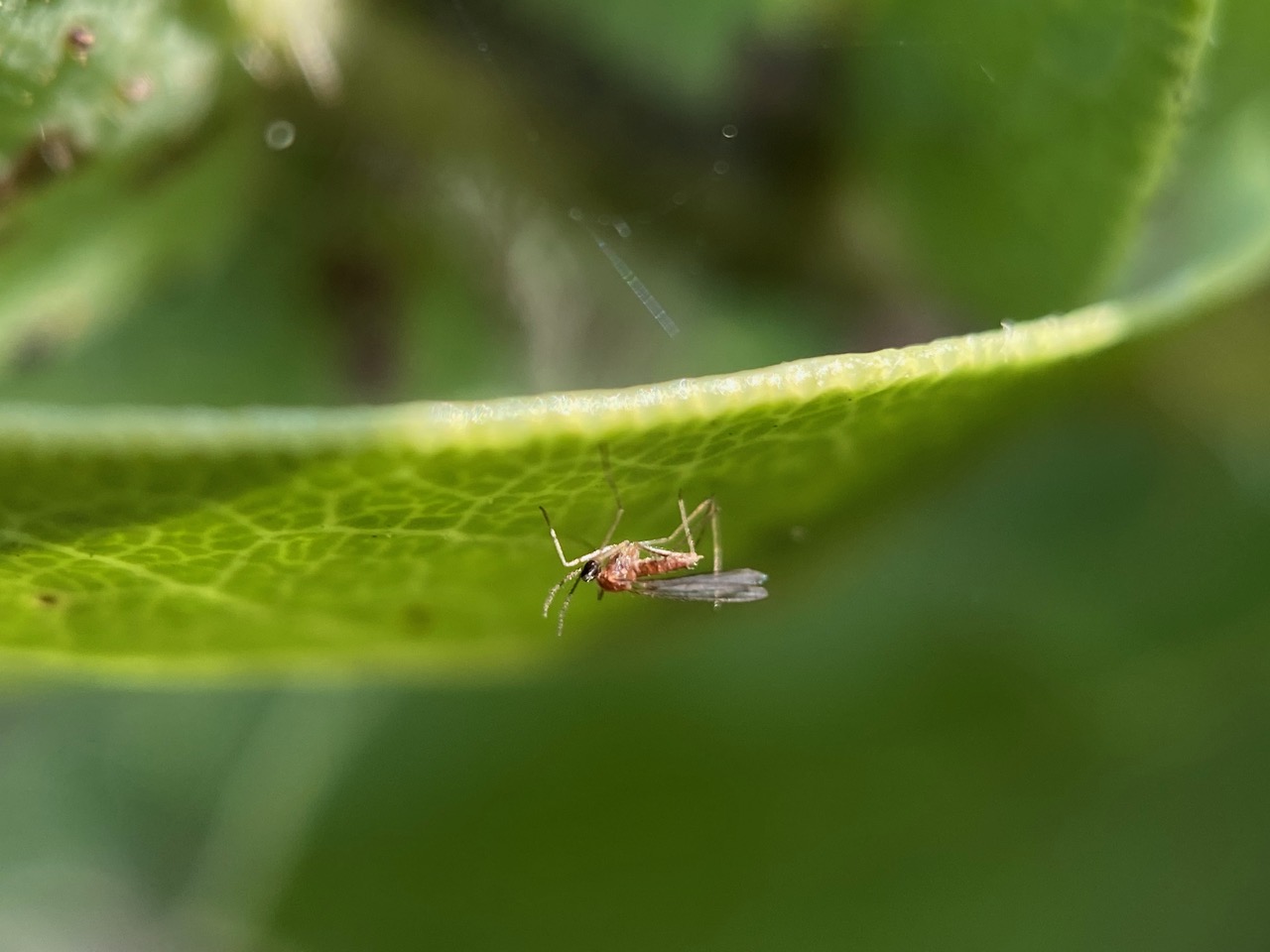
I zoom in on a tiny insect perched on a manzanita leaf. It appears to be a Gall or Forest Midge (family Cecidomyiidae).
Cecidomyiidae is a family of flies known as gall midges or gall gnats. As the name implies, their larvae feed within plant tissue, creating abnormal plant growths called galls. Cecidomyiidae are very fragile small insects usually 2-3 mm in length. They are characterized by hairy wings and have long antennae.
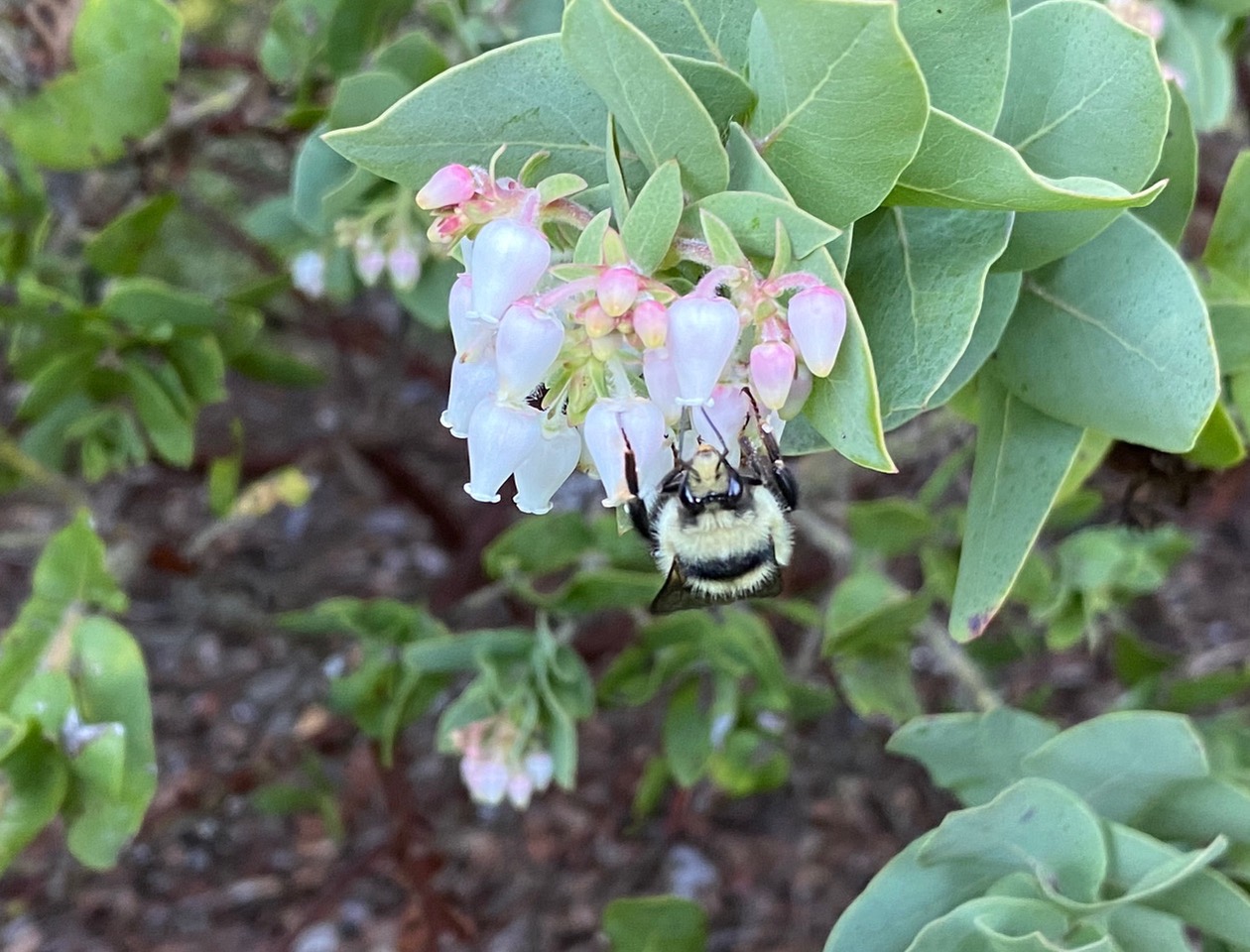
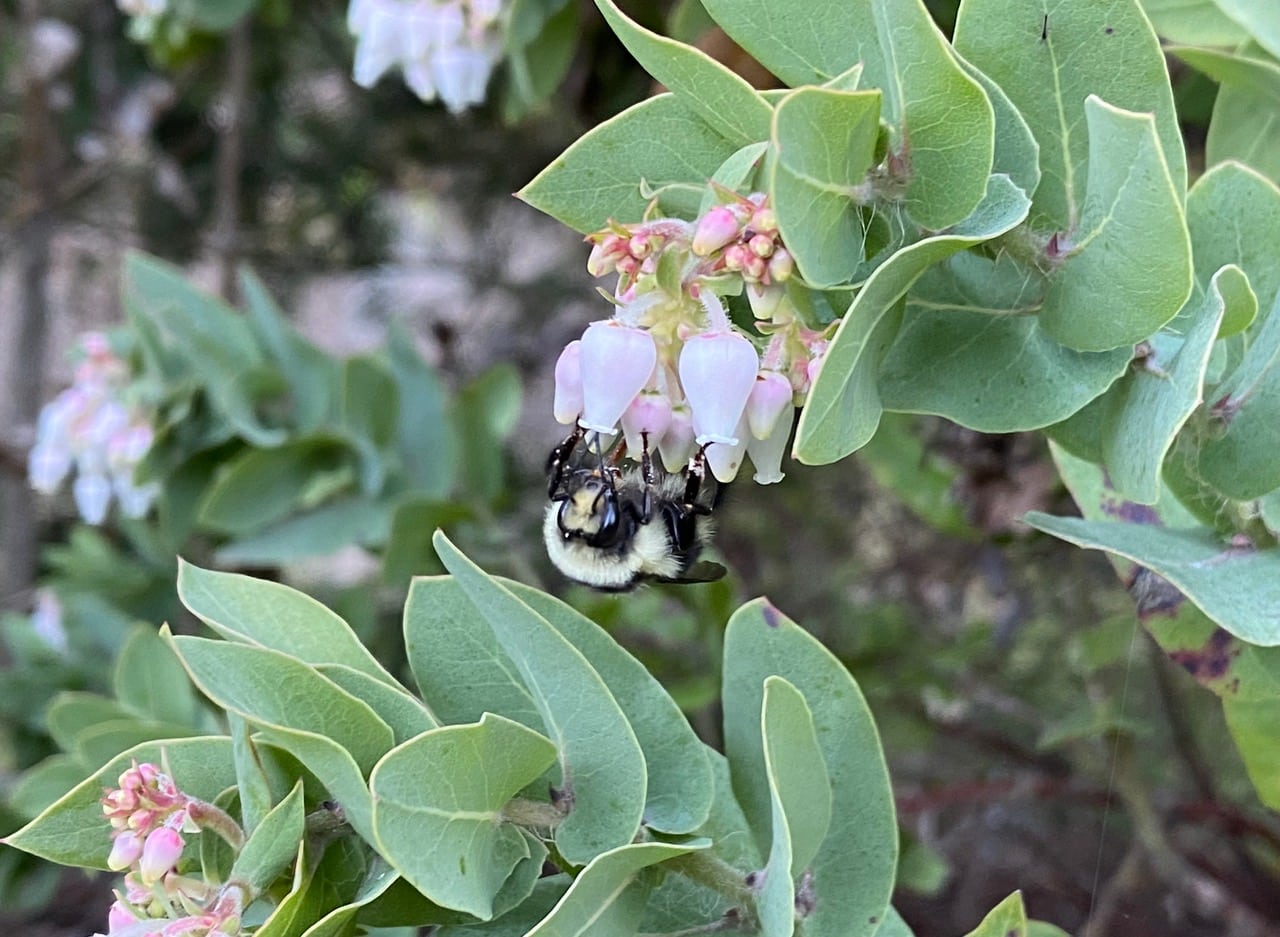
A queen Black-tailed Bumble Bee, Bombus melanopygus (family Apidae) is foraging on a cluster of Manzanita flowers.
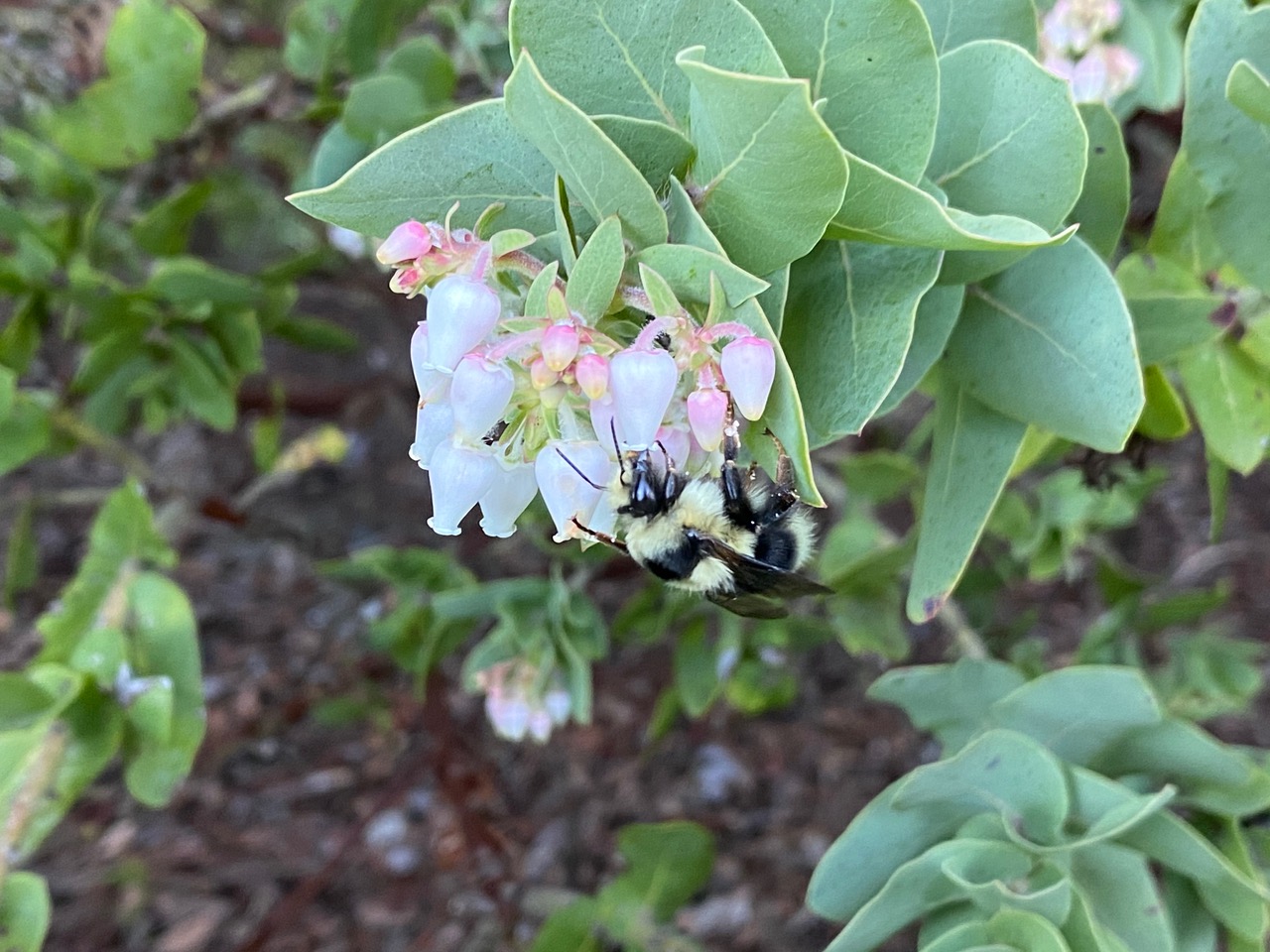
Bumble bees are social and live in colonial hives. Many of the large individuals seen early in the season are queens. They are the only members of their colony to survive the winter, hibernating until the days begin to warm and their host plants are in bloom. These queens have mated before they went into hibernation. Now their first order of business is to each find a nesting site (usually an abandoned rodent burrow), lay eggs, brood and nurture the first batch of workers. Hence forth, the queens stay behind in the hive to concentrate on laying eggs while the workers take on hive duties and foraging. Bumble bees are among the most cold tolerant bees, and are usually the first bees we see out foraging. This is why it’s important for us to plant early blooming natives to support the queen bumble bees.
Bombus melanopygus is a species of bumble bee native to western North America, widely distributed from the Pacific to the Rocky Mountains, and from Alaska to Baja California. The species is found in various habitats, including agricultural and urban areas. The bees feed on many types of plants, including manzanitas, Ceanothus, golden bushes, wild buckwheats, lupines, penstemons, rhododendrons, willows, sages, and clovers. They nest underground or aboveground in structures.
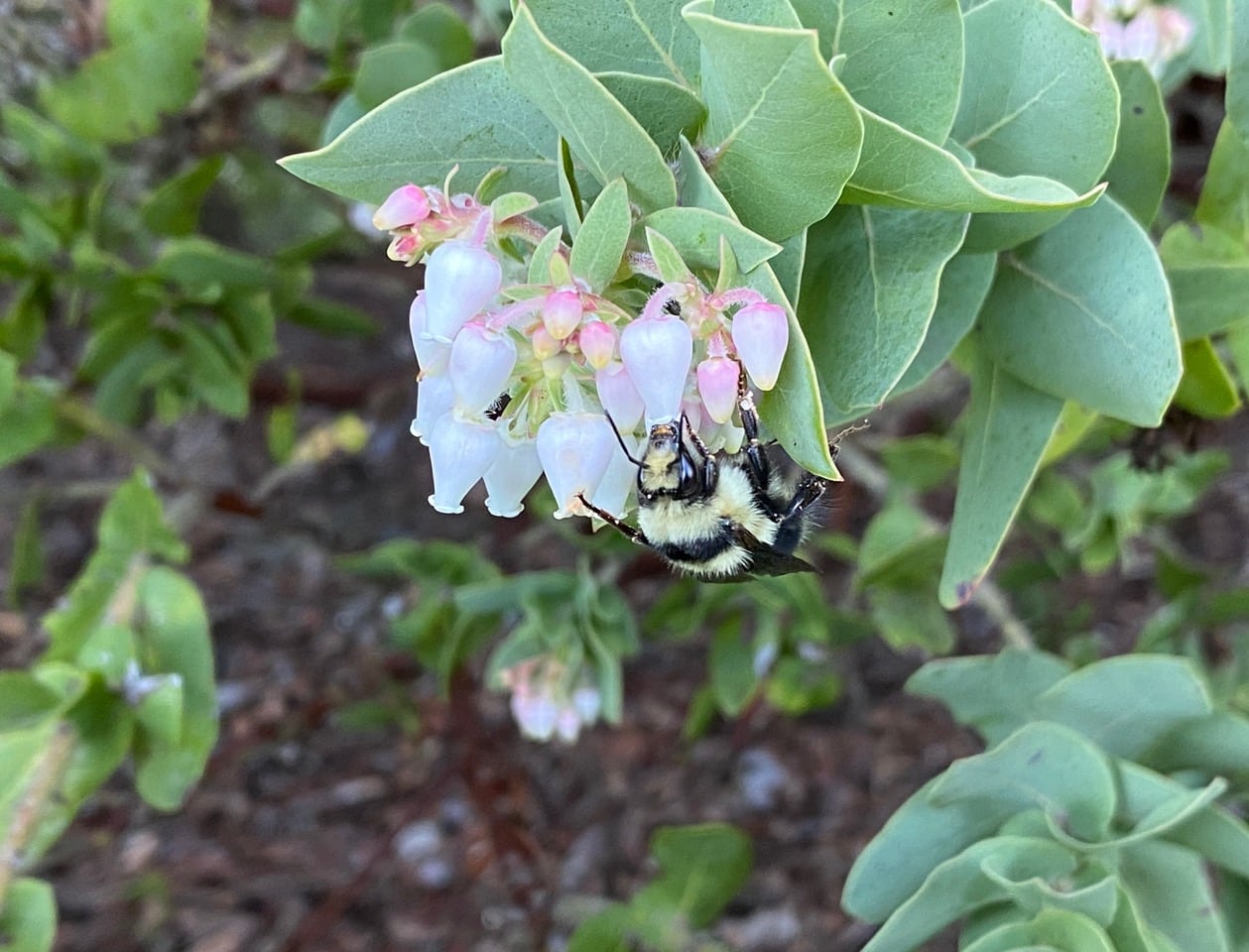
The bumble bee does not seem to be collecting pollen, as she is not sonicating the flowers and her pollen baskets (corbiculae) are empty. The pollen on her is probably acquired unintentionally while probing for nectar. This early in the season, the queen bee is probably fresh out of hibernation, and has probably not produced a brood for which she has to collect pollen.
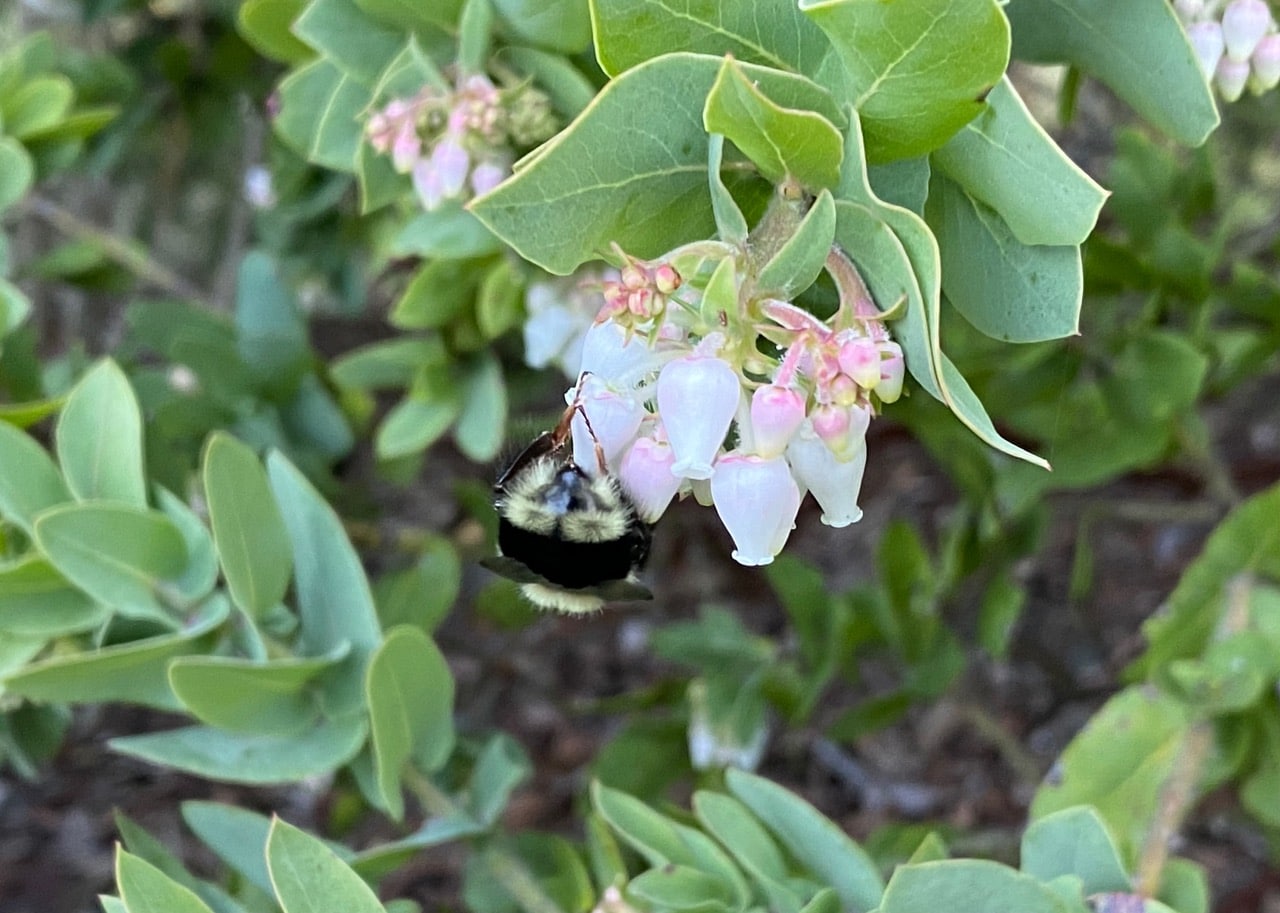
The bee has a black-tipped abdomen which gives her the common name of Black-tailed Bumble Bee.
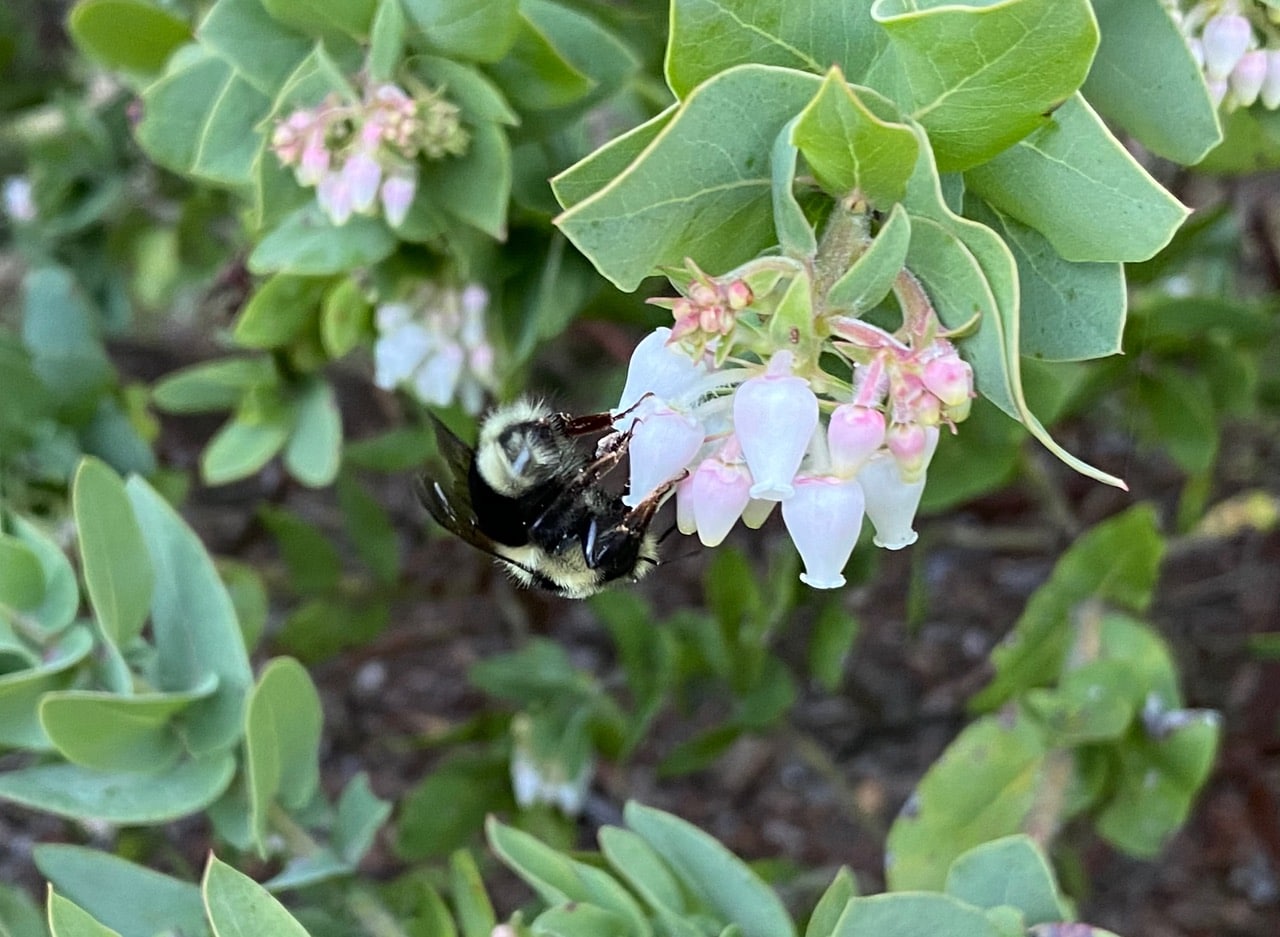
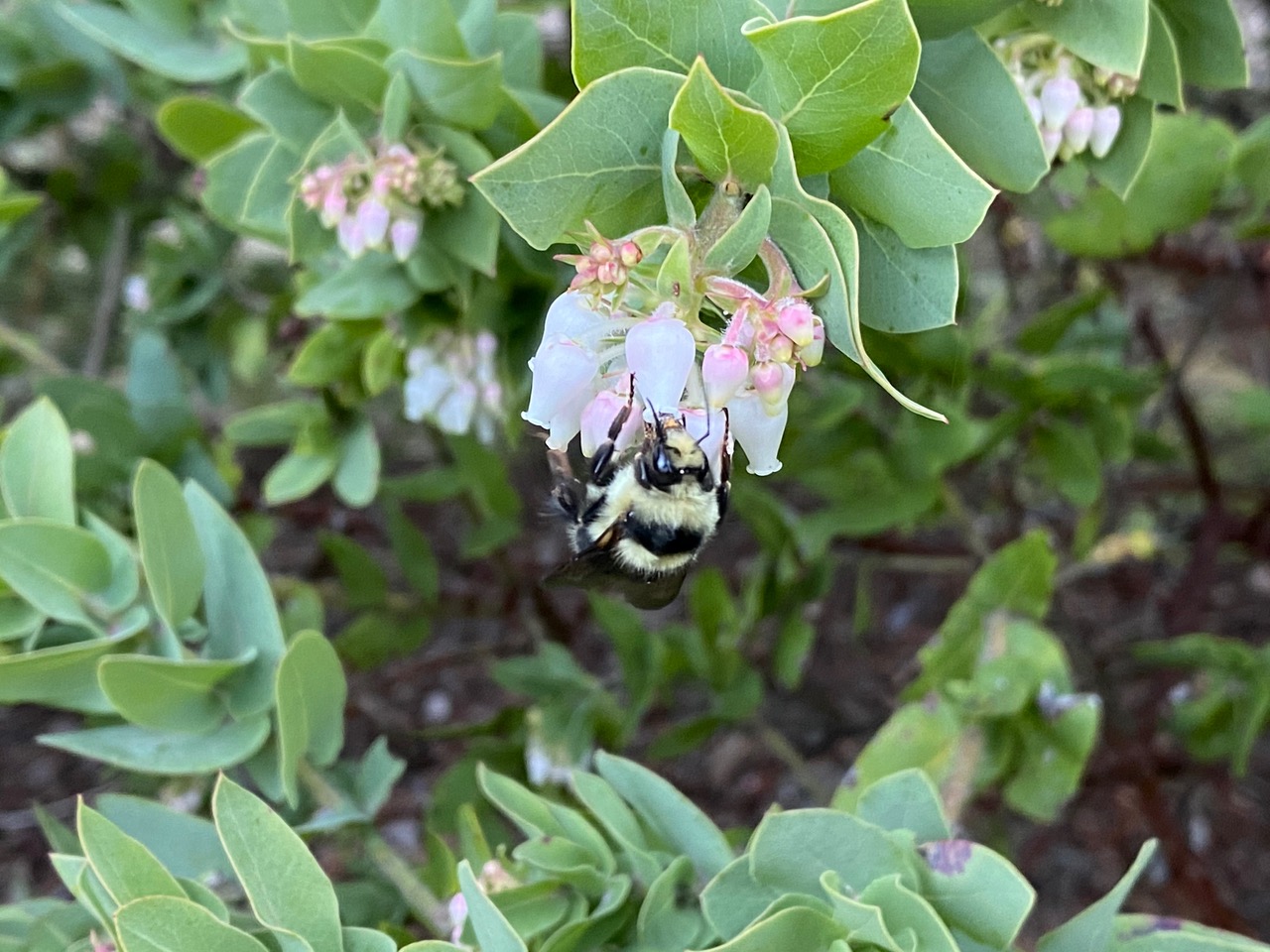
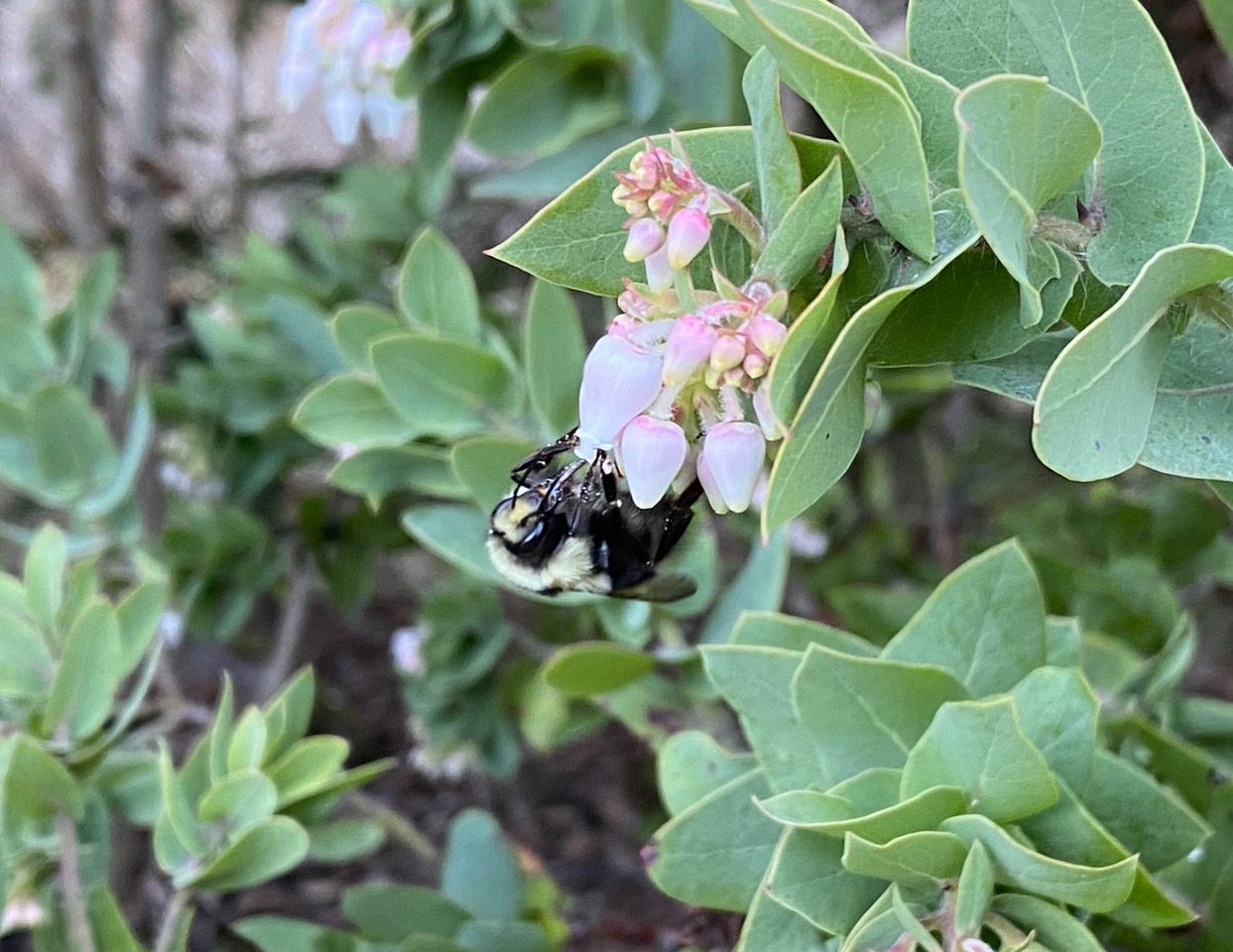
As she lifts her head from the flower, pollen can be seen adhering to her tongue. Can the pollen be transferred to other flowers by her tongue as she forages, effectively pollinating without sonicating?
To collect pollen, the bumble bees usually perform sonication or “buzz pollination” on the manzanita flower. Hanging up-side-down from the flower, the bee disengages her wings from the flight muscles; then the muscles are vibrated at a specific high frequency to cause the pollen to shake loose and to fall down onto the bee’s belly. The bee gathers the pollen into the pollen baskets on her hind legs before returning to her hive.
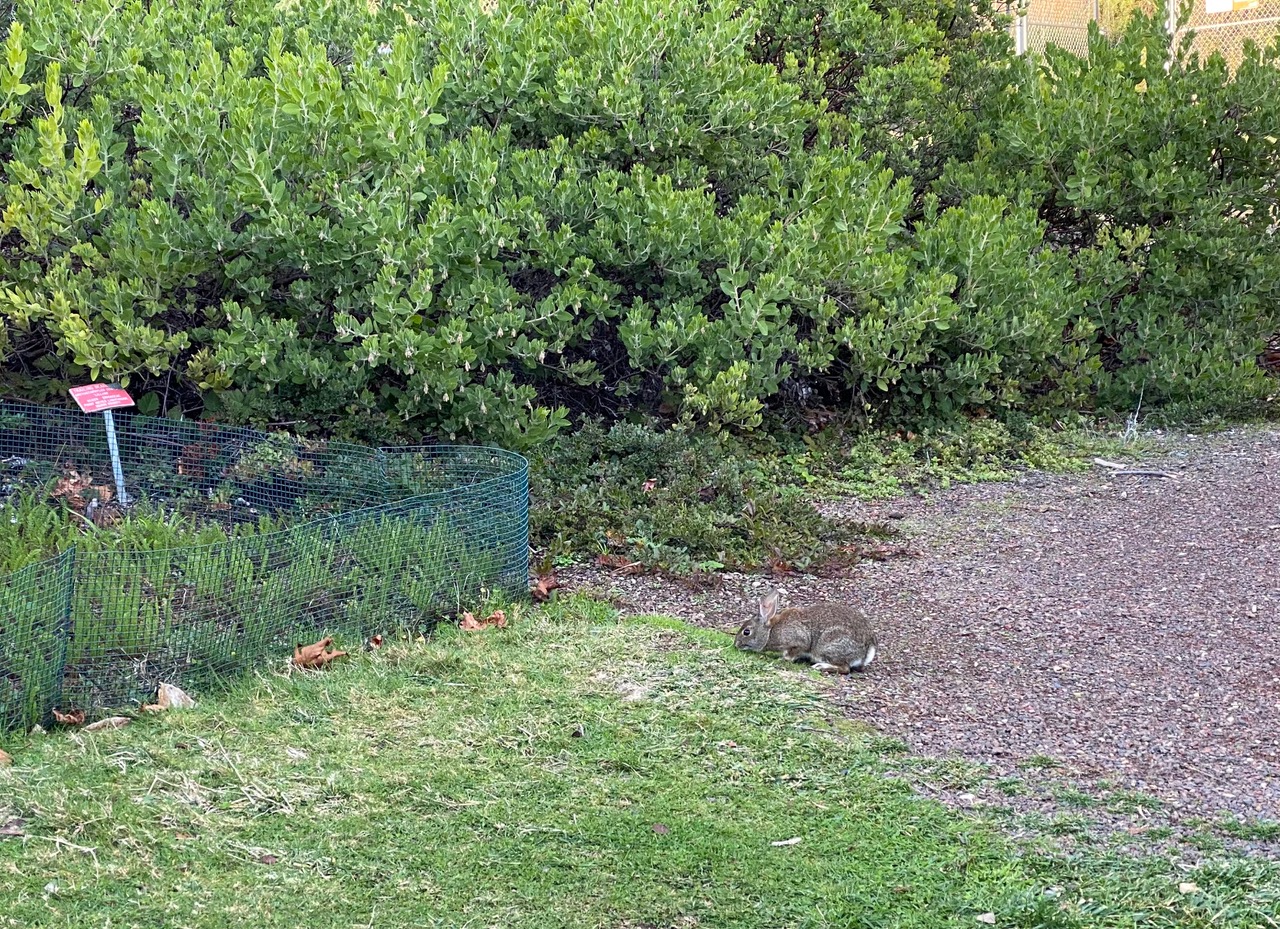
It is delightful to come across Cottontail Rabbits feeding quietly on the lawn.
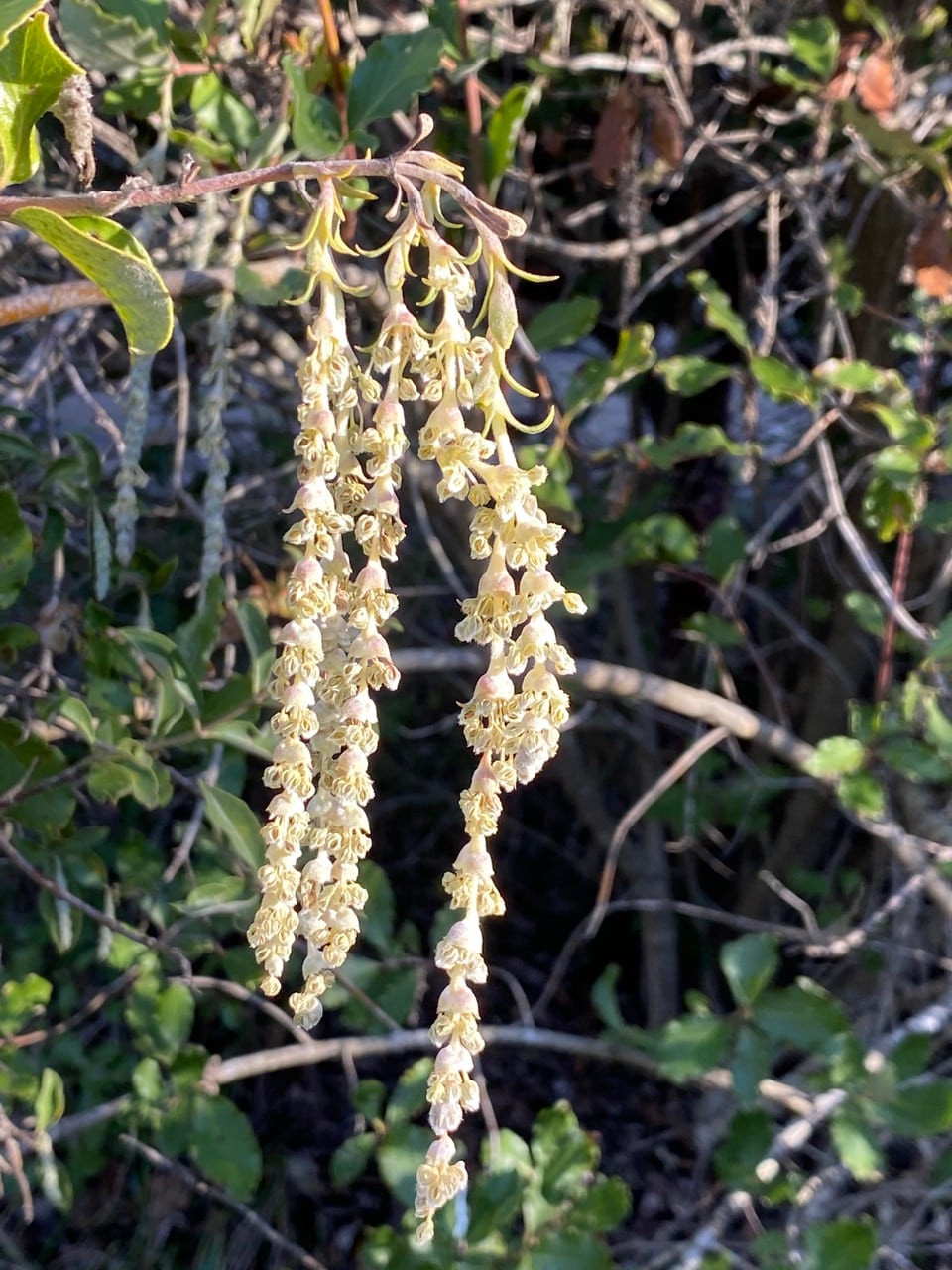
Near the front gate of the garden, the Coast Silk-tassel, Garrya elliptica is already blooming. I stop to admire the long hanging chains of flowers (catkins) on this male plant.
The Coast Silk Tassel, Garrya elliptica (family Garryaceae) is an evergreen shrub or small tree. It is dioecious, meaning male and female flowers are borne on separate plants. Flowers appear in winter, male catkin-like clusters are yellowish to greenish then gray, 8-20 cm long (“silk tassels”), female flower clusters are shorter, 5-9 cm long.

Close-up of the silky male catkins of the Coast Silk Tassel. Within each catkin, tiny male (staminate) flowers are clustered and subtended by two bracts that are fused and form a cup or bell-shaped structure. The flowers are highly reduced, lacking petals. These flowers are wind-pollinated. As the wind blows, pollen is shaken out of the exposed stamens. What a clever design, and so beautiful!
Coast Silk Tassel is an example of plants that are wind pollinated. About 12% of flowering plants and most conifers are wind pollinated. These plants do not waste energy on flower features that attract animal pollinators; instead, their flowers generally have these characteristics:
– Small, petalless, and unscented, with muted colors.
– No nectar
– Stamen (male flower part) and stigma (female pollen-receiving part) are exposed to air currents.
– Male flowers produce a great deal of pollen, which is very small, dry, and easily airborne.