

Pollinator Post 1/6/26 (1)
The rains have finally stopped and the sky has cleared. I rejoice in the wetness around me as I walk along Sanborn Drive in Joaquin Miller Park this morning.
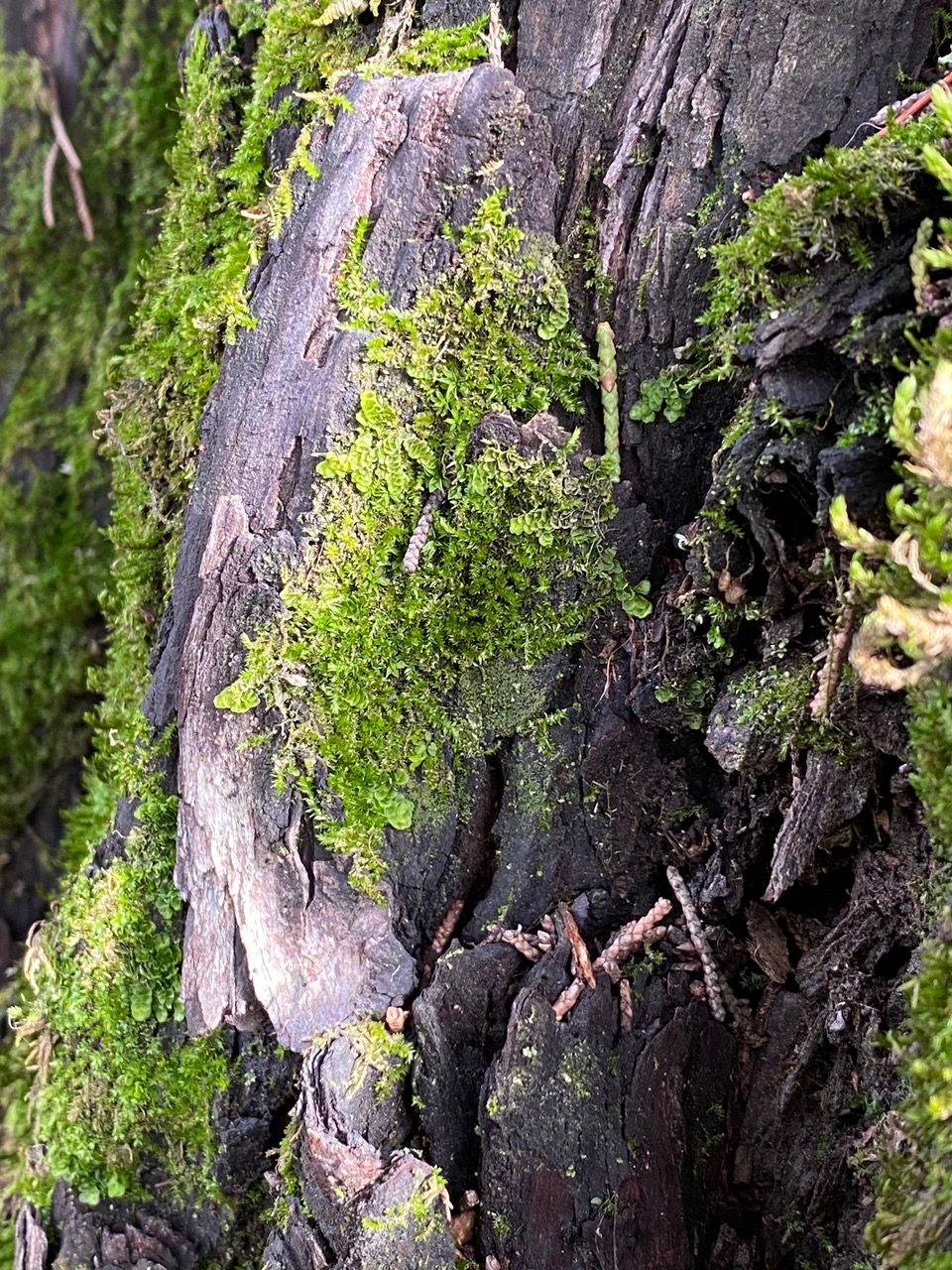
I do a double take as I walk past a moss-covered trunk of a Monterey Cypress near the parking lot. Not everything green on the peeling bark is moss! Growing among the mosses are some Leafy Liverworts.

Close-up of the Leafy Liverwort (order Jungermanniales, division Marchantiophyta).
The liverworts are thought to be the most primitive of terrestrial plants. Compared to flowering plants and ferns, liverworts are quite simple: no vascular system to transport nutrients and water, and no flowers, instead they reproduce by means of spores. Liverworts are most common in moist tropical areas, growing in moderate to deep shade. Liverworts fall into two groups based on their growth form: Thalloid liverworts look like green ribbons or scales that grow flat against a surface. Leafy liverworts are much less familiar to people. They have flattened stems with small, rounded, overlapping, leaflike scales in at least two rows; the stems often produce side branches.
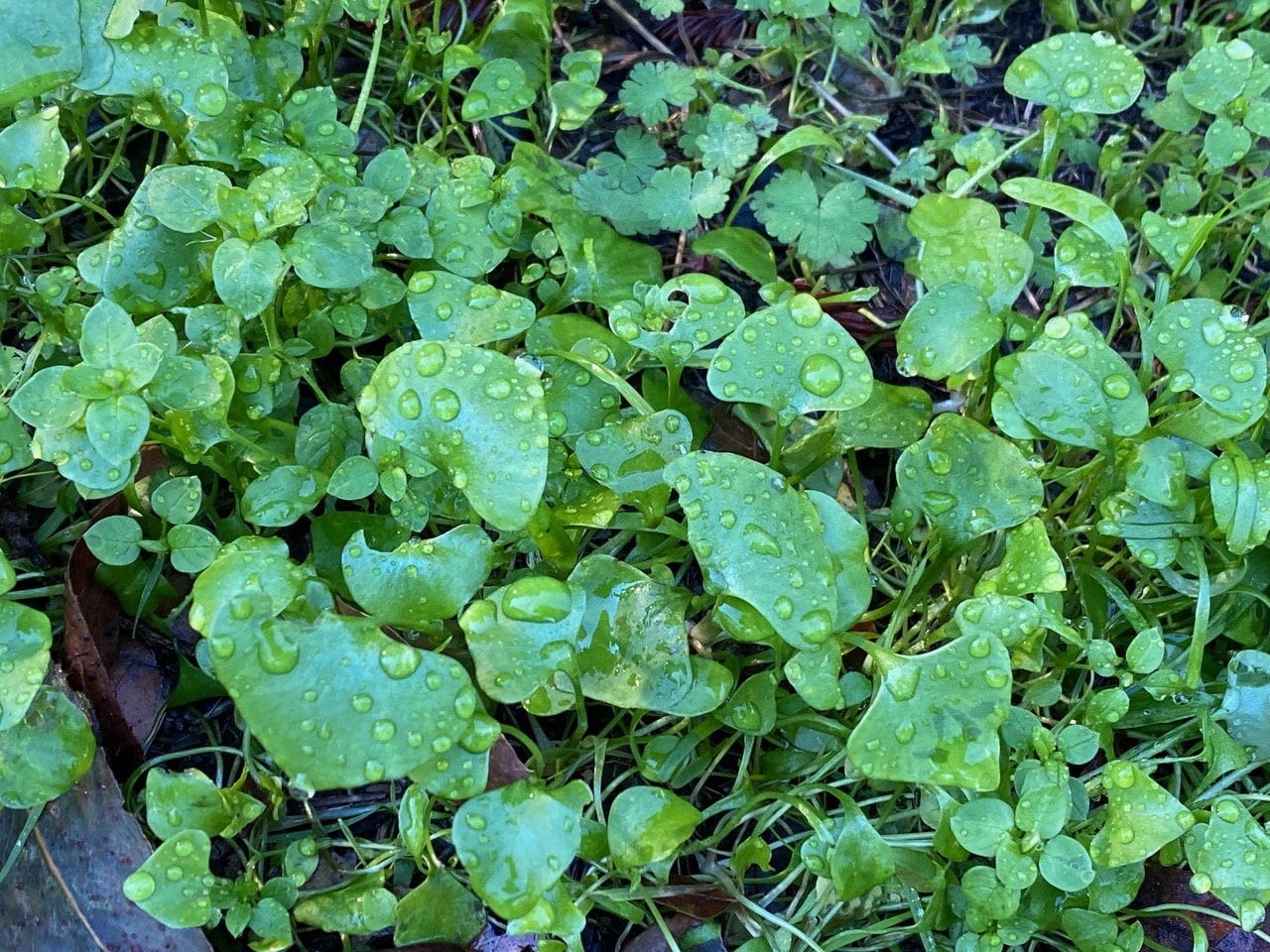
Miner’s Lettuce, Claytonia perfoliata has sprouted in profusion along the roadside. Most people are familiar the perfoliate leaves of Miner’s Lettuce that subtend the charming posies of miniature white flowers we adore. But the plant usually puts on three different foliage in succession during its development – strap-shaped, spade shaped, and circular-perfoliate. Here these young plants are exhibiting their second, spade-shaped leaves.
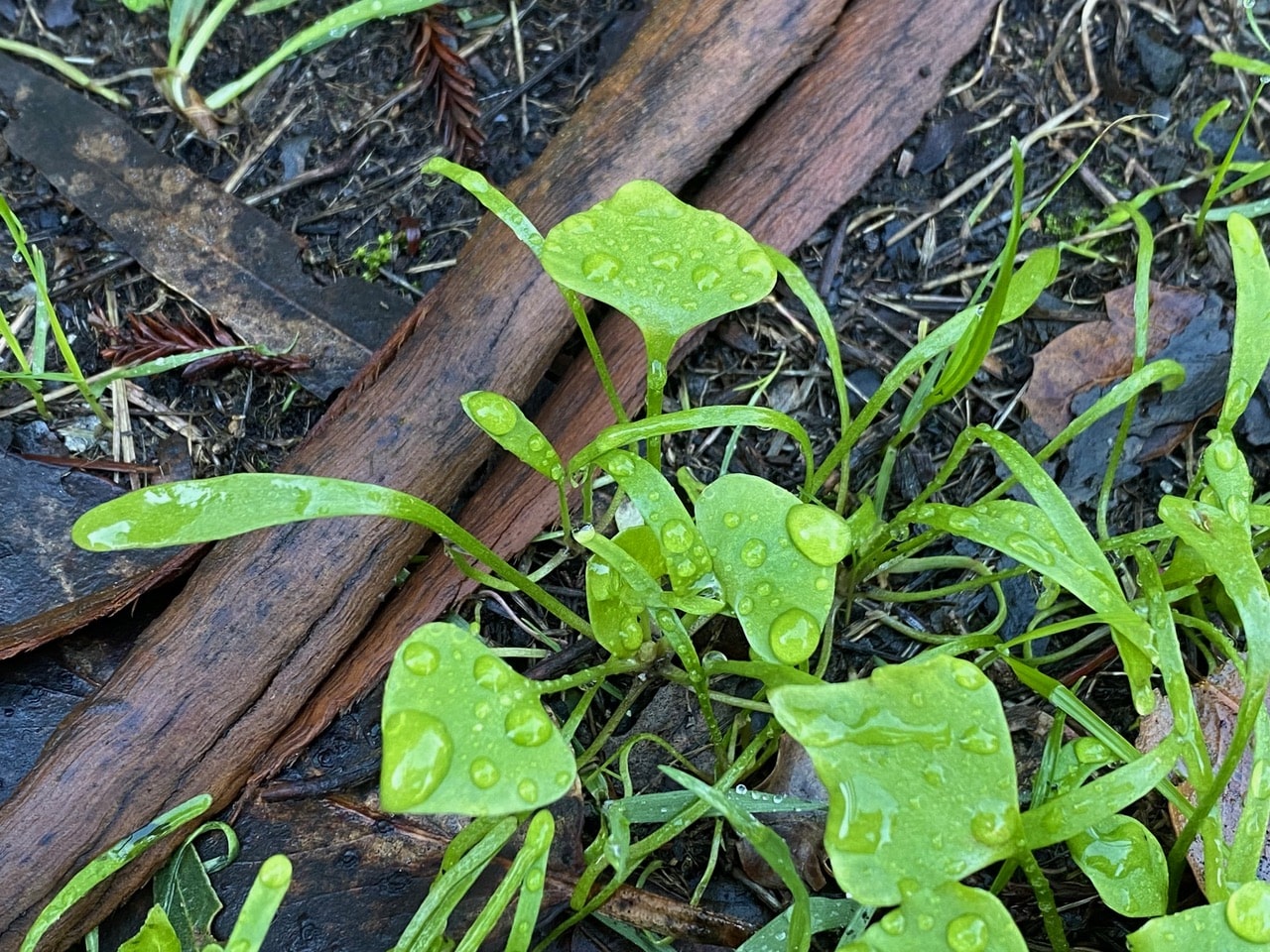
This Miner’s Lettuce still has its strap-shaped leaves, while also growing spade-shaped leaves.

An old log lying under Bay trees has sprouted some beautiful wood-rot fungi.

Close-up of Turkey-tail Fungi, Trametes versicolor.
Trametes versicolor is a common polypore mushroom found throughout the world. Its fan-shaped caps reminiscent of a wild turkey’s tail, the fungus is most commonly referred to as turkey tail.
Versicolor, meaning ‘of several colors’, accurately describes this fungus that displays a unique blend of markings. The mushroom commonly grows in overlapping layers in groups or rows on logs and stumps of deciduous trees. It is a white rot fungus which degrades lignin from wood. The fruiting body is somewhat fan-shaped, with no discernible stalk, and the tough flesh is 1-3 mm thick. The flat cap is roundish, with zones of fine hairs colored rust-brown or darker brown. The bottom surface is white, covered with fine pores from which spores are dispersed. The pores are round, becoming twisted and labyrinthine with age.
T. versicolor is considered too tough to eat, but it is recognized as a healing mushroom for its longevity and health-related effects. Its use dates back centuries when Traditional Chinese Medicine practitioners brewed turkey tail mushrooms into soothing teas. In Japan its extract is used in cancer treatment. The fungus is commonly marketed as a dietary supplement for various health benefits.
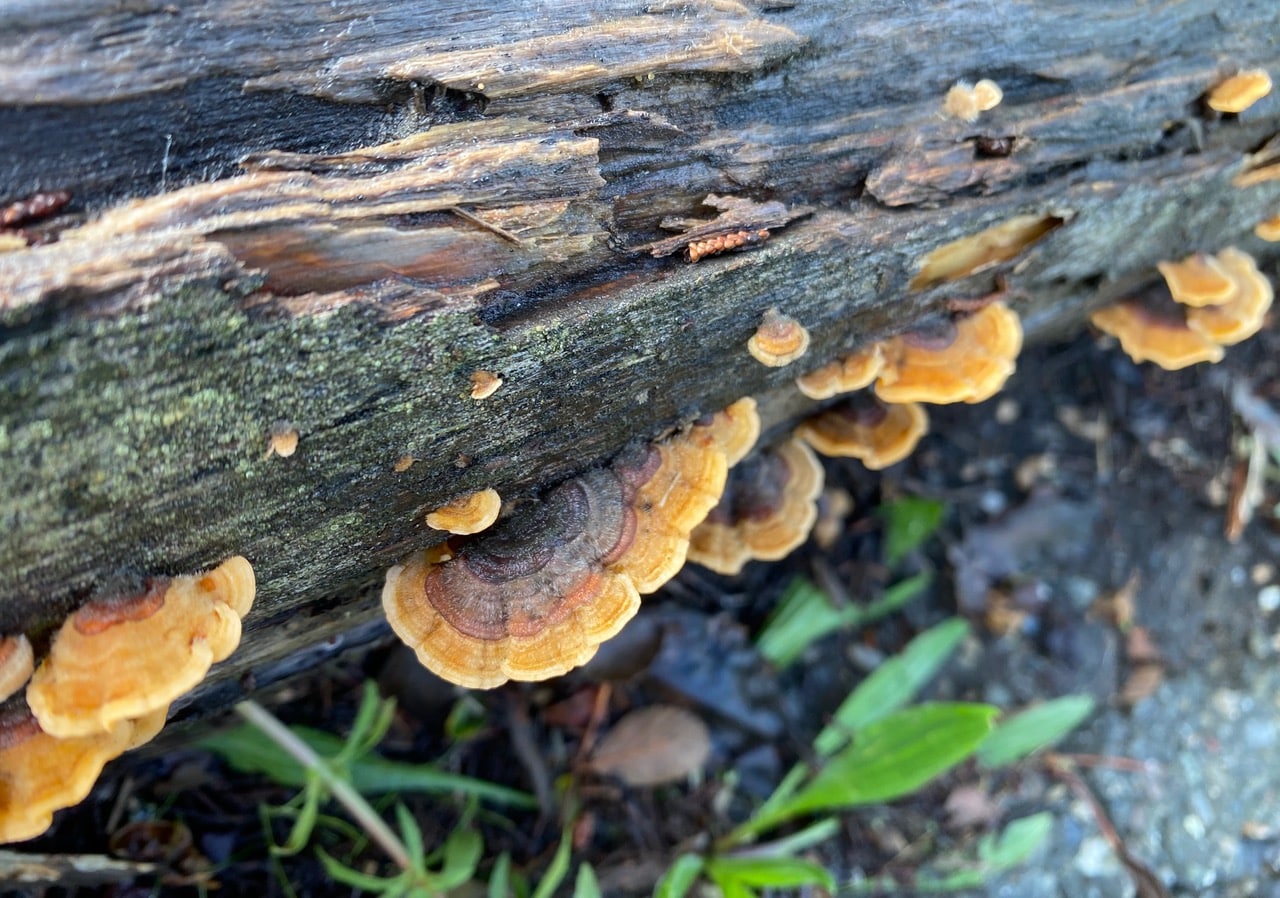
On another log close by, the fruiting bodies of the False Turkey-tail Mushroom, Stereum hirsutum have appeared in clumps and rows.
Stereum hirsutum, commonly known as the False Turkey Tail, or Hairy Curtain Crust, is a species of fungus and a plant pathogen that infects coniferous and deciduous trees. Found throughout North America, the fuzzy orangish fruiting bodies typically form in multiple brackets on dead wood. The cap is thin and tough; spores are white. The underside of the cap is yellowish/ brownish and smooth, with no visible pores. Often the fungus is itself parasitized by the fungus called Witch’s Butter. The fungus can best be distinguished from the similar Turkey-tail Mushroom by examining the undersurface of the caps.

Among the budding False Turkey Tail mushrooms on the log I spot the bright yellow of a Witch’s Butter mushroom, Tremella mesenterica. I love both the common name and the scientific name. The scientific name translates from Latin and Greek to mean “trembling guts”, so evocative of the fungus’s gelatinous, wobbly texture when wet and its convoluted structure.
Tremella mesenterica is a common jelly fungus in the family Tremellaceae of the Agaricomycotina. The gelatinous, orange-yellow fruit body of the fungus, which can grow up to 3 inches in diameter, has a convoluted or lobed surface that is greasy or slimy when damp. It is most frequently found on both dead but attached and recently fallen branches, especially of angiosperms, as a parasite of wood-decay fungi. It also grows in crevices in bark, appearing during rainy weather. Within a few days after rain it dries into a shriveled mass capable of reviving after subsequent rain. The fungus occurs widely in deciduous and mixed forests and is widely distributed in temperate and tropical regions, including those of Eurasia, Africa, Australia, and the Americas. The fungus grows parasitically on the mycelium of wood-rotting fungi such as the False Turkey Tail, Stereum hirsutum. Often (as seen here), Witch’s Butter and its host fungus are found fruiting together.

A little slug crawls from under the Witch’s Butter fungus. iNaturalist has helped identify it as a Striped Greenhouse Slug, Ambigolimax valentianus (family Limacidae).
The slug has spread widely around the world, especially in greenhouses; in warmer climates it has often then spread outdoors. The slug eats green leaves and shoots, and consequently can be a pest in greenhouses or even outdoors. It also feeds on animal matter and fallen leaves. The species seldom climbs up trees and during the day is most commonly found under boards, rocks and plant containers. Often its first discovery in a country has been in greenhouses, from whence it has spread to gardens, other human habitats outdoors, and even to woodland. Where it has been introduced, this species may become the dominant slug.
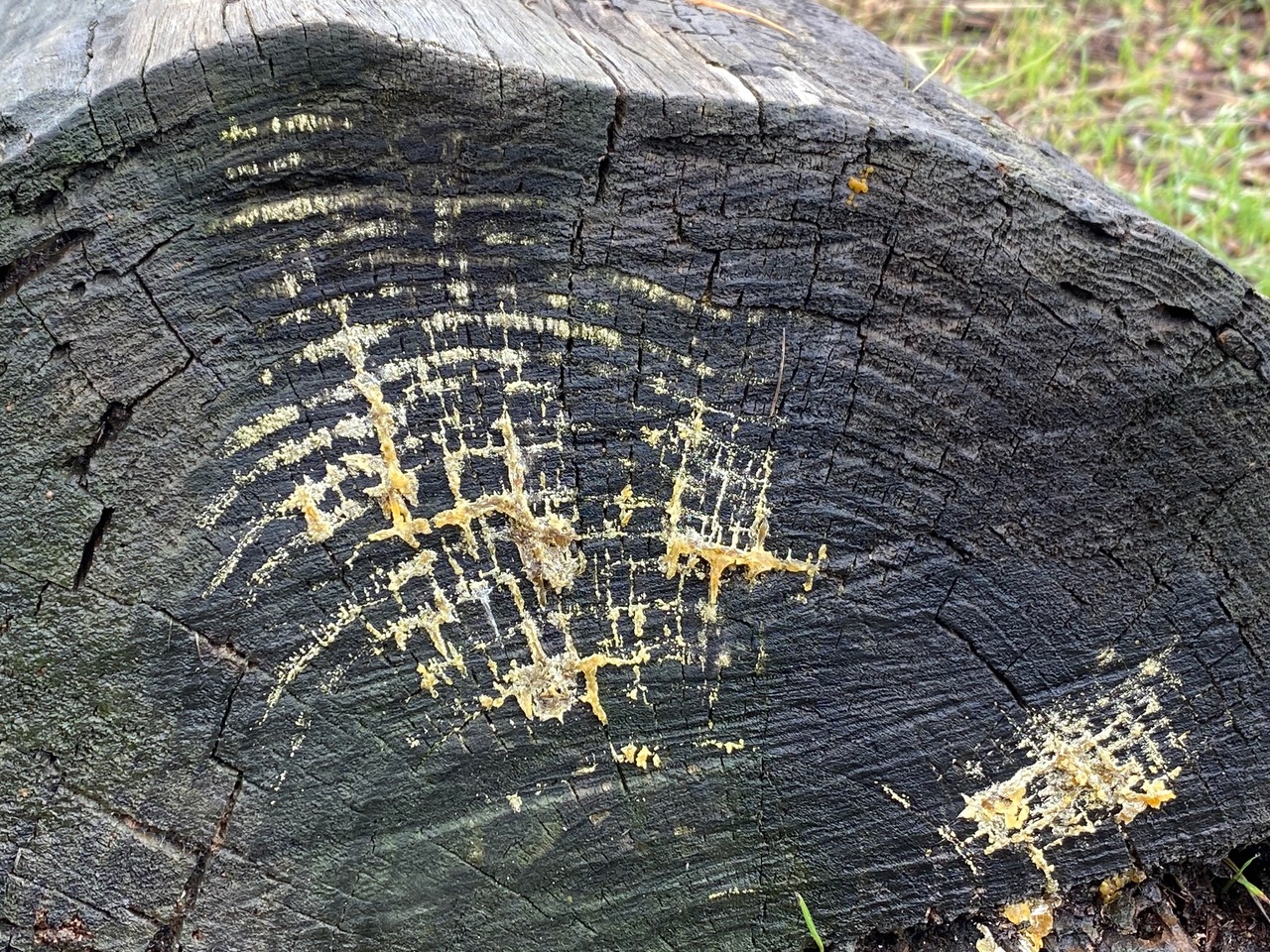
This strange pattern draws my attention to the end cut of a log lying on the ground. Are the yellow things fungi growing from the cracks and crevices of the wood?
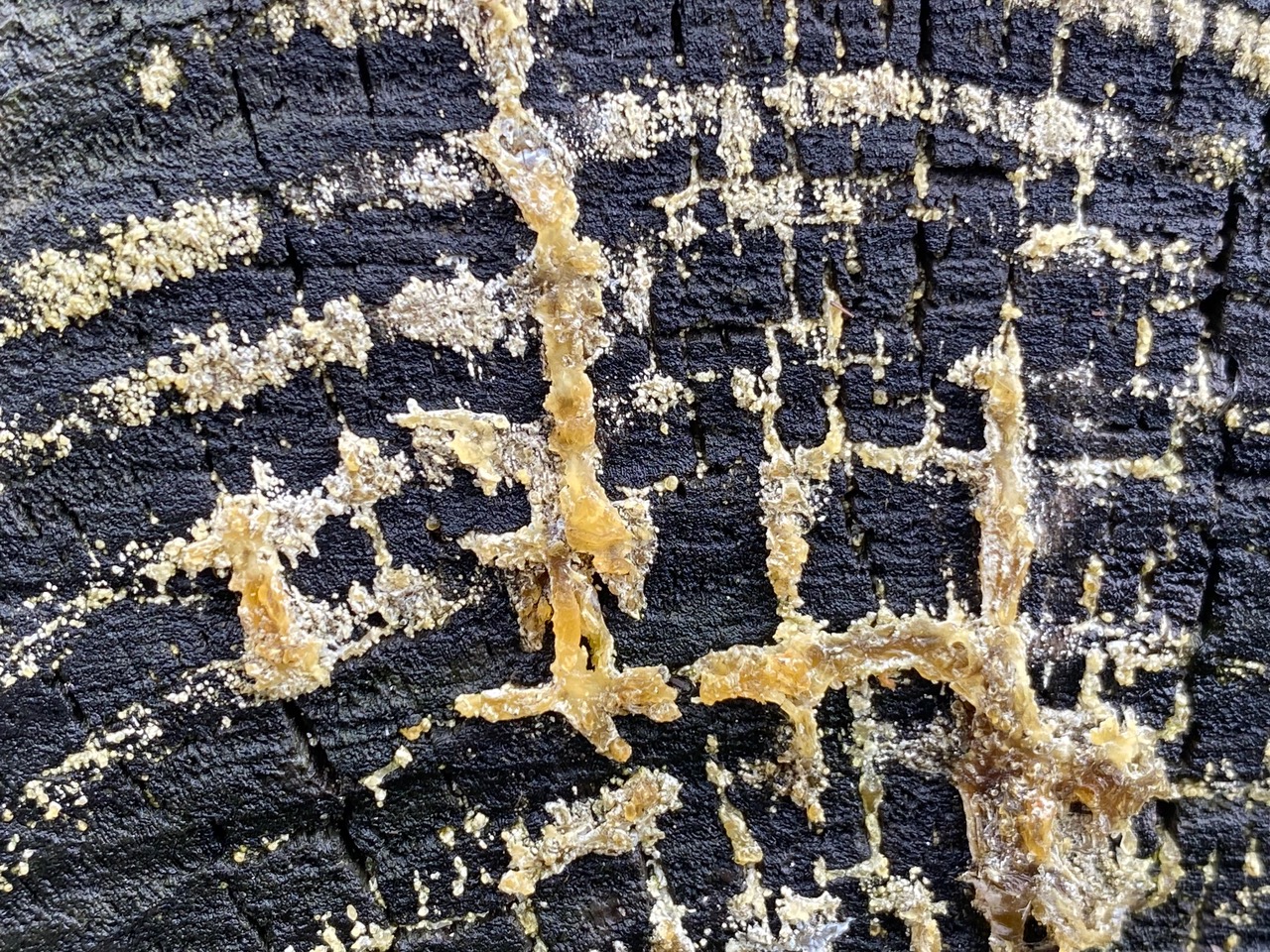
Closer inspection shows that the yellow flakes are actually dried resin. Rather surprising that an old, weathered log should still be exuding resin!
Trees produce resin as a natural defense mechanism to seal wounds, repel harmful insects and pathogens (like fungi), and protect against disease, essentially acting as a sticky, antiseptic bandage that hardens to block invaders and prevent water loss, common in conifers like pines, firs, and spruces. It’s a sticky, protective substance secreted when the tree is injured by storms, pests, or other damage.
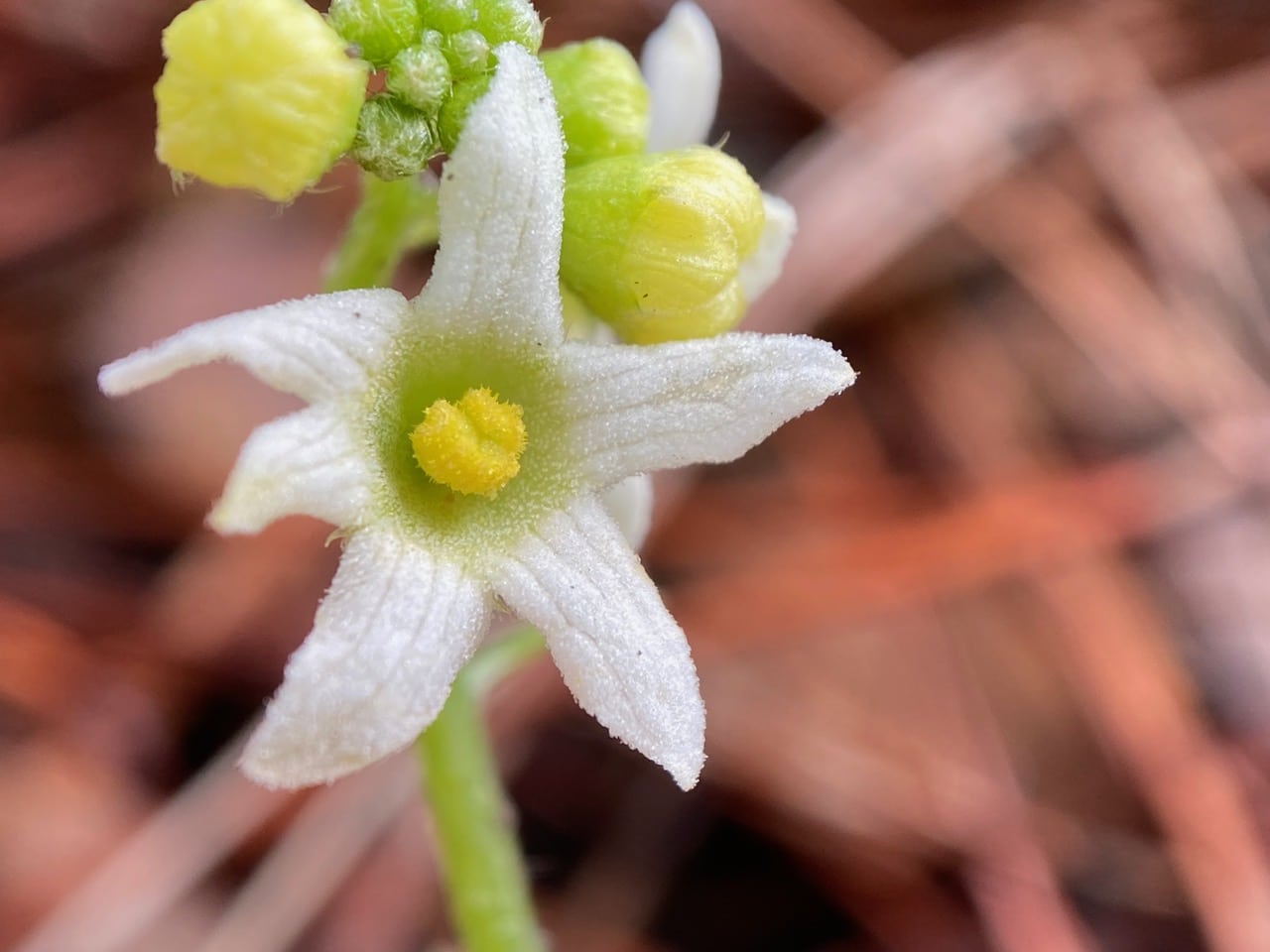
I check on the Wild Cucumber, Marah oregana growing on the side of the road. So far the monoecious plants have only produced male flowers. Note the fused anthers forming a globular structure in the center of this male flower. Monoecious species have separate male and female flowers present on the same plant.
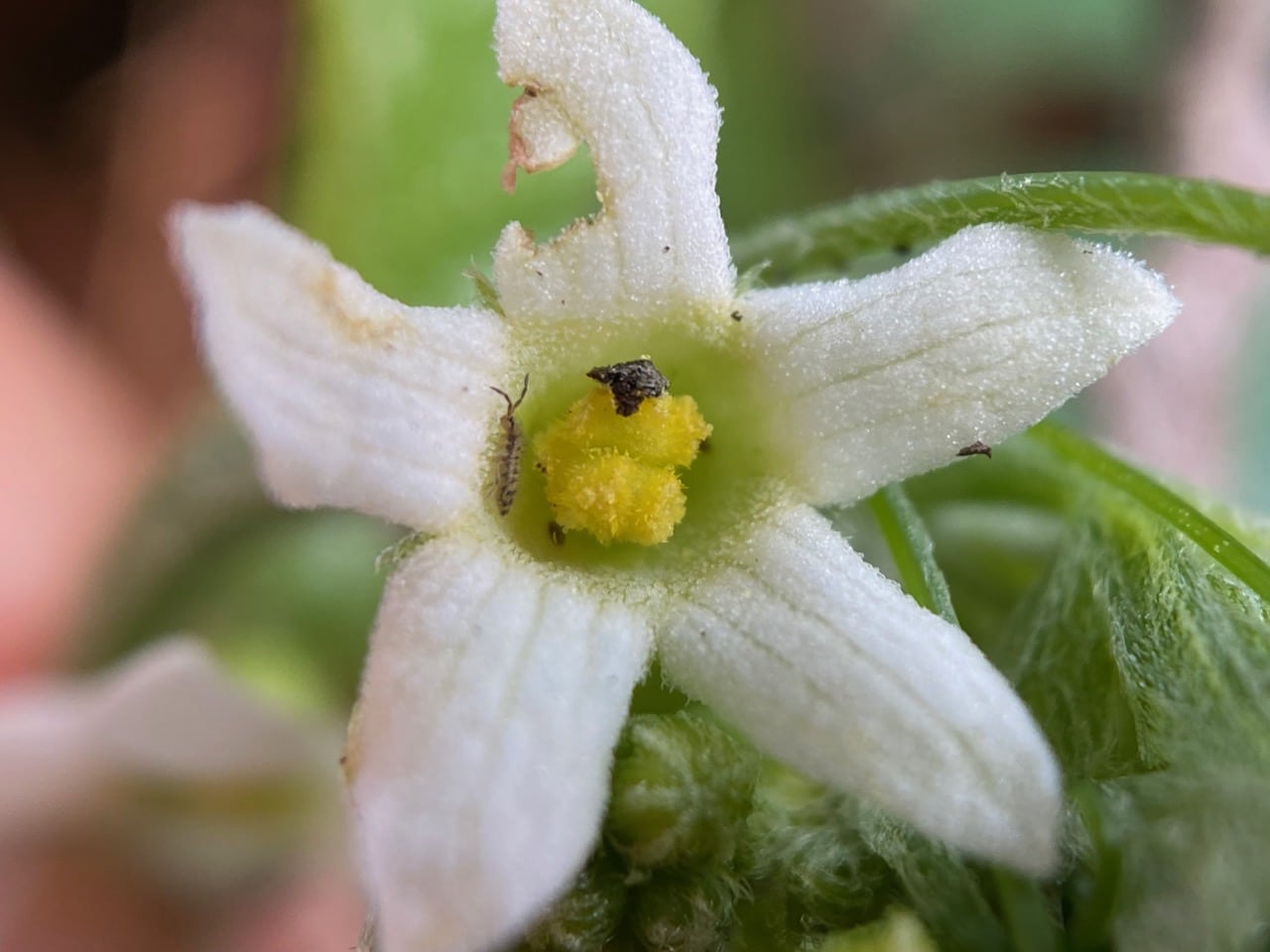
Look, there’s a Springtail in that Marah flower, just like we saw last time I visited these plants on 12/18/25. These Springtails must be regular denizens of these prostrate Wild Cucumber vines.
The Springtails are among the most abundant of all soil-dwelling arthropods. They live in a variety of habitats where they feed as scavengers on decaying vegetation and soil fungi. Most species are small (less than 6 mm in length) and quite susceptible to desiccation unless they remain in a moist environment. A unique, tube-like structure, the collophore is located ventrally on the first abdominal segment of most species. The exact function of this organ is unknown, but it probably helps maintain water balance by absorbing moisture from the environment, and helps stabilize the animal.
Springtails are named for a forked jumping organ (the furcula) found on the fourth abdominal segment. The furcula is retracted against the ventral wall of the abdomen and held there, in cocked position, by a special catch (the tenaculum). Releasing the tenaculum causes the furcula to snap down against the substrate and flip the organism some distance through the air to escape predators.
Springtails are detritivores, primarily eating fungi, decaying organic matter (such as leaf litter, dead plants), algae, pollen, and bacteria. They are vital decomposers. While some springtails feed on pollen and nectar in flowers, they may incidentally transfer pollen. However, the springtails are better known to play a vital, ancient role in helping mosses reproduce. Mosses release sperm that needs water to swim to the female plant, but springtails help by carrying this sperm on their bodies, especially when water is scarce.
Springtails aren’t insects because their mouthparts are hidden inside their head (entognathous), unlike insects with external mouthparts, and they have other distinct features like a unique jumping appendage (furcula), simple eyes, and they continue to molt after sexual maturity, setting them apart as their own ancient lineage (Collembola) within hexapods. They are more like insects’s ancient cousins, representing a separate evolutionary branch that diverged long ago, even though they share six legs and a body plan.
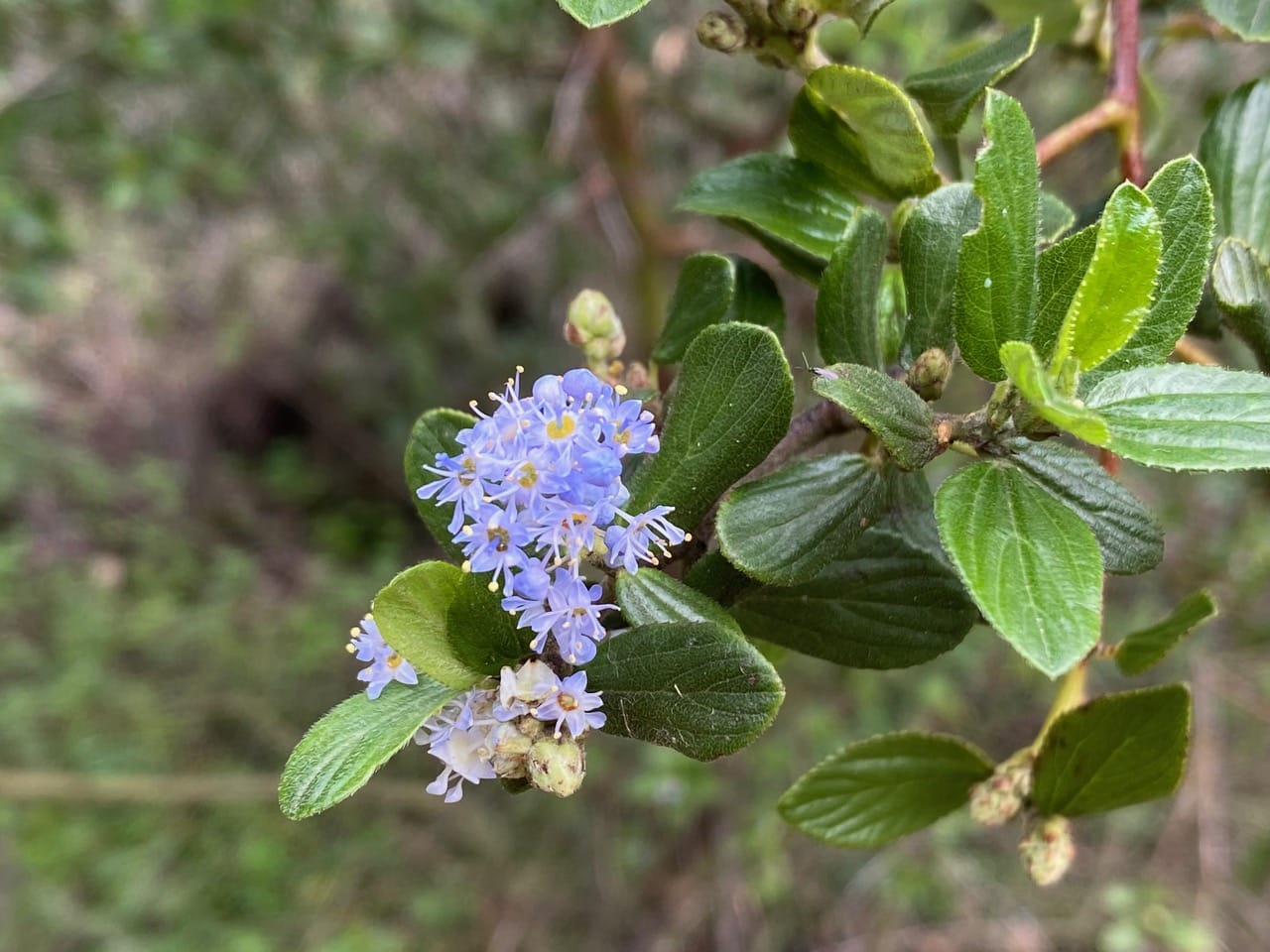
Near the Pyramid of Moses, a Blueblossom Ceanothus, Ceanothus thirsiflorus has started to bloom.
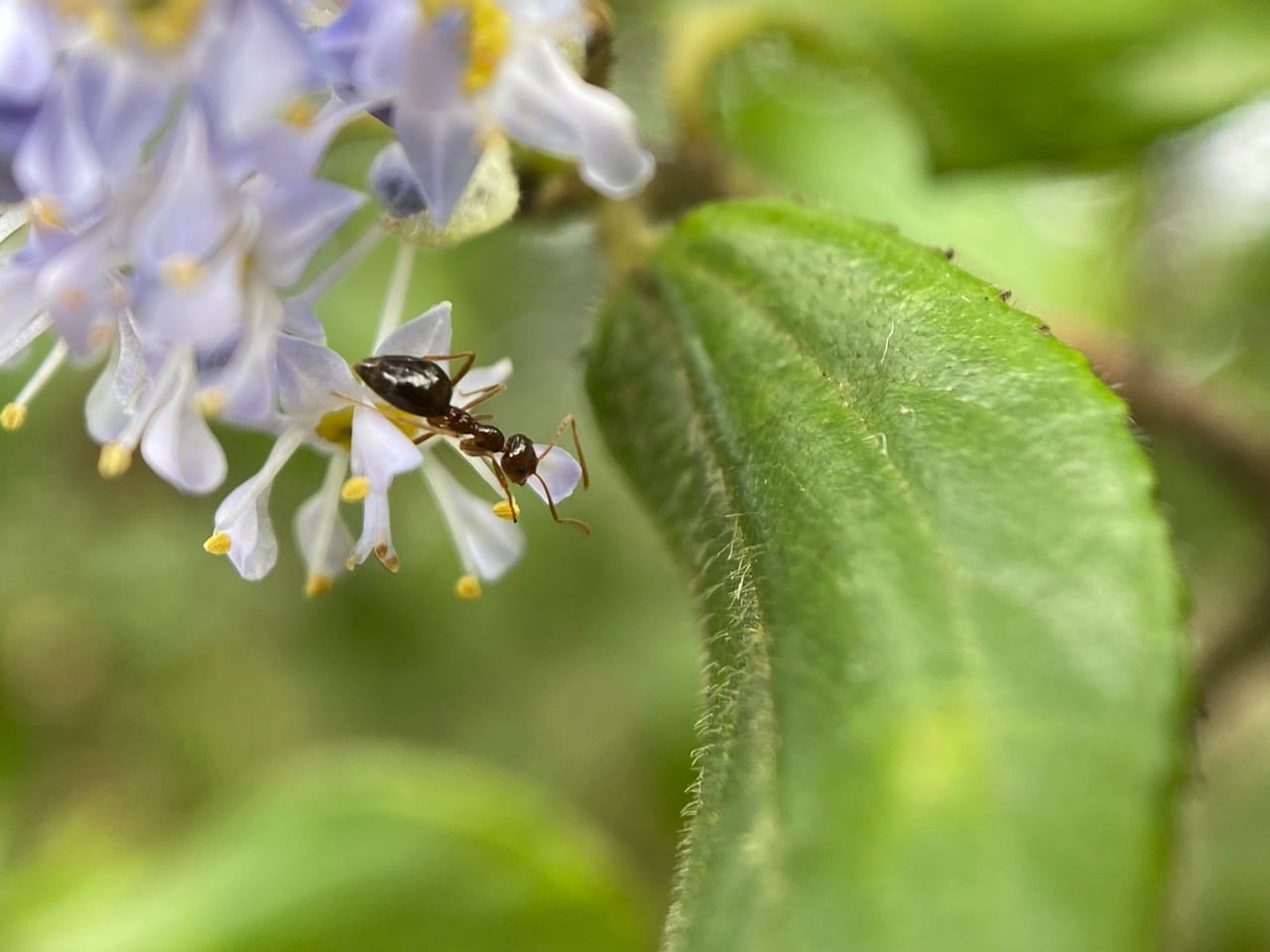
A lone American Winter Ant, Prenolepis imparis is foraging among the rain-soaked Ceanothus flowers.
The American Ant, Prenolepis imparis is a widespread North American ant. A dominant woodland species, it is most active during cool weather, when most other ant species are less likely to forage. This species is one of a few native ants capable of tolerating competition with the invasive Argentine Ant, Linepithema humile. They are also aggressive toward other ants and produce abdominal secretions that are lethal to Argentine Ants. Prenolepis imparis is a generalist omnivore. Foragers are known for tending to aphids or scale insects from which they consume excreted honeydew, aggregating on rotting fruit, and exploiting protein-rich sources such as dead worms. The colony enters estivation (a hibernation-like state) and becomes inactive above ground for the warmer months, during which time eggs are laid and brood are reared. Reproductives overwinter and emerge on the first warm day of spring for their nuptial flight.