

Pollinator Post 1/29/26 (2)
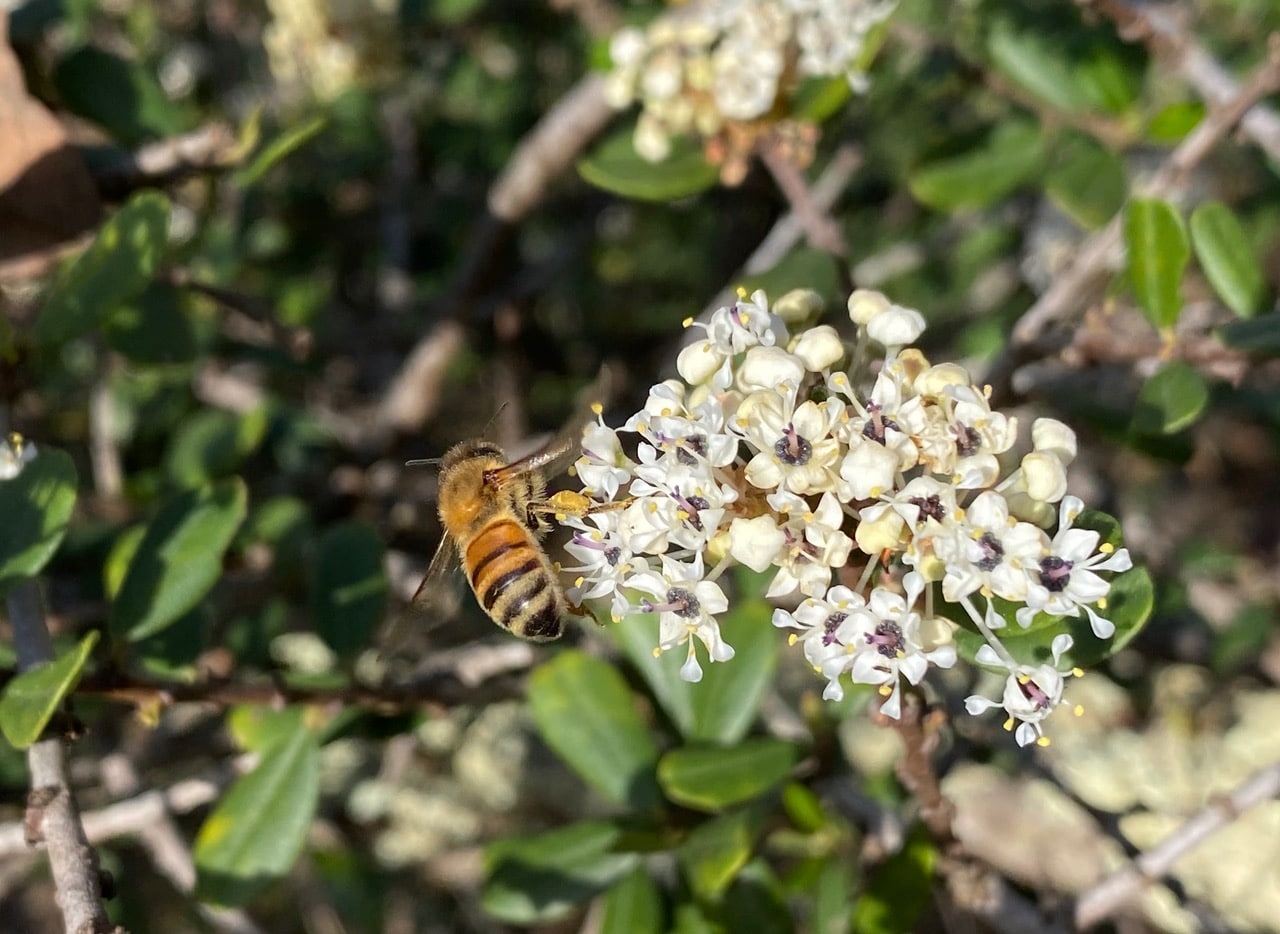
Near the front gate of the garden, the pale-flowered Otay Mountain Ceanothus, Ceanothus otayensis is getting some bee action. The tightly clustered, open-faced flowers are a rich source of easily accessible nectar and pollen. Note that the Honey Bee, Apis mellifera (family Apidae) is carrying a bit of yellow pollen in her pollen basket.
The pollen collecting apparatus in Apidae bees, which include honey bees and bumble bees, is commonly called a “pollen basket” or corbicula. This region is located on the tibia of the hind legs and consists of hairs surrounding a concave region. After the bee visits a flower, she begins to groom herself and brushes the pollen down toward her hind legs and packs the pollen into her pollen basket. A little nectar mixed with the pollen keeps it all together like putty, and the stiff hairs surrounding the pollen basket hold it in place. Remarkably bees are able to fly while carrying up to a third of their body weight in pollen.
.jpg)
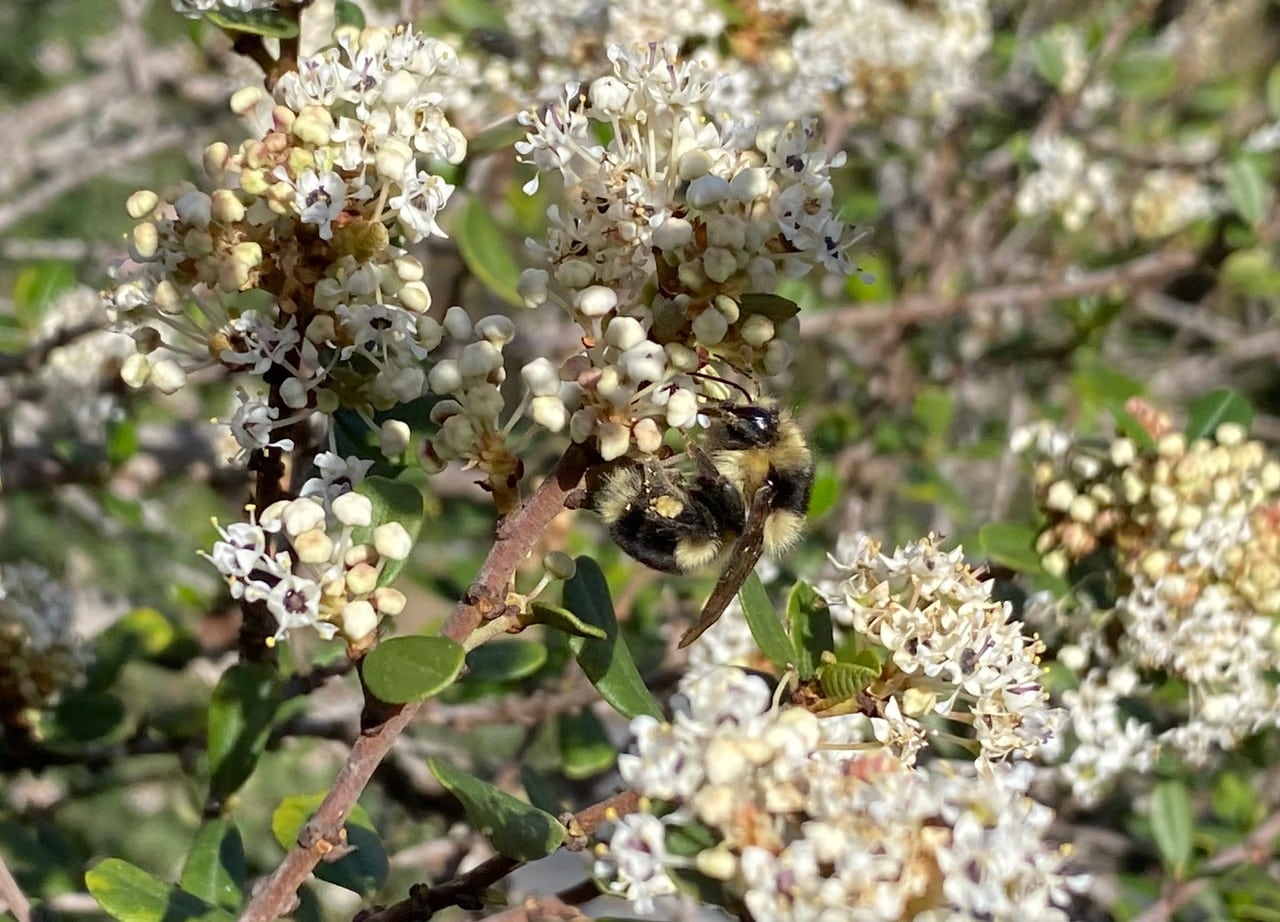
A large queen Black-tailed Bumble Bee, Bombus melanopygus (family Apidae) is foraging on the flowers of Otay Mountain Ceanothus. Hey, she too has some pollen in her pollen basket! She’s not merely taking nectar for herself, but is collecting pollen for her brood. This is a happy sign that the queen has successfully established a nest somewhere and probably has some young to feed. Way to go, Mama!
Bumble bees are social and live in colonial hives. Many of the large individuals seen early in the season are queens. They are the only members of their colony to survive the winter, hibernating until the days begin to warm and their host plants are in bloom. These queens have mated before they went into hibernation. Now their first order of business is to each find a nesting site (usually an abandoned rodent burrow), lay eggs, brood and nurture the first batch of workers. There after, the queens stay behind in the hive to concentrate on laying eggs while the workers take on hive duties and foraging. Bumble bees are among the most cold tolerant bees, and are usually the first bees we see out foraging. This is why it’s important for us to plant early blooming natives to support the queen bumble bees.
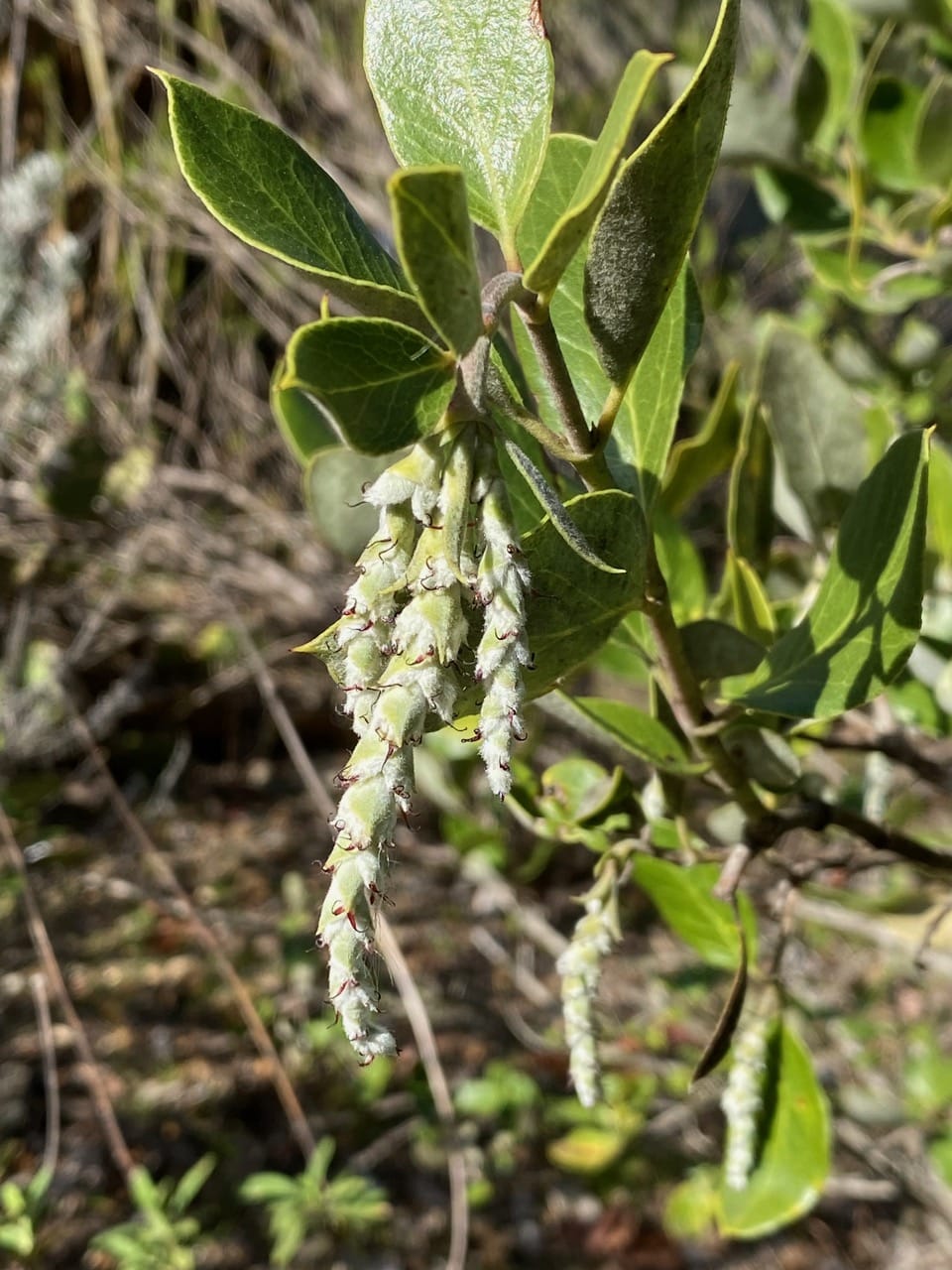
While the spectacularly long male catkins of Coast Silk Tassel are fading, the shorter catkins on the female trees are coming into their own.
The Coast Silk Tassel, Garrya elliptica (family Garryaceae) is an evergreen shrub or small tree. It is dioecious, meaning male and female flowers are borne on separate plants. Flowers appear in winter, male catkin-like clusters are yellowish to greenish then gray, 8-20 cm long (“silk tassels”), female flower clusters are shorter, 5-9 cm long.
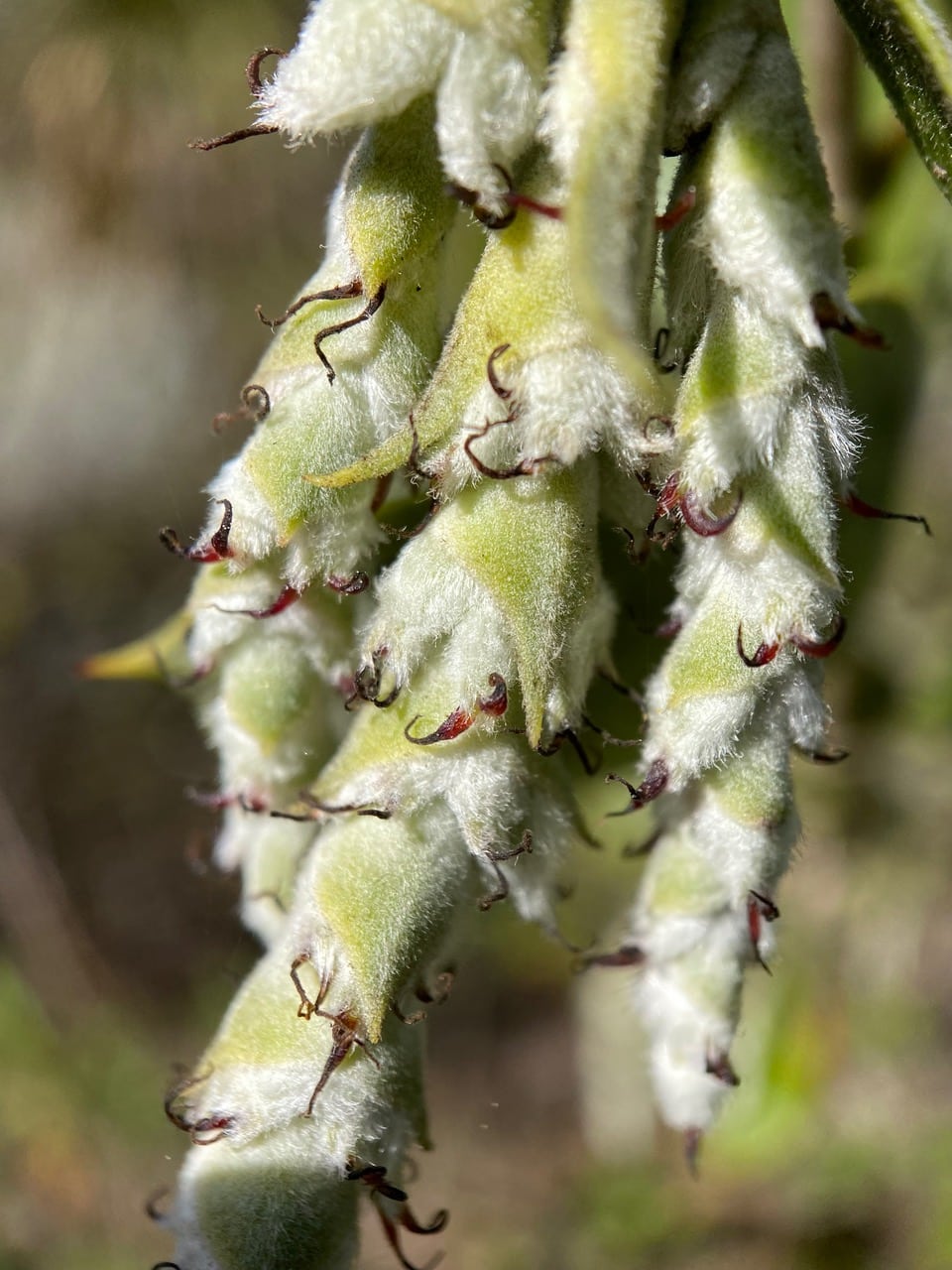
Closer examination of the female catkins of Coast Silk Tassel reveals simple styles protruding from the bell-shaped cups of the flowers in the hanging chains. The stigmas on the tips receive airborne pollen from nearby male catkins.
Coast Silk Tassel is an example of plants that are wind pollinated. About 12% of flowering plants and most conifers are wind pollinated. These plants do not waste energy on flower features that attract animal pollinators; instead, their flowers generally have these characteristics:
– Small, petalless, and unscented, with muted colors.
– No nectar
– Stamen (male flower part) and stigma (female pollen-receiving part) are exposed to air currents.
– Male flowers produce a great deal of pollen, which is very small, dry, and easily airborne.
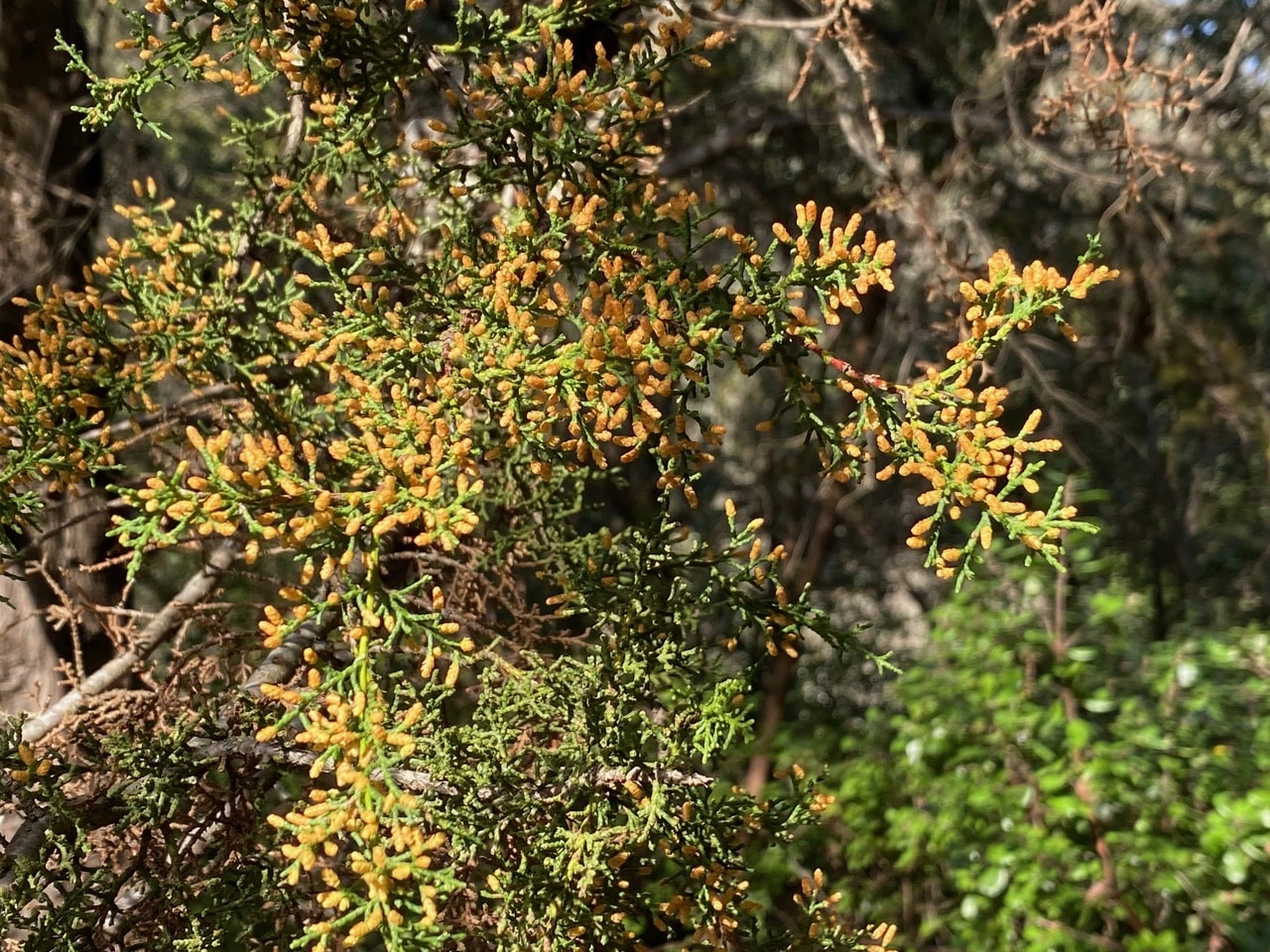
The small male cones of the Monterey Cypress, Hesperocyparis macrocarpa are at full maturity. Brush against the branches now and I risk sending a cloud of yellow pollen into the air. A strong gust of wind can do the same. Hello, allergy season!
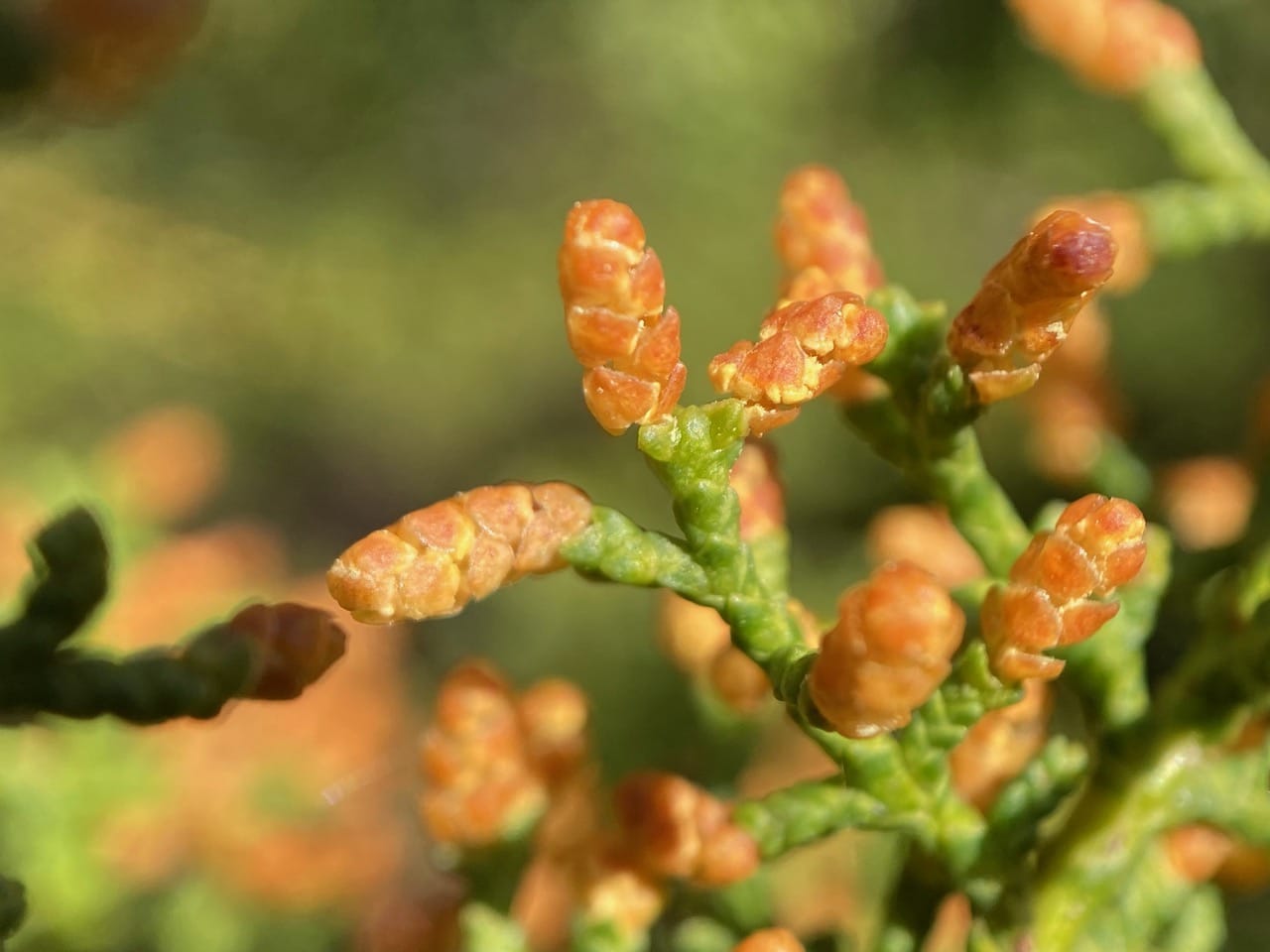
Close-up of male cones showing that they have gaped open between the scales to release pollen.
Cone-bearing trees or conifers, such as the cypress, produce both male cones (pollen-producing) and female cones (seed-producing) on the same tree. Pollen grains from the male cones are lightweight and disperse through the air by wind, reaching the female cones. When the female cones are ready for pollination, the scales slightly open, allowing pollen to access the ovules. Once pollen lands on the receptive surface of the female cone, a pollen tube grows down to reach the egg cell, enabling fertilization. After pollination, the scales of the female cone close tightly to protect the developing seeds. Monterey Cypress seeds are primarily dispersed when their woody cones, which are serotinous, open due to the heat of wildfires, releasing seeds that fall onto the exposed, nutrient-rich soil. Some cones may also open on hot summer days, allowing for wind and rain dispersal.

I stop to admire this Manzanita, intrigued by its bright pink flower stalks.


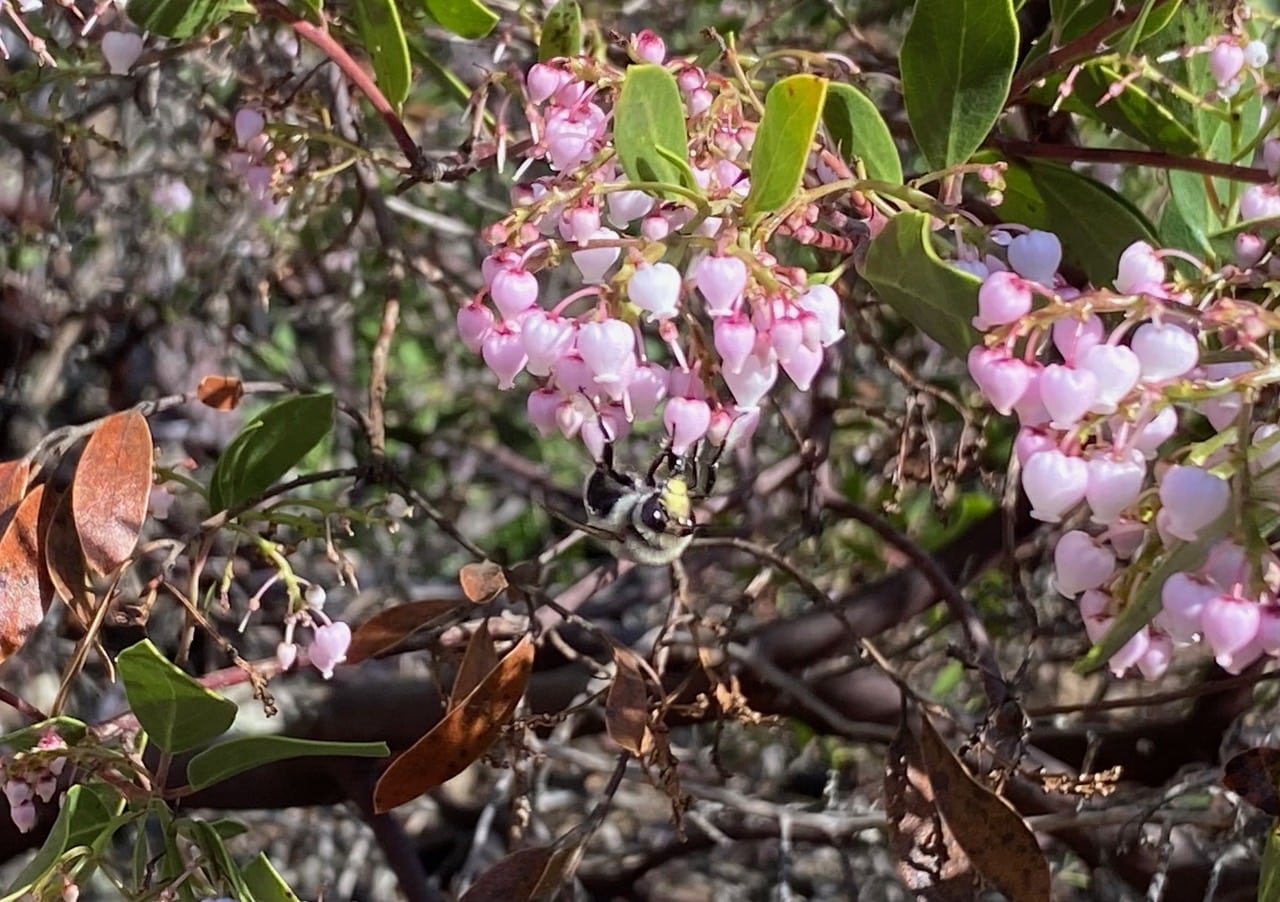
Like many species of Arctostaphylos, this manzanita has flowers with translucent “windows” at the base of the urn-shaped corolla. What function do these translucent tissues serve?
They remind me of similar “skylights’ in the flowers of California Pipevine. Those translucent skylights let in sunlight and are known to attract the trapped pollinators (fungus gnats) seeking escape. The gnats are instead guided to the reproductive structures at the base of the pipe-shaped corolla where they come in contact with pollen. Might the “windows” in the Manzanita flowers serve a similar function, guiding the small pollinators entering the flower to move toward the anthers? Or do the “windows” let in enough sunlight to warm up the interior of the corolla, making it cozy for Manzanita’s resident pollinators, the thrips? Or maybe the windows act as lenses or filters to capture and magnify light, facilitating the maturation of the reproductive structures within? These questions pique my curiosity anew every winter when Manzanita blooms.
This Ribes plant has me confused for a while. There doesn’t seem to be any spines on this main stem, but spines do appear on the younger branches. The presence of spines assured me that the plant is indeed a gooseberry, and not a currant – both are in the genus Ribes. iNaturalist has helped identify it as the Canyon Gooseberry.
The Canyon Gooseberry, Ribes menziesii, is a distinctive plant found only in California and Oregon, in the chaparral community. It is an aromatic deciduous shrub with very prickly branches growing up to 2 meters in height. Its showy hanging flowers have wine-purple sepals which are reflexed, or folded backwards along the length of the flower. The petals are white and extend forward to form a loose tube from which the stamens emerge. The plant fruits purple gooseberries which are edible but are mainly seeds with little flesh.
For this early bloomer, the pendant flowers with reflexed sepals are good for deflecting winter rains from damaging the reproductive structures, protecting the pollen. From the color of the flower, I figure it must be attractive to hummingbirds. Does the fragrance attract bees and other pollinators? I don’t see anybody visiting the flowers today, birds or bees.
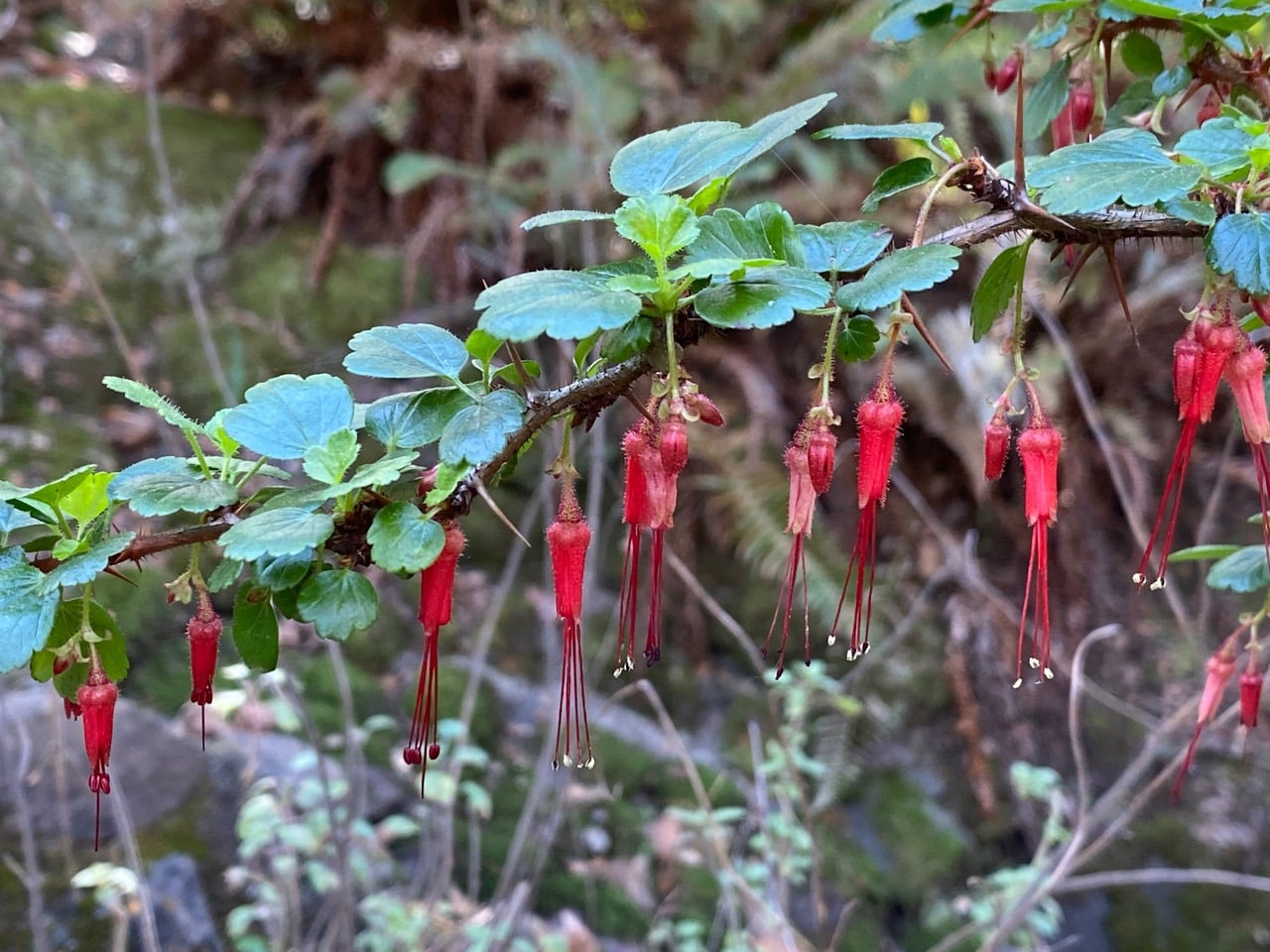
Here’s another distinctive Gooseberry in the garden – the Fuchsia-flowered Gooseberry, Ribes speciosum. Flowers are bright red, about 1” long, tubular, and pendant (hanging). Clusters of one to four flowers are more or less evenly spaced along the spiny branches. While the flowers are primarily characterized by four or five bright red, tubular-shaped sepals that resemble a fuchsia, there are small, red petals inside this tubular structure. Four stamens extend well beyond the corolla; filaments are red and anthers are red to purple (with yellow pollen). The single style extends beyond the stamens.
Fuchsia-flowered Gooseberries are pollinated by hummingbirds. The flowers are red (a color invisible to bees) and without scent (Hummingbirds have poor sense of smell.) The flower is a narrow tube (which helps exclude many insect pollinators) and hang downwards, away from the branches and leaves. In probing deep to reach the nectar at the base of the floral tube, the hummingbird’s head and upper body may brush the anthers, picking up pollen, and the stigma, depositing pollen from a previous flower.
In this photo, we can deduce the progression of flower maturation. The youngest flowers are to the left. It appears that the style is extended before the stamens, so the flowers are probably protogynous, with female parts maturing before the male parts. The stamens lengthen, and finally the anthers open to release yellow pollen. By this time, the style is withered and no longer receptive to pollen. The temporal separation of the male and female parts of the flower serves to prevent self-pollination.
I finally manage to capture some pictures of the Pacific Digger Bees, Anthophora pacifica (family Apidae) foraging on the Manzanita flowers. These fast flyers are mostly males and they far outnumber the bumble bees on the manzanita today, emanating a constant manic buzz around the shrubs.
As their name implies, the Digger Bees nest in the ground, sometimes in huge aggregations, often in banks or flat, sunny ground. The bees construct the nests by digging with their front legs and using their mandibles to loosen soil. The Pacific Digger Bee, Anthophora pacifica is known for early spring activity, sometimes appearing in temperatures as low as 40 F. These fast and noisy flyers buzz around flowers, appearing to “hop” from flower to flower while foraging. The chubby, furry Digger Bees resemble the bumble bees in many ways, but are a lot noisier. They are a fearless, rowdy lot – fun to watch but a challenge to photograph. Male digger bees of many species have white or yellow integuments on their faces. Females have shaggy hairs on their back legs, used to carry pollen. Female Anthophora are capable of buzz pollination – i.e. they vibrate their wing muscles to shake pollen from the anthers of some flowers. Digger bees are generalist pollinators that visit an impressively wide range of plants. They are exceptionally effective pollinators and play an important role in maintaining wildflower diversity, in part because their long tongues allow them to pollinate deep-throated and tubular blossoms inaccessible to other bees.
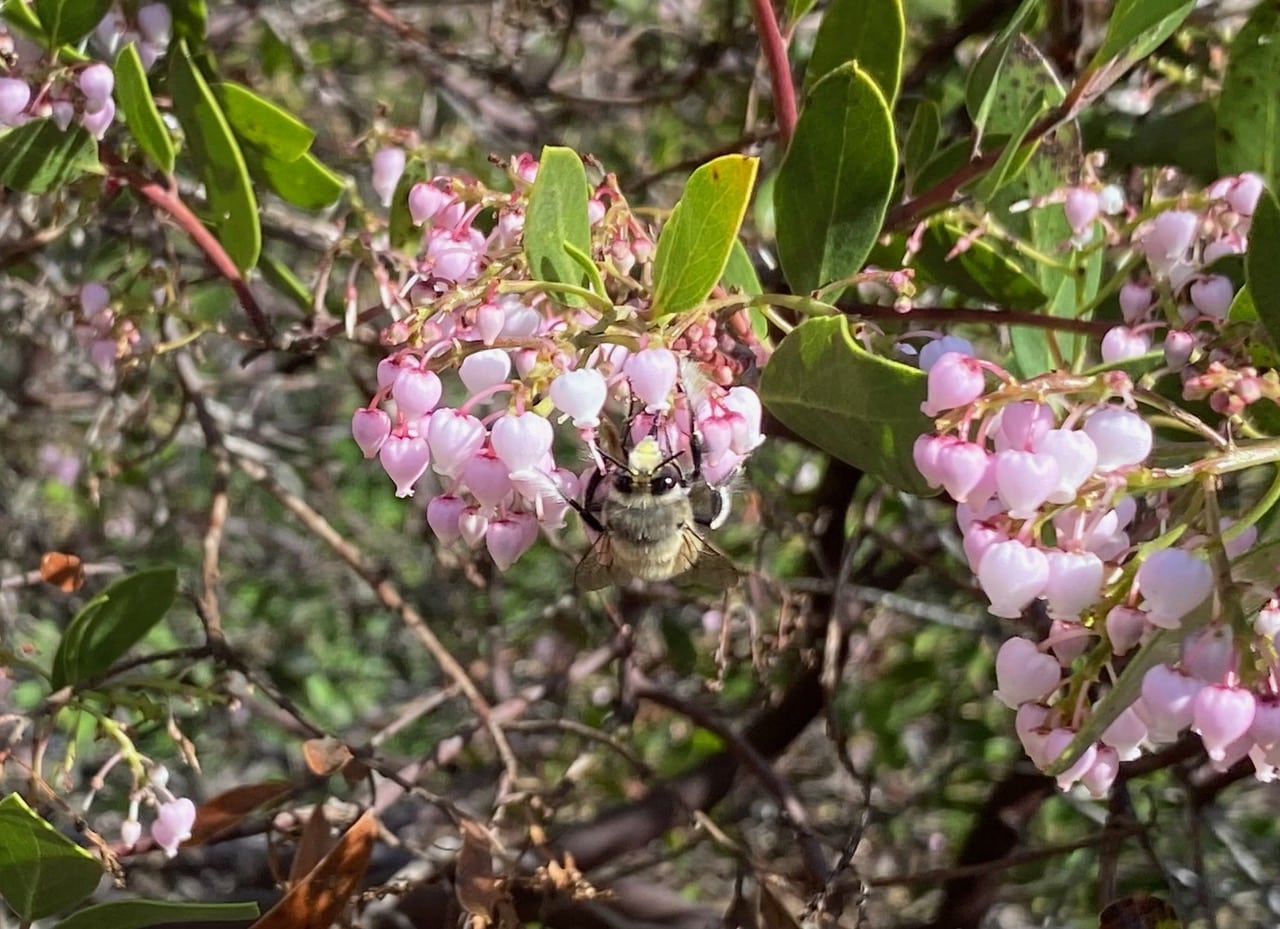
Typically, digger bees have “Roman noses”, which refers to a convex or prominently protruding facial profile. In addition, males often feature white or yellow markings on their face which distinguishes them from the all-black faces of females. The yellow integuments are often partially covered by a mustache of light-colored hair. The Pacific Digger Bee male is further identified by long fringes of white hair on its middle legs used in mating ritual.
Nature | Bee Mating Ritual Caught on Camera | Season 40 | Episode 1 | PBS
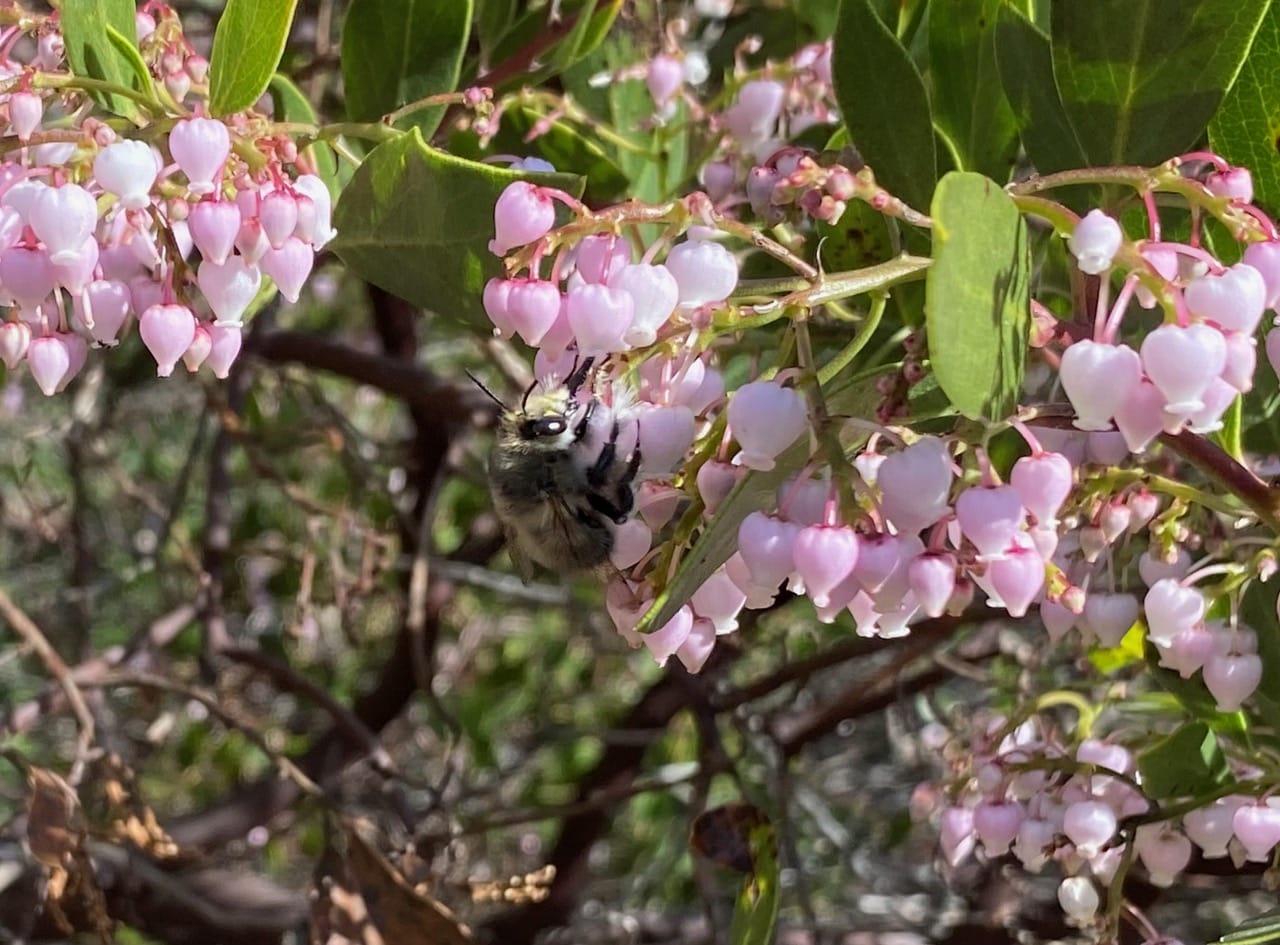
Why are most of the Pacific Digger Bees I see today males? Maybe the females have yet to emerge from their nests?
Generally (across the species) solitary bees emerge from their nests in the spring. Males emerge first and, after feeding, they hang around the nest waiting for the females. Mama bees usually lay female eggs in the back of the burrow, followed by male eggs that are laid closer to the entrance. This orderly sequence ensures that the males that develop faster and emerge earlier will not block their sisters from the exit.
Female bees determine the sex of their offspring through a process called haplodiploidy, where they choose to either fertilize or not fertilize an egg as it passes through their oviduct. Female bees store sperm in a specialized abdominal organ called the spermatheca after mating, allowing them to fertilize eggs throughout their lives. Fertilized eggs become female, while unfertilized eggs develop into males. Marvelous mamas!