

Pollinator Post 1/29/26 (1)
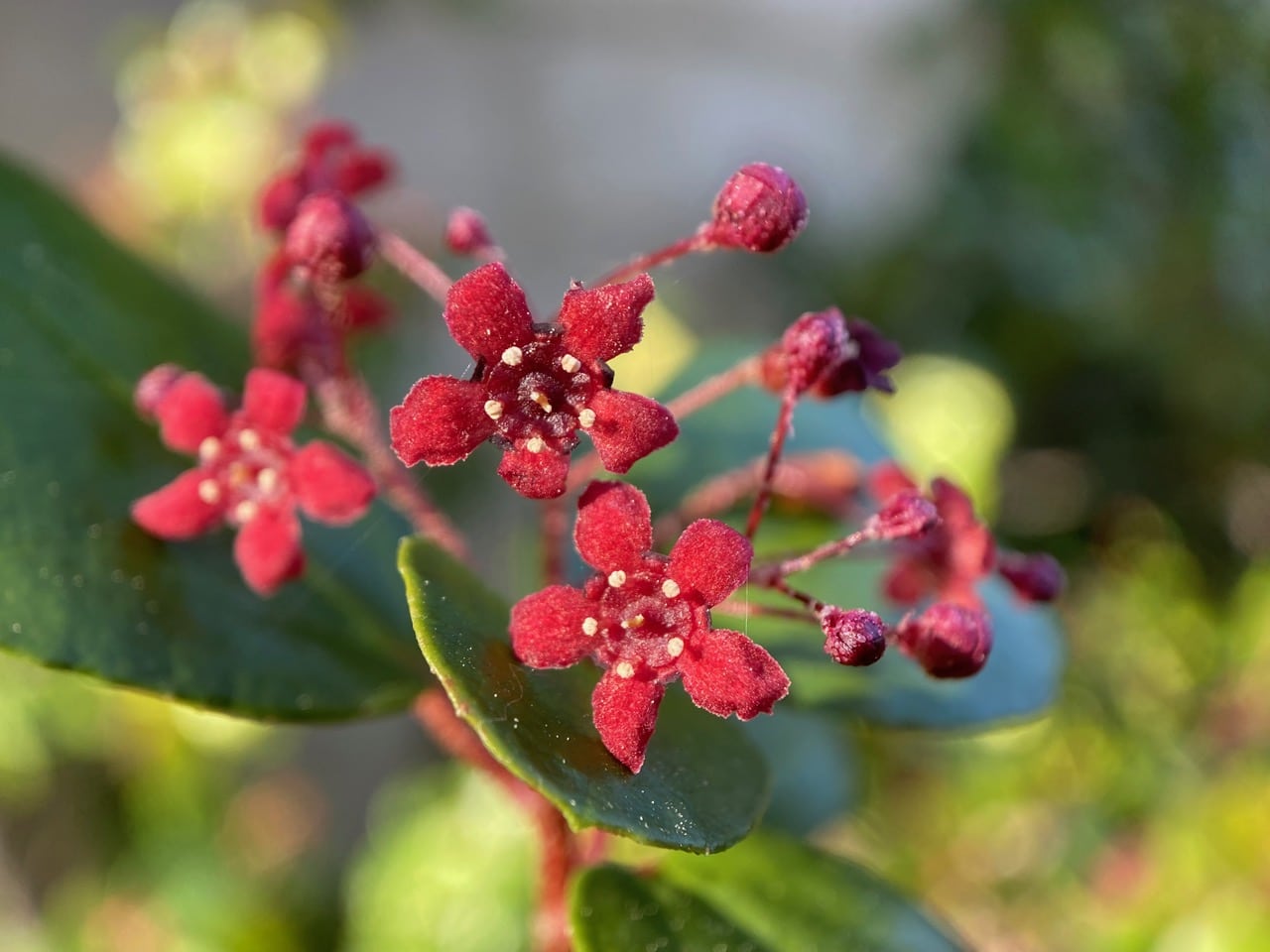
As is my habit, I check on the Catalina Currant, Ribes viburnifolium on the side of the visitor center when I enter the Regional Parks Botanic Garden this morning. The plant has been blooming for a while, but so far I have not detected any insect activity on it. Who pollinate these early blooming small flowers? While some sources claim that the flowers provide nectar for hummingbirds, I seriously doubt it. How can these small, shallow flowers possibly produce enough nectar to attract the birds?
The Catalina Currant, Ribes viburnifolium, or Evergreen Currant or Catalina Perfume as it is sometimes known, is endemic to Santa Catalina island and Baja California. It is a 2-3 foot-tall evergreen perennial shrub with dark green, leathery leaves. After a rain the plant fills the air with a sweet citrus or piney scent. The fragrance derives from glands on the underside of the leaves and stems that exude a sticky sap.
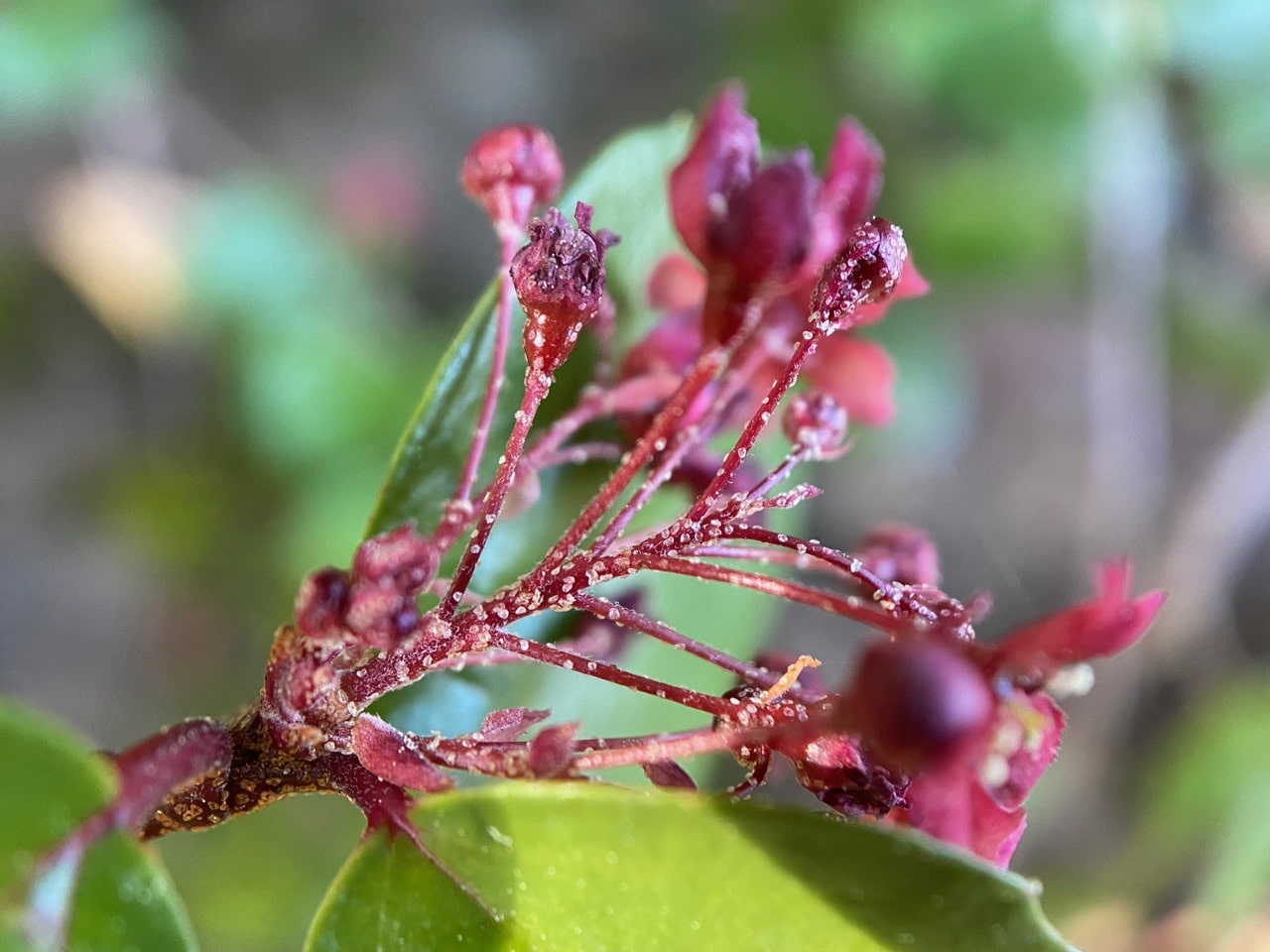
Looking closely, one can see salt-like grains dotting the red stems and flower stalks of the Catalina Currant. The granules found on the flower stalks, leaves and stems of the plant are dried exudates from glandular trichomes that secrete a sticky, resinous sap. The crystalline residues are characteristic of the species and serve several functions. They contain a strong, pleasant, spicy-citrus or clove-like fragrance when bruised or after rain, which is believed to deter herbivores. The resinous secretion also helps protect the plant from abiotic stressors such as drought, extreme temperatures, salinity, heavy metals, or intense sunlight..
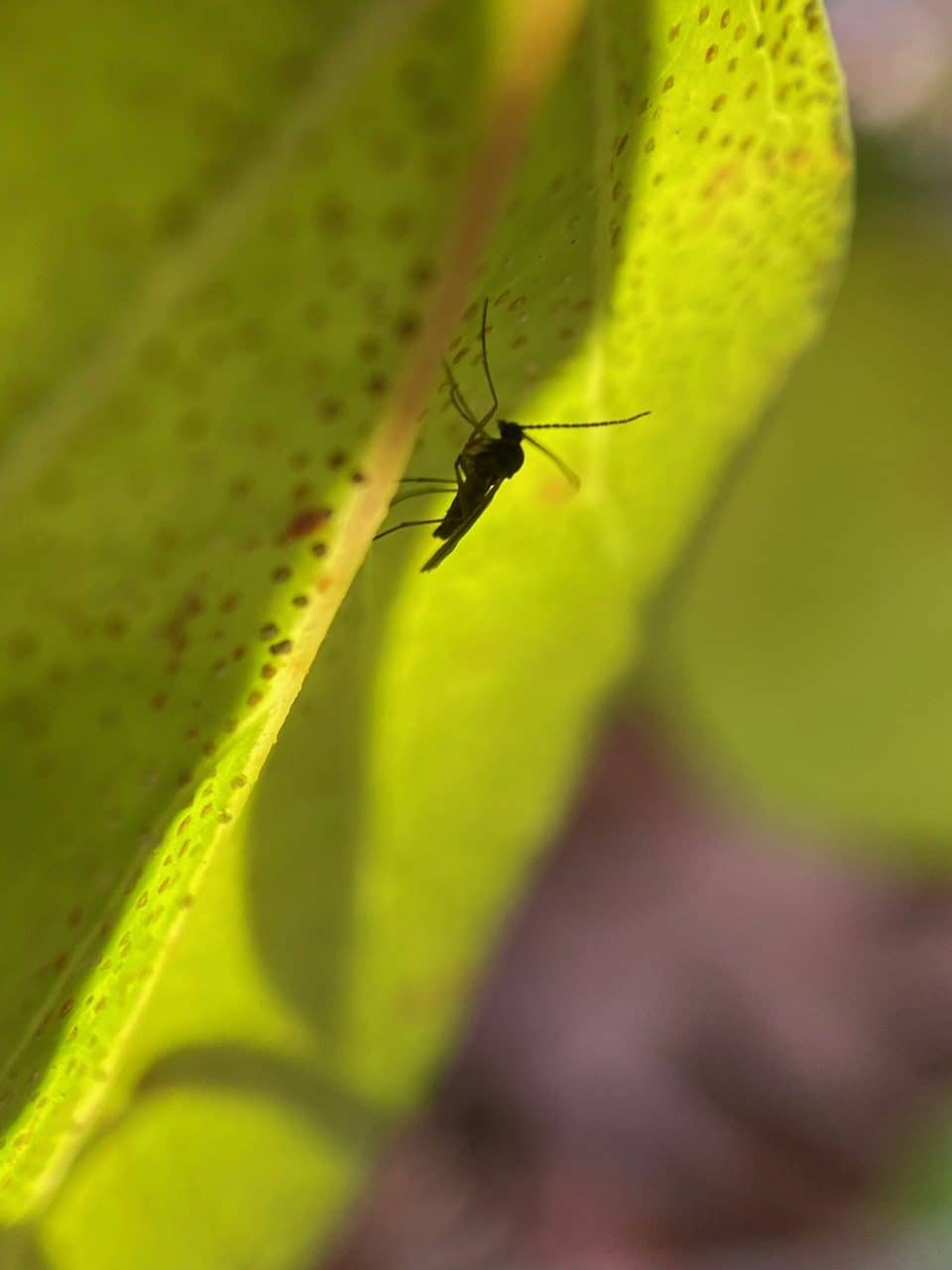
Several tiny midges hover low around the plant, attracting my attention. One finally lands on the underside of a leaf studded with spots of dark exudates. A fungus gnat? It is not deterred by the resinous exudates? iNaturalist has helped identify the insect as a Dark-winged Fungus Gnat (subfamily Megalosphyinae, family Sciaridae).
The Sciaridae are a family of flies, commonly known as Dark-winged Fungus Gnats. Commonly found in moist environments, they are known to be a pest of mushroom farms and are commonly found in indoor flowerpots. Adults are usually under 5 mm long. Most species live in forests, swamps, and moist meadows, where they live in the foliage. In moist shadowy areas, up to 70% of all dipteran species can be Sciaridae. Sciarid larvae often occur in decaying plant matter such as rotten wood or under the bark of fallen trees, but can also be found in animal feces or fungi. The larvae play an important role in turning forest leaf litter into soil. Adults emerge in unison from their larval homes in the soil and form large swarms, where mating takes place. The adults with their characteristic dancing flight do not bite. They only ingest liquids and live only long enough to mate and produce eggs.
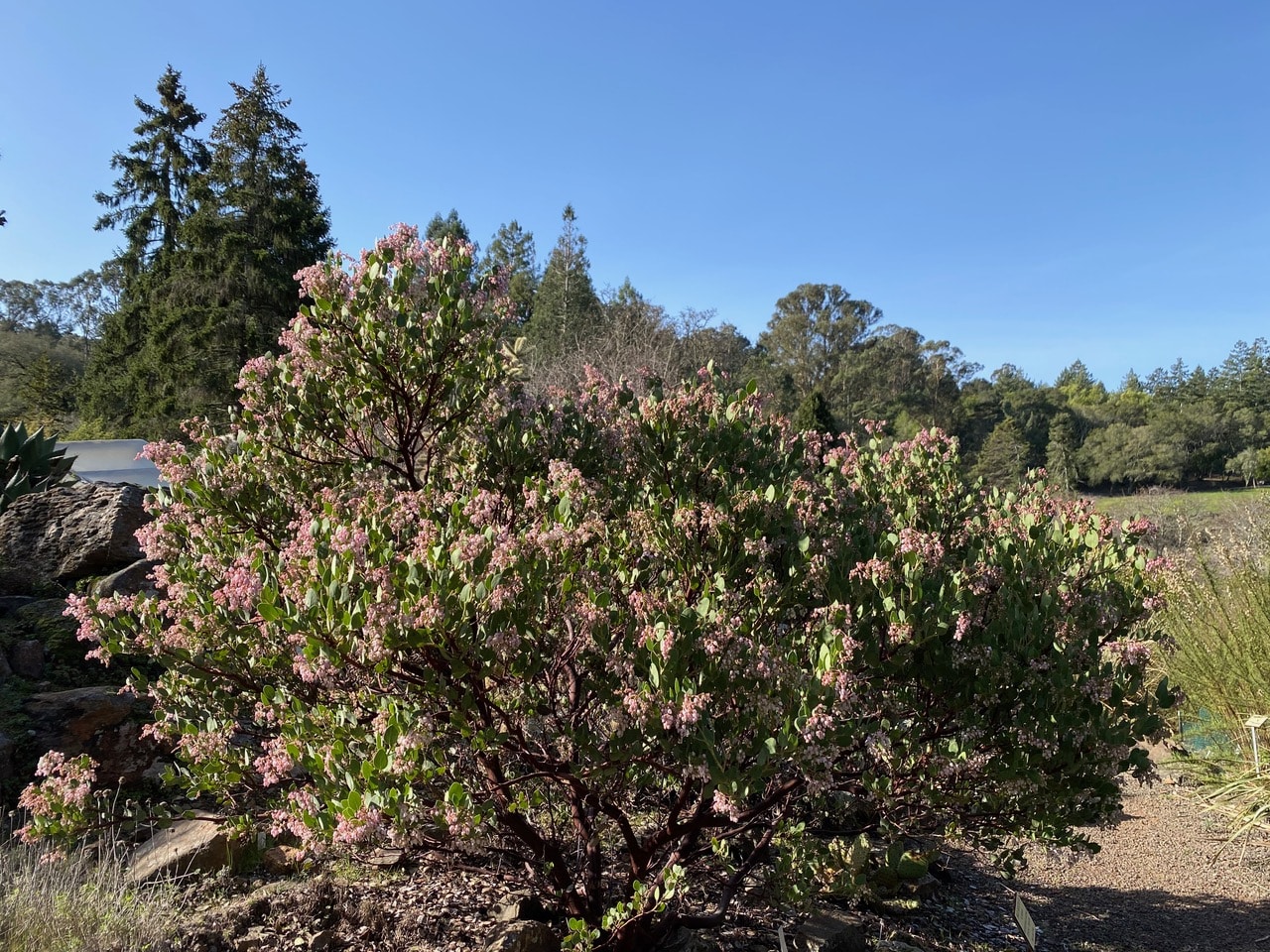
While most of the Manzanitas (Arctostaphylos) in the garden are well on their way to developing fruits, this particular individual is still in peak bloom, attracting many insects.
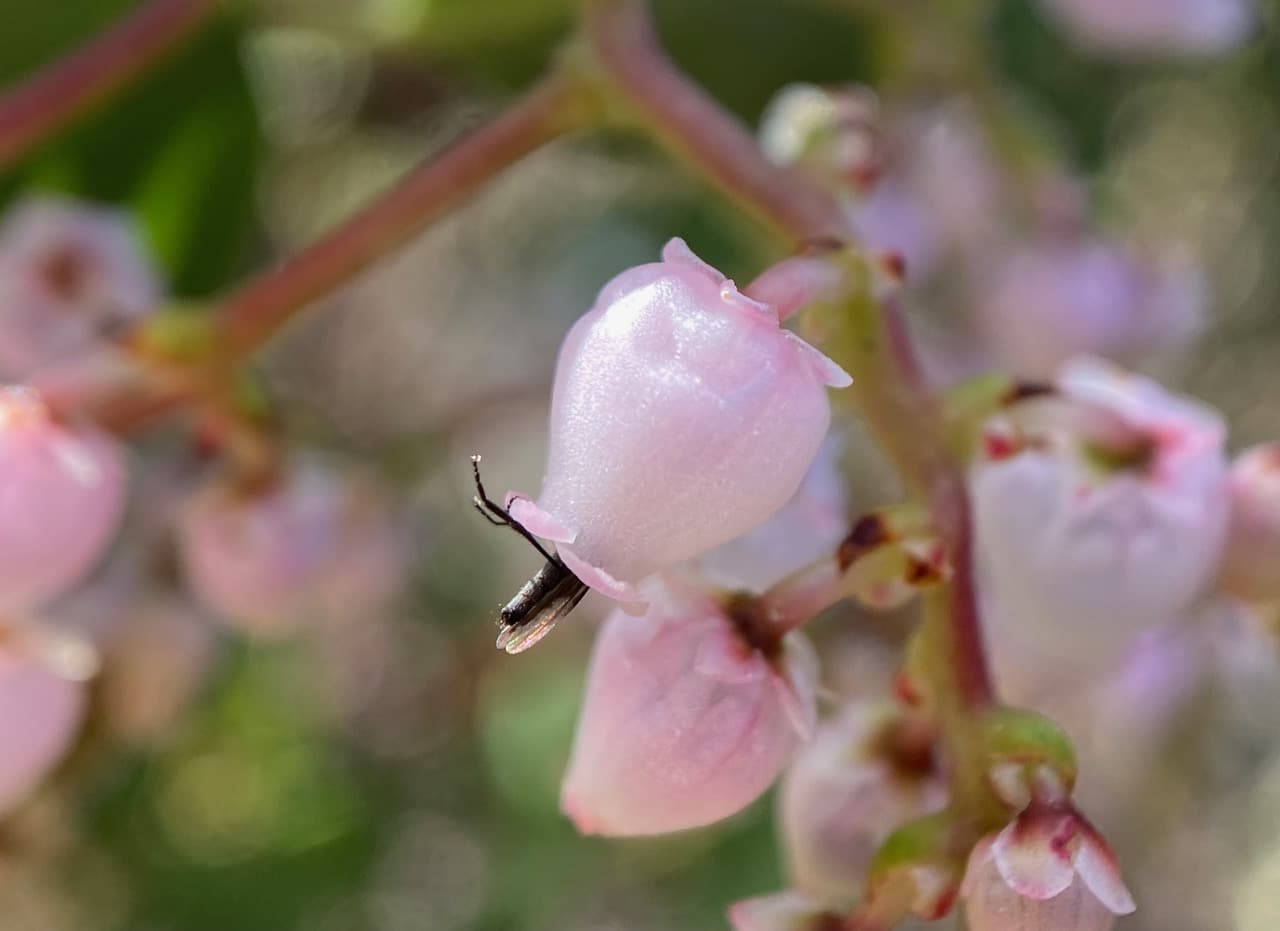
Discouraged by the frenetic Digger Bees (Anthophora) that are almost impossible to photograph, I focus on the smaller, more cooperative insects close at hand. Hey, someone is skillfully reaching into a Manzanita flower! It is holding onto the rim of the corolla with its long, slender legs.
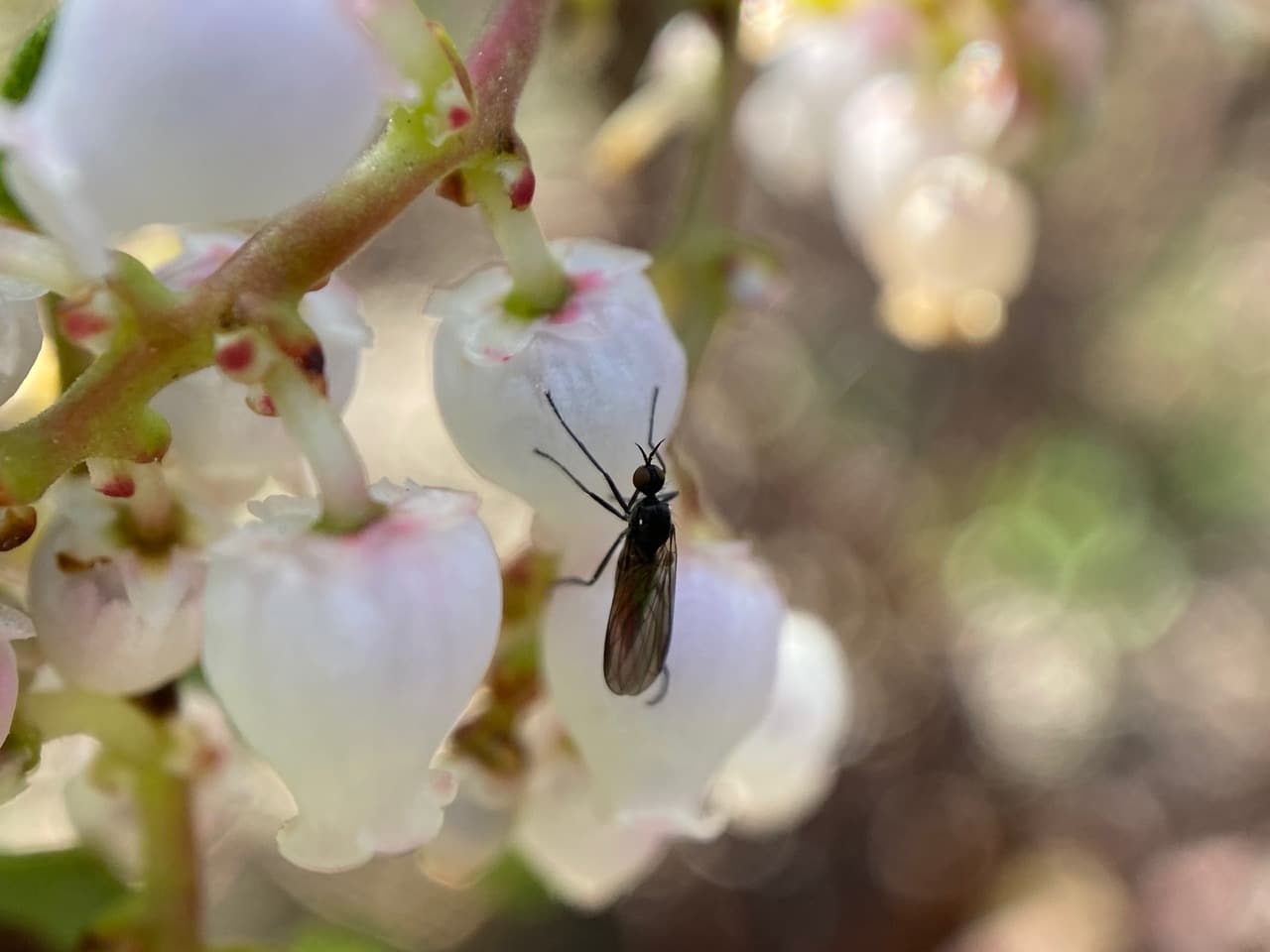
Here’s another one. A Hybotid Dance Fly (family Hybotidae)? iNaturalist has confirmed my identification.
The Hybotid Dance Flies belong to the superfamily Empidoidea and were formerly included in the Empididae as a subfamily. While the Empididae consists mainly of predatory flies, the Hybotidae mainly derive their nutrition from plants, notably nectar and pollen. Empididae generally have a thick beak pointing down, while Hybotidae have a thinner beak, or a thick beak pointing forwards or diagonally. Some crucial wing venation further distinguishes the two families. Hybotid Dance Flies are characterized by having small, often spherical heads dominated by very large compound eyes. They are small, typically 3-5 mm in length, and often have a hunched-back, dark-colored appearance, resembling tiny robber flies. Precious little is known about the life cycle and biology of Hybotids because they are not considered of economic consequence. I have observed that members of the genus Anthalia mostly feed on nectar and pollen, and may be important pollinators for small wildflowers such as Miner’s Lettuce, Wild Geranium, California Saxifrage, Buttercups and False Lily of the Valley.
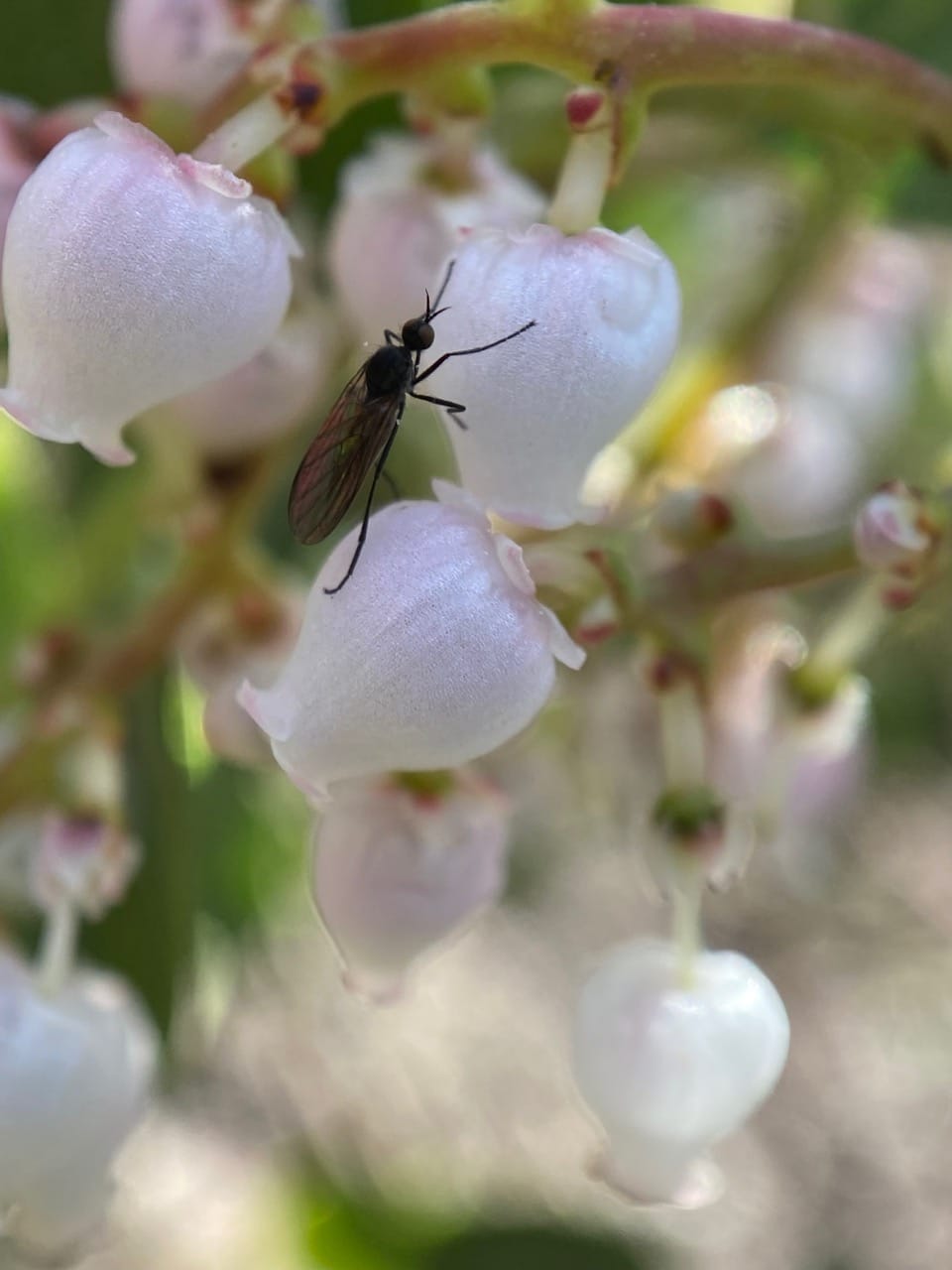
Why the name “dance fly”? This is derived from the mating swarms of males of many species. They gather in clouds over prominent objects, each individual seeming to bounce or “dance” in mid-air. Many other flies do this, notably midges, but the Empidids and the Hybotids got the moniker.
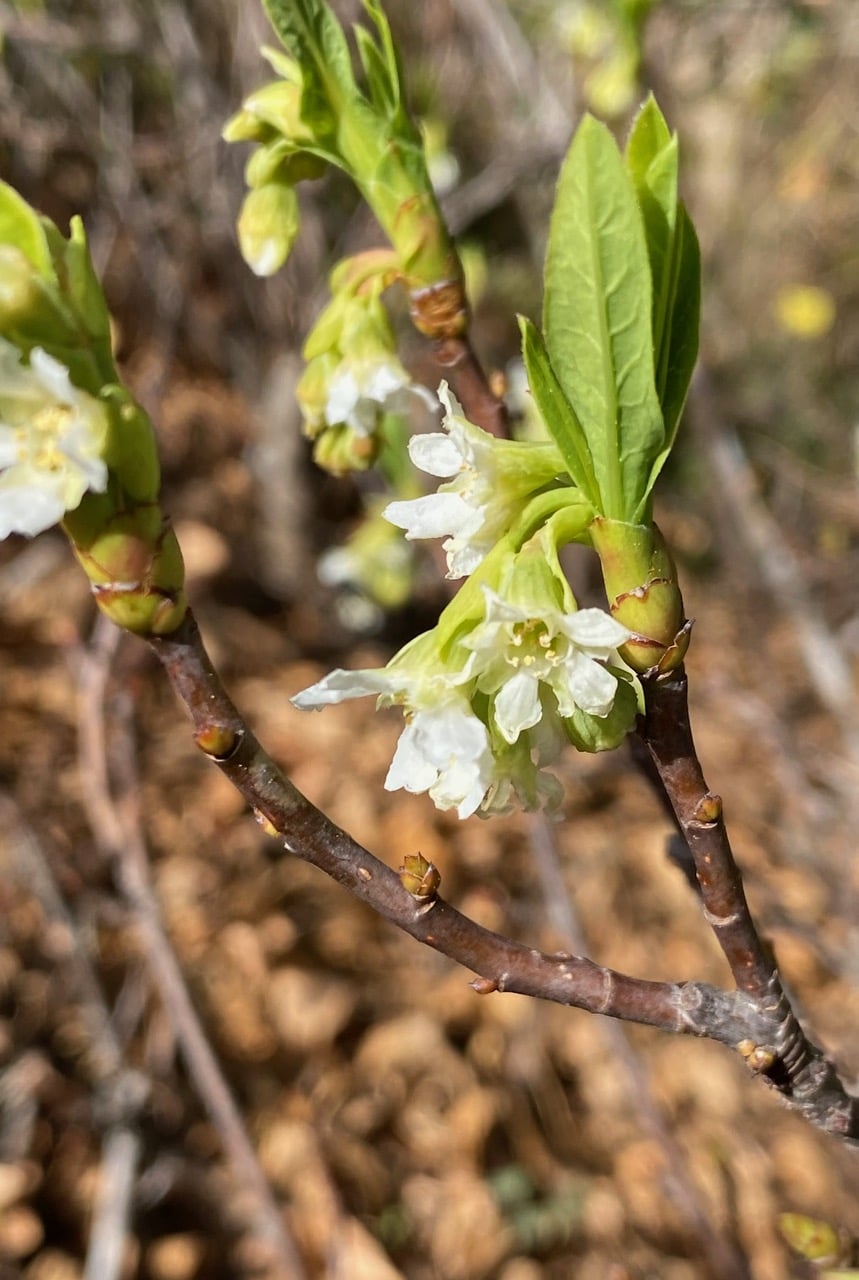
A couple of days ago when I shared my observations that many early blooming natives in our area have nodding flowers, I have forgotten to include Osoberry as an example, as I haven’t seen any in bloom this year until today. This male plant is blooming profusely at the garden, with clusters of nodding white flowers hanging from every tip and node of its branches.
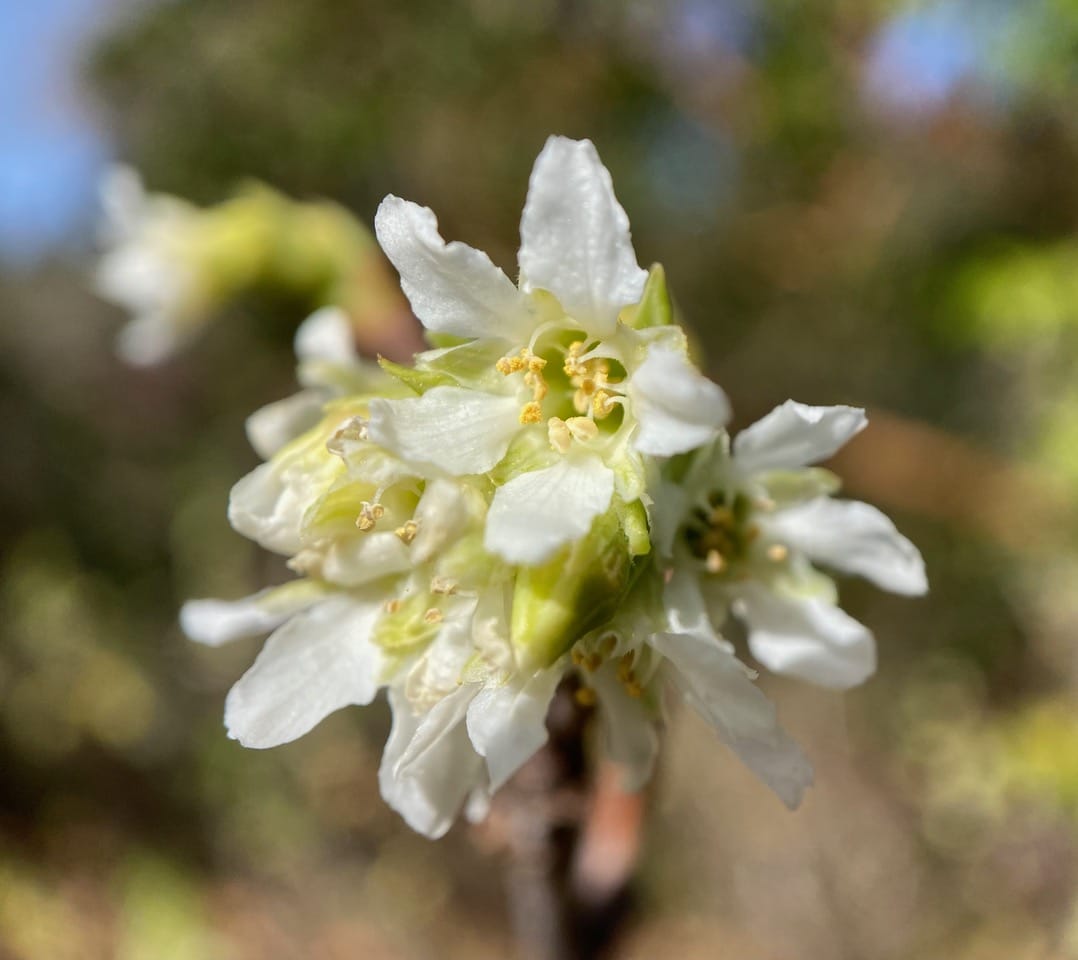
The male flowers are crowded with large anthers dispensing pollen.
The Osoberry, Oemleria cerasiformis is dioecious – male and female flowers are borne on separate plants. There are 5 petals and 5 sepals. Male flowers have prominent stamens that produce prodigious pollen. There are numerous stamens (15, to be exact), in 3 series in the tubular portion of the calyx. Female flowers have shriveled, pollen-less stamens and prominent carpels consisting of five styles and five separate ovaries. When fertilized, the ovaries develop into drupes (stone fruits), the so-called “Indian Plums”, up to five per flower.
Osoberry is known to be pollinated by bees, moths, butterflies, hummingbirds, and more. The nectar in the flowers of osoberry is an important source of food for these pollinators in the early spring. Osoberry seeds are dispersed by birds and small mammals in their droppings.
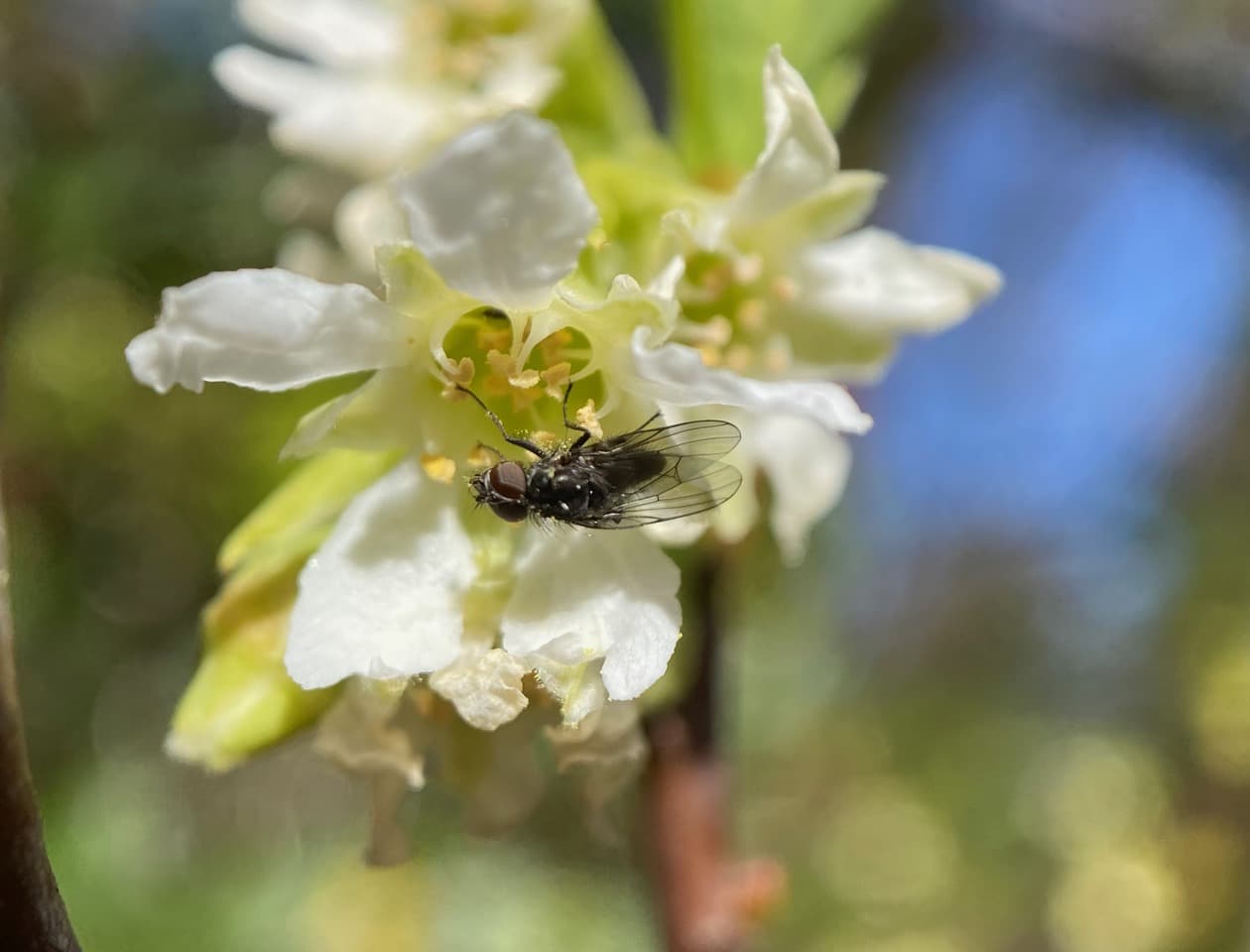
An unidentified small fly is foraging on a male Osoberry flower, pollen sticking to its hairs.
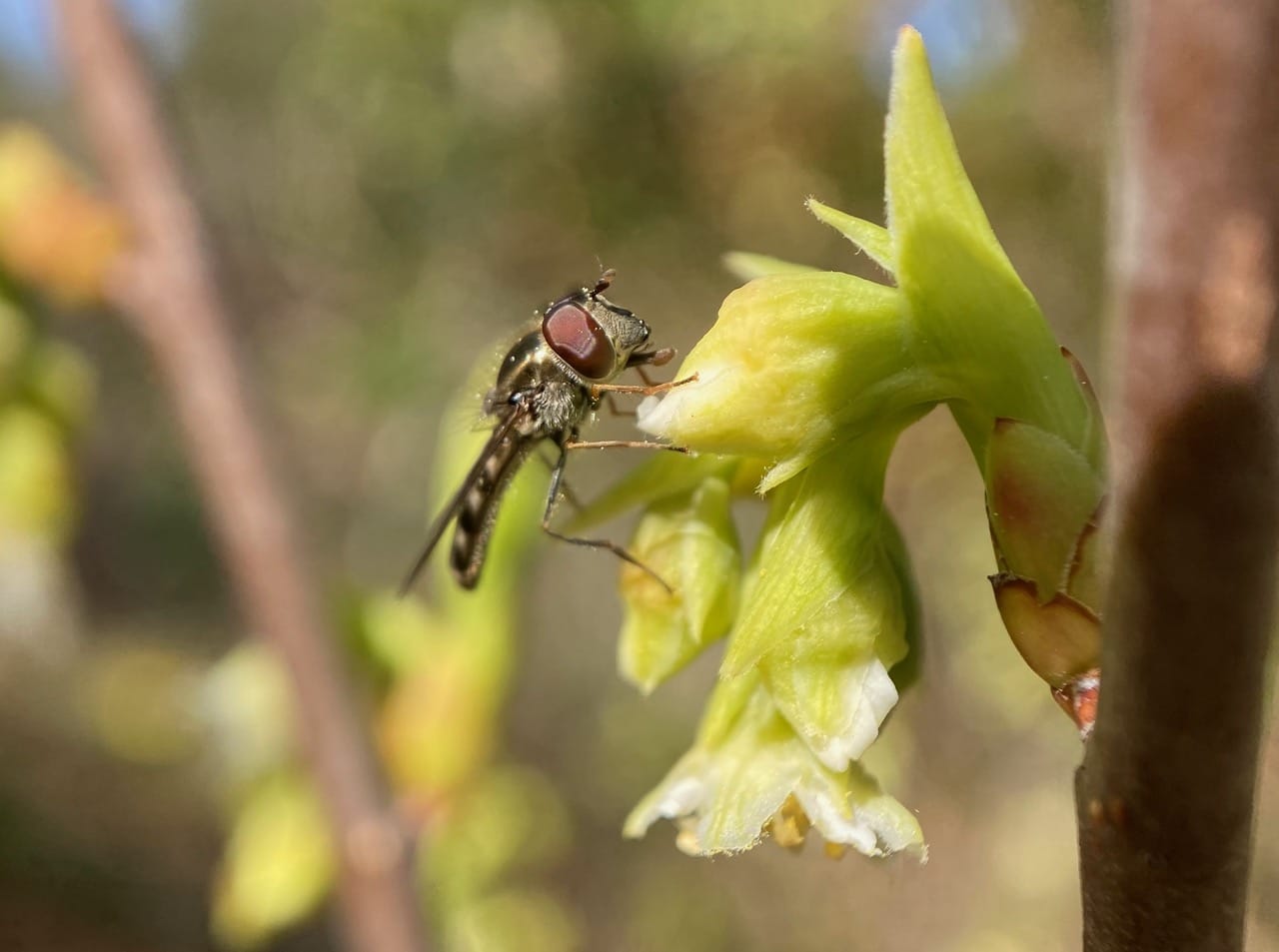
Several hover flies are circling the flowers. A Western Forest Sedgesitter, Platycheirus trichopus has landed to feed on nectar and pollen.
The Sedgesitters are generally small to medium-sized flies, active from spring through autumn, frequently visiting flowers in gardens and woodland edges. Known as “flower flies”, adults are frequently found on plants feeding on nectar and pollen. They can hover almost motionless. Larvae are aphid-eaters, providing natural pest control. The hover fly is commonly found in grass, herb vegetation, and forest environments. Many stay active during cold and rainy weather. The Western Forest Sedgesitter is found in Western North America, from Alaska to California.
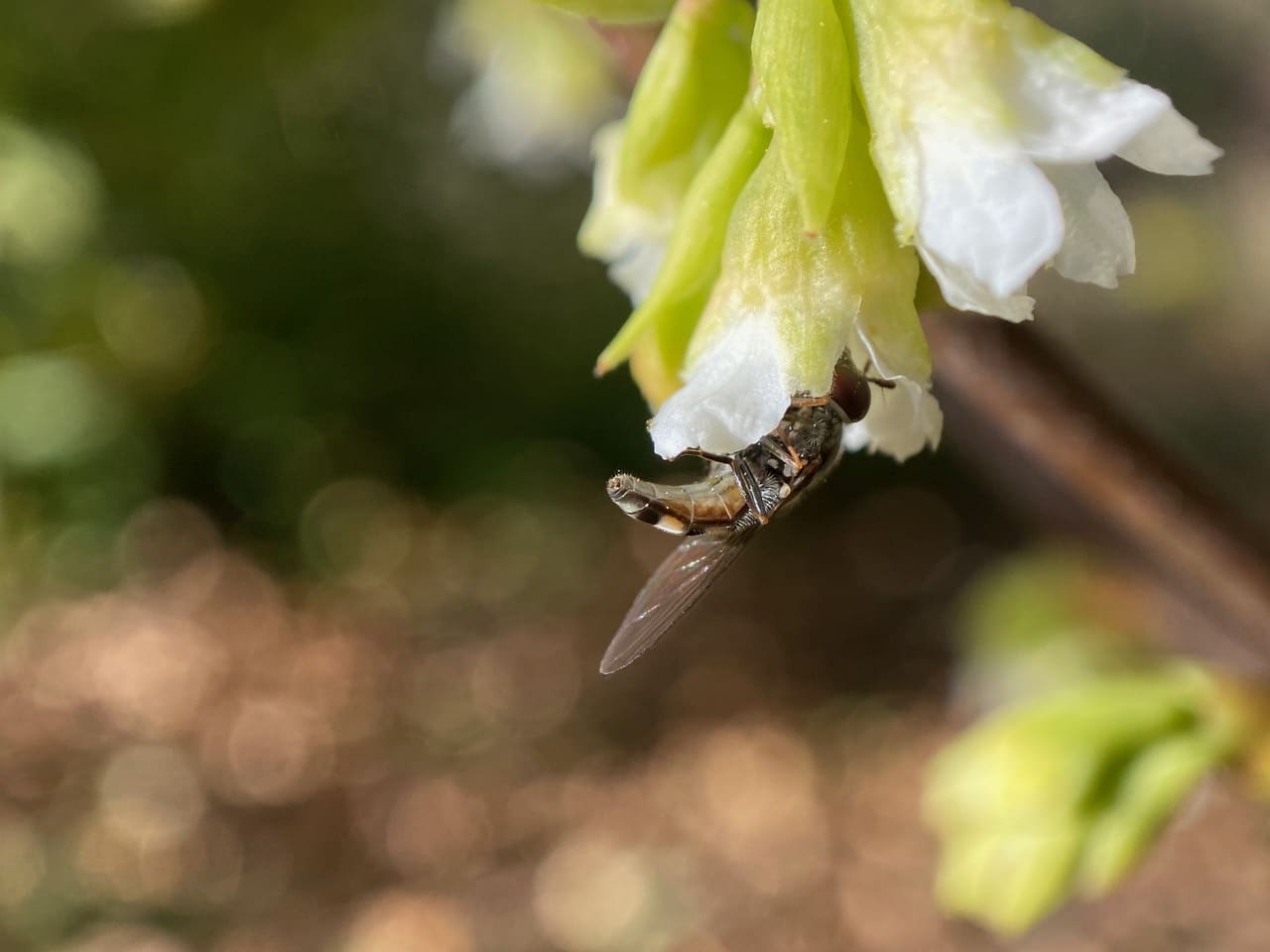
This Sedgesitter, Platycheirus sp. (family Syrphidae) is reaching into the upside down Osoberry flower to access nectar and pollen.
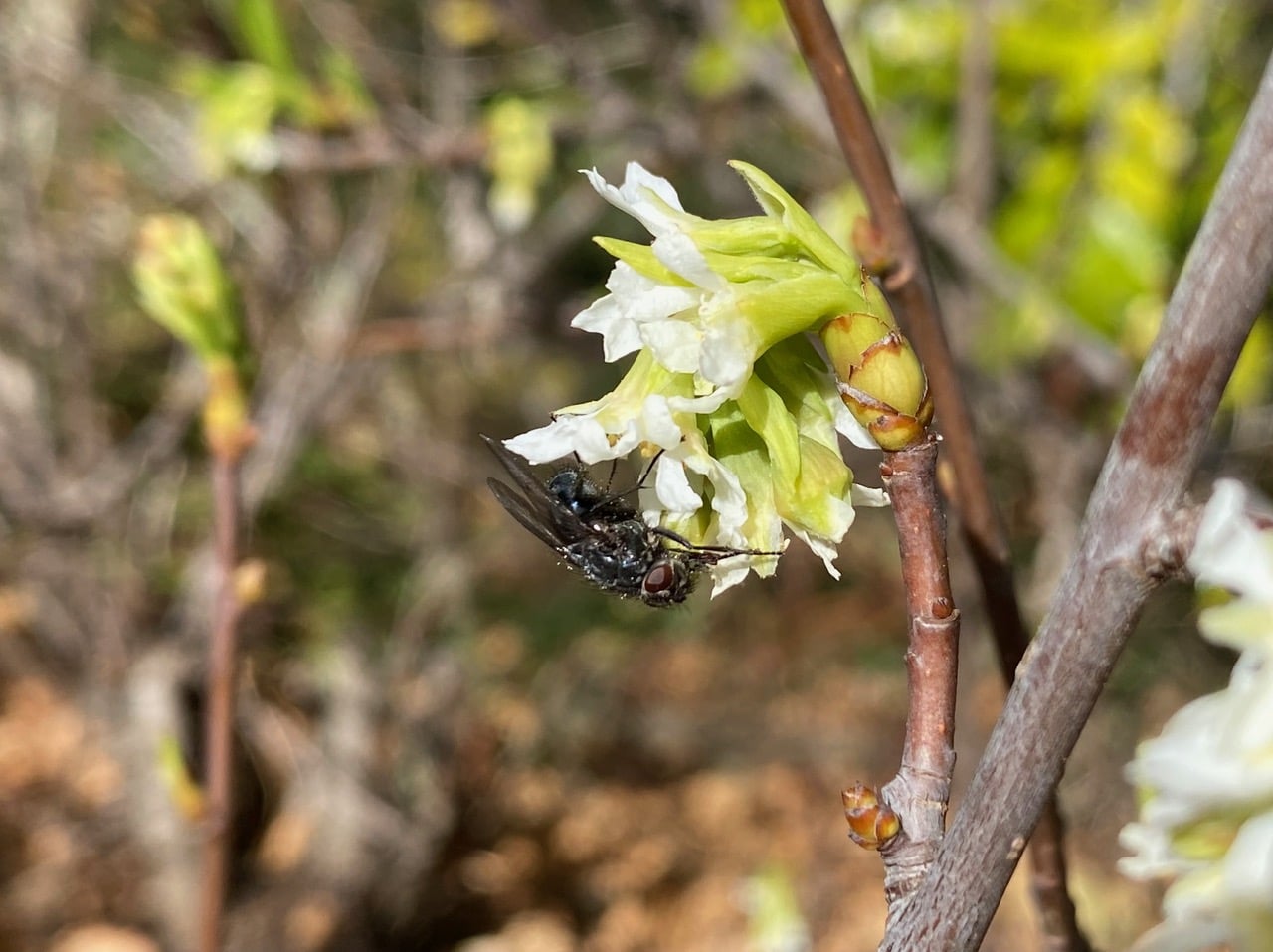
A much larger fly, the Blue Blowfly, Calliphora vicina is foraging on a cluster of male Osoberry flowers.
The Calliphoridae are variously known as blow flies, carrion flies, greenbottles, and bluebottles. Adults are usually brilliant with metallic sheen, often with blue, green, or black thoraces and abdomens. There are three cross-grooves on the thorax; calypters are well developed. Females visit carrion both for proteins and egg laying. The larvae that hatch feed on dead or necrotic tissue, passing through three instars before pupation. After the third instar, the larva leaves the corpse and burrows into the ground to pupate. Adult blow flies are occasional pollinators, being attracted to flowers with strong odors resembling rotting meat. The flies use nectar as a source of carbohydrates to fuel flight.
The Blue Blowfly, Calliphora vicina is important in the field of forensic entomology; its life cycle has been extensively studied and the flies are used to estimate the time of a person’s death in criminal cases. The species is found throughout the U.S. in urban areas and are most abundant in early spring and fall.

A Cluster Fly, Pollenia sp. (family Polleniidae) is basking on a Toyon leaf. It has lost most of the golden hairs on its thorax, but is still easily recognizable from its size, stocky build and shiny checkered silvery abdomen.
Called the Common Cluster Fly, Pollenia rudis (family Polleniidae) is slightly larger than house flies. It is dull gray with checkered black and silvery-black abdomens. A newly emerged fly has many golden hairs on its thorax which may be lost throughout the life of the fly. The common name comes from the tendency of the flies to aggregate near windows when they are trapped in human dwellings. The immature stages – eggs and larvae – are seldom seen because they are deposited on the soil where they burrow into earthworms which they parasitize. The Cluster Fly is a European species. They may have found their way to America in the ballast of ships containing soil, probably along with introduced earthworms.
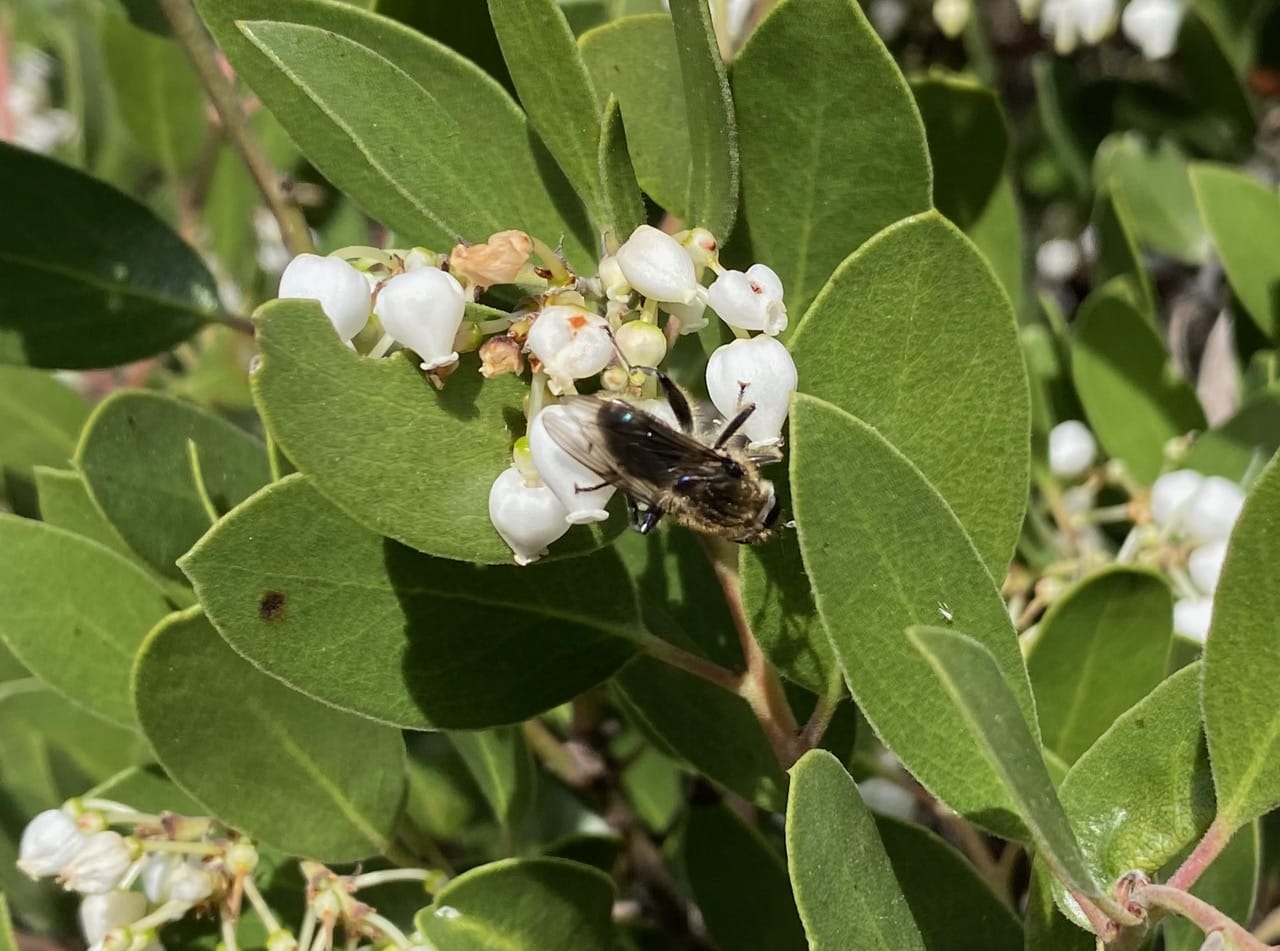
Who is that large fly probing around on a cluster of Manzanita flowers? It doesn’t look familiar to me at all.
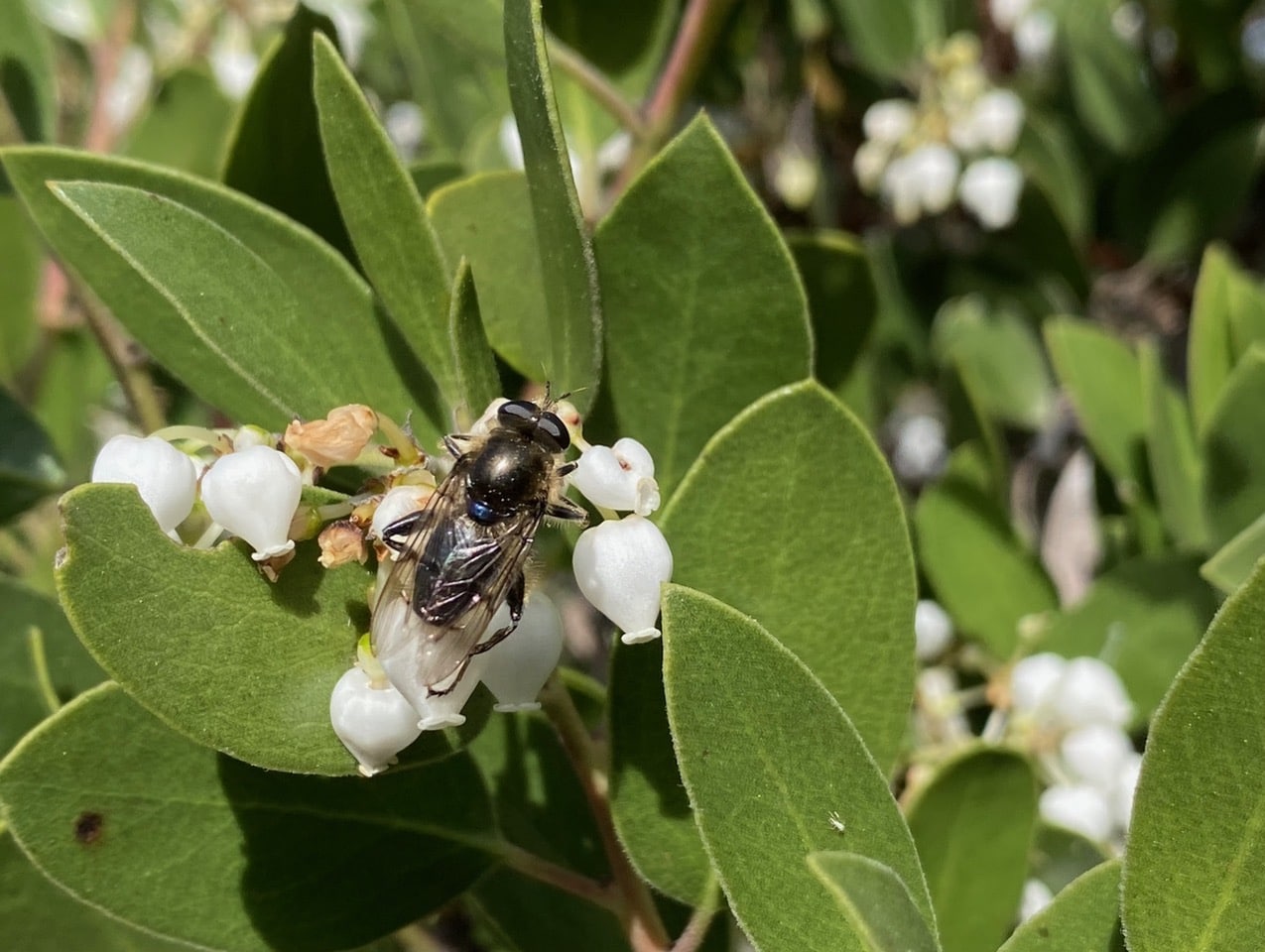
A hover fly expert on iNaturalist has helped identify it as a Catkin Fly, Brachypalpus sp. (family Syrphidae). The species is new to me – Yay!
Flies in the genus Brachypalpus are called “catkin flies” because the adults are commonly found feeding on nectar and pollen from the catkins of trees and shrubs (such as willows, alders, and poplars) early in the spring. They are some of the first hover flies to emerge in spring when catkins are blooming, making these flowers a primary food source. Many are specialized nectarivores that visit specific flowers in woodland habitats. These flies are associated with forests, where their larvae develop in decaying, water-soaked wood and tree sap, feeding on organic matter. The larvae are classified as rat-tailed maggots, characterized by a long, snorkel-like breathing tube (siphon) on their rear end that allows them to breathe air while buried in decaying material.

Something tells me that the hover fly foraging on the Ceanothus flowers is not a Sedgesitter, Platycheirus sp. The abdomen looks too long and skinny. A hover fly expert on iNaturalist has confirmed my suspicion – the fly is a Variable Duskyface Fly, Melanostoma mellinum (family Syrphidae).
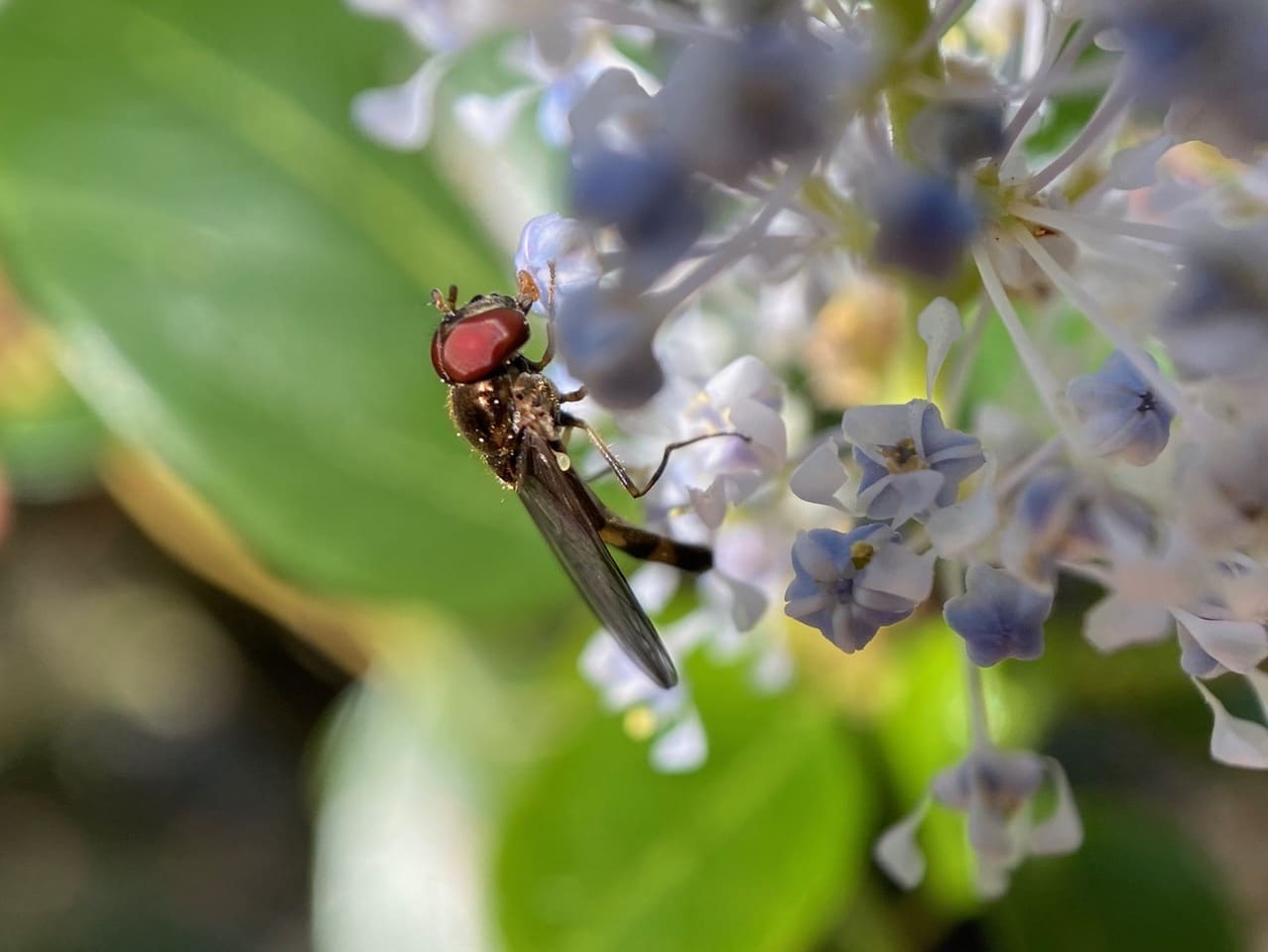
The Variable Duskyface Fly, Melanostoma mellinum is a very common species of hover fly found in many parts of Britain, Europe, North Africa, East Palearctic, and North America. Very similar to Platycheirus, it is a small species, with wingspan of 4.7-7.0 mm. They are found in grasslands and moorlands, including those in high elevations. Adults mainly feed on pollen of grasses (Poaceae) and other wind-pollinated plants, but will take pollen from other sources as well. The larvae are small, slug-like, predatory maggots often found in damp environments, leaf litter, or on plants preying on aphids.
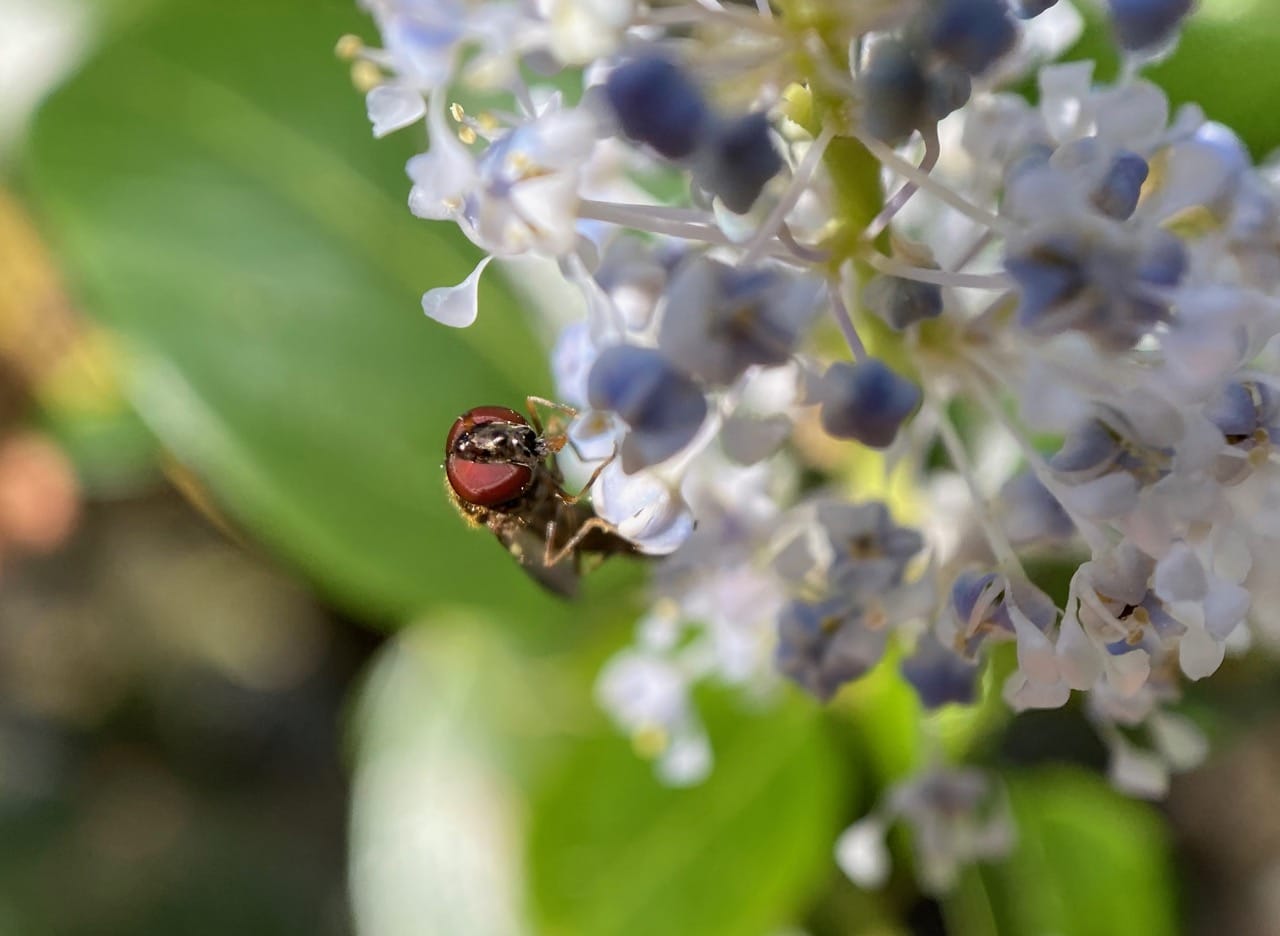
What an interesting face! Note the metallic bumps between the compound eyes of the Variable Duskyface Fly.
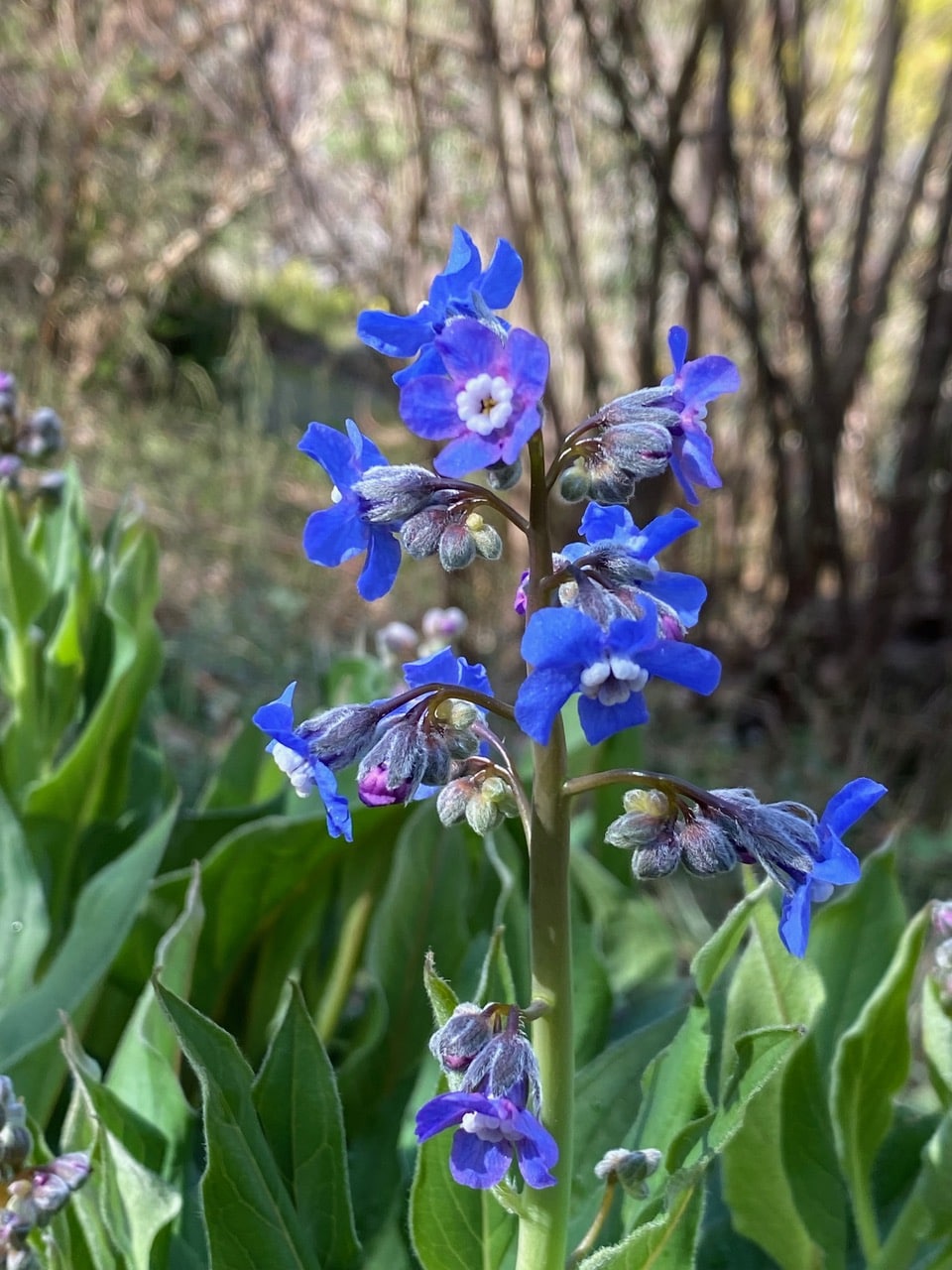
The Hound’s Tongue, Adelinia grandis has started to bloom! Why do the pink buds of Hound’s Tongue open up into blue flowers? Note that the top most, youngest flowers are still transitioning from pink to blue, while the older blooms are a brilliant blue.
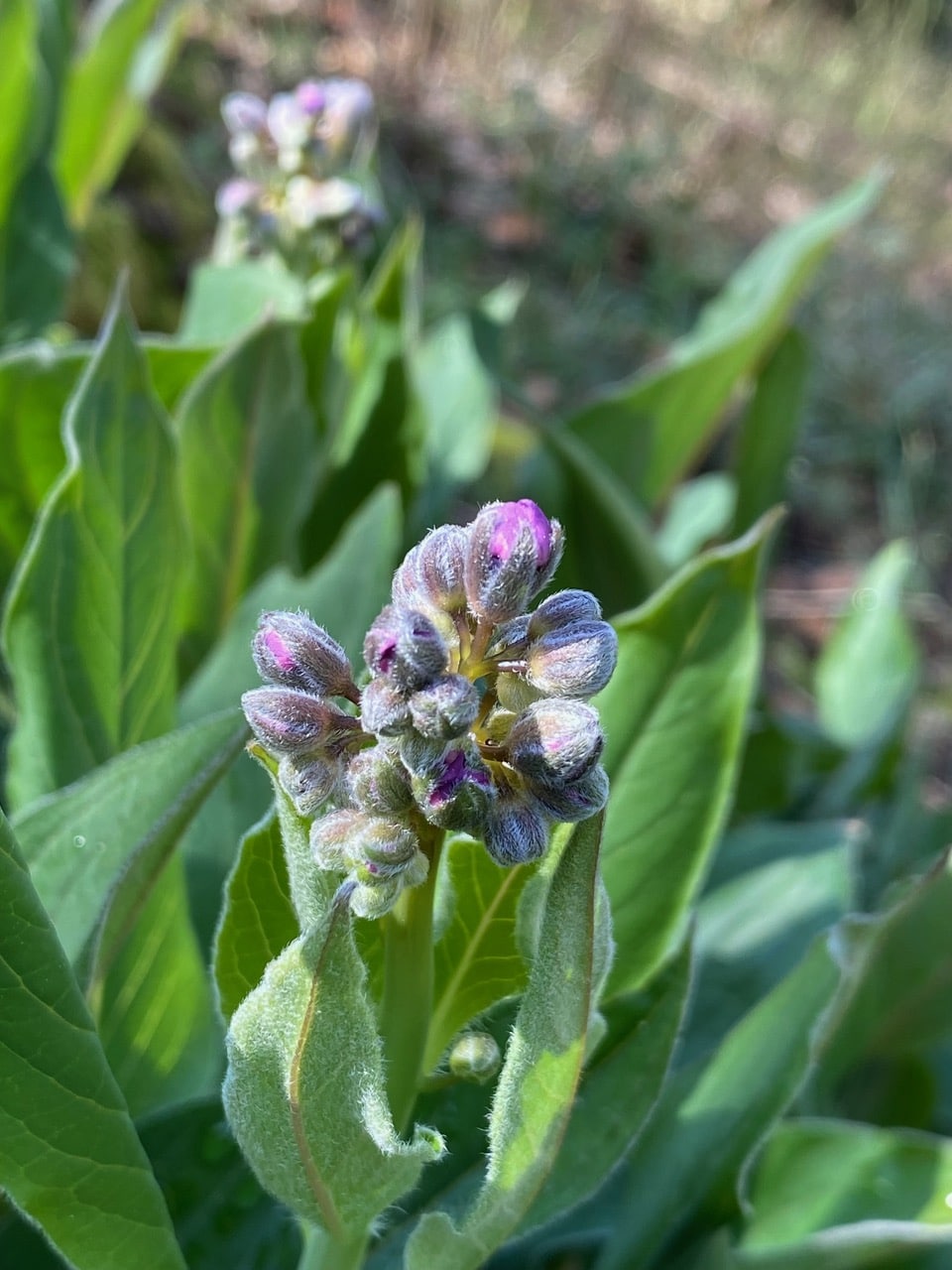
Hound’s Tongue’s flowers start off as pink buds, turning blue as they open up and mature. Later on, we’ll see that the flowers will turn pink again as they senesce. What gives?
Clusters of flowers are borne on long stalks, pink in bud changing to blue. There are five fused petals with white appendages forming a central crown around the reproductive parts. The flowers change color, perhaps guiding pollinators whether a specific flower is worth visiting for pollen and nectar. Color signaling occurs in the flowers of more than 70 plant families to direct pollinators. Examples include Forget-me-nots, and Heliotrope, also in the Borage family. Bees see blue colors well, but not reds. Hound’s Tongue flowers contain anthocyanin, a pigment that changes color with pH. Immature pink flowers may signal to bees, “Not ready; move on.”, the mature blue flowers, “Ready for pollination.”; and the fading blue-purple of the aging flowers, “I’m done; don’t bother.” What’s more, bees perceive ultraviolet colors of the nectar appendages, which appear white to us. There’s so much more than meets our eyes!
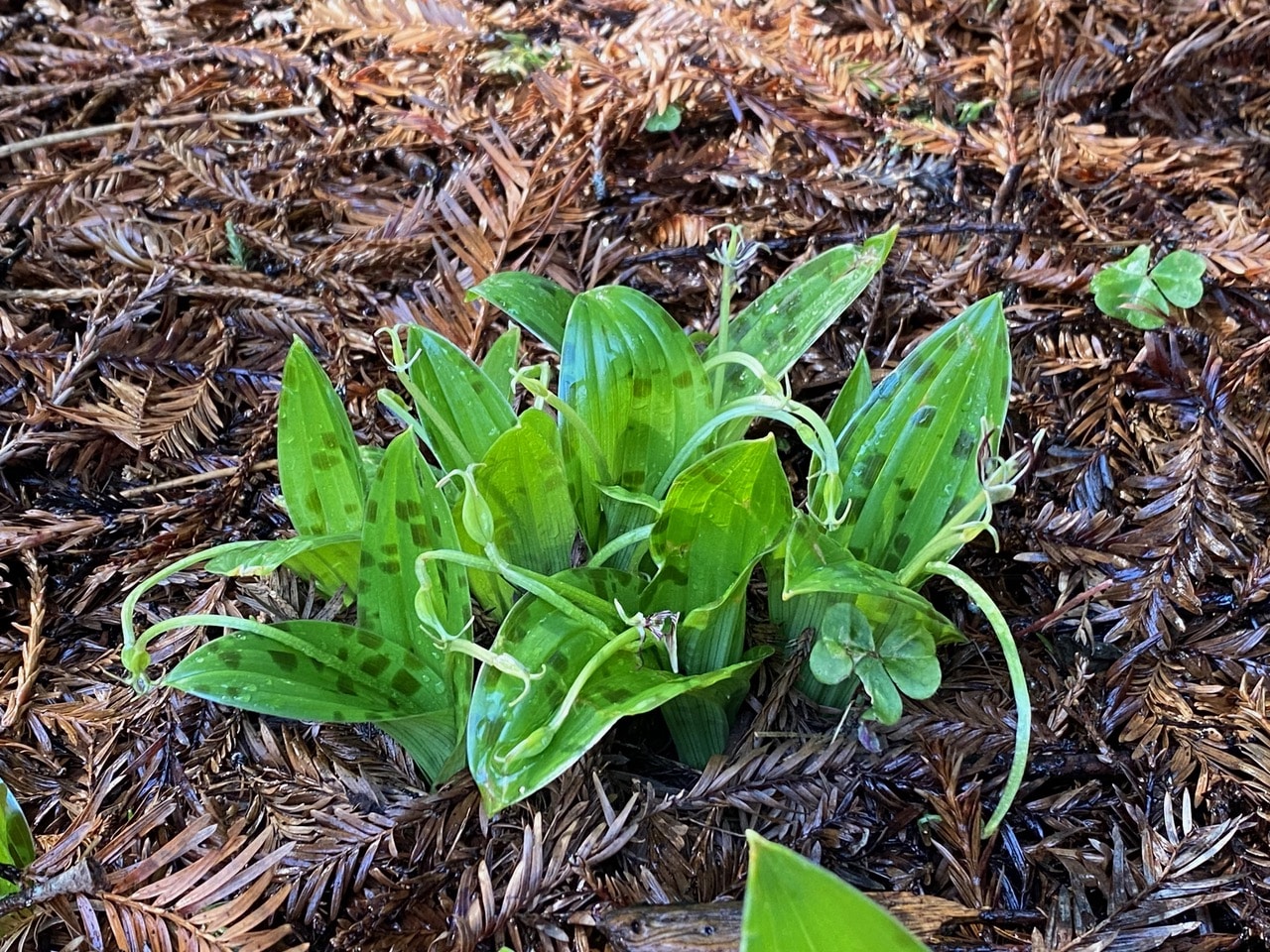
Entering the Redwood section of the garden, I have to dodge a couple of active sprinklers to get to the Fetid Adder’s Tongue, Scoliopus bigelovii . The plants look thoroughly soaked. Wow, most of the flowers have gone to seed, the developing fruits slinking their way down towards the ground. This is due to the lengthening and twisting of the pedicels (flower stalks) after the flowers are pollinated. Alas, my hope for seeing an insect in the act of pollinating these unusual flowers has been dashed once again. It will be another year for such an opportunity to present itself again.

Photo taken on 2/9/25 at the same site.
In their prime, the flowers of Fetid Adder’s Tongue emit a funky smell that attracts Fungus Gnats (family Mycetophilidae), their primary pollinators. As the tiny insects probe for nectar in the base of the flower, their back comes into contact with the anthers and gets coated with pollen. In mature flowers, the three prongs of the style droop downward; the moist stigmatic surface at the tips pick up pollen from the insect’s body from a previously visited flower.
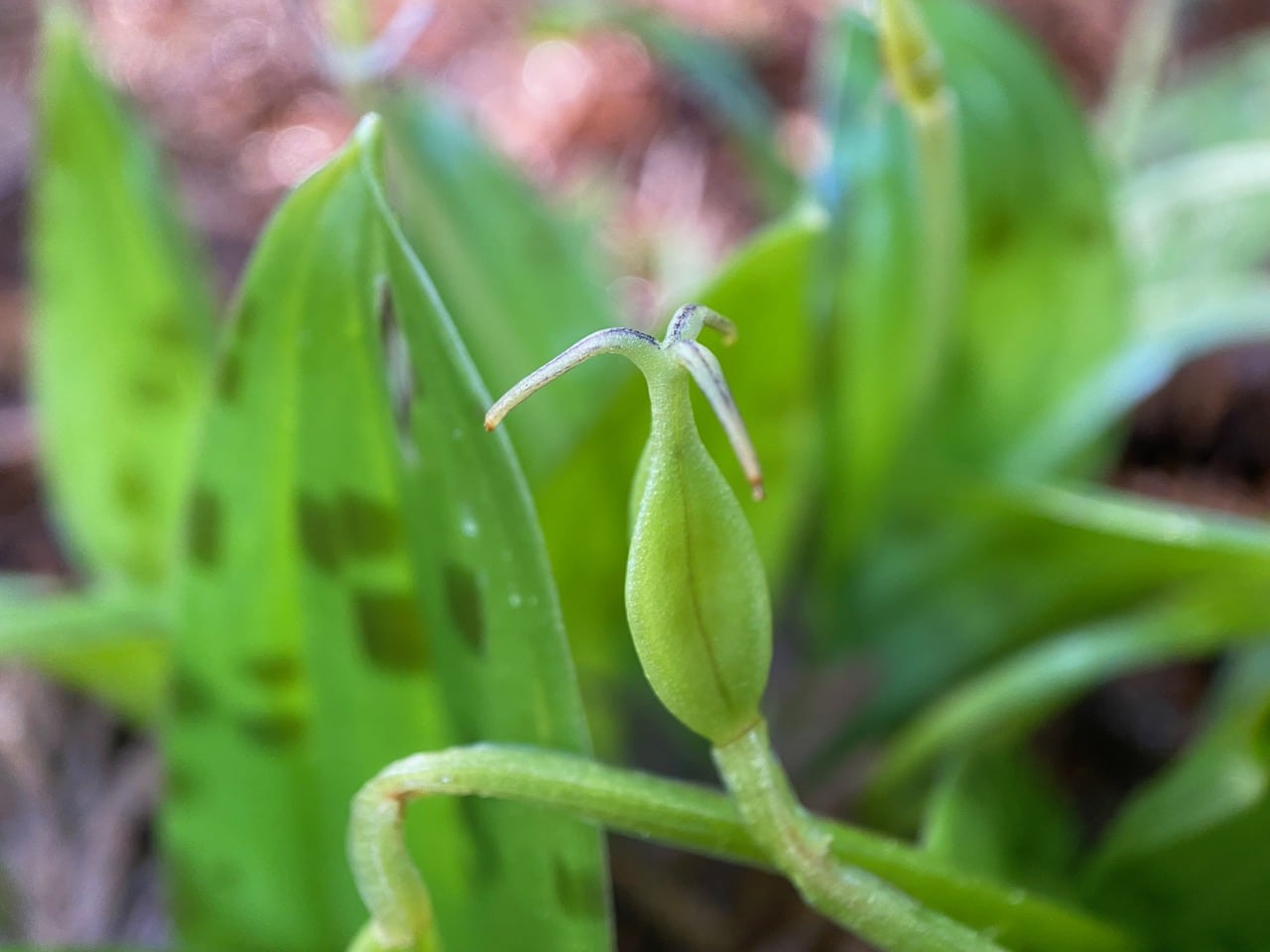
Close-up of an immature fruit, with the persistent three-pronged style still intact. The drama isn’t over yet for our Fetid Adder’s Tongue.
The seeds within the seed capsule or fruit of Fetid Adder’s Tongue are equipped with a fleshy, fatty, and nutritious appendage called an elaiosome. Ants adore these elaiosomes and avidly collect them, carrying the seed to their nests. The ants eat the elaiosomes and discard the seed in their nest’s waste area, which acts as a nutrient-rich, protected nursery for the seed. This process helps the seeds avoid predation and allows them to grow in colonies. This relationship between Fetid Adder’s Tongue and the ants is an example of myrmecophily. The word meaning “ant-love”, refers to relationships between ants and other organisms which are often specialized, with partners exchanging protection, food, or shelter, playing a key role in the evolutionary success of ants.