

Pollinator Post 1/29/24 (2)

Hello, who’s this draped over a stem of Coyote Brush? It appears to be a Camel Cricket, a nocturnal insect in the family Rhaphidophoridae, order Orthoptera. I’m not sure if the motionless insect is asleep or dead, but I’m not about to prod it to find out. It is a female, as evidenced by the prominent ovipositor at the tip of her abdomen, flanked by a pair of smaller appendages called cerci. The cerci are used to sense wind, temperature, and humidity. The female uses them to find just the right conditions for laying her eggs.
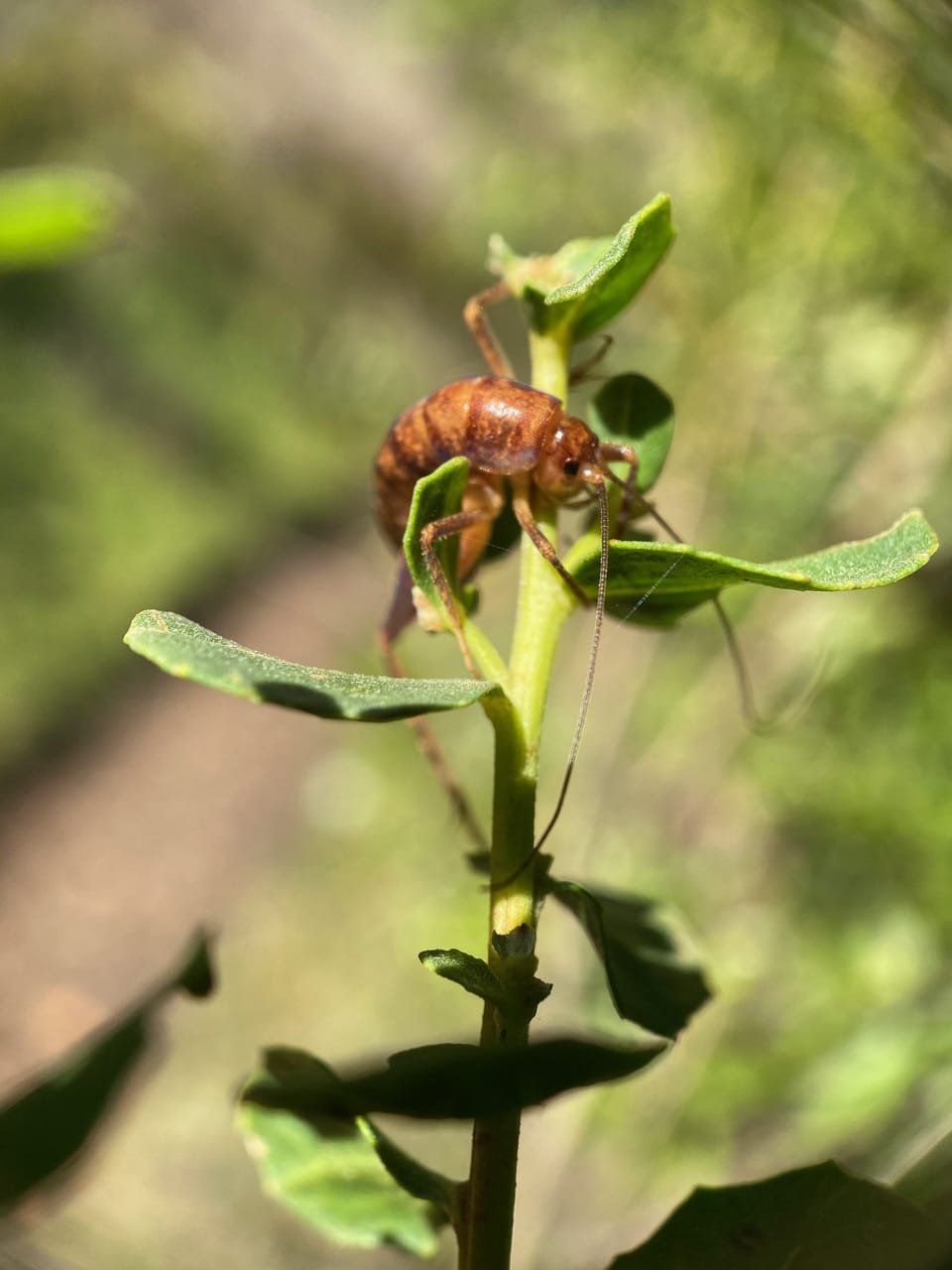
Here’s a look at her front end. Check out those long antennae!
Most camel crickets have very large hind legs with “drumstick-shaped” femora and long, thin tibia, and long, slender antennae. They are brownish in color and humpbacked in appearance, always wingless. Some species are cave dwellers. Most of these nocturnal insects inhabit cool, damp environments, such as rotten logs, stumps and hollow trees, and under damp leaves, stones, boards, and logs. The cricket’s distinctive limbs and antennae serve a double purpose. Typically living in a lightless environment, or active at night, they rely heavily on their sense of touch, which is limited by reach. Given their limited vision, these crickets often jump to avoid predation. Rhaphidophoridae are primarily omnivores/detritivores, feeding on fungus, bits of decaying plants and animals, plus the occasional live insect. Unlike other members of Orthoptera, Camel Crickets do not have the ability to make sound, or to stridulate. They are silent.
Camel crickets are important members of the ecosystem; as decomposers they break down food items into smaller pieces for smaller animals, and they are a major food source for insectivores such as voles, moles and other nocturnal animals.
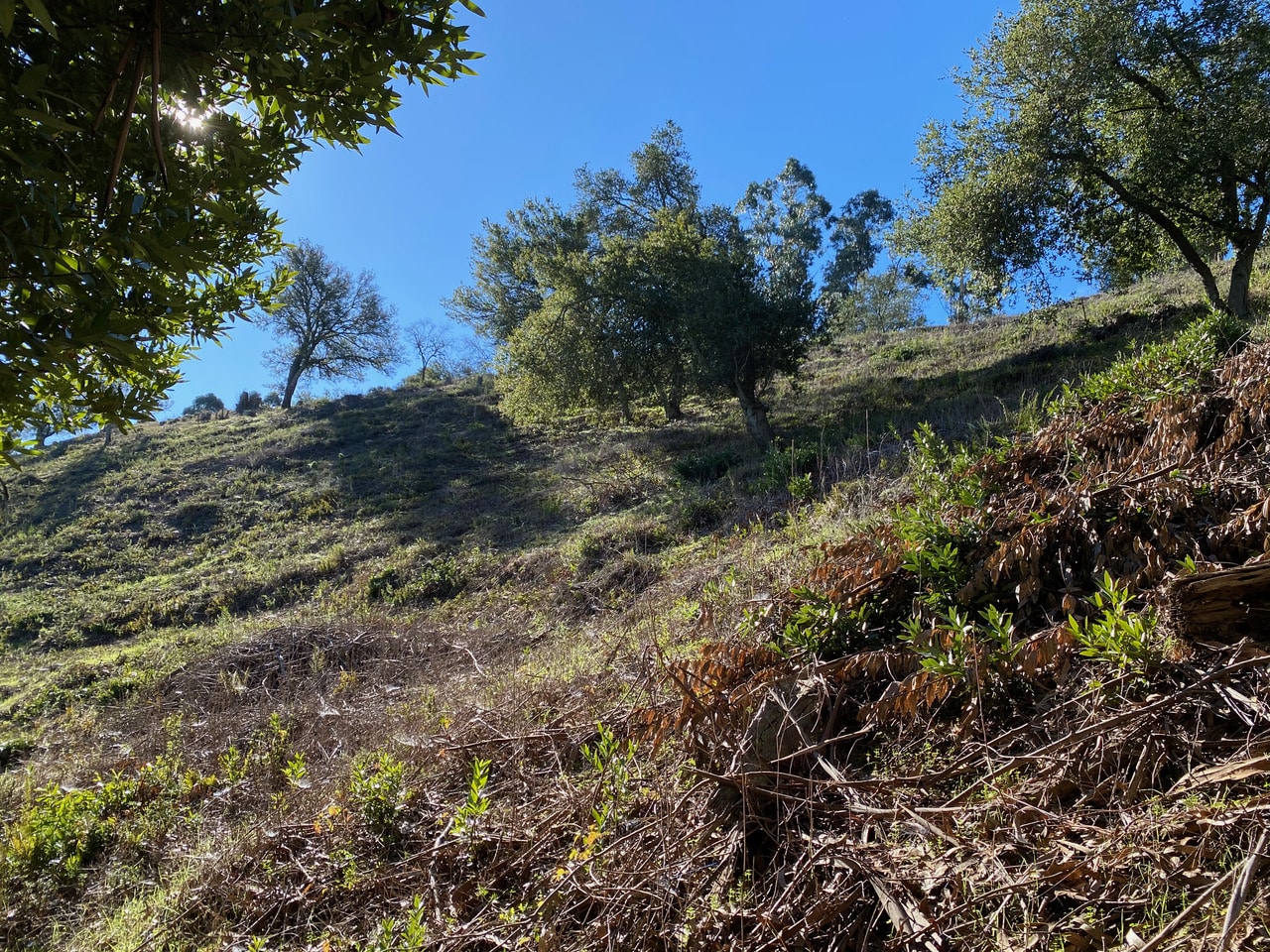
I look up sadly at the slopes east of the trail. Fire prevention has mandated aggressive brush clearing last fall. All shrubs and bushes, native and non-native alike have been cut down. I wonder how many bumble bee nests have been trampled, how many immature insects pupating in the leaf litter or underground have lost their lives. Countless insects that depend on these shrubs to complete their life cycles have been sacrificed. Now that spring is fast approaching, will there be enough vegetation to support the insects that survived?
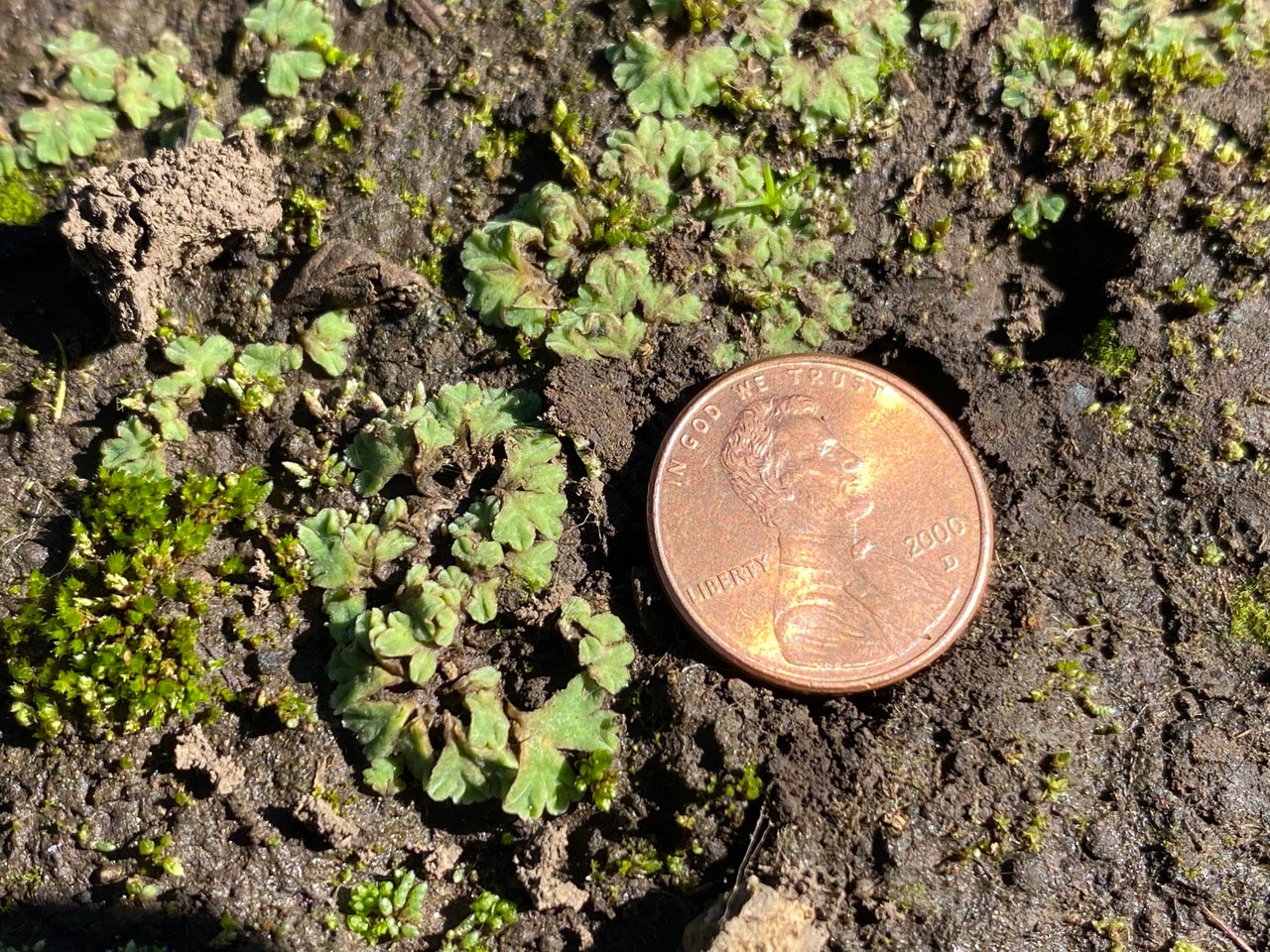
To get a sense of their diminutive size, I place a penny by the clumps of liverworts that are growing on the wet soil at the edge of the trail.

Close-up of the Common Crystalwort, Riccia sorocarpa. This liverwort is a different species from the Riccia we encountered yesterday at Siesta Nose. These are more robust and lack the hairs at the margins of the thalli.
Liverworts are primitive nonvascular plants, perhaps the most primitive true plants still in existence. There are two types – thallose and leafy. In thallose liverworts such as the genus Riccia, the plant body (thallus) consists of flattened masses of cells that look leafy but show little differentiation into different cell types. Thallose liverworts grow flat against a surface. A layer of photosynthetic tissue is underlain by non-photosynthetic cells, with a final lower scaly layer that produces rhizoids, root-like structures that help hold the plant in place.

Lush green mosses grow next to the liverworts. I zoom in on the whitish egg-like structures between the mosses only to discover that they are the budding mosses that have yet to leaf out. New things to discover everyday!
Why do we care about these minute and apparently insignificant plants? Bryophytes (mosses, liverworts and hornworts) play a very important role in the environment; they colonize sterile soils, absorb nutrients and water and release them slowly back into the ecosystem, contributing to the formation of soil for new plants to grow on. Their main talent is absorption. They can capture humidity from rain or even fog, retaining excess rain and preventing floods and soil erosion. They act as sponges and provide a water reserve for the forest, and provide shelter and food for many invertebrates. What’s not to love about Bryophytes?
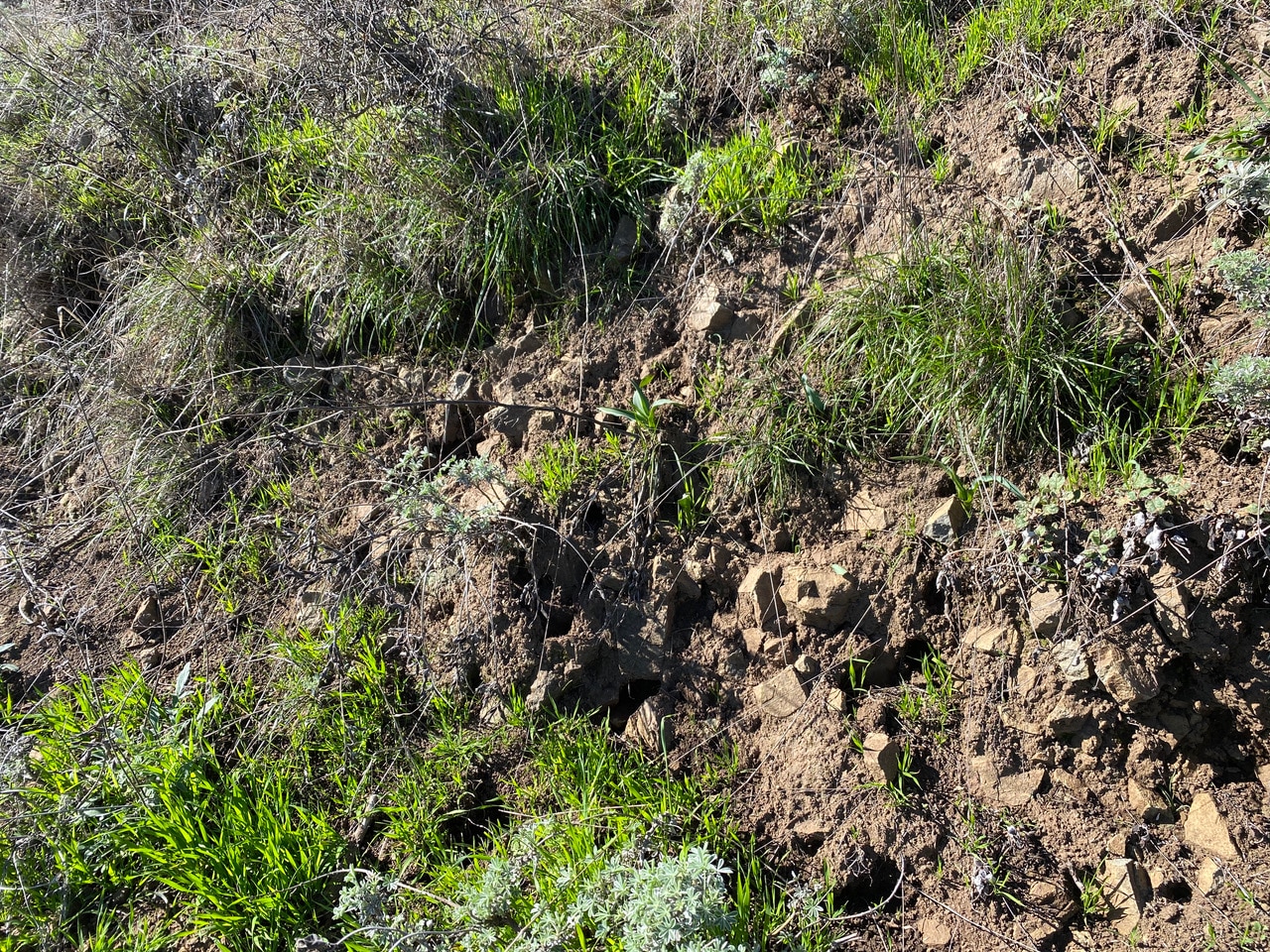
At Diablo Bend, I stop to check the tall bank along the trail. It seems the brush clearing activity upslope has caused quite a bit of erosion on the edge of this bank where I know many of our ground-nesting Digger Bees (genus Anthophora) used to nest.

Here’s that straight-edged rock where I saw a female Anthophora go in and out of her burrow last year. Just then, a large grey bee the size of a bumble bee buzzes noisily around me, making large circles in the air. Unbelievably this is exactly how I discovered the female Anthophora last year! Is this one of her newly emerged offspring assuring me that things are alright, that the nest has survived the human onslaught? Tears well up in me as I walk away.
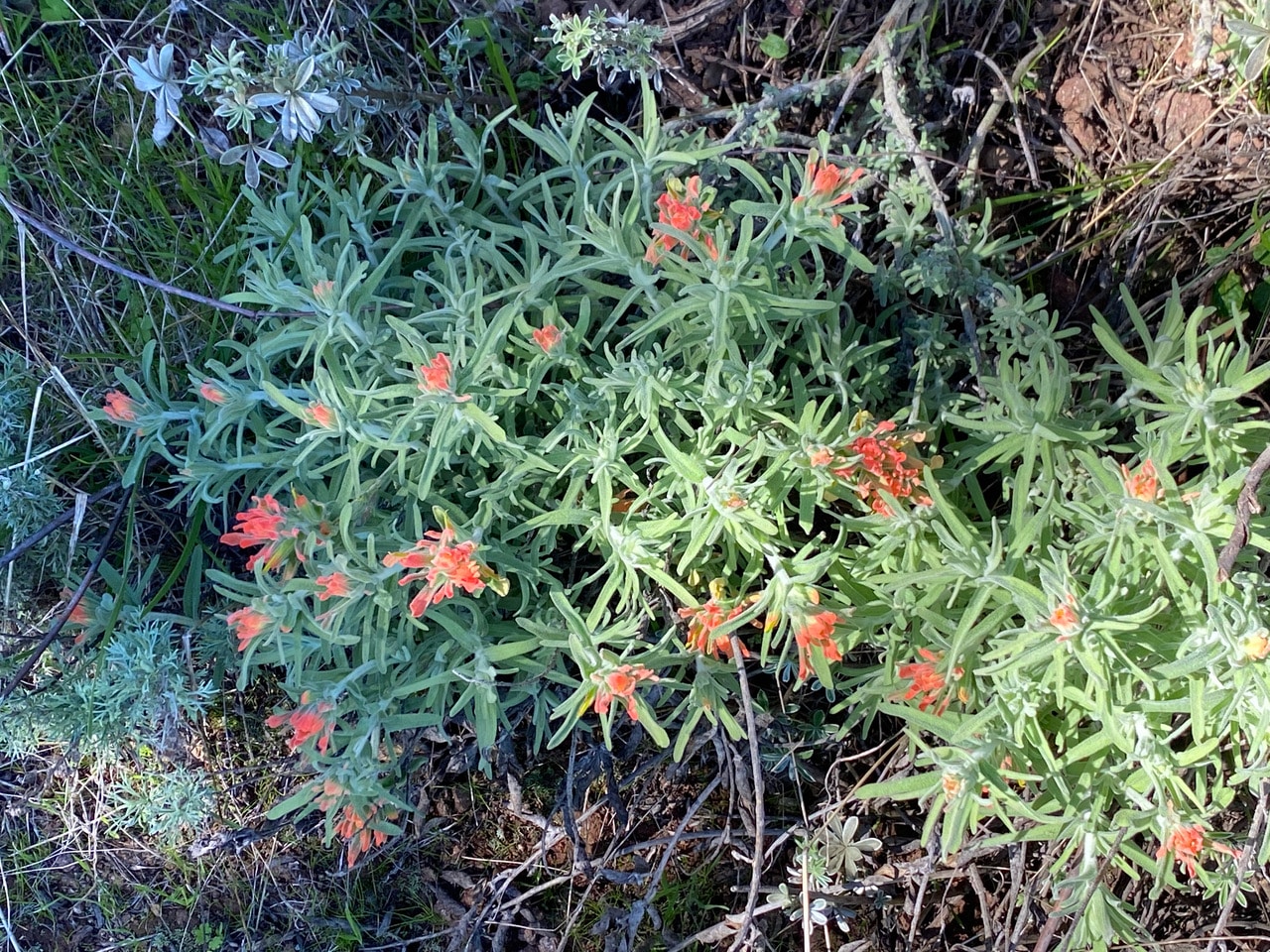
The Indian Paintbrush, Castilleja sp. under the Silverleaf Lupines at Diablo Bend has grown bigger since I last saw it. It has also sent up more scarlet inflorescences.
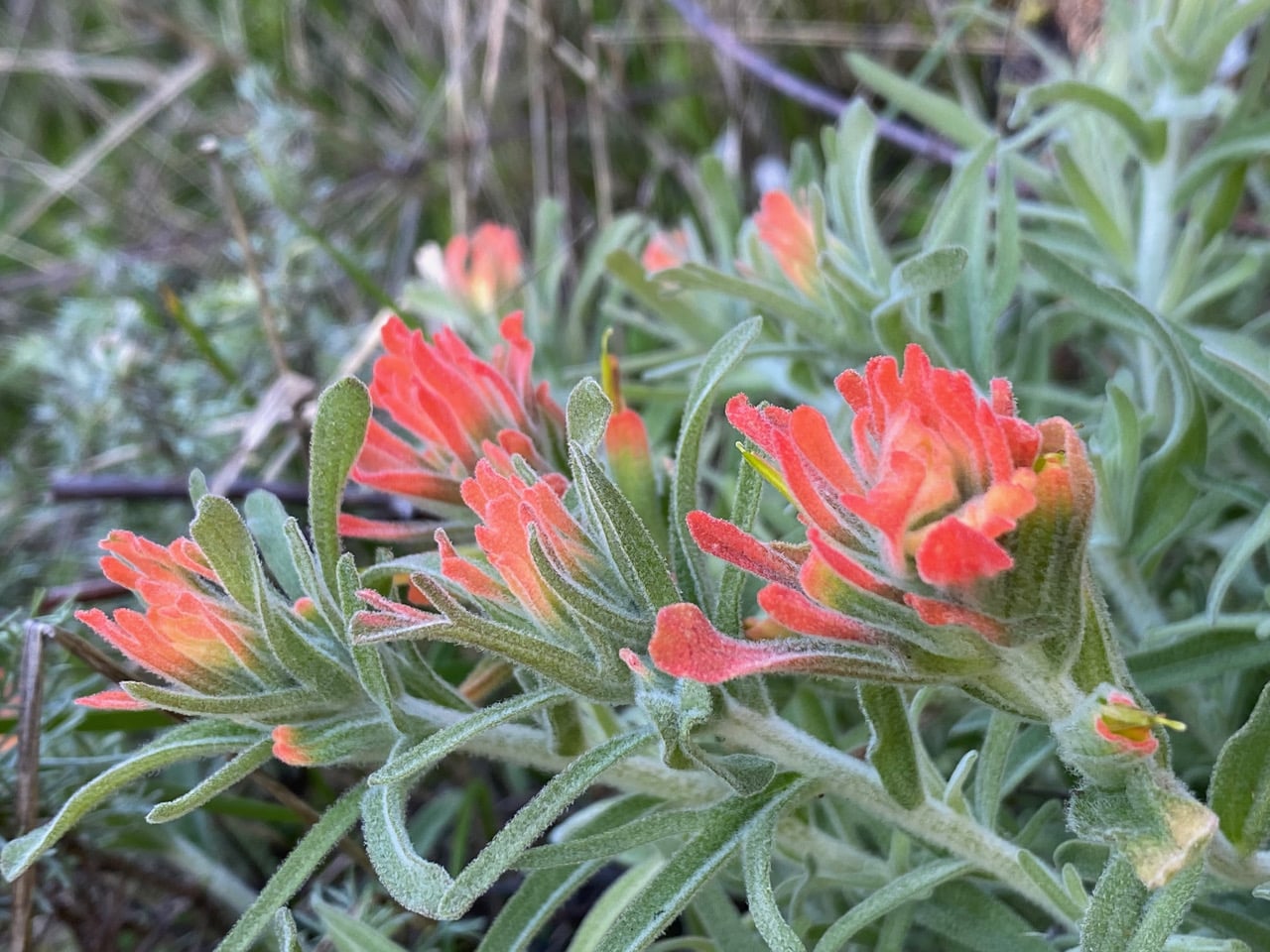
I have to admire a plant that has the audacity to defy the seasons. Since the Anna’s Hummingbirds, the flower’s main pollinators are here all year round, blooming out of season in the winter shouldn’t present a problem for this wayward Indian Paintbrush!
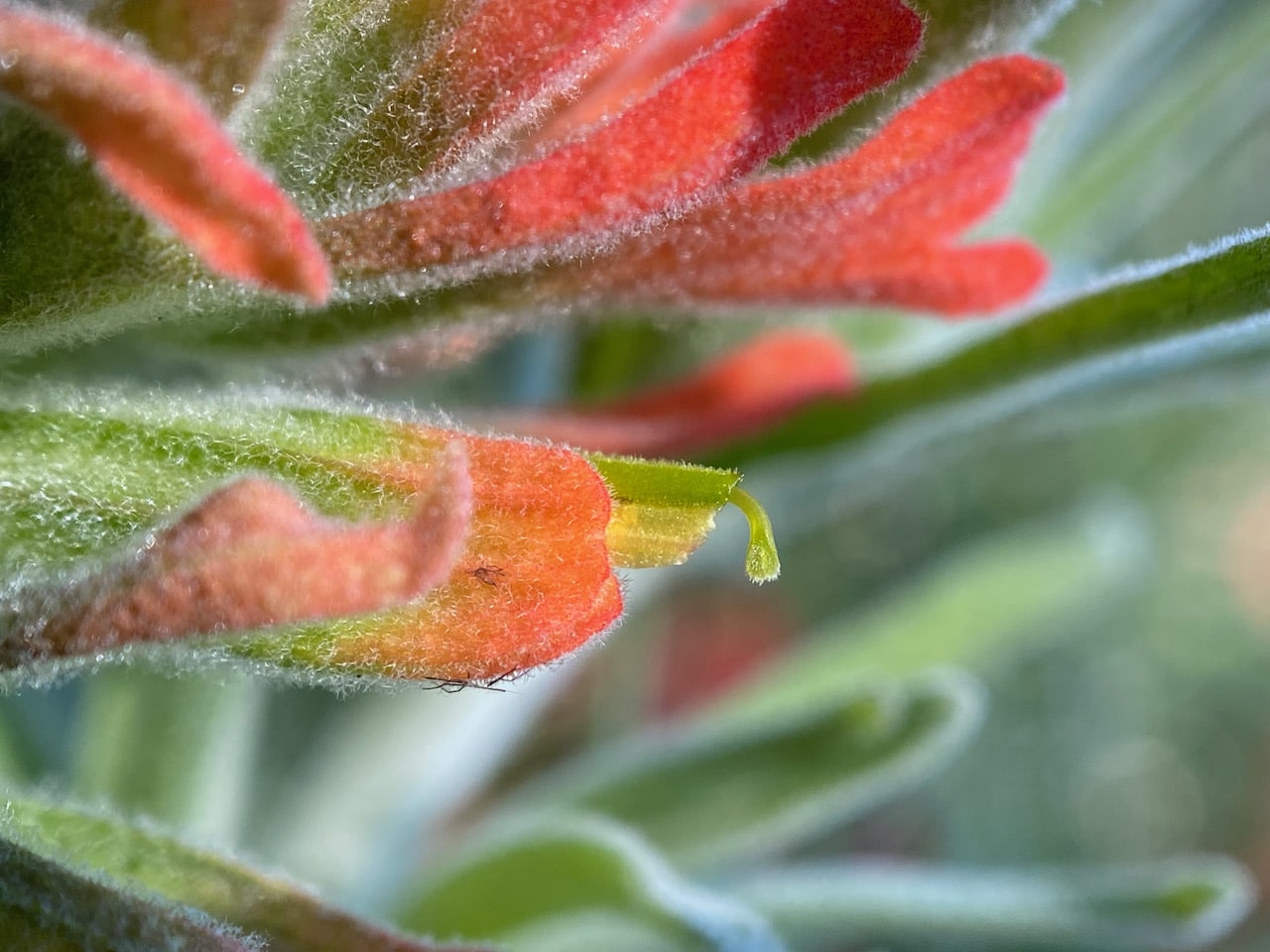
Lo, the bilobed stigma of the Indian Paintbrush protruding inconspicuously from the actual flower. The showy red structures of Indian Paintbrush are technically not petals, but bracts, a type of modified leaf. The tip of the sepals are tinged with red as well. The petals are usually green or yellow, and curiously arranged, with the upper two extending out into a long, pointed beak that envelops the stamens and style. With tubular design and red color, the flower is especially adapted for pollination by hummingbirds. The hummers have long slender bills that allow them to reach the nectar rewards at the base of the flowers.