

Pollinator Post 1/29/24 (1)
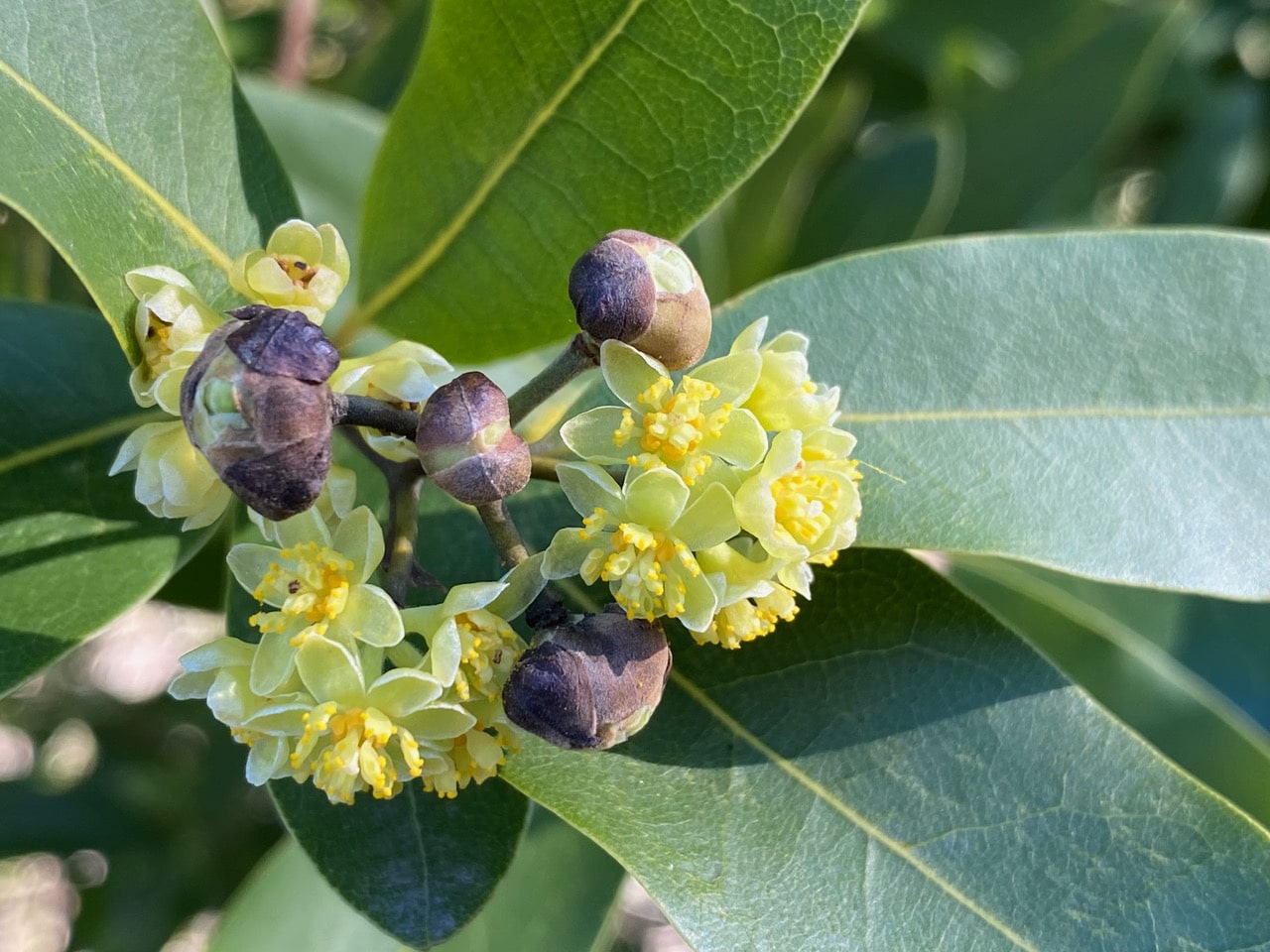
Taking advantage of a warm sunny day, I walk Skyline Trail south of Siesta Gate today, the section that I didn’t cover yesterday. My focus is on the California Bay Laurel, Umbellularia californica, hoping to find out who pollinate its winter-blooming flowers. There are few other flowers to look at any way.

The place is rather quiet, insect-wise, but as I stand around scanning the flowers, I begin to find spiders. This tiny orb-weaver has constructed a horizontal web across the foliage in front of a cluster of flowers and flower buds. It’s a good sign that there is insect activity. The little spider is hanging upside-down in the middle of its web. Given it size, its web construction and its behavior, I am willing to bet that it is a Six-spotted Orbweaver, Araniella displicata. But since the spider’s back is not visible, I can’t be sure of its identity.
The Six-spotted Orbweaver is a small cucumber spider. It occurs throughout Europe and North America and in parts of Asia. It is found on trees and shrubs in woodland habitats. It is one of the most widely distributed arachnids in North America, but often overlooked due to its small size. Adult females measure only 4-8 mm in length, males 4-6 mm. The species is distinguished by three (sometimes four) pairs of black spots along the edges of the rear half of the abdomen. There’s quite a bit of color variation within the species.





Most orb weavers spin fairly large webs in proportion to their own body size, but not so with Araniella displicata. The web of an adult spider may be only three or four inches in diameter. The spiral snare is usually built well off the ground, and often oriented in the horizontal plane, frequently spanning the edges of a single large leaf. The spider sits in the center, hanging beneath a horizontal web. Adult Araniella displicata are often mistaken for “baby” orb weavers. In late May or early June mating takes place, and females produce egg sacs that contain 80 eggs and are covered in loose, fluffy, yellowish silk. The package may be deposited in a curled leaf that also serves as the mother’s retreat on the perimeter of the web.
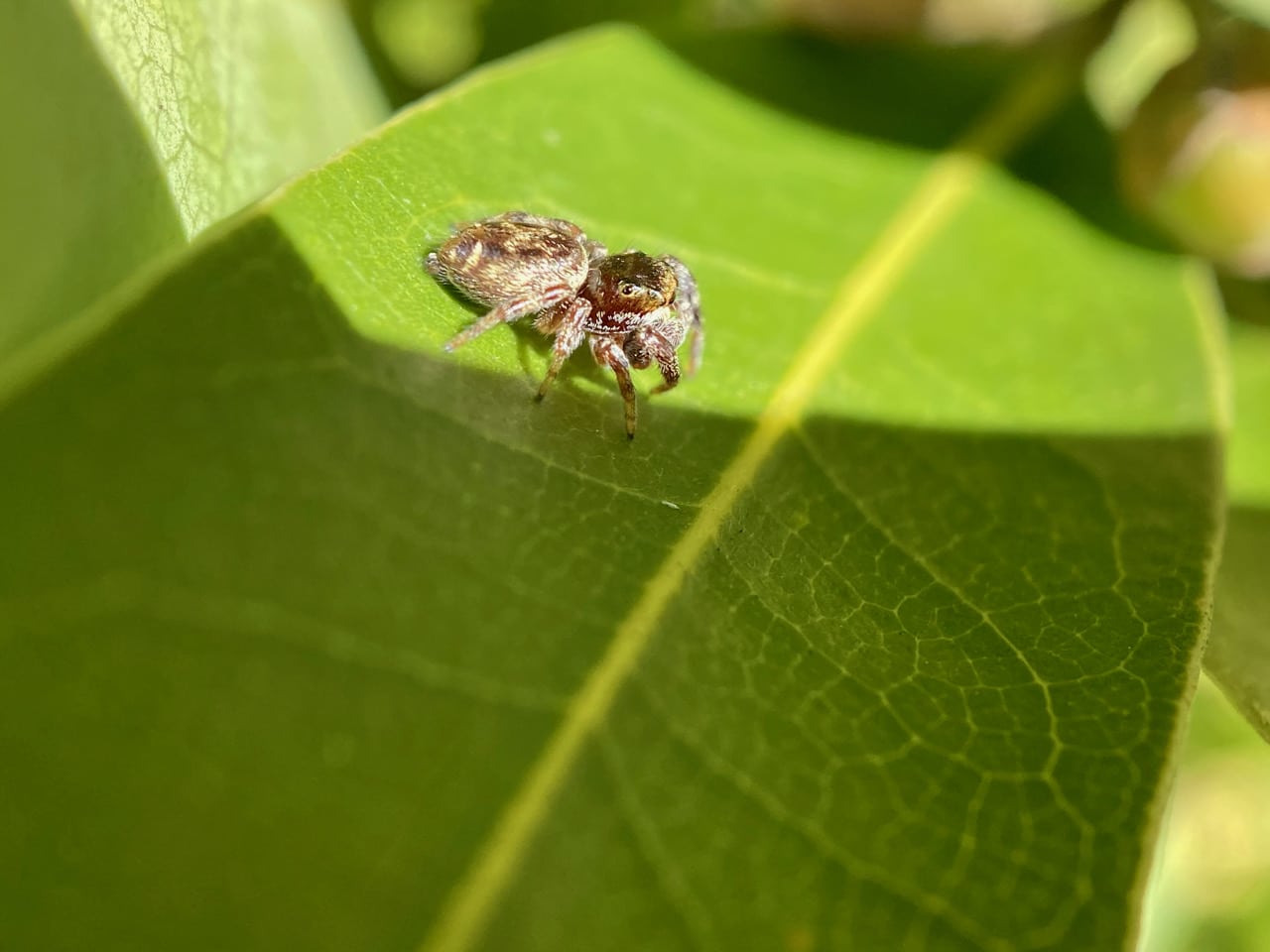
Look, here’s a Jumping Spider on a Bay leaf. I think it is a Coppered White-cheeked Jumping Spider, Pelegrina aeneola (family Salticidae).
Salticids are free-roaming hunting spiders. They do not weave a web to catch prey. They stalk, then pounce on their prey. Just before jumping, the spider fastens a safety line to the substrate. It can leap 10-20 times their body length to capture prey. Their movement is achieved by rapid changes in hydraulic pressure of the blood. Muscular contractions force fluids into the hind legs, which cause them to extend extremely quickly.
As is typical of these alert and intelligent spiders, it spins around to face me, its pedipalps shaking excitedly. Note the arrangement of its eyes on its blockish cephalothorax.
Jumping Spiders (family Salticidae) are easily distinguished by the shape of the cephalothorax and their eye patterns. They have faces that are roughly rectangular surfaces perpendicular to their direction of motion. In effect this means that their forward-looking, anterior eyes are on “flat faces”.
Jumping spiders have excellent vision, with among the highest acuities in invertebrates. The 8 eyes are grouped four on the face (the two big Anterior Median Eyes in the middle, and two smaller Anterior Lateral eyes to the side), and four on top of the carapace. The anterior median eyes provide high acuity but small field of view, while the other six eyes act like our peripheral vision, with lower resolution but broad field of view. Since all eight eyes are fixed in place and can’t pivot independently from the body like human eyes can, jumping spiders must turn to face whatever they want to see well. This includes moving their cephalothorax up and down, an endearing behavior.

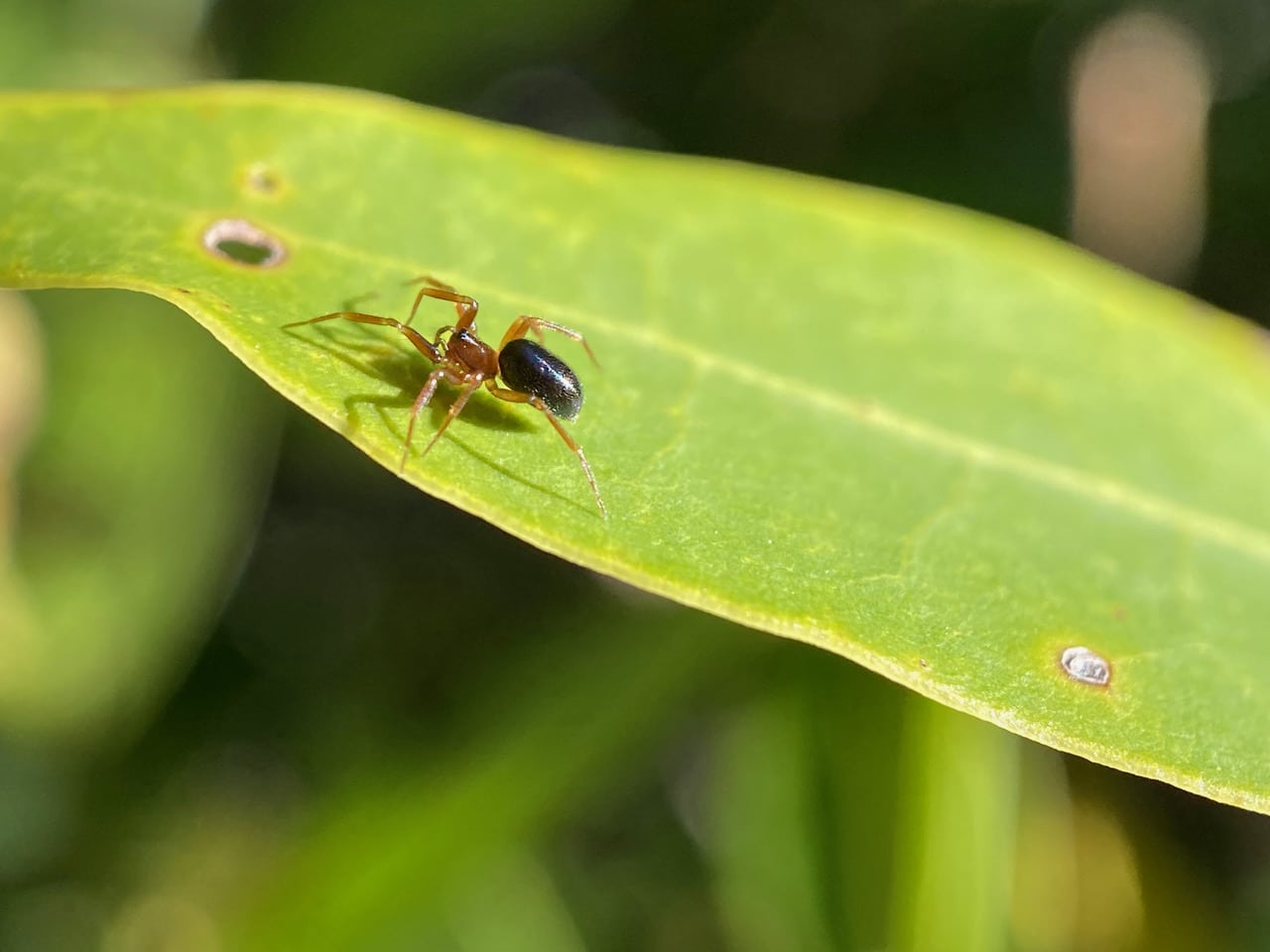
I watch as a small dark spider swiftly traverses the space between two Bay branches walking on a previously laid strand of silk. As it lands on the second leaf it explores the territory with familiarity.
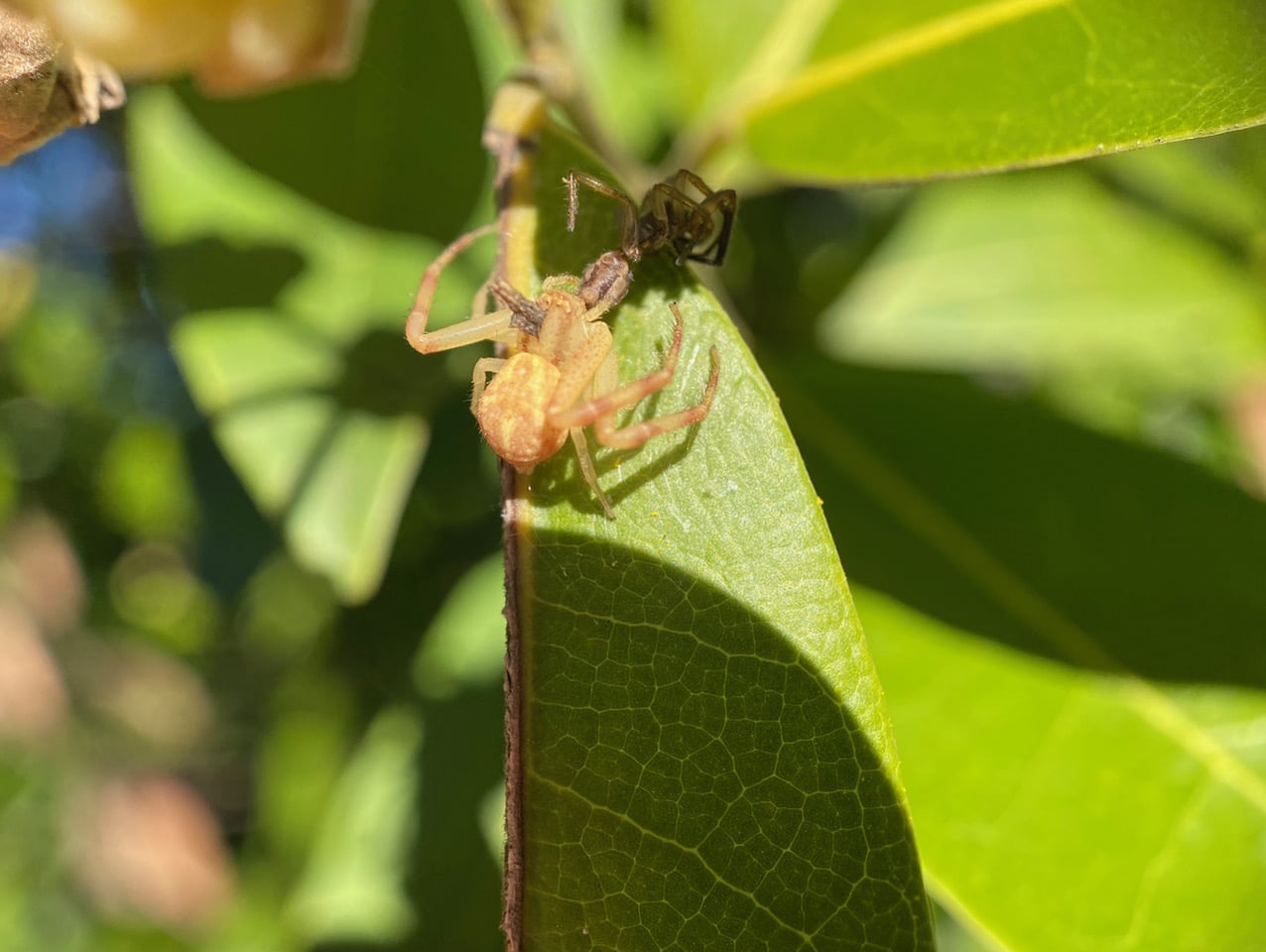
There appears to be spider action in the shadows under a cluster of Bay flowers. I tilt the leaf into the sun to get a better look. Wow, a female Crab Spider, Mecaphesa sp. (family Thomisidae) has captured another spider and is probably feeding on it from the abdomen. The crumpled prey is motionless, legs folded in contortion. What’s that thing on the Crab Spider’s cephalothorax? Has she been stabbed during the struggle, and a part of the prey’s body is still embedded in her?
I zoom in for a closer look. Wow, that’s a stab wound alright, but the embedded weapon is too big to be her prey’s body part. It’s amazing that she is able to hunt successfully despite her injury.
Members of the family Thomisidae do not spin webs, and are ambush predators. The two front legs are usually long and more robust than the rest of the legs. Their common name derives from their ability to move sideways or backwards like crabs. Most Crab Spiders sit on or beside flowers, where they grab visiting insects. Some species are able to change color over a period of some days, to match the flower on which they are sitting.
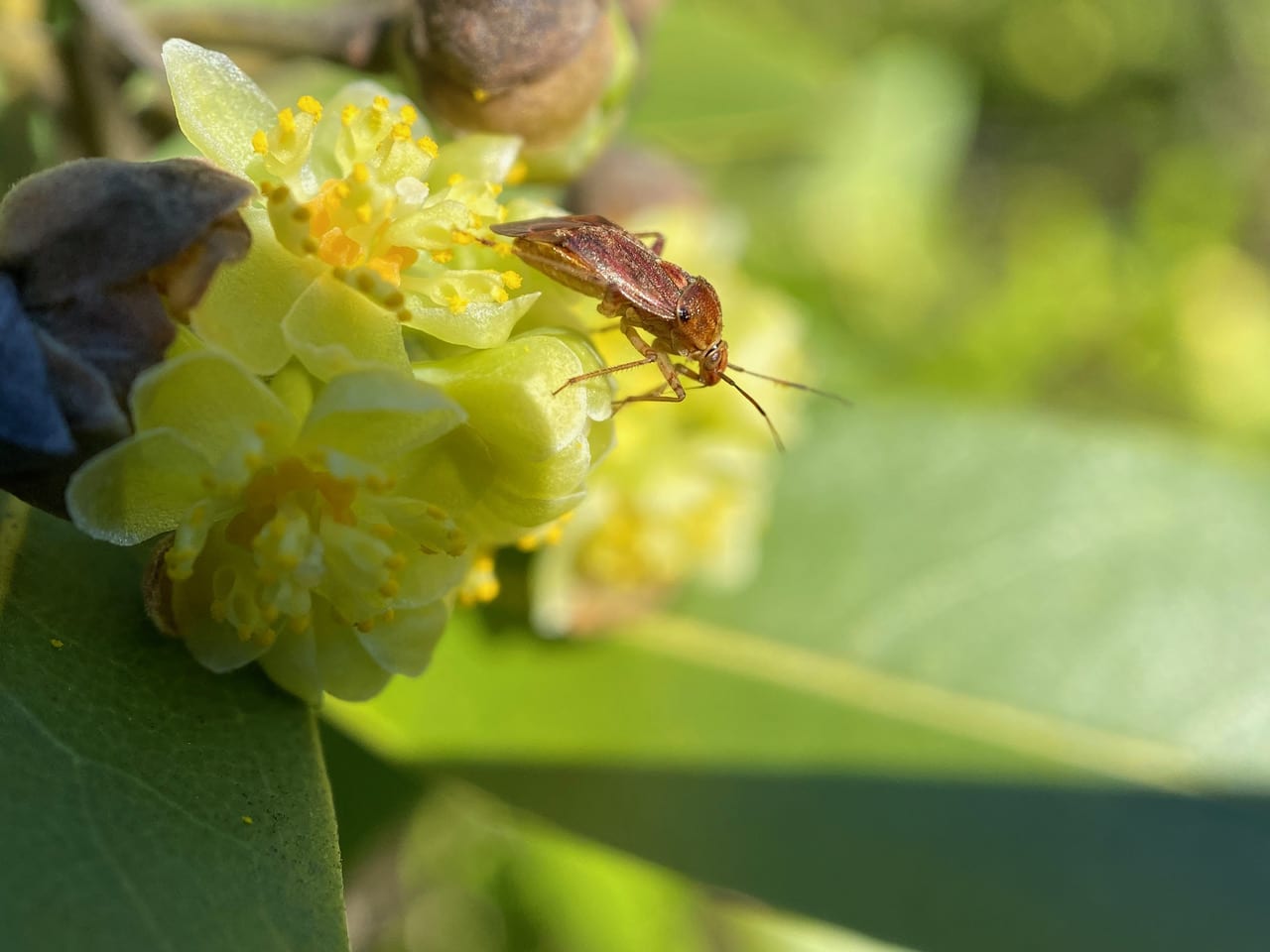
As the morning warms up, I have to take off my jacket – it’s approaching 70 degrees F, rather unusual for winter. Insects begin to appear on the Bay Trees. Its proboscis lowered, a chestnut-colored Plant Bug (family Miridae) is hunkered over a Bay flower, feeding.
Mirid bugs are also referred to as plant bugs or leaf bugs. Miridae is one of the largest family of true bugs in the order Hemiptera. Like other Hemipterans, Mirids have piercing, sucking mouthparts to extract plant sap. Some species are predatory. One useful feature in identifying members of the family is the presence of a cuneus; it is the triangular tip of the corium, the firm, horny part of the forewing, the hemielytron. The cuneus is visible in nearly all Miridae.

A tiny black wasp, most likely a parasitoid is busy exploring the surface of a bay leaf.
Parasitoid wasps are a large group of wasps that need to lay their eggs inside other insects to complete their lifecycle, eventually killing their hosts. Parasitoid-host relationships are usually very specific. Parasitoid wasps are tiny, with most species being smaller than a millimeter. Adults are commonly seen feeding on or near plants as they look for a host in which to lay their eggs. Parasitoid wasps are useful in controlling insect pests.
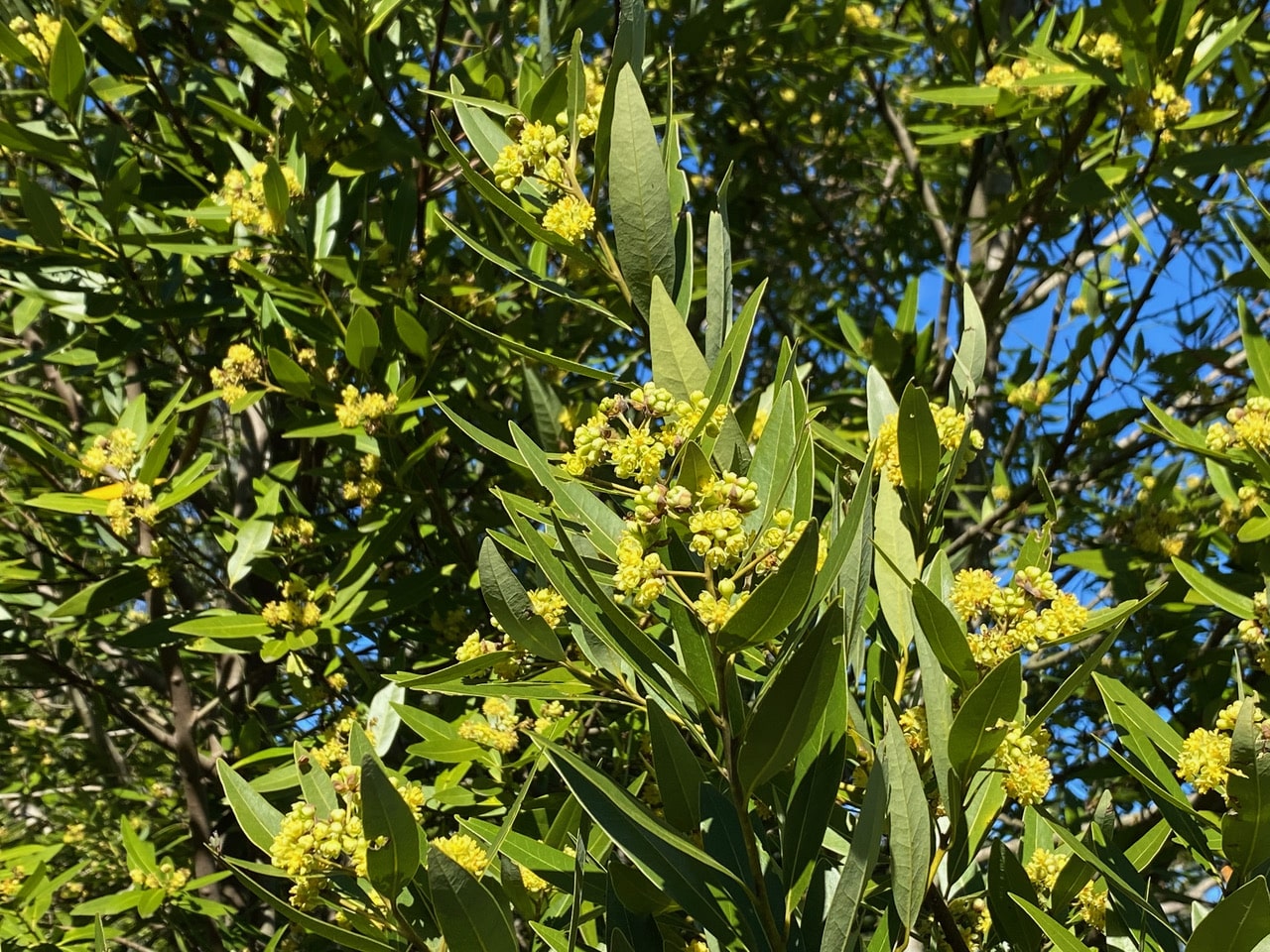
This Bay tree is in peak bloom. A large bee, the size and shape of a bumble bee circles the tree tirelessly, buzzing loudly as if trying to scare me off. It is gray/brown in color, probably a Digger Bee, Anthophora sp. (family Apidae). It never landed, so I don’t know if it forages on the bay flowers. The only other plant I see in bloom along this stretch of the trail is a big, bushy Gooseberry shrub. There I see two of these robust bees buzzing around the shrub, but never landed. Competition must be fierce for these early blooms. Good to know that the bees are out and about. I wonder if they find enough food this early in the season with so few flowers.
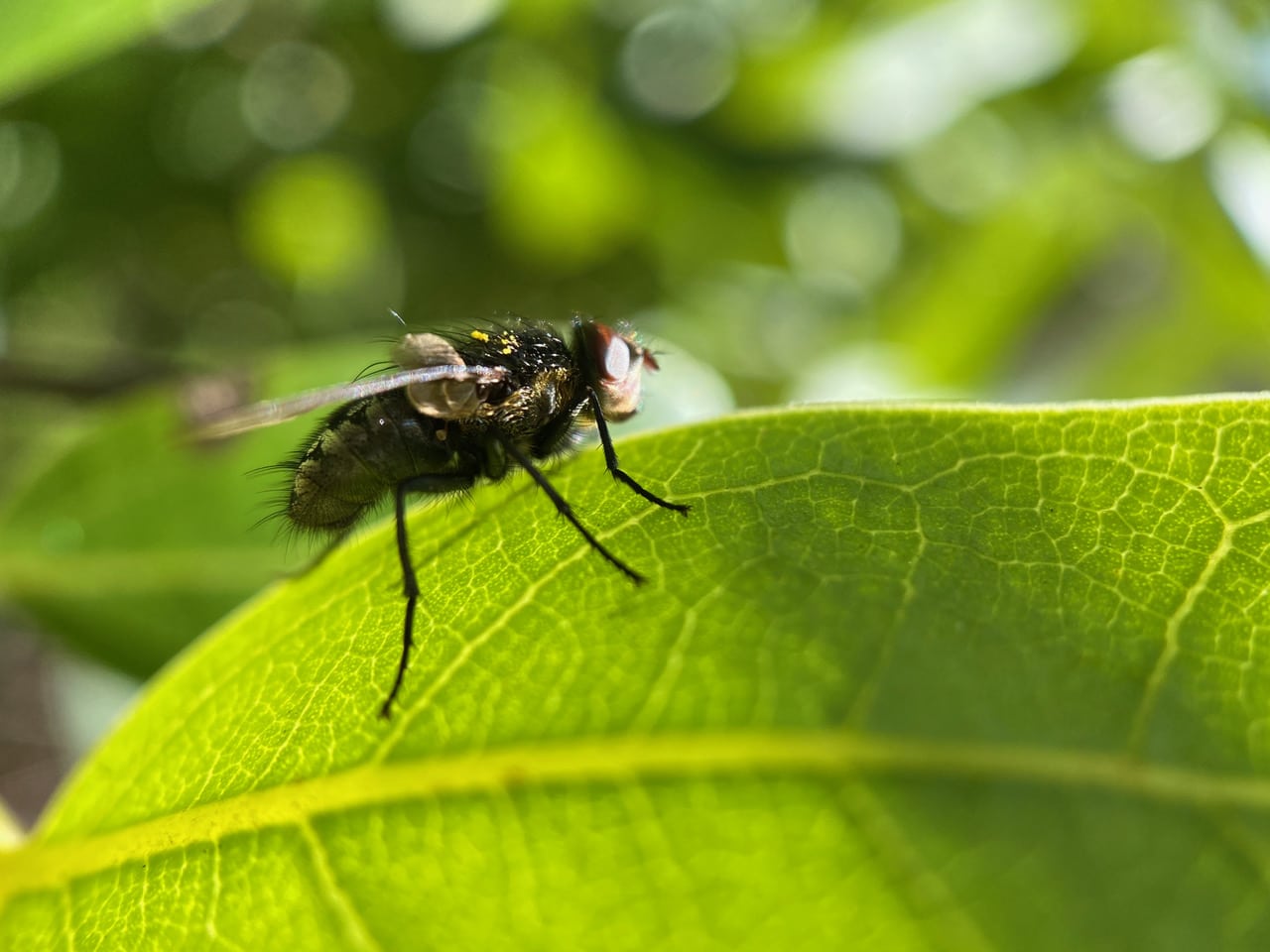
An unidentified fly lands on a bay leaf, some yellow pollen stuck to its thoracic hairs. It must have been visiting the bay flowers. A potential pollinator?
These bay flowers are fully open, loaded with pollen. Someone must’ve been rummaging in the flowers, spilling pollen onto the leaves.
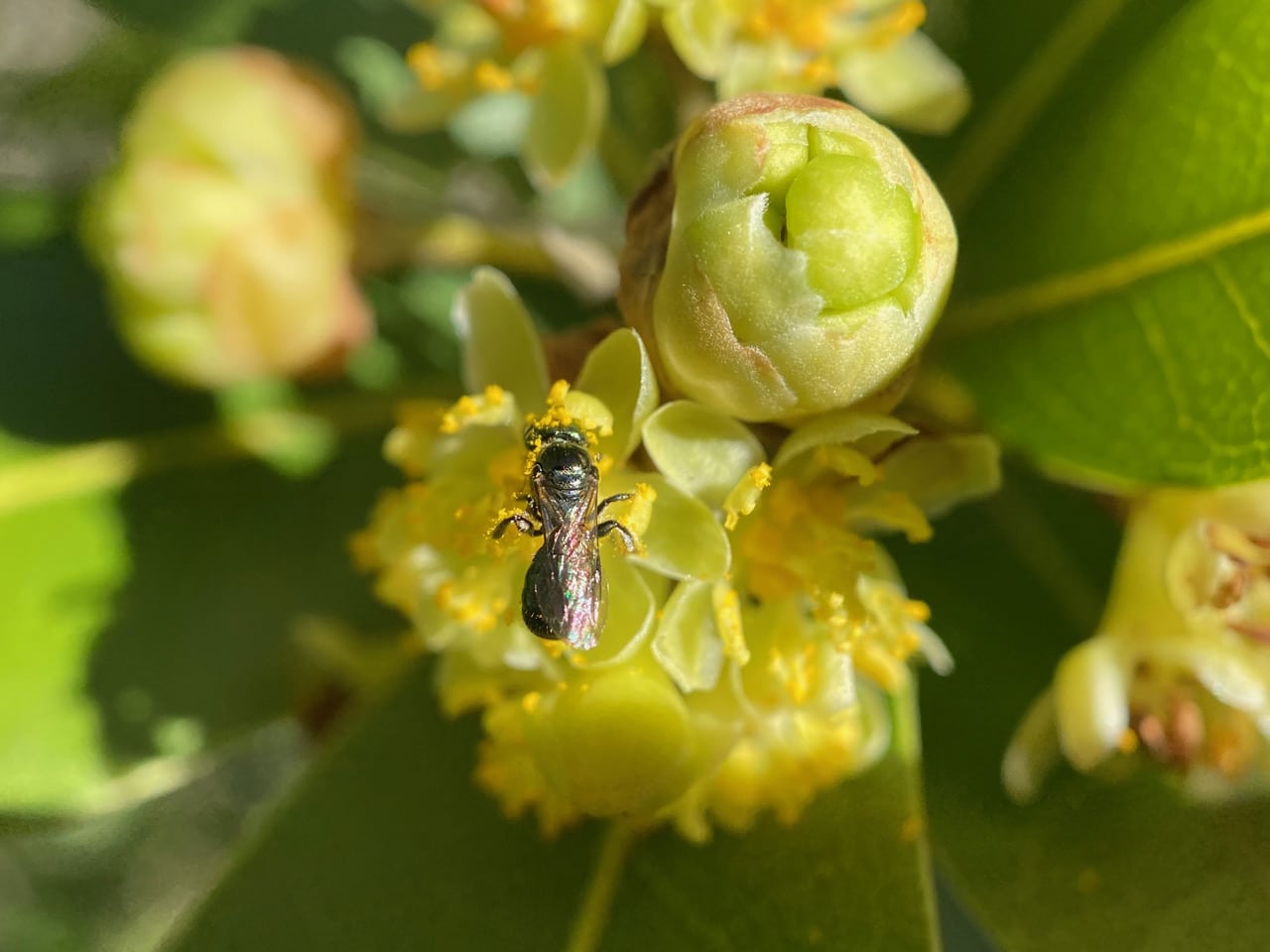
A shiny black bee is going from one cluster to the next focused on foraging. Her head and legs are well coated with the sticky pollen. I am almost sure that it is a Small Carpenter Bee, Ceratina sp. (family Apidae). This is the earliest I have seen these bees in flight. They are commonly found in spring foraging on the Sticky Cinquefoil along the trail. These plants haven’t even made an appearance yet. Watching the bee’s activity on the bay flowers, I have no doubt that it can effectively pollinate the flowers. Yay! But are there sufficient number of them to do the job for this many bay trees ? I have noticed that the fruit set on these trees along the trail is quite minimal.
The Small Carpenter Bee genus Ceratina is closely related to the more familiar, and much larger Carpenter Bees (genus Xylocopa). Ceratina are typically dark, shiny, even metallic bees, with fairly sparse body hairs and a weak scopa on the hind leg. The shield-shaped abdomen comes to a point at the tip. Some species have yellow markings, often on the face.
Females excavate nests with their mandibles in the pith of broken or burned plant twigs and stems. While many species are solitary, a number are subsocial. Both male and female carpenter bees overwinter as adults within their old nest tunnels, emerging in the spring to mate. In the spring, this resting place (hibernaculum) is modified into a brood nest by further excavation. The female collects pollen and nectar, places this mixture (called bee bread) inside the cavity, lays an egg on the provision, and then caps off the cell with chewed plant material. Several cells are constructed end to end in each plant stem.

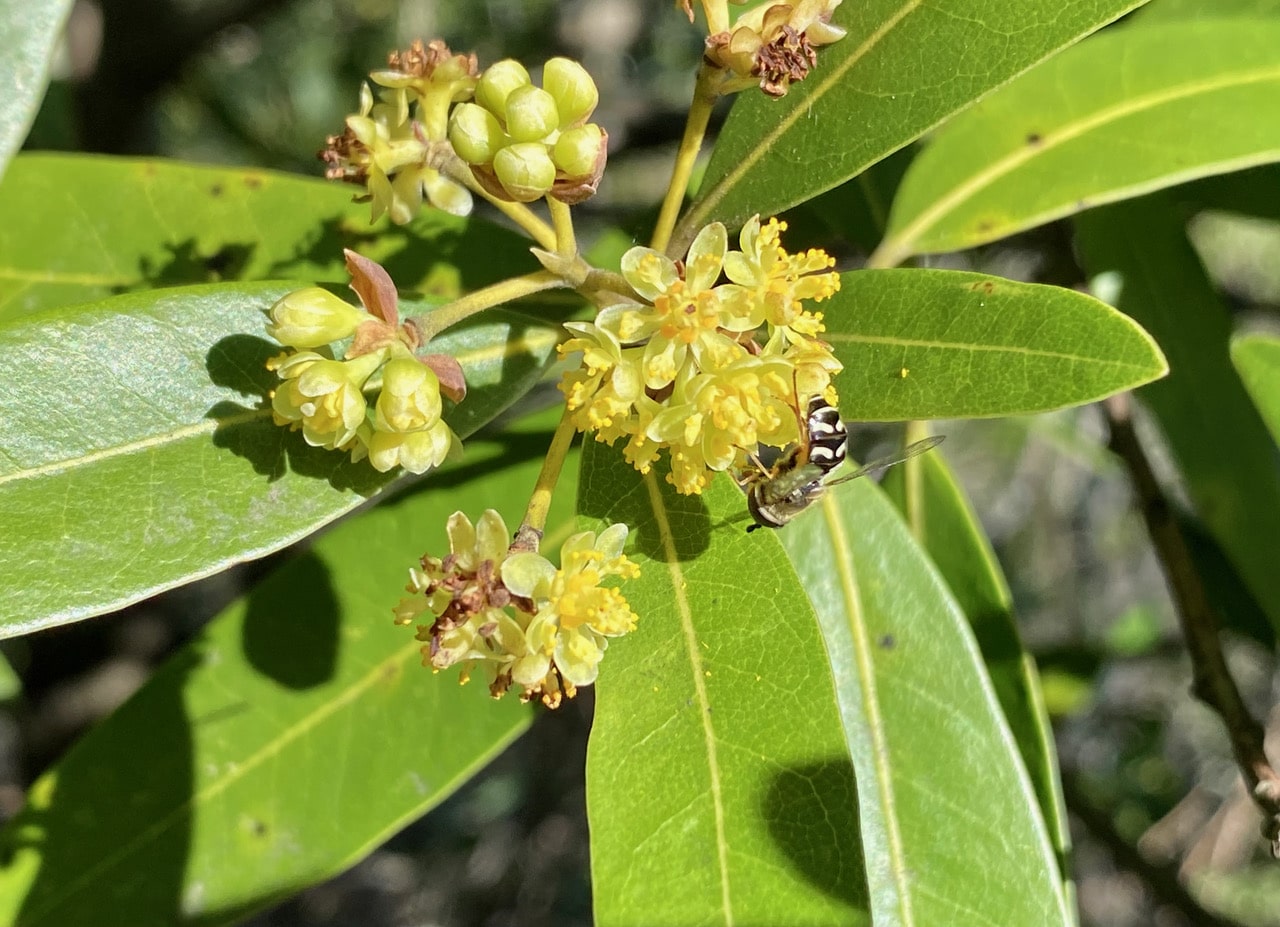
Hey, a hover fly is visiting a cluster of bay flowers! Judging by the curved white markings on its abdomen, it is probably a White-bowed Clearwing, Scaeva affinis, or a Large-tailed Aphideater, Eupeodes volucris (family Syrphidae).
Hover Flies, also called flower flies or Syrphidae flies, make up the insect family Syrphidae. The adults of many species feed mainly on nectar and pollen, and are often seen hovering and nectaring at flowers. They are important pollinators of flowering plants in many ecosystems worldwide, second only to bees. The larvae feed on a wide range of foods. In many species, the larvae are insectivores and prey on aphids, thrips, and other plant-sucking insects. In other species, the larvae are saprotrophs, eating decaying plant and animal matter in the soil or in ponds and streams. Many species of Hover Flies exhibit Batesian mimicry; they are brightly colored, with bands of yellow resembling the bees and wasps. The mimicry provides the fly with some measure of protection from potential predators, although the flies are harmless and lack a sting.
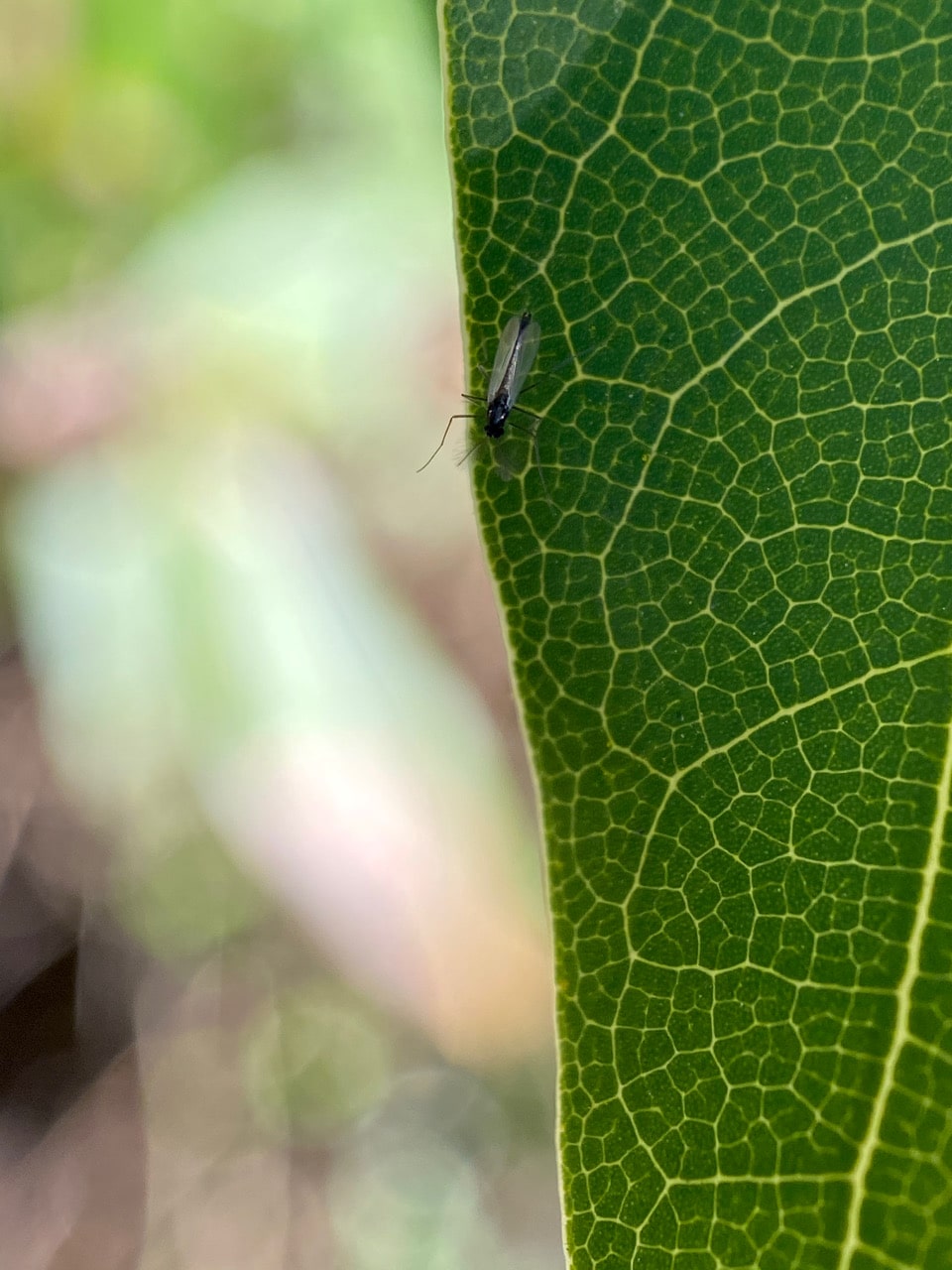
Loose swarms of tiny insects are dancing in the air over the bay trees. I wait patiently for one to land for this picture. If you squint hard enough, you might see hints of plumose antennae on its head. That’s characteristic of a male Non-biting Midge in the family Chironomidae.
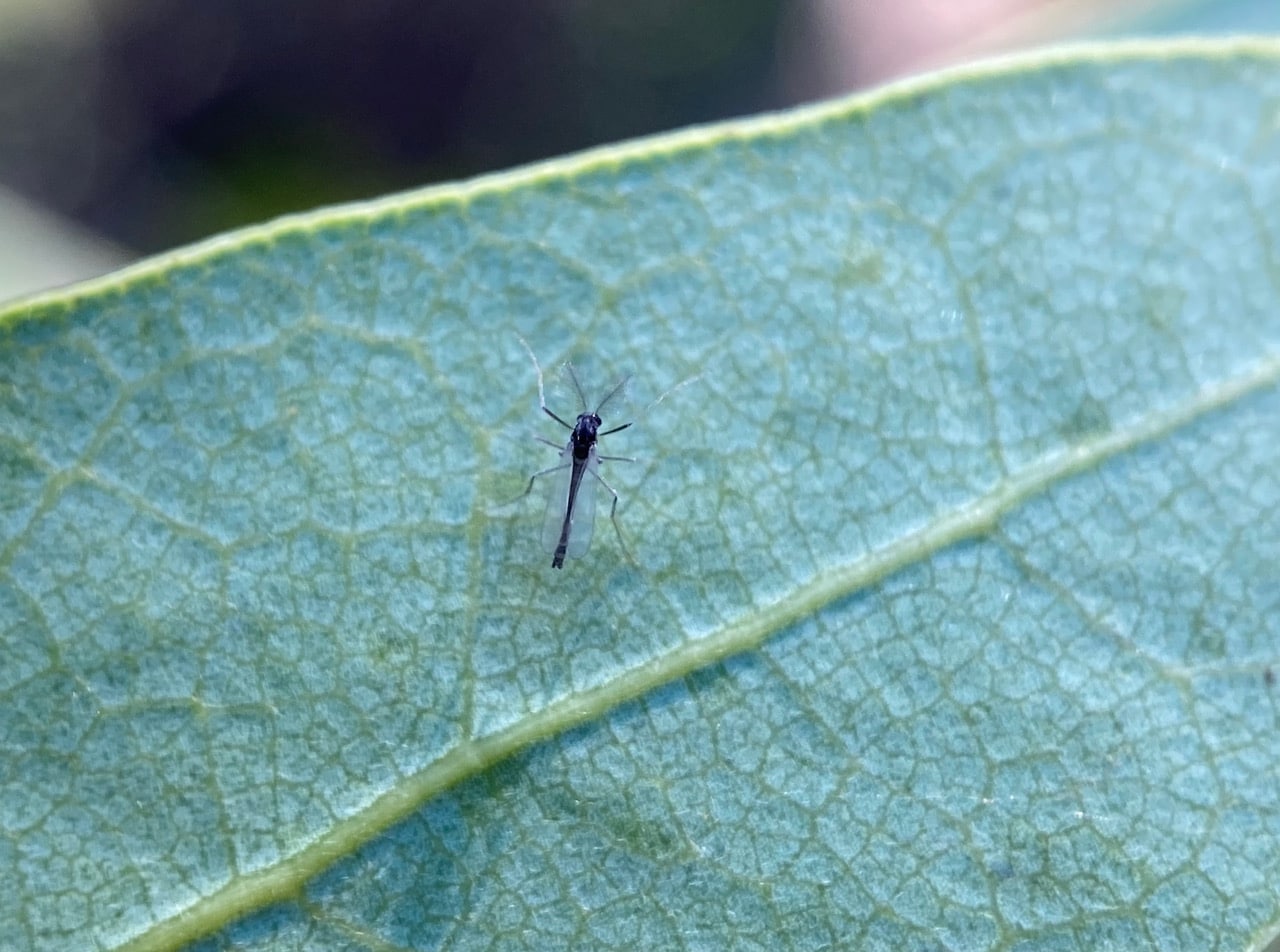
Another midge lands on the back of a bay leaf. Its plumose antennae are more visible here.
The Chironomidae is a large and diverse family of flies, with over 20,000 species known world-wide. Adult midges are small, most measuring 1-10 mm long, with narrow bodies and long legs. They resemble mosquitos, but do not bite. Males have long, feathery (plumose) antennae. Adults are short-lived. They feed on fly droppings, nectar, pollen, honeydew, and various sugar-rich materials. Larvae are mostly aquatic or semi-aquatic; most occur in freshwater habitats, a few occur in decaying matter, under bark, in moist ground, or tree holes. Larvae are mostly scavengers/detritivores. Collectively, they play a vital role in freshwater ecosystems as primary consumers. They harvest an enormous amount of energy from detritus and are important food items for fish, amphibians, birds, and predatory insects such as dragonflies and dance flies. Adult Chironomids can be pests when they emerge in large numbers, forming mating swarms over water or road surfaces.

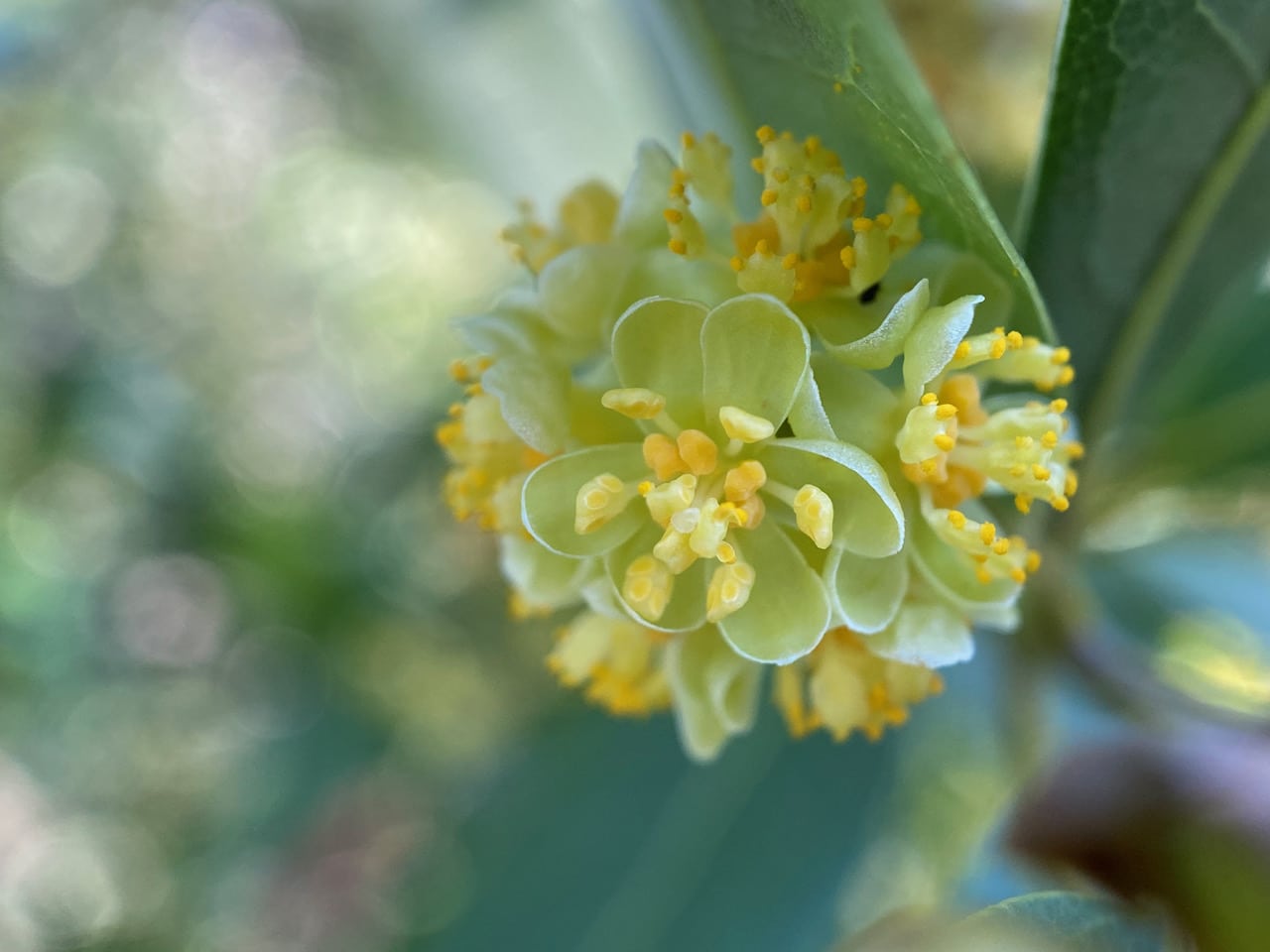
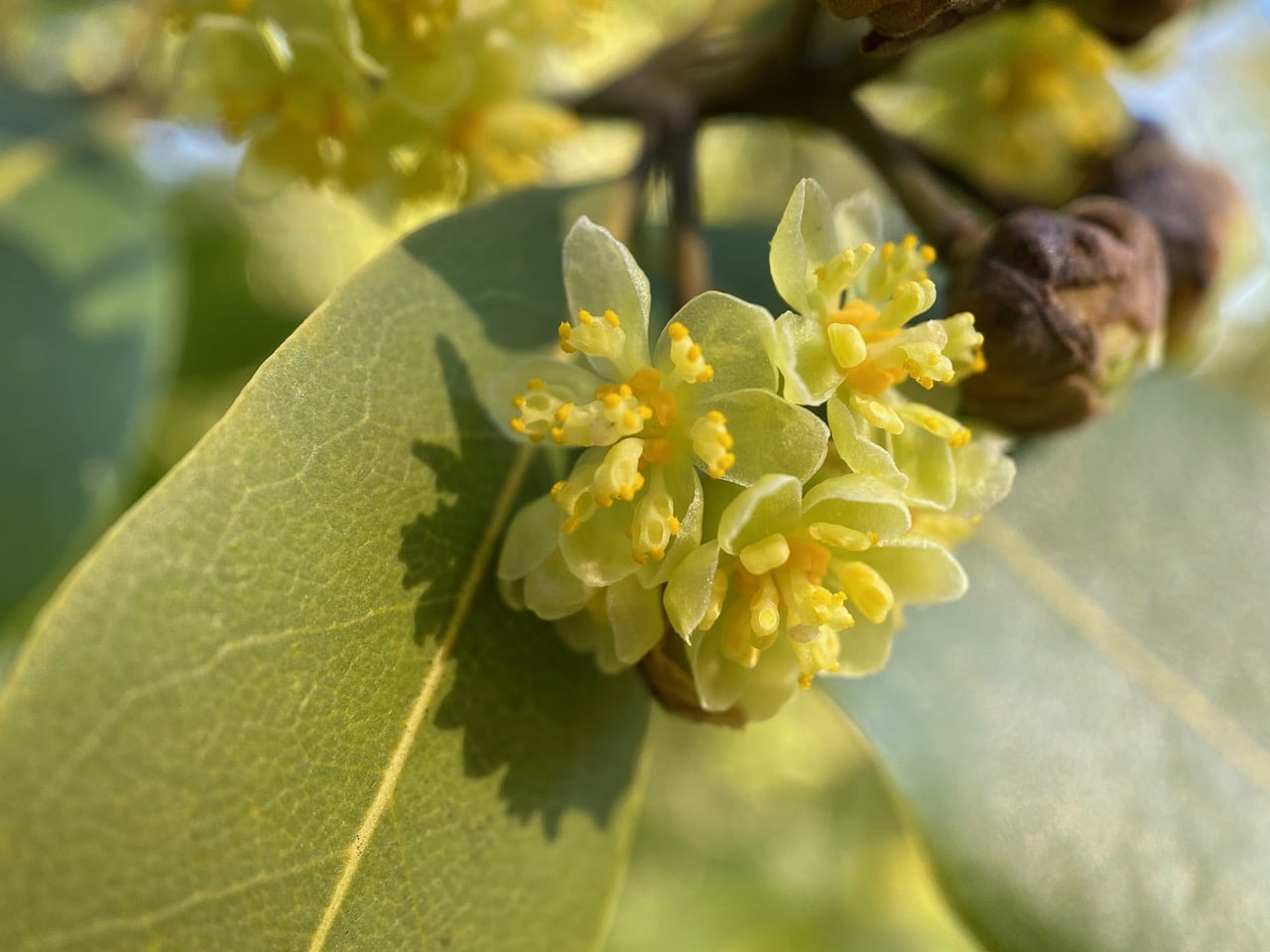
The California Bay Laurel, Umbellularia californica belongs to the family Lauraceae, the same family as avocados. The small yellowish-green flowers are in clusters of 6-10, without petals and with 6 oblong-ovate sepals. There are 9 stamens, 6 in an outer row, and 3 in an inner row with 2 stalked orange glands at their base. Each of the paw-like stamens carries 4 anther sacs. At maturity, clumps of yellow pollen “pop” out of the anther sacs, sticking up like claws on top of the anthers. A sturdy white pistil sits in the center of the flower, the stigma at about the same height as the anthers.
This photo shows mature flowers of California Bay Laurel in which the pollen has popped out of the sockets of the anthers.
Pollination of the related avocado is rather complicated. The flowers open first as females, then open again as males. In Central America the avocado is pollinated by social bees (Meliponinae) and wasps (Vespidae). In other regions of the world, honey bees, Apis mellifera are the main pollinators. In parts of Australia, large numbers of hover flies visit avocado flowers.
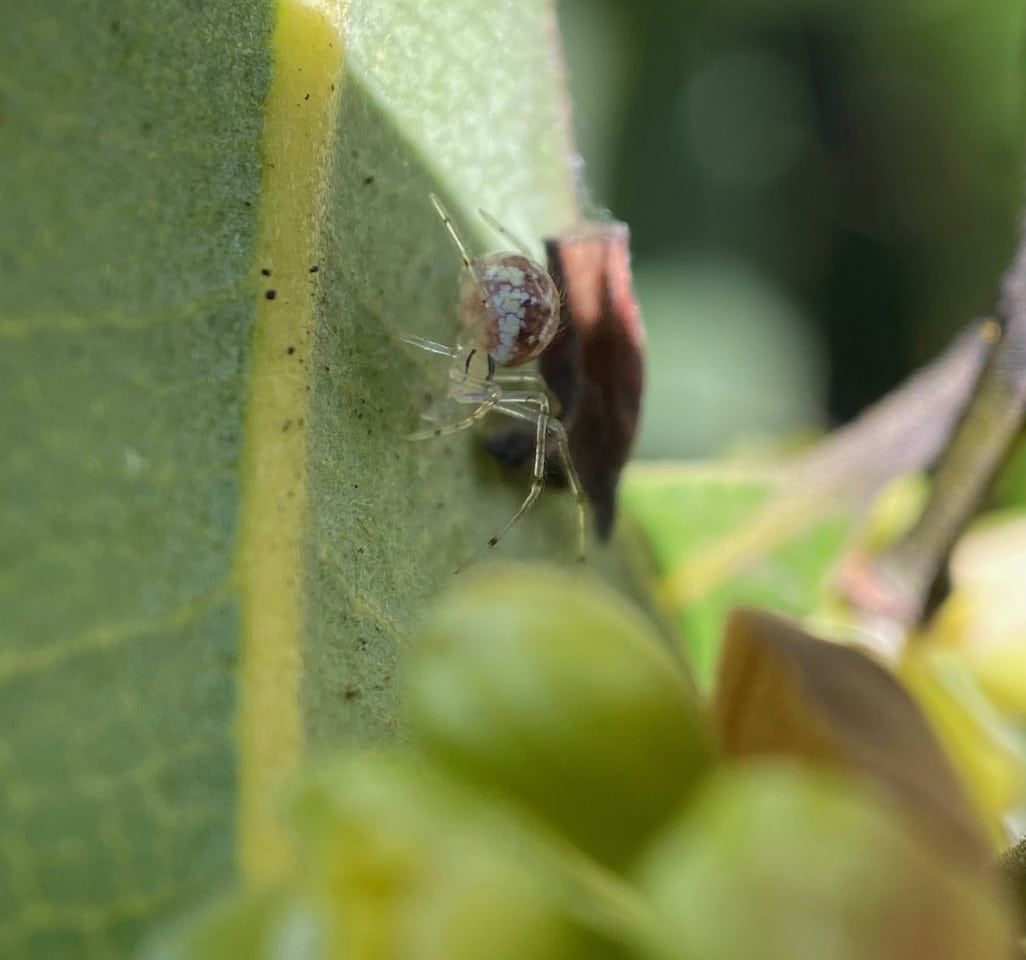
A Cobweb Spider, Theridion sp. (family Theridiidae) is skulking behind a bay leaf.
I tilt the leaf for better light on the spider. What a beauty!
Cobweb Spiders (family Theridiidae) spin sticky capture silk, and they have a comb of serrated bristles (setae) on the tarsus of the fourth leg. They often build tangle space (3-D) webs, hence their other common name of Tangle-web Spiders. Theridiidae has a large diversity of spider web forms.
Wow, it’s a 5-spider morning, all found on the bay trees! Not surprising, as all insect action is concentrated on the bay flowers now.