

Pollinator Post 1/28/26 (2)
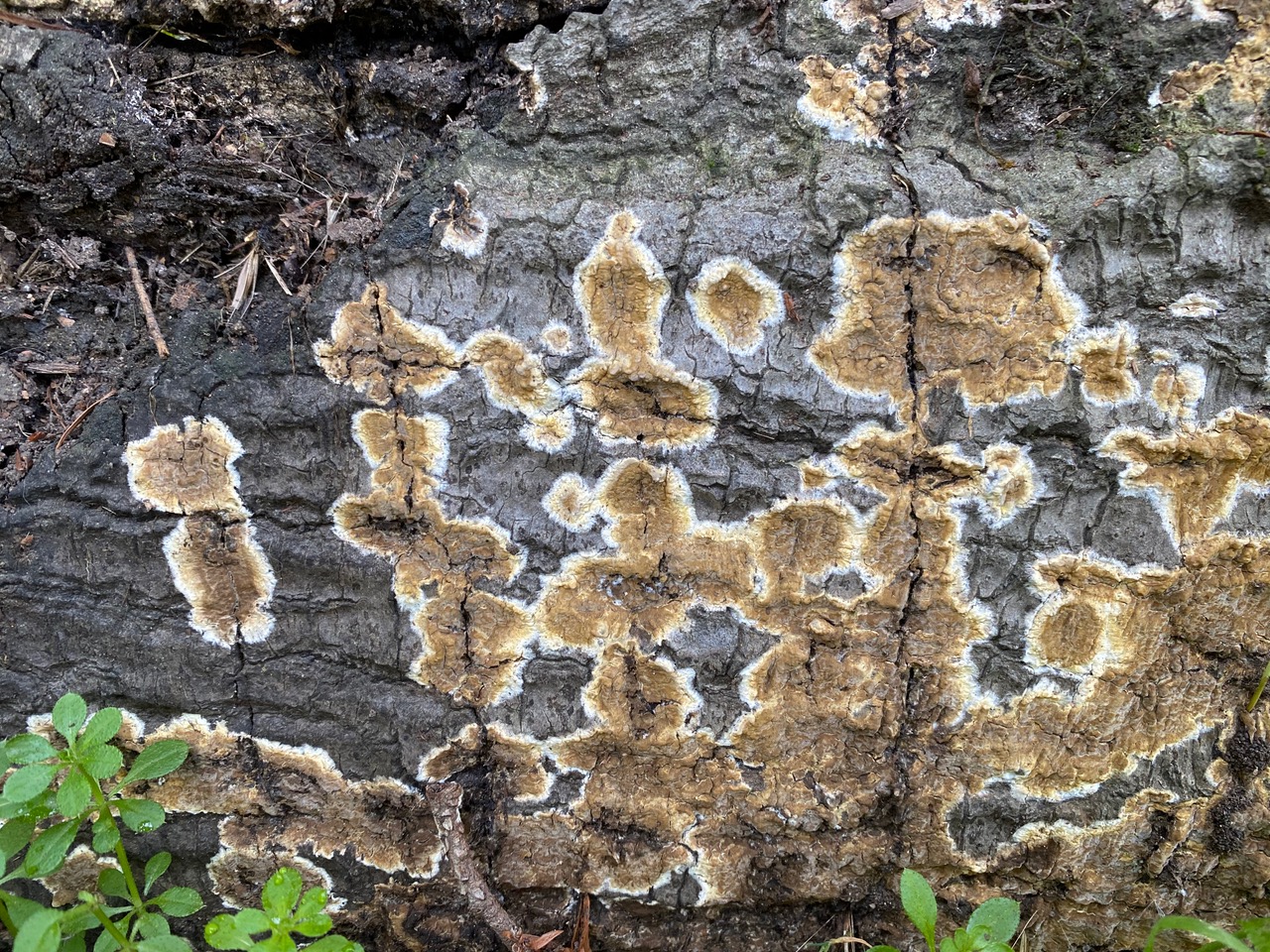
Interesting patches of a fungus has plastered a log appearing like abstract art. iNaturalist has helped identify it as Wet Rot, Coniophora puteana (division Basidiomycota).
There are two major categories of wood decay fungi – white rot and brown rot differing in which wood component they consume. White rot fungi break down lignin (bleaching wood white/pale, leaving spongy cellulose), while brown rot fungi consume cellulose cellulose (leaving brittle, crumbly, reddish-brown lignin, often cracking into cubes). Brown rot primarily affects conifers and causes significant structural damage by removing flexibility, whereas whit rot often targets hardwoods and leaves a stringy, spongy texture.
Coniophora puteana causes an atypical brown-rot in both hardwood and conifer wood, including building timbers, boats, and other substrates. The fungus possesses two types of hyphae – one type can completely degrade the entire cell wall, and the other can only modify the lignin within its substrate. The fruit bodies start as small patches that can develop into rather extensive membranous to somewhat fleshy flat continuous masses that are attached lightly to the substrate. The surface is smooth to irregularly warty, at first cream-colored then ochraceous, olivaceous, or dark brown, with a whitish edge. The high humidity requirement for growth makes C. puteana grow predominantly near water leaks or areas with high humidity or high precipitation. The species has a very widespread distribution being found on most continents including North America.

Near the restrooms, a large Coast Live Oak, Quercus agrifolia is blooming gloriously, its pollen-laden male catkins dangling from the branches.
Oak trees are monoecious, meaning a single tree produces both male and female flowers. In the spring, they produce long, yellow-green male catkins that release pollen, while tiny, inconspicuous female flowers (which turn into acorns) appear on the same tree, usually located in the leaf axils. While self-compatible, oaks are mostly wind-pollinated, relying on significant pollen production to ensure fertilization. To avoid self-fertilization, male and female flowers often mature at different times, requiring pollen from other tress in the area.

Near the swimming pool, the De La Mina Verbena, Glandularia lilacina is in bloom, offering pom-poms of clustered purple flowers filled with nectar and pollen. A Monarch butterfly settles on one of the inflorescence to take nectar.
De La Mina Verbena is a typical butterfly-pollinated flower. The small, tubular flowers are tightly clustered, providing landing platforms for butterflies. Once it has found a good perch, the butterfly can insert its long, flexiblle proboscis into many flowers, one at a time, without having to move around much. The small opening of the flower requires precision insertion of a long proboscis to access the nectar at the base of the tubular flower. Verbena flowers are typically pollinated by butterflies and long-tongued bees (such as Digger Bees, Anthophora ).
Is it normal to see active Monarch butterflies in winter?
Monarch butterflies, Danaus plexippus (family Nymphalidae) are an iconic and well-loved insect for their cheery beauty and their extraordinary annual migration. The western population of Monarchs overwinter in large, conspicuous aggregations in the tall trees along the coast of California. Less commonly known is the fact that there are currently non-migratory or resident populations of these western Monarchs present in coastal California. Over the last few years, resident populations are found in rising numbers in areas with mild winters and year-round milkweed growth, such as southern California and the Bay Area. It is believed that the resident populations use non-native milkweed species planted by misguided home gardeners wishing to help the butterflies. Unlike the native milkweeds, these milkweeds do not die back in winter. Not only do the non-native milkweeds encourage the butterflies to stay around and breed year-round, they also harbor a virulent pathogen of the butterfly. It is not completely clear whether the migratory and the resident populations are genetically distinct, or whether there is significant exchange between them that might jeopardize the migratory instincts of the species in the long run. This is a conundrum that the Xerces Society is having to deal with.
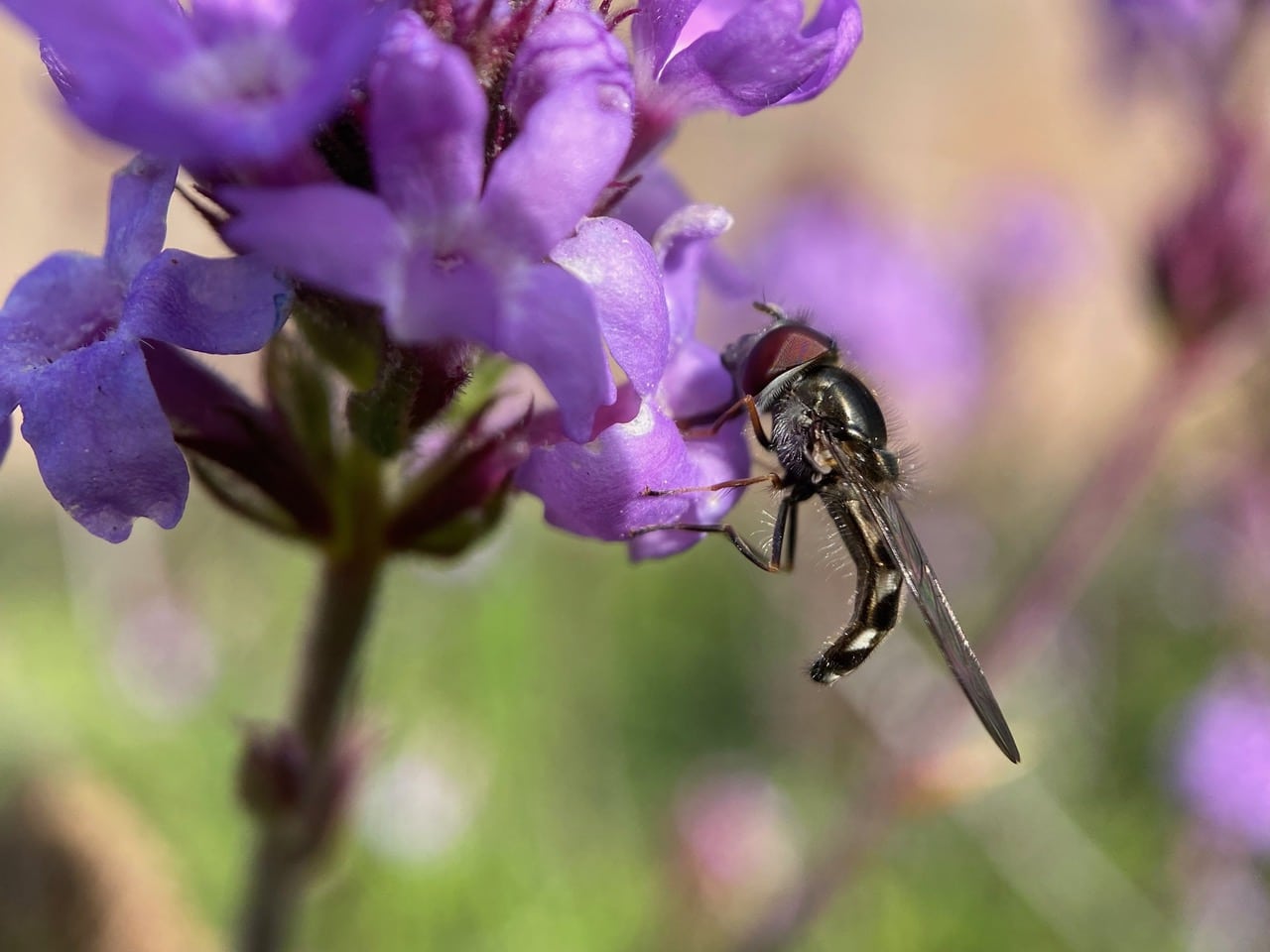
A Western Forest Sedgesitter, Platycheirus trichopus (family Syrphidae) is probing a Verbena flower with its proboscis. The hover fly is taking a long time – is it able to reach the nectar at the base of the flower? Maybe it is only feeding on the pollen near the opening of the floral tube?
The Sedgesitter, Platycheirus sp. (family Syrphidae) is found in grass and herb vegetation. Adults of many species feed on pollen of wind-pollinated plants, such as Salix, Plantago, Poaceae, Cyperaceae, but they also visit other flowers. Many stay active during cold and rainy weather. Larvae feed on aphids.
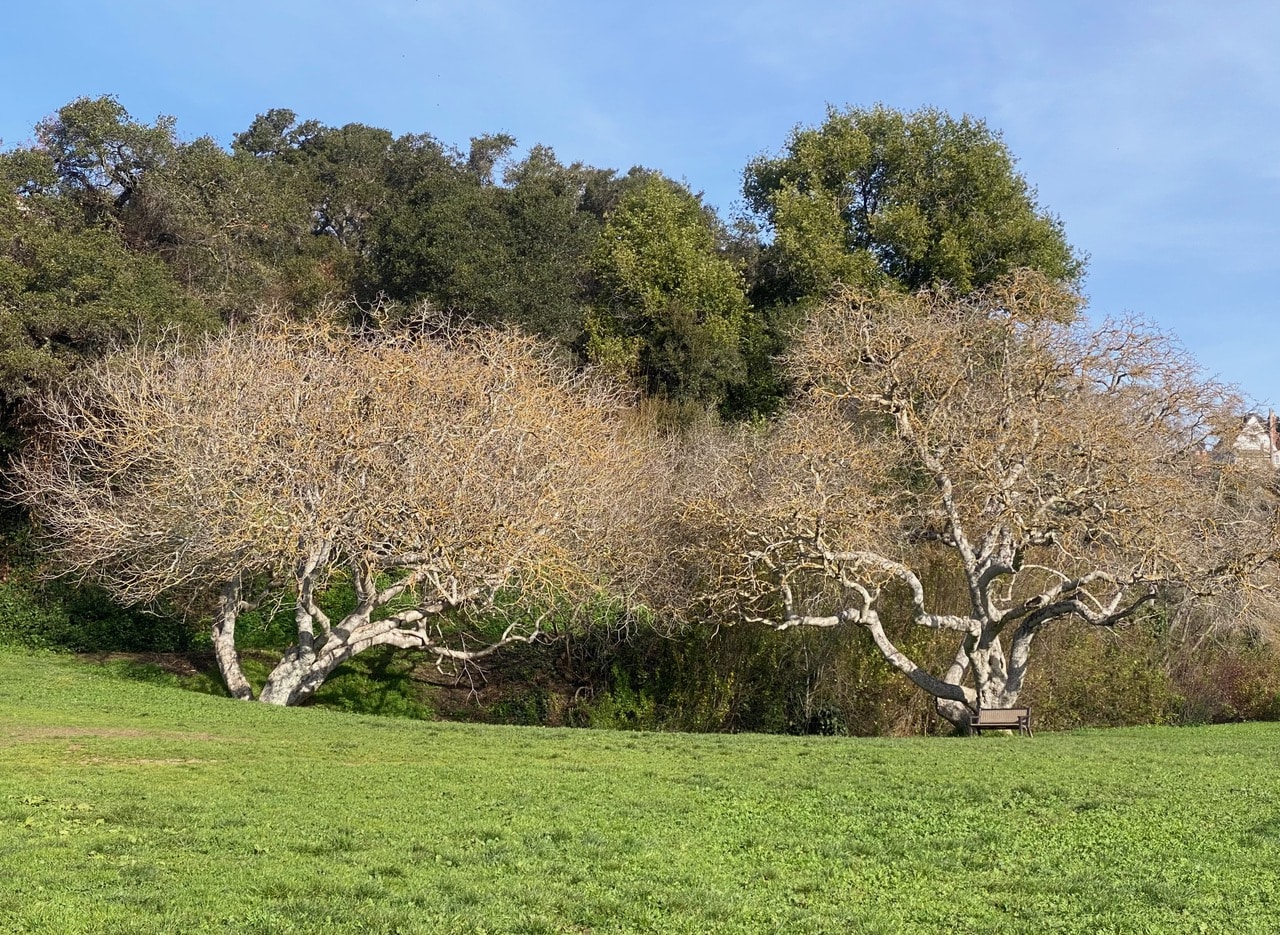
Leafless in their dormancy, the two magnificent California Buckeye, Aesculus californica near the creek are aglow in gold.

As I get closer, I can see where the vibrant color is coming from – yellow-orange lichens growing on the bare branches.

iNaturalist has helped identify the lichen as the Common Sunburst Lichen, Xanthoria parietina (family Teloschistaceae).
Lichens are unique, composite organisms formed from a symbiotic partnership between a fungus and an alga (or cyanobacteria). The fungus provides structure and absorbs water-nutrients, while the photosynthetic partner (alga/cyanobacteria) creates food, allowing lichens to thrive in harsh environments like rocks, trees, and even extreme climates where neither component could survive alone. They appear in diverse forms (crusty, leafy, shrubby) and colors, acting as important bioindicators for air quality and biodiversity.
Sunburst Lichens can be very common on sunny rocks and tree barks. They are typically yellow orange, with a circular, foliose (leafy) growth pattern with tiny, branching lobes. The foliose rosette pattern can be difficult to see when these lichens coalesce into large masses. When members of this genus have apothecia (disk-shaped spore-bearing structures), the disks have rims that are the same color as the rest of the lichen. The lichen is not hurting the tree, merely taking advantage of the surface for support. It is especially advantageous for the lichen to be growing on a deciduous tree, as it gets plenty of sunshine even in the winter when the tree is leafless. Xanthoria lichens contain a green algae photobiont from the genus Trebouxia. These algae live within the fungus’s tissue, providing photosynthetic energy in exchange for protection from high light and UV radiation, which is facilitated by the orange pigment parietin. Xanthoria lichens, particularly Xanthoria parietina (maritime sunburst lichen), are used to create natural, vibrant dyes ranging from bright yellow and orange to pink, purple and blue. The primary pigment responsible is parietin.
Xanthoria parietina is used as a bioindicator for monitoring air quality due to its capacity to accumulate environmental contaminants. More recently, it has become a subject of astrobiology research, where it survives Mars-Like environments, space vacuum, cosmic radiation, and extreme cold.