

Pollinator Post 1/28/25
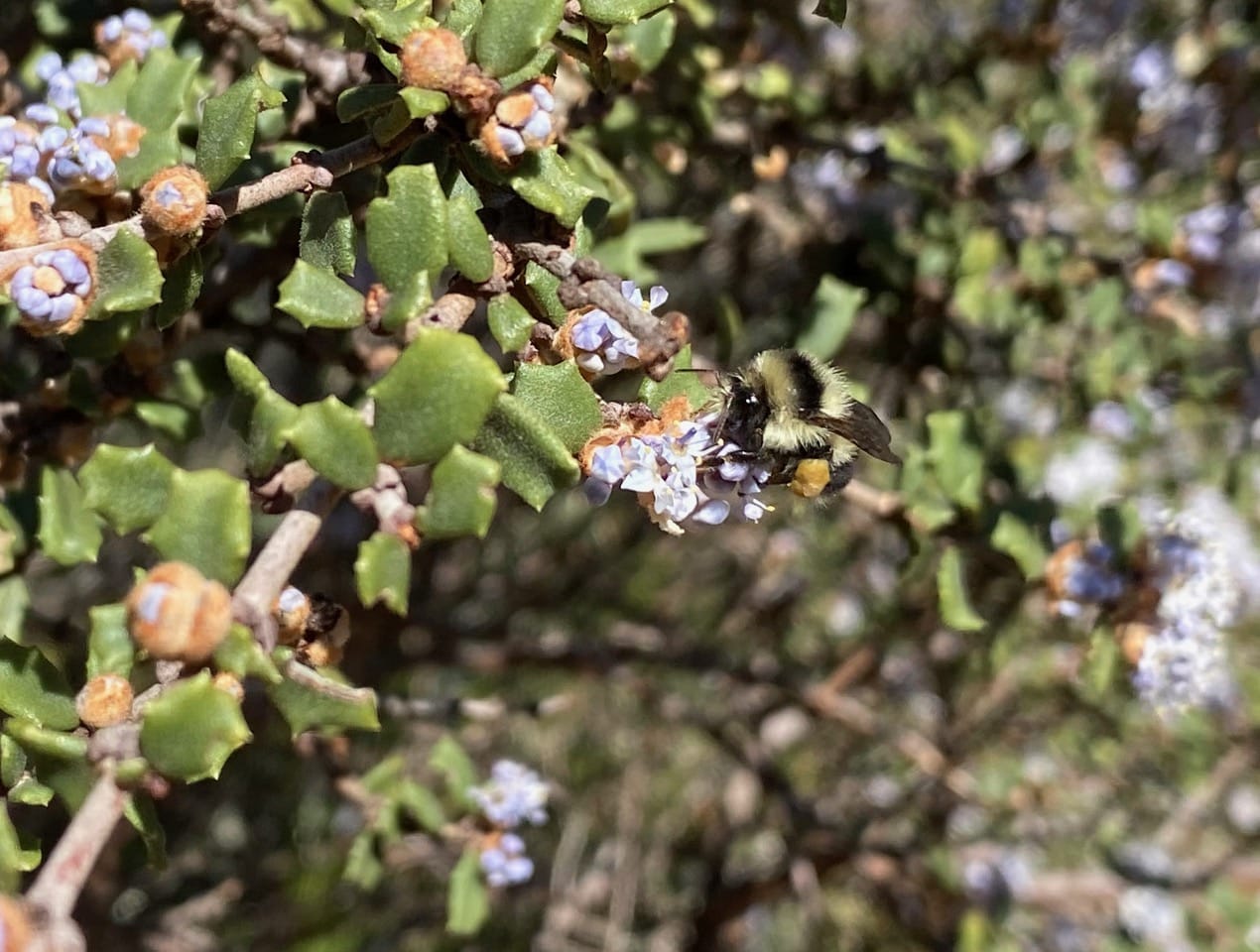
A worker Black-tailed Bumble Bee, Bombus melanopygus (family Apidae) is foraging on the flowers of Otay Mountain Ceanothus, Ceanothus otayensis near the front gate of the Regional Parks Botanic Gardens. The species is the first of our bumble bees to appear in the year, and has made quick progress, with more workers than queens in the field now.
Bumble bees are social and live in colonial hives. Many of the large individuals seen early in the season are queens. They are the only members of their colony to survive the winter, hibernating until the days begin to warm and their host plants are in bloom. These queens have mated before they went into hibernation. Now their first order of business is to each find a nesting site (usually an abandoned rodent burrow), lay eggs, brood and nurture the first batch of workers. There after, the queens stay behind in the hive to concentrate on laying eggs while the workers take on hive duties and foraging.
Bombus melanopygus is a species of bumble bee native to western North America, widely distributed from the Pacific to the Rocky Mountains, and from Alaska to Baja California. The species is found in various habitats, including agricultural and urban areas. The bees feed on many types of plants, including manzanitas, Ceanothus, golden bushes, wild buckwheats, lupines, penstemons, rhododendrons, willows, sages, and clovers. They nest underground or aboveground in structures.
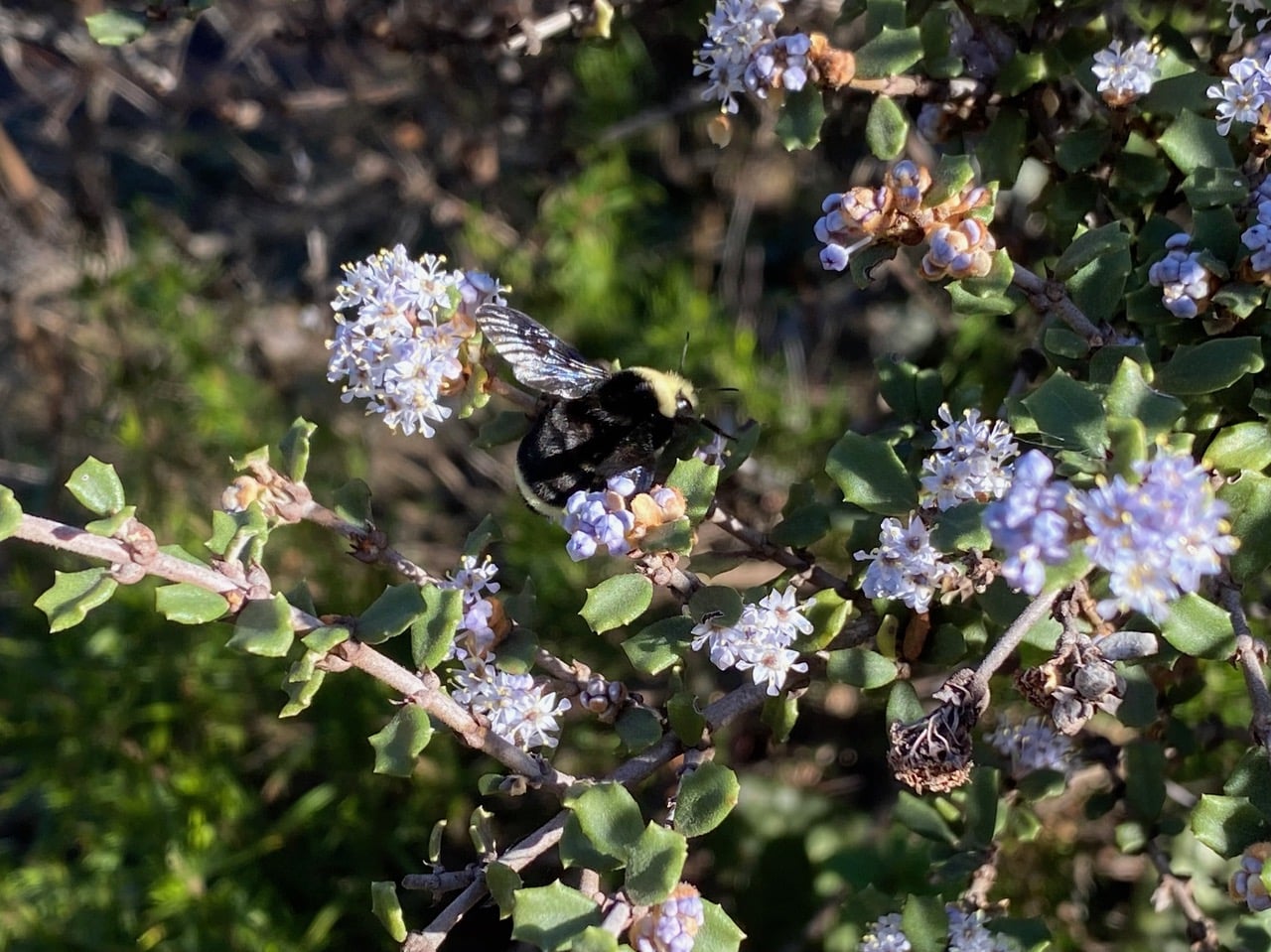
A large queen Yellow-faced Bumble Bee, subgenus Pyrobombus (family Apidae) is out foraging on the Ceanothus flowers.
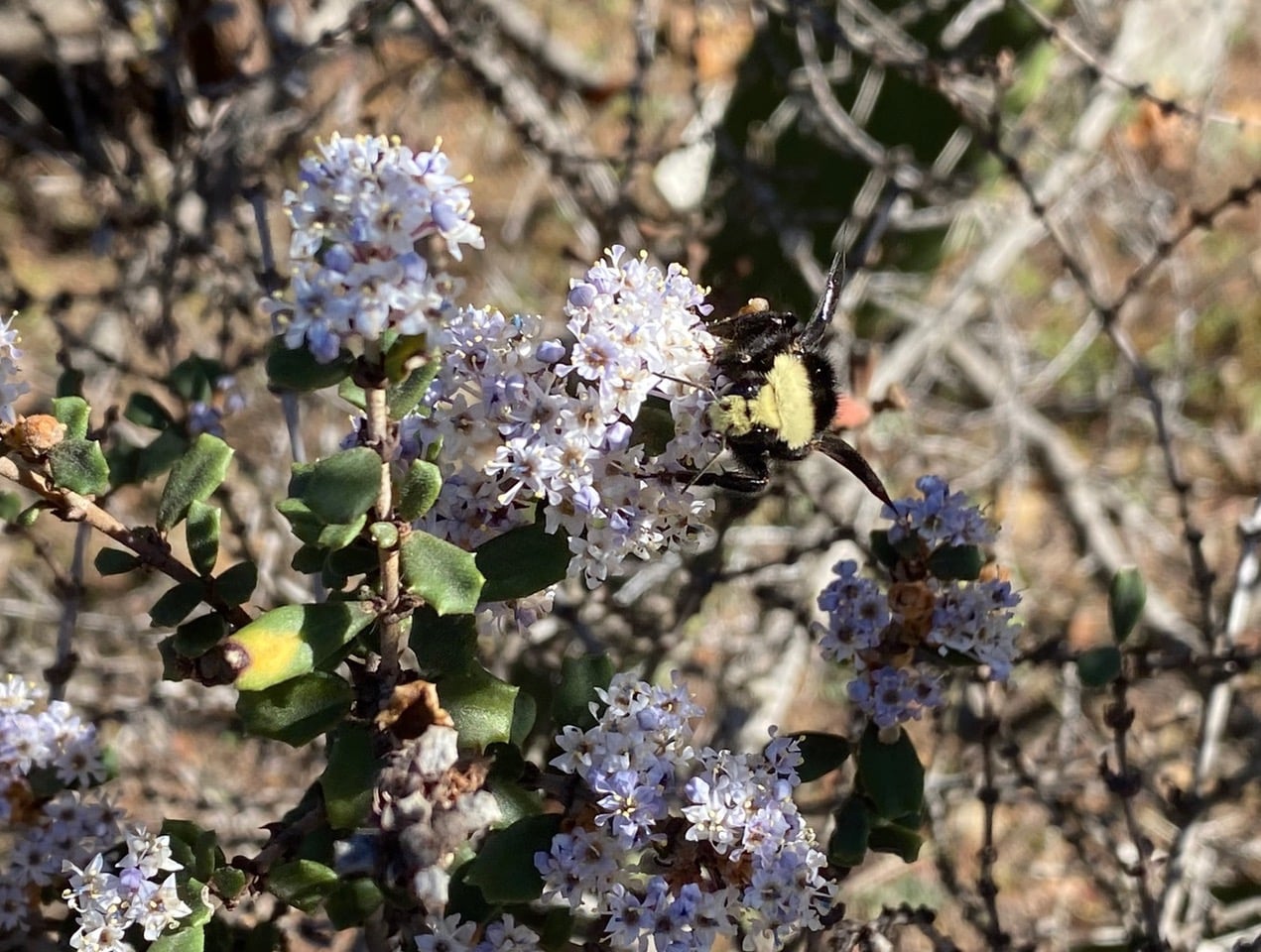
Queens are noticeably larger than worker bees, which is one of the easiest ways to distinguish them. Queen bees are fed a more substantial diet during their larval development, contributing to their larger size. The queen’s large size is crucial for her to store enough nutrients to lay a large number of eggs throughout the colony’s lifespan. In the bumble bees, workers do not feed or groom the queen, as is the case in some other social lineages.
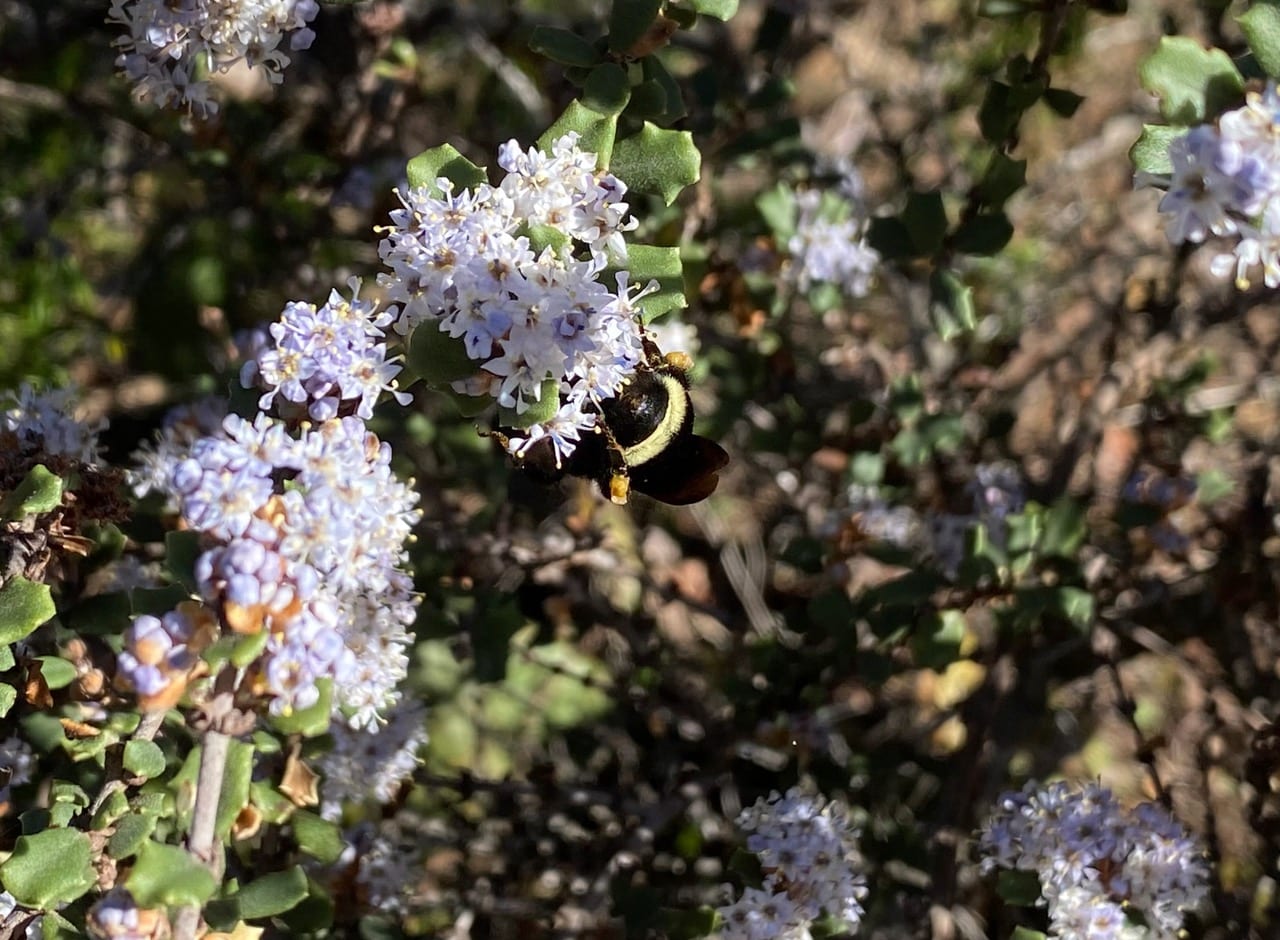
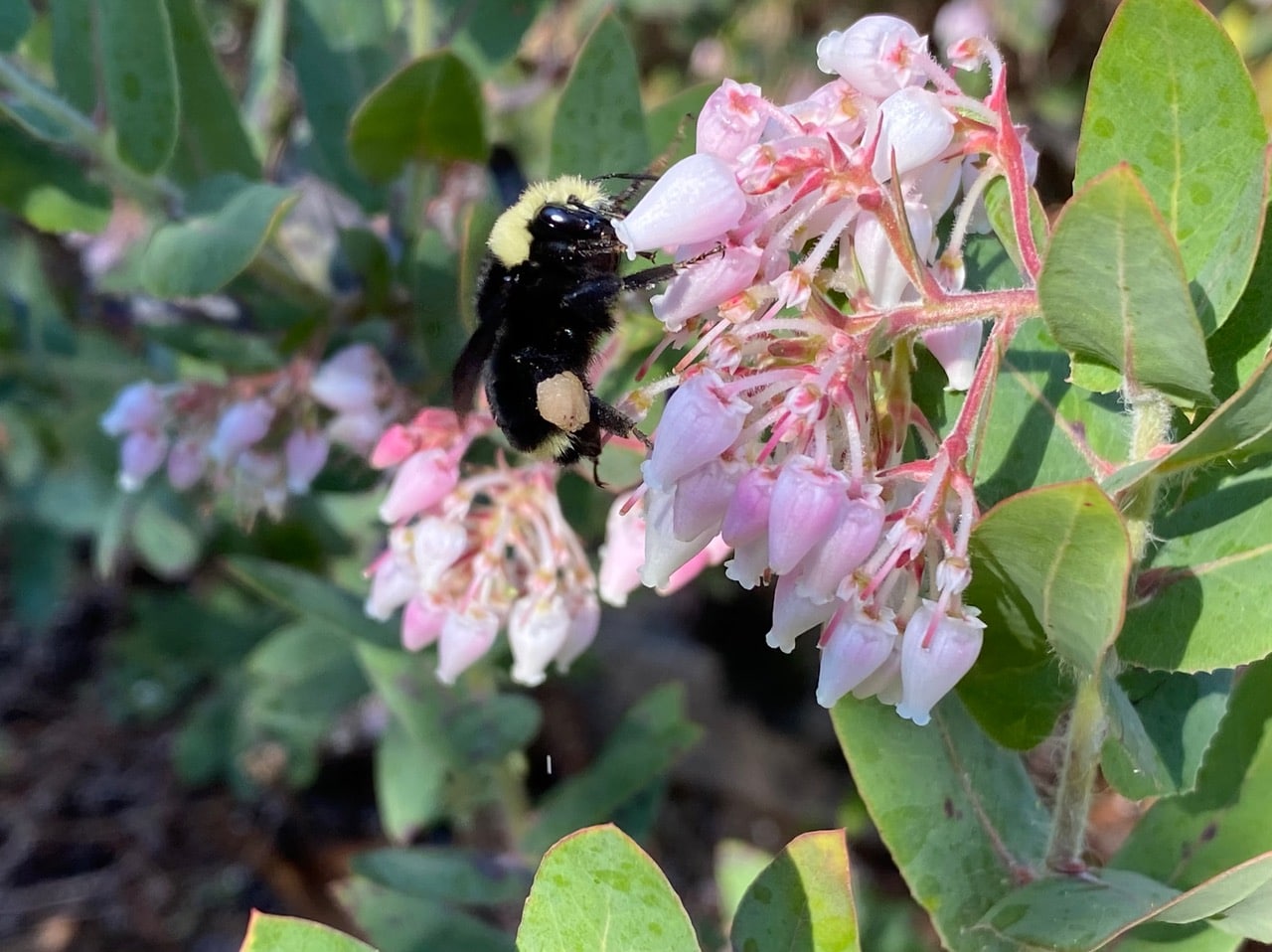
As the bee turns around on the inflorescence I am thrilled to see that she has been collecting pollen. Note the small loads of pollen in the pollen baskets on her hind legs. The queen is now a mom! She must have established a nest and is taking care of larvae now. Pollen is rich in protein, and is usually fed to the growing young.
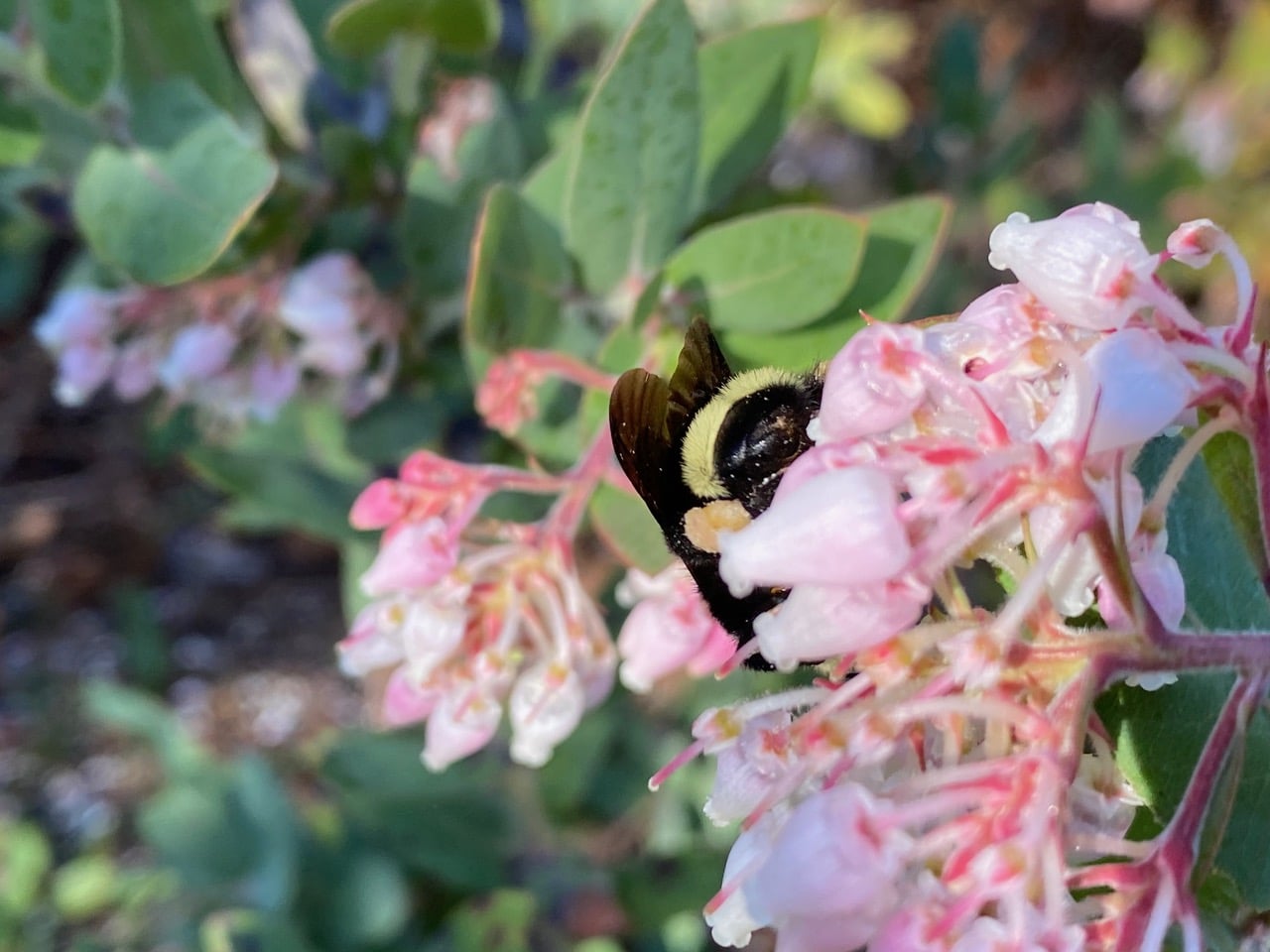
As I approach the manzanitas, I notice the same phenomenon – Yellow-faced queens collecting pollen. Nesting and reproduction are in full swing – way to go, mama!
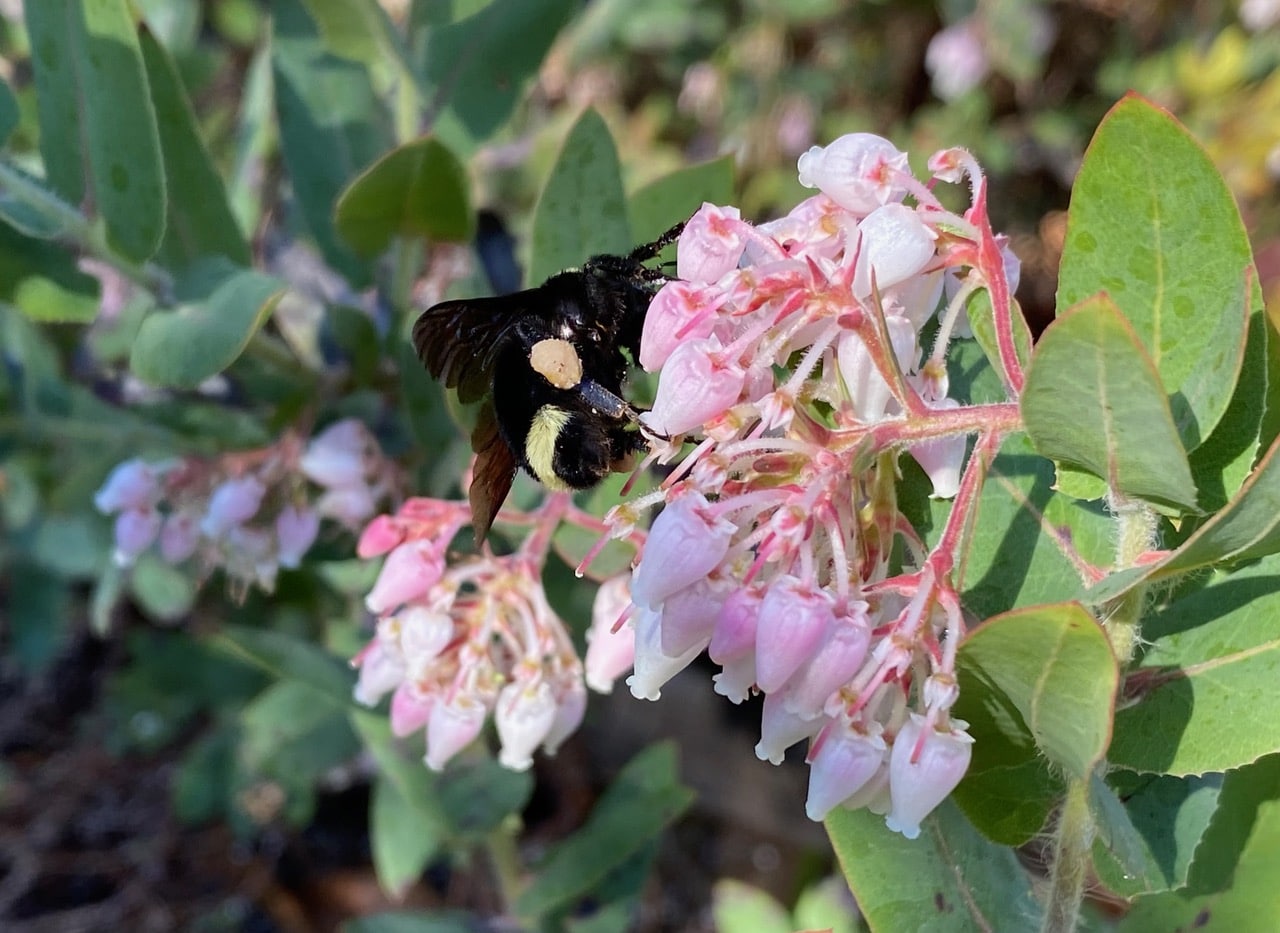
The pollen collecting apparatus in Apidae bees, which include honey bees and bumble bees, is commonly called a “pollen basket” or corbicula. This region is located on the tibia of the hind legs and consists of hairs surrounding a concave region. After the bee visits a flower, she begins to groom herself and brushes the pollen down toward her hind legs and packs the pollen into her pollen basket. A little nectar mixed with the pollen keeps it all together like putty, and the stiff hairs surrounding the pollen basket hold it in place. Remarkably bees are able to fly while carrying up to a third of their body weight in pollen.
.jpg)

A fly in the family Muscidae (which includes house flies) is resting on a sunlit leaf. Like the others in the family, it has sponging mouthparts. Sponging mouthparts facilitate absorption of food in liquid form, commonly used for feeding on liquids such as nectar and fruit juices. The fly can also secrete digestive enzymes to liquify food, then sponge it up. Not all Dipterans have sponging mouthparts. Many predatory flies have stabbing-sucking mouthparts.
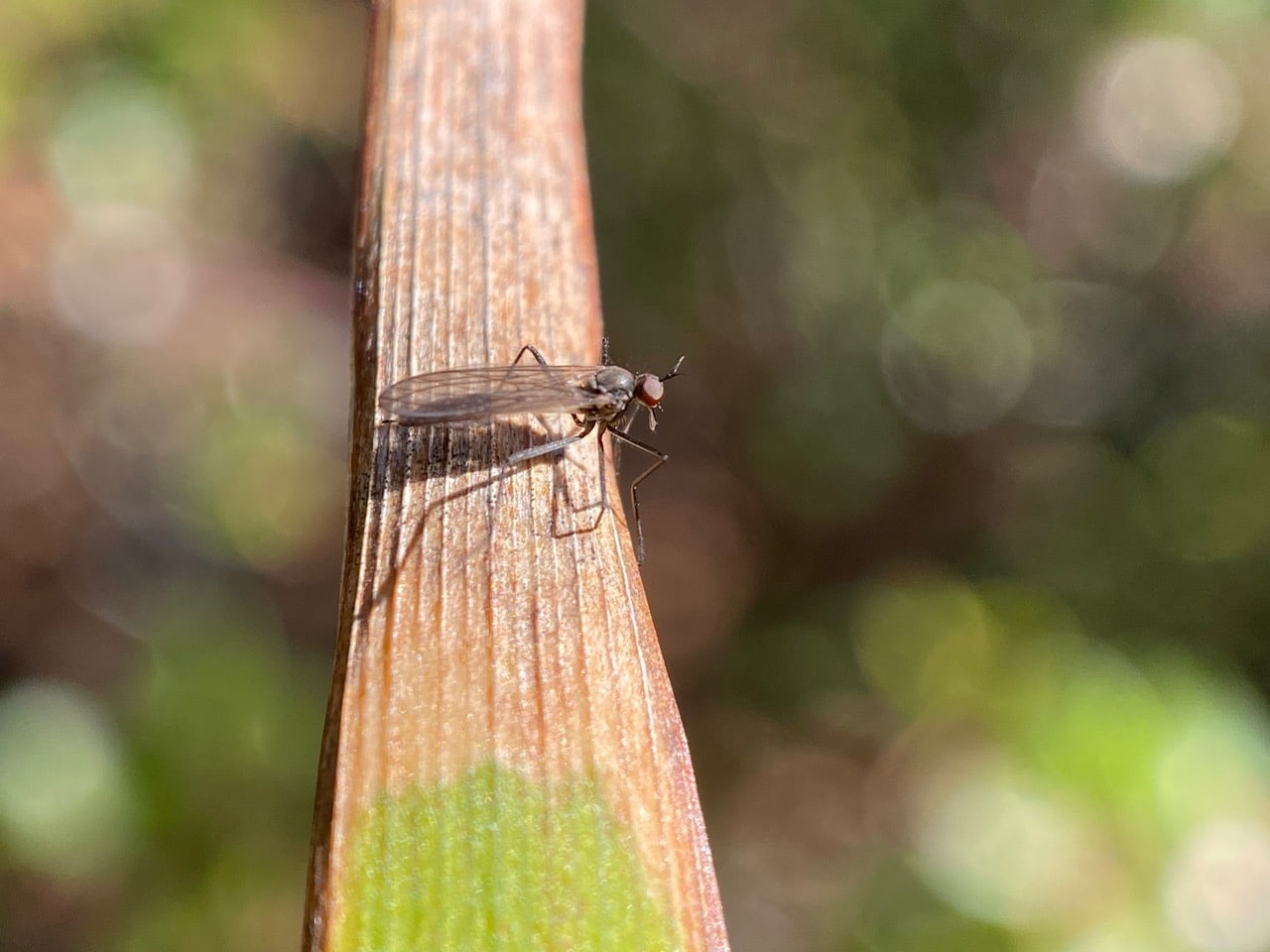
A tiny fly is basking on an iris leaf. It appears to be a Dance Fly (superfamily Empidoidea) with a piercing-sucking mouthpart. This type of mouthparts are found in mosquitoes, horse flies, and deer flies. They are used for piercing plant or animal tissues and sucking up fluids. While some Dance Flies are predatory, others are herbivorous.
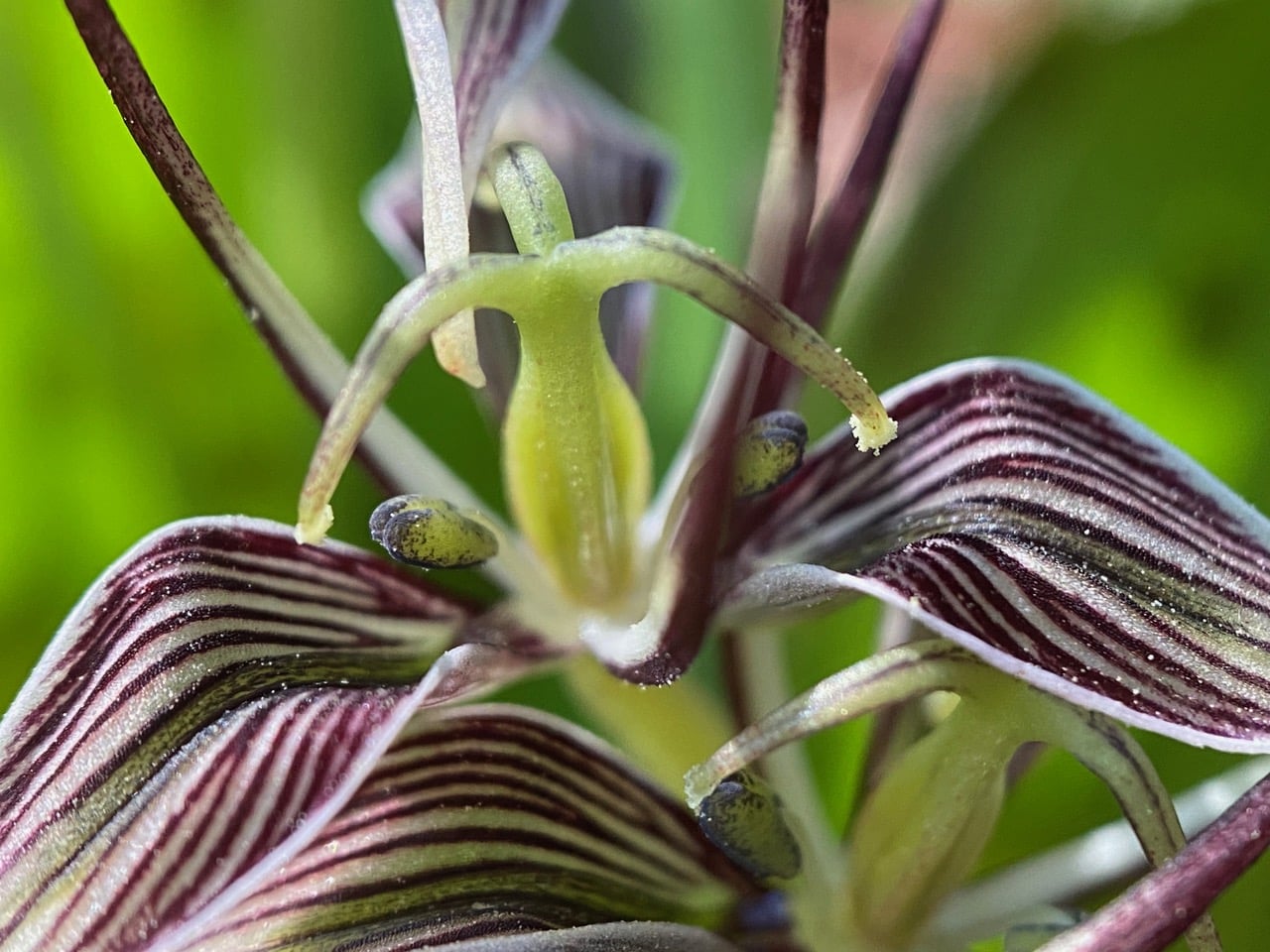
In the Redwood section of the garden, I check on the flowers of the Fetid Adder’s Tongue, Scoliopus bigelovii. Note the pollen that has adhered to the tips of the three-pronged style, and the loose pollen grains scattered on the striped sepals of the flower. There’s obviously been some pollination action going on. I park myself by the clump of the plant and wait. As morning turns into afternoon and the day warms, a breeze brings a whiff of the curious odor emitted by the flowers. Ah, maybe the pollinators will show up now?
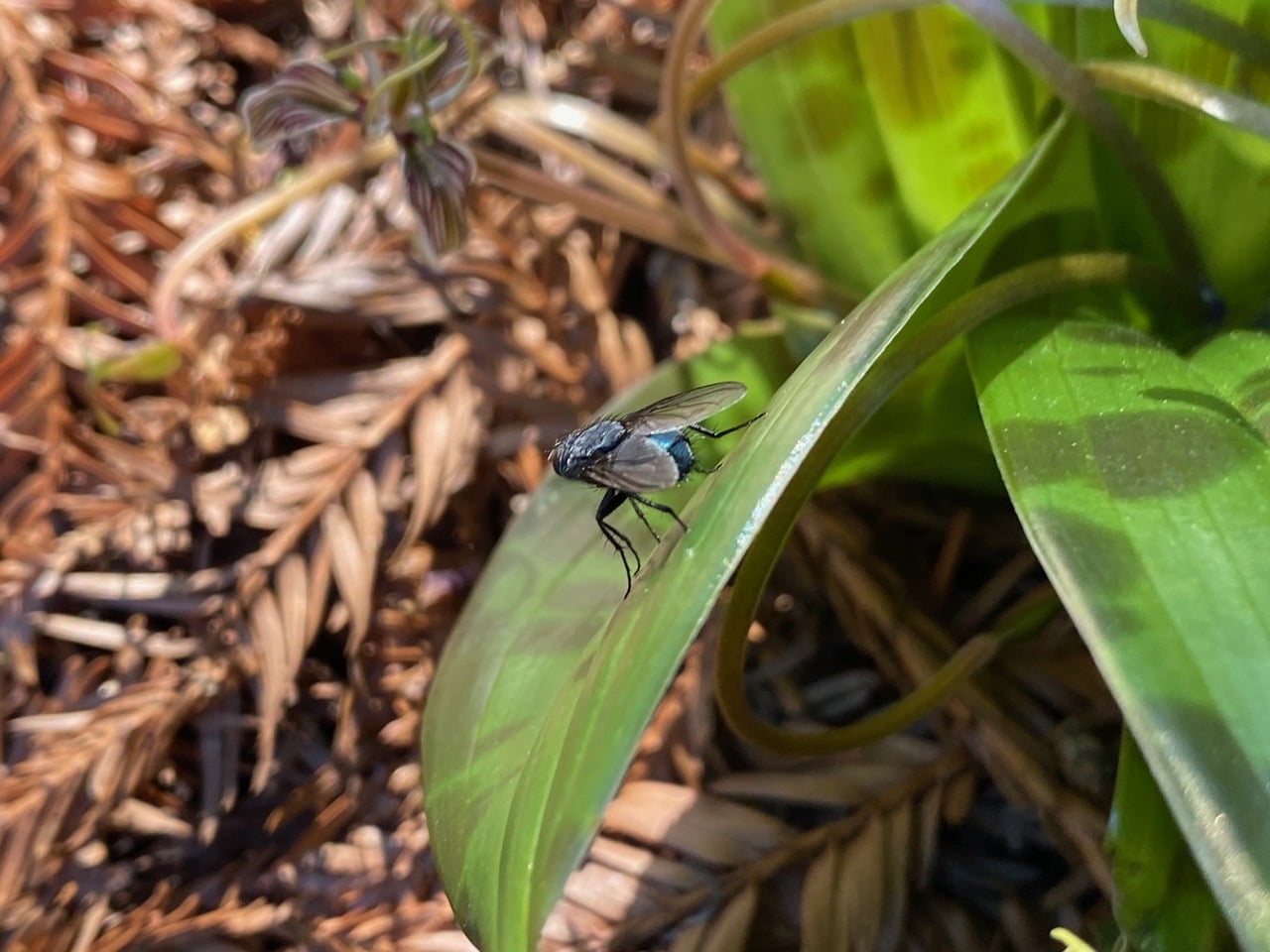
A Bluebottle Fly (family Calliphoridae) lands on a leaf of Fetid Adder’s Tongue. This is not surprising as the odor of the flowers is likely to be attractive to the scavenger.
The Calliphoridae are variously known as blow flies, carrion flies, greenbottles, and bluebottles. Adults are usually brilliant with metallic sheen, often with blue, green, or black thoraces and abdomens. There are three cross-grooves on the thorax; calypters are well developed. Females visit carrion both for proteins and egg laying. The larvae that hatch feed on dead or necrotic tissue, passing through three instars before pupation. After the third instar, the larva leaves the corpse and burrows into the ground to pupate. Adult blow flies are occasional pollinators, being attracted to flowers with strong odors resembling rotting meat. The flies use nectar as a source of carbohydrates to fuel flight.

The fly disappears for a moment, but reappears on the sepal of one of the flowers. It lowers its head to take nectar at the base of the flower. The fly seems too big to be going under the anthers to pick up pollen on its back. It is not a likely candidate for pollinating the plant.
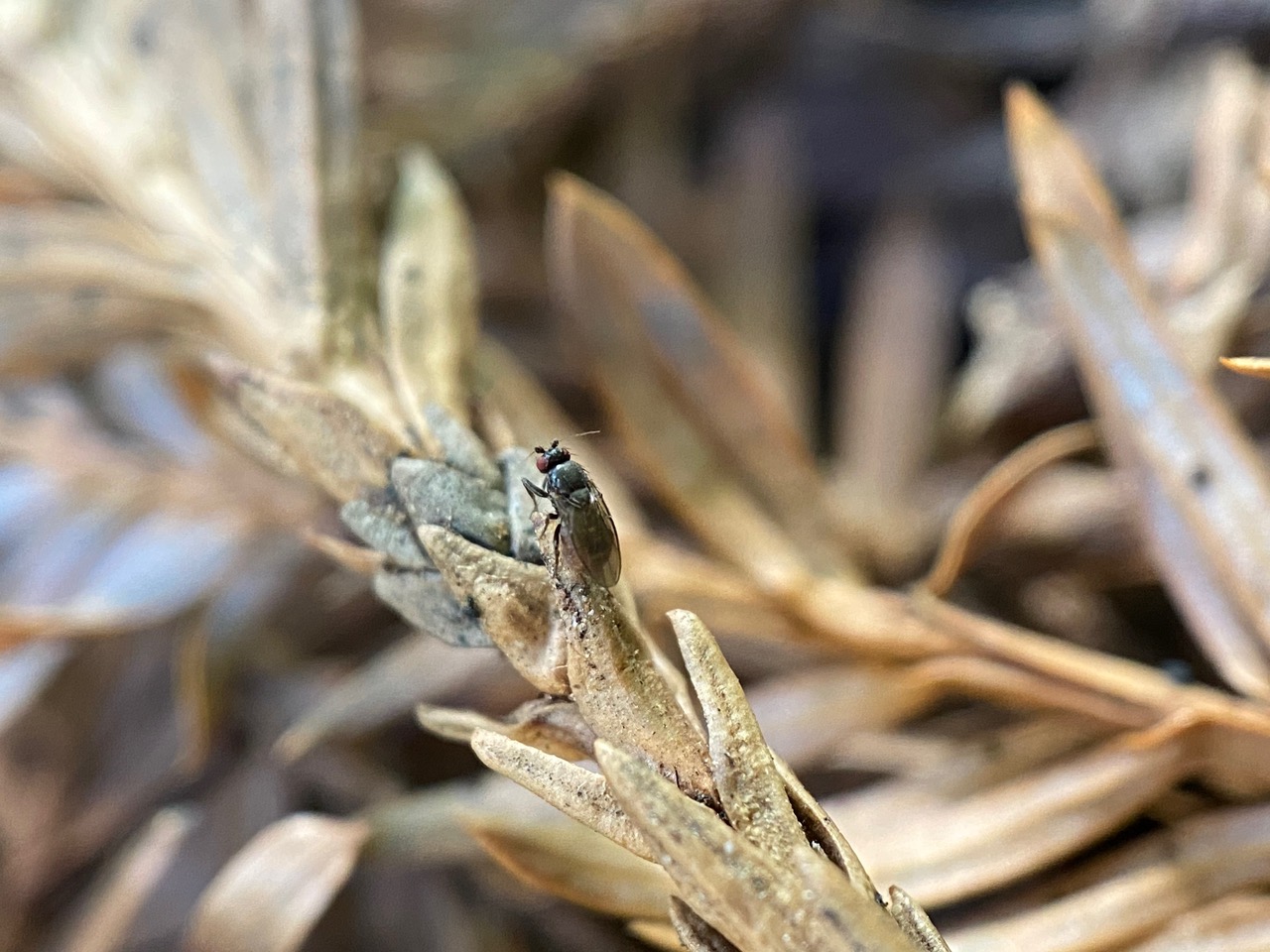
I scan the forest floor for insects close to the Fetid Adder’s Tongue. Occasionally a few tiny insects can be seen to fly low over the leaf litter. This tiny fly, barely 3 mm long, lands on the redwood duff. It is not a Fungus Gnat (family Mycetophilidae), but it is the right size for pollinating the plant. I’m sure many small insects that fit the dimensions of the flower can serve as its pollinator. iNaturalist has helped identify this fly as a member of the genus Rachispoda (family Sphaeroceridae, or Lesser Dung Fly). Ah, another fly that is attracted to smelly stuff! Note the fly’s long aristae (the bristle that is part of the antenna), and prominent scutellum.
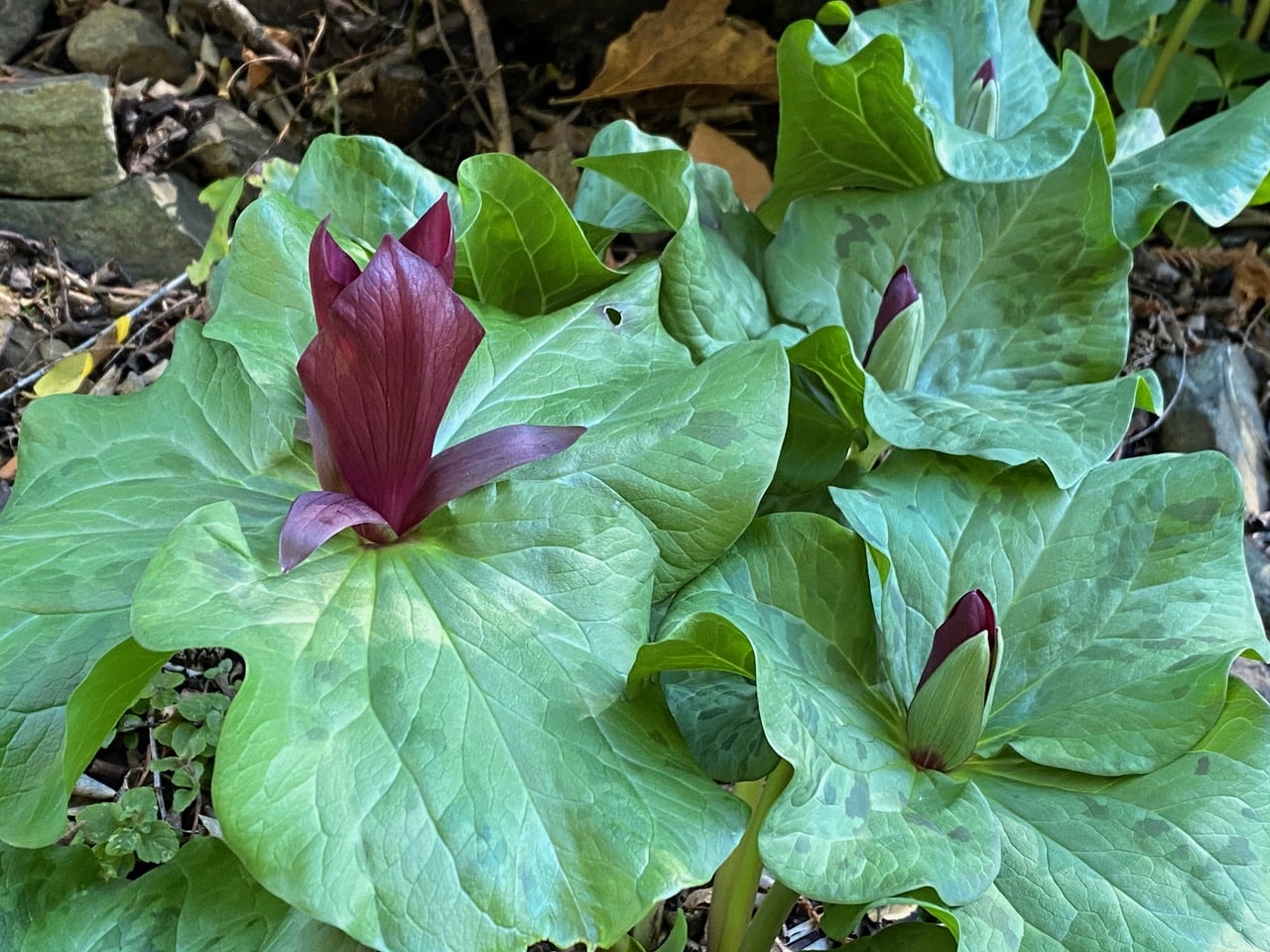
Hey, the Giant Trillium (or Wake Robin), Trillium chloropetalum has started to bloom! I take a peek inside the opened flower, but find no insect.
The name “trillium” incorporates the Latin word for three (“tri”), which refers to the three-part symmetry around which the plant parts are organized – in a single blossom there are three petals, three sepals, and likewise, the leaves (technically, bracts) also come three to a plant. Trilliums are divided into two groups, sessile or pedicellate. In the Giant Trillium, the flowers are sessile, meaning they are not subtended by a stalk or pedicel, but sit upright directly on the leaves. The floral structure is intriguing – large, erect, fleshy stamens surround a shorter, purplish, wrinkled pistil in the center. How are these flowers pollinated? From the literature, I gather that various species of trilliums are pollinated in different ways. Red trilliums that do not produce nectar are apparently pollinated by flies (Diptera) and beetles (Coleoptera). Their petals exude an odor that attract carrion flies and beetles which pollinate the flowers. Another source claims that white and drooping trilliums are pollinated by bumble bees and related insects. I have yet to evaluate these claims by my own observations. Since I started looking a few years ago, I have not found an insect on the trillium flowers at all.

Returning to the front gate, I pass the blooming Otay Mountain Ceanothus, Ceanothus otayensis again. What a difference 3 hours make! I notice a distinct change in the cast of characters on the flowers. Instead of bumble bees, the plant is now abuzz with mostly honey bees.
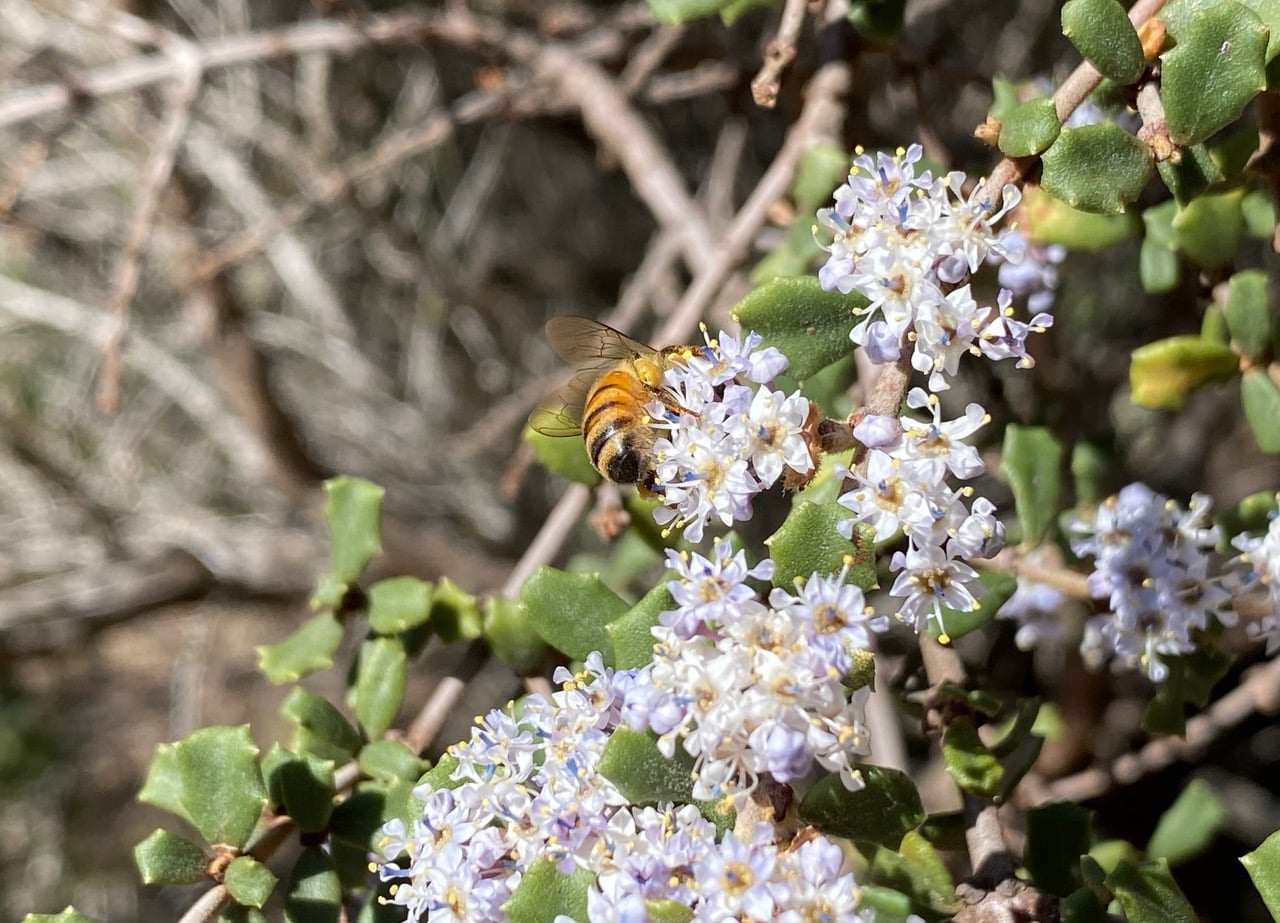
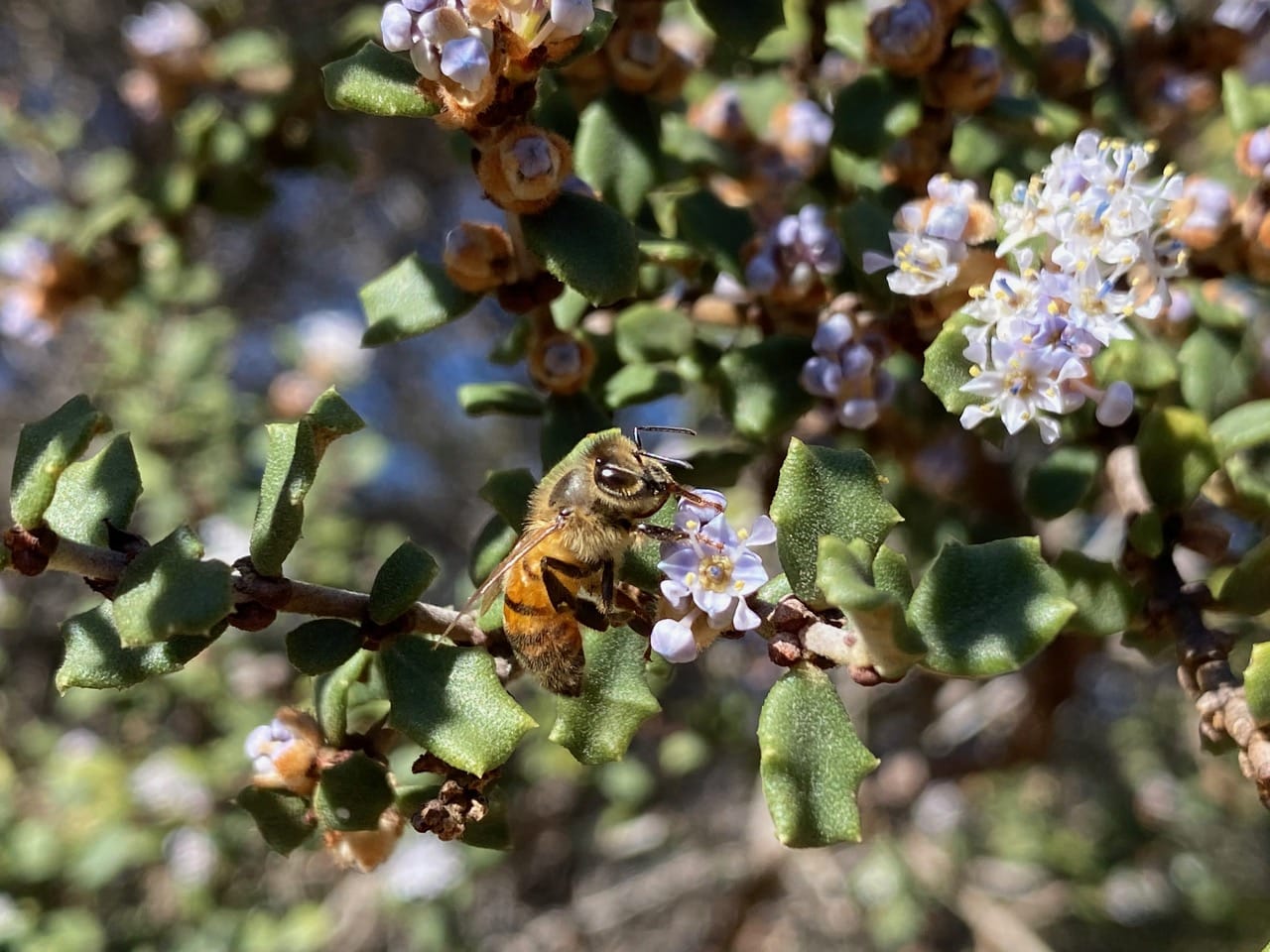
Watching honey bees forage, I am reminded of a fellow docent at the Oakland Museum Natural Sciences Gallery many years ago. Bud, a retired entomologist, taught me that every honey bee worker out foraging should be treated with respect – they are all little old ladies. Bud was absolutely correct. All Honey Bee foragers are female, and they are the oldest of their hive mates. How do honey bees get their job assignments within their social organization?
“A bee’s job is, first of all, determined by its sex. Male bees, or drones, don’t do any work. Making up roughly 10% of the colony’s population, they spend their whole lives eating honey and waiting for the opportunity to mate with the queen. The queen mates with up to 20 drones and will store their sperm in her spermatheca for the rest of her life. That’s where male duties end. Female bees, known as worker bees, make up the vast majority of a hive’s population, and they do all the work to keep it functioning. Females are responsible for the construction, maintenance, and proliferation of the nest and the colony. When a worker bee emerges as an adult, she immediately starts cleaning the cell from which she hatched. Her first 3 days are spent cleaning cells to prepare them for the queen’s next round of eggs. Then her hormones kick in to initiate the next phase of work: nursing the young. The worker bee spends about a week nursing the brood, feeding larvae with royal jelly. Next, the worker bee enters the third phase, as a sort of utility worker, moving farther away from the nest’s center. Here she builds cells and stores food in the edge of the nest for about a week. A worker’s hormone shifts into the final phase of work at around 41st day: foraging. This work is the most dangerous and arguably the most important. It’s only done by older bees who are closer to death. As the worker bee approaches her fourth week of nonstop work, she senses her end of days, and removes herself from the hive, so as not the become a burden to the colony. If she dies in the hive, her hive mates would have to remove her corpse. Thus is the life of a female honey bee during the active seasons of spring and summer, compulsively working from the day she’s born until the day she expires.” – excerpt from an article in National Geographic by Richie Hertzberg.
So, don’t forget to tip your hat to the “little old ladies” you see in the garden!
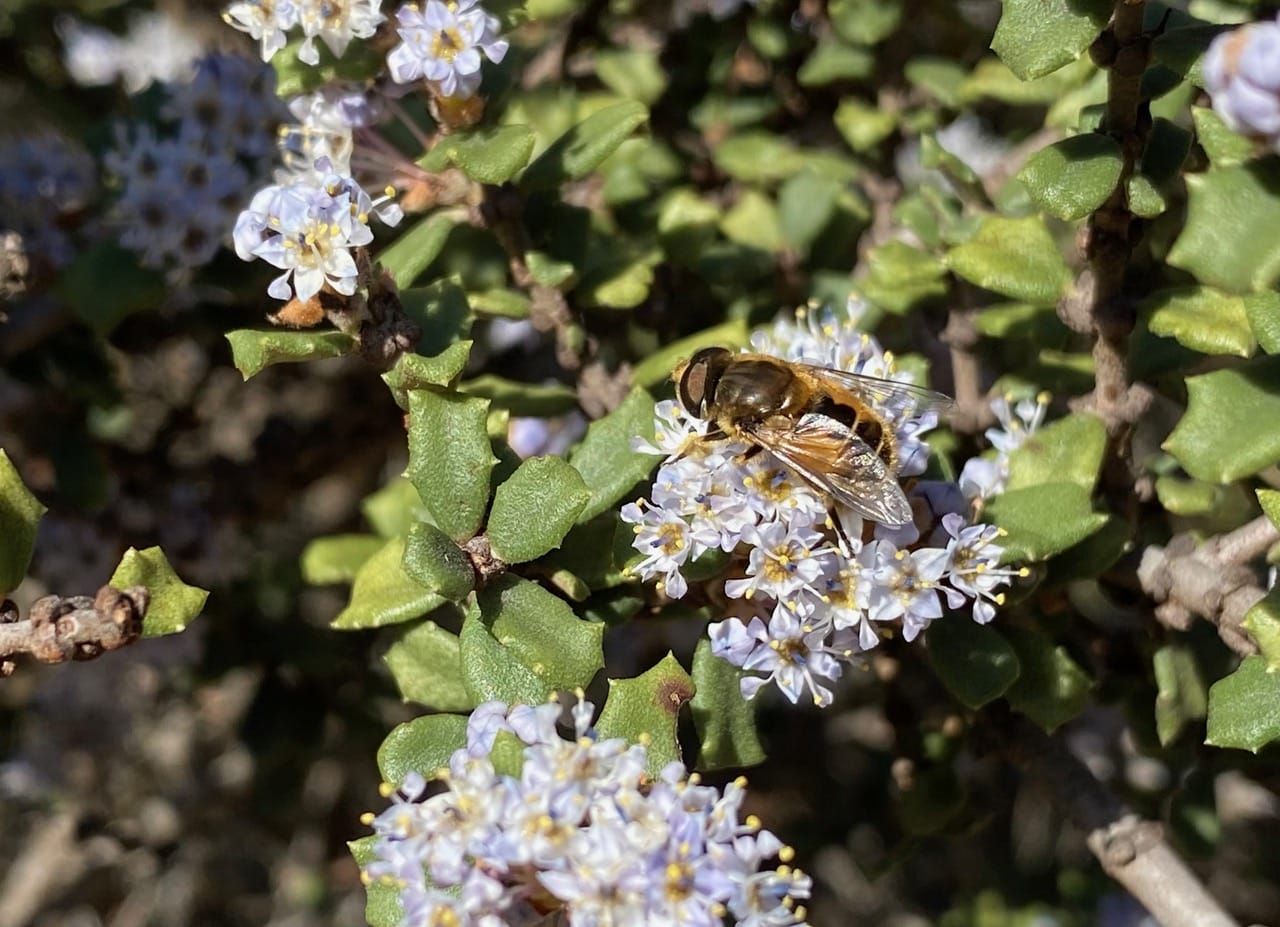
Quiet and less conspicuous than the bees are the various hover flies on the Ceanothus. A Eurasian Drone Fly, Eristalis arbustorum (family Syrphidae) is foraging on the flowers of Ceanothus.
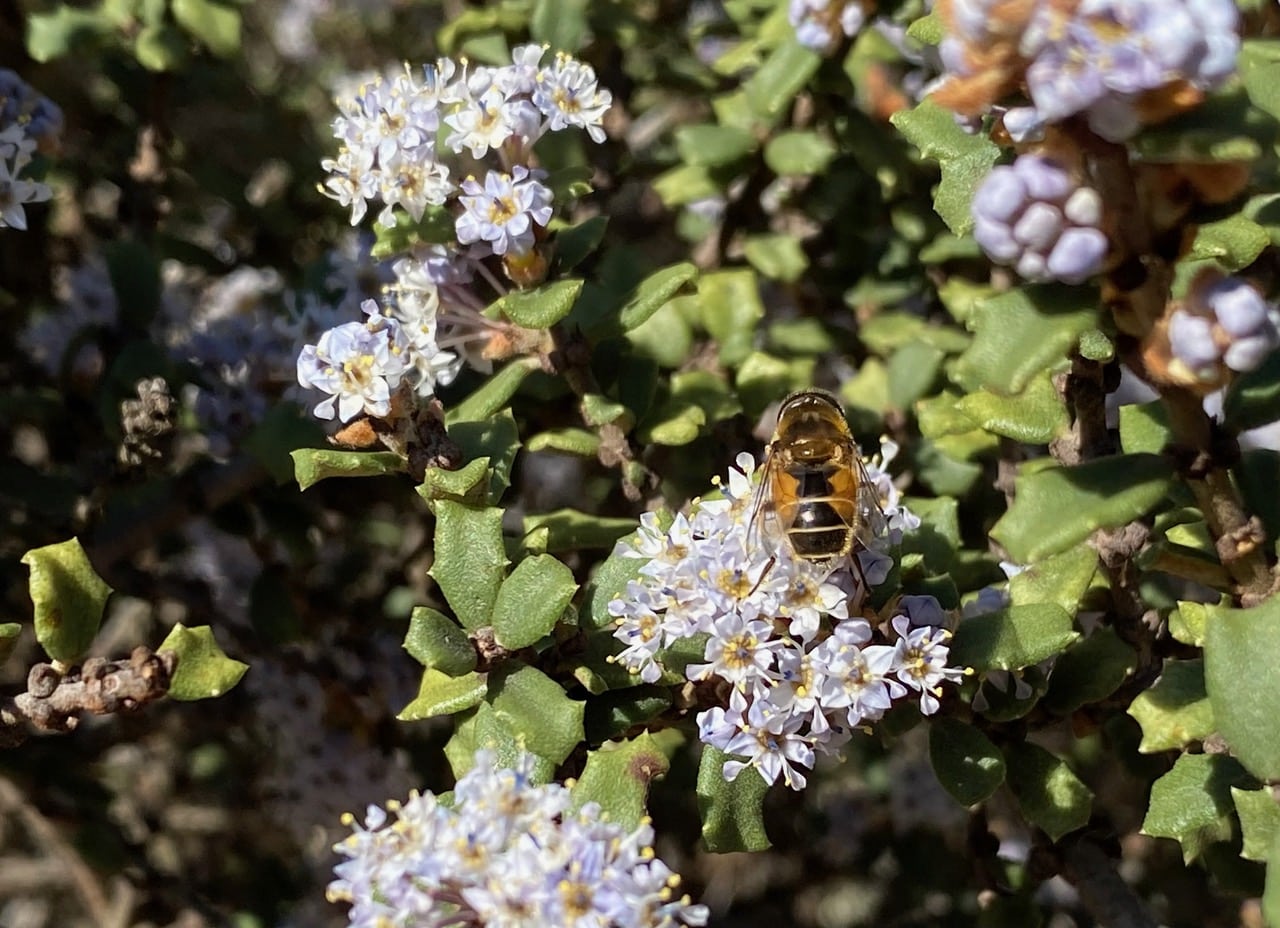
Rear view of the Eurasian Drone Fly.
The Eurasian Drone Fly, Eristalis arbustorum is an abundant species of hover fly that occurs throughout the northern hemisphere, including Europe, North Africa and North India. It was introduced to North America in the mid 1800’s and is now ubiquitous throughout much of the United States and Canada. The common name “drone fly” refers to its resemblance to the drone of the honeybee. Hoverflies get their names from the ability to remain nearly motionless while in flight. The adults are also known as flower flies as they are commonly found on and around flowers feeding on nectar and pollen. The Eurasian Drone Fly is found in a diversity of habitats, including wetland, forests, montane tundra, as well as farmland, urban parks and gardens. It visits the flowers of a wide range of low-growing plants and shrubs. The larvae are aquatic, occurring in shallow, nutrient rich standing water and in cow manure and compost heaps. Also known as “rat-tailed maggots”, the larvae have a siphon on their rear end that acts like a snorkel, helping them breathe under water. The siphon can be several times the length of the larva’s body. The larvae are saprophagous, feeding on bacteria in stagnant water rich in decomposing organic matter.
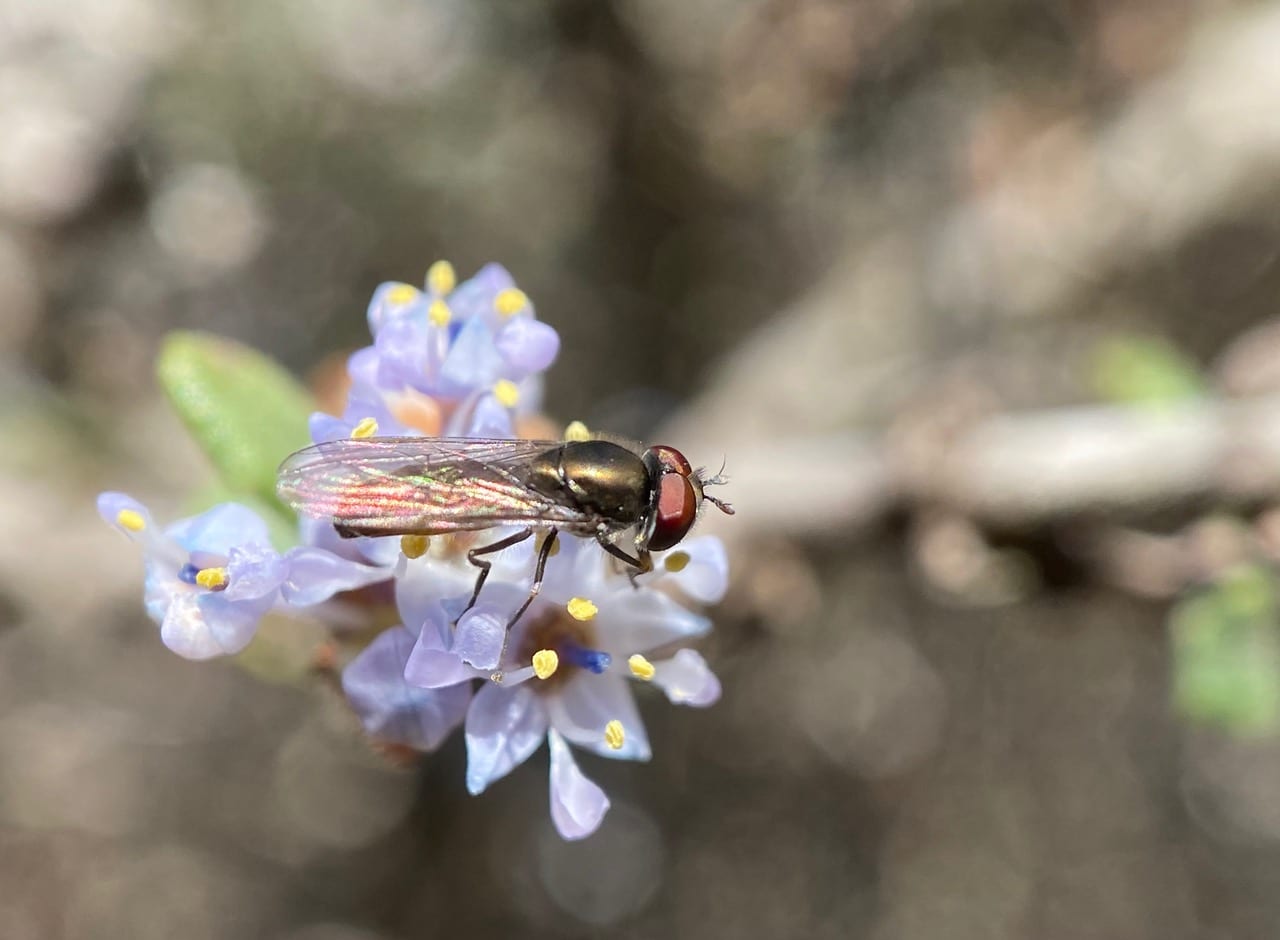
Bucking the trend of bee-mimicking black-and-yellow of many hover flies, the Sedgesitter, Platycheirus sp. (family Syrphidae) is instead cloaked in elegant metallic bronze. Instead of flaring their wings, Sedgesitters tend to hold their wings folded over their abdomen while feeding.
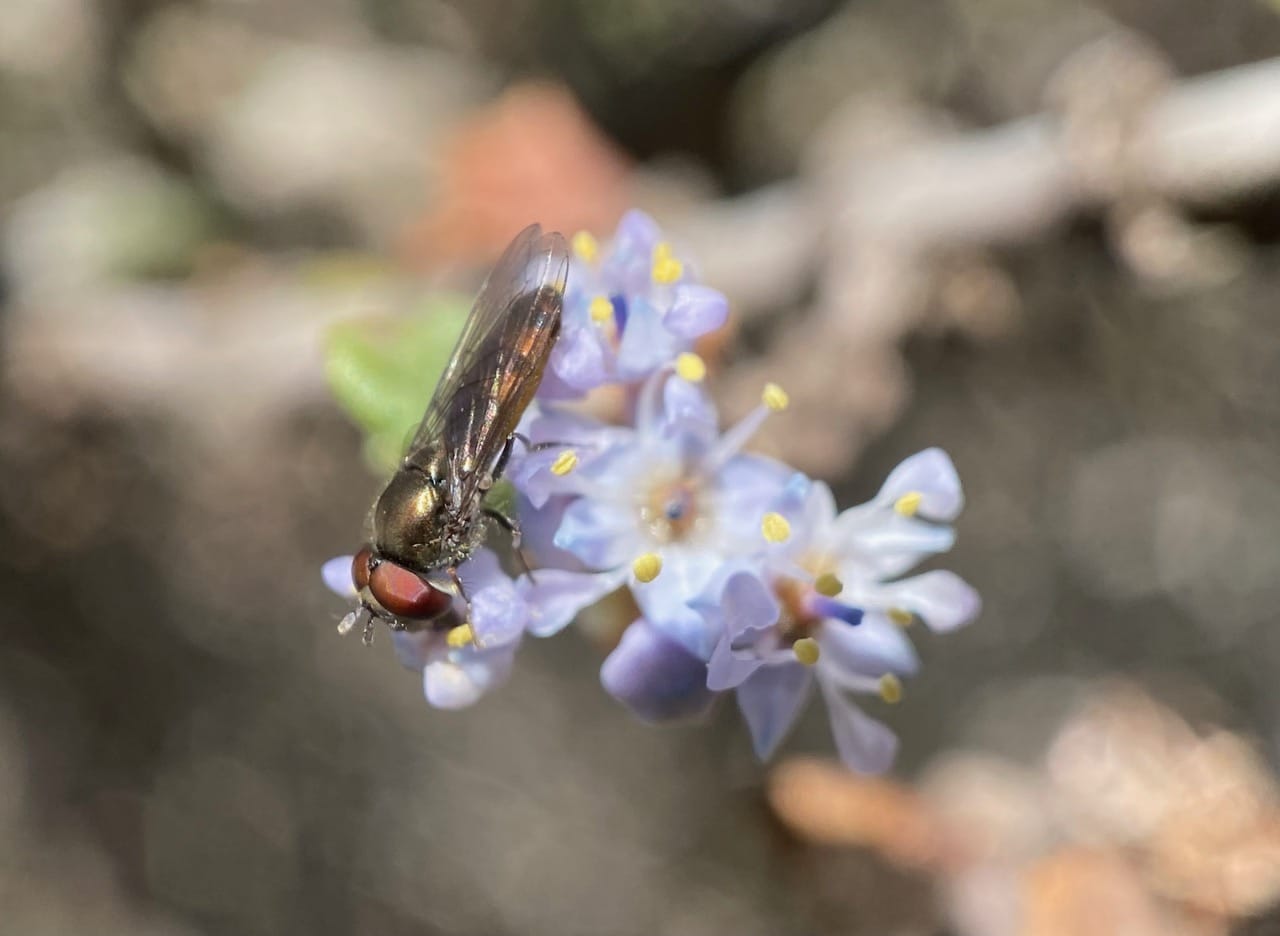
Platycheirus is found in grass and herb vegetation. Adults of many species feed on pollen of wind-pollinated plants, such as Salix, Plantago, Poaceae, Cyperaceae, but they visit other flowers as well. Many stay active during cold and rainy weather. Larvae feed on aphids.

A gravid female Oblique Streaktail, Allograpta obliqua (family Syrphidae) is foraging on a cluster of Ceanothus flowers.
The Oblique Streaktail, Allograpta obliqua is a common North American species of hover fly. Adults, 6-7 mm long, visit flowers for nectar and pollen, and are pollinators. Females lay eggs on plant surfaces near aphids. Larvae feed on the aphids.
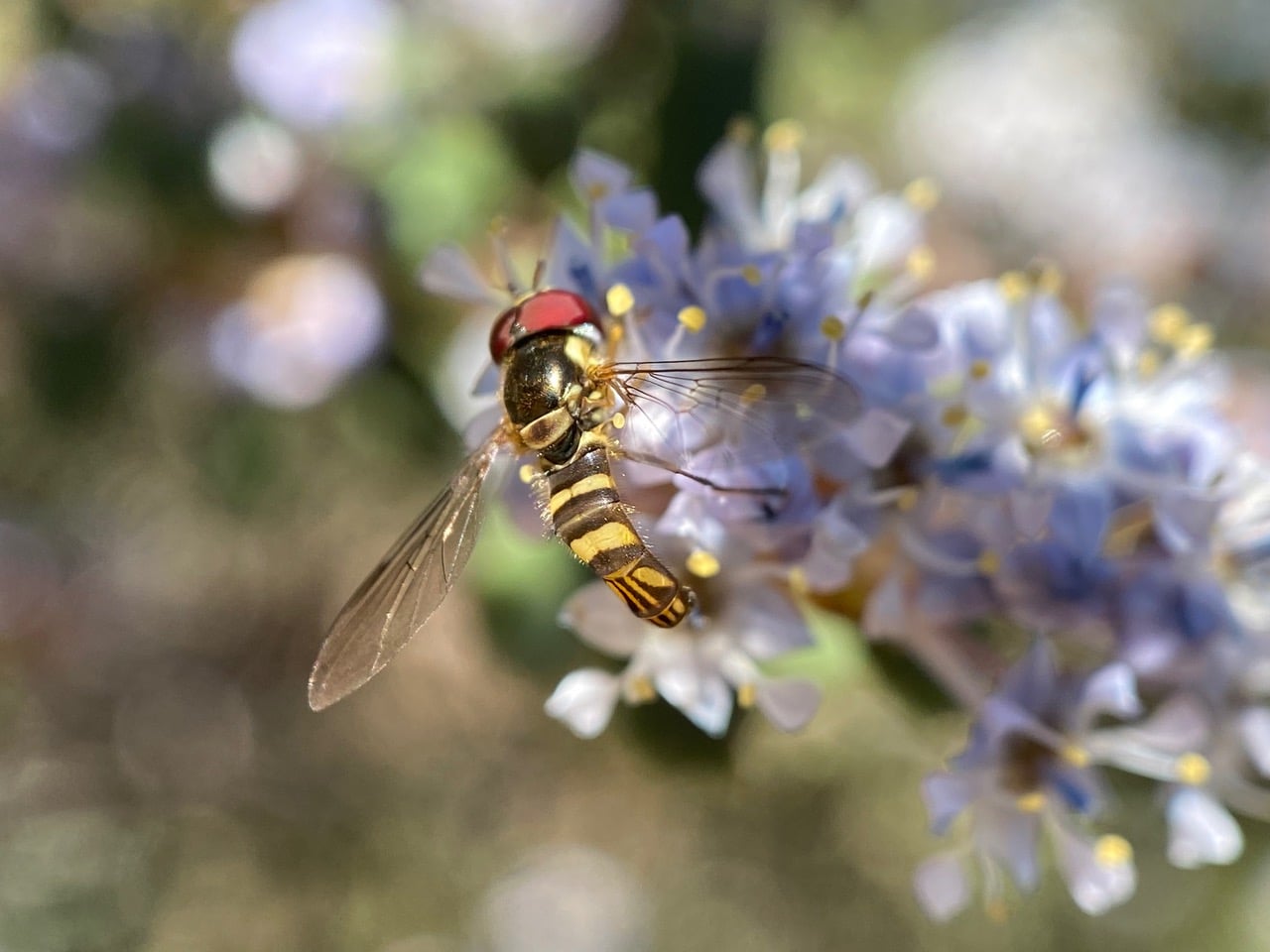
Hey, here’s a male Oblique Streaktail, Allograpta obliqua (family Syrphidae). Instead of a tapered abdomen pointed at the tip, males of the species have parallel-sided abdomen with a rounded tip. The distinct markings on the abdomen are similar in both sexes, and are easily recognizable.
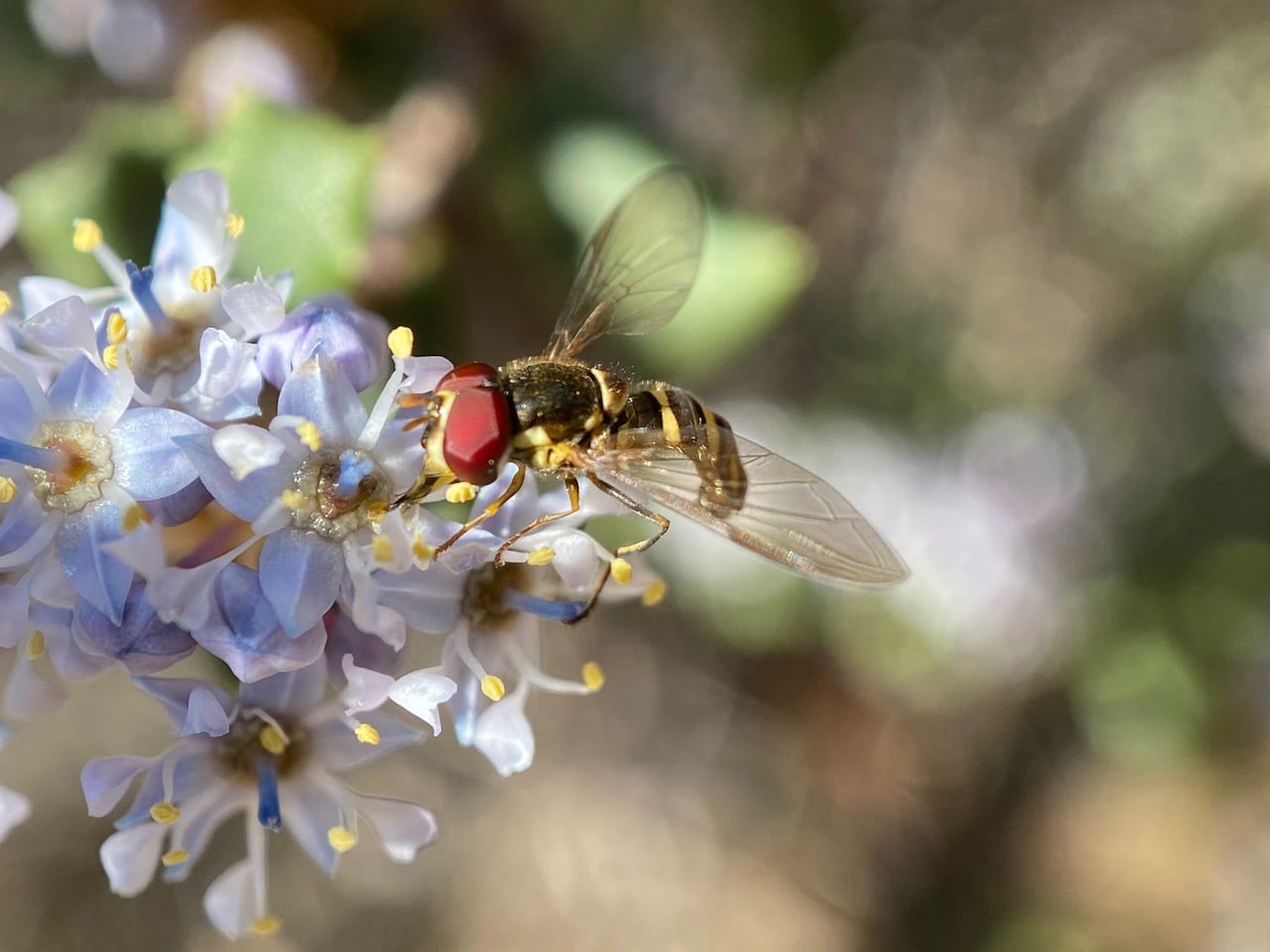
Another easy way to tell the gender of the hover fly is the arrangement of the compound eyes. Males have holoptic eyes that meet on top of the head, while the females have dichoptic eyes that are set apart from each other.