

Pollinator Post 1/27/25
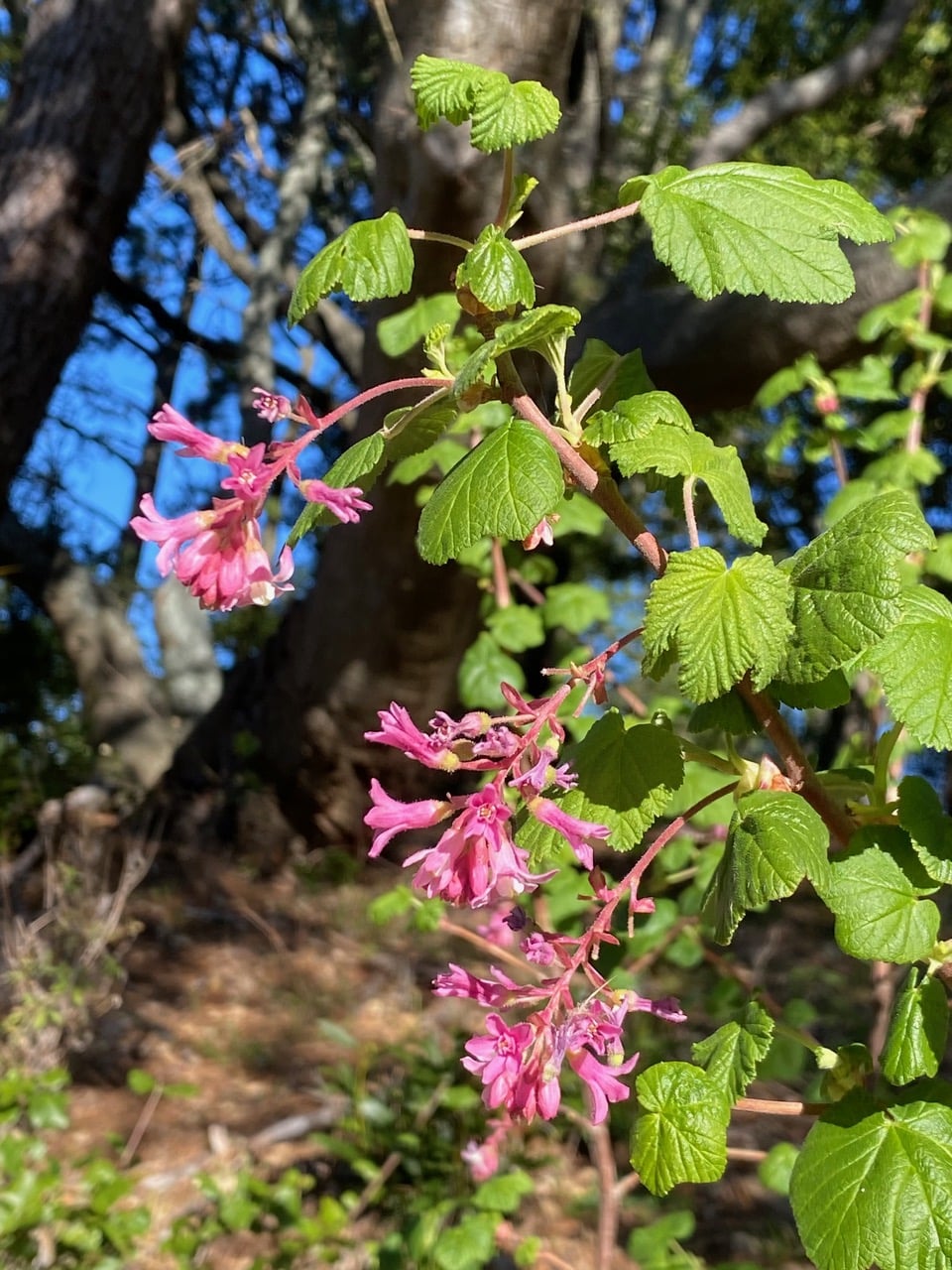
I walk the Nimitz Way at Inspiration Point in the Berkeley Hills this cold, crisp morning.
I clamber up a steep bank along the road to check out this wild Pink-flowering Currant, Ribes sanguineum blooming in the partial shade of oak trees.
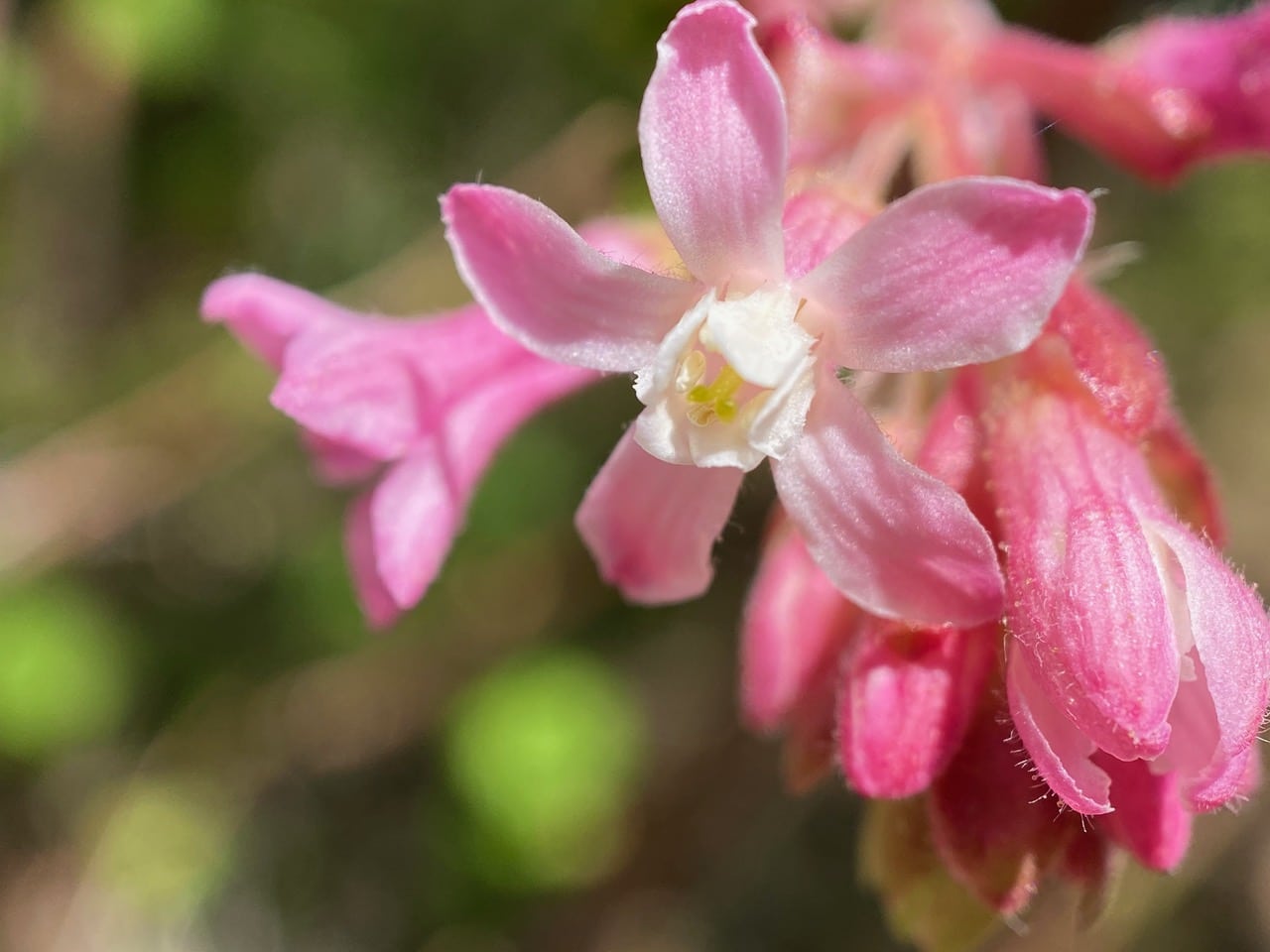
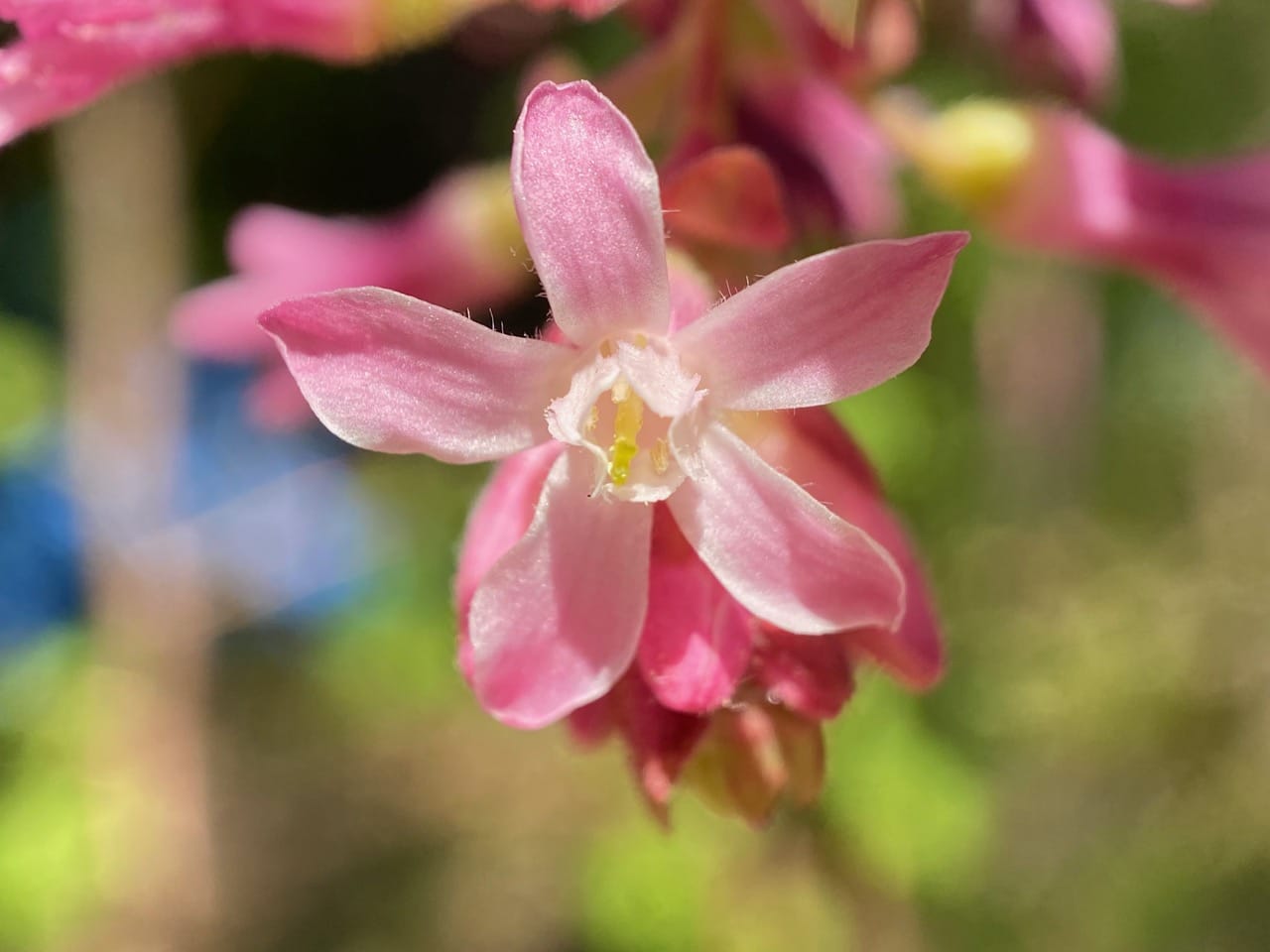
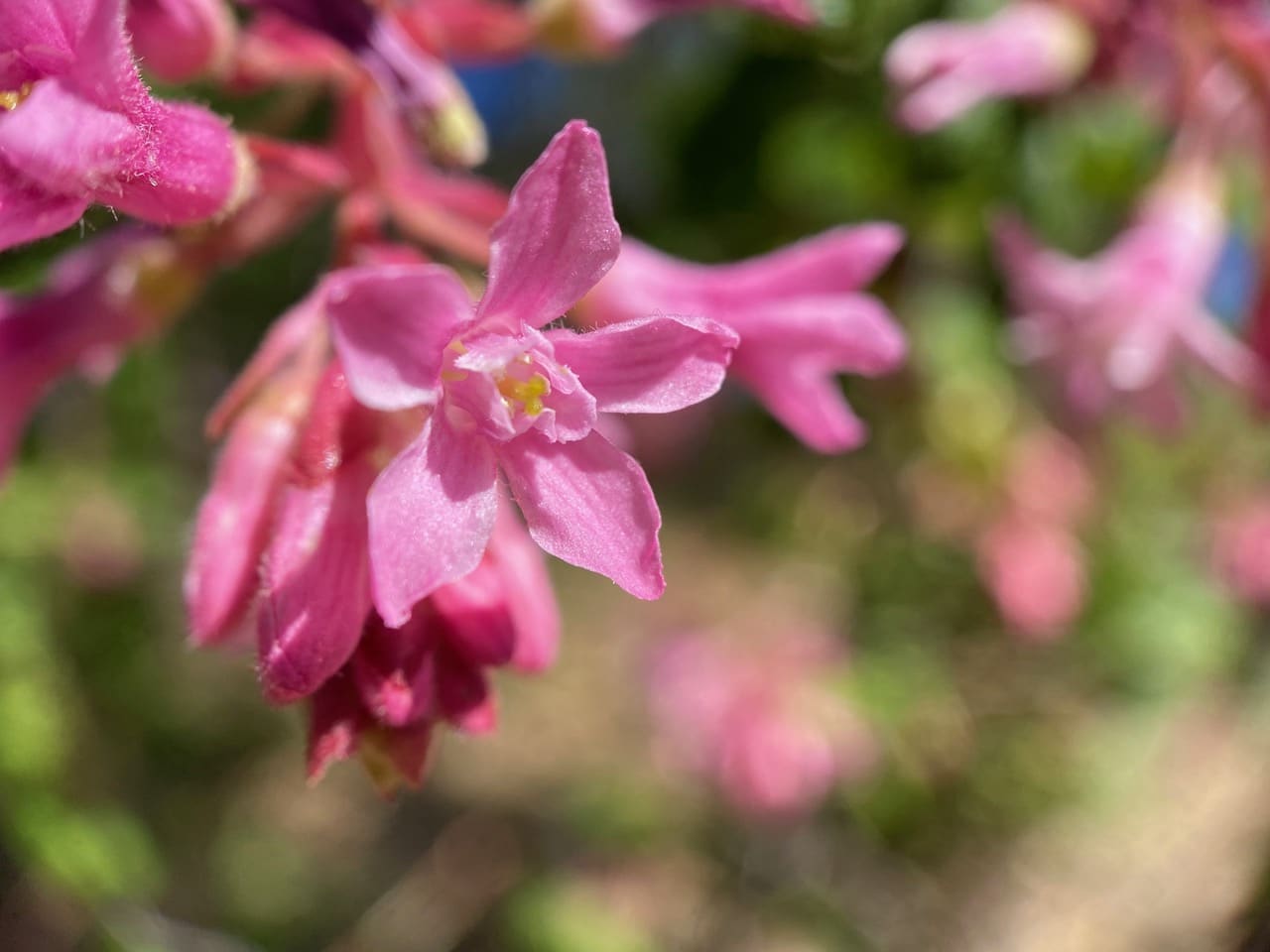
Close-up of a young flower on a drooping inflorescence of the Pink-flowering Currant. The overall pink parts of the flower are actually the sepals that have fused into a tube with flaring tips. The small white petals stand erect, surrounding the reproductive structures within. Rain can be easily diverted by the flaring sepals and downward oriented petals, sparing the reproductive structures within. It is a floral design well-adapted for California’s wet winter. The flowers requite pollinators with fairly long tongues to reach the nectar at the base of the tubes. Besides hummingbirds, I have seen Bumble Bees, Digger Bees, and Greater Bee Flies take nectar from R. sanguineum.
Dichogamy is a process in flowering plants whereby the male and female reproductive organs mature at different times. The temporal separation helps flowers avoid self-pollination and promote cross-pollination. The Pink-flowering Currant flower appears to be protogynous, the female parts maturing before the male parts. In this young flower, the stamens (male) are immature while the greenish stigma (female) appears ready to receive in-coming pollen. The flower is in its female phase.
As the flower matures, the petals turn pink, indistinguishable from the sepal color.


Five stamens surround a sturdy pistil in the middle of the flower. The anthers appear to be releasing pollen. The flower has entered its male phase.
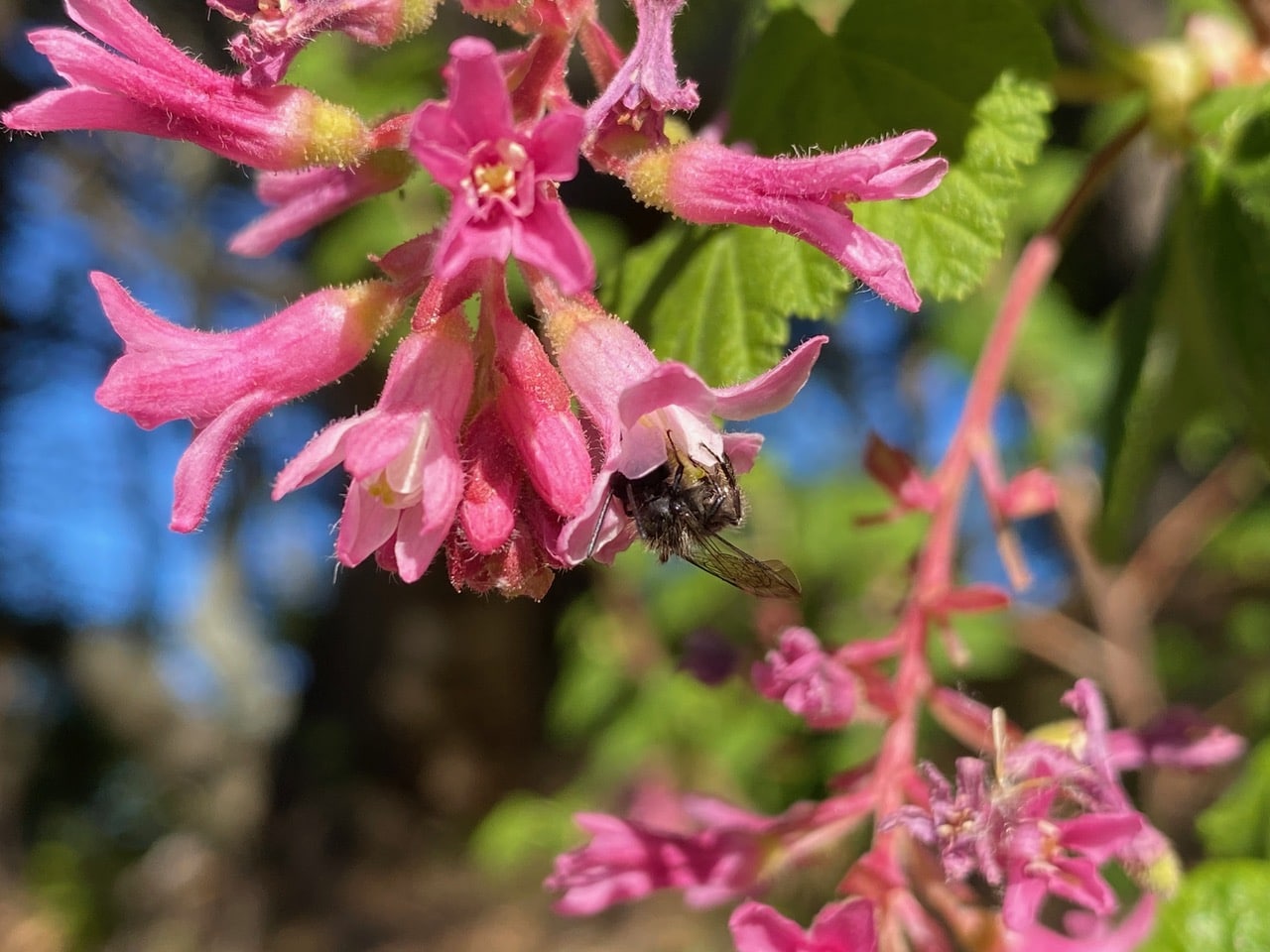
As I am examining the flowers, a black insect lands on an inflorescence next to me and reaches inside a flower.
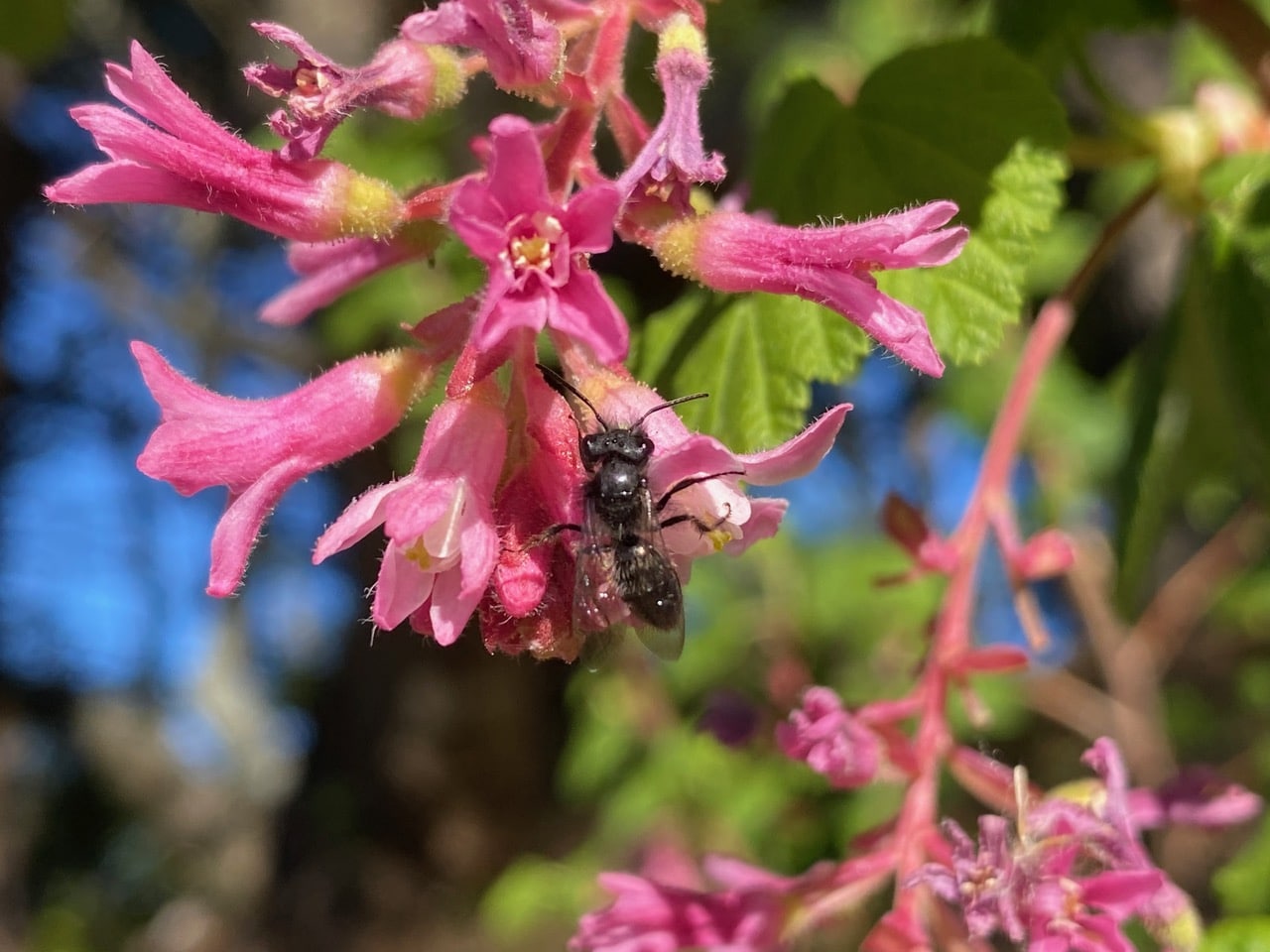
As it exits the flower, I realize that the insect is a bee! The slender, scruffy appearance, and the bee’s activity so early in the season are all suggestive of a Mining Bee in the family Andrenidae. Andrenids are short-tongued bees – was this individual able to access the nectar at the base of the tubular flower?
Bees in the family Andrenidae, commonly called miner bees or mining bees, are solitary ground-nesters. Andrenids are fairly small bees, usually dark-colored, and often banded. They are identified by the dense bristles (scopae) at the bases of the legs and the shin-like sections (tibias) of the legs, as well as by certain creases and grooves on the face and head and by unique wing venation. Many Andrenids resemble wasps – slender with long abdomen.
Most andrenids are specialist pollinators whose life cycle is timed to correspond precisely to the blooming of specific flowers. Because of this, andrenids are some of the first bees to emerge in spring, and many are active in March and April, as they visit early spring wildflowers.
The bee lingers on the inflorescence for a bit, as if enjoying the morning sun. Note the yellow integuments on its face. That together with the long antennae are indicative of a male bee.
Andrena is likely the largest and most species-diverse bee genus in California. It is one of the largest bee genera in the world. The floral preferences of Andrena species span the range of bee diets; some are broad generalists, and a number are strict specialists. Andrena are among the first bees to fly in the spring; their ability to withstand the chill is still a puzzle to scientists. The bees can’t fly until their body temperatures reach 50-60 F. They rely on the warmth of the sun to get them to speed, and it is not uncommon to see them warming up on leaves or rocks. This cold-hardiness makes Andrena excellent pollinators of early spring wildflowers and cultivated crops.
The antennae of male bees are often much longer than their female counterparts. Male antennae have an extra segment and the segments themselves are longer. This is because male antennae are specialized to pick up the subtle scent of female pheromones. Male bees do not collect pollen to provision the nest, neither do they have the equipment for the job. They do, however visit flowers for nectar, and can be good pollinators in transferring pollen between flowers.
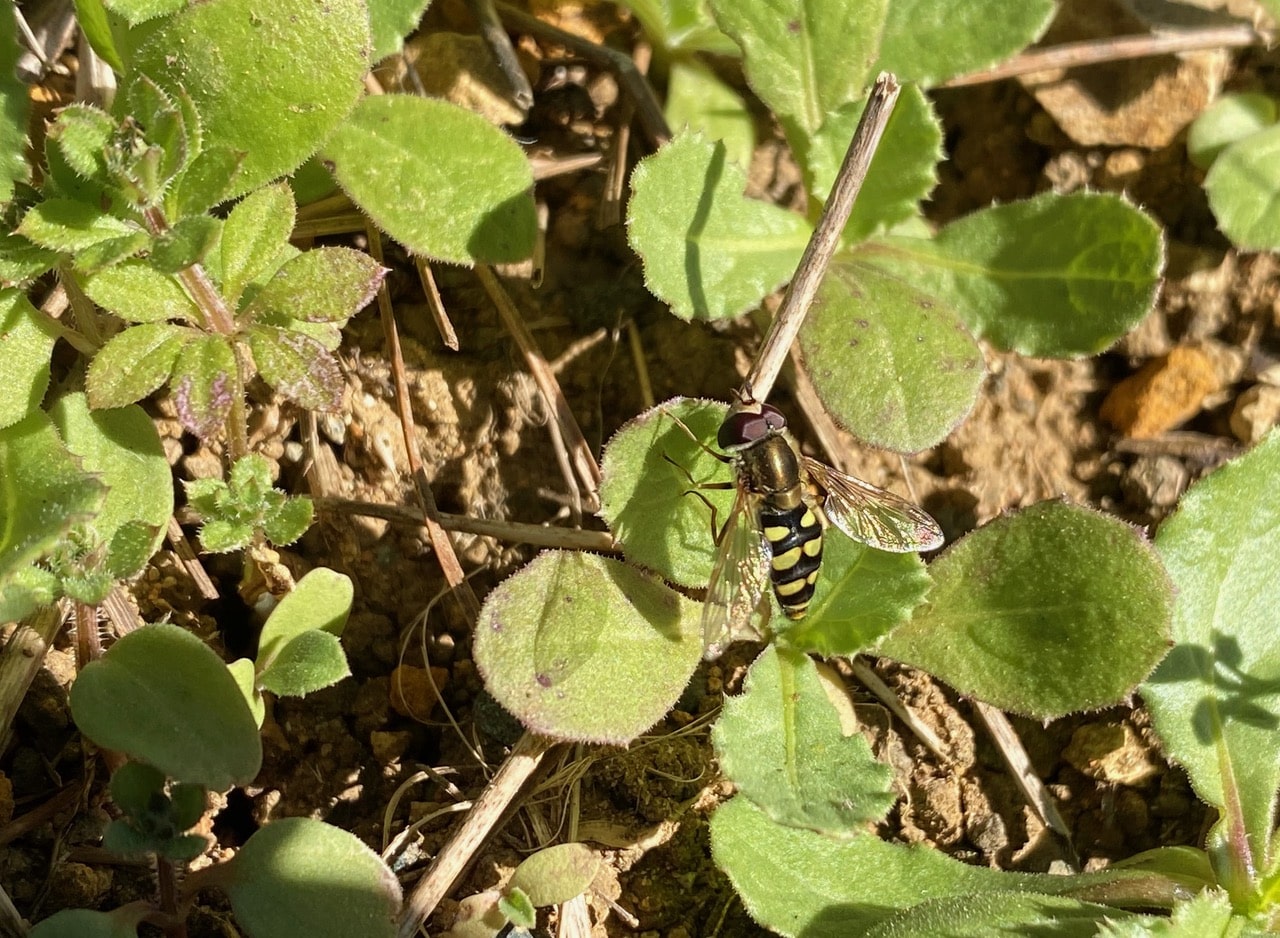
A Western Aphideater, Eupeodes fumipennis (family Syrphidae) lands on some vegetation on the ground to bask in the sun.
The Western Aphideater, Eupeodes fumipennis is a species of hoverfly in the family Syrphidae. The species is found in western North America, in a wide range of habitats including grasslands, chaparral, woodlands, croplands, urban and suburban gardens. Adults, measuring 10 mm in length, visit flowers for nectar and pollen. Their abdomens have black-and-yellow stripes reminiscent of wasps and bees. The mimicry provides these harmless flies with some protection from predators. As the common name implies, the larvae feed on plant-sucking insects, primarily aphids.
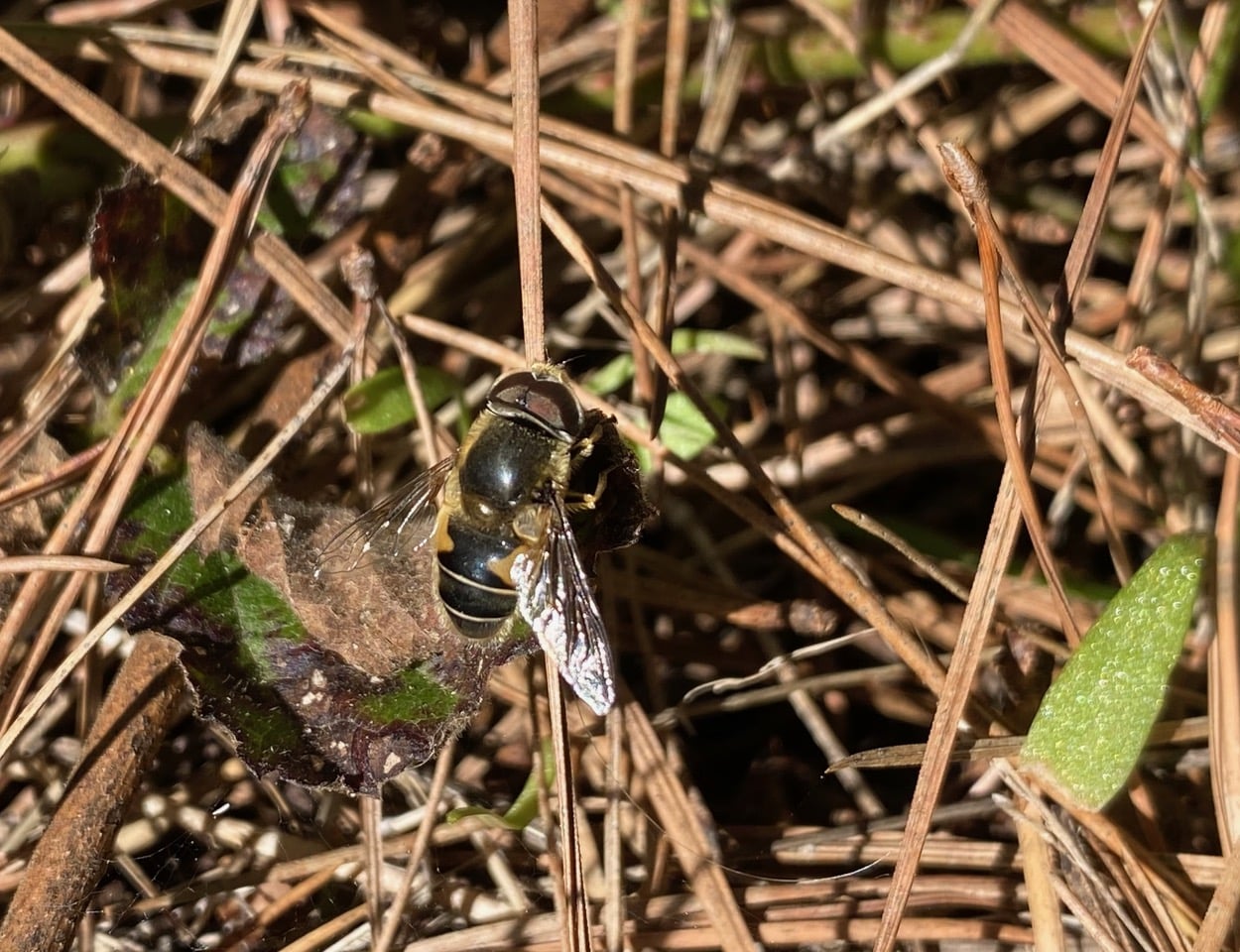
A male Black-footed Drone Fly, Eristalis hirta (family Syrphidae) perches on the leaf litter, also with its back to the sun. Note the holoptic eyes that meet on top of the head – a characteristic found in male hover flies. The females have dichoptic eyes that are set apart on the head.
About the size of a honey bee, the Black-footed Drone Fly, Eristalis hirta (family Syrphidae) is a common Western North American species of hoverfly. The adults visit flowers for nectar and pollen, and are good pollinators. Larvae are aquatic filter-feeders of the rat-tailed type. The “tails” are the siphons or breathing tubes that extend from their rear end to enable the larvae to breathe while submerged in aquatic or semi-aquatic environments. They are important decomposers/recyclers of organic matter. When mature, the larvae climb out to pupate on dry land.