

Pollinator Post 1/16/26
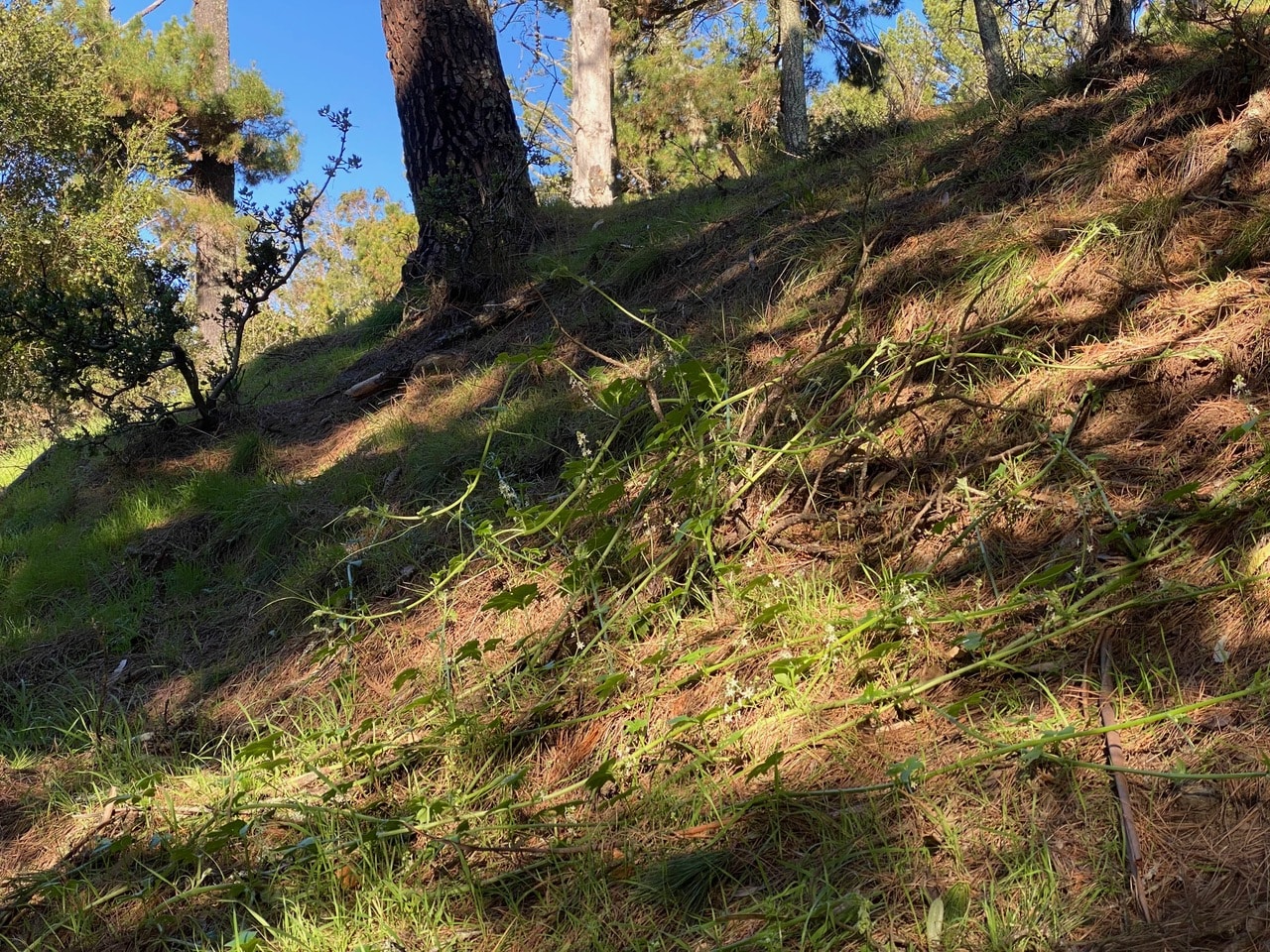
It is wildly windy at Joaquin Miller Park, I am surprised to find when I arrive this sunny morning. I can barely keep my hat on my head. There won’t be any insects in flight for sure.
In the dappled shade of the Monterey Pines, a Wild Cucumber, Marah oregana is sprawled on the steep slope in a mad tangle of vines.
Wild Cucumber
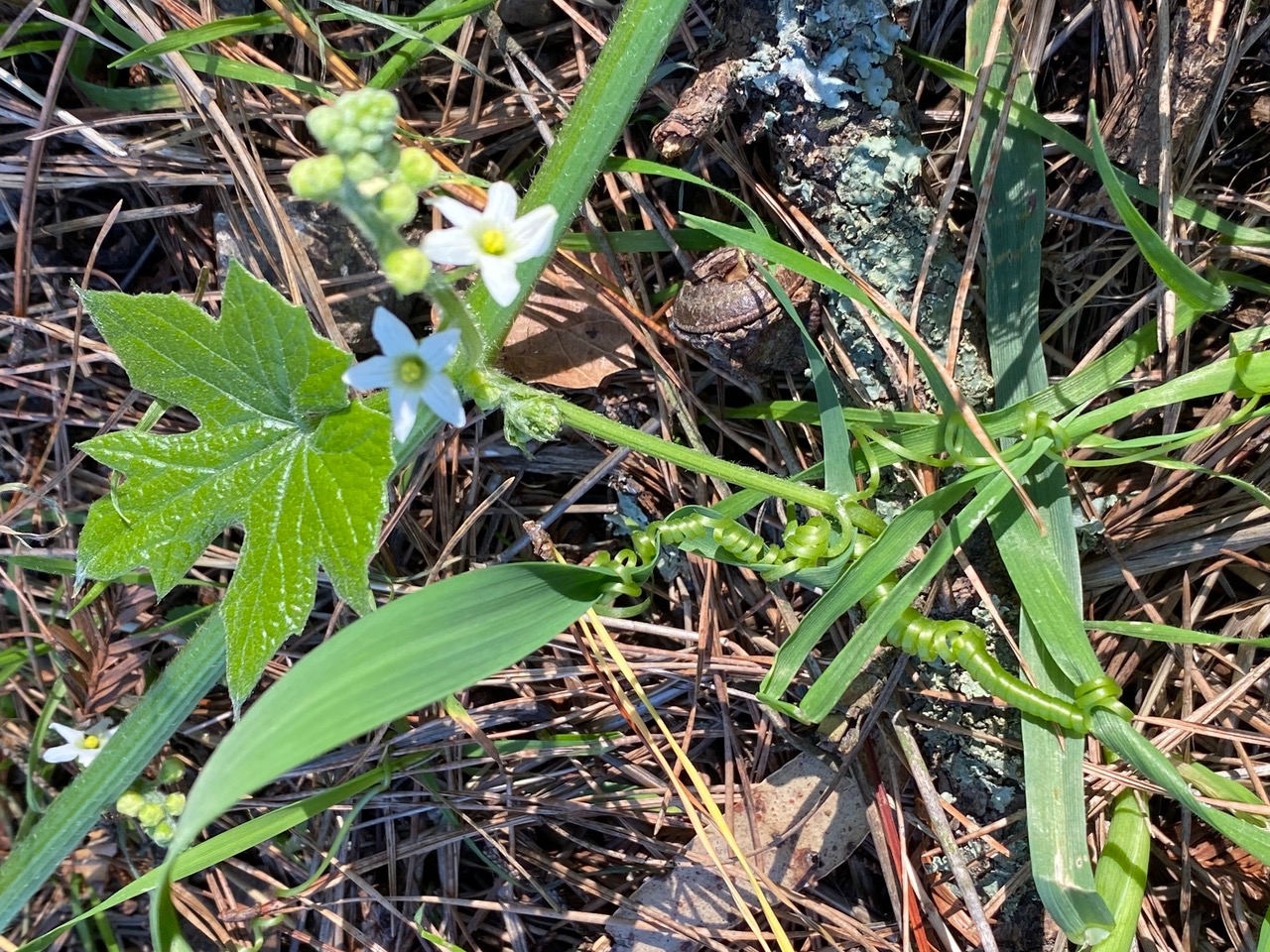




Failing to find woody structure for support, the vine has anchored itself tenaciously to the ground by grabbing nearby grasses with its tightly coiled tendrils.
Sometimes the anchor the tendrils seek can be as tenuous as a pine needle on the forest floor.
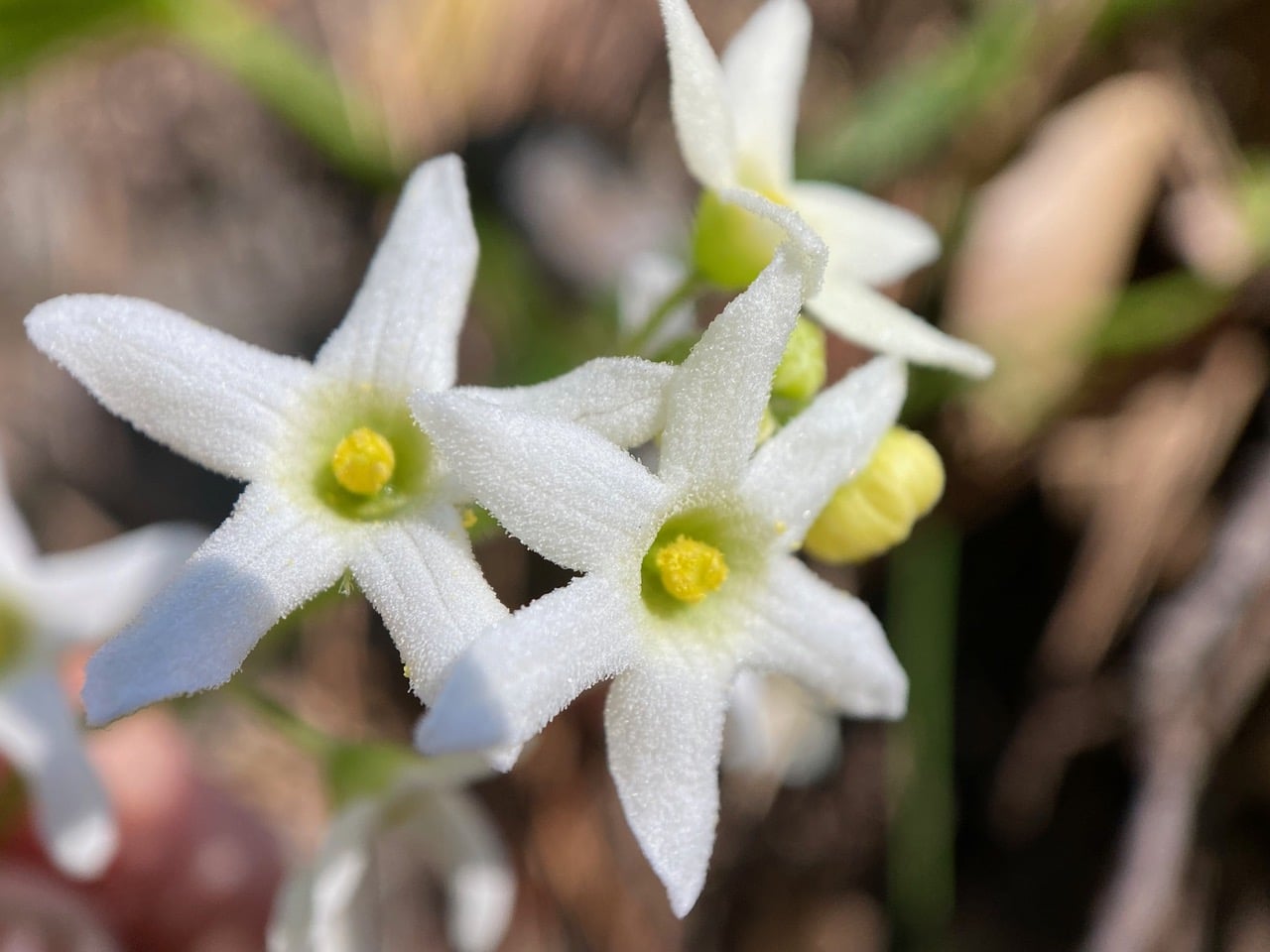
The Wild Cucumber is blooming profusely, with erect spikes of male flowers appearing at regular intervals along its vines.
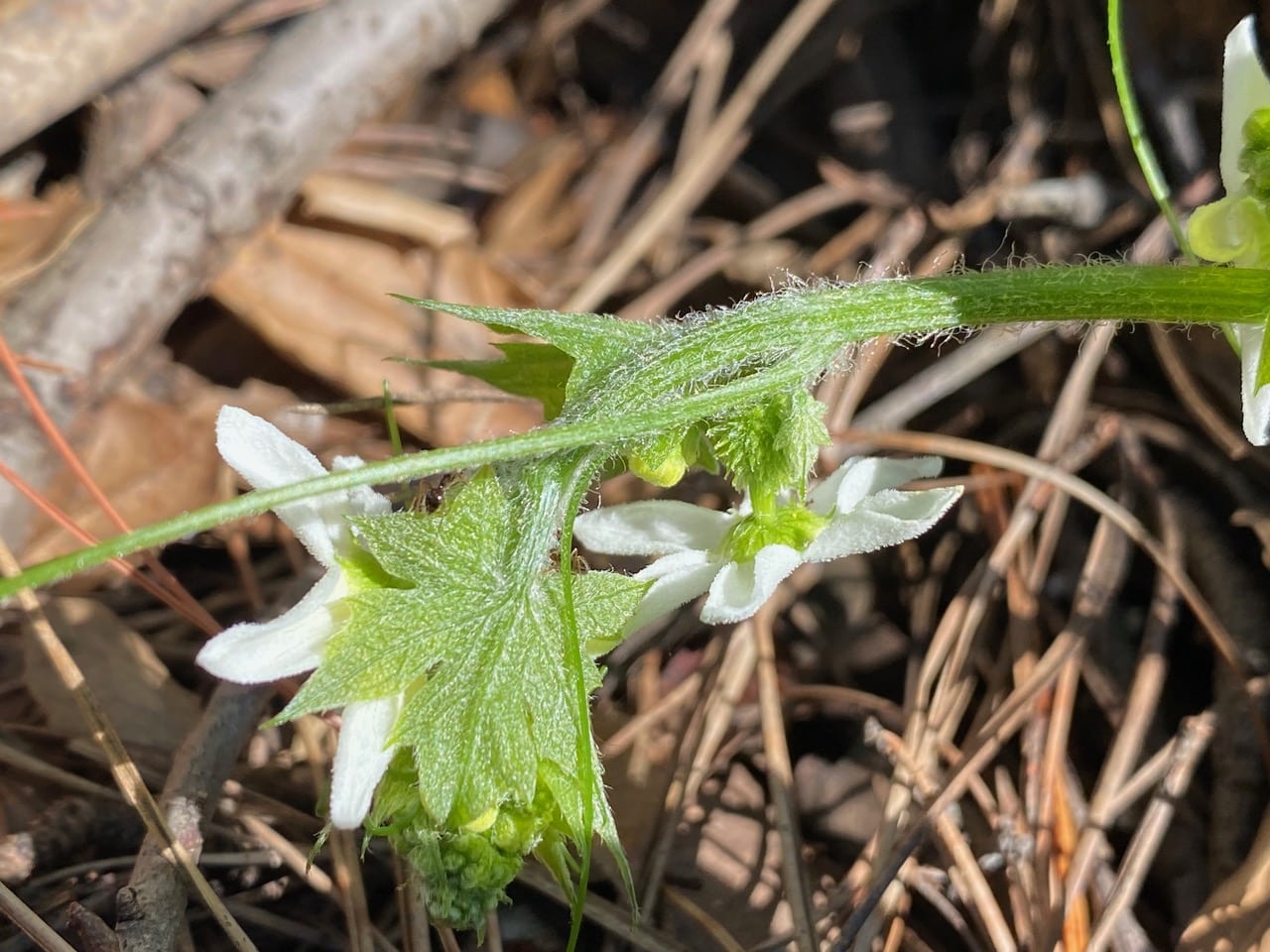
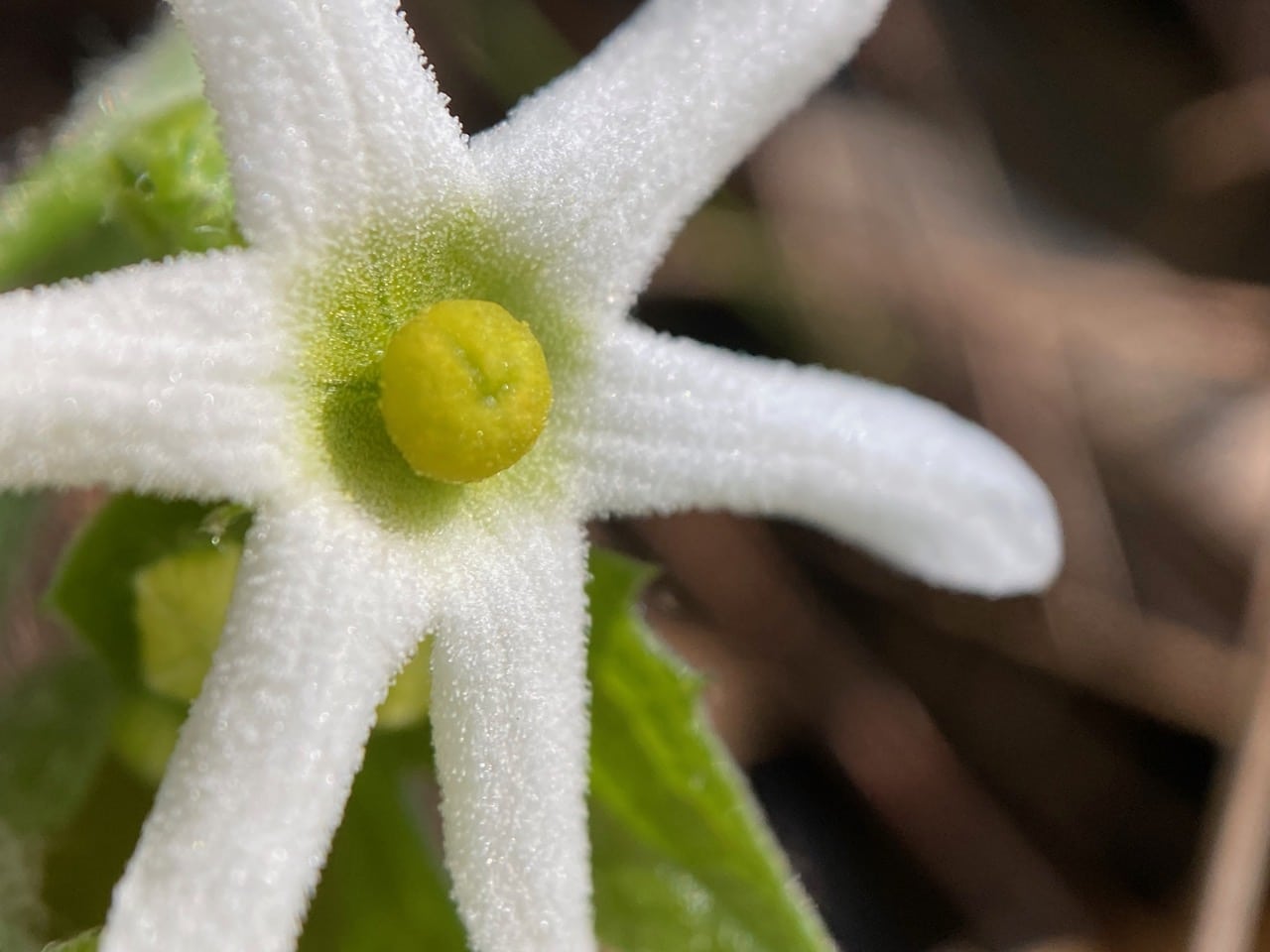
Wild Cucumber is monoecious, meaning that it bears separate male and female flowers on the same plant. Male flowers appear in open spikes while solitary female flowers appear at the leaf axil, often beneath the male flowers. A small spiky inferior ovary is already evident when the female flower is very young. This will eventually develop into a spiky fruit.
There are some female flowers too. Note the female flower that is hanging upside down near the terminal male inflorescence of this vine. Under the flower, a fuzzy green ovary is already evident.
Besides the inferior ovary, one can tell a female flower by the smooth, globular style/stigma in the center of the shallow cup at the base of the fused petals.
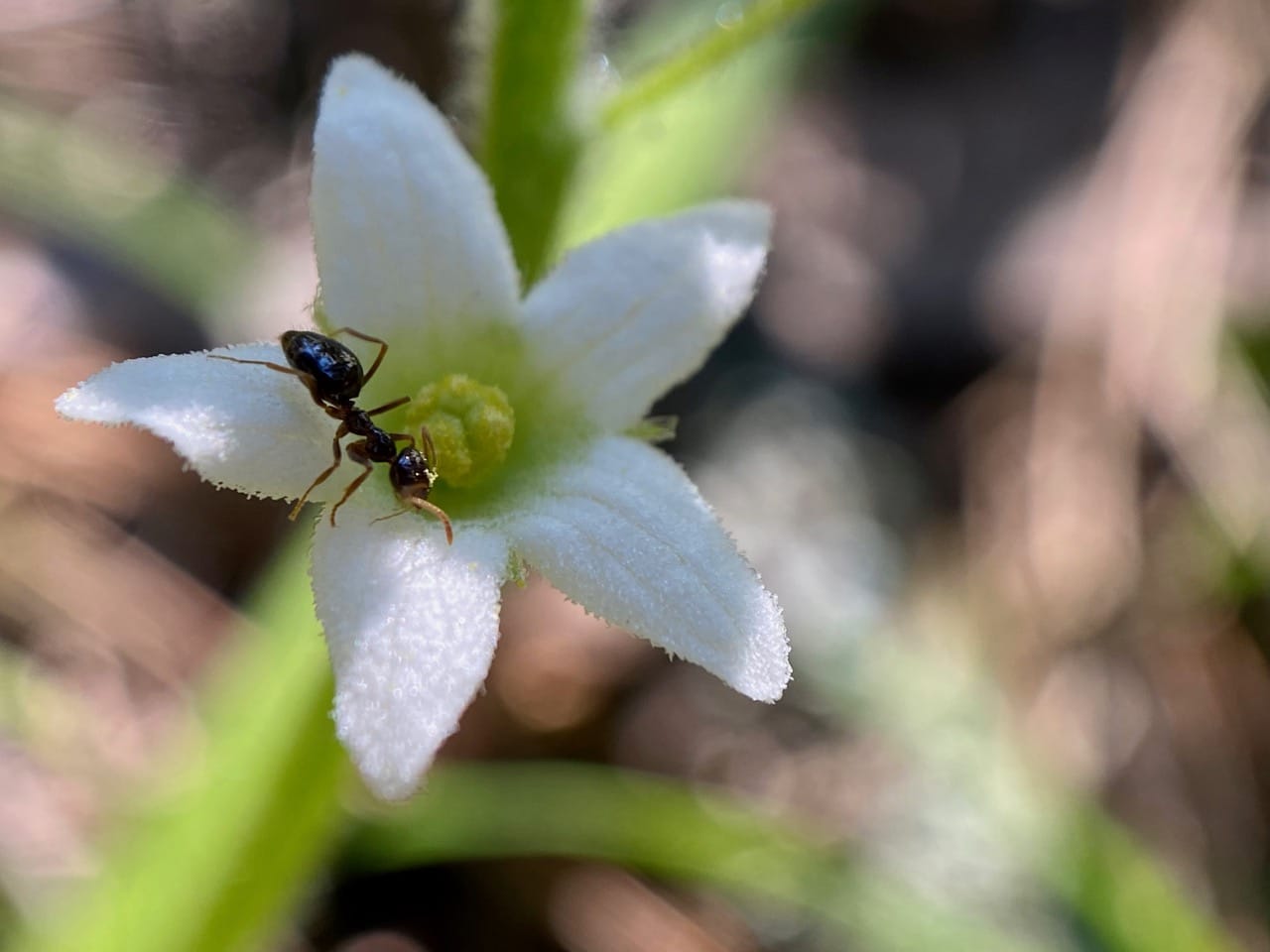
An American Winter Ant, Prenolepis imparis is exploring a male flower of Wild Cucumber.
The American Ant, Prenolepis imparis (family Formicidae) is a widespread North American ant. A dominant woodland species, it is most active during cool weather, when most other ant species are less likely to forage. This species is one of a few native ants capable of tolerating competition with the invasive Argentine Ant, Linepithema humile. They are also aggressive toward other ants and produce abdominal secretions that are lethal to Argentine Ants. Prenolepis imparis is a generalist omnivore. Foragers are known for tending to aphids or scale insects from which they consume excreted honeydew, aggregating on rotting fruit, and exploiting protein-rich sources such as dead worms. The colony enters estivation (a hibernation-like state) and becomes inactive above ground for the warmer months, during which time eggs are laid and brood are reared. Reproductives overwinter and emerge on the first warm day of spring for their nuptial flight.
To access nectar at the base of the flower, the ant lowers itself through the narrow space between the fused stamens and the corolla. Note the fused yellow stamens in the center of the male flower that is releasing pollen.
This ant is taking a more aggressive and unusual approach to nectaring, by climbing onto the fused stamens and reaching down.
This ant has emerged from the male flower with sticky pollen stuck to its head. It tries to remove the pollen by grooming with its front legs, but is not completely successful. When the ant next visits a female flower, the pollen on its head may be inadvertently transferred to the style/stigma, effectively pollinating the flower.
If the pollen of a male flower on a monoecious plant (which has separate male and female flowers) moves to the stigma of a female flower on the same plant, is it considered self-pollination? Yes, indeed. It’s a specific type of self-pollination called geitonogamy. While it involves different flowers, genetically it’s like self-pollination because the pollen comes from the same individual parent. The disadvantages of self-pollination are well known: it results in a lack of genetic variation that allows for adaptation to the changing environment or potential pathogen attack. However, there are advantages for self-pollinating flowers. First, if a given genotype is well-suited for an environment, self-pollination helps to keep this trait stable in the species. Self-pollination also facilitates rapid colonization. The ability to reproduce independently increases a plant’s potential to establish self-sustaining populations in new, remote environments where mates of the same species might not be available.
Both hermaphroditic and monoecious plants have the potential for self-pollination leading to self-fertilization unless there is a mechanism to avoid it. 80% of all flowering plants are hermaphroditic, meaning they contain both sexes in the same flower, while 5% of plant species are monoecious. The remaining 15% would therefore be dioecious (each plant unisexual). Plants have a bewildering number of ways to handle the challenges of reproduction!
Touching antennae, two American Winter Ants greet each other as they cross paths on a Wild Cucumber vine.
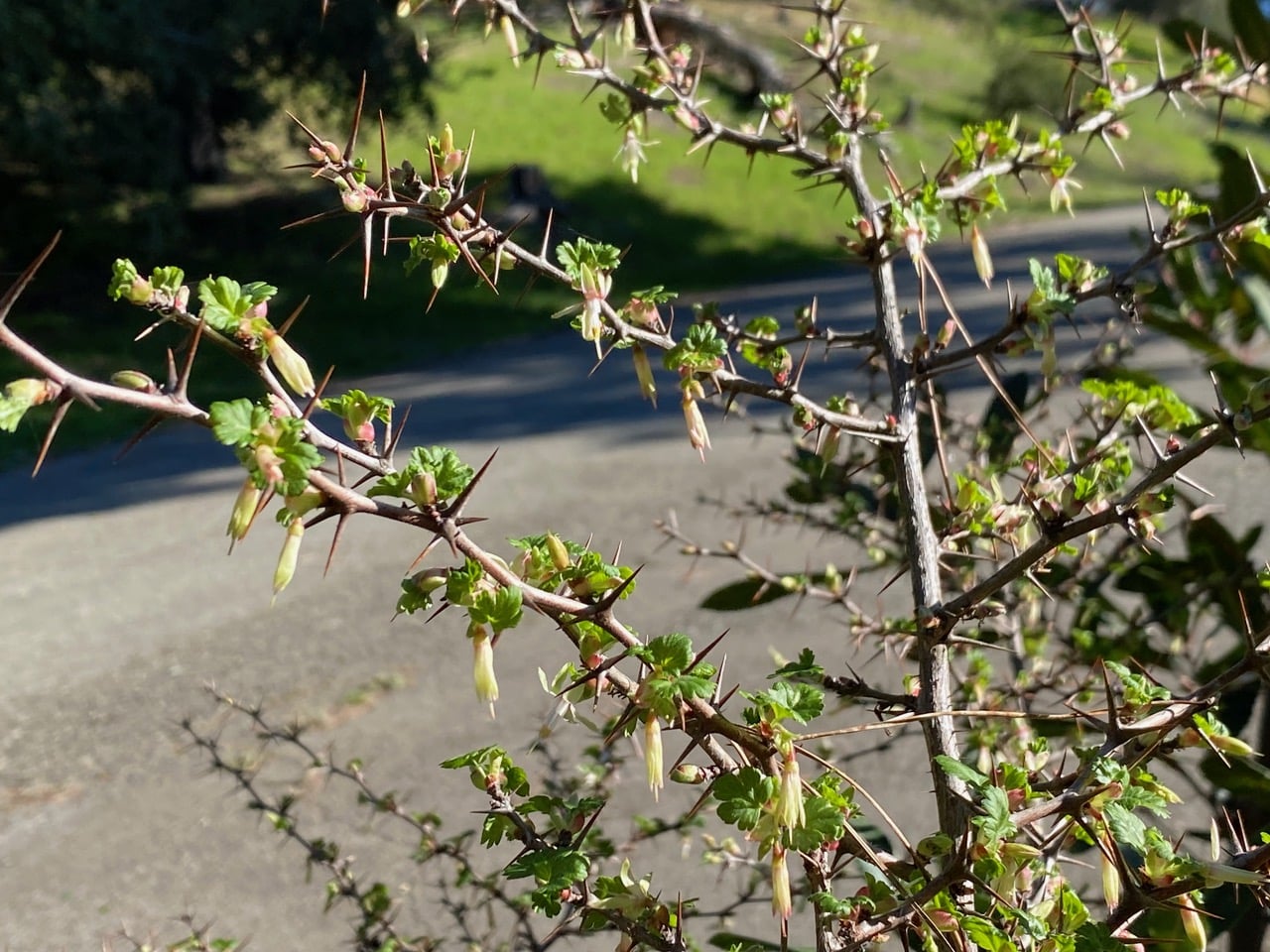
Passing the FOSC Native Plant Nursery, I spot an Anna’s Hummingbird hovering around a small-leaved shrub in the front garden. What is the bird seeking nectar from?
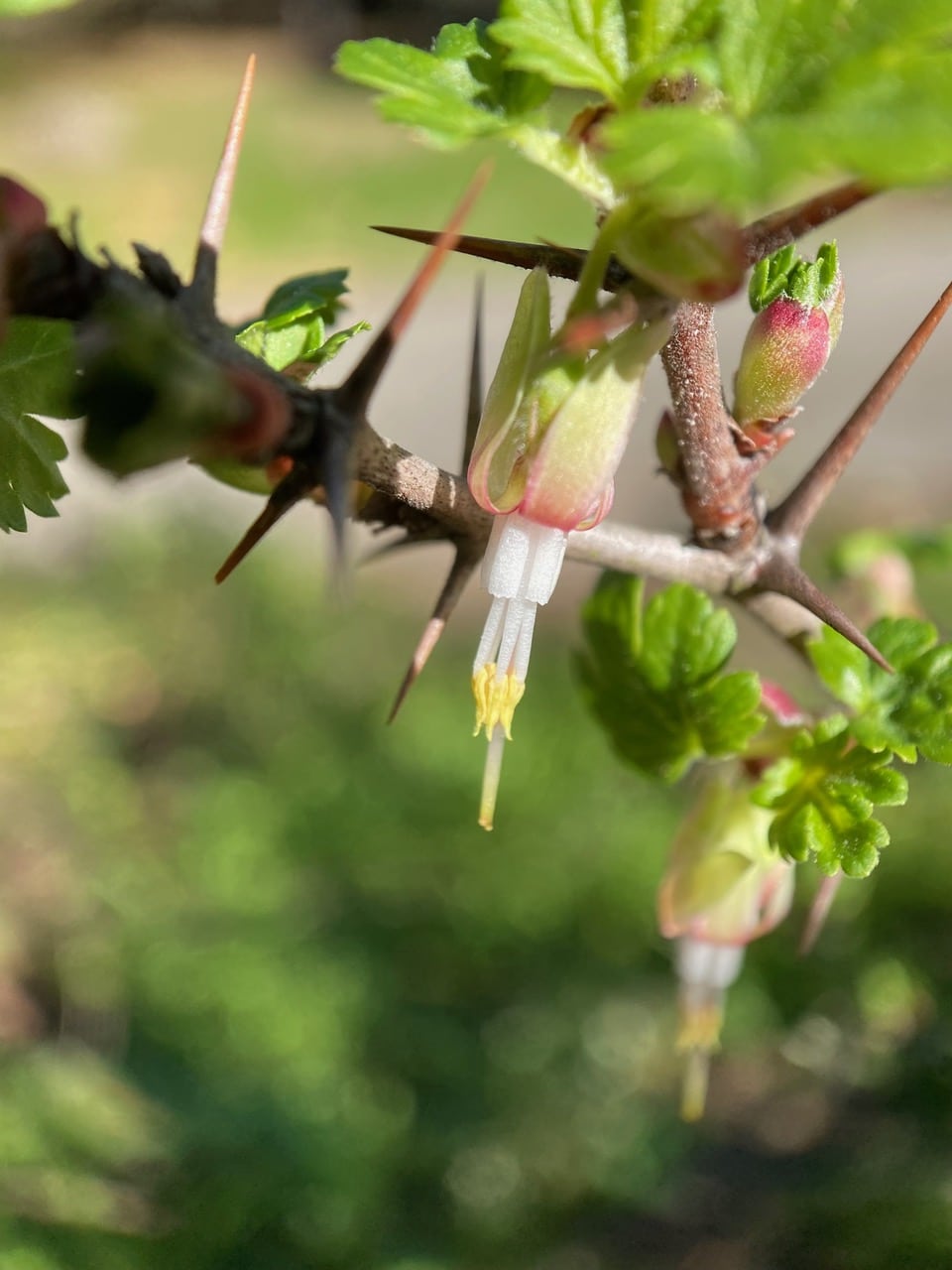
Taking a closer look, I realize that the hummingbird was taking nectar from the small, hanging flowers of a Gooseberry, Ribes sp. There’s only a faint blush of red on the base of the reflexed sepals.
The genus Ribes includes gooseberries and currants. The gooseberries are easily distinguished by their spiny stems. The charming hanging flowers have sepals that are reflexed, or folded backwards along the length of the flower. The petals are white and extend forward to form a loose tube from which the stamens emerge. The plant is known to attract bees, butterflies, hummingbirds and other pollinators. The protruding anthers dab pollen onto visitors that hover for nectar, and the even longer style/stigma in the center of the stamens serve to receive incoming pollen. What a neat and elegant arrangement!
In past years, I have observed bumble bees (Bombus) and Digger Bees (Anthophora, Habropoda) seek nectar from our native Gooseberries. A small black Miner Bee (family Andrenidae) is often seen clinging onto the filaments to gather pollen from the individual anthers.

Across the road, just past the plant nursery the stand of Blueblossom Ceanothus, Ceanothus thyrsiflorus has started to bloom on the hillside. Usually the plants are buzzing with bumble bees at this stage, but it is all quiet today except for the howling winds. Perhaps it’s too windy for even the bumble bees to be flying. Hey, do you see the Jumping Spider (family Salticidae) to the left of the inflorescence?
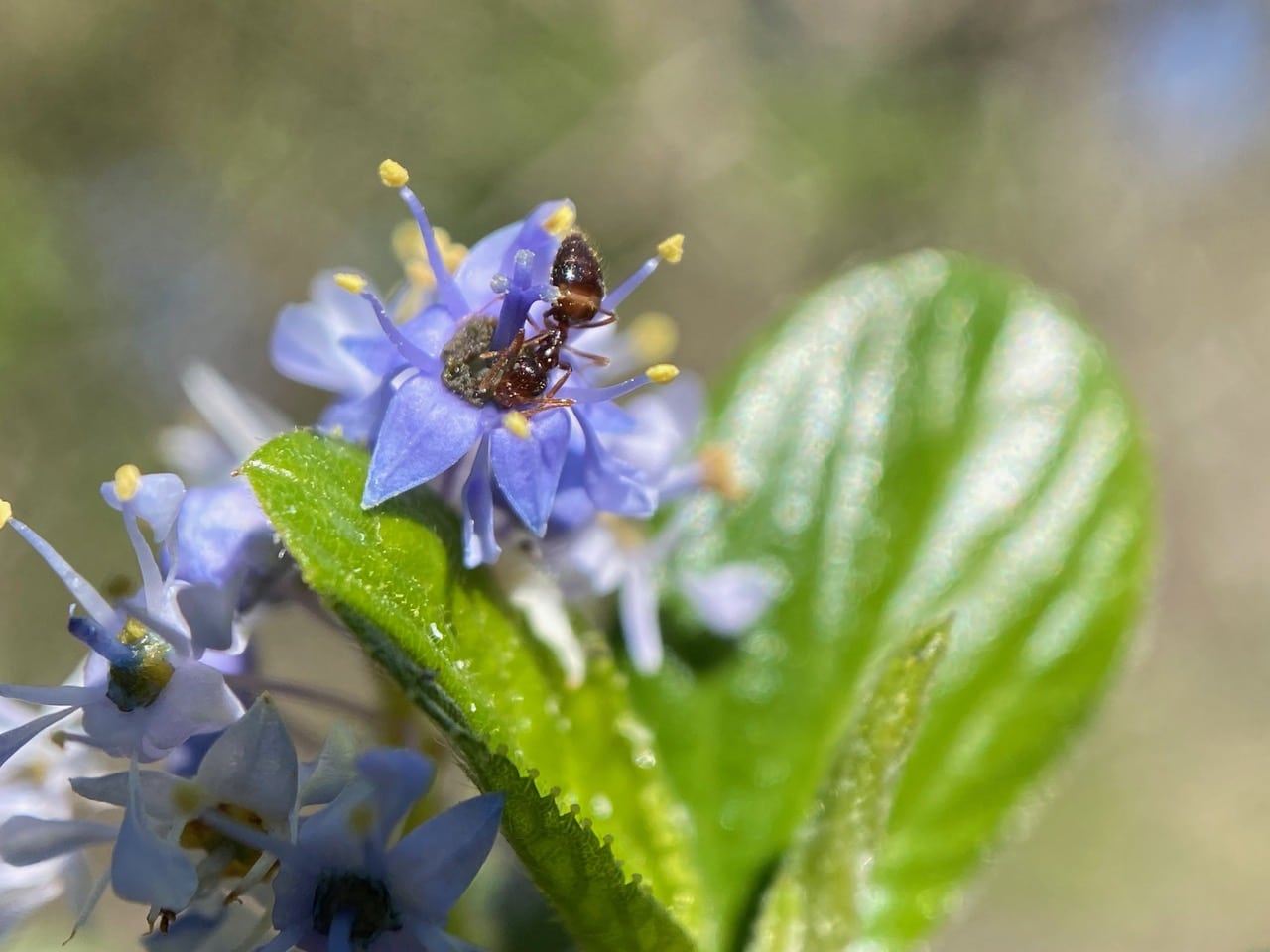
Even in the strongest of winds, the Ceanothus flowers have attracted some flightless insects – ants! An American Winter Ant, Prenolepis imparis (family Formicidae) is feeding obsessively on a Ceanothus flower. It is focused on the gelatinous dark disc at the base of the petals. This must be the nectar gland? In younger flowers, these structures are yellow.

The individual Ceanothus flowers consists of 5 hooded sepals, 5 scoop-like petals, 5 stamens attached to a nectar-bearing disc, and a superior 3-lobed ovary. Both the sepals and petals are similarly colored.
With its shallow, open-faced flowers, fully exserted stamens offering generous pollen, and production of copious nectar, it’s no wonder that Ceanothus is one of our best early-blooming natives for supporting pollinators. Bumble bees are often seen performing an exaggerated sashay through the inflorescence to collect pollen. It’s a gleeful thing to watch!
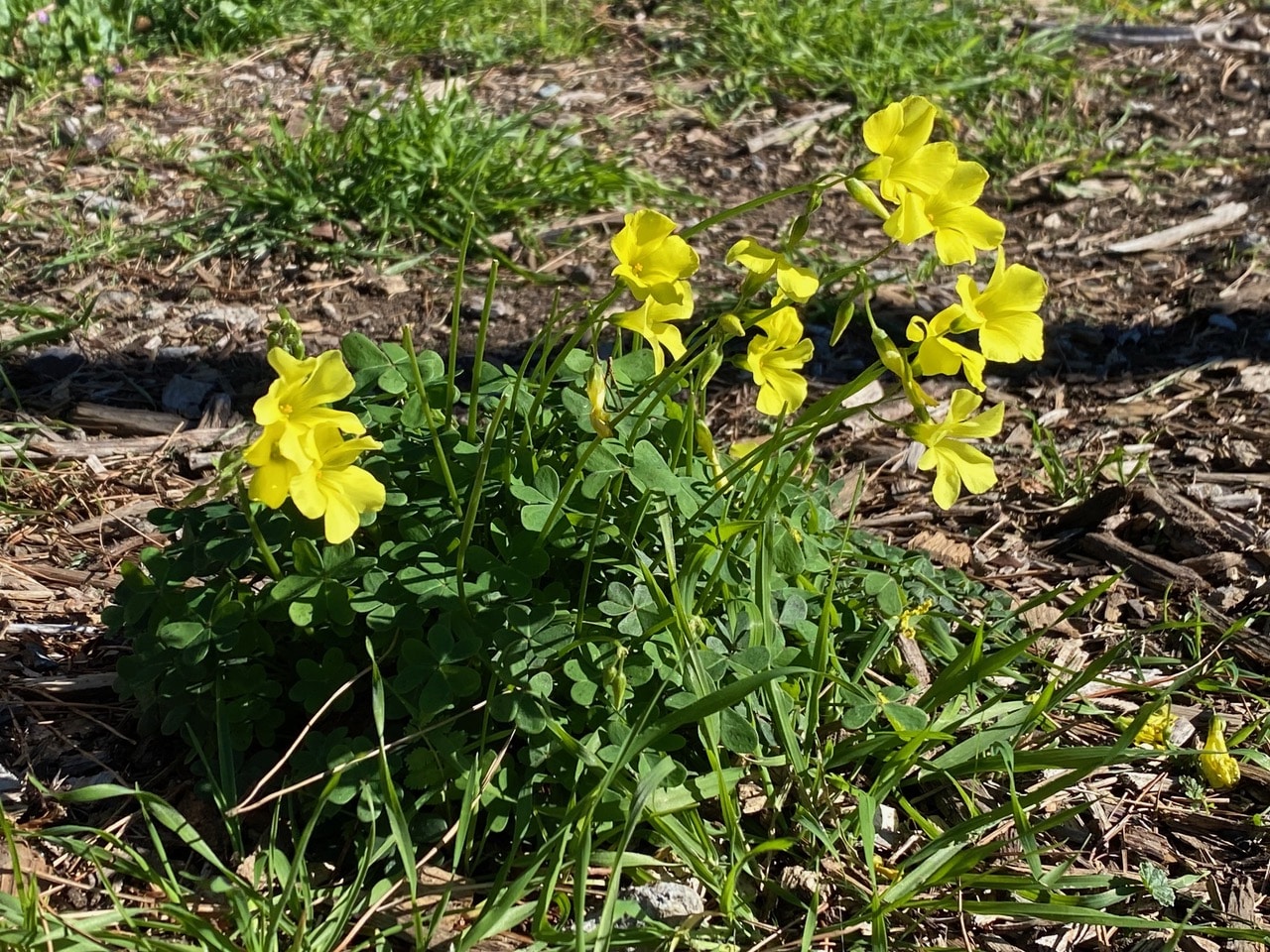
The yellow flowers of Bermuda Buttercup, Oxalis pes-caprae are blowing wildly in the winds. Maybe it’s time for me to go home.
Commonly known as Sourgrass or Bermuda Buttercup, Oxalis pes-caprae blooms from November to April in our area. The plant is native to South Africa, and was introduced to California early in the 1900s, probably as a pretty ornamental plant. It is now a persistent nuisance in home gardens and has taken over the coastal grasslands. Its success is mainly due to its prolific underground bulb production, allowing it to survive dry spells and resprout aggressively after rains, thriving in disturbed soils and outcompeting other plants for resources. It spreads rapidly via these easily dislodged bulbs and produces many daughter bulblets, making it extremely difficult to eradicate with manual removal, as tiny fragments left behind quickly grow into new plants.