

Pollinator Post 1/13/25
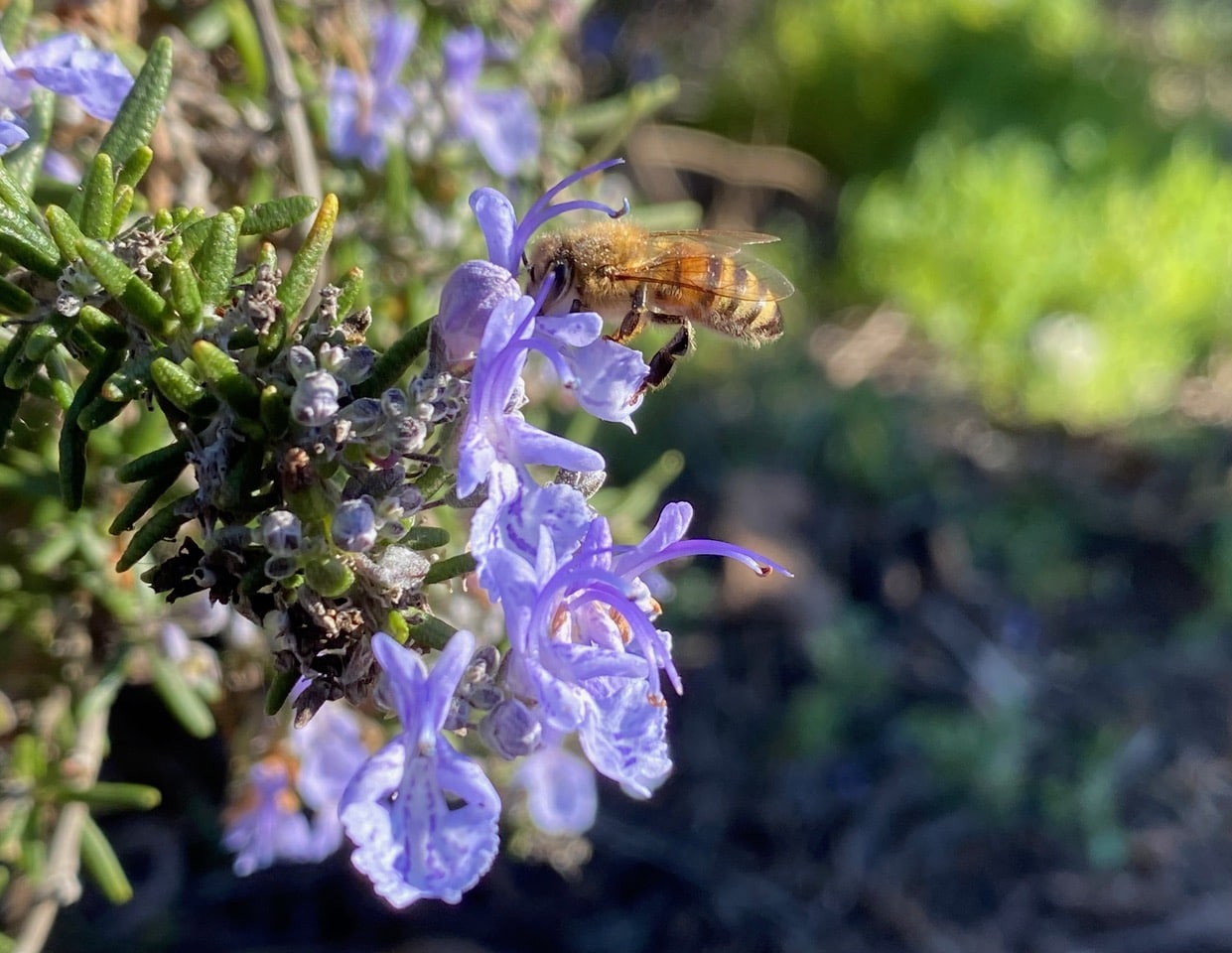
I pay a visit to Mendocino Park in Richmond, a native garden run by dedicated volunteers from the neighborhood. Taking a quick walk around the garden, I am disappointed that none of the native plants have started to bloom. At the front of the garden, the original Rosemary bushes, Salvia rosmarinus (family Lamiaceae) are in glorious bloom. Although the plant is not native, the bees (both native and non-native) are intensely attracted to the flowers – a good source of both nectar and pollen. Today the visitors are all Honey Bees, Apis mellifera (family Apidae). I pause for a treat – the dance between Rosemary flowers and bees is something to behold.
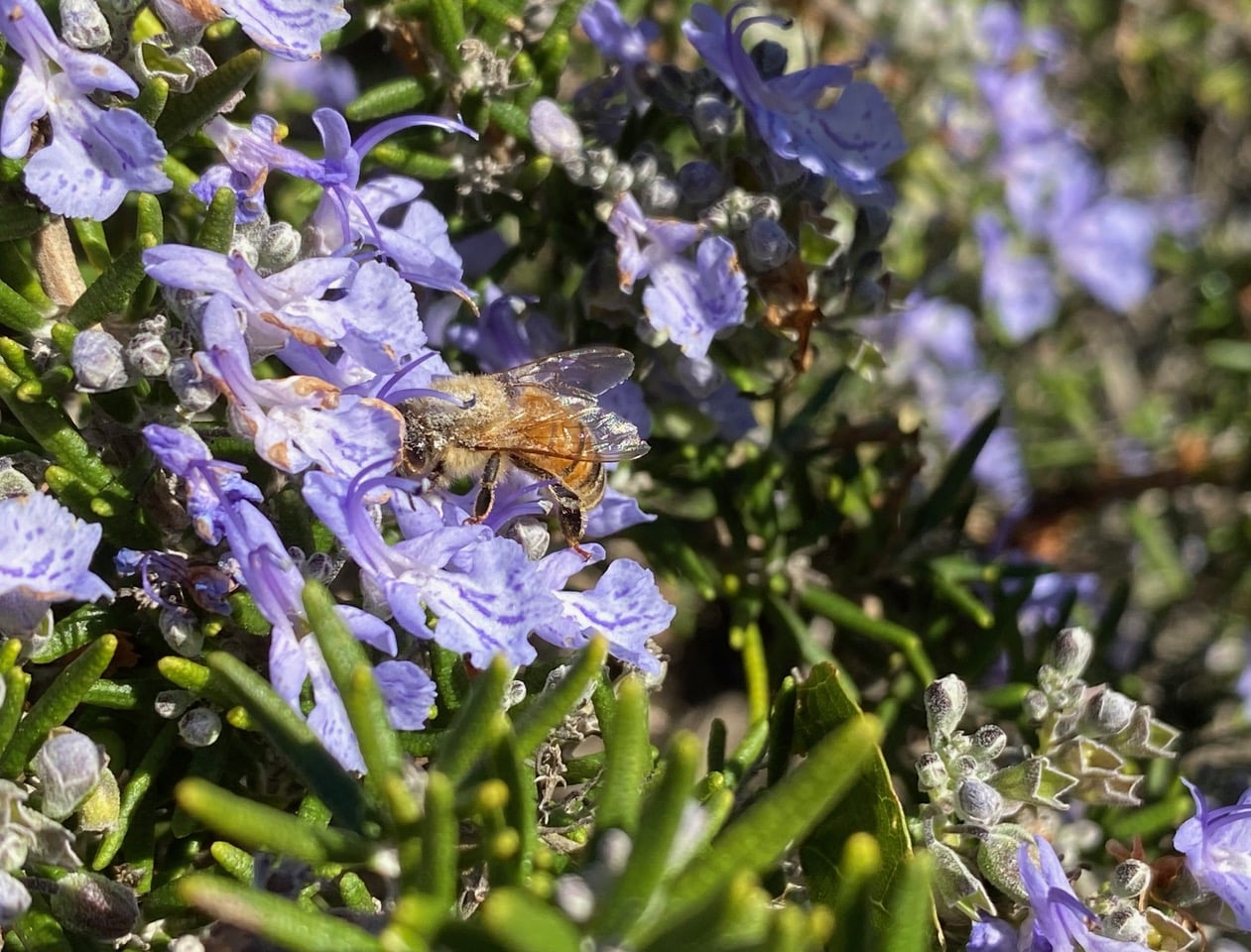
A Honey Bee, Apis mellifera (family Apidae) lands on a Rosemary flower. Perched on the lower lip of the flower, she lowers her head to probe for nectar at the back of the corolla.
Note how the flower’s pair of stamens arch over the bee’s back. The bee is essentially collecting both nectar and pollen simultaneously. The pollen comes as a free bonus, thanks to a unique mechanism in the Salvia reproductive structures.
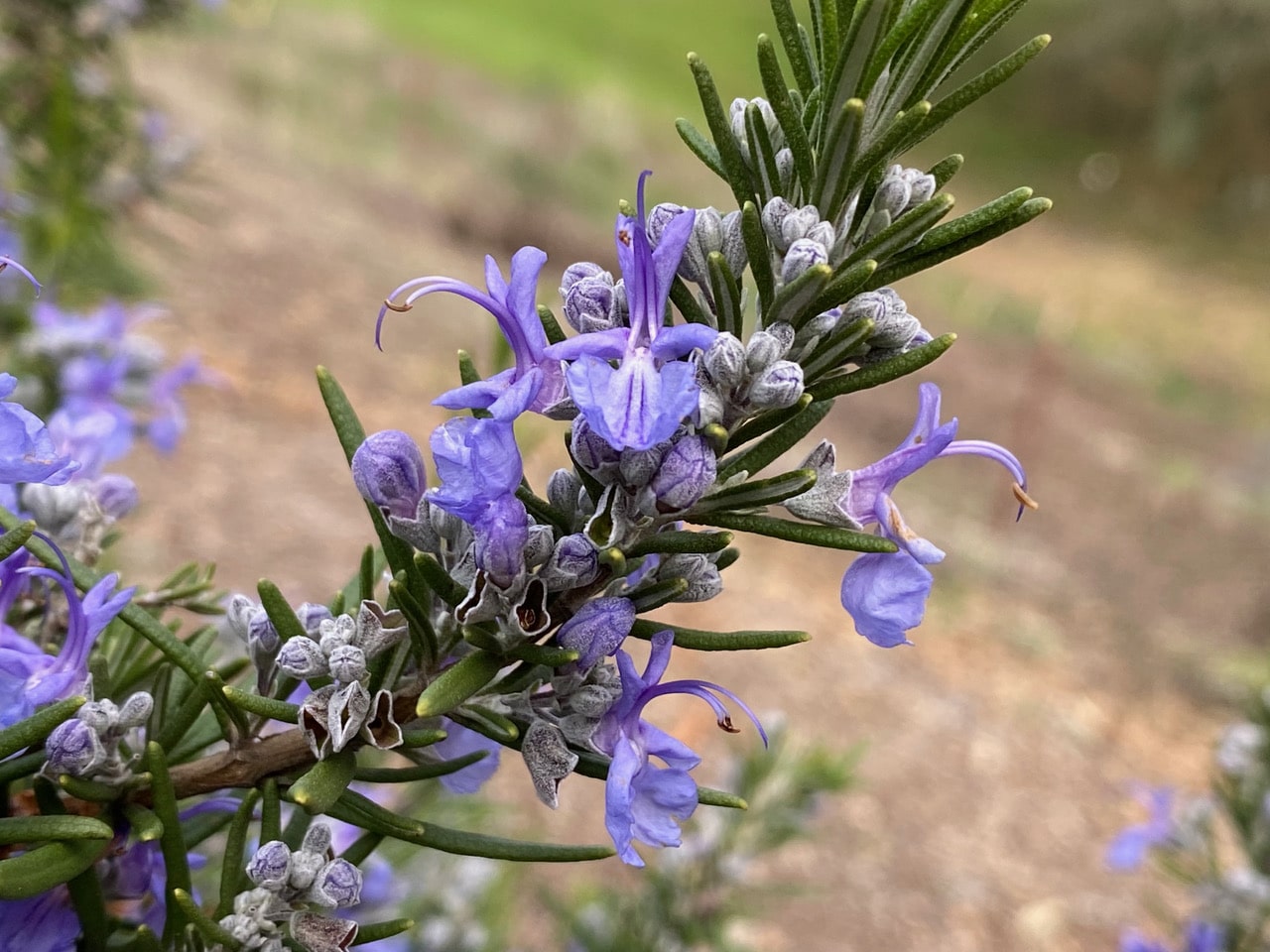
I am re-posting a photo taken on 2/15/24 at Skyline Gardens, Berkeley. It is hard to get a good picture of the Rosemary flower that shows it from all angles.
Sage flowers (genus Salvia) feature a unique pollination mechanism called a “staminal lever”. The flower is bisexual and protandrous, i.e. the male parts mature earlier than the female parts. When a pollinator probes the back of a male-phase flower in search of nectar, a see-saw contraption tilts the pair of pollen-filled (male) anthers down to deposit their load on the back of the insect. When the insect next visits a female-phase flower, the protruding mature stigma will be the first part of the flower to touch the pollinator and will receive the pollen from the previous flower.
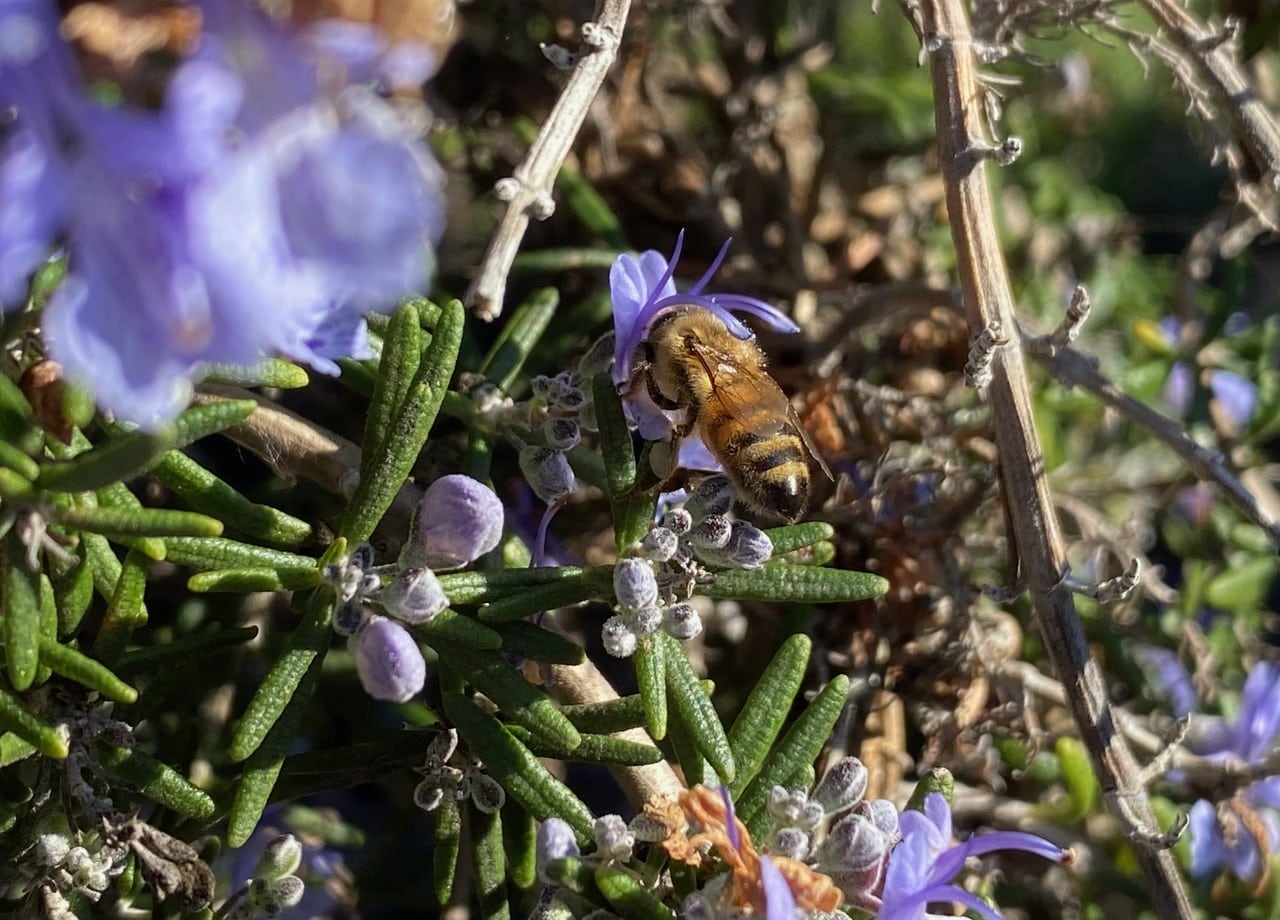
As the bee probes the depths of the flower with her tongue, the arching stamen is lowered onto the bee’s thorax, dabbing it with pollen.
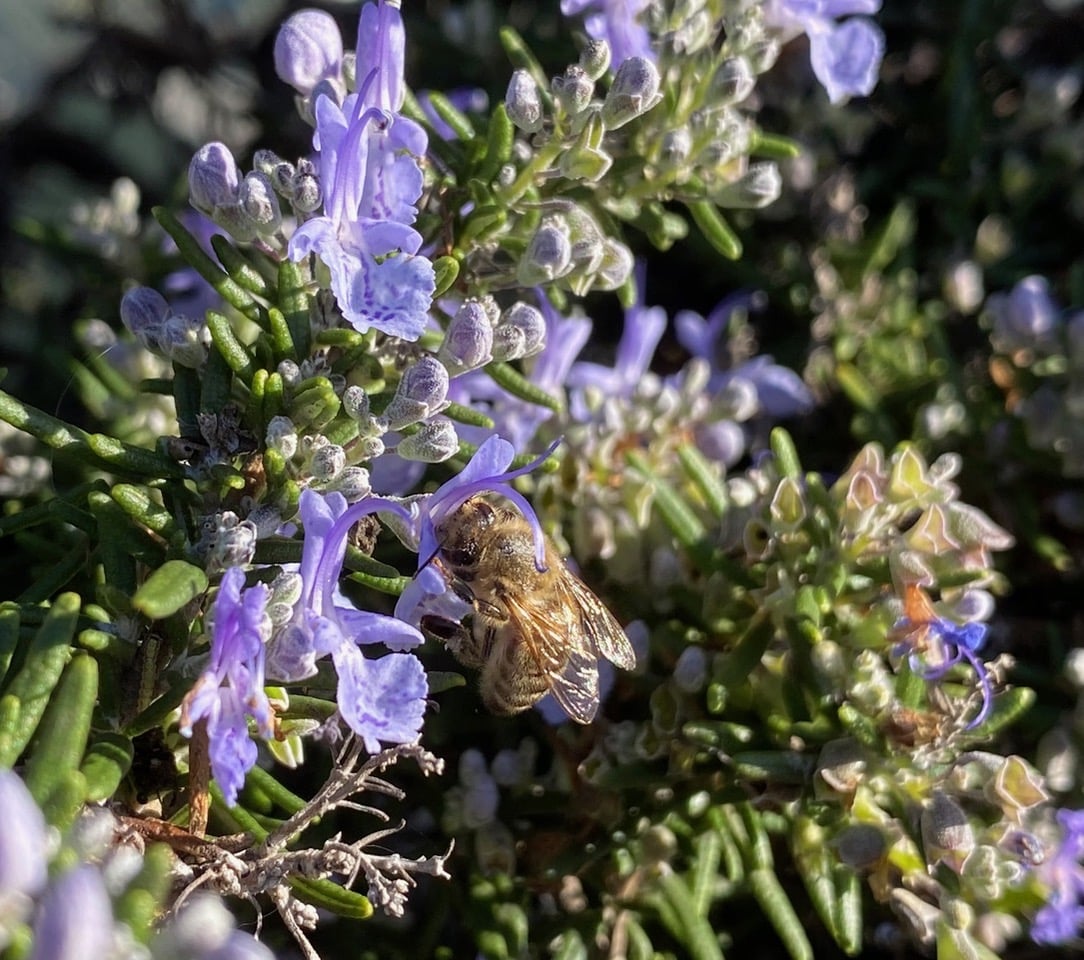
In a few minutes, I watch the staminal lever mechanism work its magic on dozens of bees…
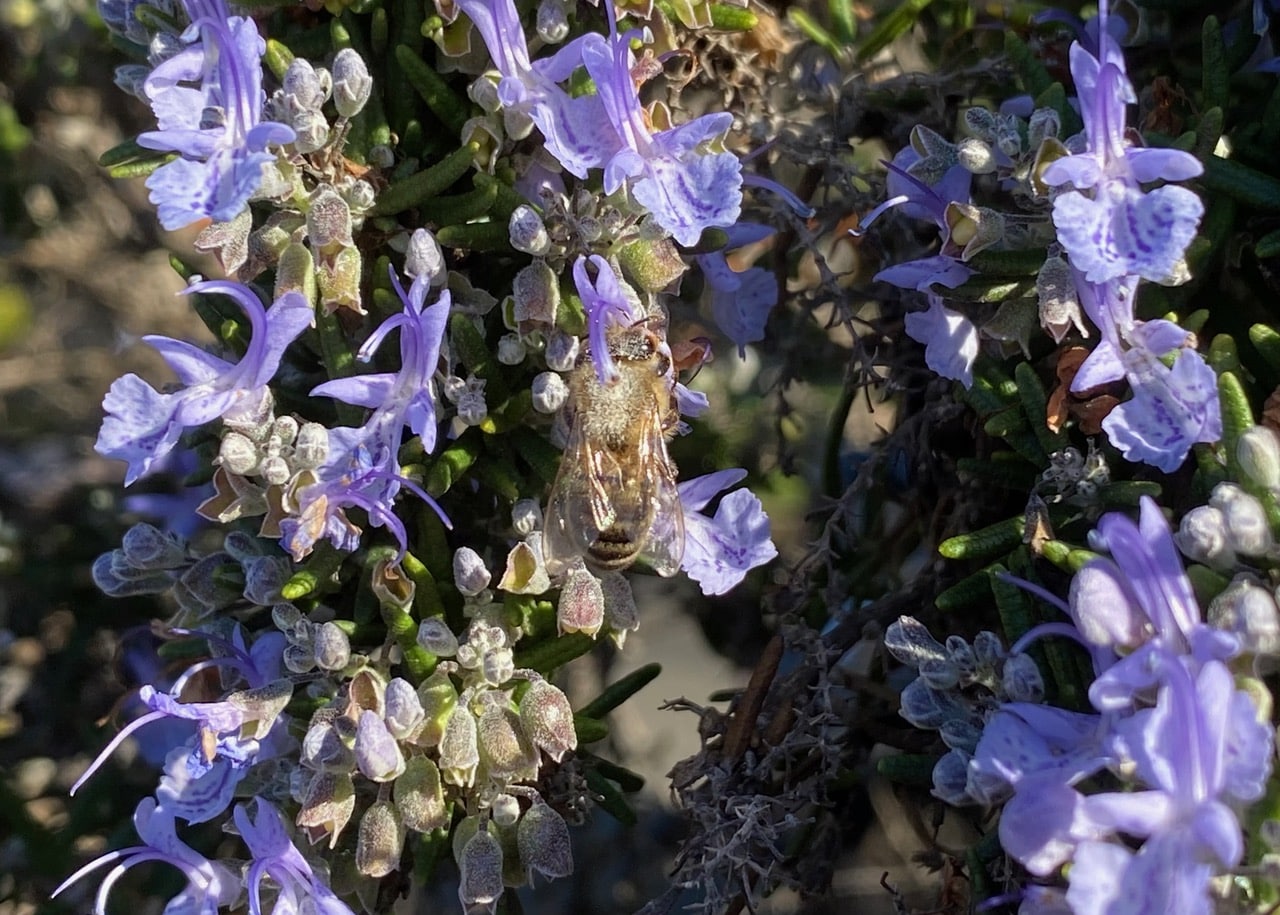
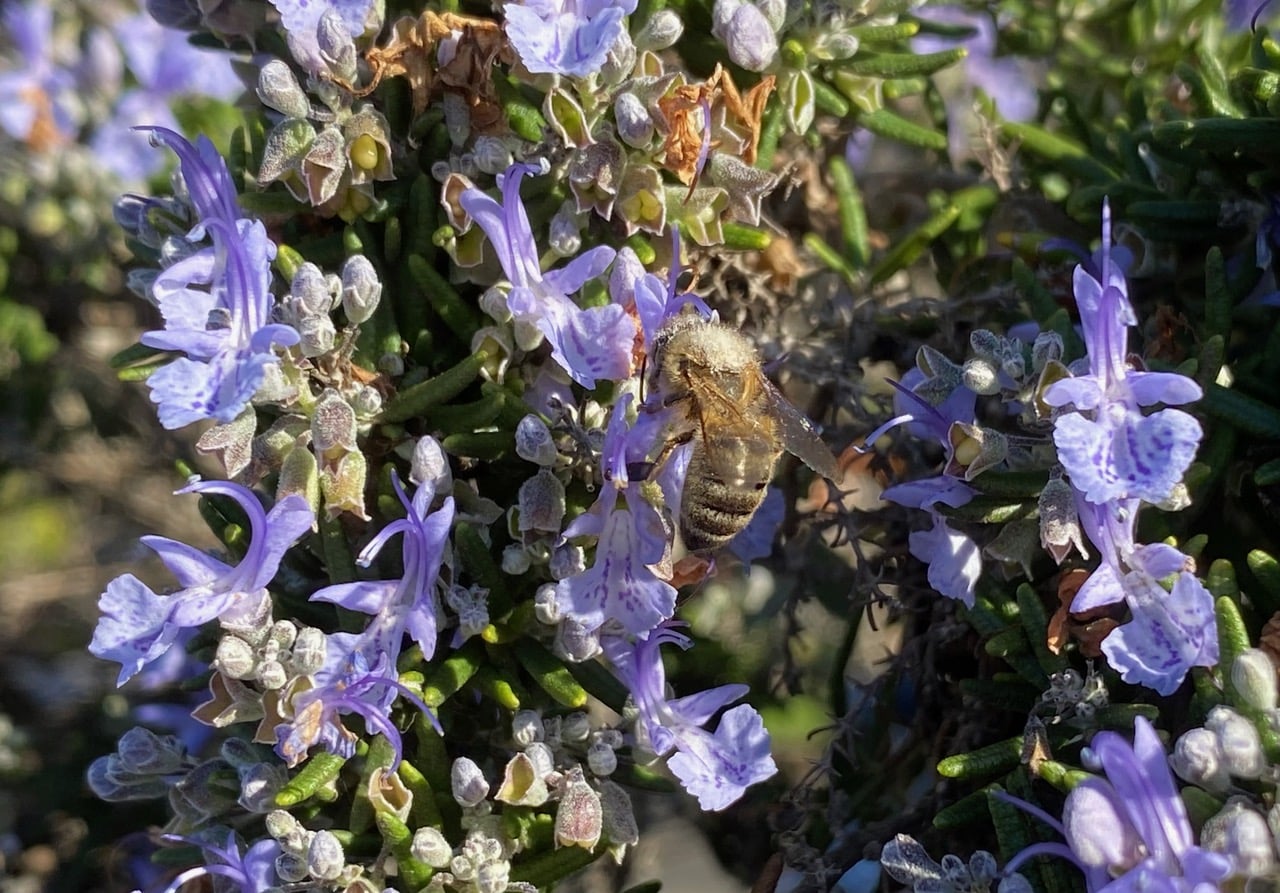
Some of the bees are so loaded with pollen, they can be seen flying around with cream-colored thorax. There are parts of the thorax that the bee can’t reach while grooming. This is the spot where the pollen can be picked up by the arching style and stigma of an older flower in the female phase. The mechanism works beautifully between the Rosemary flower and the Honey Bee – they seem to be made for each other. This is not surprising as both hale from Europe. The plant and its pollinator have co-evolved to help each other survive.
BTW, the staminal lever mechanism does not seem to be functional in the North American species of Salvia. If you find any native sages in which the mechanism works, do let me know!

Occasionally a honey bee would grasp the unopened anthers of the flower to extract pollen directly with its mandibles. I wonder why the bees even bother to do this – the mature flowers freely shower them with abundant pollen.
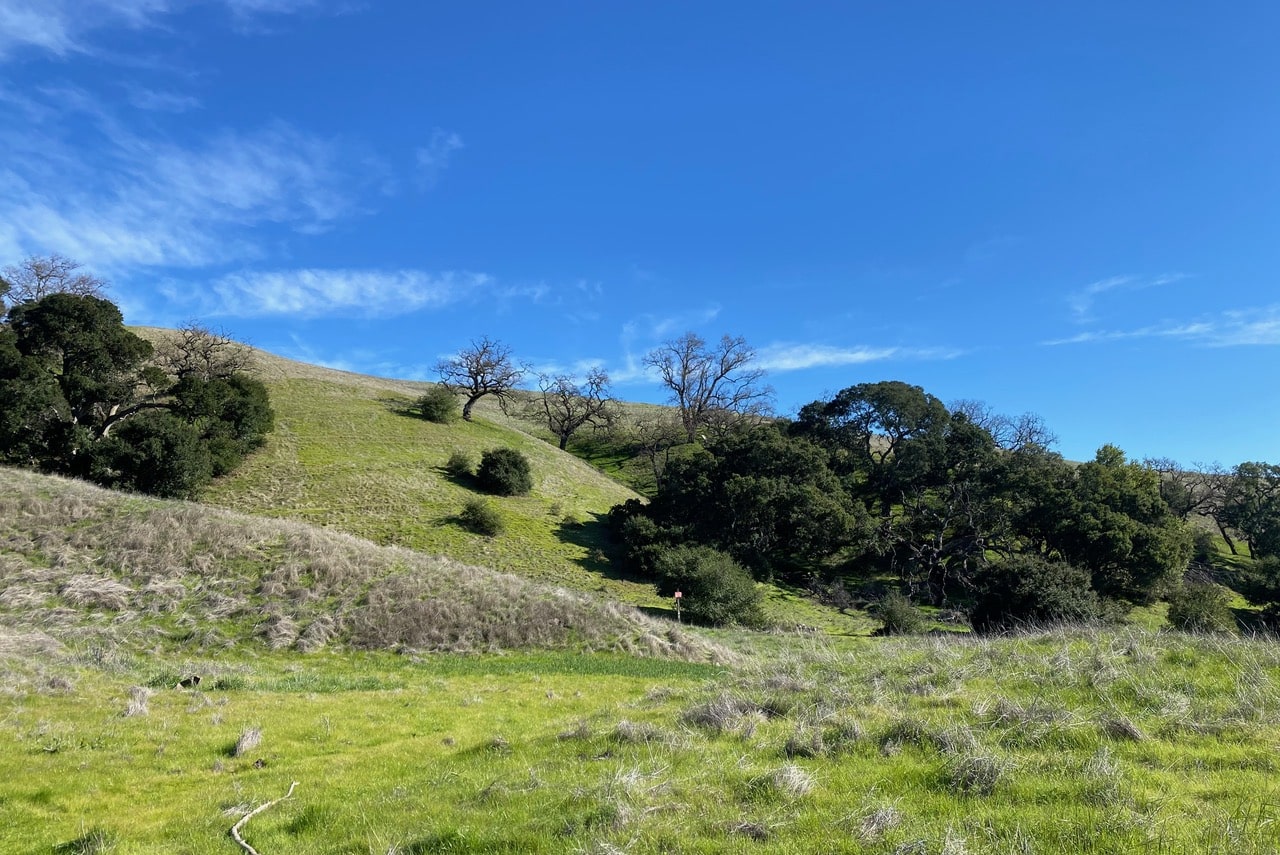
I next head north into Marin County to visit Mt. Burdell Open Space Preserve in Novato. The open vistas of green hills dotted with oak woodland is quintessential California dreamscape.
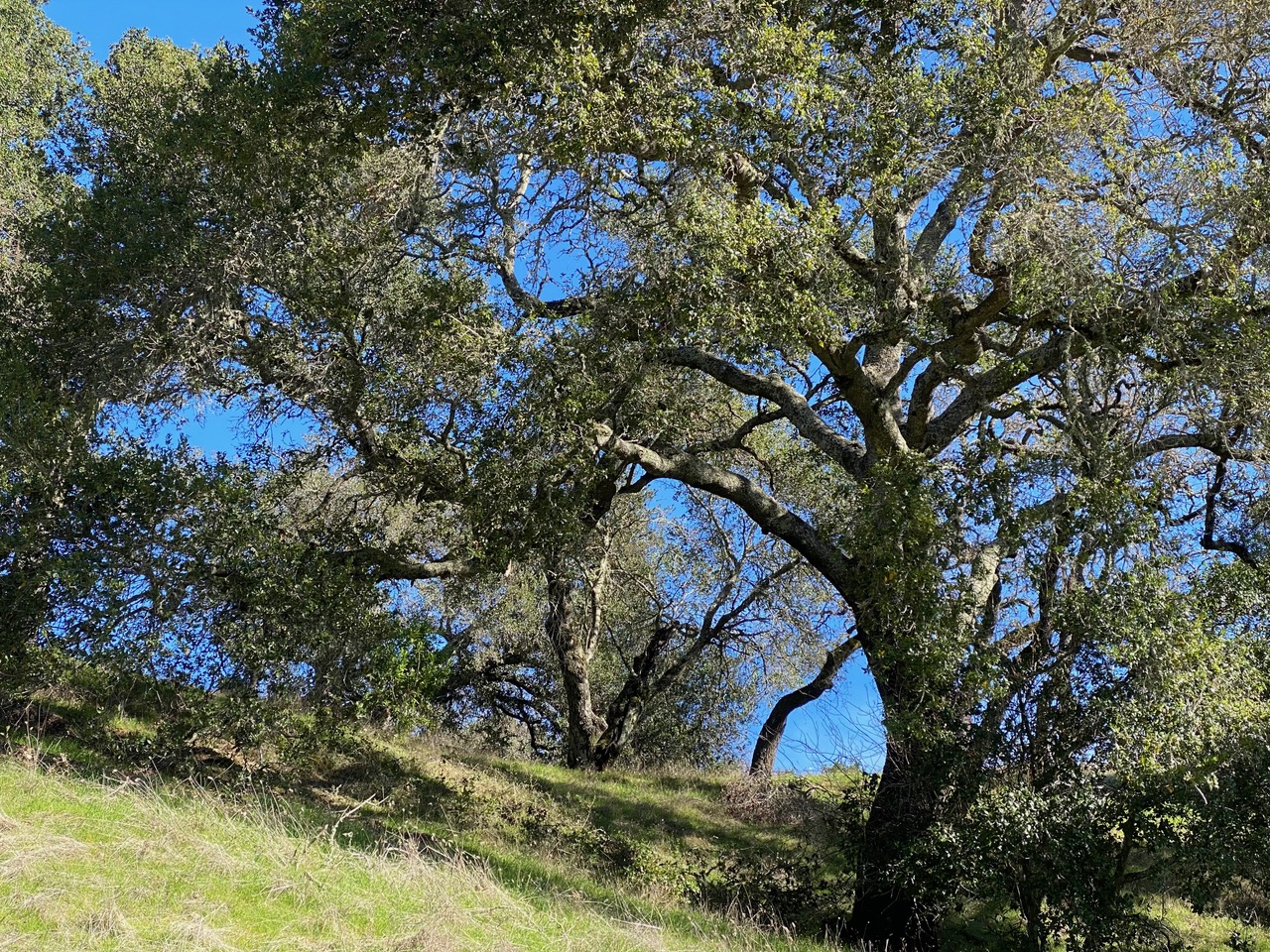
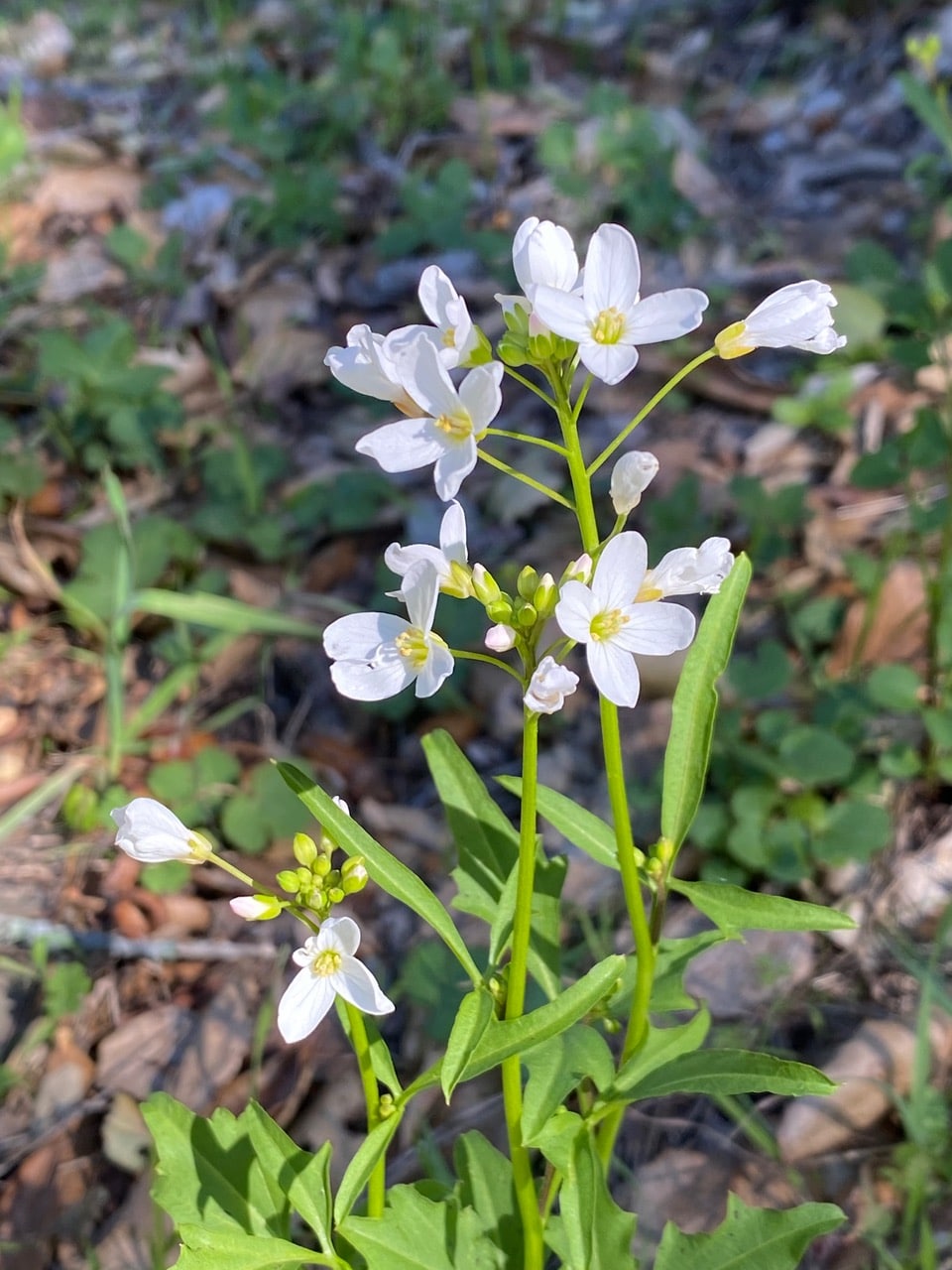
A dozen Milkmaids, Cardamine californica are blooming in the partial shade of oak trees.
Cardamine californica, or Milkmaids, is a herbaceous perennial in the family Brassicaceae, native to western North America from Washington to California and Baja California. It is common in a variety of habitats including shady slopes, open woodlands, chaparral and grasslands in the winter and early spring. In the San Francisco Bay Area, it is one of the first wildflowers to bloom, with blossoms January to May. The flowers are borne on a raceme inflorescence, each flower about 1/2 in. across with four white to pink petals. The flower closes its petals in late afternoon as the sun goes down and nods its pedicel before a rain, protecting the pollen.
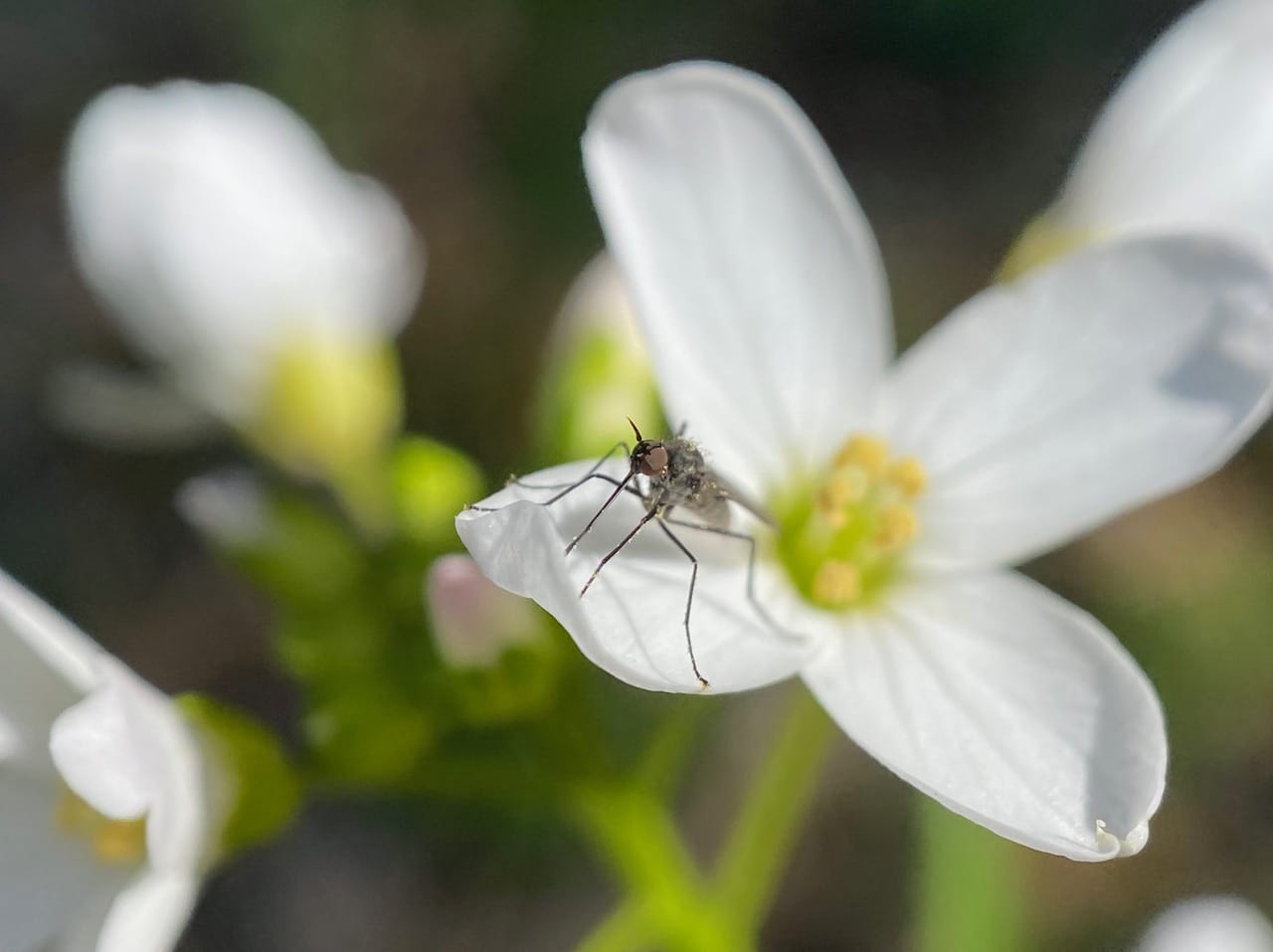
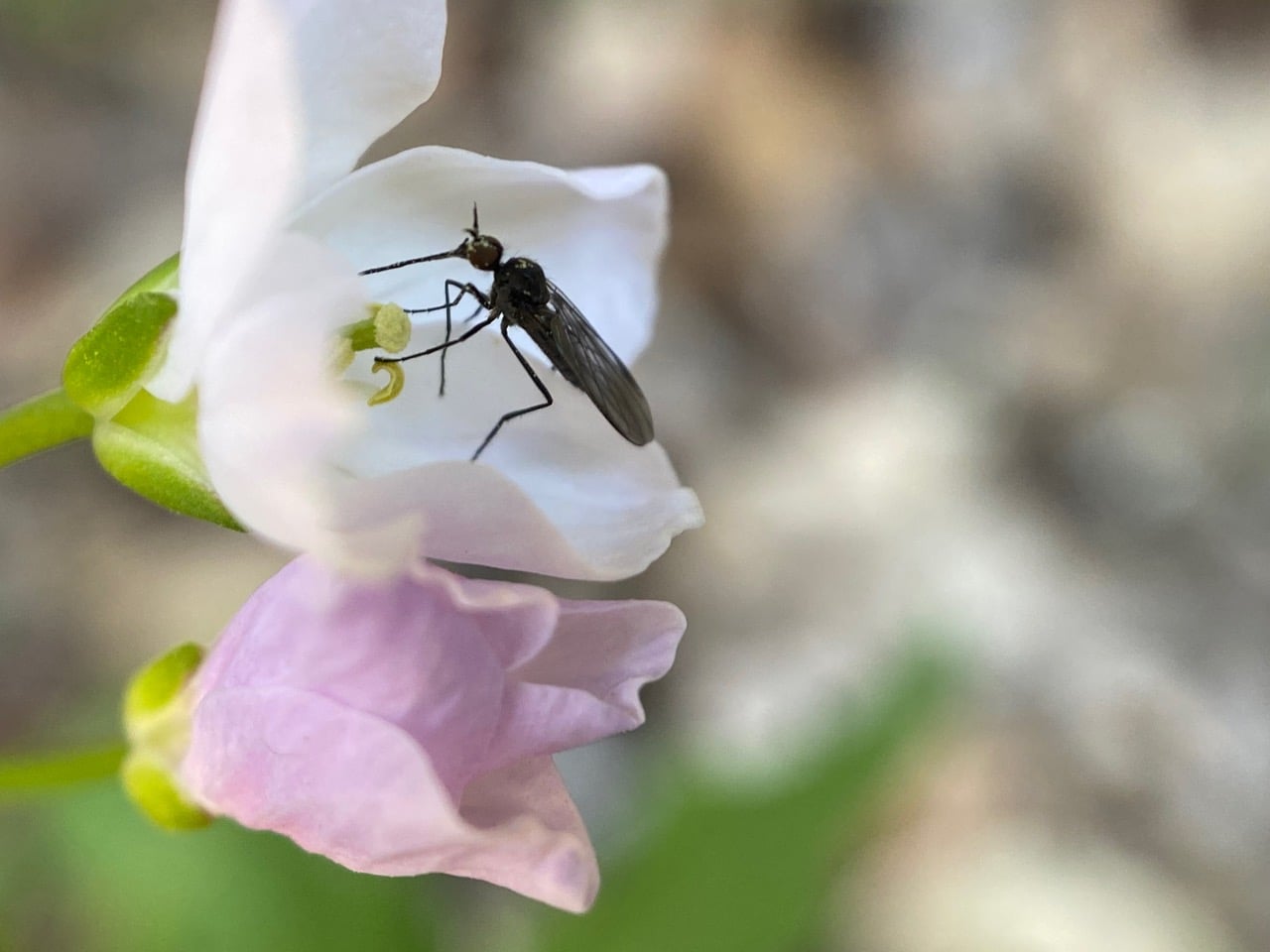
A mosquito-like insect is perched on a Milkmaid flower. Whoa, check out the length of its proboscis! Its compound eyes seem to take up most of its spherical head. A Dance Fly?
Two main types of mouthparts are found in Diptera (flies): piercing-sucking and sponging. The former is used by insects like mosquitoes to draw blood, while the latter are seen in houseflies to absorb liquid food.
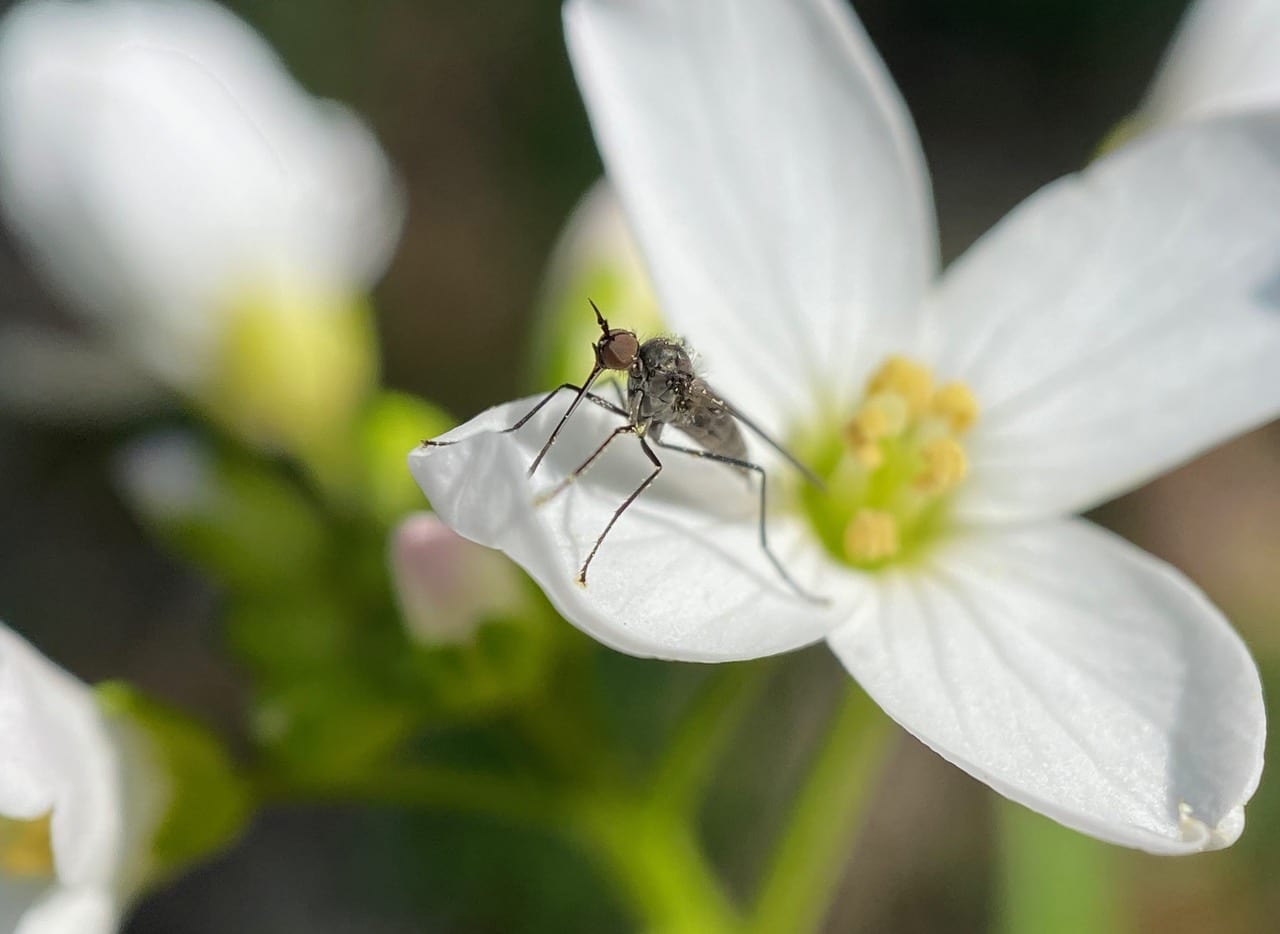
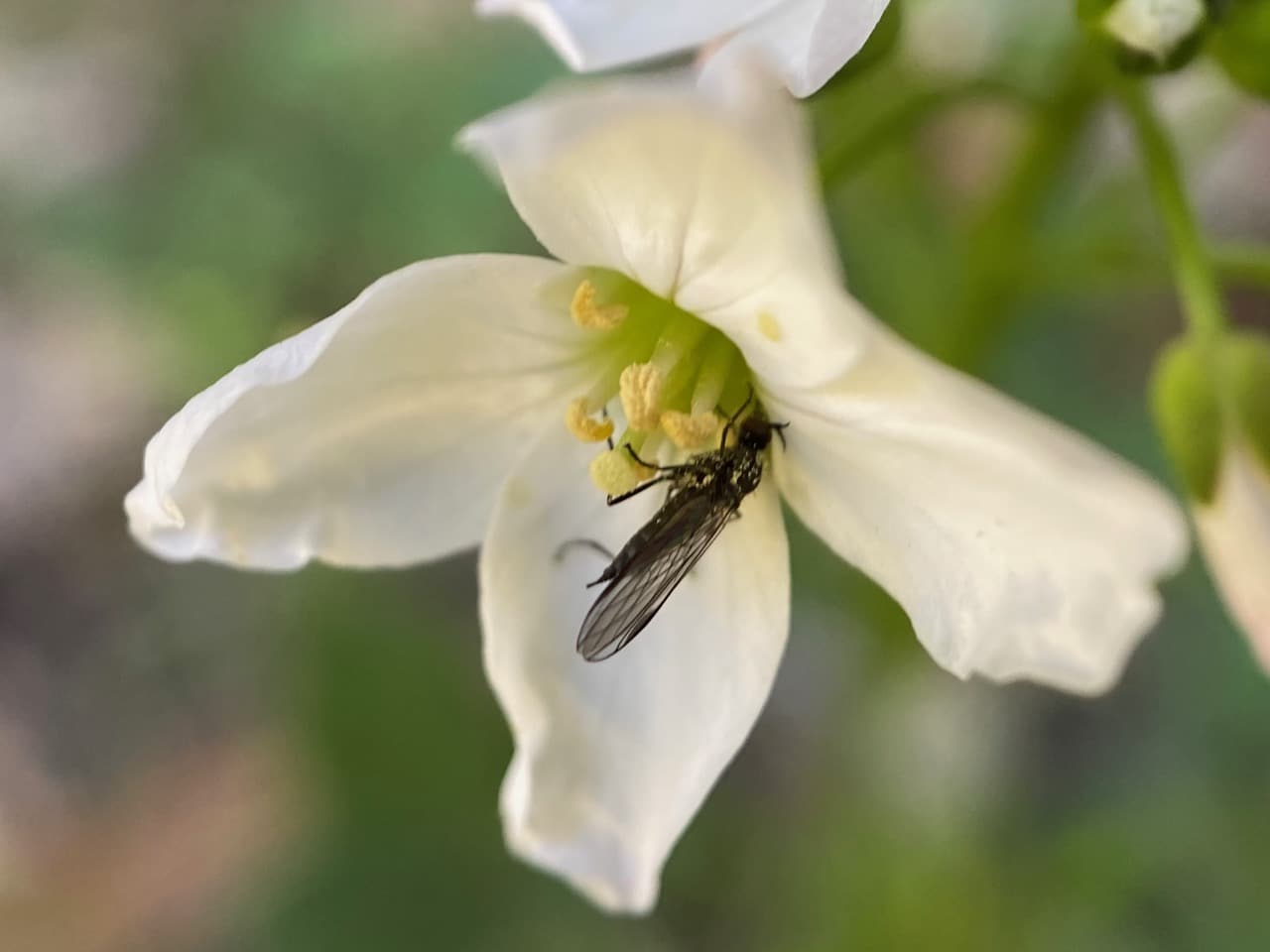
The fly must have been feeding in the center of the flower – there’s pollen scattered all over its body.
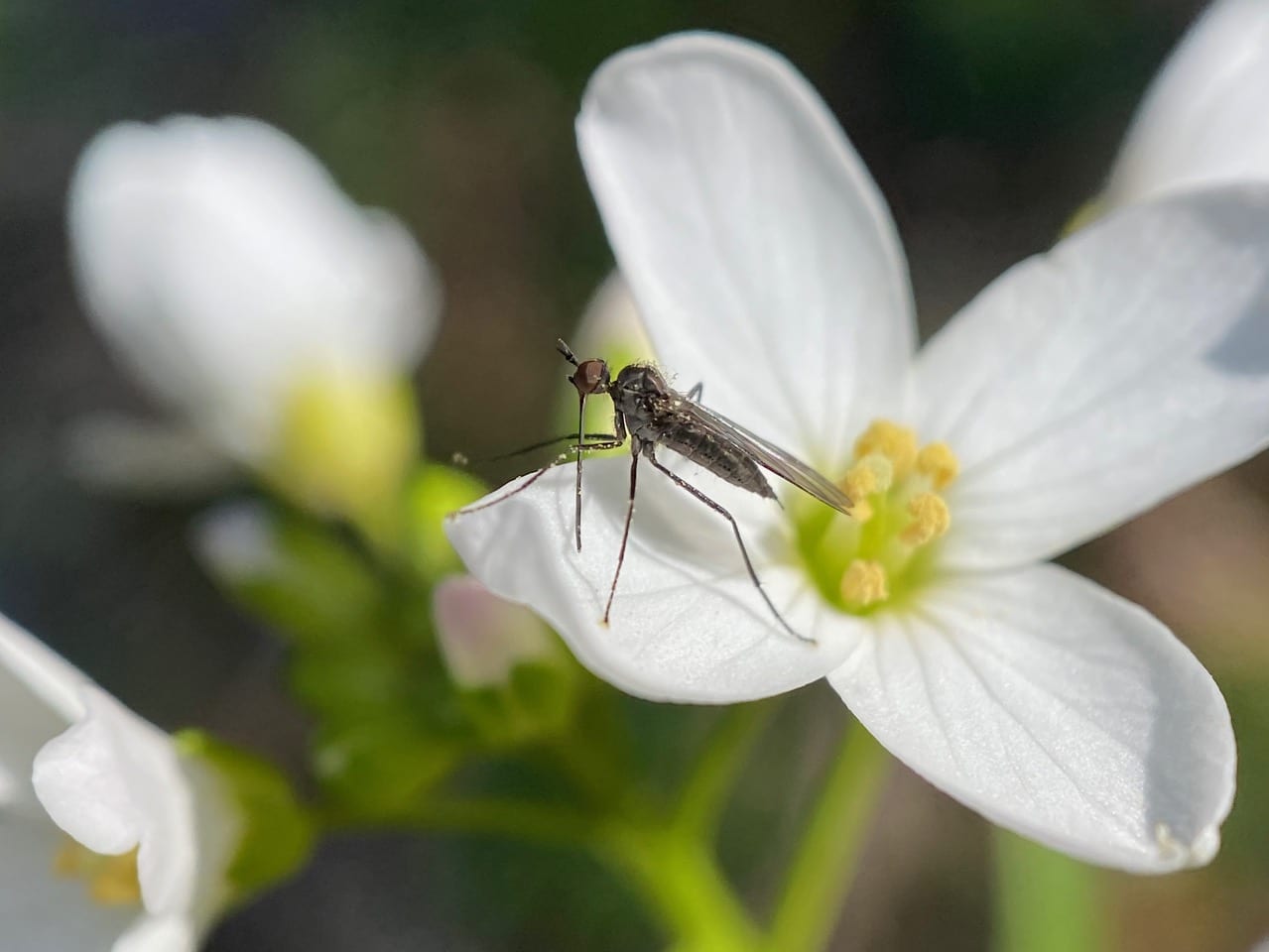
iNaturalist has helped identify the insect as Bicellaria sp., a member of the Typical Dance Flies or Hybotid Dance flies (family Hybotidae). These flies belong to the superfamily Empidoidea and were formerly included in the Empididae as a subfamily. Empididae generally have a thick beak pointing down, while Hybotidae have a thinner beak, or a thick beak pointing forwards or diagonally. Some crucial wing venation further distinguishes the two families. Precious little is known about the life cycle and biology of Hybotids because they are not considered of economic consequence. Since their forelegs are generally not raptorial, I doubt if they’re predaceous like the Empidids. Some Hybotids are known to eat pollen. I have seen Hybotids visit flowers for nectar and pollen, notably on Soap Plant, Miner’s Lettuce, California Saxifrage, Wild Geranium, Hound’s Tongue and Buttercups, and I believe they may contribute to the pollination of these small wildflowers.
Why the name “dance fly”? This is derived from the mating swarms of males of many species. They gather in clouds over prominent objects, each individual seeming to bounce or “dance” in mid-air. Many other flies do this, notably midges, but the Empidids and the Hybotids got the moniker.
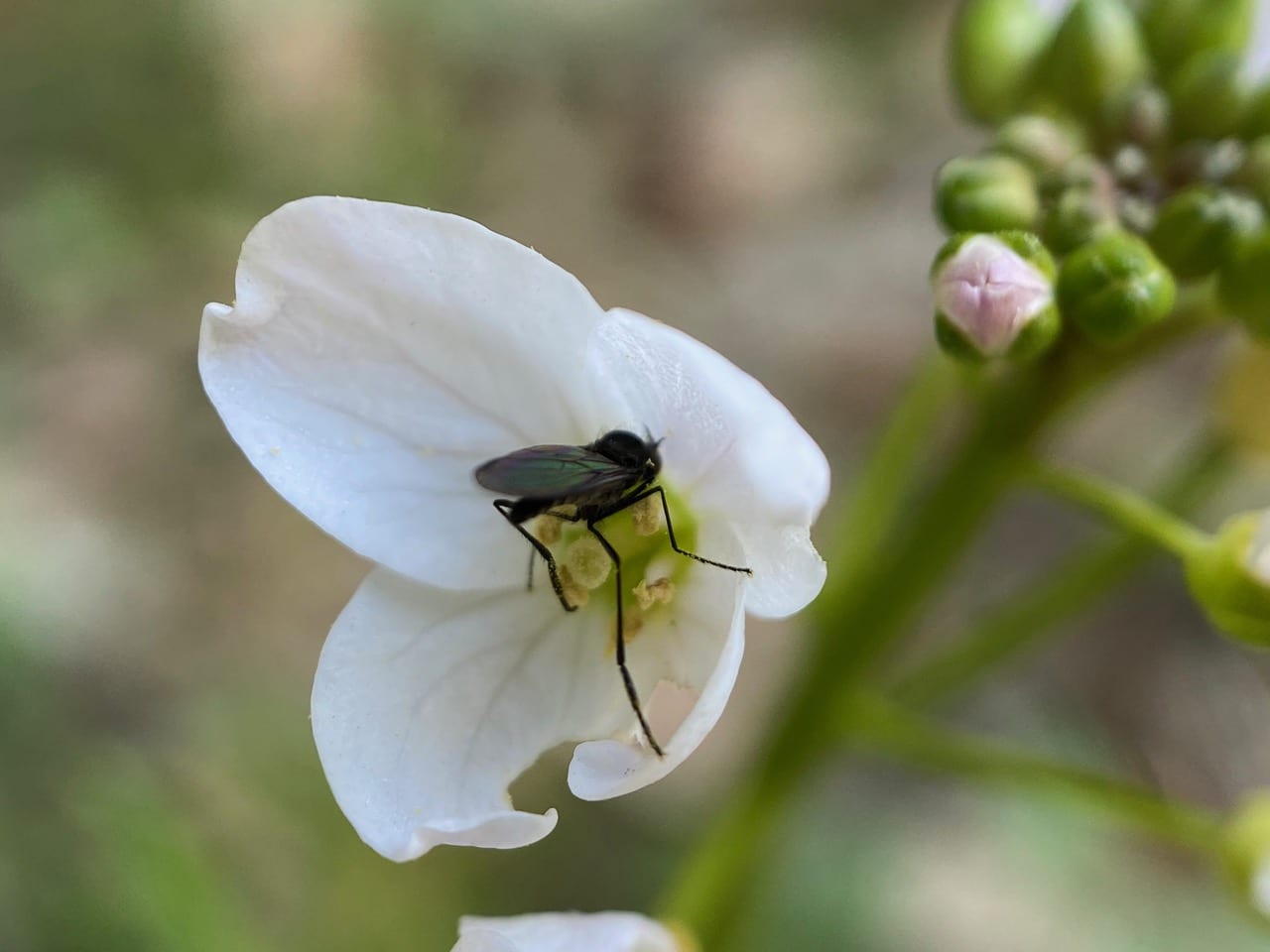
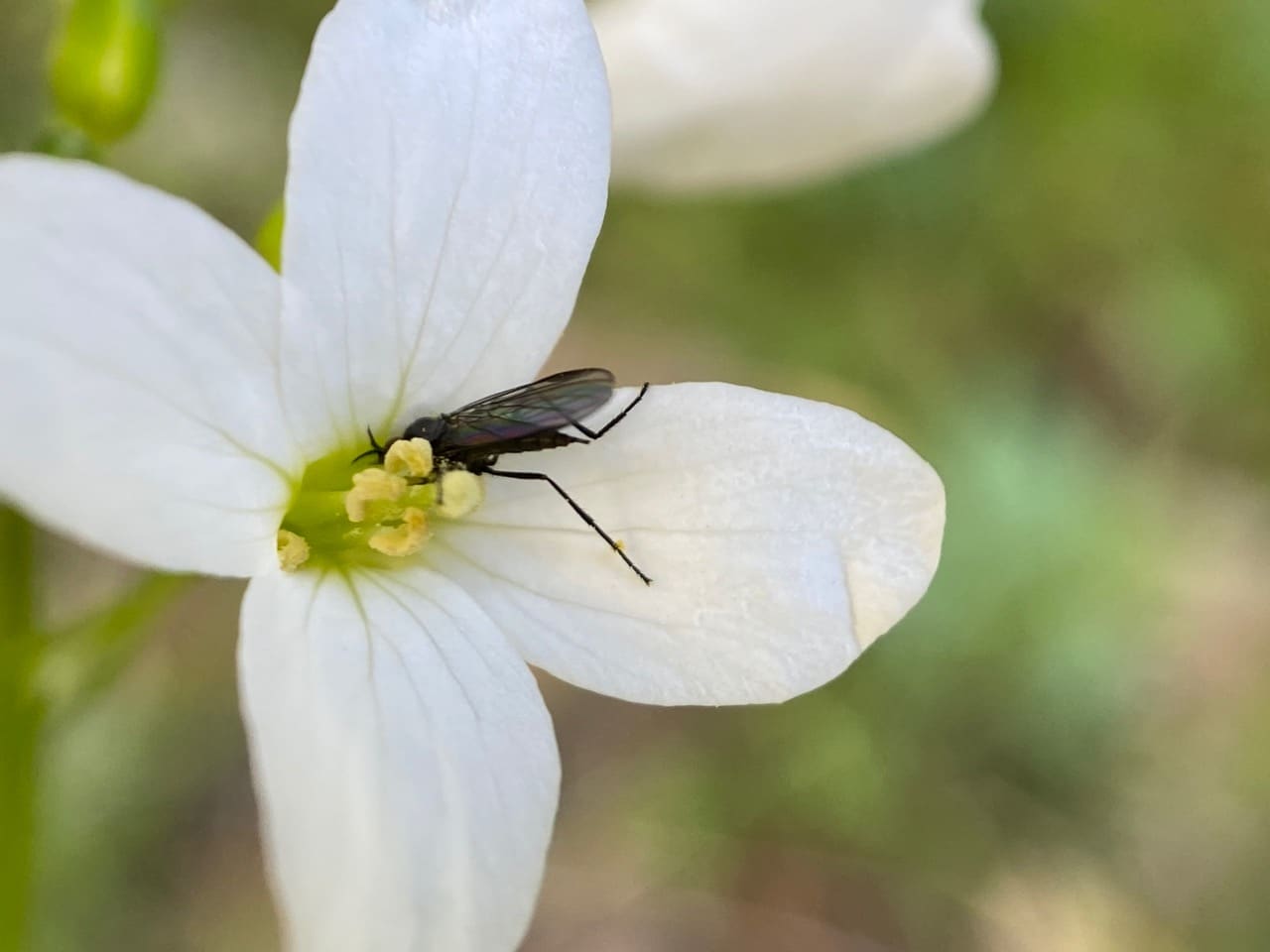
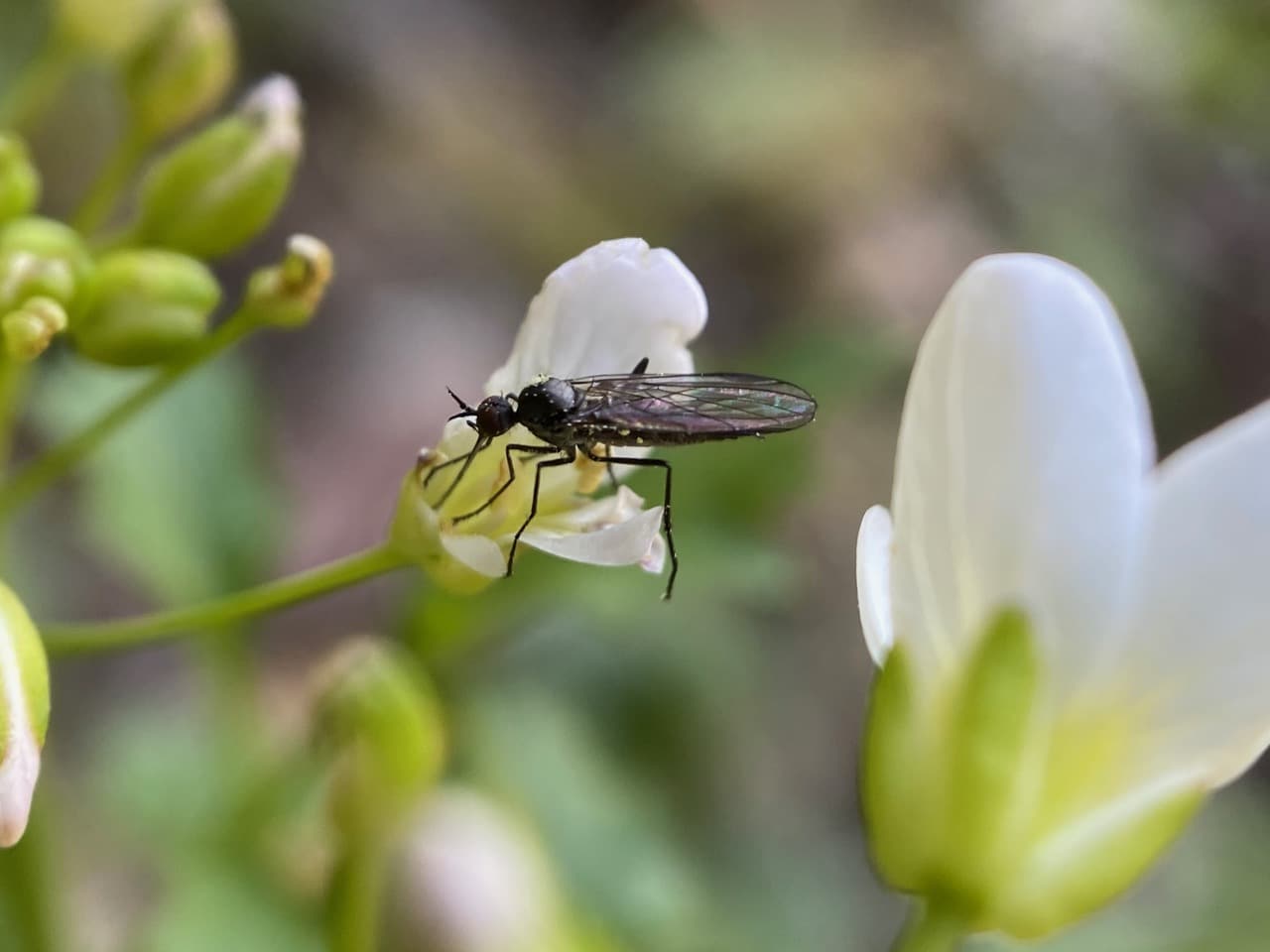
There are numerous Hybotid Dance Flies on the Milkmaid flowers. They all seem to be probing for nectar with their long proboscis.


Sharing the shade under the oak trees with the Milkmaids are clumps of freshly emerged Miner’s Lettuce, Claytonia perfoliata. These are the first or strap-shaped leaves the plant puts out.
Claytonia perfoliata usually puts on three different foliage in succession during its development – strap-shaped, spade shaped, and circular-perfoliate. The last leaves are the most familiar as they persist after the plant matures, subtending the posse of miniature white flowers we adore.

These are the second kind of leaves of Miner’s Lettuce – spade-shaped. The perfoliate leaves have yet to make their appearance.