

Pollinator Post 1/11/25 (1)

It is a joy to visit the Regional Parks Botanic Gardens again this clear winter morning. The garden has been closed last week for maintenance.
As I approach a large Monterey Cypress, Hesperocyparis macrocarpa by the path, I notice that its foliage is yellow.

Closer inspection shows that the yellow color comes from the numerous little male cones on the tips of the needles.
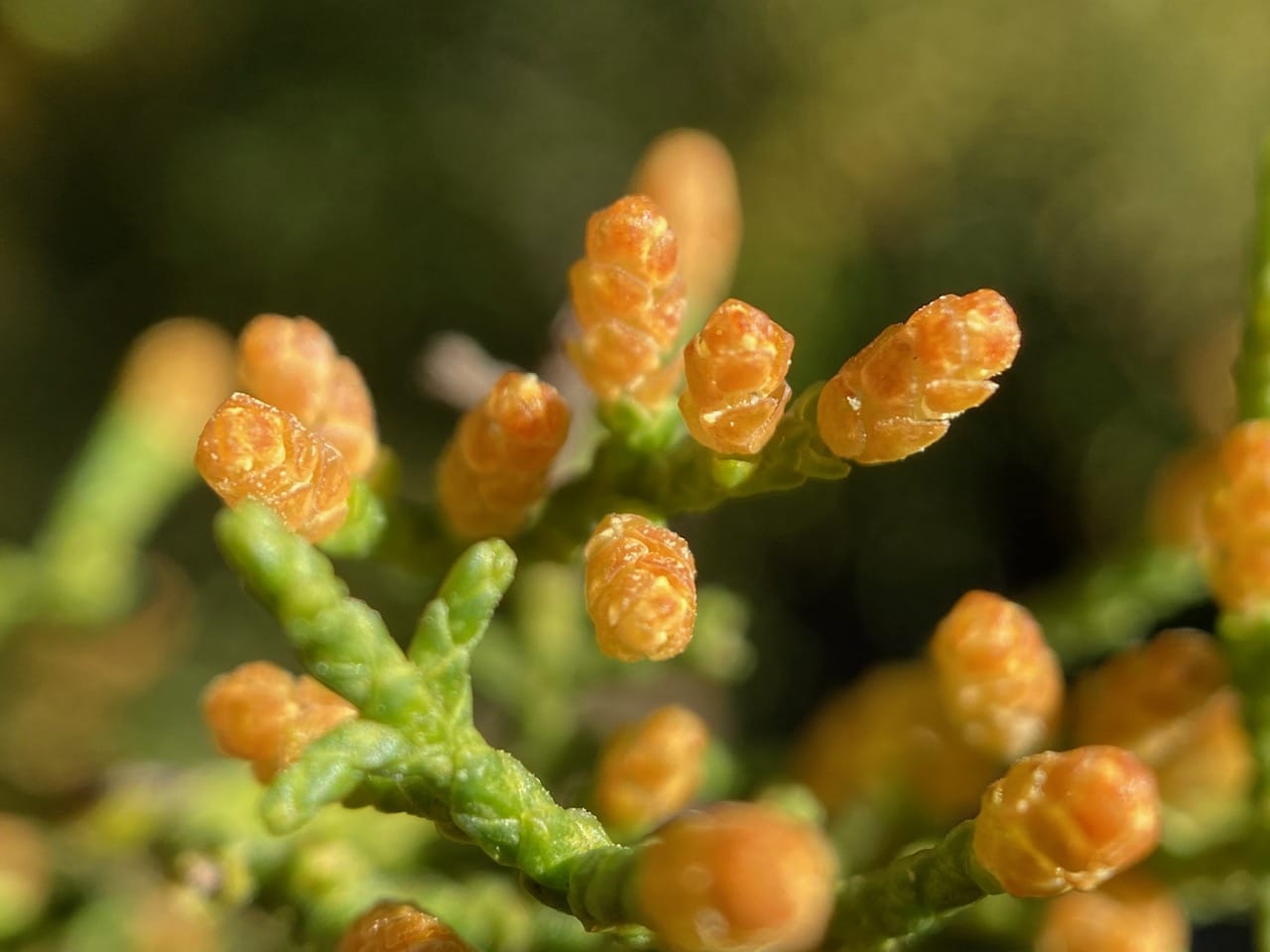
As I accidentally brush against one of the lower branches, a dense cloud of yellow pollen billows from the male cones.

Female cones of the Monterey Cypress are much larger and are borne on the woody stems.
Cone-bearing trees or conifers, such as the cypress, produce both male cones (pollen-producing) and female cones (seed-producing) on the same tree. Pollen grains from the male cones are lightweight and disperse through the air by wind, reaching the female cones. When the female cones are ready for pollination, the scales slightly open, allowing pollen to access the ovules. Once pollen lands on the receptive surface of the female cone, a pollen tube grows down to reach the egg cell, enabling fertilization. After pollination, the scales of the female cone close tightly to protect the developing seeds.

The manzanita bloom season is progressing in leaps and bounds. Almost all the species in the garden are flowering now. Some of the early bloomers are already developing fruits, the little manzanita “apples”. As the flower fades, the urn-shaped corolla detaches and falls off like a lamp shade, leaving the stout style attached to the developing fruit. As the fruit ripens, the style withers and falls off.

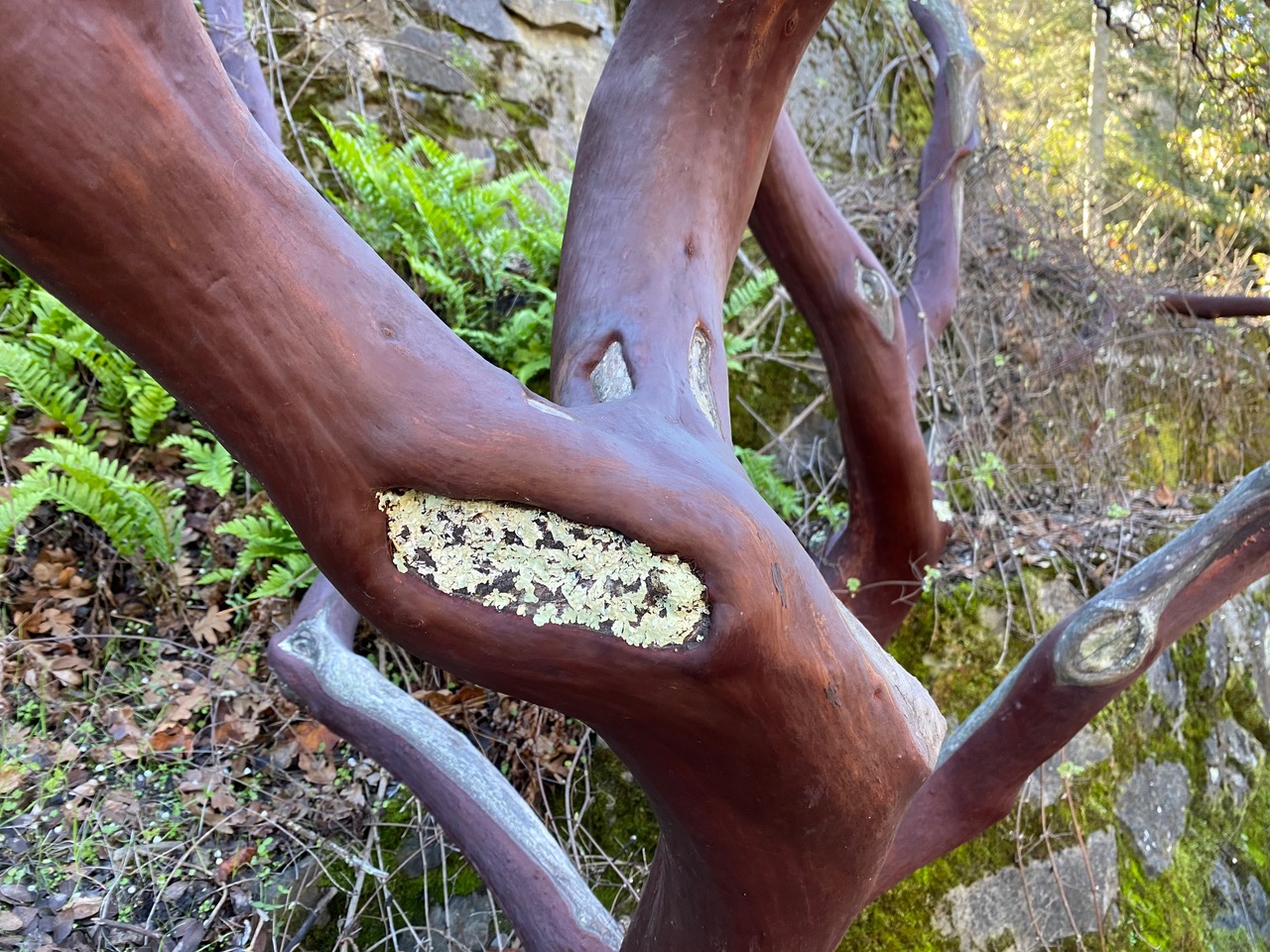



I pause to admire the structural beauty of a manzanita, Arctostaphylos sp. that has lost most of its foliage. While its small flowers provide excellent nourishment for insects in winter and early spring when few other floral resources are available, manzanitas are understandably valued more for their sculptural forms by many gardeners.
Why are manzanita bark so smooth and red?
Trees with smooth bark lack the standard protection from herbivory afforded by thick, corky exterior bark, so they must have another protective strategy. In manzanitas and other smooth-bark trees, the bark layer peels away each year. This prevents fungi, parasites, and epiphytes such as mosses and lichens, from persisting on the tree’s trunk and stems. The rich, reddish coloration of manzanitas – which varies among species from orange to mahogany to dark purple – comes from tannins (and other compounds) manufactured by, and deposited in, the cells of its exterior bark. Tannins are bitter compounds toxic to some organisms. When present, they most likely serve to deter insects, birds, and bacteria from invading the plant. So the combination of tannins and the regular shedding of the bark appears to be manzanita’s adaptation for staying healthy.
I have to smile as I pass a big manzanita with foliose lichens growing in the only places on its trunk not covered by bark – sections where branches have broken off or been pruned off. It’s a testament to the effectiveness of manzanita’s smooth and chemically-armed bark to prevent unwanted settlers.
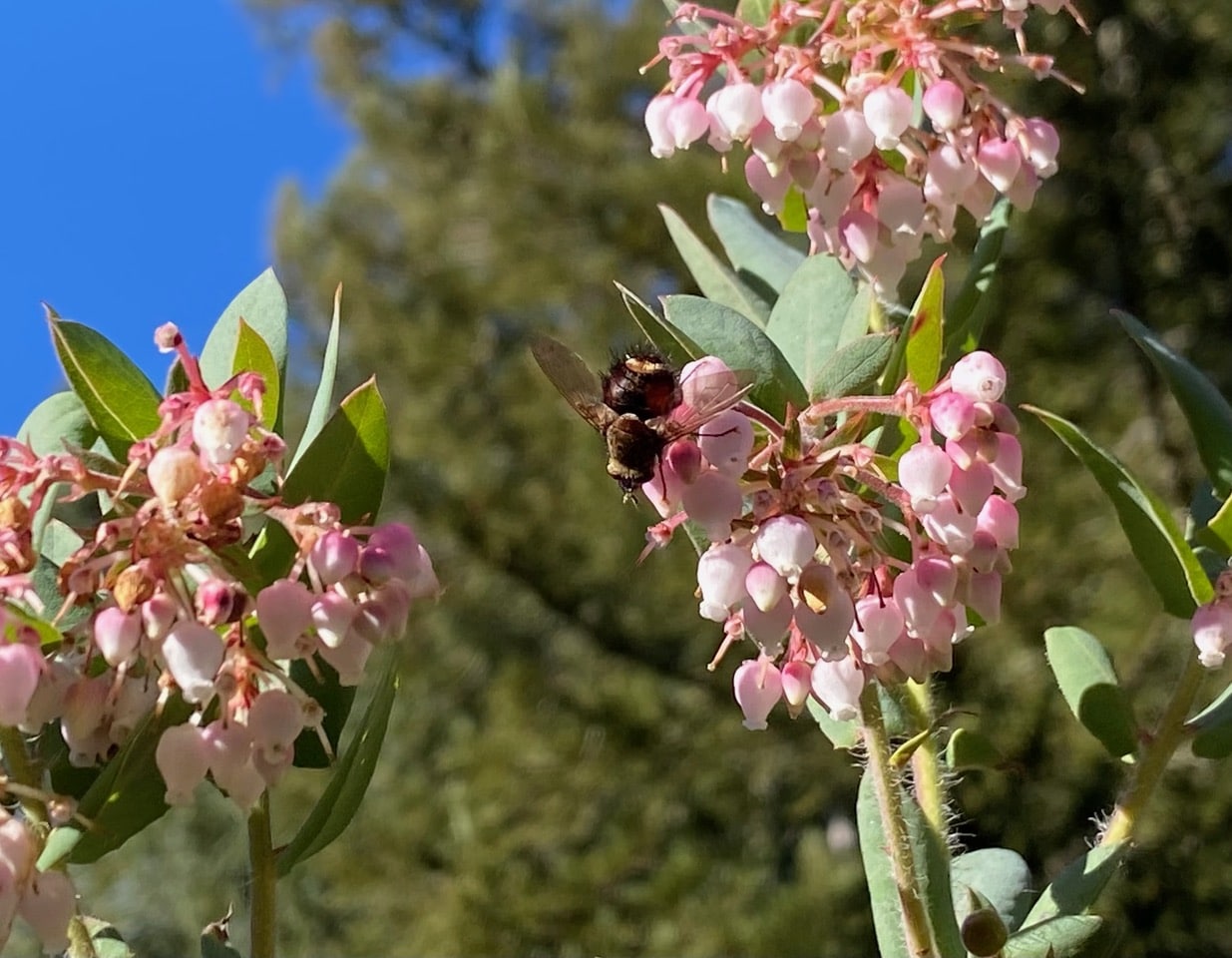
High up on a tall manzanita, a dark insect is moving around on a cluster of flowers. Although I can’t see much details, I recognize it as a Bristle Fly (family Tachinidae) from the conspicuous bristles on its abdomen.
iNaturalist has helped identify the insect as the Early Tachinid Fly, Epalpus signifer (family Tachinidae).
The family Tachinidae is by far the largest and most important group of parasitoid flies. All species are parasitic in the larval stage. Most adults have distinct abdominal bristles, hence the common name. Adults feed on liquids such as nectar and honeydew. They can be found resting on foliage, feeding at flowers or searching for hosts.
Most tachinids attack caterpillars, adult and larval beetles, true bugs, grasshoppers, and other insects. Females lay eggs in or on the host. Tachinid larvae live as internal parasites, consuming their hosts’ less essential tissues first and not finishing off the vital organs until they are ready to pupate. The larvae leave the host and pupate on the ground. Tachinids are very important in natural control of many pests, and many have been used in biological control programs.
The Early Tachinid Fly, Epalpus signifer is a species of bristle fly found in North America. It is a bristly, robust fly about 6-13 mm long. There is a triangular white or tan mark on the 5th segment of the black abdomen. The larvae are internal parasites of the caterpillars of Noctuid moths. Adults visit flowers for nectar.
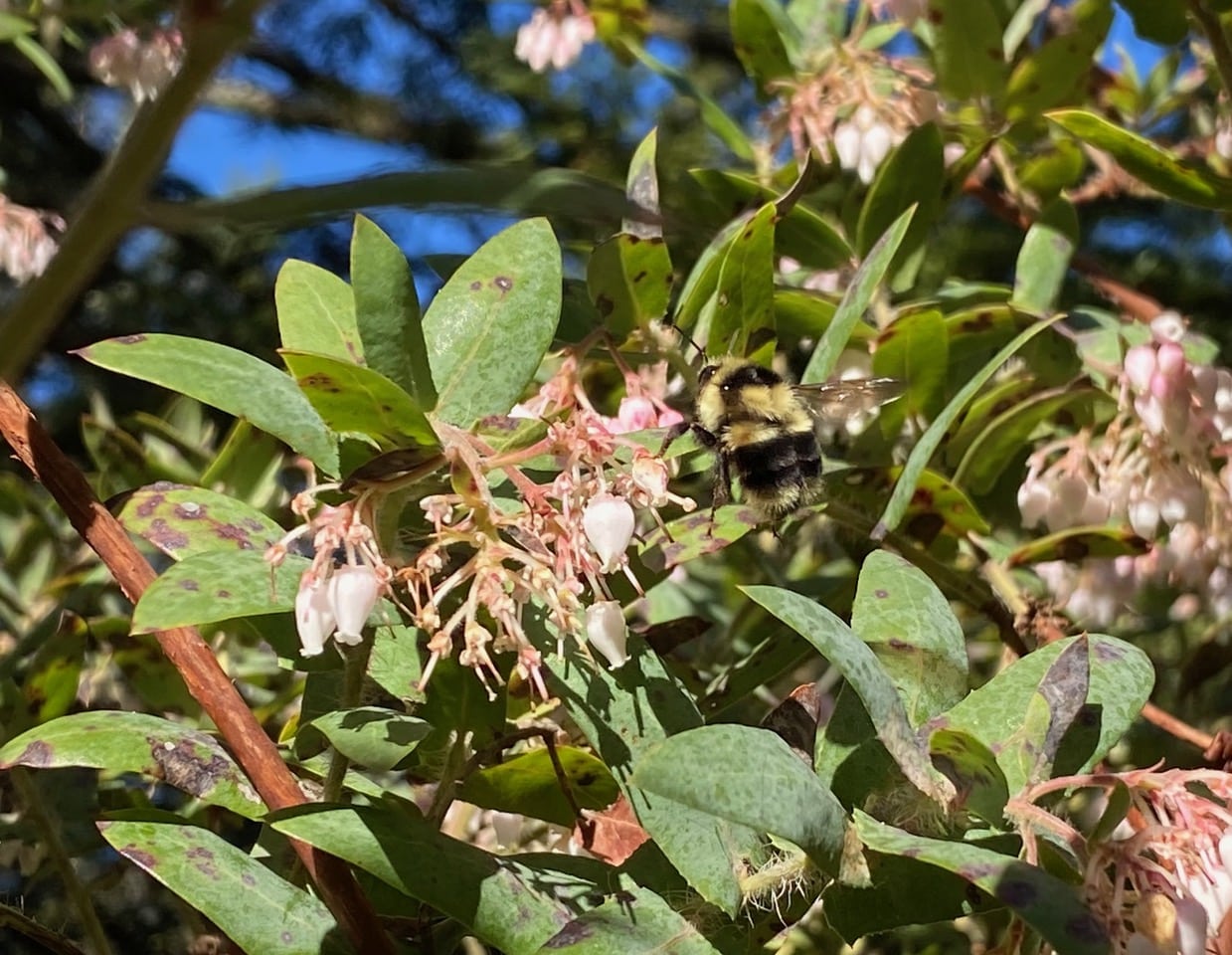
A queen Black-tailed Bumble Bee, Bombus melanopygus (family Apidae) is buzzing around a tall manzanita, stopping to take nectar from the flowers. How do I know it’s a queen? By her sheer size – she is about 3-4 times the average size of the worker bees of her species. Also, this early in the season, most of the bumble bees we see are likely queens that have freshly emerged from hibernation. They are the only ones that overwinter.
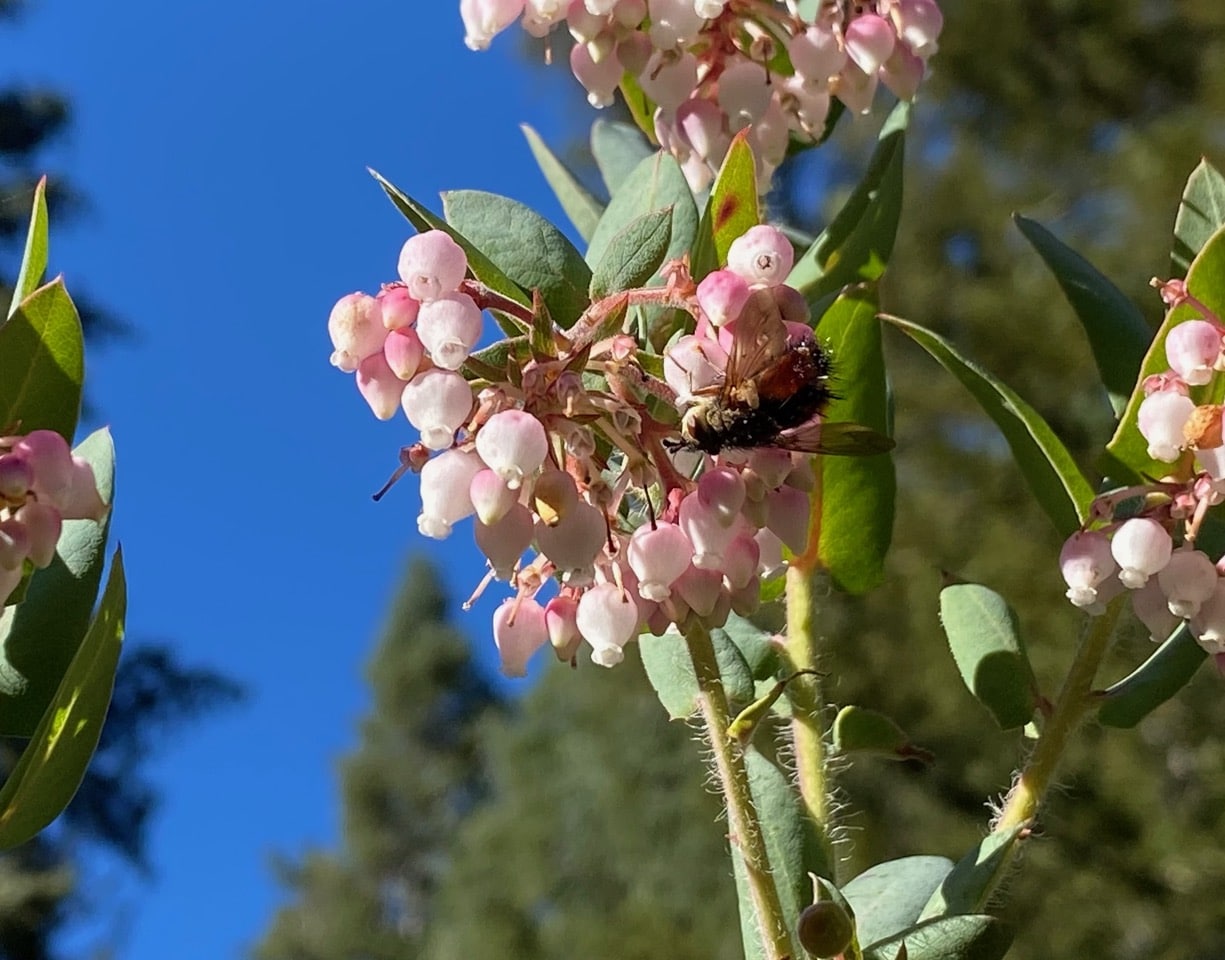
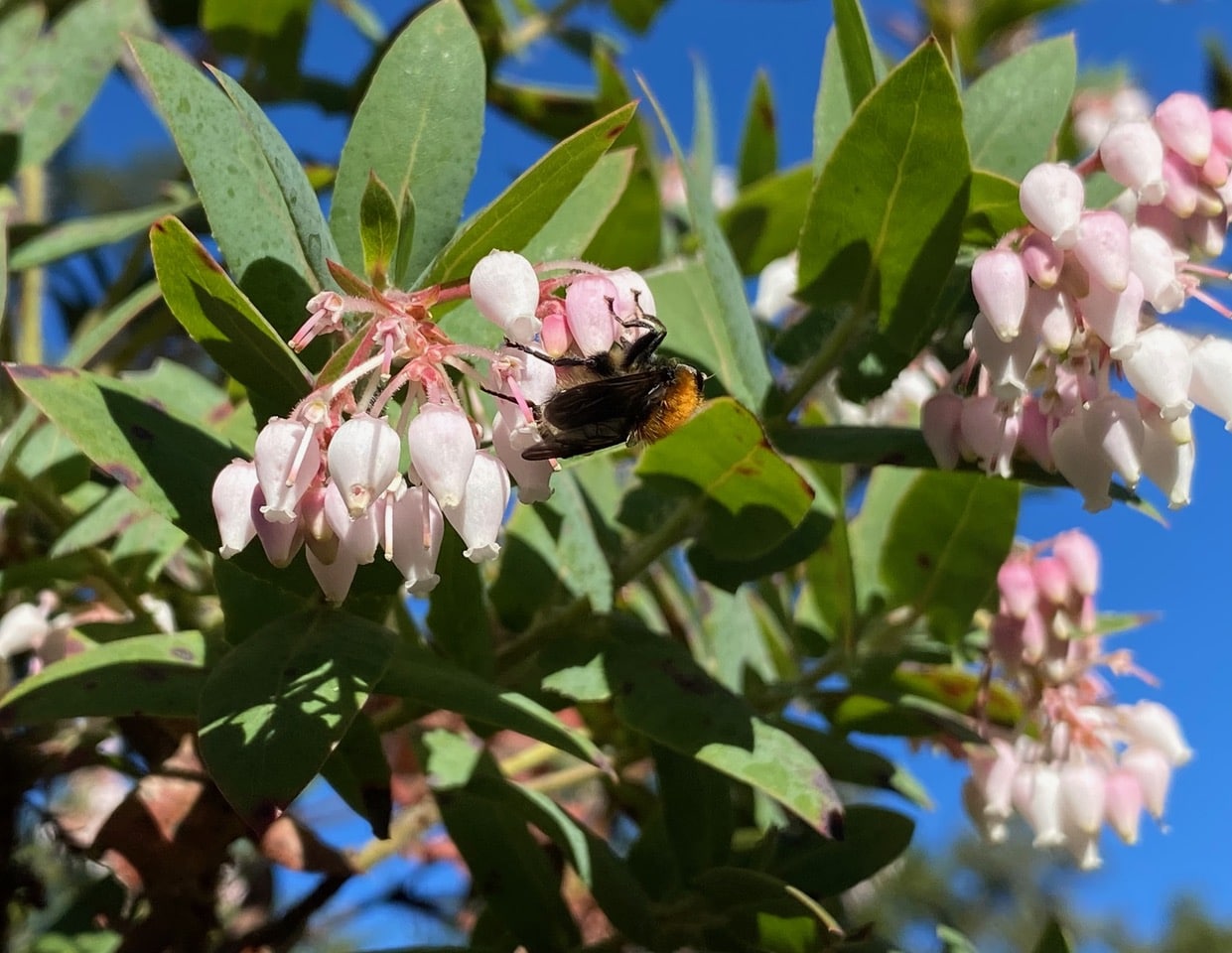
Ooh, who’s that on that cluster of manzanita flowers? It doesn’t look at all familiar to me, with a furry thorax of bright rusty color.
iNaturalist has helped identify the insect as the Bumblebee Catkin Fly, Brachypalpus alopex (family Syrphidae). Yay, a new species of hover fly for me!
The Bumblebee Catkin Fly, Brachypalpus alopex is an uncommon species of hoverfly. Hoverflies get their names from the ability to remain motionless while in flight. They are often found around and on flowers, feeding on nectar and/or pollen. The larvae are of the rat-tailed type, feeding on decaying sap under tree bark. Rat-tailed maggots are so named for having a long tail-like siphon on their abdomen that helps them breathe in liquid or semi-liquid environment.
A tall male Coast Silk Tassel towers over a garden path, with long catkins dangling gracefully. It is surprising to see a Silk Tassel grow so big. I have always known the plant to be a shrub.
The Coast Silk Tassel, Garrya elliptica (family Garryaceae) is an evergreen shrub or small tree. It is dioecious, meaning male and female flowers are borne on separate plants. Flowers appear in winter, male catkin-like clusters are yellowish to greenish then gray, 8-20 cm long (“silk tassels”), female flower clusters are shorter, 5-9 cm long.
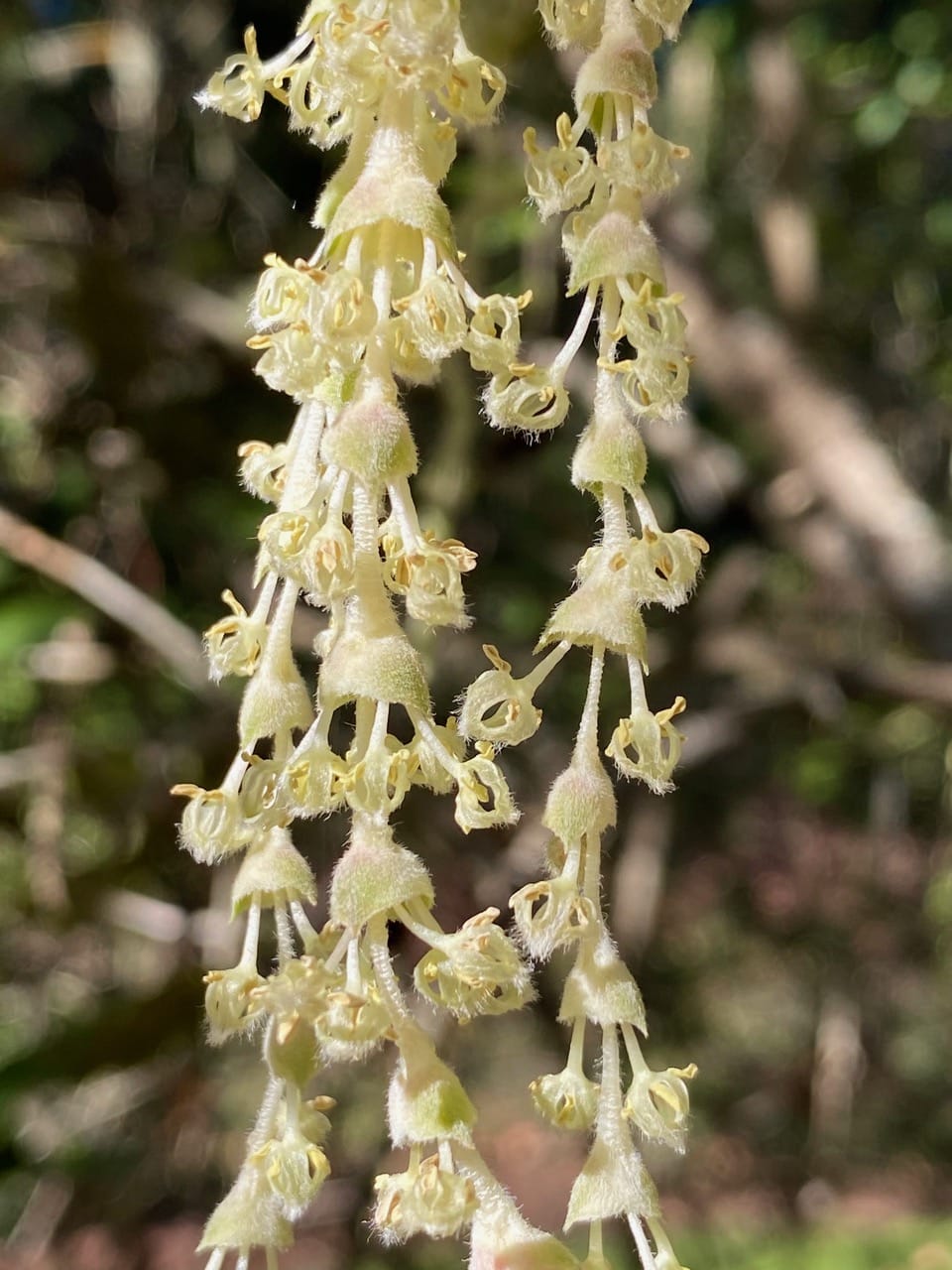
Close-up of the male catkins of Coast Silk Tassel.
Within each catkin, tiny male (staminate) flowers are clustered and subtended by two bracts that are fused and form a cup or bell-shaped structure. The flowers are highly reduced, lacking petals. These flowers are wind-pollinated. As the wind blows, pollen is shaken out of the exposed stamens. What a clever design, and so beautiful!
Coast Silk Tassel is an example of plants that are wind pollinated. About 12% of flowering plants and most conifers are wind pollinated. These plants do not waste energy on flower features that attract animal pollinators; instead, their flowers generally have these characteristics:
– Small, petalless, and unscented, with muted colors.
– No nectar
– Stamen (male flower part) and stigma (female pollen-receiving part) are exposed to air currents.
– Male flowers produce a great deal of pollen, which is very small, dry, and easily airborne.
In front of Juniper Lodge, I find a Fremont’s Silktassel, Garrya fremontii in bloom. This male plant has maroon-colored bells in long hanging chains!
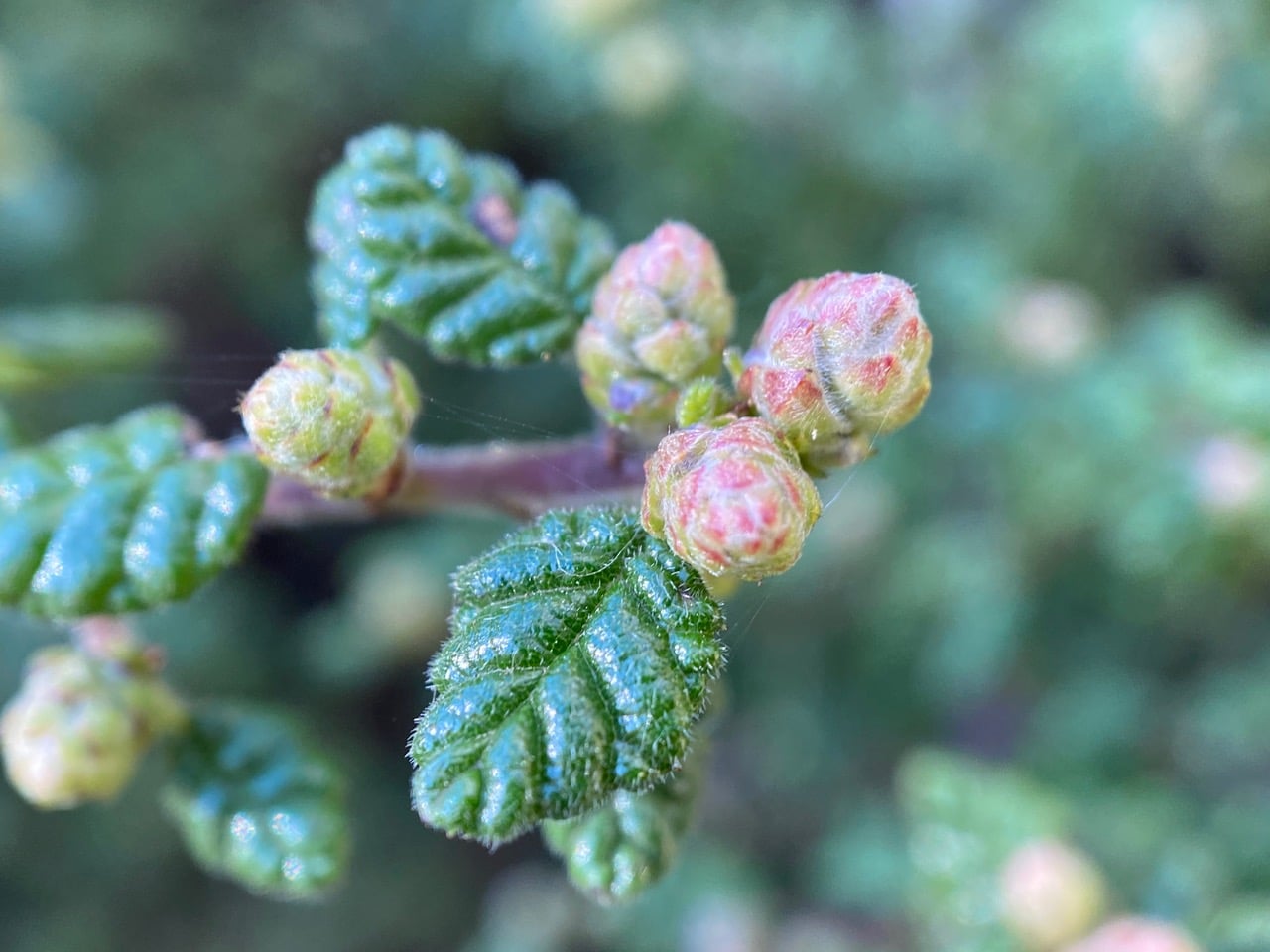
Most of the Ceanothus in the garden are bearing tight flower buds on the branches. I can’t wait until these begin to open. They will usher in the next significant wave of pollination activities in the wake of the manzanitas.