

Pollinator Pos 6/10/25 (2)


A large plum tree grows against the back fence of the backyard. The lower foliage is wet, glistening with honeydew, and most leaves are speckled with white flecks.
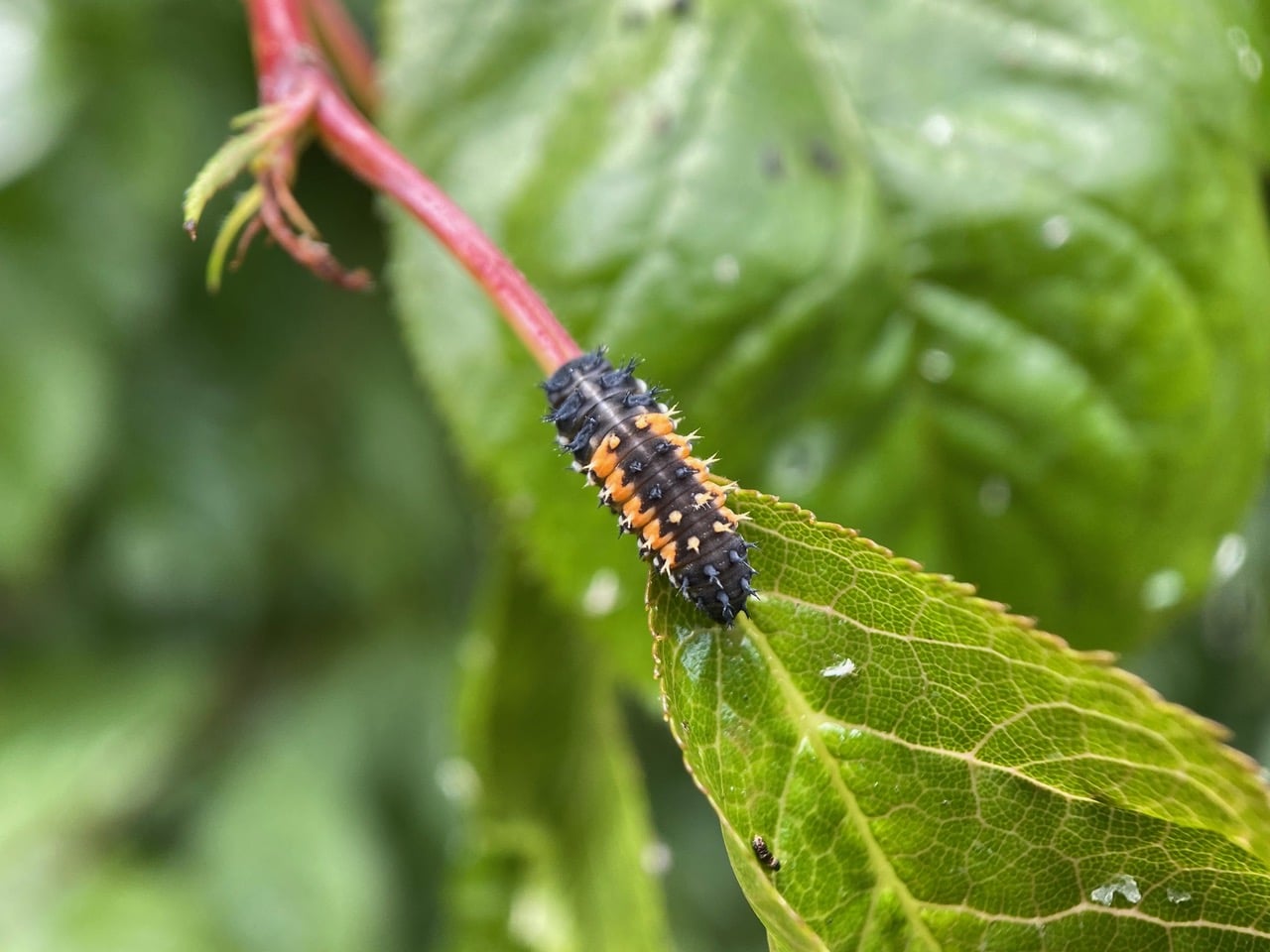
Numerous Lady Beetle larvae are found on the leaves of the plum tree.

Lady beetles go through complete metamorphosis, which comprises four stages: eggs, larva, pupa and adult. The larva goes through four molts during their development. Often described as miniature alligators with six legs, the larvae are voracious predators of aphids. Each larva can eat about 400 aphids in the three weeks before it pupates. Besides aphids, they also feed on soft scales, whitefly pupae, thrips, and spider mites.

An Asian Lady Beetle, Harmonia axyridis (family Coccinellidae) is resting on a leaf speckled with white exuvia of aphids. Exuvia are the shed exoskeleton of an insect when they molt.
The beetle is a voracious predator of arthropod pests such as aphids, mites, thrips, scale and Lepidoptera eggs. Introduced from Asia for biological control of arthropod pests during the twentieth century, it has since become established all over the US. The adult beetles are highly variable in appearance, varying in color as well as the number and size of spots. It is believed that the Multicolored Asian Ladybeetles are aggressive competitors of native ladybeetles. This supposition remains to be proven scientifically. Adult beetles aggregate in high numbers to overwinter, favoring human dwellings. When threatened the beetle produces a yellow viscous, foul-smelling defensive compound, making themselves unwelcome house guests.

Ooh, here’s another species of Lady Beetle – the California Lady Beetle, Coccinella californica (family Coccinellidae).
The California Lady Beetle, Coccinella californica (family Coccinellidae) is a species found in California, mainly in the coastal counties north of the Traverse Ranges. It has a red elytra that is usually spotless, and a mostly black thorax with two large white markings. A longitudinal black line is usually visible along the seam where the elytra meet. Both adults and larvae are voracious predators of aphids and other soft-bodied insects.

Although I expect to see aphids as I turn over a leaf of the plum tree, I am startled to find such a chaotic multitude of them, all covered with copious wax. There’s even a winged reproductive among them. iNaturalist has helped identify them as the Mealy Plum Aphid, Hyalopterus pruni (family Aphididae).
The Mealy Plum Aphid has a cosmopolitan distribution. It is a true bug and sucks sap from plants. The aphids can be found from spring through fall. The adults remain wingless for 3-13 generations. Winged adults usually appear only in June/July, moving to reed grasses or cattails, while the wingless adults stay on the host plants. The winged adults lay eggs on the host plants and overwinter in the egg stage, close to the flower buds. Eggs hatch when the buds bloom. Host plants include members of the genus Prunus, including plum, peach, apricot, peach, and almond. The feeding activity produces copious amounts of honeydew that coats the plant and attracts a variety of insects.
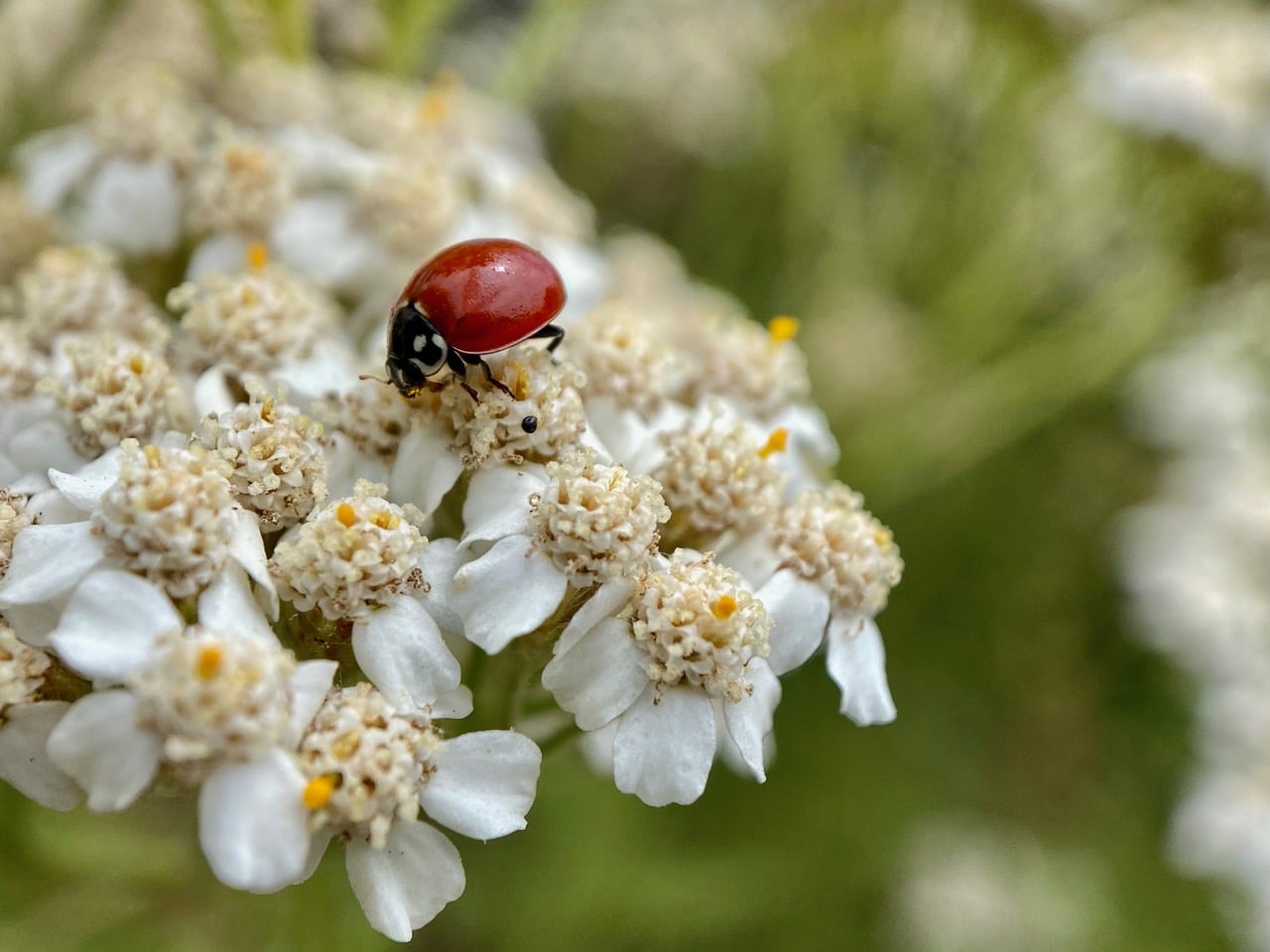
A Spotless Lady Beetle, Cycloneda sanguinea (family Coccinellidae) is resting on an inflorescence of Yarrow, Achilllea millefolium.
The Spotless Lady Beetle, Cycloneda sanguinea (family Coccinellidae) is a widespread species of lady beetle in the Americas. It is is large lady beetle with red, unspotted elytra (wing covers) ranging from 4-6.5 mm long. The black and white marks on the head and pronotum are very distinctive, and they are also gender-specific. These lady beetles are very often found feeding on aphids on milkweeds, but also occur on a number of other plants. Both adults and larvae are voracious predators of aphids and other soft-bodied insects.

A Lady Beetle larva is resting on a cluster of Yarrow flower buds.

A Eurasian Drone Fly, Eristalis arbustorum (family Syrphidae) is foraging on Yarrow.
The Eurasian Drone Fly, Eristalis arbustorum is an abundant species of hover fly that occurs throughout the northern hemisphere, including Europe, North Africa and North India. It was introduced to North America in the mid 1800’s and is now ubiquitous throughout much of the United States and Canada. The common name “drone fly” refers to its resemblance to the drone of the honeybee. Hoverflies get their names from the ability to remain nearly motionless while in flight. The adults are also known as flower flies as they are commonly found on and around flowers feeding on nectar and pollen. The Eurasian Drone Fly is found in a diversity of habitats, including wetland, forests, montane tundra, as well as farmland, urban parks and gardens. It visits the flowers of a wide range of low-growing plants and shrubs. The larvae are aquatic, occurring in shallow, nutrient rich standing water and in cow manure and compost heaps. Also known as “rat-tailed maggots”, the larvae have a siphon on their rear end that acts like a snorkel, helping them breathe under water. The siphon can be several times the length of the larva’s body. The larvae are saprophagous, feeding on bacteria in stagnant water rich in decomposing organic matter.

A Thick-legged Hover Fly, Syritta pipiens (family Syrphidae) is making its way slowly through the small flowers of a Yarrow inflorescence.
Syritta pipiens originates from Europe and is currently distributed across Eurasia and North America. They are fast and nimble flyers, and their larvae are found in wet, rotting organic matter such as garden compost, manure, and silage. The flies are important pollinators for a variety of flowering plants.
The Thick-legged Hover Flies are often found on flowers, where the adult males primarily feed on nectar and adult females eat protein-rich pollen to produce eggs. The common name comes from the fly’s distinctively broad femora. The fly is about 6.5 -9 mm long. The species flies at a very low height, rarely more than 1 m above the ground. Males accurately track females, aiming to attempt forced copulation.

A Tripartite Sweat Bee, Halictus tripartitus (family Halictidae) is navigating an inflorescence of Yarrow flower buds.
Halictus is found worldwide; they are most common in the Northern Hemisphere. All are generalists, foraging from a wide variety of flowering plants. Many species are social and produce several generations per year. This is not surprising as most blooming plants are season-specific; a bee that requires pollen and nectar across multiple seasons would not thrive as a specialist. All Halictus in North America nest in the ground, often in aggregations; and they may nest in the same area for decades.
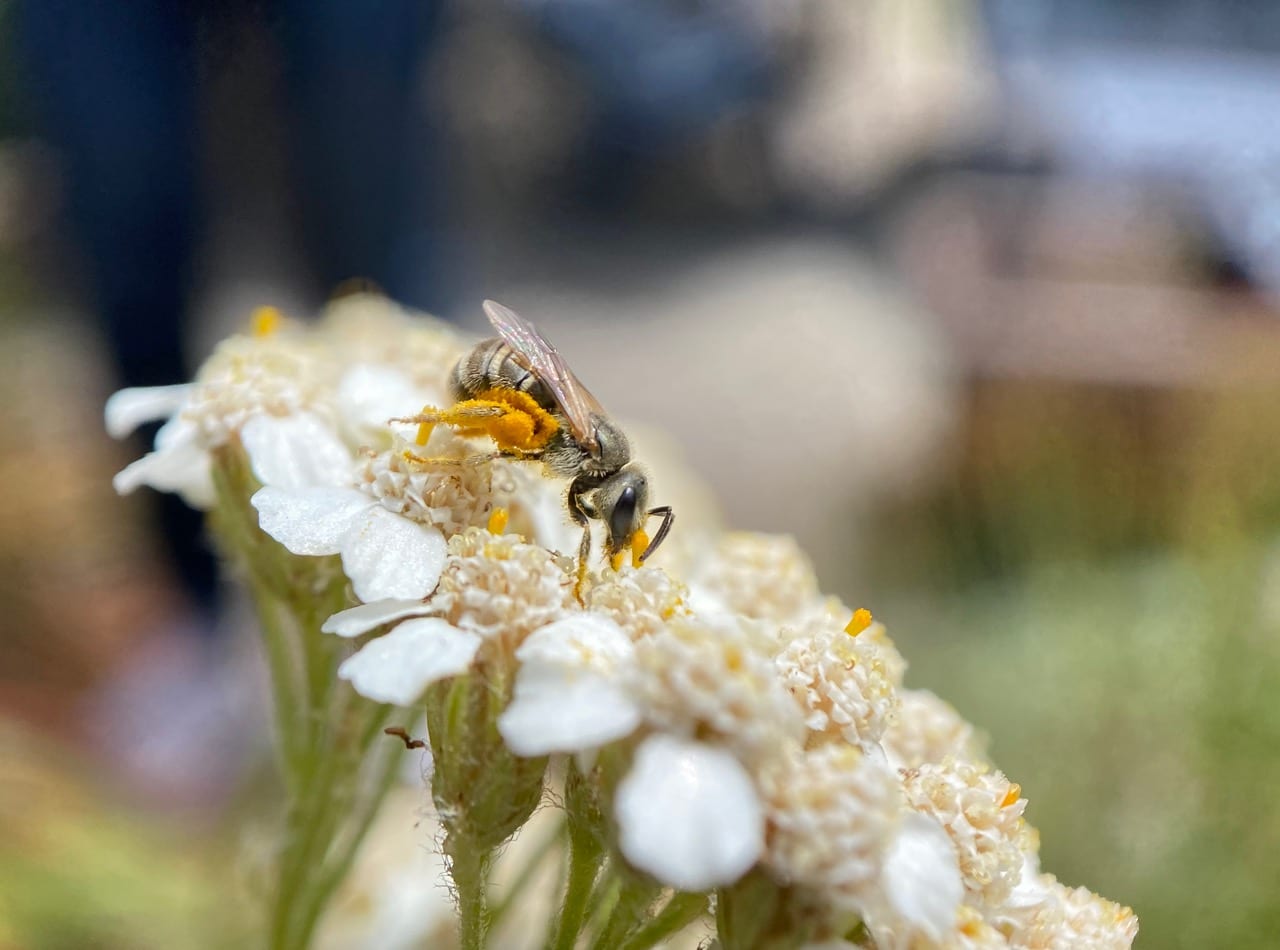
The species Halictus tripartitus (family Halictidae) is partially eusocial, with nests connected underground and some workers capable of reproducing. It is a very successful species in our area, making up the majority of bees in many gardens right now, collecting floral resources from a large variety of plants.
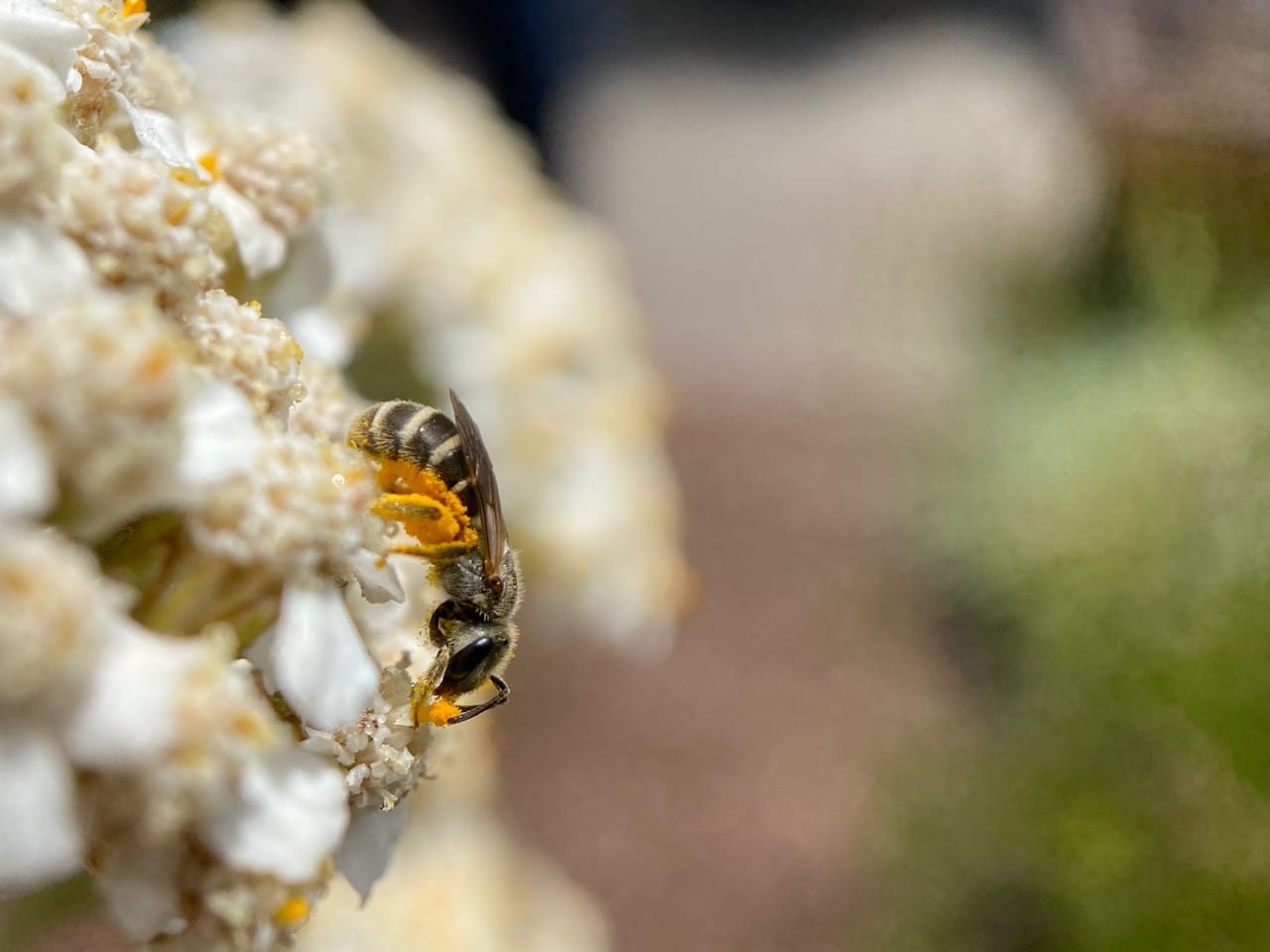
The bee extracts pollen from a Yarrow flower with her jaws and front legs. Note that she carries the pollen she has collected on the entire length of her hind legs, and on the underside of her abdomen. This is typical behavior of female Sweat Bees (family Halictidae).

Another Tripartite Sweat Bee, Halictus tripartitus (family Halictidae).

Visible as a mere dot on an inflorescence of Yarrow, a tiny Carpet Beetle, Anthrenus lepidus (family Dermestidae) is foraging for pollen.
Dermestidae are a family of Coleoptera (beetles) that are commonly referred to as skin of carpet beetles. Ranging in size from 1 to 2 mm, the beetles typically have clubbed antennae that fit into deep grooves. Most Dermestids are scavengers that feed on dry animal or plant materials, such as skin or pollen, animal hair, feathers, dead insects and natural fibers. The larvae are used in taxidermy and by natural history museums to clean animal skeletons.
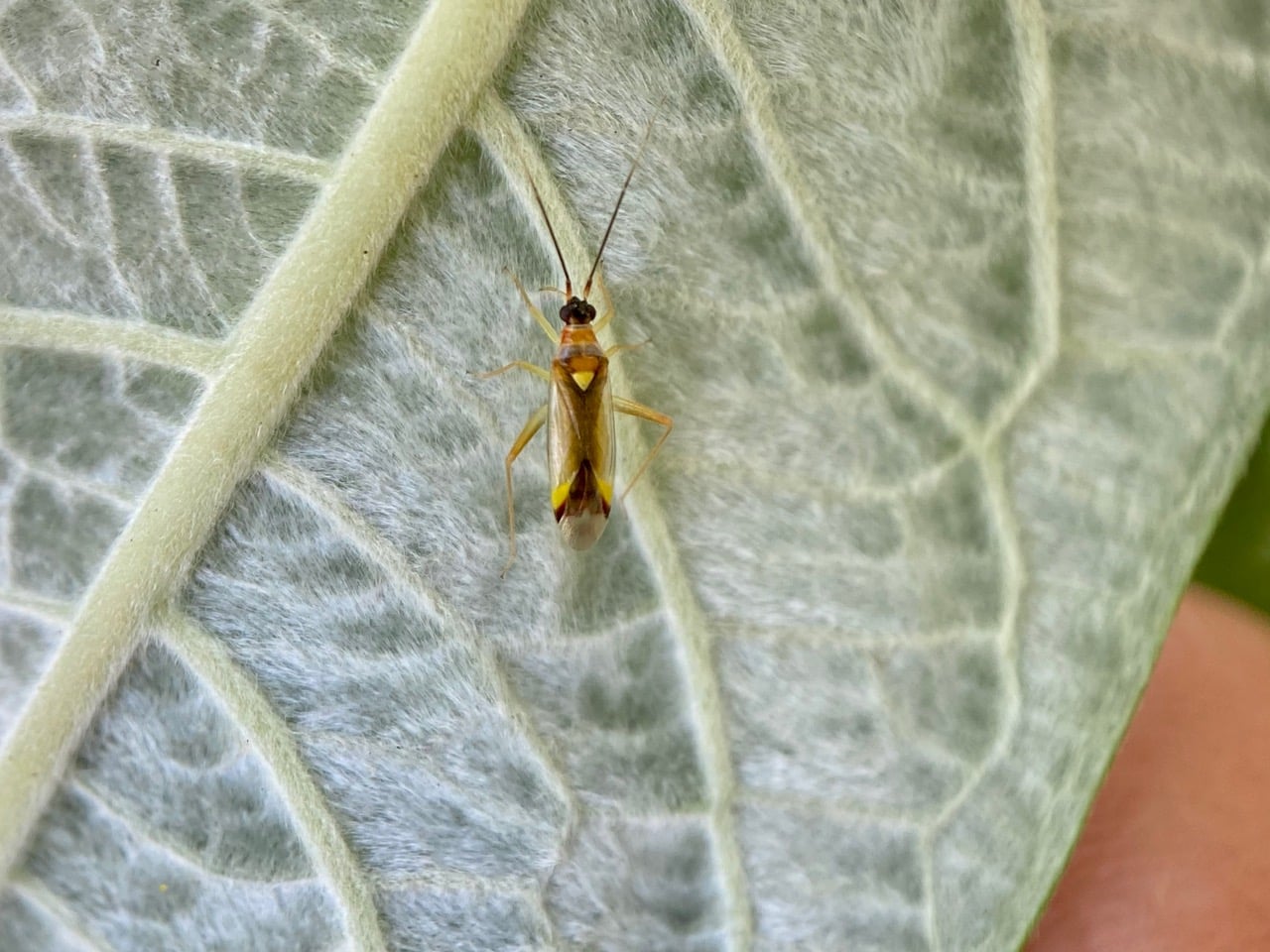
A tiny Plant Bug, Campyloneura virgula (family Miridae) is walking on the velvety surface on the back of a Willow leaf.
Mirid bugs are also referred to as plant bugs or leaf bugs. Miridae is one of the largest family of true bugs in the order Hemiptera. Like other Hemipterans, Mirids have piercing, sucking mouthparts to extract plant sap. Some species are predatory. Others are opportunistic omnivores. One useful feature in identifying members of the family is the presence of a cuneus; it is the triangular tip of the corium, the firm, horny part of the forewing, the hemielytron. The cuneus is visible in nearly all Miridae.

Campyloneura virgula has been introduced to the United States from Europe. Measuring only 4-5 mm in length, the elongate bug has a yellow scutellum, and bright yellow cuneus that are tipped with dark red. This predatory bug hunts for small insects, such as aphids and red mites. Adult flight time is from June to October when they are commonly found on numerous deciduous trees. Males are extremely rare, as this species is parthenogenetic, reproducing without mating.
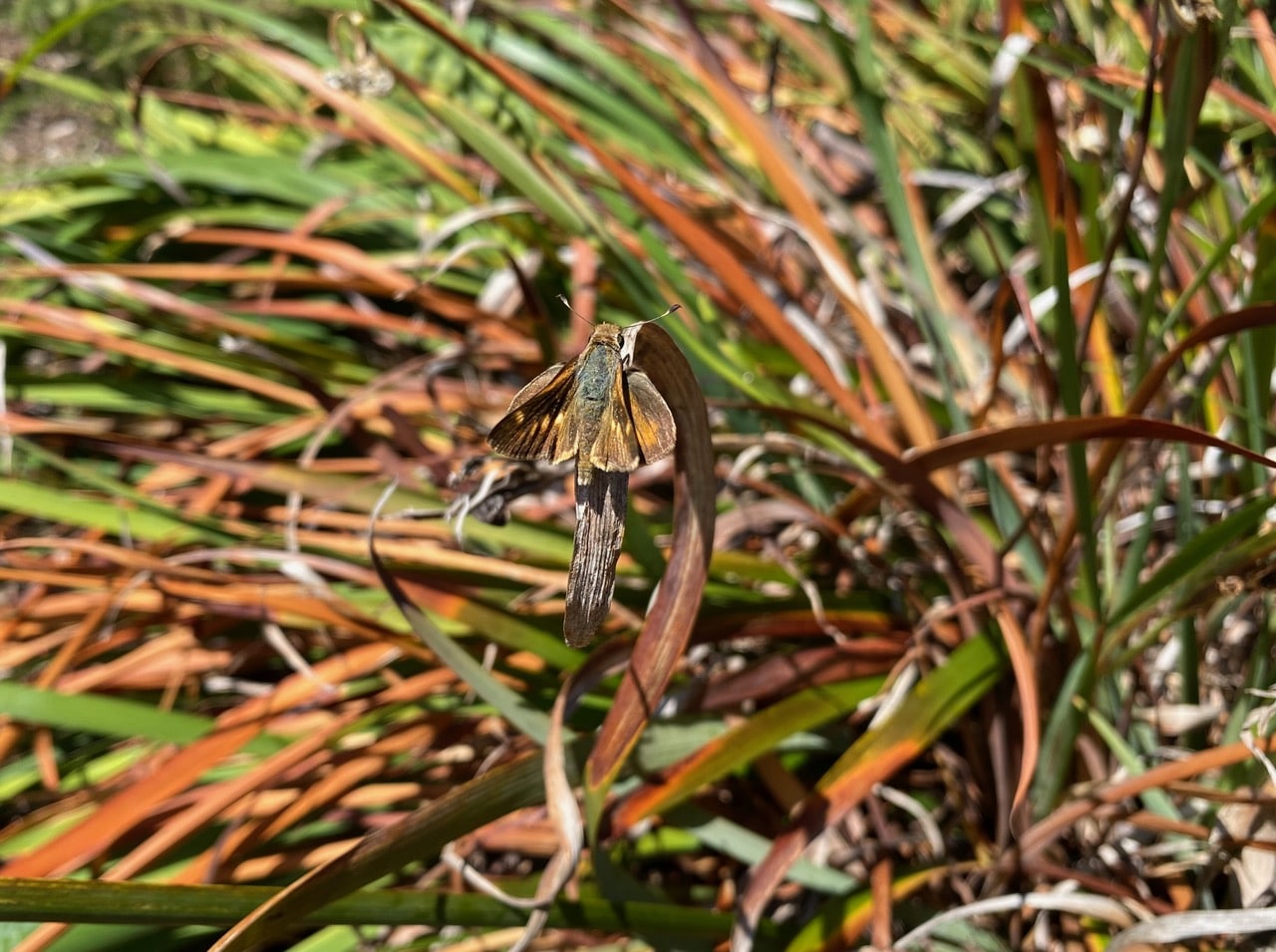
An Umber Skipper, Lon melane (family Hesperiidae) almost disappears from view as it lands on the drying foliage of Douglas Iris. The camouflage is uncanny.
Skippers are a family, the Hesperiidae, of the order Lepidoptera (butterflies and moths). They are named for their quick, darting flight habits. Most have the antenna clubs hooked backwards like a crochet hook. They also have generally stockier bodies and larger compound eyes than the other butterflies. Their wings are usually small in proportion to their bodies. When at rest, skippers keep their wings usually angled upwards or spread out, and only rarely fold them up completely. Californian species are mostly brown or tan, with black, orange, or yellow markings.
Skipper caterpillars are usually green or brown, sometimes yellowish, never brightly colored. They have a distinctive “collar”, a narrow ring around the body right behind the head. Caterpillars are camouflaged and often hide during the day. Many species make nests of leaves and silk for additional protection. Most North American species feed on grasses, but some common species eat shrubs and trees, especially in the bean family. Most species are limited to a single group of food plants. Adult skippers are only active during the day, but Skipper caterpillars feed mainly when it is dark or partly light.
The Umber Skipper is found in the western United States, the highlands of Mexico and Central America. Umber refers to the red-brown color of the upper sides of the wings. Habitat consists of desert foothills, grassy areas, streamsides, roadsides, yards, parks and open oak woodland. There are two generations per year. Adults feed on flower nectar. Larvae feed on various grasses, and live in shelters made of rolled or tied leaves.
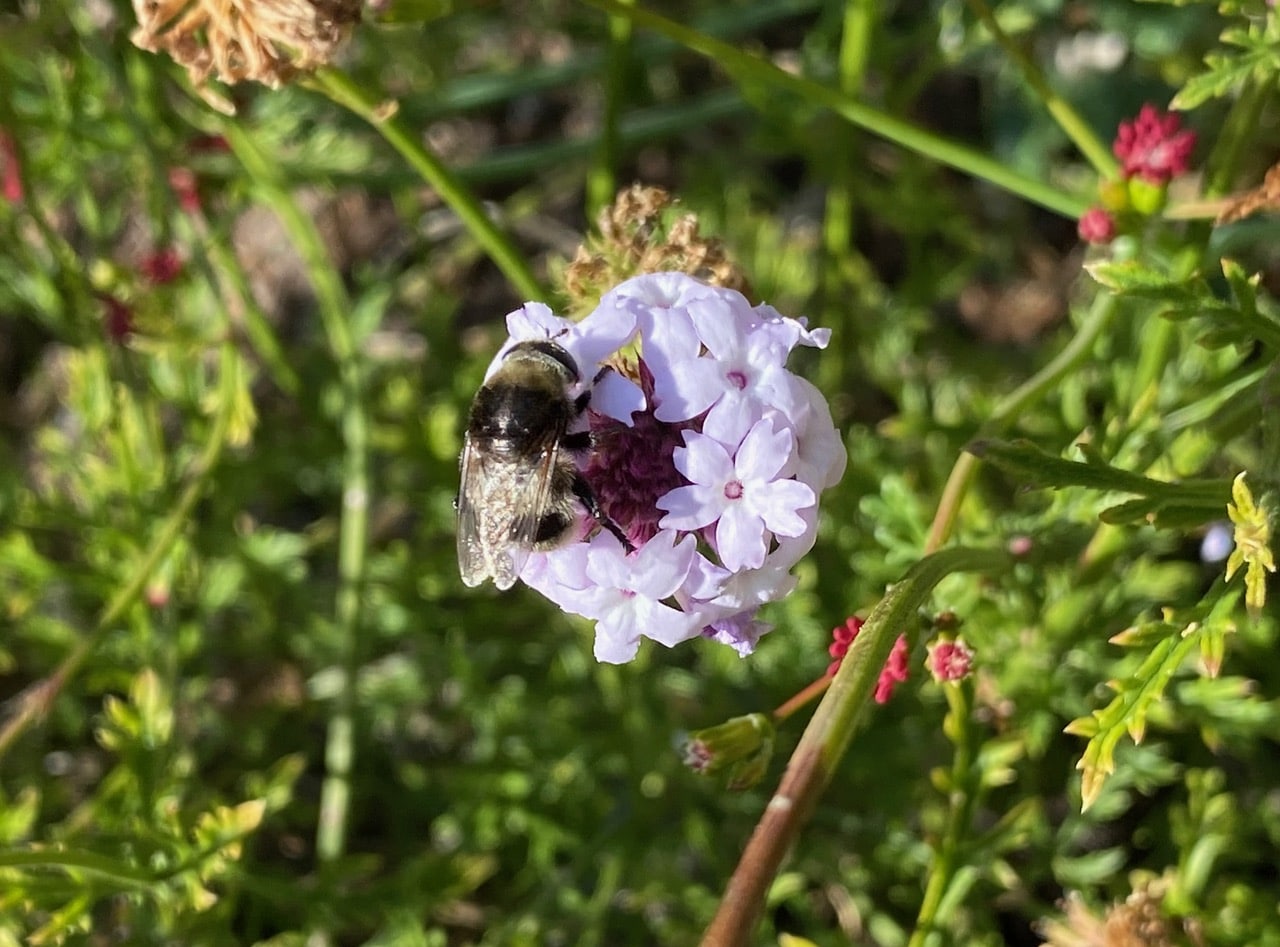
Built like a bumble bee, a fly is taking nectar on an inflorescence of Lilac Verbena, Verbena lilacina. How do I tell it’s a fly? The short antennae, and very large eyes.

The rear half of its abdomen is covered with shaggy, tan hairs.
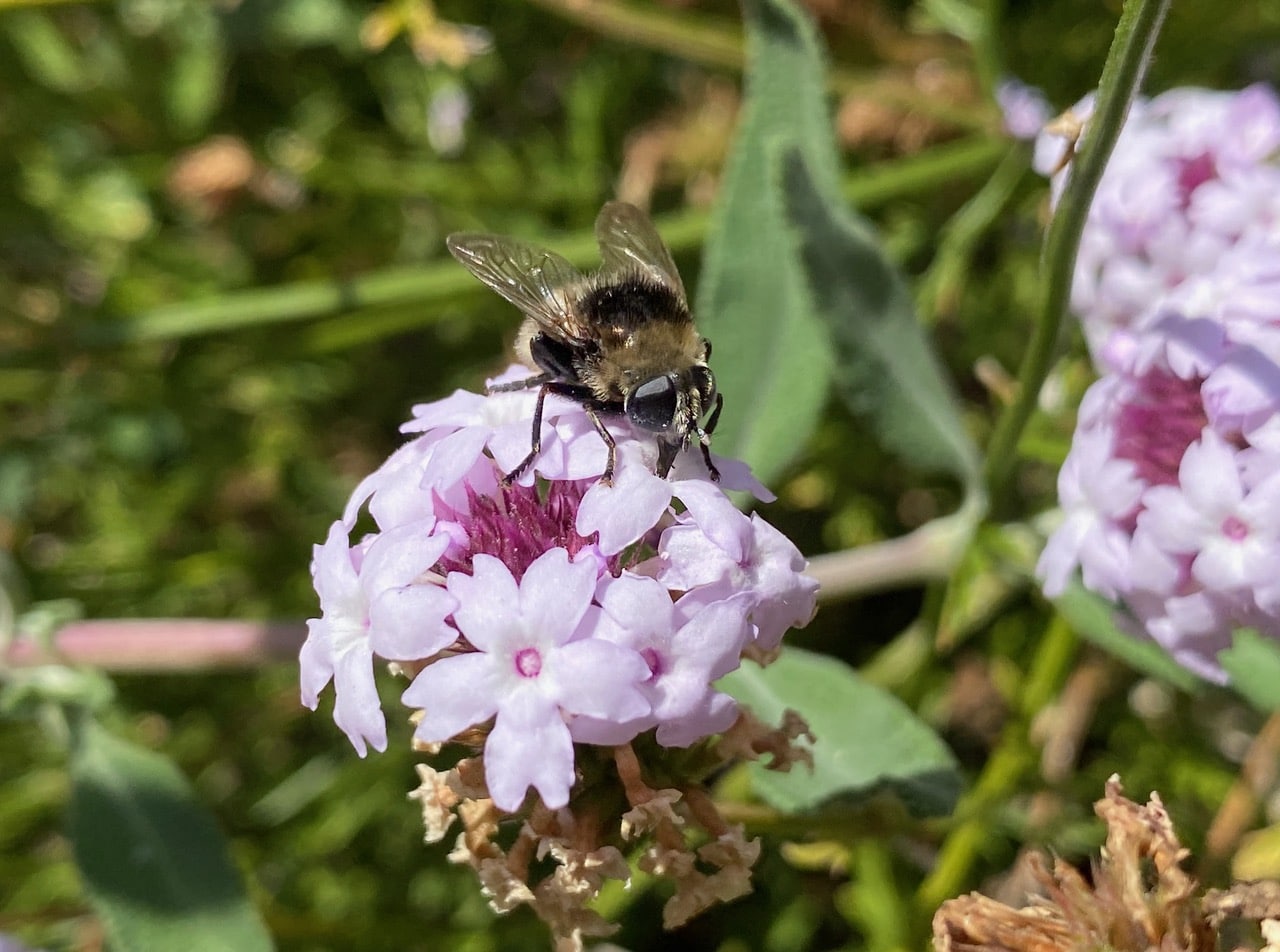
Two hover fly experts on iNaturalist has helped identify the fly as the Narcissus Bulb Fly, Merodon equestris (family Syrphidae). Note that it has lowered its tongue into the tubular flower.
The hover fly is found in Europe and North Africa, in North America from British Colombia south to California. They favor deciduous forest/open ground; also in gardens and horticultural land. The adults fly low in May to July with a fast zigzagging flight among low vegetation. They visit various flowers from different plant families for nectar and pollen. Males exhibit territorial behavior, patrolling and defending their territories by driving other insects away. Females lay eggs, usually one egg per plant, at the base of the leaves or in the adjacent soil.
The larvae feed internally in tissues of bulbs of Amaryllidaceae, and they are regarded as a horticultural pest, especially of Narcissus. The larvae overwinter in the bulbs, after which they leave the bulbs to pupate in the soil litter.

A scruffy male Yellow-faced Bumble Bee, subgenus Pyrobombus (genus Bombus, family Apidae) has landed on a flower cluster of Lilac Verbena to take nectar. Note the extra bands of yellow hairs on his abdomen, his long antennae, and his skinny hind tibia that lacks a corbicula (pollen basket) – all characteristics of a drone (male). The bumble bees are apparently winding down their season for the year. Drones and gynes (new queens) are usually only produced in late summer to early fall. For the rest of the year, we see mostly worker bees.
Most bumble bees have an annual life cycle which starts with a fertilized queen emerging from diapause (insect version of hibernation) during the late winter or early spring. After emergence and while searching for a nest site, the queen consumes pollen and nectar to replenish her depleted fat reserves and to promote development of her ovaries. Once located, the queen provisions the nest with a ball of pollen mixed with nectar and builds a single nectar pot composed of wax. The queen then lays her first clutch of eggs, and incubates them with her body heat. Newly emerged workers (all females) assume foraging and brood rearing responsibilities, enabling the queen to concentrate on egg laying. During late summer to early fall, the colony switches to producing “reproductives” (i.e. males and gynes). Male offspring develop from unfertilized eggs, and fertilized eggs develop into gynes (new queens). Gynes mate with males from other colonies and, once fertilized, these new queens enter diapause for the winter. Old queens, workers, and males die off at the end of the season, leaving only the newly mated queens to establish new colonies in the following spring.