

Pollinator Post 12/12/25

Seeking fresh air and sunshine, I find myself in the small park across from the Tilden Steam Train parking lot. I walk barefoot to ground myself, then sit down in the sun to take in the view over Skyline Gardens. The fresh conifer wood chip mulch fills my nostrils with its spicy fragrance. Ah, life is good!
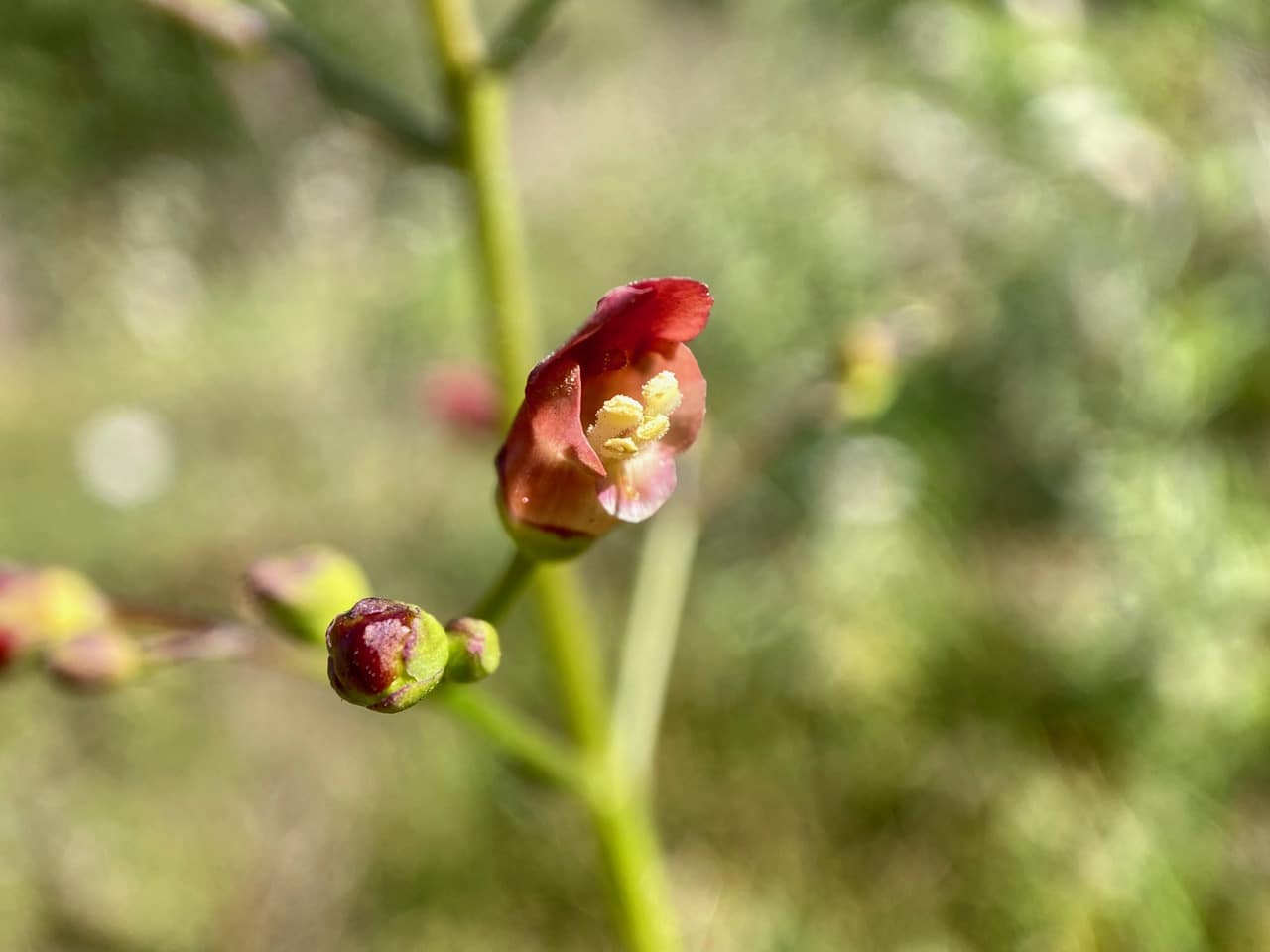
I cross the street towards Skyline Gardens, but don’t expect to linger much as it is cold and breezy. Surprise! A Bee Plant, Scrophularia californica is in full bloom on the side of the narrow trail before the cattle gate. This flower has already advanced to its male phase!
The small flowers of Bee Plant are protogynous. They undergo sex change during maturation, starting from a female phase and gradually transitioning into a male phase. During the female phase, a single style/stigma extrudes above the lower lip of the flower, ready to receive incoming pollen. Eventually the four male stamens roll out from the throat of the flower, releasing pollen (as seen in the picture). At this stage, the female style becomes flaccid and droops out of the way. This is a form of dichogamy. Dichogamy in plants is a strategy where male and female reproductive parts of a flower mature at different times, preventing self-pollination and promoting outcrossing.
The flowers of Bee Plant are usually pollinated by early season bees, such as Miner Bees (family Andrenidae) and Bumble Bees (family Apidae). They are also avidly visited by nectar seeking Hover Flies (family Syrphidae) and wasps.
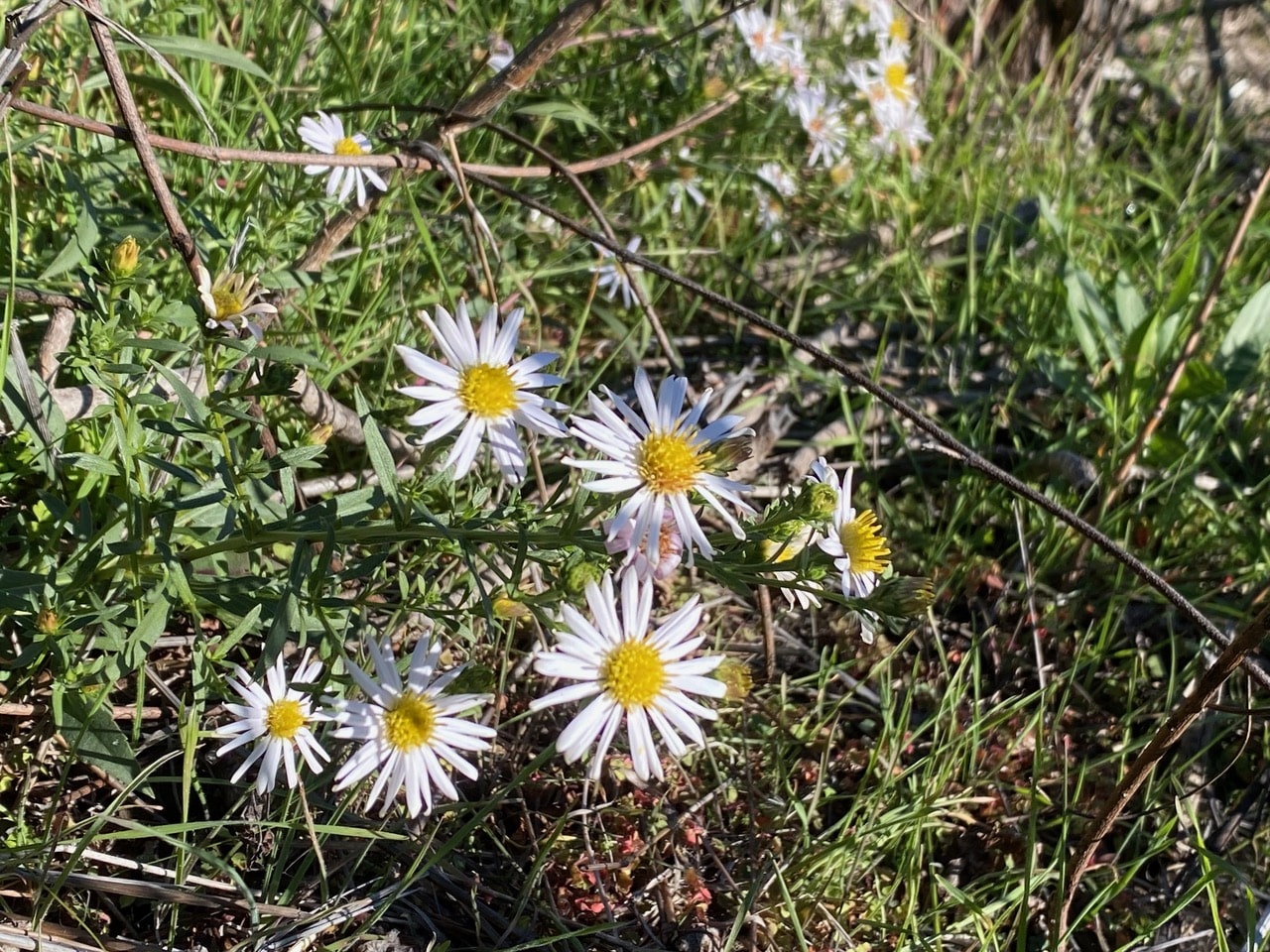
In the same vicinity along the trail, a small patch of Pacific Aster, Symphyotrichum chilense is still in bloom! I always thought of the plant as a summer bloomer, but the plentiful rains we had last month must have extended the plant’s bloom period til now – mid December!
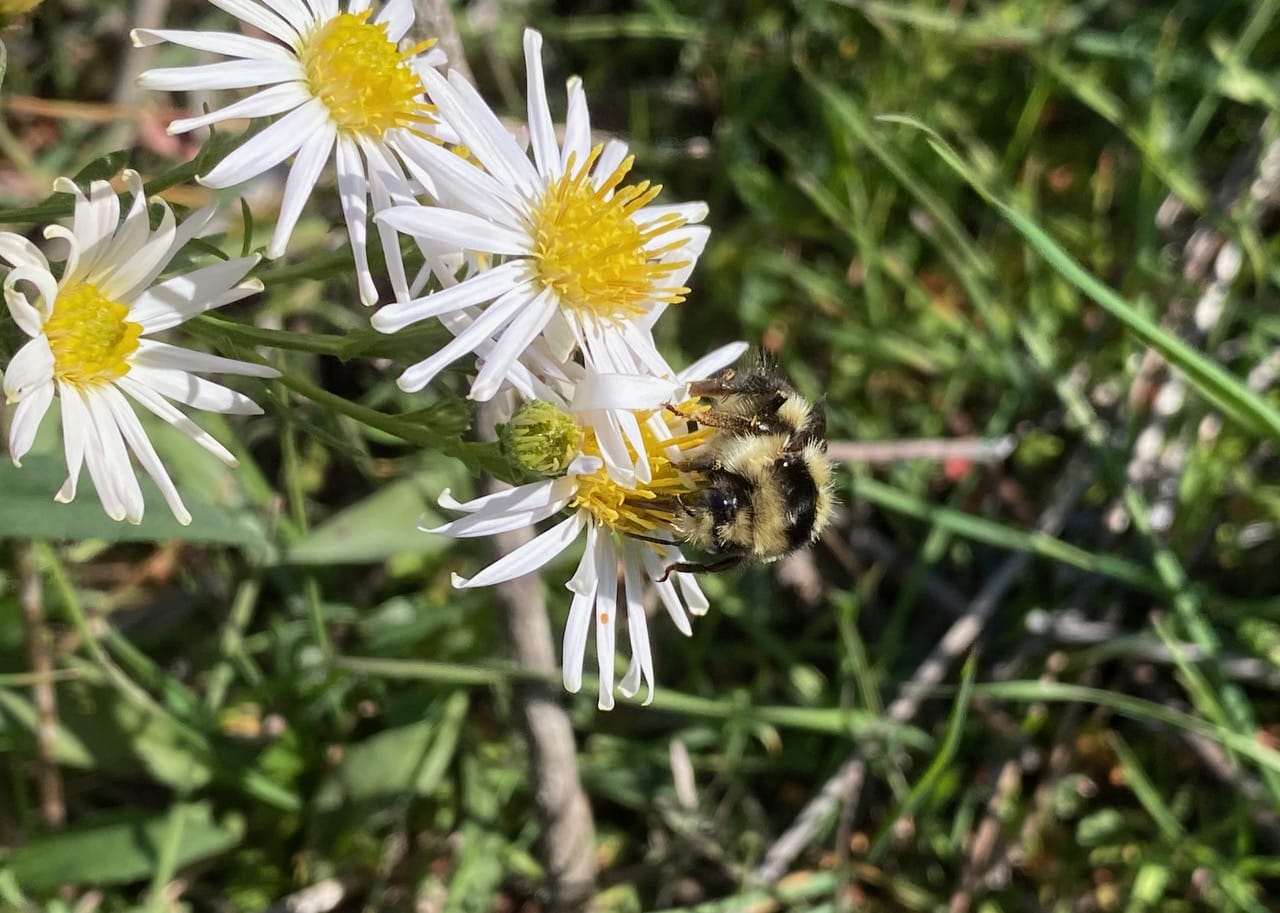
The flowerheads at the end of that branch is shaking as a large Black-tailed Bumble Bee, Bombus melanopygus (family Apidae) forages on the flowers! Judging by her size, I have no doubt that she is a queen. The Black-tailed are the earliest bumble bees to emerge from diapause (insect version of hibernation) in our area. In my own garden, the small worker bees are already out pollinating the manzanitas. My heart always swells with pride and admiration for these hardy bees out foraging in such cold weather.
We have long been taught that insects are “cold blooded” (poikilothermic), their body temperatures rising and falling with ambient temperature. As it turns out, Bumble Bees are capable of thermoregulation. Their furry coat can insulate their bodies against the cold, but they have various behavioral and physiological adaptations for low temperatures. They can use their large flight muscles to generate heat through shivering, in the same way that they buzz pollinate flowers, allowing them to maintain a relatively stable body temperature even in cold environments. The bees also use behavioral adaptations such as basking in the sun and adjusting their flight speed depending on the ambient temperature. What’s more, Bumble Bees also have a physiological mechanism for thermoregulation, called counter-current circulation. Their circulatory system helps maintain heat by allowing warm hemolymph (insect version of blood) flowing from the thorax to exchange heat with cooler hemolymph returning from the abdomen. In this process, during flight, heat produced in the thorax is transferred to the abdomen where it can be more easily dissipated.
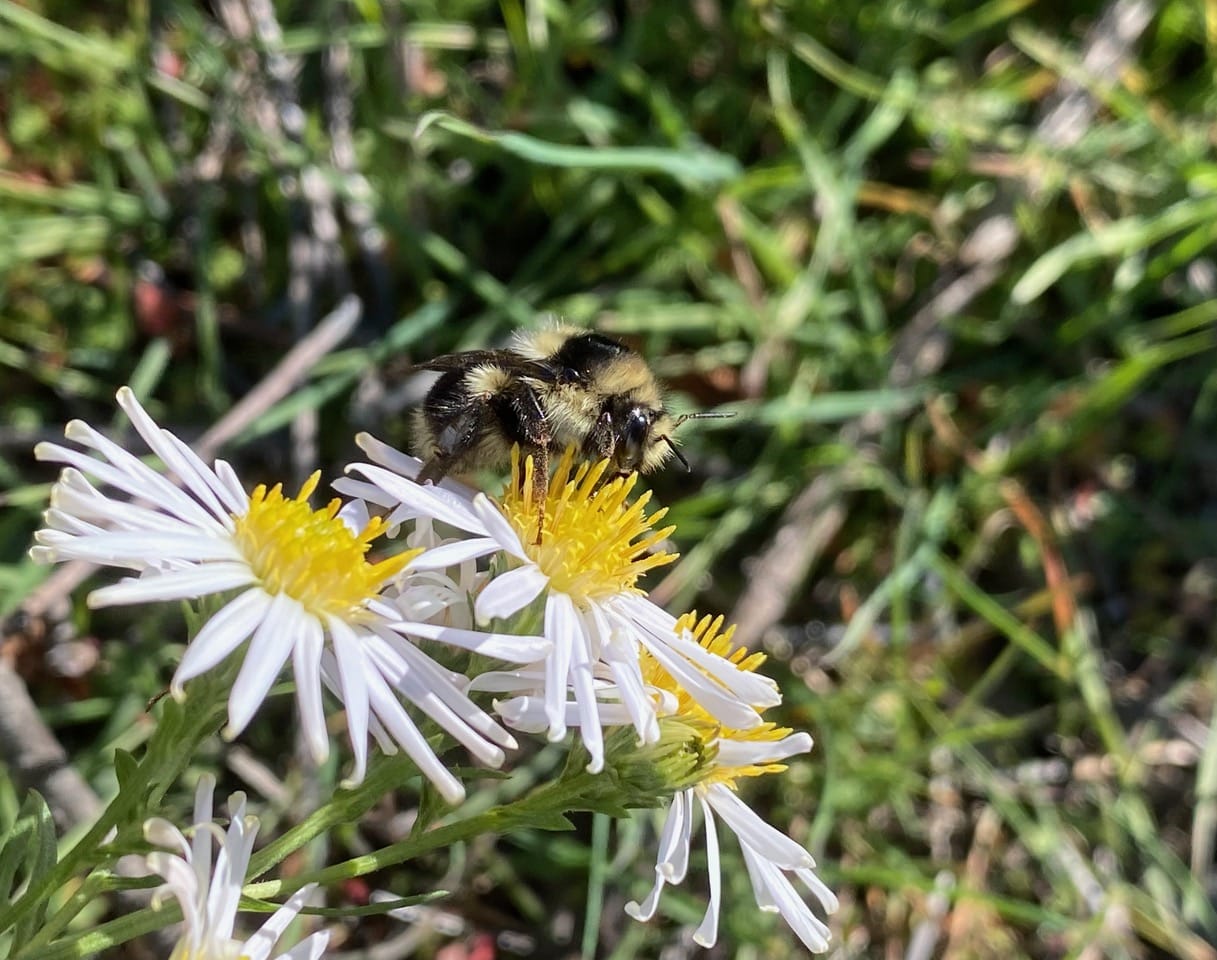
Bumble bees are social and live in colonial hives. Many of the large individuals seen early in the season are queens. They are the only members of their colony to survive the winter, hibernating until the days begin to warm and their host plants are in bloom. These queens have mated before they went into hibernation. Now their first order of business is to each find a nesting site (usually an abandoned rodent burrow), lay eggs, brood and nurture the first batch of workers. Henceforth, the queens stay behind in the hive to concentrate on laying eggs while the workers take on hive duties and foraging. At the end of the season, usually in late summer, the colony produces gynes and drones (males). These mate with others from neighboring colonies. The mated queens go off to find a safe place to hibernate through the winter, while the rest of the colony, including the old queen dies. And so the cycle is repeated.
Queens are noticeably larger than worker bees, which is one of the easiest ways to distinguish them. Queen bees are fed a more substantial diet during their larval development, contributing to their larger size. The queen’s large size is crucial for her to store enough nutrients to lay a large number of eggs throughout the colony’s lifespan.
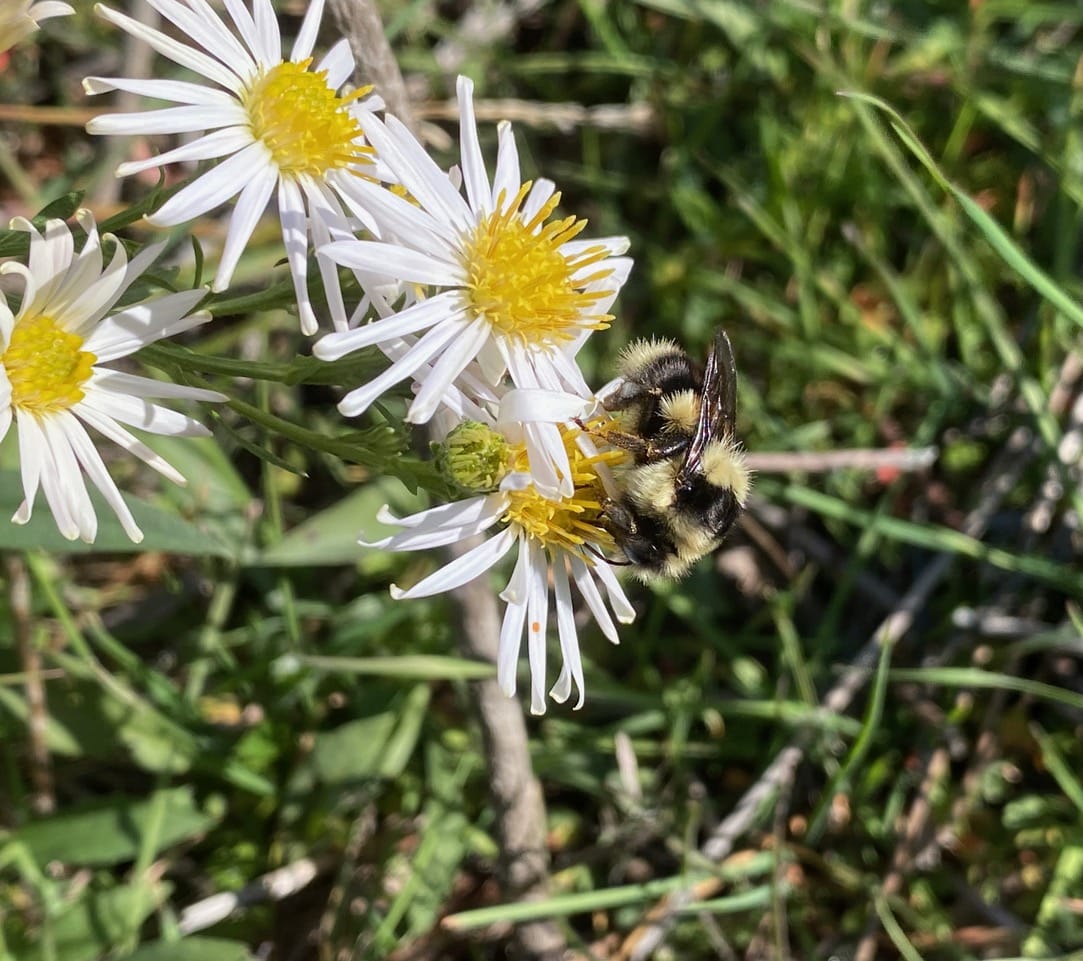
The Black-tailed Bumble Bee, Bombus melanopygus (family Apidae) is a species of bumble bee native to western North America, widely distributed from the Pacific to the Rocky Mountains, and from Alaska to Baja California. The species is found in various habitats, including agricultural and urban areas. The bees feed on many types of plants, including manzanitas, Ceanothus, golden bushes, wild buckwheats, lupines, penstemons, rhododendrons, willows, sages, and clovers. They nest underground or aboveground in structures. I have seen a colony that nested in an abandoned bird’s nest among the vines on a neighbor’s trellis.
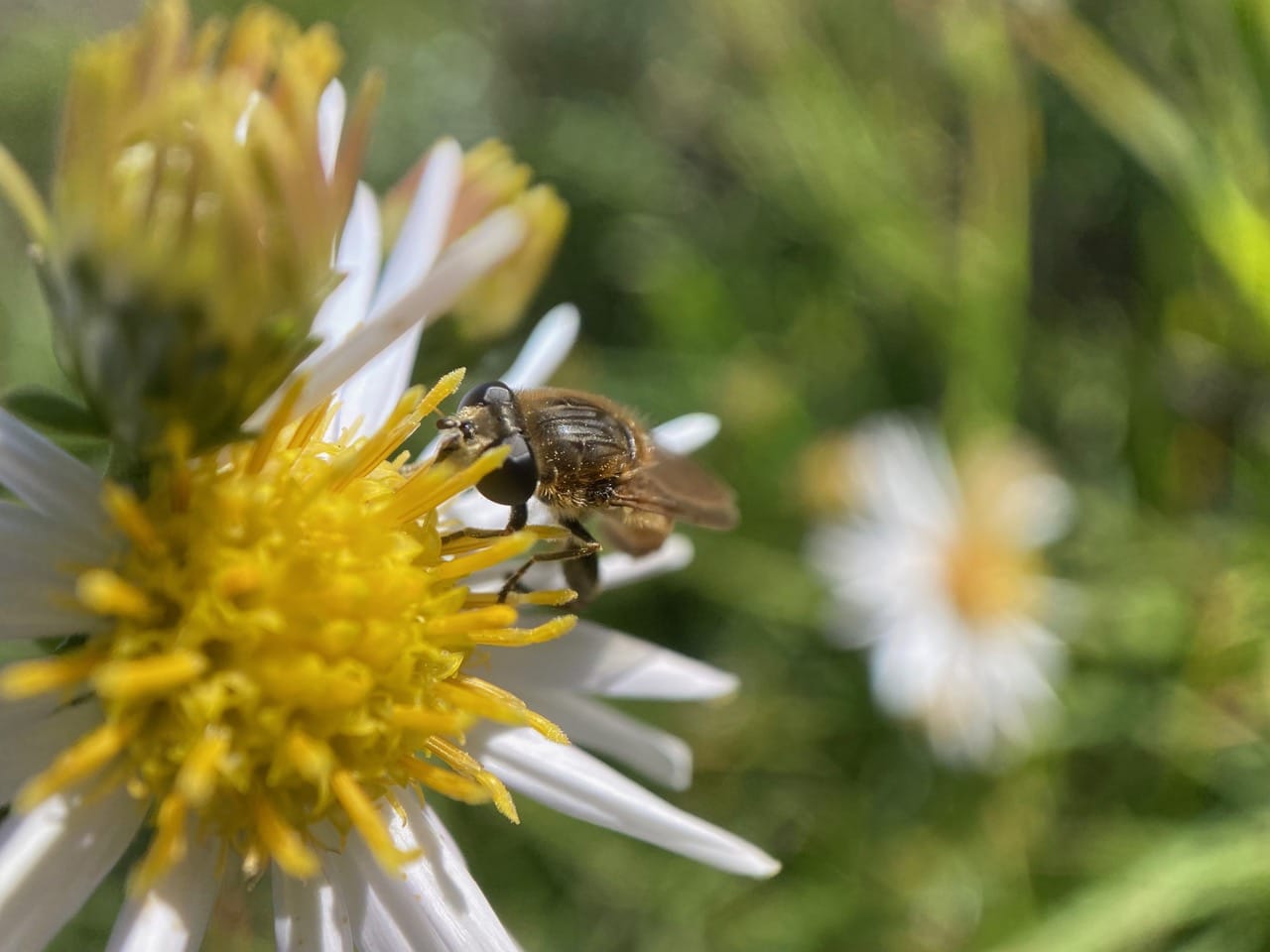
Hey, there’s a Hover Fly foraging on that Pacific Aster flowerhead. The fine lines on its thorax look familiar – the fly is a Common Sickleleg, Asemosyrphus polygrammus (family Syrphidae).
The hover fly is found in western North America. Appropriately, Polygrammus means “marked with many lines”, probably referring to the patterns on the thorax. The common name ‘sickle-leg’ probably refers to the bow-shaped tibia of the hind legs. Adults visit flowers for nectar and pollen. Larvae are rat-tail maggots. The maggots are most commonly found in dank and decaying environments such as compost, pond margins, and tree rot holes. The larvae feed on the decomposing material which is poor in oxygen but rich in organic matter. The “tails” are the siphons or breathing tubes that extend from their rear end to enable the larvae to breathe while submerged in the wet substrate. When mature, the larvae climb out to pupate on dry land. The larvae are important decomposers/recyclers and the adult flies are important pollinators.
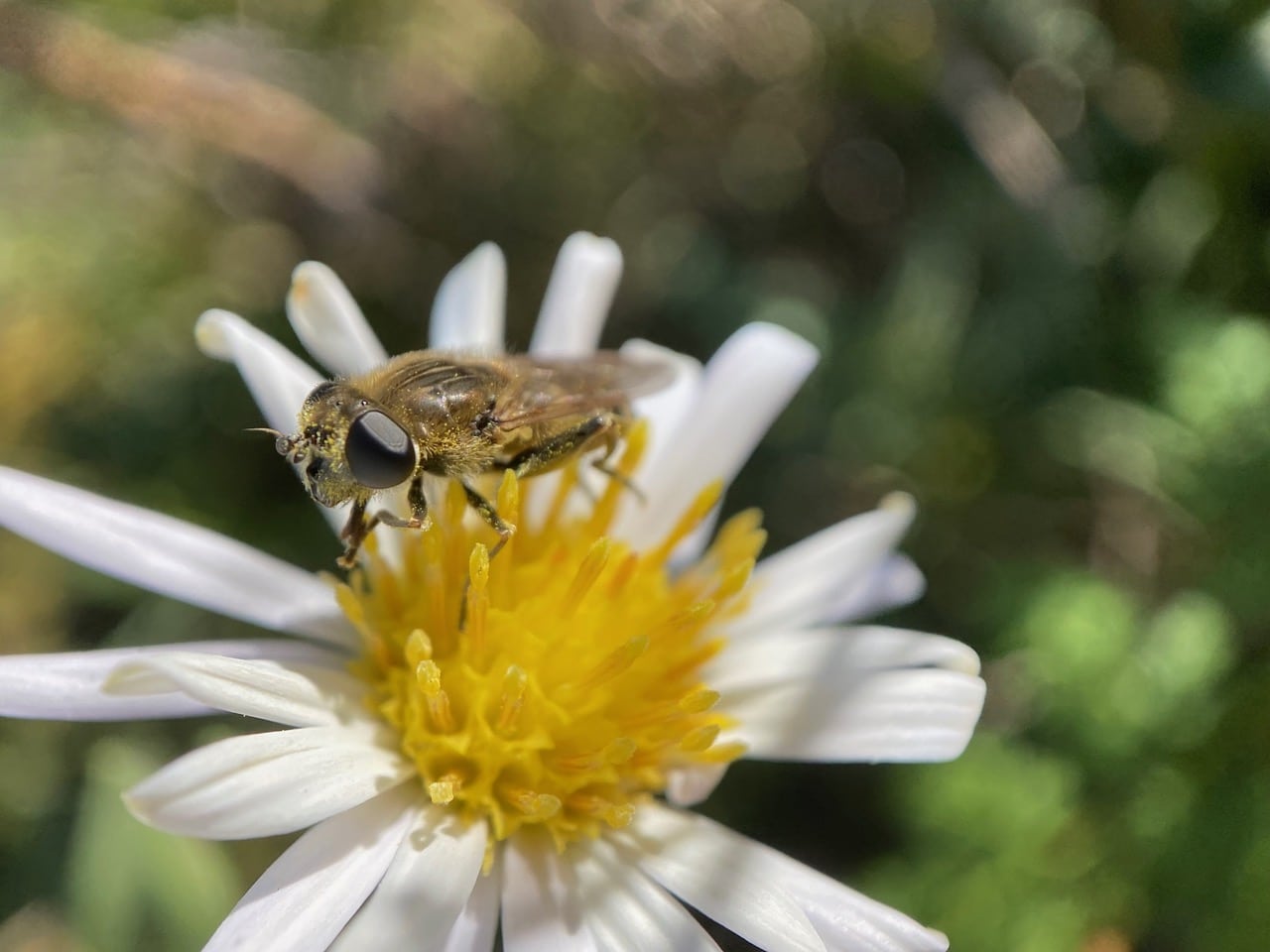
Pollen has adhered to the fly’s hairs.
When it comes to pollination honey bees may look slightly better on paper; they pollinate 80% of flowering plant species. Hoverflies, meanwhile, do so for about 70% of the wildflowers that depend on animals for pollination and 72% of all food crops. A single hover fly also tends to be less efficient pollinator than a honey bee.
One key factor is hairiness: insects that are hairier, especially on their faces, can carry more pollen than less-fuzzy species, which includes most hover flies. A furry ball of a bumble bee, for example, can carry 15,000 grains of pollen on its body, about four times as many as a hover fly of comparable size. However, what the hover flies lack in hairiness, they make up for in diligence. They visit more flowers within a field and don’t mind working in poor conditions. Research shows they can be as effective as bees at pollinating some crops, and may even outperform bees on others.

The Hover Fly spends some time cleaning its proboscis with its front legs before flying off.

Its anal prolegs firmly grasping the anther cone of a Pacific Aster flower, an Inchworm stretches its body to reach a ray petal. Note that there are no prolegs between the anal prolegs and its three pairs of true legs behind its head. iNaturalist has helped identify the caterpillar as a Geometer Moth, Neoterpes sp. (family Geometridae).
Inchworms are also called loopers and measuring worms. The majority of the inchworms are the larvae of moths in the family Geometridae. The name comes from the Greek “geo” for earth and “metro” from measure, because the caterpillars seem to be measuring the surface on which they are walking.
All caterpillars have three pairs of jointed legs behind their heads. These legs are called true legs because they will become the six legs of the adult butterfly or moth. There are additional appendages, called prolegs, along their bodies. Prolegs are not true legs, they are just outgrowths of the body wall and will be lost at metamorphosis. They have little hooks on their soles to help the caterpillar walk and grip onto things.
Most caterpillars have five sets of prolegs, four in the middle of the body and one pair at the hind end. Inchworms have the normal six true legs but only two or three pairs of prolegs, all located at the tail end of the body, with none in the middle. When an inchworm walks, it moves its tail-end prolegs up behind its true legs, causing the center of its body to loop upward. Then it stretches its front end forward to take another step.

A female Sedgesitter, Platycheirus sp. (family Syrphidae) visits a flowerhead of Bristly Oxtongue, Helminthotheca echioides. Its dusky metallic luster distinguishes this common hover fly from most others.
The Sedgesitter, Platycheirus sp. (family Syrphidae) is found in grass and herb vegetation. Adults of many species feed on pollen of wind-pollinated plants, such as Salix, Plantago, Poaceae, Cyperaceae, but they also visit other flowers. Many stay active during cold and rainy weather. Larvae feed on aphids.
How do I know the fly is female? The gender of hover flies can be easily determined at first glance. Males have holoptic eyes that meet on top of the head, while females have dichotic eyes that are set apart from each other.
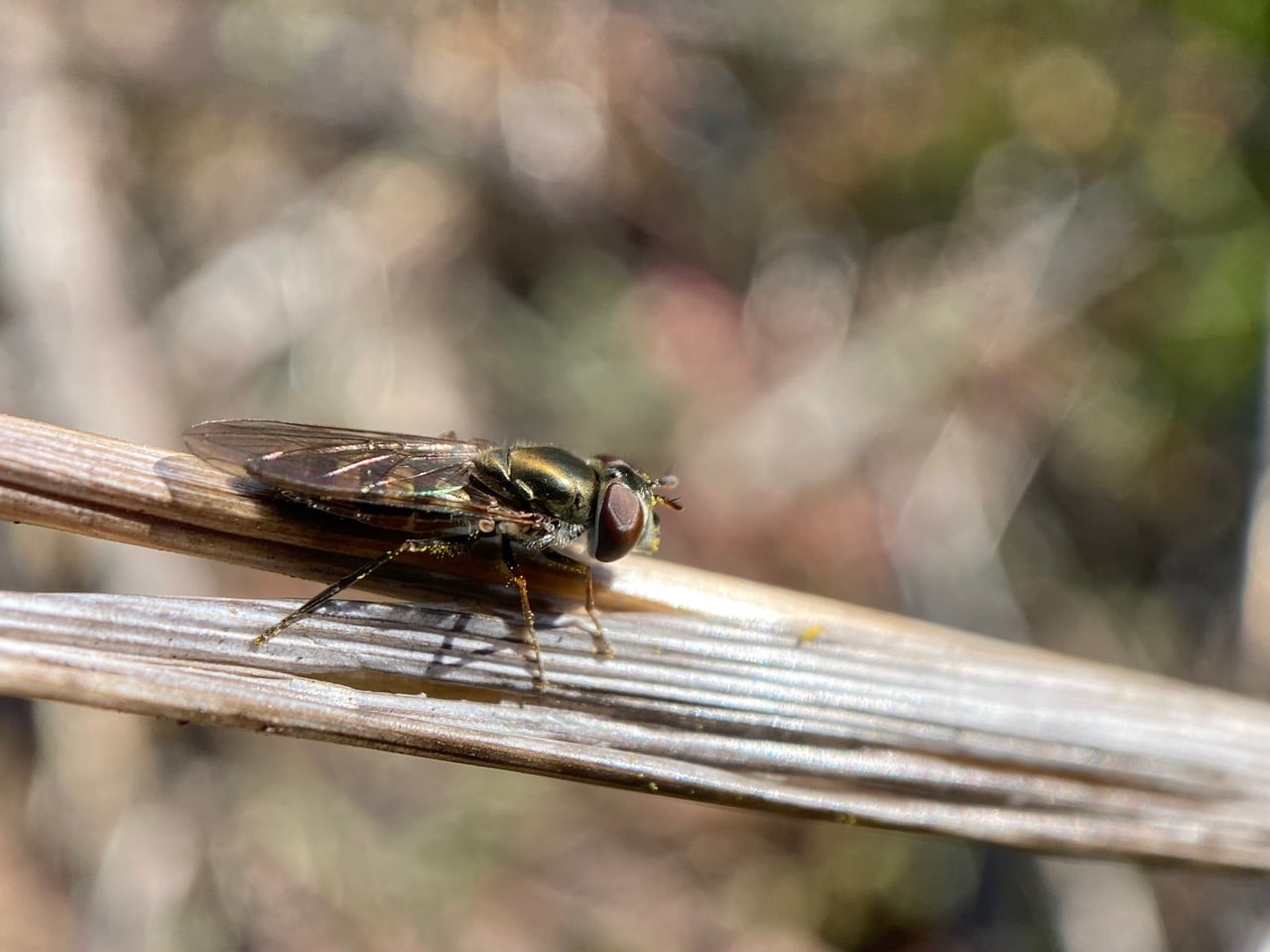
The Sedgesitter, Platycheirus sp. settles on a piece of dried grass to pose for a side view. Both species of hover fly we see this chilly morning have a dark metallic luster. I wonder if that feature confers cold tolerance to the insects?