

Pollinator Post 10/14/26 (2)

Since there are fewer large insects to find among the Grindelia these days, I can now focus on the smallest of them that have been overlooked before. Some tiny insects are flying over the Grindelia. The only way I can see them is to visually track their movements and see where they land. Ah, this one is a parasitic chalcid wasp, Eurytoma sp. (family Eurytomidae, superfamily Chalcidoidea).
Most Chalcid species are parasitoids of other insects, attacking the eggs or larval stage of their host, though many other life cycles are known. These hosts are to be found in at least 12 different insect orders including Lepidoptera (butterflies and moths), Diptera (true flies), Coleoptera (beetles), Hemiptera (true bugs), and other Hymenoptera, as well as two orders of Arachnida. When the host is itself a parasitoid, the wasps are referred to as hyperparasitoids. Generally beneficial to humans as a group, chalcidoids help keep various crop pests under control, and many species have been used as biocontrol agents.
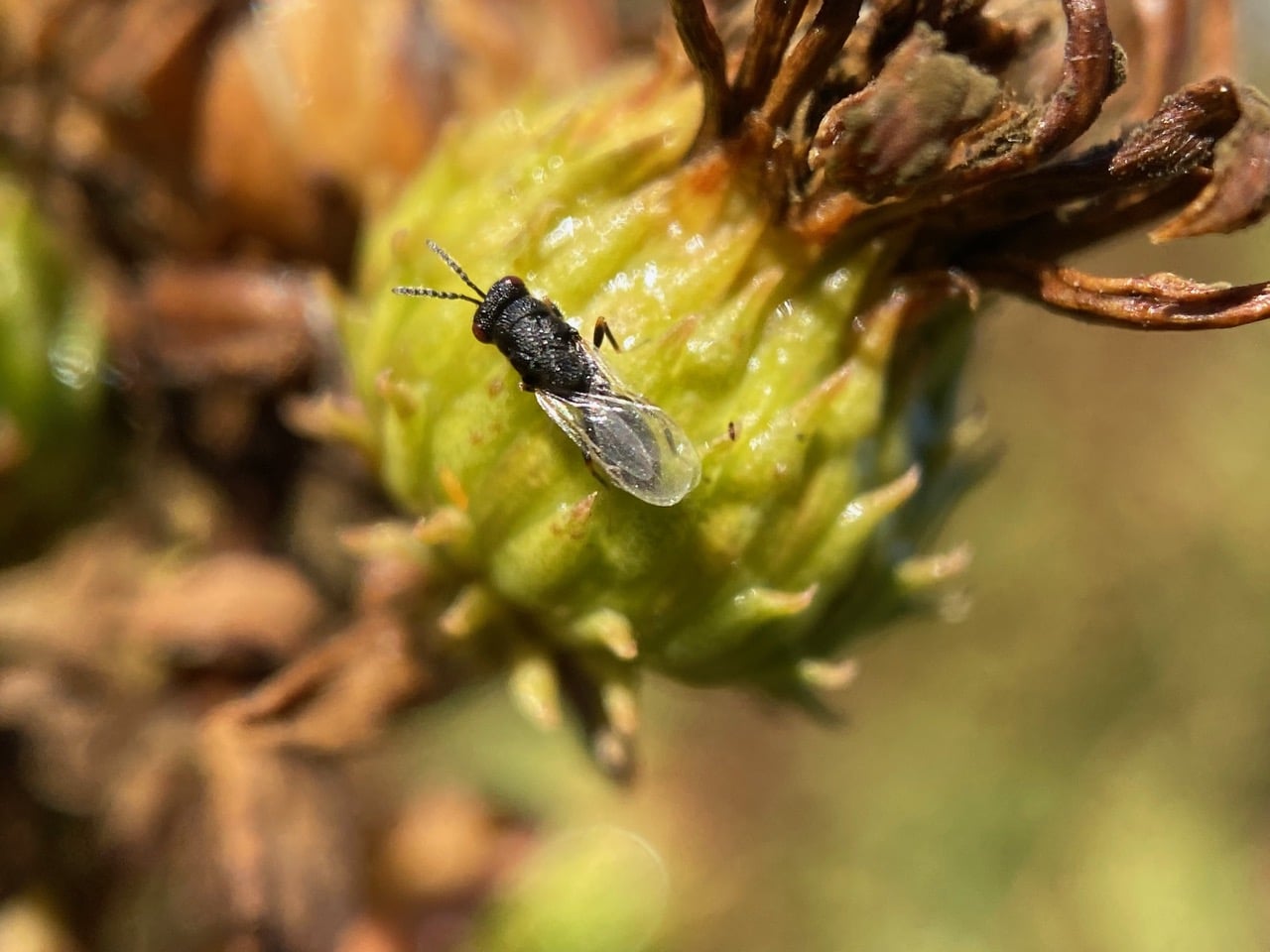
The wasp has a thick, collar-like pronotum and thorax that are heavily pitted.
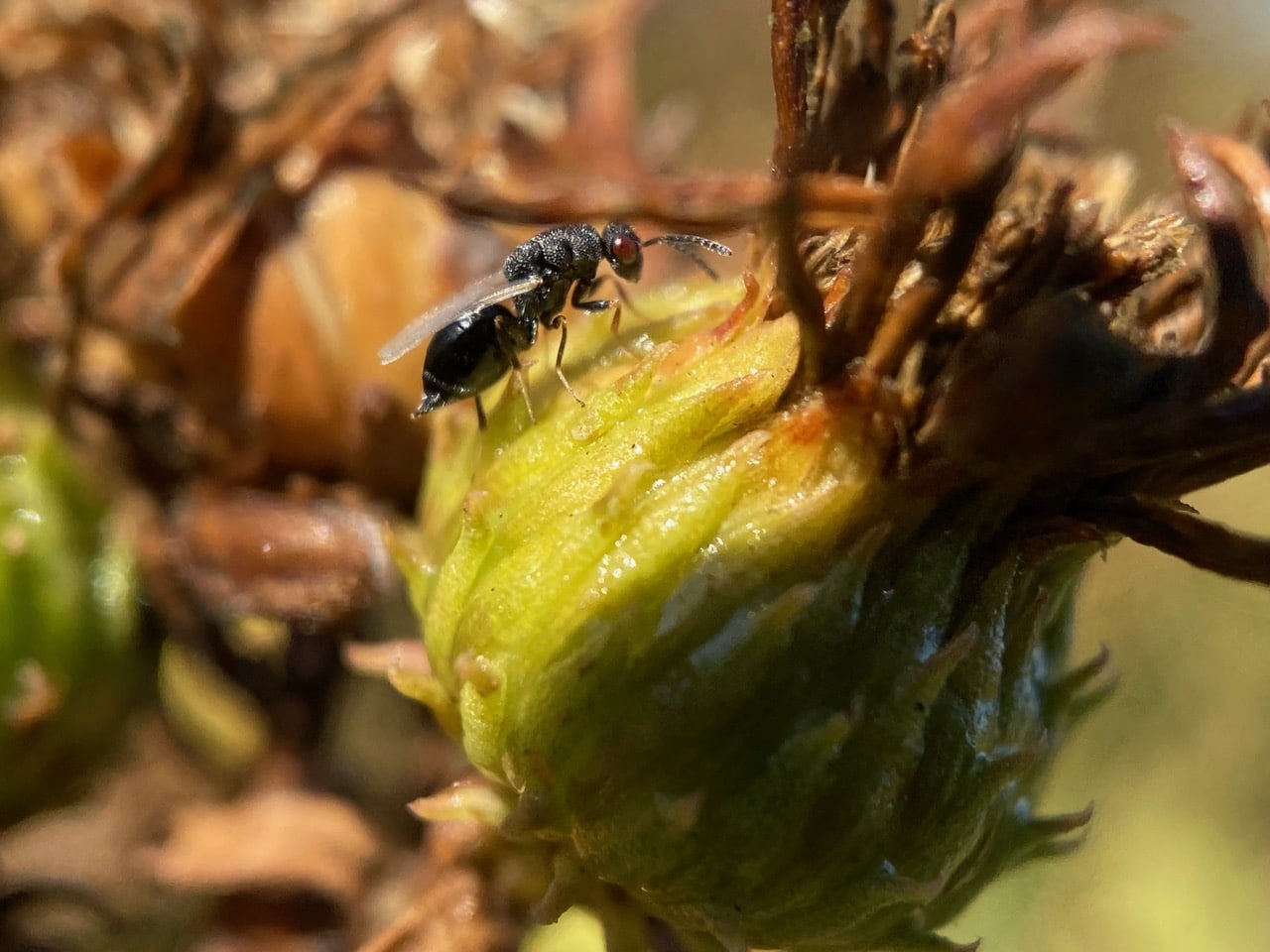
The Eurytomidae are a family within the superfamily Chaldoidea. Unlike most chalcidoids, the larvae of many are phytophagous (feeding in stems, seeds, or galls), while others are more typical parasitoids, with hosts that are usually found within plant tissues. They are found throughout the world in virtually all habitats, and a few are considered pests. The wasps tend to be dull and not metallic, and heavily punctured, with very thick collar-like pronota.
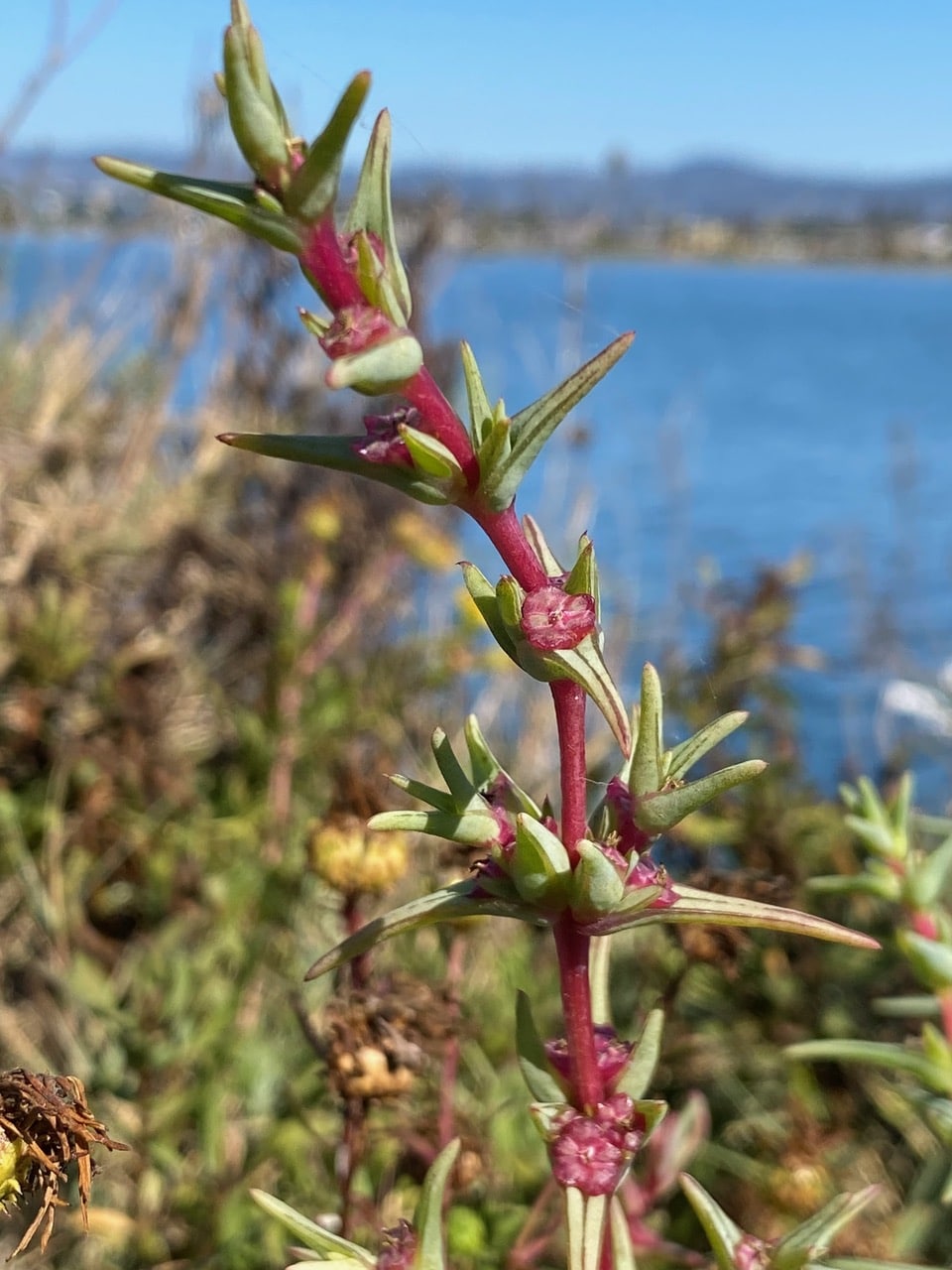
Pinkish-red, flower-like structures have appeared on the leaf axils of the Fleshy Russian Thistle, Salsola soda. These are actually fruits, not flowers.
Salsola soda (Fleshy Russian Thistle, Oppositeleaf Russian Thistle, or Glasswort) is native to southern Europe and inhabits vernal pools, swamps, mudflats and salt marshes. It is widespread in the San Francisco Bay region, in estuaries, especially in disturbed areas. It is also found in undisturbed salt marsh areas in the southern San Francisco Bay. The plant has floating fruits that serve to distribute their seeds on tidal currents.

To find the real flowers, I have to look closely at the leaf axils near the top of the plant. See those anthers dispensing pollen? There are apparently five green, membranous sepals, or tepals fused into a cup or tube.
The flowers of the Salsola genus are small, inconspicuous, and lack petals. They are typically bisexual. There are five stamens, which are the pollen-producing parts of the flower. The flower has a single pistil with an ovary.

A withered stigma surrounded by five anthers?

After fertilization, a small, one-seeded fruit called a utricle develops. It is covered by the persistent, hardened, and winged sepals.
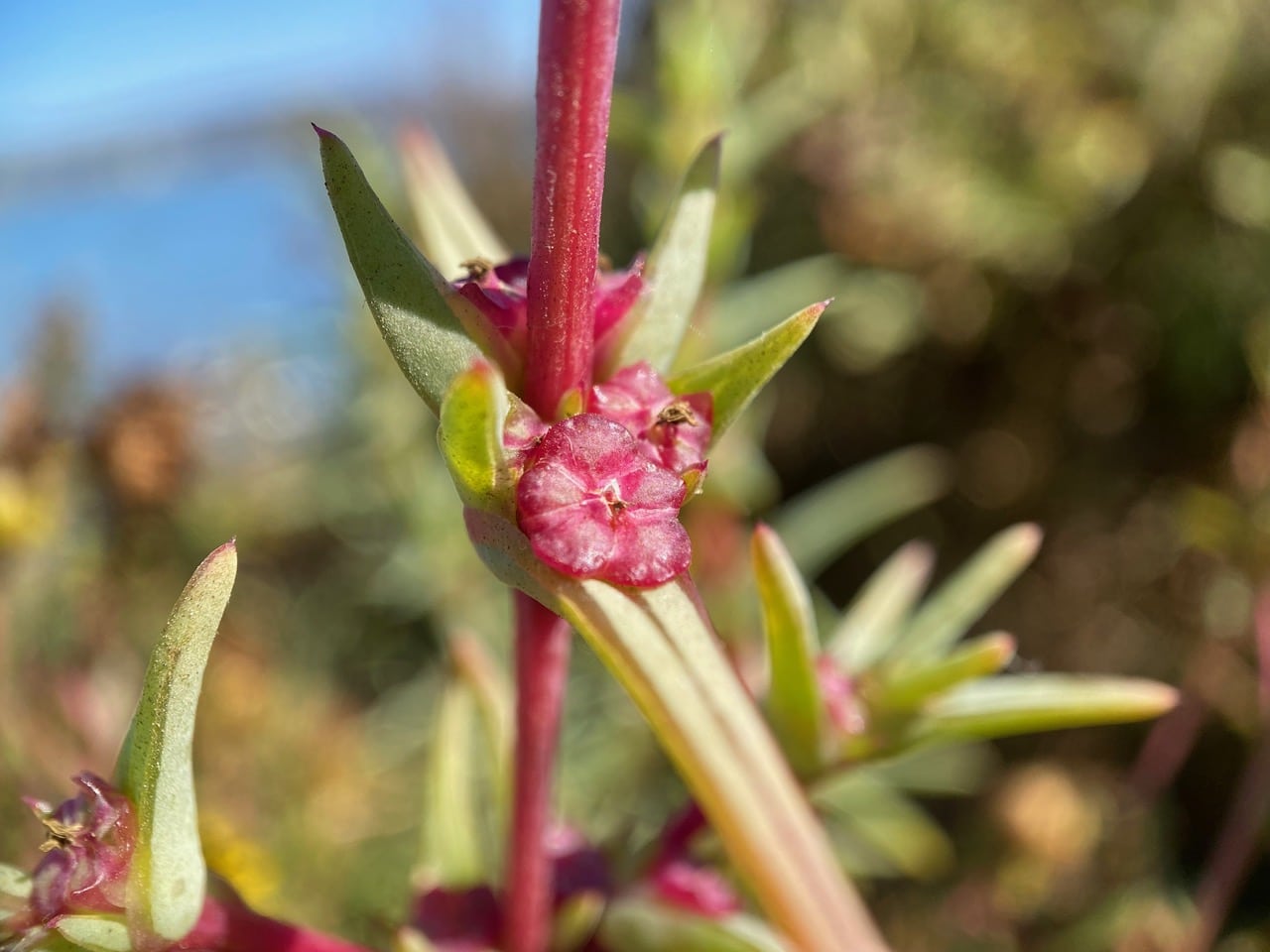
As the flower matures, the stigma and stamens wither, while the five membranous green sepals develop into papery, fan-shaped, translucent, pinkish wings that wrap around the one-seeded fruit. Once mature, the buoyant fruits can detach and float on water and serve to distribute their seeds on tidal currents. Ingenious!
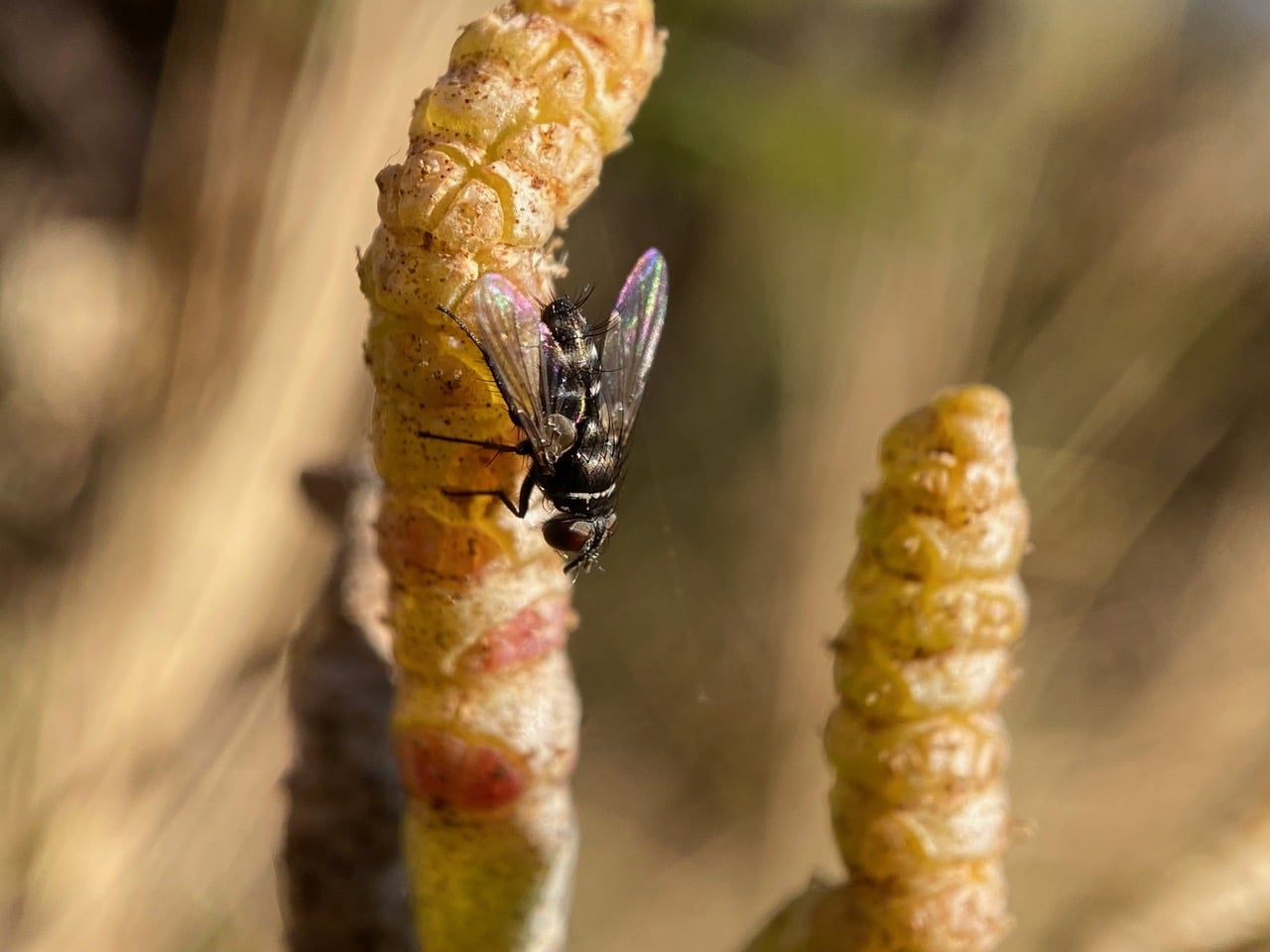
A Bristle Fly (family Tachinidae) is perched on a withered stem of Pickleweed, Saliconia pacifica.
The family Tachinidae is by far the largest and most important group of parasitoid flies. All species are parasitic in the larval stage. Most adults have distinct abdominal bristles, hence the common name. Adults feed on liquids such as nectar and honeydew. They can be found resting on foliage, feeding at flowers or searching for hosts.
Most Tachinids attack caterpillars, adult and larval beetles, true bugs, grasshoppers, and other insects. Females lay eggs in or on the host. Tachinid larvae live as internal parasites, consuming their hosts’ less essential tissues first and not finishing off the vital organs until they are ready to pupate. The larvae leave the host and pupate on the ground. Tachinids are very important in natural control of many pests, and many have been used in biological control programs.

There are still berries on the Armenian Blackberry, Rubus armeniacus.
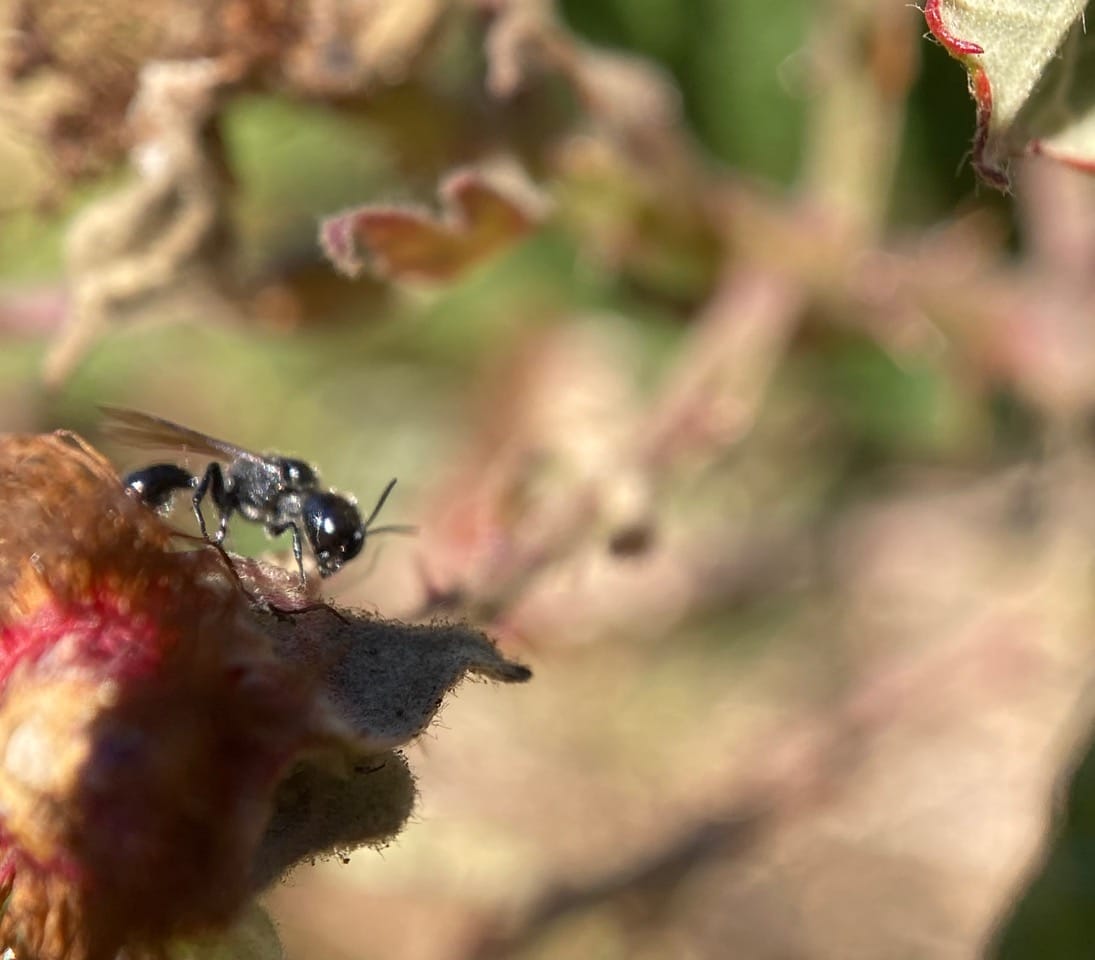
A little black wasp is weaving in and out of the spent flowers of the Armenian Blackberry. It does not seem to be feeding, but hunting in a fast and persistent manner.

The silhouette of the wasp shows a large, blockish head.
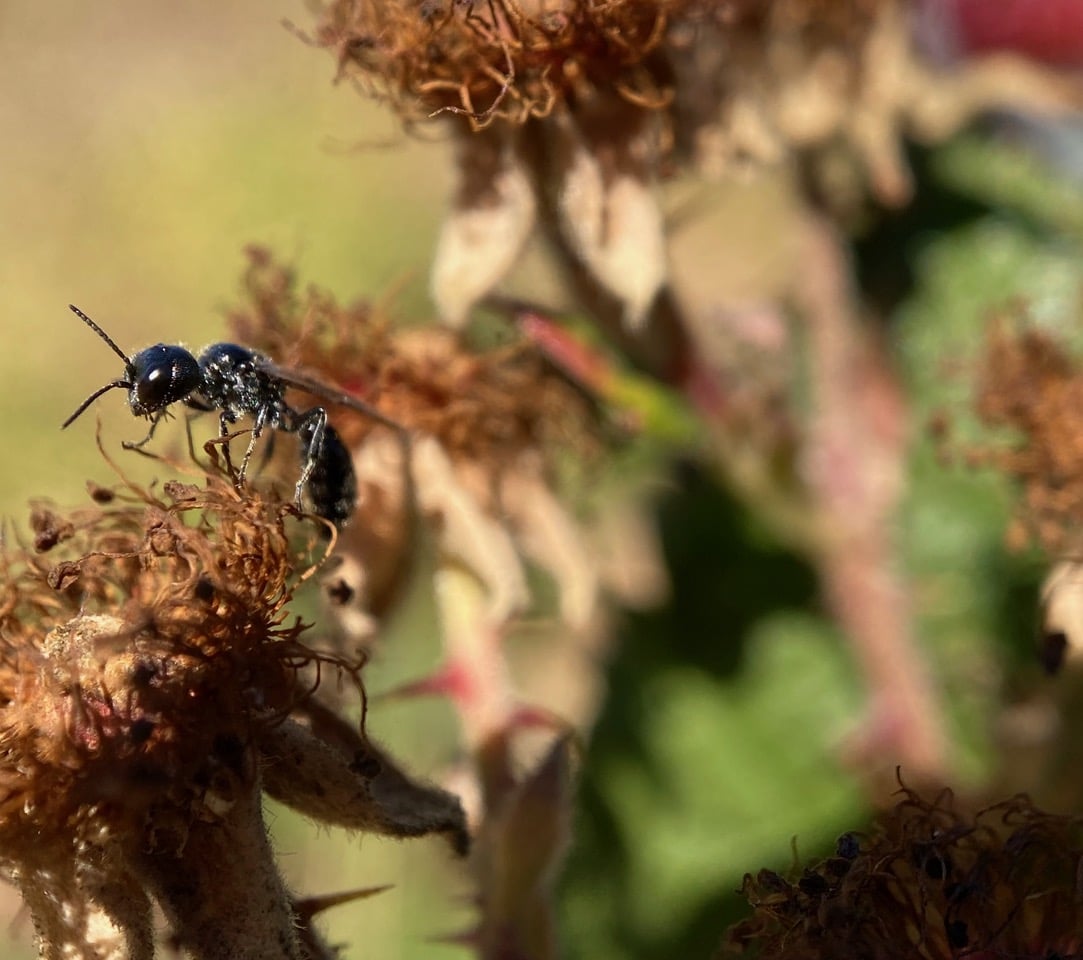
Ah, finally a clear view of the little wasp! As I have suspected, it is a Typical Aphid Wasp, Pemphredon sp. (family Pemphredonidae). Earlier in the summer, I have often found numerous Small Carpenter Bees, Ceratina sp. (family Apidae) on the Blackberry flowers when the plant was in bloom. That is because the bees like to nest in broken blackberry canes. Now I often come across these Aphid Wasps on the plant. Might they also be using the Blackberry stems for nesting too?
The Pemphredon species are often small and black. They are hunting wasps that use aphids for prey. The females usually build their nests in hollow or pithy stems. Partitions between nest cells are made of chewed pith material. Prey are located by the female wasp who grasps a single aphid, paralyzes it by stinging, and returns to the nest. Each cell is provisioned with about two dozen aphids. She then lays an egg on the aphids and seals the cell with a plug of chewed pith. Larvae that hatch out feed on the aphids, and emerge as adults after pupation in the nest. Adults emerge in reverse order of when eggs were laid. Female eggs are laid first, toward the back of the nest. Pemphredon develops proterandric, which means that the males hatch a few days before the females. The adults feed on honeydew, but sometimes also on the aphids themselves.
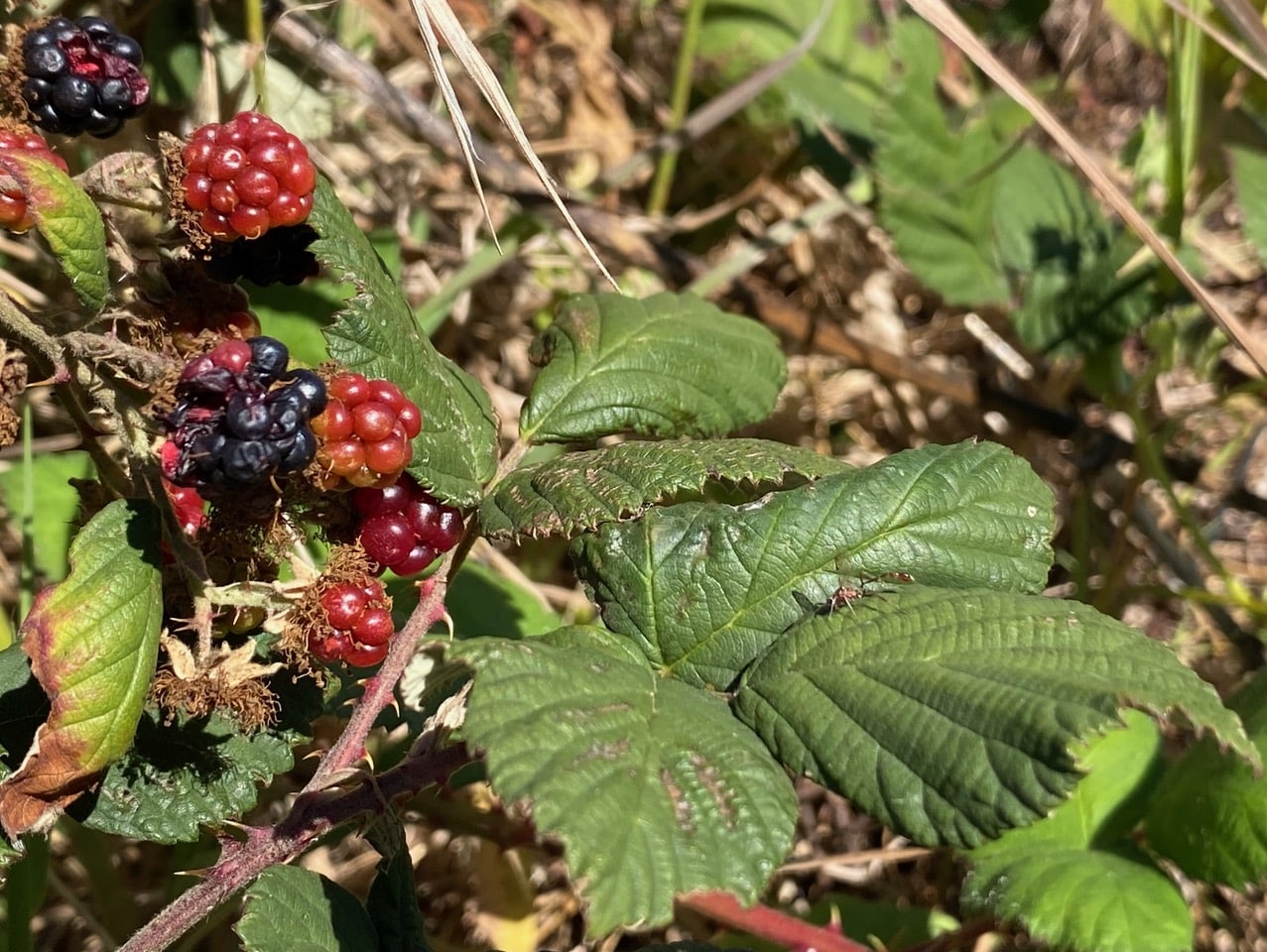
As I am photographing the Aphid Wasp, I notice 4 or 5 smaller and very slender wasps moving around on the leaves of the plant.

The wasp’s head is always lowered, as if feeding on something on the leaf surface. When not in flight, the short wings are clasped vertically over the thorax. The yellow rings around their eyes tell me that these are parasitoid wasps in the genus Anomalon (family Ichneumonidae).
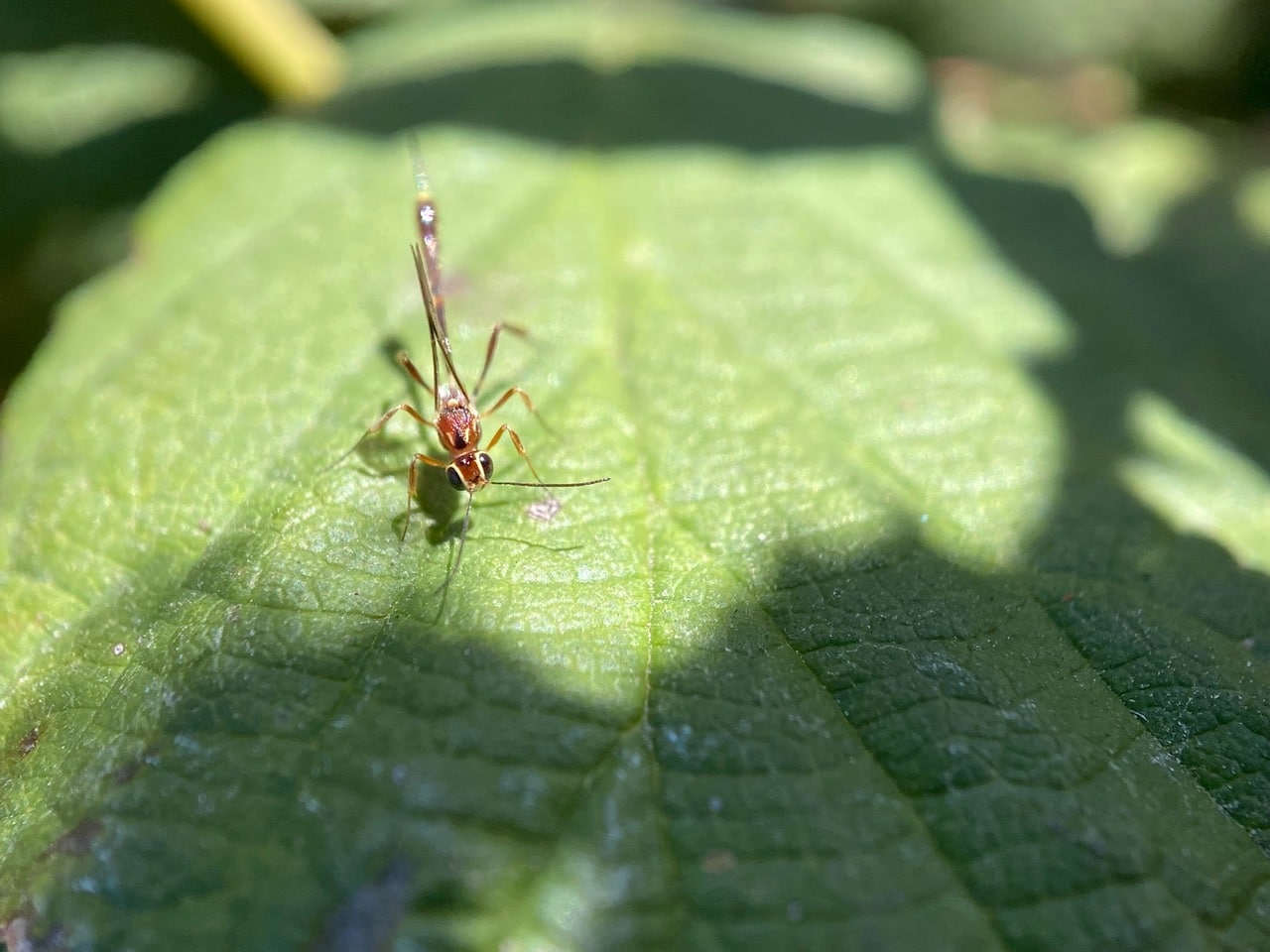

Note the ovipositor that extends beyond the tip of the elongated abdomen of this female Anomalon wasp.
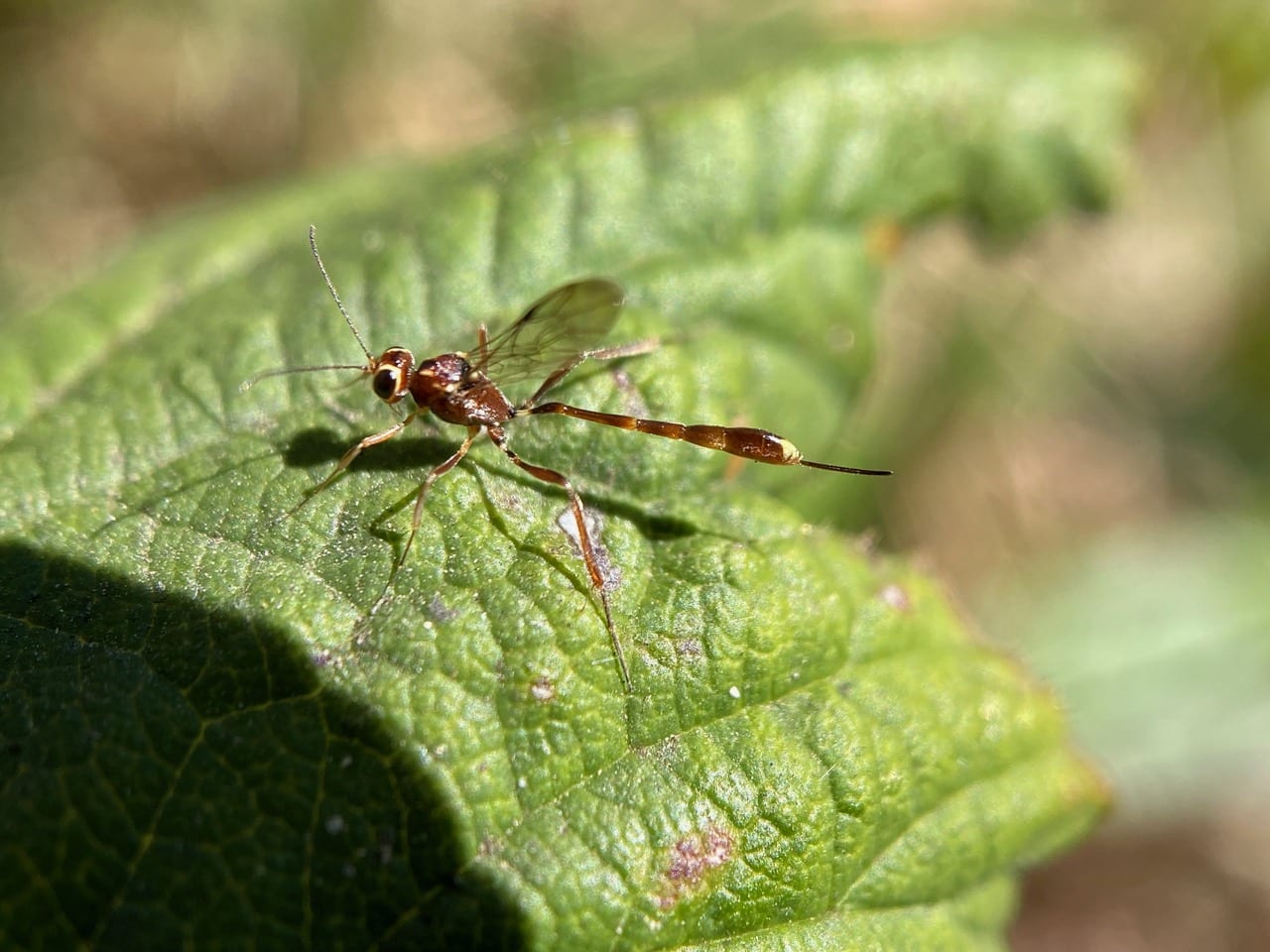
Anomalon is a large genus of parasitoid wasps in the family Ichneumonidae. The wasps are present worldwide, but most diverse in tropical regions. In the Americas they are mostly found in very wet rain forests. Recorded hosts include tenebrionid (darkling beetle) or elaterid (click beetle) larvae, and noctuid and tortricid moth larvae. Anomalon adults usually measure between 10 to 14 mm in length. They have very slender, narrow waists and abdomens that flatten out on the sides near the back. They fly slowly with a unique posture, holding their slender rear body (metasoma) high up, antennae stretched forward, and legs trailing behind. Adults feed primarily on flower nectar, pollen, and plant sap.