

Pollinator Post 9/25/26 (2)

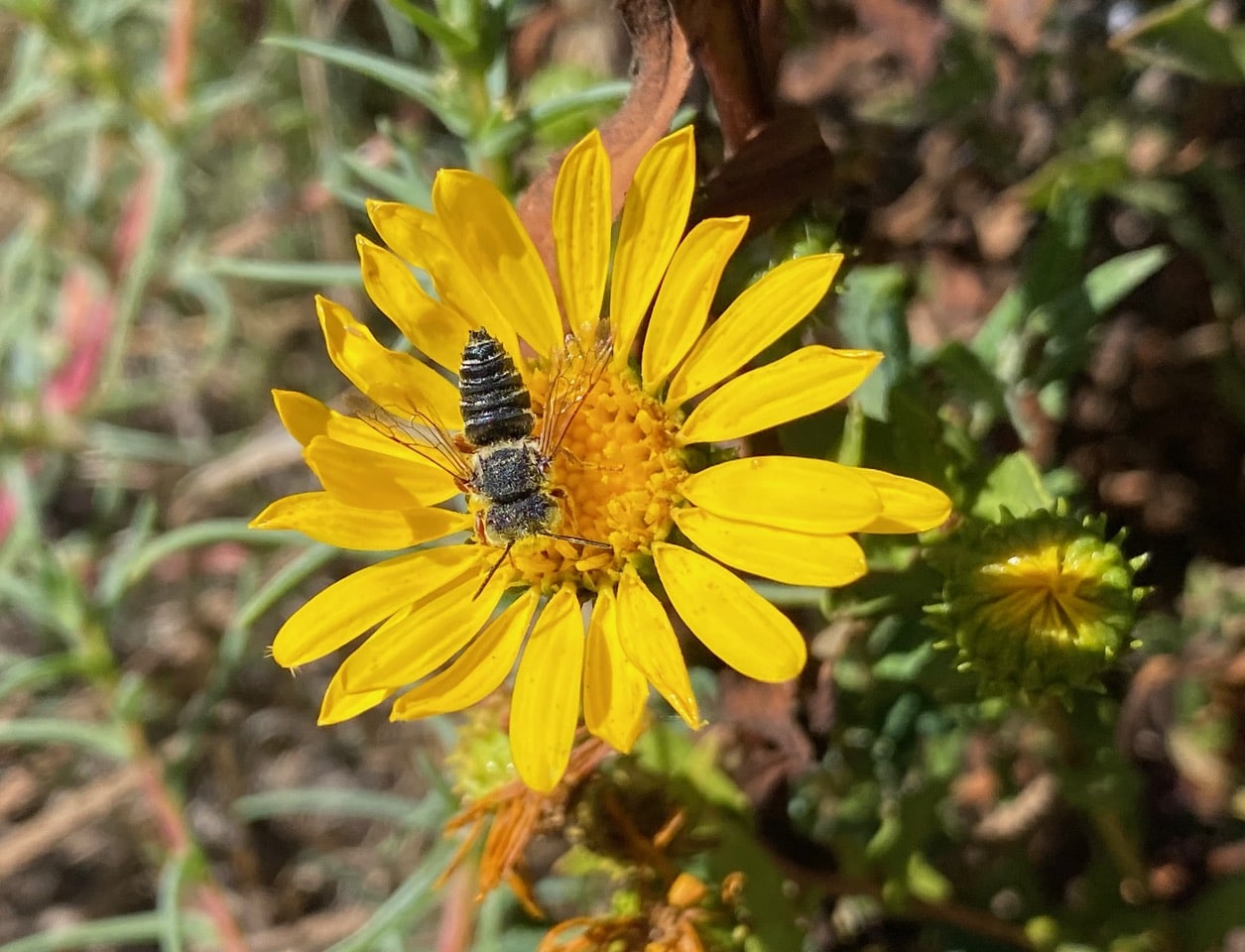
A male Fine Striped Sweat Bee, Agapostemon subtilior (family Halictidae) makes a brief nectar stop on a Grindelia flowerhead. I have not seen a female for a while. I think their season is coming to an end.
The Fine Striped Sweat Bee, Agapostemon subtilior is a small, widespread species found across North America. They are active from late spring to fall, with all-green females measuring roughly 11 mm, and males (slightly smaller) displaying a black-and-yellow striped abdomen. Like other Agapostemon bees, they are solitary ground-nesters, and are polylectic, foraging from a wide variety of flowers.

A female Western Leafcutter Bee, Megachile perihirta (family Megachilidae) forages on a Grindelia flowerhead, her abdomen held high.
Leafcutter Bees, Megachile sp. (family Megachilidae) are stout-bodied, usually with pale hair on the thorax and stripes of white hairs on the abdomen. Females usually have a triangular abdomen with a pointed tip, and males’ faces are covered with dense, pale hair. Flight season is from May into September, with peak activity from June to August. Solitary females construct nests in tubular cavities, including hollow stems, tree holes, and abandoned beetle burrows in wood. Many use holes drilled into wood, straws, or other manufactured tunnels. Females cut pieces from leaves or flower petals for use in the construction of brood cells. Most Megachile females are generalist foragers, but prefer flowers in the family Asteraceae. They carry pollen on the scopa located on the underside of the abdomen.
North America is home to many leafcutter bees, but the Western Leafcutter, Megachile perihirta is one of the largest. The species ranges on the west coast from British Columbia south to northern Mexico. From a distance, the female can be mistaken for a honey bee. She is about the same size as a worker honey bee and enjoys many of the same flowers, but her head is disproportionately large because it houses the bulky muscles that operate her large mandibles. While most leafcutter bees nest above ground in tubes and tunnels, the Western Leafcutter nests underground. Often a small group of females live in a community and burrow into soil, gravel, or sand.

A beautiful female Spittlebug, Clastoptera lineatocollis (family Clastopteridae) turns away from my camera, offering me a clear view of the false eyespot near the tip of her wing.
The false eyespots on the adult Spittlebug serves as an anti-predator defense mechanism. Predators like insectivorous birds and jumping spiders typically aim for the head of their prey to ensure a quick kill and prevent escape. By placing a highly visible fake eye at the rear end of its body, the spittlebug misdirects the predator’s strike away from its vital organs. Because Clastoptera lineatocollis is a powerful jumper that can instantly take flight when threatened, deflecting an attack to its rear buys the insect a crucial split-second, allowing the spittlebug to jump and escape unharmed.
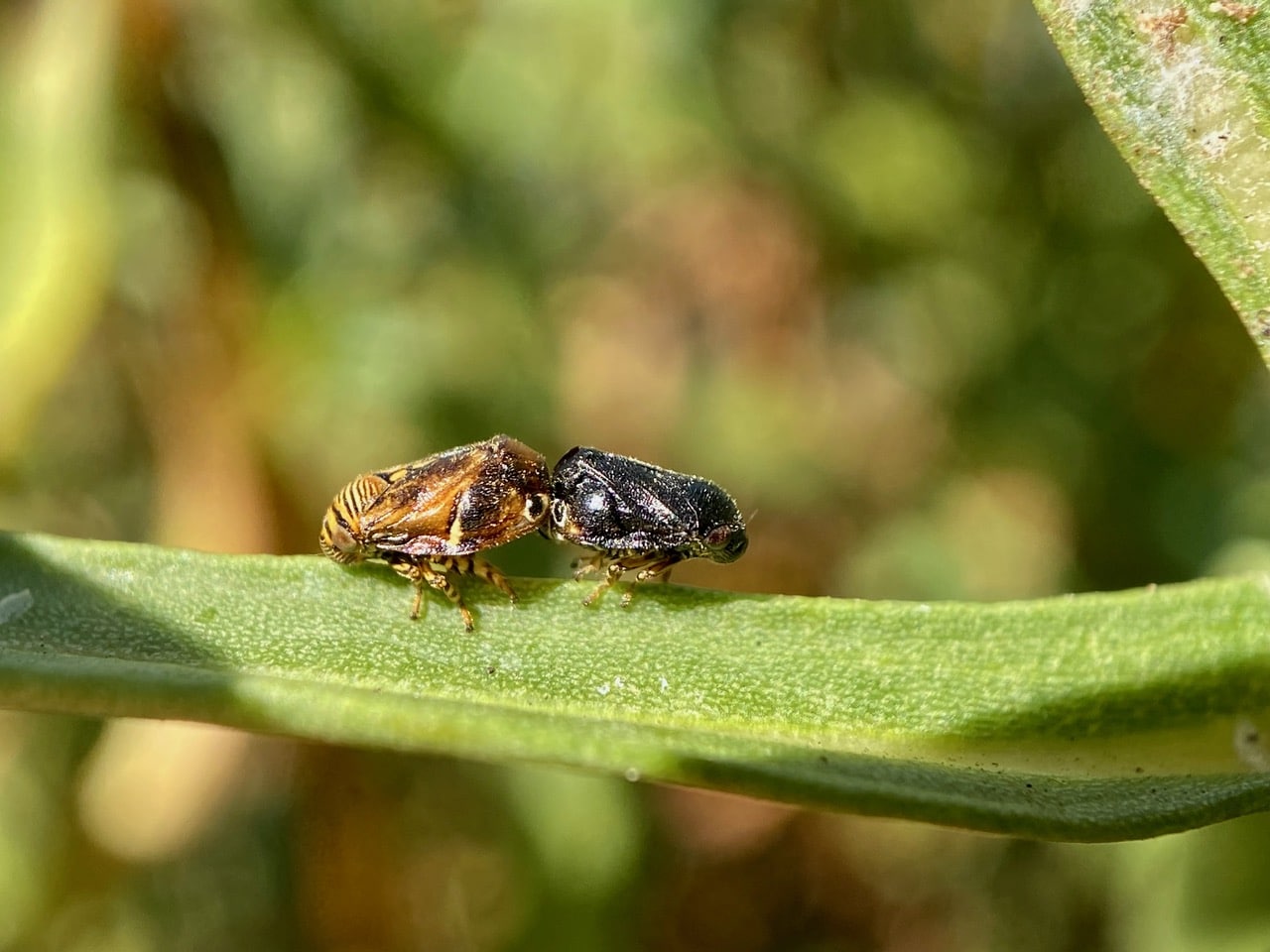
A pair of Spittlebugs, Clastoptera lineatocollis is mating on a Grindelia leaf – the larger, brown female to the left and the smaller black male to the right. There is something very gratifying about photographing a mating pair of a dimorphic species. Wow, this is the third pair I have come across in a mere hour and a half! This must be their prime mating season.
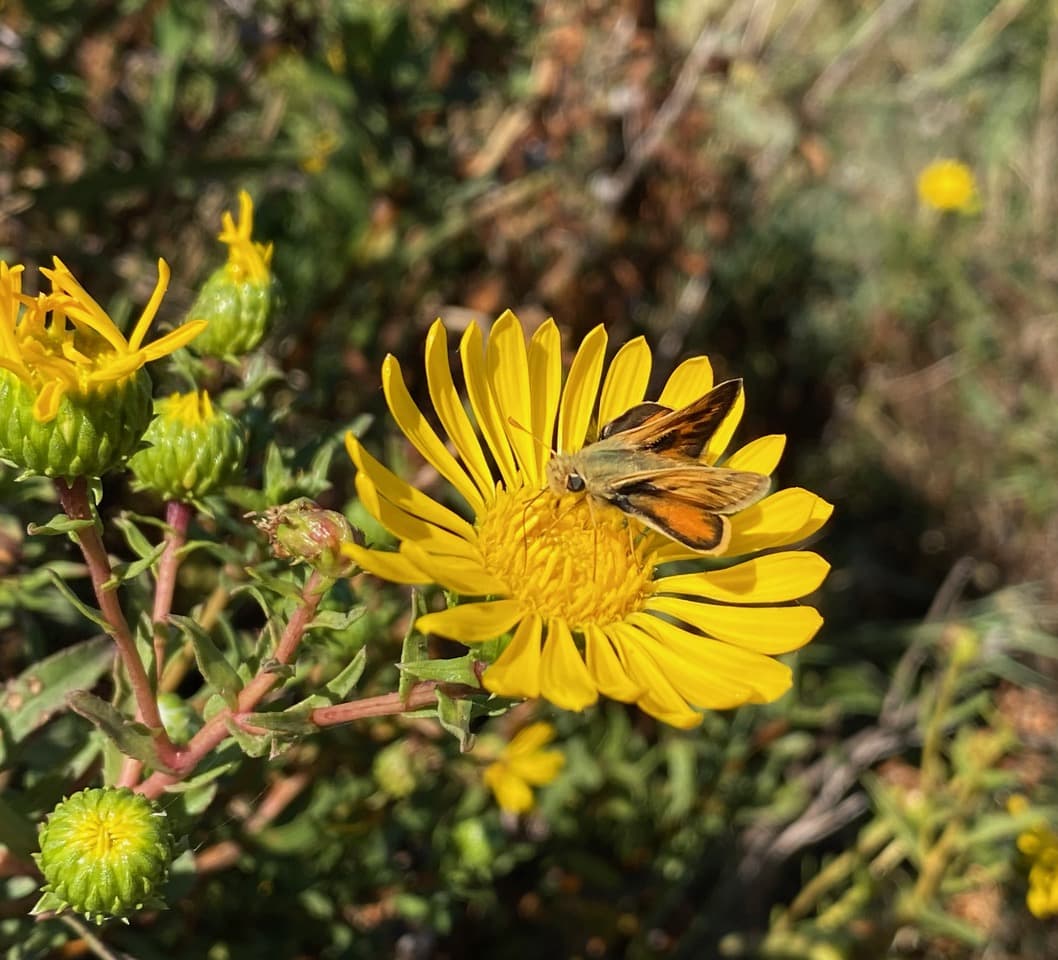
A Sandhill Skipper, Polites sabuleti (family Hesperiidae) is taking nectar from a Grindelia flowerhead.
Skippers are a family, the Hesperiidae, of the order Lepidoptera (butterflies and moths). They are named for their quick, darting flight habits. Most have the antenna clubs hooked backwards like a crochet hook. They also have generally stockier bodies and larger compound eyes than the other butterflies. Their wings are usually small in proportion to their bodies. When at rest, skippers keep their wings usually angled upwards or spread out, and only rarely fold them up completely. Californian species are mostly brown or tan, with black, orange, or yellow markings.
Skipper caterpillars are usually green or brown, sometimes yellowish, never brightly colored. They have a distinctive “collar”, a narrow ring around the body right behind the head. Caterpillars are camouflaged and often hide during the day. Many species make nests of leaves and silk for additional protection. Most North American species feed on grasses, but some common species eat shrubs and trees, especially in the bean family. Most species are limited to a single group of food plants. Adult skippers are only active during the day, but Skipper caterpillars feed mainly when it is dark or partly light.
The Sandhill Skipper, Polites sabuleti is a small, variable butterfly found in Western North America. They frequently inhabit grasslands, lawns, and alkaline meadows, where they feed on nectar and rely on saltgrass (Distichlis) as a larval host.
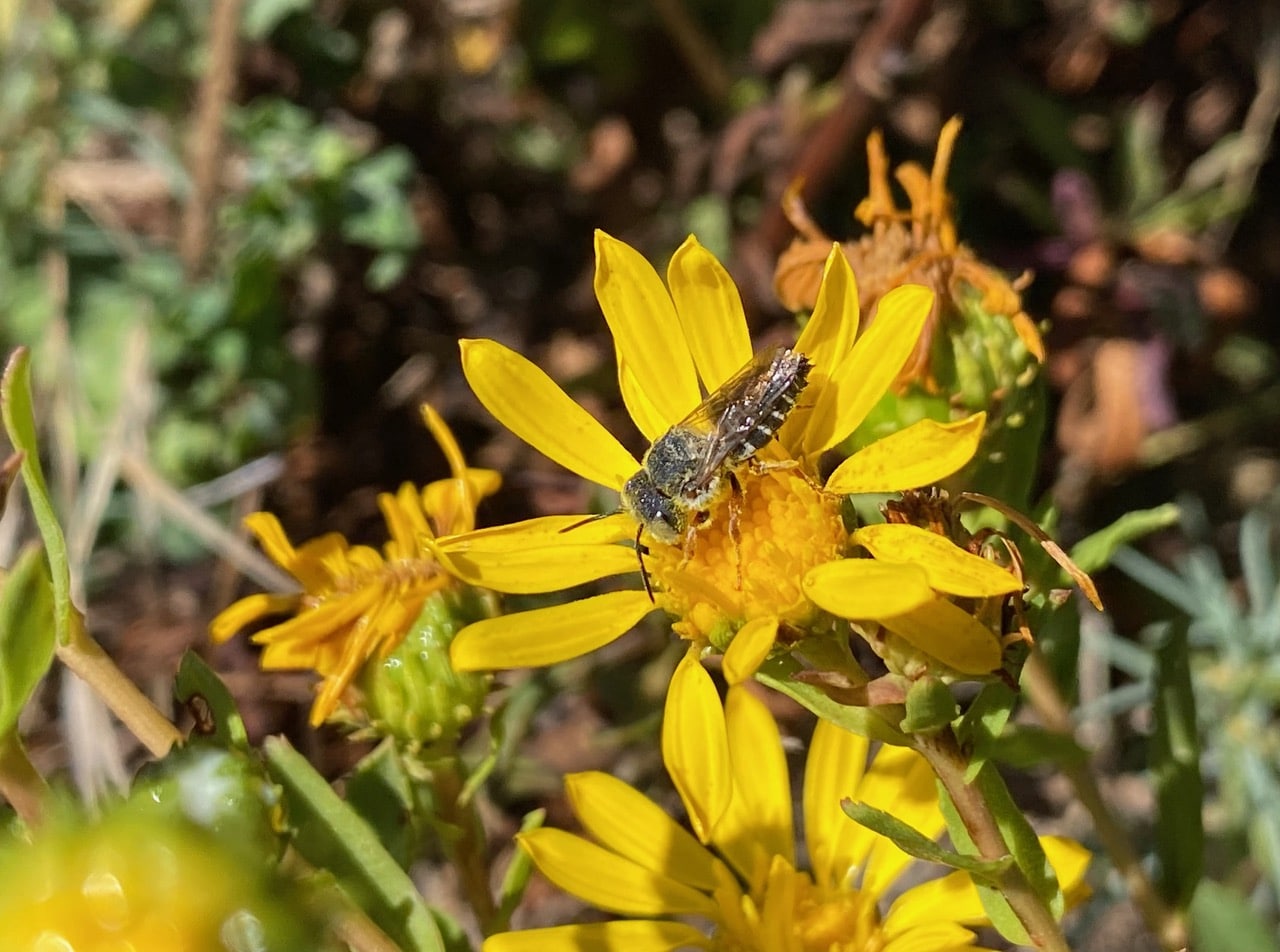
My heart misses a beat as I watch this dark insect land on a Grindelia flowerhead and realize that it is a male Sharptail Bee, Coelioxys sp. (family Megachilidae). It is always a thrill to see a cuckoo bee!

The term cuckoo bee refers to a variety of different bee lineages which have evolved the kleptoparasitic behavior of laying their eggs in the nests of other bees, similar to the behavior of cuckoo birds. Female cuckoo bees lack pollen-collecting structures and do not construct their own nests. Cuckoo bees typically enter the nests of pollen-collecting species, and lay their eggs in cells provisioned by the host bee. When the cuckoo bee larva hatches, it consumes the provision in the nest, and kills the host larva. Many cuckoo bees are closely related to their hosts, and may bear similarities in appearance reflecting this relationship. Others parasitize bees in families different from their own.
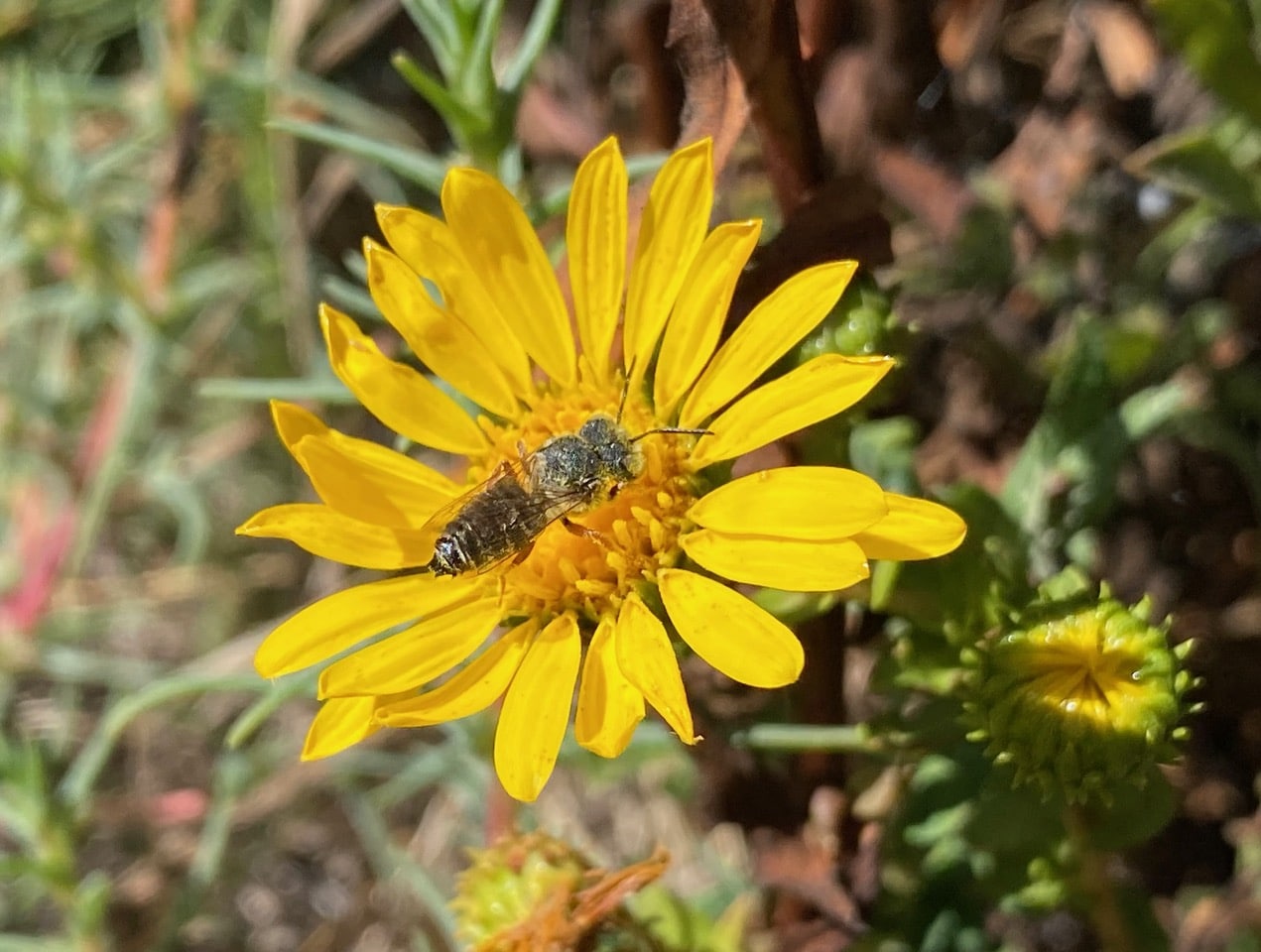
The sparkly, grainy appearance of the head and thorax of the bee is due to the thick, heavily pitted cuticle that acts like a suit of armor. This tough, textured surface protects the cuckoo bees from the stings and jaws of angry host bee.
The Cuckoo Leafcutter Bees, also known as Sharptail Bees, belong to the genus Coelioxys, in the same family as their hosts, Megachilidae. Members of the genus Coelioxys share the distinctive trait of having hairs on their eyes. In addition, the back rim of the bee’s scutellum (the second segment of the thorax) has prominent toothlike protrusions called axillae. In Greek, Coelioxys means “sharp belly”, referring to the tapered, pointed abdomens of cuckoo leaf cutters. The bees have dark abdomens banded by short pale hairs; thorax with prominent axillae; red, black or red-and-black legs; and green eyes. Female Coelioxys have pointed, conical abdomens with spearlike tips. The spade-shaped abdominal tips allow the female cuckoos to break through the brood-cell walls that leafcutters construct with leaves, petals and other materials. Males have abdomens armed with multiple pronged tips. These bees are known to sometimes sleep upside down on vegetation, holding on with their mandibles.
The pair of axillae (tooth-like protrusions) on the thorax of the Sharptail Bee are clearly visible in this view.
While we might disapprove of the parasitic behavior of cuckoo bees, their presence in the garden or in the wild is a clear indication of a thriving population of their host bees. By parasitizing specific species, cuckoo bees prevent dominant host bees from pushing out less competitive, rarer bee species, allowing for greater biodiversity. The arms race between cuckoo bees and their hosts drives genetic diversity and adaptation. Hosts evolve defenses against parasites, which naturally strengthens the resilience of the bee community. What’s more, although they do not intentionally collect pollen, cuckoo bees must visit flowers to forage for nectar, which sometimes leads to incidental pollen transfer.
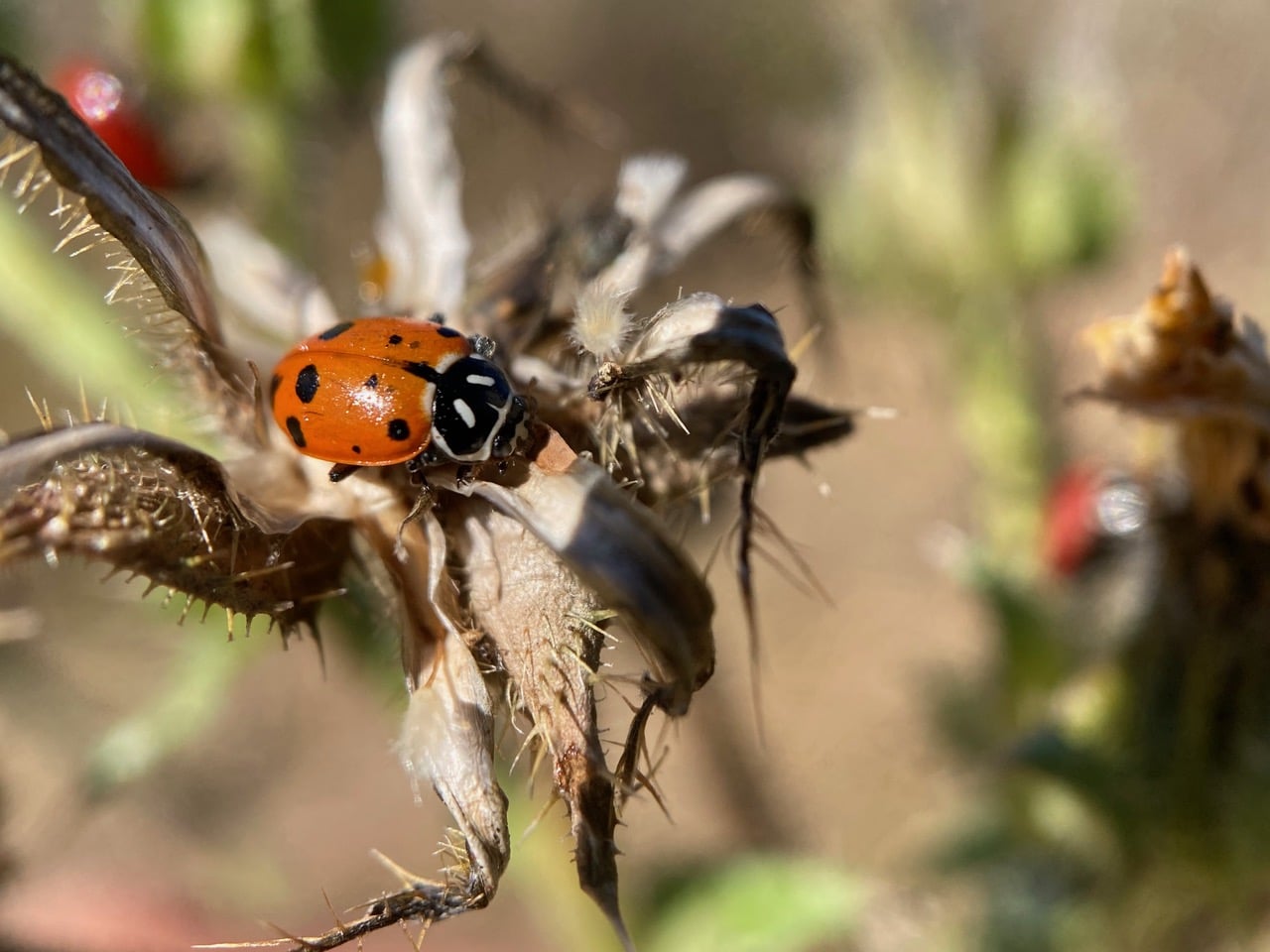
While numerous Lady Beetles of different species are hunting aphids on a heavily infested Bristly Oxtongue, Helminthotheca echioides, this satiated Convergent Lady Beetle is content to snooze on a spent seed head.
The Convergent Lady Beetle, Hippodamia convergens (family Coccinellidae) is one of the most common lady beetle species in North America, widely recognized for its role in biological pest control. Both the adult and larval beetles are voracious predators of aphids and other soft-bodied insects. These beetles are found across various habitats, including forests, grasslands, and suburban gardens. The beetles are dome-shaped, typically measuring 4-7 mm in length. They are named for the two white markings on the thorax that angle toward each other. The orange-red elytra are usually marked with varying numbers of black spots, but some spotless individuals are sometimes seen. The species is known for distinct migration patterns, often moving from agricultural areas to mountainous regions to overwinter in large aggregations.
While widely sold as a biocontrol agent for gardens and greenhouses, some experts caution against releasing purchased beetles. Purchased beetles are often collected illegally from the wild rather than reared, which can affect native populations in their natural habitats. What’s more, they may leave the release area quickly or introduced pathogens to local lady beetle fauna.