

Pollinator Post 7/5/26 (2)

The sky begins to clear as I head north and walk a short stretch of Alameda Beach along Shore Line Drive.
Alameda Beach (officially known as Robert W. Crown Memorial State Beach) is a man-made beach and maintained by the East Bay Regional Parks District. It features 2.5 miles of imported sand and is sustained via engineered dunes to provide erosion protection. Because it is located on the bay, the beach is popular for its shallow, warmer waters and excellent windsurfing conditions. However, because it lacks natural sand replenishment from rivers or creeks, the city and park district frequently dredge and move sand along the shoreline to combat erosion.

The dunes on the upper beach have undergone extensive “restoration”, with plantings of many natives such as several species of buckwheat (Eriogonum), and the Dune Sagewort (Artemisia pycnocephala). However, since the beach is artificial, I wonder if the dune project can be considered “restoration”. Who knows, perhaps true restoration should have included coastal marsh plants instead, like the marsh habitat I have just visited a little further south. The project highlights the poignant dilemma of providing for human recreation vs. wildlife needs that park services everywhere have to face. I am grateful for the beauty of the well-tended dune plants, and for the opportunity to walk barefoot on wet sand along the beach here.
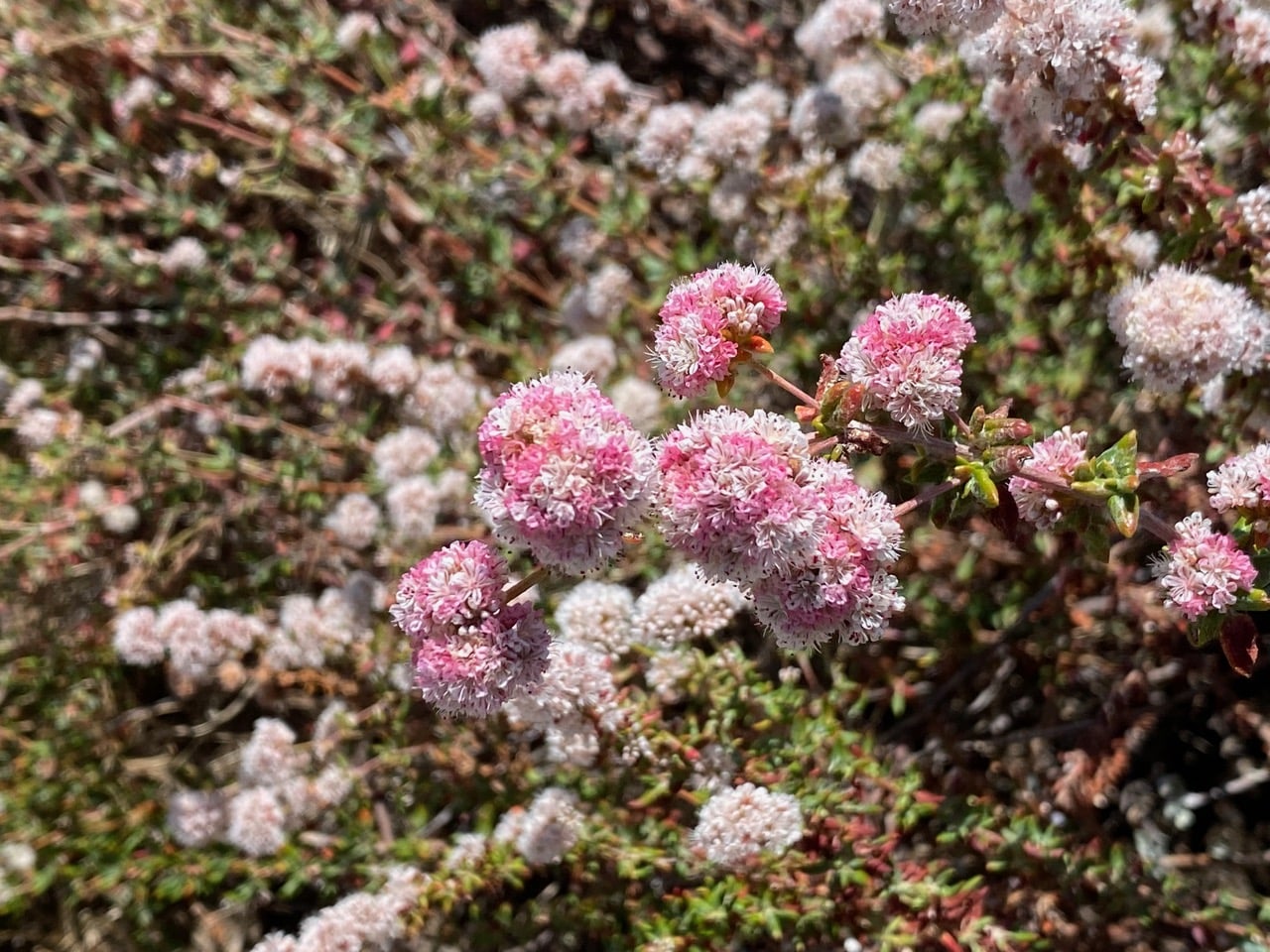
Despite the profusion of buckwheats of every shade of pink blooming at their peak (at least 4 different species found here), the flowers are quite devoid of insect activity except for Honey Bees.

A Honey Bee, Apis mellifera (family Apidae) is foraging on an inflorescence of buckwheat. Why are there so many honey bees here, and near absence of native solitary bees? The same observation has puzzled me over several summers. Are there bee keepers with bee hives near by? Are the honey bees displacing the native bees? There are a gazillion buckwheat flowers in bloom on the dunes now, competition can hardly be the reason. Has human use, and the constant beach maintenance caused too much disturbance for ground-nesting bees? 70% of our native bees nest in the ground.

A tiny fly has landed on a leaf of Sage-leaved Rock Rose, Cistus salviifolius. The pruinosity of its body causes such intense glare that the camera has difficulty bringing the fly into focus. iNaturalist has helped identify it as a Beach Fly (family Canacidae).
The Beach Flies (family Canacidae) are minute (1.6-5 mm) yellow, gray or gray-brown pruinose flies with whitish to grayish markings. The head is large with small antenna bearing bare to pubescent arista. The “mouth” is a large oval opening. The Canacidae are found along the sea coasts, on the surface of small bodies of water, saline and fresh, in places protected from the wind. They feed on infusoria and other tiny organisms. Infusoria is a word used to describe various freshwater microorganisms, including ciliates, copepods, euglenoids, planktonic crustaceans, protozoa, unicellular algae and small invertebrates.
Pruinescence or pruinosity on an insect is caused by a powdery or waxy “bloom” secreted by the insect’s body that sits on top of its hard outer shell (cuticle). This waxy layer masks the underlying coloration, giving the insect a dusty, frosted, or “hoarfrost” appearance. The waxy coating can serve several functions: it can reflect sunlight and ultraviolet (UV) radiation, helping the insect avoid overheating in hot, sunny environments. The wax is also highly water-repellent (hydrophobic), which prevents the insect from losing moisture and protects against desiccation. In some insects the reflected UV light from waxy coating can serve as a vibrant visual signal for mate recognition, species identification and territorial threat displays.

I come across a couple of Oregon Gumweed, Grindelia stricta next to the side walk of Shore Line Drive. Their bright yellow flowers are attracting all kinds of insects amidst the silent buckwheats around them. The Grindelia plants don’t look like part of the restoration work, but are likely remnants of a former marsh habitat. Perhaps true restoration of this coastline should simulate a salt marsh instead? You can’t fool mother nature and her denizens, and expect a thriving ecosystem. I wish I have more than 10 minutes to enjoy the intense insect activities on the Grindelia before having to leave.
A Sandhill Skipper, Polites sabuleti (family Hesperiidae) is taking nectar from a Grindelia flowerhead.
Skippers are a family, the Hesperiidae, of the order Lepidoptera (butterflies and moths). They are named for their quick, darting flight habits. Most have the antenna clubs hooked backwards like a crochet hook. They also have generally stockier bodies and larger compound eyes than the other butterflies. Their wings are usually small in proportion to their bodies. When at rest, skippers keep their wings usually angled upwards or spread out, and only rarely fold them up completely. Californian species are mostly brown or tan, with black, orange, or yellow markings.
Skipper caterpillars are usually green or brown, sometimes yellowish, never brightly colored. They have a distinctive “collar”, a narrow ring around the body right behind the head. Caterpillars are camouflaged and often hide during the day. Many species make nests of leaves and silk for additional protection. Most North American species feed on grasses, but some common species eat shrubs and trees, especially in the bean family. Most species are limited to a single group of food plants. Adult skippers are only active during the day, but Skipper caterpillars feed mainly when it is dark or partly light.
The Sandhill Skipper, Polites sabuleti is a small, variable butterfly found in Western North America. They frequently inhabit grasslands, lawns, and alkaline meadows, where they feed on nectar and rely on saltgrass (Distichlis) as a larval host.
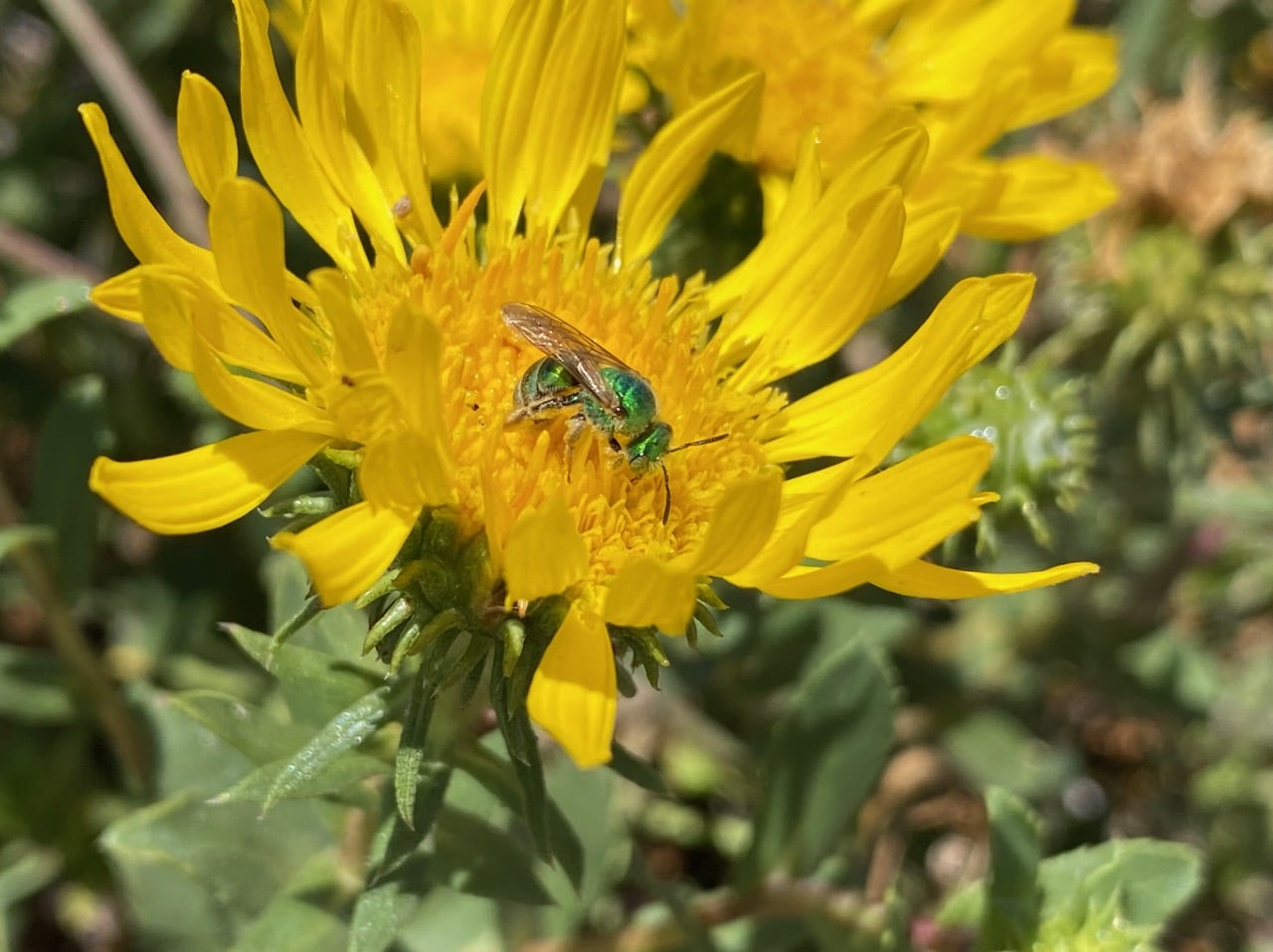
A female Fine Striped Sweat Bee, Agapostemon subtilior (family Halictidae) is foraging on a Grindelia flowerhead.
Agapostemon bees, or metallic sweat bees, are ground-nesting, often communal pollinators known for their bright green, metallic appearance and for being bivoltine (two generations per year). The first generation emerges in spring, and the second, larger generation emerges in late summer. Agapostemon bees are medium-sized (7-14.5 mm), featuring a metallic green or blue head and thorax. Many females have striped abdomens, while others are entirely metallic green. They are generalist pollinators, visiting a wide variety of flowers, including asters, sunflowers, and fruit crops. Females are efficient and fast-flying carrying pollen on their hind legs.
Mated females overwinter in the soil and emerge in early spring to establish nests in the ground, often in aggregations (close to one another). They prefer to nest in loamy soil in flat, sloped, or bank areas, creating tunnels with individual brood cells. Although solitary, some species are communal, sharing a single entrance while maintaining separate tunnels. Females create balls of pollen and nectar in each cell, laying a single egg on each, which the larva consumes upon hatching. Males usually die after mating in late summer, while mated females hibernate through the winter.
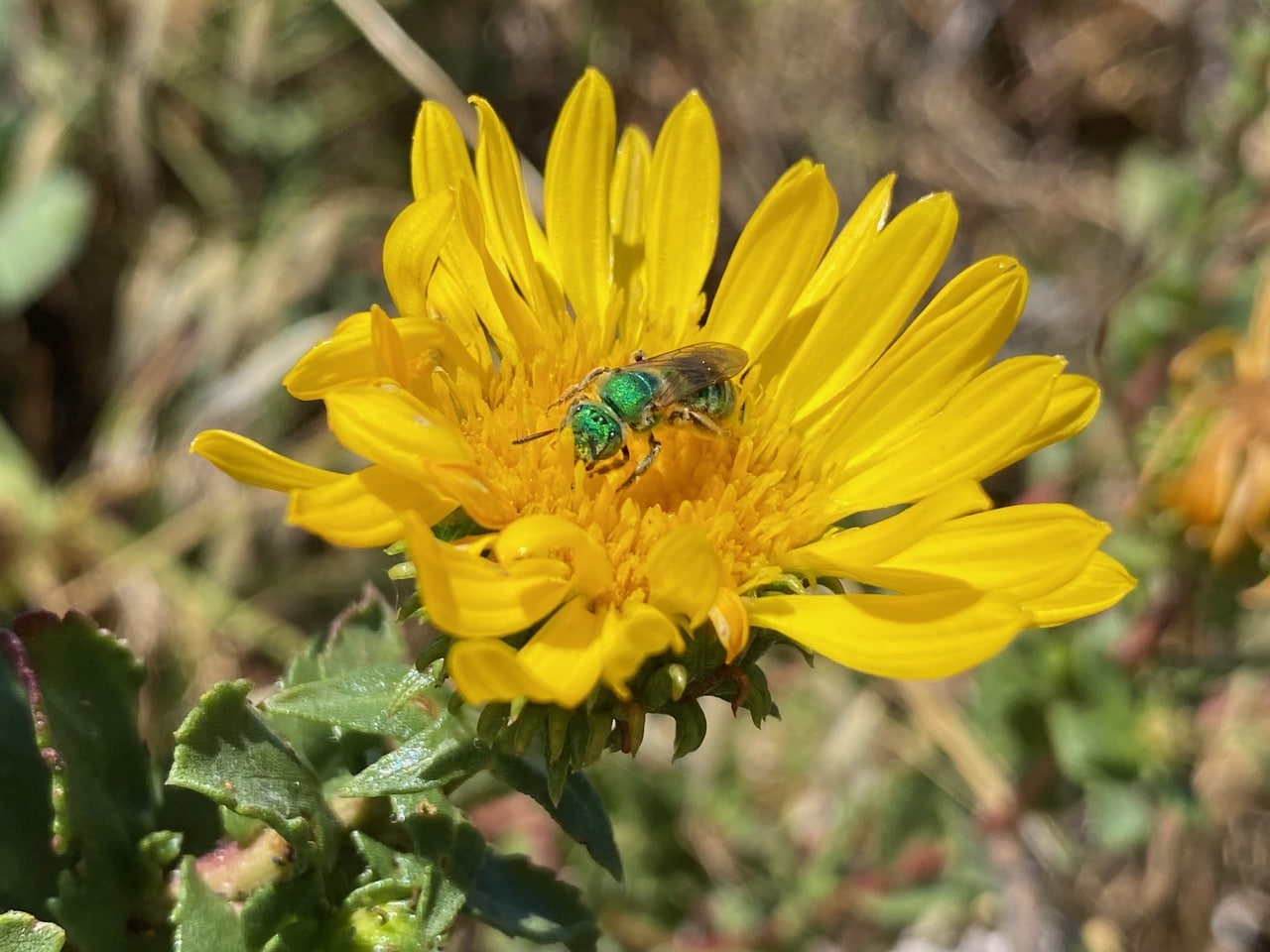
The Fine Striped Sweat Bee, Agapostemon subtilior is a small, widespread species found across North America. They are active from late spring to fall, with all-green females measuring roughly 11 mm, and males (slightly smaller) displaying a black-and-yellow striped abdomen. Like other Agapostemon bees, they are solitary ground-nesters, and are polylectic, foraging from a wide variety of flowers.

A bee with black-and-white striped abdomen has landed on a Grindelia flowerhead.
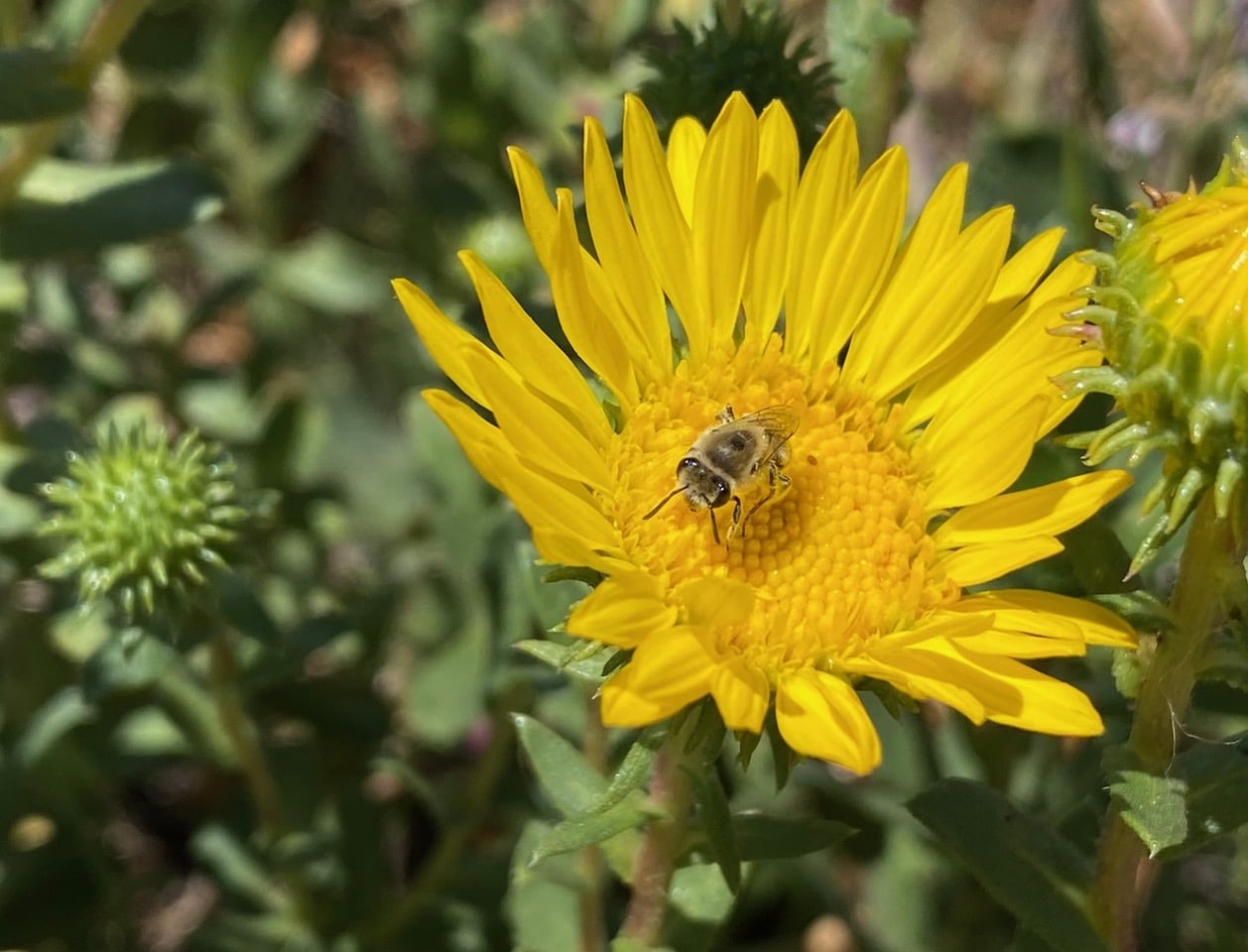
It has fuzzy head and thorax. I am confident it is a Cellophane Bee, Colletes sp. (family Colletidae).
The bee family Colletidae includes generalists and specialists, and they are likely important pollinators of many wildflowers. All Colletidae in North America are solitary ground nesters, but some species nest in large aggregations. There are two major genera of Colletidae in North America: the Masked Bees (genus Hylaeus) and Cellophane Bees (genus Colletes). The most obvious shared characteristics of Colletidae is also the hardest to see: their short tongue. Colletes are moderately hairy, slender bees, ranging in size from 7 to 16 mm. Distinct features include a hairy head and thorax, pale bands of hair on the abdomen, and a heart-shaped head. The eyes of Colletes are angled (rather than being parallel), making the face slightly heart-shaped. The eyes of Colletes are angled (rather than being parallel), making the face slightly heart-shaped.
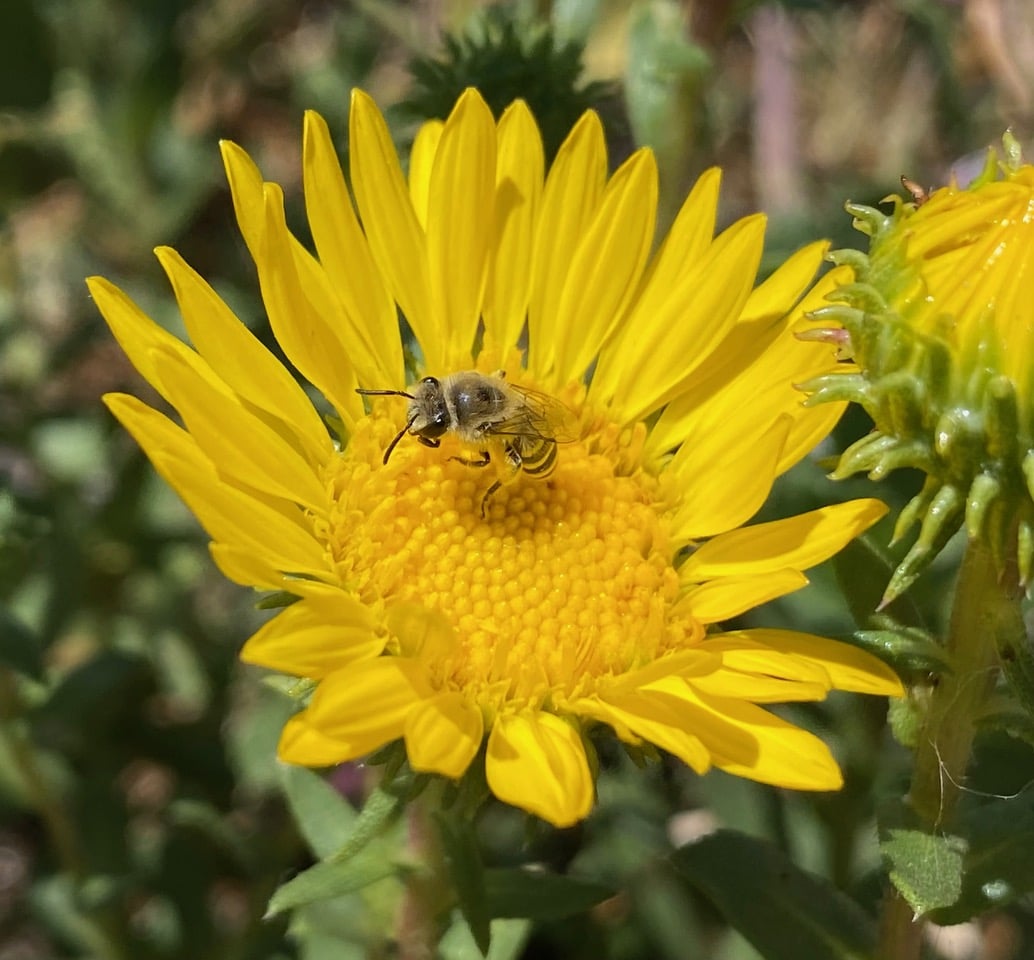
The genus name Colletes means “one who glues”, referring to their habit of applying a glue- or cellophane-like lining to the walls of nest cells, using their specialized tongues. This lining gives rise to their common names: cellophane bees, polyester bees, and plasterer bees. Colletes tongue is unique: short, flat, and forked at the tip. Colletes line their nests with a distinctive cellophane-like substance made from saliva and secretions from the Dufour’s gland on the abdomen. Using their specialized tongue, they paint the walls with saliva, then with secretions from the Dufour’s gland, they add a coat of varnish. This creates a clear covering that is strong, durable, and resistant to mold and water.
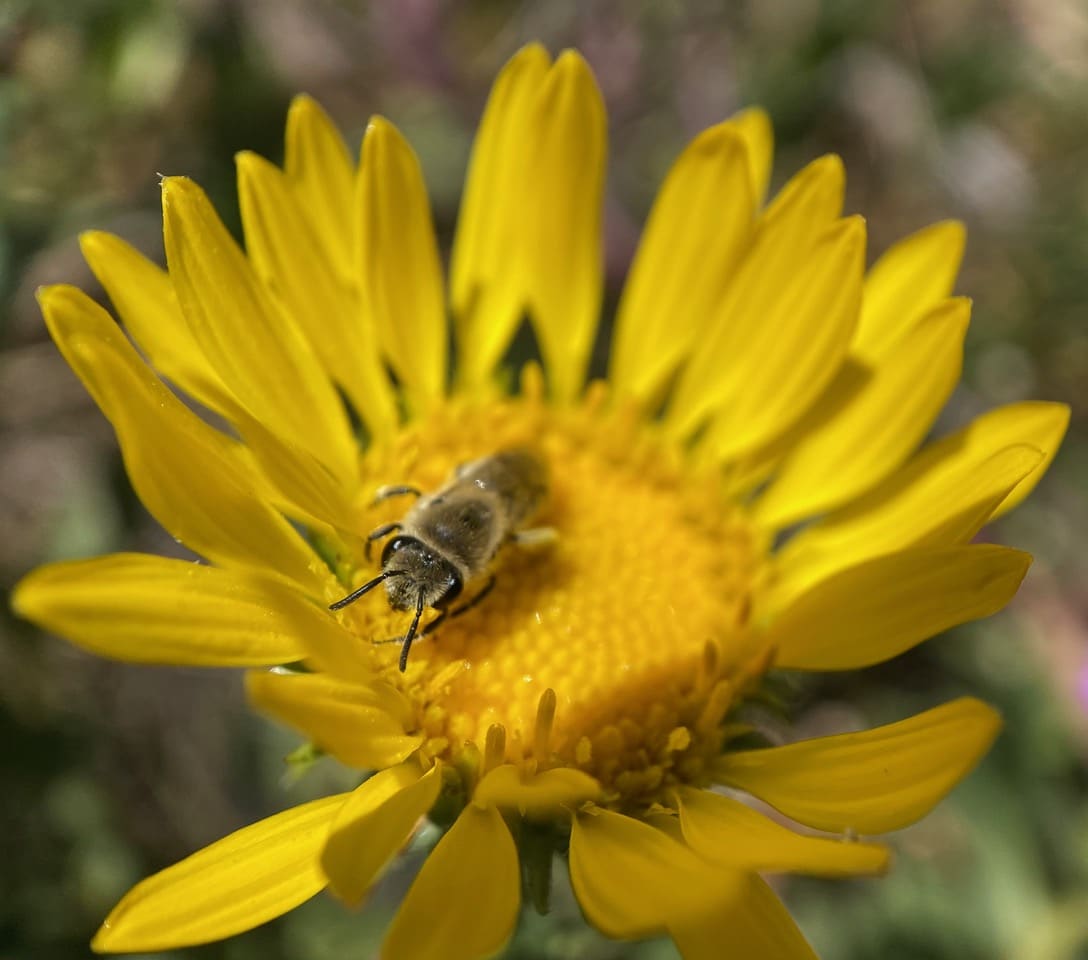
Aww, that endearing heart-shaped face of a Cellophane Bee!

Unlike the Cellophane Bees, there is nothing quiet or demure about the Western Leafcutter Bees, Megachile perihirta (family Megachilidae). The female lands on a Grindelia flowerhead with aplomb, abdomen raised ready to collect pollen. This one already has quite a load of pollen on her belly. Her sudden arrival and movements unnerve the little weevil on the flowerhead.
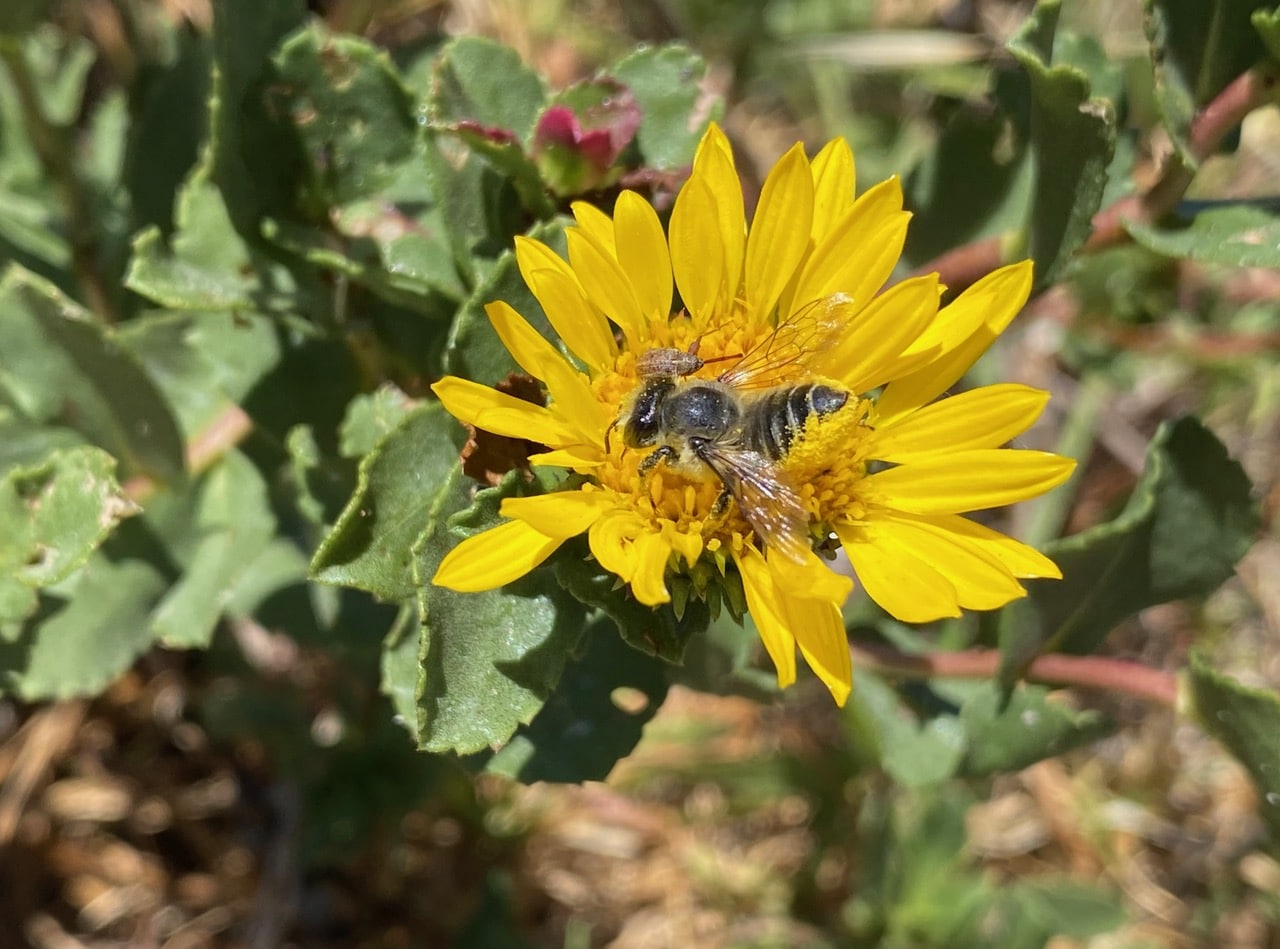
Leafcutter bees (genus Megachile) carry pollen on a dense brush of stiff hairs on the underside of their abdomen, known as a scopa. As the bee flies, her fuzzy body builds up a positive static charge. When she lands on a flower, this static electricity pulls pollen grains from the anthers, causing them to cling all over her body. Rather than landing and simply walking around, leafcutter bees often dive directly onto the flower and raise their abdomen, rubbing their hairy underside aggressively against the flower’s reproductive parts. She uses a coordinated grooming motion to brush pollen off her body with her forelegs, passing it to her middle legs, and then uses her hind legs to rake and pack the pollen grains securely into the scopa on her belly. When she returns to her nesting cavity, she scrapes the pollen off her abdomen using her hind legs and mixes it with regurgitated nectar to form a nutrient-rich “bee bread” on which she lays an egg.

Leaf-cutter Bees, Megachile sp. (family Megachilidae) are stout-bodied, usually with pale hair on the thorax and stripes of white hairs on the abdomen. Females usually have a triangular abdomen with a pointed tip, and males’ faces are covered with dense, pale hair. Flight season is from May into September, with peak activity from June to August. Solitary females construct nests in tubular cavities, including hollow stems, tree holes, and abandoned beetle burrows in wood. Many use holes drilled into wood, straws, or other manufactured tunnels. Females cut pieces from leaves or flower petals for use in the construction of brood cells. Most Megachile females are generalist foragers, but prefer flowers in the family Asteraceae. Pollen is transported in dense scopae (special pollen collecting hairs) on the underside of the abdomen.
North America is home to many leafcutter bees, but the Western Leafcutter, Megachile perihirta is one of the largest. The species ranges on the west coast from British Columbia south to northern Mexico. From a distance, the female can be mistaken for a honey bee. She is about the same size as a worker honey bee and enjoys many of the same flowers, but her head is disproportionately large because it houses the bulky muscles that operate her large mandibles. While most leafcutter bees nest above ground in tubes and tunnels, the Western Leafcutter nests underground. Often a small group of females live in a community and burrow into soil, gravel, or sand.

A Weevil (family Curculionidae) is exploring a Grindelia flowerhead. Note its long snout and the attached, elbowed antennae.
Weevils, family Curculionidae, are also called snout beetles. Curculionidae is one of the largest beetle families (about 40,000 species). Most weevils have long, distinctly elbowed antennae that may fold into special grooves on the snout. The snout is used not only for penetration and feeding but also for boring holes in which to lay eggs. The mouthparts are quite small and located at the end of the rostrum (snout), designed for chewing. Many weevils have no wings, while others are excellent fliers. Most are less than 6 mm in length. The majority of weevils feed exclusively on plants. The fleshy, legless larvae of most species feed only on a certain part of a plant – i.e., the flower head, seeds, fleshy fruits, stems, or roots. Many larvae feed either on a single plant species or on closely related ones. Adult weevils tend to be less specialized in their feeding habits. The family includes some very destructive agricultural pests.