

Pollinator Post 6/27/26
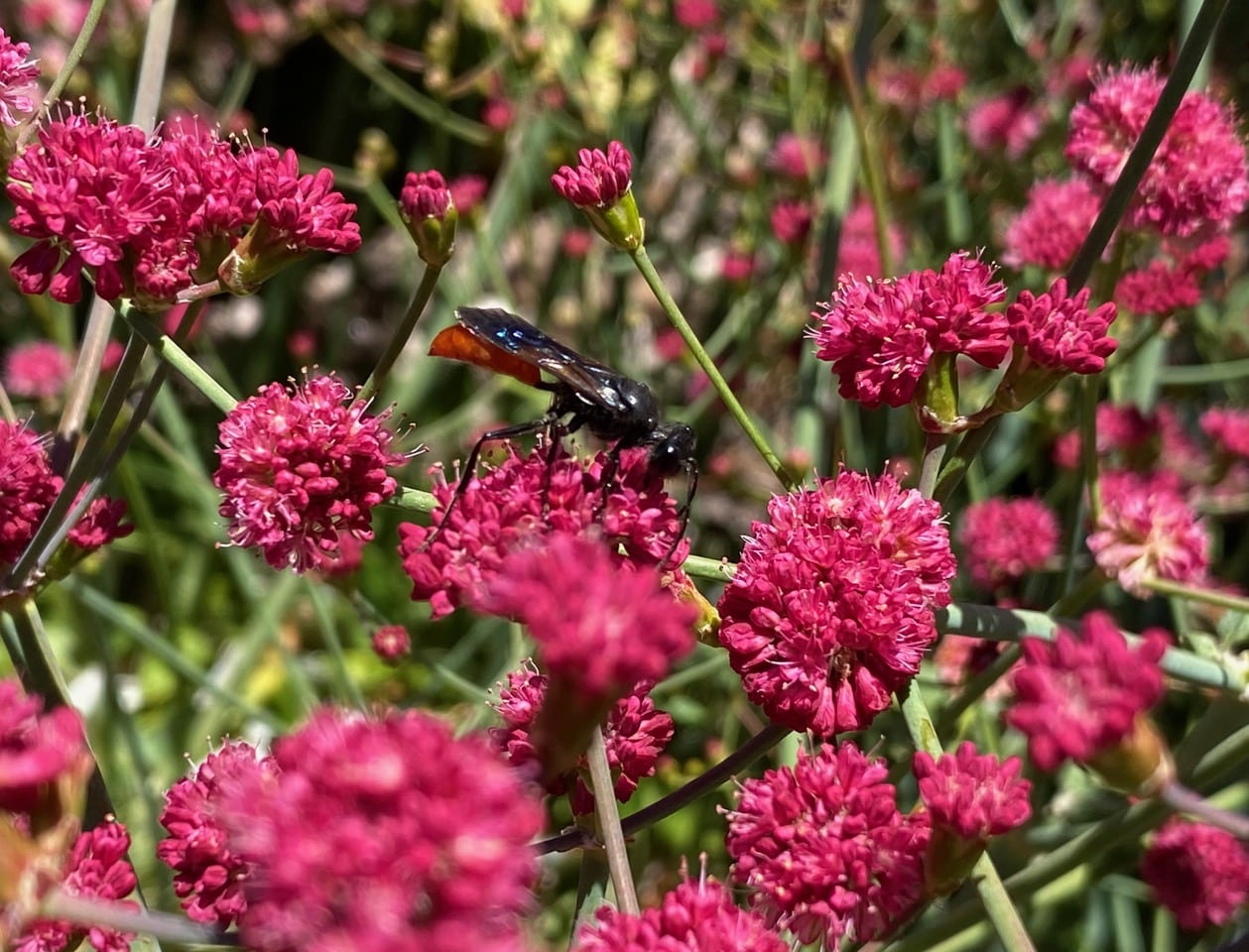
Thwarted by cloudy skies yesterday, I make a return visit to Jenny and Craig’s garden today to pick up where I left off. What difference a day makes – the sunshine and warmth have brought out many more insects, especially wasps.
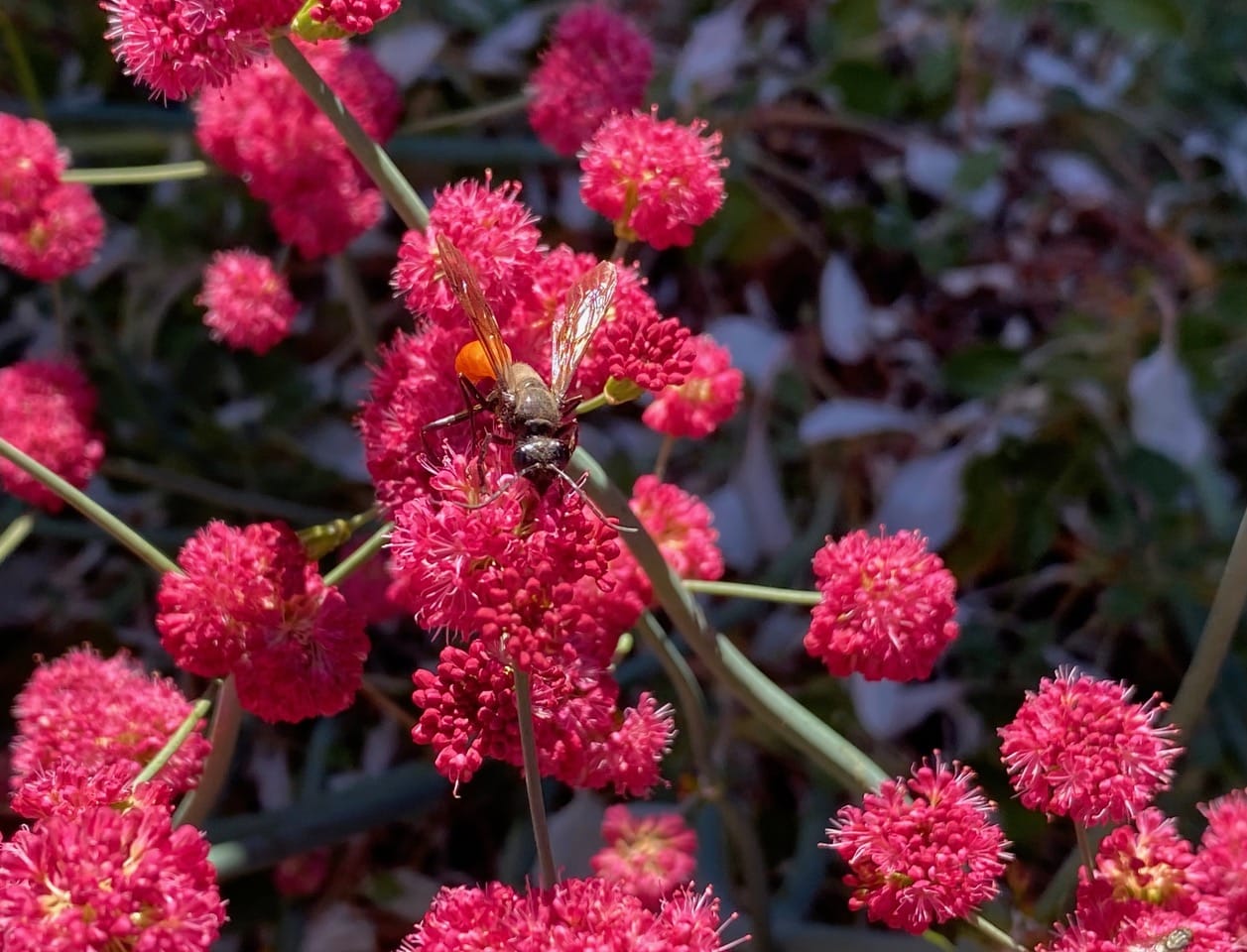







In the front garden, a female Thread-waisted Burrowing Wasp, Sphex lucae (family Sphecidae) is foraging on the flowers of Red-flowered Buckwheat, Eriogonum grande var. rubescens. Her bright orange abdomen is almost drowned out by the busy red flowers.
The Sphecidae are solitary wasps with elongated and narrow first abdominal segment, giving rise to the common name Thread-waisted Wasps. Sphex lucae is a widespread western species, ranging from WA in the north, south to CA, and east to TX. The species exhibits sexual dimorphism – females are black with a red abdomen, while the males are all black. Adults visit many types of flowers for nectar. Females hunt katydids and grasshoppers as food for their young. The wasp excavates a single-celled burrow in the soil in advance of hunting activities. She drags her paralyzed prey back to the burrow, laying a single egg on the victim. The nest entrance is then sealed and the process is repeated. Males of this species spend nights in sleeping aggregations in sheltered places such as beneath a rock overhang.
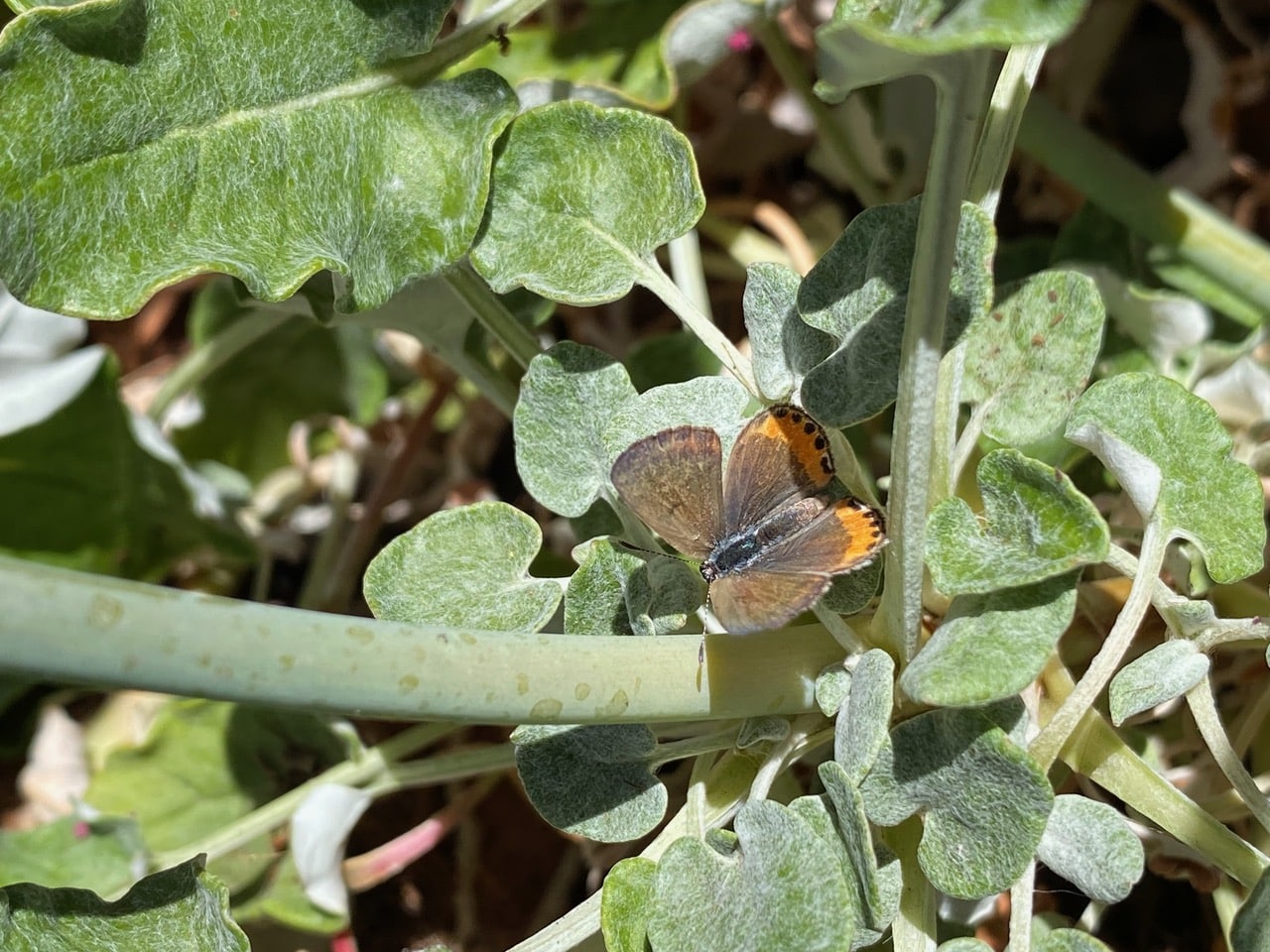
A female Acmon Blue, Icaricia acmon (family Lycaenidae) has landed on the foliage of a Red-flowered Buckwheat below the flower stalks. She is probably seeking a place to lay her eggs. Buckwheats are one of the butterfly’s favorite larval host plants.
Acmon Blue, Icaricia acmon (family Lycaenidae) is a North American butterfly, found mostly in California. It is a small butterfly, with a wingspan of 0.75 to 1.125 in. It can be seen from March to October, with peak numbers in July. Adults feed on nectar while caterpillars feed on a variety of plant species, including buckwheats, deer weed, lupines, trefoils, and milkvetches. Like many Lycaenid butterflies, Acmon Blue shares a mutualistic relationship with ants. The ants protect the caterpillars from predators in exchange for the sweet “honeydew” the caterpillars secrete from a nectary gland. The larvae are often protected and kept in the ant nest when not feeding.
Passing the Seaside Daisy, Erigeron glaucus, I notice a different caterpillar on a flowerhead today. It is a very young caterpillar of the Darker-spotted Straw Moth, Heliothis phloxiphaga (family Noctuidae). Note that many of the open florets on the outer rim of the flowerhead have been emptied of their reproductive structures.
The Darker-spotted Straw Moth, Heliothis phloxiphaga (family Noctuidae) is a medium-sized light yellow-brown or tan moth with darker markings. It is found across the United States and southern Canada. The moth frequents wooded edges, meadows, and other open areas. The species is active March through October. Adults are known to be both nocturnal and diurnal in activity, often found feeding and ovipositing during the day. The caterpillars have a wide host range. Like other species of the genus, the caterpillars feed on the flowering parts and seeds of the host plant.
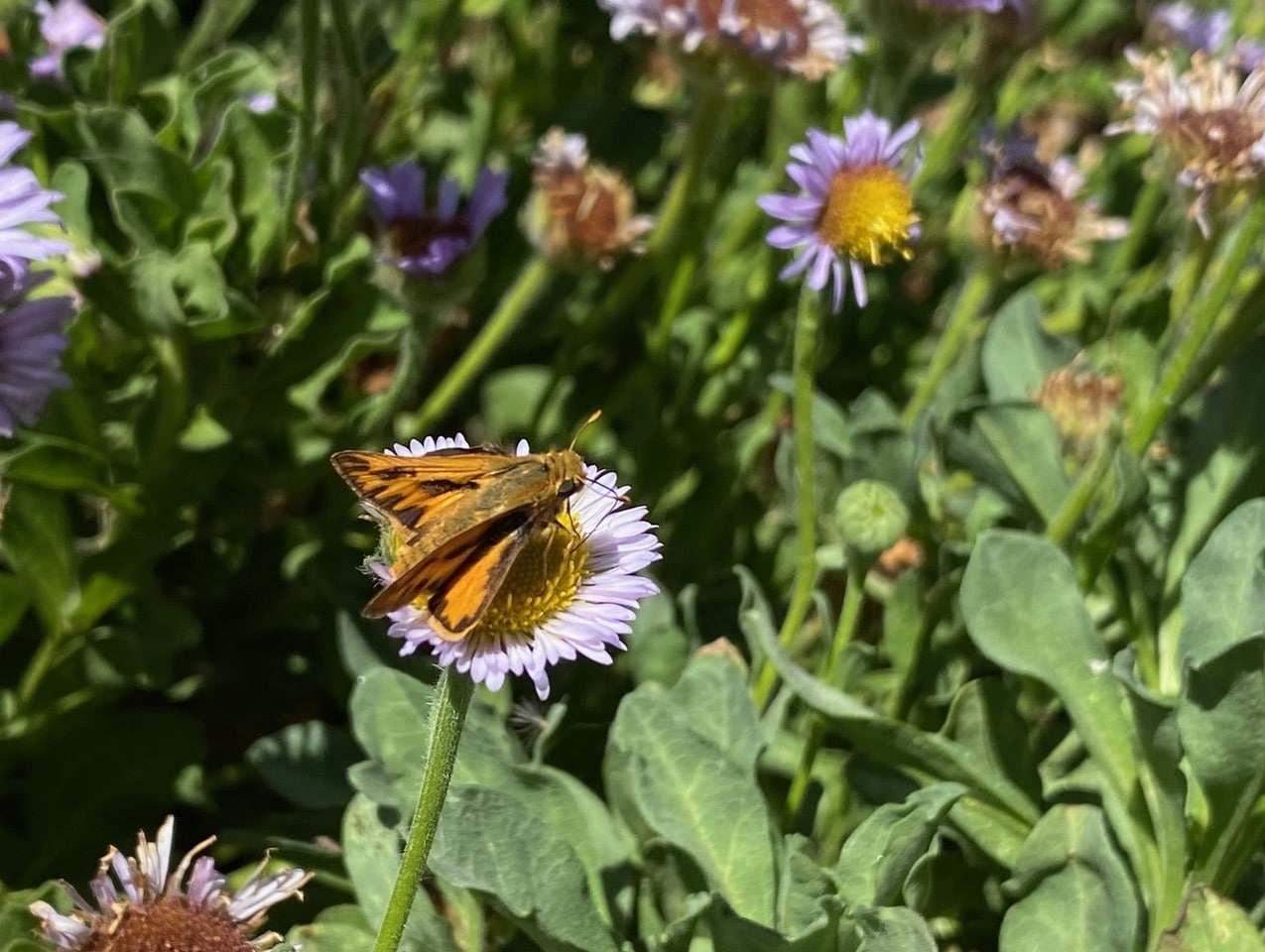
A Fiery Skipper, Hylephila phyleus (family Hesperiidae) is taking nectar on a Seaside Daisy flowerhead.
Skippers are a family, the Hesperiidae, of the order Lepidoptera (butterflies and moths). They are named for their quick, darting flight habits. Most have the antenna clubs hooked backwards like a crochet hook. They also have generally stockier bodies and larger compound eyes than the other butterflies. Their wings are usually small in proportion to their bodies. When at rest, skippers keep their wings usually angled upwards or spread out, and only rarely fold them up completely. Californian species are mostly brown or tan, with black, orange, or yellow markings.
Skipper caterpillars are usually green or brown, sometimes yellowish, never brightly colored. They have a distinctive “collar”, a narrow ring around the body right behind the head. Caterpillars are camouflaged and often hide during the day. Many species make nests of leaves and silk for additional protection. Most North American species feed on grasses, but some common species eat shrubs and trees, especially in the bean family. Most species are limited to a single group of food plants. Adult skippers are only active during the day, but Skipper caterpillars feed mainly when it is dark or partly light.
Fiery Skippers, Hylephila phyleus (family Hesperiidae) is a small butterfly, with a wingspan of 1.25 to 1.5 in. It can be seen from March to November. Host plants include various species of grasses. Fiery Skipper is the most abundant grass skipper in California, mostly due to its dominance in urban areas, thanks to the ubiquity of the Great American Lawn. Originally found only in North and South America, it has been introduced into Hawaii and Bali.
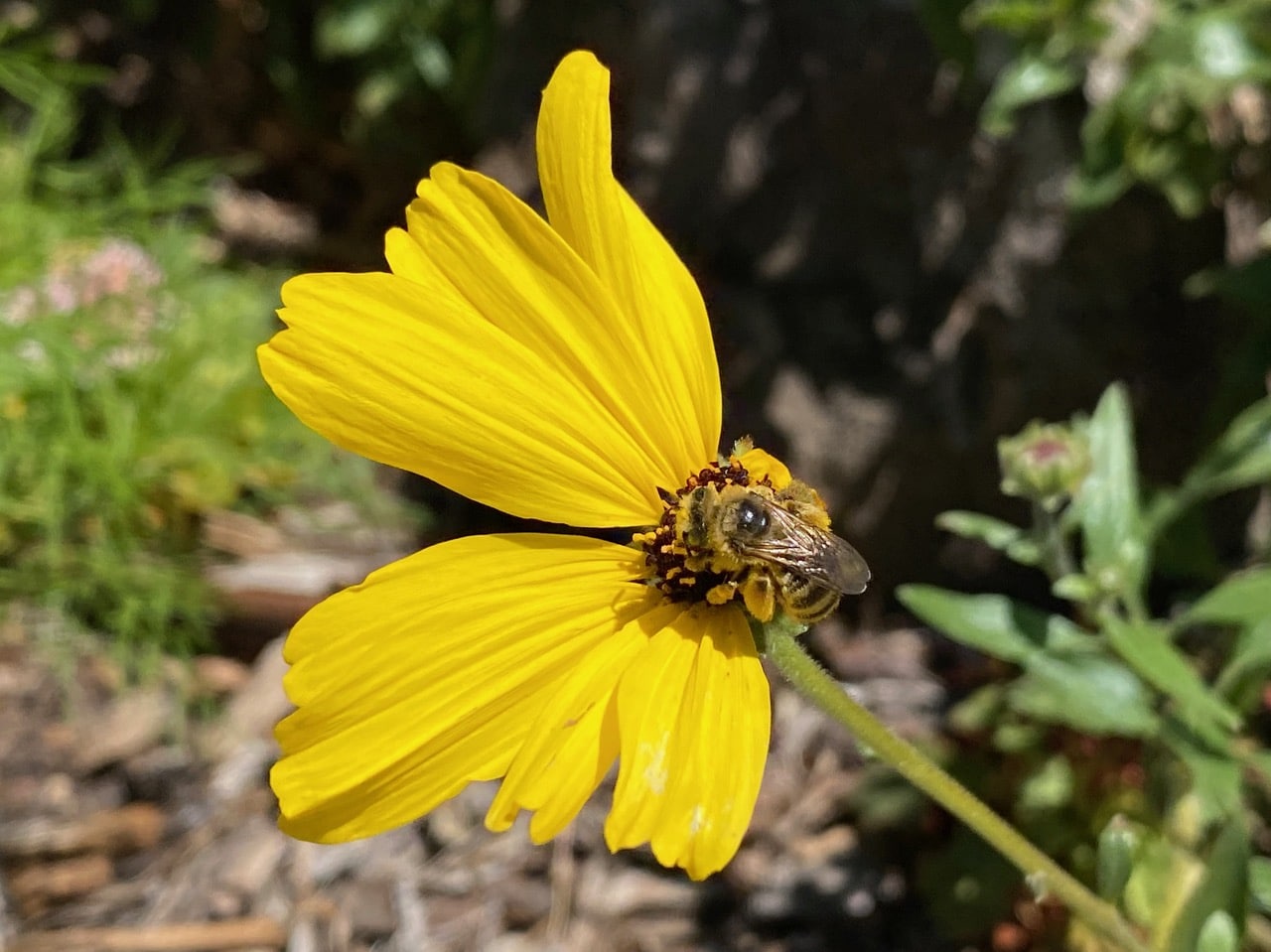
A female Summer Longhorn Bee, Melissodes sp. (family Apidae) is foraging on a flowerhead of Bush Sunflower, Encelia californica. that is missing some ray petals. She does not seem to mind that the flowerhead is missing half of its ray petals.
The Summer Longhorn Bees, Melissodes sp. (family Apidae) are medium to large bees, stout-bodied, usually with gray hair on the thorax and pale hair bands on the abdomen. Males usually have yellow markings on their faces and have very long antennae from which their common name is derived. They are active May to September, with peak flight in late June to early August. The females prefer flat, bare ground for digging their solitary nests, though they sometimes nest in aggregations. Pollen is transported in scopae on the hind legs. Pollen loads are often copious and brightly colored and thus very distinguishable. Melissodes are specialists on Asteraceae – females gather pollen from flowers of Aster, Bidens, Coreopsis, Cosmos, Encelia, Gaillardia, Helianthus, and Rudbeckia ssp.
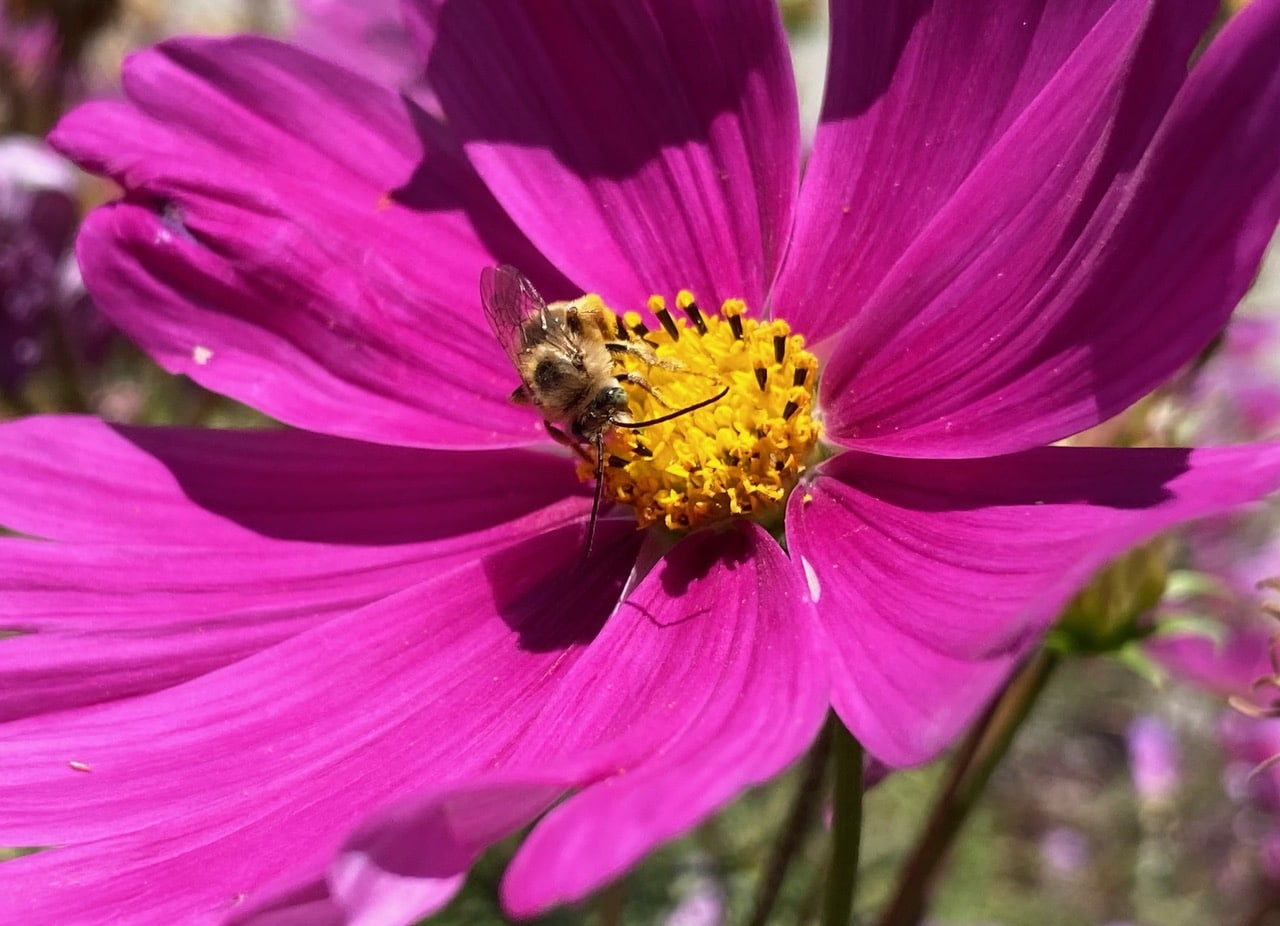
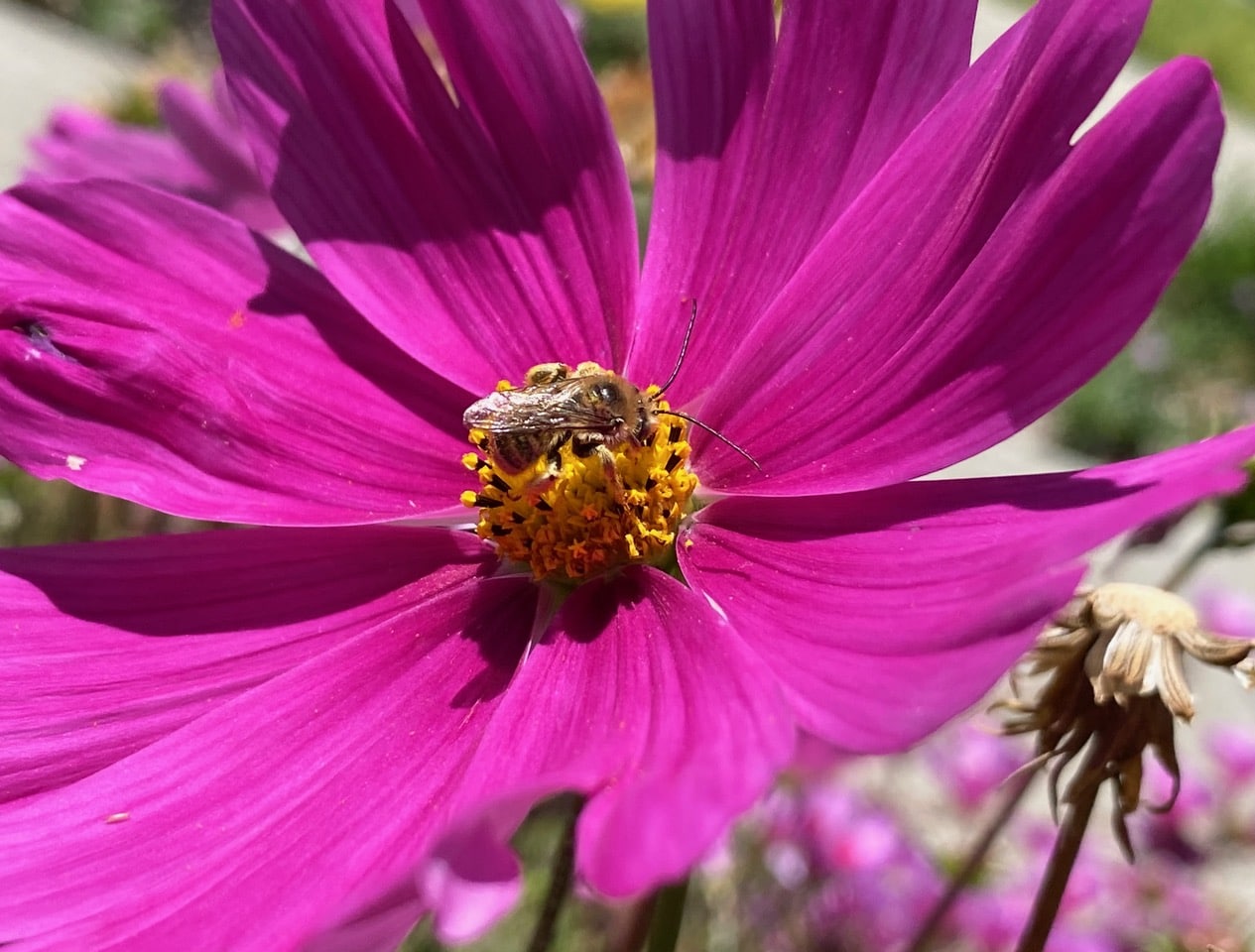
Nearby, a male Summer Longhorn Bee, Melissodes sp. (family Apidae) is taking nectar on a Cosmos flowerhead. Note his long antennae.
Male Melissode’s long antennae apparently serve a special function during mating. During copulation, the male mounts the female and uses his antennae to stroke the female’s antennae, apparently to stimulate/pacify her.
A female Western Leafcutter Bee, Megachile perihirta (family Megachilidae) is foraging on a flowerhead of Pacific Aster, Symphyotrichum chilense by the sidewalk.
Leaf-cutter Bees, Megachile sp. (family Megachilidae) are stout-bodied, usually with pale hair on the thorax and stripes of white hairs on the abdomen. Females usually have a triangular abdomen with a pointed tip, and males’ faces are covered with dense, pale hair. Flight season is from May into September, with peak activity from June to August. Solitary females construct nests in tubular cavities, including hollow stems, tree holes, and abandoned beetle burrows in wood. Many use holes drilled into wood, straws, or other manufactured tunnels. Females cut pieces from leaves or flower petals for use in the construction of brood cells. Most Megachile females are generalist foragers, but prefer flowers in the family Asteraceae. Pollen is transported in dense scopae (special pollen collecting hairs) on the underside of the abdomen.
A Large wasp is making its way around the large clusters of flowers of Seaside Buckwheat, Eriogonum latifolium, its head lowered constantly seeking nectar. It is a Great Golden Digger Wasp, Sphex ichneumoneus (family Sphecidae). Its two-colored abdomen is quite distinctive.
Sphex ichneumoneus, known commonly as the Great Golden Digger Wasp is a wasp in the family Sphecidae. It is identified by the golden pubescence on its head and thorax, its reddish orange legs, and partly reddish orange body. Size 15-27 mm. Found in fields, meadows, the wasp is native to the Western Hemisphere, from Canada to South America. The female digs a chambered tunnel in open ground, and proceeds to stock it with food for her young. She hunts for insects from the family of long-horned grasshoppers that include various crickets, katydids and grasshoppers. She stings to paralyze her prey, then flies or drags it back to the nest. A single egg is laid on the prey. The wasp larvae have fresh food to sustain them until they emerge as adults. One tunnel entrance may lead to as many as eight or ten separate larval chambers.
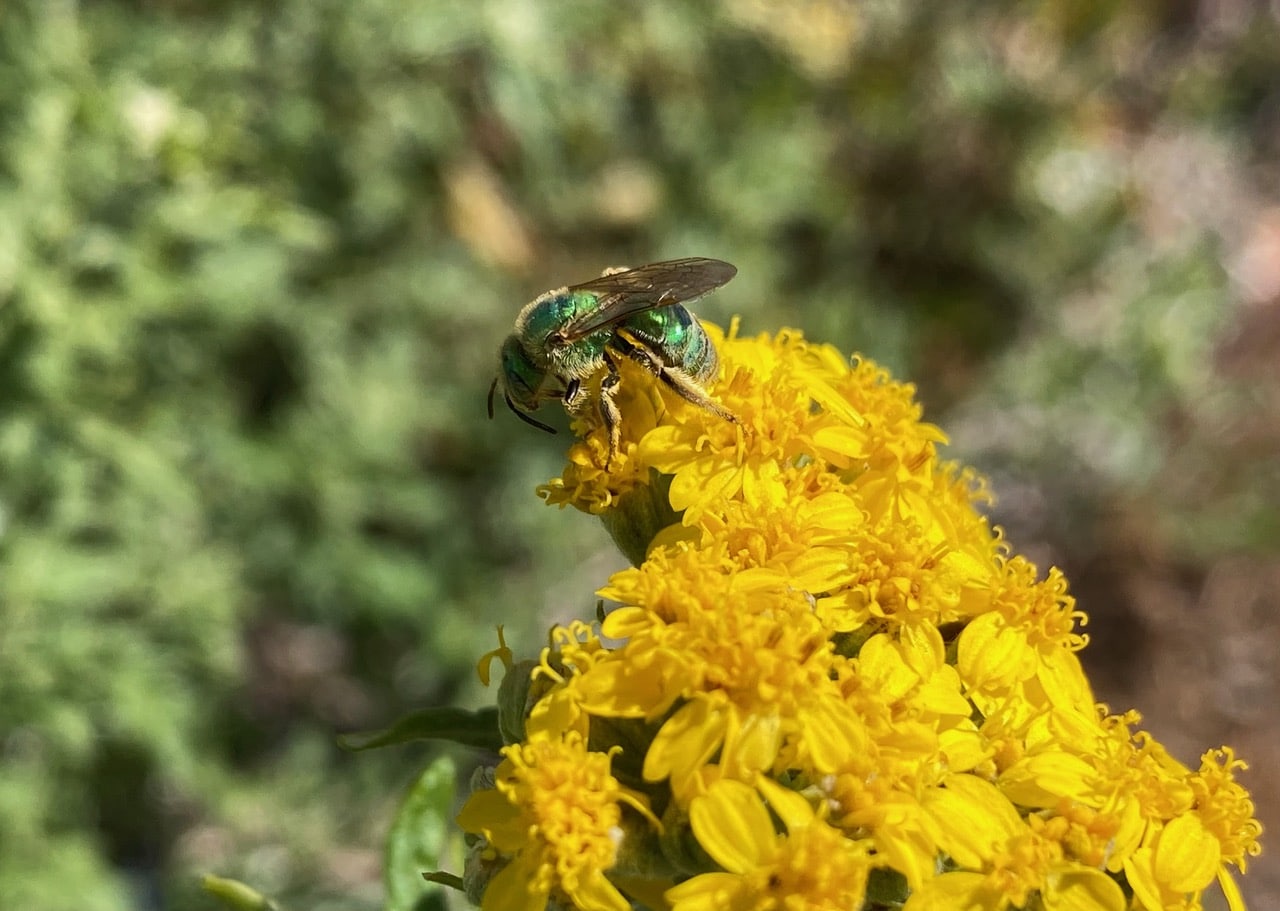
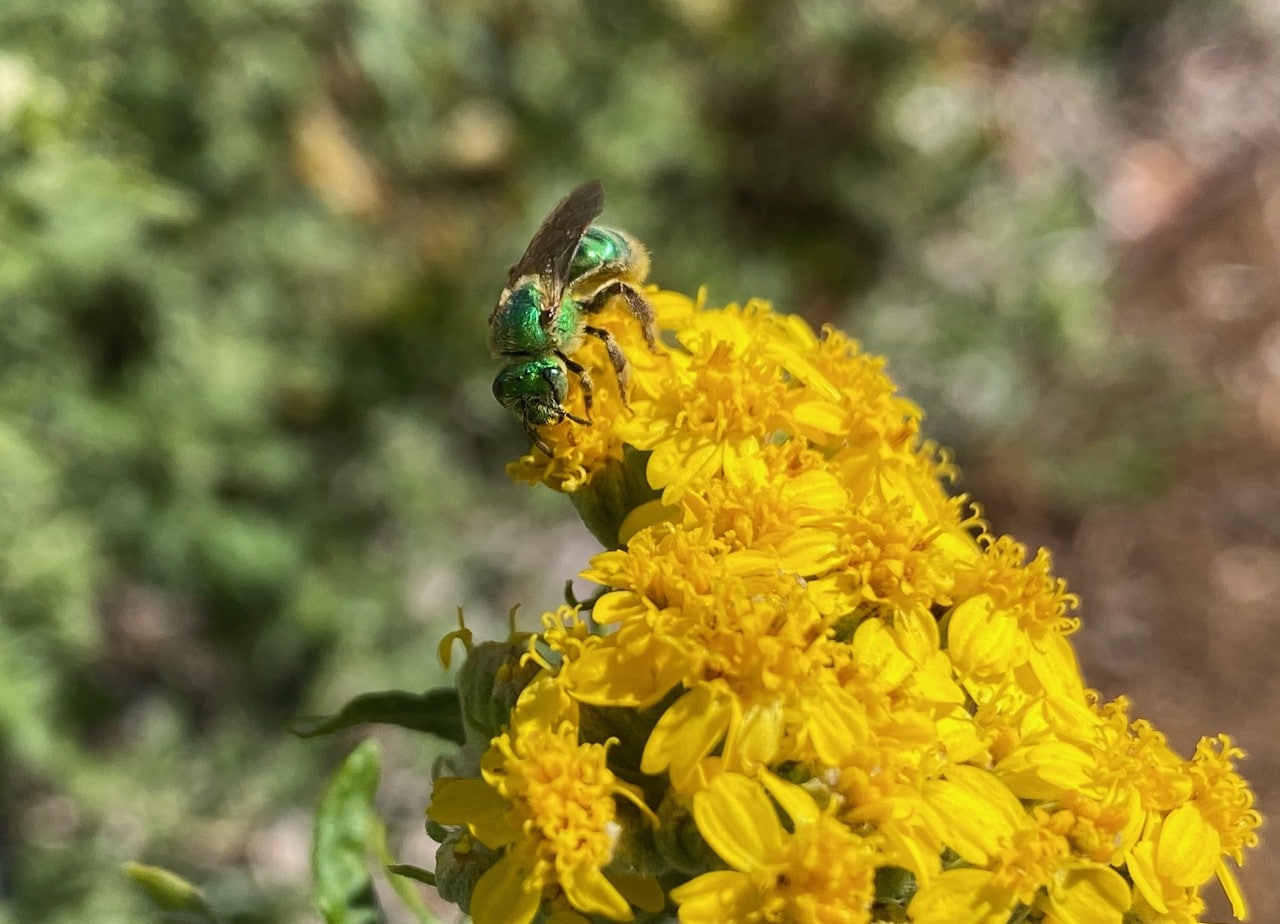
A female Fine Striped Sweat Bee, Agapostemon subtilior (family Halictidae) is foraging on a cluster of flowers of Seaside Woolly Sunflower, Eriophyllum staechadifolium.
The Fine Striped Sweat Bee, Agapostemon subtilior is a North American species of sweat bees in the family Halictidae. Adult females are entirely iridescent green, about 11 mm in length, while males are slightly smaller at 9-10 mm and have black abdomens striped with yellow. The bees may change color based on atmospheric humidity, varying from bluish to pale green. The bees are generalist foragers, collecting pollen from a wide variety of plants. They nest in the ground in solitary burrows.
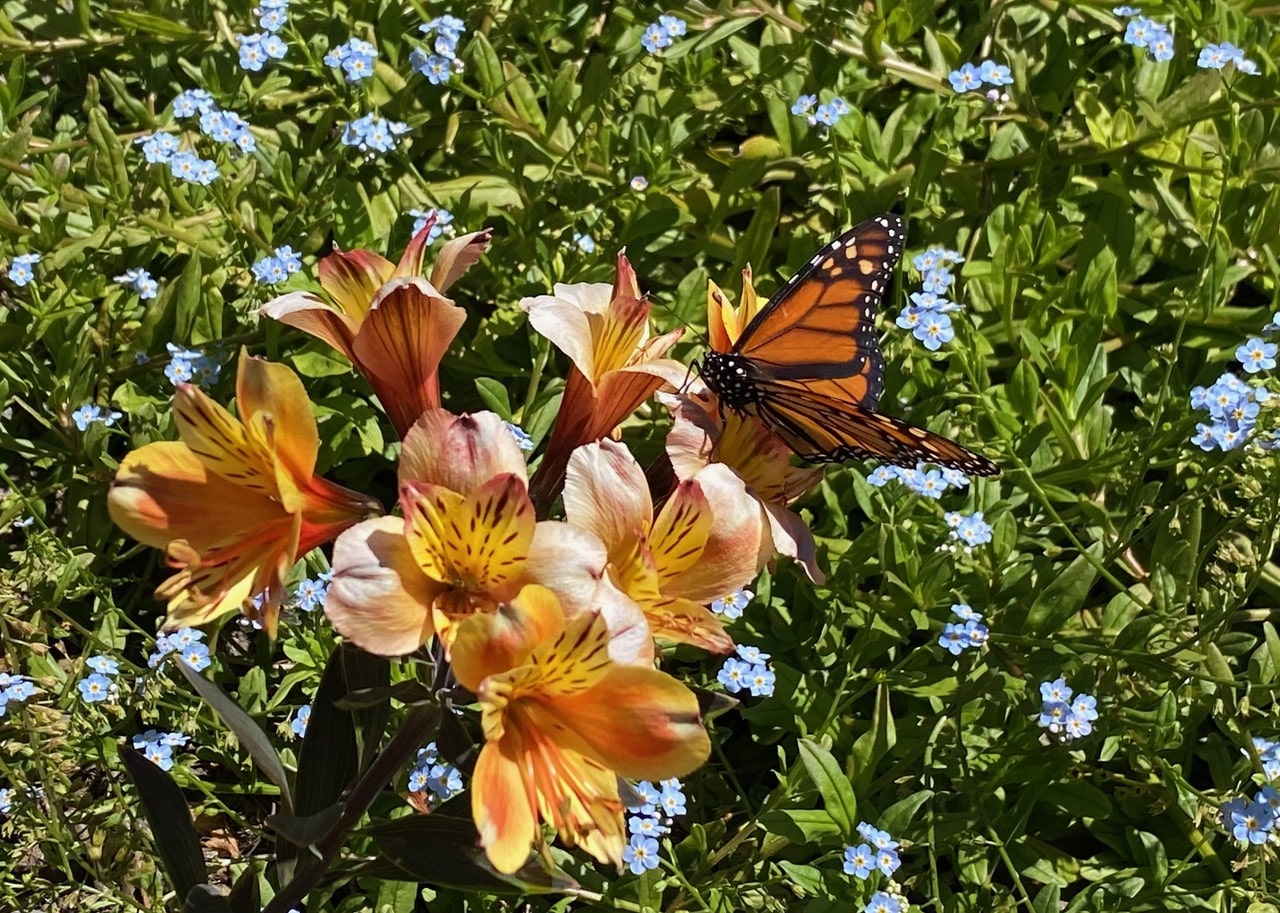
A large Monarch butterfly, Danaus plexippus (family Nymphalidae) circles the pond area several times before landing on a Peruvian Lily, Alstroemeria sp. While the butterfly is very specific about where they lay their eggs as their young will only feed on milkweeds, adults take nectar from a wide variety of flowers, including non-native plants.
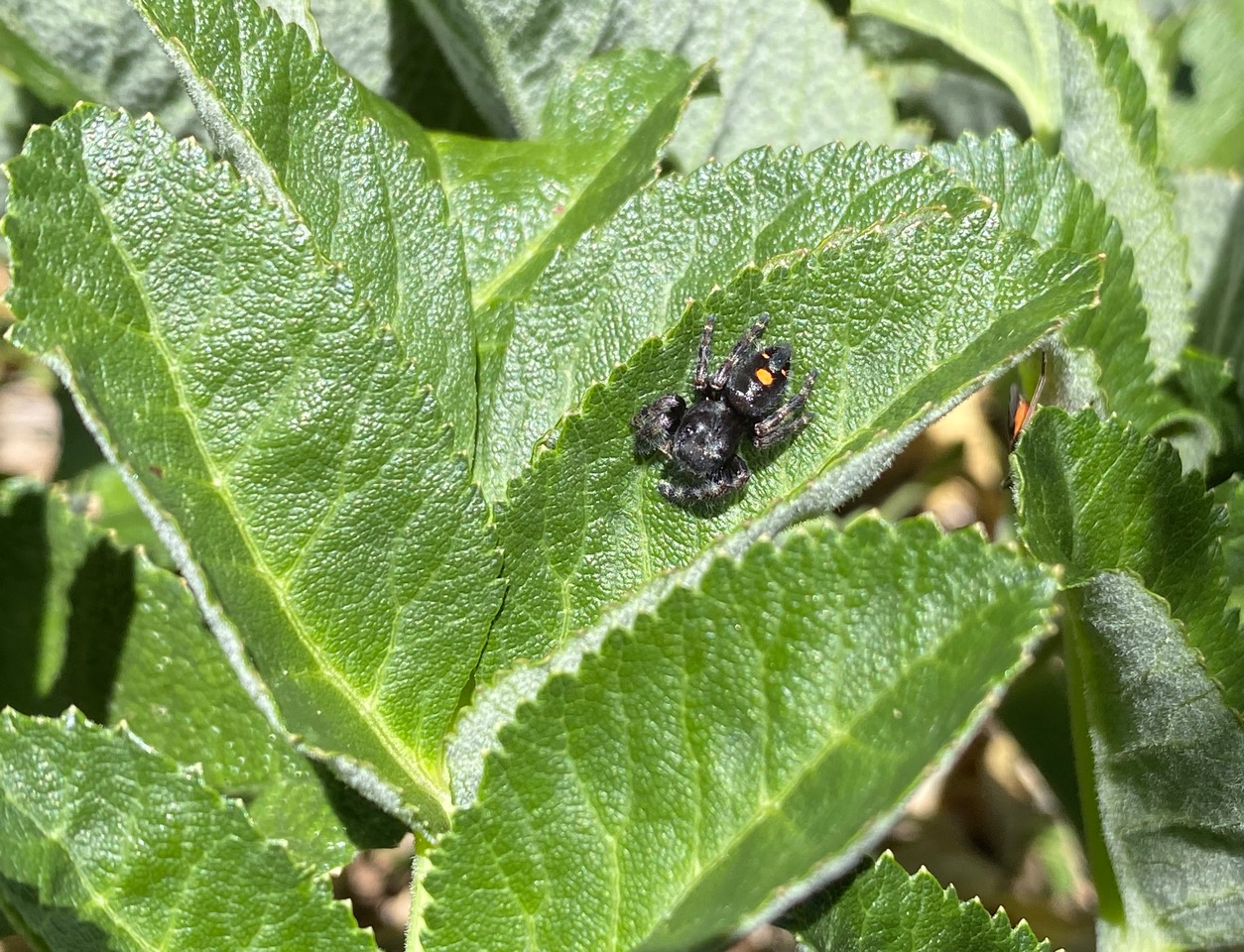
A dark glossy blob on a leaflet of Coast Angelica, Angelica hendersonii turns out to be a Jumping Spider. iNaturalist has helped identify it as a Bold Jumping Spider, Phidippus audax (family Salticidae).
Jumping spiders (family Salticidae) are free-roaming hunting spiders. They do not weave a web to catch prey. They stalk, then pounce on their prey. Just before jumping, the spider fastens a safety line to the substrate. It can leap 10-20 times their body length to capture prey. Their movement is achieved by rapid changes in hydraulic pressure of the blood. Muscular contractions force fluids into the hind legs, which cause them to extend extremely quickly. Jumping spiders are visual hunters. Their excellent vision has among the highest acuities in invertebrates. Since all their 8 eyes are fixed in place and cannot pivot independently from the body like human eyes can, jumping spiders must turn to face whatever they want to see well. This includes moving their cephalothorax up and down, an endearing behavior.
Phidippus audax (family Salticidae) is commonly referred to as Bold Jumping Spider. The species name, audax, is a Latin adjective meaning “audacious” or “bold”. These spiders are commonly found in grasslands, chaparrals, open woodlands, and agricultural fields. It is one of the most commonly occurring spider species within its range and is often found living in close proximity to humans. The adult female ranges from 8-15 mm in body length; the smaller males range from 6-13 mm. They are typically black with an ovoid abdomen and round cephalothorax. The presence of a large triangular white spot in the center of the abdomen with two smaller spots below it is often used to distinguish this species. These spiders are diurnal hunters, using their excellent eyesight for hunting, courtship and observational learning. They are often found hunting on fence posts and plant leaves, stems, and branches. At night, they hide in a crevice or small cavity and make a silk retreat to avoid predators. Bold jumpers prey on a variety of insects including caterpillars, dragonflies and grasshoppers, and other spiders. The species overwinters as immatures in sac-like silk shelters hidden underneath rocks and bark. Spiders emerge in the spring to complete their final molts, mating in late spring and early summer.
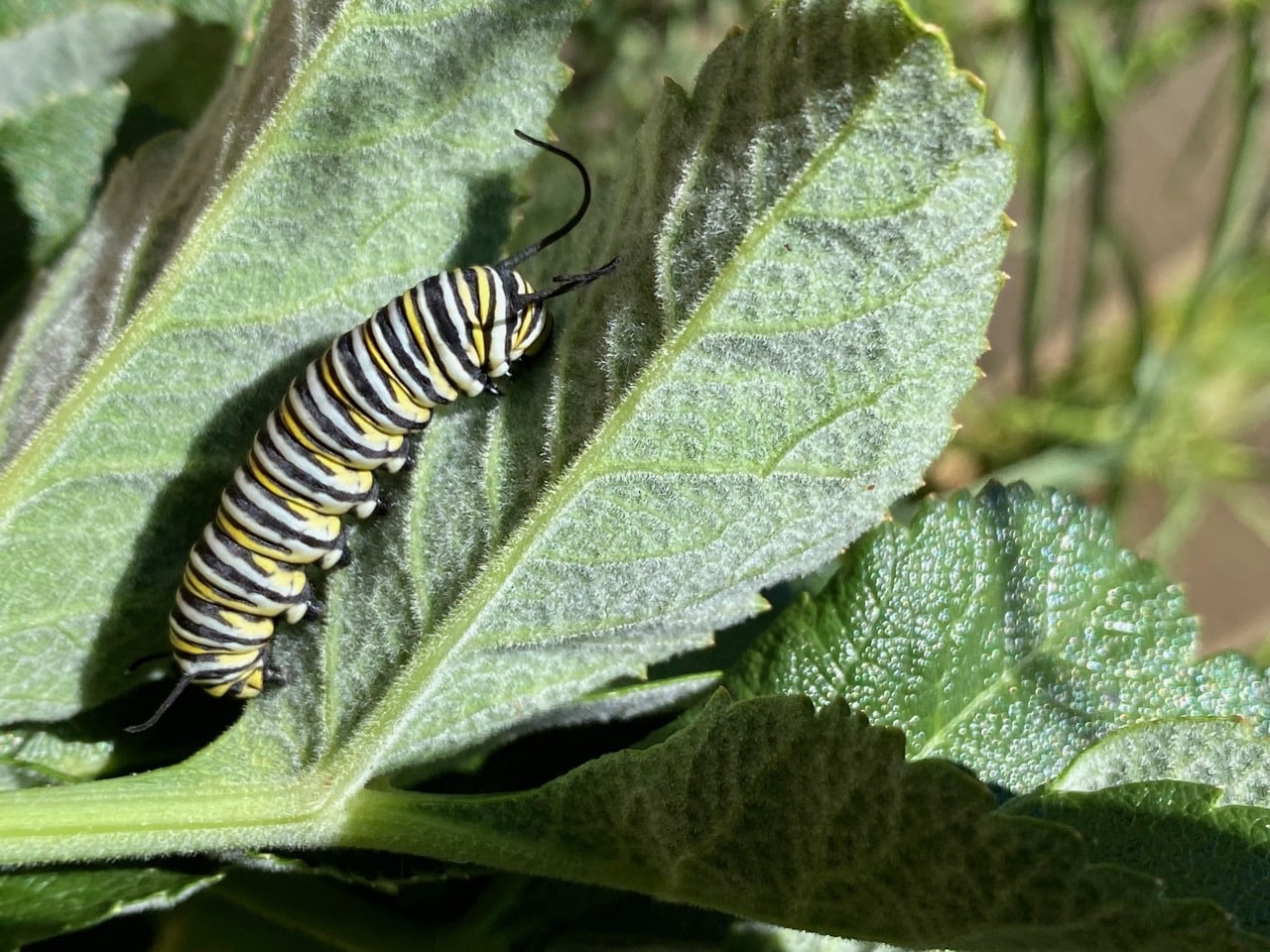
I detect a faint outline of a caterpillar under a leaf of the Coast Angelica. An Anise Swallowtail caterpillar? I instinctively ask, as I have found three of those on this very plant last year. Imagine my surprise when I turn over the leaf to find a Monarch caterpillar instead! It is fairly large, perhaps ready to pupate. Why else would it be on the Angelica that it doesn’t eat? The Angelica is growing right next to a Narrowleaf Milkweed. The mature caterpillar probably wandered over from its host plant in search for a secure place to pupate.
Caterpillars wander away from their host plants before pupating primarily to protect themselves from predators. Host plants are magnets for birds, spiders, wasps, and other insects looking for a meal. What’s more, many host plants are herbaceous, meaning they will die or wither during the time it takes for a pupa to mature. Moving to a permanent, sturdy structure ensures the defenseless pupa will be safe. Actually the Angelica is a herbaceous perennial that dies back to the ground in autumn/winter. The caterpillar is better off pupating on a tree, fence or wall. On the other hand, it still has plenty of time to pupate before the Angelica dies back. The pupal stage (chrysalis) of a Monarch butterfly typically lasts 9 to 14 days.
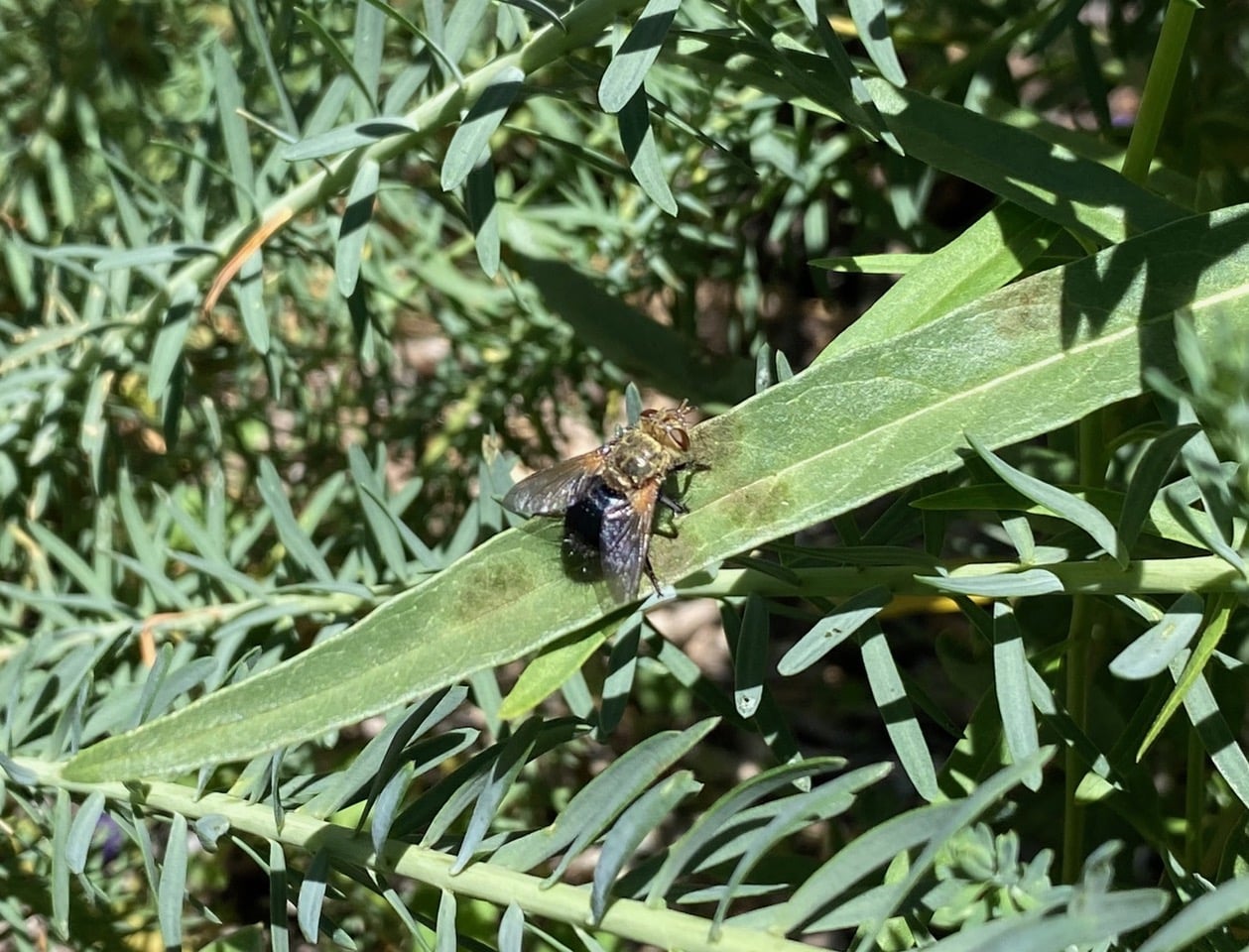
A large, bristly fly with a black abdomen has landed on a leaf of Narrowleaf Milkweed. It is a Hornworm Tachinid Fly, Archytas apicifer (family Tachinidae).
The family Tachinidae is by far the largest and most important group of parasitoid flies. All species are parasitic in the larval stage. Most adults have distinct abdominal bristles, hence the common name. Adults feed on liquids such as nectar and honeydew. They can be found resting on foliage, feeding at flowers or searching for hosts.
Most Tachinids attack caterpillars, adult and larval beetles, true bugs, grasshoppers, and other insects. Females lay eggs in or on the host. Tachinid larvae live as internal parasites, consuming their hosts’ less essential tissues first and not finishing off the vital organs until they are ready to pupate. The larvae leave the host and pupate on the ground. Tachinids are very important in natural control of many pests, and many have been used in biological control programs.
Found throughout North America and South America, Archytas apicifer is a medium to large sized (10-15 mm) tachinid fly. Adults feed on flower nectar, and are known to be pollinators of some flowers. Like many other tachinid flies, Archytas apicifer larvae are internal parasitoids of noctuid moths (family Noctuidae) such as tomato fruit worm, corn ear worm, and cutworms. In addition they are also known to parasitize Forest tent caterpillars and fall webworms. Do they parasitize Monarch caterpillars?
Another large Bristle Fly, Archytas marmoratus (family Tachinidae) is foraging on the flowers of red-flowered Yarrow, Achillea millefolium. Caterpillars, beware!
Archytas marmoratus is a species of Bristle Fly in the family Tachinidae. The flies feature a distinct “marbled” pattern on their abdomen. The species is found primarily in the Americas. Females lay microscopic maggots (planidia) on or near the larvae of moths, particularly the fall army worm (Spodoptera frugiperda) and Corn Earworm (Helicoverpa zea). The maggots penetrate the host, develop internally, and eventually emerge from the host’s pupa as adult flies. As a natural parasitoid, it is frequently used in biological control of target agricultural pests.
A well camouflaged Pug Moth caterpillar, Eupithecia sp. (family Geometridae) is rearing up to reach the reproductive structures of an adjacent flowerhead of Yarrow. Note the three pairs of true legs right behind the head and the absence of prolegs along most of the length of it body.
Many species of Pug Moth caterpillars (family Geometridae) are specialized flower feeders and will actually absorb the pigments from the flowers and pollen they eat. Because of this dietary habit, their bodies take on the exact hues of their host plants to camouflage themselves from predators.
Inchworms are also called loopers and measuring worms. The majority of the inchworms are the larvae of moths in the family Geometridae. The name comes from the Greek “geo” for earth and “metro” from measure, because the caterpillars seem to be measuring the surface on which they are walking. The “looping” locomotion is mandated by the absence of prolegs in the middle section of the caterpillar’s body.
Eupithecia is the largest genus of moths of the family Geometridae. Occurring worldwide except for Australasia, species in the genus are commonly known as pugs. The caterpillars move in a looping manner and are commonly called inchworms. Adults are typically small, 12 – 35 mm, with muted colors. Most species rest with forewings held flat at right angles to the body, while the hindwing are largely covered by the forewings. They are generally nocturnal. Larvae mostly feed from the flowers and seeds of their food plants rather than the foliage. Many species have a very specific food plant. Many are commonly found on Asteraceae flowers.
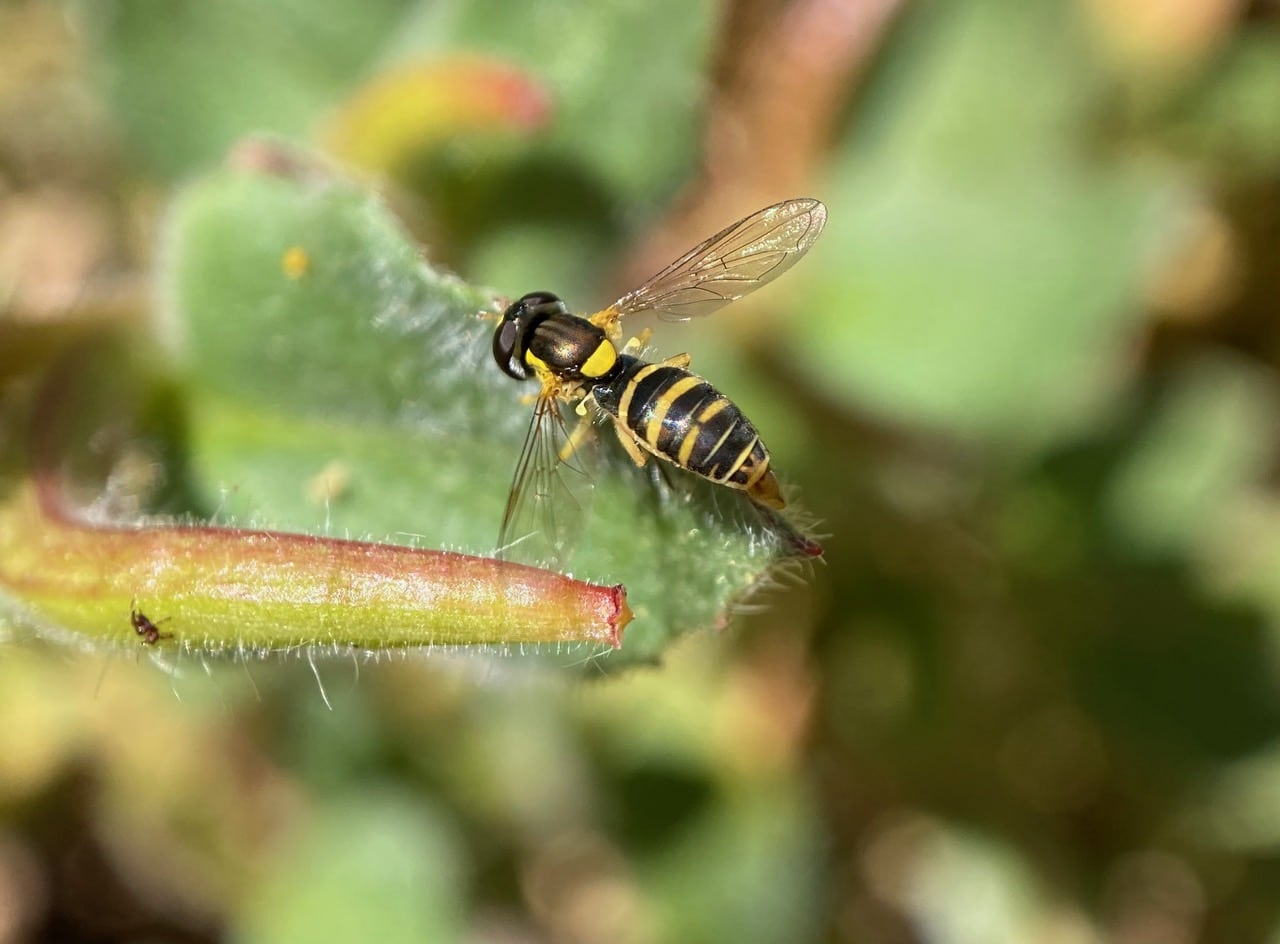
A female Forked Globetail, Sphaerophoria sulphuripes (family Syrphidae) has landed on a leaf of Beach Evening Primrose, Camissoniopsis cheiranthifolia.
The Forked Globetail, Sphaerophoria sulphuripes (family Syrphidae) is a hover fly native to western North America. Adults visit flowers for nectar and pollen. Larvae feed on aphids and other soft-bodied insects. There is marked sexual dimorphism in the species – the males have a slender abdomen with a reddish, swollen tip.

A Mason Wasp, Ancistrocerus bustamente (family Vespidae, subfamily Eumeninae) is hunting on a wilted inflorescence of Red-flowered Buckwheat, Eriogonum grande var. rubescens.
Potter wasps (or mason wasps), the Eumeninae, are a cosmopolitan wasp group presently treated as a subfamily of Vespidae. Most eumenine species are black or brown, and commonly marked with strikingly contrasting patterns of yellow, white, orange, or red. Their wings are folded longitudinally at rest. Eumenine wasps are diverse in nest building. The Mason Wasps are species that generally nest in pre-existing cavities in wood, rock, or other substrate. Potter Wasps are the species that build free-standing nests out of mud, often with a spherical mud envelope. The most widely used building material is mud made of a mixture of soil and regurgitated water.
All known Eumenine species are predators, most of them solitary mass provisioners. When a cell is completed, the adult wasp typically collects beetle larvae, spiders, or caterpillars and, paralyzing them, places them in the cell to serve as food for a single wasp larva. As a normal rule, the adult wasp lays a single egg in the empty cell before provisioning it. The complete life cycle may last from a few weeks to more than a year from the egg until the adult emerges. Adult mason wasps feed on floral nectar.
The Mason Wasp, Ancistrocerus bustamente (family Vespidae, subfamily Eumeninae) is found in western North America and Mexico. The species frequents arid areas, and nests in pre-existing cavities (e.g. old borings in wood, hollow stems, rock crevices) and use mud for partitions between brood cells. The wasps have been known to nest in Sambucus (Elderberry) stems. The name of the genus means “hooked horn” for the back-curved last segments of the antennae characteristic of the males.
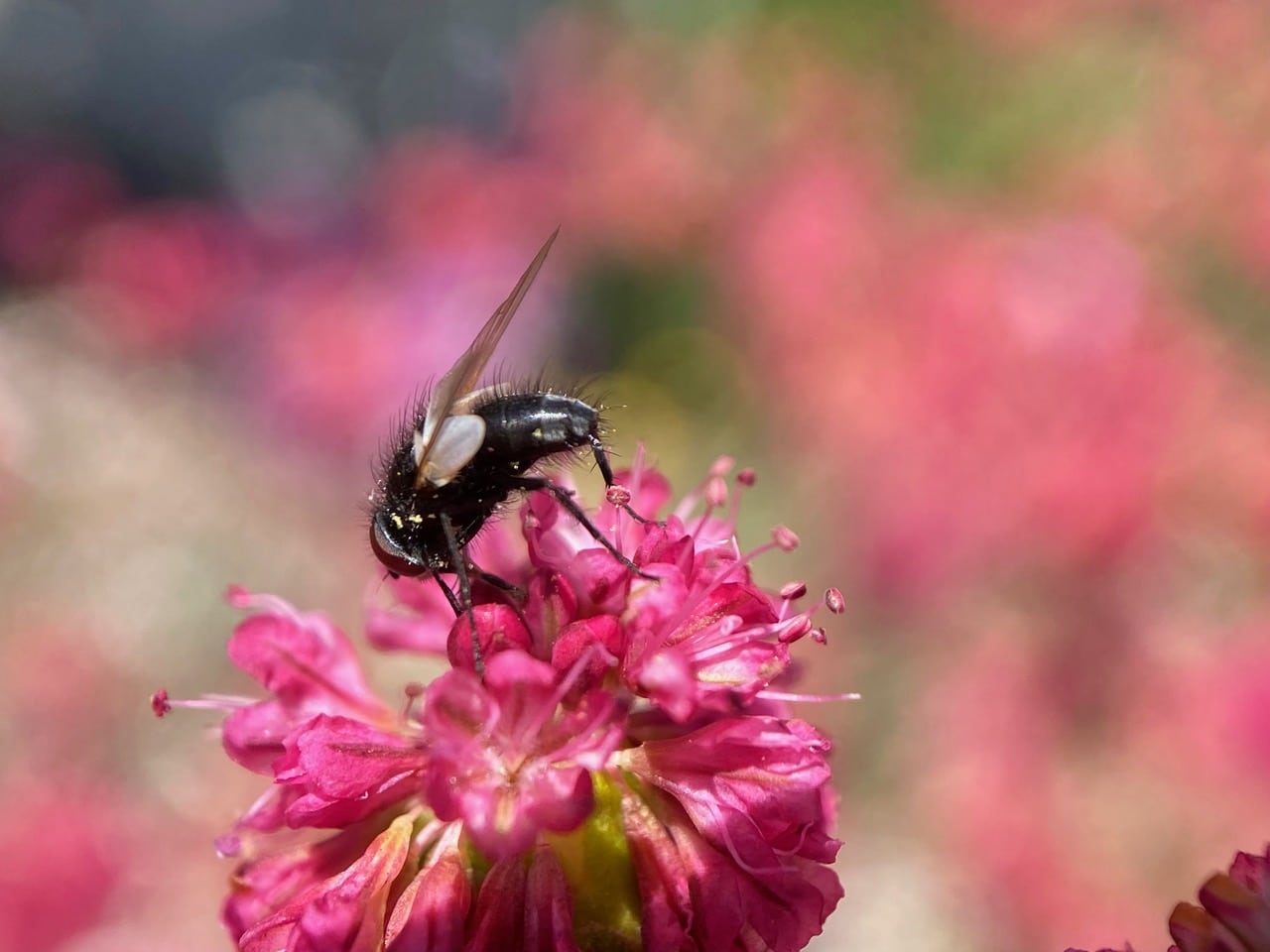
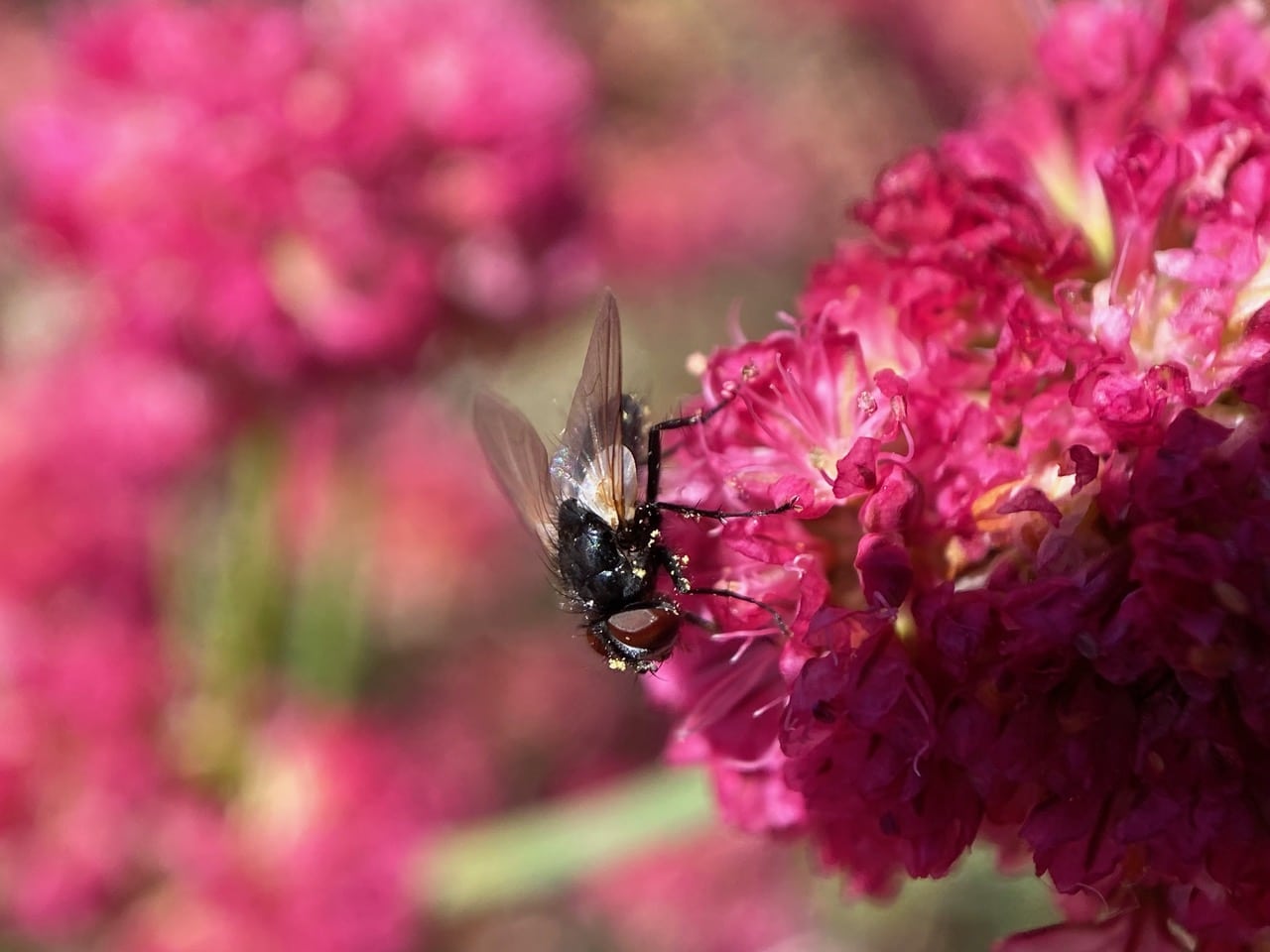
A very small fly is foraging on a Buckwheat inflorescence. I am immediately taken by its oversized calypters – those white flaps under its wings.
Calypters are small, membranous flaps located at the base of the forewings in certain true flies (order Diptera). Their primary function is to protect and conceal the halteres – the modified hindwings that act as gyroscopes to help the fly balance and steer during flight. The calypters typically consist of two lobes – and upper and a lower calypter. Their size, shape, and hairiness vary widely across different fly families. Entomologists use calypters as a key feature to identify and classify species.
I don’t think I have ever seen this fly before.
iNaturalist has helped identify the fly as a Bristle Fly, Leucostoma sp. (family Tachinidae, subfamily Phasiinae). Known in some regions as “bug-killing flies”, their larvae are parasitoids that develop inside true bugs, making them a fascinating group in natural pest management. These flies are found worldwide and are known to frequent hedgerows, margins of organic fields, and flowering vegetation where their hosts gather. They are generally small, 3-7 mm in length with shiny black or gray bodies. Certain species, often nicknamed “big flaps”, have notably large white lower calypters (the scale-like flaps below the wings).
Female Leucostoma flies are parasitoids of various true bugs (order Hemiptera), including plant bugs, and stink bugs. They have highly modified, pincer-like appendages at the tip of their abdomens used to grasp hosts while laying eggs. The developing larvae consume the host from the inside, eventually killing it.