

Pollinator Post 6/18/26 (2)

In Stefanie’s side yard, a Thick-legged Hover Fly, Syritta pipiens (family Syrphidae) is foraging on an inflorescence of Sea Cliff Buckwheat, Eriogonum parvifolium. The prevalence of this species of hover fly is probably due to the various water features in the garden that are crucial for the larval stages of the insect. Stefanie collects rain water in a large tank by the side of the house; the overflow drains into a catchment area landscaped to look like a natural stream bed running through part of the backyard.
Syritta pipiens originates from Europe and is currently distributed across Eurasia and North America. They are fast and nimble fliers. The fly has an elongate body about 6.5 – 9 mm long, and has distinctly enlarged hind femora which gives it its common name. The species flies at a very low height, rarely more than 1 m above the ground. Adults visit flowers – males primarily to feed on nectar, and females to feed on protein-rich pollen to produce eggs. The species is found wherever there are flowers. It is also anthropophilic, occurring in farmland, suburban gardens, and urban parks. Larvae are found in wetlands that are close to bodies of freshwater such as lakes, ponds, rivers, ditches. Larvae feed on decaying organic matter such as garden compost and manure. Males often track females in flight, ending with a sharp dart towards them after they have settled, aiming to attempt forced copulation.
Syritta pipiens exhibits migratory behavior. These small fast-flying hover flies are highly adaptable and migrate to avoid harsh weather and seasonal resource shortages. They utilize a time-compensated sun compass, taking advantage of tailwinds on dry, sunny days to travel long distances. By migrating, these flies act as crucial long-range pollinators, transferring pollen over hundreds of miles while feeding on small flowers.

Wow, what a beautiful bug! iNaturalist has helped identify it as a Hyaline Grass Bug, Liorhyssus hyalinus (family Rhopalidae).
The Hyaline Grass Bug, Liorhyssus hyalinus is a widely distributed, generalist insect in the family Rhopalidae (scentless plant bugs). Adults are 5.5 to 7.5 mm long and vary in color from yellow-brown to reddish. The membrane of the wings (hemelytra) is transparent (hyaline) and extends well beyond the dark upper side of the abdomen. Females lay eggs on foliage or flowers. The bugs have piercing-sucking mouthparts and prefer to feed on flowers, developing seeds, and foliage. The species mainly feeds on Asteraceae and Erodium species. They can inflict damage on garden plants as well as agricultural crops like hemp, pistachio, cotton, and sorghum. Low populations cause puncture marks and wilting, while severe infestations result in stunted growth and reduced yields.
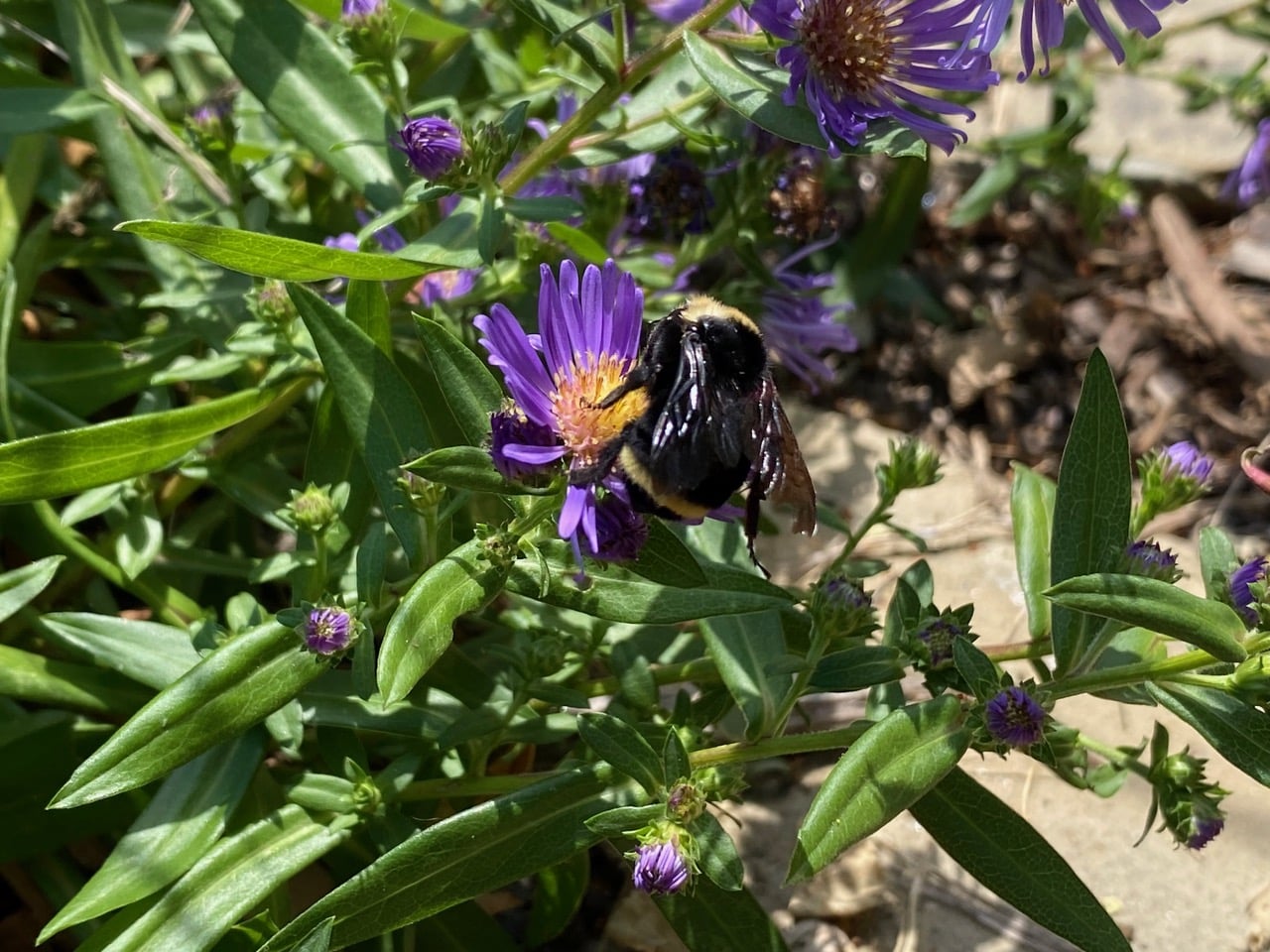
Entering the backyard through the side gate, I encounter a huge queen Yellow-faced Bumble Bee, subgenus Pyrobombus (genus Bombus, family Apidae) foraging on the low-growing Plumas Purple Aster, Symphyotrichum chilense “Plumas Purple” The bee is clumsy and can barely hold on to the flowerheads. Her wings are tattered.
A queen bumble bee out foraging so late in the season puzzles me. The fact that an old queen bee is still out foraging means that she has yet to establish a colony. Perhaps she is still struggling to feed the brood that she is raising by herself? Typically, once a queen bumble bee has successfully raised the first brood of workers, she stays back in the nest to concentrate on her reproductive role of laying eggs, relegating the foraging, nest maintenance, and brood care to the workers.
Alternatively, and more likely, this could be a new queen recently produced by the colony, who has been injured? These newly emerged bumble bee queens (often called gynes) do leave the nest to forage for nectar and pollen on their own before they find a mate. The gynes fly out to feast on flowers and build up fat reserves essential for them to survive the long winter hibernation. During these foraging trips, they may also take brief orientation flights to memorize their surroundings.
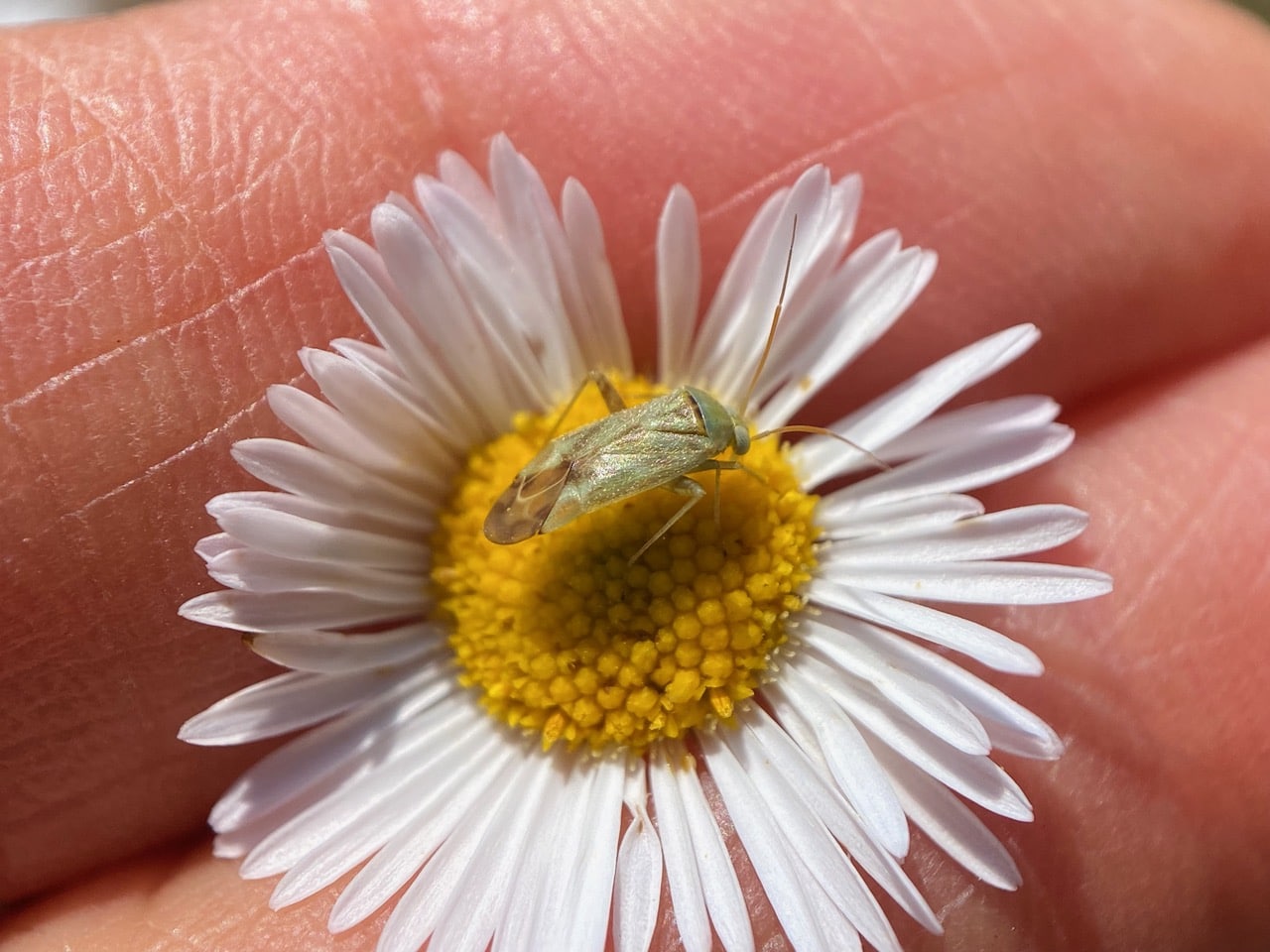
I hold an English Daisy flowerhead firmly between my fingers to photograph a bug on it. iNaturalist has helped identify it as a Broken-backed Bug, Taylorilygus apicalis (family Miridae).
The Broken-backed Bug, Taylorilygus apicalis is a cosmopolitan plant bug in the family Miridae. It is found on every continent except Antarctica and is common in California. This polyphagous insect primarily feeds on Asteraceae (sunflower family) plants and can occasionally become pests. Adults are typically 4-5 mm in length. Wings are light green to tan, featuring dark brown flecks on the inner wings. Wing tips are sharply bent downward at a 45 degree angle, giving it the characteristic “broken” look. Adults survive the winter months hidden in weeds. In favorable or warm climates, the bug can produce multiple generations within a single spring and summer season. In large numbers, they can cause damage by feeding on flowers and seeds, occasionally causing flower deformation.

Another bug crawls out of the English Daisy onto my finger. I recognize it as a Scentless Plant Bug, Arhyssus sp. (family Rhopalidae). Note the needle-like rostrum (mouth parts) partially folded under its body.
Arhyssus is a genus of small, true bugs belonging to the family Rhopalidae. There are over a dozen species native to North America. They are small, typically measuring 5-12 mm in length. They possess distinct, raised simple eyes (ocelli) at the front of the head. Unlike other true bugs, they lack well-developed scent glands (hence the common name).
Arhyssus primarily feed on weeds, seeds, and xeric (dry-habitat) grass plants. Adults spend the spring and summer feeding outdoors. In early autumn, they migrate into wall crevices, woodpiles, or homes to hibernate.

Pink Clarkia and yellow Gaillardia and Yarrow provide most of the color in the backyard.

Towards the back of the garden, berry-laden branches of an Elderberry arch over shade-loving plants such as Bee Plants and Evergreen Currant, while clumps of Deer Grass, Manzanitas, white-flowered Buckwheat, and purple-flowered Aster occupy the sunnier spots.

I don’t remember seeing this Redspot Clarkia, Clarkia speciosa in this garden before. I am taken by the striking magenta-colored X-shaped stigma in the center of the mature flowers that stand above the cream-colored anthers. In the less mature flowers, the stigmas are hardly visible, barely a magenta knob. This species seems to exhibit the same dichogamy of most Clarkias I know.
Dichogamy in flowers is the temporal separation of male and female reproductive maturation, a mechanism that prevents self-pollination. In Clarkia (evening-primrose family Onagraceae), this is almost exclusively achieved through protandry, whereby anthers release pollen before the stigma becomes receptive.
Male Phase: When the flower first opens, the anthers mature and begin shedding pollen. During this time, the style remains tightly closed, preventing the flower’s own pollen from fertilizing its ovules.
Female Phase: As the male phase concludes, the stigma lobes open up and become sticky and receptive to pollen. By this time, the flower has exhausted its pwn pollen, forcing any fertilization to occur from outside sources.

Hey, a little bee is rummaging among the anthers of this male-phase Clarkia flower. Note that the eight anthers have split open and curled back to release their pollen (which is white and almost invisible). Note that the four-lobed stigma is still tightly closed like a fist. By the bands of white hairs on its abdomen, and the little groove at the tip of the abdomen, I gather that the bee is a female “furrow bee”, specifically the Tripartite Sweat Bee, Halictus tripartitus (family Halictidae).
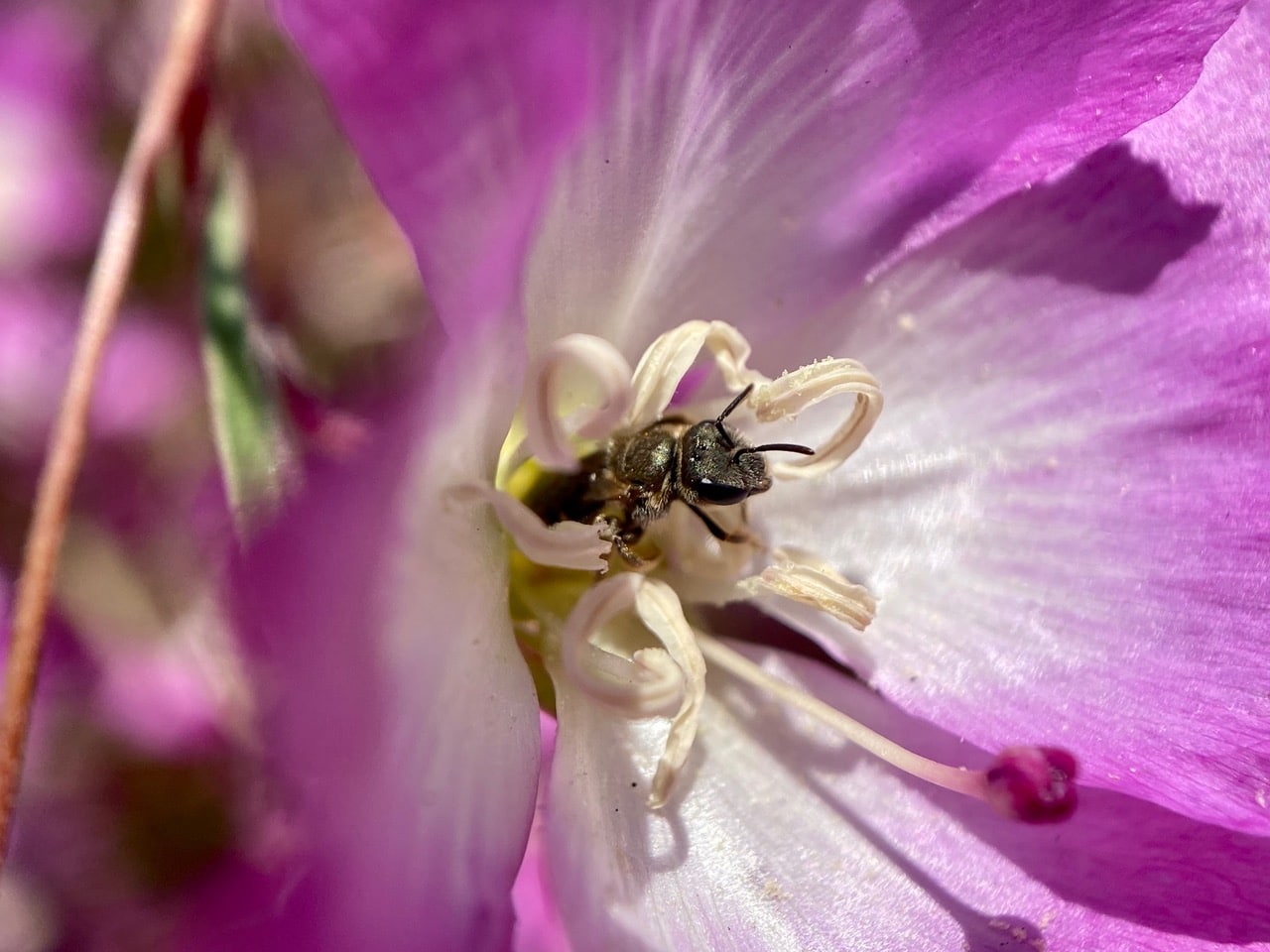
Furrow Bees are a group of ground-nesting, solitary, or primitively social bees. They get their name from a distinct longitudinal groove or “furrow” found on the abdomen of the females. They are also commonly known as Sweat Bees (family Halictidae) due to their habit of landing on humans to drink sweat for moisture and salts. These bees are generally small to medium (6 -14 mm long). They often have dark, metallic, or matte bodies with thin white or pale hair bands across the abdomen. The “furrow” on the female’s final abdominal segment is used for digging and nesting. While most furrow bees are solitary, each female digging her own tunnel in soil to lay her eggs, some species, such as the Tripartite Sweat Bee exhibit primitively social behavior. They form small colonies with a single queen and a few non-reproductive workers who forage for pollen. Their life cycle is akin to that of the bumble bees. Mated females spend the winter hibernating deep in the soil. In the spring they emerge, construct nests, and lay eggs in small chambers stocked with pollen. By the fall, the next generation of mated queens (gynes) prepare to overwinter, completing the annual cycle. These bees are crucial generalist pollinators that visit a wide variety of flowering plants and crops. Because they are short-tongued, they heavily favor easily accessible, open blooms like daisies, asters, and goldenrods.

Halictus is found worldwide; they are most common in the Northern Hemisphere. All are generalists, foraging from a wide variety of flowering plants. Many species are social and produce several generations per year. This is not surprising as most blooming plants are season-specific; a bee that requires pollen and nectar across multiple seasons would not thrive as a specialist. All Halictus in North America nest in the ground, often in aggregations; and they may nest in the same area for decades.
Tripartite Sweat Bees, Halictus tripartitus are social, forming annual colonies in the soil where a queen lays eggs and daughter bees act as workers. They are considered a “primitively social” species, meaning they have a social organization with a queen and workers, but with simpler colonies compared to more complex eusocial insects such as honey bees.
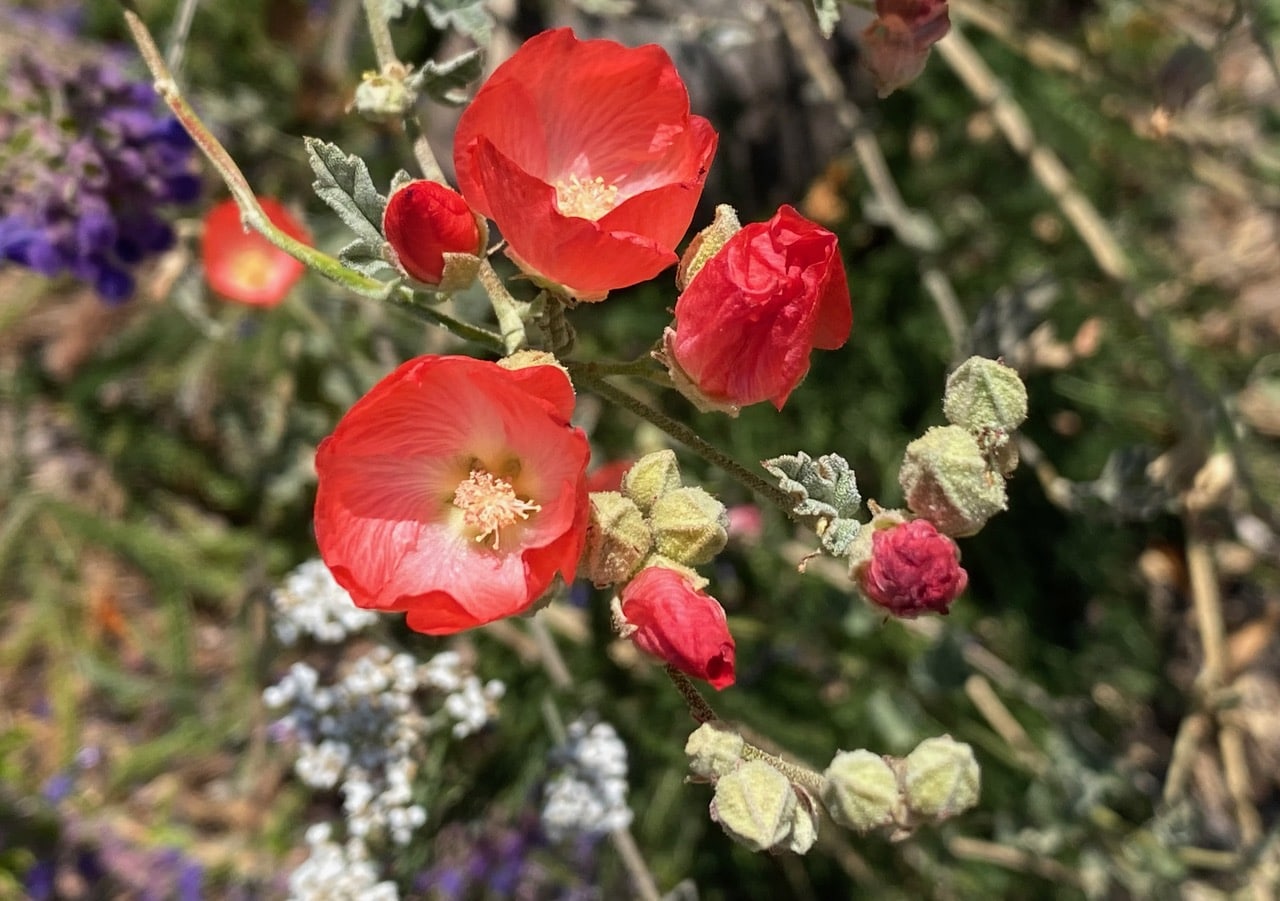
The Apricot Globemallow, Sphaeralcea ambigua is still blooming beautifully, but where are the pollinators?

A small insect crawls out of one of the Globemallow flowers. It is a Lygus Bug, Lygus sp. (family Miridae).
Lygus Bugs are small (6-7 mm long), oval-shaped plant bugs (family Miridae), ranging in color from pale green to yellowish-brown or dark brown. They feature a prominent, triangular “V” shape in the center of their back and have long, spindly antennae. Nymphs are wingless, generally pale green, and resemble aphids but lack the backward-facing tubes (cornicles) on their abdomen. They are fast-moving and larger nymphs often have five black spots on their backs. Lygus Bugs are major agricultural pests. They have a massive host range, primarily feeding on flowering crops and common weeds, which act as reservoirs before the insects migrate to commercial fields. Both adults and nymphs use piercing-sucking mouthparts to feed on new growth, buds, and seeds. Their feeding causes severe plant damage, including flower drop, discolored leaves, and deformed fruits or seeds.

A Yellow-haird Sun Fly, Myathropa florea (family Syrphidae) appears to be sampling pollen from a California Poppy. Many hover flies mimic stinging insects such as bees and wasp for protection from potential predators, but Myathropa florea is an over-the-top mimic – brighter in color and possess more stripes than their models.
The Yellow-haired Sun Fly, Myathropa florea is a hover fly native to Europe and North Africa. It has been found along the Pacific Coast of North America since 2005. It is of a similar size to the Common Drone Fly (Eristalis tenax), but Myathropa are generally more yellow, with two light bands to the thorax, interrupted with a black central smudge. These flies are rather variable in size, shape and color. The species occurs in deciduous forests, farmland, parks, and gardens. Adults visit flowers of a wide variety of plants for nectar and pollen, and are important pollinators. Larvae are rat-tailed maggots that live in stagnant, water-logged tree rot holes or decaying wood, feeding on bacteria. They have a siphon on their rear end that acts like a snorkel, helping them breathe under water. The siphon can be several times the length of the larva’s body. These larvae serve an important function as decomposer/recycler in the ecosystem.
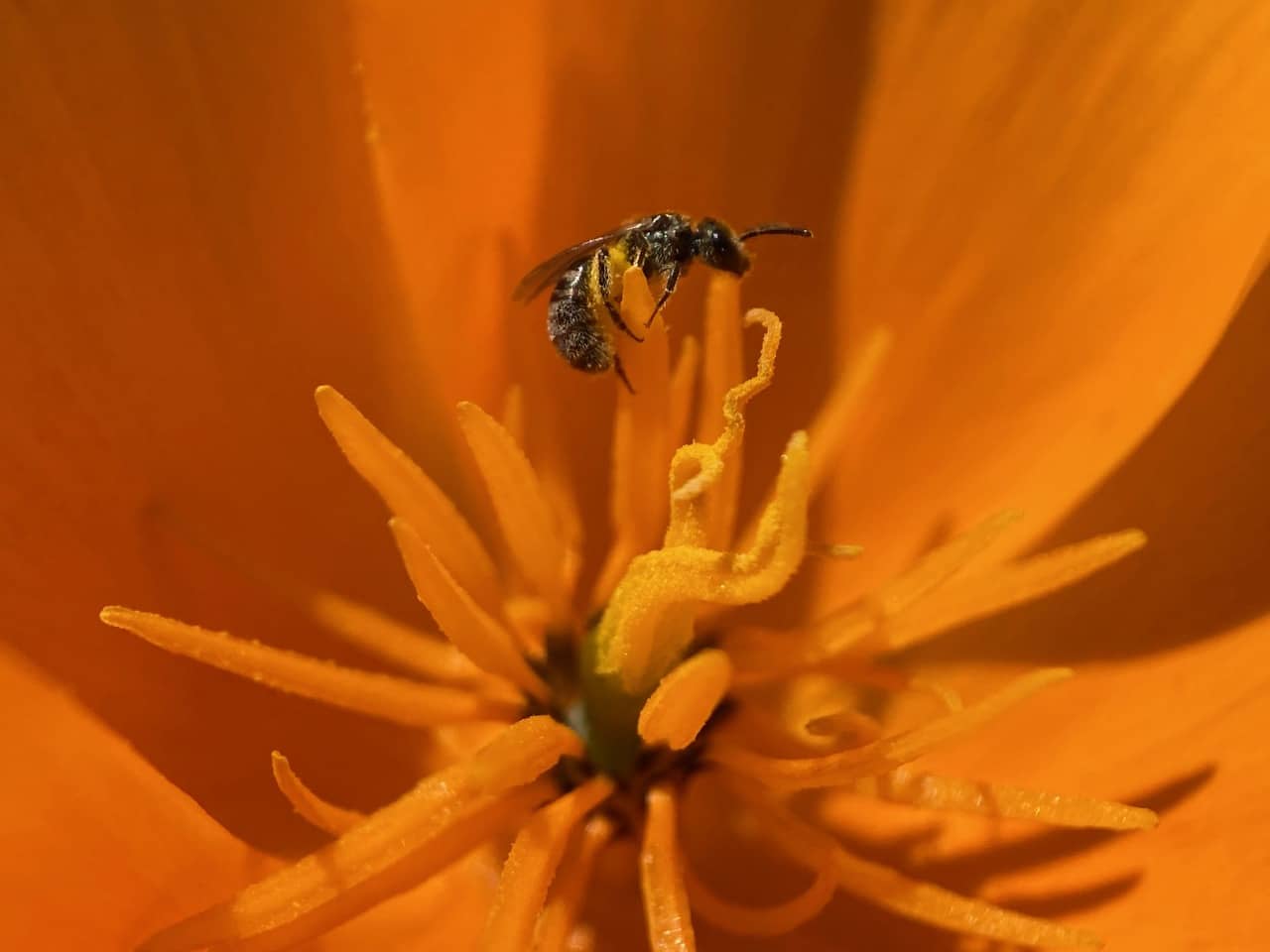
A Metallic Sweat Bee, Lasioglossum (Dialictus) sp. (family Halictidae) is collecting pollen from the anthers of a California Poppy.
Lasioglossum species are found worldwide, and they constitute the largest bee genus. The subgenus Dialictus are the most likely to be seen in the U.S., with over 300 species of these tiny metallic bees. The majority of Lasioglossum are generalists. Because they are so abundant throughout the flowering season, the bees are often important pollinators. Their sheer numbers are enough to achieve excellent pollination of many wild flowers, especially of plants in the Asteraceae, which have shallow floral tubes that are easily accessed by these minute bees.
Lasioglossum exhibit a range of social behaviors; the genus includes solitary, communal, semi social, primitively eusocial, and even parasitic species. Almost all Lasioglossum in the U.S. nest in the ground. Generally these nests are built in the spring by fertilized females (called foundresses) that spent the winter in hibernation. In social species, the foundresses behave much like the queen bumble bees – they lay the first batch of eggs that develop into the first generation of female workers. The nest grows with each additional generation of bees. Later broods may consist of both males and females. They mate, and at the end of the season the fertilized females hibernate til the following spring, repeating the life cycle of the colony.
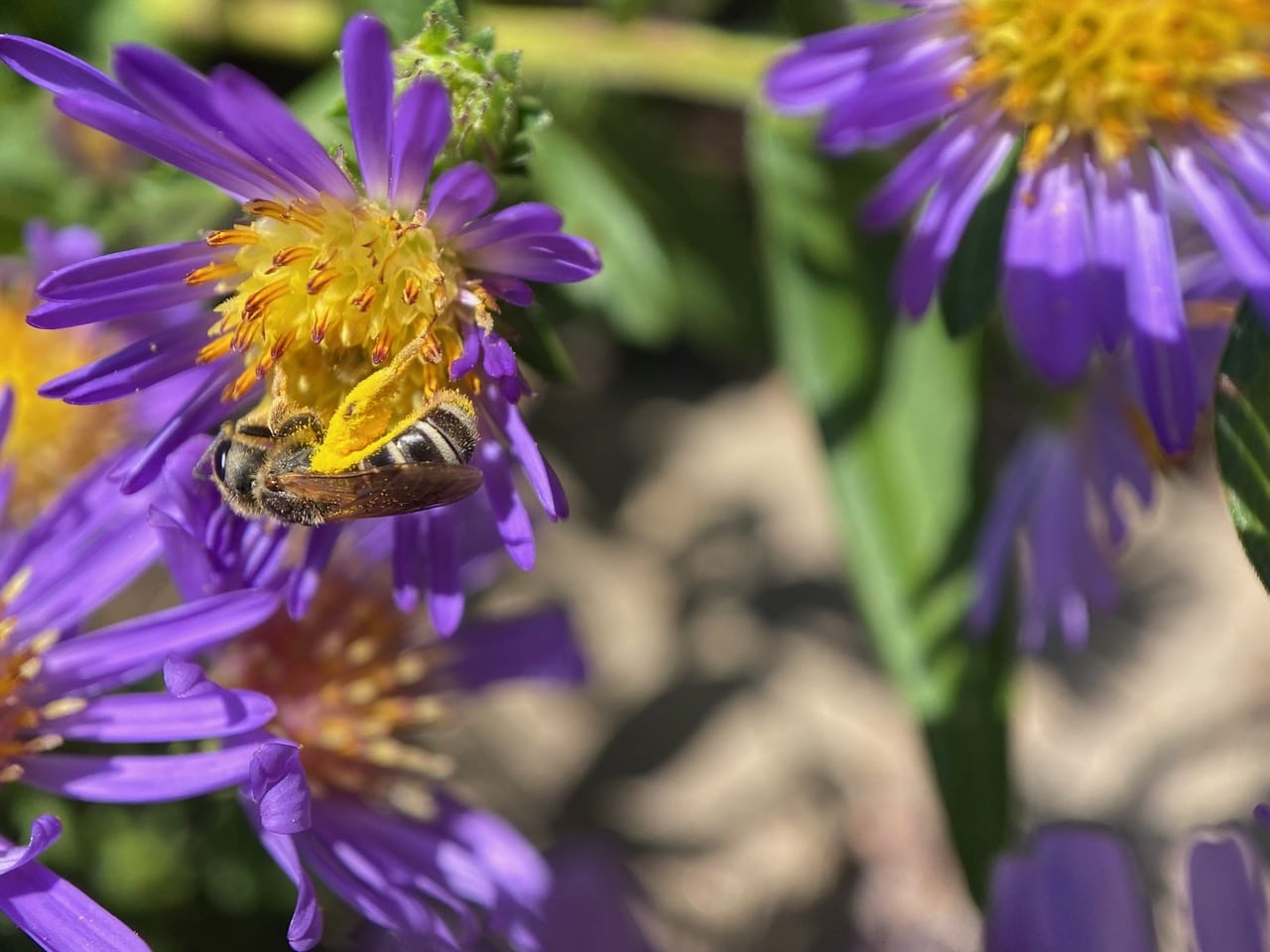
A Tripartite Sweat Bee, Halictus tripartitus (family Halictidae) is foraging on a flowerhead of Plumas Purple Aster, Symphyotrichum chilense “Plumas Purple”. Note where the bee is carrying the pollen she has collected – on the scopae along the full length of her hind leg and under her abdomen.

Asters are composite flowers, meaning the “bloom” is actually a dense head made up of hundreds of tiny, specialized flowers called florets. The disk florets are the small tubular flowers that make up the yellow center of the aster. They are androgynous, containing both male (anthers) and female (style) parts. Inside each disk floret, the five individual anthers are fused into a ring-like tube around the style. The anthers shed their pollen inward, into the hollow tube. As the central style elongates and grows upward through this tube, it acts like a plunger, sweeping the pollen out to the top where visiting pollinators can pick it up. The whole process is termed “secondary pollen presentation”, a defining characteristic of the sunflower family Asteraceae. Note that the bee is collecting pollen from the light-colored styles that have been extruded from the anther tubes.
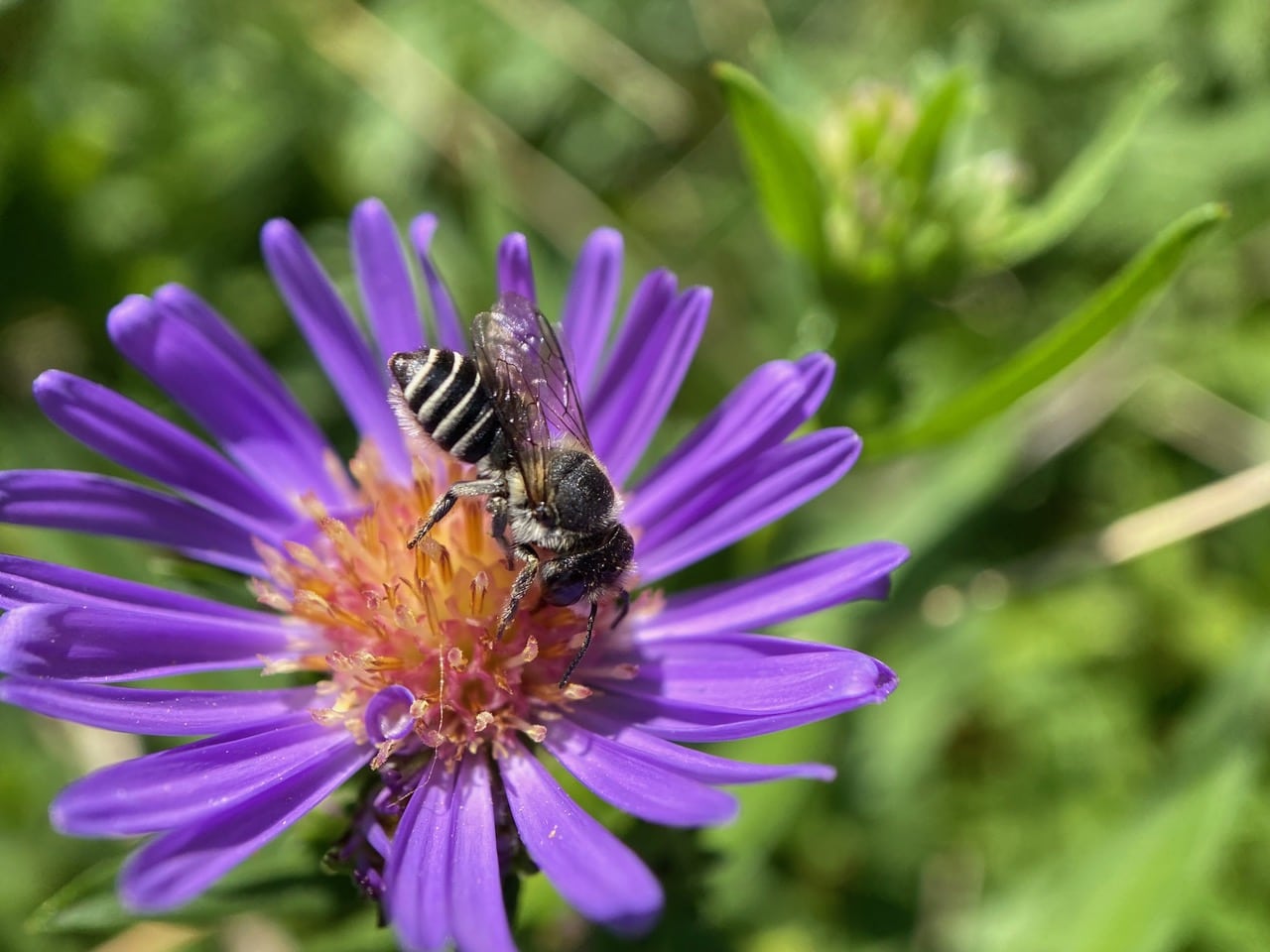
A female Alfalfa Leafcutter Bee, Megachile rotundata (family Megachilidae) is busy foraging on an Aster flowerhead. A brush of dense hair (scopa) on the underside of her abdomen is visible in this view. She is keeping her abdomen tipped up while gathering pollen into the scopa.

Originally from Eurasia, the Alfalfa Leafcutter Bee, Megachile rotundata (family Megachilidae) are highly efficient pollinators. They are solitary, each female constructing individual leaf-lined nests in cavities. They cut neat, circular discs out of soft leaves and flower petals to line and partition their nest tunnels. Because they trigger alfalfa flowers effectively to release pollen, the bees are vital to agriculture and seed production. While highly valued for commercial alfalfa, the bees also readily pollinate other crops like canola, carrots, and various wildflowers.
The species is among the most heavily managed solitary bees in the world. Females live only a few weeks in the summer. The offspring spend the winter as prepupae inside their leaf-lined cocoons. Commercial growers manage and store these cocoons in controlled environments over the winter to synchronize their emergence with summer crop blooms.

A female Oblique Streaktail, Allograpta obliqua (family Syrphidae) is taking nectar from a flower of Coffeeberry, Frangula californica. She appears to be heavily gravid, probably ready to lay her eggs.
Although small in size (6-7 mm long), the Oblique Streaktail is easily recognizable for the unique pattern on its black-and-yellow abdomen. It is a common North American species of hover fly. Adults visit flowers for nectar and pollen, and are pollinators. Females lay eggs on plant surfaces near aphids. Larvae feed on the aphids.
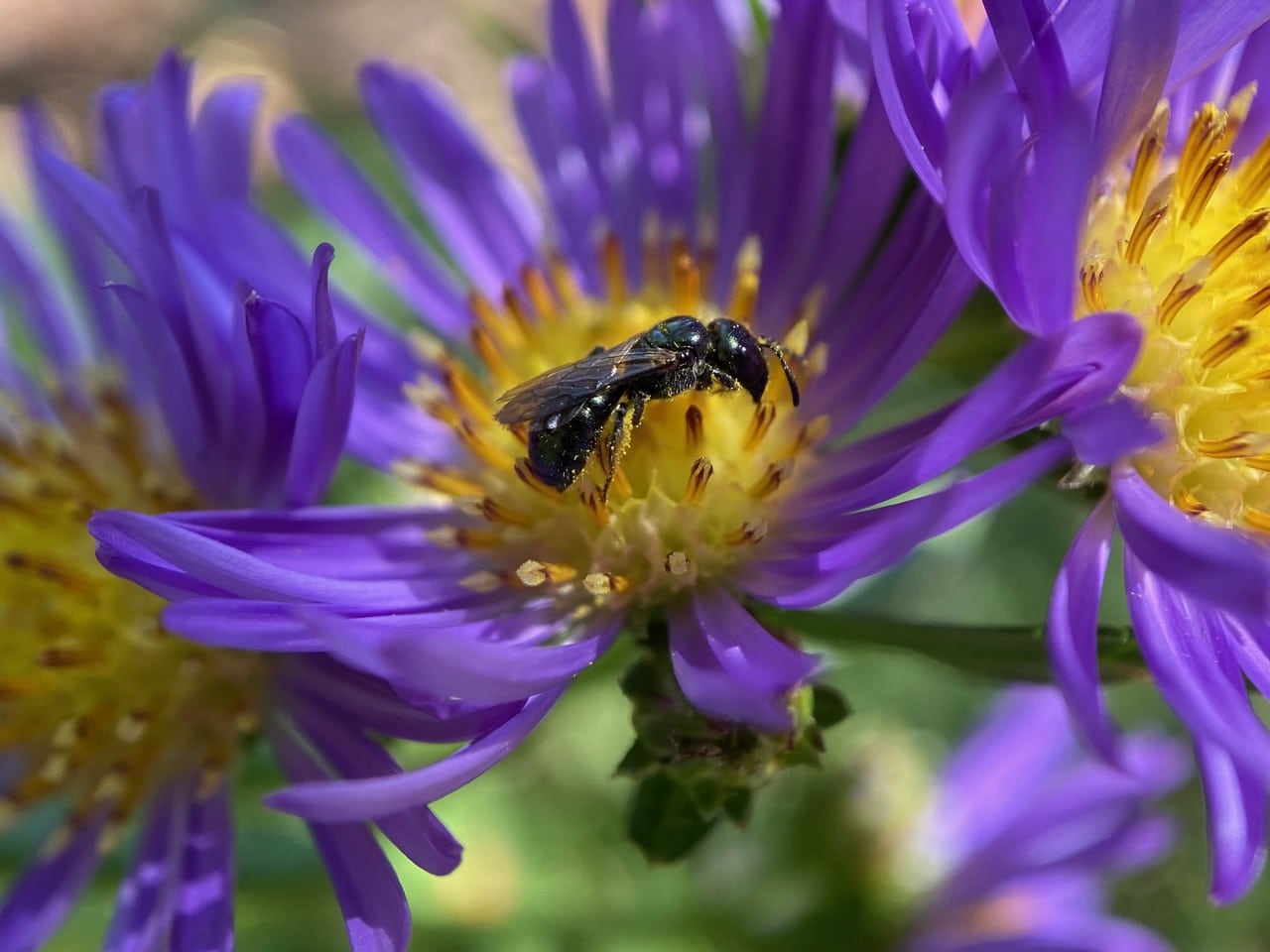
A small, glossy black bee is foraging on a flowerhead of Plumas Purple Aster. It is a Small Carpenter Bee, Ceratina sp. (family Apidae).
The Small Carpenter Bee genus Ceratina is closely related to the more familiar, and much larger Carpenter Bees (genus Xylocopa). Ceratina are typically dark, shiny, even metallic bees, with fairly sparse body hairs and a weak scopa on the hind leg. The shield-shaped abdomen comes to a point at the tip. Some species have yellow markings, often on the face.
Females excavate nests with their mandibles in the pith of broken or burned plant twigs and stems. While many species are solitary, a number are subsocial. Both male and female carpenter bees overwinter as adults within their old nest tunnels, emerging in the spring to mate. In the spring, this resting place (hibernaculum) is modified into a brood nest by further excavation. The female collects pollen and nectar, places this mixture (called bee bread) inside the cavity, lays an egg on the provision, and then caps off the cell with chewed plant material. Several cells are constructed end to end in each plant stem. Dead or broken blackberry canes are among Ceratina’s absolute favorite nesting spots.


A Gray Buckeye butterfly, Junonia grisea (family Nymphalidae) has landed to take nectar on a Aster flowerhead.
The butterfly that I used to identify as Common Buckeye Butterfly, Junonia coenia (family Nymphalidae) is now known as Gray Buckeye, Junonia grisea, formerly known as a subspecies of J. coenia. As of 2018, the entire Buckeye population west of the Rockies is now considered a separate species, the Gray Buckeye, J. grisea, due to some subtle morphological and genetic differences.

Named for its conspicuous target-shaped eyespots, the mainly brown Buckeye butterfly is readily identifiable. There is also the prominent orange “quotation marks” on the leading edge of the forewings of the butterfly. The butterfly favors open, sunny areas with low vegetation and some bare ground. Males perch during the day on low plants or bare ground to watch for females, flying periodically to patrol or to chase other flying insects. Females lay eggs singly on leaf buds or on upper side of host plant leaves. Caterpillars feed on a variety of plants within the Plantago genus. Female Buckeye butterflies identify their host plants by using specialized sensors on their feet to detect bitter iridoid glycosides, chemical compounds naturally found in Plantago species. The caterpillars eat the leaves and sequester the iridoid glycosides, rendering themselves unpalatable to predators. Other host plants include the Snapdragon (Scrophulariaceae), and Acanthus (Acanthaceae) families.