

Pollinator Post 5/24/26 (1)

I am excited to be participating in a bee walk today at the Gardens at Lake Merritt guided by my friend and bee guru, Emil Petrinic. About a dozen enthusiastic people have gathered for this fundraiser event to benefit WhollyH2O, an organization which educates, inspires stewardship, and provides environmental solutions in San Francisco East Bay watersheds.
A Sweat Bee (family Halictidae) is moving through the forest of elongate anthers, collecting pollen from a flower of California Poppy, Eschscholzia californica. Poppy flowers do not produce any nectar, but offer generous amounts of pollen to visiting insects.
Sweat Bees get their name because they are naturally drawn to human perspiration. They land on the skin to drink sweat, which provides them with essential moisture and salts. The bees belong to the family Halictidae. In our area, the family is primarily represented by three large genera – Halictus, Lasioglossum and Agapostemon.
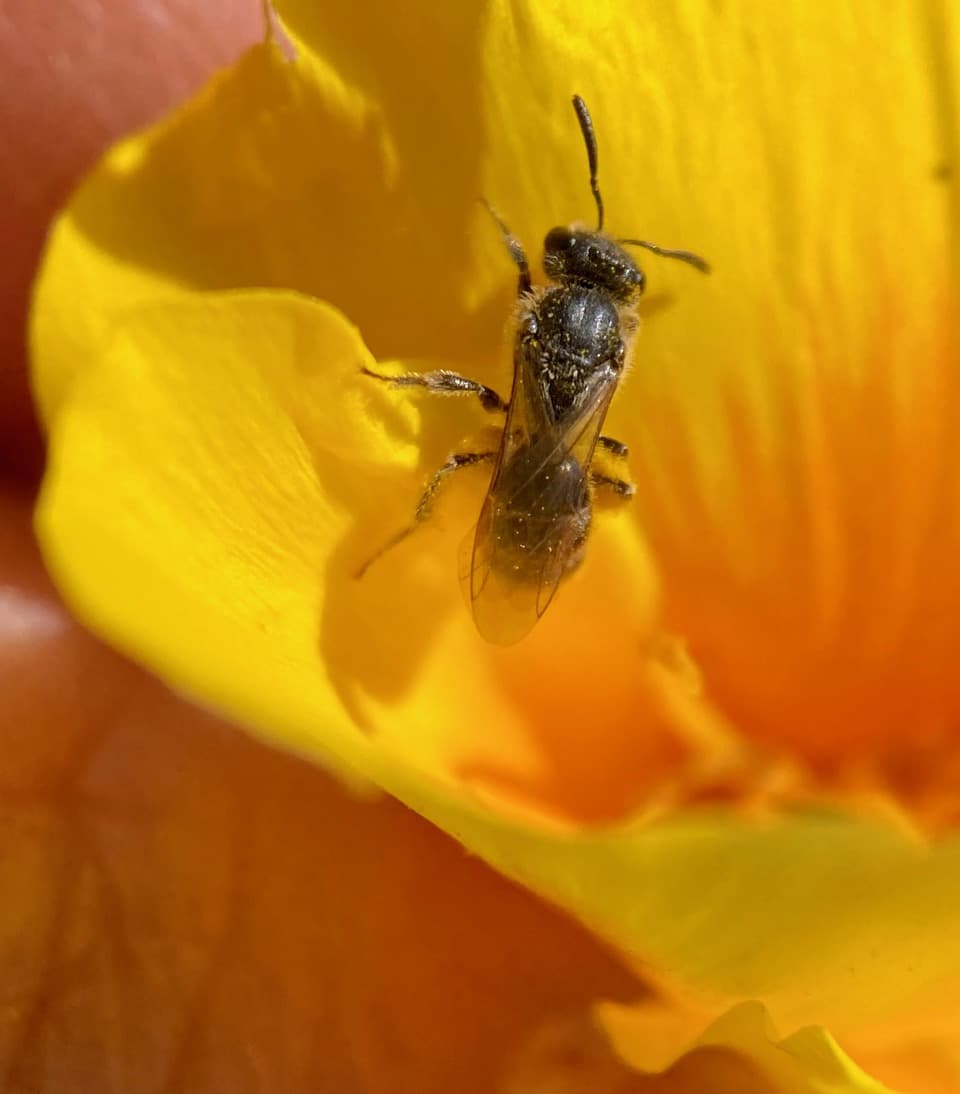
Covered with scattered pollen, a Tripartite Sweat Bee, Halictus tripartitus (family Halictidae) is exiting a California Poppy flower.
Halictus is found worldwide; they are most common in the Northern Hemisphere. All are generalists, foraging from a wide variety of flowering plants. Many species are social and produce several generations per year. This is not surprising as most blooming plants are season-specific; a bee that requires pollen and nectar across multiple seasons would not thrive as a specialist. All Halictus in North America nest in the ground, often in aggregations; and they may nest in the same area for decades.

Before flying off, the little bee quickly cleans off the pollen from her left antenna by drawing it through the antenna cleaner on her left front leg.
All bees have an antenna cleaner on each of their two forelegs. The antenna cleaners consists of two parts: a notch in the basitarsus, which is fitted with stiff hairs, and a corresponding spur on the tibia. To clean its antenna, the bee raises its foreleg over its antenna and then flexes it tarsus. The action allows the spur to close the notch, forming a ring around the antenna. The bee pulls each antenna through the bristles to clean it of debris such as pollen or dust which might interfere with the many sensory organs within the antenna. A bee’s antennae serve numerous functions: smell, taste, perceive humidity and temperature, feel, monitor gravity and flight speed and even detect sound waves to help guide the bee in its daily activities.

A Pug Moth caterpillar, Eupithecia sp. (family Geometridae) stretches across a California Poppy flower. Its anal prolegs are anchored to a petal, while the caterpillar is feeding on pollen with its head hidden among the anthers. Note that there are no prolegs in the middle section of the caterpillar. This feature is what distinguishes an “inch worm” and dictates its locomotion.
Inchworms are also called loopers and measuring worms. The majority of the inchworms are the larvae of moths in the family Geometridae. The name comes from the Greek “geo” for earth and “metro” from measure, because the caterpillars seem to be measuring the surface on which they are walking.
All caterpillars have three pairs of jointed legs behind their heads. These legs are called true legs because they will become the six legs of the adult butterfly or moth. There are additional appendages, called prolegs, along their bodies. Prolegs are not true legs, they are just outgrowths of the body wall and will be lost at metamorphosis. They have little hooks on their soles to help the caterpillar walk and grip onto things.
Most caterpillars have five sets of prolegs, four in the middle of the body and one pair at the hind end. Inchworms have the normal six true legs but only two or three pairs of prolegs, all located at the tail end of the body, with none in the middle. When an inchworm walks, it moves its tail-end prolegs up behind its true legs, causing the center of its body to loop upward. Then it stretches its front end forward to take another step.
Eupithecia is the largest genus of moths of the family Geometridae. Occurring worldwide except for Australasia, species in the genus are commonly known as pugs. The caterpillars move in a looping manner and are commonly called inchworms. Adults are typically small, 12 – 35 mm, with muted colors. Most species rest with forewings held flat at right angles to the body, while the hindwing are largely covered by the forewings. They are generally nocturnal. Larvae mostly feed from the flowers and seeds of their food plants rather than the foliage. Many species have a very specific food plant. Many are commonly found on Asteraceae flowers.

Vanessa has coaxed a tiny insect onto her finger, in the same gentle manner that Emil often does with bees. With the aid of my macro lens, I am astonished to find not a bee, but a Thick-headed Fly, Thecophora sp. (family Conopidae) on her finger. Wow!
Thecophora is a genus of small, grayish-black flies belonging to the Thick-headed Fly family, Conopidae. These flies are tiny, typically measuring only 3-6 mm in length. They feature large reddish eyes, a dark, grayish-black body, and an elongated hinged proboscis. Adults rely heavily on nectar for energy and can be found feeding on flowers in open grassy areas and arable margins. Female Thecophora are specialized parasitoids of bees.
These flies are often referred to as “bee grabbers” because of their incredibly aggressive, mid-air hunting tactics. The female fly waits near flowers that foraging bees frequent. When the unsuspecting bee takes flight, the fly pounces on it in mid-air, often tackling the victim to the ground. While the bee is momentarily stunned, the fly uses a specialized, sharp, pad-like structure at the tip of her abdomen (called the theca) to pry open a gap between the bee’s abdominal plates. She then injects a single egg directly into the bee’s body. The bee recovers and flies away, completely unaware that it is now incubating a parasite. The fly larva will hatch and slowly consume the bee from the inside out, eventually killing it.
Thecophora flies are widespread and can be found throughout North America, Europe and Asia. Depending on the local climate, adults are generally active from May through October. They are rarely seen. I usually find one about once or twice a year.
While we tend to react to parasitism with revulsion, and the fly’s modus operandi is undeniably chilling, in the larger perspective, parasites actually serve an important function in the ecosystem. They prevent host populations from growing unchecked. By reducing the fitness of dominant competitors, they allow multiple species to coexist, thereby supporting overall biodiversity. The complex life cycles of parasites increase the connectivity and stability of food webs. Because they are highly sensitive, diverse parasite communities serve as early warning signs for healthy ecosystems. If it’s any consolation, the presence of parasites is an indicator of the robustness of their host populations.
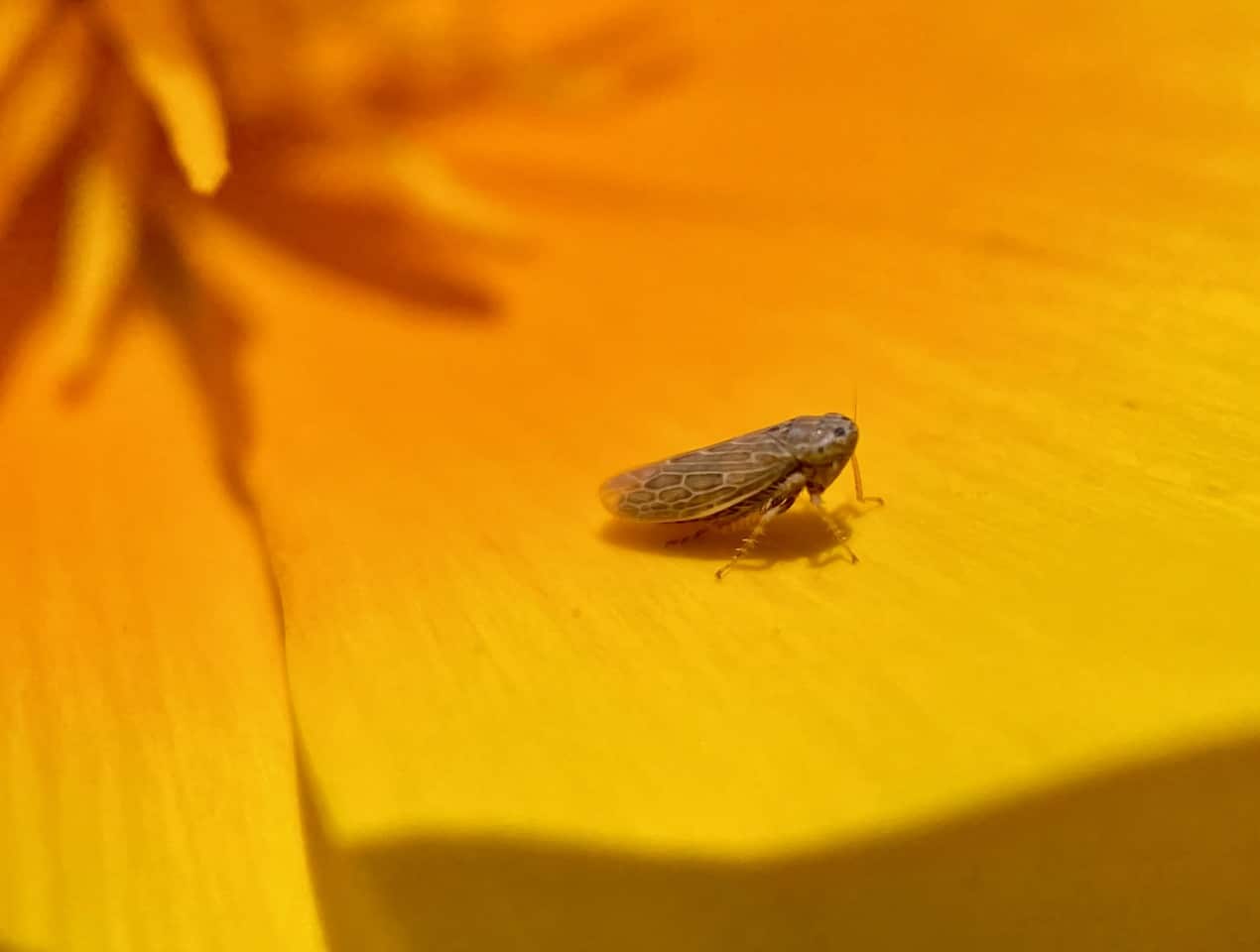
Barely a fleck that looks like debris, a Leafhopper (family Cicadellidae) is resting on a petal of California Poppy.
Over 380 species of Leafhoppers (family Cicadellidae) occur in California. Many different flower, fruit, and vegetable plants and woody ornamentals host leafhoppers. Some leafhoppers are specialists that feed on only several closely related plant species, while others are generalists that feed and move among many different plant species. Adult leafhoppers are relatively long compared with their width, wedge-shaped, and commonly less than 1/4 inch long. Leafhoppers have one or more long rows of small spines along the entire length of their hind legs. They are active insects that walk rapidly sideways or readily jump when disturbed. Like other Hemipterans, Leafhoppers have piercing-sucking mouthparts that they use to feed on plant sap. Their feeding causes leaves to develop pale specks (stippling). In heavy infestation, leaves and shoot tips may turn yellow then brown and curl and die. Leafhoppers also excrete honeydew on which blackish sooty mold grows, fouling foliage, fruit, and surfaces underneath infested plants. Some leafhopper species transmit pathogens that cause plant diseases.

Two different flies are foraging on the brilliant yellow flowers of Fern-leaf Yarrow, Achillea filipendulina. The one on the left is an Eurasian Drone Fly, Eristalis arbustorum (family Syrphidae), while the one on the right is a Hornworm Tachinid Fly, Archytas apicifer (family Tachinidae).

The family Tachinidae is by far the largest and most important group of parasitoid flies. All species are parasitic in the larval stage. Most adults have distinct abdominal bristles, hence the common name. Adults feed on liquids such as nectar and honeydew. They can be found resting on foliage, feeding at flowers or searching for hosts.
Most Tachinids attack caterpillars, adult and larval beetles, true bugs, grasshoppers, and other insects. Females lay eggs in or on the host. Tachinid larvae live as internal parasites, consuming their hosts’ less essential tissues first and not finishing off the vital organs until they are ready to pupate. The larvae leave the host and pupate on the ground. Tachinids are very important in natural control of many pests, and many have been used in biological control programs.
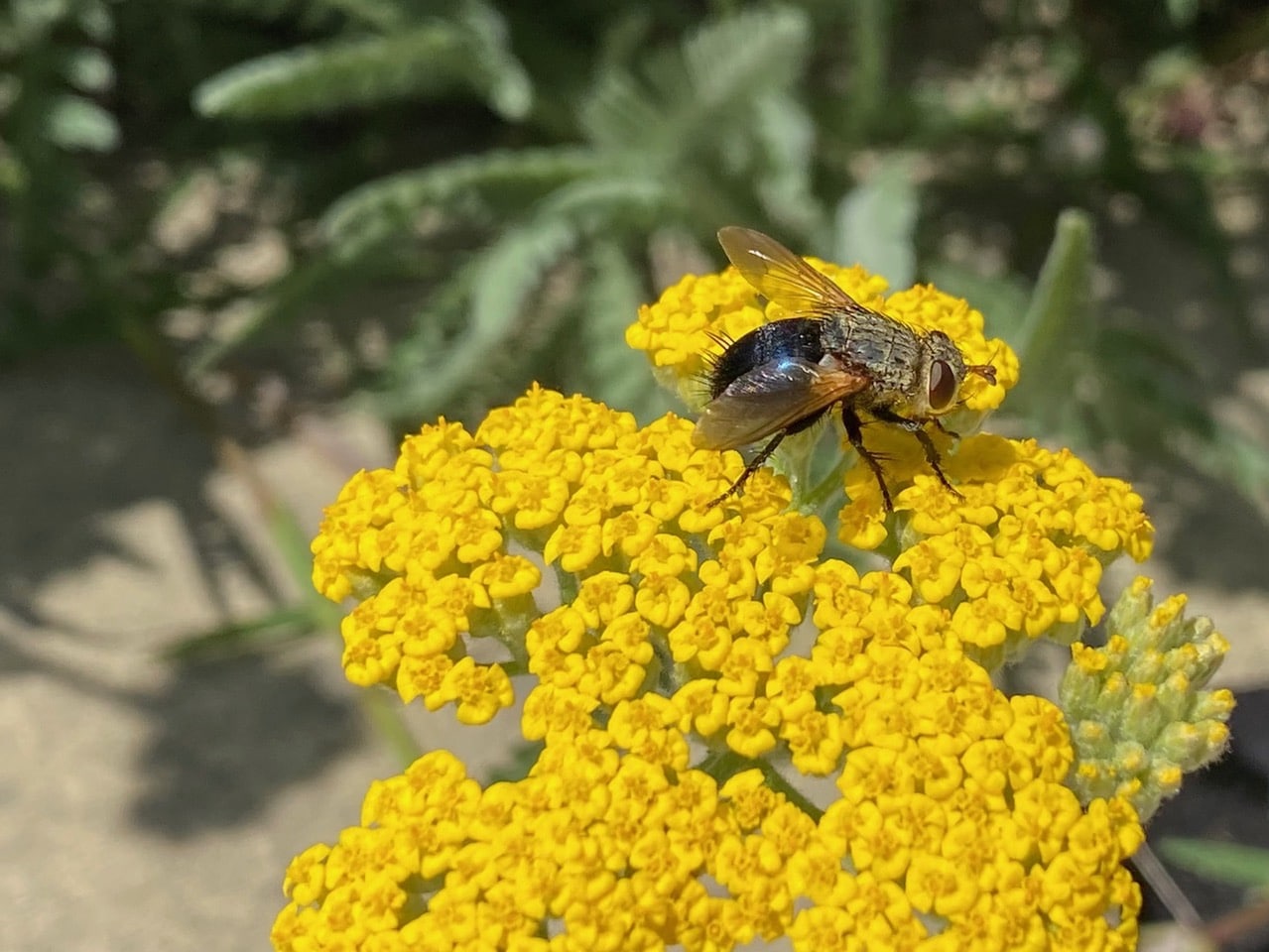
Found throughout North America and South America, Archytas apicifer is a medium to large sized (10-15 mm) tachinid fly. Adults feed on flower nectar, and are known to be pollinators of some flowers. Like many other tachinid flies, Archytas apicifer larvae are internal parasitoids of noctuid moths (family Noctuidae) such as tomato fruit worm, corn ear worm, and cutworms. In addition they are also known to parasitize Forest tent caterpillars and fall webworms.
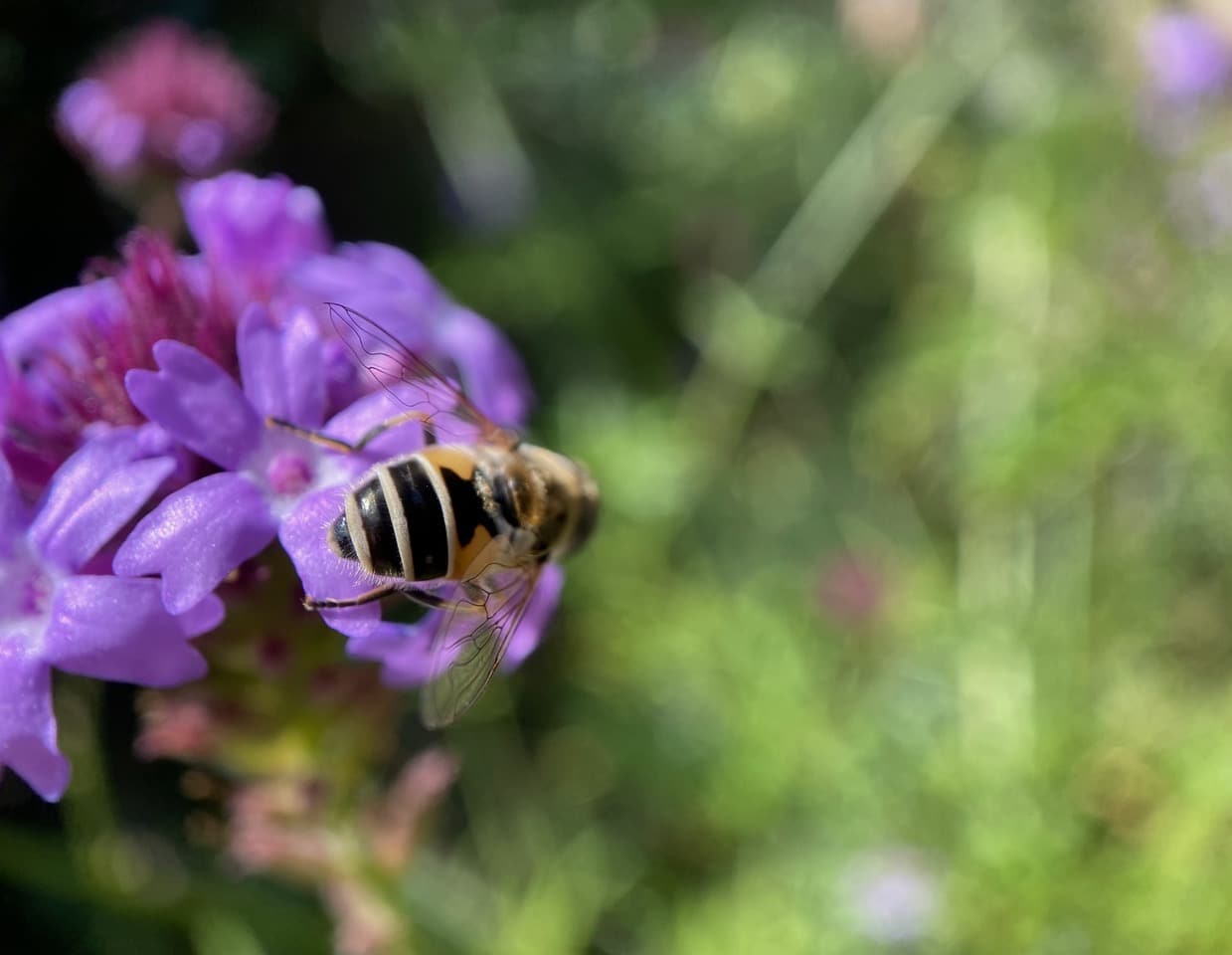
A Eurasian Drone Fly, Eristalis arbustorum (family Syrphidae) is foraging on an inflorescence of De La Mina Verbena, Verbena lilacina ‘De La Mina’.
The Eurasian Drone Fly, Eristalis arbustorum is an abundant species of hover fly that occurs throughout the northern hemisphere, including Europe, North Africa and North India. It was introduced to North America in the mid 1800’s and is now ubiquitous throughout much of the United States and Canada. The common name “drone fly” refers to its resemblance to the drone of the honeybee. The Eurasian Drone Fly is found in a diversity of habitats, including wetland, forests, montane tundra, as well as farmland, urban parks and gardens. It visits the flowers of a wide range of low-growing plants and shrubs. The larvae are aquatic, occurring in shallow, nutrient rich standing water and in cow manure and compost heaps. Also known as “rat-tailed maggots”, the larvae have a siphon on their rear end that acts like a snorkel, helping them breathe under water. The siphon can be several times the length of the larva’s body. The larvae are saprophagous, feeding on bacteria in stagnant water rich in decomposing organic matter.

Perched on an old wooden post, a Western Paper Wasp is dispatching an insect prey with its large mandibles.
The Western Paper Wasp, Mischocyttarus flavitarsis (family Vespidae, subfamily Polistinae) is a social wasp found across western North America. They are medium-sized (5/8” to 1” long) with yellow and dark brown/black colorations, slender “waists” and long legs that dangle in flight. Unlike their relative the yellowjackets, the Western Paper Wasps are very docile and rarely sting humans.
They are beneficial garden predators that build small, uncovered, umbrella-like paper nests out of chewed wood. These are often tucked in protected areas like tree branches, under eaves of roofs, or inside cavities. The active season begins in the spring (before May) and lasts until October. In late summer or early autumn, the colony raises a new batch of fertile females (new queens) and males. The reproductives leave the nest to mate. As the season turns to autumn, the original queen, the males, and the sterile female workers all perish. The newly fertilized queens seek out sheltered, insulated spots to overwinter.
Vespid wasps (such as yellowjackets, hornets, and paper wasps) have distinct diets for adults and larvae, functioning as both predators and foragers. Adult wasps cannot digest solid food. They use their large mandibles to lap up liquid carbohydrates like plant nectar, tree sap, and honeydew. Larvae require protein for growth. Adult wasps hunt insects (like caterpillars and flies) and chew and condition them into a soft meat pulp, which they feed to the larvae in the nest. In exchange, the larvae secrete a sweet, amino-acid-rich liquid which the adults consume; the larvae essentially serve as the digestive system of the adults. This cyclical exchange of food between adults and larvae is called trophallaxis.

A Tripartite Sweat Bee, Halictus tripartitus (family Halictidae) is collecting pollen on a flower of Wild Radish.

The Tripartite Sweat Bee can be easily recognizable by their small size, as well as the pale bands of hairs on the outer edge of each abdominal segments. Female Sweat Bees (family Halictidae) in general transport pollen on the underside of their abdomen and in the scopae on their hind legs.

My eyes are drawn to some brisk, fluttering movements of wings in the undergrowth. What is this California Oak Moth doing on the ground?
The California Oak Moth, Phryganidia californica is a moth in the family Notodontidae. They are tan to gray moths with prominent wing veins. The wingspan is about 30 mm. Adults are on wing from March to November. There are two generations per year in northern California. Sometimes there is a third generation in southern California.
The larvae feed on the leaves of oak, especially Coast Live Oak, Quercus agrifolia. Young larvae feed between veins on the lower leaf surface. Although the upper leaf surface is left intact, it eventually dries out and turns brown. Larvae in later instars chew completely through the leaf blade, often leaving only major leaf veins. In severe infestations, individual trees may be almost entirely defoliated, typically by late summer or early fall. Despite the visually devastating effects of its caterpillars, the moth is rarely, if ever, responsible for the outright death of trees.
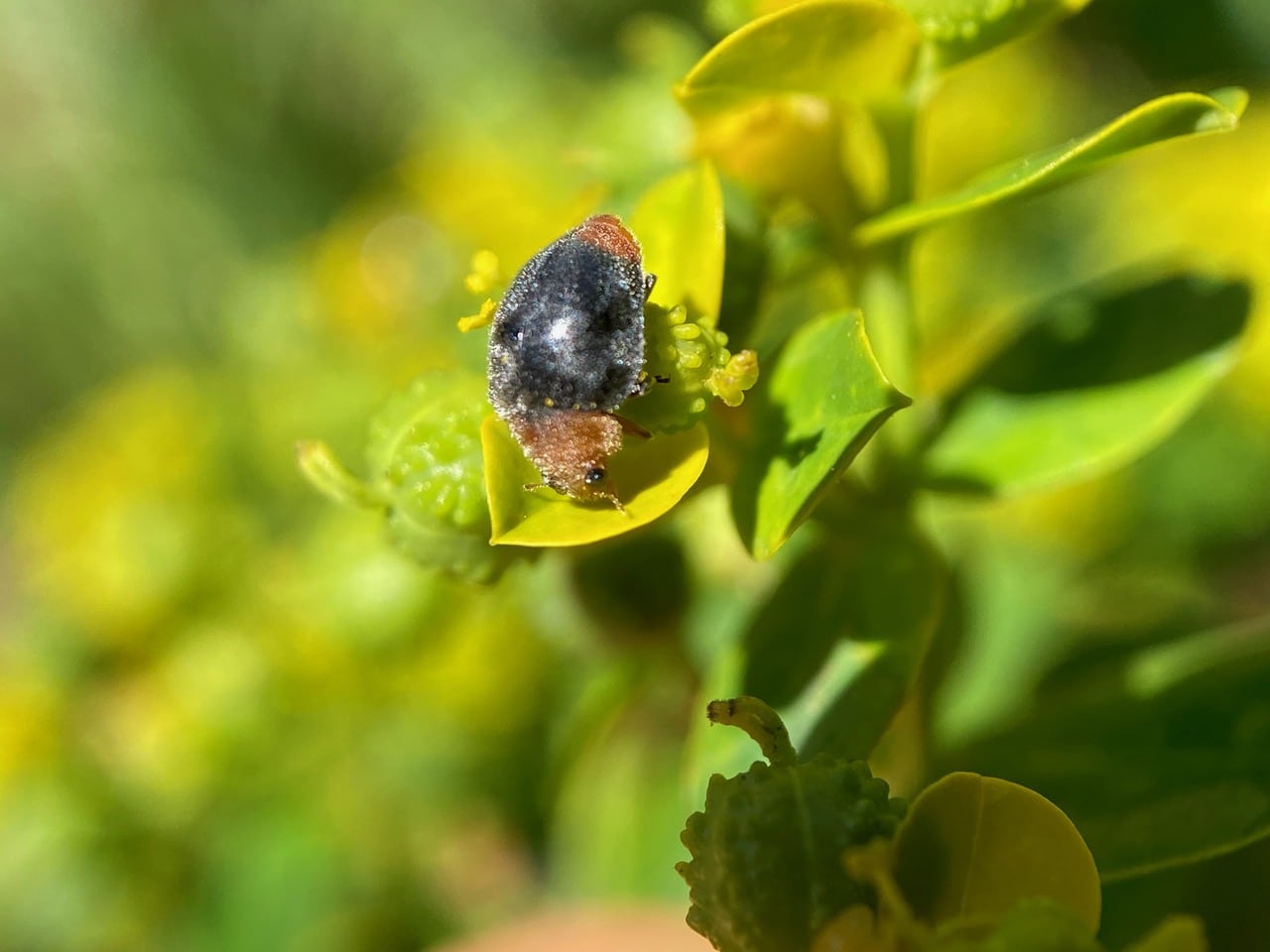
I spot a few tiny insects on the foliage and flowers of an Eggleaf Spurge, Euphorbia oblongata. Under the macro lens, they are recognizable as Mealybug Destroyers, Cryptolaemus montrouzieri (family Coccinellidae). The beetles are covered in a pale pubescence (short, white hairs).

The Mealybug Destroyer, Cryptolaemus montrouzieri (family Coccinellidae) was imported into the United States in 1891 from Australia to control citrus mealybug in California. It is a small (about 6 mm), dark brown lady beetle with a tan to orange head and posterior. Larvae grow up to 15 mm, and secrete a waxy covering that makes them look like the mealybugs they prey on, a case of aggressive mimicry. The camouflage allows the larvae to avoid the wrath of ants that protect the mealybugs. The Mealybug Destroyer is a voracious feeder of mealybugs in both the larval and adult stages. A single larva may consume up to 250 small mealybugs.
Adult females lay eggs among the cottony egg sac of mealybugs. During her lifespan of up to 2 months, a female may lay as many as 400 eggs. Larvae feed on mealybug eggs, young crawlers, and the honeydew produced by the mealybugs. Mature larvae pupate in sheltered places on stems

The rear end of a Mealybug Destroyer echoes the same reddish-brown color of its head and thorax.

A few people have gathered around Emil (in blue shirt and cap) to observe a bee on the Blanket Flowers, Gaillardia sp.

I am not close enough to see what Emil is photographing.

That blooming Sneezeweed, Helenium puberulum is attracting substantial bee activity. Several female Western Leafcutter Bees, Megachile perihirta (family Megachilidae) tromps around the globular flowerheads to collect pollen from the tiny opened flowers, while males stop by to ogle the girls and take nectar. Here a male appears to be taking a break.
Leaf-cutter Bees, Megachile sp. (family Megachilidae) are stout-bodied, usually with pale hair on the thorax and stripes of white hairs on the abdomen. Females usually have a triangular abdomen with a pointed tip, and males’ faces are covered with dense, pale hair. Flight season is from May into September, with peak activity from June to August. Solitary females construct nests in tubular cavities, including hollow stems, tree holes, and abandoned beetle burrows in wood. Many use holes drilled into wood, straws, or other manufactured tunnels. Females cut pieces from leaves or flower petals for use in the construction of brood cells. Most Megachile females are generalist foragers, but prefer flowers in the family Asteraceae. Pollen is transported in dense scopae (special pollen collecting hairs) on the underside of the abdomen.
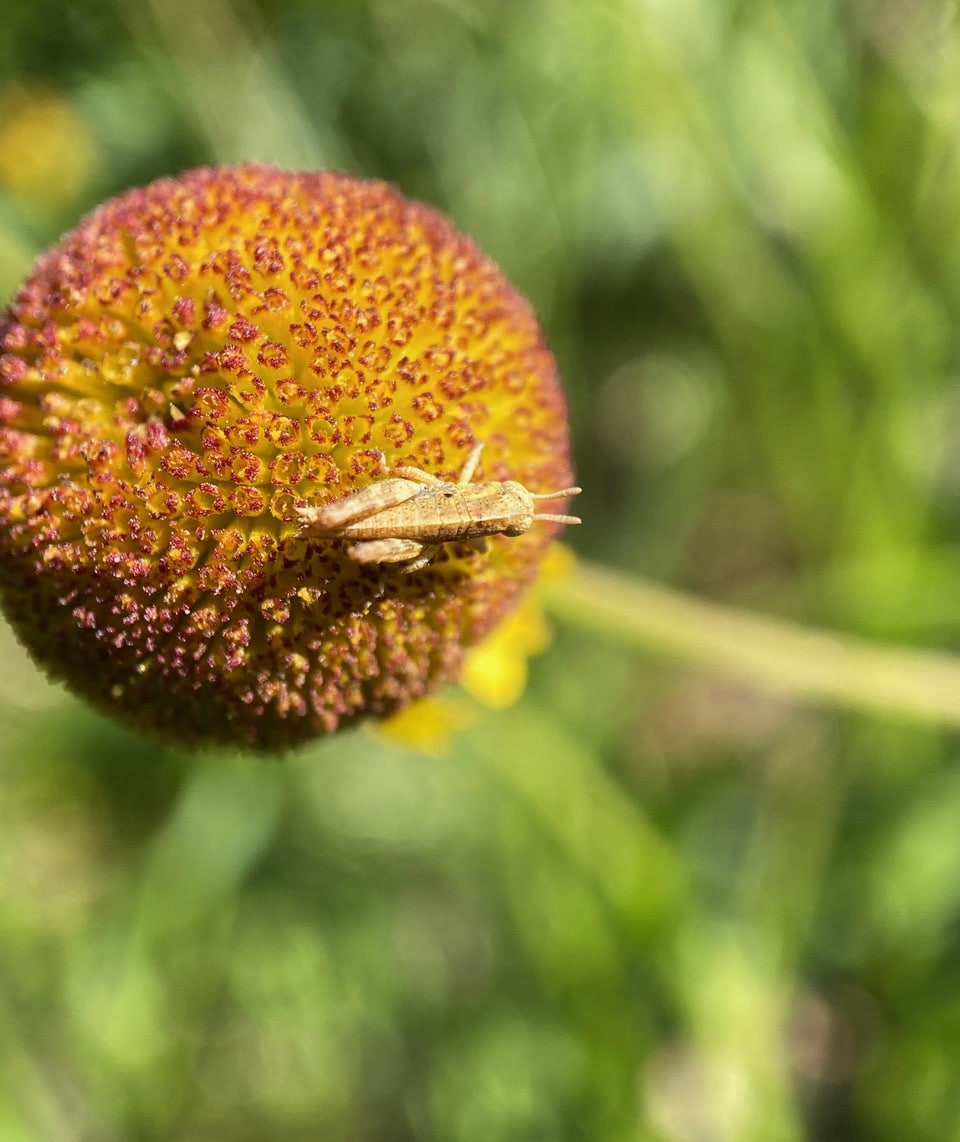
A tiny juvenile Short-horned Grasshopper (family Acrididae) is resting on a Sneezeweed flowerhead. Note the absence of wings on the nymph.
Short-horned Grasshoppers belong to the family Acrididae, representing the vast majority of grasshopper species. Recognized by their relatively short, stout antennae and oversized hind jumping legs, they are primarily herbivorous insects found worldwide in diverse open habitats, including grasslands, meadows, and prairies. Unlike many insects, they possess hearing organs (tympana) located on the sides of the first abdominal segment. Males of winged species “sing” to attract females by rubbing their hind legs against the edges of their wings or rubbing their front wings together. Females lay eggs in loose soil or among plant roots The hatchlings look like miniature, wingless replicas of adults, called nymphs, which pass through several molts before reaching maturity. The typical lifespan of an adult is about one season.
Short-horned Grasshoppers are vital components of the food web, serving as a primary protein source for birds, reptiles, and small mammals. Some species are considered pests as they feed on and cause severe damage to crops and rangelands. The family Acrididae contains the locusts, swarming pests that can devastate vegetation over vast distances.

A Tripartite Sweat Bee, Halictus tripartitus (family Halictidae) has landed on a Coreopsis flowerhead.
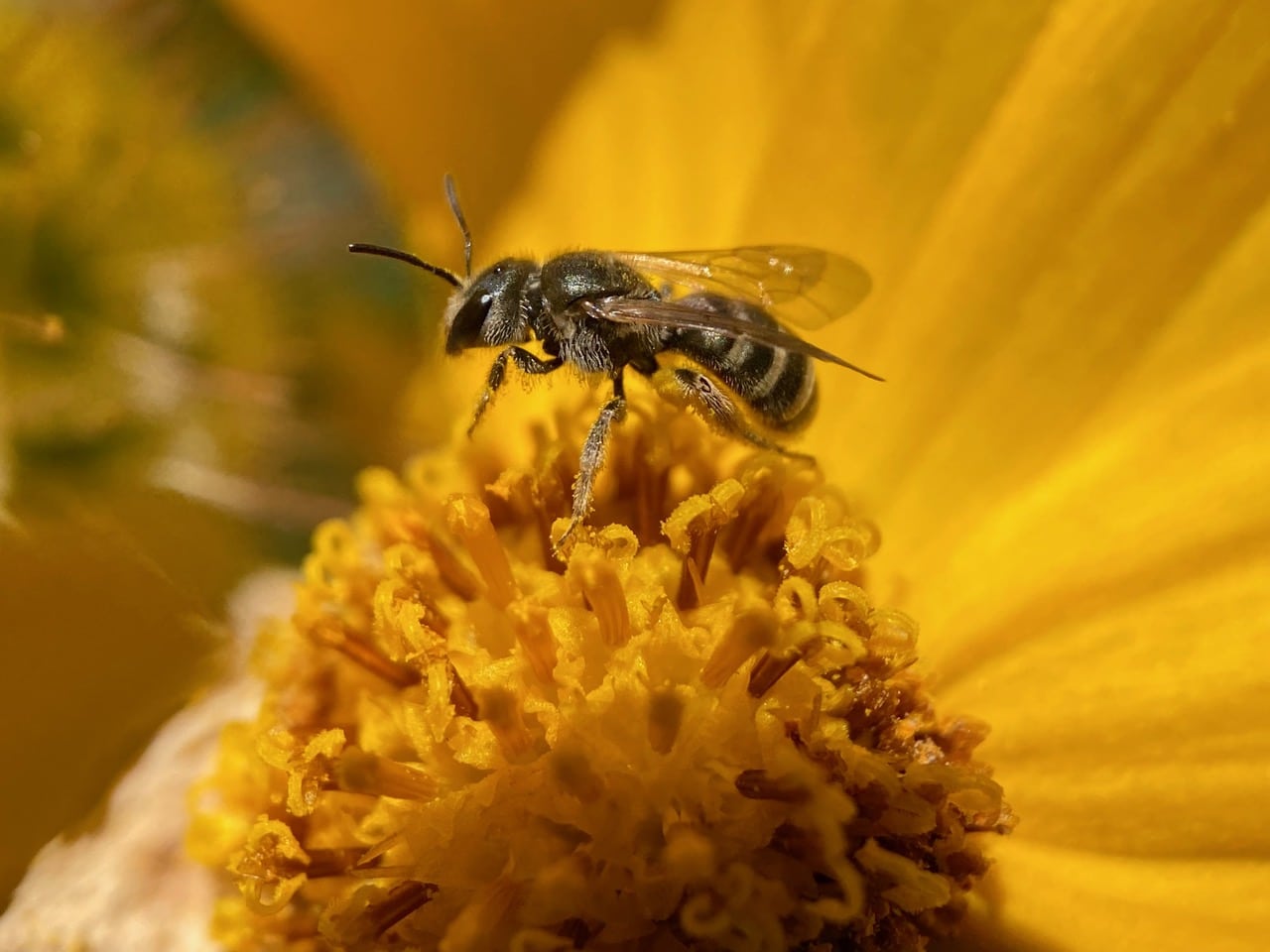
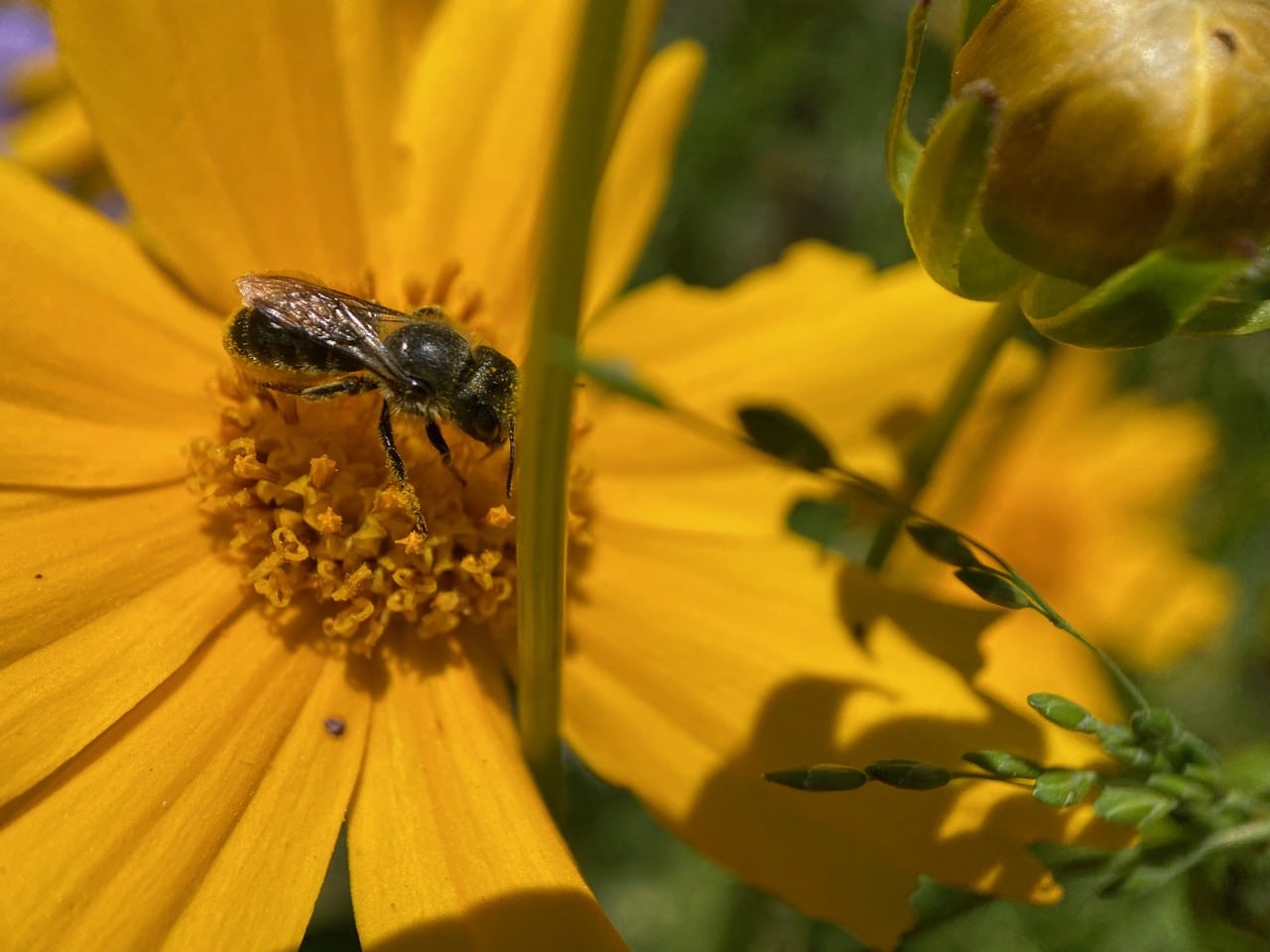
She proceeds to collect pollen from the tightly clustered flowers in the middle of the flowerhead.
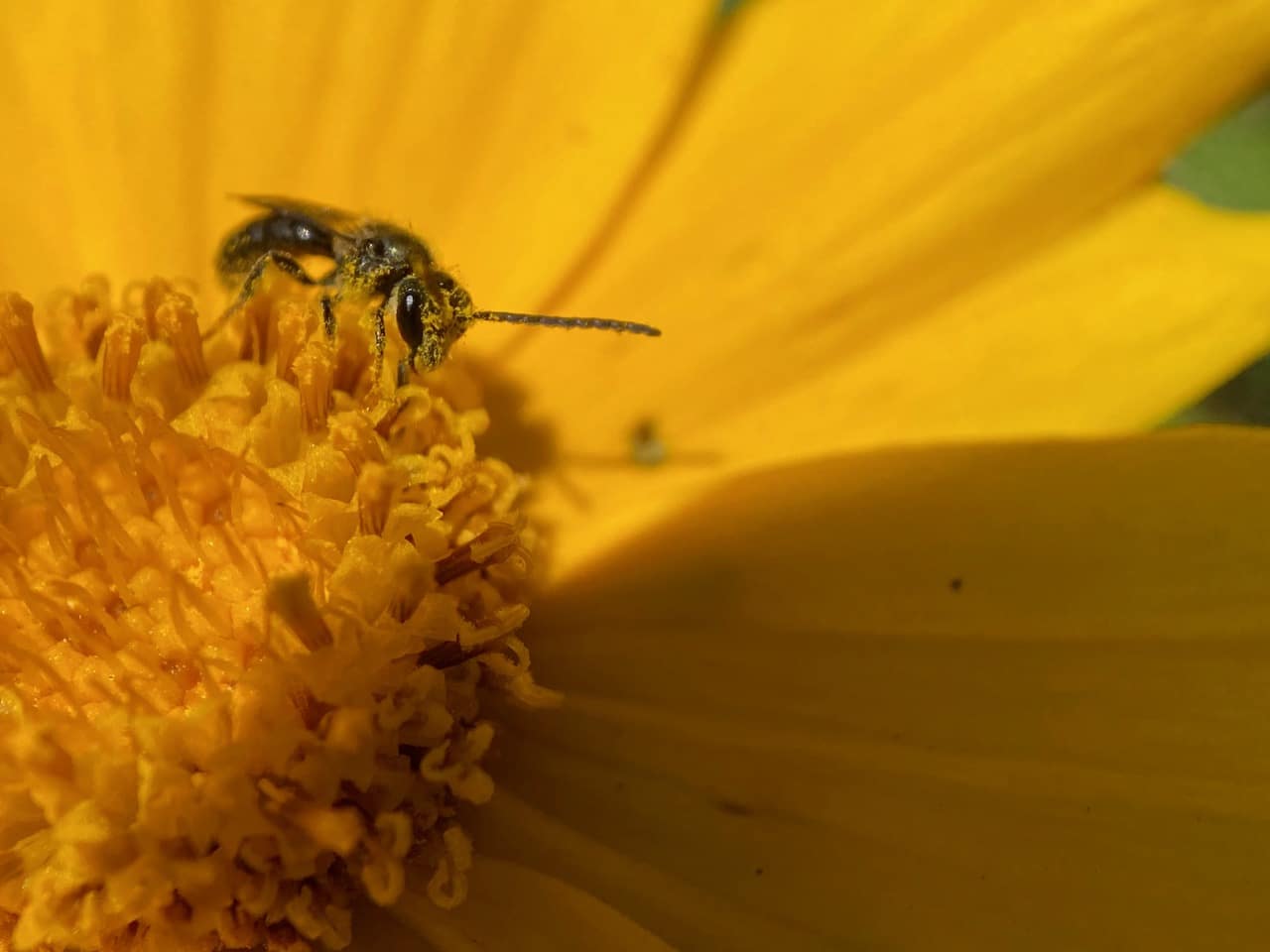
His head and body covered with sticky pollen, a male Metallic Sweat Bee, Lasioglossum (Dialictus) sp. (family Halictidae) is seeking nectar from the flowers of Coreopsis.
The antennae of male bees are often much longer than their female counterparts. Male antennae have an extra segment (13 in all) and the segments themselves are longer. This is because male antennae are specialized to pick up the subtle scent of female pheromones.
While male bees do not intentionally collect pollen to provision the nest, they can be good pollinators because their hairy body is capable of transferring lots of pollen when they visit flowers for nectar.
Lasioglossum species are found worldwide, and they constitute the largest bee genus. The subgenus Dialictus are the most likely to be seen in the U.S., with over 300 species of these tiny metallic bees. The majority of Lasioglossum are generalists. Because they are so abundant throughout the flowering season, the bees are often important pollinators. Their sheer numbers are enough to achieve excellent pollination of many wild flowers, especially of plants in the Asteraceae, which have shallow floral tubes that are easily accessed by these minute bees.
Lasioglossum exhibit a range of social behaviors; the genus includes solitary, communal, semi social, primitively eusocial, and even parasitic species. Almost all Lasioglossum in the U.S. nest in the ground. Generally these nests are built in the spring by fertilized females (called foundresses) that spent the winter in hibernation. In social species, the foundresses behave much like the queen bumble bees – they lay the first batch of eggs that develop into the first generation of female workers. The nest grows with each additional generation of bees. Later broods may consist of both males and females. They mate, and at the end of the season the fertilized females hibernate til the following spring, repeating the life cycle of the colony.
Ooh, here’s a larger bee. She is thump-thumping her abdomen on the small flowers in the middle of the Coreopsis flowerhead to gather pollen onto the scopa on the underside of her abdomen. This is typical pollen collecting behavior of female Mason Bees in the genus Osmia. iNaturalist has helped identify the bee to the species – Colorado Mason, Osmia coloradensis (family Megachilidae).
Mason Bee is a name commonly used for species of bees in the genus Osmia, of the family Megachilidae. Mason Bees are named for their habit of using mud or other “masonry” products in constructing their nests, which are made in naturally occurring gaps/cavities such as cracks in stones, hollow stems or holes in wood made by wood-boring insects. Osmia means ‘odor’, and refers to a faint lemony scent used by these bees to mark their nest entrances. Osmia species are frequently metallic green or blue. Females have black ventral scopae (special pollen collecting hairs) on the underside of their abdomen, which are difficult to see unless laden with pollen. Ventral abdominal scopae is a feature shared by all members of the Megachilidae family, which include the wool-carder bees (genus Anthidium), and leaf-cutter bees (genus Megachile).
Mason Bees are a solitary species and are non-aggressive. Every female is fertile and makes her own nest. Each nest cell is provisioned with pollen and contains one egg which will develop into a larva. The female creates a partition of mud between the nest cells. The process continues until she has filled the cavity. She plugs the entrance to the cavity, and then may seek another nest location. The larvae that hatch out consume their provisions and begin spinning a cocoon around itself and enters pupal stage. Adults mature in fall or winter, hibernating inside its cocoon.

In this view, a bit of the bright yellow pollen on the underside of the bee’s abdomen is visible around the rim.

A Gray Buckeye butterfly has landed on a Coreopsis flower.
The butterfly that I used to identify as Common Buckeye Butterfly, Junonia coenia (family Nymphalidae) is now known as Gray Buckeye, Junonia grisea, formerly known as a subspecies of J. coenia. As of 2018, the entire Buckeye population west of the Rockies is now considered a separate species, the Gray Buckeye, J. grisea, due to some subtle morphological and genetic differences.
Named for its conspicuous target-shaped eyespots, the mainly brown Buckeye butterfly is readily identifiable. There is also the prominent orange “quotation marks” on the leading edge of the forewings of the butterfly. The butterfly favors open, sunny areas with low vegetation and some bare ground. Males perch during the day on low plants or bare ground to watch for females, flying periodically to patrol or to chase other flying insects. Females lay eggs singly on leaf buds or on upper side of host plant leaves. Caterpillars feed on a variety of plants within the Plantago genus (Plantains). Female Buckeye butterflies identify their host plants by using specialized sensors on their feet to detect bitter iridoid glycosides, chemical compounds naturally found in Plantago species. The caterpillars eat the leaves and sequester the iridoid glycosides, rendering themselves unpalatable to predators.