

Pollinator Post 5/14/26
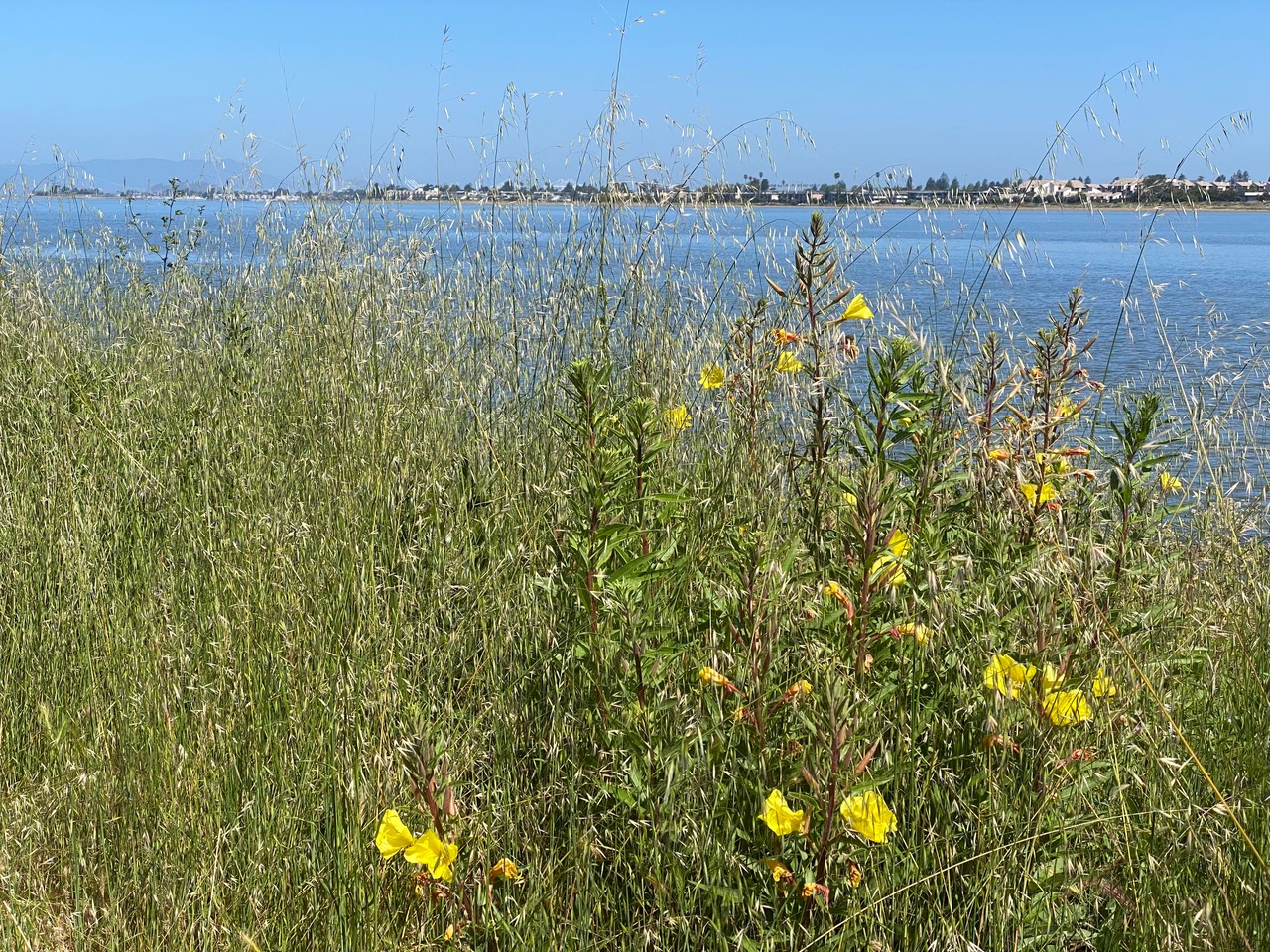 It’s a nice, sunny morning at Bay Farm. Along this stretch of Shoreline Park, the Tall or Hooker’s Evening Primrose, Oenothera elata (family Onagraceae) has started to display large, sunny yellow flowers.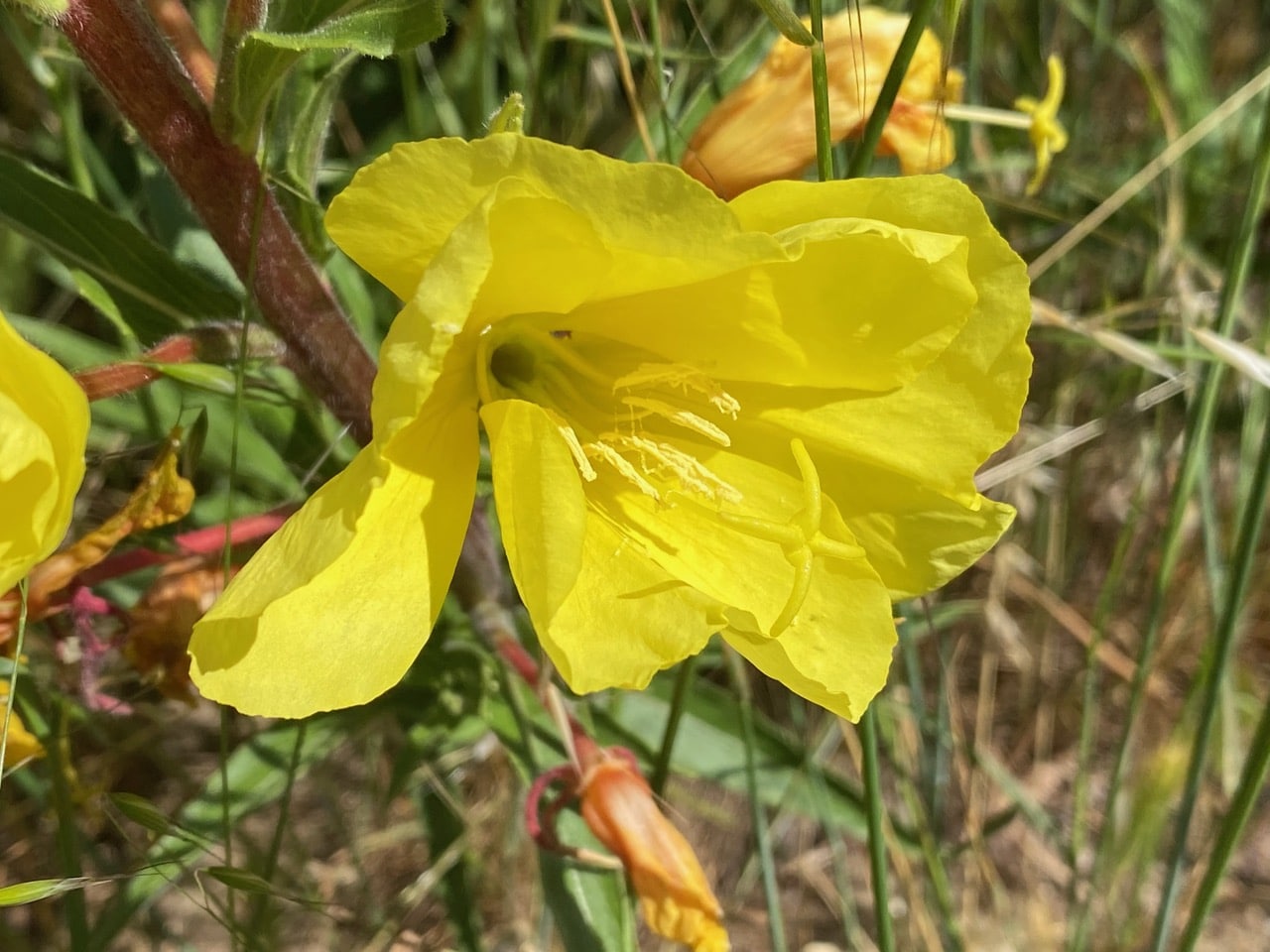
While the flowers are bright and showy, few insects are visiting today. Note that the large, elongate anthers have released pollen on stringy strands of viscin threads. Not many insects can deal with this sticky pollen. Pollination of these night-blooming flowers occur in the evening.
Hooker’s Evening Primrose, Oenothera elata is usually biennial, completing its life cycle in two growing seasons. It can reach 6 feet in height. Native to California, it is found along roadsides, in moist meadows, or in woodland. At the top of reddish stems are open clusters of 2-4 inch wide yellow flowers with 4 large petals and protruding yellow stamens and 4-branched pistil. The fragrant flowers open at dusk and close up during mid-morning the next day, turning orange with age.
The flowers of Evening Primrose open at night and have most of the characteristics associated with night-pollination by moths: they are large with nectar glands at the bottom of a deep flower cup, and their reproductive parts extend beyond the petals. The pale flowers are visible to night-pollinators; they are also sweetly scented as an additional guide at night. Pollinators brush against the reproductive structures when they go into the base of the flower after nectar. Sphinx moths are the most significant pollinators for the evening primrose that bloom at night. Their long tongues enable them to reach the nectar deep within the flower. As they feed, pollen is transferred from one flower to another. Oenothera elata is also pollinated by specialist bees active at dawn and dusk such as the twilight-foraging Evening Primrose Sweat Bees. These bees have evolved specialized hairs on their legs to collect the distinctive stringy pollen.
Viscin threads are thread-like structures composed of sporopollenin, a tough, resilient material also found in the outer layer of pollen grains (exile). These threads are produced by some plants, notably within the Onagraceae and Ericaceae families, and they bind individual pollen grains together and also help them adhere to pollinators. The threads are not just sticky, but also exhibit a cobweb-like quality, making them difficult to handle.

As I approach the Holm Oak, Quercus ilex, I notice an Anise Swallowtail fluttering persistently around the large bush. Then I realize why – she is checking out some Fennel foliage that has grown through the bush. The butterfly finally lands to lay her egg. Note that she has curled her abdomen forward to oviposit on the Fennel.
The Anise Swallowtail, Papilio zelicaon (family Papilionidae), is a common swallowtail butterfly of western North America. It is found in fairly open country, most likely seen on bare hills or mountains, in fields oar at the roadside. Adult females lay eggs singly on the underside of host plant leaves. In the first two instars, the caterpillar is a bird poop mimic – dark brown, almost black, with an irregular white band at its middle. After that it becomes more green at each successive molt until, in the fifth (last) instar, it is predominantly green, with markings in black, orange, and light blue. Its major food plants are members of the carrot family, Apiaceae (including Angelica), and also some members of the citrus family, Rutaceae.

Her maternal duty done, the butterfly rests on the nearby oak foliage, giving me time to appreciate her beautiful wing pattern.
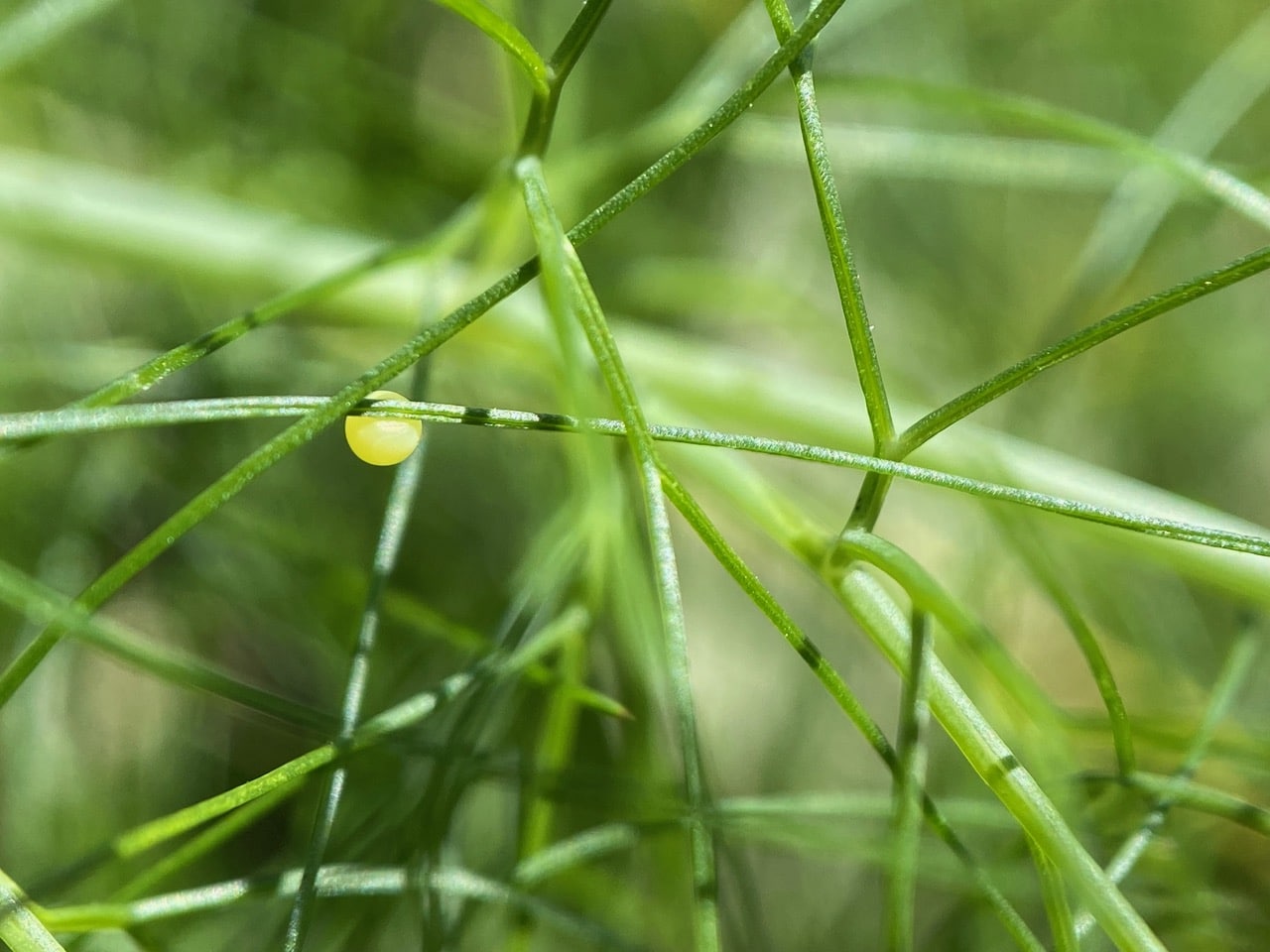
After the Anise Swallowtail leaves, I search for her egg among the Fennel foliage. There it is – pale green and perfectly round.
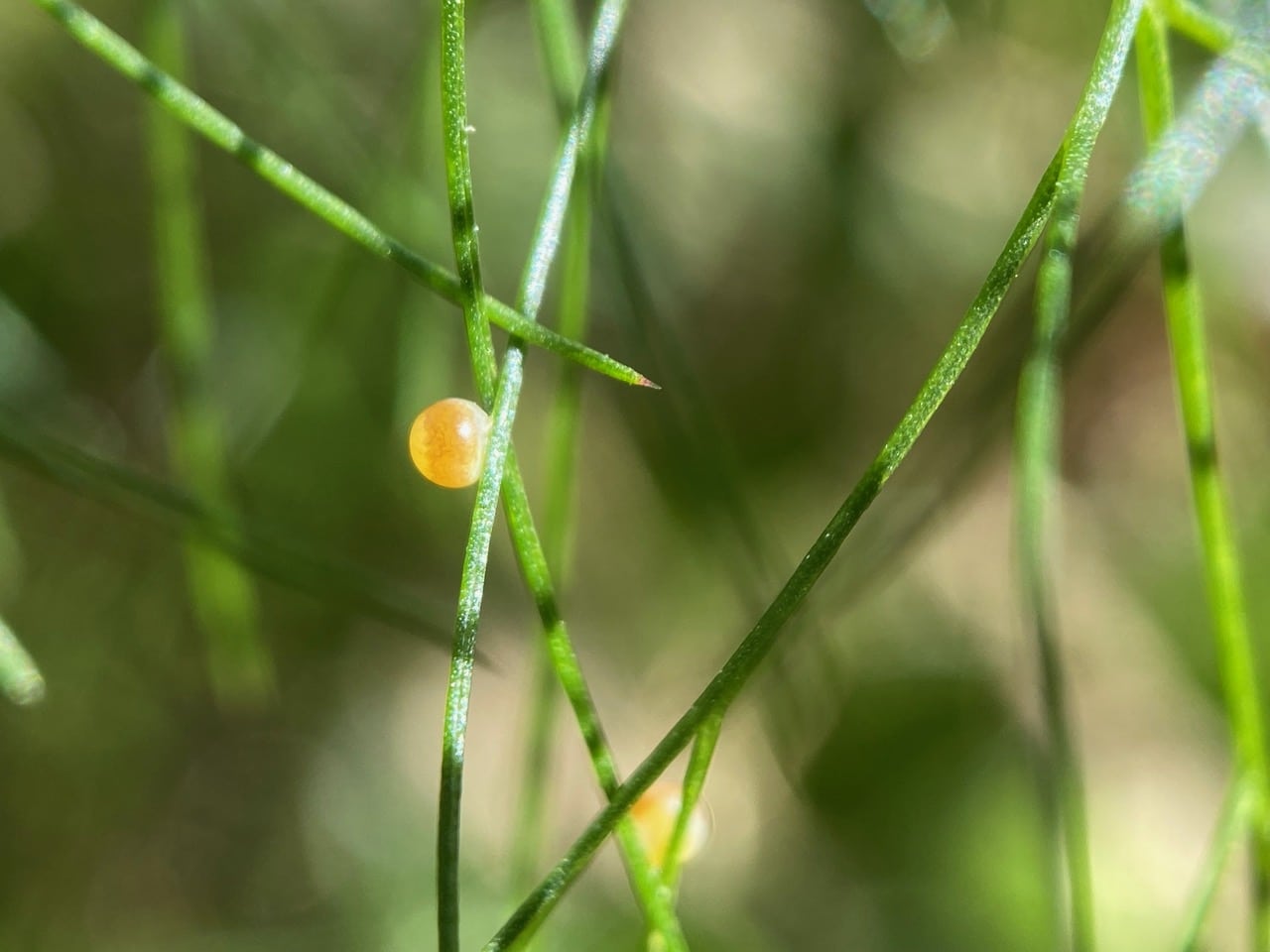
Just inches away, I spot another egg on the same Fennel. It is more mature, having turned a little darker.
Native to the Mediterranean, Fennel, Foeniculum vulgare belongs to the carrot family, Apiaceae which includes Anise Swallowtail’s original native host plants, such as Lomatium and Cow Parsnip. Since its introduction to North America, the plant has created a fascinating ecological shift. The butterfly has successfully adapted to using Fennel as a primary larval host plant. Because the invasive Fennel grows aggressively across disturbed areas, it provides a consistent, abundant food source that allows the butterflies to thrive in urban and suburban landscapes. While the plant supports multiple generations of butterflies from early spring through fall, land stewards and native plant conservationists still view Fennel as a threat to local biodiversity. In areas like the San Francisco Bay Area, native plants like Lomatium are crowded out by dense thickets of Fennel, which do not provide the proper habitat for other local insects.

A tiny fly is resting near the tip of a Catsear leaf, Hypochaeris radicata. iNaturalist has confirmed that it is a Leaf-miner Fly, Melanagromyza sp. (family Agromyzidae).
The Agromyzidae are a family commonly referred to as the Leaf-miner Flies, for the feeding habits of their larvae, most of which are leaf miners on various plants. They are small flies, most species in the range of 2-3 mm. Agromyzidae larvae are phytophagous, feeding as leaf miners, less frequently as stem miners or stem borers. A few live on developing seeds, or produce galls. There is a high degree of host specificity. A number of species attack plants of agricultural or ornamental value, so are considered pests. The shape of the mine is often characteristic of the species and therefore useful for identification. Adults occur in a variety of habitats, depending on the larval host plants.
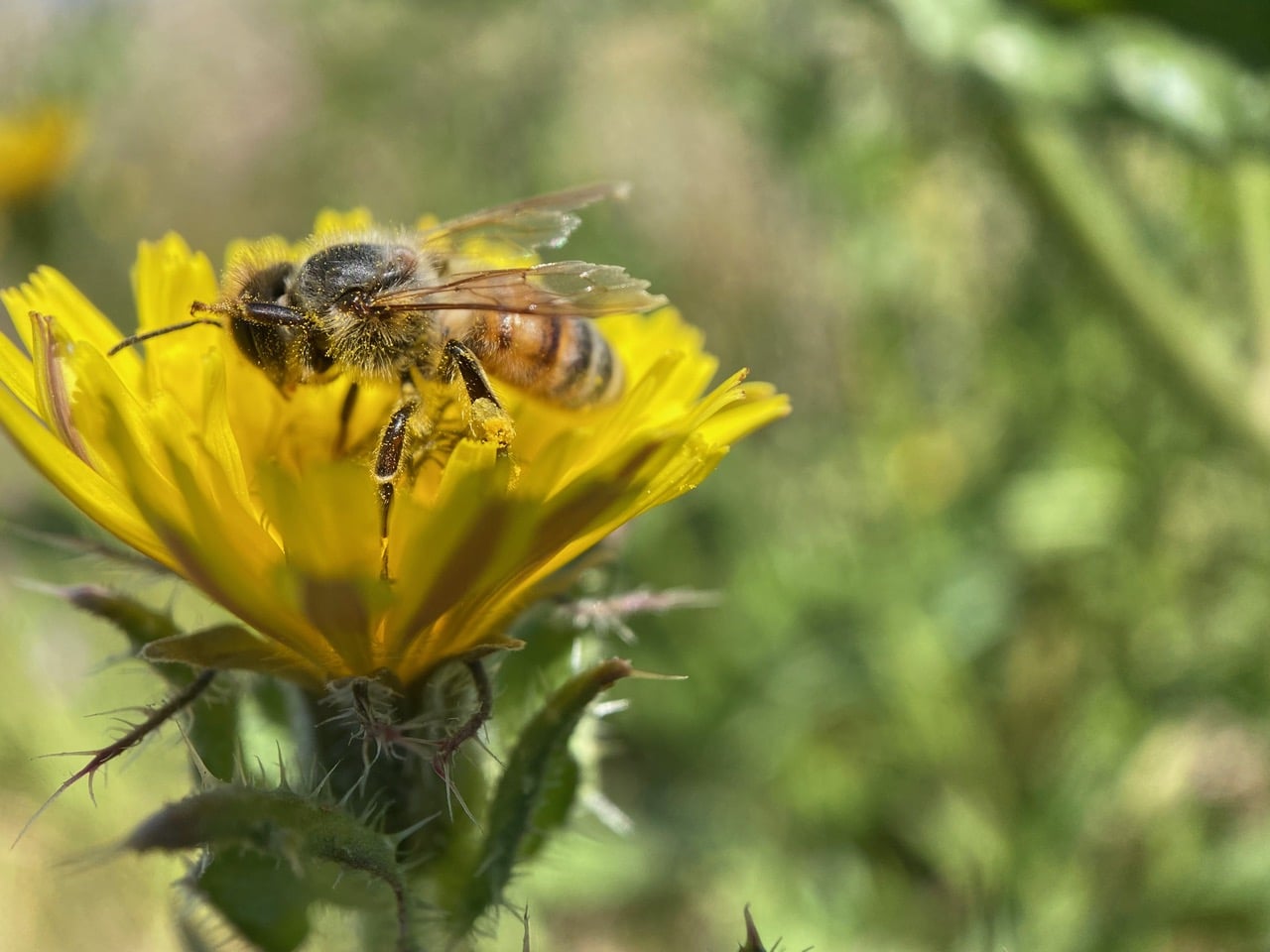
Covered in pollen while foraging in a Catsear flowerhead, a Honey Bee, Apis mellifera (family Apidae) is cleaning her face with her front legs.
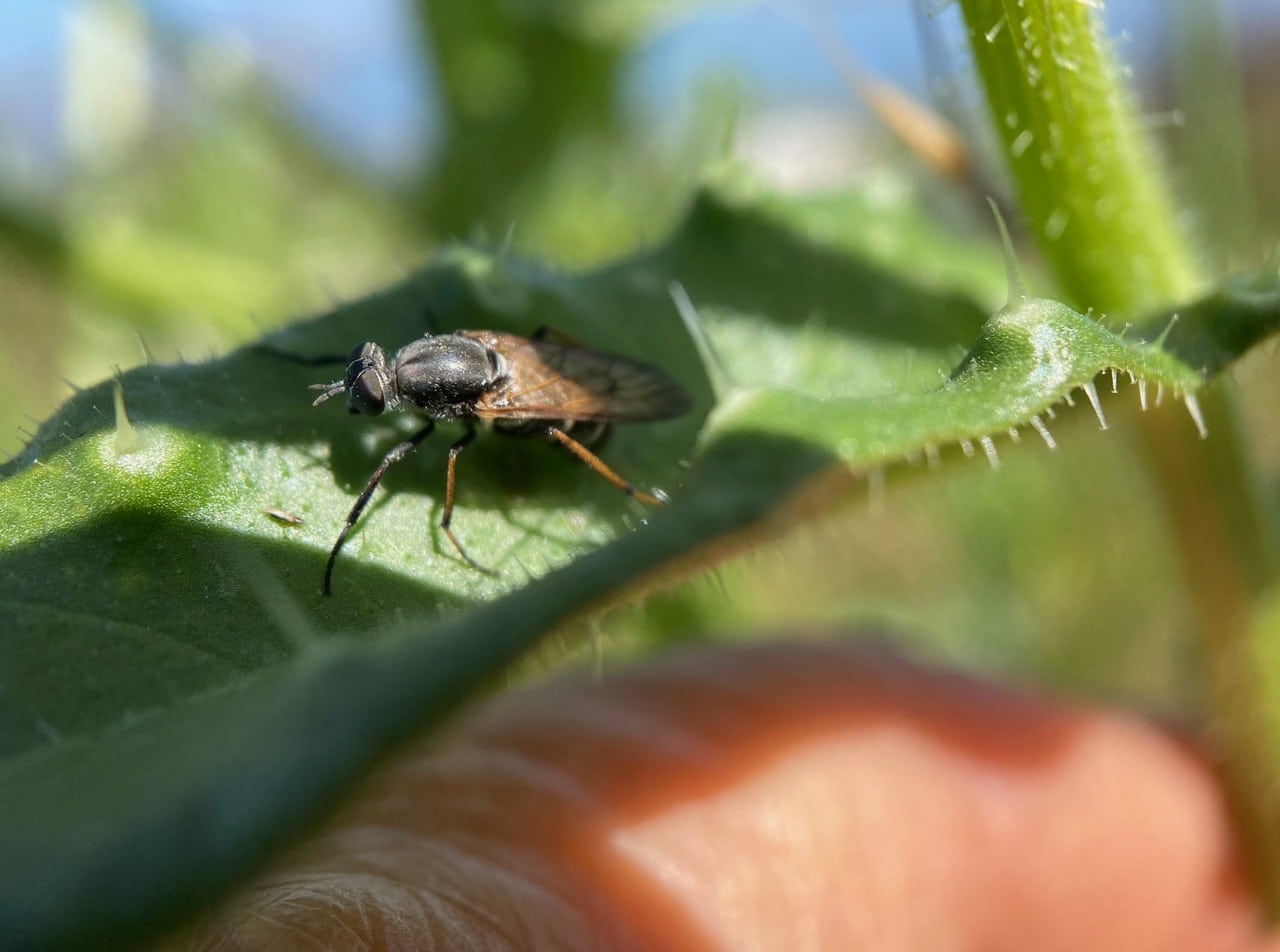
I have to tilt the stem into the light to take a better look at an unfamiliar fly resting in the shadows of a Catscear leaf. iNaturalist has helped identify it as a Stiletto Fly, Ozodiceromyia sp. (family Therevidae). A new fly family for me!
Ozodiceromyia is a genus of Stiletto Flies in the family Therevidae, consisting of about 7 described species found across North America, Central America, and northern South America. These flies are generally grayish with narrow abdomens, often resembling robber flies, and are found in open, sunny habitats. Adults are nectar-feeders, while larvae are predators of insect larvae in soil.
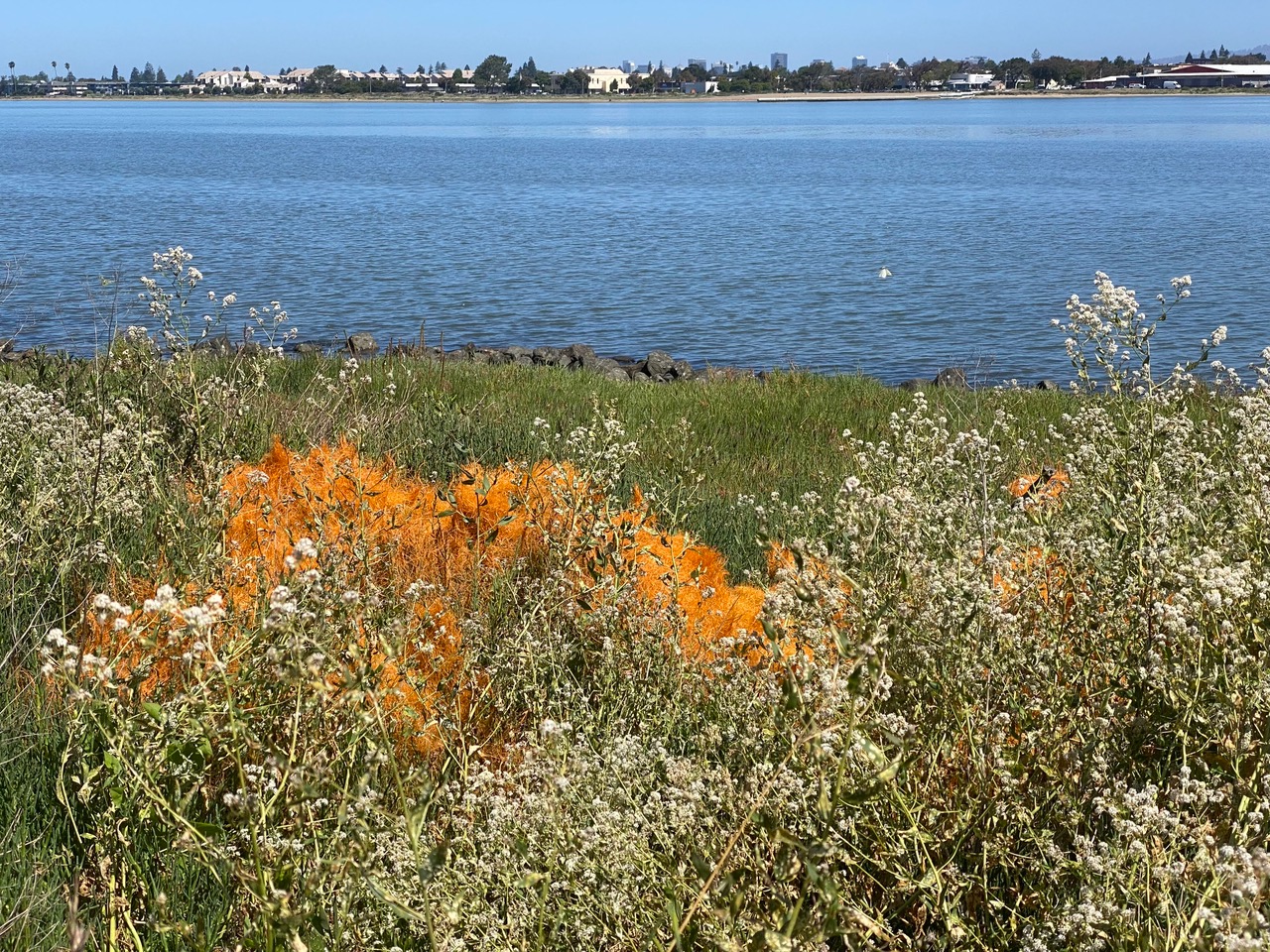
In the lower marsh beyond the blooming Pepperweed in the foreground, large unruly clumps of neon orange have appeared among the Pickleweed, Salicornia sp. It’s Dodder season on the salt marsh!
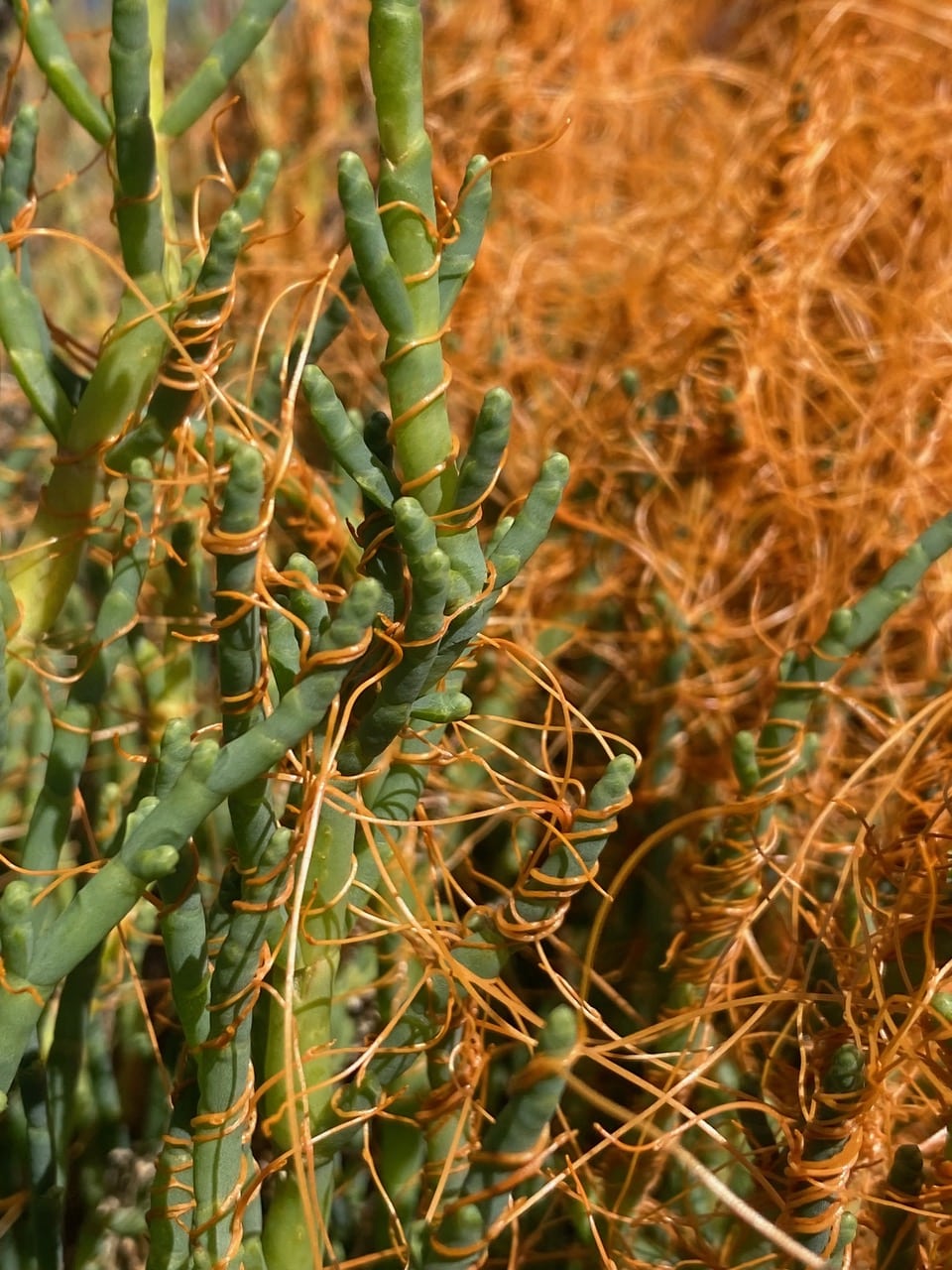
Dodder is an annual parasitic vine in a single genus, Cuscuta in the family Cuscutaceae. Dodders are obligate parasites, meaning they can’t make a living without their plant hosts. The thin, thread-like, yellow or orange stems grow rapidly entwining and covering their host plants.
Dodder seeds germinate in the soil and can live on their own for 5-10 days. Dodder seedlings are capable of detecting plant volatiles released by prospective host plants. If they have not found a suitable host in time the seedlings will die. Seedlings that find a suitable host twine around the plant and insert haustoria (modified adventitious roots) into the tender stem. The haustoria penetrate and tap the host plant’s vascular system for water, minerals and nutrients. Dodder is weakly photosynthetic, but most produce very little food on their own. As the vine successfully taps the host plant, its connection to the soil is severed. Small, white, bell-shaped flowers form in late summer and early fall and can produce copious amounts of seeds.

The white-flowered Broadleaved Pepperweed, Lepidium latifolium (family Brassicaceae) seems to be crowding out the native Oregon Gumweed, Grindelia stricta along this section of the trail. Curiously, I have never found any insect on the plant. The species is introduced from southeastern Europe and Asia, and is invasive throughout the western United States. It can establish in a wide range of environments and thrives in seasonally wet areas with high water table. Populations form dense monocultures that are easily spread by root fragments and seed, displacing native vegetation.
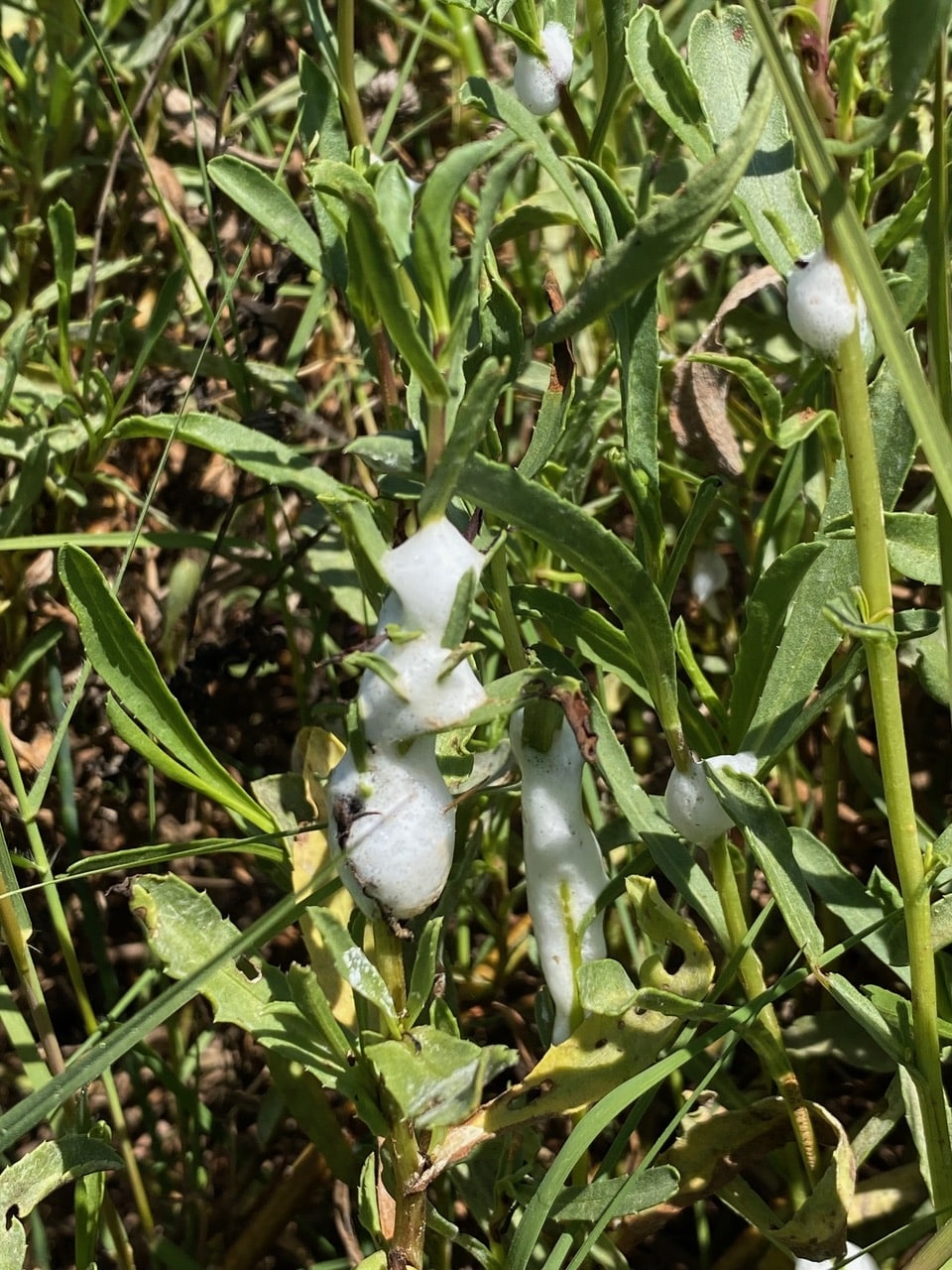
While the Oregon Gumweed, Grindelia stricta has yet to bloom, the plants are not exactly devoid of insect visitors. White foamy masses have appeared on the leaf axils, sometimes in multiple tiers. They are the work of Spittlebugs.
Spittlebugs, also known as Froghoppers belong to the superfamily Cercopoidea within the order Hemiptera (true bugs). While sometimes generally referred to as the family Cercopidae, they are scientifically divided into several families, primarily Aphrophoridae (common spittlebugs), Cercopidae (froghopper), and Clastopteridae.
Why the common name of “spittlebug”? The nymphs (immatures) of these bugs create foam masses on plants in which they live and feed. Like the adults, the nymphs use their piercing, sucking mouthparts to feed on plant juices. The nymph produces a cover of foamed-up plant sap reminiscent of saliva, hence the common name of spittlebug. Whereas most insects that feed on sap feed on the nutrient-rich fluid from the phloem, Spittlebugs tap into the much more dilute sap flowing upward via the xylem. The large amount of excess water that must be excreted and the evolution of special breathing tubes allow the young spittlebug nymphs to grow in the relatively protective environment of the spittle. Symbiotic bacteria in the insects’ digestive system provides them with the essential amino acids that their diet lacks. The foam serves a number of purposes. It hides the nymph from the view of predators and parasites, and it insulates against heat and cold, and protects the delicate nymphs from desiccation. Moreover, the foam has an acrid taste that deters predators.
Unlike their young, adult spittlebugs (also known as Froghoppers) are efficient flyers and hoppers, feeding on diverse plant species. They pierce plant stems to feed on xylem. To get enough nutrients, they consume massive quantities of sap, drinking up to 280 times their body weight daily, resulting in high waste excretion. Froghoppers can cause damage by distorting plant leaves and causing shoot tips to die back.
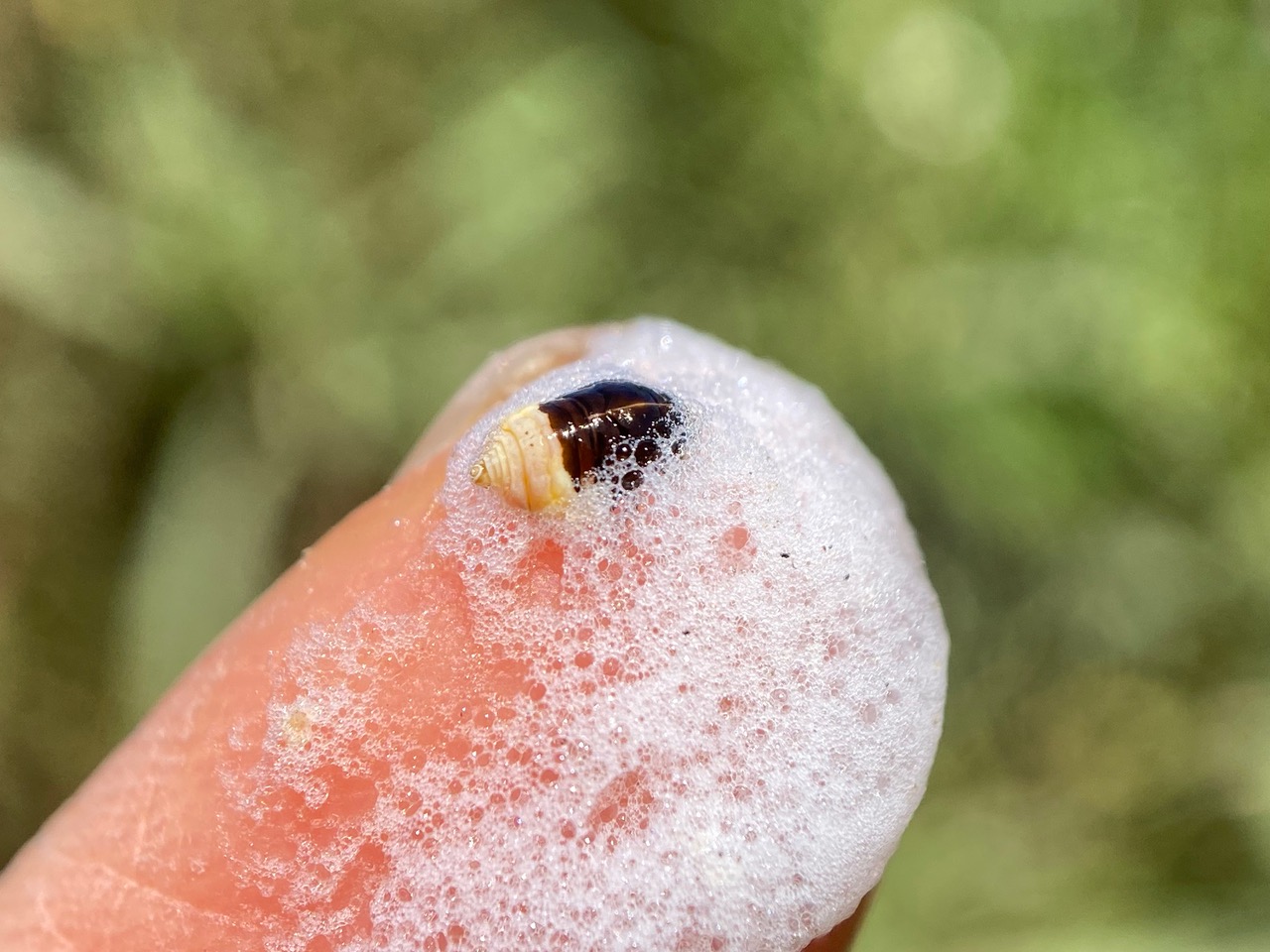
I scoop up a foam mass with a finger, and gently part the froth to reveal the Spittlebug inside. It is a bi-colored late instar nymph of the Froghopper, Complex Clastoptera lineatocollis (family Clastopteridae). The cream-colored rear end is tipped with a spigot-like structure that helps the bug whip up the foam from plant sap.
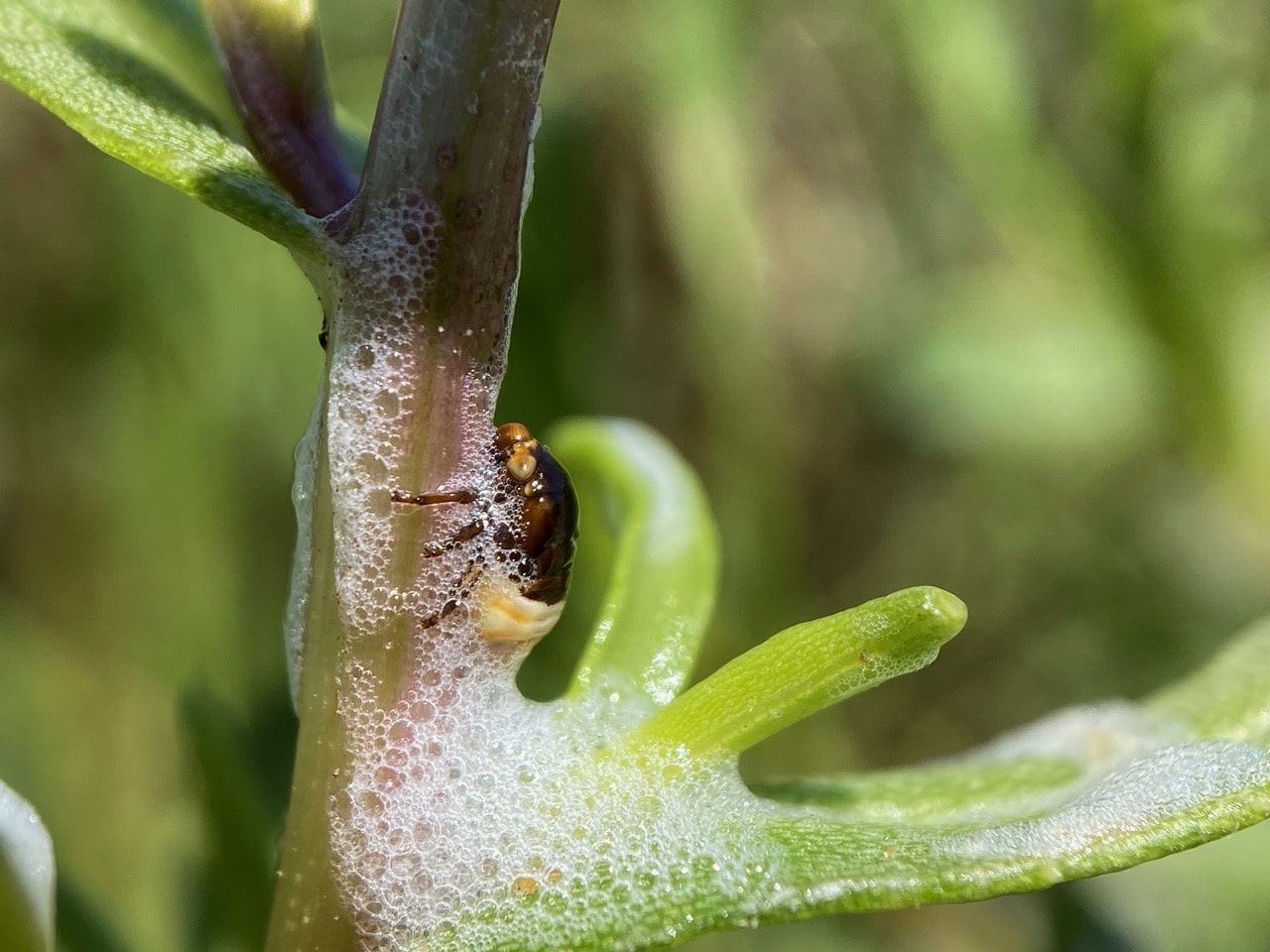
I return the nymph back onto the leaf axil where its foam mass was, knowing that it will stick its proboscis into the stem and produce another foam mass. Note its eye and prominent “snout”. I think it will develop into a brown female. During the past two summers, heavy infestation of these froghoppers had greatly impacted the health of Grindelia along this stretch of Shoreline Trail. It remains to be seen if this will happen again.
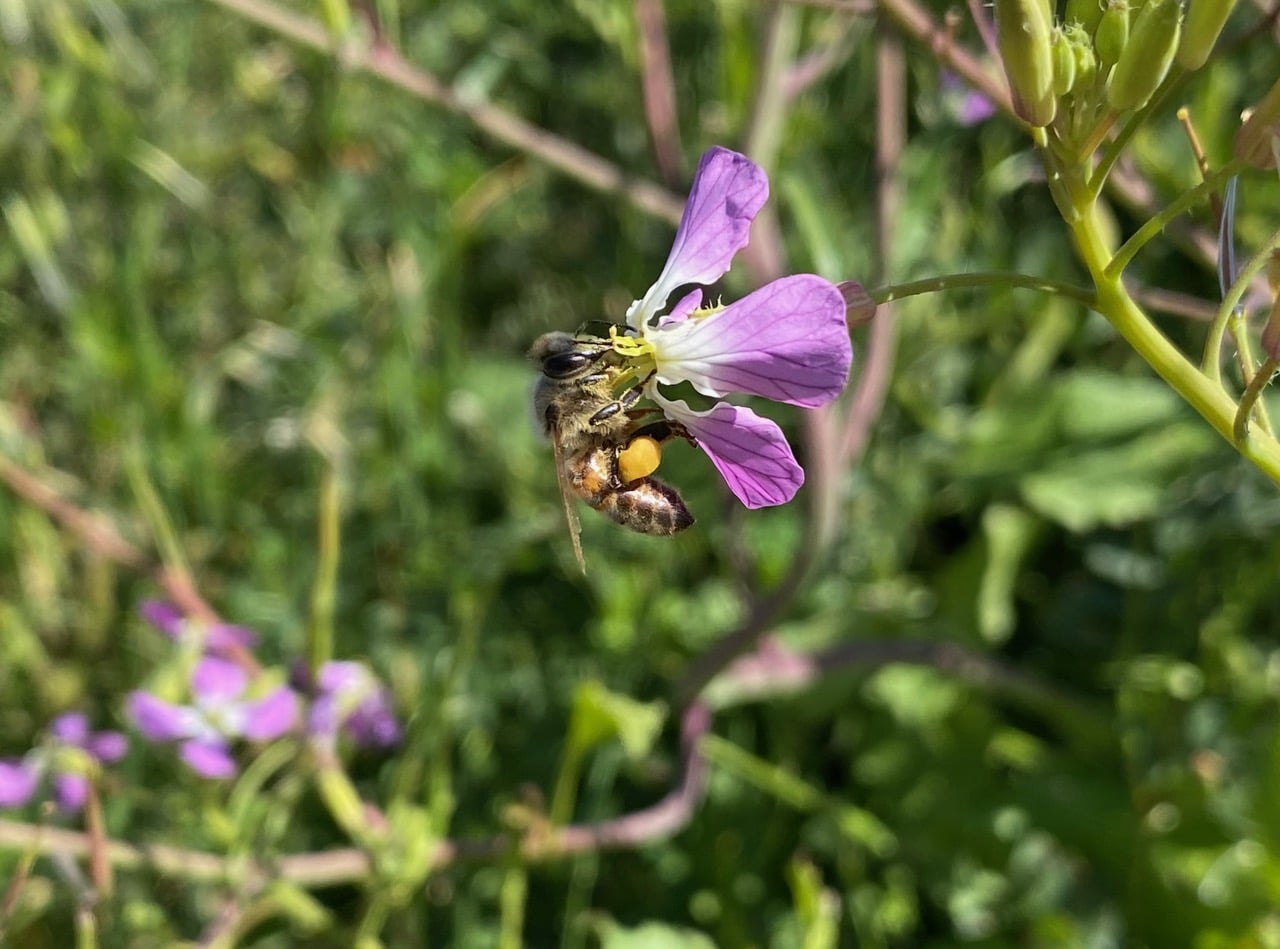
Carrying a large pollen load on her pollen baskets, a Honey Bee, Apis mellifera (family Apidae) is sipping nectar from a flower of Wild Radish.
The Wild Radish, Raphanus raphanistrum is a member of the family Brassicaceae. The species is native to western Asia, Europe and parts of Northern Africa. It has been introduced into most parts of the world and is regarded as a habitat threatening invasive species in many areas. It spreads easily and is often found growing on roadsides and other disturbed ground.
The pollen collecting apparatus in Apidae bees, which include honey bees and bumble bees, is commonly called a “pollen basket” or corbicula. This region is located on the tibia of the hind legs and consists of hairs surrounding a concave region. After the bee visits a flower, she begins to groom herself and brushes the pollen down toward her hind legs and packs the pollen into her pollen basket. A little nectar mixed with the pollen keeps it all together like putty, and the stiff hairs surrounding the pollen basket hold it in place. Remarkably bees are able to fly while carrying up to a third of their body weight in pollen.
.jpg)
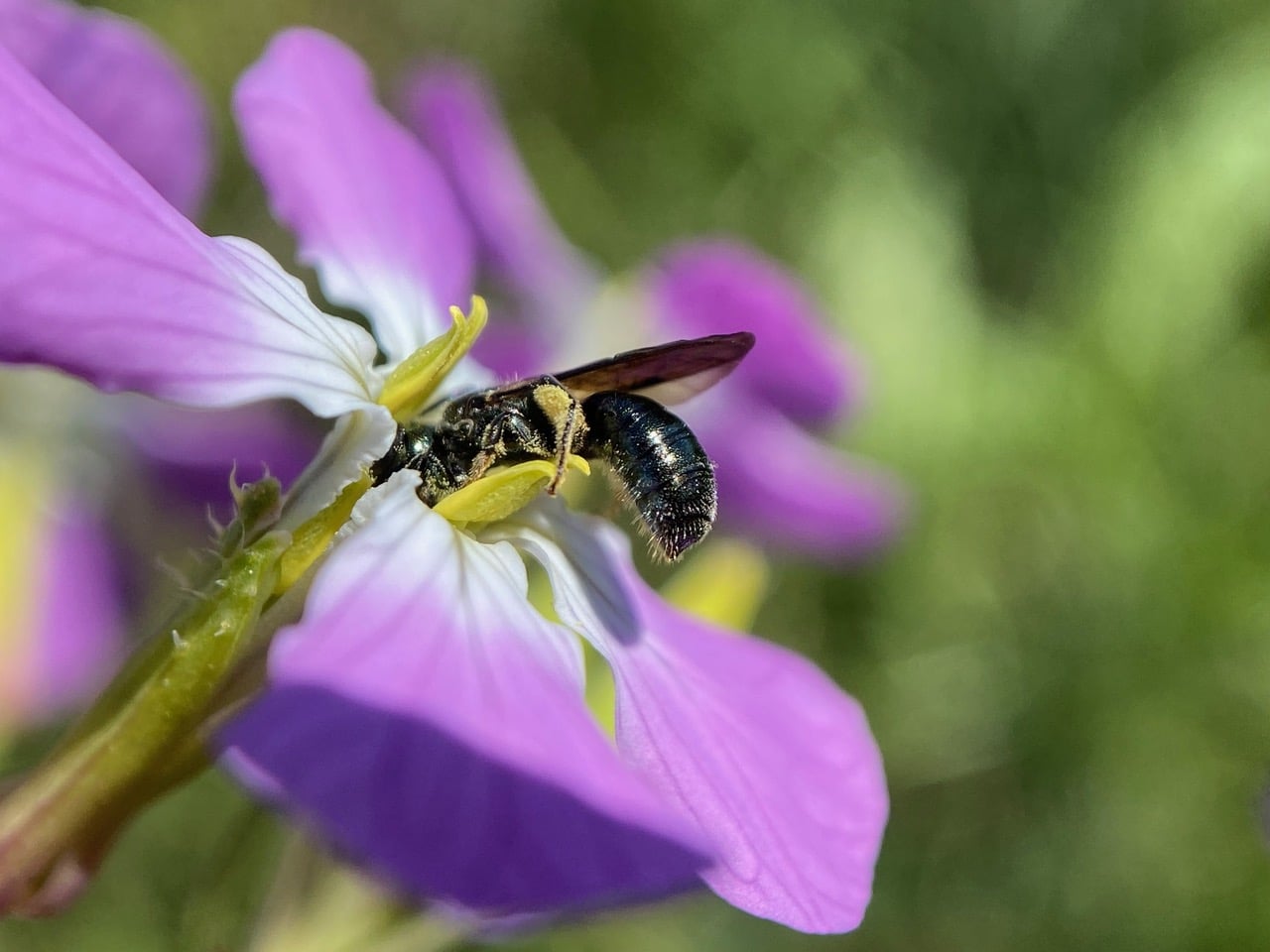
A Small Carpenter Bee, Ceratina acantha (family Apidae) is reaching between the anthers into the throat of a Wild Radish flower to access nectar.
The Small Carpenter Bee genus Ceratina is closely related to the more familiar, and much larger Carpenter Bees (genus Xylocopa). Ceratina are typically dark, shiny, even metallic bees, with fairly sparse body hairs and a weak scopa on the hind leg. The shield-shaped abdomen comes to a point at the tip. Some species have yellow markings, often on the face.
Females excavate nests with their mandibles in the pith of broken or burned plant twigs and stems. While many species are solitary, a number are subsocial. Both male and female carpenter bees overwinter as adults within their old nest tunnels, emerging in the spring to mate. In the spring, this resting place (hibernaculum) is modified into a brood nest by further excavation. The female collects pollen and nectar, places this mixture (called bee bread) inside the cavity, lays an egg on the provision, and then caps off the cell with chewed plant material. Several cells are constructed end to end in each plant stem.


As the bee lifts her head, she uses her front legs to clear pollen from her eyes.

A Small Carpenter Bee, Ceratina acantha (family Apidae) is foraging on a Catsear flowerhead.
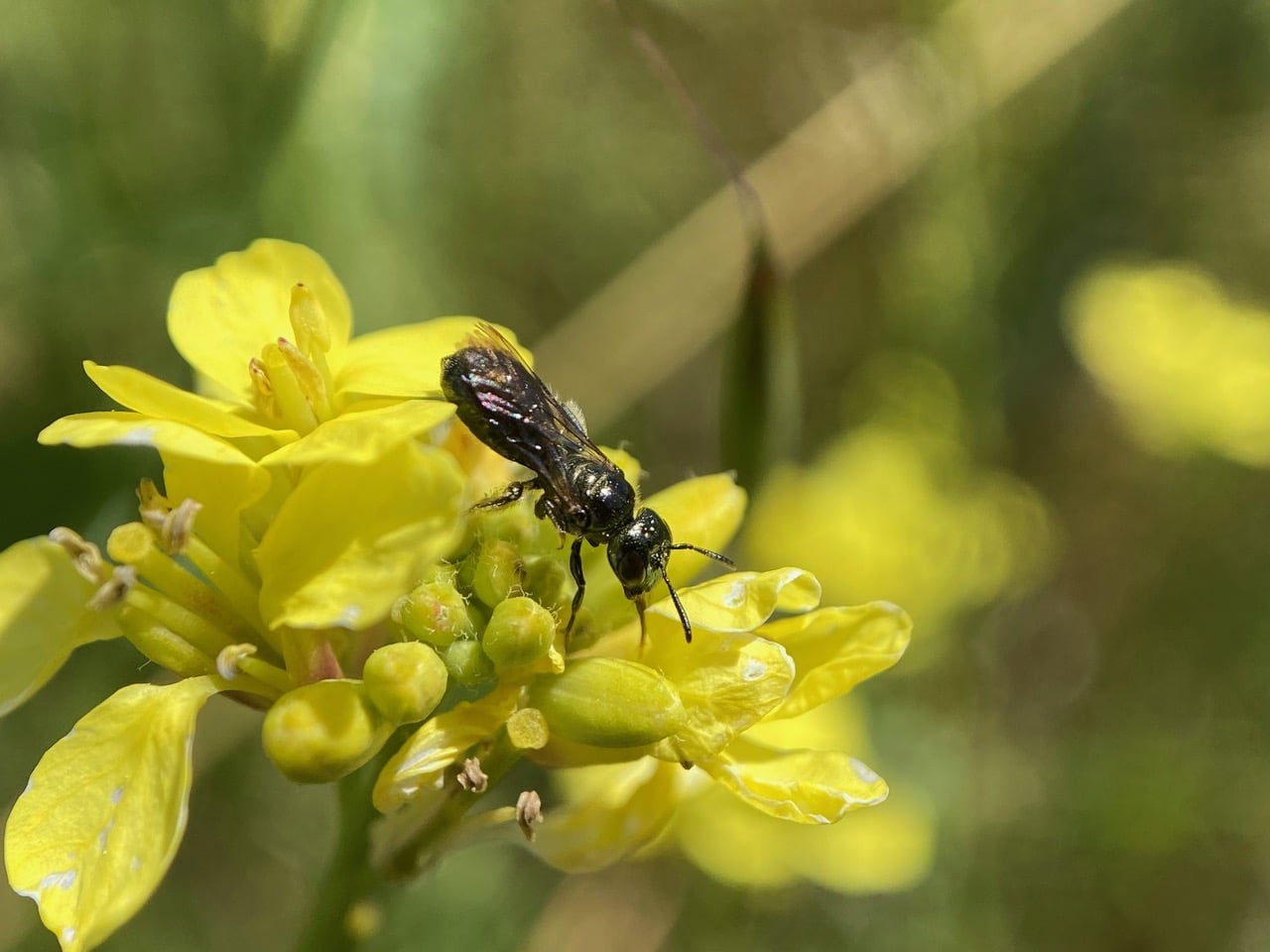
The Small Carpenter Bees, Ceratina acantha (family Apidae) are out in force today. Here a female is foraging on a cluster of Wild Mustard flowers.
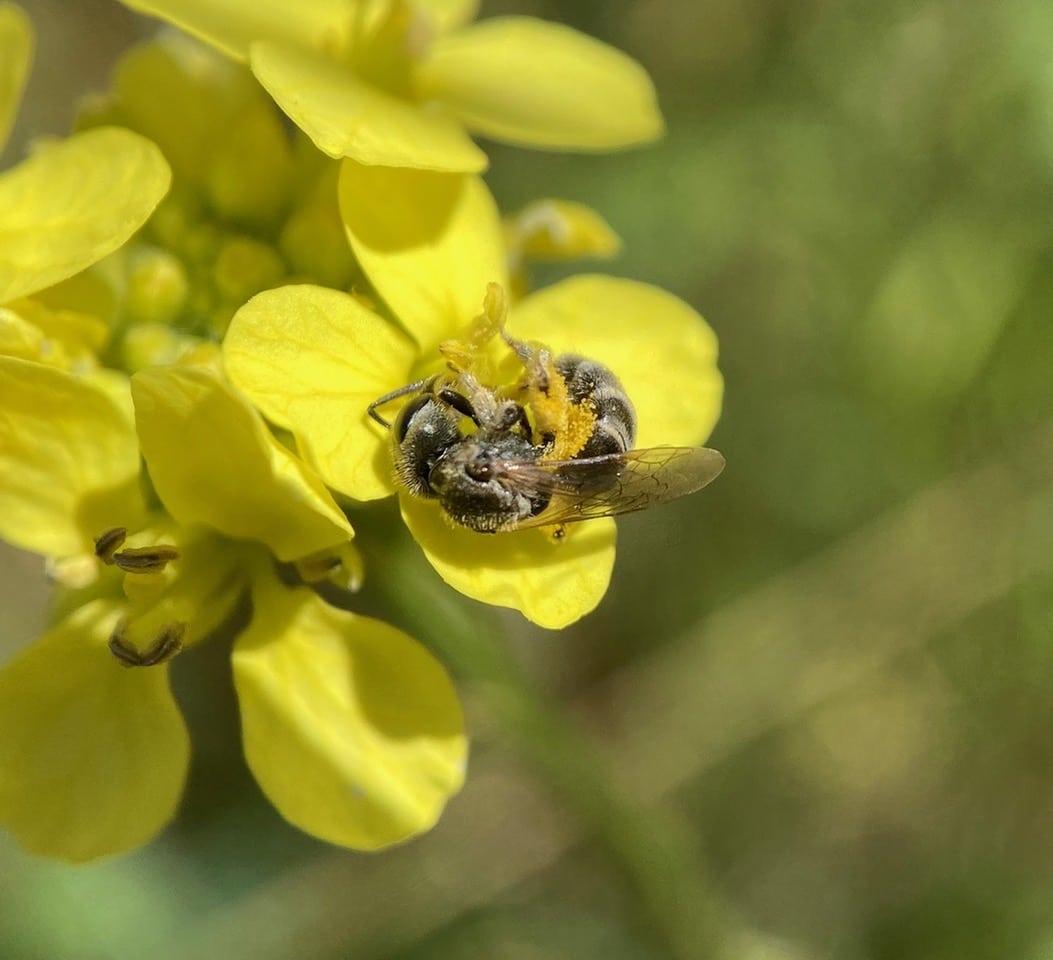
Her body curled around the anthers of a Wild Mustard flower, a Tripartite Sweat Bee, Halictus tripartitus (family Halictidae) is collecting pollen, using her legs as well as her mandibles. Note where she stores the pollen she has collected – in the scopae on her hind legs and on the underside of her body.
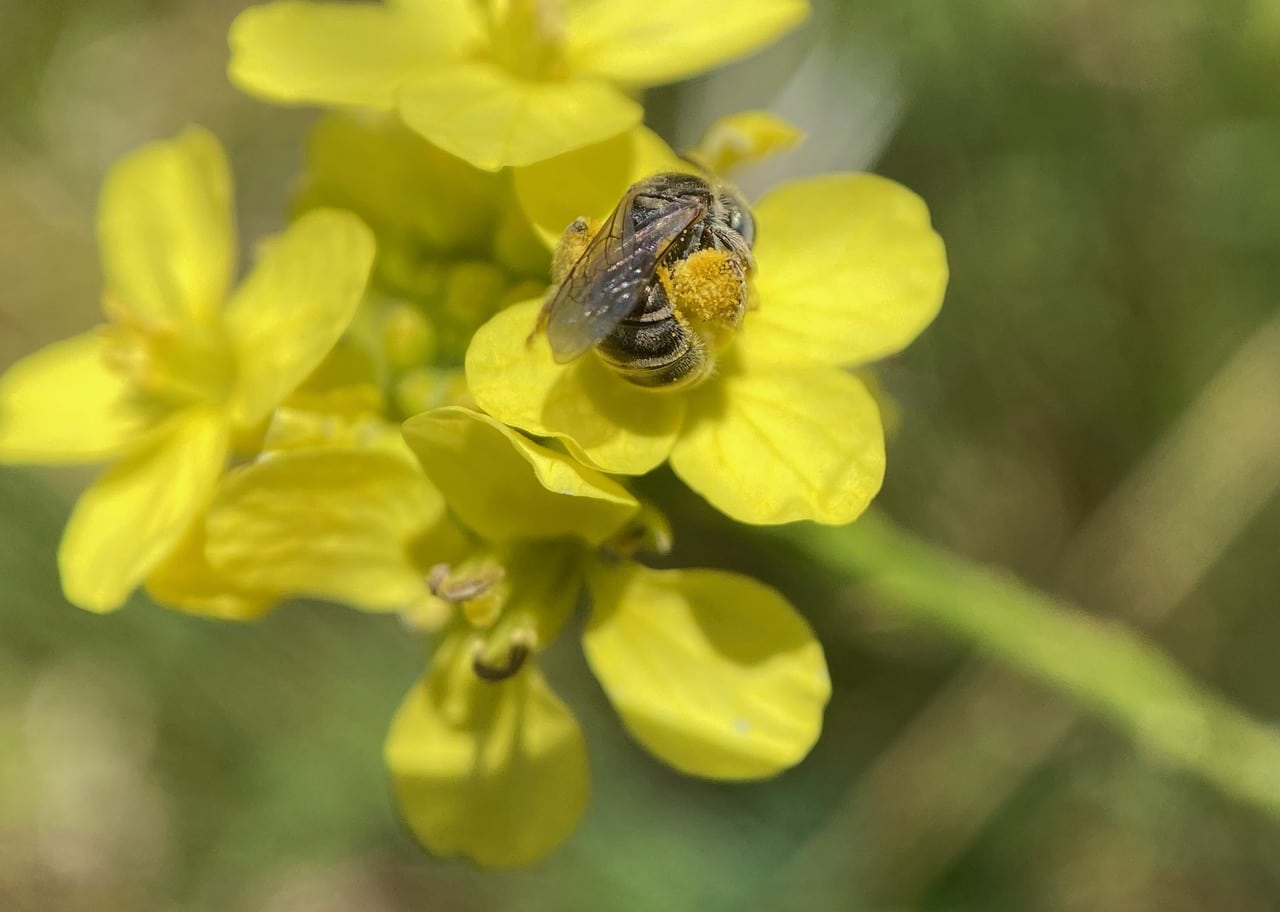
Unlike the Honey Bees and Bumble Bees that mix pollen with nectar when they pack it into their pollen baskets (corbiculae), the Sweat Bee and most other solitary bees pack pollen grains between the hairs in their scopae, loosely held by electrostatic attraction.
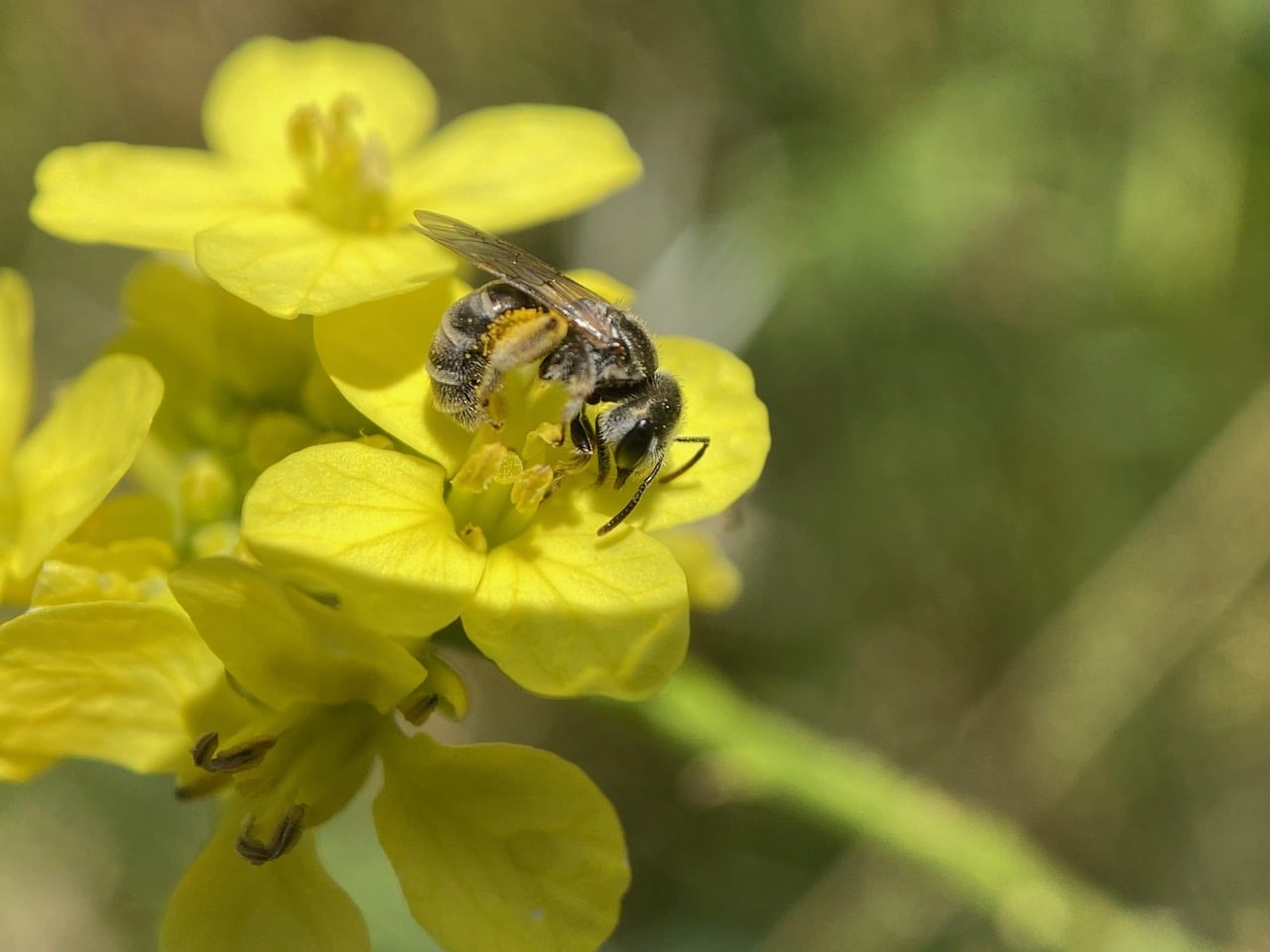
Halictus is found worldwide; they are most common in the Northern Hemisphere. All are generalists, foraging from a wide variety of flowering plants. Many species are social and produce several generations per year. This is not surprising as most blooming plants are season-specific; a bee that requires pollen and nectar across multiple seasons would not thrive as a specialist. All Halictus in North America nest in the ground, often in aggregations; and they may nest in the same area for decades.
The species Halictus tripartitus (family Halictidae) is partially eusocial, with nests connected underground and some workers capable of reproducing. It is a very successful species in our area, making up a substantial pollination workforce in many gardens right now, collecting floral resources from a large variety of plants.