

Pollinator Post 4/15/26

Along the shoreline of Bay Farm Island, a Sedgesitter, Platycheirus sp. (family Syrphidae) is perched on the stigma of a Calandrinia flower. I have often seen the hover fly forage among the stamens in these flowers, and have wondered how the pollen they carry could be transferred to the stigma of the next flower which stands way above the stamens. Now I know – the flies do use the tall style and stigma as a landing or take-off perch. The pollen on the flies can come off on the stigma and contribute to pollination.
The Sedgesitter, Platycheirus sp. (family Syrphidae) is found in grass and herb vegetation. Adults of many species feed on pollen of wind-pollinated plants, such as Salix, Plantago, Poaceae, Cyperaceae, but they also visit other flowers. Many stay active during cold and rainy weather. Larvae feed on aphids.
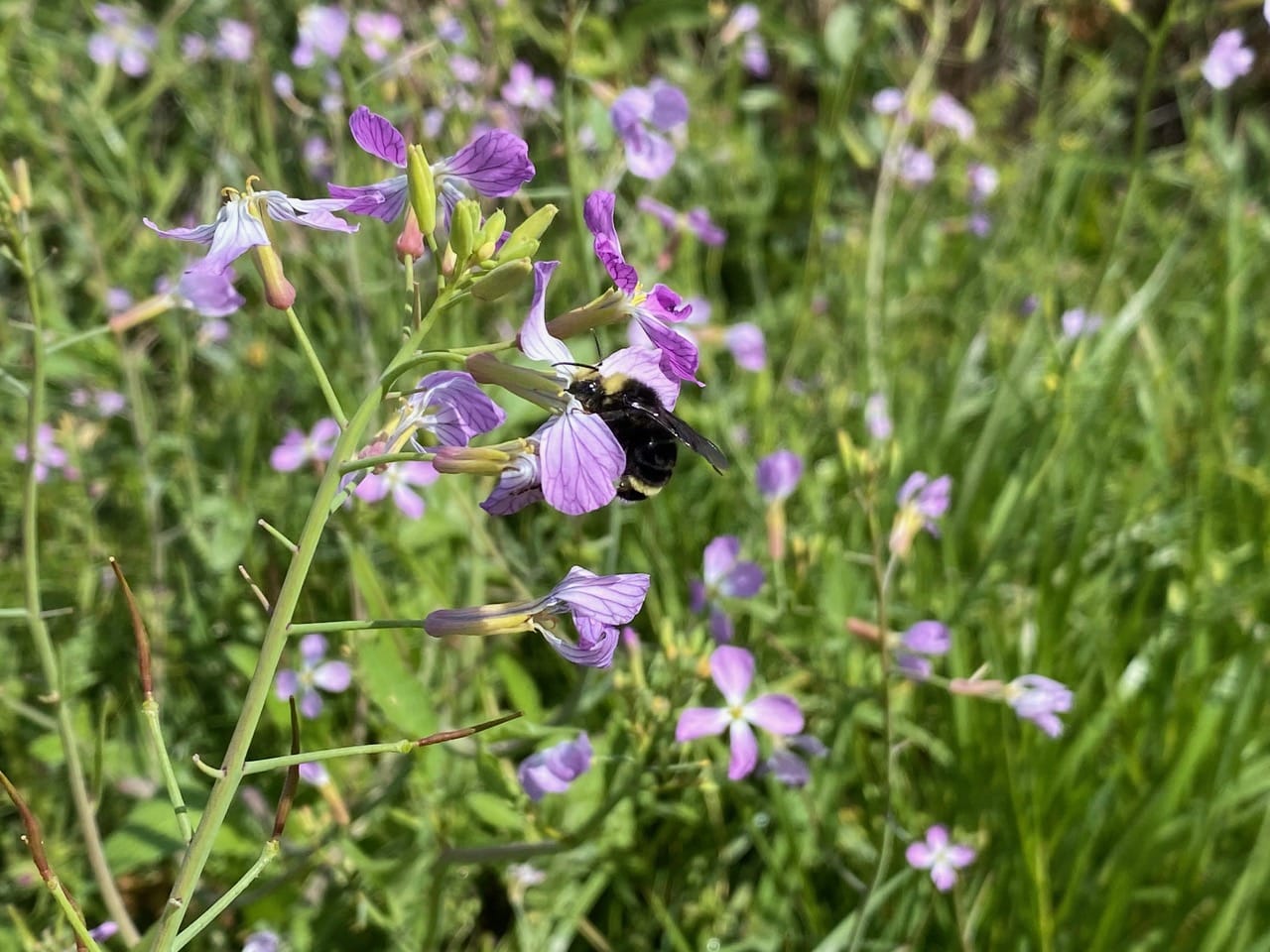
A Yellow-faced Bumble Bee, subgenus Pyrobombus (genus Bombus Bombus, family Apidae) is foraging on a flower of Wild Radish, Raphanus raphanistrum.
The Wild Radish, Raphanus raphanistrum is a member of the family Brassicaceae. The species is native to western Asia, Europe and parts of Northern Africa. It has been introduced into most parts of the world and is regarded as a habitat threatening invasive species in many areas. It spreads easily and is often found growing on roadsides and other disturbed ground.
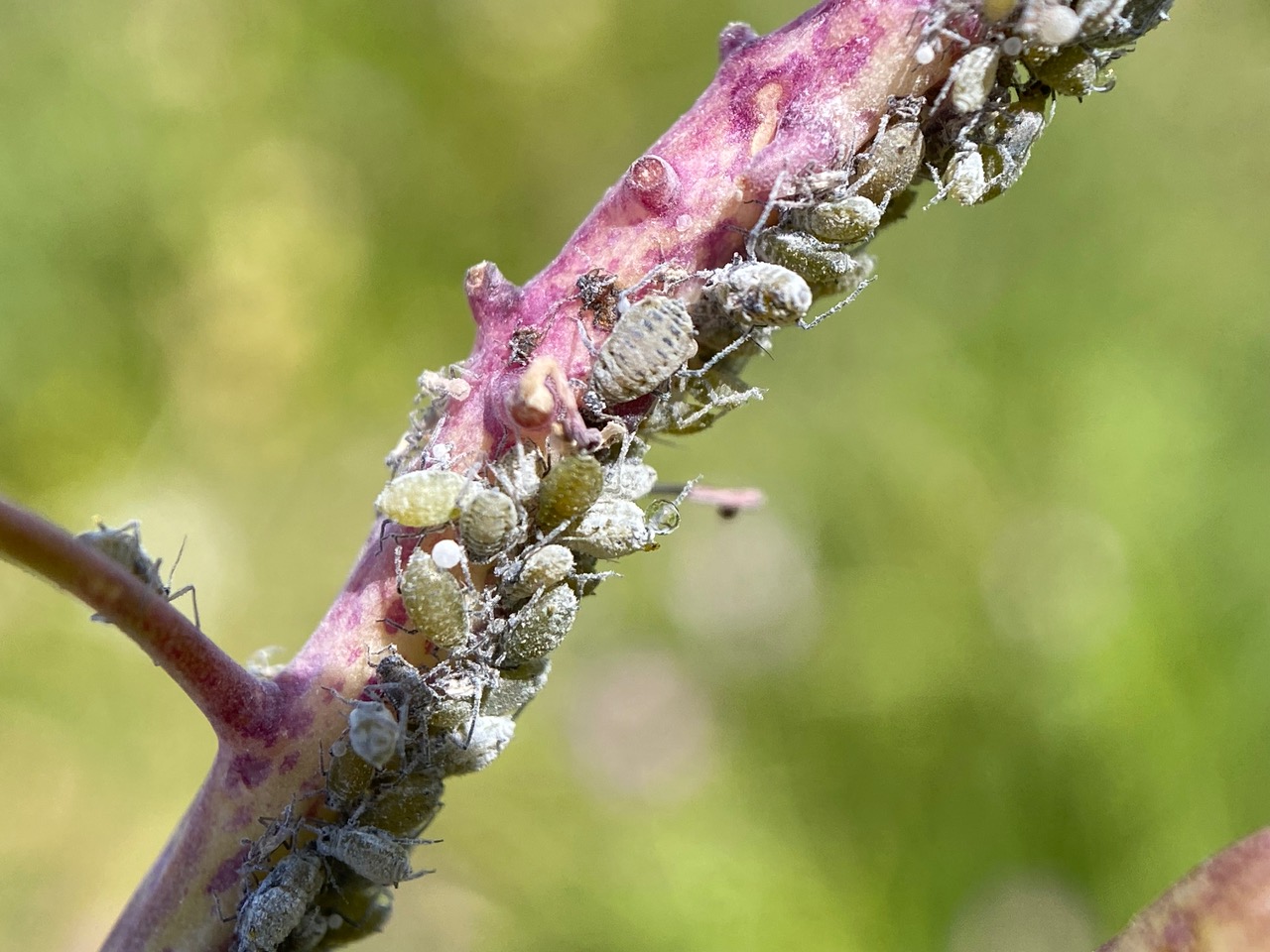
The stem of a Wild Radish is studded with tiny olive-colored aphids heavily coated with wax – not a pretty bunch! I have recently learned to recognize this species – the Cabbage Aphids, Brevicoryne brassicae (family Aphididae).
Aphids (family Aphididae) are small sap-sucking insects in the order Hemiptera. Aphids usually feed passively on phloem of plants. Once the phloem vessel is punctured, the sap, which is under pressure, is forced into the aphid’s food canal. Aphids produce large amounts of a sugary liquid waste called “honeydew”. A fungus called sooty mold can grow on honeydew deposits that accumulate on leaves and branches, turning them black.
A typical life cycle involves flightless females giving live birth to female nymphs, – who may also be already pregnant, an adaptation called telescoping generations – without the involvement of males. Maturing rapidly, females breed profusely so that the population multiplies quickly. Winged females may develop later in the season, allowing the insects to colonize new plants. In temperate regions, a phase of sexual reproduction occurs in the autumn, with the insects often overwintering as eggs. The life cycle of some species involves an alternation between two species of host plants. Some species feed on only one type of plant, while others are generalists, colonizing many plant groups. Some ants have a mutualistic relationship with aphids, tending them for their honeydew and protecting them from predators.
Cabbage Aphids are greenish-gray with a white, waxy coating. They commonly occur in dense colonies. Adults can be winged or wingless; the winged adults have a black thorax. Cabbage Aphids prefer to feed on the youngest leaves and flowering parts. These aphids feed only on plants in the family Brassicaceae, including weedy mustards and wild radishes in and around fields.
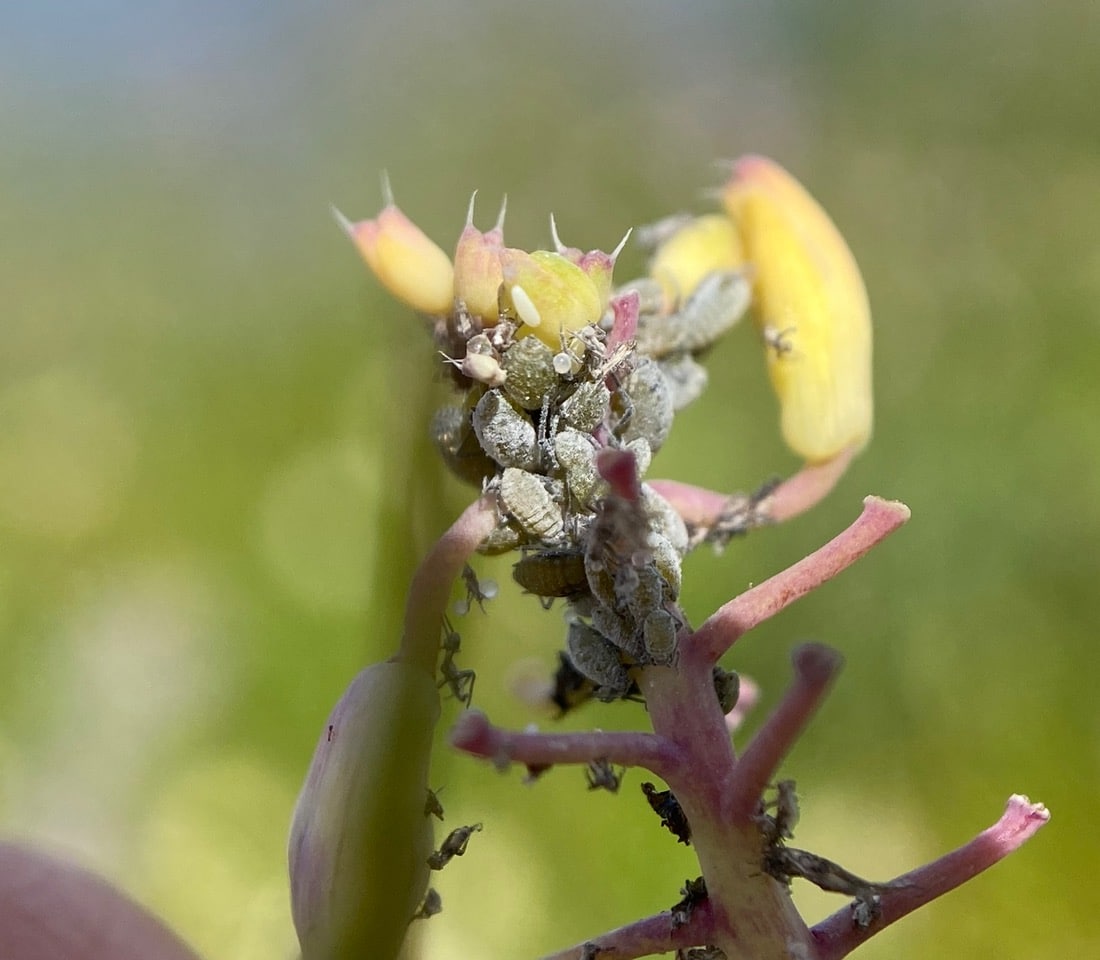
The Cabbage Aphids have also invaded a shoot tip with developing seed capsules. Hey, do you see the white object that looks like a grain of rice on the yellow seed capsule above the aphids? That’s a typical egg of a Hover Fly (family Syrphidae).
Many hover flies have larvae that feed on aphids. The females seek out aphid colonies on plants to lay their eggs among or near them, to ensure that when the larvae hatch out they’d have plenty to eat.
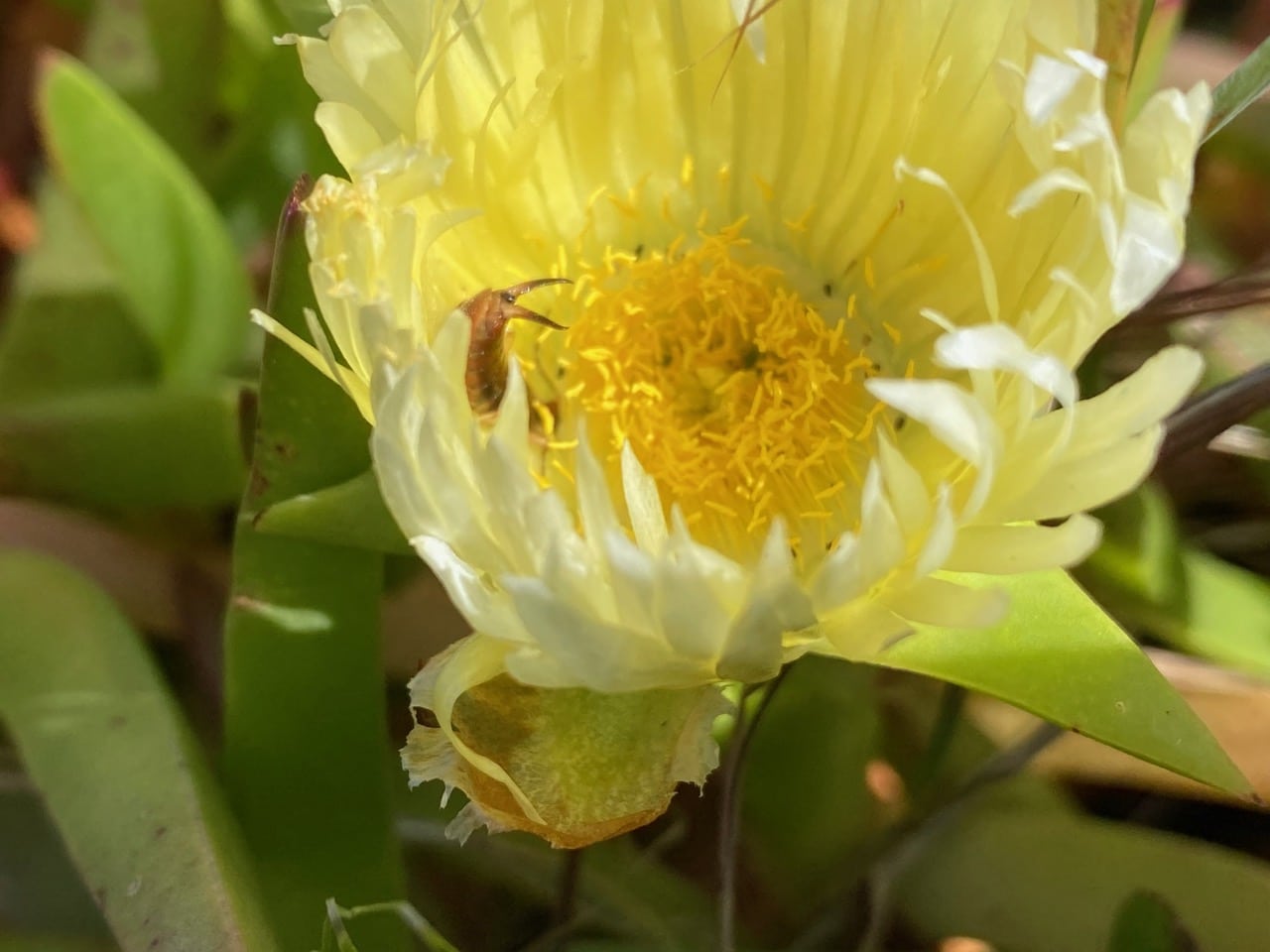
That sure looks like a pair of cerci (pincers) at the rear end of an Earwig (family Forficulidae, order Dermaptera).

Same Earwig from a different angle. We are looking at a pair of raised cerci (pincers) on the rear end of an upside down Earwig with its head buried in the stamens of a Sea Fig flower. It appears to be a female. The cerci of a male are more curved. I wonder what the insect has found at the base of the flower.
Earwigs are rather cryptic, small to medium sized insects distinguished from other insects by a pair of forcep or pincer-like cerci at the end of the abdomen. The name Dermaptera refers to the thickened leathery forewings and is derived from Greek with “derma” meaning skin and “ptera” meaning wings. Earwigs have an elongated and flattened or cylindrical body. They can be winged or wingless, and they have chewing mouthparts. The abdomen is long, flexible and telescopic. The two forcep-like cerci on the end of the abdomen are heavily sclerotized (hardened) and vary in shape and size between species. The forewings, called ’tegmina’, are short and lack veins. The large, membranous and semicircular hindwing fold up fan-like under the tegmina and can be unfurled or folded very quickly. Females can be readily distinguished from males as they are usually smaller, and have simple, straighter cerci. Earwigs use their rear pincers, or cerci, primarily for self-defense, catching prey, fighting rival males for dominance, and mating rituals. These abdominal appendages are also used to fold their wings, as they are capable of flight despite rarely doing so.
Earwigs may be found in protected, moist environments in leaf litter and all kinds of debris on the ground, under bark, under stones. The insects are usually nocturnal. They are mostly omnivorous eating a wide variety of live and decaying plant and animal material. They undergo incomplete metamorphosis. Nymphs molt 4-5 time before becoming adults. Female earwigs care for their eggs and young nymphs, an unusual trait in non-social insects.
Forficula dentata is a cryptic species closely related to the European Earwig, F. auricularia. They are found in temperate climates across Europe and North America. The species is nocturnal, and prefer moist, dark places, including under bark, leaf litter, or in crevices. Forficula dentata is omnivorous, feeding on foliage, fruits, fungi, and small insects like aphids.

It’s always worthwhile stopping at this large patch of Fennel, Foeniculum vulgare – you never know what you might find.

Hah, a young instar caterpillar of Anise Swallowtail on a Fennel leaf. It’s only about a quarter of an inch long. Note the feeding scars that the caterpillar has made on the leaf.
The Anise Swallowtail, Papilio zelicaon (family Papilionidae), is a common swallowtail butterfly of western North America. It is found in fairly open country, most likely seen on bare hills or mountains, in fields oar at the roadside. Adult females lay eggs singly on the underside of host plant leaves. In the first two instars, the caterpillar is a bird poop mimic – dark brown, almost black, with an irregular white band at its middle. After that it becomes more green at each successive molt until, in the fifth (last) instar, it is predominantly green, with markings in black, orange, and light blue. Its major food plants are members of the carrot family, Apiaceae (including Angelica), and also some members of the citrus family, Rutaceae.

I accidentally touch the branch linked to the caterpillar’s leaf, and immediately, an orange fleshy appendage is extruded from behind the caterpillar’s head. It is a defense mechanism commonly seen in Swallowtail caterpillars.
The osmeterium is a defensive organ found in Swallowtail butterfly caterpillars (family Papilionidae). It is a fleshy, forked structure that can be everted from the caterpillar right behind its head when it feels threatened. When extended, the osmeterium releases a foul-smelling secretion, often containing terpenes (essential oils) extracted from the caterpillar’s host plants.
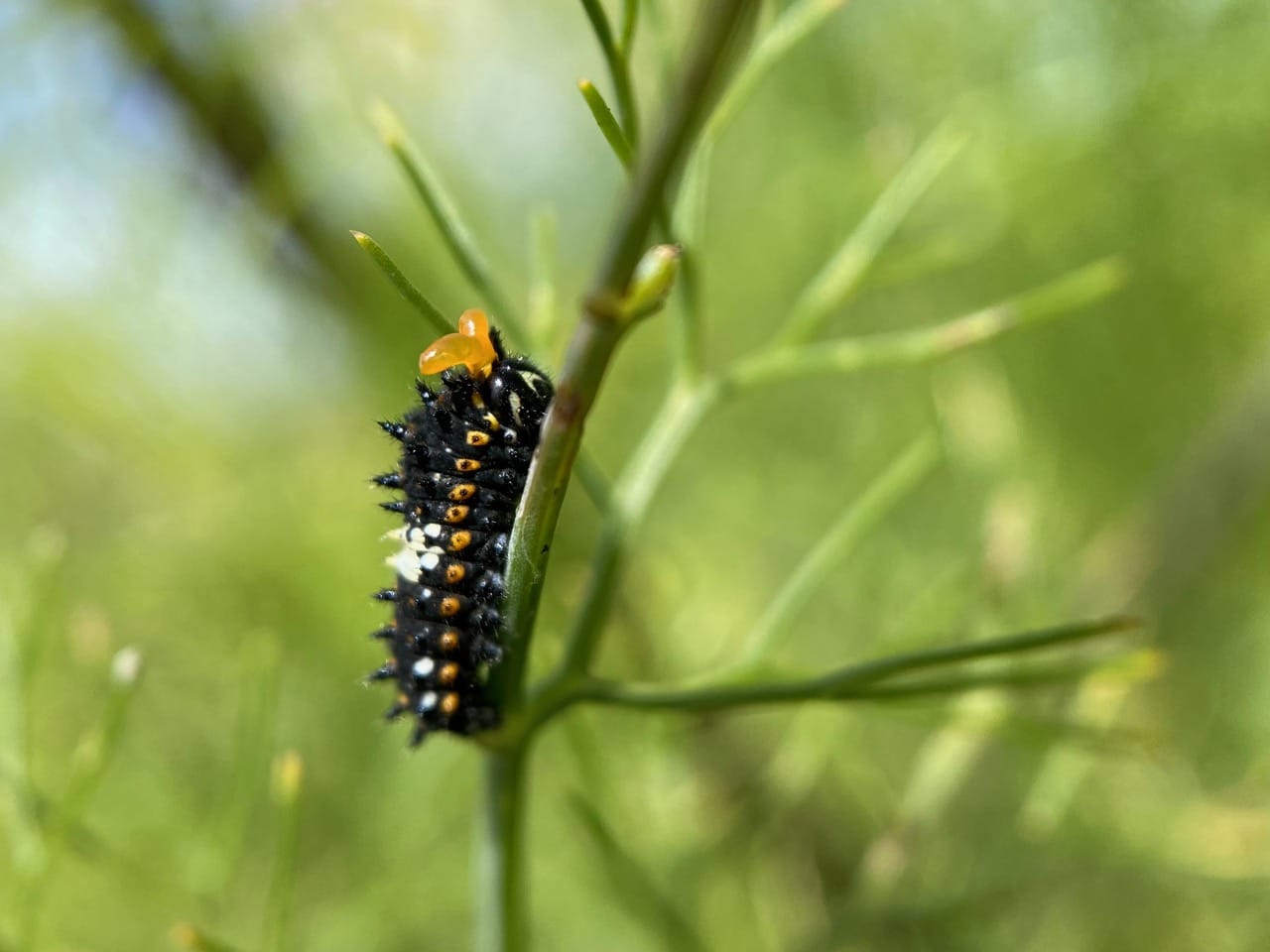
The osmeterium is almost immediately retracted.
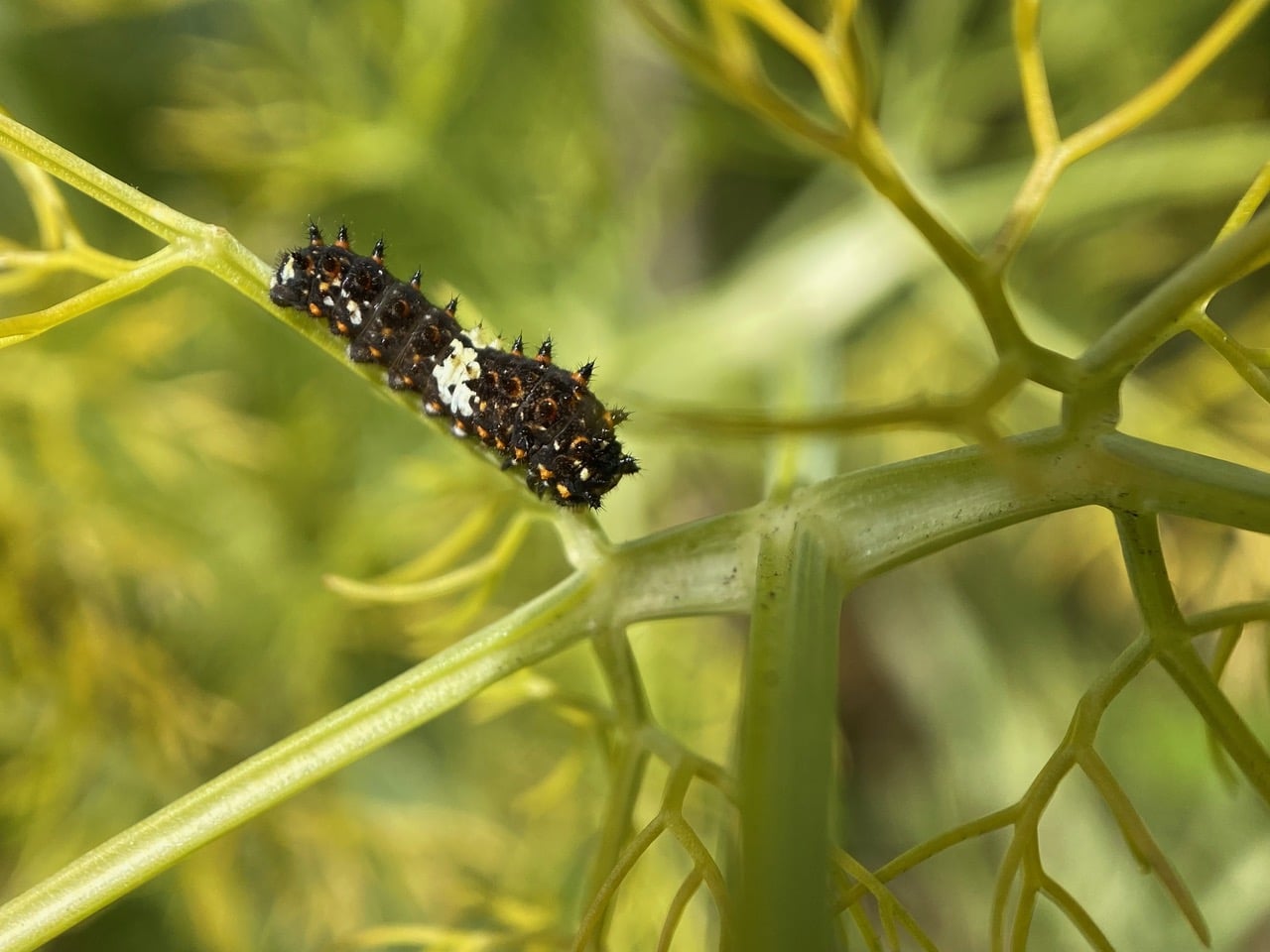
Here’s another young Anise Swallowtail caterpillar of about the same size, doing its best to look like bird poop.

Yet another young Anise Swallowtail caterpillar on the Fennel foliage. It has something black, round and shiny stuck to the spines on its thorax. I think it is the old head capsule that was shed by the caterpillar during its last molt.
The head capsule of a caterpillar is a hardened, scaly structure composed of chitin that functions as an exoskeleton for the head region. Key features includes six simple eyes, short antennae, and powerful biting mouthparts (mandibles). It is usually the last part of the caterpillar that is shed during molting.

Hey, a last (5th) instar caterpillar of Anise Swallowtail! What a dramatic change from the earlier, bird-poop mimicking instars.

It takes me a while to figure out what I am seeing here in a Sea Fig flower. A small dark Earwig has wrapped itself around the thorax of a much larger Earwig. There is no apparent movement. Are they locked in a fight? Or mating? How do Earwigs mate anyway? A juvenile playing with mom? What is going on?
Since the little one is dark and sclerotized, I figure it is not a nymph. Young earwigs pass through four to five instars, each pale and fragile, before transforming into adults. Earwig moms tend their eggs and young in their nests in sheltered places before the nymphs are old enough to fend for themselves.
Earwigs usually mate in fall and early winter. Well, so much for mating then! What about sizes of the genders? While there is significant difference in the sexes, they are primarily in their forceps (pincers) rather than overall body length. Males generally have larger, thicker, and more curved forceps used for fighting, while females have smaller, straighter, and more slender forceps.
How do earwigs mate? Mating in earwigs is an involved process where males use his cerci (pincers) to woo females, often involving tactile stimulation and tapping. During mating, they adopt a tail-to-tail position, allowing for sperm transfer via a large, often paired penis. Females can store this sperm for months, laying eggs in secluded, subterranean nest in spring.
In short, I have no idea what is going on with these two earwigs on the flower!
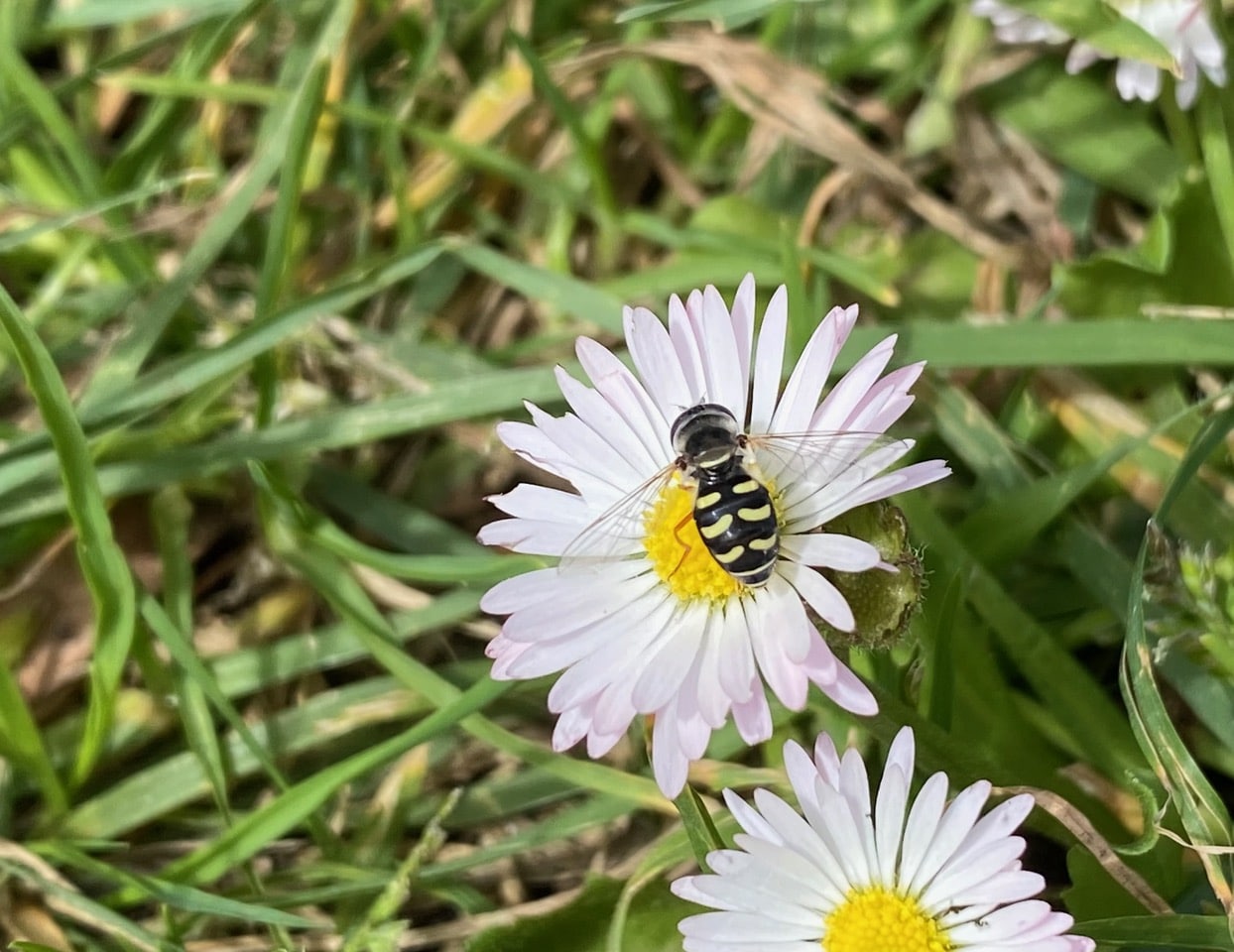
A hover fly with a distinctive black-and-white abdomen is foraging on an English Daisy flowerhead. It is a Large-tailed Aphideater, Eupeodes volucris (family Syrphidae).
The Large-tailed Aphideater, Eupeodes volucris (family Syrphidae) is found in western North America, and is active March through November. The common name of the species refers to the distinctive “large tail” or projecting cylindrical abdomen of the males. As the rest of the common name implies, the larvae of the species are voracious predators of small plant-sucking insects such as aphids. Females seek out dense aphid colonies on plants to lay eggs among them. Adults visit flowers for nectar and pollen.
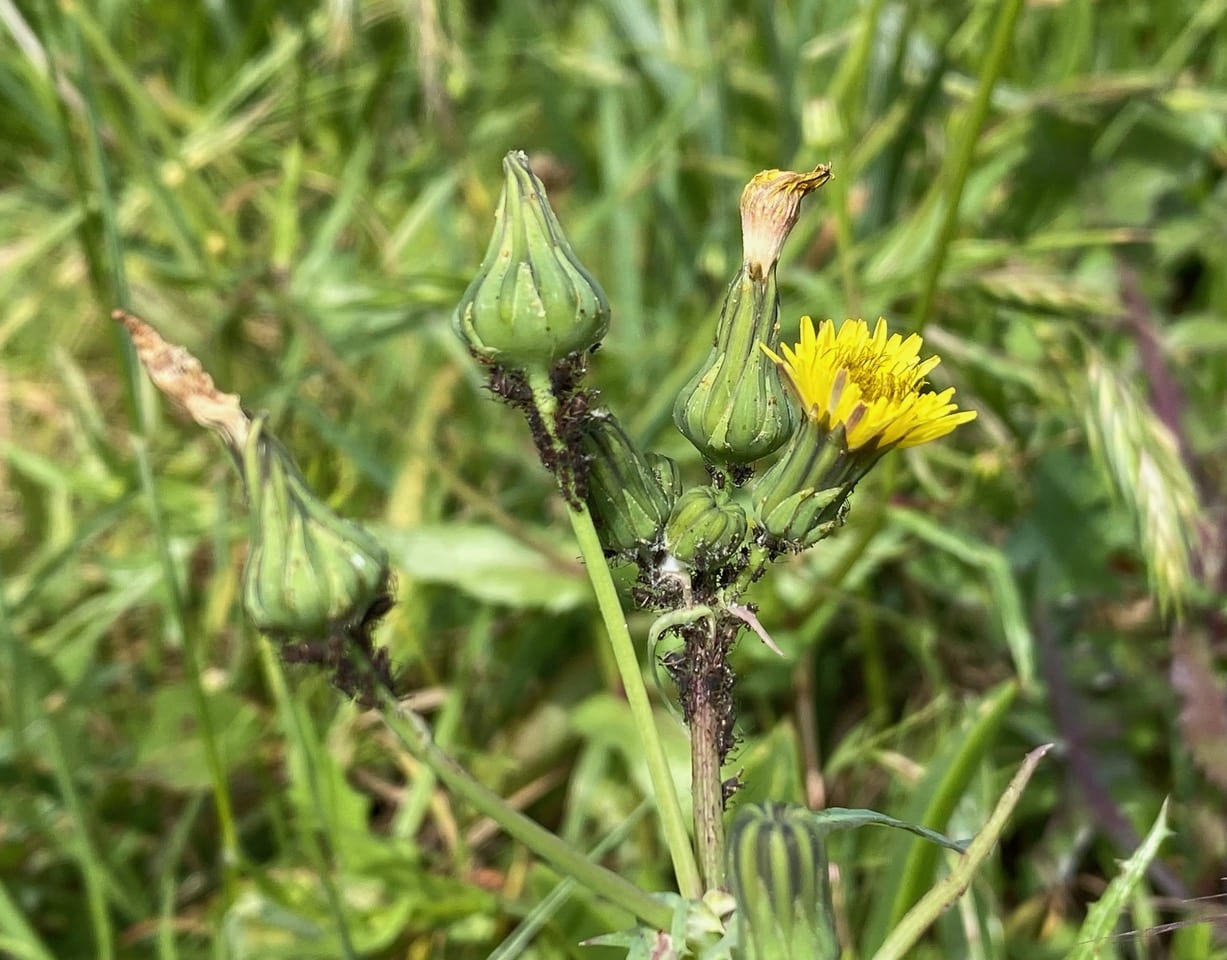
I stop short when I see dark aphids studding the stems under the flowerheads of this Sow Thistle, Sonchus sp.

Wow, there’s a lot going on here under a flower bud. These brown aphids have long legs and long cornicles (“tail pipes”). Naturalist has helped identify them as Sow-thistle Aphids, Uroleucon sonchi (family Aphididae). Do you see the two big mamas giving birth to live young?
The Sow-thistle Aphid, Uroleucon sonchi (family Aphididae) is native to Europe, and has been introduced to several other countries. It primarily feeds on the sow thistle (genus Sonchus), but also on many plants in the Asteraceae family, including cultivated lettuce.
Aphids (family Aphididae) are small sap-sucking insects in the order Hemiptera. Aphids usually feed passively on phloem of plants. Once the phloem vessel is punctured, the sap, which is under pressure, is forced into the aphid’s food canal. Aphids produce large amounts of a sugary liquid waste called “honeydew”. A fungus called sooty mold can grow on honeydew deposits that accumulate on leaves and branches, turning them black.
A typical life cycle involves flightless females giving live birth to female nymphs, – who may also be already pregnant, an adaptation called telescoping generations – without the involvement of males. Maturing rapidly, females breed profusely so that the population multiplies quickly. Winged females may develop later in the season, allowing the insects to colonize new plants. In temperate regions, a phase of sexual reproduction occurs in the autumn, with the insects often overwintering as eggs. The life cycle of some species involves an alternation between two species of host plants. Some species feed on only one type of plant, while others are generalists, colonizing many plant groups. Some ants have a mutualistic relationship with aphids, tending them for their honeydew and protecting them from predators.

I watch for 13 minutes hoping to see the babies delivered safely, but have to leave before that happens. From past observations, I recall that mama aphids are surprisingly gentle with their newborns. Once all its limbs (landing gears) have been extended, the baby is gently lowered onto the substrate, not casually dropped.

Hey, Mama, your baby has deployed its landing gear. One more push and you can set her free. Congratulations, it’s a girl (as always)!
Aphids reproduce with extreme speed via a process where females give birth to live, clonal, already-pregnant daughters without mating (parthenogenesis). This “telescoping of generations” allow nymphs to mature in roughly 10 days, with a single female producing up to 12 offspring daily. Under ideal conditions, a single aphid can theoretically produce hundreds of billions of descendants in a season. The aphid’s fecundity is their major contribution to the ecosystem, feeding a large number of organisms (mainly other insects) up the food chain.
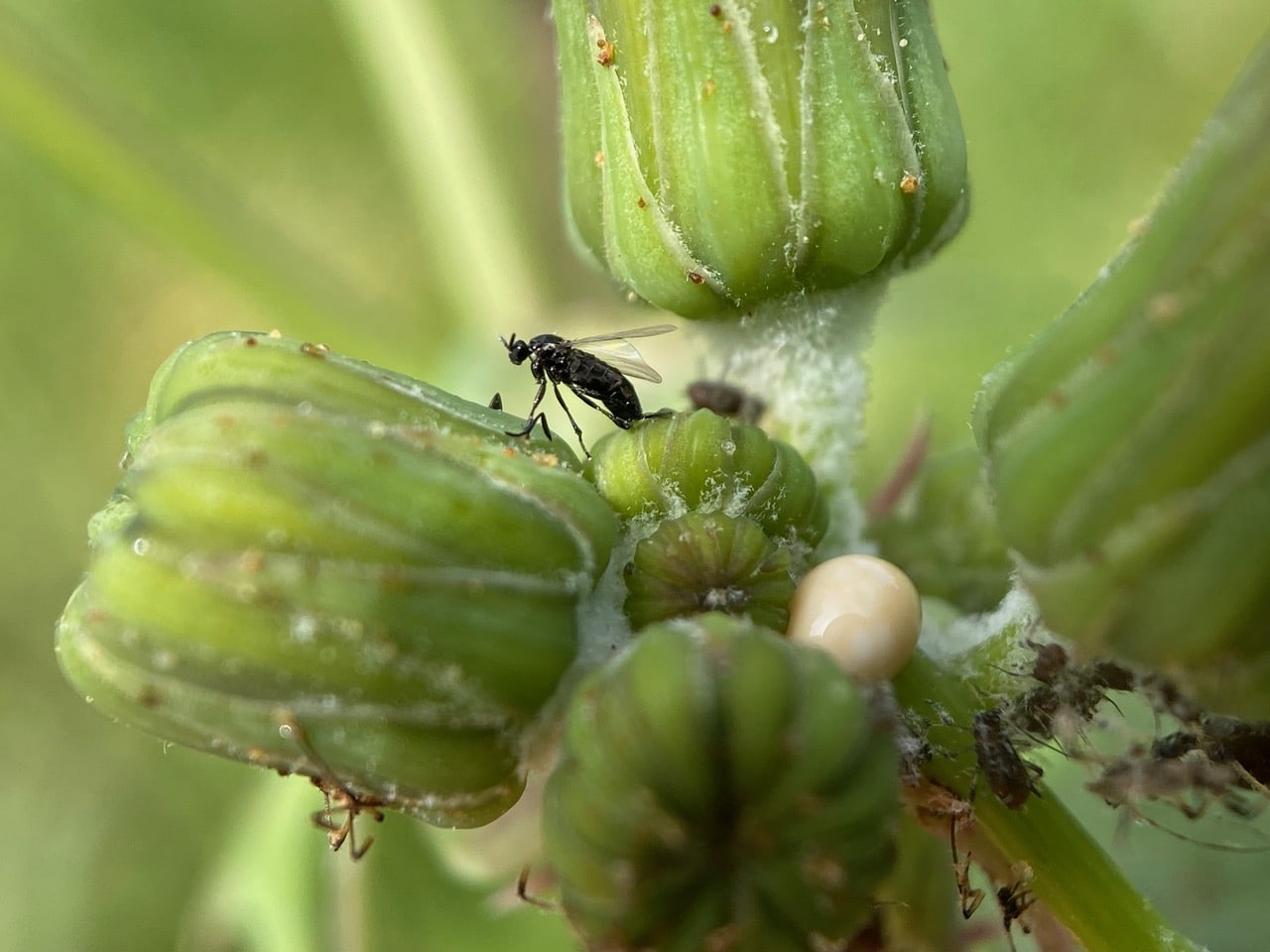
A tiny black insect is perched on immature Sow Thistle flowerheads littered with aphid debris. It is a Minute Black Scavenger Fly (family Scatopsidae).
As implied by the family name, these flies are also called “dung midges”. They are generally small, sometimes minute, dark flies (from 0.6 to 5 mm) with short antennae. Adults are often found on flowers. The larvae of most species are unknown, but the few that have been studied have a rather flattened shaped and are terrestrial and saprophagous, feeding on decaying plant and animal matter.