

Pollinator Post 4/13/26 (1)

After a weekend of cold, rainy weather, Fred and I are happy to be back walking at Bay Farm this afternoon. It is clear and sunny, and rather windy.
 Braving the brisk winds, several worker Yellow-faced Bumble Bees, subgenus Pyrobombus (genus Bombus, family Apidae) are out foraging on the flowers of Sea Fig, Carpobrotus edulis. The creeping plant with succulent leaves is native to South Africa. It has naturalized in many regions throughout the world, especially those with Mediterranean climate. The species has escaped cultivation and has become invasive, posing a serious ecological problem by forming vast monospecific zones, competing with native plants for nutrients, water, light, and space.
 The flower of Sea Fig is a large, showy, daisy-like yellow blossom with numerous narrow, elongated petals and a central, dense cluster of yellow stamens. The flowers open in the morning in bright sun and close at night. The aromatic flowers are pollinated by bees and beetles, leading to the development of edible, fleshy yellow fruits.

This Yellow-faced Bumble Bee has a sizable load of pollen in her pollen baskets (corbiculae).
The pollen collecting apparatus in Apidae bees, which include honey bees and bumble bees, is commonly called a “pollen basket” or corbicula. This region is located on the tibia of the hind legs and consists of hairs surrounding a concave region. After the bee visits a flower, she begins to groom herself and brushes the pollen down toward her hind legs and packs the pollen into her pollen basket. A little nectar mixed with the pollen keeps it all together like putty, and the stiff hairs surrounding the pollen basket hold it in place. Remarkably bees are able to fly while carrying up to a third of their body weight in pollen.
.jpg)

A green Hemipteran nymph is perched on a Catsear leaf. Note the short wing pads. The nymph is probably a juvenile Western Tarnished Plant Bug, Lygus hesperus (family Miridae) so common around here lately.
Commonly referred to as Lygus Bugs, the species is a serious pest on strawberry in the Central Coast of California. Adults are about 6 mm long, oval and rather flattened. They are greenish or brownish and have reddish-brown markings on their wings. In the center of their back is a distinct, bur small, yellow or pale green triangle that helps distinguish them from other insects. The cunei (singular cuneus), triangular-shaped areas near the end of the forewings are translucent, blending with the coloration of surrounding body parts. The immature forms are pale green and resemble aphids. They can be distinguished from aphids by their more rapid movements.
In general the Lygus Bug’s abundance is highest after winters of higher rainfall. This causes more lush grows of vegetation such as mustards and other weeds that support a higher abundance and survival of the bugs during the winter and spring. Damage to crops and garden plants are caused by the bugs’ piercing-sucking mouthparts that extract fluids from the plant tissues.
Insect larvae are called nymphs when they undergo incomplete metamorphosis (hemimetabolism), meaning they resemble smaller, wingless versions of the adult. Unlike larvae that pupate, nymphs gradually develop adult features through several stages (instars) and molt directly into adults, rather than transforming completely in a pupal stage.


This is my favorite spot along this stretch of the trail where I usually spend the most time. The two species of California native shrubs, Coyote Brush (Baccharis pilularis) and Coffeeberry (Frangula californica) are host to numerous insects, and it’s always fun to look for Anise Swallowtail caterpillars on the Fennel.
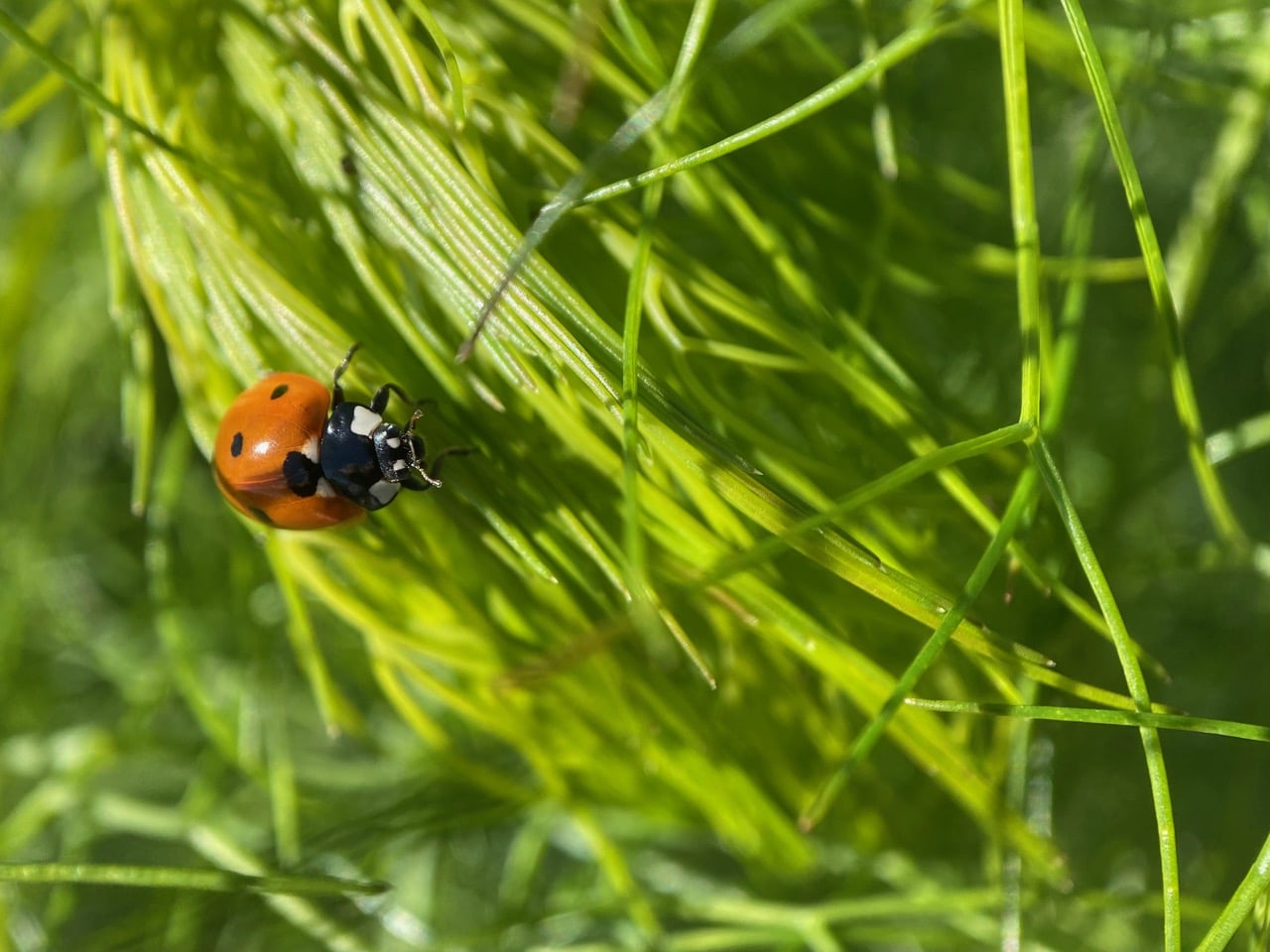
A Seven-spotted Lady Beetle, Coccinella septempunctata (family Coccinellidae) is moving on the tender young leaves of Fennel.
Native to Europe, the Seven-spotted Lady Beetle, Coccinella septempunctata (family Coccinellidae) has been repeatedly introduced to North America as a biological control agent to reduce aphid numbers. It has since spread to many states, where it has outcompeted some native species, including the Coccinella. The Seven-spotted Ladybeetles are large; adults may reach a body length of 0.5 in. Their distinctive spots and conspicuous colors warn of their toxicity, making them unappealing to predators. When threatened, the beetles can secrete a fluid from joints in their legs which gives them a foul taste.

The poor Coyote Brush, Baccharis pilularis is riddled with reddish-purple raised spots on its leaves. These are galls induced by the Baccharis Leaf Blister Mite, Aceria baccharipha (family Eriophyidae).
Eriophyid Mites are microscopic mites that often go undetected. Unlike most adult mites that have four pairs of legs, eriophyid mites have only two pairs. They are slow-moving, usually white or yellow in color, and have a distinctive “carrot” shape. They are very host-specific. Most eriophyid mites make their home on the surface of leaves where their feeding can cause bronzing or reddening but some are also responsible for creating galls on leaves or witches’-broom on stems and flower buds. Adult females overwinter in cracks and crevices of twigs and bud scales. Females lay eggs in the spring. The young mites that hatch out resemble the adults. Numerous generations are produced each year. They are primarily spread by wind.
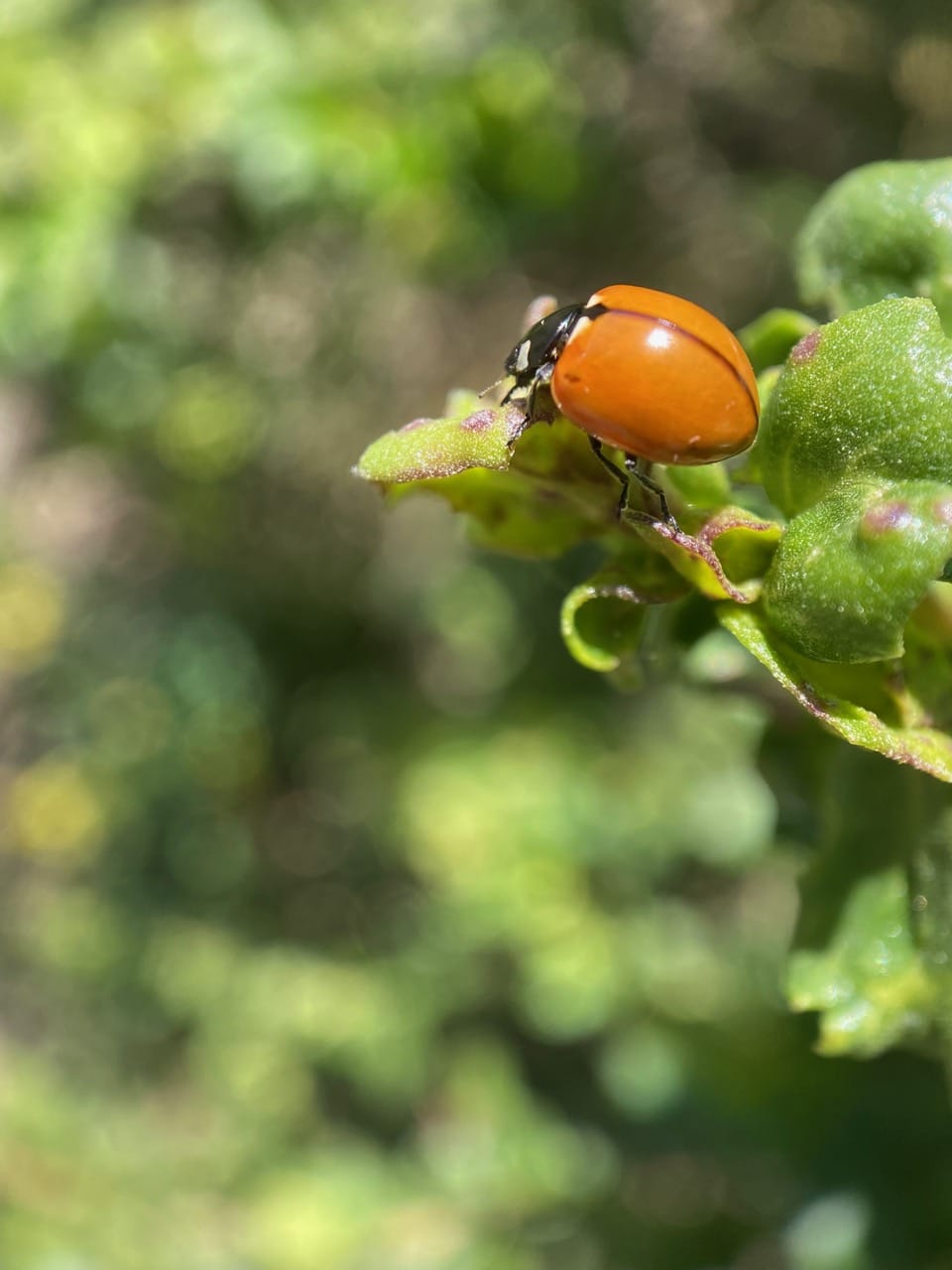
A California Lady Beetle, Coccinella californica (family Coccinellidae) is investigating the Baccharis leaves with the mite galls. Lady beetles eat mites and other small soft-bodied insects besides aphids.

The California Lady Beetle, Coccinella californica has a red elytra that is usually spotless. Pronotum is black with a white patch on each side. Head is black with two small white spots between the eyes. There is a black suture (where the wings meet, down the middle of the back). The species’ range is the coastal counties north of the Transverse Ranges. Both adults and larvae are voracious predators of aphids and other soft-bodied insects.

A Lady Beetle larva is resting on Baccharis leaf.
Lady beetle larvae, often called “miniature alligators”, are voracious, black, spiky, and orange-spotted insects that consume hundreds of aphids during their development. They serve as crucial, high-appetite biological control agents for gardeners before transforming into their familiar spotted adult forms.
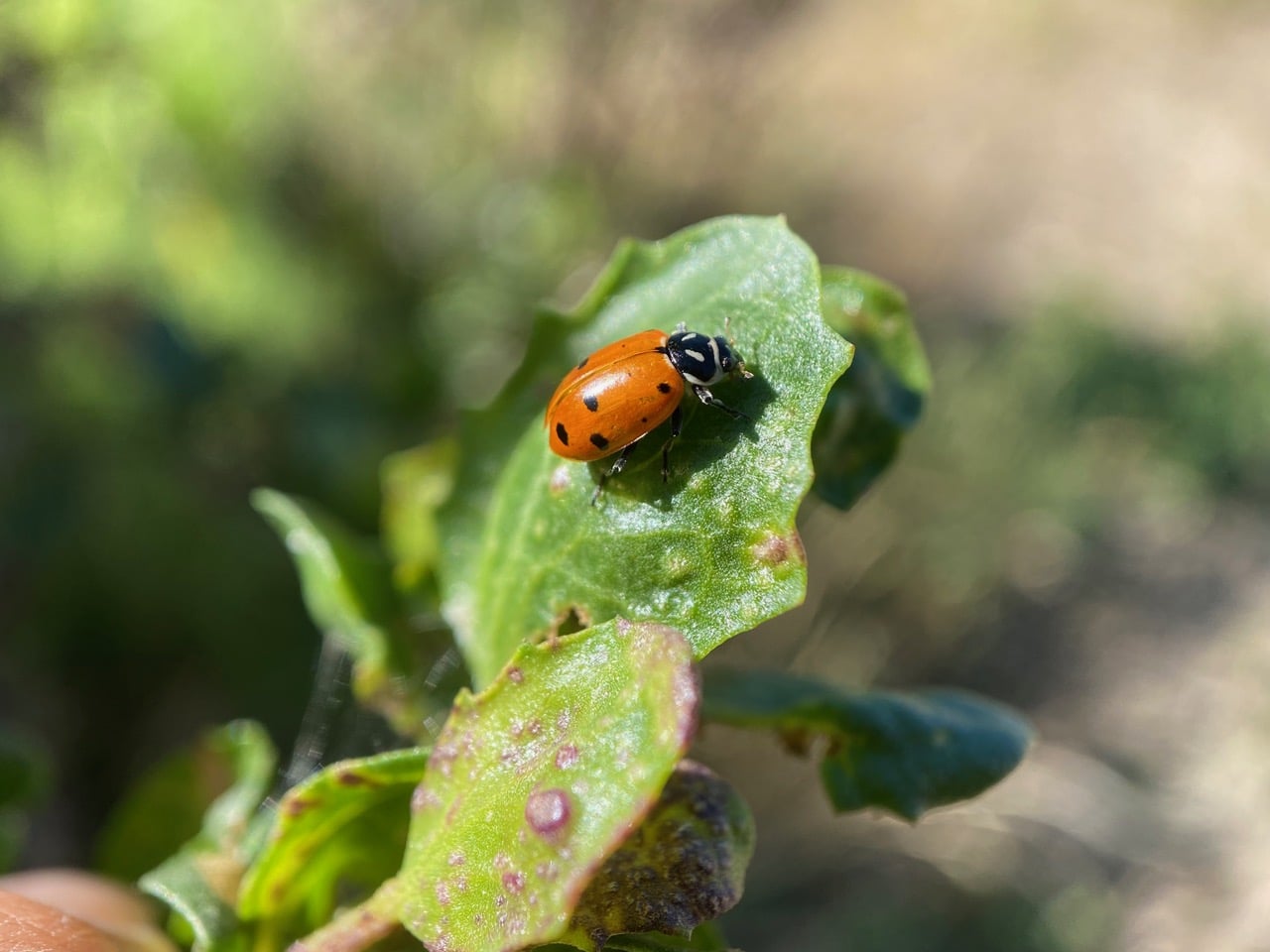
Running away from my camera, a nervous Convergent Lady Beetle, Hippodamia convergens ends up on a terminal Baccharis leaf.
The Convergent Lady Beetle, Hippodamia convergens (family Coccinellidae) is one of the most common lady beetle species in North America, widely recognized for its role in biological pest control. Both the adult and larval beetles are voracious predators of aphids and other soft-bodied insects. These beetles are found across various habitats, including forests, grasslands, and suburban gardens. The beetles are dome-shaped, typically measuring 4-7 mm in length. They are named for the two white markings on the thorax that angle toward each other. The orange-red elytra are usually marked with varying numbers of black spots, but some spotless individuals are sometimes seen. The species is known for distinct migration patterns, often moving from agricultural areas to mountainous regions to overwinter in large aggregations.
While widely sold as a biocontrol agent for gardens and greenhouses, some experts caution against releasing purchased beetles. Purchased beetles are often collected illegally from the wild rather than reared, which can affect native populations in their natural habitats. Additionally, they may leave the release area quickly or introduced pathogens to local lady beetle fauna.
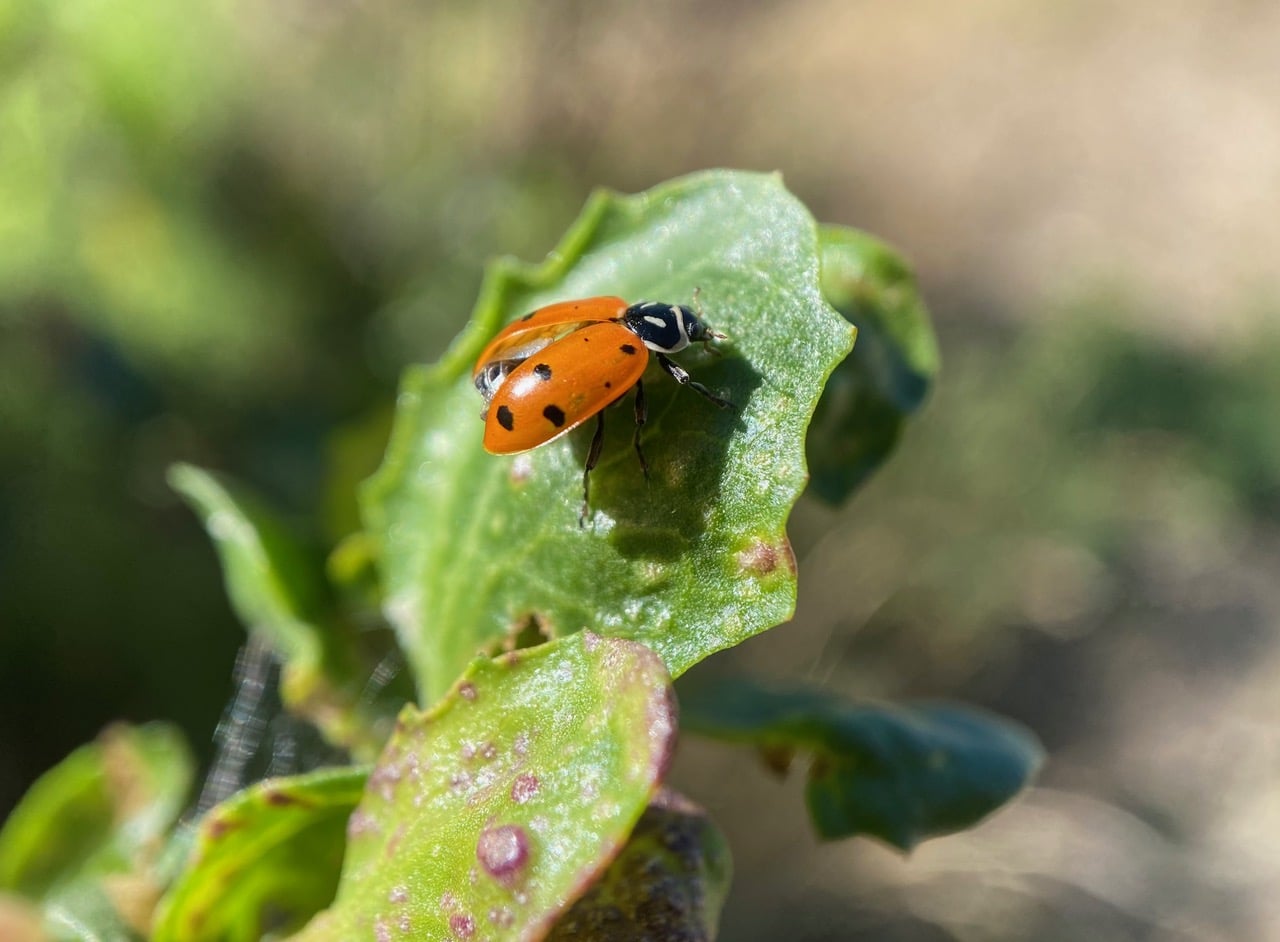
The beetle lifts its elytra, attempting to take flight.

The folded hindwings of the beetle can be seen in this image when it lifts its elytra. Unfortunately the beetle fails to unfurl its hindwings, even after three attempts. I think I know why – it is too cold. Although it is about 58 degrees F, it feels much colder because of the wind chill today. Lady beetles generally are unable to fly when temperatures drop below 50 to 55 F.
Lady beetles take flight by lifting their hardened outer shells (elytra) and unfolding and flapping the delicate hindwings. The hindwings unfold quickly in under one-tenth of a second, while the elytra stay raised when the beetle flies. The hindwings, four times the size of the body, are folded along intricate crease lines and elastic veins to fit into a tiny space under the forewings (elytra) using a complex, spring-loaded, origami-like mechanism. As revealed by high-speed camera, the wings fold into a “Z” shape, allowing them to bend and hinge. This wing-folding mechanism serves as a model for engineers in developing deployable structures, such as solar panels for spacecraft and medical devices.
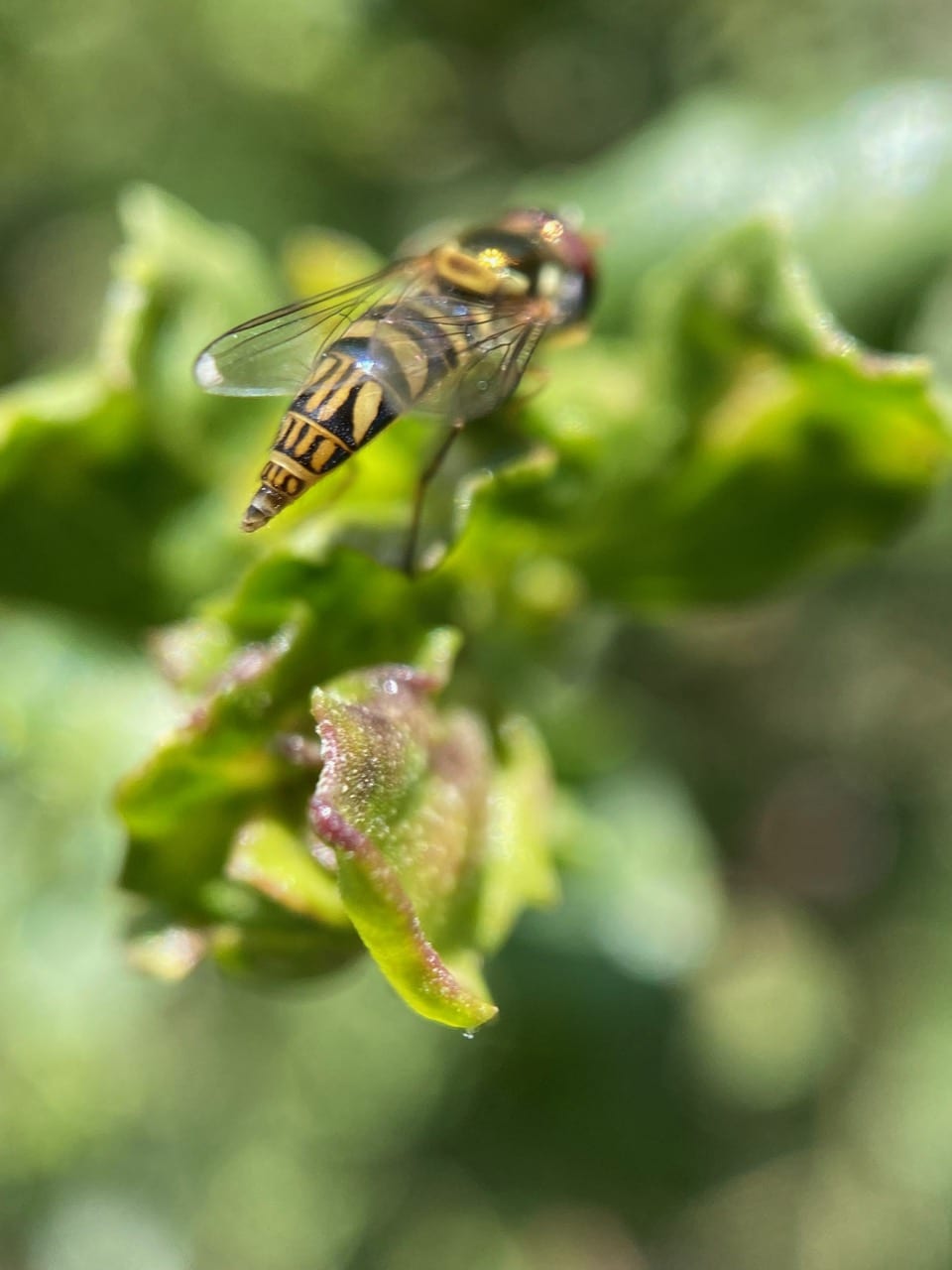
Ooh, that’s the characteristic pattern on the abdomen of an Oblique Streaktail, Allograpta obliqua (family Syrphidae).
Although small in size (6-7 mm long), the Oblique Streaktail is easily recognizable for the unique pattern on its black-and-yellow abdomen. It is a common North American species of hover fly. Adults visit flowers for nectar and pollen, and are pollinators. Females lay eggs on plant surfaces near aphids. Larvae feed on the aphids.
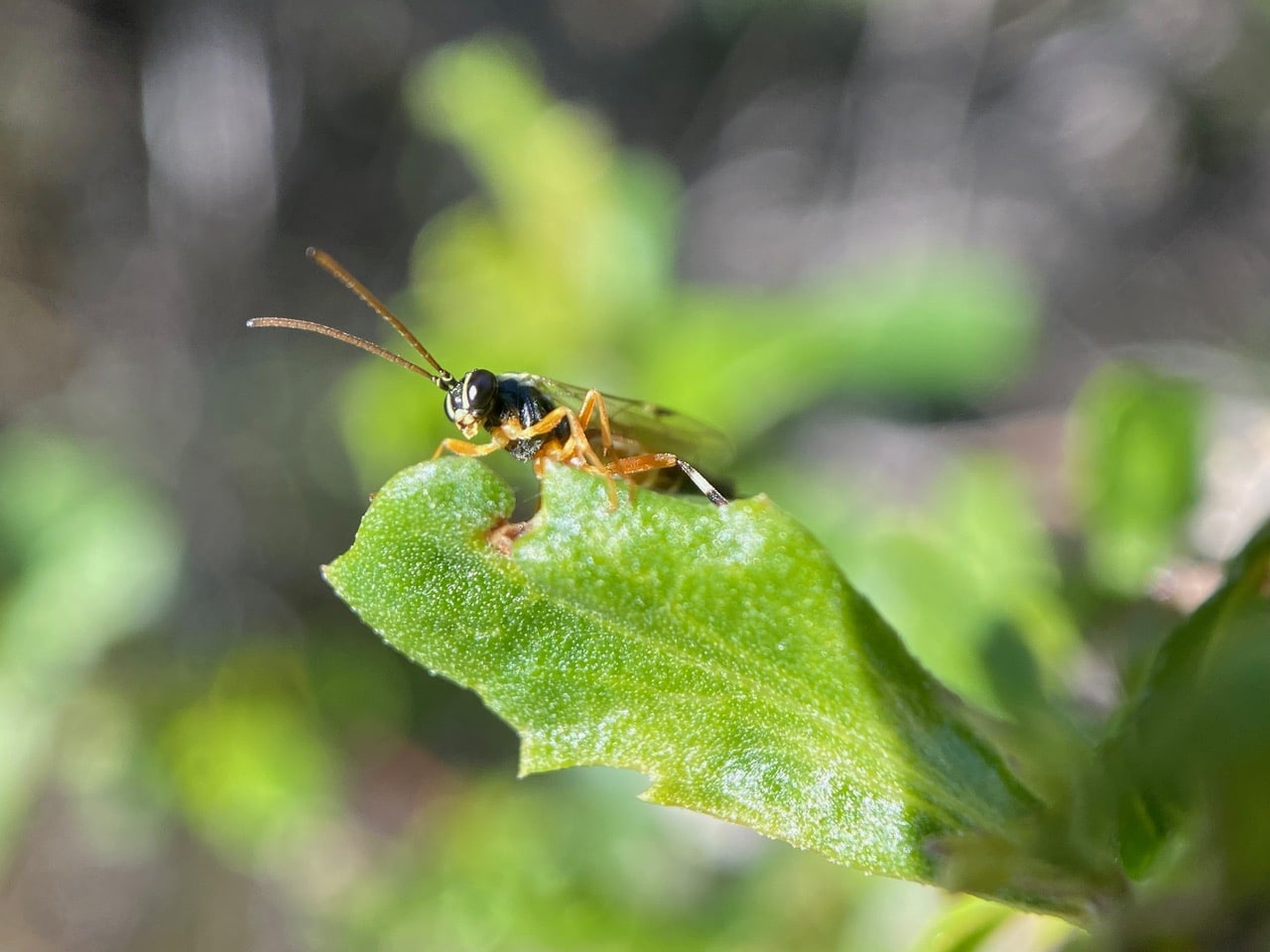
A wasp with long antennae is peering over a Baccharis leaf. Note the black-and-white bands on its hind legs. Those are useful field marks identifying the Common Hover Fly Parasitoid Wasp, Diplazon laetatorius (family Ichneumonidae).

The Common Hover Fly Parasitoid Wasp, Diplazon laetatorius is a member of the Ichneumonid wasp family and is 4-7 mm long. The body is mostly black; front two pairs of legs are orange, while the hind legs are highly distinctive and key for identification, featuring a tricolored pattern of black, white and orange. The species has a wide geographic range, from the Canadian Arctic to Argentina, Norway to South Africa, and Japan to New Zealand. Human agriculture is thought to have spread it along with aphids and syrphid flies. Adults feed on floral nectar, with a preference for flowers in the Apiaceae family. Females lay their eggs on or near the eggs and larvae of hover flies (family Syrphidae). The developing parasitoid larvae consume the host from within, eventually completing development and emerging as adult wasps.
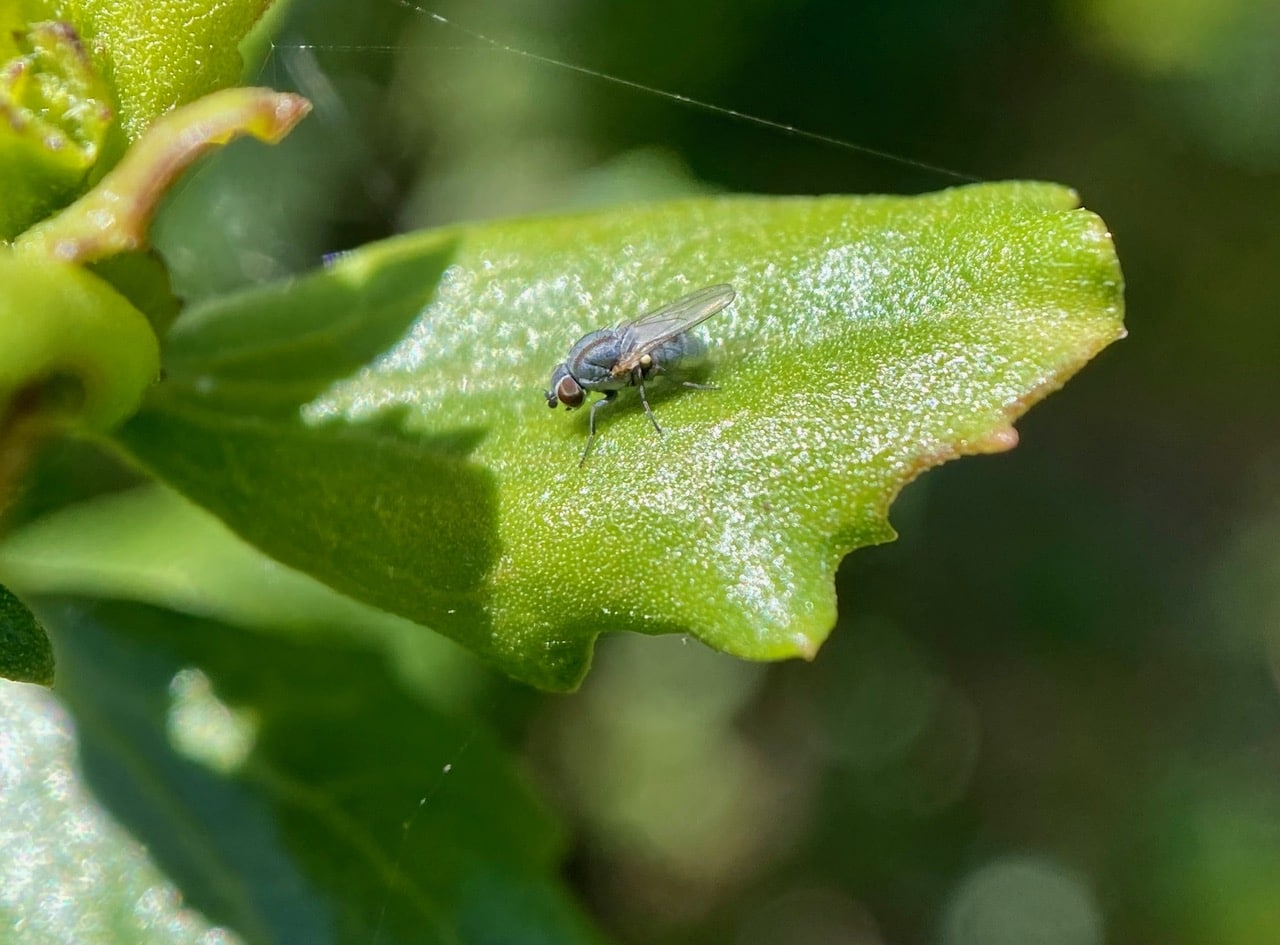
A tiny fly is perched on a Baccharis leaf. Closing in with my macro lens, I recognize it to be an Aphid Fly, Leucopis sp. (family Chamaemyiidae).
The Chamaemyiidae are a small family of acalyptrate flies with less than 200 species described worldwide. Members of the genus Leucopis (aphid flies) are very small, measuring approximately 2-4 mm in length. These grayish flies often have black abdominal spots. The larvae are active and predatory and are often used for biological control of aphids, scale insect, mealybugs, and similar pests. The predatory maggots, about 3 mm long and yellowish, are often found within colonies of their prey, moving slowly with a wrinkled appearance and distinct, two-stalked breathing tubes (spiracles) at their rear.
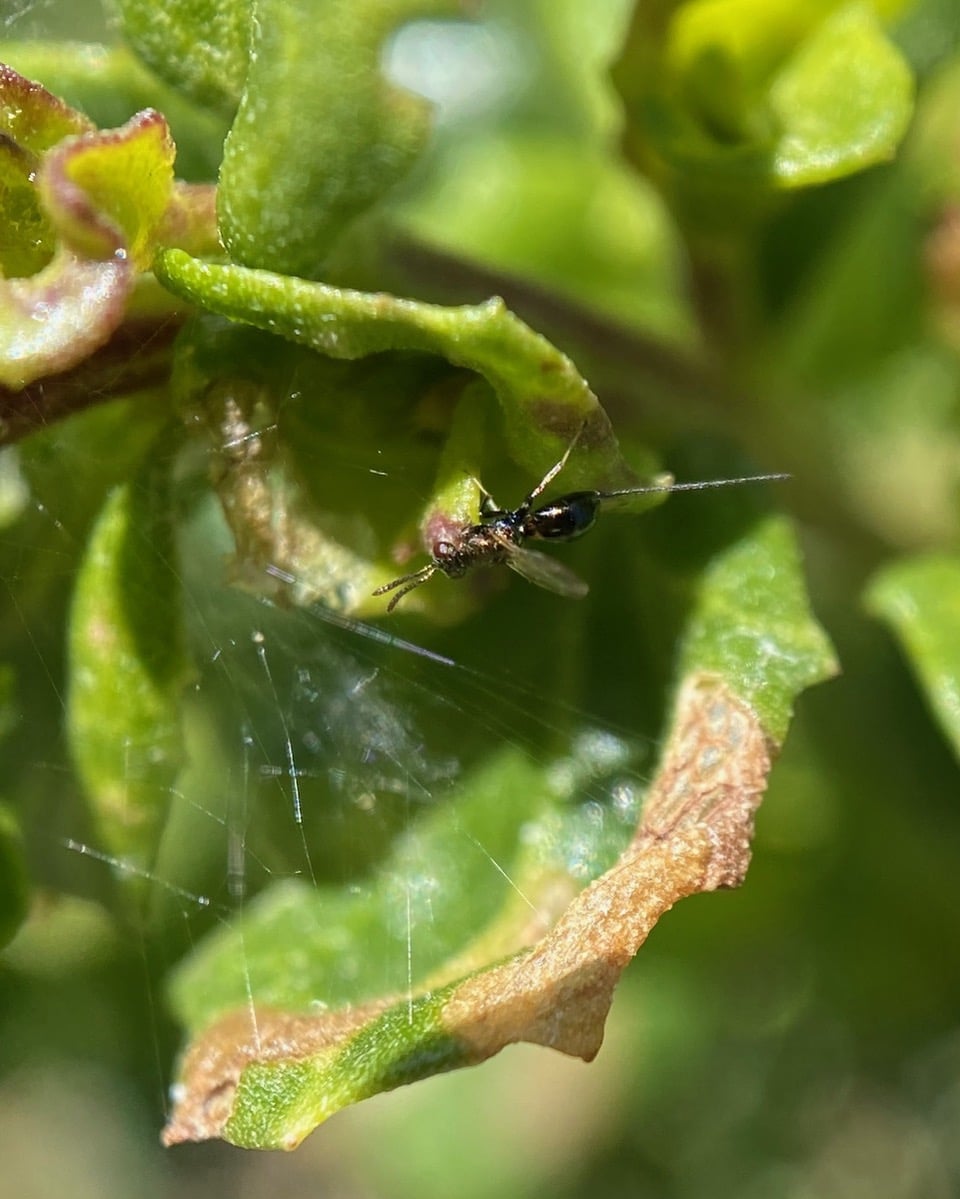
A tiny, shiny black wasp is investigating the damaged terminal leaves of the Coyote Brush that is covered with a matrix of silk. Her ovipositor is the length of her body! Is she here seeking a host (caterpillar?) in which to lay her eggs? iNaturalist has helped identify the wasp as a member of the superfamily, Chalcidoidea.
Most Chalcid species are parasitoids of other insects, attacking the eggs or larval stage of their host, though many other life cycles are known. These hosts are to be found in at least 12 different insect orders including Lepidoptera (butterflies and moths), Diptera (true flies), Coleoptera (beetles), Hemiptera (true bugs), and other Hymenoptera, as well as two orders of Arachnida. When the host is itself a parasitoid, the wasps are referred to as hyperparasitoids. Generally beneficial to humans as a group, chalcidoids help keep various crop pests under control, and many species have been used as biocontrol agents.