

Pollinator Post 3/10/26 (2)

A Mason Wasp, Ancistrocerus bustamente (family Vespidae, subfamily Eumeninae) is flying low over the Coyote Brush, Baccharis pilularis, stopping occasionally to investigate around the foliage, apparently hunting for prey.
Potter wasps (or mason wasps), the Eumeninae, are a cosmopolitan wasp group presently treated as a subfamily of Vespidae. Most eumenine species are black or brown, and commonly marked with strikingly contrasting patterns of yellow, white, orange, or red. Their wings are folded longitudinally at rest. Eumenine wasps are diverse in nest building. The Mason Wasps are species that generally nest in pre-existing cavities in wood, rock, or other substrate. Potter Wasps are the species that build free-standing nests out of mud, often with a spherical mud envelope. The most widely used building material is mud made of a mixture of soil and regurgitated water.
All known Eumenine species are predators, most of them solitary mass provisioners. When a cell is completed, the adult wasp typically collects beetle larvae, spiders, or caterpillars and, paralyzing them, places them in the cell to serve as food for a single wasp larva. As a normal rule, the adult wasp lays a single egg in the empty cell before provisioning it. The complete life cycle may last from a few weeks to more than a year from the egg until the adult emerges. Adult mason wasps feed on floral nectar.
The Mason Wasp, Ancistrocerus bustamente (family Vespidae, subfamily Eumeninae) is found in western North America and Mexico. The species frequents arid areas, and nests in pre-existing cavities (e.g. old borings in wood, hollow stems, rock crevices) and use mud for partitions between brood cells. The wasps have been known to nest in Sambucus (Elderberry) stems. The name of the genus means “hooked horn” for the back-curved last segments of the antennae characteristic of the males.

A tiny wasp is grooming itself on a terminal leaf of the Coyote Brush. For its size, I immediately think of a parasitoid wasp. A Chalcid Wasp (superfamily Chalcidoidea)?
Most Chalcid species are parasitoids of other insects, attacking the eggs or larval stage of their host, though many other life cycles are known. These hosts are to be found in at least 12 different insect orders including Lepidoptera (butterflies and moths), Diptera (true flies), Coleoptera (beetles), Hemiptera (true bugs), and other Hymenoptera, as well as two orders of Arachnida. When the host is itself a parasitoid, the wasps are referred to as hyperparasitoids. Generally beneficial to humans as a group, chalcidoids help keep various crop pests under control, and many species have been used as biocontrol agents.
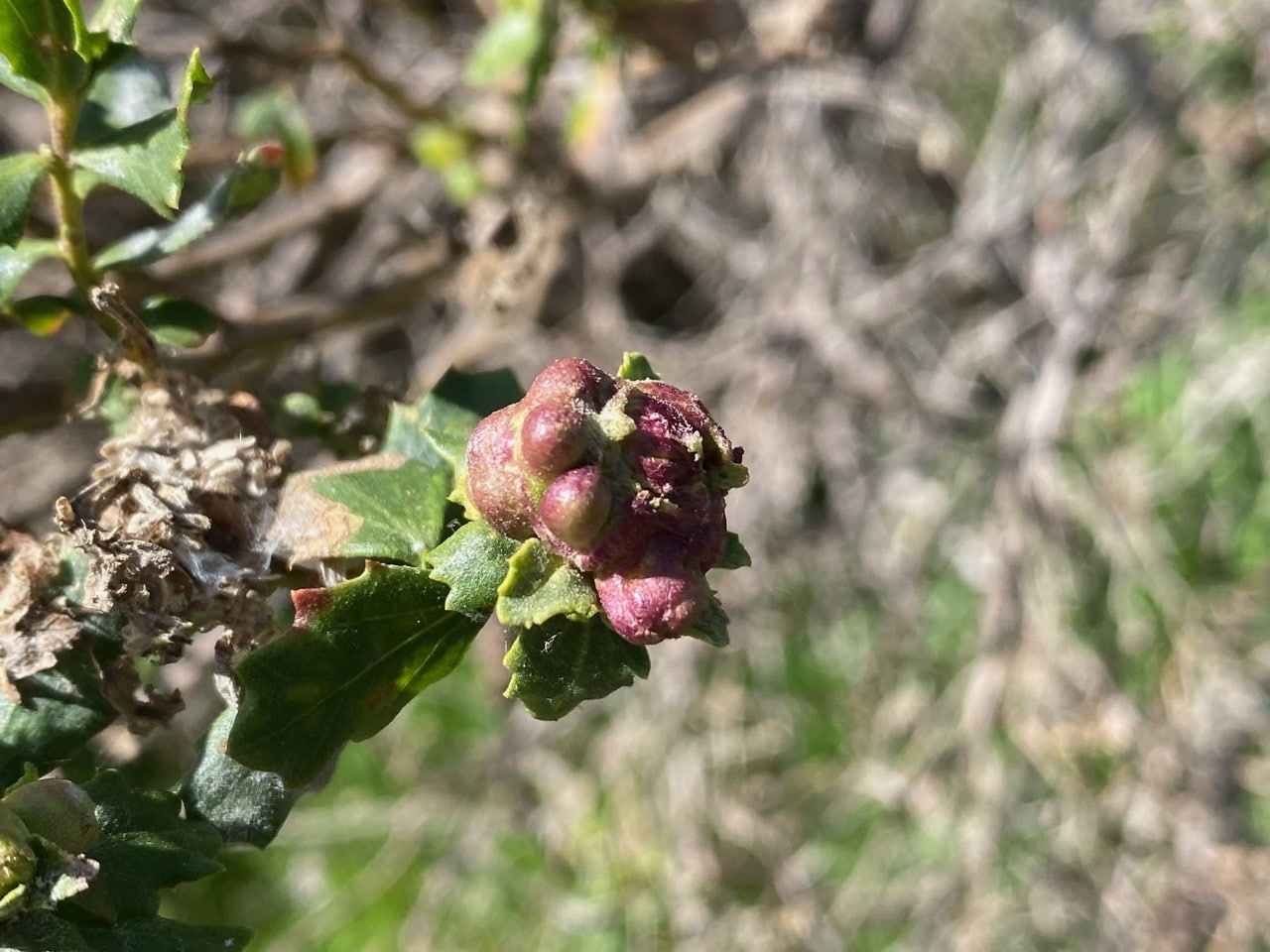
Under attack from various moth caterpillars, the weakened Coyote Brush has produced rather small galls induced by the Coyote Brush Bud Gall Midge.
The Coyote Brush Bud Gall Midge, Rhopalomyia californica lays eggs into the flowerbuds of Baccharis pilularis, inducing lumpy, fleshy galls. Female midges lay clusters of eggs on terminal buds. The larvae that hatch out burrow between bud scales and commence feeding. The gall tissue swells around each of the larvae. When fully grown, larvae burrow to the surface of the gall, where they develop their partially protruding white cocoons and pupate. Adults look like miniature mosquitoes. The species, Rhopalomyia californica (family Cecidomyiidae) represents one of the rare situations among all gall insects where fresh galls and emergence of adults occur throughout the year.
Species Rhopalomyia californica – Coyote Brush Bud Gall Midge – BugGuide.Net
Coyote Brush Bud Gall Midge (Rhopalomyia californica) · iNaturalist
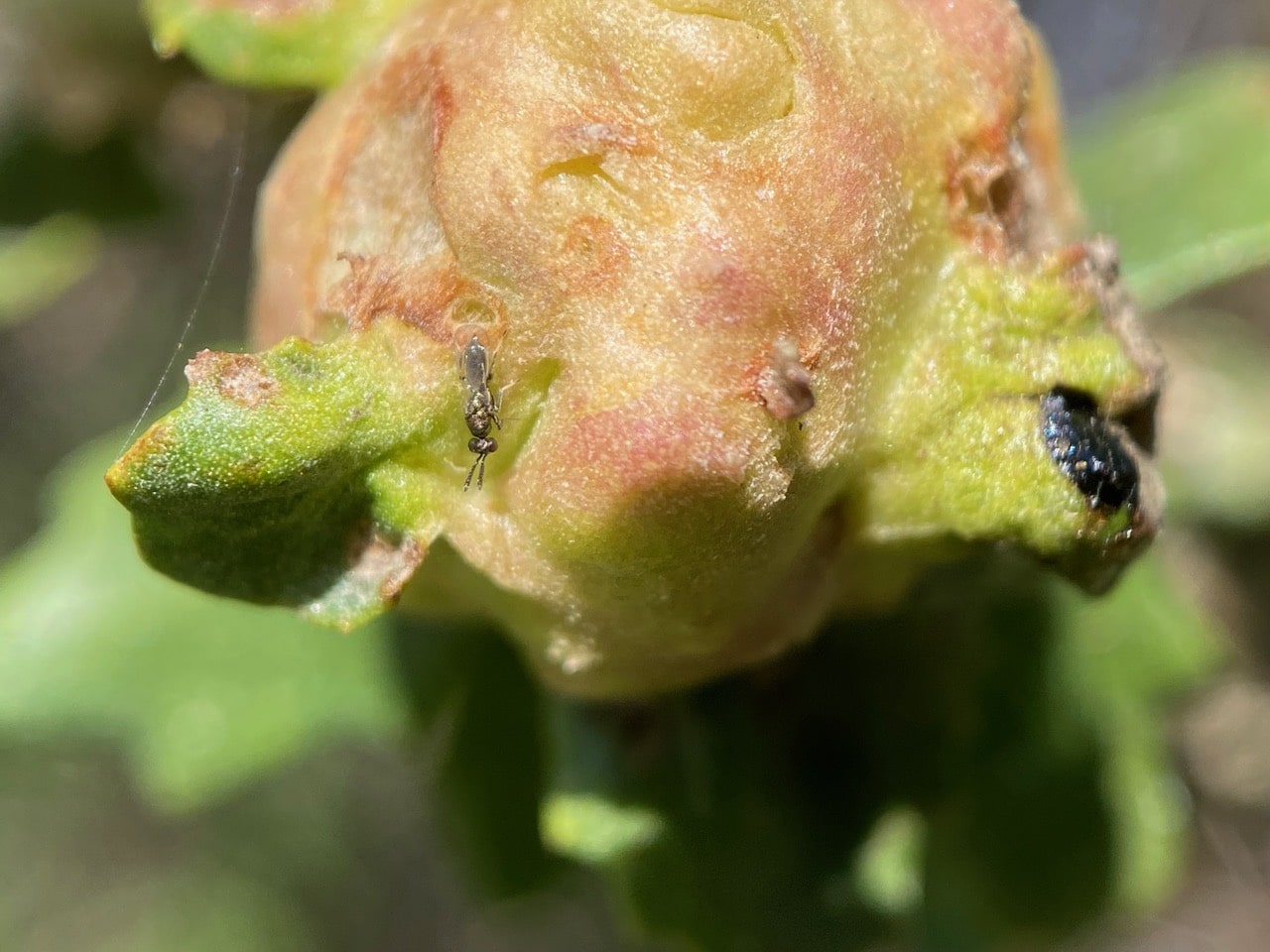
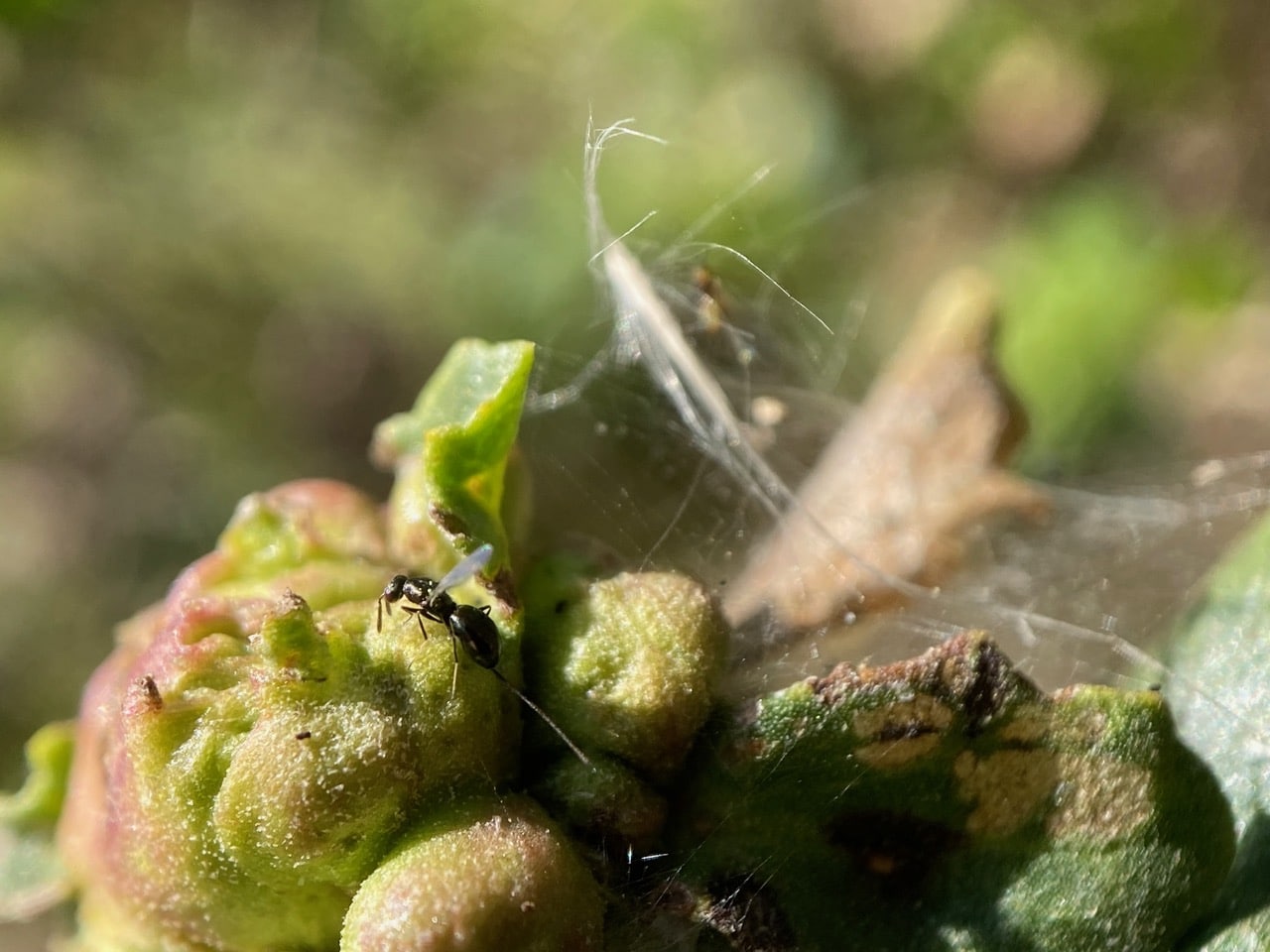
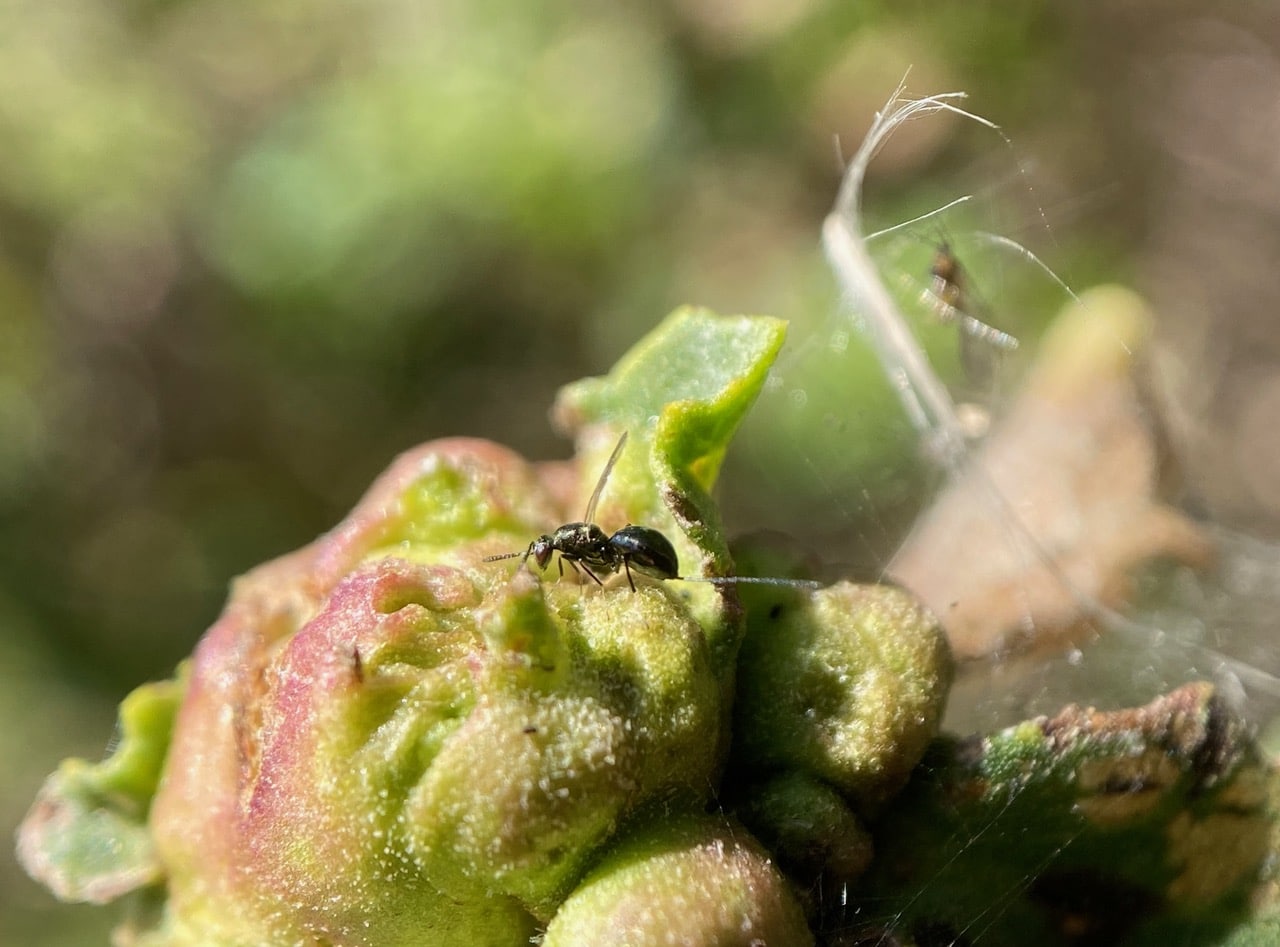
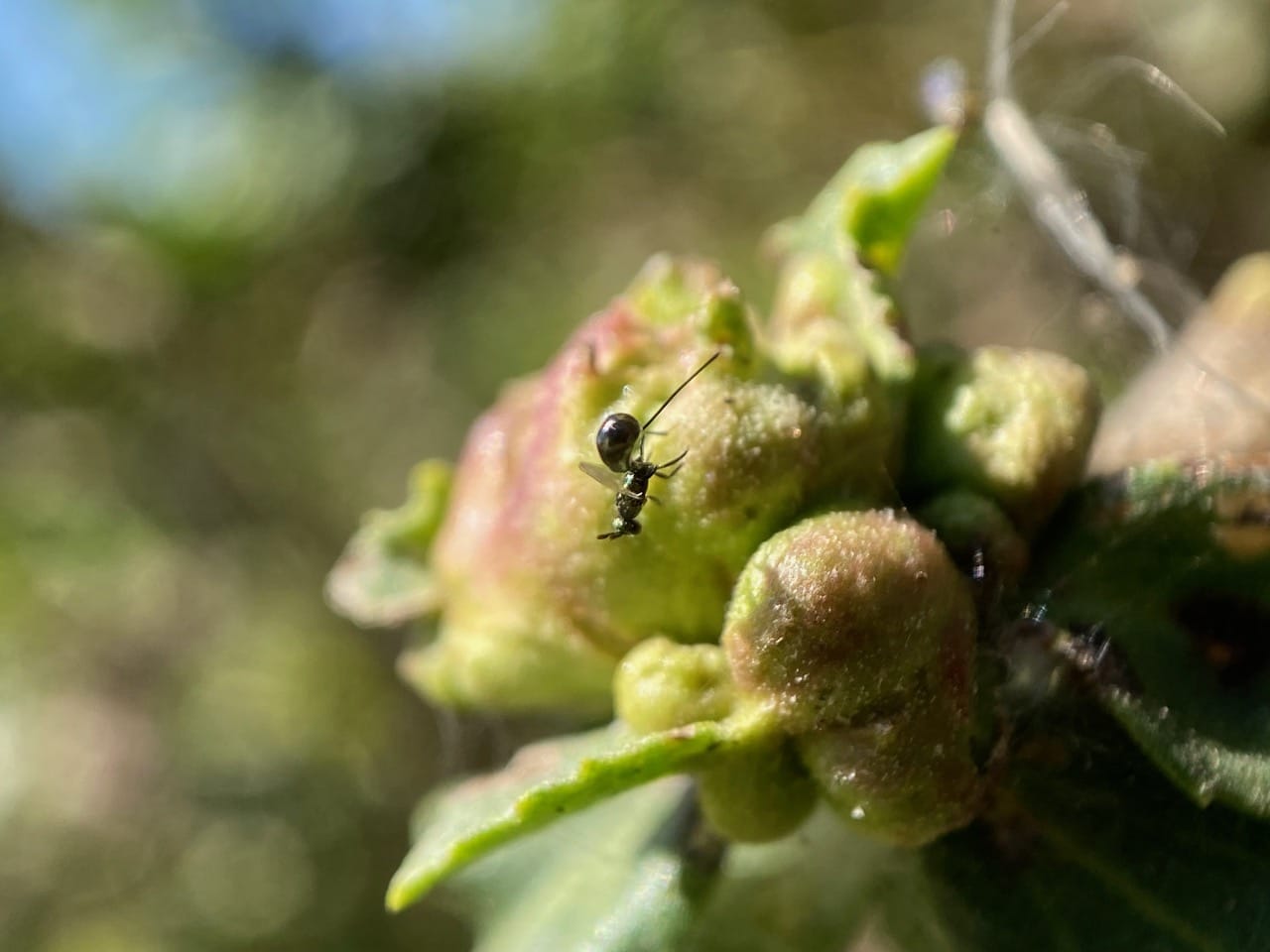


Look, a tiny wasp is exploring a Coyote Brush Bud Gall. It is probably a parasitoid wasp in the superfamily Chalcidoidea, also called a Chalcid wasp.
Whoa, check out the ovipositor of that wasp! It is the length of the wasp’s body! Her antennae lowered to the Coyote Brush Bud Gall, she is probably searching for a place to lay her eggs.
Chalcid Wasps inject eggs into hidden prey, such as larvae inside wood or plant tissue, using a highly specialized, needle-like ovipositor that functions as a flexible, high-tech drill. They often use vibrations or chemical cues to locate hosts, then drill through the barrier, injecting venom to immobilize the prey before laying eggs.
After exploring the surface of the gall for a while, the female wasp is finally unsheathing her ovipositor. She is ready to lay her egg!
The ovipositor of Chalcid Wasps are protected by a flexible, two-piece sheath (3rd valvulae) that cover and protect the delicate, needle-like egg-laying shaft (terebra) when it is not in use. Consisting of two interlocking pieces, the sheaths are part of the abdominal appendages. The sheaths are not usually inserted into the substrate but instead act as guides to stabilize the ovipositor during drilling, preventing it from buckling or breaking. During oviposition, the sheath separates, allowing the drill-like, serrated ovipositor to penetrate. The inner surface of the sheaths often contains microscopic structures (micro setae) that help clean the ovipositor between uses.
There, if you squint hard enough, you can see the hair-thin ovipositor under the body of the female wasp as she bears down to drill it into the gall. The two-parted sheath has gone back to its original position
Female parasitoid wasps inject eggs through substrates (wood, fruit, gall, leaves) using a highly specialized, needle-like appendage called an ovipositor. This organ consists of three sliding, serrated valves that move alternatively to drill, cut, or saw through material. The flexible ovipositor acts as a precision probe, capable of steering through solid substrates to find hidden hosts. Wasp ovipositors are excellent models for developing surgical drilling tools because they enable efficient, low-force, and steerable penetration of tough materials. Their three-part, interlocking structure allows for independent, alternating movement (reciprocation), reducing friction, steering, and preventing buckling. Researchers are using this to develop flexible surgical needles for minimally invasive procedures.
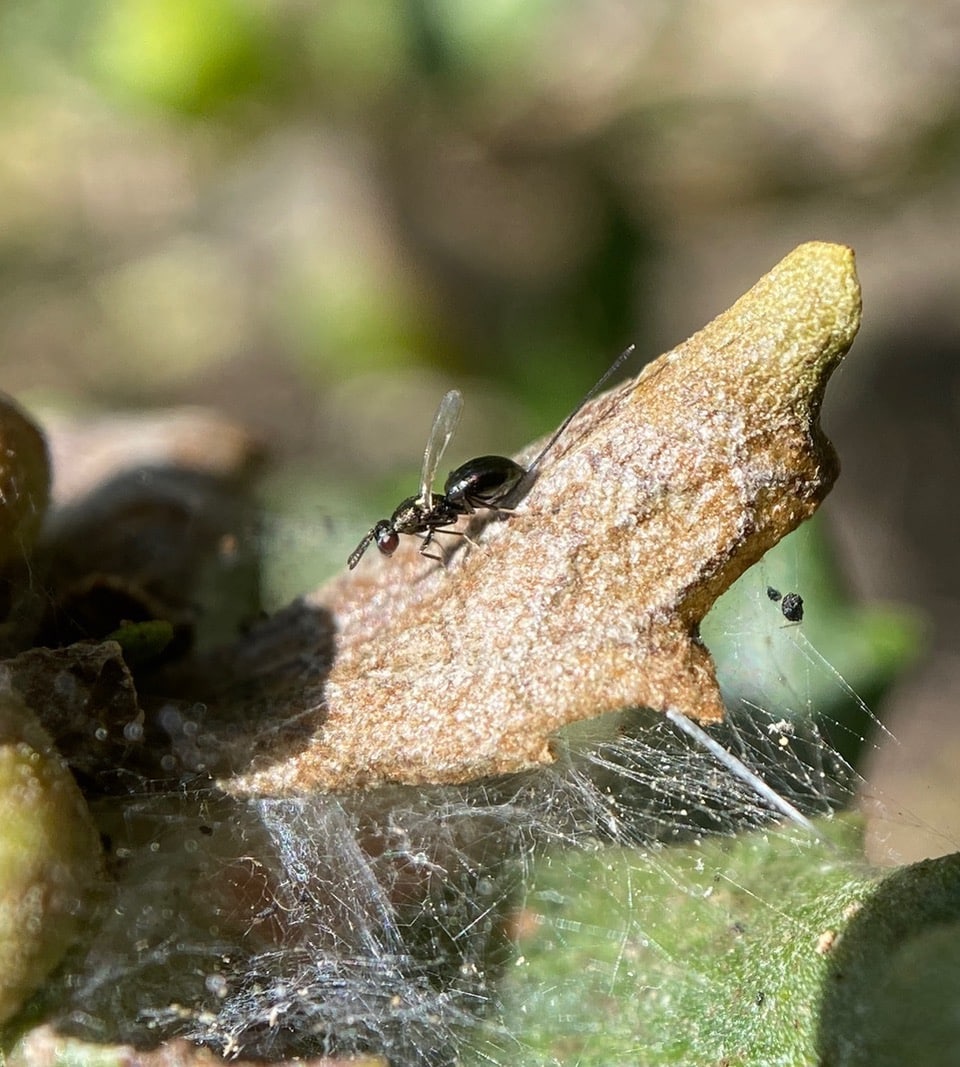
The female disappears for a minute. Then I find her again, resting on a dried leaf next to the gall. What a beauty! iNaturalist has suggested a Chalcid Wasp in the family Torymidae (superfamily Chalcidoidea).
Torymidae is a family of wasps in the superfamily Chalcidoidea. Most species in this family are small with attractive metallic coloration, and females generally have long ovipositors. Many are parasitoids on gall-forming insects, and some are phytophagous (plant-eating) species, sometimes using the galls formed by other insects. Over 960 species in about 70 genera are found worldwide. They are best recognized in that they are one of the few groups of chalcidoidea in which the cerci are visible. Most members of the genus Torymus are ectoparasitoids of gall forming insects, usually gall wasps and gall midges.
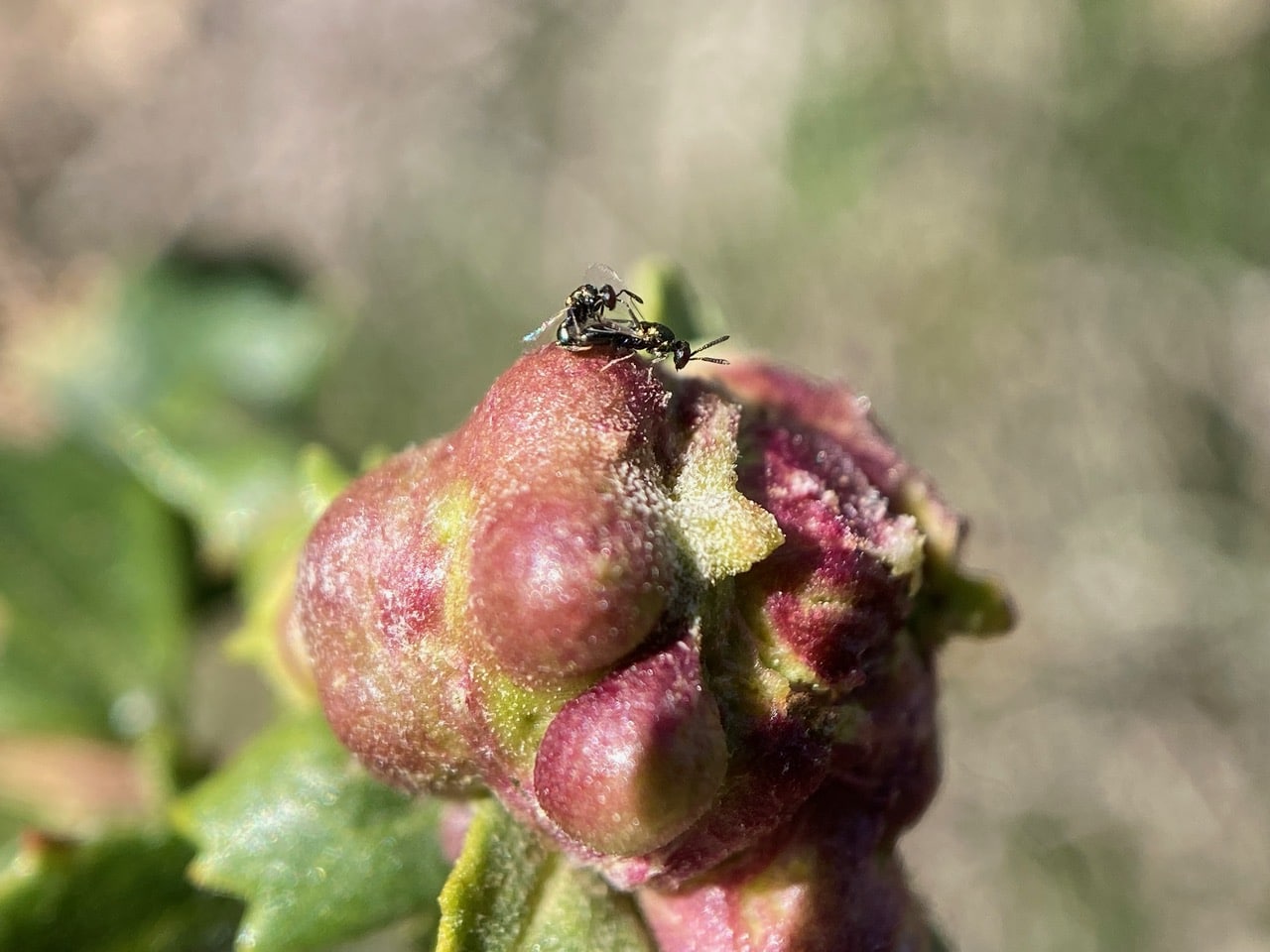
Just when I thought things can’t get any better, I see a pair of these wasps mating on the next Coyote Brush Bud Gall I look at!
Although I didn’t get to collect the moth caterpillars I came for, it has been a wildly exciting and rewarding morning. The living world is full of surprises!