

Pollinator Post 2/28/26 (1)
Our weather seems to have taken a giant leap from winter to summer in a single day. After a series of cold rain, we are now experiencing temperatures in the mid 70s F. I opt for a shady park for today’s walk – Sequoia Arena in the Oakland hills.
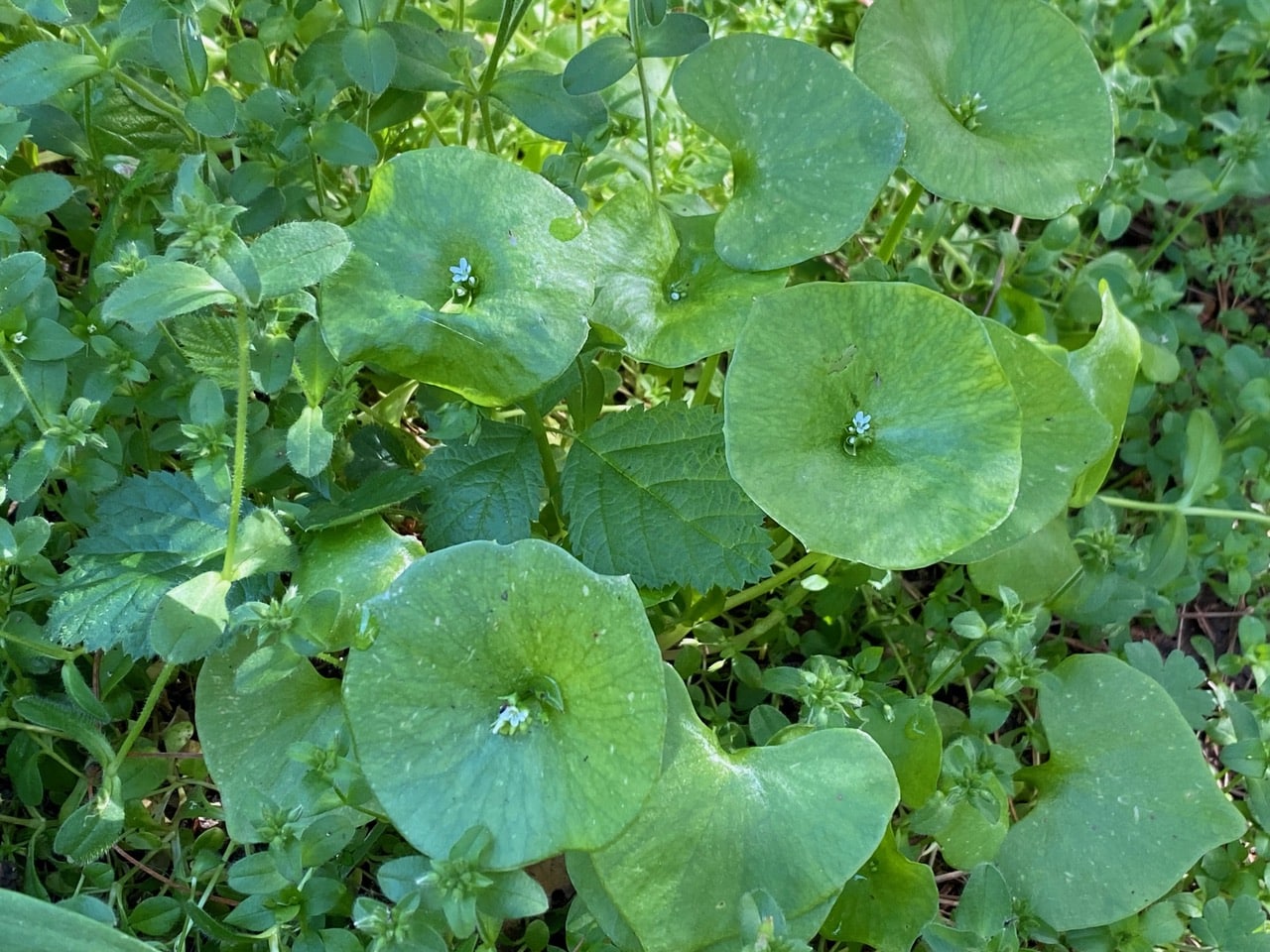
I stop at the small patch of low vegetation by the front gate. Although they look rain-battered and somewhat chlorotic, I am happy to see that the Miner’s Lettuce is now in bloom! Note that this plant has spade-shaped leaves as well as round, perfoliate leaves subtending the sweet little posies of white flowers.
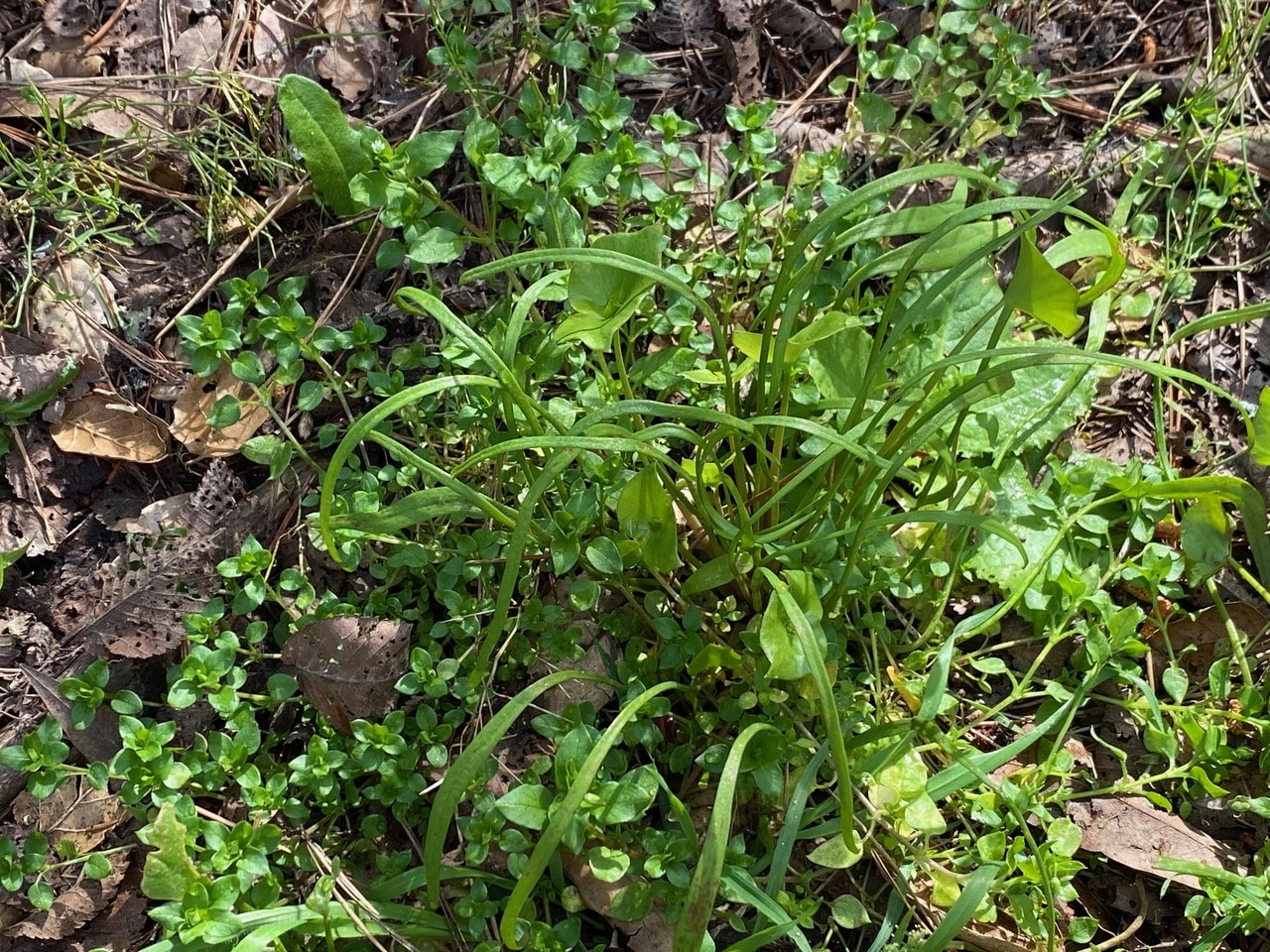
This younger Miner’s Lettuce still has the strap-shaped leaves.
Miner’s Lettuce, Claytonia perfoliata usually puts on three different foliage in succession during its development – strap-hasped, spade shaped, and circular-perfoliate.
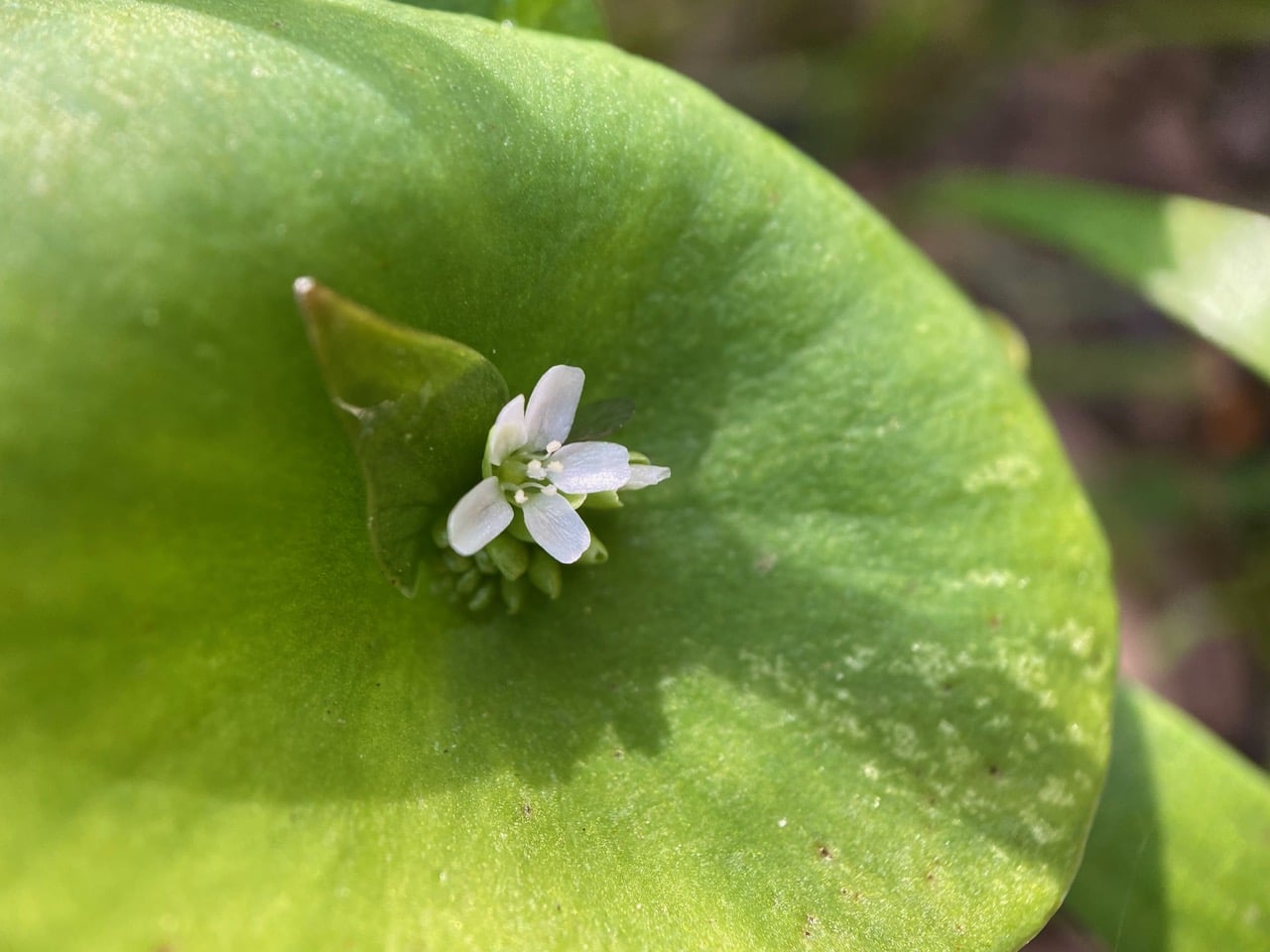
A first flower to open atop a cluster of flower buds in the middle of a perfoliate leaf of Miner’s Lettuce. The perfoliate leaf of Miner’s Lettuce develops as a pair of opposite, spade-shaped leaves that grow together and fuse around the stem, forming a single, cup-like, or circular disk beneath the flower cluster. This mature structure appears to be pierced by the stem, with flowers emerging from the center.
I find it hard to believe that the fusion can be so seamless. How come I can never find a pair of spade-shaped leaves in the process of fusing?
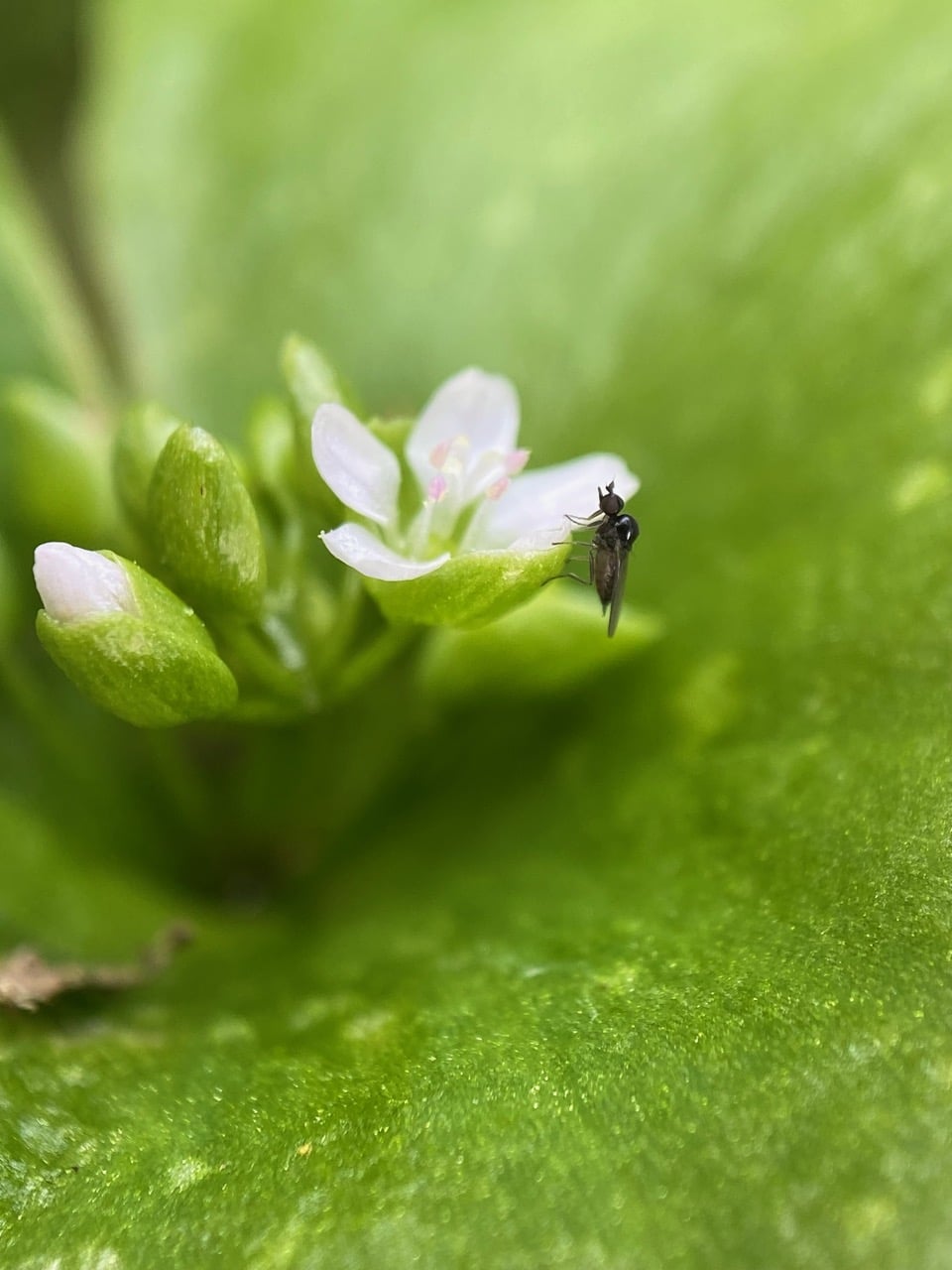
Hey, that’s a Hybotid Dance Fly on the rim of a newly opened Miner’s Lettuce flower.
The Hybotid Dance Flies belong to the superfamily Empidoidea and were formerly included in the Empididae as a subfamily. Empididae generally have a thick beak pointing down, while Hybotidae have a thinner beak, or a thick beak pointing forwards or diagonally. Some crucial wing venation further distinguishes the two families. Precious little is known about the life cycle and biology of Hybotids because they are not considered of economic consequence. Since their forelegs are generally not raptorial, I doubt if they’re predaceous like the Empidids. Some Hybotids are known to eat pollen. I have seen Hybotids visit flowers for nectar and pollen, notably on Soap Plant, Miner’s Lettuce, California Saxifrage, Wild Geranium, Hound’s Tongue and Buttercups, and I believe they may contribute to the pollination of these small wildflowers.
Why the name “dance fly”? This is derived from the mating swarms of males of many species. They gather in clouds over prominent objects, each individual seeming to bounce or “dance” in mid-air. Many other flies do this, notably midges, but the Empidids and the Hybotids got the moniker.
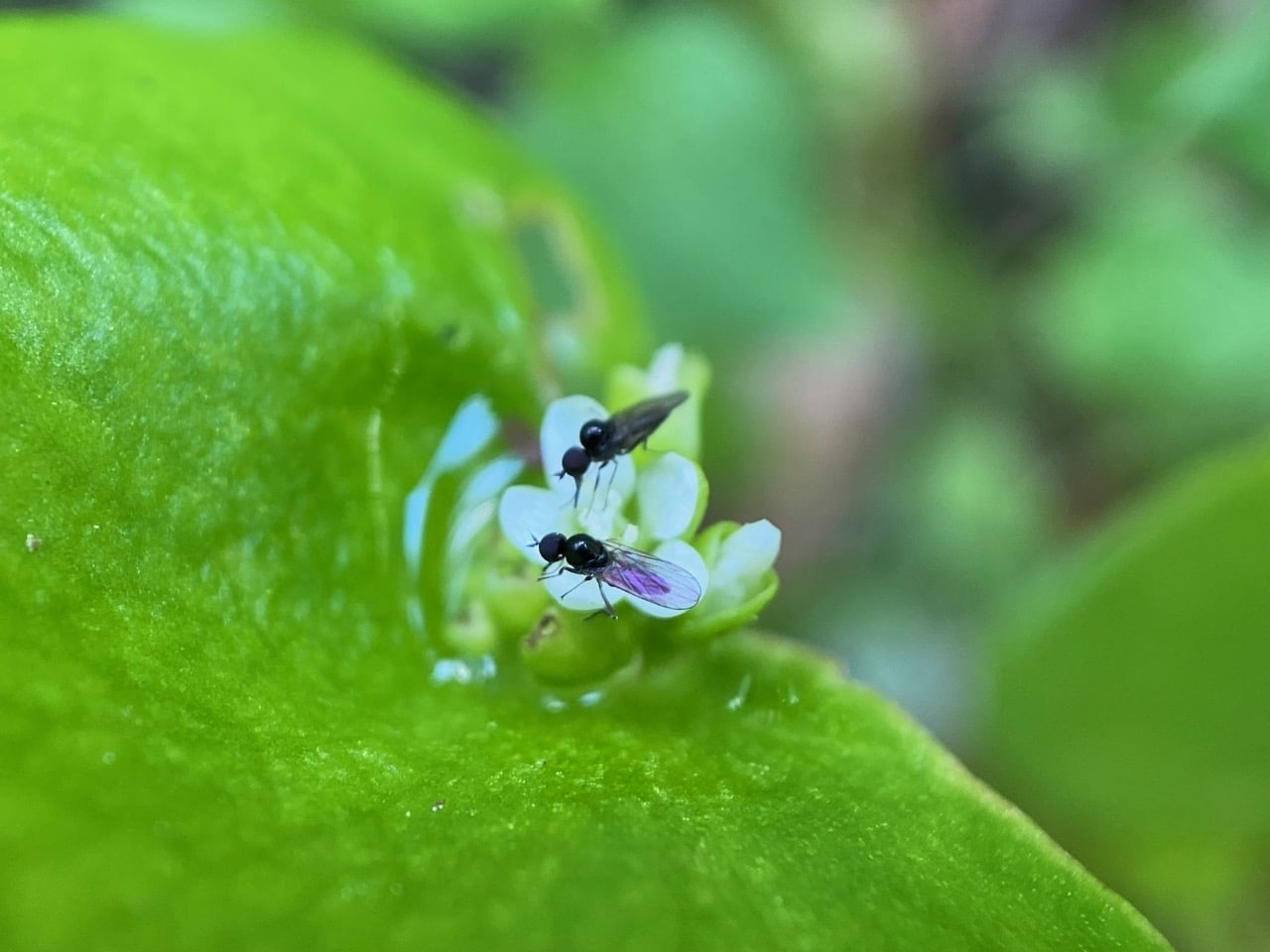
Two Hybotid Dance Flies are foraging on the same Miner’s Lettuce flower in the shade.
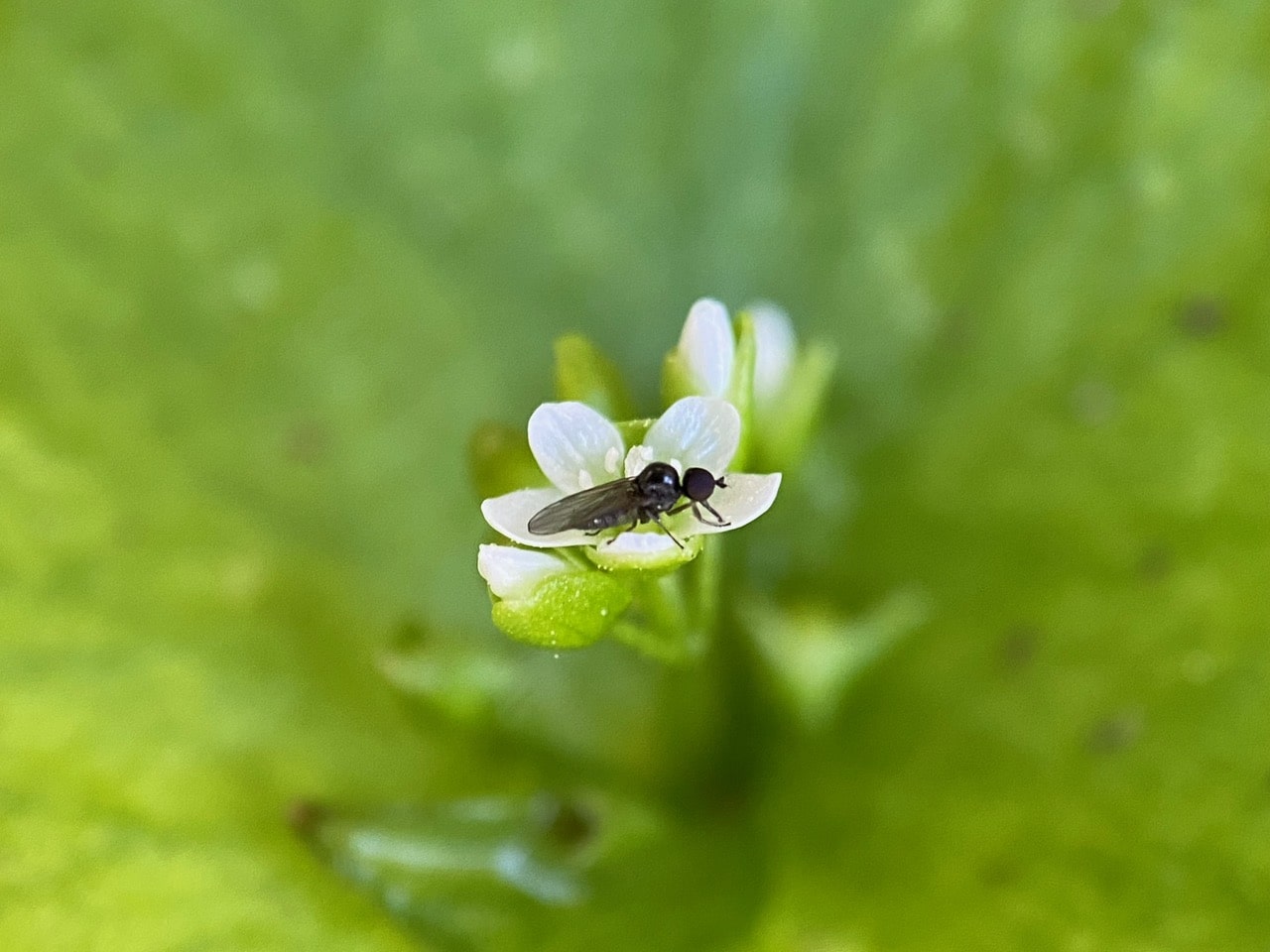
This Hybotid Dance Fly is feeding on stray pollen on a petal of Miner’s Lettuce flower. Hybotid Dance Flies are small, usually about 4 mm long. Their compound eyes occupy most of the sperical head. The flies have a characteristic humped thorax.
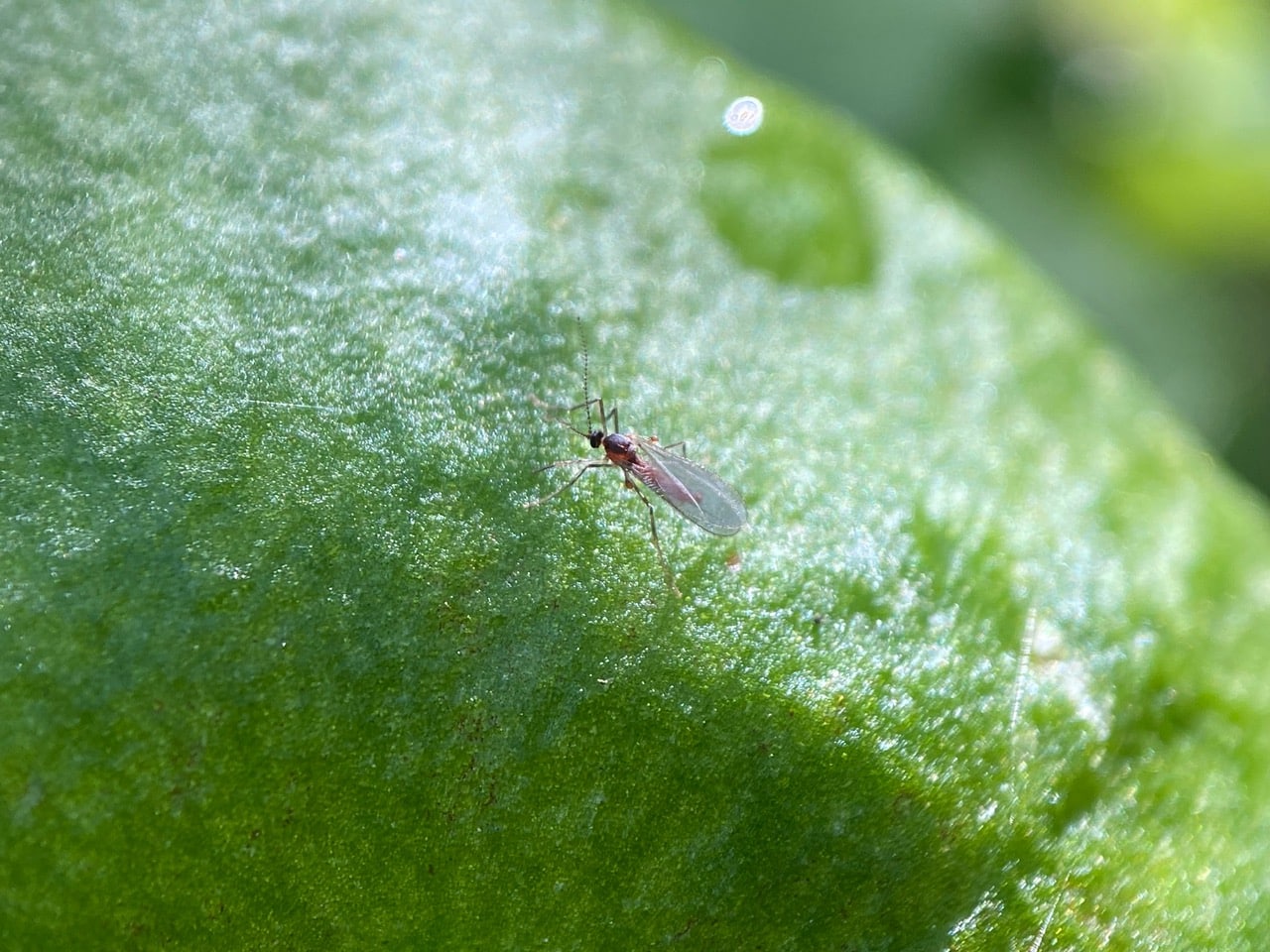
A tiny fly with long antennae lands on a Miner’s Lettuce leaf. iNaturalist has helped identify it as a member of the superfamily Sciaroidea that includes Fungus Gnats and Gall Midges.
As nematoceran flies, sciaroid adults generally have long segmented antennae, while their larvae have a well-developed head and mouthparts. Most fungus gnats live in forests with their larvae occurring in fungi, dead wood and soil. The larvae of Mycetophilids form plant galls.
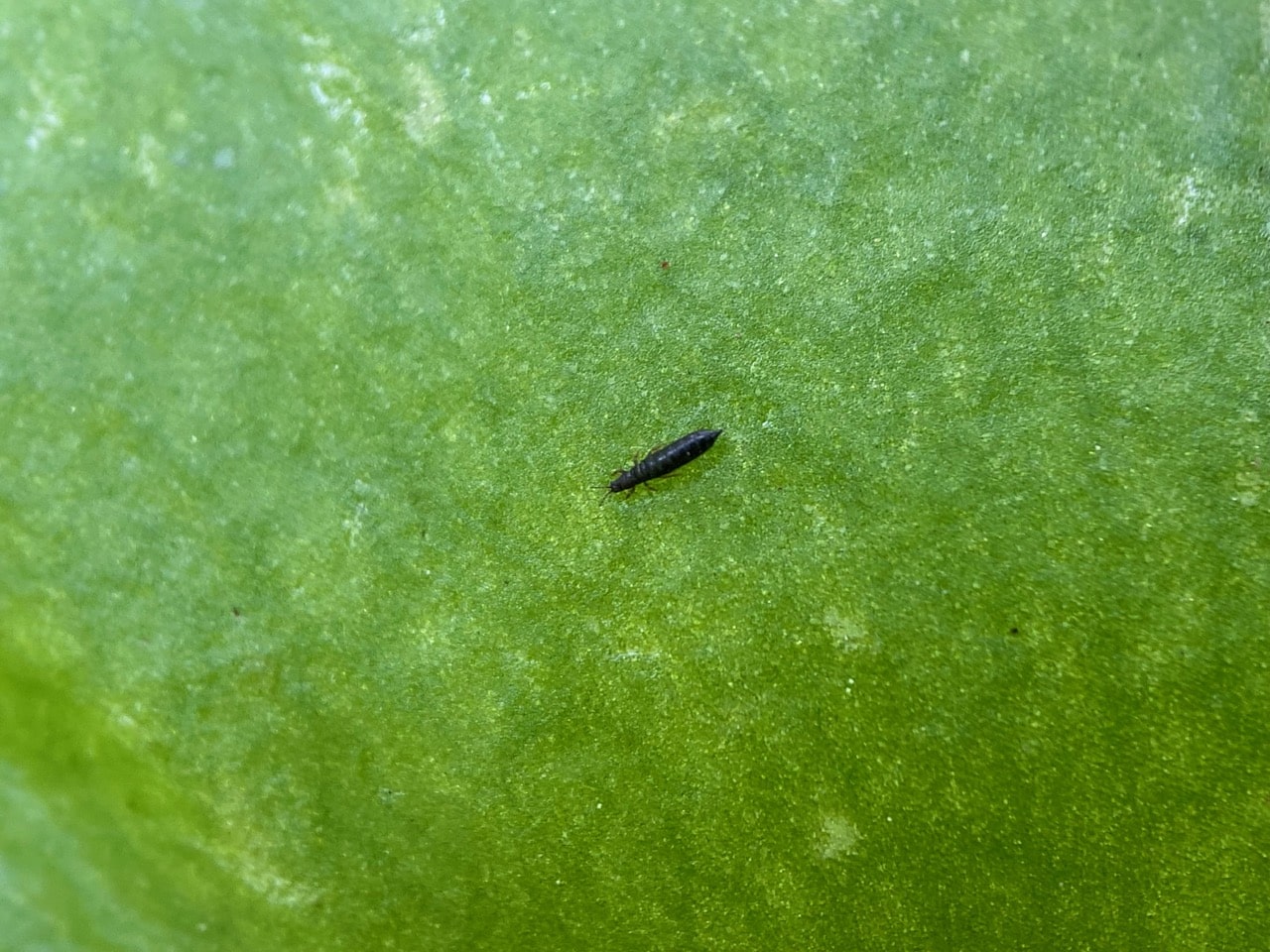
Barely visible to the naked eye, a black, elongated insect is moving on a leaf of Miner’s Lettuce. With magnification, I recognize it as a Thrips.
Thrips (order Thysanoptera) are minute (mostly 1 mm long or less), slender insects with fringed wings and unique asymmetrical mouthparts. They feed mostly on plants by puncturing and sucking up the contents, although a few are predators. Some flower-feeding thrips pollinate the flowers they are feeding on, and some scientists believe that they may have been among the first insects to evolve a pollinating relationship with their host plants. A genus is notable for being the specialist pollinator of cycads. Thrips are likewise the primary pollinators of heathers in the family Ericaceae, and play a significant role in the pollination of pointleaf manzanita. Electron microscopy has shown thrips carrying pollen grains adhering to their backs, and their fringed wings are perfectly capable of allowing them to fly from plant to plant.
BTW, there’s no such thing as a “thrip”. It’s always “thrips”, singular or plural!
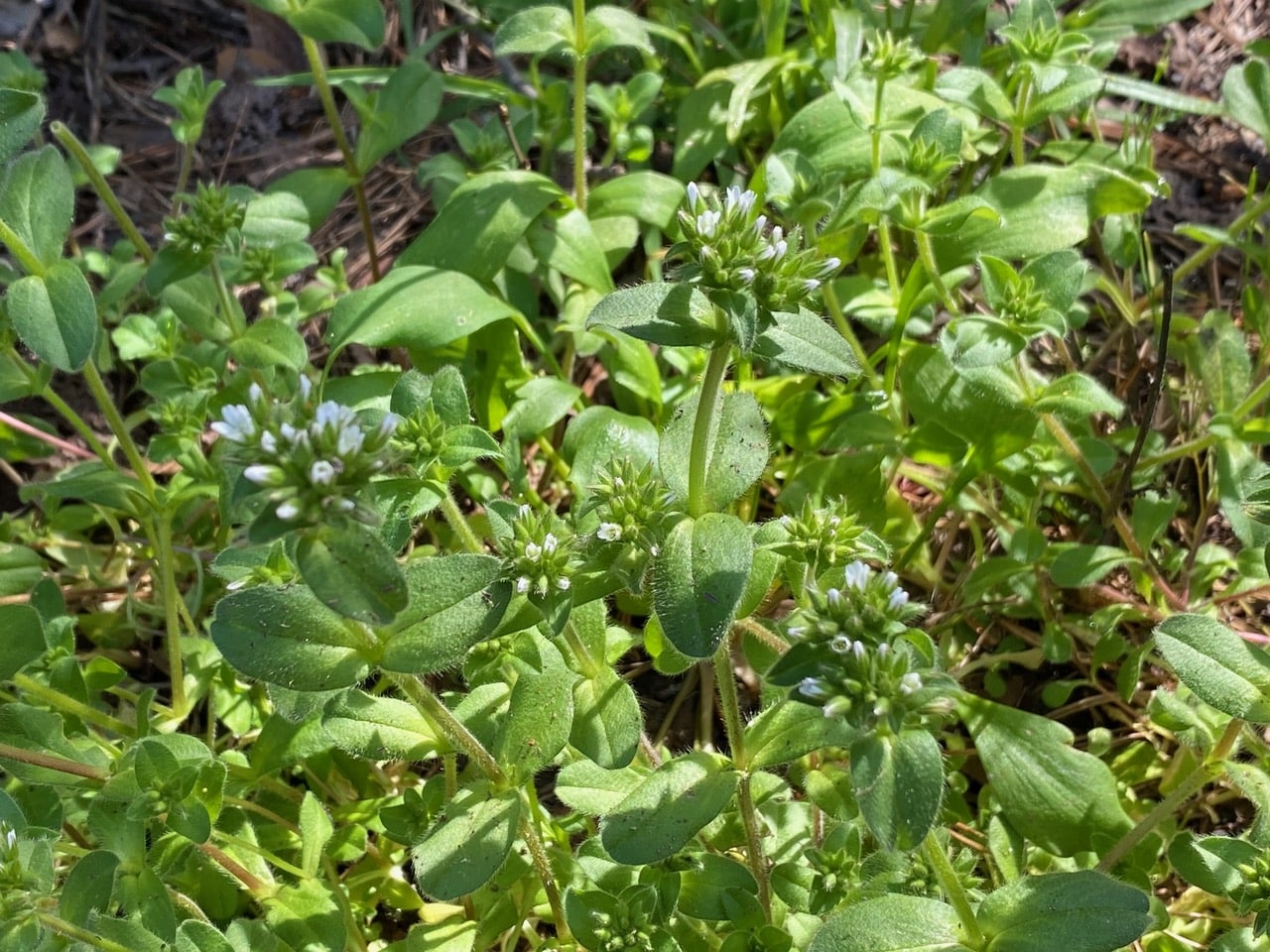
Gee, that’s a species of Chickweed I am not familiar with. iNaturalist has helped identify it as the Sticky Mouse-ear Chickweed, Cerastium glomeratus, a non-native species.
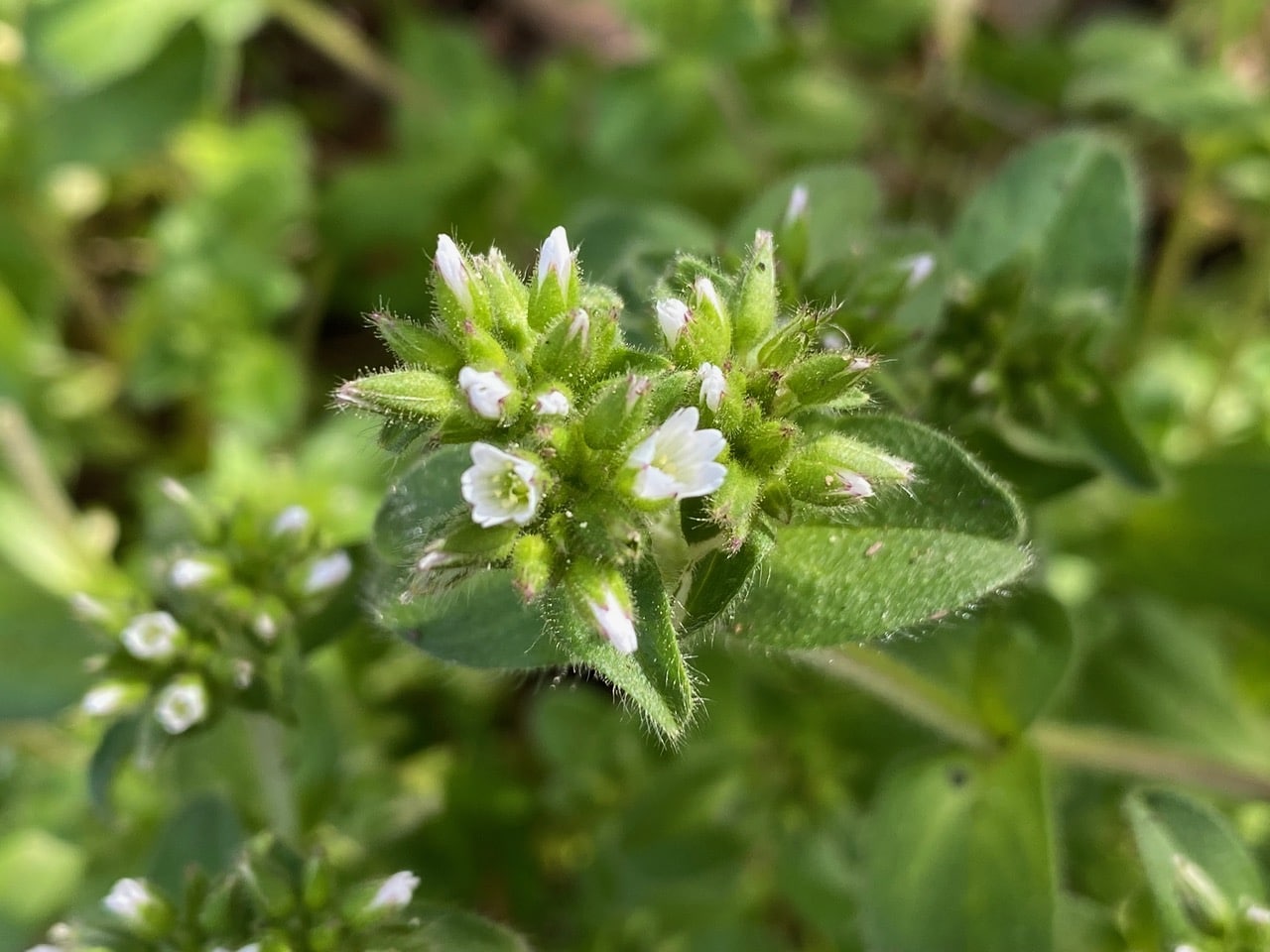
The Sticky Mouse-ear Chickweed, Cerastium glomeratum is an annual herb native to Europe, Macaronesia to Assam but is known on most continents as an introduced species. It grows in many types of habitats, blooming from February to May. The plant usually has abundant glandular hairs, especially towards the top of the stem and on the sepals. The flowers are borne on very short pedicels (stalks), so they tend to occur in tight clusters. Each inflorescence bears as few as 3 or as many as 50 small, flowers arranged in a cyme.
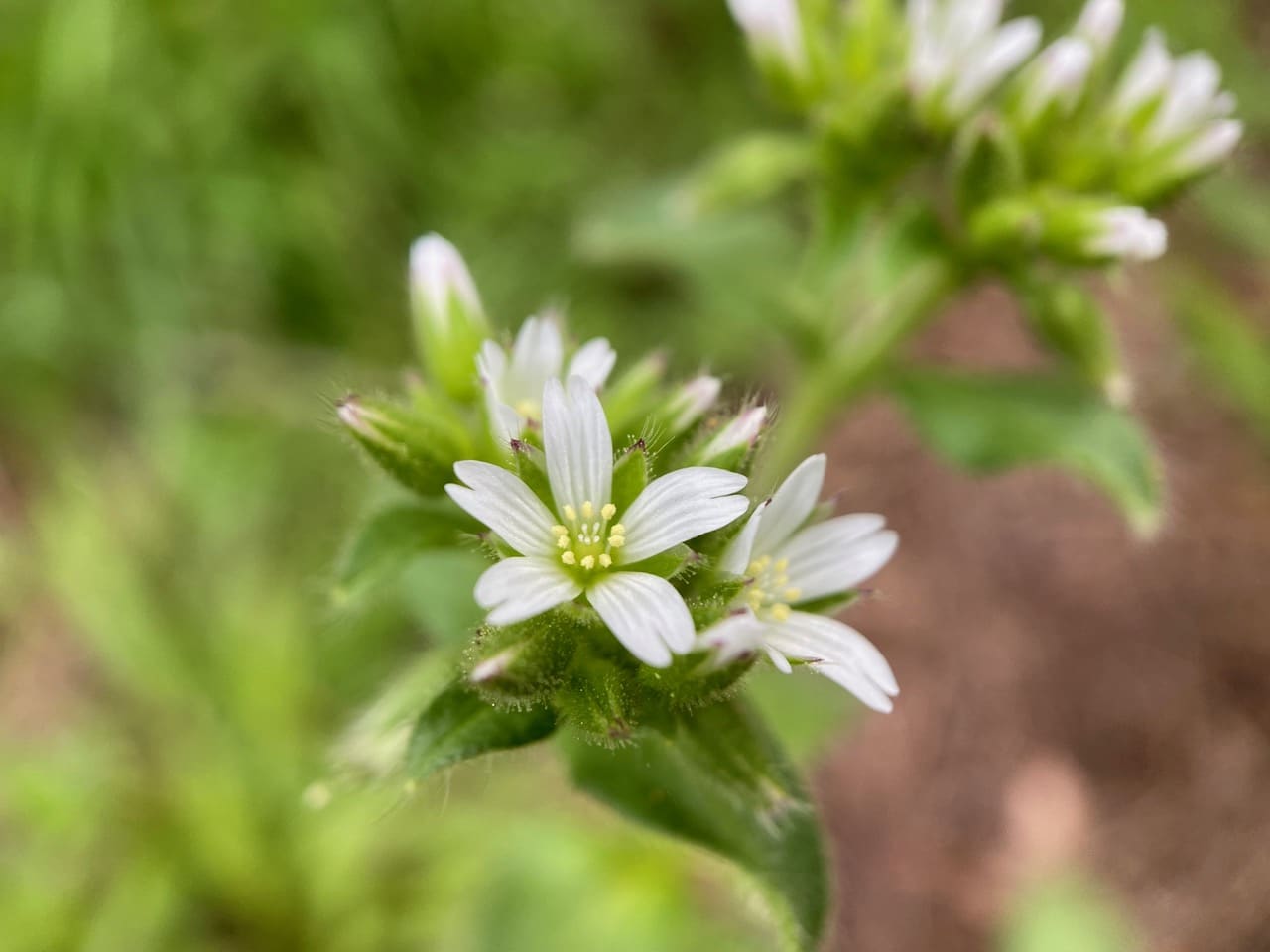
The deeply dissected or bifid petals of the Sticky Mouse-ear Chickweed render the plant recognizable as a chickweed.
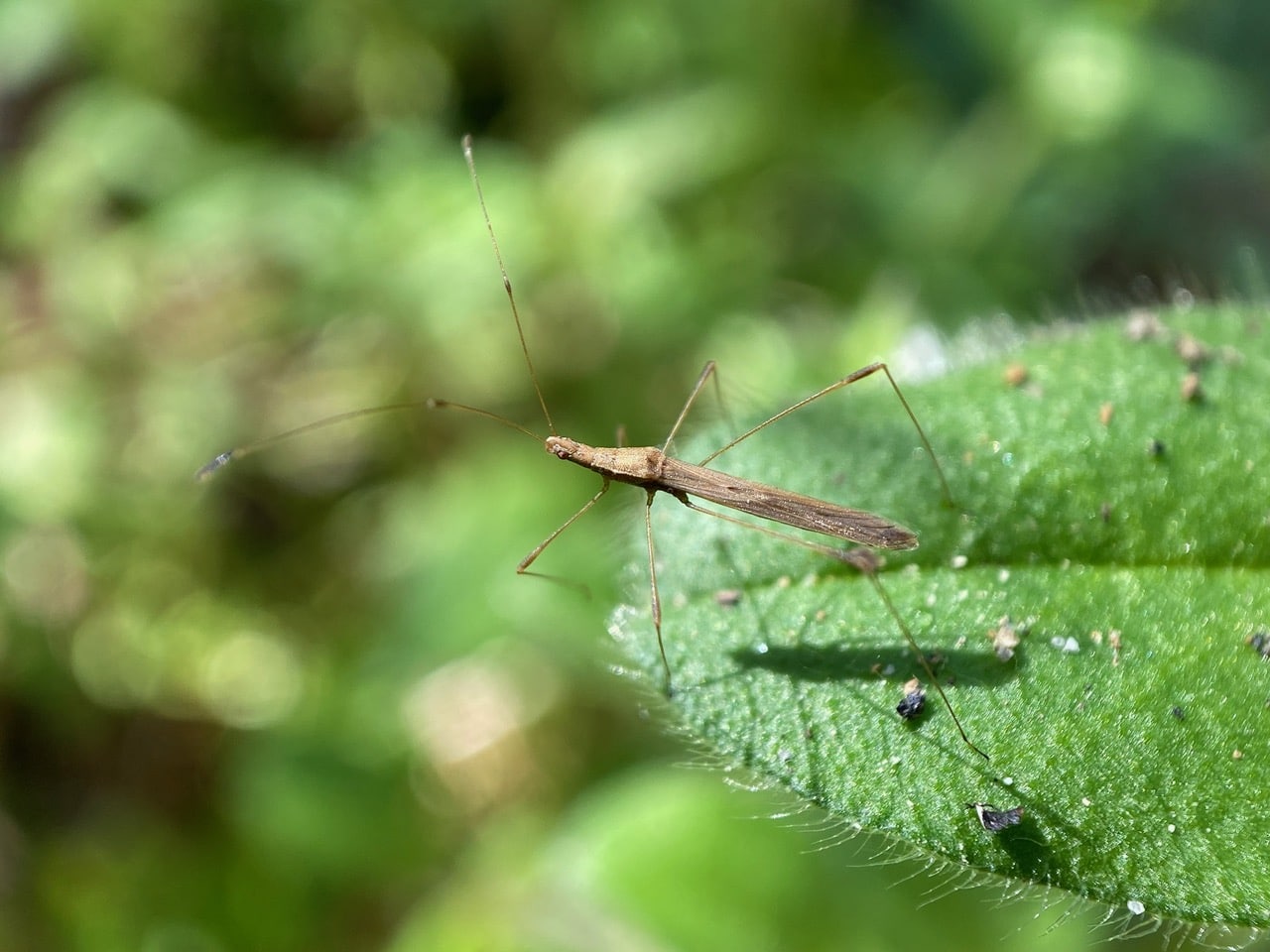
A slender, long-legged insect is moving slowly on a hairy, glandular leaf of Sticky Mouse-ear Chickweed. It is a Stilt Bug, Neoneides muticus (family Berytidae).
The Berytidae are extremely gracile insects with legs so long and slender as to suggest common names such as “thread bugs” and “stilt bugs”. They resemble some Assassin Bugs, but lack the raptorial forelegs of the predators. Antennae have 4 segments, the fourth enlarged, appearing as a swelling at the tip.
Stilt Bugs occur worldwide and throughout North America. Most are phytophagous (plant-feeders); many may be host-specific, often associated with plants with glandular hairs in Geraniaceae, Onagraceae, Scrophulariaceae, and Solanaceae. Some are occasionally omnivorous, feeding opportunistically on insects entrapped in plant exudates or on lepidopteran eggs or aphids.
Neoneides muticus is commonly found in weedy fields and pastures in the United States and southern Canada in the east and in the west, but it is mostly absent from the Great Plains. The slender bugs are typically less than 1 cm long and are often found on plants that have a long, sticky, hair-like covering. They move slowly, their long, stilt-like legs act as a pivot point, allowing them to traverse sticky surfaces that entrap other insects. They are facultative predators, meaning they can survive on plant sap alone but thrive better when their diet is supplemented with insects.
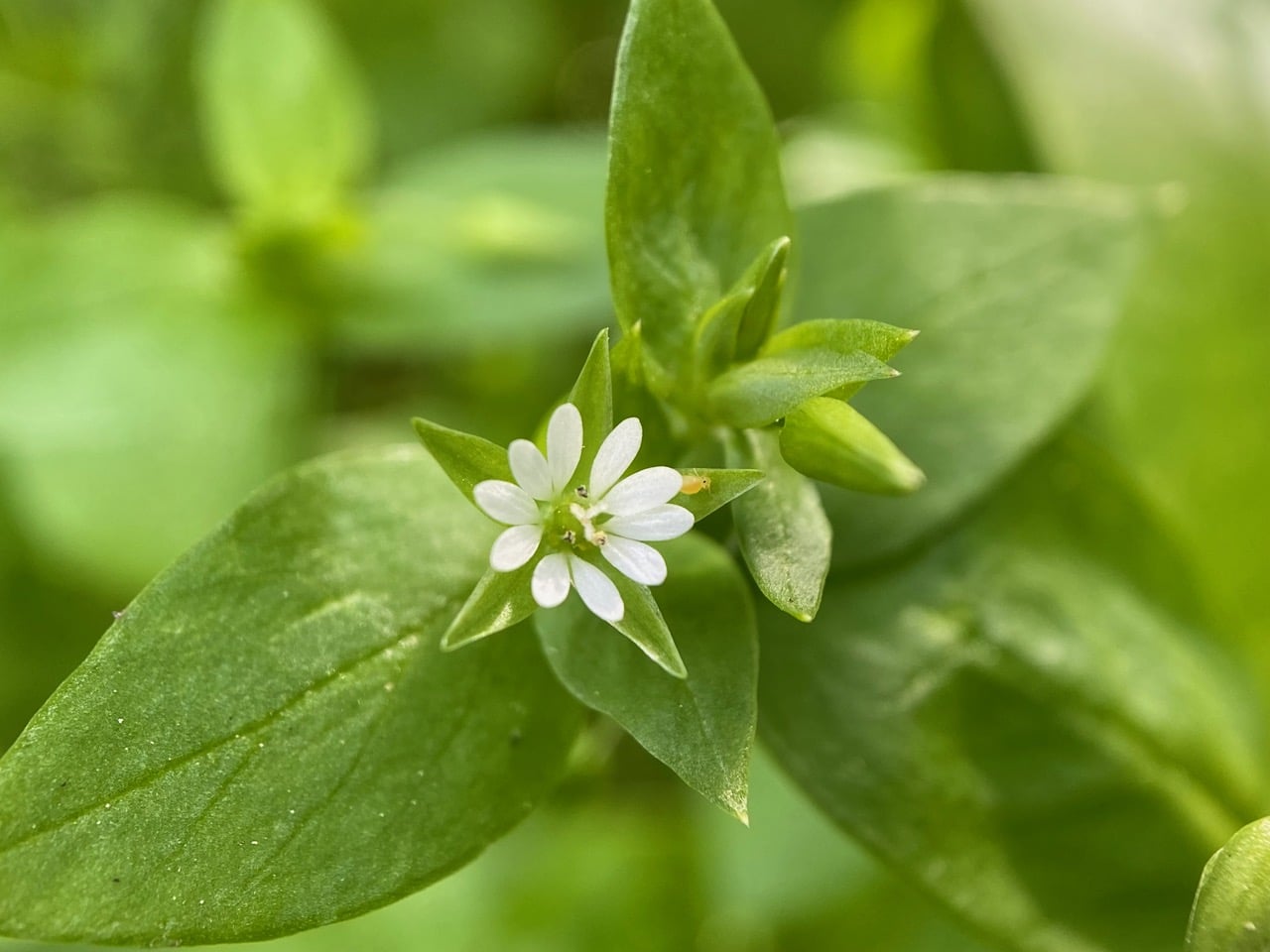
Widespread along the road side, often occurring among the Miner’s Lettuce is the Common Chickweed, Stellaria media. It is a cool-season annual herb often considered a weed, native to Eurasia but naturalized globally. It forms dense mats with small, star-like white flowers that appear to have ten petals during to deeply split petals, and it spreads rapidly by seed and rooting at leaf nodes. Chickweed is edible, non-toxic, and used in salads or as poultry feed, but it can be a competitive weed in gardens and crops, thriving in moist, fertile soils.
Note the yellowish aphid on the sepal. Or is that a globular springtail? I hadn’t noticed it when the picture was taken.
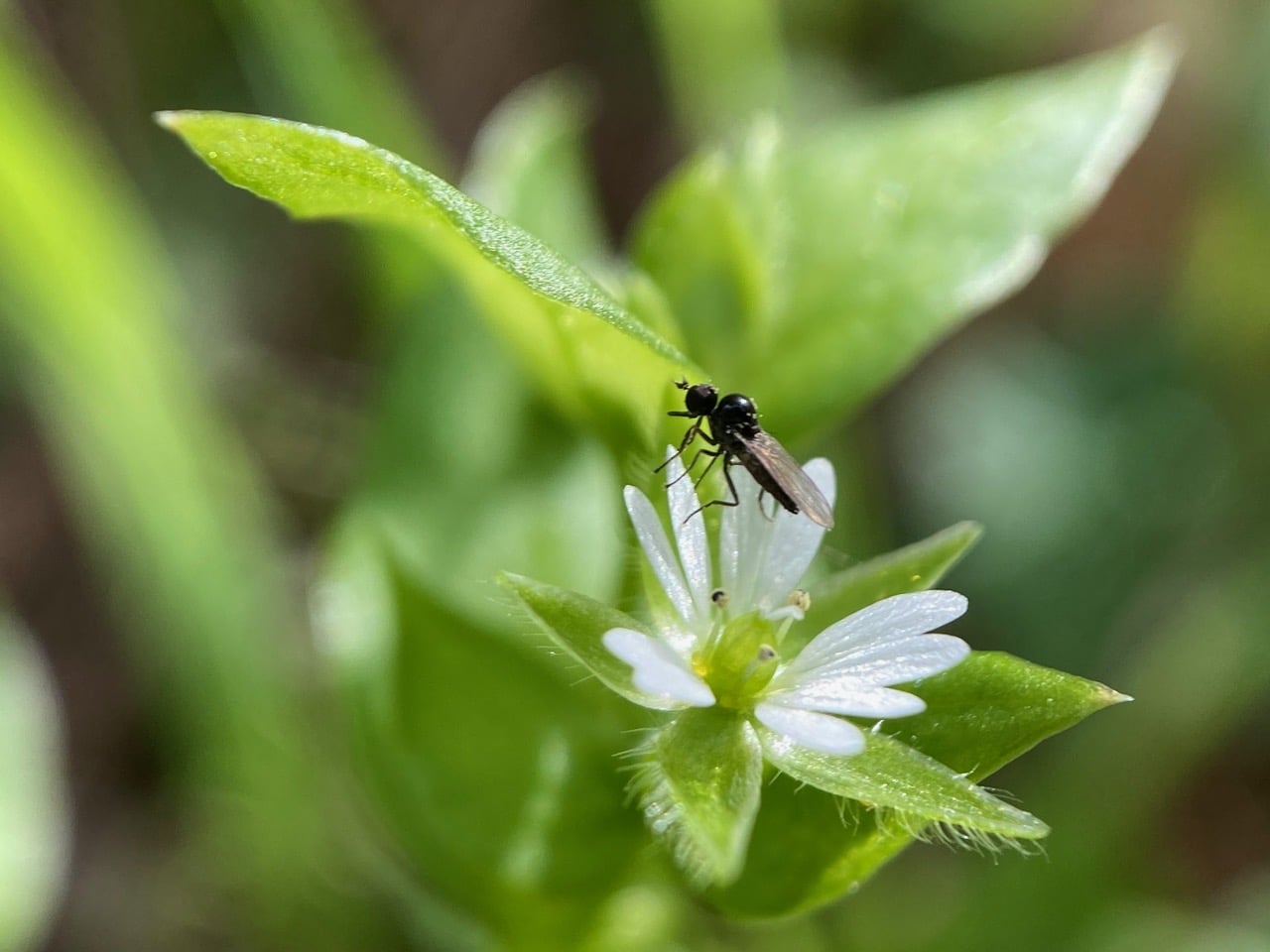
Dusted with pollen on its head and thorax, a Hybotid Dance Fly exits a Common Chickweed flower after feeding. Since the flowers of Miner’s Lettuce and Common Chickweed are of similar size and similarly structured, I often find Hybotid Dance Flies feeding on them when they bloom at the same time.
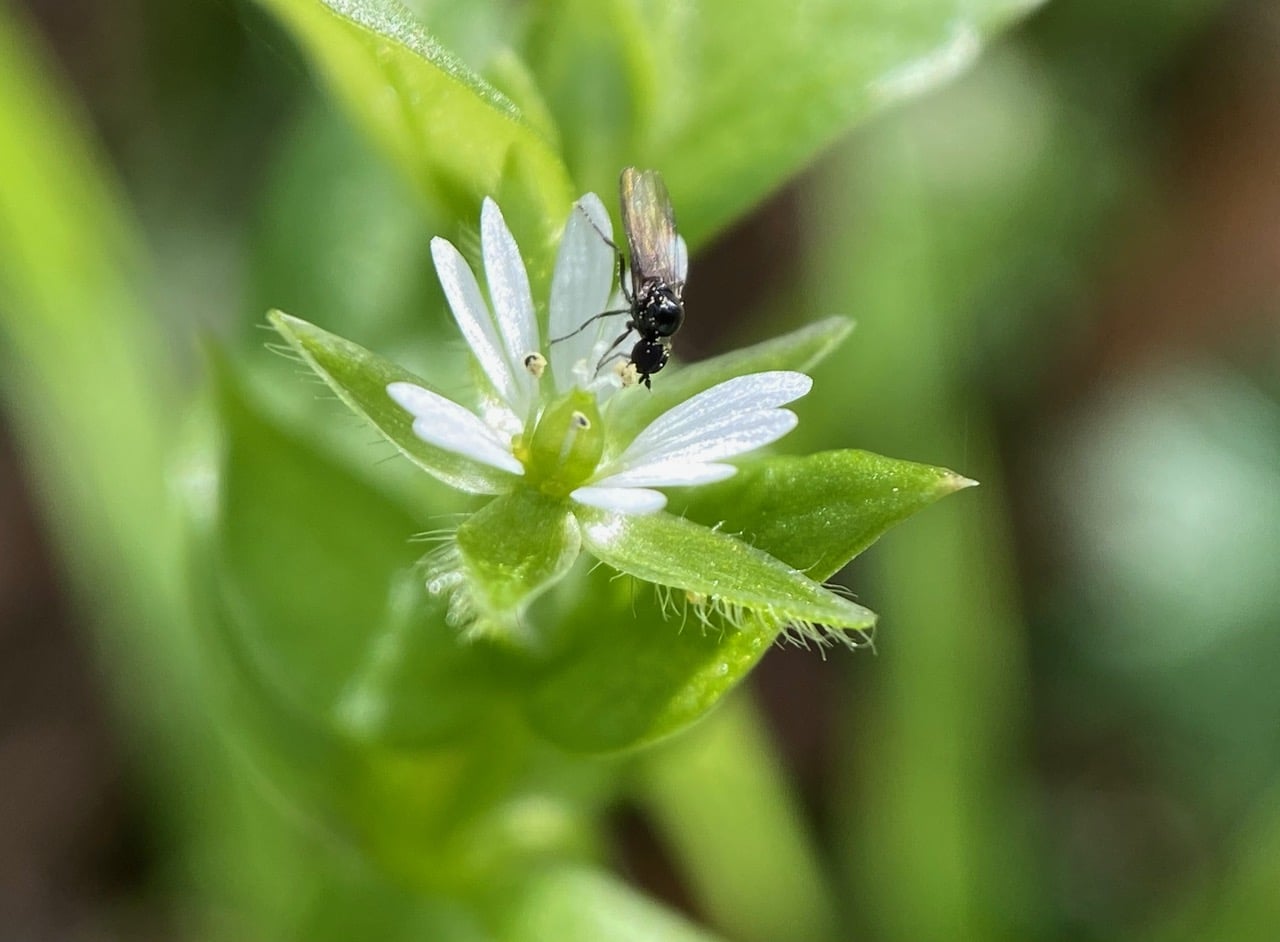
These small flowers are the perfect size for these cool-season pollinators.
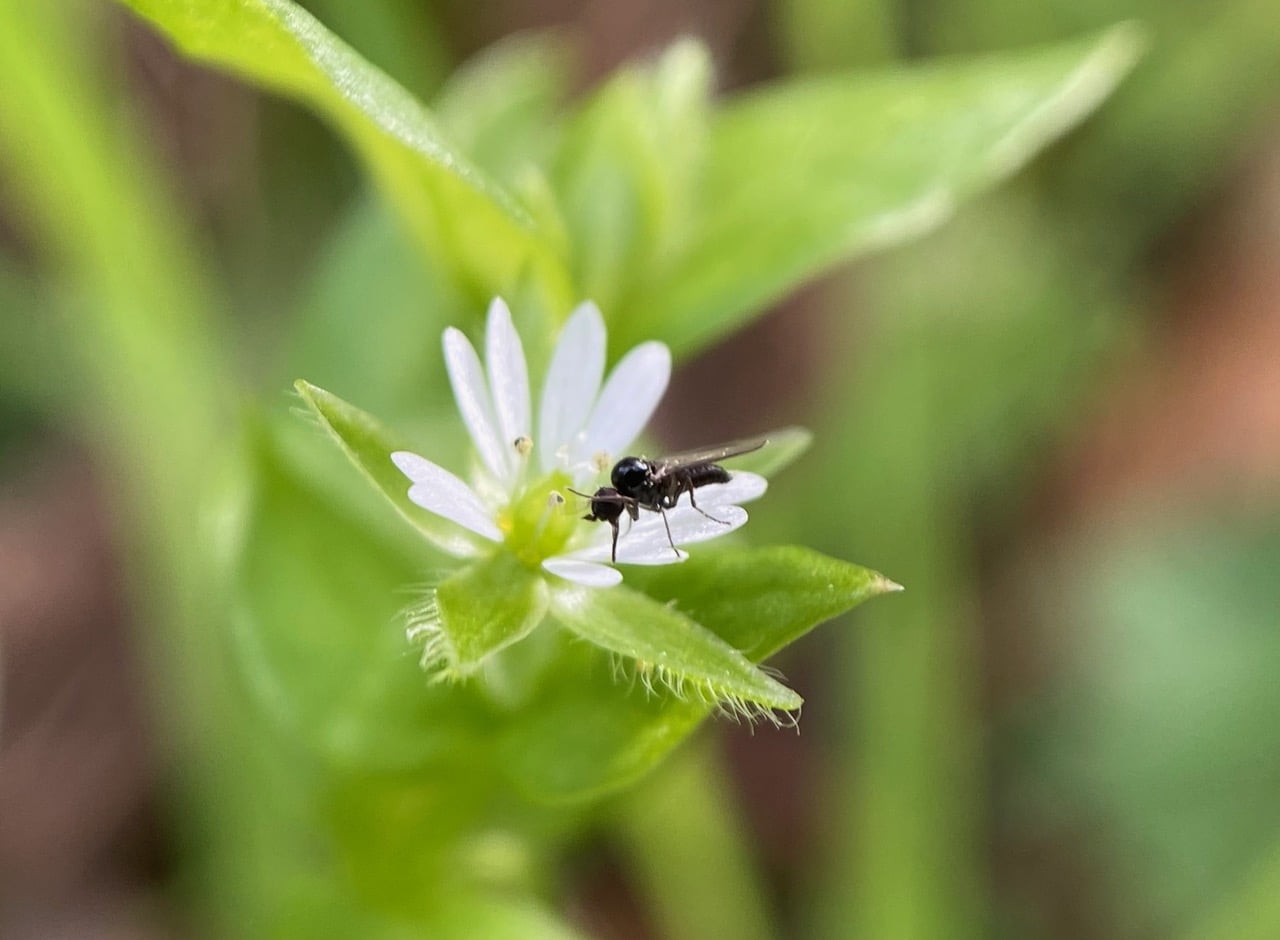
The Hybotid Dance Fly is grooming itself before flying off.
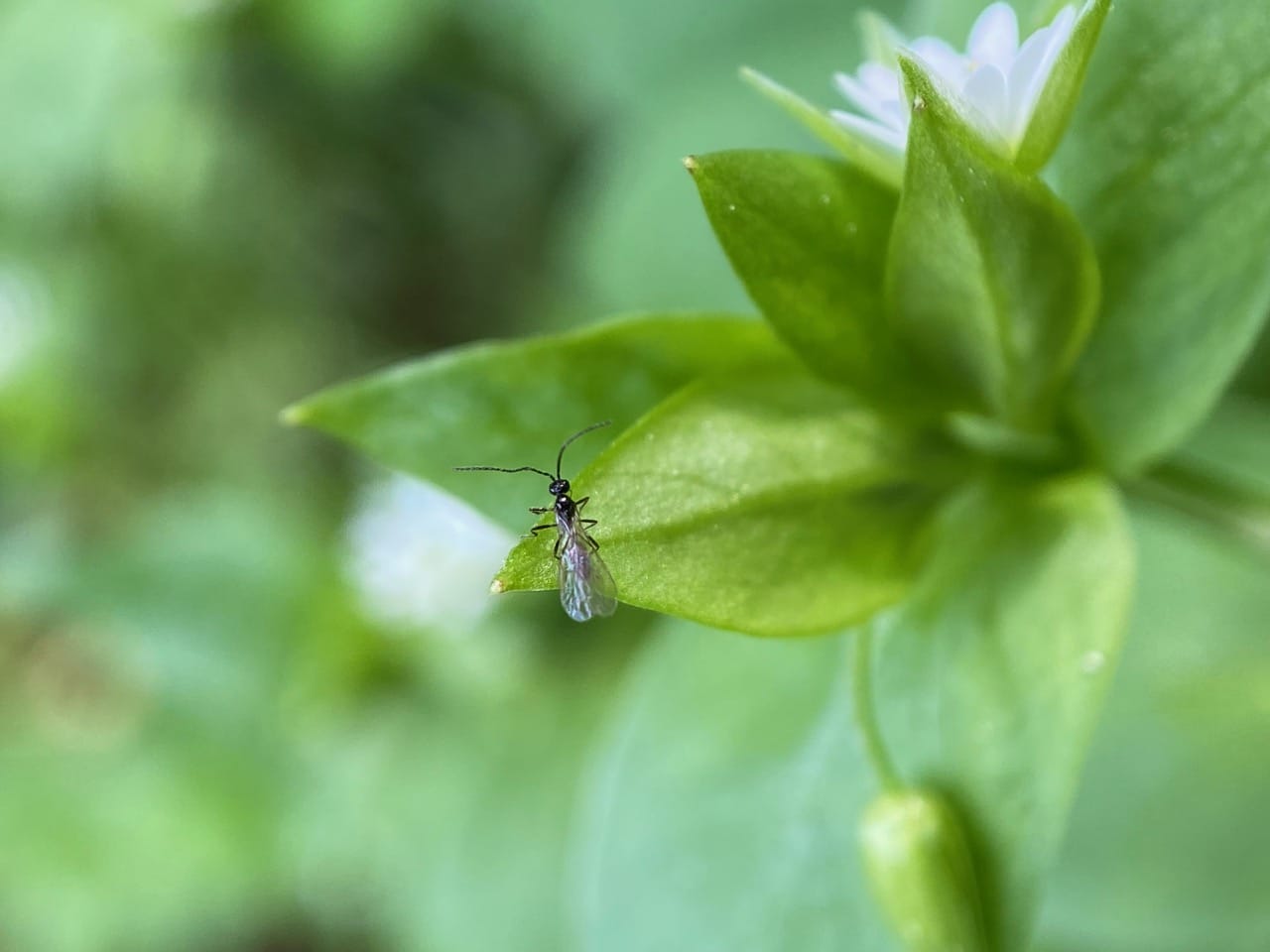
Ooh, a tiny wasp has landed on a leaf of Common Chickweed. A parasitoid wasp? iNaturalist has identified it as an Aphid Mummy Wasp (subfamily Aphidiinae, family Braconidae).
Aphid Mummy Wasps are found worldwide, but are primarily found in the northern hemisphere. Several species have been introduced to countries outside of their natural range for biocontrol of aphids. These wasps are small wasps, typically less than 1/8 in. long. The female wasp lays a single egg in an aphid. When the egg hatches, the wasp larva feeds inside the aphid. As the larva matures the aphid is killed and becomes bloated and mummified, usually turning tan or golden in color. The adult parasitoid chews its way out of the mummy leaving a hole.

Hey look, a winged aphid! Rather surprising to find an aphid alate this early in the year!
Aphids are small sap-sucking insects in the order Hemiptera. A typical life cycle involves flightless females giving live birth to female nymphs, – who may also be already pregnant, an adaptation called telescoping generations – without the involvement of males. Maturing rapidly, females breed profusely so that the population multiplies quickly. Winged females may develop later in the season, allowing the insects to colonize new plants. In temperate regions, a phase of sexual reproduction occurs in the autumn, with the insects often overwintering as eggs.
The life cycle of some species involves an alternation between two species of host plants. Some species feed on only one type of plant, while others are generalists, colonizing many plant groups. Some ants have a mutualistic relationship with aphids, tending them for their honeydew and protecting them from predators.
Aphids usually feed passively on phloem of plants. Once the phloem vessel is punctured, the sap, which is under pressure, is forced into the aphid’s food canal. Aphids produce large amounts of a sugary liquid waste called “honeydew”. A fungus called sooty mold can grow on honeydew deposits that accumulate on leaves and branches, turning them black.
Generally adult aphids are wingless, but most species also occur in winged forms, especially when populations are high or during spring and fall. The ability to produce winged individuals provides the aphids with a way to disperse to other plants when the quality of the food source deteriorates, or when predation pressure is high.
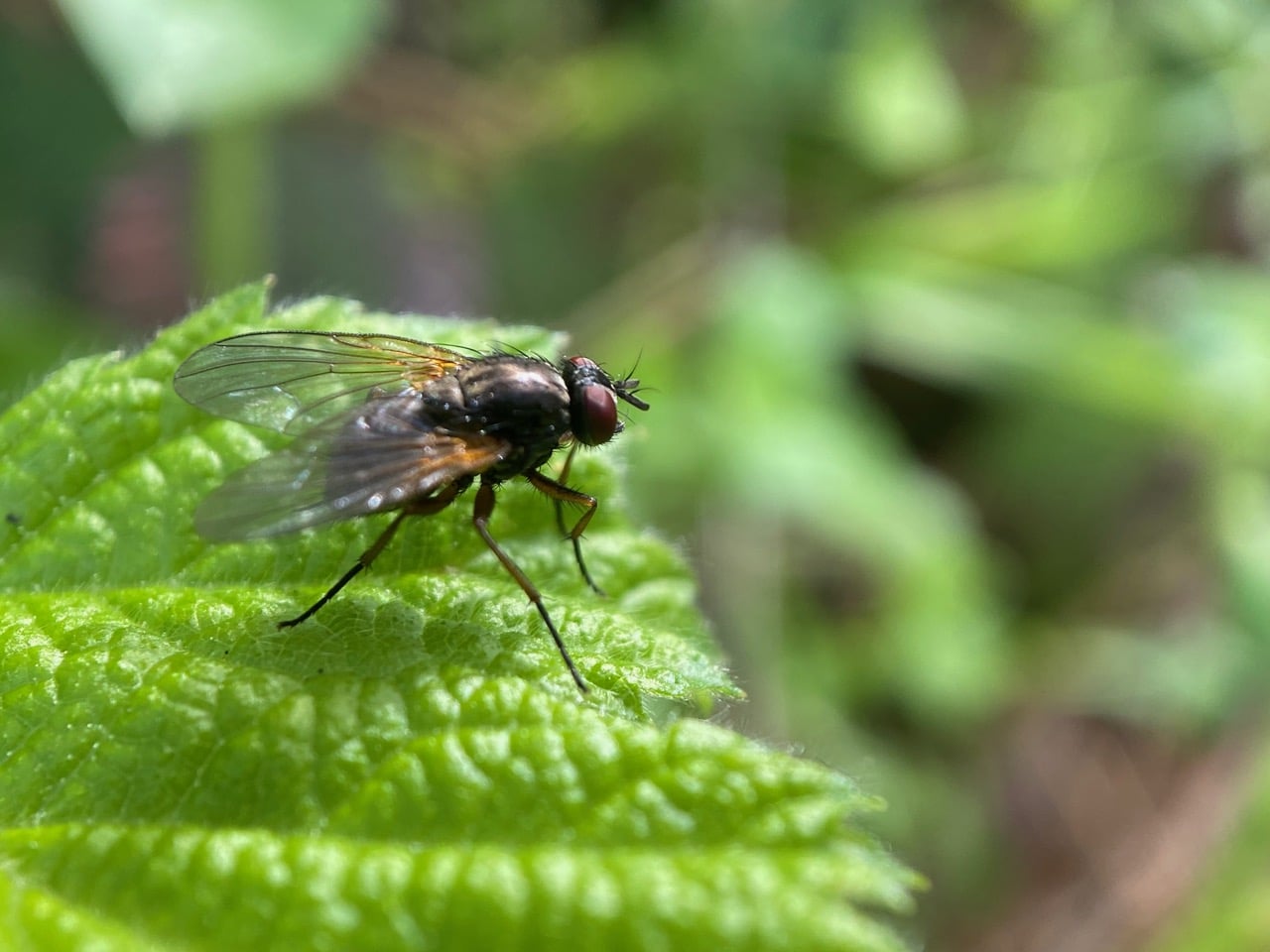
A medium-sized, robust fly with a golden hue to the base of its wings has landed on a Blackberry leaf. iNaturalist has helped identify it as a member of the genus Mydaea (family Muscidae).
Mydaea is a large genus of muscid flies (family Muscidae) known for having characteristic bristles on both the dorsal and ventral surfaces of the wing’s radio-cubital node. These flies are often found in wooded areas, with larvae commonly associated with fungi. Several species develop in fungi within humid woodland but development in dung is reported in some species.
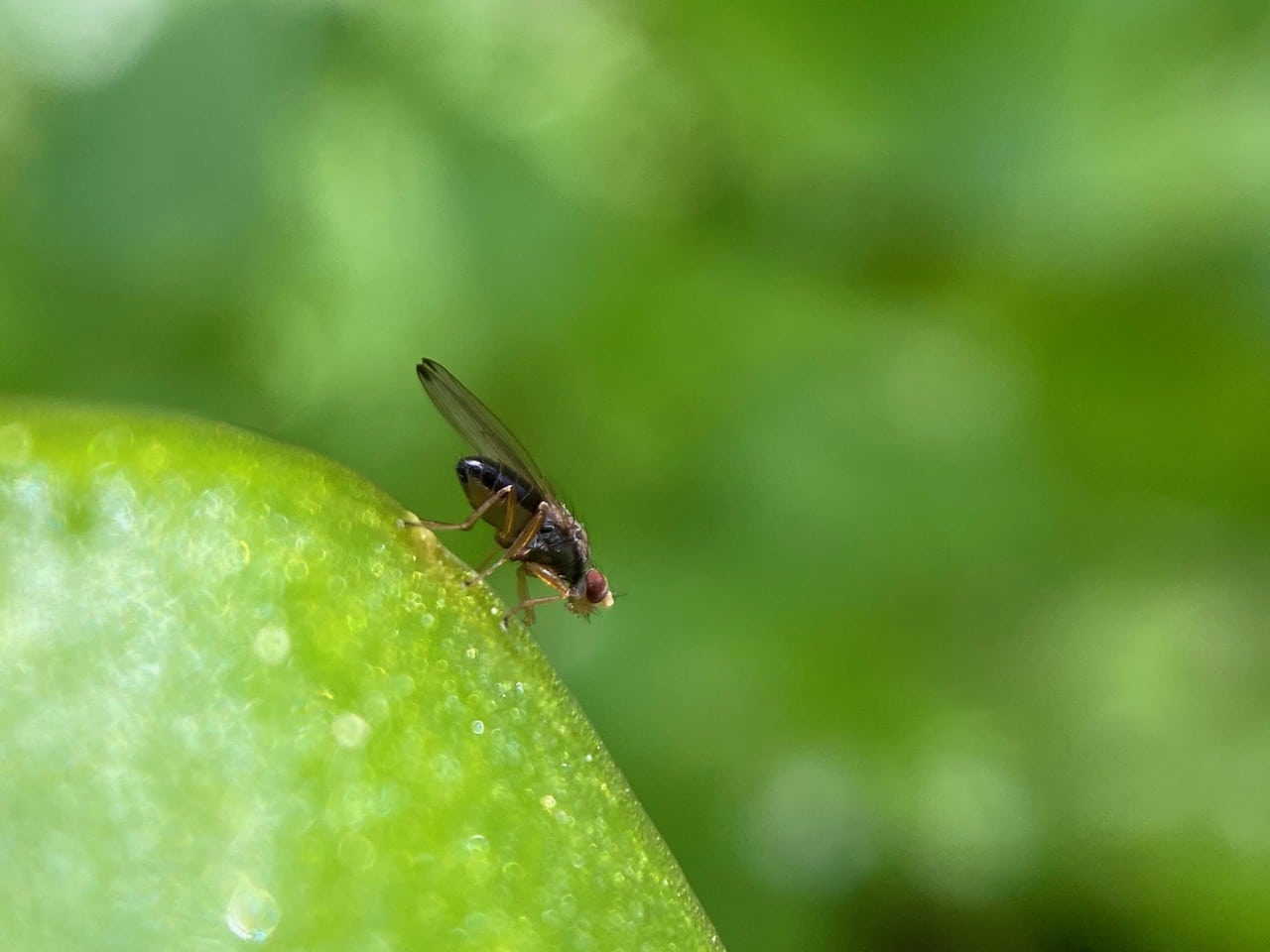
An unidentified fly on a Miner’s Lettuce leaf.
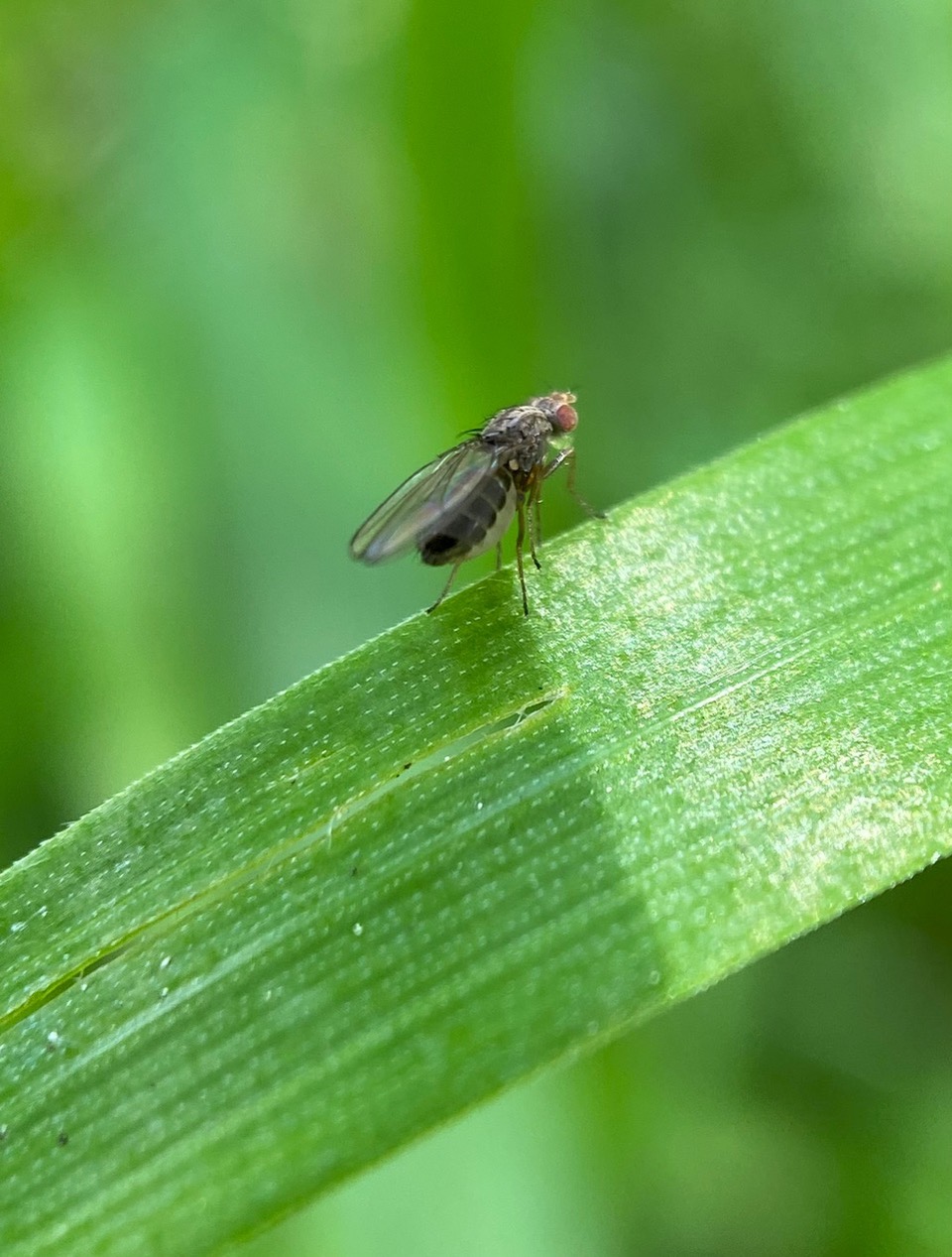
Perched on a blade of grass, a small fly is regurgitating liquid from its mouthparts. iNaturalist has help identify it as a Fruit Fly (family Drosophilidae).
Generally, drosophilids are considered to be nuisance flies rather than pests, since most species breed in rotting material. The larvae are primarily microphagous detritivores that feed on the yeast, bacteria, and fungi present in fermenting, rotting fruit, and other decaying organic matter. Why even consider them as nuisance, since their larvae are decomposers, helping to recycle organic materials in the ecosystem? Adults fruit flies likewise primarily feed on microorganisms, specifically yeasts and bacteria, that grow on fermenting and rotting plant materials. They are attracted to overripe fruit, sap flows, rotting vegetables, mushrooms, and other decaying organic matter, feeding on the sugars and fungi present. The best known species of Drosophilidae is Drosophila melanogaster, which is used extensively for studies concerning genetics, development, physiology, ecology and behavior.
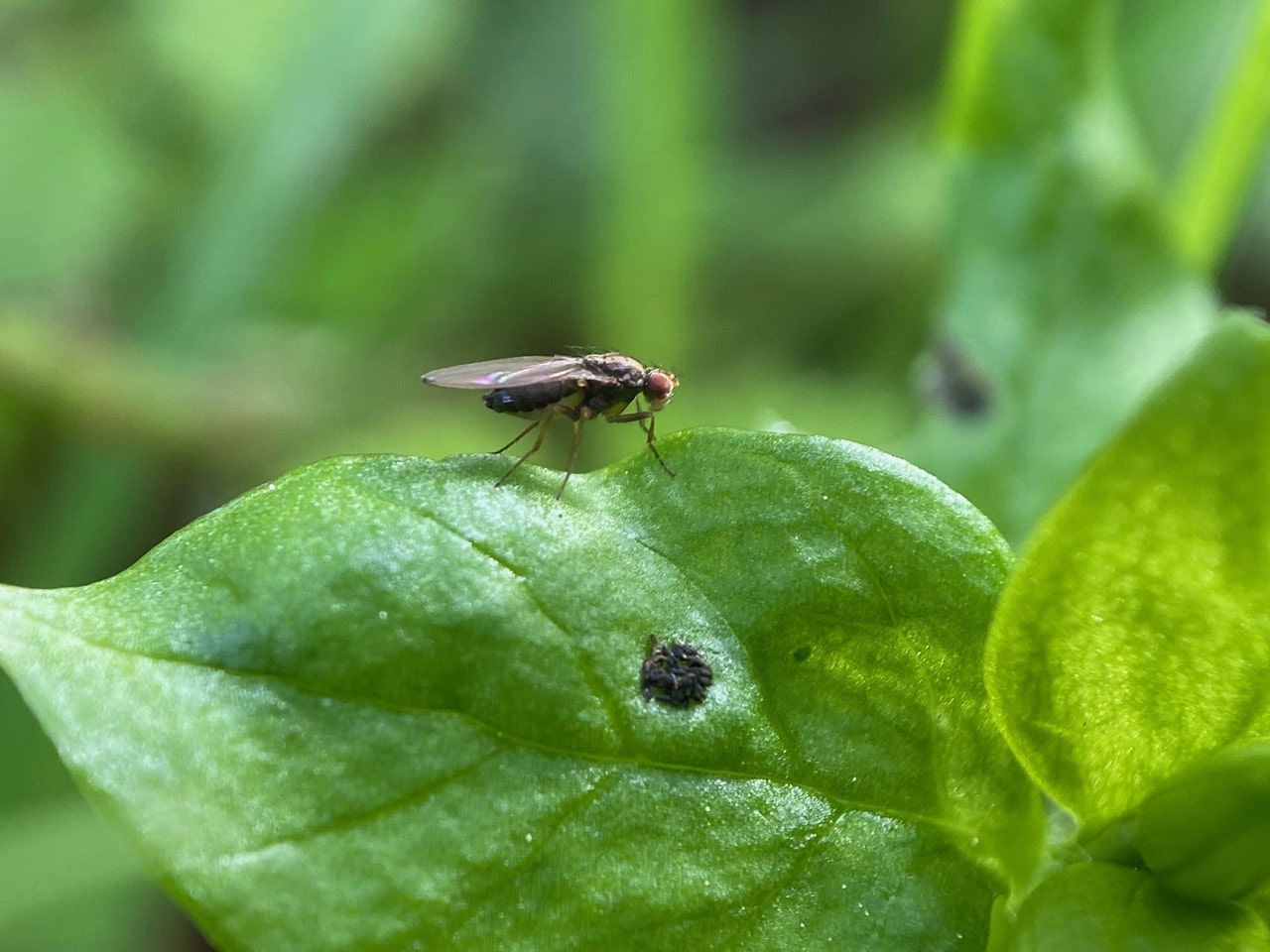
Another Fruit Fly (family Drosophilidae).
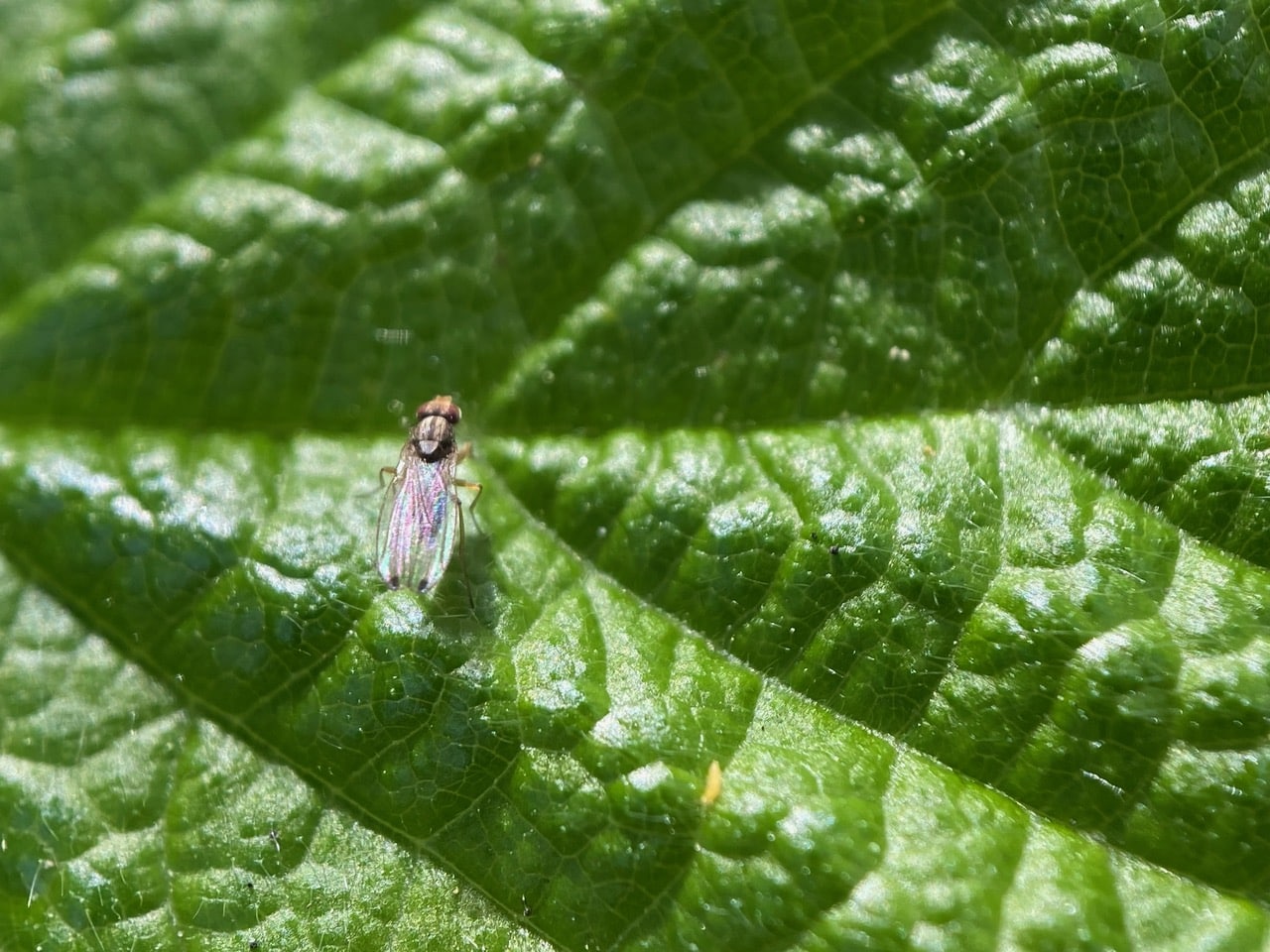
Yet another Fruit Fly (family Drosophilidae).
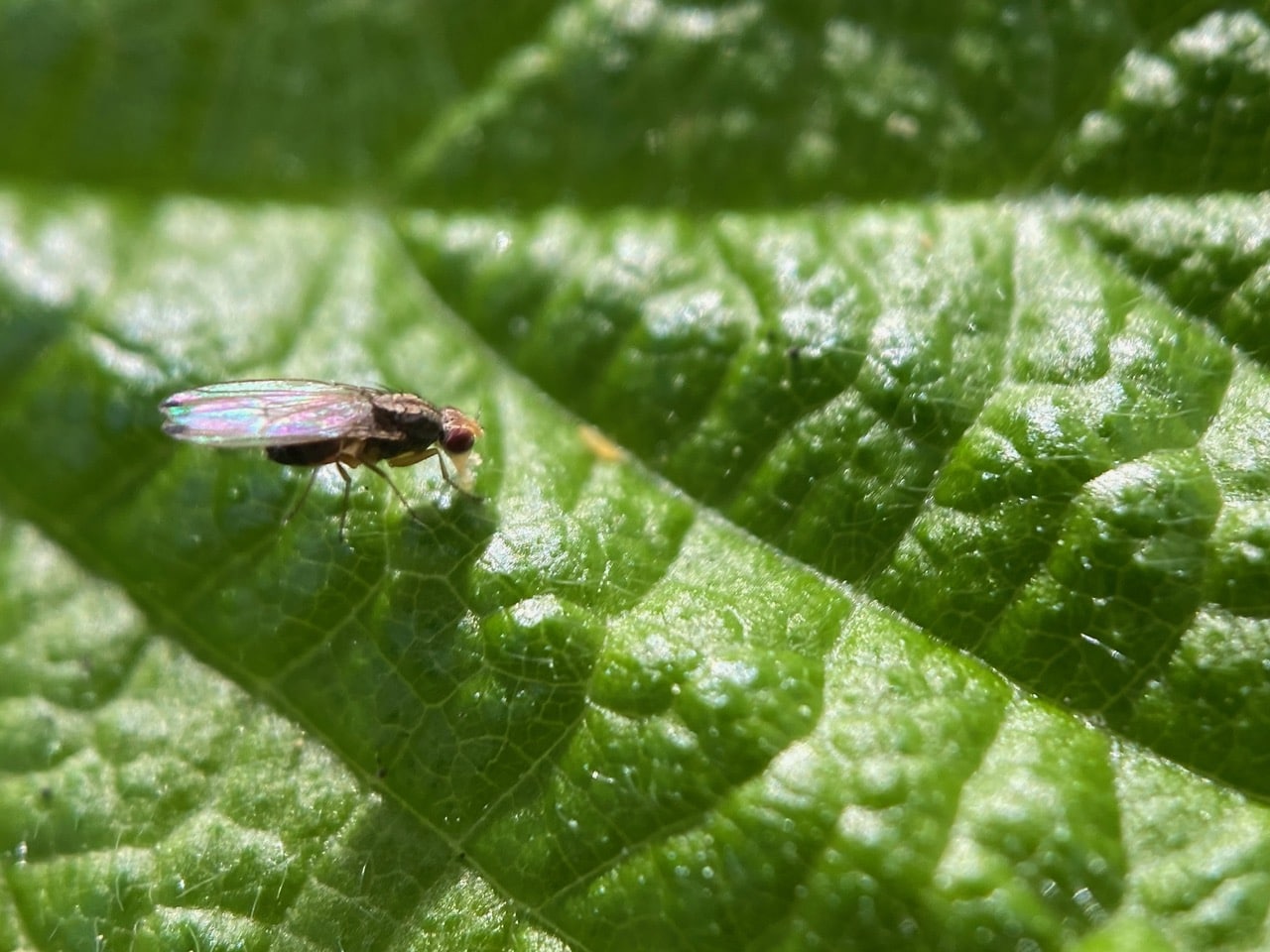
This Fruit Fly (family Drosophilidae) has its mouthparts extended, seeming to be feeding on something on the surface of the leaf.