

Showcase Feature
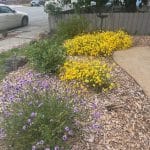
Inspired by the documentary “Kiss the Ground,” hearing Doug Tallamy speak, visiting Tour gardens, and his daughter’s passion for the environment—and realizing how critical it was to create places in which birds, butterflies, and bees could live, Mike knew he had to plant natives in his own home garden. His hopes were to create a garden that welcomed people, as well as wildlife, was inviting and colorful, and would solve a drainage problem that had been around for a while.
The resulting garden, designed by Stephanie Brady, owner of Living Garden Design, and installed by Mike and friends—both housed and unhoused—fulfilled all these goals.
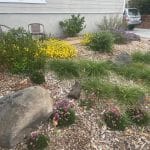
To welcome people, the garden was graded to make room for a decomposed granite walkway that provides access to the garden, and leads to a cafe table and a couple of comfortable chairs. Now there are many pleasant opportunities to chat with neighbors, dog walkers and other passers-by.
 Native birds, butterflies, and bees flit, flutter, and buzz about the garden, attracted by the pink-to-cream urn-shaped flowers on the manzanitas, electric purple blue blossoms on the penstemon, and the pink blooms on the rosy buckwheat.
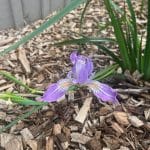
Rain water captured from the roof now drains into a swale planted with rushes and lined with blue-eyed grass. Installing a rain garden was a ‘win’ in many ways; the Egusa’s received a rebate from the Alameda County Water District for retaining the rainwater on site, and the extra water will help keep the garden green longer, in addition to replenishing the aquifer, and protecting the local creek from scouring.
Replacing the weedy lawn with water conserving native plants and installing a rain garden allowed the Egusa’s to receive a $2,300 rebate from the Alameda County Water District.
Mike’s efforts have inspired his next-door neighbor, who recently sheet mulched and planted natives.
Mike, a retired pastor, has long been involved with projects that support the unhoused. He and Stephanie have continued their collaboration by working with a team of other volunteers to create Bee Highways in Hayward and Castro Valley. The goal is to create a series of connected pathways of beautiful California native plant gardens that will help both wildlife and people thrive. Through a series of sheet mulching and Pollinator Pathway Planting Parties, natives have been planted at the First Presbyterian Church of Hayward (Yes! This is the church behind the Trader Joes!), South Hayward Parish, and Faith Lutheran Church. If you would like to make friends, get some exercise, and do good, leave your name and email address here to be added to the Bee Highways email list.
These three churches, now embraced by native and edible gardens, provide shelter for 70 adults, serve three meals a day to hundreds of people, and run a food pantry that provides food to others. If you would like to support this work on the day of the Tour you can bring non-perishable food, clothing for adult men and women, and toiletries to Mike’s house; he will bring them to those in need.
Other Garden Attractions
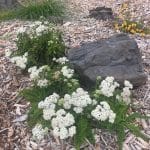
- Locally-sourced boulders provide visual interest and stability.
- Note how the plants in the sidewalk strip mirror those in the rest of the garden, creating a sense of connectivity between the two spaces. To create the continuity, the river rock from the rain garden is also carried down to the curb.
- No pesticides are used in this—or any!—Tour garden.
- Designer Stephanie Brady will be at the garden all day to answer questions.
Gardening for Wildlife
A birdbath provides much-needed water for our avian friends. Leaves are left, both to shelter the small creatures who depend upon them (such as butterfly and moth pupa, which spend the winter in leaf litter), and also to improve the soil.
Nuthatches scamper up trees. Delicate gray hairstreak butterflies sip nectar from the buckwheat blossoms.
Keystone species (watch this talk by Doug Tallamy!)
Keystone species—our own, local ecological powerhouse plants— in this garden include manzanita, buckwheat, coffeeberry, and penstemon.
Garden Talks
11:00 “How and why we removed our lawn and created a native plant garden: the inspiration, critical need to create habitat for wildlife and the opportunities we have with our home gardens, rebates, finding a designer, garden design and installation, and the pleasure of encountering butterflies, birds and neighbors in our front garden” by Mike Egusa
11:30 Designing your native garden” by Stephanie Brady, owner of Living Garden Design
At least partially wheelchair accessible? Yes
Photos
Click to see as a slideshow: