

Pollinator Post 2/7/23 (1)
Having read about the plants already in bloom at the East Bay Regional Parks Botanic Garden in Berkeley, I pay a visit today to see what insects might be active on these early bloomers.
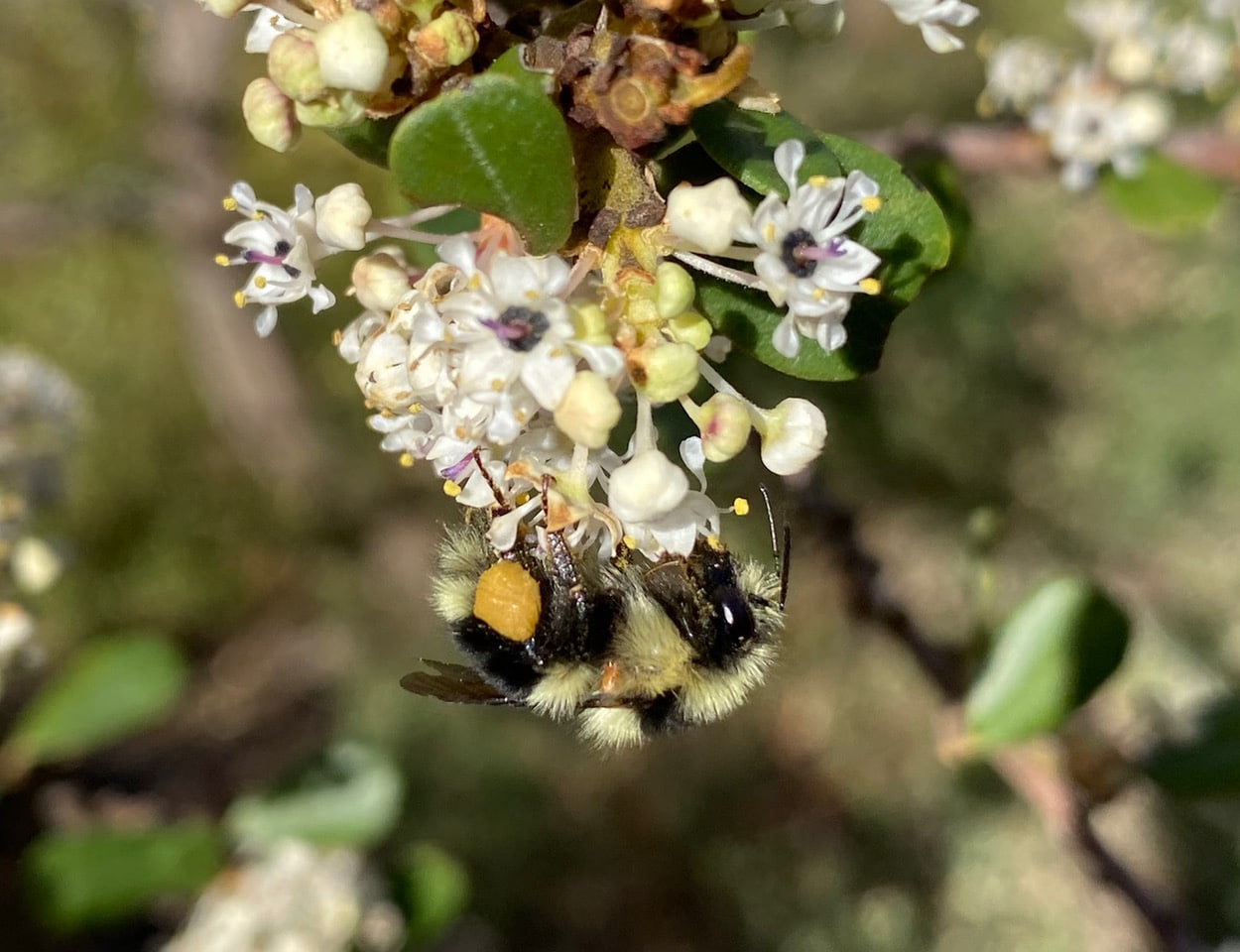
Near the entrance to the garden, in full morning sun, there’s a big Ceanothus that is buzzing with insects. Most of the visitors are the Black-tailed Bumble Bees, Bombus melanopygus. This species tends to be the first to appear in early spring. Judging by the small size of the bees I figure that they are workers. So some colonies have been established in the vicinity! Usually the queen bees, much larger in build, are the first to appear in early spring. They are the only ones of their colony to over-winter while the rest of the colony dies last year. Having been inseminated last fall, the queens or gynes are fully equipped for reproduction. Freshly emerged from hibernation, a queen has to forage for herself, look for a good nesting site, usually an abandoned rodent hole. She prepares the nest and lays eggs. She has to nourish herself and her young when they hatch, a single mom responsible for establishing a new colony by herself. Once the first brood is produced, the queen becomes a stay-at-home mom to concentrate on egg laying, while the workers (all female) take over foraging and hive duties. In early spring one often sees a surprising range in the sizes of the bumble bees, even of the same species. This is because the queens are extra big, while the workers from the first brood they hand raise tend to be extra small (probably from under-nourishment).
This is why it is important to include some early blooming natives in the garden to help support these single moms during this crucial period of their lives. The Ceanothus fits the bill nicely. The bees seem to love the nectar, and collecting pollen is a cakewalk as the small flowers are densely clustered and the anthers are fully exserted beyond the corolla.
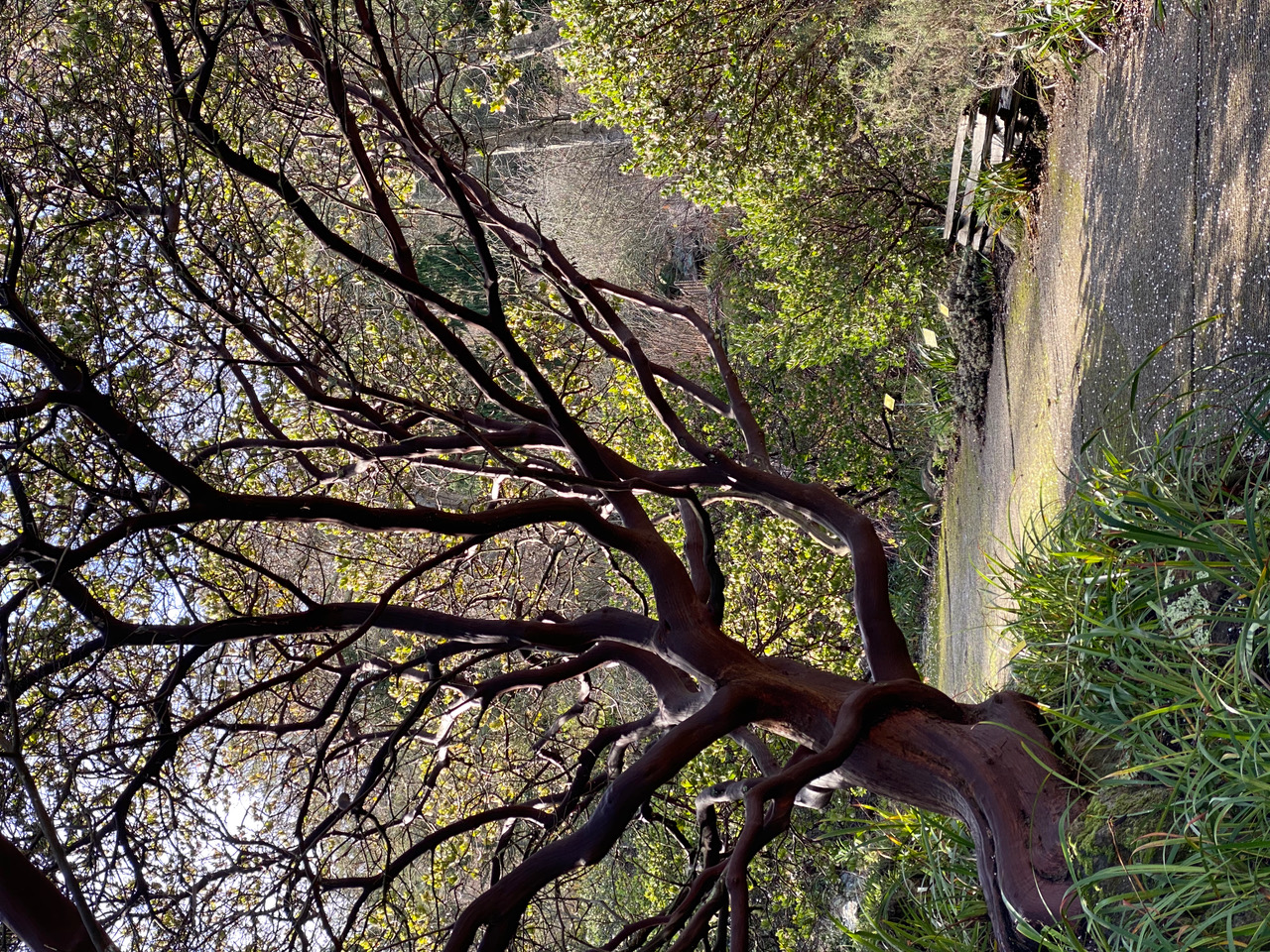
I head to the magnificent stand of Manzanitas for which the garden is well known.
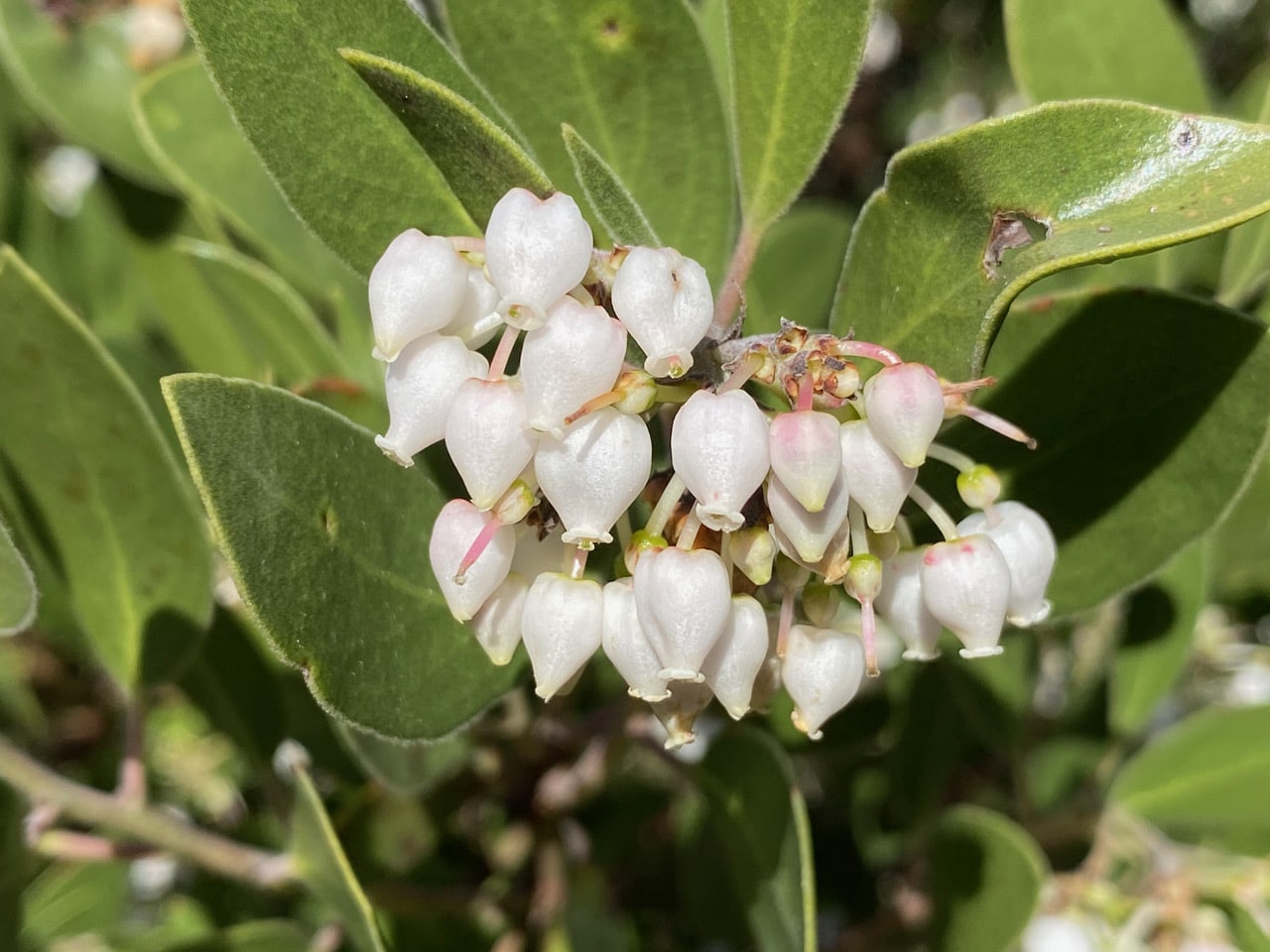
Manzanita is a common name for many species of the genus Arctostaphylos. They are evergreen shrubs or small trees present in the chaparral biome of western North America. The small flowers, white to pink, hang inverted in tight clusters. Four fused petals form an urn-shaped corolla enclosing the reproductive parts, with a very narrow opening at the tip.
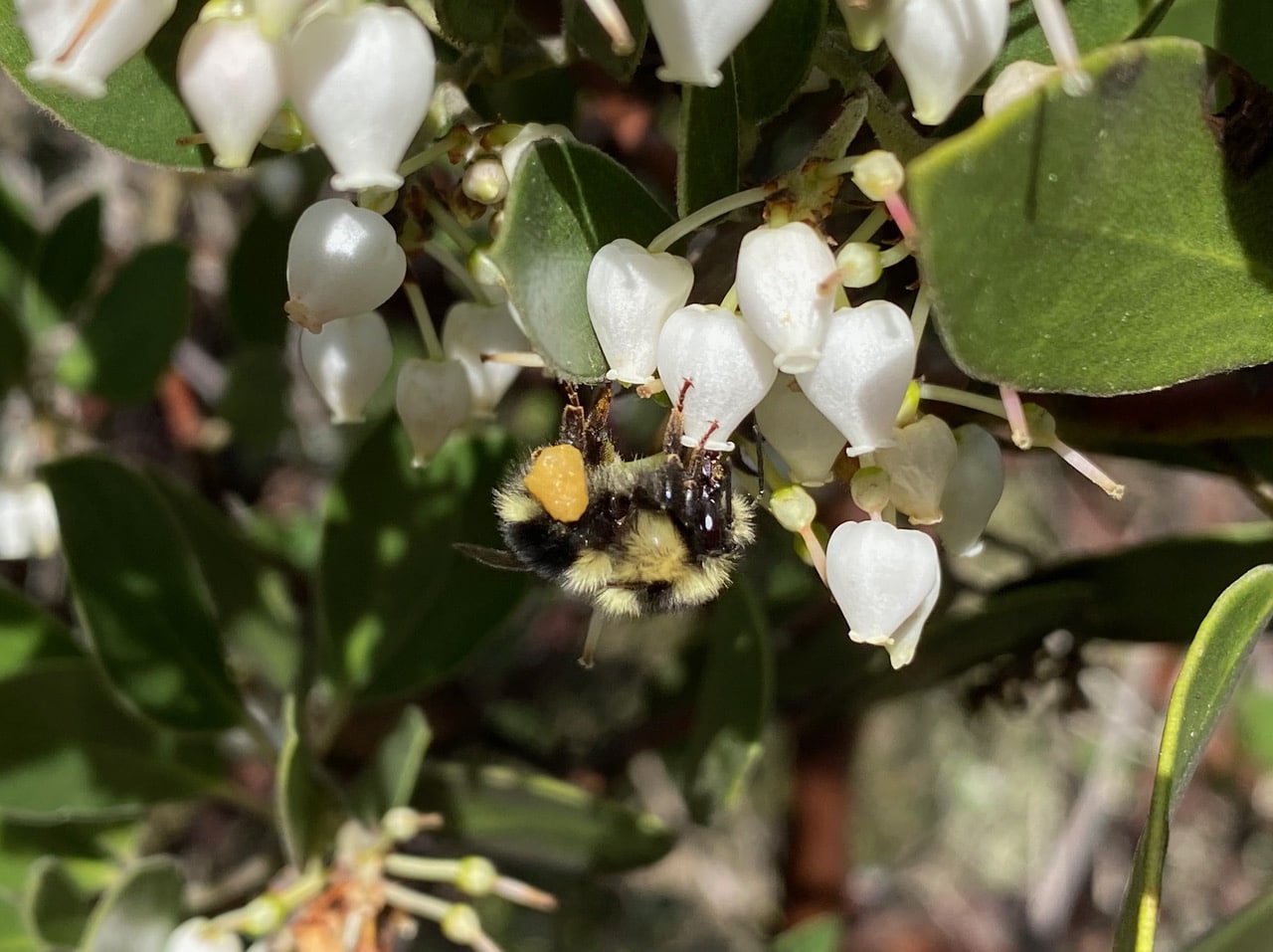
Again, most of the insect activity centers around the manzanitas that are in full sun on this cold morning. And the star of the show is again the Black-tailed Bumble Bee, Bombus melanopygus. Look at the pollen load in the bee’s pollen basket!
The pollen collecting apparatus in Apidae bees, which include honey bees and bumble bees, is commonly called a “pollen basket” or corbicula. This region is located on the tibia of the hind legs and consists of hairs surrounding a concave region. After the bee visits a flower, she begins to groom herself and brushes the pollen down toward her hind legs and packs the pollen into her pollen basket. A little nectar mixed with the pollen keeps it all together like putty, and the hairs in the pollen basket hold it in place.
.jpg)
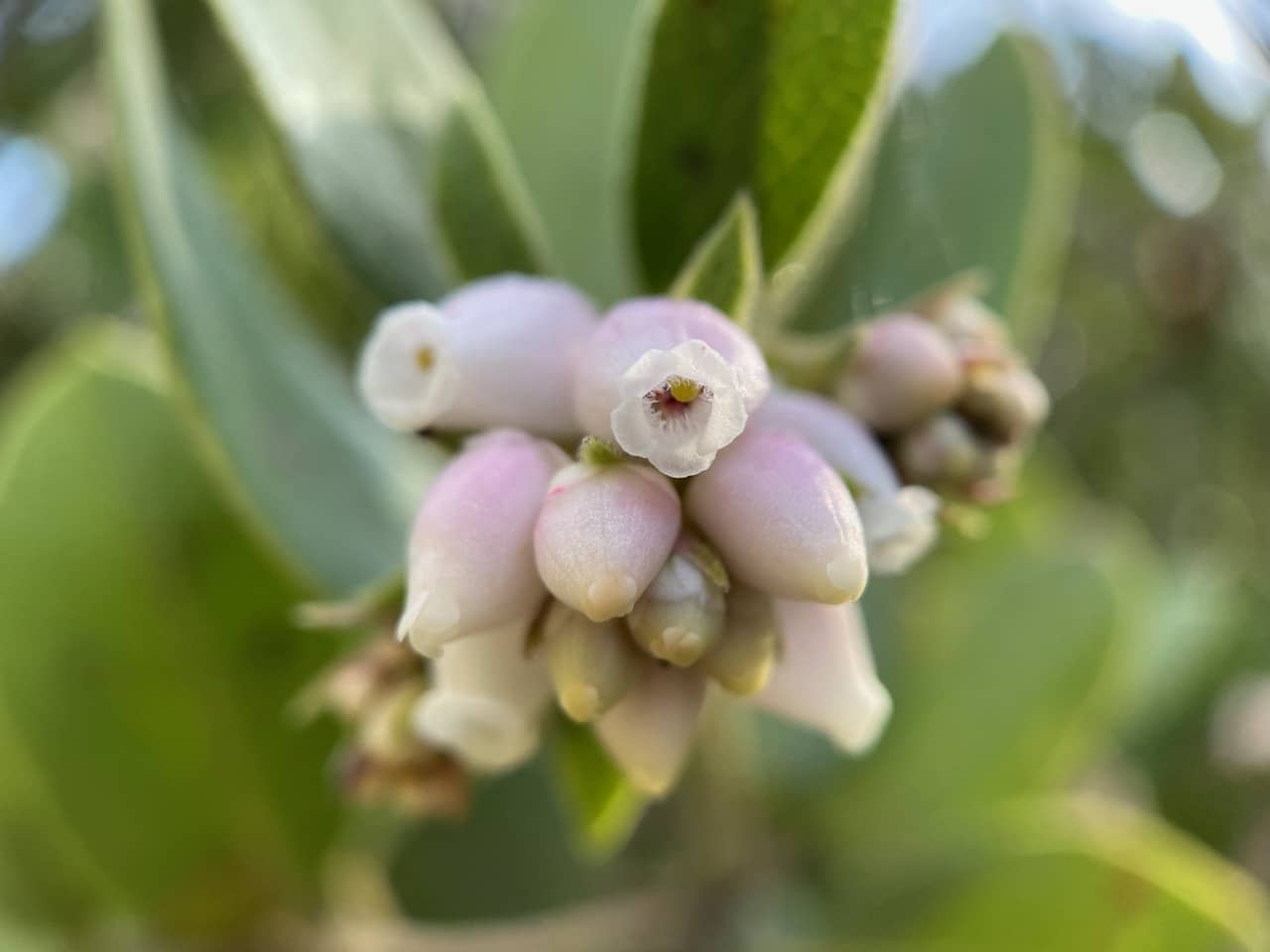
Trying to look inside a Manzanita flower is like peeking through a key hole. No amount of magnification helps as the narrow opening is further impeded by some hairs. Here’s an article that provides an illuminating view of a sectioned manzanita flower, showing all the reproductive parts relevant to pollination: Manzanitas and Buzz Pollination — San Bruno Mountain Watch
For a flower that blooms in the California winter/early spring, the inverted orientation, the urn shape and the small opening all make good sense. The precious reproductive structures are sheltered from rains. But who can access them to effect pollination? There are records of some manzanita species being pollinated by thrips. Yes, these tiny insects can fly from flower to flower to transfer pollen. I have dissected manzanita flowers and found many thrips inside.
More relevant to my observations today, the manzanita is pollinated by large bees, notably the bumble bees that have the ability to “sonicate” the flowers. The phenomenon is often referred to as “buzz pollination”. Being large, the bumble bee cannot enter the flower, but it can certainly stick its long tongue inside to sip nectar. To collect pollen, the bee grasps the corolla with its legs, disengages its flight muscles from the wings, and vibrates its body vigorously at a certain frequency. The vibration is transmitted via the “antlers”, unique structures on the stamen to dislodge the pollen from the poricidal anthers. Pollen flows out the opening onto the bee’s belly and is subsequently swept up into the pollen baskets on her legs to be ferried back to the hive. I think the bee’s tongue might play a role in transferring pollen to the next flower, as her body is not likely to make contact with the stigma of the manzanita flower.
BTW, I saw another species of bee that visited the manzanita flowers, but failed to get a photo of them. They are stout-bodied, about the size of a worker bumble bee, but gray all over. Fast and noisy flyers, these are the digger bees in the genus Habropoda. These ground nesters emerge in early spring, and often visit plants such as Manzanita and Ceanothus. Like the bumble bees, Habropoda are capable of buzz pollination.
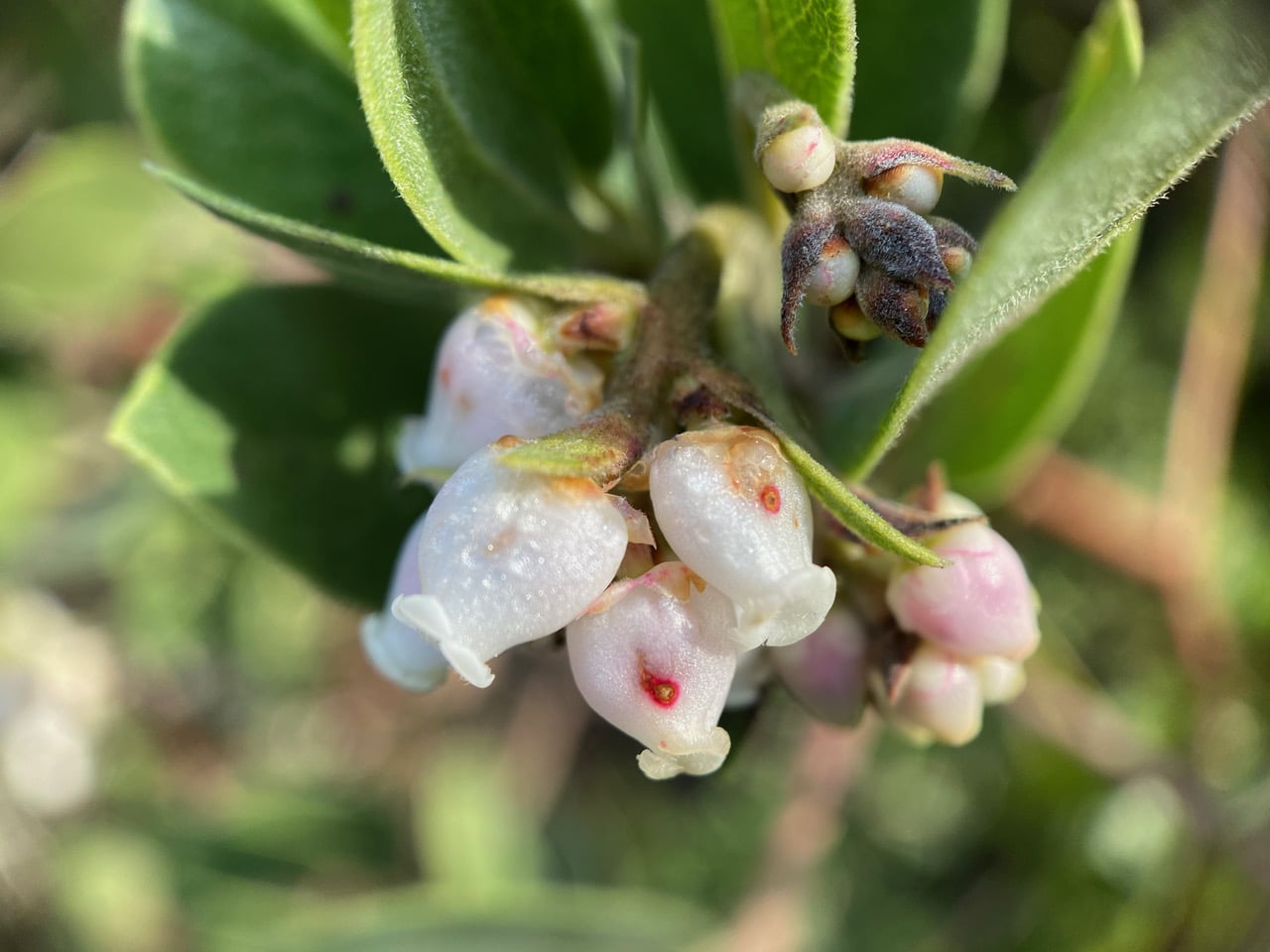
Hey, here’s a crime scene! See those wounds on the two flowers? Someone has been puncturing the corolla and getting directly to the nectar inside. Carpenter bees and bumble bees are known for this behavior, called “nectar robbing”. Often times other insects come to partake of the nectar from the ready-made holes. These are called “secondary nectar robbers”.
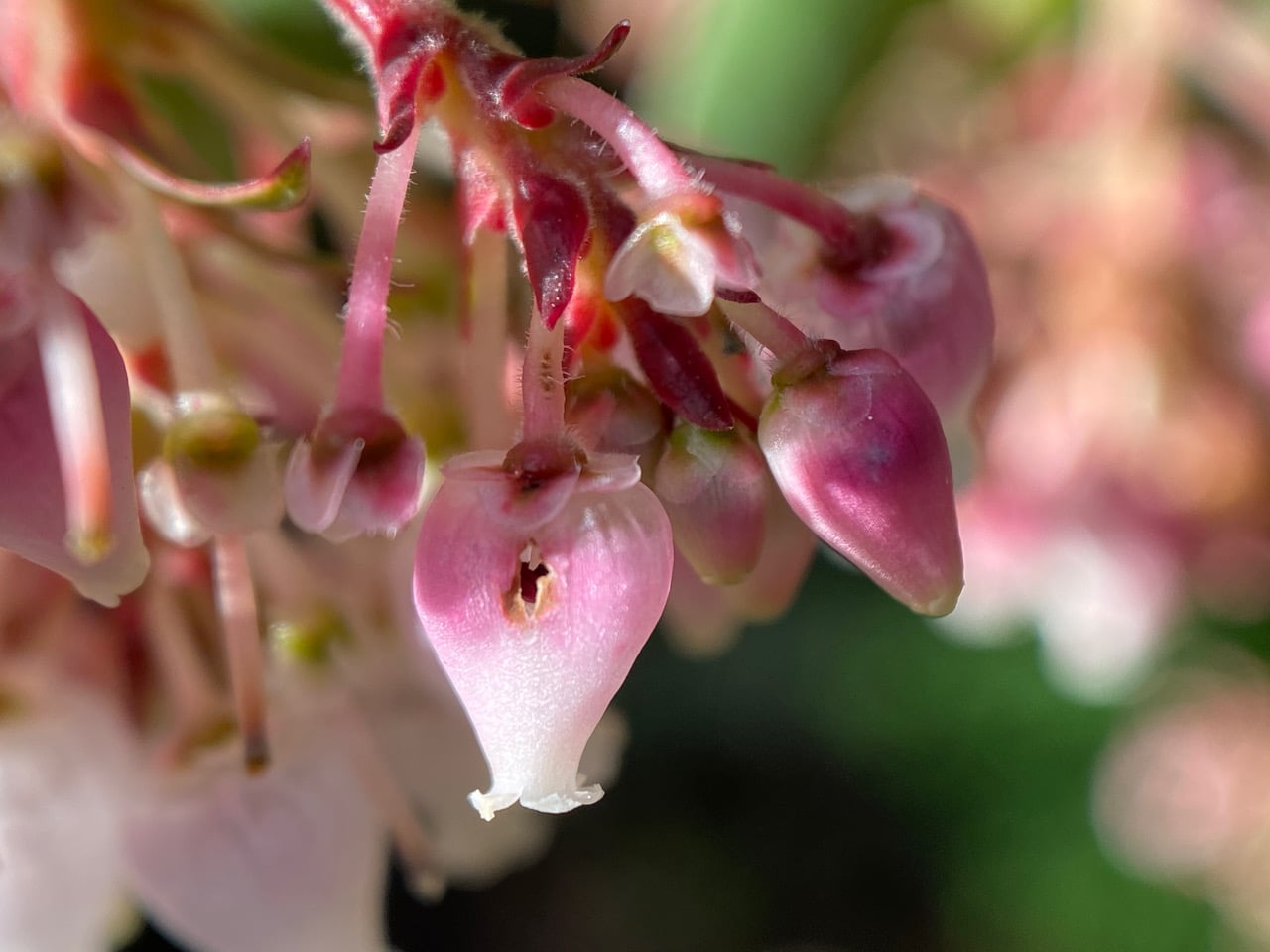
The holes or slits are usually made near the base of the inverted flower where nectar is produced.
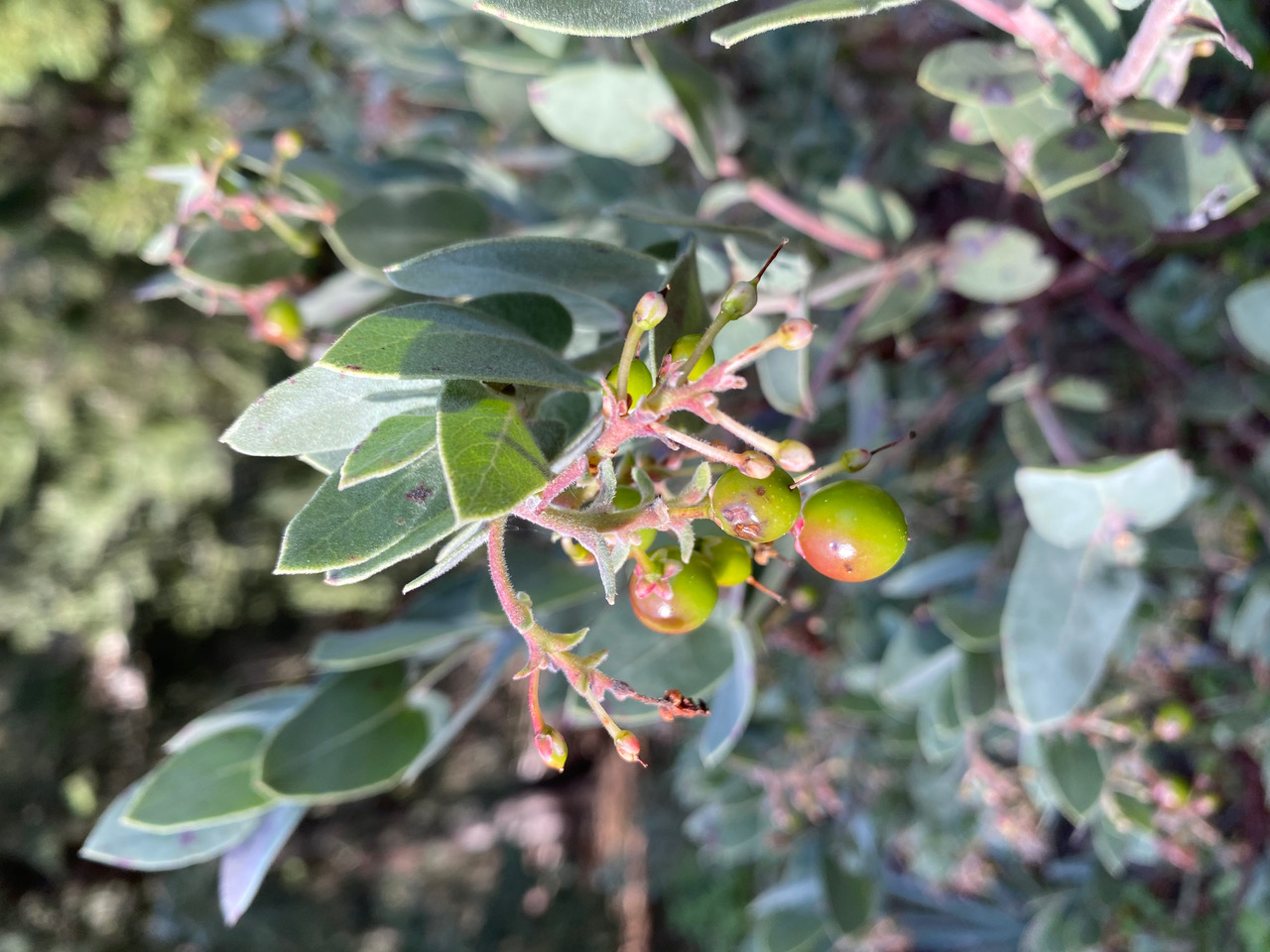
Some of the manzanitas are already developing fruits after the flowers fade! These will ripen into the “little apples” for which the plant is named.
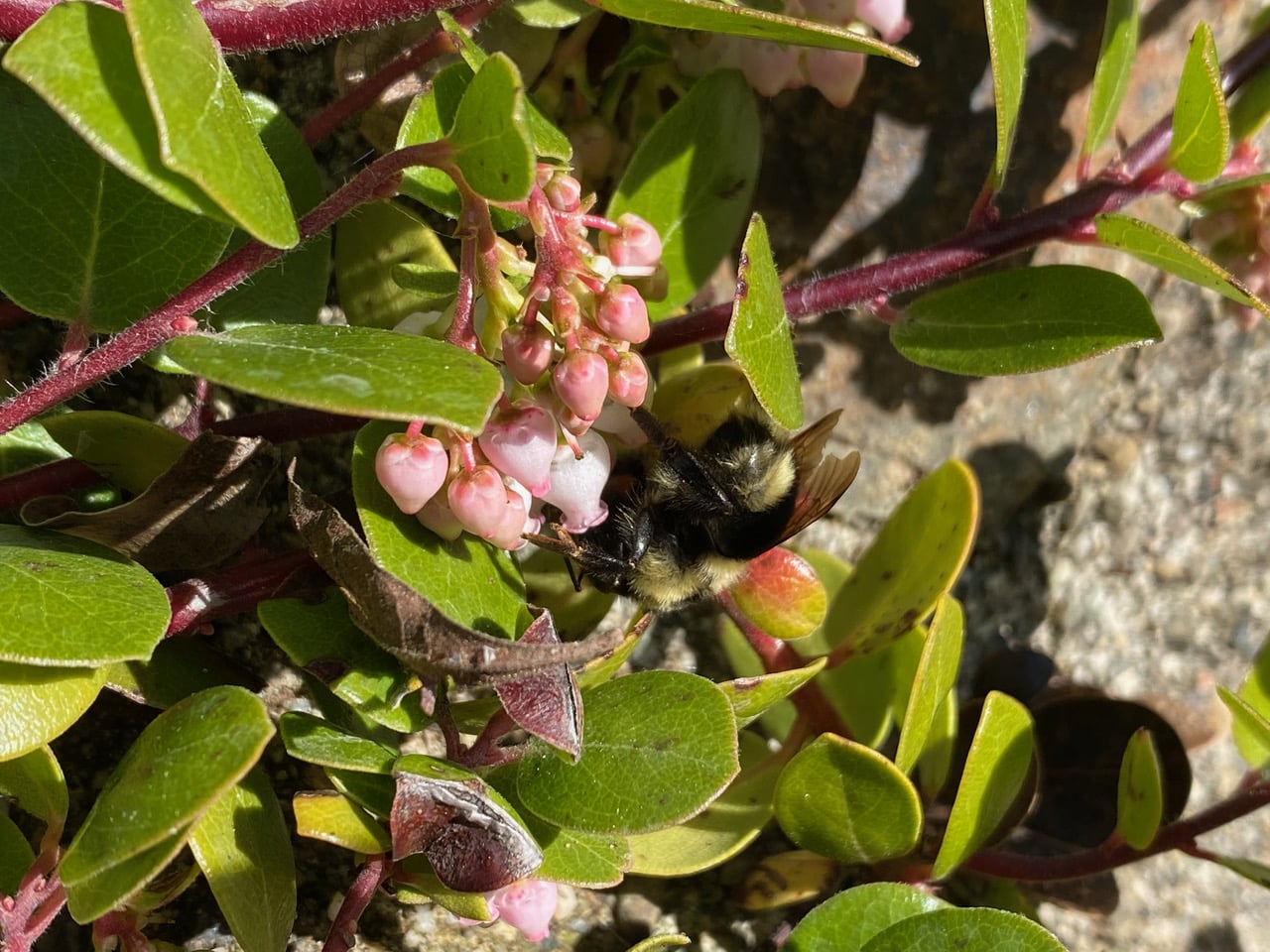
At a different section of the garden, I encounter another bumble bee on a small, prostrate Manzanita. This bee looks every bit like a Black-tailed Bumble Bee in color pattern, but it is quite a bit larger than all the ones I have been seeing today. A queen? It seems lethargic, moving slowly and sticking its tongue into the flowers laboriously. It does not seem to be collecting pollen. A tired queen?
 The bee seems to be missing some hairs on its abdomen.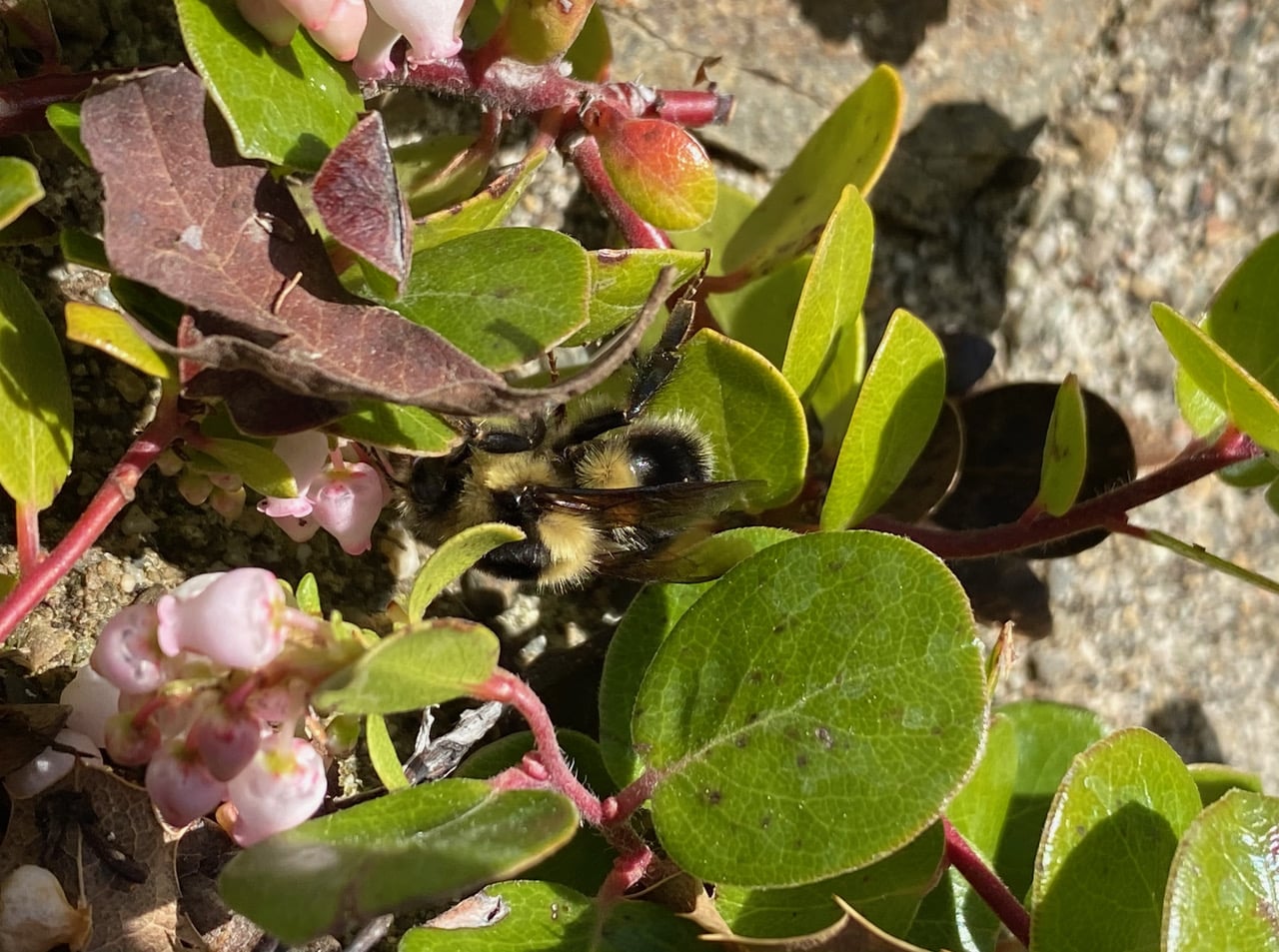
Hmmm, there seems to be no pollen basket on the tibia of the hind leg….

When I submitted the pictures to iNaturalist, one of the suggested ID was the Indiscriminate Cuckoo Bumble Bee, Bombus insularis. I have never seen a cuckoo bumble bee! It would be cool if this was indeed one. Inquiries have been sent to a couple of bee experts for their opinion. Stay tuned for further developments.
I already have tremendous fun so far, just learning about the Cuckoo Bumble Bees:
Cuckoo Bumble Bees (subgenus Psithyrus) is a social parasite of other bumble bees. The bees lack pollen baskets; the outer surface of the hind-leg tibia is flat and densely hairy. Thus, they do not have the ability to collect pollen. As in other cuckoo bees, the queen of this species enters the nest of a host species, kills the resident queen, and lives and breeds in the nest tended by the host workers. No workers are produced by this species, only queens and males.