

Pollinator Post 4/16/23 (1)

I am taking the shortest and easiest route to the Swale this fine morning.
It’s hard not to stop to admire this robust patch of Common Fiddleneck, Amsinckia intermedia along the paved road.







It’s fun and challenging trying to photograph a Bee Fly in action. Fast and wary, it’s one of the most exasperating subjects I’ve had to deal with. When hovering in front of a flower, it usually appears as a blur. It’s impossible to photograph in flight. This photo is a lucky shot captured when the fly backs off from the flower. Note the long, straight proboscis that it uses to probe small, tubular flowers for nectar. The Bee Fly cannot retract the proboscis which is always held in front of its face.
Bombylius major, commonly known as the Greater Bee Fly is a parasitic bee mimic fly in the family Bombyliidae. It derives its name from its close resemblance to bumble bees. Its flight is quite distinctive – hovering in place to feed, and darting between locations. The species has long skinny legs and a long rigid proboscis held in front of the head. Bombylius major is easily distinguished from the other local species of Bombylius for having wings with dark leading edge, hyaline trailing edge with sharp dividing border. This feature is visible even as the fly is hovering. Adults visit flowers for nectar (and sometimes pollen) from a wide variety of plant families, excelling at small tubular flowers, and are considered good generalist pollinators. Often the pollen is transferred between flowers on the fly’s proboscis.
The bee fly larvae, however, have a sinister side. They are parasitoids of ground-nesting bees and wasps, including the brood of digger bees in the family Andrenidae. Egg deposition takes place by the female hovering above the entrance of a host nest, and throwing down her eggs using a flicking movement. The larvae then make their way into the host nest or attach themselves to the bees to be carried into the nest. There the fly larvae feed on the food provisions, as well as the young solitary bees.
Connecting to Bypass Trail, I head uphill through this incredible stand of Silverleaf Lupine, Lupinus albifrons in full bloom.
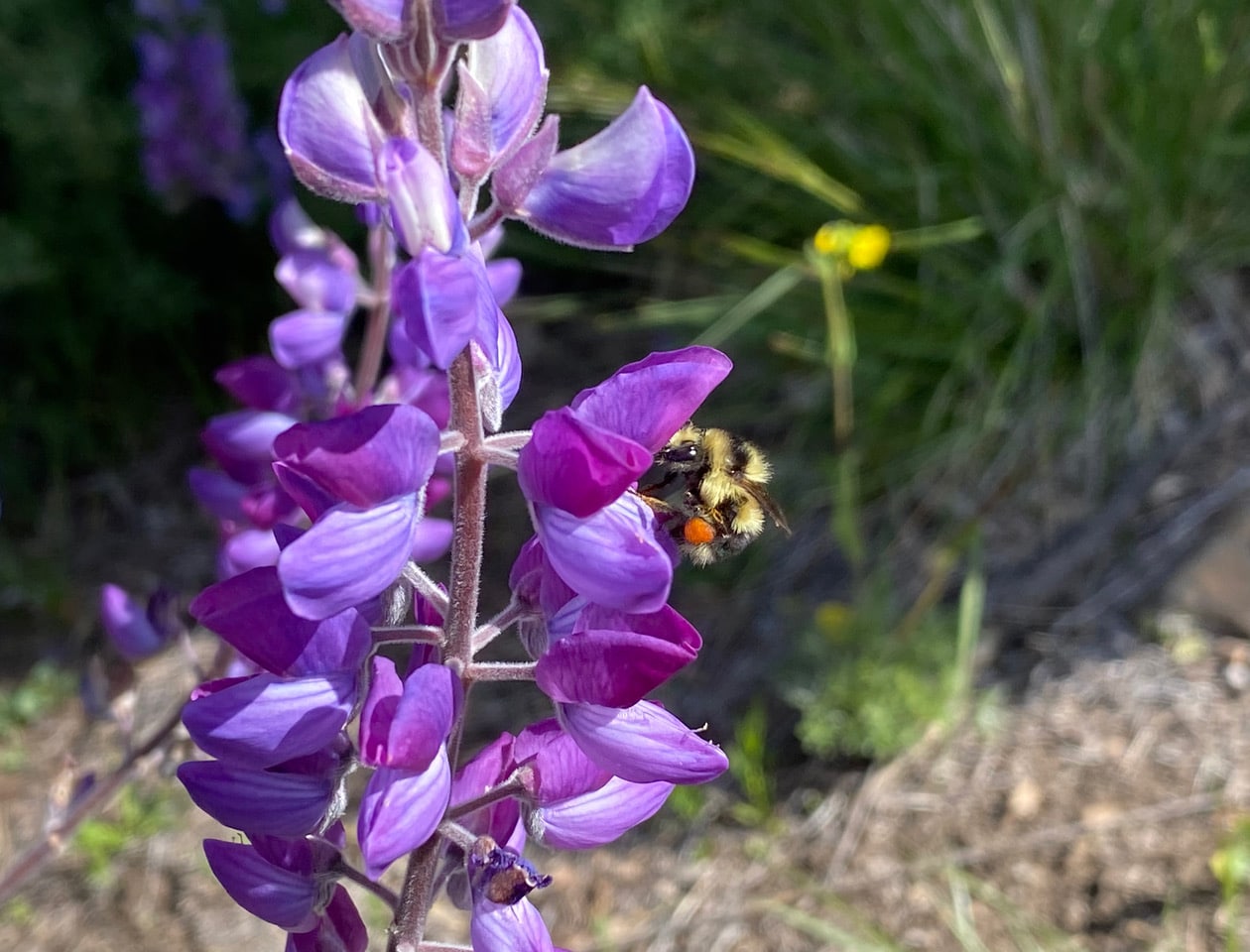
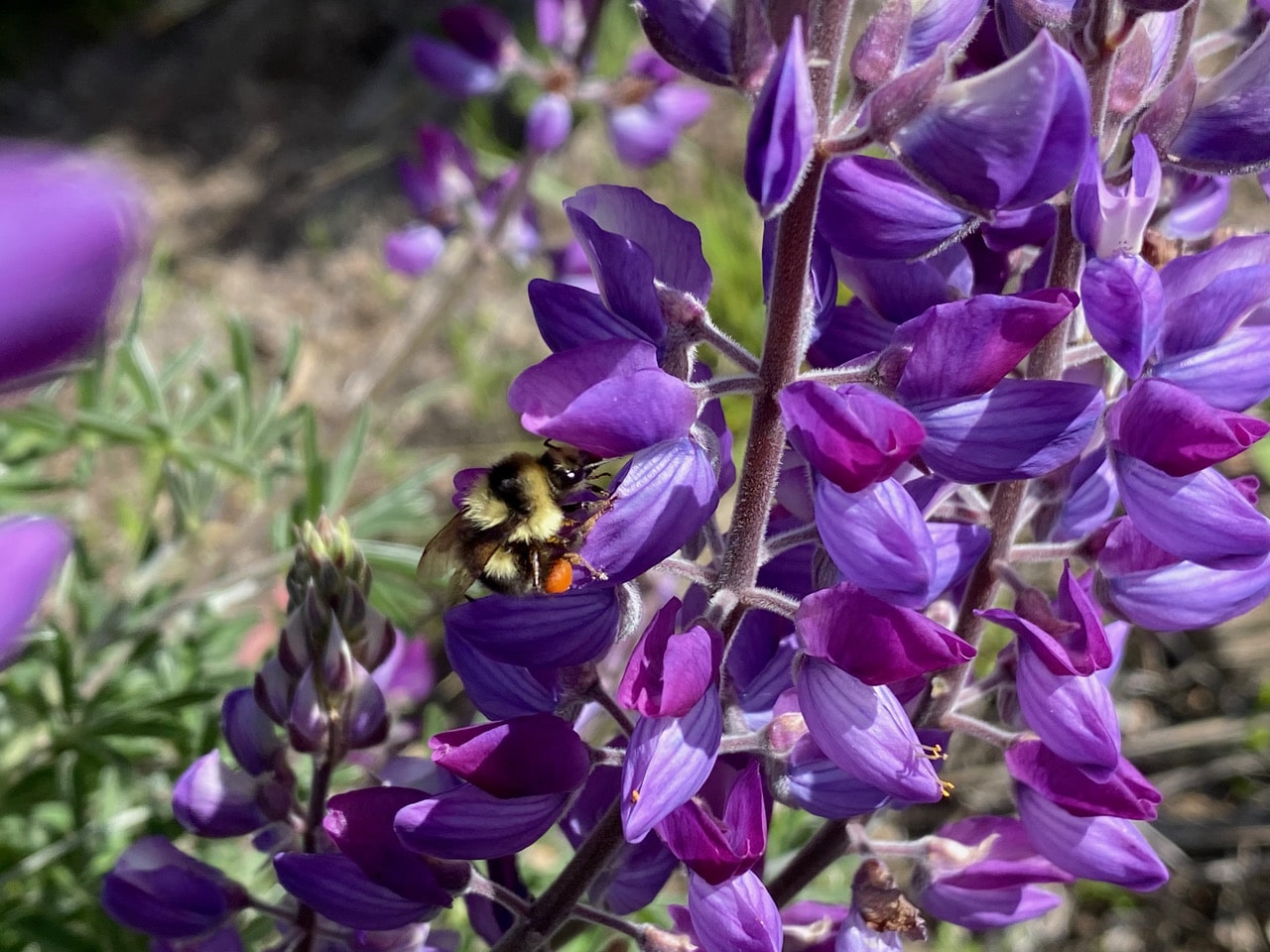
For all the lupine flowers on offer, only a few Black-tailed Bumble Bees, Bombus melanopygus are buzzing around to forage on the flowers.
Lupine hides its floral resources cryptically, and they require the heft and skill of specific bees to access. The reproductive structures are enclosed in two layers of petals, the wing petals on the exterior, and the keel in the interior. When a Bumble Bee lands on the wing petals, her weight depresses and spreads them apart, causing the keel and the reproductive structures to spring up, hitting the bee with pollen on her belly. Most bees land with their tongues extended, ready to sip nectar simultaneously while they collect pollen. See the dark lines on the wing petals that converge toward the back of the flower? These are nectar guides to direct the pollinator to the sweet reward. The nectary at the back of the flower is only accessible momentarily when the wing petals are depressed by the bee.
Why does a plant set up such barriers for its pollinators? Allowing only certain bees to access its resources, the plant makes sure that its pollen will always be delivered to the right flowers, and not wasted by non-specific pollinators that visit many types of flowers. The exclusivity is all about efficiency of pollen transfer.
Arriving at the Swale, I take a deep breath while surveying the stunning floral displays around me.
Surprisingly, the smorgasbord of wildflowers has not attracted many insects. The place is eerily silent.
I carefully scan the Baby Blue Eyes and the California Poppy flowers and am disappointed at finding only ants.
Oh, here’s a rare visitor! The shiny black fly is a Blacklet, Cheilosia sp. (family Syrphidae).
Hover Flies, also called flower flies or Syrphid flies, make up the insect family Syrphidae. The adults of many species feed mainly on nectar and pollen, and are often seen hovering and nectaring at flowers. They are important pollinators of flowering plants in many ecosystems worldwide. The larvae feed on a wide range of foods. In many species, the larvae are insectivores and prey on aphids, thrips, and other plant-sucking insects. In other species, the larvae are saprotrophs, eating decaying plant and animal matter in the soil or in ponds and streams.
Cheilosia is a rather unusual hover fly. Most Cheilosia are black or largely un-colored, lacking the bright colors and patterns of many hover fly species. Although it is one of the most species diverse genera of Syrphidae, its biology is little understood. Where known, the larvae of Cheilosia species feed in the stems of plants or in fungi.