

Pollinator Post 4/29/23 (1)

Many more California Phacelia greet the morning with open flowers today. The pale lavender flowers literally “unroll” from the tightly coiled cyme, from the base to the tip.
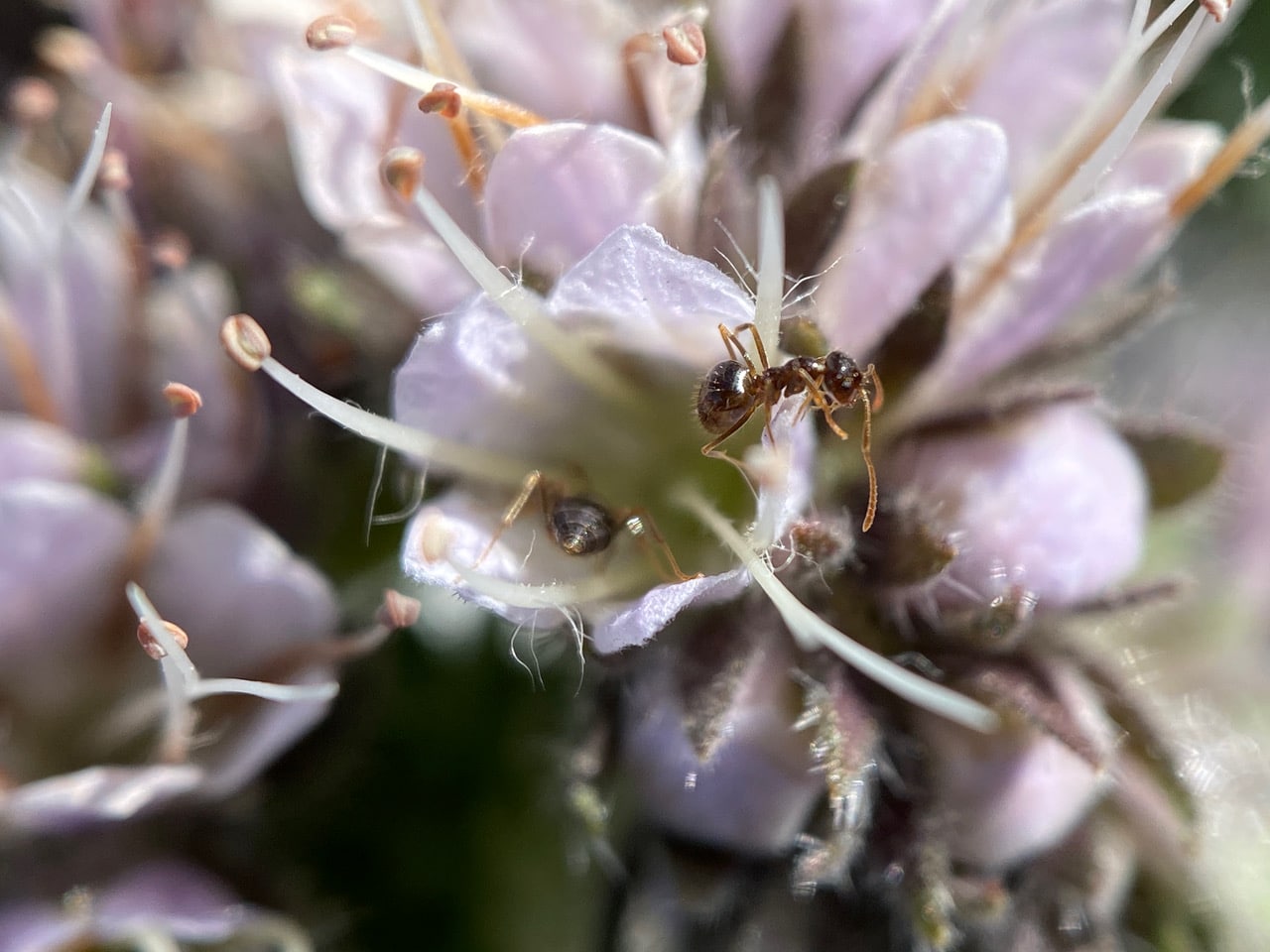
No flying insects visit the flowers yet, but the American Winter Ants, Prenolepis imparis are already busy foraging, going in and out of the bell-shaped flowers.
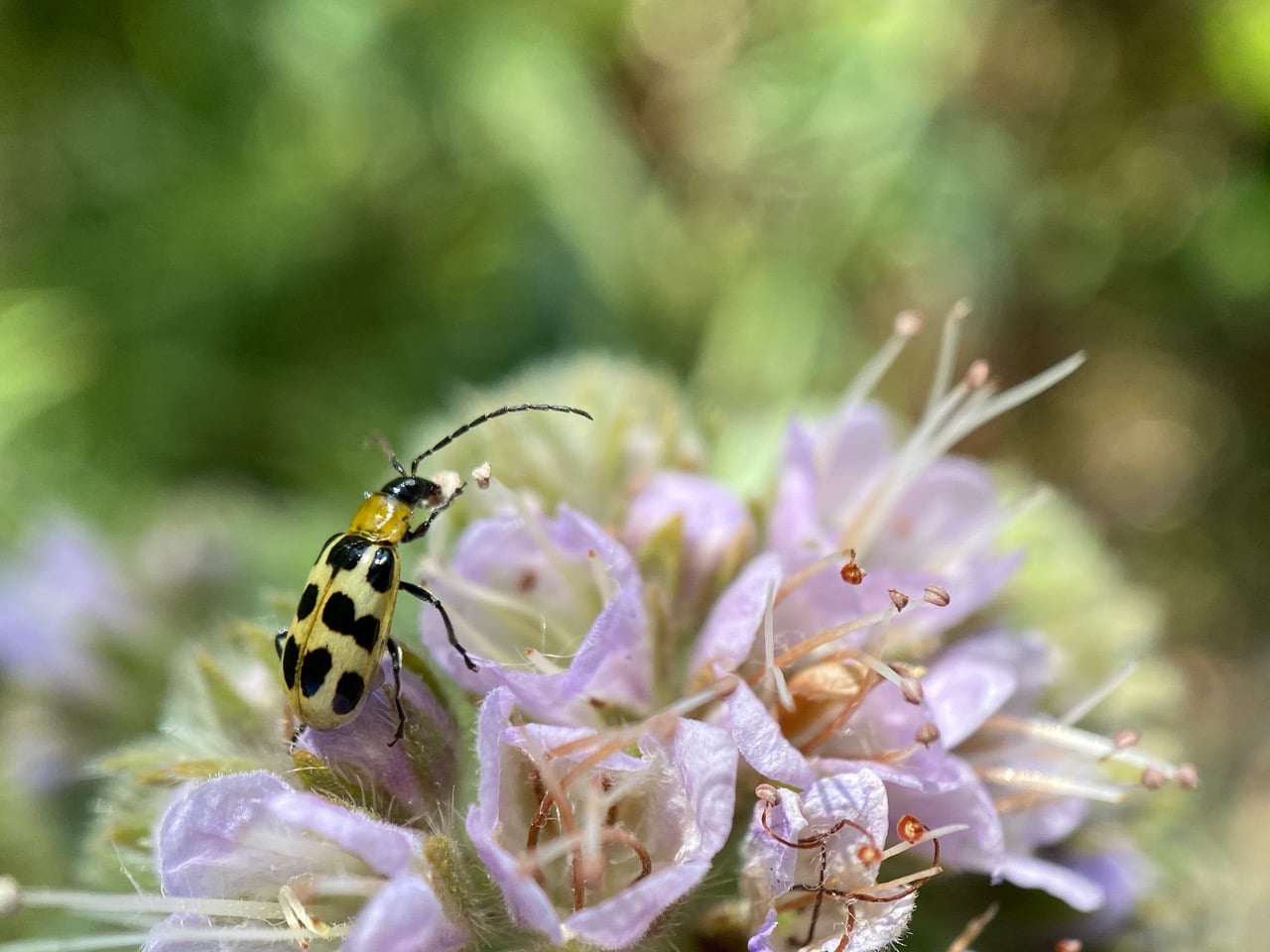
A Spotted Cucumber Beetle, Diabrotica umdecimpunctata (family Chrysomelidae) is feeding on the pollen of California Phacelia. These beetles seem to be the first insects to find the newly open flowers of a wide variety of plants. How do they do it?
Native to North America, the beetle can be a major agricultural pest, causing damage to crops in the larval as well as adult stages of their life cycle. Larvae, sometimes known as rootworms feed on the roots of emerging plants. In the adult stage the beetles cause damage by eating the flowers, leaves, stems and fruits of the plant.
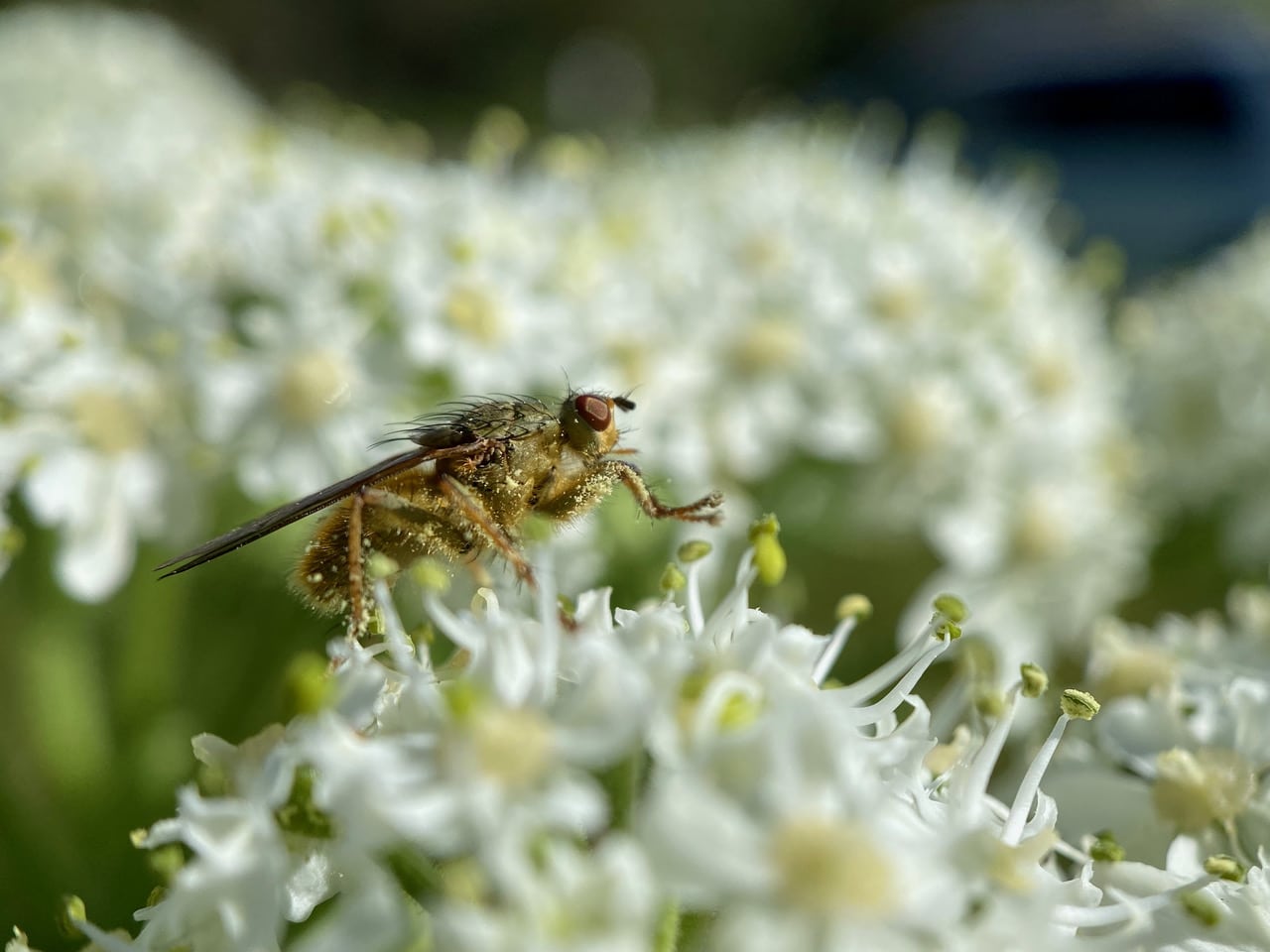
A female Golden Dung Fly, Scathophaga stercoraria (family Scathophagidae) is foraging on an umbel of Cow Parsnip flowers, Heracleum maximum.

Pollen has adhered to the hairs of the Golden Dung Fly. The fly can probably serve as a pollinator as it flies from flower to flower.
The Golden Dung Flies, Scathophaga stercoraria (family Scathophagidae) are small, spiny flies about 3/8 in. long. Males are a little larger than the females; females are not as golden and their front legs are not as fuzzy as the males’ are. As the common name suggests, the flies are commonly found on the droppings of large mammals, such as cattle, horses, sheep, deer, and wild boar. The Scathophaga are integral in the animal kingdom due to their role in the natural decomposition of dung in the fields.
The scientific name, Scathophaga stercoraria, says it all. Scatho from the Greek skatos meaning excrement, and phaga to eat, plus stercoraria from the Latin stercoris, meaning of dung, found in dung. The fly’s life is dung-centered. Adults locate dung by “scenting” it with their antennae and flying upwind to find it. Male and females meet there, mate there, lay eggs there, and take their meals there. They feed on other flies that are attracted to dung, and they also consume nectar (and in a pinch, each other). Larvae hatch in the manure’s warm, moist depths and consume both it and some other small insects they find in there.
Females spend most of their time foraging in vegetation and only visit dung pats to mate and oviposit on the dung surface. Males spend most of their time on the dung, waiting for females and feeding on other insects that visit the dung, such as blow flies. Fights often break out on the cow pat as males vie to mate with a female.
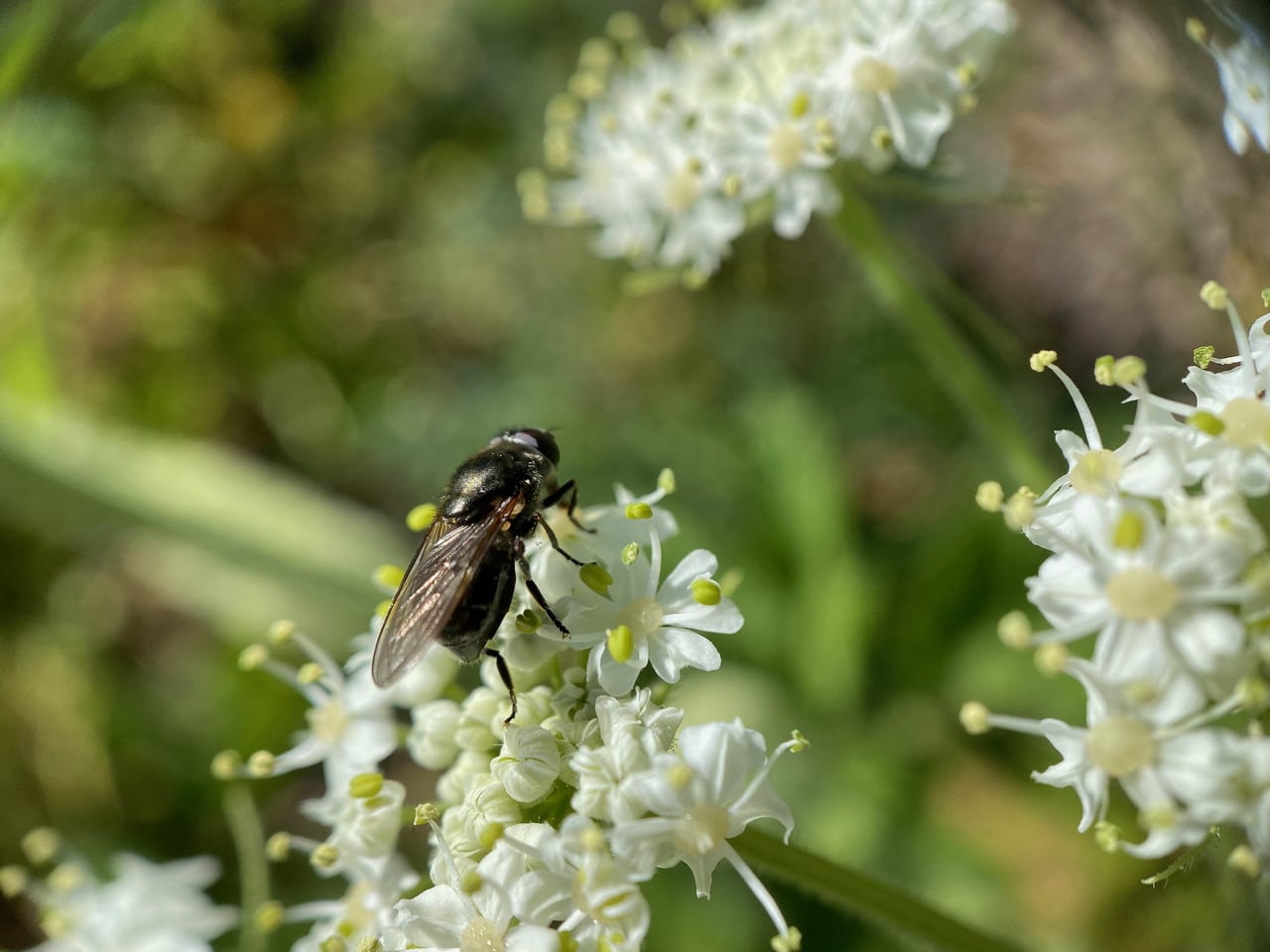
A hover fly, Blacklet, Cheilosia sp.(Family Syrphidae) is feeding on the Cow Parsnip flowers.
Hover Flies, also called flower flies or Syrphid flies, make up the insect family Syrphidae. The adults of many species feed mainly on nectar and pollen, and are often seen hovering and nectaring at flowers. They are important pollinators of flowering plants in many ecosystems worldwide. The larvae feed on a wide range of foods. In many species, the larvae are insectivores and prey on aphids, thrips, and other plant-sucking insects. In other species, the larvae are saprotrophs, eating decaying plant and animal matter in the soil or in ponds and streams.
Cheilosia is a rather unusual hover fly. Most Cheilosia are black or largely un-colored, lacking the bright colors and patterns of many hover fly species. Although it is one of the most species diverse genera of Syrphidae, its biology is little understood. Where known, the larvae of Cheilosia species feed in the stems of plants or in fungi, yet another unusual niche for a Syrphid larva.

When I first spot the dead fly at the tip of this Cow Parsnip leaf, my curiosity is piqued and I suspect foul play. As I approach closer, the story unravels itself. The female Crab Spider (family Thomisidae) has probably captured the flies from the umbel of flowers above and brought them down to feed in safety on the leaf. She has obviously had a successful morning. Both flies are probably mere husks of their former selves, having been sucked dry by the ambush predator.
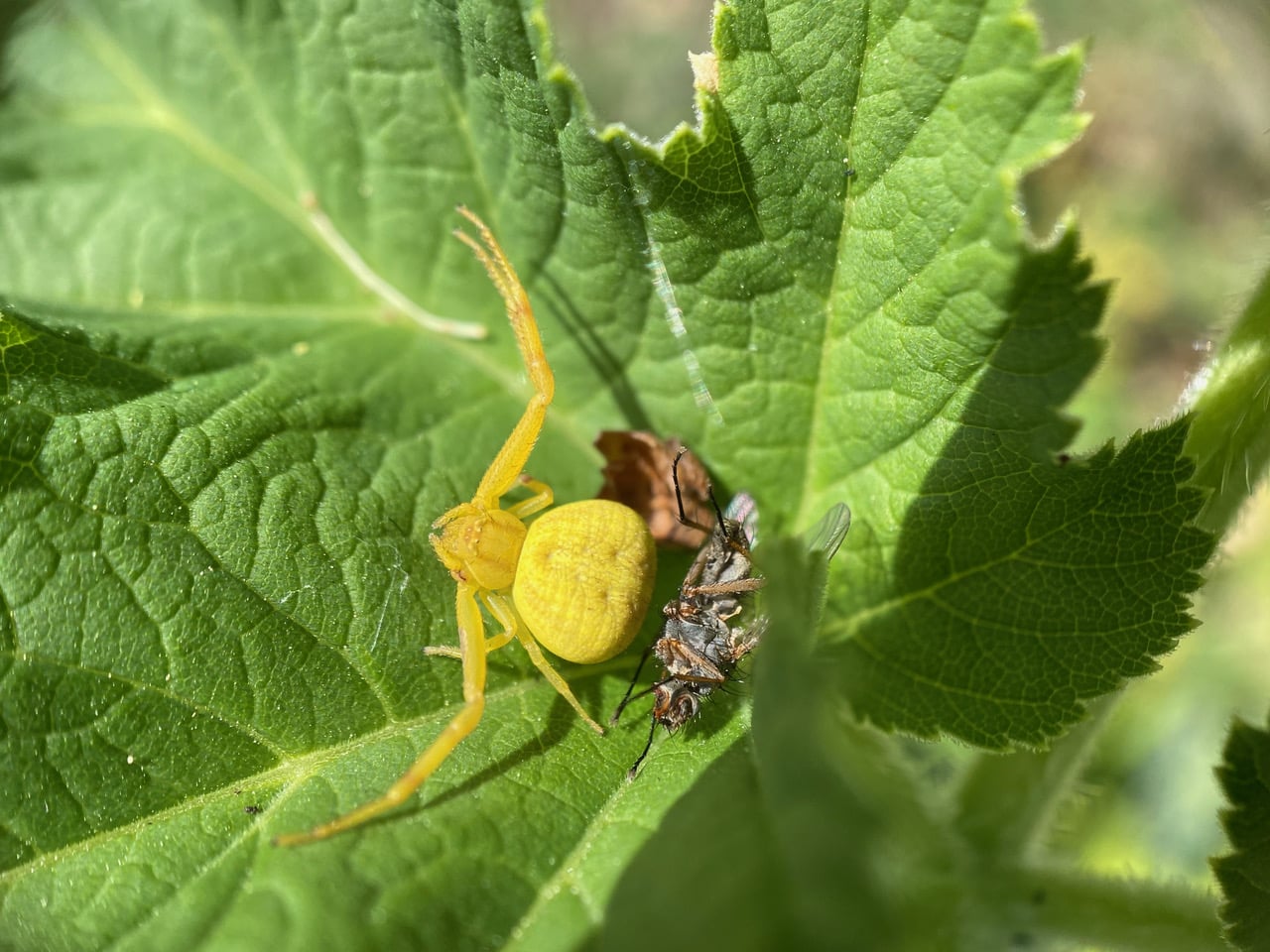
At my approach, the Crab Spider spreads her two pairs of front legs in an aggressive display.
Crab spiders (family Thomisidae) do not build webs. They are ambush predators that sit and wait to grab insects that visit flowers. After a bite, their potent venom immobilizes the prey very quickly, so little struggle is necessary. The digestive juices that is injected together with the venom break down the tissues of the prey. The spider sucks up the resulting slurry through the fangs, often leaving the exoskeleton of the prey remarkably whole except for the pair of fang marks. Crab spiders are capable of tackling prey much larger than themselves.

A scruffy-looking bee with sparse orange hairs lands on an umbel of Cow Parsnip flowers, Heracleum maximum, to take nectar.





From the tufts of hairs on its face, the absence of scopae (pollen-collecting hairs) on its hind legs, the long antennae, and the slim build of the bee, I gather that it is probably a male Mining Bee, family Andrenidae.
Male bees do not collect pollen to provision the nest, neither do they have the equipment for the job. They do, however visit flowers for nectar, and can be good pollinators in transferring pollen between flowers.
The antennae of male bees are often much longer than their female counterparts. Male antennae have an extra segment and the segments themselves are longer. This is because male antennae are specialized to pick up the subtle scent of female pheromones.
I wonder if this is an old bee, having lost much of his hairs, or is this his normal appearance?
Ooh, here’s a female White-winged March Fly, Bibio albipennis (family Bibionidae). March Flies exhibit extreme sexual dimorphism. Females have small eyes on the sides of long, narrow heads, while the males have huge holoptic eyes that cover most of the surface of the head.
March Flies (family Bibionidae) generally live in wooded areas and are often found on flowers – adults of some species feed on nectar, pollen, and honeydew, while adults of other species don’t feed at all; and in either case, they are very short-lived. They are considered important pollinators. They are also important food for other insects and spiders. The larvae feed en masse on rotting organic materials like leaves, wood, compost, and rich soil. These tiny maggots are recyclers helping to unlock the nutrients in decomposing plants and returning them to the food web.
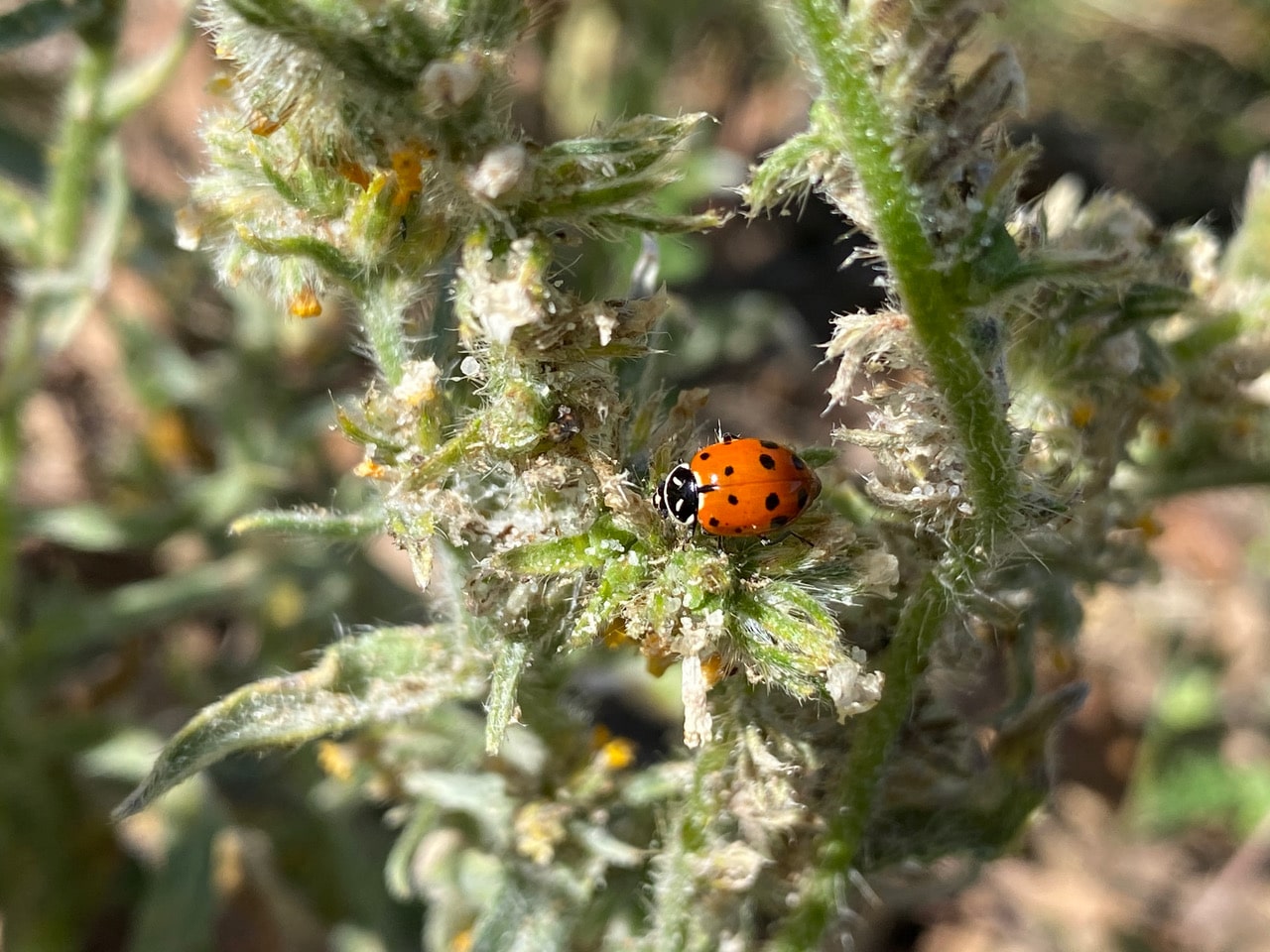
I stop by the Common Fiddleneck, Amsinckia intermedia that has been heavily infested with tiny aphids for a long time. The plant looks shriveled, covered with tiny white globs of honeydew. There are several Convergent Ladybeetles, Hippodamia convergens (family Coccinellidae) foraging on the plant; some are mating. I am surprised at the total absence of the California Ladybeetles, Coccinella californica, which has been the mainstay of pest control on this plant previously. Why are they gone? Is this a natural succession of predator species, or is there dominance/competition among the ladybeetle species?
This Pacific Pea, Lathyrus vestitus ssp. vestitus (family Fabaceae) has very pale flowers.
A Black Grass Bug, Irbisia sp. (family Miridae) is perched on the back of some Pacific Pea flower buds. Although often seen as black, the bugs light up in pretty bronze when the pubescence on the fore wings are illuminated by light at certain angles.
Mirid bugs are also referred to as plant bugs or leaf bugs. Miridae is one of the largest family of true bugs in the order Hemiptera. Like other Hemipterans, Mirids have piercing, sucking mouthparts to extract plant sap. Some species are predatory. One useful feature in identifying members of the family is the presence of a cuneus; it is the triangular tip of the corium, the firm, horny part of the forewing, the hemielytron. The cuneus is visible in nearly all Miridae.

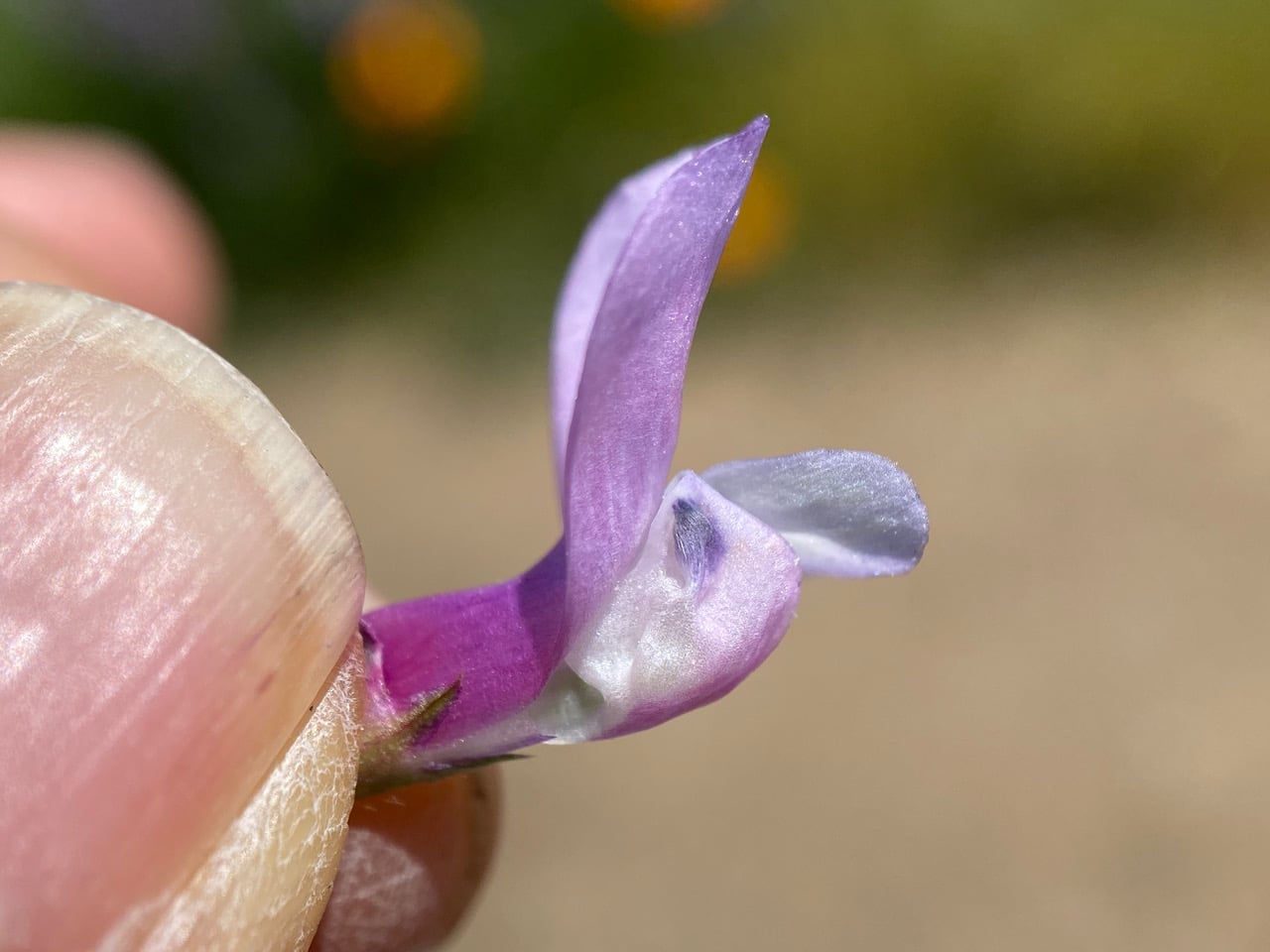
As I have wanted to check on the pollen color of the Pacific Pea, I pick a flower. Note the pale lavender upper wings called the banners. The pair of lower petals called the wings are white. Together they come together to enclose a structure beneath called the keel. This is the basic floral structure of a pea flower (family Fabaceae).
I carefully remove one of the wing petals to reveal the keel within.
By lowering the keel, I expose the reproductive structures hidden inside. The flower has a prominent, brush-like stigma to receive pollen, surrounded by several stamens that produce pollen. Some pollen grains are visible – they are white.
I have just demonstrated how a heavy-bodied bee might pollinate the flower. When the bee lands on the wing petals, depressing and spreading them apart, the keel and the reproductive structures within spring up to hit the bee with pollen and to pick up pollen already on the bee’s body, all in one fell swoop. Flower and bee choreographed in a magical dance of pollination!